The White House

Office of the Press Secretary

Remarks by the President about Storms Throughout the Midwest

Winfield House
London, England

10:34 A.M. BST
 
THE PRESIDENT:  Good morning, everybody.  Before the day starts here in England I wanted to say a few words about the devastating storms that we've seen in Missouri and Minnesota and across the Midwest.
 
Like all Americans, we have been monitoring what’s been taking place very closely and have been heartbroken by the images that we've seen in Joplin, Missouri, in particular.  The devastation is comparable and may end up exceeding some of the devastation that we saw in Tuscaloosa, Alabama, just a few weeks ago. 
 
So far we know that over 100 people lost their lives.  Others remain missing, and hundreds more are injured.  And obviously, our thoughts and prayers are with the families who are suffering at this moment.  And all we can do is let them know that all of America cares deeply about them and that we are going to do absolutely everything we can to make sure that they recover.
 
These storms often strike without warning, as we saw a little further south over the last couple of weeks.  And it’s going to be important for us to make sure that we are sustaining our efforts at rebuilding after the news cameras leave.  We can make sure that the families and communities upended by these storms have everything they need to pull through.  And in that regard, Secretary of Homeland Security Janet Napolitano as well as I have spoken with Missouri Governor Jay Nixon.  We’ve offered him not only our condolences, but we’ve told him that we will give him every ounce of resources the federal government may have that we can bring to bear on this situation.
 
At my direction, FEMA Administrator Craig Fugate and Deputy Administrator Rich Serino have traveled to Missouri to make sure our federal government is working hand in hand with state and local officials to give them the help that they need.  And on Sunday, I myself will travel to Missouri to talk with folks who’ve been affected, to talk to local officials about our response effort and hopefully to pray with folks and give them whatever assurance and comfort I can that the entire country is going to be behind them.
 
Now, these storms that came this weekend obviously compounded what has already been an extraordinary storm season throughout the Midwest and in the South.  We understand that there are more storms that are forecast today, so the thing I think I want to emphasize more than anything else, it is critical that Americans in affected areas heed storm warnings and take the lead of your local officials.
 
I know that a lot of people are wondering how they’ll get through the coming days or months or even years, but I want everybody in Joplin, everybody in Missouri, everybody in Minnesota, everybody across the Midwest to know that we are here for you.  The American people are by your side.  We’re going to stay there until every home is repaired, until every neighborhood is rebuilt, until every business is back on its feet.  That's my commitment, and that's the American people’s commitment.
 
Thanks very much.
 
END
10:38 A.M. BST

President Obama in Dublin: "Never Has a Nation So Small Inspired So Much in Another"

The Crowd at College Green in Dublin, Ireland, to Welcome President Barack Obama and First Lady Michelle Obama

Thousands of people gather at College Green in Dublin, Ireland, to welcome President Barack Obama and First Lady Michelle Obama, May 23, 2011. (Official White House Photo by Lawrence Jackson)

Given the enthusiasm of the crowd and the welcome at the President speech in Dublin today, it was understandable that the President so happily embraced his newly pin-pointed Irish heritage, small though it may be:

Now, I knew that I had some roots across the Atlantic, but until recently I could not unequivocally claim that I was one of those Irish Americans.  But now if you believe the Corrigan Brothers, there’s no one more Irish than me. 

The President also obliged with a joke about coming home "to find the apostrophe that we lost somewhere along the way," but he spent the better part of his speech honoring the rich history and spirit of Ireland:

Related Topics: Foreign Policy, New York, Ohio

The White House

Office of the Press Secretary

Executive Order 13574 Concerning Further Sanctions on Iran

- - - - - - -
AUTHORIZING THE IMPLEMENTATION OF CERTAIN SANCTIONS
SET FORTH IN THE IRAN SANCTIONS ACT OF 1996, AS AMENDED

By the authority vested in me as President by the Constitution and the laws of the United States of America, including the International Emergency Economic Powers Act (50 U.S.C. 1701 et seq.) (IEEPA), the National Emergencies Act (50 U.S.C. 1601 et seq.), the Iran Sanctions Act of 1996 (Public Law 104 172) (50 U.S.C. 1701 note) (ISA), as amended by, inter alia, the Comprehensive Iran Sanctions, Accountability, and Divestment Act of 2010 (Public Law 111 195), and section 301 of title 3, United States Code, and in order to take additional steps with respect to the national emergency declared in Executive Order 12957 of March 15, 1995,

I, BARACK OBAMA, President of the United States of America, hereby order:

Section 1.  (a)  When the President, or the Secretary of State pursuant to authority delegated by the President and in accordance with the terms of such delegation, which includes consultation with the Secretary of the Treasury, has determined that sanctions shall be imposed on a person pursuant to section 5 of ISA and has selected the sanctions set forth in section 6 of ISA to impose on that person, the Secretary of the Treasury, in consultation with the Secretary of State, shall take the following actions with respect to the sanctions imposed and maintained by the President or by the Secretary of State pursuant to and in accordance with the terms of such delegation:

(i)    with respect to section 6(a)(3) of ISA, prohibit any United States financial institution from making loans or providing credits to the ISA sanctioned person consistent with section 6(a)(3) of ISA;
(ii)   with respect to section 6(a)(6) of ISA, prohibit any transactions in foreign exchange that are subject to the jurisdiction of the United States and in which the ISA sanctioned person has any interest;
(iii)  with respect to section 6(a)(7) of ISA, prohibit any transfers of credit or payments between financial institutions or by, through, or to any financial institution, to the extent that such transfers or payments are subject to the jurisdiction of the United States and involve any interest of the ISA sanctioned person;
(iv)   with respect to section 6(a)(8) of ISA, block all property and interests in property that are in the United States, that come within the United States, or that are or come within the possession or control of any United States person, including any overseas branch, of the ISA sanctioned person, and provide that such property and interests in property may not be transferred, paid, exported, withdrawn, or otherwise dealt in; or
(v)    with respect to section 6(a)(9) of ISA, restrict or prohibit imports of goods, technology, or services, directly or indirectly, into the United States from the ISA sanctioned person.

(b)  I hereby determine that, to the extent section 203(b)(2) of IEEPA (50 U.S.C. 1702(b)(2)) may apply,  the making of donations of the types of articles specified in such section by, to, or for the benefit of any ISA sanctioned person whose property and interests in property are blocked pursuant to subsection (a)(iv) of this section would seriously impair my ability to deal with the national emergency declared in Executive Order 12957, and I hereby prohibit such donations as provided by subsection (a)(iv) of this section.

(c)  The prohibitions in subsection (a)(iv) of this section include but are not limited to:

(i)   the making of any contribution or provision of funds, goods, or services by, to, or for the benefit of any ISA sanctioned person whose property and interests in property are blocked pursuant to this order; and
(ii)  the receipt of any contribution or provision of funds, goods, or services from any such ISA sanctioned person.

(d)  The prohibitions in subsection (a) of this section apply except to the extent provided by statutes, or in regulations, orders, directives, or licenses that may be issued pursuant to this order, and notwithstanding any contract entered into or any license or permit granted prior to the date of this order.

Sec. 2.  (a)  Any transaction by a United States person or within the United States that evades or avoids, has the purpose of evading or avoiding, causes a violation of, or attempts to violate any of the prohibitions set forth in this order is prohibited.

(b)  Any conspiracy formed to violate any of the prohibitions set forth in this order is prohibited.

Sec. 3.  For the purposes of this order:

(a)  the term "person" means an individual or entity;

(b)  the term "entity" means a partnership, association, trust, joint venture, corporation, group, subgroup, or other organization;

(c)  the term "United States person" means any United States citizen, permanent resident alien, entity organized under the laws of the United States or any jurisdiction within the United States (including foreign branches), or any person in the United States;

(d)  the term "financial institution" includes (i) a depository institution (as defined in section 3(c)(1) of the Federal Deposit Insurance Act) (12 U.S.C. 1813(c)(1)), including a branch or agency of a foreign bank (as defined in section 1(b)(7) of the International Banking Act of 1978) (12 U.S.C. 3101(7)); (ii) a credit union; (iii) a securities firm, including a broker or dealer; (iv) an insurance company, including an agency or underwriter; and (v) any other company that provides financial services;

(e)  the term "United States financial institution" means a financial institution (including its foreign branches) organized under the laws of the United States or of any jurisdiction within the United States; and

(f)  the term "ISA sanctioned person" means a person that the President, or the Secretary of State pursuant to authority delegated by the President and in accordance with the terms of such delegation, including consultation with the Secretary of the Treasury, has determined is a person on whom sanctions shall be imposed pursuant to section 5 of ISA and on whom the President or the Secretary of State has imposed any of the sanctions in section 6 of ISA.

Sec. 4.  For those persons whose property and interests in property are blocked pursuant to this order who might have a constitutional presence in the United States, I find that because of the ability to transfer funds or other assets instantaneously, prior notice to such persons of measures to be taken pursuant to section 1(a)(iv) of this order would render those measures ineffectual.  I therefore determine that for these measures to be effective in addressing the national emergency declared in Executive Order 12957, there need be no prior notice of an action taken pursuant to section 1(a)(iv) of this order.

Sec. 5.  The Secretary of the Treasury, in consultation with the Secretary of State, is hereby authorized to take such actions, including the promulgation of rules and regulations, and to employ all powers granted to the President by IEEPA and sections 6(a)(6), 6(a)(7), 6(a)(8), and 6(a)(9) of ISA, and to employ all powers granted to the United States Government by section 6(a)(3) of ISA as may be necessary to carry out the purposes of this order.  The Secretary of the Treasury may redelegate any of these functions to other officers and agencies of the United States Government consistent with applicable law.  All agencies of the United States Government are hereby directed to take all appropriate measures within their authority to carry out the provisions of this order.

Sec. 6.  This order is not intended to, and does not, create any right or benefit, substantive or procedural, enforceable at law or in equity by any party against the United States, its departments, agencies, or entities, its officers, employees, or agents, or any other person.

Sec. 7.  The measures taken pursuant to this order are in response to actions of the Government of Iran occurring after the conclusion of the 1981 Algiers Accords, and are intended solely as a response to those later actions.

                        BARACK OBAMA

THE WHITE HOUSE,
May 23, 2011.

The White House

Office of the Press Secretary

Message to the Congress Concerning Further Sanctions on Iran

TO THE CONGRESS OF THE UNITED STATES:

Pursuant to the International Emergency Economic Powers Act (50 U.S.C. 1701 et seq.) (IEEPA), I hereby report that I have issued an Executive Order (the "order") that takes additional steps with respect to the national emergency declared in Executive Order 12957 of March 15, 1995, and implements the existing statutory requirements of the Iran Sanctions Act of 1996 (Public Law 104 172) (50 U.S.C. 1701 note) (ISA), as amended by, inter alia, the Comprehensive Iran Sanctions, Accountability, and Divestment Act of 2010 (Public Law 111 195) (CISADA).

In Executive Order 12957, the President found that the actions and policies of the Government of Iran threaten the national security, foreign policy, and economy of the United States.  To deal with that threat, the President in Executive Order 12957 declared a national emergency and imposed prohibitions on certain transactions with respect to the development of Iranian petroleum resources.  To further respond to that threat, Executive Order 12959 of May 6, 1995, imposed comprehensive trade and financial sanctions on Iran.  Executive Order 13059 of August 19, 1997, consolidated and clarified the previous orders.  To take additional steps with respect to the national emergency declared in Executive Order 12957 and to implement section 105(a) of CISADA, I issued Executive Order 13553 on September 28, 2010, to impose sanctions on officials of the Government of Iran and other persons acting on behalf of the Government of Iran determined to be responsible for or complicit in certain serious human rights abuses.

In CISADA, which I signed into law on July 1, 2010, the Congress found that the illicit nuclear activities of the Government of Iran, along with its development of unconventional weapons and ballistic missiles and its support for international terrorism, threaten the security of the United States.  To address the potential connection between Iran's illicit nuclear program and its energy sector, CISADA amended ISA to expand the types of activities that are sanctionable under that Act.  ISA now requires that sanctions be imposed or waived for persons that are determined to have made certain investments in Iran's energy sector or to have engaged in certain activities relating to Iran's refined petroleum sector.  In addition to expanding the types of sanctionable energy related activities, CISADA added new sanctions that can be imposed pursuant to ISA.

This order is intended to implement the statutory requirements of ISA.  Certain ISA sanctions require action by the private sector, and the order will further the implementation of those ISA sanctions by providing authority under IEEPA to the Secretary of the Treasury to take certain actions with respect to those sanctions.  The order states that the Secretary of the Treasury, in consultation with the Secretary of State, shall take the following actions necessary to implement the sanctions selected, imposed, and maintained on a person by the President or by the Secretary of State, pursuant to authority that I have delegated:

  • with respect to section 6(a)(3) of ISA, prohibit any United States financial institution from making loans or providing credits to the person consistent with section 6(a)(3) of ISA;
  • with respect to section 6(a)(6) of ISA, prohibit any transactions in foreign exchange that are subject to the jurisdiction of the United States and in which the person has any interest;
  • with respect to section 6(a)(7) of ISA, prohibit any transfers of credit or payments between financial institutions or by, through, or to any financial institution, to the extent that such transfers or payments are subject to the jurisdiction of the United States and involve any interest of the person;
  • with respect to section 6(a)(8) of ISA, block all property and interests in property that are in the United States, that come within the United States, or that are or come within the possession or control of any United States person, including any overseas branch, of the person, and provide that such property and interests in property may not be transferred, paid, exported, withdrawn, or otherwise dealt in; or
  • with respect to section 6(a)(9) of ISA, restrict or prohibit imports of goods, technology, or services, directly or indirectly, into the United States from the person.

I have delegated to the Secretary of the Treasury the authority, in consultation with the Secretary of State, to take such actions, including the promulgation of rules and regulations, and to employ all powers granted to the President by IEEPA and the relevant provisions of ISA, and to employ all powers granted to the United States Government by the relevant provision of ISA as may be necessary to carry out the purposes of the order.  All executive agencies of the United States Government are directed to take all appropriate measures within their authority to carry out the provisions of the order.

I am enclosing a copy of the Executive Order I have issued.

                             BARACK OBAMA

THE WHITE HOUSE,
May 23, 2011.

The White House

Office of the Press Secretary

Nominations Sent to the Senate

Joyce A. Barr, of Washington, a Career Member of the Senior
Foreign Service, Class of Minister-Counselor, to be an Assistant
Secretary of State (Administration), vice Rajkumar Chellaraj,
resigned.
 
Charles Thomas Massarone, of Kentucky, to be a Commissioner of
the United States Parole Commission for a term of six years, vice
Edward F. Reilly, Jr., resigned.
 
Anne W. Patterson, of Virginia, a Career Member of the Senior
Foreign Service, Personal Rank of Career Ambassador, to be Ambassador Extraordinary and Plenipotentiary of the United States of America to the Arab Republic of Egypt.
 
Claude M. Steele, of New York, to be a Member of the National
Science Board, National Science Foundation, for a term expiring May
10, 2014, vice Elizabeth Hoffman, term expired.

The White House

Office of the Press Secretary

Presidential Proclamation--U.S.-Singapore Free Trade Agreement

     1.  On May 6, 2003, the President entered into the United States Singapore Free Trade Agreement (USSFTA).  The USSFTA was approved by the Congress in section 101(a) of the United States Singapore Free Trade Agreement Implementation Act (the "USSFTA Act") (Public Law 108 78, 117 Stat. 948) (19 U.S.C. 3805 note).

     2.  Presidential Proclamation 7747 of December 30, 2003, implemented the USSFTA with respect to the United States and, pursuant to the USSFTA Act, incorporated in the Harmonized Tariff Schedule of the United States (HTS) the tariff modifications and rules of origin necessary or appropriate to carry out the USSFTA.

     3.  Section 202 of the USSFTA Act provides rules for determining whether goods imported into the United States originate in the territory of a USSFTA Party and thus are eligible for the tariff and other treatment contemplated under the USSFTA.  Section 202(o) authorizes the President to proclaim, as part of the HTS, the rules of origin set out in the USSFTA and to proclaim modifications to previously proclaimed rules of origin, subject to the consultation and layover requirements of section 103(a) of the USSFTA Act.

     4.  The United States and Singapore have agreed to modify the USSFTA rules of origin by adding certain rules of origin.  I have determined that modification of the USSFTA rules of origin set forth in Proclamation 7747 is therefore necessary.

     5.  On July 24, 2010, in accordance with section 103(a) of the USSFTA Act, the United States Trade Representative submitted a report to the Committee on Ways and Means of the House of Representatives and the Committee on Finance of the Senate that set forth the proposed modifications to the USSFTA rules of origin.  The consultation and layover period specified in section 103(a) expired on November 22, 2010.

     6.  Presidential Proclamation 8097 of December 29, 2006, modified the HTS pursuant to section 1206 of the Omnibus Trade and Competitiveness Act of 1988 (19 U.S.C. 3006) to conform the HTS to amendments to the International Convention on the Harmonized Commodity Description and Coding System.2

     7.  Presidential Proclamation 8214 of December 27, 2007, modified the HTS, including adjustments to rules of origin under the USSFTA to ensure that the tariff and certain other treatment accorded originating goods of Singapore under tariff categories

     modified in Proclamation 8097 continued, and to carry out the duty reductions proclaimed in Proclamation 7747.  A rule of origin was inadvertently omitted from general note 25 of the HTS.  I have determined that a technical correction to general note 25 to the HTS is necessary to provide for the intended tariff and certain other treatment accorded under the USSFTA to originating goods of Singapore.

     8.  On April 12, 2006, the United States entered into the United States Peru Trade Promotion Agreement (USPTPA), and on June 24 and June 25, 2007, the Parties to the USPTPA signed a protocol amending the USPTPA.  The Congress approved the USPTPA as amended in section 101(a) of the United States Peru Trade Promotion Agreement Implementation Act (the "USPTPA Act") (Public Law 110 138, 121 Stat. 1455) (19 U.S.C. 3805 note).

     9.  Section 201 of the USPTPA Act authorizes the President to proclaim such modifications or continuation of any duty, such continuation of duty free or excise treatment, or such additional duties, as the President determines to be necessary or appropriate to carry out or apply Articles 2.3, 2.5, 2.6, 3.3.13 and Annex 2.3 of the USPTPA.

     10.  U.S. General Note 5 to Annex 2.3 of the USPTPA provides that originating goods of Peru shall not be subject to any duty provided for in heading 9901 of the HTS, provided that certain conditions specified in that note are met.

     11.  Pursuant to section 201 of the USPTPA Act, I have determined that modifications to the HTS are necessary to carry out U.S. General Note 5 to Annex 2.3 of the USPTPA.

     12.  Presidential Proclamation 6641 of December 15, 1993, implemented the North American Free Trade Agreement (NAFTA) with respect to the United States and, pursuant to the North American Free Trade Agreement Implementation Act (the "NAFTA Act") (Public Law 103-182, 107 Stat. 2057), incorporated in the HTS the schedule of duty reductions and rules of origin necessary or appropriate to carry out the NAFTA.

     13.  Section 202 of the NAFTA Act (19 U.S.C. 3332) provides rules for determining whether goods imported into the United States originate in a NAFTA Party and thus are eligible for the tariff and other treatment contemplated under the NAFTA.

     14.  Presidential Proclamation 8405 of August 31, 2009, modified the HTS, including adjustments to rules of origin under the NAFTA, to ensure that the tariff and certain other treatment accorded originating goods of Canada and Mexico under tariff categories modified in Proclamation 8097 continued.  Two technical errors were made in the modifications to general note 12 to the HTS.  I have determined that technical corrections to general note 12 to the HTS are necessary to provide for the intended tariff and certain other treatment accorded under the NAFTA to originating goods.

     15.  Presidential Proclamation 8536 of June 12, 2010, made technical corrections to certain rules of origin under the NAFTA.  Two additional errors in general note 12 were not corrected in that proclamation.  I have determined that further technical corrections to general note 12 are necessary to provide the tariff and certain other treatment accorded under the NAFTA to originating goods.

     16.  Section 604 of the Trade Act of 1974, as amended (19 U.S.C. 2483), authorizes the President to embody in the HTS the substance of the relevant provisions of that Act, and of other Acts, affecting import treatment, and actions thereunder, including the removal, modification, continuance, or imposition of any rate of duty or other import restriction.

     NOW, THEREFORE, I, BARACK OBAMA, President of the United States of America, by virtue of the authority vested in me by the Constitution and the laws of the United States of America, including section 202 of the USSFTA Act, section 201 of the USPTPA Act, and section 604 of the Trade Act of 1974, do proclaim that:

     (1)  In order to modify the rules of origin under the USSFTA, general note 25 to the HTS is modified as provided in Annex I to this proclamation.

     (2)  The modifications made by section A of Annex I to this proclamation shall be effective with respect to goods of Singapore that are entered, or withdrawn from warehouse for consumption, on or after May 24, 2011.

     (3)  The modification made by section B of Annex I to this proclamation shall be effective with respect to goods of Singapore that are entered, or withdrawn from warehouse for consumption, on or after February 7, 2008.

     (4)  In order to implement certain provisions of Annex 2.3 of the USPTPA, the HTS is modified as provided in Annex II to this proclamation.

     (5)  The modifications made by Annex II to this proclamation shall be effective with respect to originating goods of Peru entered, or withdrawn from warehouse for consumption, on or after January 1, 2011.

     (6)  In order to make technical corrections necessary to provide the intended rules of origin under the NAFTA, the HTS is modified as set forth in Annex III to this proclamation.

     (7)  The modifications to the HTS set forth in Annex III to this proclamation shall be effective with respect to articles entered, or withdrawn from warehouse for consumption, on or after October 2, 2009.

     (8)  Any provisions of previous proclamations and Executive Orders that are inconsistent with the actions taken in this proclamation are superseded to the extent of such inconsistency.

     IN WITNESS WHEREOF, I have hereunto set my hand this
     twenty-third day of May, in the year of our Lord two thousand eleven, and of the Independence of the United States of America the two hundred and thirty fifth.

BARACK OBAMA

The White House

Office of the Press Secretary

Remarks by the President at Irish Celebration in Dublin, Ireland

College Green, Dublin, Ireland

5:55 P.M. IST

     THE PRESIDENT:  Thank you!  (Applause.)  Hello, Dublin!  (Applause.)  Hello, Ireland!  (Applause.)  My name is Barack Obama -- (applause -- of the Moneygall Obamas.  (Applause.)  And I've come home to find the apostrophe that we lost somewhere along the way.  (Laughter and applause.)

     AUDIENCE MEMBER:  I've got it here!

     THE PRESIDENT:  Is that where it is?  (Laughter.)

     Some wise Irish man or woman once said that broken Irish is better than clever English.  (Applause.)  So here goes:  Tá áthas orm bheith in Éirinn -- I am happy to be in Ireland!  (Applause.) I'm happy to be with so many á cairde.  (Applause.) 

     I want to thank my extraordinary hosts -- first of all, Taoiseach Kenny -- (applause) -- his lovely wife, Fionnuala -- (applause) -- President McAleese and her husband, Martin -- (applause) -- for welcoming me earlier today.  Thank you, Lord Mayor Gerry Breen and the Gardai for allowing me to crash this celebration.  (Applause.) 

     Let me also express my condolences on the recent passing of former Taoiseach Garrett Fitzgerald -- (applause) -- someone who believed in the power of education, someone who believed in the potential of youth, most of all, someone who believed in the potential of peace and who lived to see that peace realized.

     And most of all, thank you to the citizens of Dublin and the people of Ireland for the warm and generous hospitality you’ve shown me and Michelle.  (Applause.)  It certainly feels like 100,000 welcomes.  (Applause.)  We feel very much at home.  I feel even more at home after that pint that I had.  (Laughter.)  Feel even warmer.  (Laughter.) 

     In return let me offer the hearty greetings of tens of millions of Irish Americans who proudly trace their heritage to this small island.  (Applause.)  They say hello. 

     Now, I knew that I had some roots across the Atlantic, but until recently I could not unequivocally claim that I was one of those Irish Americans.  But now if you believe the Corrigan Brothers, there’s no one more Irish than me.  (Laughter and applause.) 

     So I want to thank the genealogists who traced my family tree.

     AUDIENCE MEMBER:  -- right here!

     THE PRESIDENT:  Right here?  Thank you.  (Applause.)  It turns out that people take a lot of interest in you when you're running for President.  (Laughter.)  They look into your past.  They check out your place of birth.  (Laughter.)  Things like that.  (Laughter.)  Now, I do wish somebody had provided me all this evidence earlier because it would have come in handy back when I was first running in my hometown of Chicago -- (applause) -- because Chicago is the Irish capital of the Midwest.  (Applause.)  A city where it was once said you could stand on 79th Street and hear the brogue of every county in Ireland.  (Applause.) 

     So naturally a politician like me craved a slot in the St. Patrick’s Day parade.  The problem was not many people knew me or could even pronounce my name.  I told them it was a Gaelic name. They didn’t believe me.  (Laughter.)

     So one year a few volunteers and I did make it into the parade, but we were literally the last marchers.  After two hours, finally it was our turn.  And while we rode the route and we smiled and we waved, the city workers were right behind us cleaning up the garbage.  (Laughter.)  It was a little depressing.  But I’ll bet those parade organizers are watching TV today and feeling kind of bad -- (applause) -- because this is a pretty good parade right here.  (Applause.) 

     AUDIENCE MEMBER:  Go Bulls!

     PRESIDENT OBAMA:  Go Bulls -- I like that.  (Laughter.)  We got some Bulls fans here. 

     Now, of course, an American doesn’t really require Irish blood to understand that ours is a proud, enduring, centuries-old relationship; that we are bound by history and friendship and shared values.  And that’s why I’ve come here today, as an American President, to reaffirm those bonds of affection.  (Applause.) 

     Earlier today Michelle and I visited Moneygall where we saw my ancestral home and dropped by the local pub.  (Applause.)  And we received a very warm welcome from all the people there, including my long-lost eighth cousin, Henry.  (Laughter.)  Henry now is affectionately known as Henry VIII.  (Laughter.)  And it was remarkable to see the small town where a young shoemaker named Falmouth Kearney, my great-great-great grandfather, my grandfather’s grandfather, lived his early life.  And I was the shown the records from the parish recording his birth.  And we saw the home where he lived. 

     And he left during the Great Hunger, as so many Irish did, to seek a new life in the New World.  He traveled by ship to New York, where he entered himself into the records as a laborer.  He married an American girl from Ohio.  They settled in the Midwest. They started a family. 

     It’s a familiar story because it’s one lived and cherished by Americans of all backgrounds.  It’s integral to our national identity.  It’s who we are, a nation of immigrants from all around the world.

     But standing there in Moneygall, I couldn’t help but think how heartbreaking it must have been for that great-great-great grandfather of mine, and so many others, to part.  To watch Donegal coasts and Dingle cliffs recede.  To leave behind all they knew in hopes that something better lay over the horizon.

     When people like Falmouth boarded those ships, they often did so with no family, no friends, no money, nothing to sustain their journey but faith -- faith in the Almighty; faith in the idea of America; faith that it was a place where you could be prosperous, you could be free, you could think and talk and worship as you pleased, a place where you could make it if you tried.

     And as they worked and struggled and sacrificed and sometimes experienced great discrimination, to build that better life for the next generation, they passed on that faith to their children and to their children’s children -- an inheritance that their great-great-great grandchildren like me still carry with them.  We call it the America Dream.  (Applause.)

     It’s the dream that Falmouth Kearney was attracted to when he went to America.  It’s the dream that drew my own father to America from a small village in Africa.  It’s a dream that we’ve carried forward -- sometimes through stormy waters, sometimes at great cost -- for more than two centuries.  And for my own sake, I’m grateful they made those journeys because if they hadn’t you’d be listening to somebody else speak right now.  (Laughter.)

     And for America’s sake, we’re grateful so many others from this land took that chance, as well.  After all, never has a nation so small inspired so much in another.  (Applause.)

     Irish signatures are on our founding documents.  Irish blood was spilled on our battlefields.  Irish sweat built our great cities.  Our spirit is eternally refreshed by Irish story and Irish song; our public life by the humor and heart and dedication of servants with names like Kennedy and Reagan, O’Neill and Moynihan.  So you could say there’s always been a little green behind the red, white and blue.  (Applause.)

     When the father of our country, George Washington, needed an army, it was the fierce fighting of your sons that caused the British official to lament, “We have lost America through the Irish.”  (Applause.)  And as George Washington said himself, “When our friendless standards were first unfurled, who were the strangers who first mustered around our staff?  And when it reeled in the light, who more brilliantly sustained it than Erin’s generous sons?”

     When we strove to blot out the stain of slavery and advance the rights of man, we found common cause with your struggles against oppression.  Frederick Douglass, an escaped slave and our great abolitionist, forged an unlikely friendship right here in Dublin with your great liberator, Daniel O’Connell.  (Applause.) His time here, Frederick Douglass said, defined him not as a color but as a man.  And it strengthened the non-violent campaign he would return home to wage. 

     Recently, some of their descendents met here in Dublin to commemorate and continue that friendship between Douglass and O’Connell. 

     When Abraham Lincoln struggled to preserve our young union, more than 100,000 Irish and Irish Americans joined the cause, with units like the Irish Brigade charging into battle -- green flags with gold harp waving alongside our star-spangled banner. 

     When depression gripped America, Ireland sent tens of thousands of packages of shamrocks to cheer up its countrymen, saying, “May the message of Erin shamrocks bring joy to those away.”

     And when an Iron Curtain fell across this continent and our way of life was challenged, it was our first Irish President -- our first Catholic President, John F. Kennedy, who made us believe 50 years ago this week -- (applause) -- that mankind could do something big and bold and ambitious as walk on the moon.  He made us dream again. 

     That is the story of America and Ireland.  That’s the tale of our brawn and our blood, side by side, in making and remaking a nation, pulling it westward, pulling it skyward, moving it forward again and again and again.  And that is our task again today.

     I think we all realize that both of our nations have faced great trials in recent years, including recessions so severe that many of our people are still trying to fight their way out.  And naturally our concern turns to our families, our friends and our neighbors.  And some in this enormous audience are thinking about their own prospects and their own futures.  Those of us who are parents wonder what it will mean for our children and young people like so many who are here today.  Will you see the same progress we’ve seen since we were your age?  Will you inherit futures as big and as bright as the ones that we inherited?  Will your dreams remain alive in our time?

     This nation has faced those questions before:  When your land couldn’t feed those who tilled it; when the boats leaving these shores held some of your brightest minds; when brother fought against brother.  Yours is a history frequently marked by the greatest of trials and the deepest of sorrow.  But yours is also a history of proud and defiant endurance.  Of a nation that kept alive the flame of knowledge in dark ages; that overcame occupation and outlived fallow fields; that triumphed over its Troubles –- of a resilient people who beat all the odds.  (Applause.)
     And, Ireland, as trying as these times are, I know our future is still as big and as bright as our children expect it to be.  (Applause.)  I know that because I know it is precisely in times like these –- in times of great challenge, in times of great change -– when we remember who we truly are.  We’re people, the Irish and Americans, who never stop imagining a brighter future, even in bitter times.  We’re people who make that future happen through hard work, and through sacrifice, through investing in those things that matter most, like family and community.
     We remember, in the words made famous by one of your greatest poets that “in dreams begins responsibility.”
     This is a nation that met that responsibility by choosing, like your ancestors did, to keep alight the flame of knowledge and invest in a world-class education for your young people.  And today, Ireland’s youth, and those who’ve come back to build a new Ireland, are now among the best-educated, most entrepreneurial in the world.  And I see those young people here today.  And I know that Ireland will succeed.  (Applause.)

     This is a nation that met its responsibilities by choosing to apply the lessons of your own past to assume a heavier burden of responsibility on the world stage.  And today, a people who once knew the pain of an empty stomach now feed those who hunger abroad.  Ireland is working hand in hand with the United States to make sure that hungry mouths are fed around the world -- because we remember those times.  We know what crippling poverty can be like, and we want to make sure we’re helping others.

     You’re a people who modernized and can now stand up for those who can’t yet stand up for themselves.  And this is a nation that met its responsibilities -– and inspired the entire world -– by choosing to see past the scars of violence and mistrust to forge a lasting peace on this island.

     When President Clinton said on this very spot 15 years ago, waging peace is risky, I think those who were involved understood the risks they were taking.  But you, the Irish people, persevered.  And you cast your votes and you made your voices heard for that peace.  (Applause.)  And you responded heroically when it was challenged.  And you did it because, as President McAleese has written, “For all the apparent intractability of our problems, the irrepressible human impulse to love kept nagging and nudging us towards reconciliation.”

     Whenever peace is challenged, you will have to sustain that irrepressible impulse.  And America will stand by you -- always. (Applause.)  America will stand by you always in your pursuit of peace.  (Applause.)

     And, Ireland, you need to understand that you’ve already so surpassed the world’s highest hopes that what was notable about the Northern Ireland elections two weeks ago was that they came and went without much attention.  It’s not because the world has forgotten.  It’s because this once unlikely dream has become that most extraordinary thing of things:  It has become real.  A dream has turned to reality because of the work of this nation.  (Applause.) 

     In dreams begin responsibility.  And embracing that responsibility, working toward it, overcoming the cynics and the naysayers and those who say “you can’t” -- that’s what makes dreams real.  That’s what Falmouth Kearney did when he got on that boat, and that’s what so many generations of Irish men and women have done here in this spectacular country.  That is something we can point to and show our children, Irish and American alike.  That is something we can teach them as they grow up together in a new century, side by side, as it has been since our beginnings.

     This little country, that inspires the biggest things -- your best days are still ahead.  (Applause.)  Our greatest triumphs -- in America and Ireland alike -- are still to come.  And, Ireland, if anyone ever says otherwise, if anybody ever tells you that your problems are too big, or your challenges are too great, that we can’t do something, that we shouldn’t even try -- think about all that we’ve done together.  Remember that whatever hardships the winter may bring, springtime is always just around the corner.  And if they keep on arguing with you, just respond with a simple creed:  Is féidir linn.  Yes, we can. Yes, we can.  Is féidir linn.  (Applause.) 

     For all you’ve contributed to the character of the United States of America and the spirit of the world, thank you.  And may God bless the eternal friendship between our two great nations. 

     Thank you very much, everybody.  Thank you, Dublin.  Thank you, Ireland.  (Applause.) 

END 6:18 P.M. IST

President Obama Addresses the Irish People

May 23, 2011 | 32:13 | Public Domain

President Obama speaks about the historical and continuing ties between the people of Ireland and the people of the United States in an address in Dublin.

Download mp4 (308MB) | mp3 (30MB)

Read the Transcript

Remarks by the President at Irish Celebration in Dublin, Ireland

5:55 P.M. IST

     THE PRESIDENT:  Thank you!  (Applause.)  Hello, Dublin!  (Applause.)  Hello, Ireland!  (Applause.)  My name is Barack Obama -- (applause -- of the Moneygall Obamas.  (Applause.)  And I've come home to find the apostrophe that we lost somewhere along the way.  (Laughter and applause.)

     AUDIENCE MEMBER:  I've got it here!

     THE PRESIDENT:  Is that where it is?  (Laughter.)

     Some wise Irish man or woman once said that broken Irish is better than clever English.  (Applause.)  So here goes:  Tá áthas orm bheith in Éirinn -- I am happy to be in Ireland!  (Applause.) I'm happy to be with so many á cairde.  (Applause.) 

     I want to thank my extraordinary hosts -- first of all, Taoiseach Kenny -- (applause) -- his lovely wife, Fionnuala -- (applause) -- President McAleese and her husband, Martin -- (applause) -- for welcoming me earlier today.  Thank you, Lord Mayor Gerry Breen and the Gardai for allowing me to crash this celebration.  (Applause.) 

     Let me also express my condolences on the recent passing of former Taoiseach Garrett Fitzgerald -- (applause) -- someone who believed in the power of education, someone who believed in the potential of youth, most of all, someone who believed in the potential of peace and who lived to see that peace realized.

     And most of all, thank you to the citizens of Dublin and the people of Ireland for the warm and generous hospitality you’ve shown me and Michelle.  (Applause.)  It certainly feels like 100,000 welcomes.  (Applause.)  We feel very much at home.  I feel even more at home after that pint that I had.  (Laughter.)  Feel even warmer.  (Laughter.) 

     In return let me offer the hearty greetings of tens of millions of Irish Americans who proudly trace their heritage to this small island.  (Applause.)  They say hello. 

     Now, I knew that I had some roots across the Atlantic, but until recently I could not unequivocally claim that I was one of those Irish Americans.  But now if you believe the Corrigan Brothers, there’s no one more Irish than me.  (Laughter and applause.) 

     So I want to thank the genealogists who traced my family tree.

     AUDIENCE MEMBER:  -- right here!

     THE PRESIDENT:  Right here?  Thank you.  (Applause.)  It turns out that people take a lot of interest in you when you're running for President.  (Laughter.)  They look into your past.  They check out your place of birth.  (Laughter.)  Things like that.  (Laughter.)  Now, I do wish somebody had provided me all this evidence earlier because it would have come in handy back when I was first running in my hometown of Chicago -- (applause) -- because Chicago is the Irish capital of the Midwest.  (Applause.)  A city where it was once said you could stand on 79th Street and hear the brogue of every county in Ireland.  (Applause.) 

     So naturally a politician like me craved a slot in the St. Patrick’s Day parade.  The problem was not many people knew me or could even pronounce my name.  I told them it was a Gaelic name. They didn’t believe me.  (Laughter.)

     So one year a few volunteers and I did make it into the parade, but we were literally the last marchers.  After two hours, finally it was our turn.  And while we rode the route and we smiled and we waved, the city workers were right behind us cleaning up the garbage.  (Laughter.)  It was a little depressing.  But I’ll bet those parade organizers are watching TV today and feeling kind of bad -- (applause) -- because this is a pretty good parade right here.  (Applause.) 

     AUDIENCE MEMBER:  Go Bulls!

     PRESIDENT OBAMA:  Go Bulls -- I like that.  (Laughter.)  We got some Bulls fans here. 

     Now, of course, an American doesn’t really require Irish blood to understand that ours is a proud, enduring, centuries-old relationship; that we are bound by history and friendship and shared values.  And that’s why I’ve come here today, as an American President, to reaffirm those bonds of affection.  (Applause.) 

     Earlier today Michelle and I visited Moneygall where we saw my ancestral home and dropped by the local pub.  (Applause.)  And we received a very warm welcome from all the people there, including my long-lost eighth cousin, Henry.  (Laughter.)  Henry now is affectionately known as Henry VIII.  (Laughter.)  And it was remarkable to see the small town where a young shoemaker named Falmouth Kearney, my great-great-great grandfather, my grandfather’s grandfather, lived his early life.  And I was the shown the records from the parish recording his birth.  And we saw the home where he lived. 

     And he left during the Great Hunger, as so many Irish did, to seek a new life in the New World.  He traveled by ship to New York, where he entered himself into the records as a laborer.  He married an American girl from Ohio.  They settled in the Midwest. They started a family. 

     It’s a familiar story because it’s one lived and cherished by Americans of all backgrounds.  It’s integral to our national identity.  It’s who we are, a nation of immigrants from all around the world.

     But standing there in Moneygall, I couldn’t help but think how heartbreaking it must have been for that great-great-great grandfather of mine, and so many others, to part.  To watch Donegal coasts and Dingle cliffs recede.  To leave behind all they knew in hopes that something better lay over the horizon.

     When people like Falmouth boarded those ships, they often did so with no family, no friends, no money, nothing to sustain their journey but faith -- faith in the Almighty; faith in the idea of America; faith that it was a place where you could be prosperous, you could be free, you could think and talk and worship as you pleased, a place where you could make it if you tried.

     And as they worked and struggled and sacrificed and sometimes experienced great discrimination, to build that better life for the next generation, they passed on that faith to their children and to their children’s children -- an inheritance that their great-great-great grandchildren like me still carry with them.  We call it the America Dream.  (Applause.)

     It’s the dream that Falmouth Kearney was attracted to when he went to America.  It’s the dream that drew my own father to America from a small village in Africa.  It’s a dream that we’ve carried forward -- sometimes through stormy waters, sometimes at great cost -- for more than two centuries.  And for my own sake, I’m grateful they made those journeys because if they hadn’t you’d be listening to somebody else speak right now.  (Laughter.)

     And for America’s sake, we’re grateful so many others from this land took that chance, as well.  After all, never has a nation so small inspired so much in another.  (Applause.)

     Irish signatures are on our founding documents.  Irish blood was spilled on our battlefields.  Irish sweat built our great cities.  Our spirit is eternally refreshed by Irish story and Irish song; our public life by the humor and heart and dedication of servants with names like Kennedy and Reagan, O’Neill and Moynihan.  So you could say there’s always been a little green behind the red, white and blue.  (Applause.)

     When the father of our country, George Washington, needed an army, it was the fierce fighting of your sons that caused the British official to lament, “We have lost America through the Irish.”  (Applause.)  And as George Washington said himself, “When our friendless standards were first unfurled, who were the strangers who first mustered around our staff?  And when it reeled in the light, who more brilliantly sustained it than Erin’s generous sons?”

     When we strove to blot out the stain of slavery and advance the rights of man, we found common cause with your struggles against oppression.  Frederick Douglass, an escaped slave and our great abolitionist, forged an unlikely friendship right here in Dublin with your great liberator, Daniel O’Connell.  (Applause.) His time here, Frederick Douglass said, defined him not as a color but as a man.  And it strengthened the non-violent campaign he would return home to wage. 

     Recently, some of their descendents met here in Dublin to commemorate and continue that friendship between Douglass and O’Connell. 

     When Abraham Lincoln struggled to preserve our young union, more than 100,000 Irish and Irish Americans joined the cause, with units like the Irish Brigade charging into battle -- green flags with gold harp waving alongside our star-spangled banner. 

     When depression gripped America, Ireland sent tens of thousands of packages of shamrocks to cheer up its countrymen, saying, “May the message of Erin shamrocks bring joy to those away.”

     And when an Iron Curtain fell across this continent and our way of life was challenged, it was our first Irish President -- our first Catholic President, John F. Kennedy, who made us believe 50 years ago this week -- (applause) -- that mankind could do something big and bold and ambitious as walk on the moon.  He made us dream again. 

     That is the story of America and Ireland.  That’s the tale of our brawn and our blood, side by side, in making and remaking a nation, pulling it westward, pulling it skyward, moving it forward again and again and again.  And that is our task again today.

     I think we all realize that both of our nations have faced great trials in recent years, including recessions so severe that many of our people are still trying to fight their way out.  And naturally our concern turns to our families, our friends and our neighbors.  And some in this enormous audience are thinking about their own prospects and their own futures.  Those of us who are parents wonder what it will mean for our children and young people like so many who are here today.  Will you see the same progress we’ve seen since we were your age?  Will you inherit futures as big and as bright as the ones that we inherited?  Will your dreams remain alive in our time?

     This nation has faced those questions before:  When your land couldn’t feed those who tilled it; when the boats leaving these shores held some of your brightest minds; when brother fought against brother.  Yours is a history frequently marked by the greatest of trials and the deepest of sorrow.  But yours is also a history of proud and defiant endurance.  Of a nation that kept alive the flame of knowledge in dark ages; that overcame occupation and outlived fallow fields; that triumphed over its Troubles –- of a resilient people who beat all the odds.  (Applause.)
     And, Ireland, as trying as these times are, I know our future is still as big and as bright as our children expect it to be.  (Applause.)  I know that because I know it is precisely in times like these –- in times of great challenge, in times of great change -– when we remember who we truly are.  We’re people, the Irish and Americans, who never stop imagining a brighter future, even in bitter times.  We’re people who make that future happen through hard work, and through sacrifice, through investing in those things that matter most, like family and community.
     We remember, in the words made famous by one of your greatest poets that “in dreams begins responsibility.”
     This is a nation that met that responsibility by choosing, like your ancestors did, to keep alight the flame of knowledge and invest in a world-class education for your young people.  And today, Ireland’s youth, and those who’ve come back to build a new Ireland, are now among the best-educated, most entrepreneurial in the world.  And I see those young people here today.  And I know that Ireland will succeed.  (Applause.)

     This is a nation that met its responsibilities by choosing to apply the lessons of your own past to assume a heavier burden of responsibility on the world stage.  And today, a people who once knew the pain of an empty stomach now feed those who hunger abroad.  Ireland is working hand in hand with the United States to make sure that hungry mouths are fed around the world -- because we remember those times.  We know what crippling poverty can be like, and we want to make sure we’re helping others.

     You’re a people who modernized and can now stand up for those who can’t yet stand up for themselves.  And this is a nation that met its responsibilities -– and inspired the entire world -– by choosing to see past the scars of violence and mistrust to forge a lasting peace on this island.

     When President Clinton said on this very spot 15 years ago, waging peace is risky, I think those who were involved understood the risks they were taking.  But you, the Irish people, persevered.  And you cast your votes and you made your voices heard for that peace.  (Applause.)  And you responded heroically when it was challenged.  And you did it because, as President McAleese has written, “For all the apparent intractability of our problems, the irrepressible human impulse to love kept nagging and nudging us towards reconciliation.”

     Whenever peace is challenged, you will have to sustain that irrepressible impulse.  And America will stand by you -- always. (Applause.)  America will stand by you always in your pursuit of peace.  (Applause.)

     And, Ireland, you need to understand that you’ve already so surpassed the world’s highest hopes that what was notable about the Northern Ireland elections two weeks ago was that they came and went without much attention.  It’s not because the world has forgotten.  It’s because this once unlikely dream has become that most extraordinary thing of things:  It has become real.  A dream has turned to reality because of the work of this nation.  (Applause.) 

     In dreams begin responsibility.  And embracing that responsibility, working toward it, overcoming the cynics and the naysayers and those who say “you can’t” -- that’s what makes dreams real.  That’s what Falmouth Kearney did when he got on that boat, and that’s what so many generations of Irish men and women have done here in this spectacular country.  That is something we can point to and show our children, Irish and American alike.  That is something we can teach them as they grow up together in a new century, side by side, as it has been since our beginnings.

     This little country, that inspires the biggest things -- your best days are still ahead.  (Applause.)  Our greatest triumphs -- in America and Ireland alike -- are still to come.  And, Ireland, if anyone ever says otherwise, if anybody ever tells you that your problems are too big, or your challenges are too great, that we can’t do something, that we shouldn’t even try -- think about all that we’ve done together.  Remember that whatever hardships the winter may bring, springtime is always just around the corner.  And if they keep on arguing with you, just respond with a simple creed:  Is féidir linn.  Yes, we can. Yes, we can.  Is féidir linn.  (Applause.) 

     For all you’ve contributed to the character of the United States of America and the spirit of the world, thank you.  And may God bless the eternal friendship between our two great nations. 

     Thank you very much, everybody.  Thank you, Dublin.  Thank you, Ireland.  (Applause.) 

END 6:18 P.M. IST

Close Transcript

Deepest Condolences for Missouri and the Midwest

Ed. Note: You can help people affected by disasters like the recent floods, tornadoes and wildfires, as well as countless other crises at home and around the world, through American Red Cross Disaster Relief.  If you are in the affected areas, you can also register as "Safe and Well" to let your friends and family know you are OK.

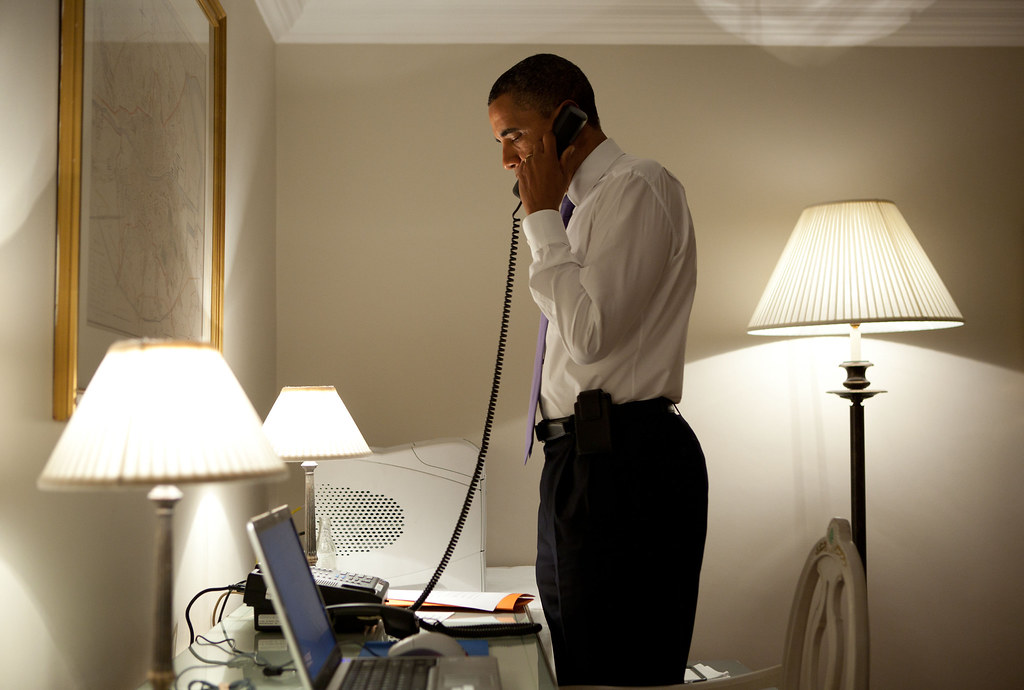
In the wake of yet more terrible storms, this time in the Midwest, the President called Missouri Governor Jay Nixon to personally extend his condolences and to tell all of the families of Joplin affected by the severe tornadoes that they are in his thoughts and prayers. The President assured the governor that FEMA will remain in close contact and coordination with state and local officials.

President Barack Obama talks on the phone with Missouri Governor Jay Nixon, during his visit to Dublin, Ireland, May 23, 2011. The President and Gov. Nixon discussed the deadly tornado that touched down in Joplin, Mo., Sunday night. (Official White House Photo by Pete Souza)

[View Full Size]

The President has directed FEMA Administrator Craig Fugate to travel to Missouri to ensure the state has all the support it needs. In addition, in anticipation of requests for assistance, a FEMA Incident Management Assistance Team (IMAT) is en route to Joplin. This self-sustaining team will work with FEMA officials already in Missouri to coordinate with state and local officials to identify needs and any shortfalls impacting disaster response and recovery.

The President also released this statement last night:

Michelle and I send our deepest condolences to the families of all those who lost their lives in the tornadoes and severe weather that struck Joplin, Missouri as well as communities across the Midwest today.  We commend the heroic efforts by those who have responded and who are working to help their friends and neighbors at this very difficult time. At my direction, FEMA is working with the affected areas' state and local officials to support response and recovery efforts, and the federal government stands ready to help our fellow Americans as needed.

Related Topics: Homeland Security, Missouri

The White House

Office of the Press Secretary

Remarks by President Obama and Prime Minister Kenny of Ireland

Farmleigh House
Dublin, Ireland

11:50 A.M. IST

PRIME MINISTER KENNY:  If everybody can hear.  Obviously this is the first occasion in world history I think there is two bilaterals with an American President in the space of 67 minutes. But I want to welcome President Obama and the First Lady Michelle to Dublin on their way through to a state visit in England and further activities. 

I can say that the Irish people have been waiting for this visit.  Their excitement is palpable.  And I trust that the President and his wife and party will enjoy their visit to Moneygall, home of his triple-great grandfather, Falmouth Kearney, when he goes down there today. 

I’d like to say on this occasion here we’ve discussed a range of issues.  I've explained to the President the seriousness of which Ireland and its new government -- thereby myself and the presence here of the Oireachtas -- are dealing with the issues that affect our country -- the banks and the economic situation and our seriousness of intent in dealing with our budget deficit; also in conjunction with the conditions of the IMF bailout, dealing with the situation there.  And we expressed appreciation for the general support of America in that regard.

We discuss the question of the Northern Ireland Assembly, the new assembly, our relationship with that assembly in relation to the British government.  We discussed the implications and the consequences of the Queen’s visit here, following on the President’s invitation, and the enormous impact that that made, together with the visit of the British Prime Minister during the course of that state visit.

We discussed the question of the President’s speech on immigration, which he made in El Paso, and the fact that the administration is continuing to work on that. 

We discussed the relationship between Ireland and the States, the continuing importance of that, and I reiterated the no-change policy in respect of the use of Shannon in respect of American aircraft serving the U.N. resolutions passing through.

And we discussed a range of other issues relative to the country here and the fact that courage is necessary for leaders who take risks in the interests of solving the problems of their people and their countries. 

I reiterated our appreciation and heartfelt thanks to the American President for his visit here.  And like all politicians, we have some unfinished business, and that is that the next time he comes back he’s going to bring his golf clubs.  (Laughter.) 

Thank you.

PRESIDENT OBAMA:  Thank you so much. 

Well, first of all, let me just say how extraordinarily grateful I am to the Taoiseach, to the President of Ireland, for their extraordinary hospitality to myself and Michelle.  It is heartwarming to be here -- and people even arranged for the sun to come out shortly after I arrived.

The friendship and the bond between the United States and Ireland could not be stronger.  Obviously it is not just a matter of strategic interest, it’s not just a matter of foreign policy; for the United States, Ireland carries a blood link with us.  And for the millions of Irish Americans, this continues to symbolize the homeland and the extraordinary traditions of an extraordinary people.

The Taoiseach and I have already had occasion to meet in Washington.  It’s wonderful to be able to discuss with him again some of the important issues that he is working on.  We’re glad to see that progress is being made in stabilizing the economic situation here.  I know it’s a hard road, but it’s one that the Irish people are more than up to the task in achieving.

What I emphasized is that we want to continue to strengthen the bonds of trade and commerce between our two countries, and that we are rooting for Ireland’s success and we’ll do everything that we can to be helpful on the path to recovery.

We also wanted to express our extraordinary appreciation to Ireland for all the work that it does internationally.  I mentioned that Ireland punches above its weight.  It’s a small country, but the work it does on a range of issues -- in peacekeeping to the trainers in Afghanistan, to this work we’re doing together on food security, to its strong voice on human rights -- all that makes an enormous difference around the world. And the extraordinary relationship that we have with Ireland is also reflected in the work that it does in the EU, and so we’re grateful for that.

Finally I wanted to just express to the Irish people -- and I’ll have occasion to make some lengthier remarks later -- how inspired we have been by the progress that's been made in Northern Ireland, because it speaks to the possibilities of peace and people in longstanding struggles being able to re-imagine their relationships.  To see Her Majesty the Queen of the England come here, and to see the mutual warmth and healing that I think took place as a consequence of that visit, to know that the former Taoiseach Fitzgerald was able to witness the Queen coming here, that sends a signal not just in England, not just here in Ireland, but around the world.  It sends what Bobby Kennedy once called “a ripple of hope,” that may manifest itself in a whole range of ways.

And so, to all those who have been working tirelessly to bring about peace in Northern Ireland, to those who’ve been willing to take those risks, we are grateful to them.  To your administration, which I know is carrying on that legacy and continues to invest in it, we appreciate it.

We are proud of the part that America played in helping to get both sides to talk and to provide a space for that conversation to take place, and we want you to know that we will continue to be there as that moves forward.  And we’re confident that it, in fact, will. 

So I am extraordinarily grateful to be here.  To the Irish people, thank you for the wonderful welcome you’re providing my wife and myself.

PRIME MINISTER KENNY:  Professor Padriac Whyt in Trinity College -- he’s a professor of children’s literature -- broached me some time ago -- in 1922, Padriac Colum was commissioned by the Hawaiian legislature to track down myths and legends of Hawaii and write them as children’s stories.  He produced three volumes of children’s stories, which I presented -- and I had the honor of a first edition -- not to the President, not to the First Lady, but to his children, Malia and Sasha -- stories of their daddy’s birthplace.  And I hope they enjoyed it.

PRESIDENT OBAMA:  Well, this is an extraordinary gift, and it just confirms that if you need somebody to do some good writing, you hire an Irishman.  (Laughter.) 

END
12:00 P.M. IST