Weekly Wrap Up: A Moment of Opportunity

 Your quick look at the week of May 16th to May 20th on WhiteHouse.gov:

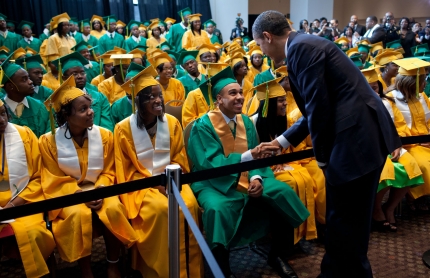
President Obama Surprises Students at Booker T. Washington

President Barack Obama surprises Booker T. Washington students before their commencement ceremony at Cook Convention Center in Memphis, Tenn., May 16, 2011. (Official White House Photo by Pete Souza)

Graduation Season: This week, the President and First Lady spoke at commencements around the country. President Obama addressed graduating seniors at Booker T. Washington High School in Memphis, TN -- the winners of the 2011 Commencement Challenge. The First Lady spoke at Spelman College in Atlanta and delivered a historic address to graduating Cadets at the United States Military Academy at West Point.

Moment of Opportunity: President Obama laid out his vision for a new chapter in American diplomacy as calls for reform and democracy spread across the Middle East and North Africa. After the speech, Deputy National Security Advisor Ben Rhodes answered questions from all over the world via Twitter.

Do You Know Someone Like This?: Nominate an everyday hero for the 2011 Presidential Citizens Medal. 

Huskies at the White House: President Obama honored the NCAA champions the UConn Huskies in a ceremony at the White House. Watch a video of the team's basketball clinic with local kids.

The White House

Office of the Press Secretary

Remarks by the President, CIA Director Leon Panetta, and DNI Director James Clapper to the Intelligence Community at CIA Headquarters

CIA Headquarters, Langley, Virginia

2:55 P.M. EDT

     DIRECTOR CLAPPER:  Mr. President, Director Panetta, and members of the intelligence community, both those who are here and those connected electronically:  Recently, I received an email from a former student of mine at Georgetown who lost his wife at the World Trade Center.  He wanted to thank those responsible for the takedown of Osama bin Laden.  It represented closure for him. 

     And in a sense, this dramatic event represents a measure of closure as well for the intelligence community.  It was an historic milestone in a relentless campaign which continues on. 

     Those heartfelt thanks of my student deservedly go to many.  To the men and women in the intelligence community who contributed directly -- notably, from CIA, NSA, NGA, NRO, and NCTC -- and many others from intelligence organizations who contributed indirectly, taken together a magnificent example of teamwork and intelligence integration.

     But most assuredly, thanks must go to the President, our Commander-in-Chief -- (applause) -- for making perhaps the most courageous decision I’ve witnessed in almost 48 years in intelligence.  He made this decision based on very compelling, but largely circumstantial intelligence. 

     And, sir, we are all grateful to you for your faith and trust in us.  We’re honored by your visit and by your speaking to the intelligence community.  And I think it most appropriate that you do so here at the heart of American intelligence, in the presence of the stars on the wall.  We remember as well, across the community, those who sacrificed their lives on and since 9/11. 
     It’s now my great honor and privilege and pleasure to introduce Leon Panetta, who himself played a crucial role in this operation.  (Applause.)

     Leon, you’ve been a superb Director of CIA, a great partner and a wonderful friend.  My thanks to you and the men and women of this magnificent agency.

     Leon.  (Applause.) 

     DIRECTOR PANETTA:  Thank you.  Thank you, Jim.  For all of us here at the CIA, it is a privilege and a pleasure to have our intelligence community family here with us, to have all of our military partners with us, and I also want to thank the White House staff, particularly those involved in the national security element, to be with us today.  We welcome all of you.

     And I think it’s fair to say that we’ve never had a closer, more effective working relationship, both within our community and across the national security sector of our government.  We thank all of you -- all of you -- for the team effort that was involved in the operation to go after bin Laden.  It would not have happened without your full cooperation.   

     Jim Clapper deserves a lot of credit for his leadership in bringing the intelligence community together.  And I want to thank you, Jim, for everything you’ve done.  (Applause.) 

     Mr. President, on behalf of everyone here at the CIA, we are truly honored and very proud to have you here.  I can’t tell you how much it means to all of us to have you here, to mark one of the greatest intelligence operations in our history.  And it’s one that had so many of our officers working day and night for so many years.

     Throughout that time, some of our officers made the ultimate sacrifice.  Last year we lost seven men and women to a terrorist suicide bomber at Khost Base in Afghanistan.  Their stars are now on this wall behind me -- along with those who gave their lives in this fight.  Their devotion, their skill, and the inspiration that we take from their sacrifice helped make this day possible.

     Tracking down the most infamous terrorist of our time required the very best tradecraft and the very best technology.  But it also demanded the very best of our people -- the highest level of creativity, dedication, teamwork, analysis, and just sheer, dogged determination to never give up when the trail went cold.  Those are basic American qualities and they are reflected in our country’s intelligence officers and in our war fighters -- the team that really carried out this mission.

     But it also required one other essential American quality -- the courage to take risks, the kind of risks that you have to take on if you want to succeed.  And Mr. President, joining with Jim, all of us in the intelligence community deeply thank you for the gutsy decision you made to follow the intelligence, to conduct this operation, and to bring bin Laden to justice.  (Applause.) 

     We are grateful to have a Commander-in-Chief who was willing to put great trust in our work.  And in return, as we approach the tenth anniversary of 9/11, we commit to you that we will continue to do everything in our power to fulfill your mission of defeating al Qaeda and their militant allies.  We will do whatever it takes to protect this country and to keep it safe.

     This has been a long and tough fight, and it’s not over.  But as we have just proven, it’s a fight that we’re going to win -- for you, Mr. President, and for the American people.

     Ladies and gentlemen, it is my great honor to introduce the President of the United States.  (Applause.) 

     THE PRESIDENT:  Thank you.  (Applause.)  Thank you very much.  Thank you all.  (Applause.)  Thank you so much.  Thank you very much, everybody.  Well, thank you, Leon, and thank you, Jim.

     When I chose Leon Panetta as Director of the CIA, I said he was going to be a strong advocate for this agency and would strengthen your capabilities to meet the threats of our time.  And when I chose Jim Clapper as Director of National Intelligence, I charged him with making sure that our intelligence community works as one integrated team.  That’s exactly what these two leaders have done, along with all of you.

     So, Jim and Leon, thank you for your remarkable leadership, not just in recent weeks, but during the entirety of your tenure. You have done a great job.  (Applause.) 

     This is my third visit here to Langley as President, and each of these visits has marked another milestone in our mission to protect the American people and keep our country safe.

     On my first visit, just months after taking office, I stood here and I said that this agency and our entire intelligence community is fundamental to America’s national security.  I said that I believed that your best days were still to come and I pledged that you would have my full support to carry out your critical work. 

     Soon after that visit, I called Leon into the Oval Office and I directed him to make the killing or capture of Osama bin Laden the top priority in our war to defeat al Qaeda.  And he came back here, and you guys, who had already been working so hard on this issue, redoubled your efforts.  And that was true all across the intelligence community. 

     My second visit, a year later, came under more somber circumstances.  We gathered to pay tribute to seven American patriots who gave their lives in this fight at a remote post in Afghanistan.  As has already been mentioned, their stars now grace this memorial wall.  And through our grief and our tears, we resolved that their sacrifice would be our summons to carry on their work, to complete this mission, to win this war.

     Today I’ve returned just to say thank you, on behalf of all Americans and people around the world, because you carried on.  You stayed focused on your mission.  You honored the memory of your fallen colleagues.  And in helping to locate and take down Osama bin Laden, you made it possible for us to achieve the most significant victory yet in our war to defeat al Qaeda. 

     I just met with some of the outstanding leaders and teams from across the community who worked so long and so hard to make that raid a success.  And I’m pleased today that we’re joined by representatives from all of our intelligence agencies, and that folks are watching this live back at all of those agencies, because this truly was a team effort.  That’s not always the case in Washington.  (Laughter.)  But all of you work together every single day.

     This is one of the few times when all these leaders and organizations have the occasion to appear together publicly.  And so I thank all of you for coming -- because I think it’s so important for the American people to see all of you here today.

     Part of the challenge of intelligence work is, by necessity, your work has to remain secret.  I know that carries a heavy burden.  You’re often the first ones to get the blame when things go wrong, and you’re always the last ones to get the credit when things go right.  So when things do go right -- and they do more often than the world will ever know -- we ought to celebrate your success. 

     That’s why I came here.  I wanted every single one of you to know, whether you work at the CIA or across the community, at every step of our effort to take out bin Laden, the work you did and the quality of the intelligence that you provided made the critical difference -- to me, to our team on those helicopters, to our nation.   

     After I directed that getting bin Laden be the priority, you hunkered down even more, building on years of painstaking work; pulling together, in some cases, the slenderest of intelligence streams, running those threads to ground until you found that courier and you tracked him to that compound.  And when I was briefed last summer, you had built the strongest intelligence case against -- in terms of where bin Laden was since Tora Bora.

     In the months that followed, including all those meetings in the Situation Room, we did what sound intelligence demands:  We pushed for more collection.  We pushed for more evidence.  We questioned our assumptions.  You strengthened your analysis.  You didn’t bite your tongue and try to spin the ball, but you gave it to me straight each and every time.

     And we did something really remarkable in Washington -- we kept it a secret.  (Laughter and applause.)  That’s how it should be. 

     Of course, when the time came to actually make the decision, we didn’t know for sure that bin Laden was there.  The evidence was circumstantial and the risks, especially to the lives of our special operations forces, were huge.  And I knew that the consequences of failure could be enormous.  But I made the decision that I did because I had absolute confidence in the skill of our military personnel and I had confidence in you.  I put my bet on you.  And now the whole world knows that that faith in you was justified. 

     So just as impressive as what you did was how you did it.  It was a tribute to your perseverance, your relentless focus and determination over many years.  For the fight against al Qaeda did not begin on 9/11.  Among you are veterans who’ve been pursuing these murderers for many years, even before they attacked our embassies in Africa and struck the Cole in Yemen.  Among you are young men and women for whom 9/11 was a call to service.  This fight has defined your generation.  And on this wall are stars honoring all your colleagues and friends, more than a dozen who have given their lives in the fight against al Qaeda and its violent allies.

     As the years wore on, others began to think that this terrorist might never be brought to justice.  But you never quit.  You never gave up.  You pulled together across this agency and across the community.

     No one piece of information and no one agency made this possible.  You did it together -- CIA, National Security Agency, National Reconnaissance Office, the National Geospatial Intelligence Agency, everyone at ODNI and the National Counterterrorism Center.  Folks across the country, civilian and military, so many of you here today. 

     And that’s exactly how our intelligence community is supposed to work, using every capability -- human, technical -- collecting, analyzing, sharing, integrating intelligence, and then acting on it. 

     That’s what made this one of the greatest intelligence successes in American history, and that’s why intelligence professionals are going to study and be inspired by your achievement for generations to come.

     Now, make no mistake -- this is not over.  Because we not only took out the symbol and operational leader of al Qaeda, we walked off with his files -- (laughter) -- the largest treasure trove of intelligence ever seized from a terrorist leader.  Many of you now are working around the clock; you didn’t have much time to celebrate.  We’ve got to analyze and evaluate and exploit this mountain of intelligence.

     So today, every terrorist in the al Qaeda network should be watching their back, because we’re going to review every video, we are going to examine every photo, we’re going to read every one of those millions of pages, we’re going to pursue every lead.  We are going to go wherever it takes us.  We’re going to finish the job.  We are going to defeat al Qaeda. 

     Even as we stay focused on this mission, we need you to stay nimble and flexible to meet the full range of threats to our security, from plots against our homeland to nations seeking weapons of mass destruction to transnational threats such as cyber criminals and narcotraffickers.

     So I’m going to keep relying on you -- for your intelligence, the analysis that comes across my desk every single day.  And 300-plus Americans are counting on you to stay a step ahead of our adversaries and to keep our country safe.

     I have never been more proud or more confident in you than I am today -- not just because this extraordinary success, but because it reminds us of who we are as a people and as a nation.  You reminded us that when we Americans set our mind to something, when we are focused and when we are working together, when we’re not worried about who’s getting the credit and when we stay true to our values, even if it takes years, there is nothing we cannot do. 

     That’s why I still believe in what I said my first visit here two years ago:  Your greatest days are still to come.  And if any of you doubt what this means, I wish I could have taken some of you on the trip I made to New York City, where we laid a wreath at Ground Zero, and I had a chance to meet firefighters who had lost an entire shift; police officers who had lost their comrades; a young woman, 14 years old, who had written to me because her last memory of her father was talking to him on the phone while her mother wept beside her, right before they watched the tower go down. 

     And she and other members of families of 9/11 victims talked about what this meant.  It meant that their suffering had not been forgotten, and that the American community stands with them, that we stand with each other. 

     So most of you will never get headlines for the work that you do.  You won’t get ticker-tape parades.  But as you go about your work with incredible diligence and dedication every single day, I hope all of you understand how important it is, how grateful I am, and that you have the thanks of a grateful nation.

     God bless you.  And God bless the United States of America.  Thank you.  (Applause.)

END 3:14 P.M. EDT
The White House

Office of the Press Secretary

Presidential Proclamation--National Safe Boating Week

     As Americans anticipate the warm weather of the summer months, we look to our Nation's abundant outdoors and waterways for relaxation and recreation.  America's lakes, rivers, and oceans are enjoyable, but can sometimes pose dangers to watergoers.  National Safe Boating Week is an opportunity to highlight the importance of safety precautions and sensible behavior when spending time on the water.

     Safe boating is responsible boating.  Individuals can prepare for excursions by taking boating safety courses and filing float plans with family members, relatives, or friends.  To prevent accidents and drowning while on the water, boaters should remain aware of weather conditions, perform vessel safety checks, and ensure each passenger wears a life jacket and all required safety equipment is on board.  Safe boating is also sober boating.  Alcohol use is a leading factor in fatal boating accidents, so limiting alcohol use while on or operating a boat can save lives.

     Each year for National Safe Boating Week, the United States Coast Guard partners with boating organizations to raise awareness on the importance of taking proper precautions while boating.  By embracing responsible boating practices, Americans can avoid preventable injuries and enjoy the majesty of our Nation's waterways.

     In recognition of the importance of safe boating practices, the Congress, by joint resolution approved June 4, 1958 (36 U.S.C. 131), as amended, has authorized and requested the President to proclaim annually the 7-day period prior to Memorial Day weekend as "National Safe Boating Week."

     NOW, THEREFORE, I, BARACK OBAMA, President of the United States of America, do hereby proclaim May 21 through May 27, 2011, as National Safe Boating Week.  I encourage all Americans who participate in boating activities to observe this occasion by learning more about safe boating practices and taking advantage of boating education.

     IN WITNESS WHEREOF, I have hereunto set my hand this
     twentieth day of May, in the year of our Lord two thousand eleven, and of the Independence of the United States of America the two hundred and thirty-fifth.

BARACK OBAMA

The White House

Office of the Press Secretary

President Obama Grants Pardons

WASHINGTON – Today President Barack Obama granted pardons to the following eight individuals:

  •  Randy Eugene Dyer – Burien, Wash.
    Offense: Conspiracy to import marijuana (hashish), 21 U.S.C. § 963; conspiracy to remove baggage from the custody and control of the U.S. Customs Service and convey false information concerning an attempt to damage a civil aircraft, 18 U.S.C. § 371.
    Sentence:  June 19, 1975; Western District of Washington; five years in prison and two years of special parole (special parole term subsequently vacated.)
     
  • Danny Alonzo Levitz - Angola, Ind.
    Offense: Conspiracy, 18 U.S.C. § 371.
    Sentence: Aug. 18, 1980; Northern District of Indiana; two years of probation, $400 fine.
     
  • Michael Ray Neal - Palm Coast, Fla.
    Offense: Manufacture, assembly, modification and distribution of equipment for unauthorized decryption of satellite cable programming, 47U.S.C. § 605(e)(4).
    Sentence: May 31, 1991, as amended June 2, 1992; Eastern District of Virginia; six months in prison, three years of supervised release conditioned on six months of home confinement, $2,500 fine.
     
  • Edwin Alan North - Wolcottville, Ind.
    Offense: Transfer of a firearm without payment of transfer tax, 26 U.S.C. § 5861(e).
    Sentence: Aug. 18, 1980; Northern District of Indiana; six months of unsupervised probation.
     
  • Allen Edward Peratt Sr. - Sioux Falls, S.D.
    Offense: Conspiracy to distribute methamphetamine, 21 U.S.C. §§ 841(a)(1) and 846.
    Sentence: July 23, 1990, as amended May 29, 1991; District of South Dakota; 30 months in prison, five years of supervised release.
     
  • Christine Marie Rossiter - Lincoln, Neb.
    Offense: Conspiracy to distribute less than 50 kilograms of marijuana, 21 U.S.C. §§ 841(a)(1) and 846.
    Sentence: Oct. 7, 1992; District of Nebraska; three years of probation conditioned on performance of 500 hours of community service.
     
  • Patricia Ann Weinzatl - Prentice, Wis.
    Offense: Structuring transactions to evade reporting requirements, 31 U.S.C. § 5324(a)(3).
    Sentence: Aug. 15, 2001; Western District of Wisconsin; three years of probation, $5,000 fine.
     
  • Bobby Gerald Wilson - Summerton, S.C.
    Offense: Aiding and abetting the possession and sale of illegal American alligator hides (Lacey Act), 16 U.S.C. § 3373(d)(1)(B) and 18U.S.C. § 2.
    Sentence: Dec. 19, 1985, as amended May 13, 1986; Southern District of Georgia; three and one-half months in prison, five years of probation conditioned on performance of 300 hours of community service.

The White House

Office of the Press Secretary

Presidential Proclamation--National Hurricane Preparedness Week

     National Hurricane Preparedness Week highlights the importance of planning ahead to protect our families and secure our communities and homes in advance of the upcoming hurricane season.

     Hurricanes are powerful storms that can create severe flooding, dangerous storm surges, high winds, and tornadoes.  The effects of these storms can be devastating to entire communities and can have long-lasting consequences, including loss of life and property.  In addition to threatening coastal areas, hurricanes significantly impact inland locations.  Our Nation has seen devastating hurricanes and storms, and we must not let our guard down as we prepare for this year's hurricane season.  With tens of millions of Americans living in coastal communities, preparation can enhance our ability to respond to and recover from any natural disaster we might face.

     Our Nation's weather forecasters at the National Oceanic and Atmospheric Administration's National Hurricane Center continue to improve the accuracy of their hurricane forecasts.  However, we cannot prevent a hurricane from making landfall, and awareness of the threat is not enough -- we must translate this knowledge into action, and work together to develop prepared and resilient communities.  My Administration recognizes that we must move from a government-centric approach to disaster management to a community-oriented approach that includes all levels of government, the private sector, volunteers, community and faith-based organizations, and the public.  A whole
     community effort is needed to effectively prepare for, protect against, respond to, recover from, and mitigate against any disaster.

     During National Hurricane Preparedness Week, we emphasize the need for individuals, businesses, nonprofits, and families to prepare emergency plans, create emergency supply kits, and learn evacuation routes.  More information on hurricane hazards and details on how to secure buildings and belongings is available at www.Hurricanes.gov/Prepare and www.Ready.gov.

     America has seen the heartbreak a hurricane can leave behind.  By working together, government, private and nonprofit organizations, emergency responders, and private citizens can help save lives and reduce the damage caused by these storms.

     NOW, THEREFORE, I, BARACK OBAMA, President of the United States of America, by virtue of the authority vested in me by the Constitution and the laws of the United States,

     do hereby proclaim May 22 through May 28, 2011, as National Hurricane Preparedness Week.  I call upon government agencies, private organizations, schools, media, and residents in the coastal areas of our Nation to share information about hurricane preparedness and response to help save lives and protect communities.

     IN WITNESS WHEREOF, I have hereunto set my hand this twentieth day of May, in the year of our Lord two thousand eleven, and of the Independence of the United States of America the two hundred and thirty-fifth.

BARACK OBAMA

The White House

Office of the Press Secretary

Presidential Proclamation--Armed Forces Day

     The Armed Forces of the United States of America embody the highest ideals of our Nation.  Serving at home and in posts around the world, our service members represent America as ambassadors of our principles.  They display the honor, duty, and discipline of the finest fighting force the world has ever known.  These brave men and women are willing to sacrifice their lives for the security of our Nation and the freedoms of their fellow citizens.  We are humbled by their continued resolve to respond to the call of duty and defend America and its people.

     From our earliest days as a fledgling republic, the United States has relied on the unwavering courage and patriotism of our men and women in uniform to sustain us through wars, emergencies, and challenges at home and abroad.  While conflicts in Iraq, Afghanistan, and other areas demand an ever-changing set of capabilities and competencies, our service members continue to protect our Nation with professionalism and distinction.

     As a grateful Nation, we are indebted to the members of our Armed Forces for their service, and we support them in each mission they are tasked to accomplish.  I have no greater privilege as President of the United States than serving as Commander in Chief, and my Administration is dedicated to providing the men and women of our Armed Forces with the resources and support they require and deserve.  We are also committed to providing the same superior support to our veterans when they return home.  This is the sacred trust our Nation must hold with her warriors.

     It is not just our troops who are called to serve and sacrifice, but also their families, who give our service members the love and support they need to carry on the fight.  We will continue to improve and enhance our support for the families and survivors our troops leave behind.  These heroes are dedicated to defending the country we love, and we must stand firmly beside them and help care for their spouses and children.

     On Armed Forces Day, let us salute the Soldiers, Sailors, Airmen, Marines, and Coast Guardsmen who perform their duties with impeccable courage, commitment, and character, and recognize our moral obligation to serve them and their families as well as they have served us.

     NOW, THEREFORE, I, BARACK OBAMA, President of the United States of America, and Commander in Chief of the Armed Forces of the United States, continuing the precedent of my predecessors in office, do hereby proclaim the third Saturday of May as Armed Forces Day.

     I direct the Secretary of Defense on behalf of the Army, Navy, Air Force, and Marine Corps, and the Secretary of Homeland Security on behalf of the Coast Guard, to plan for appropriate observances, with the Secretary of Defense responsible for encouraging the participation and cooperation of civil authorities and private citizens.

     I invite the Governors of the States, the Commonwealth of Puerto Rico, and other areas subject to the jurisdiction of the United States, to provide for the observance of Armed Forces Day in an appropriate manner to increase public understanding and appreciation of our Armed Forces.  I also invite veterans, civic leaders, and other organizations to join in the observance of Armed Forces Day.

     Finally, I call upon all Americans to display the flag of the United States at their homes on Armed Forces Day, and I urge citizens to learn more about military service by attending and participating in the local observances of the day.  I also encourage Americans to volunteer at organizations that provide support to our troops.

     Proclamation 8522 of May 14, 2010, is hereby superseded.

     IN WITNESS WHEREOF, I have hereunto set my hand this
     twentieth day of May, in the year of our Lord two thousand eleven, and of the Independence of the United States of America the two hundred and thirty-fifth.

BARACK OBAMA

President Obama Hosts Prime Minister Netanyahu: “An Extremely Constructive Discussion”

A day after the President’s speech on the Middle East and North Africa, where he spoke on the changes sweeping the region as well as the ongoing conflict between Israelis and Palestinians, the President hosted Prime Minister Netanyahu of Israel for a lengthy meeting.  Afterwards they both spoke to the press in the Oval Office, and the President described their discussion as focusing on the same themes as his speech, including support for reforms in countries throughout the region:

Well, let me, first of all, welcome again Prime Minister Netanyahu, who I think has now been here seven times during the course of my presidency.  And I want to indicate that the frequency of these meetings is an indication of the extraordinary bonds between our two countries, as is the opportunity for the Prime Minister to address Congress during his visit here.  I know that’s an honor that’s reserved for those who have always shown themselves to be a great friend of the United States and is indicative of the friendship between our countries.

We just completed a prolonged and extremely useful conversation touching on a wide range of issues.  We discussed, first of all, the changes that are sweeping the region and what has been happening in places like Egypt and Syria and how they affect the interests and security of the United States and Israel, as well as the opportunity for prosperity, growth and development in the Arab world.

We agreed that there is a moment of opportunity that can be seized as a consequence of the Arab Spring, but also acknowledge that there’s significant perils as well, and that it’s going to be important for the United States and Israel to consult closely as we see developments unfold. 

President Barack Obama Meets with Prime Minister Benjamin Netanyahu of Israel

President Barack Obama meets with Prime Minister Benjamin Netanyahu of Israel, in the Oval Office, May 20, 2011. (by Pete Souza)

The President also spoke at some length about their discussion of the peace process:

Related Topics: Foreign Policy

The White House

Office of the Press Secretary

Remarks by President Obama and Prime Minister Netanyahu of Israel After Bilateral Meeting

Oval Office

1:35 P.M. EDT

     PRESIDENT OBAMA:  Well, let me, first of all, welcome again Prime Minister Netanyahu, who I think has now been here seven times during the course of my presidency.  And I want to indicate that the frequency of these meetings is an indication of the extraordinary bonds between our two countries, as is the opportunity for the Prime Minister to address Congress during his visit here.  I know that’s an honor that’s reserved for those who have always shown themselves to be a great friend of the United States and is indicative of the friendship between our countries.

     We just completed a prolonged and extremely useful conversation touching on a wide range of issues.  We discussed, first of all, the changes that are sweeping the region and what has been happening in places like Egypt and Syria and how they affect the interests and security of the United States and Israel, as well as the opportunity for prosperity, growth and development in the Arab world.

     We agreed that there is a moment of opportunity that can be seized as a consequence of the Arab Spring, but also acknowledge that there’s significant perils as well, and that it’s going to be important for the United States and Israel to consult closely as we see developments unfold. 

     I outlined for the Prime Minister some of the issues that I discussed in my speech yesterday -- how important it was going to be for the United States to support political reform, support human rights, support freedom of speech, religious tolerance and economic development, particularly in Egypt, as the largest Arab country, as well as Tunisia, the country that first started this revolutionary movement that’s taking place throughout the Middle East and North Africa.

     We also discussed the situation in Syria, which is obviously of acute concern to Israel, given its shared border.  And I gave more details to the Prime Minister about the significant steps that we are taking to try to pressure Syria and the Assad regime to reform, including the sanctions that we placed directly on President Assad.

     We continue to share our deep concerns about Iran, not only the threat that it poses to Israel but also the threat that it poses to the region and the world if it were to develop a nuclear weapon.  We updated our strategy to continue to apply pressure, both through sanctions and our other diplomatic work.  And I reiterated my belief that it is unacceptable for Iran to possess a nuclear weapon.

     We also discussed the hypocrisy of Iran suggesting that it somehow supports democratization in the Middle East when, in fact, they first showed the repressive nature of that regime when they responded to the own peaceful protests that took place inside Iran almost two years ago.

     Finally, we discussed the issue of a prospective peace between Israelis and Palestinians.  And I reiterated and we discussed in depth the principles that I laid out yesterday -- the belief that our ultimate goal has to be a secure Israeli state, a Jewish state, living side by side in peace and security with a contiguous, functioning and effective Palestinian state. 

     Obviously there are some differences between us in the precise formulations and language, and that’s going to happen between friends.  But what we are in complete accord about is that a true peace can only occur if the ultimate resolution allows Israel to defend itself against threats, and that Israel’s security will remain paramount in U.S. evaluations of any prospective peace deal.

     I said that yesterday in the speech, and I continue to believe it.  And I think that it is possible for us to shape a deal that allows Israel to secure itself, not to be vulnerable, but also allows it to resolve what has obviously been a wrenching issue for both peoples for decades now.

     I also pointed out, as I said in the speech yesterday, that it is very difficult for Israel to be expected to negotiate in a serious way with a party that refuses to acknowledge its right to exist.  And so for that reason I think the Palestinians are going to have to answer some very difficult questions about this agreement that’s been made between Fatah and Hamas.  Hamas has been and is an organization that has resorted to terror; that has refused to acknowledge Israel’s rights to exist.  It is not a partner for a significant, realistic peace process.  And so, as I said yesterday during the speech, the Palestinians are going to have to explain how they can credibly engage in serious peace negotiations in the absence of observing the Quartet principles that have been put forward previously.

     So, overall, I thought this was an extremely constructive discussion.  And coming out of this discussion, I once again can reaffirm that the extraordinarily close relationship between the United States and Israel is sound and will continue, and that together, hopefully we are going to be able to work to usher in a new period of peace and prosperity in a region that is going to be going through some very profound transformations in the coming weeks, months and years.

     So, Mr. Prime Minister. 

     PRIME MINISTER NETANYAHU:  Thank you, Mr. President.

     PRESIDENT OBAMA:  Thank you very much.

     PRIME MINISTER NETANYAHU:  Mr. President, first I want to thank you and the First Lady for the gracious hospitality that you’ve shown me, my wife, and our entire delegation.  We have an enduring bond of friendship between our two countries, and I appreciate the opportunity to have this meeting with you after your important speech yesterday.

     We share your hope and your vision for the spread of democracy in the Middle East.  I appreciate the fact that you reaffirmed once again now, and in our conversation, and in actual deed the commitment to Israel’s security.  We value your efforts to advance the peace process. 

     This is something that we want to have accomplished.  Israel wants peace.  I want peace.  What we all want is a peace that will be genuine, that will hold, that will endure.  And I think that the -- we both agree that a peace based on illusions will crash eventually on the rocks of Middle Eastern reality, and that the only peace that will endure is one that is based on reality, on unshakeable facts.

     I think for there to be peace, the Palestinians will have to accept some basic realities.  The first is that while Israel is prepared to make generous compromises for peace, it cannot go back to the 1967 lines -- because these lines are indefensible; because they don’t take into account certain changes that have taken place on the ground, demographic changes that have taken place over the last 44 years.

     Remember that, before 1967, Israel was all of nine miles wide.  It was half the width of the Washington Beltway.  And these were not the boundaries of peace; they were the boundaries of repeated wars, because the attack on Israel was so attractive.

     So we can't go back to those indefensible lines, and we're going to have to have a long-term military presence along the Jordan.  I discussed this with the President and I think that we understand that Israel has certain security requirements that will have to come into place in any deal that we make.

     The second is -- echoes something the President just said, and that is that Israel cannot negotiate with a Palestinian government that is backed by Hamas.  Hamas, as the President said, is a terrorist organization committed to Israel’s destruction.  It’s fired thousands of rockets on our cities, on our children.  It’s recently fired an anti-tank rocket at a yellow school bus, killing a 16-year-old boy.  And Hamas has just attacked you, Mr. President, and the United States for ridding the world of bin Laden.

     So Israel obviously cannot be asked to negotiate with a government that is backed by the Palestinian version of al Qaeda.

     I think President Abbas has a simple choice.  He has to decide if he negotiates or keeps his pact with Hamas, or makes peace with Israel.  And I can only express what I said to you just now, that I hope he makes the choice, the right choice, in choosing peace with Israel.

     The third reality is that the Palestinian refugee problem will have to be resolved in the context of a Palestinian state, but certainly not in the borders of Israel. 

     The Arab attack in 1948 on Israel resulted in two refugee problems -- Palestinian refugee problem and Jewish refugees, roughly the same number, who were expelled from Arab lands.  Now, tiny Israel absorbed the Jewish refugees, but the vast Arab world refused to absorb the Palestinian refugees.  Now, 63 years later, the Palestinians come to us and they say to Israel, accept the grandchildren, really, and the great grandchildren of these refugees, thereby wiping out Israel’s future as a Jewish state.

     So it’s not going to happen.  Everybody knows it’s not going to happen.  And I think it’s time to tell the Palestinians forthrightly it’s not going to happen.  The Palestinian refugee problem has to be resolved.  It can be resolved, and it will be resolved if the Palestinians choose to do so in a Palestinian state.  So that's a real possibility.  But it’s not going to be resolved within the Jewish state.

     The President and I discussed all these issues and I think we may have differences here and there, but I think there’s an overall direction that we wish to work together to pursue a real, genuine peace between Israel and its Palestinian neighbors; a peace that is defensible.

     Mr. President, you're the -- you're the leader of a great people, the American people.  And I'm the leader of a much smaller people, the --

     PRESIDENT OBAMA:  A great people.

     PRIME MINISTER NETANYAHU:  It’s a great people, too.  It’s the ancient nation of Israel.  And, you know, we've been around for almost 4,000 years.  We've experienced struggle and suffering like no other people.  We've gone through expulsions and pogroms and massacres and the murder of millions.  But I can say that even at the dearth of -- even at the nadir of the valley of death, we never lost hope and we never lost our dream of reestablishing a sovereign state in our ancient homeland, the land of Israel.

     And now it falls on my shoulders as the Prime Minister of Israel, at a time of extraordinary instability and uncertainty in the Middle East, to work with you to fashion a peace that will ensure Israel’s security and will not jeopardize its survival.  I take this responsibility with pride but with great humility, because, as I told you in our conversation, we don't have a lot of margin for error.  And because, Mr. President, history will not give the Jewish people another chance.  

     So in the coming days and weeks and months, I intend to work with you to seek a peace that will address our security concerns, seek a genuine recognition that we wish from our Palestinian neighbors to give a better future for Israel and for the entire region. 

     And I thank you for the opportunity to exchange our views and to work together for this common end.  Thank you, Mr. President. 

     PRESIDENT OBAMA:  Thank you.

END 1:51 P.M. EDT

President Obama Thanks the Intelligence Community

May 20, 2011 | 13:04 | Public Domain

The President travels to CIA Headquarters in Langley, VA to personally thank the members of the intelligence community for their role in the death of Osama bin Laden and their efforts in the fight against Al Qaeda.

Download mp4 (125MB) | mp3 (12MB)

Read the Transcript

Remarks by the President, CIA Director Leon Panetta, and DNI Director James Clapper to the Intelligence Community at CIA Headquarters

2:55 P.M. EDT

     DIRECTOR CLAPPER:  Mr. President, Director Panetta, and members of the intelligence community, both those who are here and those connected electronically:  Recently, I received an email from a former student of mine at Georgetown who lost his wife at the World Trade Center.  He wanted to thank those responsible for the takedown of Osama bin Laden.  It represented closure for him. 

     And in a sense, this dramatic event represents a measure of closure as well for the intelligence community.  It was an historic milestone in a relentless campaign which continues on. 

     Those heartfelt thanks of my student deservedly go to many.  To the men and women in the intelligence community who contributed directly -- notably, from CIA, NSA, NGA, NRO, and NCTC -- and many others from intelligence organizations who contributed indirectly, taken together a magnificent example of teamwork and intelligence integration.

     But most assuredly, thanks must go to the President, our Commander-in-Chief -- (applause) -- for making perhaps the most courageous decision I’ve witnessed in almost 48 years in intelligence.  He made this decision based on very compelling, but largely circumstantial intelligence. 

     And, sir, we are all grateful to you for your faith and trust in us.  We’re honored by your visit and by your speaking to the intelligence community.  And I think it most appropriate that you do so here at the heart of American intelligence, in the presence of the stars on the wall.  We remember as well, across the community, those who sacrificed their lives on and since 9/11. 
     It’s now my great honor and privilege and pleasure to introduce Leon Panetta, who himself played a crucial role in this operation.  (Applause.)

     Leon, you’ve been a superb Director of CIA, a great partner and a wonderful friend.  My thanks to you and the men and women of this magnificent agency.

     Leon.  (Applause.) 

     DIRECTOR PANETTA:  Thank you.  Thank you, Jim.  For all of us here at the CIA, it is a privilege and a pleasure to have our intelligence community family here with us, to have all of our military partners with us, and I also want to thank the White House staff, particularly those involved in the national security element, to be with us today.  We welcome all of you.

     And I think it’s fair to say that we’ve never had a closer, more effective working relationship, both within our community and across the national security sector of our government.  We thank all of you -- all of you -- for the team effort that was involved in the operation to go after bin Laden.  It would not have happened without your full cooperation.   

     Jim Clapper deserves a lot of credit for his leadership in bringing the intelligence community together.  And I want to thank you, Jim, for everything you’ve done.  (Applause.) 

     Mr. President, on behalf of everyone here at the CIA, we are truly honored and very proud to have you here.  I can’t tell you how much it means to all of us to have you here, to mark one of the greatest intelligence operations in our history.  And it’s one that had so many of our officers working day and night for so many years.

     Throughout that time, some of our officers made the ultimate sacrifice.  Last year we lost seven men and women to a terrorist suicide bomber at Khost Base in Afghanistan.  Their stars are now on this wall behind me -- along with those who gave their lives in this fight.  Their devotion, their skill, and the inspiration that we take from their sacrifice helped make this day possible.

     Tracking down the most infamous terrorist of our time required the very best tradecraft and the very best technology.  But it also demanded the very best of our people -- the highest level of creativity, dedication, teamwork, analysis, and just sheer, dogged determination to never give up when the trail went cold.  Those are basic American qualities and they are reflected in our country’s intelligence officers and in our war fighters -- the team that really carried out this mission.

     But it also required one other essential American quality -- the courage to take risks, the kind of risks that you have to take on if you want to succeed.  And Mr. President, joining with Jim, all of us in the intelligence community deeply thank you for the gutsy decision you made to follow the intelligence, to conduct this operation, and to bring bin Laden to justice.  (Applause.) 

     We are grateful to have a Commander-in-Chief who was willing to put great trust in our work.  And in return, as we approach the tenth anniversary of 9/11, we commit to you that we will continue to do everything in our power to fulfill your mission of defeating al Qaeda and their militant allies.  We will do whatever it takes to protect this country and to keep it safe.

     This has been a long and tough fight, and it’s not over.  But as we have just proven, it’s a fight that we’re going to win -- for you, Mr. President, and for the American people.

     Ladies and gentlemen, it is my great honor to introduce the President of the United States.  (Applause.) 

     THE PRESIDENT:  Thank you.  (Applause.)  Thank you very much.  Thank you all.  (Applause.)  Thank you so much.  Thank you very much, everybody.  Well, thank you, Leon, and thank you, Jim.

     When I chose Leon Panetta as Director of the CIA, I said he was going to be a strong advocate for this agency and would strengthen your capabilities to meet the threats of our time.  And when I chose Jim Clapper as Director of National Intelligence, I charged him with making sure that our intelligence community works as one integrated team.  That’s exactly what these two leaders have done, along with all of you.

     So, Jim and Leon, thank you for your remarkable leadership, not just in recent weeks, but during the entirety of your tenure. You have done a great job.  (Applause.) 

     This is my third visit here to Langley as President, and each of these visits has marked another milestone in our mission to protect the American people and keep our country safe.

     On my first visit, just months after taking office, I stood here and I said that this agency and our entire intelligence community is fundamental to America’s national security.  I said that I believed that your best days were still to come and I pledged that you would have my full support to carry out your critical work. 

     Soon after that visit, I called Leon into the Oval Office and I directed him to make the killing or capture of Osama bin Laden the top priority in our war to defeat al Qaeda.  And he came back here, and you guys, who had already been working so hard on this issue, redoubled your efforts.  And that was true all across the intelligence community. 

     My second visit, a year later, came under more somber circumstances.  We gathered to pay tribute to seven American patriots who gave their lives in this fight at a remote post in Afghanistan.  As has already been mentioned, their stars now grace this memorial wall.  And through our grief and our tears, we resolved that their sacrifice would be our summons to carry on their work, to complete this mission, to win this war.

     Today I’ve returned just to say thank you, on behalf of all Americans and people around the world, because you carried on.  You stayed focused on your mission.  You honored the memory of your fallen colleagues.  And in helping to locate and take down Osama bin Laden, you made it possible for us to achieve the most significant victory yet in our war to defeat al Qaeda. 

     I just met with some of the outstanding leaders and teams from across the community who worked so long and so hard to make that raid a success.  And I’m pleased today that we’re joined by representatives from all of our intelligence agencies, and that folks are watching this live back at all of those agencies, because this truly was a team effort.  That’s not always the case in Washington.  (Laughter.)  But all of you work together every single day.

     This is one of the few times when all these leaders and organizations have the occasion to appear together publicly.  And so I thank all of you for coming -- because I think it’s so important for the American people to see all of you here today.

     Part of the challenge of intelligence work is, by necessity, your work has to remain secret.  I know that carries a heavy burden.  You’re often the first ones to get the blame when things go wrong, and you’re always the last ones to get the credit when things go right.  So when things do go right -- and they do more often than the world will ever know -- we ought to celebrate your success. 

     That’s why I came here.  I wanted every single one of you to know, whether you work at the CIA or across the community, at every step of our effort to take out bin Laden, the work you did and the quality of the intelligence that you provided made the critical difference -- to me, to our team on those helicopters, to our nation.   

     After I directed that getting bin Laden be the priority, you hunkered down even more, building on years of painstaking work; pulling together, in some cases, the slenderest of intelligence streams, running those threads to ground until you found that courier and you tracked him to that compound.  And when I was briefed last summer, you had built the strongest intelligence case against -- in terms of where bin Laden was since Tora Bora.

     In the months that followed, including all those meetings in the Situation Room, we did what sound intelligence demands:  We pushed for more collection.  We pushed for more evidence.  We questioned our assumptions.  You strengthened your analysis.  You didn’t bite your tongue and try to spin the ball, but you gave it to me straight each and every time.

     And we did something really remarkable in Washington -- we kept it a secret.  (Laughter and applause.)  That’s how it should be. 

     Of course, when the time came to actually make the decision, we didn’t know for sure that bin Laden was there.  The evidence was circumstantial and the risks, especially to the lives of our special operations forces, were huge.  And I knew that the consequences of failure could be enormous.  But I made the decision that I did because I had absolute confidence in the skill of our military personnel and I had confidence in you.  I put my bet on you.  And now the whole world knows that that faith in you was justified. 

     So just as impressive as what you did was how you did it.  It was a tribute to your perseverance, your relentless focus and determination over many years.  For the fight against al Qaeda did not begin on 9/11.  Among you are veterans who’ve been pursuing these murderers for many years, even before they attacked our embassies in Africa and struck the Cole in Yemen.  Among you are young men and women for whom 9/11 was a call to service.  This fight has defined your generation.  And on this wall are stars honoring all your colleagues and friends, more than a dozen who have given their lives in the fight against al Qaeda and its violent allies.

     As the years wore on, others began to think that this terrorist might never be brought to justice.  But you never quit.  You never gave up.  You pulled together across this agency and across the community.

     No one piece of information and no one agency made this possible.  You did it together -- CIA, National Security Agency, National Reconnaissance Office, the National Geospatial Intelligence Agency, everyone at ODNI and the National Counterterrorism Center.  Folks across the country, civilian and military, so many of you here today. 

     And that’s exactly how our intelligence community is supposed to work, using every capability -- human, technical -- collecting, analyzing, sharing, integrating intelligence, and then acting on it. 

     That’s what made this one of the greatest intelligence successes in American history, and that’s why intelligence professionals are going to study and be inspired by your achievement for generations to come.

     Now, make no mistake -- this is not over.  Because we not only took out the symbol and operational leader of al Qaeda, we walked off with his files -- (laughter) -- the largest treasure trove of intelligence ever seized from a terrorist leader.  Many of you now are working around the clock; you didn’t have much time to celebrate.  We’ve got to analyze and evaluate and exploit this mountain of intelligence.

     So today, every terrorist in the al Qaeda network should be watching their back, because we’re going to review every video, we are going to examine every photo, we’re going to read every one of those millions of pages, we’re going to pursue every lead.  We are going to go wherever it takes us.  We’re going to finish the job.  We are going to defeat al Qaeda. 

     Even as we stay focused on this mission, we need you to stay nimble and flexible to meet the full range of threats to our security, from plots against our homeland to nations seeking weapons of mass destruction to transnational threats such as cyber criminals and narcotraffickers.

     So I’m going to keep relying on you -- for your intelligence, the analysis that comes across my desk every single day.  And 300-plus Americans are counting on you to stay a step ahead of our adversaries and to keep our country safe.

     I have never been more proud or more confident in you than I am today -- not just because this extraordinary success, but because it reminds us of who we are as a people and as a nation.  You reminded us that when we Americans set our mind to something, when we are focused and when we are working together, when we’re not worried about who’s getting the credit and when we stay true to our values, even if it takes years, there is nothing we cannot do. 

     That’s why I still believe in what I said my first visit here two years ago:  Your greatest days are still to come.  And if any of you doubt what this means, I wish I could have taken some of you on the trip I made to New York City, where we laid a wreath at Ground Zero, and I had a chance to meet firefighters who had lost an entire shift; police officers who had lost their comrades; a young woman, 14 years old, who had written to me because her last memory of her father was talking to him on the phone while her mother wept beside her, right before they watched the tower go down. 

     And she and other members of families of 9/11 victims talked about what this meant.  It meant that their suffering had not been forgotten, and that the American community stands with them, that we stand with each other. 

     So most of you will never get headlines for the work that you do.  You won’t get ticker-tape parades.  But as you go about your work with incredible diligence and dedication every single day, I hope all of you understand how important it is, how grateful I am, and that you have the thanks of a grateful nation.

     God bless you.  And God bless the United States of America.  Thank you.  (Applause.)

END 3:14 P.M. EDT

Close Transcript

The White House

Office of the Press Secretary

President Obama Signs Idaho Disaster Declaration

The President today declared a major disaster exists in the State of Idaho and ordered Federal aid to supplement State, Tribal, and local recovery efforts in the area struck by flooding, landslides, and mudslides during the period of March 31 to April 11, 2011.

Federal funding is available to State, Tribal, and eligible local governments and certain private nonprofit organizations on a cost-sharing basis for emergency work and the repair or replacement of facilities damaged by the flooding, landslides, and mudslides in Bonner, Clearwater, Idaho, Nez Perce, and Shoshone Counties and the Nez Perce Tribe.

Federal funding is also available on a cost-sharing basis for hazard mitigation measures for all counties and Tribes within the State.

W. Craig Fugate, Administrator, Federal Emergency Management Agency (FEMA), Department of Homeland Security, named Dolph A. Diemont as the Federal Coordinating Officer for Federal recovery operations in the affected area. 

FEMA said additional designations may be made at a later date if requested by the State and warranted by the results of further damage assessments.

FOR FURTHER INFORMATION CONTACT:  FEMA (202) 646-3272.