Photos: President Obama in Poland

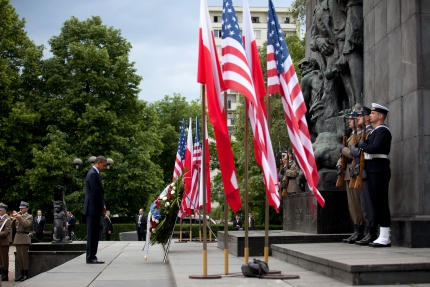
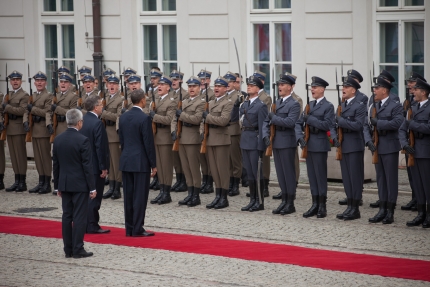
President Barack Obama and President Bronislaw Komorowski review troops

President Barack Obama and President Bronislaw Komorowski review troops during the arrival ceremony in the courtyard of the Presidential Palace in Warsaw, Poland, May 28, 2011. A member of the Ceremonial Army Garrison stands with them. (Official White House Photo by Lawrence Jackson)

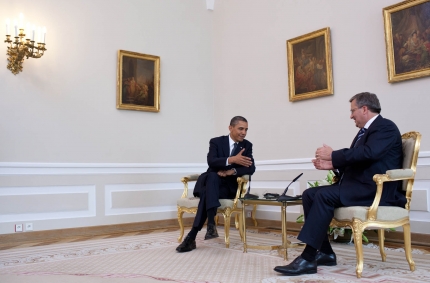
Today President Obama was in Warsaw, Poland where he held a bilateral meeting  Polish President Bronisław Komorowski and participated a discussion on democracy with President Komorowski and NGO’s.

President Barack Obama reaches to shake hands with President Bonislaw Komorowski

President Barack Obama reaches to shake hands with President Bonislaw Komorowski of Poland following their statements to the press at the Presidential Palace in Warsaw, Poland, May 28, 2011. (Official White House Photo by Pete Souza)

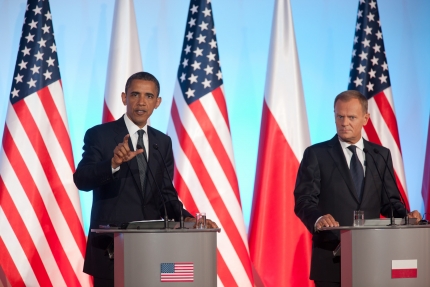
Later in the day, the President met Polish Prime Minister Donald Tusk and held a joint press conference. 

President Barack Obama and Polish Prime Minister Donald Tusk

President Barack Obama and Polish Prime Minister Donald Tusk make remarks during a press conference at the Chancellery Building in Warsaw, Poland, May 28, 2011. (Official White House Photo by Lawrence Jackson)

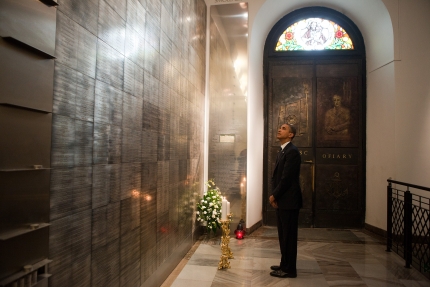
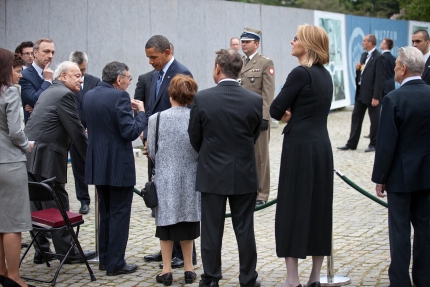
Before heading back to Washington, the President visited the memorial to the victims of the Smolensk plane crash at the Field Cathedral of the Polish Military.

President Barack Obama pays his respects while visiting the memorial to the victims of the Smolensk

President Barack Obama pays his respects while visiting the memorial to the victims of the Smolensk plane crash at Field Cathedral of the Polish Military in Warsaw, Poland, May 28, 2011. (Official White House Photo by Lawrence Jackson)

President Obama and Prime Minister Tusk Press Conference

May 28, 2011 | 35:58 | Public Domain

President Obama and Prime Minister Tusk of Poland hold a joint press conference at the Chancellery Building in Warsaw, Poland.

Download mp4 (343MB) | mp3 (33MB)

Read the Transcript

Remarks by President Obama and Prime Minister Tusk of Poland in Joint Press Conference in Warsaw, Poland

Chancellery Building
Warsaw, Poland

2:30 P.M. CEST

PRIME MINISTER TUSK:  (As translated.)  Mr. President, ladies and gentlemen, before the visit of President Barack Obama, I learned that Ralph Waldo Emerson was your favorite American thinker.  And certainly at the time I tried to search for some association, some quotations, some connections.  And out of all these ideas, the one that talks about enthusiasm -- that nothing great was ever achieved without enthusiasm -- it seems to be especially fit for our way of understanding the world.

When I was thinking about our understanding of the world, I’m thinking about both of us as people, but first of all, about our nations and about our states.  I want to tell you that Poland today is the place where we have lots of enthusiasm.  We have gone through the previous years, the difficult, critical years, also in the global dimension, with a faith in our own power, our strength.  And it’s faith and enthusiasm that allow us to overcome the difficulties.  It is also the effect of our cooperation. 

You Americans have invested in Poland.  But you have invested also in the whole region and with lots of your enthusiasm.  Some money, too, some other types of assistance habitually works.  But just as enthusiasm was needed to create the great Solidarity movement in Poland, it was also needed when, except for enthusiasm and freedom, we had nothing else in 1989.  But people with enthusiasm and freedom are enough when you have friends.  You have invested in the region and it works. 

We talked, amongst others, about Enterprise Fund that was so good for jobs in Poland.  But that investment was actually the investment in freedom and the related prosperity for 100 million people -- because today we are speaking about Eastern partnership, we are speaking about our cooperation that could help those nations and those people in the region that are waiting for their chance, their opportunity and their freedom.

Mr. President, I want to say what we say in Poland quite often:  It works.  When friends are ready to help, when people have enthusiasm, and when there is freedom, then it really works.

And the fact that Poles today can speak with so much pride about ourselves on the eve of the presidency in the European Union, that we were also able to show to Europe how to manage -- how to operate also under the conditions of the financial crisis, it was possible, amongst others, thanks to the fact that we together have invested in our future with so much of American and Polish enthusiasm.

I want to tell you -- and this is what we declared during our conversation -- that our experience, the certainty that it worked, can be translated and we can translate this, and we do this when we think about those nations whose leaders you met yesterday -- but also those who are waiting for freedom and democracy for even longer.  I am speaking here about the region of North Africa and some of the countries of the Middle East.

So I’m really very happy that together we were able to accept this ambitious project so that the experience resulting from Enterprise Fund and other experiences that Poles and Americans could implement together give to those who are waiting for such assistance.

I also would like to thank you very much for understanding and your kind approach to the idea of another stage of this cooperation, which is an innovation fund.  And this is the idea which came into being during our conversation.  Both of us think that there will be the follow-up of this innovation fund, which here in Poland will also result in the form of modernity, new technologies and human intellectual capital.

We have been already operating in this area.  We have been spending dozens of millions of zloty for education of the most skillful managers at American universities, people of technical skills, engineers.  And I think that it will also bring results for the future.

We have confirmed our solidarity also in the context of our joint operations in the most difficult places of the world.  We spoke about Afghanistan.  For Polish security, that's important that the memorandum on the presence of the American air detachment in Poland systematically, gradually is becoming a fact of life.  And I would like to thank you very much for your readiness to finalize the project.

And shale gas -- well, for obvious reason, it was a subject of important talks -- and nuclear power.  We agreed with President Obama that these undertakings are really an excellent area for Polish-American cooperation.  And I am sure that it will bring good results.  To the Polish people, American people, it will be both joint business and joint common energy security.  And it will also be of use to a united Europe, this cooperation that will also give to Europe more stability in terms of energy.

I would like to thank you once again, Mr. President, for your visit is another help because your enthusiasm and your ability in the future is proverbial in the world, and we feel in Poland that you are one of us, thanks to the fact that we believe very strongly in our own strength and our future. 

Thank you.

PRESIDENT OBAMA:  Thank you very much, Mr. Prime Minister.  Once again, I just want to thank you and the people of Poland for the extraordinary welcome that I’ve received since I arrived.  And I have to tell you that my wife Michelle and the girls very much want to come back, because I’ve told them on the phone what a extraordinary country this is.

And you’re right, in some ways I am part of Poland because I come from Chicago, and if you live in Chicago and you haven’t become a little bit Polish, then something’s wrong with you. 

You know, Poland is one of our strongest and closest allies in the world -- and is a leader in a Europe.  And I believe that Poland’s story demonstrates how a proud and determined and enthusiastic people can overcome extraordinary challenges and build a democracy that represents the great strength and character of this nation, while now serving as an example for Europe and the world.

During our conversations, we reaffirmed the strength of our alliance.  Our alliance is rooted in shared history, shared values, deep ties among our people.  Our alliance is cemented through NATO and the ironclad commitment that Article 5 of NATO represents.

Of course, our alliance is also rooted in shared interests, and we, during our lunch, reviewed a wide range of issues.  I want to congratulate Poland on behalf of the United States for reaching the incredible milestone of assuming the presidency of the European Union.  This is Poland’s first opportunity to take on this leadership role since joining the EU.  And it speaks to the incredible progress that Poland has made both politically and economically during this period of time.  And we look forward to working closely with Poland as it assumes these new responsibilities.

Along those lines, we are interested and excited about Poland’s plans for the Eastern partnership as a priority of its EU presidency.  And I understand that it will host a summit this fall to raise awareness and support for Eastern Europe and the South Caucasus.  And the dinner that I had yesterday was an indication of Poland’s leadership in helping to shape a vision for the region that continues down a path that offers more opportunity and more prosperity to people.  And obviously one of the important roles that Poland can play is not just as a promoter of ideas but as a living example of what is possible when countries take reform seriously.

We’re also aiming to expand our bilateral economic relationship with Poland, as the Prime Minister mentioned.  Poland’s economy was the only economy in the EU not to fall into recession during the economic crisis, and has enormous potential for economic growth.  So far, as a consequence, this fall we will hold a high-level U.S.-Poland business roundtable, which brings together private and public sector leaders to identify and promote new opportunities to boost economic growth.  And the idea that was raised by the Prime Minister about a potential innovation fund that is a part of this fall summit I think is an excellent idea, and so we’re going to pursue that actively.

We also discussed the potential for us to cooperate on a wide range of clean energy initiatives, including how we can, in an environmentally sound way, develop natural gas in both the United States and Poland and how we can cooperate on the technology and science around that.

The United States is also fully committed to supporting safe nuclear power generation in Poland, and we’re prepared to offer our expertise of the largest and safest nuclear power industry in the world.
  
And finally we discussed the issue of how jointly we can promote democracy.  The session that I had this morning with democracy promotion experts, including many of the founders of Solidarity, who recently traveled to Tunisia to share their advice and assistance, is just a symbol of why Poland is so important.  It has gone through what many countries want to now go through, and has done so successfully.  And so the United States wants to work with Poland, and we welcome their leadership in reaching out to North Africa and the Middle East.

At the same time, as Prime Minister Tusk mentioned, here in this neighborhood we still have challenges.  We discussed in particular the unacceptable situation in Belarus.  President Lukashenko has shown a total disregard for democratic values, the rule of law, and the human rights of his own people.  And his brutal crackdown included the conviction and sentencing of presidential candidates who challenged him in the presidential election, and the repression and imprisonment of members of the free press, including one of the Polish press. 

So since this crackdown has begun, Poland and the United States have coordinated closely on Belarus, both bilaterally and through the EU.  We appreciate Poland’s leadership on this issue, including the strong support of Belarusian civil society and the generosity to its people.  We are looking forward to strong cooperation on this front.

Last point I guess I would make, we discussed our respective relationships with Russia.  And I am a strong believer that the reset between the United States and Russia has benefitted this region, as well as the United States and Russia, because it’s reduced tensions and has, I think, facilitated genuine dialogue about how each country can move forward.

We very much appreciate Poland’s pragmatic approach to their relationship with Russia.  I applaud the Prime Minister for his determination to continue these efforts, even if it is not always the most politically popular thing to do. 

We both believe that we cannot compromise on our most cherished principles and ideals, but we should also seek to cooperate where we can -- for example, in areas like counterterrorism, counternarcotics, the spread of nuclear weapons and materials, and the support of our joint operations in Afghanistan.

So this has been an excellent visit.  It’s fitting that I conclude my trip here in Poland.  At each stop I’ve affirmed the fact that America’s transatlantic alliance is the cornerstone of our engagement in the world.  It’s indispensable to the peace and prosperity of the world.  It helps to uphold the principles of rule of law and individual liberty around the world.  And I think that Poland is a leader on all these issues.

So, congratulations, Mr. Prime Minister, for your outstanding leadership.  And to the Polish people, thank you so much for your incredible hospitality.

PRIME MINISTER TUSK:  Thank you very much. 

And now I would like to ask -- get a question from the Polish Press Agency.

Q    Good afternoon.  We know that the American administration plans to liberalize the visa system for the Polish people.  What are the ideas?  When can they come into force?  In other words, when will the people of Poland will be able to do shopping at Fifth Avenue in New York? 

And my second question is how do you see the cooperation in the area of energy security between Poland and America, and between America and the European Union?  And my third, last question is did you talk about political repressions in Belarus, and as far as the arrest of journalist of Gazeta Wyborcza, Andrezej Poczobut?

PRESIDENT OBAMA:  Well, I’m going to try to remember all those questions.  (Laughter.)   

With respect to the visa issue, this is a topic that was brought up by your President when he visited the White House.  And I promised at that time that we would begin to try to find a solution. 

The problem has to do with the existing law that had a very specific criteria for who gets the waiver visa system, and that criteria was based on the rejection rate of visas.  Poland didn't qualify under that law and I could not simply waive the law.  But what I’ve now done is put my support behind legislation in Congress that would change the criteria so that we're looking at the overstay rate of visas, and our expectation is, is that by this change in the law, we can be in a position to resolve this issue in a way that is satisfactory to Poland, but also meets the security concerns of the United States.

We very much want you to shop on Fifth Avenue and anywhere else in the United States.  (Laughter.)   

With respect to -- see, I've already forgotten the other questions.  (Laughter.)  It was Belarus, energy --

Q    Yes --

PRESIDENT OBAMA:  As I mentioned earlier, we had an extensive discussion about both shale gas and nuclear power.  I think Prime Minister Tusk and I both believe that it is important for us to diversify our energy sources.  The United States doesn't want to be energy-independent [sic] on anybody.  And Poland doesn’t want to be energy-dependent on anybody.  And what that means is that there has to be a broad set of energy approaches. 

Shale gas is an opportunity; it has to be developed in an environmentally secure and sensitive way.  We believe that there is the capacity technologically to extract that gas in a way that is entirely safe, and what we want to do is to be able to share our expertise and technology with Poland in a fully transparent and accountable way -- because we think that consumers,  environmentalists, everybody should be able to look at the data and say this is something that can actually work.

With respect to nuclear power, similarly, we have to do it in a way that is safe and secure.  Obviously, all of us are mindful of what happened in Japan.  And we have a great track record and enormous expertise in the United States of developing nuclear power in a way that is safe and secure.  And we are happy to consult with the Polish government, and have our companies consult with the Polish government, in terms of how to approach that.

That does not eliminate the need for us in both countries and all around the world to continue to develop other clean energy sources like solar, like wind, biomass.  And we are putting a lot of basic research dollars into this clean energy space because we think it’s going to be important not only for our individual countries but for dealing with greenhouse gases and climate change.

And the final point, with respect to Belarus, we had, as I indicated, a very extensive conversation.  I am familiar with the case of the journalist that you just mentioned, and we agreed that we have to apply as much pressure as we can on Belarus to change its practices.  And that's going to require close coordination between the United States and Poland, but also between the United States and all of Europe.  And I think Poland is uniquely situated during its presidency to be able to show extraordinary leadership on this issue.

PRIME MINISTER TUSK:  One sentence only for me to refer to the three issues raised by you.  As far as the last one is concerned, I stated with satisfaction that our views we are one hundred percent aligned.  There is no future for such dictatorships as the one which is represented today by Lukashenko in Belarus. 

Both the United States and Poland will be ambitiously setting forth -- the conduct for the international community so that the Belarusian people do not have to pay too high a price and for too long a period.  I also informed President Obama about our interpretation of the events in the Belarusian economy.

Talking about the arrests of the regime, including our journalists -- whether your journalists or our journalists -- and your colleague, Mr. Poczobuta -- already President Komorowski and myself, too, both informed President Obama about this particularly Polish problem. 

Talking about the visa waiver and Fifth Avenue, what is, and what should be important in Poland is that more and more Polish people make enough money to be able to afford shopping on Fifth Avenue.  And that means that it is in the interest of the United States to make sure that as many Polish people as possible could get to not just the shops on Fifth Avenue, but all over the United States, in the easiest possible way.  Because this is bad business for both parties.

I want to already say, Mr. President, that there are many other places in the world where you can buy things and where you can spend your money, so I'm really very glad that there are very clear signs and your personal engagement, Mr. President, in this will most probably also let American people to make more money on Polish tourists and Polish buyers.

Talking about national security, this is a breakthrough moment.  And I'm not talking about our conversation here, but it is simply that reconfirmation of the fact that we are approaching, or that we are participants of the energetic breakthrough.  It’s literally joking anymore, or kidding -- we are speaking about technological cooperation.  We are talking about joint investments.  And we are talking about political cooperation of the two nations, out of which one is an absolute leader in the area of technology, and the other one, Poland, turned out to be one of the leaders in terms of deposits, resources. 

That is why it was with a great satisfaction that I received the words of the United States that in the United States, people think very seriously about cooperation.  We want to combine our ideas about innovative cooperation and technological cooperation with the sectors that will be cooperating in real terms with each other.  It’s mainly about power sector.

And we also want to reconfirm the full will of the Polish party to be fully open in the area of nuclear power.  American people will be a very valuable partner to us as a country, which is really experienced and with goodwill.

MR. CARNEY:  For the American press corps, Scott Horsley of National Public Radio.

Q    Thank you.  Mr. Prime Minister, can you tell me if Poland today feels reassured about the U.S. commitment to Poland’s security, and if coming into this meeting you felt that reassurance was required?

And, Mr. President, you’ve talked a lot this week about inspiration -- inspiration in Northern Ireland for the Middle East peace process; inspiration in Eastern Europe for the Arab Spring.  I wonder if you take home with you also some cautionary lessons about the challenges in the experience here and in Northern Ireland, and what you can do as President to maintain that Emersonian enthusiasm at a time of fiscal austerity in the U.S. and Europe?

PRIME MINISTER TUSK:  Well, these were my first words during the meeting with President Obama.  I spoke about the security of Poland.  The security of Poland has different dimensions.  People every day feel safer and more secure if they do not have to pay too high prices.  This dimension of security will be achieved by us when we have energy independence and when both of us act effectively for stability and peace in different regions of the world.

Risk, danger, high living costs -- they are born or conflicts are born, while speculation feeds on unrest and war.  And that’s why this dimension of security of both Poland and the United States requires our cooperation so that we could stabilize the situation in the world, especially in the regions which are really very much suffering from the conflicts.

Talking about the direct security of Poland, I have to tell you that it is a very important sign for us to reach an agreement which will be finalized by the signing of the memorandum of understanding, the memorandum that in the future will mean the presence of American troops on the Polish soil.  The order of magnitude is not really large, but the gesture is very significant.

Secondly, we spoke about the future of the installation, the so-called missile defense.  (Inaudible) -- informed also public opinion in -- well, in Poland long time ago.  And I want to stress very strongly that the words that I heard from him today give us the sense that together we work also for the sake -- for the purpose of Polish security.  These words, that NATO is to defend NATO, these words are very much binding, binding for all the members of NATO.  And I also wanted to thank for these words.

Definitely after this meeting, with absolutely pure conscience I can tell you that our cooperation with the United States, both bilaterally and within NATO, leads to the fact that every year Poland becomes a country which is more and more secure.  And our political cooperation, as was mentioned by President Obama, leads to the point when perhaps never in the future we will have to use arms in this part of Europe. 

Both of us focused very much on political methods of conflict resolution and solving threats, and I believe that this is the best way to guarantee security to Poland.  But, you know, you have to be cautious and you have to be ensured.  That is why we always speak also about the military aspects of security.

PRESIDENT OBAMA:  Just a point about security.  As I said, Poland is one of our closest and strongest allies.  That’s been demonstrated time and again.  Really what we did here today was simply to reconfirm what Prime Minister Tusk and I have discussed before, which is that NATO is the strongest alliance in history, primarily because it has a very simple principle, and that is we defend each other.  That’s what Article 5 is all about.

And when I came into office I indicated to all the NATO members that there’s no such thing as a new NATO member or an old NATO member; there are just NATO members.  And everybody is the same and everybody has the same rights and the same responsibilities.  And as a consequence, one of the things that I initiated was making sure that we have actual contingency plans for each country, including those in Eastern Europe and Central Europe that obviously are coming out of a fairly recent and difficult history of security issues.

Now, as the Prime Minister mentioned, that evolution of our security relationship continues to evolve.  The aviation detachment that is being finalized will be significant, and we’re proud that we’ve gotten that completed.  Our missile defense plans that we have laid out that involve Poland will allow us to deal with shared threats.  And what we want to do is to create an environment in this region in which peace and security are a given.  That’s not just good for this region; it is good for the United States of America.  And we will always be there for Poland.

Now, I wasn’t sure, because it was such a clever question, what exactly cautionary notes you wanted me to address.  Were you referring to cautionary notes about what’s happening around the world?  Were you talking about cautionary notes and any reflections I have about what’s taking place back home?  So I want to make sure I answer your question.

Q    The endpoint in Northern Ireland and Eastern Europe is a happy endpoint, but in terms of the process, the length of time, the obstacles, the challenges, the patience that was required -- if there’s something you learned on this trip that you take home that maybe gives you some thoughts about how you will approach that as President, and maintain the interest in a country where our attention spans are short and our resources are limited.

PRESIDENT OBAMA:  I think it’s an excellent question, and this has been something that I've been reflecting on throughout this trip.

Keep in mind what the purpose of this trip was, from my perspective.  In addition to reestablishing a wonderful conversation with strong friends and allies, I wanted to make sure that everybody in our country, but everybody around the world, understands that the transatlantic alliance remains a cornerstone, a foundation stone for American security.

We share ideals.  We share values.  And we have taken on consistently leadership on some of the toughest challenges that face the world.  And part of that leadership has always been the promotion of freedom and democracy in different regions. 

I was struck by something that the president of the Senate or the head of the Senate here in Poland mentioned during our democracy forum, that he had lived through three waves of revolutionary transformation in his lifetime.  He saw the shift from military rule to democracy in Latin America.  He saw those changes then take place with incredible speed when the Berlin Wall came down and the Iron Curtain was pulled asunder.  And now he’s seeing what’s happening in North Africa the Middle East.

And in each of these cases, what you have is a process that's not always smooth.  There are going to be twists and turns. There are going to be occasions where you take one step forward and two steps back -- sometimes you take two steps forward and one step back.

What’s required I think is, number one, understanding that you have to institutionalize this transformation.  It’s not enough just to have the energy -- the initial thrust of those young people in Tahrir Square, or the initial enthusiasm of the Solidarity movement.  That, then, has to be institutionalized and the habits of countries have to change. 

It’s not sufficient just to have elections.  You then also have to have a process to establish rule of law and the respect of the rights of minorities, and a constant vigilance when it comes to do with freedom of the press and freedom of speech and freedom of religion.  And you have to, then, broker a whole set of potential ethnic conflicts that may arise.  And sometimes those may flair into violence. 

So part of the lesson is that you have to institutionalize change.  And that is a hard process, and it’s a long process. 

Number two is that countries on the outside cannot impose this change, but we can really help.  We can facilitate.  We can make a difference.  And the testimony of I think the people that I’ve spoken to here in Poland -- as is true when I had conversations about the resolution of the Northern Ireland conflict -- was that American participation, American facilitation of dialogue, our investment in civil society, our willingness to do business, our openness to ultimate membership in international institutions like NATO -- all those things made a difference.  It solidifies, it fortifies people’s impulse that change is possible.

And so to the American people, even at a time when we have fiscal constraints, even at a time where I spend most of my day thinking about our economy and how to put folks back to work and how to make sure that we’re reducing gas prices and how we stabilize the housing market and how we innovate and adapt and change so that we are fully competitive in the 21st century and maintain our economic leadership, I want the American people to understand we’ve got to leave room for us to continue our tradition of providing leadership when it comes to freedom, democracy, human rights. 

And in the dinner last night, I thought something very interesting was said -- these are Central European leaders and presidents from all across the region.  One of them said, there were those who said we could not handle democracy, that our cultures were too different.  But America had faith in us.  And so now we want to join with America and have faith in those in the Middle East and in North Africa.  Even if some don't think that they can handle democracy, or that their cultures are too different, our experience tells us something different.

And I think that's a good lesson for all of us to remember. And I think that Poland can play an extraordinary role precisely because they have traveled so far, so rapidly, over the last 25 years. 

We’re looking forward to being a strong partner with them because when we work together, that's a force multiplier.  The more we have strong leaders like Poland working alongside us, the more successful we can be in dealing with North Africa and the Middle East, and encouraging the best impulses in that region. And that's going to be good for all of our security.

Thank you very much.

END
3:03 P.M. CEST

Close Transcript

President Obama and President Komorowski Participate in a Discussion on Democracy

May 28, 2011 | Public Domain

President Obama and President Bronislaw Komorowski of Poland discuss Polish democracy, the contributions Poland is making in Tunisia, and President Obama thanks the people of Poland for being an inspiration to change around the world.

Download mp4 (56MB) | mp3 (6MB)

Read the Transcript

Remarks by President Obama and President Komorowski in Discussion on Democracy in Warsaw, Poland

Presidential Palace
Warsaw, Poland

12:15 P.M. CEST

PRESIDENT KOMOROWSKI:  (As translated.)  Mr. President, ladies and gentlemen, dear friends, I think we feel it all too well that it’s worth having dreams, but dreams come true when, apart from dreams, we have courage and determination to pursue such goals as freedom and democracy.

Mr. President, today in this room you are meeting the Polish democracy.  These are those who fought for the Polish freedom and for the democratic state, and they fought well.  Those are the people who brought in the anti-communist position; those are the people of Solidarity.  And here in this room, you also see those who have come here to meet you, and those are the protectioners of today’s democracy.  Those are the ones who will take part in the today’s processes of democratization.  Here we see the representatives of the both chambers of the parliament.  There are ministers; there are also representatives of the major political forces in Poland, in our democratic Poland. 

I also would like to indicate that that part of the Polish democracy, which is not directly involved with politics, but they co-create Polish democracy, those are nongovernmental organizations as they are watchdogs; they, in fact, incentivize us as to take due care of democracy as our constant challenge and our constant commitment, and to also be in touch with the society. 

Also there is the former prime minister, Mazowiecki, together with us, and he is the person who would like to talk with you about our Polish experience in transformation; that is, when we were passing away from the communist regime and getting onto a democratic society.

And once again, I would ask to speak Mr. President first, and then the former prime minister.

PRESIDENT OBAMA:  Well, thank you very much, Mr. President, and thank you for the great honor of appearing with all of you.  I want to express my thanks to everyone who is here today to share with me their experiences and expertise in democracy building.  I look forward to listening and learning from Poland’s esteemed democracy leaders and younger activists.

I have to say that it is especially a treat for me to be able to see so many of you who inspired us in America when the Solidarity movement first appeared.  I was still a relatively young man.  I have a lot of gray hair now, but at the time I was still studying.  And I remember at that time understanding that history was being made because ordinary people were standing up and doing extraordinary things with great courage and a great -- against great odds. 

And the Solidarity leaders and others in this room launched a peaceful revolution that eventually led to a regime’s collapse and the downfall of a broader system of Soviet repression.  And that’s had ripple effects and ramifications around the world, not just in Central and Eastern Europe.

Your actions charted a course for freedom that inspired many on this continent and beyond.  And it has many relevant lessons, so we want to encourage all states undergoing similar experiences to learn from Poland.  We all know that in the aftermath of the overthrow of a repressive regime, emotions run high.  But new democratic governments have to show themselves to be able to channel that energy in constructive ways, to hold themselves to higher standards than their authoritarian predecessors in being inclusive, respecting the rule of law, respecting minority rights, believing in freedom of expression even when we don’t agree with what’s being expressed.  And so I think that Poland has navigated that process as well as any country in recent history. 

I very much value the contributions that Poland is making in Tunisia.  I appreciate the fact that your foreign minister has now visited Benghazi. 

So, again, let me thank everybody in this room, but the people of Poland, for being an inspiration to change around the world.  And I’m very much looking forward to hearing some of the observations that those who’ve fought long and hard for democracy may have as we face similarly transformative moments around the world.

END
12:20 P.M. CEST

Close Transcript

President Obama’s Bilateral Meeting with President Komorowski of Poland

May 28, 2011 | 8:45 | Public Domain

President Obama and President Bronislaw Komorowski of Poland make a joint statement to the media after their bilateral meeting at the Presidential Palace in Warsaw, Poland.

Download mp4 (84MB) | mp3 (8MB)

Read the Transcript

Remarks by President Obama and President Komorowski of Poland after Bilateral Meeting in Warsaw, Poland

Presidential Palace
Warsaw, Poland

11:52 A.M. CEST

PRESIDENT KOMOROWSKI:  (As translated.)  Mr. President, I would like to express my satisfaction and my gratitude because of your presence at our summit of Central and Eastern European states.  It was an important event for the leaders of my region of Europe, our region of Europe.

Your words were also very important, when you said that in the process of European integration you can see an opportunity to reenforce the world of Western values.  Other words were also very important -- the words about keeping up an open character of both NATO and the European Union.  I know that these words go very deeply to the hearts and minds of many of the leaders of this part of Europe. 

This part of Europe has its successes; it also has its problems.  And I'm very glad that there was also a meeting directly between you and the President of Ukraine.  I would like Ukraine to be a country which consistently, perhaps not very spectacularly, but still consistently striving at deepening its relations with the Western world. 

I'm very happy that we could exchange our opinions about the engagement in the construction of democracy in the environment of Europe, both to the East -- for example, in Belarus, where there was a dramatic collapse of democratic processes.  So we are having to deal with the arrests and convictions of the combatants or the opposition to the current presidential elections and we also saw the harassment of the correspondent of the Polish press in Belarus.  I'm also very glad that our views are absolutely identical as far as a very firm presentation of problems of civil and human rights in Belarus. 

I also would like to point out very clearly the issues connected to the security -- for the security policy.  And with satisfaction, I would like to note that the arrangements that were made in Lisbon are fully reflected in that practice of political actions taken up by the United States and NATO as a whole.

I mean here, first of all, the -- prospect of NATO missile defense program, which will take into account the possibility of cooperation with Russia, but it will continue to be an element or the tool of the alliance that will also be capable of performing tasks connected to Article 5 of the Washington Treaty.

PRESIDENT OBAMA:  Let me once again thank President Komorowski for his wonderful hospitality, and to the Polish people, thank you for the warmth and generosity with which you’ve greeted me. 

Yesterday was a excellent day.  I was glad to be able to commemorate the extraordinary sacrifices of the Polish men and women in uniform, to meet some of the veterans from previous wars; to go to the memorial of the Warsaw ghetto uprising, which was extraordinarily moving, and to meet some of the survivors of that period, and to see the enormous investment that the city of Warsaw and the Polish people have made in remembrance that I think will end up being a site that is important not only for Polish history but will end up being an attraction for people from around the world who need to know the history of that period and before.

The dinner last night I thought was excellent.  It was a good, frank conversation with leaders from throughout the region. As the President indicated, what I emphasized was that a strong, integrated Europe is very much in the security and economic interests of the United States.  And we want to encourage that process as much as we can. 

We want to make sure that NATO and EU membership remain open.  We think that’s important.  We think that Poland, because of its extraordinary success, both as a democracy and as a market-based economy, is a model and example for the region.  And the incredible transformation that’s taken place over the last 25 years here in Poland is now making it a leader in Europe -- as we look forward to an EU presidency for Poland, that’s an example of the leadership that it’s taking -- but also as countries like Ukraine look to Poland, and Poland I think exerts a very helpful influence in showing a pathway for modernization and democratic reform.

In our meetings today, as the President noted, a country like Belarus is backsliding, and it’s important that we work together, as we’ve already committed to doing, to encouraging civil society, encouraging reformist trends within Belarus.  The kind of depressive actions that we’ve seen in Belarus can end up having a negative impact over the region as a whole, and that makes us less safe and makes us less secure.

We had an extensive discussion about our respective relationships with Russia.  I’m very proud of the reset process that has helped to stabilize relations between the United States and Russia, and President Medvedev I think has been an important partner in this process. 

As I indicated at the Lisbon Summit and I reiterated over the last two days, we believe that missile defense is something where we should be cooperating with the Russians because we share external threats, and this would not be a threat to the strategic balance that Russia is concerned with.  But as you just heard from the President, we think it’s very important that NATO remains in charge of NATO defense capabilities.  That's one of the central principles of NATO.

We also discussed how we can strengthen Polish and American commercial ties.  President Komorowski presented some interesting ideas that we will be pursuing on that front.  We discussed how we can more regularize the visa process between our two countries, and I indicated to him the work that we are doing in the United States to be able to achieve that.

And we also discussed NATO operations both in Afghanistan, as well as in Libya.  And I want to again thank the Polish people and the Polish armed forces for consistently meeting their responsibilities. 

In sum, I think the relationship between our two countries has never been stronger.  I am very proud to come here in order to say thank you to the Polish people for their friendship and to assure them that there are millions of Americans who understand that Poland is one of our closest and strongest allies. 

We congratulate Poland for its extraordinary successes under your leadership, Mr. President.  And we trust that the next 25 years are going to be bringing as much extraordinary progress to this great country as the previous 25 years, and again, thank Poland for the leadership it’s taking not just in the region but around the world when it comes to promoting democracy not just through word but also by example.

END
12:01 P.M. CEST

Close Transcript

The White House

Office of the Press Secretary

Remarks by President Obama and Prime Minister Tusk of Poland in Joint Press Conference in Warsaw, Poland

Chancellery Building
Warsaw, Poland

2:30 P.M. CEST

PRIME MINISTER TUSK:  (As translated.)  Mr. President, ladies and gentlemen, before the visit of President Barack Obama, I learned that Ralph Waldo Emerson was your favorite American thinker.  And certainly at the time I tried to search for some association, some quotations, some connections.  And out of all these ideas, the one that talks about enthusiasm -- that nothing great was ever achieved without enthusiasm -- it seems to be especially fit for our way of understanding the world.

When I was thinking about our understanding of the world, I’m thinking about both of us as people, but first of all, about our nations and about our states.  I want to tell you that Poland today is the place where we have lots of enthusiasm.  We have gone through the previous years, the difficult, critical years, also in the global dimension, with a faith in our own power, our strength.  And it’s faith and enthusiasm that allow us to overcome the difficulties.  It is also the effect of our cooperation. 

You Americans have invested in Poland.  But you have invested also in the whole region and with lots of your enthusiasm.  Some money, too, some other types of assistance habitually works.  But just as enthusiasm was needed to create the great Solidarity movement in Poland, it was also needed when, except for enthusiasm and freedom, we had nothing else in 1989.  But people with enthusiasm and freedom are enough when you have friends.  You have invested in the region and it works. 

We talked, amongst others, about Enterprise Fund that was so good for jobs in Poland.  But that investment was actually the investment in freedom and the related prosperity for 100 million people -- because today we are speaking about Eastern partnership, we are speaking about our cooperation that could help those nations and those people in the region that are waiting for their chance, their opportunity and their freedom.

Mr. President, I want to say what we say in Poland quite often:  It works.  When friends are ready to help, when people have enthusiasm, and when there is freedom, then it really works.

And the fact that Poles today can speak with so much pride about ourselves on the eve of the presidency in the European Union, that we were also able to show to Europe how to manage -- how to operate also under the conditions of the financial crisis, it was possible, amongst others, thanks to the fact that we together have invested in our future with so much of American and Polish enthusiasm.

I want to tell you -- and this is what we declared during our conversation -- that our experience, the certainty that it worked, can be translated and we can translate this, and we do this when we think about those nations whose leaders you met yesterday -- but also those who are waiting for freedom and democracy for even longer.  I am speaking here about the region of North Africa and some of the countries of the Middle East.

So I’m really very happy that together we were able to accept this ambitious project so that the experience resulting from Enterprise Fund and other experiences that Poles and Americans could implement together give to those who are waiting for such assistance.

I also would like to thank you very much for understanding and your kind approach to the idea of another stage of this cooperation, which is an innovation fund.  And this is the idea which came into being during our conversation.  Both of us think that there will be the follow-up of this innovation fund, which here in Poland will also result in the form of modernity, new technologies and human intellectual capital.

We have been already operating in this area.  We have been spending dozens of millions of zloty for education of the most skillful managers at American universities, people of technical skills, engineers.  And I think that it will also bring results for the future.

We have confirmed our solidarity also in the context of our joint operations in the most difficult places of the world.  We spoke about Afghanistan.  For Polish security, that's important that the memorandum on the presence of the American air detachment in Poland systematically, gradually is becoming a fact of life.  And I would like to thank you very much for your readiness to finalize the project.

And shale gas -- well, for obvious reason, it was a subject of important talks -- and nuclear power.  We agreed with President Obama that these undertakings are really an excellent area for Polish-American cooperation.  And I am sure that it will bring good results.  To the Polish people, American people, it will be both joint business and joint common energy security.  And it will also be of use to a united Europe, this cooperation that will also give to Europe more stability in terms of energy.

I would like to thank you once again, Mr. President, for your visit is another help because your enthusiasm and your ability in the future is proverbial in the world, and we feel in Poland that you are one of us, thanks to the fact that we believe very strongly in our own strength and our future. 

Thank you.

PRESIDENT OBAMA:  Thank you very much, Mr. Prime Minister.  Once again, I just want to thank you and the people of Poland for the extraordinary welcome that I’ve received since I arrived.  And I have to tell you that my wife Michelle and the girls very much want to come back, because I’ve told them on the phone what a extraordinary country this is.

And you’re right, in some ways I am part of Poland because I come from Chicago, and if you live in Chicago and you haven’t become a little bit Polish, then something’s wrong with you. 

You know, Poland is one of our strongest and closest allies in the world -- and is a leader in a Europe.  And I believe that Poland’s story demonstrates how a proud and determined and enthusiastic people can overcome extraordinary challenges and build a democracy that represents the great strength and character of this nation, while now serving as an example for Europe and the world.

During our conversations, we reaffirmed the strength of our alliance.  Our alliance is rooted in shared history, shared values, deep ties among our people.  Our alliance is cemented through NATO and the ironclad commitment that Article 5 of NATO represents.

Of course, our alliance is also rooted in shared interests, and we, during our lunch, reviewed a wide range of issues.  I want to congratulate Poland on behalf of the United States for reaching the incredible milestone of assuming the presidency of the European Union.  This is Poland’s first opportunity to take on this leadership role since joining the EU.  And it speaks to the incredible progress that Poland has made both politically and economically during this period of time.  And we look forward to working closely with Poland as it assumes these new responsibilities.

Along those lines, we are interested and excited about Poland’s plans for the Eastern partnership as a priority of its EU presidency.  And I understand that it will host a summit this fall to raise awareness and support for Eastern Europe and the South Caucasus.  And the dinner that I had yesterday was an indication of Poland’s leadership in helping to shape a vision for the region that continues down a path that offers more opportunity and more prosperity to people.  And obviously one of the important roles that Poland can play is not just as a promoter of ideas but as a living example of what is possible when countries take reform seriously.

We’re also aiming to expand our bilateral economic relationship with Poland, as the Prime Minister mentioned.  Poland’s economy was the only economy in the EU not to fall into recession during the economic crisis, and has enormous potential for economic growth.  So far, as a consequence, this fall we will hold a high-level U.S.-Poland business roundtable, which brings together private and public sector leaders to identify and promote new opportunities to boost economic growth.  And the idea that was raised by the Prime Minister about a potential innovation fund that is a part of this fall summit I think is an excellent idea, and so we’re going to pursue that actively.

We also discussed the potential for us to cooperate on a wide range of clean energy initiatives, including how we can, in an environmentally sound way, develop natural gas in both the United States and Poland and how we can cooperate on the technology and science around that.

The United States is also fully committed to supporting safe nuclear power generation in Poland, and we’re prepared to offer our expertise of the largest and safest nuclear power industry in the world.
  
And finally we discussed the issue of how jointly we can promote democracy.  The session that I had this morning with democracy promotion experts, including many of the founders of Solidarity, who recently traveled to Tunisia to share their advice and assistance, is just a symbol of why Poland is so important.  It has gone through what many countries want to now go through, and has done so successfully.  And so the United States wants to work with Poland, and we welcome their leadership in reaching out to North Africa and the Middle East.

At the same time, as Prime Minister Tusk mentioned, here in this neighborhood we still have challenges.  We discussed in particular the unacceptable situation in Belarus.  President Lukashenko has shown a total disregard for democratic values, the rule of law, and the human rights of his own people.  And his brutal crackdown included the conviction and sentencing of presidential candidates who challenged him in the presidential election, and the repression and imprisonment of members of the free press, including one of the Polish press. 

So since this crackdown has begun, Poland and the United States have coordinated closely on Belarus, both bilaterally and through the EU.  We appreciate Poland’s leadership on this issue, including the strong support of Belarusian civil society and the generosity to its people.  We are looking forward to strong cooperation on this front.

Last point I guess I would make, we discussed our respective relationships with Russia.  And I am a strong believer that the reset between the United States and Russia has benefitted this region, as well as the United States and Russia, because it’s reduced tensions and has, I think, facilitated genuine dialogue about how each country can move forward.

We very much appreciate Poland’s pragmatic approach to their relationship with Russia.  I applaud the Prime Minister for his determination to continue these efforts, even if it is not always the most politically popular thing to do. 

We both believe that we cannot compromise on our most cherished principles and ideals, but we should also seek to cooperate where we can -- for example, in areas like counterterrorism, counternarcotics, the spread of nuclear weapons and materials, and the support of our joint operations in Afghanistan.

So this has been an excellent visit.  It’s fitting that I conclude my trip here in Poland.  At each stop I’ve affirmed the fact that America’s transatlantic alliance is the cornerstone of our engagement in the world.  It’s indispensable to the peace and prosperity of the world.  It helps to uphold the principles of rule of law and individual liberty around the world.  And I think that Poland is a leader on all these issues.

So, congratulations, Mr. Prime Minister, for your outstanding leadership.  And to the Polish people, thank you so much for your incredible hospitality.

PRIME MINISTER TUSK:  Thank you very much. 

And now I would like to ask -- get a question from the Polish Press Agency.

Q    Good afternoon.  We know that the American administration plans to liberalize the visa system for the Polish people.  What are the ideas?  When can they come into force?  In other words, when will the people of Poland will be able to do shopping at Fifth Avenue in New York? 

And my second question is how do you see the cooperation in the area of energy security between Poland and America, and between America and the European Union?  And my third, last question is did you talk about political repressions in Belarus, and as far as the arrest of journalist of Gazeta Wyborcza, Andrezej Poczobut?

PRESIDENT OBAMA:  Well, I’m going to try to remember all those questions.  (Laughter.)   

With respect to the visa issue, this is a topic that was brought up by your President when he visited the White House.  And I promised at that time that we would begin to try to find a solution. 

The problem has to do with the existing law that had a very specific criteria for who gets the waiver visa system, and that criteria was based on the rejection rate of visas.  Poland didn't qualify under that law and I could not simply waive the law.  But what I’ve now done is put my support behind legislation in Congress that would change the criteria so that we're looking at the overstay rate of visas, and our expectation is, is that by this change in the law, we can be in a position to resolve this issue in a way that is satisfactory to Poland, but also meets the security concerns of the United States.

We very much want you to shop on Fifth Avenue and anywhere else in the United States.  (Laughter.)   

With respect to -- see, I've already forgotten the other questions.  (Laughter.)  It was Belarus, energy --

Q    Yes --

PRESIDENT OBAMA:  As I mentioned earlier, we had an extensive discussion about both shale gas and nuclear power.  I think Prime Minister Tusk and I both believe that it is important for us to diversify our energy sources.  The United States doesn't want to be energy-independent [sic] on anybody.  And Poland doesn’t want to be energy-dependent on anybody.  And what that means is that there has to be a broad set of energy approaches. 

Shale gas is an opportunity; it has to be developed in an environmentally secure and sensitive way.  We believe that there is the capacity technologically to extract that gas in a way that is entirely safe, and what we want to do is to be able to share our expertise and technology with Poland in a fully transparent and accountable way -- because we think that consumers,  environmentalists, everybody should be able to look at the data and say this is something that can actually work.

With respect to nuclear power, similarly, we have to do it in a way that is safe and secure.  Obviously, all of us are mindful of what happened in Japan.  And we have a great track record and enormous expertise in the United States of developing nuclear power in a way that is safe and secure.  And we are happy to consult with the Polish government, and have our companies consult with the Polish government, in terms of how to approach that.

That does not eliminate the need for us in both countries and all around the world to continue to develop other clean energy sources like solar, like wind, biomass.  And we are putting a lot of basic research dollars into this clean energy space because we think it’s going to be important not only for our individual countries but for dealing with greenhouse gases and climate change.

And the final point, with respect to Belarus, we had, as I indicated, a very extensive conversation.  I am familiar with the case of the journalist that you just mentioned, and we agreed that we have to apply as much pressure as we can on Belarus to change its practices.  And that's going to require close coordination between the United States and Poland, but also between the United States and all of Europe.  And I think Poland is uniquely situated during its presidency to be able to show extraordinary leadership on this issue.

PRIME MINISTER TUSK:  One sentence only for me to refer to the three issues raised by you.  As far as the last one is concerned, I stated with satisfaction that our views we are one hundred percent aligned.  There is no future for such dictatorships as the one which is represented today by Lukashenko in Belarus. 

Both the United States and Poland will be ambitiously setting forth -- the conduct for the international community so that the Belarusian people do not have to pay too high a price and for too long a period.  I also informed President Obama about our interpretation of the events in the Belarusian economy.

Talking about the arrests of the regime, including our journalists -- whether your journalists or our journalists -- and your colleague, Mr. Poczobuta -- already President Komorowski and myself, too, both informed President Obama about this particularly Polish problem. 

Talking about the visa waiver and Fifth Avenue, what is, and what should be important in Poland is that more and more Polish people make enough money to be able to afford shopping on Fifth Avenue.  And that means that it is in the interest of the United States to make sure that as many Polish people as possible could get to not just the shops on Fifth Avenue, but all over the United States, in the easiest possible way.  Because this is bad business for both parties.

I want to already say, Mr. President, that there are many other places in the world where you can buy things and where you can spend your money, so I'm really very glad that there are very clear signs and your personal engagement, Mr. President, in this will most probably also let American people to make more money on Polish tourists and Polish buyers.

Talking about national security, this is a breakthrough moment.  And I'm not talking about our conversation here, but it is simply that reconfirmation of the fact that we are approaching, or that we are participants of the energetic breakthrough.  It’s literally joking anymore, or kidding -- we are speaking about technological cooperation.  We are talking about joint investments.  And we are talking about political cooperation of the two nations, out of which one is an absolute leader in the area of technology, and the other one, Poland, turned out to be one of the leaders in terms of deposits, resources. 

That is why it was with a great satisfaction that I received the words of the United States that in the United States, people think very seriously about cooperation.  We want to combine our ideas about innovative cooperation and technological cooperation with the sectors that will be cooperating in real terms with each other.  It’s mainly about power sector.

And we also want to reconfirm the full will of the Polish party to be fully open in the area of nuclear power.  American people will be a very valuable partner to us as a country, which is really experienced and with goodwill.

MR. CARNEY:  For the American press corps, Scott Horsley of National Public Radio.

Q    Thank you.  Mr. Prime Minister, can you tell me if Poland today feels reassured about the U.S. commitment to Poland’s security, and if coming into this meeting you felt that reassurance was required?

And, Mr. President, you’ve talked a lot this week about inspiration -- inspiration in Northern Ireland for the Middle East peace process; inspiration in Eastern Europe for the Arab Spring.  I wonder if you take home with you also some cautionary lessons about the challenges in the experience here and in Northern Ireland, and what you can do as President to maintain that Emersonian enthusiasm at a time of fiscal austerity in the U.S. and Europe?

PRIME MINISTER TUSK:  Well, these were my first words during the meeting with President Obama.  I spoke about the security of Poland.  The security of Poland has different dimensions.  People every day feel safer and more secure if they do not have to pay too high prices.  This dimension of security will be achieved by us when we have energy independence and when both of us act effectively for stability and peace in different regions of the world.

Risk, danger, high living costs -- they are born or conflicts are born, while speculation feeds on unrest and war.  And that’s why this dimension of security of both Poland and the United States requires our cooperation so that we could stabilize the situation in the world, especially in the regions which are really very much suffering from the conflicts.

Talking about the direct security of Poland, I have to tell you that it is a very important sign for us to reach an agreement which will be finalized by the signing of the memorandum of understanding, the memorandum that in the future will mean the presence of American troops on the Polish soil.  The order of magnitude is not really large, but the gesture is very significant.

Secondly, we spoke about the future of the installation, the so-called missile defense.  (Inaudible) -- informed also public opinion in -- well, in Poland long time ago.  And I want to stress very strongly that the words that I heard from him today give us the sense that together we work also for the sake -- for the purpose of Polish security.  These words, that NATO is to defend NATO, these words are very much binding, binding for all the members of NATO.  And I also wanted to thank for these words.

Definitely after this meeting, with absolutely pure conscience I can tell you that our cooperation with the United States, both bilaterally and within NATO, leads to the fact that every year Poland becomes a country which is more and more secure.  And our political cooperation, as was mentioned by President Obama, leads to the point when perhaps never in the future we will have to use arms in this part of Europe. 

Both of us focused very much on political methods of conflict resolution and solving threats, and I believe that this is the best way to guarantee security to Poland.  But, you know, you have to be cautious and you have to be ensured.  That is why we always speak also about the military aspects of security.

PRESIDENT OBAMA:  Just a point about security.  As I said, Poland is one of our closest and strongest allies.  That’s been demonstrated time and again.  Really what we did here today was simply to reconfirm what Prime Minister Tusk and I have discussed before, which is that NATO is the strongest alliance in history, primarily because it has a very simple principle, and that is we defend each other.  That’s what Article 5 is all about.

And when I came into office I indicated to all the NATO members that there’s no such thing as a new NATO member or an old NATO member; there are just NATO members.  And everybody is the same and everybody has the same rights and the same responsibilities.  And as a consequence, one of the things that I initiated was making sure that we have actual contingency plans for each country, including those in Eastern Europe and Central Europe that obviously are coming out of a fairly recent and difficult history of security issues.

Now, as the Prime Minister mentioned, that evolution of our security relationship continues to evolve.  The aviation detachment that is being finalized will be significant, and we’re proud that we’ve gotten that completed.  Our missile defense plans that we have laid out that involve Poland will allow us to deal with shared threats.  And what we want to do is to create an environment in this region in which peace and security are a given.  That’s not just good for this region; it is good for the United States of America.  And we will always be there for Poland.

Now, I wasn’t sure, because it was such a clever question, what exactly cautionary notes you wanted me to address.  Were you referring to cautionary notes about what’s happening around the world?  Were you talking about cautionary notes and any reflections I have about what’s taking place back home?  So I want to make sure I answer your question.

Q    The endpoint in Northern Ireland and Eastern Europe is a happy endpoint, but in terms of the process, the length of time, the obstacles, the challenges, the patience that was required -- if there’s something you learned on this trip that you take home that maybe gives you some thoughts about how you will approach that as President, and maintain the interest in a country where our attention spans are short and our resources are limited.

PRESIDENT OBAMA:  I think it’s an excellent question, and this has been something that I've been reflecting on throughout this trip.

Keep in mind what the purpose of this trip was, from my perspective.  In addition to reestablishing a wonderful conversation with strong friends and allies, I wanted to make sure that everybody in our country, but everybody around the world, understands that the transatlantic alliance remains a cornerstone, a foundation stone for American security.

We share ideals.  We share values.  And we have taken on consistently leadership on some of the toughest challenges that face the world.  And part of that leadership has always been the promotion of freedom and democracy in different regions. 

I was struck by something that the president of the Senate or the head of the Senate here in Poland mentioned during our democracy forum, that he had lived through three waves of revolutionary transformation in his lifetime.  He saw the shift from military rule to democracy in Latin America.  He saw those changes then take place with incredible speed when the Berlin Wall came down and the Iron Curtain was pulled asunder.  And now he’s seeing what’s happening in North Africa the Middle East.

And in each of these cases, what you have is a process that's not always smooth.  There are going to be twists and turns. There are going to be occasions where you take one step forward and two steps back -- sometimes you take two steps forward and one step back.

What’s required I think is, number one, understanding that you have to institutionalize this transformation.  It’s not enough just to have the energy -- the initial thrust of those young people in Tahrir Square, or the initial enthusiasm of the Solidarity movement.  That, then, has to be institutionalized and the habits of countries have to change. 

It’s not sufficient just to have elections.  You then also have to have a process to establish rule of law and the respect of the rights of minorities, and a constant vigilance when it comes to do with freedom of the press and freedom of speech and freedom of religion.  And you have to, then, broker a whole set of potential ethnic conflicts that may arise.  And sometimes those may flair into violence. 

So part of the lesson is that you have to institutionalize change.  And that is a hard process, and it’s a long process. 

Number two is that countries on the outside cannot impose this change, but we can really help.  We can facilitate.  We can make a difference.  And the testimony of I think the people that I’ve spoken to here in Poland -- as is true when I had conversations about the resolution of the Northern Ireland conflict -- was that American participation, American facilitation of dialogue, our investment in civil society, our willingness to do business, our openness to ultimate membership in international institutions like NATO -- all those things made a difference.  It solidifies, it fortifies people’s impulse that change is possible.

And so to the American people, even at a time when we have fiscal constraints, even at a time where I spend most of my day thinking about our economy and how to put folks back to work and how to make sure that we’re reducing gas prices and how we stabilize the housing market and how we innovate and adapt and change so that we are fully competitive in the 21st century and maintain our economic leadership, I want the American people to understand we’ve got to leave room for us to continue our tradition of providing leadership when it comes to freedom, democracy, human rights. 

And in the dinner last night, I thought something very interesting was said -- these are Central European leaders and presidents from all across the region.  One of them said, there were those who said we could not handle democracy, that our cultures were too different.  But America had faith in us.  And so now we want to join with America and have faith in those in the Middle East and in North Africa.  Even if some don't think that they can handle democracy, or that their cultures are too different, our experience tells us something different.

And I think that's a good lesson for all of us to remember. And I think that Poland can play an extraordinary role precisely because they have traveled so far, so rapidly, over the last 25 years. 

We’re looking forward to being a strong partner with them because when we work together, that's a force multiplier.  The more we have strong leaders like Poland working alongside us, the more successful we can be in dealing with North Africa and the Middle East, and encouraging the best impulses in that region. And that's going to be good for all of our security.

Thank you very much.

END
3:03 P.M. CEST
The White House

Office of the Press Secretary

Text of a letter from the President regarding Poland and the Visa Waiver Program

May 27, 2011

Dear Representative: (Dear Senator:)    Senator Mark Kirk, Senator Barbara Mikulski, Representative Mike Quigley, Representative Janice Schakowsky, Representative Daniel Lipinski, and Representative Brian Higgins

Thank you for your letter regarding my visit to Poland and your recent introduction of the Secure Travel and Counterterrorism Partnership Program Act of 2011 (S. 497/H.R. 959) to restructure the Visa Waiver Program (VWP).

I write to express my strong support for the Secure Travel and Counterterrorism Partnership Program Act of 2011.  I share your view that our counterterrorism and security partnerships have evolved and it makes sense to pursue a restructuring of the program.  Countries that are willing to cooperate with the United States on our global priorities, including on counterterrorism initiatives, information sharing, and prevention of terrorist travel, deserve the opportunity to become part of our VWP.

I also share your support for Poland and disappointment that this close NATO ally has been excluded from the VWP to date.  Poland's strong and steadfast support during our missions in Iraq and Afghanistan demonstrates the deep alliance we have forged and the close partnership between our two countries.

It is my hope that my trip to Poland will help to strengthen the enduring bonds between the American and Polish people.  Thank you again for your leadership on this important issue of interest to both countries.

Sincerely,

BARACK OBAMA

The White House

Office of the Press Secretary

Remarks by President Obama and President Komorowski in Discussion on Democracy in Warsaw, Poland

Presidential Palace
Warsaw, Poland

12:15 P.M. CEST

PRESIDENT KOMOROWSKI:  (As translated.)  Mr. President, ladies and gentlemen, dear friends, I think we feel it all too well that it’s worth having dreams, but dreams come true when, apart from dreams, we have courage and determination to pursue such goals as freedom and democracy.

Mr. President, today in this room you are meeting the Polish democracy.  These are those who fought for the Polish freedom and for the democratic state, and they fought well.  Those are the people who brought in the anti-communist position; those are the people of Solidarity.  And here in this room, you also see those who have come here to meet you, and those are the protectioners of today’s democracy.  Those are the ones who will take part in the today’s processes of democratization.  Here we see the representatives of the both chambers of the parliament.  There are ministers; there are also representatives of the major political forces in Poland, in our democratic Poland. 

I also would like to indicate that that part of the Polish democracy, which is not directly involved with politics, but they co-create Polish democracy, those are nongovernmental organizations as they are watchdogs; they, in fact, incentivize us as to take due care of democracy as our constant challenge and our constant commitment, and to also be in touch with the society. 

Also there is the former prime minister, Mazowiecki, together with us, and he is the person who would like to talk with you about our Polish experience in transformation; that is, when we were passing away from the communist regime and getting onto a democratic society.

And once again, I would ask to speak Mr. President first, and then the former prime minister.

PRESIDENT OBAMA:  Well, thank you very much, Mr. President, and thank you for the great honor of appearing with all of you.  I want to express my thanks to everyone who is here today to share with me their experiences and expertise in democracy building.  I look forward to listening and learning from Poland’s esteemed democracy leaders and younger activists.

I have to say that it is especially a treat for me to be able to see so many of you who inspired us in America when the Solidarity movement first appeared.  I was still a relatively young man.  I have a lot of gray hair now, but at the time I was still studying.  And I remember at that time understanding that history was being made because ordinary people were standing up and doing extraordinary things with great courage and a great -- against great odds. 

And the Solidarity leaders and others in this room launched a peaceful revolution that eventually led to a regime’s collapse and the downfall of a broader system of Soviet repression.  And that’s had ripple effects and ramifications around the world, not just in Central and Eastern Europe.

Your actions charted a course for freedom that inspired many on this continent and beyond.  And it has many relevant lessons, so we want to encourage all states undergoing similar experiences to learn from Poland.  We all know that in the aftermath of the overthrow of a repressive regime, emotions run high.  But new democratic governments have to show themselves to be able to channel that energy in constructive ways, to hold themselves to higher standards than their authoritarian predecessors in being inclusive, respecting the rule of law, respecting minority rights, believing in freedom of expression even when we don’t agree with what’s being expressed.  And so I think that Poland has navigated that process as well as any country in recent history. 

I very much value the contributions that Poland is making in Tunisia.  I appreciate the fact that your foreign minister has now visited Benghazi. 

So, again, let me thank everybody in this room, but the people of Poland, for being an inspiration to change around the world.  And I’m very much looking forward to hearing some of the observations that those who’ve fought long and hard for democracy may have as we face similarly transformative moments around the world.

END
12:20 P.M. CEST

The White House

Office of the Press Secretary

Remarks by President Obama and President Komorowski of Poland after Bilateral Meeting in Warsaw, Poland

Presidential Palace
Warsaw, Poland

11:52 A.M. CEST

PRESIDENT KOMOROWSKI:  (As translated.)  Mr. President, I would like to express my satisfaction and my gratitude because of your presence at our summit of Central and Eastern European states.  It was an important event for the leaders of my region of Europe, our region of Europe.

Your words were also very important, when you said that in the process of European integration you can see an opportunity to reenforce the world of Western values.  Other words were also very important -- the words about keeping up an open character of both NATO and the European Union.  I know that these words go very deeply to the hearts and minds of many of the leaders of this part of Europe. 

This part of Europe has its successes; it also has its problems.  And I'm very glad that there was also a meeting directly between you and the President of Ukraine.  I would like Ukraine to be a country which consistently, perhaps not very spectacularly, but still consistently striving at deepening its relations with the Western world. 

I'm very happy that we could exchange our opinions about the engagement in the construction of democracy in the environment of Europe, both to the East -- for example, in Belarus, where there was a dramatic collapse of democratic processes.  So we are having to deal with the arrests and convictions of the combatants or the opposition to the current presidential elections and we also saw the harassment of the correspondent of the Polish press in Belarus.  I'm also very glad that our views are absolutely identical as far as a very firm presentation of problems of civil and human rights in Belarus. 

I also would like to point out very clearly the issues connected to the security -- for the security policy.  And with satisfaction, I would like to note that the arrangements that were made in Lisbon are fully reflected in that practice of political actions taken up by the United States and NATO as a whole.

I mean here, first of all, the -- prospect of NATO missile defense program, which will take into account the possibility of cooperation with Russia, but it will continue to be an element or the tool of the alliance that will also be capable of performing tasks connected to Article 5 of the Washington Treaty.

PRESIDENT OBAMA:  Let me once again thank President Komorowski for his wonderful hospitality, and to the Polish people, thank you for the warmth and generosity with which you’ve greeted me. 

Yesterday was a excellent day.  I was glad to be able to commemorate the extraordinary sacrifices of the Polish men and women in uniform, to meet some of the veterans from previous wars; to go to the memorial of the Warsaw ghetto uprising, which was extraordinarily moving, and to meet some of the survivors of that period, and to see the enormous investment that the city of Warsaw and the Polish people have made in remembrance that I think will end up being a site that is important not only for Polish history but will end up being an attraction for people from around the world who need to know the history of that period and before.

The dinner last night I thought was excellent.  It was a good, frank conversation with leaders from throughout the region. As the President indicated, what I emphasized was that a strong, integrated Europe is very much in the security and economic interests of the United States.  And we want to encourage that process as much as we can. 

We want to make sure that NATO and EU membership remain open.  We think that’s important.  We think that Poland, because of its extraordinary success, both as a democracy and as a market-based economy, is a model and example for the region.  And the incredible transformation that’s taken place over the last 25 years here in Poland is now making it a leader in Europe -- as we look forward to an EU presidency for Poland, that’s an example of the leadership that it’s taking -- but also as countries like Ukraine look to Poland, and Poland I think exerts a very helpful influence in showing a pathway for modernization and democratic reform.

In our meetings today, as the President noted, a country like Belarus is backsliding, and it’s important that we work together, as we’ve already committed to doing, to encouraging civil society, encouraging reformist trends within Belarus.  The kind of depressive actions that we’ve seen in Belarus can end up having a negative impact over the region as a whole, and that makes us less safe and makes us less secure.

We had an extensive discussion about our respective relationships with Russia.  I’m very proud of the reset process that has helped to stabilize relations between the United States and Russia, and President Medvedev I think has been an important partner in this process. 

As I indicated at the Lisbon Summit and I reiterated over the last two days, we believe that missile defense is something where we should be cooperating with the Russians because we share external threats, and this would not be a threat to the strategic balance that Russia is concerned with.  But as you just heard from the President, we think it’s very important that NATO remains in charge of NATO defense capabilities.  That's one of the central principles of NATO.

We also discussed how we can strengthen Polish and American commercial ties.  President Komorowski presented some interesting ideas that we will be pursuing on that front.  We discussed how we can more regularize the visa process between our two countries, and I indicated to him the work that we are doing in the United States to be able to achieve that.

And we also discussed NATO operations both in Afghanistan, as well as in Libya.  And I want to again thank the Polish people and the Polish armed forces for consistently meeting their responsibilities. 

In sum, I think the relationship between our two countries has never been stronger.  I am very proud to come here in order to say thank you to the Polish people for their friendship and to assure them that there are millions of Americans who understand that Poland is one of our closest and strongest allies. 

We congratulate Poland for its extraordinary successes under your leadership, Mr. President.  And we trust that the next 25 years are going to be bringing as much extraordinary progress to this great country as the previous 25 years, and again, thank Poland for the leadership it’s taking not just in the region but around the world when it comes to promoting democracy not just through word but also by example.

END
12:01 P.M. CEST

The White House

Office of the Press Secretary

President Obama Signs Oklahoma Disaster Declaration

The President today declared a major disaster exists in the State of Oklahoma and ordered Federal aid to supplement State and local recovery efforts in the area struck by severe storms and flooding during the period of April 21-28, 2011.
 
Federal funding is available to State and eligible local governments and certain private nonprofit organizations on a cost-sharing basis for emergency work and the repair or replacement of facilities damaged by the severe storms and flooding in the counties of Adair, Cherokee, Delaware, Haskell, Le Flore, McIntosh, Muskogee, Okmulgee,  Pittsburg, and Sequoyah.
 
Federal funding is also available on a cost-sharing basis for hazard mitigation measures statewide.
 
W. Craig Fugate, Administrator, Federal Emergency Management Agency (FEMA), Department of Homeland Security, named William J. Doran III as the Federal Coordinating Officer for Federal recovery operations in the affected area.
 
FEMA said additional designations may be made at a later date if requested by the State and warranted by the results of further damage assessments.
 
 
FOR FURTHER INFORMATION CONTACT:  FEMA (202) 646-3272.

Wrapping Up the G-8 Summit and Heading to Poland

This morning, President Obama wrapped up the G-8 Summit in Deauville, France, and held a bilateral meeting with French President Nicholas Sarkozy of France.  In a statement following his meeting with President Sarkozy, President Obama commented on the “enormous convergence of approaches and views on the challenges that we face around the world” including changes in the Middle East and North Africa.  The President also discussed the progress made in Libya:

We agreed that we have made progress on our Libya campaign, but that meeting the U.N. mandate of civilian protection cannot be accomplished when Qaddafi remains in Libya directing his forces in acts of aggression against the Libyan people.  And we are joined in resolve to finish the job.

We discussed the enormous opportunities as well as challenges that are presented by the Arab Spring, and shortly we’ll be discussing in depth how we can fully support countries like Egypt and Tunisia, not only as they transition to democracy but also ensuring that that democratic transition is accompanied by economic growth, which can provide more opportunities for all the people, particularly the young people in the region.

Later in the day, President Obama travelled to Warsaw, Poland where he participated in wreath laying ceremonies at both the Tomb of the Unknown Soldier and the Warsaw Ghetto Memorial.  The President also met with Jewish community leaders and Holocaust survivors at the Warsaw Ghetto Memorial.

President Barack Obama lays a wreath at the Warsaw Ghetto Memorial

President Barack Obama lays a wreath at the Warsaw Ghetto Memorial in Warsaw, Poland, May 27, 2011. (Official White House Photo by Lawrence Jackson)

President Barack Obama visits with Jewish community leaders

President Barack Obama visits with Jewish community leaders and Holocaust survivors at the Warsaw Ghetto Memorial in Warsaw, , May 27, 2011. (Official White House Photo by Lawrence Jackson)