The White House

Office of the Press Secretary

Press Briefing by Press Secretary Jay Carney, 9/11/2013

James S. Brady Press Briefing Room

12:50 P.M. EDT

MR. CARNEY:  Good afternoon, ladies and gentlemen.  Thank you for being here at the White House for your daily briefing.

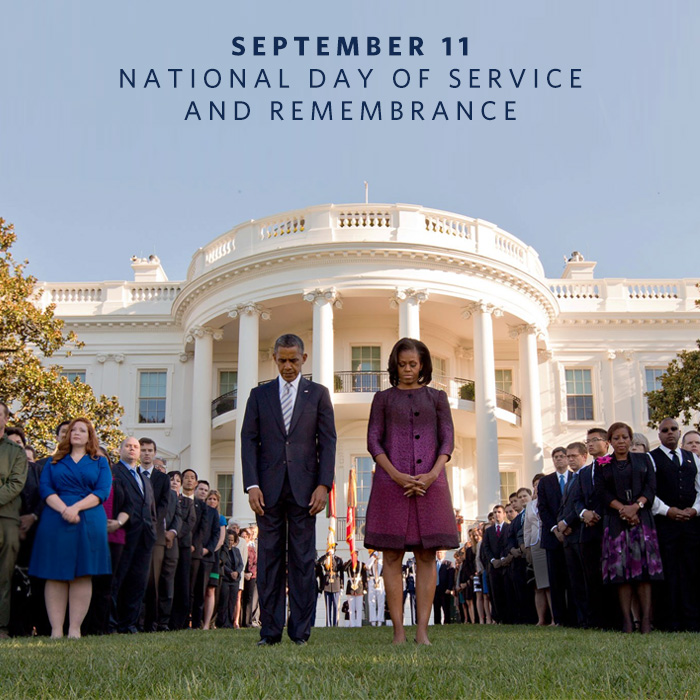
Before I take your questions, I just wanted to note, as many of you know, early today in honor of the 12th anniversary of the September 11th attacks, the President, the First Lady, the Vice President and Dr. Biden led White House staff in observing a moment of silence on the South Lawn.

Throughout the day, the President, First Lady, Vice President, Dr. Biden and members of the Cabinet will be participating in a number of memorial events here in D.C., also in Virginia and New York, Pennsylvania and other states.

As you know, this morning, the President joined Secretary Hagel and General Dempsey at an event at the Pentagon, where he delivered remarks and participated in a wreath-laying ceremony to honor the victims of the attack there.

In the afternoon, he will participate in a service project to commemorate the September 11th National Day of Service and Remembrance.  The First Lady will visit with military children and families at the new USO Warrior and Family Center at Fort Belvoir.  The largest center in USO history, the USO Warrior and Family Center supports wounded, ill and injured troops, their families and caregivers, as well as local active-duty troops.

During Mrs. Obama’s visit, she will participate in an activity making patriotic crafts with military children.

This evening, the Vice President and Dr. Biden will host a barbeque for wounded warriors and their families at the Naval Observatory.  And, as I mentioned, members of the Cabinet are participating in events across the country, including at memorial events in New York City and in Shanksville, Pennsylvania.

With that, I’ll take your questions.  Julie Pace.

Q    Thanks, Jay.  I had a question about the decision the President announced last night to delay votes in Congress while pursuing this diplomatic track on Syria.  So much of the conversation about the diplomatic track has been from the administration saying that it’s only feasible because of the pressure and the threat of a military strike.  But if you pull back on the votes, then don’t you ease up on the possibility of a military strike?  Don’t you make that less imminent?

MR. CARNEY:  What the President said is that he believed it was the right thing to do for Congress to postpone a vote.  Congress is obviously continuing to work on this issue.  And a number of members have begun looking at resolutions that might take into account the diplomatic avenues that are being pursued, and that is certainly worthy of pursuit.  And we’re in consultations with Congress about that.

There is no question that the credible threat of U.S. military force brought us this diplomatic opening.  Until two days ago, Syria did not even acknowledge that it possessed chemical weapons.  We have seen more cooperation and helpful activity on this matter from the Russians in the last two days than we’ve seen in the last two years.  And I think that is clearly because of the President’s forceful comments about the need to hold Bashar al-Assad accountable for the use of chemical weapons against his own civilians.

So we are doing the responsible thing here, which is testing the potential here for success of resolving this matter of Syria’s possession of chemical weapons and deterring Syria from using chemical weapons again through diplomatic means rather than military means.

Q    Do you have a timeline for when you need to see some kind of tangible progress on the diplomatic front before going back to the Hill?

MR. CARNEY:  I don’t have a timeline to give to you.  What I can say is that it obviously will take some time.  There are technical aspects involved in developing a plan for securing Syria’s chemical weapons and verifying their location and putting them under international control.

Secretary Kerry is leaving for Geneva, as you know, at the President’s request to meet with his Russian counterpart, Foreign Minister Lavrov, where they will discuss this matter.  And each side -- the American and the Russian side -- will bring technical experts, so bringing a team, a delegation to evaluate the proposal and to assess paths forward.

So I expect that this will take some time.  But we also are not interested in delaying tactics.  And we believe it's very important to hold Assad accountable. 

What is I think very clarifying about this is, as the President made clear all along, the potential use of limited military strikes by the United States was in response to Assad's use of chemical weapons.  It was not, as he said, an effort to involve the United States militarily directly in the Syrian civil war.  It was not designed to precipitate regime change.  It was around the question of chemical weapons.  And if Assad's chemical weapon stockpiles can be secured and removed from his position absent military force, that would be a very good thing.

Q    But I know you're not going to give us sort of a specific date for when you want something to be done by or want some sign of progress.  But in talking to experts about this process, this is something that could take months, even years to carry out.  So don't we need to give some sort of firmer timetable for when you need to see progress?  Otherwise, this could just drag out and become a delaying tactic.

MR. CARNEY:  Well, again, let's be clear.  This initiative has been presented only in recent days.  We are deploying the Secretary of State to meet with his Russian counterpart in Geneva.  And these discussions will take place. 

Separate from that, there are discussions in New York at the United Nations around framing a United Nations Security Council resolution on this issue and on the removal from Assad's control of his chemical weapon stockpile.  So let's be clear -- I don't want to suggest, because it's certainly not the case that we are interested in a delay or avoidance of accountability here.  And there are steps in this process, if it were to succeed, and that is obviously a demonstration of sincerity and a verifiable way to secure the weapons and remove them from Assad's control, ultimately to destroy them.

And the fulfillment of that process would certainly take some time.  But the implementation of it could begin obviously before its completion.  And we're going to work with the Russians.  And it would be irresponsible not to explore this potential diplomatic resolution of this very serious matter.

Mark.

Q    Could you talk about what the President expects from the diplomatic process?  Has the United States seen the French draft resolution?  And would the use of force in the failure of diplomacy need to be part of any U.N. resolution, the possibility of use of force, I guess?

MR. CARNEY:  I'm not going to draft a U.N. Security Council resolution from here.  That's a process that will take place up at the U.N.  And we are working within the P3, with Great Britain and France on that, and obviously within the broader P5.

Separately, in Geneva, Secretary Kerry will meet with Foreign Minister Lavrov to explore the path forward when it comes to how we would go about securing Assad's chemical weapons, identifying, verifying, securing, and ultimately removing from his possession those weapons with the final goal of destroying them.

So this is a process that will take a certain amount of time, but it needs to be credible.  It needs to be verifiable.  And we will work with our allies and partners to test whether or not that can be achieved.

Q    Has the President spoken with Putin since last night or since the discussions in Russia?  And what does the President hope for Kerry to achieve with Lavrov?

MR. CARNEY:  I don’t have any presidential calls to read out with foreign leaders today.  The President hopes that Secretary Kerry will be able to work with Foreign Minister Lavrov on the Russian proposal, the very explicit Russian proposal to have Syria’s chemical weapons stockpile secured, removed from Assad’s possession, placed under control of the international community and ultimately destroyed.

And I think that it’s important to note one of the milestones here that was crossed -- there are several -- Syria saying, after 20 years of denying that they possess chemical weapons and refusing to sign the Chemical Weapons Convention, suddenly acknowledging that they possess those weapons and suggesting that they would sign the Chemical Weapons Convention -- that is significant. 

Two, Russia, after two years of blocking efforts at the United Nations and elsewhere to hold Assad accountable, broadly speaking, and hold Assad accountable for his chemical weapons stockpile, now playing -- or at least suggesting that it wants to play a constructive role towards preventing Assad from ever using those weapons again -- this is significant. 

And I think that it demonstrates that Russia is now putting its prestige on the line when it comes to moving further along this diplomatic avenue.  Russia is Assad’s and Syria’s closest ally.  Russia has played the role of blocking international efforts thus far to hold Assad accountable.  And the proposition that they put forward to deal with Assad’s chemical weapons presents a real opportunity, if it were to be successful.

Q    Let’s jump around.  The Brazilian Foreign Minister is meeting with Susan Rice today to talk about surveillance.  Brazil’s President has asked for the full explanation about what U.S. surveillance activities have been involving Brazil, rather than sort of a drip-drip, as new leaks become public.  What message is Susan Rice going to give the Brazilian Foreign Minister about surveillance this afternoon?

MR. CARNEY:  I don't have a specific preview to give you.  I can tell you that the President obviously spoke with his Brazilian counterpart at the G20 and this subject was part of that conversation.  The President spoke about this in his press conference in St. Petersburg, and so I would point you to what he said.  That's entirely consistent with what our National Security Advisor Susan Rice will be discussing with her counterpart later today.

We obviously, like most nations, collect intelligence.  And when it comes to revelations on specific countries, we're not going to get into specifics about the intelligence that we collect, but I would point you to what the President said on Friday.

Jim.

Q    Jay, I wanted to get back to the speech last night and some of the criticism that the President received in response to that speech.  Some of the polling that came out after the speech was not exactly excellent.  Some of the members of your administration were taking to Twitter to rebuff some of the comments that were being made by various columnists.  And I'm just curious -- when you go back to the speech, it seems like the President was saying we need action, but it’s not going to be another Iraq; but we're not going to put boots on the ground; but we don't do pinpricks.  It just seemed like a tough case to make because there were so many twists and turns in the speech, that there really were just so many inherent conflicts in the speech that it wasn’t a clear case that he was making to the American people last night.

MR. CARNEY:  I think your question makes it more complicated than it is.  When it comes to the use of military force this is a proposed limited military strike, limited in scope and duration, that would have significant effect on Assad’s capabilities.  But -- and there’s only one “but,” not three -- but it would not be -- and it is important that the American people understand this -- it would not be an engagement that places American boots on the ground.  It would not be the kind of open-ended, large-scale military engagement that we saw in Afghanistan and Iraq.  It would not even be of the size and scope of the Libya operation, or the Kosovo operation in the late ‘90s.

So those are significant distinctions that need to be made.  Because, understandably, as the President made clear, the American people and their representatives are, understandably and justifiably, weary of military conflict and wary of new military conflict.  The President is completely understanding of that dynamic.  And insta-polls notwithstanding, he understood going in that this would be a tough case to make.  He has made that clear from the beginning since he announced that he wanted to go to Congress for authorization.  And he made that clear last night I think in very sincere terms, where he addressed specifically one by one the concerns that the American people have. 

He talked about letters that he received from Americans on this specific issue about this question of whether or not the United States should be the world’s policeman, whether or not it’s in the U.S. interest to involve itself in a civil war in the Middle East.  These are understandable questions and understandable anxieties, and the President addressed them last night. 

And the job that he set out to achieve last night was to lay out for the American people why Syria and the use of chemical weapons in Syria matter to the United States; why we are sure that Assad and his regime are responsible for deploying those chemical weapons against innocent civilians; why it is in, ultimately, our national security interest to hold Assad accountable for the use of chemical weapons; and why the international community, broadly, has as its interest --

Q    So what do you to account for the -- I mean, it seemed like there was a lot of negative reactions to the speech.  How do you account for that?

MR. CARNEY:  Well, I’m not sure that that’s the case.  I think that the commentary that I saw reflected where the American people are, where commentators are, experts are, members of Congress are, which is conflicted.  There’s very little dissension about whether or not a chemical weapons attack occurred; in fact, I’ve heard none in this country.  There’s zero disagreement with the assertion that the Assad regime is responsible.  There is zero [disagreement] that I’ve seen, at least from lawmakers, that it is in our national security interest to maintain the prohibition on the use of chemical weapons.

The question is do we need to take military action in order to enforce that prohibition.  That’s never a desirable option.  Prior to 48 or 72 hours ago, there were no diplomatic avenues open to resolve this.  Now that Russia has put forward a potential diplomatic avenue, we are going to explore it.  That is a responsible thing to do.  But it remains the case that this is a very serious matter; that, in the long term, if unchallenged, if Assad is not held accountable, would make the world a more dangerous place for the United States and for our allies.

Q    And earlier this morning, some pretty notable Republican senators came out and said that they would be voting “no” for authorization of use of force.  And I’m just curious, as of yesterday, how did you think the vote was going to go?

MR. CARNEY:  Look, I think the President acknowledged from the beginning that this would be a challenge.  We have presented a great deal of information to members of Congress, both in the House and the Senate, and we are continuing to do that today in briefings and will continue to do that moving forward.  Congress has only been back in town for a day and a half.

Q    Were there concerns about the vote not going your way?  And did those concerns have anything to do with the President’s decision to ask for a delay of that vote?

MR. CARNEY:  I think it’s important to note that we set the speech, the President was going to make his case, and that’s the case that he did make last night.  Part of the case now is the opening that has been provided here:  the possibility of resolving this through diplomatic means.

But the President went forward and made the case for why we should hold Assad accountable last night.  And that’s the position he held prior to this diplomatic opening and it’s the position he holds today.

Jon.

Q    Jay, did the President consider at all cancelling the speech?

MR. CARNEY:  No.

Q    Because the original intent when you called for it on Friday was to make the case for military action and to make the case for Congress to pass this resolution with both clearly delayed.  No consideration whatsoever to cancelling?

MR. CARNEY:  I would be intimately involved in that consideration and it did not take place.  And the reason for that is that it is still very important for the President to speak to the American people about what he views to be necessary in response to this appalling attack by the Syrian regime against its own people; and to put forward to the American people the context of this discussion from his point of view as Commander-in-Chief and President, and to explain also the now potential diplomatic avenue that has been opened that could allow us to resolve this without resorting to military force.

So absolutely, the President -- we never considered canceling.  The President believed it was a useful thing to do to have the opportunity to speak to the American people.  And this is something -- gone are the days when even a speech like that is seen by the vast majority of Americans.  And we will continue to have this discussion, as we have over the last several days -- or the President has -- through interviews in the days ahead.

Q    And just trying to get a direct answer to what Jim was asking.  Clearly, the threat of force, as you've said over and over again, helps the diplomacy.  It's why the diplomatic opening happened.  So if you could have gotten that vote from Congress, it helps the diplomacy.  You asked for -- the President asked for a delay in that vote because he didn't have the votes.

MR. CARNEY:  The President asked for a delay in that vote because we're engaged in diplomatic -- exploring a diplomatic avenue.  And members of Congress are interested also in exploring that diplomatic avenue, as you've seen in some of the actions that they've taken with regards to potential resolutions.  The President thought that was an appropriate thing to do.

What remains true is that the credible threat of U.S. military action is on the table.  And it is because that threat is on the table that we have seen the kind of about-face from the Syrians that we've seen in these last several days.  And we've seen the constructive approach that the Russians have taken in the last several days.  And that remains.  And the President made clear last night that his military remains on the same status that it was and remains ready to implement an operation if necessary.

Q    But Dianne Feinstein said that she believes that Putin really wants to end this.  Does the White House have a similar confidence that Vladimir Putin is acting in good faith on this?

MR. CARNEY:  What the President said in one of his interviews is that we should approach this in the way that Ronald Reagan memorably did when he was dealing with his counterparts, and that is to trust but verify.  It is simply the case that Russia has not been constructive or helpful on this matter for the last two years.  But there is an opportunity here, and they have laid it out pretty specifically, for Russia to be helpful, to help create a scenario where we could secure Assad's chemical weapons, place them under international control and ultimately destroy them so they can never be used again.

And so I think that that -- it is absolutely the right thing to do and the responsible thing to do to explore this potential avenue.  We, of course, remain skeptical of any commitments that Syria is making.  The Assad regime has not shown itself particularly consistent in keeping its commitments, but it is absolutely the right thing to do to explore this possibility.

Q    And then just one last technical question.  Should this agreement also include Assad turning over his biological weapons?

MR. CARNEY:  I'll have to defer that to the experts who are negotiating this, perhaps the State Department or others -- the team that's going with Secretary Kerry.  What is obviously directly of concern here was the use of chemical weapons by the Assad regime.  But I think that's a question that's worth following up on.

Q    I know you don't want to negotiate the resolution here, but if you are asserting, as you have, that military force was an important -- the threat of it was an important component about this development, you certainly can't say that the U.S. government would be willing to take that off the table in the context of a resolution before the U.N. Security Council, would you?

MR. CARNEY:  Well, we haven’t taken it off the table.

Q    So that would be something that would have to be included, then?

MR. CARNEY:  Again, I'm not going to negotiate a United Nations Security Council resolution.  What I'm saying is echoing what the President said last night, which is he believes that absent the success of a diplomatic initiative like this that verifiably removes chemical weapons from Assad’s control, the right course of action is to engage in a limited operation, as we've described over these past several days.

Q    But would not including that in a U.N. resolution increase this international buy-in to uphold the standard and apply a sanction to a country that used chemical weapons -- all consistent with the goals the President has set forth in --

MR. CARNEY:  I think it’s simply too early to begin from here to pinpoint what must be in a United Nations Security Council resolution beyond a verifiable process for removing chemical weapons from Assad’s control into international control.

Q    Picking up on that word “verifiable,” you are no doubt aware of the difficulties that many experts have raised in the last 24 hours about verifying removal of chemical weapons in many scattered stockpiles in the midst of a civil war.  How difficult a task is that?  And does that present practical problems that could be separate from the diplomatic language involved to make this workable?

MR. CARNEY:  I don't doubt that this would be a complex operation, which is why it has to be verifiable, which is why Syria would have to keep any commitment it made to allow for this process and to facilitate this process, and why Russia obviously, as the nation that proposed this avenue, would have to engage directly in verifying it and making it happen. 

I think that it’s important, as I noted earlier, to say that by making this proposal Russia has, I think to its credit, put its prestige on the line when it comes to its close ally and the activities of its close ally.  And it’s clearly in the world’s interest that Assad give up his chemical weapons so that he can never use them again.  That would resolve the specific matter at hand here, which is a point that I and others have been making over these past weeks, which is the issue of chemical weapons and their use in Syria by Assad is obviously related to the context of the civil war but it is distinct from our policy towards the opposition and the civil war itself, and the fact that resolution of that conflict has to be brought about through political negotiation.

Q    And when you say “prestige,” what exactly do you mean?  That Russia has to deliver Syrian compliance?

MR. CARNEY:  I'm saying that every participant in this process would have a stake in seeing it bear fruit.

Q    But you didn’t say Syria’s prestige is on the line; you said Russia’s.  So what you're saying is this is something that Russia has to deliver on the world stage now?

MR. CARNEY:  I'm saying that Russia has stepped forward and put this proposal on the table.  A Russian delegation is going to work with an American delegation in Geneva on some of the technical details of it.  There are discussions in New York at the United Nations around what a Security Council resolution would look like.  We are very interested in having a U.N. Security Council resolution.  And I think this whole process will test the seriousness of all participants, and it is absolutely the right thing to do to pursue this and see if it can bear fruit.

Q    Lastly, you said you're skeptical.  Are you more skeptical or optimistic?

MR. CARNEY:  I think this is far too complex an issue to reduce to single phrases or words.  I would say that it would be a good thing if we were able to resolve this through diplomatic means.  Syria has not shown itself particularly credible in the past on these matters.  Russia has obviously not played a very constructive role at the United Nations on these matters.  But the proposal they put forward is very specific; Syria’s reaction to it changes the position they’ve held for years and is a total about-face from the position Bashar al-Assad held three days ago. And that is significant.

So it is absolutely the right thing to do to test whether or not this can be a success.

Q    Jay, I want to ask you about Syria.  But, first, another resolution -- the CR, the continuing resolution; the House may bring it up as early as tomorrow.  There’s obviously something you may want to weigh in on before about health care funding being tied in there.  But more broadly than a fight over that, does the White House feel there’s any progress being made on those talks at all in terms of preventing a government shutdown?  Where are we right now?

MR. CARNEY:  Well, we clearly believe --

Q    -- we’ve been talking about other issues --

MR. CARNEY:  Sure.  No, it’s certainly the case that we haven't had this conversation in a little while.  But our view is that Congress needs to act to avoid a shutdown.  Washington should not engage in an activity that creates more self-inflicted wounds on the economy, and a shutdown would do just that at a time when we've created, since the Great Recession, 7.5 million private sector jobs, when we've seen steady economic growth, we've seen improvements in a housing market that was obviously in dire straits during the recession.  And we are continuing to make progress.  There is certainly more work to do, and allowing a government shutdown for ideological reasons would be hugely counterproductive.

So we haven't seen any bill yet.  Our position obviously is that we will not accept anything that delays or defunds Obamacare.  Again, threatening a government shutdown over an ideological position is not something most Americans would believe is the right thing to do.  Harming the economy to refight old political battles, to refight a battle that was waged and ended when Congress passed the law -- the President signed the law, the Supreme Court upheld the law -- is not in the interest of the American middle class.  So we would obviously oppose that.
Q    Back on Syria.  There were several times you have said there has been an about-face by Syria because of this credible threat of military action by the President.  How then do you explain Secretary Kerry on Monday saying that any U.S. military action would be "unbelievably small"?  Was that a gaffe?  Because I'm not sure Assad would think "unbelievably small" would sort of scare him to the table, would it?

MR. CARNEY:  I took this question the other day.  I think you weren't here.  But the Secretary was describing the proposed military action in contrast to the large-scale, open-ended ground invasion-type operations that we've seen in Afghanistan and Iraq.

As the President made clear, even the kind of operation that we were contemplating, that we are contemplating is not a pinprick.  It would have a serious effect on Assad's capabilities, specifically his capabilities when it comes to carrying out further chemical weapons attacks.  And it would have the effect of deterring Assad from using chemical weapons again.

And deterrence is a key factor here.  The goal of military action is to prevent Assad from using chemical weapons again, to deter their use.  And the pursuit of this diplomatic channel, this diplomatic avenue towards relieving from his possession that chemical weapons stockpile obviously has as its ultimate goal deterring Assad from using chemical weapons again in the future.

Q    Having said that, on Monday, Secretary Kerry also downplayed the idea that Russia could be helpful here.  And more importantly, perhaps, Ambassador Rice gave an important speech on Monday where she specifically said the President "would much prefer the backing of the United Nations Security Council.  But let's be realistic, it's just not going to happen now.  Believe me, I know.  I was there for all those U.N. debates."  And I won't belabor it.  But she said, I was there for two and a half years; Russia has never been helpful in this process.  What has changed since Monday?  It's only been 48 hours.  Is this just a fig leaf to buy you more time?

MR. CARNEY:  What I think has changed -- and I would point you to the on-the-record statements by Russian government officials as well as Syrian government officials -- is the threat of U.S. military action.  And as I think has been reported and we've said, we have had conversations with the Russians -- going back to the G20 in Los Cabos, between President Putin and President Obama -- general conversations about the need to deal with the threat posed by Syria's chemical weapons stockpile.  Those conversations continued in various forms between Secretary Kerry and Foreign Minister Lavrov.  They were one of the topics of conversation between President Obama and President Putin in St. Petersburg.

But Susan Rice's comments and Secretary Kerry's comments reflected the reality that we had dealt with as a nation when it came to Russia's disposition on this matter.  And it wasn't until -- because private conversations are one thing, but it wasn't until Foreign Minister Lavrov explicitly and publicly put forward a proposal to act on the need to secure Syria's chemical weapons -- to remove them from Assad's control, to place them under international control and ultimately destroy them -- that that avenue was open.  Because prior to that, based on past experience, there was not a lot of optimism about resolving this diplomatically with Russia's help, given the role that Russia had played in the past.

Now, Russia has made this proposal.  Russia is engaging with the United States and other members of the United Nations Security Council and other participants in this process.  And we will see where it leads.  It is certainly too early to tell if it will be successful.  And there is certainly reason to be skeptical, and we are entering this with our eyes wide open.  But it is particularly -- because as the President has said, our military commanders, his military commanders have assured him that the military is ready and that waiting for a certain period of time will not negatively affect their ability to inflict the kind of damage that we envision on Assad's capabilities, if that were to become necessary.  We should pursue this diplomatic avenue, and we are.

Q    Two other quick ones, though.  If, in fact -- I've heard this line that for months these talks were going on with the Russians, talking about the possibility of them playing a positive role in Syria, and that this wasn't just sort of thrown out there by Secretary Kerry on Monday; it wasn't a gaffe, that this had been privately worked on.  If that is true, why would you have canceled the summit back on August 7th?  If all of this great progress was happening behind the scenes, why would you put out a press release under your name on August 7th, saying we're not making progress with the Russians, so we're not going to have a one-on-one summit with Putin, because it's just not fruitful? 

MR. CARNEY:  Well, I understand that some may doubt President Obama's word or Secretary Kerry's word.  But perhaps the fact that Foreign Minister Lavrov or President Putin have said --

Q    No, you said that we were not making progress, on August 7th, so we're not going to have a summit.

MR. CARNEY:  Well, first of all --

Q    So how do you trust Putin now?  All of a sudden, this is the -- 

MR. CARNEY:  I just said in answer to your last question that we had made no progress.  We were having these conversations, but there was no indication prior to Foreign Minister Lavrov's public statement that this avenue would be pursued.  And it's a welcome development.  But given Russia's past positions, there was very little optimism that Russia would take this course.  And it is a welcome development that Russia seems to be willing to take this course, and certainly a welcome
development that Syria has suddenly -- three days after Assad himself denied possessing chemical weapons -- acknowledged that they possess chemical weapons, and now said, after 20 years of refusing to sign the CBW -- sorry, the CWC -- said it wants to sign the Chemical Weapons Convention.

So there’s no question that these are significant changes from positions held in the past -- in the very recent past.  But, again, the point I was making is it’s not just President Obama or Secretary Kerry who have said, or their aides, who have said that these conversations had taken place; Foreign Minister Lavrov and President Putin have said that these conversations have taken place.  What they had not produced prior to earlier this week was any actual action towards a diplomatic resolution of this matter.

Q    Last one.  You mentioned the President’s words.  Senator McCain, Senator Graham came out of the Oval Office after meeting with the President a week ago Monday, and they said then out in the driveway and then in subsequent interviews that the President assured them in private that he was going to make a bigger push on helping the Syrian Free Army, the rebels in Syria, and that this would be part of the public case.  And that was part of the reason why McCain came out here and said that he was relatively supportive of the effort.  Today Senator McCain is saying he’s stunned that the President didn’t mention the Syrian Free Army last night.  What happened?  Why were they --

MR. CARNEY:  I think “stunned” is your words.  I think he said he wished he had heard that.  But if I could, Ed, we have always maintained that there is a distinction between a military response to Assad’s use of chemical weapons against his own people and our policy of supporting the Syria opposition -- support that has increased significantly in recent months and that is aimed towards supporting the opposition so that it can withstand the assault that Assad has been perpetrating against it and against the Syrian people, and that will ultimately lead to a political settlement.  That’s our position. 

We had said and have said, and I say today that a military, strike, if it were deployed, would degrade Assad’s capabilities, specifically his capabilities when it comes to using chemical weapons, and would no doubt have an overall impact on his capabilities.  But it was specifically and explicitly not designed to precipitate regime change.  And it was not designed to begin a long-term engagement by the U.S. military in a Syrian civil war that can only be resolved, in our view, through a political settlement.

Peter, and then I'm going to move around.

Q    Following up briefly on what Ed said, Jay.  Let’s say that Assad gives up his chemical weapons, does that mean that he would get to kill civilians with conventional weapons for an indefinite period of time without U.S. action?

MR. CARNEY:  The U.S. has been acting in its explicit and substantial support for the opposition in Syria.  What we have said for two years now is that we're not putting boots on the ground in Syria; we're not engaging directly with our military in a Syrian civil war that can only be resolved through political negotiation.  And that will remain the case even if there is a military strike in response to Assad’s use of chemical weapons.  We've been extremely explicit about that.  And the President repeated that last night.

So the fact of the matter is we support the Syrian opposition.  We provide support to the military opposition.  We provide substantial humanitarian support to the Syrian people.  And we will continue to do that moving forward.  We believe, as the Russians do and so many other nations do, that the only resolution here that we, collectively -- the international community -- should seek is a political settlement, because that offers the best hope for the Syrian nation, for the maintenance of a Syrian state, and a better future for that country.

So we will continue to work with Congress, including Senators McCain and Graham, on that policy.  But it is distinct from a response to Assad’s chemical weapons use.

Q    On the topic of boots on the ground, U.N. inspectors, when they recently were in Syria in their efforts to try to gather evidence at some of those neighborhoods and communities that were attacked, were attacked again at that time.  I guess the question is, if there is to be some form of an agreement that requires the confiscation or the shutting down, the dumping in some form of Syria’s chemical weapons, the President promised last night there would be no boots on the ground attached to military action.  Would there be no American boots on the ground attached to an effort to confiscate or to dump chemical weapons?  Does it apply to that as well?  No American troops in Syria whatsoever?

MR. CARNEY:  We do not envision boots on the ground.  That is our policy.  And we are not participating in the Syrian civil war in a direct military way.  We are providing support to the Syrian military opposition and to the Syrian people. 

The process by which chemical weapons would be identified, verified, secured, and removed from Assad’s control is obviously a complicated one, and that will be discussed in Geneva and I'm sure in New York.  And I'm not -- again, I don't pretend to know all the parameters of what that would look like.  It would clearly -- going to Syria’s commitments here -- require Syria’s acceptance of the fact that it is giving up its chemical weapons. And that would require cooperation from Syria in making that happen.

Q    So just to be very clear, so the pledge, “no boots on the ground,” at this time it’s too early to dictate whether or not that would apply to any U.S. involvement in --

MR. CARNEY:  There are going to be no boots on ground involved in Syria’s civil war.  And the President could not have been clearer about that on many occasions.

Q    Final question, if I can, very briefly.  NBC News has been on the ground in Syria.  A Free Syrian Army commander told us immediately after the President’s remarks, “Bashar al-Assad won this battle.”  He said, “The U.S. doesn’t seem to care about Syrian losses.  There will be more victims and more destruction.”  What do you say to the Free Syrian Army?

MR. CARNEY:  I say that this administration, the United States supports the Syrian opposition and has provided stepped-up support to the Syrian opposition, and will continue to do that.

But we have been explicit that the military response contemplated had to do with Assad’s use of chemical weapons.  It was never envisioned as a means by which the United States would engage directly, militarily in the Syrian civil war.  It is a proposed limited strike, limited in scope and time, designed specifically as a response to hold Assad accountable for the use of chemical weapons against his own people.

Margaret, and then Carol.

Q    Thanks, Jay.  Does the prospect of this diplomatic resolution now allow the White House to refocus more of its attention with Congress on the domestic agenda?  And besides the debt ceiling and Obamacare, what are sort of those issues you want to get back to?  And could you also help me to understand whether the path that this thing is taking with Syria is likely to make -- to strengthen or to weaken the President’s hand?  In other words, do you think that Republicans will see it as he blinked and he’ll continue to blink if they do standoffs with him?  Or do you think they will see it as he sought our vote on authorization and he wants to be cooperative and we should be cooperative?

MR. CARNEY:  He, being?

Q    The President of the United States.

MR. CARNEY:  I'll try that one first and get to your other question.  I think members of Congress understand -- Republican and Democrat -- that it was the credible threat of U.S. military action that led to the opening of this diplomatic avenue.  There is no other explanation behind this rather remarkable change of position by the Syrians, and no other explanation behind the decision by the Russians to seek a diplomatic resolution of the problem of Syria’s chemical weapons stockpile.  And I think that members of Congress understand that.

So what they see through their eyes, you’ll have to ask them.  But I think a number of them have noted that, and that is why we have to keep the pressure on. 

When it comes to other matters, there’s no question that Syria has consumed a lot of attention here in Washington, around the country, around the world.  That's the way these things are. The President remains committed to pushing forward on an economic agenda that creates a better bargain for the middle class, that focuses on middle-class security, the opportunities of providing education to America’s children, and to making the necessary investments in our economy so that we can continue to grow out of the worst recession since the Great Depression.

And absolutely, the President will be focusing on those issues in the coming weeks and months, because they’re so important to the American people and they’re so vital to the long-term future of this country.

Q    Can I just clarify?  So are you saying, on that other question, that you think that Syria has no impact on this domestic political hand, or weakens, or strengthens it?

MR. CARNEY:  I'm not going to make a political assessment.  I think that what the President has been discussing here and what he has sought from Congress is a sincere debate about whether or not Congress should authorize the use of force in this case -- a debate that ideally sets aside political affiliation and focuses on the stakes for the United States, the consequences of not upholding this prohibition against chemical weapons use, and the risks of acting and the risks of not acting.

And I think we've seen a healthy debate.  I don't think it’s been completely devoid of politics, but I think generally it’s been healthy.  And the President appreciates that.  And you’ve seen his administration at every level engage with Congress in any way that it can to provide more information about this very important issue.

Q    And just, sorry -- we understand from the Russians that Russia has submitted to the U.S. the plan -- an initial plan for Syria.  Do you have any reaction to that initial plan?  Have you released the text, or are you releasing the text?

MR. CARNEY:  Again, I think there are -- I know there are conversations ongoing and paper being exchanged.  I don't know that there’s a formal plan to present anywhere.  I think that the United Nations Security Council will be meeting.  I know that Secretary Kerry and Foreign Minister Lavrov will be meeting with substantial teams in Geneva.  I think we're not at the stage of putting down public pieces of paper.

Carol, and then Mara.

Q    I want to go back to the timing question.  You’ve said a number of times it will take -- the diplomatic process will take some time, a certain amount of time.  Isn't that just stating the obvious?

MR. CARNEY:  Yes.  (Laughter.) 

Q    So can you put a little sharper point on that?  I mean, you're asking -- you have a President out there addressing the American people in a primetime address and saying this is a national security threat and that he’s going to take this opportunity -- he wants the American people to give him time to do this.  So what are people supposed to expect?  Are you talking days, weeks?

MR. CARNEY:  The timeline for this, appropriately, will be worked out at the United Nations Security Council.  The P5 is meeting this afternoon, as I understand it.  And then other aspects of this, more technical aspects, the implementation aspects of it will be discussed in Geneva between Secretary Kerry and Foreign Minister Lavrov and their teams.

So I'm not going to place a timeline on it except that, as I said earlier, we're not interested in delay or avoidance.  We have ample reason to be skeptical about Syria’s commitments and intentions.  But you don't negotiate these kinds of things with partners that have always been willing, or with interlocutors that have always been helpful.  You wouldn't have to.  These kinds of things come about because, in this case, pressure has been placed on Syria to change its position.  And Russia has decided to put forward what could be a very positive path forward to resolve this diplomatically.  But we're not there yet and that's going to take some time.

Q    Just two other quick things.  When you say that you're not interested in delay and avoidance, what types of benchmarks or what are you looking for?  And what would signal delay and avoidance?  And at what point do you cut ties and go back to Congress and ask for authorization for force?

MR. CARNEY:  Again, I'm not going to place a date on it or a time limit on it.  I think that over the course of our discussions in New York and Geneva and what continues out of those discussions -- because I don't want to suggest that all of this could possibly be wrapped up by Friday; let me assure you that it won't be.  But we will begin to see how serious the opportunity is here, how committed the participants are in making this happen.  And we'll be able to make assessments as this process moves forward.

Q    And then, lastly, just -- it also has to do with the timing.  On Russia's involvement in this, do you guys feel like while they're involved and engaged in this -- as a former White House Chief of Staff might say, they have skin in the game -- does that give you confidence that Assad will not use chemical weapons again because it would embarrass President Putin?

MR. CARNEY:  I think it's impossible to know with certainty.  But it is certainly the case that Russia has been Assad's closest ally.  Russia has essentially protected Assad from being held accountable by the international community, by the United Nations Security Council.  Assad depends on Russia in many ways for support.  And so it stands to reason, based on all those facts, that Assad would care about the position that Russia holds on this specific matter. 

And we've seen that.  Russia makes a proposal; Syria has accepted it.  Syria has volunteered the possibility that it might sign the Chemical Weapons Convention.  I don't think any of Syria's actions would have taken place prior to Russia putting forward its proposed solution.  And how that relationship plays out as these diplomatic discussions are being held is certainly one that will be fascinating to watch for everyone. 

Q    It sounds like you have some confidence in that.

MR. CARNEY:   I think that the logical assessment based on the relationship is that there will be some coordination.  But it's impossible to know for sure. 

Q    Both supporters and opponents of the resolution in Congress all say that you're right to pursue this diplomatic opening, whether it pans out or not.  If it doesn’t -- which I guess is the greater likelihood here -- do you feel that your hand would be strengthened to get Democratic votes for a resolution?

MR. CARNEY:  I just wouldn't guess about what a vote count might look like in the aftermath of the pursuit of this diplomatic opening.  And I certainly wouldn't get into hypotheticals about whether it succeeds or fails or anything like that.  I think that this is a tough issue.  The President knew it was going to be a tough issue.  He knew it was going to be a challenge when he decided that it was the right thing to do to ask Congress for authorization. 

He knew and knows and understands that the American people are extremely reluctant to get the United States involved again militarily in the Middle East -- not just in the Middle East, but anywhere.  But as someone who deeply understands that, and who has spent four and a half years as President getting us out of wars, he believes in the case that he made last night, and I think he understands why there's reluctance and why there's anxiety about potentially striking Syria in response to the use of chemical weapons. 

But he views this as something that has long-term implications for U.S. national security, long-term implications for U.S. troops serving in theater in the future.  If the Chemical Weapons Convention and the prohibition against the use of chemical weapons unravels, and Assad is allowed to use them again without repercussions and others see that, and we begin to see the use of chemical weapons in other areas and the potential proliferation of chemical weapons to non-state bad actors, there are potentially hugely negative consequences for the United States and for other nations in the region.

Q    Does that mean that U.S. prestige is on the line, as well as Russia's?

MR. CARNEY:  Well, I think the United States leads in these situations, and it's not always popular and it's not always comfortable.  But we are a unique nation in many ways, the oldest constitutional democracy.  And the responsibilities that we bear when there are crises around the world are unique.  But it is also part of our democratic process and the President's views that we have an open debate about it; that we in this case, because the circumstances allow it, that we have a debate in Congress and a vote potentially on authorization of military force.

Q    Just one practical question.  When Secretary Kerry made his off-the-cuff remarks in London, the last thing he said was it can’t be done, on a practical level it cannot be done; can't get these weapons out of a place that's in the midst of a civil war.  Is that still your conclusion?  Or have you come to a conclusion on whether it's physically possible to do?

MR. CARNEY:  Certainly, it's possible. 

Q    In the midst of a civil war?

MR. CARNEY:  And the fact that it's a challenge -- certainly, you're not suggesting or no one would suggest that because it's difficult we shouldn’t pursue it.

Q    No, we're not suggesting that.

MR. CARNEY:  Because it would certainly achieve our goal, and the international community's goal, to take those chemical weapon stockpiles away from Assad, place them under international control and dispose of them.  That would be an enormous accomplishment -- one of the largest stockpiles in the world under the control of a regime that has been willing to use them.

I'm sorry, Margaret.

Q    Have you come to a conclusion about whether you need a ceasefire to do it?  Have you come to any conclusions?

MR. CARNEY:  Again, I think you're talking about mechanics that are going to be negotiated by experts, that are going to be negotiated at the United Nations Security Council in Geneva between the Russian and U.S. delegations and elsewhere.  But I accept the assessments by experts that this kind of thing isn't easy.  But that doesn’t mean we shouldn't pursue it, because it's obviously a preferable alternative and it achieves the goal that we set out, which is to deter Assad from using chemical weapons in the future to make it clear to him that there are enormous consequences to using those chemical weapons.  And if we can achieve diplomatically that goal without a strike, that would be a good thing. 

Q    Jay, two quick questions.  First, you said earlier that there is no question that the threat of force led to this potential outcome.  And the timing on that is confusing, because two weeks ago when it seemed like force was imminent, it seemed like the President was ready to strike; the Syrians nor the Russians relented.  This week, when it looked like congressional and public opinion was moving against the use of force, making such use even more difficult arguably, they finally relented.  Can you square that circle?

MR. CARNEY:  I think that you're viewing this through a particular Washington and American lens.  I think that there is no question, based on what the Russians have said and the Syrians have said and what we know, that the credible threat of U.S. military action precipitated this.  And I'm not sure what other source you ascribe it to or it could possibly be.  The fact of the matter is the President made clear that even when he decided to go to Congress, that he believes he as Commander-in-Chief and President retains the authority to use a U.S. military strike in defense of our national interests.  And that remains the case today.

But he believed -- because the threat wasn't imminent, the threat posed by Assad's use of chemical weapons -- that it was the right thing to do to seek congressional authorization.  So I don't think there’s any doubt that the credible threat of force has produced this change in dynamic.

Q    And, secondly, the President invoked the Holocaust, international law, crimes against humanity last night in connection to the chemical weapons attack by Assad.  In that context, did the President -- had the President concluded that Assad would constitute a war criminal and should be brought before the ICC for prosecution?

MR. CARNEY:  That's obviously a distinct matter that was not a focus of the President’s remarks.  It’s a not a focus of the discussion right now about using military force in response to the use of chemical weapons or pursuing the diplomatic opening that is currently being explored.  So I would leave that for discussions in the future.

Christi.

Q    Thank you, Jay.  I just wonder if you would agree with the assessment that there’s been a zig-zag quality to the foreign policy at the White House over the last couple of weeks?  I mean, the President was --

MR. CARNEY:  Is that a shout-out to Politico?  (Laughter.)

Q    Well, it’s a good phrase.  (Laughter.)  It seems apt. 

MR. CARNEY:  It seems like a cliché to me.  But --

Q    Okay, well, I mean, how would you put it?  First, the President was talking about international law, then he was talking about norms, then it looked like strikes were imminent, then diplomatic -- this diplomatic solution was being pursued.  I mean, do you agree that maybe --

MR. CARNEY:  And so this approach that has engendered these analyses and criticism and stuff has led to what today? 

Q    Well --

MR. CARNEY:  A complete about-face by the Syrian regime, an acknowledgement for the first time in its existence that they hold chemical weapons --

Q    A complete about-face?

MR. CARNEY:  On it’s possession of chemical weapons -- true or not?

Q    Well, they're saying they're going to turn them over.  Have you seen them? 

MR. CARNEY:  Hey, Ed, we can debate on “Crossfire” one day when we’re both out of our current jobs.  (Laughter.)  But the --

Q    We can arrange that.  (Laughter.)

MR. CARNEY:  Jim is going to set us up.  We’ll talk to Stephanie and Newt. 

But they have completely changed their position about whether they possess chemical weapons.  Syrian government officials aren’t only acknowledging they possess them, they're talking explicitly about why they had them and how they fit into their military arsenal.  That is a --

Q    They're still not taking responsibility for the attack on the 21st, right?  That's not a complete about-face.

MR. CARNEY:  I didn't say that.  And I --

Q    Well, you’re saying a “complete about-face.”  And they're saying they're going to --

MR. CARNEY:  Ed, let’s save it for “Crossfire.”  But on the issues of whether or not Syria possesses -- even Andrei would agree with this -- that Syria possess chemical weapons, it’s true --

Q    Okay, but what you’re saying is that you’ve ended up in a good place.  Would you agree that you’ve sort of zig-zagged your way to it?

MR. CARNEY:  I think that there have been developments along the way that have obviously affected how everyone views this matter.  What has been -- where the President has been consistent is that we cannot, in his view, as a nation or as a responsible international community, accept the flagrant violation of a prohibition against the use of chemical weapons.  Because there’s a price to be paid for that.

And these are hard choices.  And I think in his address last night, the President made clear that he understands how hard these choices are.  But he also made clear why he believes deeply that we have to hold Assad accountable for gassing his own people, for killing his own nation’s children in their beds merely to retain his grasp on power.

Q    But none of those facts changed while the President was changing some -- his approach to it, right?  I mean, the international law versus the international norm argument changed while the facts didn't change. 

MR. CARNEY:  You’re talking about language here.

Q    Or the “unbelievably small” strike versus --

MR. CARNEY:  It’s a chemical -- what language you use to describe it, there is an international prohibition enshrined in the Chemical Weapons Convention signed by 189 nations, representing 98 percent of the world’s population that prohibits the use of chemical weapons.  You can call it a norm or a law, it’s a standard ascribed to by almost the entire world.  And Assad violated it, and that's a serious thing.  And that's the approach the President has taken.

Obviously, when it comes to the change in direction associated with this diplomatic initiative, we acknowledge that and we think it’s a good thing, potentially.  Although we’re healthily skeptical about the process and about the participants given the track record.  But it is absolutely the right thing to explore it.  It would be irresponsible not to explore it.

Andrei, pajalsta.

Q    Spasibo.  Spasibo, Jay.  Last night, the President referred to this new opening as coming in part from his prior constructive talks with Putin.  Frankly, it is not how you described those talks for us.  So if you could explain to us what he meant by saying the talks were constructive, that would be helpful for me.

MR. CARNEY:  Sure.

Q    And also, does the President intend to keep being engaged -- personally engaged in the process?

MR. CARNEY:  I can answer the second one -- yes.

And in the first, I accept your point.  And the point I was making is that even though they were useful and constructive conversations that date all the way back to Los Cabos, what we had not seen -- fair to say -- from the Russians prior to this week was a proposal for action to resolve the fact that its close ally, the Assad regime, possesses chemical weapons, and that those chemical weapons potentially represent a threat not just to the Syrian people, as we’ve already seen, but to people around the region, including potentially the Russian people and the American people.

But the President’s conversation with President Putin in St. Petersburg was constructive, as the President said that day.  And it was constructive on this subject and on other subjects.  And I take your point, and I accept that.  And Foreign Minister Lavrov, Secretary Lavrov has had, in our view, constructive conversations on this issue with Secretary Kerry.

What we had not seen until this week was a willingness by the Russians to actually move forward and act, because obviously they play a very important role in this dynamic given their relationship with Damascus.

Q    And then, secondly, if I may, another point.  Does this new opening and the new feeling of rapport between our nations, does this mean that the Russian arguments on the Syrian issue will now get a new look from Washington?  What I specifically mean is the Russians have been saying throughout that they doubt that the picture of events as presented by the Syrian rebels and by Washington, by the way, is completely accurate and borne out by the facts.  They have produced their own report of a different chemical attack in Aleppo in March, and they have submitted it for the Security Council at the U.N.  Will you now -- well, will the experts now be looking at all the evidence at hand, or are we still focused on --

MR. CARNEY:  Well, I’ll say this, Andrei, there was a U.N. inspection team that was fired upon and almost not allowed to visit the sites of the attacks on August the 21st, but they have obviously been able to conduct an inspection.  And we await, as the Russians do and others do, the results of that report.

We think, and we’ve seen no credible suggestion to the contrary, that it’s undeniable that there was a chemical weapons attack that night, and we think that the evidence is overwhelming that Assad and his regime were responsible for it.

All of these matters, I think, when it comes to other instances of chemical weapons use, appropriately should be reviewed by the United Nations.  And we have always supported that.

Unfortunately, what we have seen by and large has been a refusal of the Assad regime to allow inspections; or in the case of the August 21st events, an effort to delay the inspection so that they could bomb those neighborhoods as much as possible in an effort to destroy evidence.  But we're in a slightly different place now.  And we hope that this process bears some fruit. 

Thanks very much.

END
1:56 P.M. EDT

Remembering September 11th

Today, we honor those who lost their lives on September 11th, 2001.

At 8:46 AM, the time that the first plane struck the South Tower of the World Trade Center, President Obama was joined by the Vice President, the First Lady, Dr. Biden, and White House staff on the South Lawn to observe a moment of silence.

Later that morning, the President, Defense Secretary Hagel, and other military officials attended the September 11th Observance ceremony at the Pentagon Memorial in Arlington. The President laid a wreath at the Zero Age Line and observed a moment of silence at 9:37 to honor the victims of the attack at the Pentagon.

President Obama then delivered remarks to families of the victims, also honoring the four Americans who lost their lives a year ago today in Benghazi.

They left this Earth. They slipped from our grasp.  But it was written, “What the heart has once owned and had, it shall never lose.”  What your families lost in the temporal, in the here and now, is now eternal. The pride that you carry in your hearts, the love that will never die, your loved ones’ everlasting place in America’s heart. 

Pres Obama, Sec. Hagel and Gen. Dempsey at 9/11 Pentagon ceremony

President Obama, Secretary of Defense Chuck Hagel, and General Dempsey attend the September 11th Observance Ceremony at the Pentagon Memorial in Arlington, Virginia, Sept. 11, 2013. (Official White House Photo by Pete Souza)

Read the President's full remarks from the September 11th Observance Ceremony

Later this afternoon, President Obama also participated in a service opportunity with Food & Friends, a Washington-area organization that provides freshly-prepared meals to people living with life-challenging illnesses.

Related Topics: Additional Issues, Virginia

The White House

Office of the Press Secretary

Presidential Nominations Sent to the Senate

NOMINATIONS SENT TO THE SENATE:

Larry Edward André, Jr., of Virginia, a Career Member of the Senior Foreign Service, Class of Counselor, to be Ambassador Extraordinary and Plenipotentiary of the United States of America to the Islamic Republic of Mauritania.

Elizabeth Frawley Bagley, of the District of Columbia, to be an Alternate Representative of the United States of America to the Sixty-eighth Session of the General Assembly of the United Nations.

John P. Carlin, of New York, to be an Assistant Attorney General, vice Lisa O. Monaco, resigned.

Beth F. Cobert, of California, to be Deputy Director for Management, Office of Management and Budget, vice Jeffrey D. Zients, resigned.

Bradley Crowell, of Nevada, to be an Assistant Secretary of Energy (Congressional and Intergovernmental Affairs), vice Jeffrey A. Lane.

Richard G. Frank, of Massachusetts, to be an Assistant Secretary of Health and Human Services, vice Sherry Glied, resigned.

Anthony Luzzatto Gardner, of New York, to be Representative of the United States of America to the European Union, with the rank and status of Ambassador Extraordinary and Plenipotentiary.

Sloan D. Gibson, of the District of Columbia, to be Deputy Secretary of Veterans Affairs, vice W. Scott Gould.

Heather Anne Higginbottom, of the District of Columbia, to be Deputy Secretary of State for Management and Resources, vice Thomas R. Nides, resigned.

Paul Nathan Jaenichen, Sr., of Kentucky, to be Administrator of the Maritime Administration, vice David T. Matsuda, resigned.

Esther Puakela Kia'aina, of Hawaii, to be an Assistant Secretary of the Interior, vice Anthony Marion Babauta.

Helen Meagher La Lime, of the District of Columbia, a Career Member of the Senior Foreign Service, Class of Minister-Counselor, to be Ambassador Extraordinary and Plenipotentiary of the United States of America to the Republic of Angola.

Michael Anderson Lawson, of California, for the rank of Ambassador during his tenure of service as Representative of the United States of America on the Council of the International Civil Aviation Organization.

Barbara Lee, of California, to be a Representative of the United States of America to the Sixty-eighth Session of the General Assembly of the United Nations.

Michael D. Lumpkin, of California, to be an Assistant Secretary of Defense, vice Michael A. Sheehan.

Mark Meadows, of North Carolina, to be a Representative of the United States of America to the Sixty-eighth Session of the General Assembly of the United Nations.

Luis G. Moreno, of Texas, a Career Member of the Senior Foreign Service, Class of Minister-Counselor, to be Ambassador Extraordinary and Plenipotentiary of the United States of America to Jamaica.

Jamie Michael Morin, of Michigan, to be Director of Cost Assessment and Program Evaluation, Department of Defense, vice Christine H. Fox, resigned.

Jo Ann Rooney, of Massachusetts, to be Under Secretary of the Navy, vice Robert O. Work, resigned.

James H. Shelton III, of the District of Columbia, to be Deputy Secretary of Education, vice Anthony W. Miller, resigned.

Christopher Smith, of Texas, to be an Assistant Secretary of Energy (Fossil Energy), vice Charles DeWitt McConnell, resigned.

Theodore Strickland, of Ohio, to be an Alternate Representative of the United States of America to the Sixty-eighth Session of the General Assembly of the United Nations.

Puneet Talwar, of the District of Columbia, to be an Assistant Secretary of State (Political-Military Affairs), vice Andrew J. Shapiro.

George James Tsunis, of New York, to be Ambassador Extraordinary and Plenipotentiary of the United States of America to the Kingdom of Norway.

Victoria Marie Baecher Wassmer, of Illinois, to be Chief Financial Officer, Environmental Protection Agency, vice Barbara J. Bennett, resigned.

David Weil, of Massachusetts, to be Administrator of the Wage and Hour Division, Department of Labor, vice Paul DeCamp.

Roy K. J. Williams, of Ohio, to be Assistant Secretary of Commerce for Economic Development, vice John R. Fernandez, resigned.

Daniel W. Yohannes, of Colorado, to be Representative of the United States of America to the Organization for Economic Cooperation and Development, with the rank of Ambassador.

Stephen N. Zack, of Florida, to be an Alternate Representative of the United States of America to the Sixty-eighth Session of the General Assembly of the United Nations.

The White House

Office of the Press Secretary

Upcoming Guidance on Música Latina: In Performance at the White House

Event includes Evening Performances and Daytime Student Workshop
in Celebration of Hispanic Heritage Month


Monday, September 16 * White House – As part of their In Performance at the White House series, the President and First Lady will invite music artists to the White House for a celebration of Latin music during Hispanic Heritage Month.

Música Latina: In Performance at the White House will showcase Latin musical heritage, reflecting the influence of richly diverse Latino communities from throughout the Americas. The program celebrates the beauty and diversity of that music. From the lively rhythms of Central America and the Caribbean to the beautiful sounds of South America, Latin music is known for blending a wide variety of styles.

The evening will feature artists Natalie Cole, Lila Downs, Gloria Estefan, Raul Malo, Ricky Martin, Prince Royce, Arturo Sandoval, Romeo Santos, Alejandro Sanz and Marco Antonio Solis. (Program subject to change.) The President’s remarks will be pooled press, and the entire event will be streamed live on www.whitehouse.gov/live starting at 7:00 p.m. ET. 

Música Latina: In Performance at the White House will be broadcast Tuesday, October 8 at 8:00 p.m. ET on PBS stations nationwide (check local listings). The program will also be broadcast Sunday, October 13 via the American Forces Network to American service men and women and civilians at U.S. Department of Defense locations around the world.

As she has done with previous White House music events, the First Lady will host a special daytime event for students. The First Lady will welcome 130 middle and high school students from around the Washington, D.C. area to take part in an educational workshop, Celebrando el Ritmo Latino: The History of Latin Music. Beginning at 11:00 a.m. in the State Dining Room, The GRAMMY Museum’s Executive Director Robert Santelli will lead the students in an overview of the origins of Latin music, inform them of the elements of the genre, discuss how Latin music has been popularized in other parts of the world and talk about the many subgenres that encompass the larger Latin genre. Some performers from the evening event, including Lila Downs, Romeo Santos and Marco Antonio Solis, will share their experiences as well as answer student questions about the music and entertainment world. 

The workshop will stream live on www.whitehouse.gov/live. This event will be open press, but space is limited. Members of the media who wish to cover this event must RSVP to firstladypress@who.eop.gov by Thursday, September 12 at 12:00 p.m. ET. Press who do not have a White House hard pass must include a social security number, date of birth, country of citizenship, current city/state of residence, and gender.

Música Latina: In Performance at the White House will be the twelfth In Performance at the White House program during President Barack Obama’s administration. From February 2009 to the most recent broadcast in May 2013, these latest In Performance at the White House events have honored the musical genius of Stevie Wonder, Sir Paul McCartney, Carole King, Burt Bacharach and Hal David; celebrated Hispanic musical heritage during Hispanic Heritage Month; marked Black History Month with events featuring the music from the Civil Rights Movement, Motown, Memphis Soul and the Blues; explored the history of the uniquely American art form of Country music; and spotlighted Broadway and the exceptional spirit of the American musical. The star-studded lineups have included Marc Anthony, Tony Bennett, Elvis Costello, Sheryl Crow, Bob Dylan, Jamie Foxx, José Feliciano, Dave Grohl, Herbie Hancock, Faith Hill, Jennifer Hudson, Mick Jagger, B.B. King, Nathan Lane, Queen Latifah, John Legend, Eva Longoria, Lyle Lovett, Audra McDonald, Idina Menzel, Smokey Robinson, Seal, Jerry Seinfeld, Esperanza Spalding, Elaine Stritch, James Taylor, Justin Timberlake and Jack White, among others.

The White House

Office of the Press Secretary

Remarks by the President at the September 11th Observance at the Pentagon Memorial

The Pentagon
Arlington, Virginia

9:32 A.M. EDT

THE PRESIDENT:  Good morning. 

AUDIENCE:  Good morning!

THE PRESIDENT:  From Scripture, we learn of the miracle of restoration.  “You who have made me see many troubles and calamities will revive me again.  From the depths of the earth you will bring me up again.  You will increase my greatness and comfort me again.”

Secretary Hagel, General Dempsey, members of our Armed Forces and most of all, the survivors who bear the wounds of that day and the families of those we lost, it is an honor to be with you here again to remember the tragedy of twelve Septembers ago  -- to honor the greatness of all who responded and to stand with those who still grieve and to provide them some measure of comfort once more.  Together we pause and we pray and we give humble thanks -- as families and as a nation -- for the strength and the grace that from the depths of our despair has brought us up again, has revived us again, has given us strength to keep on.

We pray for the memory of all those taken from us -- nearly 3,000 innocent souls.  Our hearts still ache for the futures snatched away, the lives that might have been -- the parents who would have known the joy of being grandparents, the fathers and mothers who would have known the pride of a child’s graduation, the sons and daughters who would have grown, maybe married and been blessed with children of their own.  Those beautiful boys and girls just beginning to find their way who today would have been teenagers and young men and women looking ahead, imagining the mark they’d make on the world.  

They left this Earth.  They slipped from our grasp.  But it was written, “What the heart has once owned and had, it shall never lose.”  What your families lost in the temporal, in the here and now, is now eternal.  The pride that you carry in your hearts, the love that will never die, your loved ones’ everlasting place in America’s heart. 

We pray for you, their families, who have known the awful depths of loss.  And in the quiet moments we have spent together and from the stories that you've shared, I'm amazed at the will that you've summoned in your lives to lift yourselves up and to carry on, and to live and love and laugh again.

Even more than memorials of stone and water, your lives are the greatest tribute to those that we lost.  For their legacy shines on in you -- when you smile just like him, when you toss your hair just like her, when you foster scholarships and service projects that bear the name of those we lost and make a better world.  When you join the firehouse or you put on the uniform or you devote yourself to a cause greater than yourself, just like they did, that's a testimony to them.  And in your resilience you have taught us all there is no trouble we cannot endure and there is no calamity we cannot overcome. 

We pray for all those who have stepped forward in those years of war -- diplomats who serve in dangerous posts, as we saw this day last year in Benghazi, intelligence professionals, often unseen and unheralded who protect us in every way -- our men and women in uniform who defend this country that we love. 

Today we remember not only those who died that September day.  We pay solemn tribute to more than 6,700 patriots who have given their full measure since -- military and civilians.  We see their legacy in the friendships they forged, the attacks they prevented, the innocent lives they saved and in their comrades in Afghanistan who are completing the mission and who by the end of next year will have helped to end this war. 

This is the path that we've traveled together.  These are the wounds that continue to heal.  And this is the faith in God and each other that carries us through, that restores us and that we summon once more each time we come to hallowed ground -- beside this building or in a Pennsylvania field or where the towers once stood.  Here, in such moments of grace, we are renewed.  And it is here that we reaffirm the values and virtues that must guide us.  

Let us have the strength to face the threats that endure, different though they may be from 12 years ago, so that as long as there are those who would strike our citizens, we will stand vigilant and defend our nation.

Let us have the wisdom to know that while force is at times necessary, force alone cannot build the world we seek.  So we recommit to the partnerships and progress that builds mutual respect and deepens trust and allows more people to live in dignity, prosperity and freedom.

Let us have the confidence in the values that make us American, which we must never lose, the shining liberties that make us a beacon of the world; the rich diversity that makes us stronger, the unity and commitment to one another that we sustain on this National Day of Service and Remembrance.

And above all, let us have the courage like the survivors and families here today to carry on, no matter how dark the night or how difficult the day.  “You who have made me see many troubles and calamities will revive me again.  And from the depths of the earth you will bring me up again.  You will increase my greatness and you will comfort me again.”

May God bless the memory of those that we lost.  May he comfort you and your families and may God bless these United States of America.  (Applause.)
 
END
9:40 A.M. EDT

Honor September 11th: National Day of Service and Remembrance

This morning, President Obama, Vice President Biden, the First Lady, and Dr. Biden will join White House staff on the South Lawn of the White House for a moment of silence at 8:46 AM ET – the time that the first airplane struck the World Trade Center.

Please join us in observing a moment of silence to mark the 12th anniversary of the 9/11 attacks from wherever you are.

Later today, the President will participate in service projects to commemorate the September 11th National Day of Service and Remembrance. Find out how you can get involved in a service project here.

Related Topics: Additional Issues

President Obama Addresses the Nation on Syria

September 10, 2013 | Public Domain

President Barack Obama delivers remarks from the White House on Syria.

Download mp4 (578MB) | mp3 (37MB)

Read the Transcript

Remarks by the President in Address to the Nation on Syria

9:01 P.M. EDT

THE PRESIDENT:  My fellow Americans, tonight I want to talk to you about Syria -- why it matters, and where we go from here.

Over the past two years, what began as a series of peaceful protests against the repressive regime of Bashar al-Assad has turned into a brutal civil war.  Over 100,000 people have been killed.  Millions have fled the country.  In that time, America has worked with allies to provide humanitarian support, to help the moderate opposition, and to shape a political settlement.  But I have resisted calls for military action, because we cannot resolve someone else’s civil war through force, particularly after a decade of war in Iraq and Afghanistan.

The situation profoundly changed, though, on August 21st, when Assad’s government gassed to death over a thousand people, including hundreds of children.  The images from this massacre are sickening:  Men, women, children lying in rows, killed by poison gas.  Others foaming at the mouth, gasping for breath.  A father clutching his dead children, imploring them to get up and walk.  On that terrible night, the world saw in gruesome detail the terrible nature of chemical weapons, and why the overwhelming majority of humanity has declared them off-limits -- a crime against humanity, and a violation of the laws of war.

This was not always the case.  In World War I, American GIs were among the many thousands killed by deadly gas in the trenches of Europe.  In World War II, the Nazis used gas to inflict the horror of the Holocaust.  Because these weapons can kill on a mass scale, with no distinction between soldier and infant, the civilized world has spent a century working to ban them.  And in 1997, the United States Senate overwhelmingly approved an international agreement prohibiting the use of chemical weapons, now joined by 189 governments that represent 98 percent of humanity.

On August 21st, these basic rules were violated, along with our sense of common humanity.  No one disputes that chemical weapons were used in Syria.  The world saw thousands of videos, cell phone pictures, and social media accounts from the attack, and humanitarian organizations told stories of hospitals packed with people who had symptoms of poison gas.

Moreover, we know the Assad regime was responsible.  In the days leading up to August 21st, we know that Assad’s chemical weapons personnel prepared for an attack near an area where they mix sarin gas.  They distributed gasmasks to their troops.  Then they fired rockets from a regime-controlled area into 11 neighborhoods that the regime has been trying to wipe clear of opposition forces.  Shortly after those rockets landed, the gas spread, and hospitals filled with the dying and the wounded.  We know senior figures in Assad’s military machine reviewed the results of the attack, and the regime increased their shelling of the same neighborhoods in the days that followed.  We’ve also studied samples of blood and hair from people at the site that tested positive for sarin.

When dictators commit atrocities, they depend upon the world to look the other way until those horrifying pictures fade from memory.  But these things happened.  The facts cannot be denied. The question now is what the United States of America, and the international community, is prepared to do about it.  Because what happened to those people -- to those children -- is not only a violation of international law, it’s also a danger to our security.

Let me explain why.  If we fail to act, the Assad regime will see no reason to stop using chemical weapons.  As the ban against these weapons erodes, other tyrants will have no reason to think twice about acquiring poison gas, and using them.  Over time, our troops would again face the prospect of chemical warfare on the battlefield.  And it could be easier for terrorist organizations to obtain these weapons, and to use them to attack civilians. 

If fighting spills beyond Syria’s borders, these weapons could threaten allies like Turkey, Jordan, and Israel.  And a failure to stand against the use of chemical weapons would weaken prohibitions against other weapons of mass destruction, and embolden Assad’s ally, Iran -- which must decide whether to ignore international law by building a nuclear weapon, or to take a more peaceful path.

This is not a world we should accept.  This is what’s at stake.  And that is why, after careful deliberation, I determined that it is in the national security interests of the United States to respond to the Assad regime’s use of chemical weapons through a targeted military strike.  The purpose of this strike would be to deter Assad from using chemical weapons, to degrade his regime’s ability to use them, and to make clear to the world that we will not tolerate their use. 

That's my judgment as Commander-in-Chief.  But I’m also the President of the world’s oldest constitutional democracy.  So even though I possess the authority to order military strikes, I believed it was right, in the absence of a direct or imminent threat to our security, to take this debate to Congress.  I believe our democracy is stronger when the President acts with the support of Congress.  And I believe that America acts more effectively abroad when we stand together. 

This is especially true after a decade that put more and more war-making power in the hands of the President, and more and more burdens on the shoulders of our troops, while sidelining the people’s representatives from the critical decisions about when we use force.

Now, I know that after the terrible toll of Iraq and Afghanistan, the idea of any military action, no matter how limited, is not going to be popular.  After all, I've spent four and a half years working to end wars, not to start them.  Our troops are out of Iraq.  Our troops are coming home from Afghanistan.  And I know Americans want all of us in Washington

-- especially me -- to concentrate on the task of building our nation here at home:  putting people back to work, educating our kids, growing our middle class.

It’s no wonder, then, that you're asking hard questions.  So let me answer some of the most important questions that I've heard from members of Congress, and that I've read in letters that you've sent to me.

First, many of you have asked, won’t this put us on a slippery slope to another war?  One man wrote to me that we are “still recovering from our involvement in Iraq.”  A veteran put it more bluntly:  “This nation is sick and tired of war.”

My answer is simple:  I will not put American boots on the ground in Syria.  I will not pursue an open-ended action like Iraq or Afghanistan.  I will not pursue a prolonged air campaign like Libya or Kosovo.  This would be a targeted strike to achieve a clear objective:  deterring the use of chemical weapons, and degrading Assad’s capabilities.

Others have asked whether it's worth acting if we don’t take out Assad.  As some members of Congress have said, there’s no point in simply doing a “pinprick” strike in Syria.

Let me make something clear:  The United States military doesn’t do pinpricks.  Even a limited strike will send a message to Assad that no other nation can deliver.  I don't think we should remove another dictator with force -- we learned from Iraq that doing so makes us responsible for all that comes next.  But a targeted strike can make Assad, or any other dictator, think twice before using chemical weapons.

Other questions involve the dangers of retaliation.  We don’t dismiss any threats, but the Assad regime does not have the ability to seriously threaten our military.  Any other retaliation they might seek is in line with threats that we face every day.  Neither Assad nor his allies have any interest in escalation that would lead to his demise.  And our ally, Israel, can defend itself with overwhelming force, as well as the unshakeable support of the United States of America.

Many of you have asked a broader question:  Why should we get involved at all in a place that's so complicated, and where  -- as one person wrote to me -- “those who come after Assad may be enemies of human rights?”

It’s true that some of Assad’s opponents are extremists.  But al Qaeda will only draw strength in a more chaotic Syria if people there see the world doing nothing to prevent innocent civilians from being gassed to death.  The majority of the Syrian people -- and the Syrian opposition we work with -- just want to live in peace, with dignity and freedom.  And the day after any military action, we would redouble our efforts to achieve a political solution that strengthens those who reject the forces of tyranny and extremism.

Finally, many of you have asked:  Why not leave this to other countries, or seek solutions short of force?  As several people wrote to me, “We should not be the world’s policeman.”

I agree, and I have a deeply held preference for peaceful solutions.  Over the last two years, my administration has tried diplomacy and sanctions, warning and negotiations -- but chemical weapons were still used by the Assad regime.

However, over the last few days, we’ve seen some encouraging signs.  In part because of the credible threat of U.S. military action, as well as constructive talks that I had with President Putin, the Russian government has indicated a willingness to join with the international community in pushing Assad to give up his chemical weapons.  The Assad regime has now admitted that it has these weapons, and even said they’d join the Chemical Weapons Convention, which prohibits their use. 

It’s too early to tell whether this offer will succeed, and any agreement must verify that the Assad regime keeps its commitments.  But this initiative has the potential to remove the threat of chemical weapons without the use of force, particularly because Russia is one of Assad’s strongest allies.

I have, therefore, asked the leaders of Congress to postpone a vote to authorize the use of force while we pursue this diplomatic path.  I’m sending Secretary of State John Kerry to meet his Russian counterpart on Thursday, and I will continue my own discussions with President Putin.  I’ve spoken to the leaders of two of our closest allies, France and the United Kingdom, and we will work together in consultation with Russia and China to put forward a resolution at the U.N. Security Council requiring Assad to give up his chemical weapons, and to ultimately destroy them under international control.  We’ll also give U.N. inspectors the opportunity to report their findings about what happened on August 21st.  And we will continue to rally support from allies from Europe to the Americas -- from Asia to the Middle East -- who agree on the need for action. 

Meanwhile, I’ve ordered our military to maintain their current posture to keep the pressure on Assad, and to be in a position to respond if diplomacy fails.  And tonight, I give thanks again to our military and their families for their incredible strength and sacrifices.

My fellow Americans, for nearly seven decades, the United States has been the anchor of global security.  This has meant doing more than forging international agreements -- it has meant enforcing them.  The burdens of leadership are often heavy, but the world is a better place because we have borne them. 

And so, to my friends on the right, I ask you to reconcile your commitment to America’s military might with a failure to act when a cause is so plainly just.  To my friends on the left, I ask you to reconcile your belief in freedom and dignity for all people with those images of children writhing in pain, and going still on a cold hospital floor.  For sometimes resolutions and statements of condemnation are simply not enough.

Indeed, I’d ask every member of Congress, and those of you watching at home tonight, to view those videos of the attack, and then ask:  What kind of world will we live in if the United States of America sees a dictator brazenly violate international law with poison gas, and we choose to look the other way?

Franklin Roosevelt once said, “Our national determination to keep free of foreign wars and foreign entanglements cannot prevent us from feeling deep concern when ideals and principles that we have cherished are challenged.”  Our ideals and principles, as well as our national security, are at stake in Syria, along with our leadership of a world where we seek to ensure that the worst weapons will never be used.

America is not the world’s policeman.  Terrible things happen across the globe, and it is beyond our means to right every wrong.  But when, with modest effort and risk, we can stop children from being gassed to death, and thereby make our own children safer over the long run, I believe we should act.  That’s what makes America different.  That’s what makes us exceptional.  With humility, but with resolve, let us never lose sight of that essential truth. 

Thank you.  God bless you.  And God bless the United States of America.

END                    9:17 P.M. EDT

Close Transcript

President Obama Addresses the Nation on Syria

Just after 9:00 PM ET, President Obama delivered a national address from the East Room of the White House to discuss the situation in Syria. He explained why he has called for military strikes in response to the Assad regime's use of chemical weapons, laid out his reasons for asking Congress to authorize the use of force, and described how the threat of U.S. action has created the potential for a diplomatic breakthrough.

"Terrible things happen across the globe, and it is beyond our means to right every wrong," the President said. "But when, with modest effort and risk, we can stop children from being gassed to death, and thereby make our own children safer over the long run, I believe we should act."

Read the full remarks here | Watch the full video here

The White House

Office of the Press Secretary

Remarks by the President in Address to the Nation on Syria

East Room

9:01 P.M. EDT

THE PRESIDENT:  My fellow Americans, tonight I want to talk to you about Syria -- why it matters, and where we go from here.

Over the past two years, what began as a series of peaceful protests against the repressive regime of Bashar al-Assad has turned into a brutal civil war.  Over 100,000 people have been killed.  Millions have fled the country.  In that time, America has worked with allies to provide humanitarian support, to help the moderate opposition, and to shape a political settlement.  But I have resisted calls for military action, because we cannot resolve someone else’s civil war through force, particularly after a decade of war in Iraq and Afghanistan.

The situation profoundly changed, though, on August 21st, when Assad’s government gassed to death over a thousand people, including hundreds of children.  The images from this massacre are sickening:  Men, women, children lying in rows, killed by poison gas.  Others foaming at the mouth, gasping for breath.  A father clutching his dead children, imploring them to get up and walk.  On that terrible night, the world saw in gruesome detail the terrible nature of chemical weapons, and why the overwhelming majority of humanity has declared them off-limits -- a crime against humanity, and a violation of the laws of war.

This was not always the case.  In World War I, American GIs were among the many thousands killed by deadly gas in the trenches of Europe.  In World War II, the Nazis used gas to inflict the horror of the Holocaust.  Because these weapons can kill on a mass scale, with no distinction between soldier and infant, the civilized world has spent a century working to ban them.  And in 1997, the United States Senate overwhelmingly approved an international agreement prohibiting the use of chemical weapons, now joined by 189 governments that represent 98 percent of humanity.

On August 21st, these basic rules were violated, along with our sense of common humanity.  No one disputes that chemical weapons were used in Syria.  The world saw thousands of videos, cell phone pictures, and social media accounts from the attack, and humanitarian organizations told stories of hospitals packed with people who had symptoms of poison gas.

Moreover, we know the Assad regime was responsible.  In the days leading up to August 21st, we know that Assad’s chemical weapons personnel prepared for an attack near an area where they mix sarin gas.  They distributed gasmasks to their troops.  Then they fired rockets from a regime-controlled area into 11 neighborhoods that the regime has been trying to wipe clear of opposition forces.  Shortly after those rockets landed, the gas spread, and hospitals filled with the dying and the wounded.  We know senior figures in Assad’s military machine reviewed the results of the attack, and the regime increased their shelling of the same neighborhoods in the days that followed.  We’ve also studied samples of blood and hair from people at the site that tested positive for sarin.

When dictators commit atrocities, they depend upon the world to look the other way until those horrifying pictures fade from memory.  But these things happened.  The facts cannot be denied. The question now is what the United States of America, and the international community, is prepared to do about it.  Because what happened to those people -- to those children -- is not only a violation of international law, it’s also a danger to our security.

Let me explain why.  If we fail to act, the Assad regime will see no reason to stop using chemical weapons.  As the ban against these weapons erodes, other tyrants will have no reason to think twice about acquiring poison gas, and using them.  Over time, our troops would again face the prospect of chemical warfare on the battlefield.  And it could be easier for terrorist organizations to obtain these weapons, and to use them to attack civilians. 

If fighting spills beyond Syria’s borders, these weapons could threaten allies like Turkey, Jordan, and Israel.  And a failure to stand against the use of chemical weapons would weaken prohibitions against other weapons of mass destruction, and embolden Assad’s ally, Iran -- which must decide whether to ignore international law by building a nuclear weapon, or to take a more peaceful path.

This is not a world we should accept.  This is what’s at stake.  And that is why, after careful deliberation, I determined that it is in the national security interests of the United States to respond to the Assad regime’s use of chemical weapons through a targeted military strike.  The purpose of this strike would be to deter Assad from using chemical weapons, to degrade his regime’s ability to use them, and to make clear to the world that we will not tolerate their use. 

That's my judgment as Commander-in-Chief.  But I’m also the President of the world’s oldest constitutional democracy.  So even though I possess the authority to order military strikes, I believed it was right, in the absence of a direct or imminent threat to our security, to take this debate to Congress.  I believe our democracy is stronger when the President acts with the support of Congress.  And I believe that America acts more effectively abroad when we stand together. 

This is especially true after a decade that put more and more war-making power in the hands of the President, and more and more burdens on the shoulders of our troops, while sidelining the people’s representatives from the critical decisions about when we use force.

Now, I know that after the terrible toll of Iraq and Afghanistan, the idea of any military action, no matter how limited, is not going to be popular.  After all, I've spent four and a half years working to end wars, not to start them.  Our troops are out of Iraq.  Our troops are coming home from Afghanistan.  And I know Americans want all of us in Washington

-- especially me -- to concentrate on the task of building our nation here at home:  putting people back to work, educating our kids, growing our middle class.

It’s no wonder, then, that you're asking hard questions.  So let me answer some of the most important questions that I've heard from members of Congress, and that I've read in letters that you've sent to me.

First, many of you have asked, won’t this put us on a slippery slope to another war?  One man wrote to me that we are “still recovering from our involvement in Iraq.”  A veteran put it more bluntly:  “This nation is sick and tired of war.”

My answer is simple:  I will not put American boots on the ground in Syria.  I will not pursue an open-ended action like Iraq or Afghanistan.  I will not pursue a prolonged air campaign like Libya or Kosovo.  This would be a targeted strike to achieve a clear objective:  deterring the use of chemical weapons, and degrading Assad’s capabilities.

Others have asked whether it's worth acting if we don’t take out Assad.  As some members of Congress have said, there’s no point in simply doing a “pinprick” strike in Syria.

Let me make something clear:  The United States military doesn’t do pinpricks.  Even a limited strike will send a message to Assad that no other nation can deliver.  I don't think we should remove another dictator with force -- we learned from Iraq that doing so makes us responsible for all that comes next.  But a targeted strike can make Assad, or any other dictator, think twice before using chemical weapons.

Other questions involve the dangers of retaliation.  We don’t dismiss any threats, but the Assad regime does not have the ability to seriously threaten our military.  Any other retaliation they might seek is in line with threats that we face every day.  Neither Assad nor his allies have any interest in escalation that would lead to his demise.  And our ally, Israel, can defend itself with overwhelming force, as well as the unshakeable support of the United States of America.

Many of you have asked a broader question:  Why should we get involved at all in a place that's so complicated, and where  -- as one person wrote to me -- “those who come after Assad may be enemies of human rights?”

It’s true that some of Assad’s opponents are extremists.  But al Qaeda will only draw strength in a more chaotic Syria if people there see the world doing nothing to prevent innocent civilians from being gassed to death.  The majority of the Syrian people -- and the Syrian opposition we work with -- just want to live in peace, with dignity and freedom.  And the day after any military action, we would redouble our efforts to achieve a political solution that strengthens those who reject the forces of tyranny and extremism.

Finally, many of you have asked:  Why not leave this to other countries, or seek solutions short of force?  As several people wrote to me, “We should not be the world’s policeman.”

I agree, and I have a deeply held preference for peaceful solutions.  Over the last two years, my administration has tried diplomacy and sanctions, warning and negotiations -- but chemical weapons were still used by the Assad regime.

However, over the last few days, we’ve seen some encouraging signs.  In part because of the credible threat of U.S. military action, as well as constructive talks that I had with President Putin, the Russian government has indicated a willingness to join with the international community in pushing Assad to give up his chemical weapons.  The Assad regime has now admitted that it has these weapons, and even said they’d join the Chemical Weapons Convention, which prohibits their use. 

It’s too early to tell whether this offer will succeed, and any agreement must verify that the Assad regime keeps its commitments.  But this initiative has the potential to remove the threat of chemical weapons without the use of force, particularly because Russia is one of Assad’s strongest allies.

I have, therefore, asked the leaders of Congress to postpone a vote to authorize the use of force while we pursue this diplomatic path.  I’m sending Secretary of State John Kerry to meet his Russian counterpart on Thursday, and I will continue my own discussions with President Putin.  I’ve spoken to the leaders of two of our closest allies, France and the United Kingdom, and we will work together in consultation with Russia and China to put forward a resolution at the U.N. Security Council requiring Assad to give up his chemical weapons, and to ultimately destroy them under international control.  We’ll also give U.N. inspectors the opportunity to report their findings about what happened on August 21st.  And we will continue to rally support from allies from Europe to the Americas -- from Asia to the Middle East -- who agree on the need for action. 

Meanwhile, I’ve ordered our military to maintain their current posture to keep the pressure on Assad, and to be in a position to respond if diplomacy fails.  And tonight, I give thanks again to our military and their families for their incredible strength and sacrifices.

My fellow Americans, for nearly seven decades, the United States has been the anchor of global security.  This has meant doing more than forging international agreements -- it has meant enforcing them.  The burdens of leadership are often heavy, but the world is a better place because we have borne them. 

And so, to my friends on the right, I ask you to reconcile your commitment to America’s military might with a failure to act when a cause is so plainly just.  To my friends on the left, I ask you to reconcile your belief in freedom and dignity for all people with those images of children writhing in pain, and going still on a cold hospital floor.  For sometimes resolutions and statements of condemnation are simply not enough.

Indeed, I’d ask every member of Congress, and those of you watching at home tonight, to view those videos of the attack, and then ask:  What kind of world will we live in if the United States of America sees a dictator brazenly violate international law with poison gas, and we choose to look the other way?

Franklin Roosevelt once said, “Our national determination to keep free of foreign wars and foreign entanglements cannot prevent us from feeling deep concern when ideals and principles that we have cherished are challenged.”  Our ideals and principles, as well as our national security, are at stake in Syria, along with our leadership of a world where we seek to ensure that the worst weapons will never be used.

America is not the world’s policeman.  Terrible things happen across the globe, and it is beyond our means to right every wrong.  But when, with modest effort and risk, we can stop children from being gassed to death, and thereby make our own children safer over the long run, I believe we should act.  That’s what makes America different.  That’s what makes us exceptional.  With humility, but with resolve, let us never lose sight of that essential truth. 

Thank you.  God bless you.  And God bless the United States of America.

END                    9:17 P.M. EDT

The White House

Office of the Press Secretary

President Obama Announces More Key Administration Posts

WASHINGTON, DC – Today, President Obama announced his intent to nominate the following individuals to key Administration posts:

  • Beth F. Cobert– Deputy Director for Management, Office of Management and Budget

  • Sloan D. Gibson– Deputy Secretary, Department of Veterans Affairs

  • Heather Anne Higginbottom– Deputy Secretary for Management and Resources, Department of State

  • Jim Shelton– Deputy Secretary, Department of Education

  • Jo Ann Rooney– Under Secretary of the Navy, Department of Defense

  • Captain Paul Nathan Jaenichen, Sr., USN (Ret)– Administrator of the Maritime Administration, Department of Transportation

  • David Weil– Administrator of the Wage and Hour Division, Department of Labor

  • John P. Carlin– Assistant Attorney General for National Security, Department of Justice

  • Bradley Crowell– Assistant Secretary for Congressional and Intergovernmental Affairs, Department of Energy

  • Richard G. Frank– Assistant Secretary for Planning and Evaluation, Department of Health and Human Services

  • Esther Kia’aina– Assistant Secretary for Insular Areas, Department of the Interior

  • Michael D. Lumpkin– Assistant Secretary of Defense for Special Operations and Low Intensity Conflict, Department of Defense

  • Christopher Smith– Assistant Secretary for Fossil Energy, Department of Energy

  • Puneet Talwar–Assistant Secretary for Political-Military Affairs, Department of State

  • Jay Williams– Assistant Secretary for Economic Development, Department of Commerce

  • Jamie Morin– Director of Cost Assessment and Program Evaluation, Department of Defense

  • Victoria Wassmer– Chief Financial Officer, Environmental Protection Agency

  • Larry Edward André, Jr.– Ambassador to the Islamic Republic of Mauritania, Department of State

  • Anthony Luzzatto Gardner– Representative of the United States to the European Union, with the rank of Ambassador, Department of State

  • Ambassador Helen Meagher La Lime– Ambassador to the Republic of Angola, Department of State

  • Michael Anderson Lawson– Rank of Ambassador during his tenure of service as Representative of the United States on the Council of the International Civil Aviation Organization, Department of State

  • Luis G. Moreno– Ambassador to Jamaica, Department of State

  • George J. Tsunis– Ambassador to the Kingdom of Norway, Department of State

  • Daniel W. Yohannes– Representative of the United States to the Organization for Economic Cooperation and Development, with the rank of Ambassador, Department of State

  • Representative Barbara Lee– Representative of the United States to the Sixty-eighth Session of the General Assembly of the United Nations (U.S. Representative from the State of California)

  • Representative Mark Meadows– Representative of the United States to the Sixty-eighth Session of the General Assembly of the United Nations (U.S. Representative from the State of North Carolina)

  • Ambassador Elizabeth Frawley Bagley– Alternate Representative of the United States to the Sixty-eighth Session of the General Assembly of the United Nations

  • Ted Strickland– Alternate Representative of the United States to the Sixty-eighth Session of the General Assembly of the United Nations

  • Stephen N. Zack– Alternate Representative of the United States to the Sixty-eighth Session of the General Assembly of the United Nations

President Obama said, “I am grateful that these talented and dedicated individuals have agreed to take on these important roles and devote their talents to serving the American people.  I look forward to working with them in the coming months and years.”

President Obama announced his intent to nominate the following individuals to key Administration posts:

Beth F. Cobert, Nominee for Deputy Director for Management, Office of Management and Budget
Beth F. Cobert is a Senior Partner at McKinsey & Company, where she has worked since 1984.  She is the firm’s Global Leader for Functional Capability Building, responsible for developing skills among over 9,000 consulting staff at the firm.  Ms. Cobert is also a Global Leader of McKinsey's Marketing and Sales practice, and chairs the firm’s pension fund.  She served as the head of McKinsey’s San Francisco office from 2005 to 2008.  Prior to working at McKinsey & Company, from 1980 to 1982, she worked as an analyst at Goldman Sachs.  Ms. Cobert received her B.A. from Princeton and her M.B.A. from the Stanford Graduate School of Business.

Sloan D. Gibson, Nominee for Deputy Secretary, Department of Veterans Affairs
Sloan D. Gibson is Chief Executive Officer and President of the United Service Organizations (USO).  Before joining USO in 2008, Mr. Gibson worked in banking for 20 years, including 11 years as an executive at AmSouth Bancorporation and 9 years as a Senior Vice President at Bank South.  In 2004, he retired as Vice Chairman and Chief Financial Officer of AmSouth Bancorporation, a position he held since 2000.  In 2002, Mr. Gibson chaired the United Way campaign in Central Alabama.  Mr. Gibson is a 1975 graduate of the United States Military Academy at West Point.  He earned both Airborne and Ranger qualifications and served as infantry officer in the U.S. Army.  Mr. Gibson received a M.A. from the University of Missouri in Kansas City and a M.P.A. from Harvard University.

Heather AnneHigginbottom, Nominee for Deputy Secretary for Management and Resources, Department of State
Heather Anne Higginbottom is Counselor in the Office of the Secretary at the Department of State (DOS).  Prior to joining DOS, Ms. Higginbottom served as Deputy Director of the Office of Management and Budget from 2011 to 2013.  From 2009 to 2011, Ms. Higginbottom served as Deputy Assistant to the President and Deputy Director of the White House Domestic Policy Council.  From 2007 to 2008, she was Policy Director for Obama for America.  Ms. Higginbottom worked as Senator John Kerry’s Legislative Director from 1999 to 2007 and as Deputy Director for Policy on his Presidential campaign from 2003 to 2004.  In 2004, Ms. Higginbottom founded and served as Executive Director of the American Security Project, a national security think tank.  Ms. Higginbottom received a B.A. from the University of Rochester and a M.P.P. from George Washington University.

Jim Shelton, Nominee for Deputy Secretary, Department of Education
Jim Shelton is the Acting Deputy Secretary of Education, a position he has held since June 2013.  He is also the Assistant Deputy Secretary for Innovation and Improvement at the Department of Education, where he has served since March 2009.  Mr. Shelton previously was the Deputy Director for the Education Division of the Bill & Melinda Gates Foundation from 2003 to 2009.  He was a Partner for NewSchools Venture Fund from 2002 to 2003, President for the LearnNow Division of Edison Schools from 2001 to 2002, and the President and Co-Founder of LearnNow, Inc. from 1999 to 2001.  He was Vice President of Knowledge Universe from 1997 to 1999.  From 1993 to 1997, Mr. Shelton worked at McKinsey & Company as an Associate and then Senior Engagement Manager.  Mr. Shelton received a B.A. from Morehouse College, an M.B.A. from the Stanford Graduate School of Business, and an M.A. from the Stanford Graduate School of Education.

Dr. Jo Ann Rooney, Nominee for Under Secretary of the Navy, Department of Defense
Dr. Jo Ann Rooney is a Managing Director at the Huron Consulting Group in Chicago, a position she has held since 2012.  Previously, Dr. Rooney was Principal Deputy Under Secretary of Defense for Personnel and Readiness at the Department of Defense from 2011 to 2012, and served as Acting Under Secretary of Defense for Personnel and Readiness from November 2011 to June 2012.  Prior to her appointment in 2011, Dr. Rooney was President of Mount Ida College in Massachusetts and also served as President of Spalding University in Kentucky from 2002 to 2010.  From 1996 to 2002, Dr. Rooney served as Corporate General Counsel, Chief Financial Officer, Chief Operating Officer, and Partner at The Lyons Companies in Waltham, Massachusetts.  Prior to The Lyons Companies, she practiced tax law in the Boston area and was a founding partner of the consulting firm Stearns, Rooney & Associates in Hingham, Massachusetts.  Dr. Rooney received a B.S. from Boston University, a J.D. from Suffolk University Law School, a LL.M. from Boston University School of Law, and an Ed.D. from the University of Pennsylvania.

CaptainPaul Nathan Jaenichen, Sr., USN (Ret), Nominee for Administrator of the Maritime Administration, Department of Transportation
Captain Paul Nathan Jaenichen, Sr., USN (Ret), currently serves as the Acting Administrator and as the Deputy Administrator of the Maritime Administration (MARAD) at the Department of Transportation.  Captain Jaenichen was a career naval officer, retiring after serving 30 years as a nuclear trained Submarine Officer in the United States Navy.  His final assignment was Deputy Chief of Legislative Affairs for the Department of the Navy from 2010 to 2012.  At sea, Captain Jaenichen served as Commanding Officer of the USS Albany from 1999 to 2002 and Commander of Submarine Squadron ELEVEN in San Diego, California from 2007 to 2008.  Ashore, he served as Director of the Submarine/Nuclear Officer Distribution at Navy Personnel Command from 2008 to 2010; Chief of the Western/Eastern Europe and North Atlantic Treaty Organization Divisions on the Strategic Plans and Policy Joint Staff from 2005 to 2007; Executive Assistant to the Director of the Submarine Warfare Division from 2004 to 2005; and Senior Member of the Atlantic Fleet Nuclear Propulsion Examination Board from 2002 to 2004.  He received a B.S. from the U.S. Naval Academy in Ocean Engineering and a M.S. from Old Dominion University in Engineering Management.

Dr. David Weil, Nominee for Administrator of the Wage and Hour Division, Department of Labor
Dr. David Weil is Professor of Markets, Public Policy, and Law and the Everett W. Lord Distinguished Faculty Scholar at Boston University School of Management, where he has worked since 1992.  He is also Senior Research Fellow and Co-Director of the Transparency Policy Project at the John F. Kennedy School of Government at Harvard University, a position he has held since 2002.  He has been a lecturer and Research Fellow at the Harvard Law School Labor and Worklife Program since 1987.  He is the recipient of the Broderick Prize in Research and the Broderick Prize for Teaching at Boston University, the Shingo Prize for Research on Manufacturing Innovations, and Boston University School of Management Best M.B.A. Instructor of the Year in 2011 and 2012.  Dr. Weil received a B.S. from the School of Industrial and Labor Relations at Cornell University, an M.P.P. from the John F. Kennedy School of Government at Harvard University, and a Ph.D. in Public Policy from Harvard University.

John P. Carlin, Nominee for Assistant Attorney General for National Security, Department of Justice
John P. Carlin is the Acting Assistant Attorney General for National Security at the Department of Justice (DOJ), a position he has held since March 2013.  In addition, he has been the Principal Deputy Assistant Attorney General and Chief of Staff for the National Security Division since 2011.  From 2007 to 2011, he served in leadership roles at the Federal Bureau of Investigation (FBI), ultimately serving as Chief of Staff to FBI Director Robert S. Mueller, III.  A career federal prosecutor, he served in 2007 as National Coordinator of the Computer Hacking and Intellectual Property program within the DOJ Criminal Division.  From 2001 to 2006, he served as an Assistant United States Attorney for the District of Columbia.  Mr. Carlin first joined DOJ through the Attorney General’s Honors Program in 1999.  He is a five-time recipient of the Department of Justice Award for Special Achievement.  He received a B.A. from Williams College and a J.D. from Harvard Law School.

Bradley Crowell, Nominee for Assistant Secretary for Congressional and Intergovernmental Affairs, Department of Energy
Bradley Crowell is the Acting Assistant Secretary and Principal Deputy Assistant Secretary for Congressional and Intergovernmental Affairs at the U.S. Department of Energy (DOE).  Prior to this, he was the Deputy Assistant Secretary from 2010 to 2012.  Previously, he was a Senior Policy Advisor to Senator Sheldon Whitehouse from 2007 to 2010.  Mr. Crowell was the Legislative Advocate at the Natural Resources Defense Council from 2004 to 2007 and a Policy Advisor to Congressman Chris Bell from 2002 to 2003.  He was a Public Policy Associate for Burness Communications from 2001 to 2002 and a Legislative Aide for Senator Richard Bryan from 1999 to 2001.  Mr. Crowell received a B.S. from Santa Clara University.

Dr. Richard G. Frank, Nominee for Assistant Secretary for Planning and Evaluation, Department of Health and Human Services
Dr. Richard G. Frank is currently the Margaret T. Morris Professor of Health Economics in the Department of Health Care Policy at Harvard Medical School, a position he has held since 1999.  From August 2009 to March 2011, while on leave from Harvard Medical School, he served as the Deputy Assistant Secretary for Planning and Evaluation at the Department of Health and Human Services, where he directed the Office on Disability, Aging, and Long-Term Care Policy.  From 1994 to 1999, Dr. Frank was Professor of Health Economics in the Department of Health Policy at Harvard Medical School.  Dr. Frank previously held faculty positions at the Department of Health Policy and Management in the School of Hygiene and Public Health at Johns Hopkins University from 1984 to 1994 and at the University of Pittsburgh from 1980 to 1984.  He was a Peace Corps volunteer in the Republic of Botswana from 1975 to 1976.  He is the 2011 recipient of the Distinguished Service Award from the Mental Health Association of Maryland.  He has been a member of the Institute of Medicine since 1997, a Research Associate at the National Bureau of Economic Research since 1987, and is a co-editor of the Journal of Health Economics.  Dr. Frank received a B.A. in Economics from Bard College and a Ph.D. in Economics from Boston University.

Esther Kia’aina, Nominee for Assistant Secretary for Insular Areas, Department of the Interior
Esther Kia’aina is the First Deputy Director of the Department of Land and Natural Resources for the State of Hawaii, a position she has held since 2012.  Previously, she was Chief Advocate for the Office of Hawaiian Affairs from 2009 to 2011 and from 2007 to 2009, she was a Land Asset Manager for the Kamehameha Schools’ Land Asset Division.  Ms. Kia’aina served as Chief of Staff for Congressman Ed Case from 2003 to 2007.  From 1999 to 2003, she was Chief of Staff and Legislative Director for Congressman Robert Underwood.  Ms. Kia’aina served as a Legislative Assistant for Senator Daniel Akaka from 1990 to 1999.  Ms. Kia’aina received a B.A. from the University of Southern California and a J.D. from the George Washington University Law School.

Michael D. Lumpkin, Nominee for Assistant Secretary of Defense for Special Operations and Low Intensity Conflict, Department of Defense
Michael D. Lumpkin is Special Assistant to the Secretary of Defense, a position he has held since 2013.  Mr. Lumpkin was the Chief Executive Officer of Industrial Security Alliance Partners from 2012 to 2013.  From 2011 to 2012, Mr. Lumpkin served as Principal Deputy Assistant Secretary of Defense (Special Operations/Low-Intensity Conflict & Interdependent Capabilities) at the Department of Defense.  From 2010 to 2011, he served as a Senior Advisor in the Office of the Secretary, and then Deputy Chief of Staff for Operations at the Department of Veterans Affairs.  Prior to joining the Administration, Mr. Lumpkin served as the Director of Business Development for Aardvark Tactical, Inc., a supplier of nonlethal tactical equipment, from 2008 to 2010.  Mr. Lumpkin served in the U.S. Navy for 21 years, including as a Navy SEAL.  He received a B.A. from the University of California, San Diego and a M.A. from Naval Postgraduate School.

Christopher Smith, Nominee for Assistant Secretary for Fossil Energy, Department of Energy
Christopher Smith is the Principal Deputy Assistant Secretary for Fossil Energy at the U.S. Department of Energy (DOE), a position he has held since February 2013.  He also served as Acting Assistant Secretary for Fossil Energy from February 2013 to August 2013 and as the Deputy Assistant Secretary for Oil and Gas from 2009 to 2013.  From 2007 to 2009, he was as the Director of Liquid Natural Gas Trading Analytics for Chevron Global Gas.  From 2005 to 2007, he was an Advisor to the President and Chief of Staff for Chevron Global Supply & Trading.  Mr. Smith was a Developmental Manager and Regional Manager of the Latin America region for ChevronTexaco Global Gas from 2002 to 2005.  He held several roles with Texaco, including Business Development Manager from 1999 to 2002 and Executive Business Analyst from 1998 to 1999.  He was an Operations Officer and Task Force Engineer for the 25th Infantry Division of the United States Army from 1991 to 1993.  Mr. Smith received a B.S. from the United States Military Academy at West Point and an M.B.A. from the University of Cambridge. 

Puneet Talwar, Nominee for Assistant Secretary for Political-Military Affairs, Department of State
Puneet Talwar is a Special Assistant to the President and Senior Director for Iran, Iraq, and the Gulf States on the White House National Security Staff, a position he has held since 2009.  Prior to this, Mr. Talwar served as a Senior Professional Staff Member on the Committee on Foreign Relations of the United States Senate (SFRC) from 2001 to 2009 and from 1997 to 1999, and was the chief advisor on the Middle East to then Senator Joseph R. Biden, Jr., SFRC Chairman.  He served as a member of the Department of State’s Policy Planning Staff from 1999 to 2001.  From 1992 to 1995, he served as a foreign policy advisor to Representative Thomas C. Sawyer, and from 1990 to 1992 as an official with the United Nations.  He received a B.S. from Cornell University and an M.A. from Columbia University’s School of International and Public Affairs.

Jay Williams, Nominee for Assistant Secretary for Economic Development, Department of Commerce
Jay Williams is the Director of the Office of Recovery for Auto Communities and Workers at the Department of Labor, a position he has held since 2011.  Mr. Williams was the Mayor of Youngstown, Ohio from 2006 to 2011.  Prior to becoming Mayor, he was the Executive Director of the Community Development Agency for Youngstown from 2000 to 2005.  From 1997 to 2000, Mr. Williams was with First Place Bank in Warren, Ohio.  Previously, from 1995 to 1997, Mr. Williams was an Examiner at the Federal Reserve Bank of Cleveland in Cleveland, Ohio.  Mr. Williams received a B.S.B.A. from Youngstown State University.

Jamie Morin, Nominee for Director of Cost Assessment and Program Evaluation, Department of Defense
Jamie Morin is the Assistant Secretary of the Air Force for Financial Management, a position he has held since 2009, and was Acting Under Secretary of the Air Force from 2012 to 2013.  From 2003 to 2009, he served as the Senior Defense Analyst at the U.S. Senate Committee on the Budget.  From 2002 to 2003, Mr. Morin was a National Fellow at the Miller Center for Public Affairs at the University of Virginia.  In 2001, he was a Visiting Fellow at the Center for Strategic and Budgetary Assessments, working primarily for the Pentagon's Office of Net Assessment.  From 2000 to 2001, Mr. Morin was an economist and strategy specialist at J.E. Austin and Associates and was a research associate and assistant from 1995 to 1997 at the same firm.  Mr. Morin received a B.S.F.S. from Georgetown University, a M.Sc. from the London School of Economics, and a Ph.D. from Yale University.

Victoria Wassmer, Nominee for Chief Financial Officer, Environmental Protection Agency
Victoria Wassmer is the Assistant Administrator for Finance and Management at the Federal Aviation Administration (FAA), a position she has held since 2011.  Previously, she was the Vice President of Administration and Finance at the Millennium Challenge Corporation from 2010 to 2011.  From 2004 to 2010, Ms. Wassmer held several senior roles at the FAA, including Deputy Director of the Office of Budget and Management and Chief Financial Officer.  She was a Senior Associate with the Carmen Group from 2003 to 2004 and a staff member in the Office of Capital Programs and Oversight for the Washington Metropolitan Area Transit Authority from 2002 to 2003.  From 1996 to 2002, Ms. Wassmer was a Policy Analyst with the Office of Management and Budget.  Ms. Wassmer received an A.B. from Bryn Mawr College and an M.P.P. from Harvard University.

Larry Edward André, Jr., Nominee for Ambassador to the Islamic Republic of Mauritania, Department of State
Larry Edward André, Jr., a career member of the Senior Foreign Service, Class of Counselor, most recently served as Acting Envoy and Director of the Office of the Special Envoy for Sudan and South Sudan at the Department of State.  Prior to this role, Mr. André served as Deputy Executive Director for the Department’s Bureau of African Affairs from 2010 to 2011 and as Deputy Chief of Mission at the U.S. Embassy in Dar es Salaam, Tanzania from 2008 to 2010.  Other previous assignments have included Political Counselor at the U.S. Embassy in Nairobi, Kenya (2006 to 2008); Deputy Director of the Office of West African Affairs (2004 to 2006) and Deputy Chief of Mission to the U.S. Embassy in Freetown, Sierra Leone (2002 to 2004).  Mr. André received a B.A. from Claremont McKenna College and a M.B.A from Thunderbird School of Global Management.

Anthony Luzzatto Gardner, Nominee for Representative of the United States to the European Union, with the rank of Ambassador, Department of State
Anthony Luzzatto Gardner is the Managing Director of Structured Finance at Palamon Capital Partners in London, a position he has held since 2007.  In 2007, Mr. Gardner was Executive Director, European Leveraged Finance, at Bank of America in London.  From 2002 to 2007, Mr. Gardner served as Executive Director, European Leveraged Finance, in GE Commercial Finance and as Director, European Industrial Business Development, at GE International in London.  Mr. Gardner served as Director for European Affairs in the European Directorate at the National Security Council from 1994 to 1995.  He also worked in the Directorate-General for Competition Policy of the European Commission from 1990 to 1991.  He received a B.A. from Harvard University, a M.Phil. from Oxford University, a J.D. from Columbia University Law School, and a M.Sc. from London Business School.

Ambassador Helen Meagher La Lime, Nominee for Ambassador to the Republic of Angola, Department of State
Ambassador Helen Meagher La Lime, a Career Member of the Senior Foreign Service, Class of Minister-Counselor, is the Director of Outreach for the United States Africa Command, a position she has held since 2011.  From 2008 to 2011, she was Deputy Chief of Mission and Chargé d’Affaires in the Republic of South Africa.  Ambassador La Lime served as the Consul General in Cape Town from 2006 to 2008.  From 2003 to 2006, Ambassador La Lime served as the United States Ambassador to the Republic of Mozambique.  She was Deputy Chief of Mission of U.S. Embassy Rabat from 2001 to 2003 and Director of the Office of Central African Affairs from 2000 to 2001.  Ambassador La Lime has held a number of other positions, including Deputy Director in the Office of Central African Affairs, Deputy Chief of Mission at the U.S. Embassy in N’Djamena, Chad, and International Economist at the Bureau of International Organization Affairs at the Department of State.  She received a B.S. from Georgetown University and a M.S. from the National Defense University.

Michael Anderson Lawson, Nominee for rank of Ambassador during his tenure of service as Representative of the United States on the Council of the International Civil Aviation Organization, Department of State
Michael Anderson Lawson is the immediate past President of the Los Angeles World Airports’ Board of Airport Commissioners.  He has been a member of the Board of Airport Commissioners since 2005 and held the position of President of the Commission since 2011.  From 1980 to 2011, he practiced law at Skadden, Arps, Slate, Meagher & Flom, LLP where he served as partner since 1995.  From 1978 to 1980, he was a staff attorney at the Pension Benefit Guaranty Corporation.  Mr. Lawson is a member of the Board of Trustees of Morehouse College, Loyola Marymount University, The Advancement Project, the Music Center at the Performing Arts Center of Los Angeles County, the California State Teachers Retirement System Board, and the Community Redevelopment Agency Oversight Board for the City of Los Angeles.  Mr. Lawson received a B.A. from Loyola University in Los Angeles and a J.D. from Harvard Law School.

Luis G. Moreno, Nominee for Ambassador to Jamaica, Department of State
Luis G. Moreno, a Career Member of the Senior Foreign Service, Class of Minister-Counselor, is the Deputy Chief of Mission at the U.S. Embassy in Madrid, Spain.  From 2010 to 2011, he served as Political-Military Affairs Minister Counselor, as well as Force Strategic Engagement Cell Director at the U.S. Embassy in Baghdad, Iraq.  From 2010 to 2007, Mr. Moreno served as Deputy Chief to Mission in Tel Aviv, Israel.  From 2004 to 2007, he served as Consul General and Principal Officer in Monterrey, Mexico.  Mr. Moreno also served as Deputy Chief of Mission at the U.S. Embassy in Port au Prince, Haiti from 2001 to 2004 and as Narcotics Affairs Director at the U.S. Embassy in Bogota, Colombia from 1997 to 2001.  Throughout his time with the Foreign Service, Mr. Moreno served as Refugee Coordinator at the U.S. Embassy in Port-au-Prince, Haiti; International Relations Officer in the Bureau of International Narcotics and Law Enforcement Affairs at the U.S. Department of State; and Deputy Director of Narcotics Affairs at the U.S. Embassy in Lima, Peru.  He received a B.A. from Fordham University and a M.A. from Kean College.

George J. Tsunis, Nominee for Ambassador to the Kingdom of Norway, Department of State
George J. Tsunis is the Founder, Chairman and Chief Executive Officer of Chartwell Hotels, LLC.  From 1999 to 2009, Mr. Tsunis was of counsel at Rivkin Radler, LLP and served as partner since 2005.  Mr. Tsunis was Special Counsel to the Town of Huntington Committee on Open Space Preservation as well as Counsel to the Dix Hills Water District from 2003 to 2009.  From 1998 to 1999, he practiced law at Goldberg & Cohen in Brooklyn, NY.  From 1996 to 1998, he was a Legislative Attorney at the New York City Council.  Mr. Tsunis received a B.A. from New York University and a J.D. from St. John's University School of Law.

Daniel W. Yohannes, Nominee for Representative of the United States to the Organization for Economic Cooperation and Development, with the rank of Ambassador, Department of State
Daniel W. Yohannes is the Chief Executive Officer of the Millennium Challenge Corporation, a position he has held since 2009.  From 2003 to 2009, he was President and CEO of M&R Investments.  From 1999 to 2003, he served as Vice Chairman of U.S. Bancorp, first as Head of Consumer Banking and then as Head of Integration, Community and Public Affairs.  From 1992 to 1999, Mr. Yohannes was President and CEO of U.S. Bank Colorado (formerly Colorado National Bank).  From 1977 to 1992, he worked at Security Pacific Bank (now Bank of America), ultimately serving as Executive Vice President.  Mr. Yohannes has previously served on the boards of the National Jewish Hospital and Research Center, the Denver Art Museum, the University of Colorado Medical School and Project C.U.R.E.  Mr. Yohannes received a B.S. from Claremont McKenna College and a M.B.A. from Pepperdine University.

Representative Barbara Lee, Nominee for Representative of the United States to the Sixty-eighth Session of the General Assembly of the United Nations (U.S. Representative from the State of California)
Representative Barbara Lee represents the 13th District of California.  She was first elected in 1998.  Representative Lee is a member of the Committee on Appropriations, serving on both the Subcommittee on Labor, Health and Human Services, Education, and Related Agencies and on the Subcommittee on State, Foreign Operations, and Related Programs.  She is also a member of the Committee on the Budget and the Democratic Steering and Policy Committee.  From 2009 to 2010, she served as Chair of the Congressional Black Caucus.  From 2002 to 2008, Representative Lee served as the co-chair of the Congressional Progressive Caucus.  She received a B.A. from Mills College and an M.S.W. from the University of California, Berkeley.

Representative Mark Meadows, Nominee for Representative of the United States to the Sixty-eighth Session of the General Assembly of the United Nations (U.S. Representative from the State of North Carolina)
Representative Mark Meadows represents the 11th District of North Carolina.  He was first elected in 2012.  Representative Meadows is a member of the Committee on Foreign Affairs, the Committee on Oversight and Government Reform, and the Committee on Transportation and Infrastructure.  Prior to this, Representative Meadows was a real estate developer from 1992 to 2012, and owned his own restaurant from 1986 to 1990.  From 1983 to 1986, Representative Meadows was the Director of Customer Relations and Public Safety at Tampa Electric.  He received a B.A. from the University of South Florida.

Ambassador Elizabeth Frawley Bagley, Nominee for Alternate Representative of the United States to the Sixty-eighth Session of the General Assembly of the United Nations
Ambassador Elizabeth Frawley Bagley is a Special Adviser at the Department of State.  From 2010 to 2012, she served as Special Representative for Public-Private Partnerships in the Global Partnership Initiative at the Department of State.  From 2008 to 2011, Ambassador Bagley was a Member on the United States Advisory Commission on Public Diplomacy.  From 2005 to 2007, she was a Counselor at Manatt, Phelps, Phillips law firm, and Manatt Jones Global Strategies in Washington, D.C.   Previously, Ambassador Bagley was Senior Advisor to the Secretary of State for Media Acquisition in the Balkans from 1997 to 2001, and served as U.S. Ambassador to the Portuguese Republic from 1994 to 1997.  Prior to this, Ambassador Bagley was a Professor of Law at Georgetown University Law Center from 1991 to 1993.  She was the Congressional Relations Director at the Center for National Policy from 1981 to 1987.  She received a B.A. from Regis College and a J.D. from Georgetown University Law Center.

Governor Ted Strickland, Nominee for Alternate Representative of the United States to the Sixty-eighth Session of the General Assembly of the United Nations
Governor Ted Strickland is co-founder and Chairman of Midwest Gateway Partners, a position he has held since 2011.  Previously, he served as the Governor of Ohio from 2007 to 2011.  He served as a U.S. Representative representing the 6th District of Ohio from 1993 to 1995 and again from 1997 to 2007.  From 1983 to 2004, he practiced psychology in Ohio.  Governor Strickland served in a number of capacities at the Methodist Children’s Home of Kentucky, Shawnee State University, and the Southern Ohio Correctional Facility.  He received a B.A. from Asbury College in Kentucky, a M.Div. from Asbury Theological Seminary, and a M.A. and Ph.D. from the University of Kentucky.

Stephen N. Zack, Nominee for Alternate Representative of the United States to the Sixty-eighth Session of the General Assembly of the United Nations
Stephen N. Zack is an attorney and administrative partner at Boies, Schiller & Flexner, LLP, a position he has held since 2002.  Previously, from 1998 to 2002, he was a managing partner at Zack Kosnitzky, P.A.  Mr. Zack was a partner at a number of law firms from 1991 to 1998, including Zack, Sparber, Kosnitzky, Spratt & Brooks.  From 2010 to 2012, he served as President of the American Bar Association, the first Hispanic American to hold the position.  Mr. Zack served as Chair of the Florida Ethics Commission from 1987 to 1994 and was appointed to re-write the Florida Constitution as a member of the Florida Constitution Revision Commission in 1997.  Mr. Zack received a B.A. from the University of Florida and a J.D. from the University of Florida Law School.