The White House

Office of the Press Secretary

President Obama Signs Iowa Disaster Declaration

The President today declared a major disaster exists in the State of Iowa and ordered Federal aid to supplement state and local recovery efforts in the area affected by severe storms, tornadoes, and flooding during the period of May 19 to June 14, 2013. 

Federal funding is available to state and eligible local governments and certain private nonprofit organizations on a cost-sharing basis for emergency work and the repair or replacement of facilities damaged by the severe storms, tornadoes, and floodng in the counties of Appanoose, Benton, Buchanan, Buena Vista, Butler, Cherokee, Chickasaw, Clay, Clayton, Crawford, Davis, Delaware, Des Moines, Fayette, Floyd, Franklin, Greene, Grundy, Hardin, Henry, Ida, Iowa, Jasper, Johnson, Jones, Keokuk, Lee, Linn, Louisa, Lyon, Mahaska, Marshall, Mitchell, Monona, Monroe, O’Brien, Palo Alto, Plymouth, Poweshiek, Sac, Sioux, Story, Tama, Wapello, Webster, Winnebago, and Wright.

Federal funding is also available on a cost-sharing basis for hazard mitigation measures statewide. 

W. Craig Fugate, Administrator, Federal Emergency Management Agency (FEMA), Department of Homeland Security, named Joe M. Girot as the Federal Coordinating Officer for federal recovery operations in the affected area. 

FEMA said additional designations may be made at a later date if requested by the state and warranted by the results of further damage assessments.

FOR FURTHER INFORMATION MEDIA SHOULD CONTACT:  FEMA NEWS DESK AT (202) 646-3272 OR FEMA-NEWS-DESK@DHS.GOV

The White House

Office of the Press Secretary

Statement by the President on the passing of Former Congressman William H. Gray III

Bill Gray was a trailblazer, proudly representing his beloved Philadelphia in Congress for over a decade as the first African-American to chair the Budget Committee and to serve as the Majority Whip. Bill's extraordinary leadership, on issues from housing to transportation to supporting efforts that ended Apartheid in South Africa, made our communities, our country and our world a more just place. Michelle and I extend our deepest sympathies to Bill's family, especially to his wife Andrea and their three sons

President Obama Speaks at Ubungo Symbion Power Plant

July 02, 2013 | 07:20 | Public Domain

At a power plant in Dar es Salaam, Tanzania, President Obama discusses a new initiative called Power Africa that aims to double access to electricity across Africa.

Download mp4 (73MB) | mp3 (18MB)

Read the Transcript

Remarks by President Obama at Ubungo Symbion Power Plant

Ubungo Plaza, Symbion Power Plant
Dar es Salaam, Tanzania

10:58 A.M. EAT
 
PRESIDENT OBAMA:  Good morning, everybody.  Please have a seat.  It is wonderful to be here with President Kikwete.  I want to thank everybody from Ubungo Power Plant for this visit.  We are here today to focus on one of the biggest hurdles to Africa’s economic development -- the fact that nearly 70 percent of Africans lack access to electricity. 

And that’s why in my speech in Cape Town I announced a major new initiative -- Power Africa -- to double access to electricity here in Africa.  Now, the first step that we’re going to take is to try to bring electricity to 20 million homes and businesses.
 
And this plant represents the kind of public-private partnership that we want to replicate all across the continent.  This facility was idle.  But the Tanzanian government, under President Kikwete’s leadership, committed to making reforms in the energy sector.  With support from the Millennium Challenge grant, General Electric, and Symbion, they got it up and running again.  More Tanzanians got electricity.  
 
So Power Africa embraces this model.  Public and private resources will be matched with projects led by African countries that are taking the lead on reform.  In this case, African governments commit to energy reforms.  And the U.S. is committing some $7 billion in support, and private sector companies have already committed more than $9 billion.  And this is just the beginning -- because we look forward to even more companies joining this effort. 
 
So this is a win-win.  It’s a win for Africans -- families get to electrify their homes; businesses can run their plants; investors can say if we locate in an African country, that they’re going to be able to power up in a reliable way.  All this will make economies grow.  It’s a win for the United States because the investments made here, including in cleaner energy, means more exports for the U.S. and more jobs in the U.S.  And, obviously, a growing market in Africa will mean more opportunities for all countries.
 
And this reflects -- is representative of my new approach when it comes to development.  I believe that the purpose of development should be to build capacity and to help other countries actually to stand on their own feet -- whether it’s in agriculture, in health systems, in electricity.  Instead of perpetual aid, development has to fuel investment and economic growth so that assistance is no longer necessary, or some of the more successful countries in Africa can start being donors instead of recipients of assistance. 
 
But development isn’t just about the big projects.  Sometimes simple ideas can bring about transformational change.  Some of you saw the Soccket -- the soccer ball that we were kicking around that generates electricity as it’s kicked.  I don’t want to get too technical, but I thought it was pretty cool.  And this is developed by two young women from the U.S., so Soccket turns one of the most popular games in Africa into a source of electricity and progress.  And you can imagine this in villages all across the continent. 
 
So that’s just the example of the kind of creativity that is possible if we’ve got the public sector and the private sector, and the not-for-profit sectors all working together.
 
Now, in order for this to work, then we all have to feel a sense of urgency.  One of the things, Mr. President, that I learned around the business roundtable is if we are going to electrify Africa, we’ve got to do it with more speed.  We can’t have projects that take, seven, eight, nine years to be approved and to get online.  If we’re going to make this happen, we’ve got to cut through the red tape, and that can only happen with leadership like the leadership that President Kikwete has shown.
 
We’ve got to be able to say, when the environmental studies are done, when the planning is done, when the paperwork is done, we can move this approval process, clear the red tape, make sure that the regulatory structure is in place, and get these things up and running in a timely way -- because it’s hard to attract private-sector business if they feel as if their money is going to be tied up forever in uncertainty.  So we want to focus on speed, but we also want to do it right.  And the United States intends to be a strong partner in this process. 

This is my last stop on my trip.  We’re going to be heading home right after this.  And as I think about the week that we’ve spent here, I think about the farmers in Senegal who are harnessing new technologies and, as a consequence, increasing yields; women who started off with one hectare now having sixteen, and doubling or tripling their income, and buying a tractor for the first time and suddenly they’re employing people, and the entire community is benefiting.
 
I think about amazing young Africans that I saw at the town hall meeting down in Soweto, and their eagerness to promote trade and not just to seek aid, to be entrepreneurs and starts businesses, and just hoping that the governments will support them and that the efforts will be made to increase transparency and accountability, and to eliminate corruption.
 
I think about the visit here to Tanzania -- the incredible progress that’s been made in reducing malaria and HIV and tuberculosis; the progress that’s been made in terms of education and agricultural improvements; and progress that’s being made as represented by this power plant. 
 
And I think of all these things, and I see leaders like President Kikwete who are making every effort to do the right thing, and I’m inspired.  Because I’m absolutely convinced that, with the right approach, Africa and its people can unleash a new era of prosperity.  And that’s what Power Africa is all about.  That’s what Feed the Future is all about.  That’s what all our efforts are going to be about -- is making sure that Africans have the tools to create a better life for their people, and that the United States is a partner in that process.  It’s going to be good for Africa, it’s going to be good for the United States, and it’s going to be good for the world.
 
So thank you very much, everyone.  And most of all, thank you, President Kikwete, for your wonderful hospitality.  Thank you.  (Applause.)

END
11:06 A.M. EAT

Close Transcript

The White House

Office of the Press Secretary

Remarks by President Obama at Ubungo Symbion Power Plant

Ubungo Plaza, Symbion Power Plant
Dar es Salaam, Tanzania

10:58 A.M. EAT
 
PRESIDENT OBAMA:  Good morning, everybody.  Please have a seat.  It is wonderful to be here with President Kikwete.  I want to thank everybody from Ubungo Power Plant for this visit.  We are here today to focus on one of the biggest hurdles to Africa’s economic development -- the fact that nearly 70 percent of Africans lack access to electricity. 

And that’s why in my speech in Cape Town I announced a major new initiative -- Power Africa -- to double access to electricity here in Africa.  Now, the first step that we’re going to take is to try to bring electricity to 20 million homes and businesses.
 
And this plant represents the kind of public-private partnership that we want to replicate all across the continent.  This facility was idle.  But the Tanzanian government, under President Kikwete’s leadership, committed to making reforms in the energy sector.  With support from the Millennium Challenge grant, General Electric, and Symbion, they got it up and running again.  More Tanzanians got electricity.  
 
So Power Africa embraces this model.  Public and private resources will be matched with projects led by African countries that are taking the lead on reform.  In this case, African governments commit to energy reforms.  And the U.S. is committing some $7 billion in support, and private sector companies have already committed more than $9 billion.  And this is just the beginning -- because we look forward to even more companies joining this effort. 
 
So this is a win-win.  It’s a win for Africans -- families get to electrify their homes; businesses can run their plants; investors can say if we locate in an African country, that they’re going to be able to power up in a reliable way.  All this will make economies grow.  It’s a win for the United States because the investments made here, including in cleaner energy, means more exports for the U.S. and more jobs in the U.S.  And, obviously, a growing market in Africa will mean more opportunities for all countries.
 
And this reflects -- is representative of my new approach when it comes to development.  I believe that the purpose of development should be to build capacity and to help other countries actually to stand on their own feet -- whether it’s in agriculture, in health systems, in electricity.  Instead of perpetual aid, development has to fuel investment and economic growth so that assistance is no longer necessary, or some of the more successful countries in Africa can start being donors instead of recipients of assistance. 
 
But development isn’t just about the big projects.  Sometimes simple ideas can bring about transformational change.  Some of you saw the Soccket -- the soccer ball that we were kicking around that generates electricity as it’s kicked.  I don’t want to get too technical, but I thought it was pretty cool.  And this is developed by two young women from the U.S., so Soccket turns one of the most popular games in Africa into a source of electricity and progress.  And you can imagine this in villages all across the continent. 
 
So that’s just the example of the kind of creativity that is possible if we’ve got the public sector and the private sector, and the not-for-profit sectors all working together.
 
Now, in order for this to work, then we all have to feel a sense of urgency.  One of the things, Mr. President, that I learned around the business roundtable is if we are going to electrify Africa, we’ve got to do it with more speed.  We can’t have projects that take, seven, eight, nine years to be approved and to get online.  If we’re going to make this happen, we’ve got to cut through the red tape, and that can only happen with leadership like the leadership that President Kikwete has shown.
 
We’ve got to be able to say, when the environmental studies are done, when the planning is done, when the paperwork is done, we can move this approval process, clear the red tape, make sure that the regulatory structure is in place, and get these things up and running in a timely way -- because it’s hard to attract private-sector business if they feel as if their money is going to be tied up forever in uncertainty.  So we want to focus on speed, but we also want to do it right.  And the United States intends to be a strong partner in this process. 

This is my last stop on my trip.  We’re going to be heading home right after this.  And as I think about the week that we’ve spent here, I think about the farmers in Senegal who are harnessing new technologies and, as a consequence, increasing yields; women who started off with one hectare now having sixteen, and doubling or tripling their income, and buying a tractor for the first time and suddenly they’re employing people, and the entire community is benefiting.
 
I think about amazing young Africans that I saw at the town hall meeting down in Soweto, and their eagerness to promote trade and not just to seek aid, to be entrepreneurs and starts businesses, and just hoping that the governments will support them and that the efforts will be made to increase transparency and accountability, and to eliminate corruption.
 
I think about the visit here to Tanzania -- the incredible progress that’s been made in reducing malaria and HIV and tuberculosis; the progress that’s been made in terms of education and agricultural improvements; and progress that’s being made as represented by this power plant. 
 
And I think of all these things, and I see leaders like President Kikwete who are making every effort to do the right thing, and I’m inspired.  Because I’m absolutely convinced that, with the right approach, Africa and its people can unleash a new era of prosperity.  And that’s what Power Africa is all about.  That’s what Feed the Future is all about.  That’s what all our efforts are going to be about -- is making sure that Africans have the tools to create a better life for their people, and that the United States is a partner in that process.  It’s going to be good for Africa, it’s going to be good for the United States, and it’s going to be good for the world.
 
So thank you very much, everyone.  And most of all, thank you, President Kikwete, for your wonderful hospitality.  Thank you.  (Applause.)

END
11:06 A.M. EAT

The White House

Office of the Press Secretary

Readout of the President's call with President Morsy of Egypt

President Obama called President Morsy on Monday, July 1, to convey his concerns about recent developments in Egypt.  The President told President Morsy that the United States is committed to the democratic process in Egypt and does not support any single party or group.  He stressed that democracy is about more than elections; it is also about ensuring that the voices of all Egyptians are heard and represented by their government, including the many Egyptians demonstrating throughout the country.  President Obama encouraged President Morsy to take steps to show that he is responsive to their concerns, and underscored that the current crisis can only be resolved through a political process. As he has said since the revolution, President Obama reiterated that only Egyptians can make the decisions that will determine their future

President Obama also underscored his deep concern about violence during the demonstrations, especially sexual assaults against female citizens. He reiterated his belief that all Egyptians protesting should express themselves peacefully, and urged President Morsy to make clear to his supporters that all forms of violence are unacceptable. Finally, the President noted that he is committed to the safety of U.S. diplomats and citizens in Egypt and stressed his expectation that the Government of Egypt continue to protect U.S. diplomatic personnel and facilities.

President Obama Speaks at a Business Leaders Forum in Tanzania

July 01, 2013 | 17:31 | Public Domain

President Obama meets with business leaders from across Africa to discuss investment, trade and economic growth.

Download mp4 (644MB) | mp3 (42MB)

Read the Transcript

Remarks by President Obama at Business Leaders Forum

Hyatt Kilimanjaro
Dar es Salaam, Tanzania

7:30 P.M. EAT

PRESIDENT OBAMA:  Thank you.  (Applause.)  Please have a seat.  I apologize that we were a little bit late, but some of your colleagues had many things to say, and they were all extremely valuable.  And I wanted to spend at least as much time listening as I was speaking.

Let me begin by expressing our gratitude to President Kikwete and the people of Dar es Salaam and Tanzania for their incredible hospitality.  Thank you to our hosts -- the Corporate Council on Africa -- for bringing us here together.  I want to acknowledge the Secretary General of the East African Community, Richard Sezibera; and the President of the African Development Bank, Donald Kaberuka.  I want to thank both of them for their incredible leadership.  So please give them a round of applause.  (Applause.) 

I want to welcome all of you who have come from across the region -- Kenya, Uganda, Rwanda, Burundi -- and beyond, including the United States. 

I’m pleased to be joined by leaders from across my administration, including my new U.S. Trade Representative, Mike Froman.  Mike, where are you?  Stand up so everyone knows.  (Applause.)  Because Mike will be very busy working to increase trade and commerce between the United States and Africa.  We’ve also got USAID Administrator Raj Shah.  (Applause.)  We’ve got a son of Ethiopia who achieved great success in America and now leads our Millennium Challenge Corporation, Daniel Yohannes.  (Applause.)  And President of the Export/Import Bank, Fred Hochberg.  (Applause.)  Director of U.S. Trade and Development Agency, Lee Zak.  (Applause.)  And our Executive Vice President of OPIC, Mimi Alemayehou.  (Applause.)  

Now, we just had an opportunity to have a terrific conversation with some of you about what we can be doing together -- investment between our countries and economic growth here in Africa.  And that’s what I want to just speak on briefly today.

This is the final leg of my visit to Africa.  And at every stop, one of my main messages has been that, even as this continent faces great challenges, this is also a moment of great promise for Africa.  And it’s a tribute to the extraordinary drive, and talents, and determination of Africans all across the continent.  So, yesterday, in Cape Town, I said that I believe this creates opportunities for a new kind of relationship between the United States and Africa -- a partnership rooted in equality and shared interests.  And it starts by building on the progress that we’re seeing and empowering Africans to access even greater economic opportunity. 

And that’s a worthy goal in its own right, but I’m also here because, in our global economy, our fortunes are linked like never before.  So more growth and opportunity in Africa can mean more growth and opportunity in the United States.  And this is not charity; this is self-interest.  And that’s why a key element of my engagement with Africa, and a key focus during this trip, has been to promote trade and investment that can create jobs on both sides of the Atlantic.  And I believe we can accomplish that, because we’ve got an enormous opportunity to unleash the next era of African growth.  And many of you know it better than I because you’re at the forefront of it. 

Africa is home to many of the world’s fastest-growing economies.  Sectors like retail, telecom and manufacturing are gaining speed.  And here in East Africa, over a decade, the region’s economy quadrupled.  The world is investing in Africa like never before.  In fact, we’re close to reaching a historic milestone where foreign aid to Africa is surpassed by foreign investment in Africa.  And that’s great news.

And that growth is changing lives.  Poverty rates are coming down.  Incomes are going up.  More Africans are joining a growing middle class.  African consumers are spending more and creating new markets where we can all sell our goods. 

So I see Africa as the world’s next major economic success story.  And the United States wants to be a partner in that success.  That’s why OPIC has tripled its investments in Africa, from hospitals in Ghana to biomass power generation right here in Tanzania.  We launched a campaign to encourage more American companies to do business here.  And we’ve increased the value of our financing and support for trade and investment dramatically -- to more than $7 billion.

And we’ve seen progress.  Over the past decade, under the African Growth and Opportunity Act, African exports to the U.S. have surged, and support jobs across the continent.  Our exports to Africa have tripled -- with Caterpillar, for example, from my home state of Illinois, selling mining trucks to Mozambique.  Boeing is selling airplanes to Kenya -- Kenya Airways.  American-made solar-powered water treatment systems sold in Senegal and Cameroon, they’re supporting jobs back in Pennsylvania. 

So we’re making progress, but we’re here because we know there’s a lot more work that has to be done.  There’s a lot of untapped potential.  The entire GDP of sub-Saharan Africa is still less than $2 trillion -- which is about the same as Italy.  Our entire trade with Africa is about the same as our trade with Brazil or South Korea -- countries with a fraction of Africa’s population.  Of all our exports to the world, only about two percent goes to Africa.  So I know we could be doing much more together.  And let me suggest a few ways where we can make progress.

First, to keep our trade growing, we need to renew AGOA.  But we’ve also got to make some decisions about how we can make it more effective.  Today, the vast majority of our trade with Africa is with just three countries -- South Africa, Nigeria and Angola.  We need to broaden that.  We need to make sure more Africans are taking advantage of the opportunity to export to the United States.  And one of the best ways to do that is to make sure more African goods can compete in the global marketplace.  And that means more opportunities for small and medium-sized companies, and entrepreneurs, and merchants and farmers, including women.  And so I’m pleased that Mike Froman will kick off this process at the next AGOA Forum next month in Addis.

But let me be candid -- improving AGOA is not going to be enough.  The real answer to unlocking the next era of African growth is not in Washington, it’s here in Africa.  And during the discussion with business leaders, we've got some terrific ideas about how we can release that energy. 

First of all, African governments are going to have to take the lead -- not because the United States says so, but because that’s what works best.  And for those willing to do the hard work of the necessary reforms to create a vibrant market economy and business environment, the United States is going to be a steady and eager partner.

So, for example, the vast majority of Africans working in agriculture, that’s potential that has not been fully tapped.  So we need country-led plans that can attract private capital so we’re boosting the income of small farmers, which can fuel broad-based economic growth and lift 50 million Africans from poverty, putting some money in the pockets of the agricultural sector -- small farmers, small shareholders.  Suddenly, you've got customers for a whole range of products, and that gives additional opportunities for African manufacturers or telecom companies or insurance.  Tidjane, he always wants me to talk about insurance.  (Laughter.)   

For the overwhelming number of Africans who are young, we've got to make sure they've got skills and the networks and the capital to realize their ambitions.  So that’s one of the reasons I'm announcing the expansion of my Young African Leaders Initiative, so we’re investing in the next generation of African leaders in government and non-profits, but also in business. 

We know that it has to become easier to do business in Africa.  This is something that we had extensive conversations about, and all of you know this better than anyone -- you've figured out how to work around the constraints, but we need to tear down these constraints.  It still takes way too long -- too many documents, too much bureaucracy -- just to start a business, to build a new facility, to start exporting.  And one of the useful comments that came during our discussion is, if we're going to, for example, build a lot of power around Africa, we can't have a seven-year timeframe for building a power plant.  We've got to move.  Things have to go faster.  And government can have an impact on that -- for good or for ill.

So as part of our partnership for growth, we're working with countries like Tanzania and Ghana to make sure rules and regulations are encouraging investment, not scaring it away.  And, by the way, if we can synchronize regionally between countries so that there is some standardization of how business gets done, that’s helpful too, because then people don’t have to try to figure out and unlock a different bureaucracy and a different system, different paperwork for even the most routine tasks.  

We know that strengthening good governance is good business as well -- and this is something that I've been emphasizing throughout my tour with leaders and with citizens in Senegal and South Africa, and now in Tanzania.  No one should have to pay a bribe to start a business or ship their goods.  You should have to hire somebody's cousin who doesn’t come to work just to get your job -- get your business done.  You shouldn’t have to do that.  (Applause.) 

So as part of our global effort against corruption, we're working with countries across Africa to improve governance, enhance open government, uphold the rule of law.  Because trade will flow where rules are predictable and investment is protected.

We also know that unleashing Africa's economic potential demands more access to electricity.  That’s how businesses keep the light on.  That’s how communities can literally connect to the global economy.  And more than two-thirds of the people in sub-Saharan Africa have no access to electricity, even as Africa's potential to produce energy is vast.  And that’s unacceptable in 2013. 

So that’s why, yesterday, I announced Power Africa -- our initiative to double access to electricity in sub-Saharan Africa.  I want to thank the African Development Bank for its partnership, as well as many companies that have stepped up with commitments, including some here.  And I have to say, those who are involved in this process, they continually tell us the problem is not going to be private-sector financing.  The problem is going to be getting the rules right, creating the framework whereby we can build to scale rapidly.  That's what we're committed to doing. 

We’re starting with countries that are making progress already with reforms in the energy sector -- Tanzania, Ethiopia, Kenya, Nigeria, Ghana, Uganda, Mozambique and Liberia.  And with a focus on cleaner energy, we will initially add 10,000 megawatts of new electricity generation, which expands electricity to 20 million homes and businesses.

We also know that many of the greatest opportunities for growth are often in markets right next door, right across the border.  But if it's easier for you to sell to Europe than it is the folks right next door, we've got a problem.  That's a constraint on Africa development and growth.  So here in East Africa, by reducing tariffs and pursuing a customs union, you’ve doubled trade between your countries in recent years.  But we've got to keep working.  It should not take longer to ship products between African countries than it does to ship to Europe.  A company like Ford shouldn't have to transport cars to Kenya from South Africa by airplane because it's so expensive or unreliable to do it by road or by rail.  So you've got to create a situation which is easier to trade within Africa. 

So today, I’m announcing a new initiative -- Trade Africa -- to boost trade with and within Africa, starting with the East African Community.  (Applause.)  And as part of this effort, we’ll negotiate a regional investment treaty with the EAC.  We’ll launch a new program to facilitate trade by focusing on moving goods across borders faster and cheaper.  We’ll work with the countries involved to modernize customs, move to single more efficient border crossings, reduce bottlenecks, reduce the roadblocks that stymie the flow of goods to market.

And we’re focused on specific goals.  So moving goods faster between ports like Dar es Salaam and Mombasa to Burundi and Rwanda in the interior; or reducing the wait times that truckers endure at the border; increasing East African exports to the United States under AGOA by 40 percent and not simply increasing trade within East Africa -- doubling it.  That’s our aim.  Those are the goals we're setting for ourselves under Trade Africa and here in East Africa.  And we intend to be -- we intend this to be the foundation for similar progress regionally that we can do across the continent in years to come.

And, finally, we’re going to sustain our efforts.  I’m making this trip early in my second term, because I intend for this to be the beginning of a new level of economic engagement with Africa.  So I’m announcing today that my new Commerce Secretary, Penny Pritzker, will lead a major trade mission to Africa in her first year.  My Treasury Secretary and my Energy Secretary will come to the region as well.  We will bring American investors and businesses together in a major conference on doing business in Africa.  Other American trade missions next year will focus on forging new partnerships in agriculture and energy and infrastructure.  So, across the board, we want to step up our game.

And the bottom line is this:  I want to make sure we’re doing everything we can to encourage the new growth we’re seeing across Africa, and more trade between our countries.  And that’s what your companies represent.  That’s what the incredible young men and women from across Africa who I met at our town hall in Soweto represent.  I was hearing their stories and the impact they’re already having, and listening to their hopes and seeing their determination to build their lives and their communities and their countries.  And it just reinforced everything I believe about Africa and its people. 

If people across this continent are just given a chance, if they're just empowered with the skills and the resources and the capital -- and government is accelerating and advancing their opportunities as opposed to it being an impediment -- they can achieve extraordinary progress.  And that’s what I believe.  And I know that's what you believe. 

And that's why the United States is going to keep investing in efforts that unleash that potential and its greatest natural resource, which is its citizens.  When we do, I'm absolutely convinced it won’t just mean more growth and opportunity for Africa, it will mean greater prosperity for the United States and indeed the world.  So thank you very much for participating.  I appreciate it.  (Applause.) 

END
7:50 P.M. EA

Close Transcript

The White House

Office of the Press Secretary

Readout of President Obama’s Call to Arizona Governor Jan Brewer

Today, President Obama called Governor Jan Brewer to receive an update on the Yarnell Hill fire and express his condolences to the families of the 19 brave firefighters and all whose lives have been impacted by this tragedy.  He also expressed his gratitude to the hundreds of first responders who continue to work around the clock to protect homes and businesses from this deadly blaze. 

The President reinforced his commitment to providing the necessary federal support to the state and local efforts.  The administration will continue to keep in constant contact with the local officials and coordinate with our federal partners including FEMA, Department of Homeland Security, US Forest Service and Department of Interior.

Hundreds of brave men and women are responding to the Yarnell Hill fire, and hundreds more are battling dangerous fires in Arizona and other parts of the Nation.  Additional assets have been deployed to support and assist the ongoing effort including airtankers, engines and helicopters. A National Wildland Fire Type 1 Incident Management Team has also been deployed to assist with the response. FEMA has approved Fire Management Assistance Grants for the Yarnell Hill fire and the President asked the Governor to inform him of any additional resources that could be provided to protect the communities and families across the state.  The President encourages all local residents to follow the instructions of local officials, especially evacuation orders.

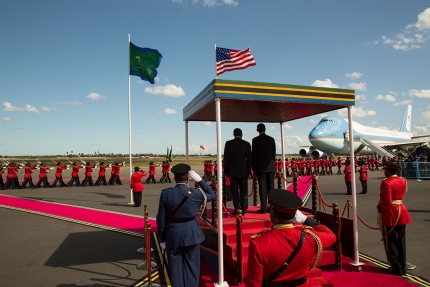
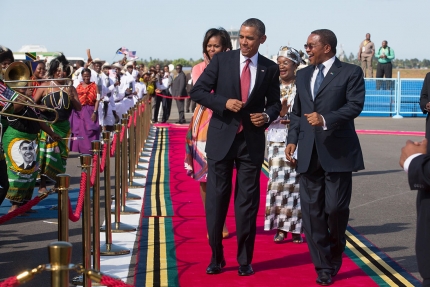
President Obama Visits Tanzania

President Barack Obama and President Jakaya Kikwete of Tanzania watch as an honor guard passes during the arrival ceremony

President Barack Obama and President Jakaya Kikwete of Tanzania watch as an honor guard passes during the arrival ceremony at Julius Nyerere International Airport in Dar es Salaam, Tanzania, July 1, 2013. (Official White House Photo by Pete Souza)

Today, President Obama flew to Dar Es Salaam, Tanzania, the third and final stop on his three-country trip to Africa.

President Barack Obama and President Jakaya Kikwete of Tanzania, along with First Lady Michelle Obama and Salma Kikwete

President Barack Obama and President Jakaya Kikwete of Tanzania, along with First Lady Michelle Obama and Salma Kikwete, watch performers during an arrival ceremony at Julius Nyerere International Airport in Dar es Salaam, Tanzania, July 1, 2013. (Official White House Photo by Chuck Kennedy)

After an afternoon arrival ceremony, he held a bilateral meeting and press conference with President Jakaya Kikwete. Read the remarks from the press conference here.

President Barack Obama participate in a joint press conference with President Jakaya Kikwete

President Barack Obama participate in a joint press conference with President Jakaya Kikwete of Tanzania at the State House in Dar es Salaam, Tanzania, July 1, 2013. (Official White House Photo by Pete Souza)

President Obama and President Kikwete Hold a Press Conference

July 01, 2013 | 45:29 | Public Domain

President Obama and President Kikwete of Tanzania answer questions from the press following a bilateral meeting in Dar es Salaam.

Download mp4 (1720MB) | mp3 (110MB)

Read the Transcript

Remarks by President Obama and President Kikwete of Tanzania at Joint Press Conference

State House
Dar es Salaam, Tanzania

5:09 P.M. EAT

PRESIDENT KIKWETE:  You Excellency, Barack Obama, President of the United States of America -- Mr. President, let me once again welcome you and the U.S. First Lady, and your entire delegation to Tanzania.   
 
I thank you, Mr. President, for accepting my invitation to visit Tanzania.  The people of Tanzania love you.  (Applause.)
 
You have seen the outpouring of warmth.  There has never been a visit by head of state to Tanzania that has attracted such big crowds like the one -- the first one of its kind.  Thank you for coming. 
 
Mr. President, Tanzania and the United States enjoy an excellent relationship.  We see eye to eye on many regional and global issues.  We have been receiving invaluable support in our development endeavors.  The lives of the people of Tanzania are different today thanks in many ways to the support and engaging from the United States of America -- support in health care, support in education.  And health care has made many people, many lives to be saved.  In education, many young men and women of Tanzania had to get -- education. 
 
Support in food security, nutrition security is increasingly building Tanzania’s capacity for self-sufficiency and food supply.  And we’re already getting there with regards to rice. 
 
Support in infrastructure development, in the road sector, in electricity, in the water sector has made many Tanzanians get these services, which otherwise they would not have been getting them.  We applaud programs like the Millennium Challenge compact; PEPFAR, against HIV/AIDS and malaria.  And your own brainchild, Feed the Future; Partnership for Growth; New Alliance for Food and Nutrition Security -- these have proven to be very useful in supporting the development efforts.
 
Mr. President, we had very fruitful discussions today.  We discussed many issues of mutual interest and mutual concern.  Again, I will say, President, thank you for coming.  And your words of support during the official talks, and readiness to continue to support Tanzania in our development endeavors goes a long way.  It was assuring us in you, and in the United States, we have a true friend indeed.
 
Mr. President, welcome.  (Applause.)
 
PRESIDENT OBAMA:  Thank you so much.  Thank you.  Well, thank you so much, President Kikwete, for your very kind words and for the incredible welcome that I’ve received here in Dar es Salaam.  This is my first visit to Tanzania, but I feel a special connection to this country.  Obviously, my family on my father’s side is from East Africa.  They spent some time actually in Tanzania.  And so, the love Michelle and I and the girls have felt on our arrival, I want to assure you that love is reciprocated and given back in return.  So, habari zenu.  (Applause.) 
 
Now, President Kikwete was the first African leader I welcomed to the White House after I took office.  I was pleased to welcome him to Washington last year for the launch of our New Alliance on Food Security.  And as the President indicated, we had excellent discussions today.  Our visits and work together reflect the long relationship between our countries and our shared commitment to the development and the dignity of the people of Tanzania.
 
My visit comes on the 50th anniversary of a key moment in our relationship -- when President Kennedy welcomed to the White House the father of your nation, President Julius Nyerere.  Tanzania was one of the first countries to welcome the Peace Corps.  That spirit of friendship continues.  Tanzania is a close partner, as the President indicated, on almost all our major development initiatives.  And this reflects our confidence in the people of Tanzania that, with the right steps, Tanzania has the potential to unlock new economic growth not only in this country but all across East Africa.
 
For example, Tanzanians continue to work to strengthen their democracy.  Parliament, opposition groups, civil society groups, and journalists are all doing their part to advance the good governance and transparency upon which democracy and prosperity depend.
 
And I want to commend President Kikwete on your reform efforts to strengthen institutions, improve the delivery of basic services, and make government more responsive to the Tanzanian people.  And I also want to salute you and President Shein of Zanzibar and the Tanzanian people for embarking on a vital constitutional process that will determine the future of this nation and its democracy.
 
President Kikwete and I agreed to keep tackling the hurdles of greater economic growth, starting with the sector where the vast majority of Tanzanians work, and that’s in the agricultural sector.  As has been mentioned, our Feed the Future program has allowed us to work together to help more than 14,000 farmers here to better manage their crops and increase their yields by almost 50 percent.  That means higher incomes and a ladder for families and communities to greater prosperity.  And we're very proud of the work we've done with the Tanzanian government.
 
We discussed the importance of creating opportunities for Tanzanian youth, and I’m hopeful that young men and women here will apply for the new fellows program that I've announced this week so that we can partner with them as we seek new ways to serve, working with young people, their communities, and to help them start new companies and create new jobs.
 
I want to congratulate Tanzania on nearing completion of the largest Millennium Challenge compact in the world, which has benefited millions of Tanzanians with new roads and improved access to water and electricity.  And Tanzania is also one of the first four countries selected for our Partnership for Growth, and its investments in key areas -- new and improved roads, reforms to the energy sector -- that can help lift people out of poverty and unlock economic growth.
 
And I’m also pleased that Tanzania is going to be one of the first participants in the new effort that I announced yesterday -- Power Africa -- with its goal of doubling access to electricity.  (Applause.)  This will mean more reliable and affordable electricity for more Tanzanians, and it's something that we want to spread all across the continent.  Later today, I’ll be announcing another initiative to improve trade with and within Africa, starting here with the East African Community.
 
On health, we’re going to continue our efforts, which are saving lives.  Here in Tanzania, we're working together; we’ve seen dramatic decreases in malaria and child deaths in part because of the support that we've been able to provide.  Fewer people are being infected with HIV, more people are being treated.  We’re reaching more than 1.2 million Tanzanians with care and support through PEPFAR, including more than 500,000 vulnerable children and orphans.  So we’re going to keep up that fight.
 
Regionally, I thanked President Kikwete for Tanzania’s contribution to security, including its peacekeepers in Darfur and the Congo.  On the Congo, we agreed that all parties need to implement their commitments under the Framework for Peace, that armed groups need to lay down their arms, and human rights abusers need to be held accountable.  And I very much want to commend President Kikwete as well for the leadership role that he's played in the Southern African Development Community on the issue of Zimbabwe.  (Applause.)  We agree that the threats and intimidation of citizens are unacceptable and must stop, and that further reforms are needed to create the conditions for free, fair, and credible elections that will put Zimbabwe on a path of success and prosperity.

And finally, we discussed an issue that’s inseparable from Africa’s identity and prosperity -- and that’s its wildlife.  Tourists from around the world, including the United States, come here -- especially to Tanzania -- to experience its natural beauty and its national parks, and that’s obviously an important part of the economy of this country.  But poaching and trafficking is threatening Africa’s wildlife, so today I issued a new executive order to better organize U.S. government efforts in this fight so that we can cooperate further with the Tanzanian government and others.  And this includes additional millions of dollars to help countries across the region build their capacity to meet this challenge, because the entire world has a stake in making sure that we preserve Africa's beauty for future generations.
 
So, again, Mr. President, thank you so much for your leadership and for your commitment to the partnership between our two nations.  We've covered a lot of ground today.  One last point I need to make, and that is the President and I are both basketball fans.  We did not discuss Hasheem Thabeet, who plays in the NBA, but maybe next time we'll have a chance to talk about that.  (Laughter and applause.)  So, asante.  (Applause.)  Asante sana.
 
Q    Your Excellencies, my name is Peter Ambilikile from Jamboree Newspaper.  My question is for both of you, starting with President Obama.  President Obama, are you satisfied with the aid that your country provides to Tanzania, especially the MCC?  Second question goes to President Kikwete.  Do you believe that U.S.A. is doing enough to support our country, Tanzania?  That’s all, thanks.
 
 PRESIDENT OBAMA:  Well, not only do I think that what we're doing is important, but we have proof that U.S. assistance is making a difference.  Because of our programs, you've reduced incidents of malaria.  Because of our programs, you've reduced child and infant mortality.  Because of our programs, there are roads that are being built here; farmers are seeing crops with better yields and are better able to get them to market because of new roads. 
 
The MCC I think has been so successful here in Tanzania that phase one is near completion, and I know that Tanzania is going to be eligible for applying for phase two.  And when it comes to Power Africa, the new program that I'm announcing, I think there's enormous potential here in Tanzania to start getting electricity out into villages in rural areas, more reliable service that can then power manufacturing, power new businesses which creates more jobs, creates more demand.  And we can do it using clean energy and not just some of the traditional sources.
 
Now, what I would say is -- and I've said this throughout Africa -- we are looking at a new model that’s based not just on aid and assistance, but on trade and partnership.  And increasingly, what we want to do is use whatever monies that we're providing to build capacity.  So we don’t want to just provide the medicine, we want to help build the health infrastructures that allow Tanzanians to improve their overall health systems. 
 
We don’t want to just provide food, we want to increase food self-sufficiency.  When it comes to power, we're not just building power plants ourselves -- we're working with the various governments that are involved to think about what are the laws and regulations that are required to sustain it, and how do we leverage the private sector to put more money in.  So we're coming up with $7, $8 billion of U.S. government money on our Power Africa program but we're also already obtaining about $9 billion worth of commitments from the private sector. 
 
So ultimately, the goal here is for Africa to build Africa for Africans.  And our job is to be a partner in that process, and Tanzania has been one of our best partners.
 
PRESIDENT KIKWETE:  I think the issue of satisfied with MCC should have been asked me.  MCC has been a great assistance from the United States government to the people of Tanzania.  There are three sectors here. 
 
There is the road sector.  And a good thing about the MCC is that we decide on the areas or the sectors that we need assistance.  But even we decide on where.  For example, in the case of roads, there are roads that we've talked to many donors who are not ready to support us.  But when you said there is going to be support on roads, I said, let's try these roads.  Let's see what the Americans are going to say.  The Americans said, fine -- if you think you need these roads, fine, we'll give you the money.
 
Those, Tanzanians, fellow Tanzanians know Namtumbo, Songea, Binga, Tunduma, Sumbawanga, Tanga, Horo Horo -- the roads in Pemba.  But we chose those roads, because these roads are actually in our breadbasket areas.  This is where we get the corn -- Ruvuma, Rukwa, Mbeya.  We decided -- we chose the U.S. to assist us to increase water supply to Dar es Salaam.  It was our decision.  The project is now being implemented.  With electricity, we said one of our biggest problems is access to electricity for people in the rural areas.  The U.S. said, fine.  We have grid in 10 regions of Tanzania.  Coverage of electricity has increased from 10 percent to 21 percent.  It's a phenomenal increase.
 
So I want to underscore the fact that I'm satisfied with the support from MCC.  Is the U.S. doing enough?  The U.S. has done a lot.  But if I say they have done enough, then the President will not listen to my new requests.  (Laughter.)  But so far, so good.  (Laughter.)
 
Death from malaria has declined by over 50 percent.  Infant mortality rates have declined.  HIV infections have declined.  Through the PMTCT, Prevention of Mother-to-Child Transmission, more children born by HIV-infected mothers are born free of the disease. 
 
The U.S. has supported us with over 2 million books.  And today, I asked the President we want another 2 million.  He says, you talk to -- and I have seen from their faces that they are in agreement with the President.  (Laughter.)  So that when it comes to science and mathematics books, we'll have every Tanzanian child have a book of his or her own, instead of the ratios they are talking today, 5 to 1 -- now 3 to 1.  So the list is endless.  We have a lot of support.  We are very appreciative, very thankful.  It has really helped change the lives of our people.  But if they can do more, please.
 
Q    Mr. President, President Kikwete, thank you very much.  Mr. President, these scenes in Egypt suggest that Mohamed Morsi and his Muslim Brotherhood government have lost the support of the Egyptian people.  When we saw similar protesting against Mubarak, you called on Mubarak to step down.  By all accounts, these protests are even bigger.  So my question is, is it time for Morsi to go?  And does any of this cause you to reconsider the hundreds of millions of dollars -- even billions of dollars -- in aid the United States gives Morsi’s government?
 
And, President Kikwete, if I can ask you -- actually both of you -- to comment on the significance of President Obama’s trip here to Africa and the fact that tomorrow we will see in what I believe is a first of two U.S. Presidents, President Bush and President Obama together in a public appearance here in Tanzania.
 
PRESIDENT OBAMA:  Obviously, we’re all concerned about what’s happening in Egypt, and we’ve been monitoring it very closely.  Our commitment to Egypt has never been around any particular individual or party.  Our commitment has been to a process.  And when I took a position that it was time for Egypt to transition, it was based on the fact that Egypt had not had a democratic government for decades, if ever.  And that’s what the people were calling for. 
 
They went through an election process that, by all accounts, were legitimate.  And Mr. Morsi was elected.  And the U.S. government’s attitude has been we would deal with a democratically elected government.  What we’ve also said is that democracy is not just about elections, it’s also about how are you working with an opposition; how do you treat dissenting voices; how do you treat minority groups.  And what is clear right now is that although Mr. Morsi was elected democratically, there’s more work to be done to create the conditions in which everybody feels that their voices are heard, and that the government is responsive and truly representative. 
 
And so what we’ve encouraged the government to do is to reach out to the opposition and work through these issues in a political process.  It’s not the U.S.’s job to determine what that process is.  But what we have said is, go through processes that are legitimate and observe rule of law.
 
Now, obviously, we’ve been watching these big protests.  Our number-one priority has been making sure that our embassies and consulates are protected.  Number two, what we’ve consistently insisted on is that all parties involved -- whether it’s members of Mr. Morsi’s party or the opposition -- that they remain peaceful.  And although we have not seen the kind of violence that many had feared so far, the potential remains there, and everybody has to show restraint.
 
I should add, by the way, we have seen many reports of women being assaulted in these protests.  And for those who are participating in these protests or marches, assaulting women does not qualify as peaceful protests. 
 
So we’re going to continue to work with all parties inside of Egypt to try to channel this through legal, legitimate processes.  But I do think that if the situation is going to resolve itself for the benefit of Egypt over the long term, then all the parties there have to step back from maximalist positions.  Democracies don’t work when everybody says it’s the other person’s fault and I want 100 percent of what I want.
 
And the good thing about the United States and other mature democracies is you work through processes that force compromise, and those get institutionalized.  But, look, we’ve had 200-plus years of practice at it.  This is still new in Egypt.  And so they’re going to have to work through these things.  The key is making sure that they don’t work through them in a violent fashion.  But our position has always been it’s not our job to choose who Egypt’s leaders are.  We do want to make sure that all the voices are heard and is done in a peaceful way.
 
I know you directed the question to President Kikwete, but my appearance with President Bush tomorrow -- and I know the First Lady is going to be seeing Laura Bush -- I think this is just another opportunity for me to reiterate what I said in South Africa yesterday when we were at an HIV/AIDS clinic that has saved lives because of the U.S. PEPFAR program that President Bush started.  I think this is one of his crowning achievements. 
 
Because of the commitment of the Bush administration and the American people, millions of people’s lives have been saved.  Antiretroviral drugs have been made available to people who didn’t have them before, and they, even if they were infected with the disease, could look forward to a decent life.  Children have been able to avoid infection because of that work.  And we've continued that work, and we are going to continue that work.
 
One thing I do think is worth mentioning is that there's been some suggestion that somehow we've reduced our commitment there.  The fact of the matter is, is that we are serving four times the number of people today than we were when PEPFAR first began.  But because we've gotten better at it and more efficient at it, we're doing it at reduced costs, and then we're not taking that money out of global health; what we're doing is we're putting it back into things like tuberculosis and malaria alleviation, which is making sure that more people's lives are saved because HIV/AIDS is not the only disease that is affecting people here in Africa.  And you have public health crises in some of these other areas as well.  
 
But this indicates how timely the PEPFAR program was.  And the bipartisan support that it has received has been extraordinary, and President Bush deserves enormous credit for that.  And so, I'm looking forward to being able, on African soil, to once again thank him on behalf of the American people for showing how American generosity and foresight could end up making a real difference in people's lives. 
 
Q    And the U.S. aid to Egypt?
 
 PRESIDENT OBAMA:   Well, Jonathan, I have to say that your numbers on U.S. aid to Egypt were a little bit imprecise.  We have some regular assistance that we provide Egypt.  We have some dollars that have been held up and have to be approved by Congress.  But the way we make decisions about assistance to Egypt is based on are they in fact following rule of law and democratic procedures.  And we don’t make those decisions just by counting the number of heads in a protest march, but we do make decisions based on whether or not a government is listening to the opposition, maintaining a free press, maintaining freedom of assembly, not using violence or intimidation, conducting fair and free elections.  And those are the kinds of things that we're examining, and we press the Egyptian government very hard on those issues.
 
PRESIDENT KIKWETE:  Is President Obama's visit significant?  Very significant.  Why am I saying so?  Africa needs the United States.  The United States needs Africa.  And the only way you can build this relationship is through exchange of visits, and visits at the highest level speaks volumes about doing that.
 
So I would say the visit of President Obama to Africa consolidates existing relations, but also advances them to greater heights for the mutual benefits of our two countries and our two peoples.
 
President Bush and Madam Laura Bush are visiting Tanzania.  The George Bush Foundation has programs supporting African first ladies in the work that they do in their respective countries, particularly supporting women groups and supporting girls with regards to education and empowerment. 
 
Were we excited?  We have the President and the former President in Tanzania at the same time.  It's a blessing to this country. 
 
Q    My question to President Obama -- Mr. President, there has been no peace in Congo for almost 20 years now.  As a powerful nation in the world and a permanent member of the Security Council with a lot of influence to major players of the Congo conflict, how is the U.S. going to assist the DRC and Great Lakes to reach a permanent peace?  Thank you. 
 
 PRESIDENT OBAMA:   Well, the people of Congo need a chance.  They need a fair chance to live their lives, raise their families.  And they haven't had that opportunity because of constant conflict and war for way too many years.  And of course, the tragedy is compounded by the fact that Congo is so rich in natural resources and potential, but because of this constant conflict and instability, the people of Congo haven't benefitted from that. 
 
I want to congratulate, again, President Kikwete and others who have helped to shape a peace framework.  Because one of the things that I've said throughout this trip is, the United States doesn’t seek to impose solutions on Africa.  We want to work with Africans to find solutions to some of these ongoing security and regional problems.
 
And so, the fact that you now have a peace framework that the various parties have signed onto is critical.  But it can't just be a piece of paper; there has to be follow-through.  And so, one of the things that I discussed with President Kikwete is how we can encourage all the parties concerned to follow through on commitments that they've made in order to bring about a lasting solution inside of Congo.  That means, for example, that President Kabila inside of Congo, he has to do more and better when it comes to dealing with the DRC's capacity on security issues and delivery of services.  And that’s very important, because if there's a continuing vacuum there, then that vacuum sometimes gets filled by actors that don’t have the best interests of Congo at heart.  And we're prepared to work the United Nations and regional organizations and others to help him build capacity.
 
The countries surrounding the Congo, they've got to make commitments to stop funding armed groups that are encroaching on the territorial integrity and sovereignty of the Congo.  And they've signed onto a piece of paper now, now the question is do they follow through. 
 
And so, we're prepared to work with anybody to try to make this happen.  Ultimately, though, the countries involved have to recognize it is in their self-interest to do so.  We can't force a solution onto the region.  The peoples of the region have to stand up and say that’s enough; it's time to move forward in a different way.  And, by the way, that means holding those who've committed gross human rights abuses accountable for what they've done.
 
But there's an opportunity for peace here.  And the countries surrounding the Congo should recognize that if the Congo stabilizes, that will improve the prospects for their growth and their prosperity, because right now, it's as if you have a millstone around your neck.  If you have one of the biggest countries in terms of geography in all of Africa with all these natural resources, but it's constantly a problem as opposed to being part of the solution, everybody suffers. 
 
Tanzania should be doing more trade with the DRC.  Rwanda should be doing more trade and commerce with the DRC.  One of the things we're talking about it how do we get more inter-Africa trade, because if countries like Tanzania are going to improve their economic position in the globe, the first thing they have to do is to make sure they can trade with each other more effectively. 
 
Right now, in Africa -- this is true not just in Tanzania, but in Kenya and Uganda and other places -- it's easier to send flowers or coffee to Europe than it is to send it across the way.  And that means that fewer businesses are getting started and fewer jobs are being created.
 
So we want to work with the existing international structures like the United Nations, and we're supportive of the brigade that’s been shaped and in which Tanzania is making a contribution.  But ultimately, it's going to be the African countries themselves that have to follow up on the commitments that they've already made. 
 
Q    President Obama, President Kikwete, thank you very much.  President Obama, the first question goes to you, and I want to get your reaction to a breaking news alert that just came in a few minutes ago.  According to Reuters, a senior Russian security official says that you and President Putin have asked the FBI and FSB to seek a solution on Snowden, so can you confirm that report? 
 
Also, the latest leaks by Edward Snowden suggest the United States have been monitoring the phone and email records of its allies in the EU.  So is the United States spying on its European allies?  Also, France and other countries are demanding an explanation with France saying that free trade talks could be threatened.  So how can you reassure your allies to make sure that free trade talks aren't threatened and that your relations abroad are not threatened?  And what will the federal response be to the 19 firefighters who were killed in Arizona?  Thank you. 
 
 And to President Kikwete, did you discuss with President Obama the Tanzanian diplomat who was stationed in Washington, D.C. and fined a million dollars for holding a woman against her will as a domestic servant?  Is this person still an advisor to you, and does this issue in any way undercut your ability to fight human trafficking in your great country?  Thank you, to both of you. 
 
 PRESIDENT OBAMA:   Well, I can confirm -- because I said so I think at the beginning of this trip in one of the first questions that was asked -- that we have gone through regular law enforcement channels in enforcing the extradition request that we've made with respect to Mr. Snowden.  And that’s been true with all the countries that have been involved, including Russia.  And so, there have been high-level discussions with the Russians about trying to find a solution to the problem. 
 
We don't have an extradition treaty with Russia.  On the other hand, Mr. Snowden, we understand, has traveled there without a valid passport, without legal papers.  And we are hopeful that the Russian government makes decisions based on the normal procedures regarding international travel and the normal interactions that law enforcement have.  So I can confirm that.
 
With respect to the latest article that in part I gather is prompted by Mr. Snowden's leaks, we're still evaluating the article because the problem is that these things come out in dribs and drabs.  We don't know necessarily what programs they're referring to, we don’t know how they're sourced.  And so, what I've said is, to my team, take a look at this article, figure out what they may or may not be talking about, and then what we'll do is we'll communicate to our allies appropriately.
 
But I'll make some general points.  So I'm not going to comment on any particular allegation, but I'll make a couple of general points.  Number one, the Europeans are some of the closest allies that we have in the world.  And we work with them on everything, and we share intelligence constantly.  And our primary concerns are the various security threats that may have an impact on both our countries. 
 
The initial two programs that were of concern as a consequence of the Snowden leak had to do with a very particular issue, and that is, were we going around snooping and reading people's emails and listening to people's phone calls, whether that was in the United States or in Europe.  And I responded to that when I was in Europe, in Germany, explaining that one program had to do with telephone numbers that were exchanged without content.  The other was very narrowly tailored to deal with threats like terrorism, proliferation -- and that all of this was done legally and under the supervision of the FISA Court.  So that's one set of issues.
 
Now, there's a second set of issues that this article seems to be raising, and that is how our intelligence services operate generally around the world.  And I think we should stipulate that every intelligence service -- not just ours, but every European intelligence service, every Asian intelligence service, wherever there's an intelligence service -- here's one thing that they're going to be doing:  they're going to be trying to understand the world better and what's going on in world capitals around the world from sources that aren't available through the New York Times or NBC News; that they are seeking additional insight beyond what's available through open sources. 
 
And if that weren't the case, then there would be no use for an intelligence service.  And I guarantee you that in European capitals, there are people who are interested in, if not what I had for breakfast, at least what my talking points might be should I end up meeting with their leaders.  That's how intelligence services operate. 
 
So I don't know what is precisely in this article.  I've asked my team and the NSA to evaluate everything that's being claimed.  When we have an answer, we will make sure to provide all the information that our allies want and what exactly the allegations have been.
 
But I can -- here's one last thing I'll say.  I'm the end user of this kind of intelligence.  And if I want to know what Chancellor Merkel is thinking, I will call Chancellor Merkel.  If I want to know what President Hollande is thinking on a particular issue, I'll call President Hollande.  If I want to know what David Cameron is thinking, I'll call David Cameron.  Ultimately, we work so closely together that there's almost no information that's not shared between our various countries. 
 
But I do think it's important for everybody analytically to separate this issue, which is how our intelligence service is gathering information about the world versus the particular programs that were initially the cause of this controversy, which I was responding to when I was in Germany.
 
Q    And the wildfires?
 
THE PRESIDENT:  Oh, thank you.  See, this is what happens when I've got too many questions.  Obviously, the news is heartbreaking.  And our thoughts and prayers go out to the families of the brave firefighters who are out there. 
 
This is one more reminder of the fact that our first responders, they put their lives on the line every single day.  And every time we have a community in crisis, a disaster strikes, we've got people in need -- firefighters, law enforcement officers, they run towards the danger.  And so we are heartbroken about what happened.  Obviously, we're prepared to provide any support we can in investigating exactly how this took place.
 
I think we're going to have to ask ourselves a set of broader questions about how we're handling increasingly deadly and difficult firefights.  Wildfires have been continually escalating at higher and higher cost, and putting more and more pressure not only the federal fire services, but also on state and local fire services.  And we're going to have to think about what more we can do on that front.  But for now, I think what we're most concerned about is how painful these losses are.
 
PRESIDENT KIKWETE:  The question that was directed to me -- yes, I am aware of a situation in Washington that involved one of our diplomats who later we recalled.  This incident involves a young sister of the wife of this diplomat.  They took her with them to help her get education and support -- make it in life.  And then I think there was a conflict within the family, and then this young lady accused the brother-in-law and the sister of using her for cheap labor.
 
The court decided on a one million fine, an amount which, for a Tanzanian, there is no way that he can afford to pay.  See, even the President here -- the President -- when I retire, my retirement benefits cannot pay that, because we get far less.  Then, I think there was reconsideration for this gentleman to pay $175,000, which, as far as I know, has already been paid.  So that matter has been put to rest.
 
END 
5:55 P.M. EAT

Close Transcript

The White House

Office of the Press Secretary

Readout of President Obama’s Call with Australian Prime Minister Rudd and former Prime Minister Gillard

Earlier today from Air Force One, the President called Prime Minister Kevin Rudd and former Prime Minister Julia Gillard of Australia. In his call with Prime Minister Rudd, the President congratulated the Prime Minister on his return to office.  The President also reiterated the enduring strength of the U.S.-Australia alliance and his confidence that the United States and Australia will continue to work together closely on important global and regional issues.  The two leaders also discussed the importance of completing the high standard Trans-Pacific Partnership agreement.  In his call with former Prime Minister Gillard, President Obama thanked her for her warm friendship and close partnership in deepening cooperation between the United States and Australia, and he wished her well in her future endeavors.