The White House

Office of the Press Secretary

Remarks by President Obama and Archbishop Tutu After Roundtable Discussion

Desmond Tutu HIV Foundation Youth Center Cape Town, South Africa

5:05 P.M. SAST

 THE PRESIDENT:  It is a great pleasure to be here at the Desmond Tutu HIV Foundation Youth Center.  It is appropriately named after somebody who has done heroic work not only on behalf of peace and justice, and the ending of Apartheid, but also who very early on took on the challenge of HIV/AIDS here in South Africa and around the world.  And so I’m so proud to be with my friend again --

ARCHBISHOP TUTU:  Thank you.

THE PRESIDENT:  -- who is an unrelenting champion of justice and human dignity.

South Africa obviously has faced a heavy burden from HIV as well as other diseases -- Tuberculosis, most recently.  But the great news is that South Africa is now leading the way in caring for its citizens, in paving the way for a brighter future for the South African people and their families, and I am very proud the United States has been such a terrific partner on this issue.

I was hearing stories from all these incredible folks -- some of whom are counselors and outreach workers, some of whom have struggled with HIV/AIDS themselves -- and the great news is that, in part because of leadership from people like Archbishop Tutu but also because of the great work of nurses like Sister Iris, or young people like Mbulelo, and wonderful counselors like Lindiwe, what we’ve seen is a reduction of the stigma around testing on HIV/AIDS, greater education around prevention, and what we’ve seen is treatment that allows people to manage HIV and live long and productive lives. 

And a lot of that has to do with the terrific work of the South African people, but the United States has really done wonderful work through the PEPFAR program, started under my predecessor, President Bush, and continued through our administration.  We’ve seen more than $3.7 billion in supporting South Africa’s efforts to combat HIV and AIDS. 

Together, we’re investing in building South Africa’s capacity to manage a national response to HIV/AIDS.  The South African government is showing leadership up and down the line, and the health minister here has talked about all the initiatives that are taking place.  And this center is a wonderful example of that transition.  It’s moving from receiving U.S. government support through PEPFAR to now independent funding that continues to secure the health and success of Africa’s next generation. 

And part of what makes this center so successful is it combines not just health advice and testing, and counseling, but it also provides educational opportunities, sports activities, recreational activities so that young people are able to come here without the fear of stigma or potentially running into their parents, and getting honest, smart advice about what they need to do to keep themselves healthy and to ensure that they are not infected by HIV/AIDS.

So because of the wonderful work that’s being done on the ground, because of the partnership between the United States and South Africa -- a model, by the way, that has been duplicated across the continent -- we have the possibility of achieving an AIDS-free generation -- achieving an AIDS-free generation and making sure that everybody in our human family is able to enjoy their lives and raise families, and succeed in maintaining their health here in Africa and around the world.

So I just want to say thank you to all of you for sharing your stories with me.  I want to give a special thanks to Ambassador Eric Goosby, who doesn’t always get a lot of attention but has been an outstanding leader on behalf of our global AIDS efforts.  And if it weren’t for people like Eric as well as the people around this room, we’d be far, far behind, and a lot more people would be suffering tragedy.  So thank you all. 

And Archbishop Desmond Tutu needs to say something because his picture is over there.  (Laughter.)  His name is on the project.  I think it’s fair to say that --

ARCHBISHOP TUTU:  Yes, I should have said this earlier but then I -- anytime is okay.  It is a very big honor to welcome the President of the United States, even at such a somber time for us South Africans.

It is a special joy to welcome the President to Africa, the continent of his forbearers, the cradle of humanity.  I don’t have to compete against your beautiful Michelle doing pushups in public.  (Laughter.)

Mr. President, when you became the first black incumbent of the White House, you don’t know what you did for our psyches.  My wife sat in front of the TV with tears running down her face as she watched the celebration with you in Chicago.  You won.  And we won.  And you repeated the feat when the odds were stacked against you.  So welcome home, even if you’re about to go.  (Laughter.) 

Thank you and the American people.  You heard everyone here thanking you so much for the contribution that the PEPFAR fund has made in our struggle against TB, HIV, and AIDS, and malaria -- not just here, but in other parts of Africa.  Our center, as you have heard, is run by the HIV center of the university where you are going just now.  You have funded us.  You funded funding a center in the University of Stellenbosch TB Center.  And we have just rejoiced to hear of the HIV infections in infants has dropped by a whopping 63 percent -- in very large measure due to the financial support that we have received from yourselves.  So thank you.

As you have been here before -- I mean Africa -- you have heard us speak of something called Ubuntu -- Ubuntu -- and we’ve said a person is a person to other persons.  Your success is our success.  Your failure, whether you like it or not, is our failure.  (Laughter.) 

And so we want to assure you that we pray for you to be a great success.  We want you to be known as having brought peace to the world, especially to have brought an end to the anguish of all in the Middle East.  We pray that you will be known as having brought peace in all of these places where there is strife.  You will have brought peace and no more need for Guantanamo Bay Detention Center.  You have brought peace and we mourn the weeping as we do for the anguish of our sisters and brothers in the Middle East.  We are bound to you.  You belong to us.  And your victory is our victory.

So thank you.


END       5:16 P.M. SAST


The White House

Office of the Press Secretary

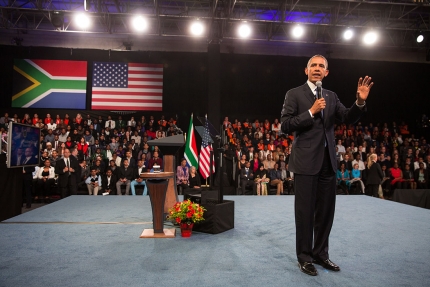
Remarks by President Obama at the University of Cape Town

Cape Town, South Africa

6:14 P.M. SAST

PRESIDENT OBAMA:  Thank you!  (Applause.)  Thank you very much.  Thank you.  (Applause.)  Please, please, everybody have a seat.  Hello Cape Town! 

AUDIENCE:  Hello!

PRESIDENT OBAMA:  Thobela.  Molweni.  Sanibona.  Dumelang.  Ndaa.  Reperile.  

AUDIENCE:  Reperile!

PRESIDENT OBAMA:  See, I’ve been practicing.  How-zit?  (Applause.)  Did I leave anybody out?  All right, well, I didn’t want to leave anybody out here. 

I want to thank Vice Chancellor Max Price, who’s here, as well as Archbishop Njongonkulu.  It’s wonderful to have them in attendance. 

I am so happy to be here today.  It is wonderful to see all of these outstanding young people.  I just had the honor of going to Robben Island with Michelle and our two daughters this afternoon.  And this was my second time; I had the chance to visit back in 2006.  But there was something different about bringing my children.  And Malia is now 15, Sasha is 12 -- and seeing them stand within the walls that once surrounded Nelson Mandela, I knew this was an experience that they would never forget.  I knew that they now appreciated a little bit more the sacrifices that Madiba and others had made for freedom.  

But what I also know is that because they’ve had a chance to visit South Africa for a second time now, they also understand that Mandela’s spirit could never be imprisoned -- for his legacy is here for all to see.  It’s in this auditorium:  young people, black, white, Indian, everything in between -- (laughter) -- living and learning together in a South Africa that is free and at peace.

Now, obviously, today Madiba’s health weighs heavily on our hearts.  And like billions all over the world, I -- and the American people -- have drawn strength from the example of this extraordinary leader, and the nation that he changed.  Nelson Mandela showed us that one man’s courage can move the world.  And he calls on us to make choices that reflects not our fears, but our hopes -- in our own lives, and in the lives of our communities and our countries.  And that’s what I want to speak to all of you about today.

Some of you may be aware of this, but I actually took my first step into political life because of South Africa.  (Applause.)  This is true.  I was the same age as some of you -- 19 years old, my whole life ahead of me.  I was going to school on a campus in California -- not quite as pretty as this one -- (laughter) -- but similar.  And I must confess I was not always focused on my studies.  (Laughter.)  There were a lot of distractions.  (Laughter.)  And I enjoyed those distractions.

And as the son of an African father and a white American mother, the diversity of America was in my blood, but I had never cared much for politics.  I didn’t think it mattered to me.  I didn’t think I could make a difference.  And like many young people, I thought that cynicism -- a certain ironic detachment -- was a sign of wisdom and sophistication.

But then I learned what was happening here in South Africa.  And two young men, ANC representatives, came to our college and spoke, and I spent time hearing their stories.  And I learned about the courage of those who waged the Defiance Campaign, and the brutality leveled against innocent men, women and children from Sharpeville to Soweto.  And I studied the leadership of Luthuli, and the words of Biko, and the example of Madiba, and I knew that while brave people were imprisoned just off these shores on Robben Island, my own government in the United States was not standing on their side.  That’s why I got involved in what was known as the divestment movement in the United States.

It was the first time I ever attached myself to a cause.  It was the first time also that I ever gave a speech.  It was only two minutes long -- (laughter) -- and I was really just a warm-up act at a rally that we were holding demanding that our college divest from Apartheid South Africa.  So I got up on stage, I started making my speech, and then, as a bit of political theater, some people came out with glasses that looked like security officers and they dragged me off the stage.  (Laughter.)  Fortunately, there are no records of this speech.  (Laughter.)  But I remember struggling to express the anger and the passion that I was feeling, and to echo in some small way the moral clarity of freedom fighters an ocean away.

And I’ll be honest with you, when I was done, I did not think I’d made any difference -- I was even a little embarrassed.  And I thought to myself -- what’s a bunch of university kids doing in California that is somehow going to make a difference?  It felt too distant from what people were going through in places like Soweto.  But looking back, as I look at that 19-year old young man, I'm more forgiving of the fact that the speech might not have been that great, because I knew -- I know now that something inside me was stirring at that time, something important.  And that was the belief that I could be part of something bigger than myself; that my own salvation was bound up with those of others.

That’s what Bobby Kennedy expressed, far better than I ever could, when he spoke here at the University of Cape Town in 1966.  He said, “Each time a man stands up for an ideal, or acts to improve the lot of others, or strikes out against injustice, he sends forth a tiny ripple of hope, and crossing each other from a million different centers of energy and daring, those ripples build a current which can sweep down the mightiest walls of oppression and resistance.”

Now, the world was very different on that June day in 1966 when Bobby Kennedy spoke those words.  Mandela faced many more years as a prisoner.  Apartheid was entrenched in this land.  In the United States, the victories of the Civil Rights Movement were still uncertain.  In fact, on the very day that Kennedy spoke here, the American civil rights leader, James Meredith, was shot in Mississippi, where he was marching to inspire blacks to register to vote.  

Those were difficult, troubled, trying times.  The idea of hope might have seemed misplaced.  It would have seemed inconceivable to people at that time -- that less than 50 years later, an African American President might address an integrated audience, at South Africa’s oldest university, and that this same university would have conferred an honorary degree to a President, Nelson Mandela.  (Applause.)  It would have seemed impossible.

That’s the power that comes from acting on our ideals.  That’s what Mandela understood.  But it wasn’t just the giants of history who brought about this change.  Think of the many millions of acts of conscience that were part of that effort.  Think about how many voices were raised against injustice over the years -- in this country, in the United States, around the world.  Think of how many times ordinary people pushed against those walls of oppression and resistance, and the violence and the indignities that they suffered; the quiet courage that they sustained.  Think of how many ripples of hope it took to build a wave that would eventually come crashing down like a mighty stream.

So Mandela’s life, like Kennedy’s life, like Gandhi's life, like the life of all those who fought to bring about a new South Africa or a more just America -- they stand as a challenge to me.  But more importantly, they stand as a challenge to your generation, because they tell you that your voice matters -- your ideals, your willingness to act on those ideals, your choices can make a difference.  And if there’s any country in the world that shows the power of human beings to affect change, this is the one.  You’ve shown us how a prisoner can become a President.  You've shown us how bitter adversaries can reconcile.  You've confronted crimes of hatred and intolerance with truth and love, and you wrote into your constitution the human rights that sustain freedom.

And those are only the most publicized aspects of South Africa’s transformation, because alongside South Africa’s political struggle, other battles have been waged as well to improve the lives of those who for far too long have been denied economic opportunity and social justice. 

During my last journey here in 2006, what impressed me so much was the good works of people on the ground teaching children, caring for the sick, bringing jobs to those in need.  In Khayelitsha Township -- I'm still working on some of these -- (laughter) -- I met women who were living with HIV.  And this is at a time back in 2006, where there were still some challenges in terms of the policies around HIV and AIDS here in South Africa.  But they were on the ground, struggling to keep their families together -- helping each other, working on behalf of each other.  In Soweto, I met people who were striving to carry forward the legacy of Hector Pieterson.  At the Rosa Parks Library in Pretoria, I was struck by the energy of students who -- they wanted to capture this moment of promise for South Africa.

And this is a moment of great promise.  South Africa is one of the world’s economic centers.  Obviously, you can see it here in Cape Town.  In the country that saw the first human heart transplant, new breakthroughs are being made in the treatment of HIV/AIDS.  I was just talking to your Vice Chancellor.  People come to this University from over 100 countries to study and teach.  In America, we see the reach of your culture from “Freshly Ground” concerts to the -- (applause) -- we've got the Nando’s just a couple of blocks from the White House.  (Laughter and applause.)  And thanks to the first World Cup ever held on this continent, the world now knows the sound of the vuvuzela.  (Applause.)  I'm not sure that's like the greatest gift that South Africa ever gave.  (Laughter.)

But progress has also rippled across the African continent.  From Senegal to Cote D’Ivoire to Malawi, democracy has weathered strong challenges. 

Many of the fastest-growing economies in the world are here in Africa, where there is an historic shift taking place from poverty to a growing, nascent middle class.  Fewer people are dying of preventable disease.  More people have access to health care.  More farmers are getting their products to market at fair prices.  From micro-finance projects in Kampala, to stock traders in Lagos, to cell phone entrepreneurs in Nairobi, there is an energy here that can't be denied -- Africa rising. 

We know this progress, though, rests on a fragile foundation.  We know that progress is uneven.  Across Africa, the same institutions that should be the backbone of democracy can all too often be infected with the rot of corruption.  The same technology that enables record profits sometimes means widening a canyon of inequality.  The same interconnection that binds our fates makes all of Africa vulnerable to the undertow of conflict.

So there is no question that Africa is on the move, but it's not moving fast enough for the child still languishing in poverty in forgotten townships.  It's not moving fast enough for the protester who is beaten in Harare, or the woman who is raped in Eastern Congo.  We've got more work to do, because these Africans must not be left behind.

And that’s where you come in –- the young people of Africa.  Just like previous generations, you've got choices to make.  You get to decide where the future lies.  Think about it -- over 60 percent of Africans are under 35 years old.  So demographics means young people are going to be determining the fate of this continent and this country.  You’ve got time and numbers on your side, and you’ll be making decisions long after politicians like me have left the scene.

And I can promise you this:  The world will be watching what decisions you make.  The world will be watching what you do.  Because one of the wonderful things that’s happening is, where people used to only see suffering and conflict in Africa, suddenly, now they're seeing opportunity for resources, for investment, for partnership, for influence.  Governments and businesses from around the world are sizing up the continent, and they're making decisions themselves about where to invest their own time and their own energy.  And as I said yesterday at a town hall meeting up in Johannesburg, that’s a good thing.  We want all countries -- China, India, Brazil, Turkey, Europe, America -- we want everybody paying attention to what's going on here, because it speaks to your progress.

And I've traveled to Africa on this trip because my bet is on the young people who are the heartbeat of Africa’s story.  I'm betting on all of you.  As President of the United States, I believe that my own nation will benefit enormously if you reach your full potential. 

If prosperity is broadly shared here in Africa, that middle class will be an enormous market for our goods.  If strong democracies take root, that will enable our people and businesses to draw closer to yours.  If peace prevails over war, we will all be more secure.  And if the dignity of the individual is upheld across Africa, then I believe Americans will be more free as well, because I believe that none of us are fully free when others in the human family remain shackled by poverty or disease or oppression.

Now, America has been involved in Africa for decades.  But we are moving beyond the simple provision of assistance, foreign aid, to a new model of partnership between America and Africa -– a partnership of equals that focuses on your capacity to solve problems, and your capacity to grow.  Our efforts focus on three areas that shape our lives:  opportunity, democracy, and peace.

So first off, we want a partnership that empowers Africans to access greater opportunity in their own lives, in their communities, and for their countries.

As the largest economy on the continent, South Africa is part of a trend that extends from south to north, east to west -- more and more African economies are poised to take off.  And increased trade and investment from the United States has the potential to accelerate these trends –- creating new jobs and opportunities on both sides of the Atlantic.

So I’m calling for America to up our game when it comes to Africa.  We’re bringing together business leaders from America and Africa to deepen our engagement.  We’re going to launch new trade missions, and promote investment from companies back home.  We’ll launch an effort in Addis to renew the African Growth and Opportunity Act to break down barriers to trade, and tomorrow I’ll discuss a new Trade Africa initiative to expand our ties across the continent, because we want to unleash the power of entrepreneurship and markets to create opportunity here i Africa.

It was interesting -- yesterday at the town hall meeting I had with a number of young people, the first three questions had to do with trade, because there was a recognition -- these young people said, I want to start a -- I want to start something.  I want to build something, and then I want to sell something.  Now, to succeed, these efforts have to connect to something bigger. 

And for America, this isn’t just about numbers on a balance sheet or the resources that can be taken out of the ground.  We believe that societies and economies only advance as far as individuals are free to carry them forward.  And just as freedom cannot exist when people are imprisoned for their political views, true opportunity cannot exist when people are imprisoned by sickness, or hunger, or darkness.

And so, the question we've been asking ourselves is what will it take to empower individual Africans?

For one thing, we believe that countries have to have the power to feed themselves, so instead of shipping food to Africa, we’re now helping millions of small farmers in Africa make use of new technologies and farm more land.  And through a new alliance of governments and the private sector, we’re investing billions of dollars in agriculture that grows more crops, brings more food to market, give farmers better prices and helps lift 50 million people out of poverty in a decade.  An end to famine, a thriving African agricultural industry –- that’s what opportunity looks like.  That’s what we want to build with you.

We believe that countries have to have the power to prevent illness and care for the sick.  And our efforts to combat malaria and tropical illness can lead to an achievable goal:  ending child and maternal deaths from preventable disease.  Already, our commitment to fight HIV/AIDS has saved millions, and allows us to imagine what was once unthinkable:  an AIDS-free generation.  And while America will continue to provide billions of dollars in support, we can’t make progress without African partners.  So I’m proud that by the end of my presidency, South Africa has determined it will be the first African country to fully manage its HIV care and treatment program.  (Applause.)  That’s an enormous achievement.  Healthy mothers and healthy children; strong public health systems -- that’s what opportunity looks like.

And we believe that nations must have the power to connect their people to the promise of the 21st century.  Access to electricity is fundamental to opportunity in this age.  It’s the light that children study by; the energy that allows an idea to be transformed into a real business.  It’s the lifeline for families to meet their most basic needs.  And it’s the connection that’s needed to plug Africa into the grid of the global economy.  You’ve got to have power.  And yet two-thirds of the population in sub-Saharan Africa lacks access to power -- and the percentage is much higher for those who don’t live in cities.

So today, I am proud to announce a new initiative.  We’ve been dealing with agriculture, we’ve been dealing with health.  Now we’re going to talk about power -- Power Africa -- a new initiative that will double access to power in sub-Saharan Africa.  Double it.  (Applause.)  We’re going to start by investing $7 billion in U.S. government resources.  We’re going to partner with the private sector, who themselves have committed more than $9 billion in investment.  And in partnership with African nations, we’re going to develop new sources of energy.  We’ll reach more households not just in cities, but in villages and on farms.  We’ll expand access for those who live currently off the power grid.  And we’ll support clean energy to protect our planet and combat climate change.  (Applause.)  So, a light where currently there is darkness; the energy needed to lift people out of poverty -- that’s what opportunity looks like.

So this is America’s vision:  a partnership with Africa that unleashes growth, and the potential of every citizen, not just a few at the very top.  And this is achievable.  There’s nothing that I’ve outlined that cannot happen.  But history tells us that true progress is only possible where governments exist to serve their people, and not the other way around.  (Applause.)  

If anyone wants to see the difference between freedom and tyranny, let them come here, to South Africa.  Here, citizens braved bullets and beatings to claim that most basic right:  the ability to be free, to determine your own fate, in your own land.  And Madiba’s example extended far beyond that victory.  Now, I mentioned yesterday at the town hall -- like America’s first President, George Washington, he understood that democracy can only endure when it’s bigger than just one person.  So his willingness to leave power was as profound as his ability to claim power.  (Applause.)  

The good news is that this example is getting attention across the continent.  We see it in free and fair elections from Ghana to Zambia.  We hear it in the voices of civil society.  I was in Senegal and met with some civil society groups, including a group called Y’en Marre, which meant “fed up” -- (laughter) -- that helped to defend the will of the people after elections in Senegal.  We recognize it in places like Tanzania, where text messages connect citizens to their representatives.  And we strengthen it when organizations stand up for democratic principles, like ECOWAS did in Cote d’Ivoire.

But this work is not complete -- we all know that.  Not in those countries where leaders enrich themselves with impunity; not in communities where you can’t start a business, or go to school, or get a house without paying a bribe to somebody.  These things have to change.  And they have to chance not just because such corruption is immoral, but it’s also a matter of self-interest and economics.  Governments that respect the rights of their citizens and abide by the rule of law do better, grow faster, draw more investment than those who don’t.  That’s just a fact.  (Applause.)  

Just look at your neighbor, Zimbabwe, where the promise of liberation gave way to the corruption of power and then the collapse of the economy.  Now, after the leaders of this region -- led by South Africa -- brokered an end to what has been a long-running crisis, Zimbabweans have a new constitution, the economy is beginning to recover.  So there is an opportunity to move forward -- but only if there is an election that is free, and fair, and peaceful, so that Zimbabweans can determine their future without fear of intimidation and retribution.  And after elections, there must be respect for the universal rights upon which democracy depends.  (Applause.)

These are things that America stands for -- not perfectly -- but that’s what we stand for, and that’s what my administration stands for.  We don’t tell people who their leaders should be, but we do stand up with those who support the principles that lead to a better life.  And that’s why we’re interested in investing not in strongmen, but in strong institutions:  independent judiciaries that can enforce the rule of law -- (applause); honest police forces that can protect the peoples’ interests instead of their own; an open government that can bring transparency and accountability.  And, yes, that’s why we stand up for civil society -- for journalists and NGOs, and community organizers and activists -- who give people a voice.  And that’s why we support societies that empower women -- because no country will reach its potential unless it draws on the talents of our wives and our mothers, and our sisters and our daughters.  (Applause.)

Just to editorialize here for a second, because my father's home country of Kenya -- like much of Africa -- you see women doing work and not getting respect.  I tell you, you can measure how well a country does by how it treats its women.  (Applause.)  And all across this continent, and all around the world, we've got more work to do on that front.  We've got some sisters saying, "Amen."  (Laughter and applause.)

Now, I know that there are some in Africa who hear me say these things -- who see America's support for these values -- and say that's intrusive.  Why are you meddling?  I know there are those who argue that ideas like democracy and transparency are somehow Western exports.  I disagree.  Those in power who make those arguments are usually trying to distract people from their own abuses.  (Applause.)  Sometimes, they are the same people who behind closed doors are willing to sell out their own country’s resource to foreign interests, just so long as they get a cut.  I'm just telling the truth.  (Laughter and applause.)

Now ultimately, I believe that Africans should make up their own minds about what serves African interests.  We trust your judgment, the judgment of ordinary people.  We believe that when you control your destiny, if you've got a handle on your governments, then governments will promote freedom and opportunity, because that will serve you.  And it shouldn’t just be America that stands up for democracy -- it should be Africans as well.  So here in South Africa, your democratic story has inspired the world.  And through the power of your example, and through your position in organizations like SADC and the African Union, you can be a voice for the human progress that you’ve written into your own Constitution.  You shouldn't assume that that's unique to South Africa.  People have aspirations like that everywhere.

And this brings me to the final area where our partnership can empower people -- the pursuit and protection of peace in Africa.  So long as parts of Africa continue to be ravaged by war and mayhem, opportunity and democracy cannot take root.  Across the continent, there are places where too often fear prevails.  From Mali to Mogadishu, senseless terrorism all too often perverts the meaning of Islam -- one of the world’s great religions -- and takes the lives of countless innocent Africans.  From Congo to Sudan, conflicts fester -- robbing men, women and children of the lives that they deserve.  In too many countries, the actions of thugs and warlords and drug cartels and human traffickers hold back the promise of Africa, enslaving others for their own purposes. 

America cannot put a stop to these tragedies alone, and you don’t expect us to.  That’s a job for Africans.  But we can help, and we will help.  I know there's a lot of talk of America’s military presence in Africa.  But if you look at what we’re actually doing, time and again, we're putting muscle behind African efforts.  That’s what we’re doing in the Sahel, where the nations of West Africa have stepped forward to keep the peace as Mali now begins to rebuild.  That’s what we’re doing in Central Africa, where a coalition of countries is closing the space where the Lord’s Resistance Army can operate.  That’s what we’re doing in Somalia, where an African Union force, AMISOM, is helping a new government to stand on its own two feet.

These efforts have to lead to lasting peace, not just words on a paper or promises that fade away.  Peace between and within Sudan and South Sudan, so that these governments get on with the work of investing in their deeply impoverished peoples.  Peace in the Congo with nations keeping their commitments, so rights are at last claimed by the people of this war-torn country, and women and children no longer live in fear.  (Applause.)  Peace in Mali, where people will make their voices heard in new elections this summer.  In each of these cases, Africa must lead and America will help.  And America will make no apology for supporting African efforts to end conflict and stand up for human dignity.  (Applause.)  

And this year marks the 50th anniversary of the OAU, now the African Union -- an occasion that is more historic, because the AU is taking on these challenges.  And I want America to take our engagement not just on security issues, but on environmental issues -- and economic issues and social issues, education issues -- I want to take that engagement to a whole new level.  So I’m proud to announce that next year, I'm going to invite heads of state from across sub-Saharan Africa to a summit in the United States to help launch a new chapter in U.S.-African relations.  (Applause.)  And as I mentioned yesterday, I'm also going to hold a summit with the next class of our Young African Leaders Initiative, because we want to engage leaders and tomorrow's leaders in figuring out how we can best work together.  (Applause.)

So let me close by saying this.  Governments matter.  Political leadership matters.  And I do hope that some of you here today decide to follow the path of public service.  It can sometimes be thankless, but I believe it can also be a noble life.  But we also have to recognize that the choices we make are not limited to the policies and programs of government.  Peace and prosperity in Africa, and around the world, also depends on the attitudes of people.

Too often, the source of tragedy, the source of conflict involves the choices ordinary people make that divide us from one another -- black from white, Christian from Muslim, tribe from tribe.  Africa contains a multitude of identities, but the nations and people of Africa will not fulfill their promise so long as some use these identities to justify subjugation –- an excuse to steal or kill or disenfranchise others.

And ultimately, that’s the most important lesson that the world learned right here in South Africa.  Mandela once wrote, “No one is born hating another person because of the color of his skin, or his background, or his religion.  People must learn to hate, and if they can learn to hate, they can be taught to love, for love comes more naturally to the human heart than its opposite.”  (Applause.) 

I believe that to be true.  I believe that’s always been true -- from the dawn of the first man to the youth today, and all that came in between here in Africa -- kingdoms come and gone; the crucible of slavery and the emergence from colonialism; senseless war, but also iconic movements for social justice; squandered wealth, but also soaring promise.  

Madiba’s words give us a compass in a sea of change, firm ground amidst swirling currents.  We always have the opportunity to choose our better history.  We can always understand that most important decision -- the decision we make when we find our common humanity in one another.  That’s always available to us, that choice. 

And I've seen that spirit in the welcoming smiles of children on Gorée Island, and the children of Mombasa on Kenya’s Indian Ocean coast.  That spirit exists in the mother in the Sahel who wants a life of dignity for her daughters; and in the South African student who braves danger and distance just to get to school.  It can be heard in the songs that rise from villages and city streets, and it can be heard in the confident voices of young people like you.

It is that spirit, that innate longing for justice and equality, for freedom and solidarity -- that’s the spirit that can light the way forward.  It's in you.  And as you guide Africa down that long and difficult road, I want you to know that you will always find the extended hand of a friend in the United States of America.  (Applause.)

Thank you very much.  God bless you.  (Applause.)

END                7:02 P.M. SAST


President Obama Visits the Desmond Tutu HIV Foundation Youth Centre

June 30, 2013 | 10:37 | Public Domain

To highlight South Africa's work to combat HIV/AIDS and secure the health and success of Africa's next generation, President Obama visits a community health center that provides health advice, testing, and counseling, as well as educational opportunities and sports and recreational activities for young people.

Download mp4 (390MB) | mp3 (26MB)

Read the Transcript

Remarks by President Obama and Archbishop Tutu After Roundtable Discussion

5:05 P.M. SAST

 THE PRESIDENT:  It is a great pleasure to be here at the Desmond Tutu HIV Foundation Youth Center.  It is appropriately named after somebody who has done heroic work not only on behalf of peace and justice, and the ending of Apartheid, but also who very early on took on the challenge of HIV/AIDS here in South Africa and around the world.  And so I’m so proud to be with my friend again --

ARCHBISHOP TUTU:  Thank you.

THE PRESIDENT:  -- who is an unrelenting champion of justice and human dignity.

South Africa obviously has faced a heavy burden from HIV as well as other diseases -- Tuberculosis, most recently.  But the great news is that South Africa is now leading the way in caring for its citizens, in paving the way for a brighter future for the South African people and their families, and I am very proud the United States has been such a terrific partner on this issue.

I was hearing stories from all these incredible folks -- some of whom are counselors and outreach workers, some of whom have struggled with HIV/AIDS themselves -- and the great news is that, in part because of leadership from people like Archbishop Tutu but also because of the great work of nurses like Sister Iris, or young people like Mbulelo, and wonderful counselors like Lindiwe, what we’ve seen is a reduction of the stigma around testing on HIV/AIDS, greater education around prevention, and what we’ve seen is treatment that allows people to manage HIV and live long and productive lives. 

And a lot of that has to do with the terrific work of the South African people, but the United States has really done wonderful work through the PEPFAR program, started under my predecessor, President Bush, and continued through our administration.  We’ve seen more than $3.7 billion in supporting South Africa’s efforts to combat HIV and AIDS. 

Together, we’re investing in building South Africa’s capacity to manage a national response to HIV/AIDS.  The South African government is showing leadership up and down the line, and the health minister here has talked about all the initiatives that are taking place.  And this center is a wonderful example of that transition.  It’s moving from receiving U.S. government support through PEPFAR to now independent funding that continues to secure the health and success of Africa’s next generation. 

And part of what makes this center so successful is it combines not just health advice and testing, and counseling, but it also provides educational opportunities, sports activities, recreational activities so that young people are able to come here without the fear of stigma or potentially running into their parents, and getting honest, smart advice about what they need to do to keep themselves healthy and to ensure that they are not infected by HIV/AIDS.

So because of the wonderful work that’s being done on the ground, because of the partnership between the United States and South Africa -- a model, by the way, that has been duplicated across the continent -- we have the possibility of achieving an AIDS-free generation -- achieving an AIDS-free generation and making sure that everybody in our human family is able to enjoy their lives and raise families, and succeed in maintaining their health here in Africa and around the world.

So I just want to say thank you to all of you for sharing your stories with me.  I want to give a special thanks to Ambassador Eric Goosby, who doesn’t always get a lot of attention but has been an outstanding leader on behalf of our global AIDS efforts.  And if it weren’t for people like Eric as well as the people around this room, we’d be far, far behind, and a lot more people would be suffering tragedy.  So thank you all. 

And Archbishop Desmond Tutu needs to say something because his picture is over there.  (Laughter.)  His name is on the project.  I think it’s fair to say that --

ARCHBISHOP TUTU:  Yes, I should have said this earlier but then I -- anytime is okay.  It is a very big honor to welcome the President of the United States, even at such a somber time for us South Africans.

It is a special joy to welcome the President to Africa, the continent of his forbearers, the cradle of humanity.  I don’t have to compete against your beautiful Michelle doing pushups in public.  (Laughter.)

Mr. President, when you became the first black incumbent of the White House, you don’t know what you did for our psyches.  My wife sat in front of the TV with tears running down her face as she watched the celebration with you in Chicago.  You won.  And we won.  And you repeated the feat when the odds were stacked against you.  So welcome home, even if you’re about to go.  (Laughter.) 

Thank you and the American people.  You heard everyone here thanking you so much for the contribution that the PEPFAR fund has made in our struggle against TB, HIV, and AIDS, and malaria -- not just here, but in other parts of Africa.  Our center, as you have heard, is run by the HIV center of the university where you are going just now.  You have funded us.  You funded funding a center in the University of Stellenbosch TB Center.  And we have just rejoiced to hear of the HIV infections in infants has dropped by a whopping 63 percent -- in very large measure due to the financial support that we have received from yourselves.  So thank you.

As you have been here before -- I mean Africa -- you have heard us speak of something called Ubuntu -- Ubuntu -- and we’ve said a person is a person to other persons.  Your success is our success.  Your failure, whether you like it or not, is our failure.  (Laughter.) 

And so we want to assure you that we pray for you to be a great success.  We want you to be known as having brought peace to the world, especially to have brought an end to the anguish of all in the Middle East.  We pray that you will be known as having brought peace in all of these places where there is strife.  You will have brought peace and no more need for Guantanamo Bay Detention Center.  You have brought peace and we mourn the weeping as we do for the anguish of our sisters and brothers in the Middle East.  We are bound to you.  You belong to us.  And your victory is our victory.

So thank you.


END       5:16 P.M. SAST


Close Transcript

President Obama Holds a Town Hall with Young African Leaders

Young African Leaders Initiative Town Hall

President Barack Obama answers questions at a Young African Leaders Initiative Town Hall at the University of Johannesburg Soweto campus in Johannesburg, South Africa, June 29, 2013. (Official White House Photo by Pete Souza)

On Saturday, President Obama participated in a town hall with the Young African Leaders Initiative at the University of Johannesburg-Soweto in Johannesburg, South Africa. The Young African Leaders Initiative launched in 2010 by President Obama supports leadership development, promotes entrepreneurship, and connects the next generation of African leaders with one another and the United States. Town hall participants included over 600 young leaders, ages 18-35, who are involved in public, private and civic organizations.  

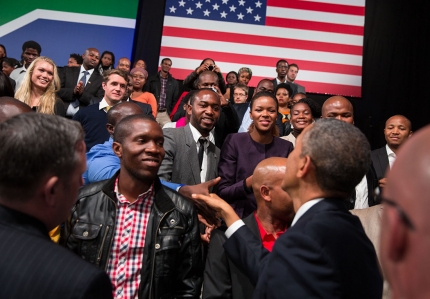
President Barack Obama greets audience members during a Young African Leaders Initiative Town Hall

President Barack Obama greets audience members during a Young African Leaders Initiative Town Hall at the University of Johannesburg Soweto campus in Johannesburg, South Africa, June 29, 2013. (Official White House Photo by Pete Souza)

At the start of the town hall, President Obama announced a significant expansion of this initiative - a new program called the Washington Fellowship for Young African Leaders. This new program provides thousands of promising young Africans the opportunity to come to the United States in order to develop skills at public and private American colleges and universities. President Obama described the programs focused: 

We’ll focus on civic leadership and public administration and business and entrepreneurship, the skills you need to serve your communities and start and grow businesses and run effective ministries.  And you’ll interact with Americans from all walks of life, because our citizens -- especially our young people -- can learn from you, too.  You’ll meet with leaders in business and nonprofits and government, including me.  And I look forward to welcoming you at a summit that I’ll host in Washington, because I want to hear directly from you -- your hopes, your dreams, what we can achieve together.

The White House

Office of the Press Secretary

Press Gaggle by Press Secretary Jay Carney and Deputy National Security Advisor for Strategic Communications Ben Rhodes -- en route Cape Town, South Africa

Aboard Air Force One
En Route Cape Town, South Africa

10:50 A.M. SAST
 
MR. CARNEY:  Good morning, everyone.  Thanks for joining us as we make our way to Cape Town.  Here to deliver the world’s fastest gaggle is Ben Rhodes, Deputy National Security Advisor.
 
MR. RHODES:  We’ll begin by going to Robben Island.  This is the President’s second trip to Robben Island but it’s his family’s first, and it was very important for the President to have the opportunity to bring his family to Robben Island and to pay tribute to Nelson Mandela and all the people who sacrificed by being imprisoned there on behalf of their ideals.
 
His tour will include the “B Section” courtyard, the recreation room, as well as Nelson Mandela’s cell, the Robert Sobukwe House, and the Lime Quarry.  The tour guide will be Ahmed Kathrada, who is 83 years old, a former inmate of Robben Island, a notable anti-Apartheid activist.  He also led the President’s tour in 2006 when he visited Robben Island.
 
Q    Can you spell that?
 
MR. RHODES:  Sure.  It’s Ahmed -- A-h-m-e-d and then K-a-t-h-r-a-d-a.  Obviously, there’s a tradition on Robben Island of former inmates giving these tours, which adds even more meaning to the opportunity to be shown where people were imprisoned by those who shared in the sacrifice with Nelson Mandela and so many others.
 
After that, as you know, we’ll be going to visit a community health center run by Desmond Tutu.  And of course, Archbishop Tutu was also a very important voice for social justice and in opposition to the Apartheid movement -- before giving the speech in Cape Town.
 
MR. CARNEY:  Anything else?
 
Q    This is the first time for Mrs. Obama and the girls?  They were never at Robben Island before?
 
MR. RHODES:  Yes, so last time they visited, they were able to visit with Nelson Mandela but they were not able to make it to Robben Island, so this is the first time for them.
 
Q    Will he be joined by any members of the Mandela family as well on this tour?
 
MR. CARNEY:  Just Mr. Kathrada.
 
Q    Just to follow up on the President’s comments on Egypt yesterday -- can you say what kind of contacts you’ve been having with the Egyptian government regarding safeguarding the embassy and consulates?  Are there sort of any military contingencies in place?  That kind of stuff.
 
MR. RHODES:  Well, first of all, we’ve been in touch with all of our contacts in the government -- the political leadership, the military.  Those conversations haven’t just focused on the security of our facilities -- that’s clearly been a top priority for us -- we’ve also focused on our desire for there to be a peaceful resolution of differences in Egypt, respect for both peaceful protests, also the obligation of the opposition to protest peacefully.  We’ve also been in touch with the opposition as well through our contacts. 
 
In terms of contingencies, we’ve basically taken the appropriate action to ensure that our embassies and consulates have additional security measures and that our personnel are taking additional security precautions.  I do want to just note there was an inaccurate report yesterday that I saw about a military deployment of some kind to Egypt -- that is not the case.  We believe we have significant security measures in place and that our civilians who are serving in Egypt can take additional precautions.  But we’re watching the situation very carefully.
 
Q    Any of this informed by the Inspector General’s report on Benghazi?  Is there anything done differently because of that?
 
MR. RHODES:  I would have to defer that question to the State Department.  What I would say is that we’ve had significant experience in Egypt with trying to assure security -- for instance, around the protests, some of which turned violent last September in Cairo.  So they’ve been dealing with a very volatile security situation for some time now, and we very regularly review the security posture and the diplomatic posture of our people in Egypt.
 
Q    I know one American was killed -- reported killed in what happened.  Has the White House had any kind of contact with the family by any chance? He was a D.C.-area resident.
 
MR. RHODES:  I know that the State Department has been in touch with the family and we’re providing all the services that we do in these instances.  It was clearly a tragic case, particularly painful to lose a young person.  It speaks to how volatile the security situation is there.  The President is certainly aware of the loss of that American and shares in the grief that the family has, and we’ll let you know if there are any additional contacts to report.
 
Q    Has the President been in touch with Secretary Kerry at all about the Middle East peace process?  I know he’s extended his stay to talk about it.
 
MR. RHODES:  Well, the President spoke at length with Secretary Kerry before he left for this latest trip to the region.  So he fully supports what Secretary Kerry is of course trying to move forward there.  And we’ve been kept regularly updated by Secretary Kerry and his team from the road, and I think it speaks to what high a priority we place on trying to move forward with a peace process that the Secretary of State has invested so much time and energy in this.
 
Q    President and Secretary Kerry haven’t chatted recently about it?
 
MR. RHODES:  I’m not aware of them having spoken since -- in the last couple days while he’s been there.  They did speak again before he left and Secretary Kerry briefed the President on his plans.  But I’ll let you know if we have any updates on additional conversations.
 
Q    Can I ask you one thing about tomorrow?  I think President Bush and, of course, the First Lady -- former First Lady will be in Tanzania.  Is there any talk -- have there been any -- well, first of all, would the current President be talking or meeting in any way with President Bush?  And/or have there been any discussions about them doing any kind of joint event?
 
MR. RHODES:  I don’t -- well, first of all, the First Lady, Michelle Obama, will be participating in the forum that Laura Bush is hosting.  So they will appear together.  It’s an important forum that lifts up the role of women in Africa. 
 
And I think the presence of the Bushes is something that marks I think the bipartisan support for Africa that exists in the United States, and it’s a very welcome symbol that they can be there at the same time.  We think it sends a very positive message that both political parties in the United States share a commitment to this continent.
 
In terms of the two Presidents, we’ll keep you updated if there are any scheduling updates as to whether or not they’ll be at the same place at the same time.  I think that’s still being worked through. 
 
Q    But right now, where does it stand?
 
MR. RHODES:  I’m just not aware that we have anything scheduled at this time.  But it may -- there may be something.  We’ll keep you updated.
 
Q    And has President Obama spoken with Morsi directly?  Or is there any high-level -- like Biden, anyone like that -- contact with the Egyptian government that you can read out?
 
MR. RHODES:  There have been a range of high-level contacts.  I don’t have the fullest to read out to you, but we’ll let you know if there’s any additional information there.
 
Thanks, guys.
 
END
10:58 A.M. SAST

President Obama and President Zuma of South Africa Toasts

July 29, 2013 | 7:24 | Public Domain

At a dinner hosted in honor of the President and First Lady, President Zuma of South Africa and President Obama exchange toasts.

Download mp4 (270MB) | mp3 (18MB)

Read the Transcript

Remarks by President Obama in an Exchange of Dinner Toasts

PRESIDENT OBAMA:  Well, good evening, everyone.  President Zuma, Madam Zuma, distinguished guests, thank you for your incredible hospitality.  When I was last here, as a Senator, my entourage was a little smaller.  (Laughter.)  By that I mean no entourage.  (Laughter.)  The Speaker just helpfully showed me a photograph of me and him from that first visit and pointed out that I had no gray hair in the photo -- (laughter) -- and that the years had taken their toll.

I also want to thank President Zuma’s staff for making my staff feel much better, because this is not the first time that a President has come to the podium without notes -- (laughter) -- that were supposed to be there.  And they are greatly relieved that that does not only happen to them.  (Laughter.) 

Traveling to South Africa the first time was different because part of the thing about not having an entourage is it meant I could go take walks on the streets of Johannesburg and Soweto and Cape Town.  And that’s how you truly get to appreciate a country -- the small interactions with shopkeepers or people who were willing to give you some directions.  And I’ve never forgotten the beauty of this country, the warmth of its people.  And tonight, I am reminded of that again, and Michelle and I can’t thank you enough.

I will not speak long.  I have spoken enough today; I know Michelle heartily agrees.  (Laughter.)  I will be giving another speech tomorrow about what this nation represents to me and about the future that I believe that we can build together. 

I’m told that there’s a word, a concept, that has come to define the way many South Africans see themselves and each other.  And I’m not sure it translates easily into English.  But it’s the recognition that, here on Earth, we’re bound together in ways that are sometimes invisible to the eye; that there is a basic oneness to our humanity.  It’s the belief that we can only achieve true excellence and our full potential by sharing ourselves with other, by caring for those around us.  I believe you call it Ubuntu.  (Applause.)

And we feel that spirit tonight.  We feel it in the lives of all those -- including President Zuma -- who endured the prisons and the beatings to end an unjust system so that we might stand here today in a free South Africa.  And to President Zuma, and to all of you who participated in that struggle, the world will always remember your sacrifice.  It’s a sacrifice that resonated in the United States in the same way that the U.S. civil rights movement helped to create bonds of solidarity with those in South Africa who were seeking their freedom.

We feel that spirit in the bonds between our two peoples that I think are unique in human history.  I would not be here were it not for those Freedom Fighters, and I certainly would not be here if people weren’t willing to fight for the principles that both our countries hold dear.

America’s founding prnciples -- our belief that “all men are created equal” -- which would find expression in your Freedom Charter, which declared that this nation “belongs to all who live in it, black and white” with all people “enjoying equal rights and opportunities.”  In time, the tables turned.  Just as I believe that many South Africans were inspired by people like Dr. King and Bobby Kennedy, we drew inspiration from your struggle.  And your success reminded us that all things were possible, including the improbable idea that a son of an African man might even become an American President.  (Applause.)

And we feel that spirit -- Ubuntu -- tonight because, we must admit, our minds and our hearts are not fully here because a piece of us, a piece of our heart is with a man and a family who is not far away from here.  Much has been said about Madiba today.  More will be said in the years to come.  This evening, I’d simply like to close with the words that he turned to so often himself, in that cell; the poem he read to the others, in their darkest moments, to give them strength.  

Out of the night that covers me,

Black as the Pit from pole to pole,

I thank whatever gods may be

For my unconquerable soul.


In the fell clutch of circumstance

I have not winced nor cried aloud.

Under the bludgeonings of chance

My head is bloody, but unbowed.


Beyond this place of wrath and tears

Looms but the Horror of the shade,

And yet the menace of the years

Finds, and shall find, me unafraid.


It matters not how strait the gate,

How charged with punishments the scroll, I am the master of my fate:

I am the captain of my soul.

And so I propose a toast:  To a man who has always been a master of his fate who taught us that we could be the master of ours, to a proud nation, and South Africa’s unconquerable soul, and to President Zuma and Madam Zuma for their outstanding leadership in carrying on the great traditions of the South African struggle.  Pula!

 END


Close Transcript

The White House

Office of the Press Secretary

Remarks by President Obama in an Exchange of Dinner Toasts

Union Building Pretoria, South Africa

PRESIDENT OBAMA:  Well, good evening, everyone.  President Zuma, Madam Zuma, distinguished guests, thank you for your incredible hospitality.  When I was last here, as a Senator, my entourage was a little smaller.  (Laughter.)  By that I mean no entourage.  (Laughter.)  The Speaker just helpfully showed me a photograph of me and him from that first visit and pointed out that I had no gray hair in the photo -- (laughter) -- and that the years had taken their toll.

I also want to thank President Zuma’s staff for making my staff feel much better, because this is not the first time that a President has come to the podium without notes -- (laughter) -- that were supposed to be there.  And they are greatly relieved that that does not only happen to them.  (Laughter.) 

Traveling to South Africa the first time was different because part of the thing about not having an entourage is it meant I could go take walks on the streets of Johannesburg and Soweto and Cape Town.  And that’s how you truly get to appreciate a country -- the small interactions with shopkeepers or people who were willing to give you some directions.  And I’ve never forgotten the beauty of this country, the warmth of its people.  And tonight, I am reminded of that again, and Michelle and I can’t thank you enough.

I will not speak long.  I have spoken enough today; I know Michelle heartily agrees.  (Laughter.)  I will be giving another speech tomorrow about what this nation represents to me and about the future that I believe that we can build together. 

I’m told that there’s a word, a concept, that has come to define the way many South Africans see themselves and each other.  And I’m not sure it translates easily into English.  But it’s the recognition that, here on Earth, we’re bound together in ways that are sometimes invisible to the eye; that there is a basic oneness to our humanity.  It’s the belief that we can only achieve true excellence and our full potential by sharing ourselves with other, by caring for those around us.  I believe you call it Ubuntu.  (Applause.)

And we feel that spirit tonight.  We feel it in the lives of all those -- including President Zuma -- who endured the prisons and the beatings to end an unjust system so that we might stand here today in a free South Africa.  And to President Zuma, and to all of you who participated in that struggle, the world will always remember your sacrifice.  It’s a sacrifice that resonated in the United States in the same way that the U.S. civil rights movement helped to create bonds of solidarity with those in South Africa who were seeking their freedom.

We feel that spirit in the bonds between our two peoples that I think are unique in human history.  I would not be here were it not for those Freedom Fighters, and I certainly would not be here if people weren’t willing to fight for the principles that both our countries hold dear.

America’s founding prnciples -- our belief that “all men are created equal” -- which would find expression in your Freedom Charter, which declared that this nation “belongs to all who live in it, black and white” with all people “enjoying equal rights and opportunities.”  In time, the tables turned.  Just as I believe that many South Africans were inspired by people like Dr. King and Bobby Kennedy, we drew inspiration from your struggle.  And your success reminded us that all things were possible, including the improbable idea that a son of an African man might even become an American President.  (Applause.)

And we feel that spirit -- Ubuntu -- tonight because, we must admit, our minds and our hearts are not fully here because a piece of us, a piece of our heart is with a man and a family who is not far away from here.  Much has been said about Madiba today.  More will be said in the years to come.  This evening, I’d simply like to close with the words that he turned to so often himself, in that cell; the poem he read to the others, in their darkest moments, to give them strength.  

Out of the night that covers me,

Black as the Pit from pole to pole,

I thank whatever gods may be

For my unconquerable soul.


In the fell clutch of circumstance

I have not winced nor cried aloud.

Under the bludgeonings of chance

My head is bloody, but unbowed.


Beyond this place of wrath and tears

Looms but the Horror of the shade,

And yet the menace of the years

Finds, and shall find, me unafraid.


It matters not how strait the gate,

How charged with punishments the scroll, I am the master of my fate:

I am the captain of my soul.

And so I propose a toast:  To a man who has always been a master of his fate who taught us that we could be the master of ours, to a proud nation, and South Africa’s unconquerable soul, and to President Zuma and Madam Zuma for their outstanding leadership in carrying on the great traditions of the South African struggle.  Pula!

 END


The White House

Office of the Press Secretary

Readout of President Obama’s Meeting with African Union Chairperson Dr. Nkosazana Dlamini-Zuma

President Obama met with African Union Chairperson Dr. Nkosazana Dlamini-Zuma in Pretoria, South Africa on Saturday, June 29th.  The President congratulated Chairperson Dlamini-Zuma on the 50th anniversary of the formation of the Organization of African Unity (OAU) /African Union, and expressed U.S. commitment to broaden and deepen the U.S. - African Union partnership.  President Obama commended the African Union’s leadership on regional peace and security, including its vital work to resolve the conflicts in Sudan, South Sudan, Somalia, Democratic Republic of the Congo, Central African Republic, and Mali.  The President also underscored the importance of the African Union’s leadership in advancing development and democratic norms across the continent.  The leaders also discussed shared interest in empowering women and youth, expanding trade and investment, and creating broad-based prosperity for people across the African continent.

# # #

The White House

Office of the Press Secretary

Remarks by President Obama at Young African Leaders Initiative Town Hall

University of Johannesburg-Soweto Johannesburg, South Africa

3:48 P.M. SAST

MS. MABUSE:  You guys are an amazing crowd.  Good afternoon, and welcome to the University of Johannesburg’s Soweto campus.  My name is Nkepile Mabuse and I will be the moderator this afternoon.

I really do hope that the strong significance and symbolism of what is happening here in Soweto today does not escape you.  There really are no two occasions in recent time that have had a more profound impact on the African people than when Nelson Mandela walked out of prison a free man in 1990, and of course, the election of Barack Obama in 2008.

Now, these two men are politicians and their legacies will be judged by history.  But there’s absolutely no doubt that these two developments in history have had a profound impact on the African continent.  They have brought hope in Africa, and also began the process of restoring pride and dignity in the African people. 

Now, as I speak to you and as you all know, President Nelson Mandela is lying in hospital, critically ill.  The euphoria that engulfed this continent when President Obama was elected is fading, but in this room -- look around you -- is Africa’s brand new hope.  These young people are doing amazing things in their communities.  They have already been identified as leaders, and leaders who are committed to serving others and not themselves. 

Exactly 37 years ago this month, young school children here in Soweto braved Apartheid bullets, fighting for freedom.  It’s no coincidence that a new generation of young people is here today.  And like the ’76 generation, they refuse to conform, but are inspired to transform their world. 

 When President Obama launched the Young African Leaders Initiative in 2010, he described them as the Africa that is overlooked.  Well, at this moment the world can see and hear you.  President Obama will come here, address you and then engage you.  We will take a question here in South Africa before we cross to Kenya, Uganda and then Lagos, Nigeria.  When the President selects you, please, be proud.  Introduce yourselves and ask a short, sharp, smart question.  (Laughter.) 

 As a fellow African, I really want to thank you from the bottom of my heart for keeping hope alive in Africa.  Please join me in welcoming onstage the 44th President of the United States of America Barack Obama.  (Applause.)

PRESIDENT OBAMA:  Hello, everybody!  (Applause.)  Yebo Mzansi!  (Applause.)  Oh, it is wonderful to be back in South Africa.  Everybody have a seat, everybody have a seat.  Relax.  Yes, I’m excited, too.  (Applause.)  

It is wonderful to be here with all these extraordinary young people -- young people from across this magnificent country, but also from all across the continent.  And I want to give special thanks and special welcome to those who are watching from Nigeria and Uganda and Kenya, a country obviously very close to my heart. 

 When I travel around the world, this is one of my favorite things to do -- meeting and talking with young men and women like you.  And our format today, this town hall is a longstanding tradition in America, and I get asked all sorts of things.  I remember one event, a person asked a question that’s often on a lot of people’s minds when I show up:  Where’s Michelle?  (Laughter.)  Sometimes people ask me, you seem to have gotten so old since you were elected -- (laughter) -- what happened? 

 So this format can be a little humbling, but it energizes me because it gives me a chance to hear from you directly what you’re thinking, what you care about, what your vision is.  And I’m making this trip to Africa because I believe this is a region on the move.  Even as this continent faces great challenges -- and they are great, and we can’t paper over them or pretend that those challenges don’t exist -- even as too many Africans still endure tremendous hardship and great injustice, there is, as the song says -- a “new Africa” -- more prosperous, more confident, taking its place on the world stage. 

 And one of the reasons is because of your generation.  And it’s fitting that we’ve gathered here, in Jo’burg, in Soweto, because here we learned that history is in our hands.  Not far from here, in Orlando West, two young men came of age who would transform this nation and inspire the world -- Nelson Mandela and Desmond Tutu.  And President Mandela once said that during all those years in that cell, it was his home here in Soweto -- that small red-brick house -- that was what he called the “center point of my world.” 

 And obviously he’s on our minds today, and we join the people of the world in sending our prayers to Madiba and his family because he still inspires us all. 

Now, not far from here, on a June morning, young students gathered in peaceful protest for the right to be taught in their own language, for the right to be treated like human beings.  And after all the police bullets, after the smoke cleared, the world was shocked by that image -- protesters holding the body of a young boy, Hector Pieterson.  And what a powerful tribute it is to Hector’s sacrifice, and to all who struggled, that we can gather here today in a free South Africa at a university that serves all South Africans. 

And I know the story of Soweto inspires you in your lives, but keep in mind it inspired me, too.  The uprising here helped open my mind to a broader world and to our responsibilities to choose between fairness and injustice, between right and wrong.  And as a Senator, during my first visit to South Africa, I was able to go to Hector Pieterson’s memorial and pay tribute to an African boy who moved the world.  And humbled by the sacrifices of all who have gone before us so that we can stand here as free men and women, I am honored to return to Soweto now as President of the United States of America.  (Applause.) 

Now, tomorrow I’ll be down in Cape Town at the University of Cape Town, and I’ll speak about the future that we can build together -- Africans and Americans.  And that’s where Robert Kennedy delivered his eloquent address to another generation of young people.  The challenges of our world, he said, demand “the qualities of youth; not a time in life, but a state of mind, a temper of the will, a quality of the imagination, a predominance of courage over timidity, of the appetite for adventure over the love of ease.”  That’s what young people are.  That’s the spirit of youth, and it’s still true. 

That’s why three years ago, I launched a new effort to make sure we’re tapping those qualities of youth -- the imagination, the courage, the “yes, we can” attitude of young Africans like you.  It’s our Young African Leaders Initiative, and I kicked it off by welcoming young men and women from across Africa to the White House, and we had a town hall similar to this one.  I think some of you were there, in fact. 

And since then, we’ve helped empower young people across this continent with new skills and entrepreneurship and leadership, and new partnerships in education and health and technology.  Michelle came here to Soweto for a forum with some inspiring young women, and she’s here today in Jozi meeting with students who -- (laughter) -- did I say that wrong? -- (applause) -- meeting with students who, like you, are going to determine the future of your countries.

 So today, I’m proud to announce a significant expansion of this initiative.  We’re launching a new program that’s going to give thousands of promising young Africans like you the opportunity to come to the United States and develop your skills at some of our best colleges and universities.  (Applause.) 

It’s called the Washington Fellowship for Young African Leaders, and I hope all of you apply because we’re joining with our top schools -- public and private.  We’ll focus on civic leadership and public administration and business and entrepreneurship, the skills you need to serve your communities and start and grow businesses and run effective ministries.  And you’ll interact with Americans from all walks of life, because our citizens -- especially our young people -- can learn from you, too.  You’ll meet with leaders in business and nonprofits and government, including me.  And I look forward to welcoming you at a summit that I’ll host in Washington, because I want to hear directly from you -- your hopes, your dreams, what we can achieve together.

And your time in America will be just the beginning.  When you come back home, new grants will help you turn your ideas into new businesses and new non-profits.  And we’re going to partner with American companies here in Africa to provide internships and mentoring and job opportunities to help you grow into the next generation of business leaders.  We’re going to partner with your governments and regional organizations here in Africa and foundations and civil society to amplify your voices as you stand up for democracy and equality.  And with the connections you make as a Washington Fellow, you’ll have something else for the rest of your life, and that is a network of Africans and Americans ready to collaborate on the future that you want to build. 

So this won’t be the most expensive program that we have, but I actually believe this is going to end up being one of the most important.  And it’s important to me personally, because it’s a great way for me to show my faith and confidence in all of you.  I believe in you, and I intend to make this a lasting part of our engagement with Africa beyond my presidency, for years to come. 

 We want to empower entrepreneurs like Fred Swaniker.  Where’s Fred?  He’s from Ghana.  (Applause.)  Where is he?  There he is.  So Fred has got a fan club over here.  (Laughter and applause.)  Fred helped to start a biotech company, and now uses his expertise to help other young Africans develop their leadership skills so that they can come back and put those skills to use serving their communities, starting businesses, creating jobs.  So thank you, Fred, for the great work that you’re doing.  (Applause.) 

We want to empower citizens like Khadija Patel.  Where’s Khadija?  Khadija?  (Applause.)  So Khadija is a fearless journalist here in South Africa.  She’s reported on Sudan, and Mali, and the Democratic Republic of Congo.  (Applause.)  She’s exposed the roots of conflict, she’s challenged leaders as a voice for peace and justice.  So we’re very proud of the work that you do, Khadija.  Thank you.  (Applause.)

We want to empower advocates like Jacob Jabari.  Where’s Jacob?  Right here.  (Applause.)  So here in South Africa, Jacob decided he was not going to hide the fact that he was HIV positive; he embraced it, he became a counselor.  He helps guide others, because he says the key to saving lives and slowing the spread of AIDS is an honest approach, and that takes great courage.  Thank you, Jacob.  (Applause.)

And we want to empower women like Lebo Bogapane.  Lebo?  (Applause.)  Growing up, Lebo endured domestic abuse and violence, which led to homelessness and hunger.  Over many years, she didn’t simply rebuild her own life, she built a crisis center here in South Africa that’s helped thousands of women and children escape abuse as well.  What a great legacy.  Thank you, Lebo.  (Applause.)

So building the future that you seek, realizing the vision that you have, not just for your own countries but for the world -- it will not be easy.  It will not be easy.  But as you go forward, I want you to think of the man who’s in our prayers today.  Think about 27 years in prison.  Think about the hardships and the struggles and being away from family and friends. 

Reflecting on his years in prison, Nelson Mandela wrote that there were dark moments that tested his faith in humanity, but he refused to give up.  And he said, “I am fundamentally an optimist.  Whether that comes from nature or nurture, I cannot say.  Part of being optimistic is keeping one’s head pointed towards the sun, one’s feet moving forward.”

So in your lives, there will be time to test your faith.  But no matter how old you grow, I say to all of you today, don’t lose those qualities of youth -- your imagination, your optimism, your idealism.  Because the future of this continent is in your hands, and if you keep your head pointed towards the sun and you keep your feet moving forward, I promise you will have no better friend and partner than the United States of America.  (Applause.)

Thank you very much, everybody.  Thank you. 

So now I get to do what I really want to do, which is to hear from you.  So why don’t we open it up for questions.  And I understand that we’ve got somebody from South Africa here perhaps.

MS. MABUSE:  Yes, the plan is to get somebody here in Soweto before we move across to other parts of the continent. 

PRESIDENT OBAMA:  Okay.

MS. MABUSE:  The choice is yours, Mr. President.

PRESIDENT OBAMA:  well, this is a good-looking group.  Let me -- (laughter) -- I’m going to call on this young lady right here.  Introduce yourself.

Q    Good afternoon, President Obama.  My name is Melissa (ph).  I’m an attorney, and I’m passionate about telecoms in Africa.  My question is:  The African Growth and Opportunities Act, the term expires in 2015, and I understand there’s a bill which provides for an extension to 2019.  Do you think this bill will be passed?  And if it isn’t passed, what do you think the impact will be on small states in Africa that are benefiting, such as Lesotho and Togo?

PRESIDENT OBAMA:  Well, it’s a great question.  (Applause.)  By the way, what kind of law are you practicing?

Q    Oh, right now I actually do cross-border African work.

PRESIDENT OBAMA:  Excellent.

Q    Yes, (inaudible) work.

PRESIDENT OBAMA:  Fantastic.  Well, for those of you who are not as familiar with it, the program we call AGOA is basically a trade arrangement that allows probably 95 percent of goods from Africa to come into the United States without tariffs, duty-free.  And, as a consequence, it obviously gives African exports a greater advantage. 

And the whole idea is that historically, if you look at the relationship between Africa and the rest of the global market, dating back to colonial days, the idea was somehow that raw materials get sent somewhere else, they got produced somewhere or refined somewhere else; sometimes they’re sold back to Africa, but the jobs, the value, the profits are all someplace else. 

And we graduated from those colonial times to the idea of aid, which continues to be critically important.  There are parts of Africa that -- where, right now, people just need food, or right now people just need medicine, and it is the obligation of wealthier nations to help deliver that food or that medicine. 

But everywhere I go in Africa, what’s very clear is people want to break out of a dependency trap.  The idea is not that Africa somehow should be the ward of some other country.  What we need is an Africa that is building, manufacturing, creating value, inventing, and then sending those products around the world and receiving products in return in fair terms of trade.  And if we do that, then there’s no reason why Africa cannot succeed. 

So part of what I’m trying to highlight during this trip is the enormous opportunities for an Africa that is intimately integrated into the world market.  I want small and medium-sized businesses and entrepreneurs and startups here in Africa to see their potential not just in the local market, but to be able to sell goods and service all around the world and to bring those profits back to Africa and reinvest in Africa and hire Africans. 

And so as part of that, we want to make sure that the United States is a critical trading partner.  And, by the way, we’re not doing it out of charity.  We’re doing it because if Africa is doing well, then now we’ve got a market of people who want to buy more iPads and -- (laughter) -- Boeing airplanes and all the good stuff that we sell, right?  And Africa, by the way, is the youngest continent, which means that demographically this is going to be a larger and larger share of the world market. 

So specifically, in terms of AGOA, you’re right -- the current AGOA structure expires in 2015.  It is my hope that we get it renewed.  Now, what I mentioned to President Zuma today, and I said this at a press conference, is that we will have to engage in some negotiations to find ways to both improve what we’re currently doing, but also to reflect on the fact that South Africa is becoming more and more successful, and that U.S. businesses -- in order for me to get it through Congress in the United States, U.S. businesses have to feel as if they’re getting a level playing field relative to, for example, some of the European companies who are able to operate here -- because there’s a free trade agreement between Europe and the United States.

But I’m confident that with good negotiations, that we should be able to get it done.  The broader point I want to make, though, is that the future is going to be in creating value here in Africa and making sure then that Southeast Asia and China and Turkey, and all these other places around the world that everybody is starting to see the benefits of global trade patterns.  And Africa cannot just be a source of raw materials for somebody else.  It has to be a source of the kinds of products and services and imagination that is going to be the future of the 21st century.  Thank you.  (Applause.)

MS. MABUSE:  We have a young person in Kenya who has a question for you.  Kenya, you ready?  There we go.

KENYA MODERATOR:  Thank you, South Africa.  You are watching us, broadcasted to you live from Nairobi here in Kenya’s capital.  And indeed I’m joined by eight young Kenyans who have come in from five different counties within the country, quite excited.  I think I speak for all of them when I say that indeed it’s an honor to be able to engage with you, Mr. President, while directly during this program. 

And I’ll just get right to it and give an opportunity for one of the Kenyans who is with me here to be able to ask a question to you, Mr. President.  Margaret (ph), you have the floor now.

Q    Thank you, Katherine (ph).  Jambo, Barack Obama, President.  We are honored to be with you live today this afternoon from Nairobi, Kenya.  Our question to you really is, given the recent shift of trade ties of Kenya to the East, how does this impact on American foreign policy towards Kenya?  And does the ICC indictment of our President and his deputy prevent the U.S. from engaging with Kenya both politically and economically?  In addition, Mr. President, many Kenyan youth would like to know what are your thoughts and plans on youth empowerment that involve structure of governance to Kenya?  Thank you.

KENYA MODERATOR:  Now, Mr. President, as you prepare to respond to that question, I’m sure you’re alive to the fact that there has been a lot of speculation in the Kenyan media and also in the social media for your reasons for not visiting Kenya on your second tour of Africa.  Maybe if you recall in an interview that you did have with this channel that is way back on the 1st of June 2010, you did a promise that during your tenure as President of the United States of America, you will be touring Kenya.  Well, will you still keep your word on that?  (Laughter and applause.)

PRESIDENT OBAMA:  Well, Asante Sana.  It’s wonderful to see all of you.  (Laughter.)  First of all, let me just say that I’m going to be President for another three and a half years.  (Laughter and applause.)  One of the things that you learn as President is not only do people want you to fulfill your promises, but they want you to fulfill your promises yesterday.  (Laughter.)

And part of the reason that I wasn’t able to visit Kenya this time is I’ve been to Kenya multiple times and there hadn’t been a sustained visit by me in West Africa; and then South Africa, given the importance of the work that we’re doing together; Tanzania is a country I hadn’t visited before.  So I was trying to spread the wealth a little bit in terms of my visit.

But what’s also true, I won’t deny, is that Kenya just had an election.  I was very proud to see the restraint in which the election was held.  We did not see a repeat of the violence that we saw in the last election.  But with a new administration that’s also having to manage some of the international issues around the ICC, I did not think it was the optimal time for me to visit.  But as I said, I’m going to -- I’ve got three and a half years.  So if in three years and seven months I’m not in Kenya, then you can fault me for not following through on my promise.  (Laughter.)

You raise the issue of whether our attitudes towards Kenya changed because of Kenya’s orientation towards trade and commerce with the East.  And this was asked of me before -- it’s a general question that I get during this visit; people saying, well, China is here a lot, and is this what’s motivating America to want to be more involved.  And I want to make two points. 

First of all, our commitment to Africa is based on our belief in Africa’s promise and Africa’s future, and we want to be part of that future.  Second of all, I think everybody should be involved in Africa.  (Applause.)  I want China and I want India and I want Brazil, and I want Singapore -- everybody, come on down -- (laughter) -- to Africa because 6 of the 10-fastest growing economies in the world are right here in Africa.  (Applause.)

You are seeing a shift inside of Africa in which a commitment to democracy and transparency is beginning to take hold.  I just visited Senegal, where President Sall has embarked on a reform agenda, including, by the way, shortening his term from seven years to five years, and a belief that, for example, members who join the government need to disclose their assets -- just basic measures that can help to root out corruption.

And so when you start seeing these changes, everybody should be excited about wanting to do business here in Africa and doing business with Kenya.  Now, what I said during a press conference today I want to repeat, which is I want to make sure that as countries come to Africa, that it’s benefiting Africans.  So if somebody is building a road here in Africa, make sure they’re hiring some Africans.  (Applause.)  If there’s going to be manufacturing taking place of raw materials, locate some of those plants here in Africa.

And so I do want to make sure that whoever you’re dealing with -- and as you enter into government and business -- whoever you’re dealing with, making sure you’re getting a good deal that’s benefiting the people here and can help to spur on broad-based development.  And, hopefully, that’s the kind of relationship that you’ll be able to develop with the United States of America.  And that’s the kind of relationship I want Kenya to have with every country on Earth. 

We’re in a global economy with a global supply chain, and I don’t want Africa to continually just be at the bottom of the supply chain.  You produce the raw materials, sold cheap, and then all the way up the chain somebody else is making the money and creating the jobs and the value. 

So part of what your generation’s challenge will be is making sure that, first of all, you have a transparent, accountable, non-corrupt, open government -- because economic development is not going to happen in the absence of that kind of certainty.  That’s what businesses want.  They don’t want to have to pay a bribe just to get phone lines installed in their business.  They don’t want to have to hire somebody’s cousin just to open a business.  And we have to be honest about it.  In a lot of countries, that’s still the case, and that discourages investment.

And then as you move into positions of power, I want to make sure that you’re negotiating a good deal with these other countries.  Now, it’s got to be realistic.  It’s got to be based on what assets do you bring to bear.  And initially, at least in some countries and in some regions in parts of Africa, you’re looking at a certain type of manufacturing or a certain type of industry that may not be very capital-intensive, for example, because there may not be as much capital initially to invest.  So it may start at a smaller scale but continually upgrading and improving the prospects for Africa I think will require that kind of tough, hardheaded negotiations.  But I want every country to be here.

Last point on Kenya -- I already made this for all countries -- yes, I want young people to be involved in holding their governments accountable.  Now, there is a lot of variety here in Africa in terms of quality of governance.  And I don’t want to reinforce for the American press that are here this attitude that Africa is just one big piece of land on the map.  (Applause.) 

There’s a lot of variation.  Some countries are doing great work when it comes to accountability and democracy, and an act of civil society, and a free press, and freedom of assembly.  And some countries are not doing as well.  But what’s exciting right now is you’re starting to see more and more a norm, a standard, take hold in Africa.  And young people, I think especially, have high expectations about how government should function, and it should function for the public good, not for the benefit of just a few.  And people should be able to speak their mind, and they should be able to organize without fear of retribution.  And they should be able to cast a ballot without problem. 

And South Africa, I think, has been a great model.  This is one of the greatest legacies of Nelson Mandela -- is to show that through a commitment to the constitution and rule of law, and equal treatment for all people, that a country can prosper despite a tragic history.  And the same should be true in Kenya, which is why I was heartened that the process of the last election at least did not result in chaos. 

And that should be true for every country.  And President Zuma said something important today at the press conference, and I’m going to see what we can do to work with them.  The African Union I think is trying to create sort of a peer review system so that it’s not just the United States coming in and lecturing some African country that’s not observing democracy; it’s fellow Africans who are saying, what are you doing?  Why are you suppressing your people?  Why are you throwing political dissidents in jail?  Why are you blocking people’s ability to organize new political parties?

And when peers are organizing in that fashion, then slowly standards get raised and new norms are established, and all of you can be at the forefront of that.  Thank you, Kenya.  (Applause.)

MS. MABUSE:  We are going to stay in East Africa and take a question from Kampala, Uganda.

PRESIDENT OBAMA:  Fantastic.

UGANDA MODERATOR:  Hello from Kampala in Uganda, “the pearl of Africa,” as we are known.  I am Nancy Kacungira, a news presenter with NTV Uganda.  And Uganda is a very youthful nation -- more than half of our population is actually under the age of 15.  I’m here today with a group of vibrant and dynamic young people.  And as you can see, they are very excited to be addressing President Obama today and asking him a question. 

Now, I’ve had the chance to interact with the young people here today, and they’re all great young leaders in their own right.  And they all have different backgrounds and different experiences, but I’ve found that one of the things they do have in common is their passion -- their passion for a better Uganda and for a better Africa.  Mr. President, one of them is now going to ask you a question on behalf of the rest of the group.

Q    Hello, Mr. President.  It’s an honor.  My name is Eirene Ikomon (ph).  My question comes on behalf of everyone seated here with me.  Unfortunately, it’s also regarding trade.  Mr. President, as young Ugandan leaders, we are looking to the world for equal business partners and commitments, and not necessarily aid.  We are not looking for donors.  And yet, Mr. President, the policy you have just described right now seems to emphasize help coming in from the U.S. but emphasizing offering jobs and employment within the countries that they come into.  As young leaders, Mr. President, we want to do the businesses at home and be the ones to own our own markets.  So how do you, Mr. President, plan on assisting us in reaffirming the U.S. policy to achieve this vision?  (Applause.)

PRESIDENT OBAMA:  Well, with respect to U.S. policy, I think you mischaracterize it, because our policy is to see success here in Africa.  Now, there’s no doubt that U.S. businesses also want to sell into Africa, because as President of the United States, I want to create some jobs in Africa as well.

But my attitude is that the more successful African entrepreneurs are, then the more they’re going to be purchasing and interested in purchasing U.S. goods.  And, conversely, when the economy in the United States is doing strong, then we’re going to buy more from Africa, and everybody’s standards of living can rise.  But as you heard me say earlier, I completely agree with you that we want more investment and value creation here in Africa. 

Now, one thing we haven’t spoken about, which I think is critical, is intra-African trade.  All too often, it’s easier to export, say, tea and coffee, from East Africa or flowers from East Africa to Europe than it is to export it someplace else in Africa. 

And part of that is the legacy of colonialism, an orientation out of Africa rather than internal to Africa.  Part of it is a lack of basic infrastructure -- so port facilities, trains, rail, roads.  So one of the things that we’re going to be very interested in is working with the African Union as well as various regional organizations to find ways that we can start linking up markets inside of Africa, because particularly for new businesses -- if you’re starting a business here in South Africa, then the best chance you have initially for export might be closer to home, one of the surrounding countries. 

If Uganda -- if you have a business that you want to get started, and initially you’ve gotten your product popular inside of Uganda, the next step before you think about selling to the United States, you might say to yourself, let me start selling some in Kenya, or let me start selling in Tanzania, or Rwanda.  And so part of what we have to do is to find additional ways in which Africans can also trade with each other. 

The last point I will make -- because it’s related to trade and capacity-building -- I just came, as I said, from Senegal.  And one of the things that we were featuring was our Feed the Future program and a Food Security Alliance that we’re creating here in Africa.  And we’ve already gotten nine countries to join, and Senegal just determined that it was going to join as well.  But we’ve already helped 7 million small farmers in Africa to pool their resources, access lower credit, link themselves together as one producer group so that they can market and sell more effectively.  And we’ve seen those farmers increase their yields and their sales by 10, 20, 30, in some cases, 50 or 100 percent. 

I met with a young woman farmer who had started off with one hectare, now has 16.  She has been able to achieve enough growth that she has now bought a tractor.  She’s hired eight people.  Now, that’s not what we ordinarily think of as business or entrepreneurship, but if you think about the number of Africans who are involved in agriculture and giving them the tools where suddenly they’re getting better prices for their crops, they’ve got access to a marketplace, they now are getting enough credit to be able to mechanize their operations, and now suddenly they’re able to hire some people in their surrounding villages, you’ve just suddenly seen a small business grow.  And the next step may be then they start doing some small food processing.  And next thing you know, now they’re suddenly supplying these processed foods to a school.  And next thing you know, they’re supplying those processed foods to the whole country. 

And so not every business is going to be an Internet business, an app -- (laughter) -- I mean, I know that’s what young people are all about -- I’m just going to create an app, I’m the next Facebook.  That’s great, and I hope some of you do that, but when we think of development of Africa as a whole, especially if we’re thinking about broad-based development, then part of what we have to recognize is that a huge number of people inside of Africa are still in the agricultural sector, and the work that we’re doing is trying to create capacity for those small farmers who are essentially small entrepreneurs to be successful -- because if they’ve got more money in their pockets, now they can afford to buy your app.

So thank you very much for the question, Uganda.  Appreciate it.  (Applause.)

MS. MABUSE:  Mr. President, we’re moving over to West Africa now, and we’re going to take a question from Lagos, Nigeria.

NIGERIA MODERATOR:  Well, welcome, Mr. President, to Lagos, Nigeria, home to perhaps Africa’s biggest youth population.  I’m Maupe Ogun for Channels Television here.  And here with me in the studio are a selection of some of Nigeria’s brightest and best, and I must tell you, Mr. President, they’re mostly women, so you better be careful around them.  (Laughter.)  And they say they’re on the march and they have their question ready.  Over now to Aisha (ph).

Q    Good afternoon, Mr. President.  My name is Aisha Myna (ph), and I represent seven other people here.  In acknowledging our challenges and our responsibility as the young leaders of Nigeria to accept our challenges and make the difference, we would like to thank you for your support to Nigeria and Africa as a whole.  The largest resource in Nigeria is our human capital, and we would like to ask a two-pronged question. 

The first is, how can the United States deepen its investment in deploying technology that will develop our vast human capital as well as the education of her youth?  My second question -- it’s two-pronged, sorry, Mr. President -- considering how long the war on terror has been on for, would you say that we’re winning the war on terror, seeing that there are new terrorist groups developing in Africa, one of which is in Nigeria?  Thank you.

PRESIDENT OBAMA:  Well, those are both great questions.  Thank you.  (Applause.)

And before I answer the question, I just want to be clear:  I am surrounded by opinionated women in my house all day long -- (laughter) -- so I’ve got good practice dealing with strong women.  You guys haven’t met Michelle, but you’ve probably seen her on TV.  She’s not shy.  (Laughter.)  And Malia and Sasha, they’re just taking right up after her.  So every night at dinner I’m surrounded.

In terms of human capital and young people, I think there is no doubt that the most important investment any country can make -- not just an African country -- any country can make is educating its youth and providing them the skills they need to compete in a highly technological advanced world economy -- countries that do not do that well will not succeed.  Countries that excel at training their young people are going to succeed, because these days businesses can go anywhere.  And one of the key criteria for any business is, where can I find outstanding workers?  Where can I find outstanding people to manage a plant or manage my sales force?  And if you have countries with high illiteracy rates or limited skills, you’re going to have problems. 

And I want to be clear that this is a problem in the United States, not just a problem in Africa.  One of the main things that I’m spending a lot of time on is trying to push Congress to improve our early childhood education, because it turns out that children are most susceptible to learning between the ages of zero and three.  And so working with parents, particularly mothers, around reading to their children, proper nutrition, stimulating activities.  Then, when they get to school, making sure that our schools are prepared and redesigned for today -- because a lot of the schools in the United States were first created during the agricultural era and aren’t always appropriate for what’s required today.  And then on into what we call community colleges, which are two-year colleges or four-year colleges and universities. 

Somebody should have told my helicopter to quiet down while I’m talking.  (Laughter.)

So across the board, we’re having to rethink education and workforce training.  And one of the things that we want to do is to partner with a country like Nigeria and identify ways that we can provide direct value added -- whether it’s in helping to train teachers, helping to incorporate technologies into the education process. 

So, for example, one of the things that you hear across the continent is, because a lot of Africans still live in rural areas, it may be difficult for them to access education and schooling once they get beyond a certain level.  Well, are there ways in which we can pipe in, essentially, a university into a rural community?  And suddenly, you’ve got the lecturer right there, without the same costs or obligation for a young person to take on when they go to travel far away from home in order to study. 

 And so I think that there are some excellent ideas that sometimes we’re doing country by country, depending on the country.  But this is an area where I would love to get more input from young people in terms of what they think would work.  And so part of the Young African Leaders Initiative may be to elicit additional ideas from those -- particularly those who may be working in education and have a sense of what are the barriers right now for young people in order to succeed.

Now, with respect to the so-called war on terror, there’s no doubt that we’ve made some progress in dealing with some extremist groups -- for example, core al Qaeda and bin Laden, that was based in the FATA area between Pakistan and Afghanistan -- that they have been greatly diminished.  But what is also true is that in some ways, the problem has metastasized.  You have more regional terrorist organizations, like a Boko Haram in Nigeria, espousing an extremist ideology, showing no regard for human life.  And although they may not have the same transnational capacity that some of the earlier organizations did, they’re doing great harm in Africa and in the Middle East and in South Asia. 

People always talk about the terrorist threat to the United States or the West, but the truth of the matter is, is that the number of people who are killed by terrorist attacks in African countries, or in Muslim countries, or in South Asia, far outstrips any deaths that are experienced by westerners.  It’s typically people right there where these organizations are based that are most likely to be killed.  When the Kenya Embassy bombing happened, the overwhelming majority of people who were killed were Kenyans, not Americans.  And so this is not just a problem for us.  This is a problem for everybody. 

Now, the question is, how do we address this problem?  It is my strong belief that terrorism is more likely to emerge and take root where countries are not delivering for their people and where there are sources of conflict and underlying frustrations that have not been adequately dealt with.  The danger we have right now, for example, in a place like Somalia is that it’s been two generations, maybe three since there was a functioning government inside of Somalia.  Now, we’ve started to see actually some progress, in part because of intervention by African nations in Somalia to clear the space, to create the space for governance. 

But you look at what’s happening in Mali, for example, right now.  Part of the problem is, is that you had a weak central government and democratic institutions that weren’t reaching out as far into the country as were necessary, and we’ve got to build those institutions.  A lot of what we talked about in terms of responsiveness and governance and democracy, those things become defense mechanisms against terrorism.  They’re the most important defense against terrorism. 

So I don’t start with the attitude of a military solution to these problems.  I think the more that we’re giving people opportunity, the more that we’re giving people education, the more that we’re helping resolve conflicts through regular democratic processes, the less likely they are to take root.  Now, having said that, there are some extremist groups that will not compromise or work through a democratic process, and we have to also be realistic about that.  And what we want to do is partner with African countries to figure out how we can help. 

But I promise, this notion somehow that we want to somehow expand our military reach -- I was elected to end a war.  I’ve ended one.  I’m now in the process of ending another one.  Every few weeks, I go and visit soldiers who are your age, who have had their legs blown off in Afghanistan, or worse.  Every week, I’m writing letters to the families of fallen soldiers.  Sometimes I go to Arlington National Cemetery, where our heroes are buried, and I hug those families and I feel their sobs on my shoulder. 

This idea somehow that we want to get more involved militarily around the world is simply not true.  First of all, it costs a lot of money, and the United States, just like every country around the world, has to think about its budget.  And where we intervene oftentimes it’s not very effective because unless you’ve got a local population that is standing up against terrorism, we end up being viewed as interlopers and intruders.

So with -- in the Africa context, what we want to do is to build African capacity.  We want the African Union and other regional organizations to build up the capacity to send in peacekeepers, to be able to nip terrorist cells that may be forming before they start and gain strength.  And we can provide advice and training and in some cases equipment, but we would love nothing more than for Africa, collectively, to say no to extremism, say no to terrorism, to say no to sectarianism -- which in the case of Boko Haram, for example, is an example of essentially a religious rationale for this kind of violence -- and the United States to be able to step back and worry about selling iPads and planes.  That’s what we would like to do. 

But what we won’t do is just stand by if our embassy is being attacked or our people are in vulnerable situations.  And we expect countries to work with us to try to deal with some of these threats.  And this is a global issue; it’s not just one related to the United States.  Okay.  All right.  (Applause.)

MS. MABUSE:  We have time to take one last question from Soweto.

PRESIDENT OBAMA:  If it’s a really short question, I’ll give a short answer and we’ll get two in.  (Laughter.)  Gentleman right here, yes, go ahead.  Everybody has got -- you’ve got to describe why you’re all wearing orange.  (Laughter.)

Q    Okay.  Firstly, my name is Han Dinkelman (ph).  I’m nervous.  (Laughter and applause.)  I’m a student at UJ.  I’m an honor student; also studied education.  You said education people should stand up.  (Laughter.)  My education is -- oh, my question is we’ve got a lot of barriers in this country, and one of those barriers is the amount of students in our classes versus a single person.  And what I find difficult is, how does that one person stand up and control, in some cases -- we’ve just come back from training -- some cases 90 to 100 kids in one class?  It’s difficult enough to carry 40 in my class.  How do you carry those 90 -- I find it very difficult -- and try to make an impact in their lives?

PRESIDENT OBAMA:  Good.  I think that’s a great question.  First of all, I think it’s wonderful that you’re going into education.  Very proud of you.  (Applause.)  No job more important than educating our young people.  This is a challenge that we have in the United States as well, and that is the issue of class size. 

Now, our problem typically is that our class sizes are around 35 or 33, and we’d like to see if we can get it down in the twenties.  If you’re talking about 90 -- (laughter) -- that’s a whole other level.  Now, we’re -- I’m assuming we’re talking about primary and secondary education, we’re not talking about universities, because by the time you get to university it’s -- you better be focused on your studies.  It’s not the job of the teacher to make you do your work and pay attention, because you’re now an adult.  But when it comes to young people, studies do show that particularly for poorer children, the more one-on-one attention that they can get from their teachers, the more personalized instruction they can get, the better they’re going to do.

So the first response is, if you can budget -- if a government can budget smaller class sizes, that’s better.  But not every country is going to have the resources to do that.  And one of the things that we’re starting to see in the United States is, how can you effectively use, for example, teacher’s assistants in a class, who may not be fully certified teachers but can break up, let’s say, a class of 90 into smaller groups.  This is also where technology can also potentially make a difference, because it’s conceivable that if you’ve got some sort of technology -- a couple of laptops -- that you can leverage one teacher into multiple instruction. 

The question you raise, though, makes me want to suggest to my team when we leave here that we start taking some of the best practices and some of the things that we’re learning in the United States and seeing if there may be some application we can -- might be able to start some pilot programs here in South Africa to see if we can make an impact there.  (Applause.) 

Good.  All right.  Last question?  One more.  All right.  All these folks have been so patient in the back, I don’t want them to feel neglected.  So the -- this gentleman right here, because he seems very eager.  Right here.  Yes, yes, you right there.  (Laughter.)  Go ahead.  The -- but you guys can -- feel free to stand together if you want, but -- (laughter) -- I’m only going to take a question from one of you.  (Laughter.)  What’s your name?

Q    My name is Sydney Mukumu (ph).  I’m from Limpopo.  (Applause.)  Thank you.  President Obama, I met you in 2006.  I was working for the embassy. 

PRESIDENT OBAMA:  Excellent.

Q    Yes.  I’m very much worried about some of United States international -- I mean foreign policy, especially on the environment.  President Obama, today I want you to tell these young leaders about the foreign policy of the United States on the environment.

PRESIDENT OBAMA:  On the environment?

Q    Yes, because South Africa is facing the same problem.  Whatever is happening in America, it’s affecting us.  Please tell these -- this is your children -- tell us today -- (laughter) --

PRESIDENT OBAMA:  Yes.

Q    -- just like people who are protesting outside, there are people who are crying, and now you must address them here --

PRESIDENT OBAMA:  Okay, let’s go.

Q    -- and tell them outside what is happening.  Make it clear, and then when you go back you will have a safe trip.  Thank you very much, President.  (Applause.)

PRESIDENT OBAMA:  I’m ready.  I’m ready.  I’m ready.  I’m ready.  (Laughter.)  I’ll see if I can make it clear.  U.S. environmental policy is something that I care deeply about.  As some of you know, I grew up in Hawaii, one of the most beautiful places on Earth.  And as a child, I was just taught to treasure what the Earth gives us and to make sure that we leave it for the next generation.  And obviously in a country like South Africa, with incredible beauty and natural resources, that same mentality about conserving the Earth and nurturing it to pass on to future generations, I think, applies here just as much as it does in the United States.

The biggest challenge we have environmentally -- and it is an international challenge that we cannot solve alone -- is the issue of climate change.  There are other issues:  dirty water, dirty air.  But the truth is, is that we’ve made enormous progress over the last several years, over the last several decades in the United States.  And if you come to the United States, environmental quality is pretty good.  And internationally, we’ve promoted policies around how mercury is released into the environment, and how other poisons are released in the environment, and how businesses have to be held to international standards in terms of worker safety.  Those are areas where the United States have been at the forefront.  We’ve been at the front of the line, not the back of the line when it comes to those issues.

But the existential challenge that we face has to do with a warming planet.  And your generation is the one that’s going to be the most severely affected.  Now, the United States and other highly industrialized, developed countries over the last 50, 100 years have been pumping up carbon emissions into the atmosphere.  And slowly, this has been building up and it is warming the planet, and we may be reaching a tipping point in which if we do not solve this problem soon, it will spin out of control and change weather patterns in ways that we can’t anticipate, with drought, floods, much more severe natural disasters.  And unfortunately, in those situations it’s often poorer countries that are affected the most by these changing climate patterns.

So I just gave a speech this past week on what the United States is going to do on our next phase of reducing our carbon emissions.  The United States actually reduced our carbon emissions more than any other country since I came into office.  I just want to make that point.  (Applause.)  We doubled fuel-efficiency standards on cars.  We’re investing in clean energy like solar and wind.  And we actually want to share that technology, because we think that all countries need to benefit.  And part of the opportunity for Africa is to see if we can leapfrog some of the polluting practices of America or Europe, and go straight to the clean energy strategies that will allow you to advance economic growth, but not corrupt the planet.

So we’ve made progress, but we haven’t done enough.  And what I did was to say I challenge the United States.  I said we’ve got to do more.  We’re going to start regulating our power plants more efficiently.  We’re going to make sure that we redouble our efforts to reduce our carbon emissions, and we’re setting a goal to meet the agreements that we had both in Copenhagen and in Durban for advanced countries that have a big carbon footprint.

But let me make one last point:  The United States cannot do it by itself.  And the biggest emitter of carbon right now is China.  They still have a much lower carbon footprint per person than the United States, but because they have so many people, it’s going up rapidly.  And Chinese leaders understand this.  The same thing that’s sending all the carbon into the atmosphere is also making it difficult to breathe in Beijing.  So they recognize they’ve got to come up with a new development model.  India is going to have to come up with new development models -- Africa. 

We’re going to all have to work together to find ways in which collectively, we reduce carbon but we make sure that there’s some differentiation so that countries that are very wealthy are expected to do more, and countries that are still developing, obviously they shouldn’t be resigned to poverty simply because the West and Europe and America got there first.  That wouldn’t be fair.  But everybody is going to have to do something.  Everybody is going to have to make some important choices here.  And I expect that it’s going to be your generation that helps lead this, because if we don’t, it’s going to be your generation that suffers the most. 

Ultimately, if you think about all the youth that everybody has mentioned here in Africa, if everybody is raising living standards to the point where everybody has got a car and everybody has got air conditioning, and everybody has got a big house, well, the planet will boil over -- unless we find new ways of producing energy.  And tomorrow, or the next day, when I visit Tanzania, I’m actually going to be going to a power plant to focus on the need for electrification, but the need to do it in an environmentally sound way. 

So let me just close by saying this has been an unbelievable conversation.  I had a lot of faith in all of you before I came here; now I have even more faith in you.  You guys are all going to do great things.  I’ll be retired by the time you do them, and so I’ll just sit back and watch -- (laughter) -- and I’ll be proud of you.  But what I promise you is that the United States government and the American people are going to want to be your partner for the duration of your careers.  And I hope all of you, again, apply for the Young African Leaders Initiative.  We want to hear from you about how we can work even more effectively with this great continent, because we see a bright future ahead.

I hope you’ve enjoyed it.  Thank you, everybody.  God bless you.  Thank you.  (Applause.) 


END                5:00 P.M. SAST

Young African Leaders Initiative Town Hall

June 29, 2013 | 01:12:00 | Public Domain

At the University of Johannesburg - Soweto, President Obama discusses youth empowerment and leadership with young African leaders in a town hall meeting.

Download mp4 (2724MB) | mp3 (173MB)