The White House

Office of the Press Secretary

Statement from the President on the Confirmation of Sally Jewell as the Next Secretary of the Interior

I am pleased that today the Senate took bipartisan action to confirm Sally Jewell as our next Secretary of the Interior. With her extensive business experience, including her background in the energy sector, along with her lifelong commitment to conservation, Sally is the right person for this important job. She brings an important mix of strong management skills, appreciation for our nation’s tradition of protecting our public lands and heritage, and a keen understanding of what it means to be good stewards of our natural resources.

Sally’s commitment to energy and climate issues, her belief in our strong government-to-government relationship with Indian Country, and her understanding of the inherent link between conservation and good jobs ensure that she will be an exceptional Secretary of the Interior. I am very glad she is joining my team, and I look forward to her counsel on these important issues, as we continue to leverage our natural resources responsibly while protecting our nation’s treasures for generations to come.

The White House

Office of the Press Secretary

Sequestration Order for Fiscal Year 2014

By the authority vested in me as President by the laws of the United States of America, and in accordance with section 251A of the Balanced Budget and Emergency Deficit Control Act (the "Act"), as amended, 2 U.S.C. 901a, I hereby order that, on October 1, 2013, direct spending budgetary resources for fiscal year 2014 in each non-exempt budget account be reduced by the amount calculated by the Office of Management and Budget in its report to the Congress of April 10, 2013.

All sequestrations shall be made in strict accordance with the requirements of section 251A of the Act and the specifications of the Office of Management and Budget's report of April 10, 2013, prepared pursuant to section 251A(11) of the Act.

BARACK OBAMA

The White House

Office of the Press Secretary

Statement from the President on Senate Background Checks Agreement

I applaud Senators Joe Manchin and Pat Toomey for their leadership on forging a bipartisan agreement around commonsense background checks that will make it harder for dangerous people to get their hands on a gun.
 
This is not my bill, and there are aspects of the agreement that I might prefer to be stronger.  But the agreement does represent welcome and significant bipartisan progress. It recognizes that there are good people on both sides of this issue, and we don’t have to agree on everything to know that we’ve got to do something to stem the tide of gun violence.
 
Of course, a lot of work remains.  Congress needs to finish the job.  The Senate must overcome obstruction by defeating a threatened filibuster, and allow a vote on this and other commonsense reforms to protect our kids and our communities.  Any bill still has to clear the House.  So I’m going to keep asking the American people to stand up and raise their voices, because these measures deserve a vote – and so do the families and communities they’re designed to protect.

The White House

Office of the Press Secretary

Statement by NSC Spokesperson Caitlin Hayden on Earthquake in Southern Iran

The American people extend condolences to the people of Iran for the devastation that resulted from the recent earthquake and aftershocks in southern Iran, particularly to those whose loved ones were injured or lost their lives.  We are deeply saddened by the loss of life and the destruction that’s been caused by this disaster, and stand ready to help the Iranian people in this time of need.

President Obama Announces the Fiscal Year 2014 Budget

April 10, 2013 | 11:15 | Public Domain

The President’s Fiscal Year 2014 Budget demonstrates that we can make critical investments to strengthen the middle class, create jobs, and grow the economy while continuing to cut the deficit in a balanced way.

Download mp4 (413MB) | mp3 (27MB)

Read the Transcript

Remarks by the President Announcing the Fiscal Year 2014 Budget

Rose Garden

11:00 A.M. EDT

THE PRESIDENT:  Good morning, everybody.  Please, please have a seat.  Well, as President, my top priority is to do everything I can to reignite what I consider to be the true engine of the American economy:  a rising, thriving middle class.  That’s what I think about every day.  That’s the driving force behind every decision that I make.

And over the past three years, our businesses have created nearly 6.5 million new jobs.  But we know we can help them create more.  Corporate profits are at an all-time high.  But we have to get wages and incomes rising, as well.  Our deficits are falling at the fastest pace in years.  But we can do more to bring them down in a balanced and responsible way.

The point is, our economy is poised for progress -- as long as Washington doesn’t get in the way.  Frankly, the American people deserve better than what we’ve been seeing:  a shortsighted, crisis-driven decision-making, like the reckless, across-the-board spending cuts that are already hurting a lot of communities out there -- cuts that economists predict will cost us hundreds of thousands of jobs during the course of this year. 

If we want to keep rebuilding our economy on a stronger, more stable foundation, then we’ve got to get smarter about our priorities as a nation.  And that’s what the budget I’m sending to Congress today represents -- a fiscally responsible blueprint for middle-class jobs and growth. 

For years, the debate in this town has raged between reducing our deficits at all costs, and making the investments necessary to grow our economy.  And this budget answers that argument, because we can do both.  We can grow our economy and shrink our deficits.  In fact, as we saw in the 1990s, nothing shrinks deficits faster than a growing economy.  That’s been my goal since I took office.  And that should be our goal going forward.

At a time when too many Americans are still looking for work, my budget begins by making targeted investments in areas that will create jobs right now, and prime our economy to keep generating good jobs down the road.  As I said in my State of the Union address, we should ask ourselves three questions every day:  How do we make America a magnet for new jobs?  How do we give our workers the skills they need to do those jobs?  And how do we make sure that hard work leads to a decent living?

To make America a magnet for good jobs, this budget invests in new manufacturing hubs to help turn regions left behind by globalization into global centers of high-tech jobs.  We’ll spark new American innovation and industry with cutting-edge research like the initiative I announced to map the human brain and cure disease.  We’ll continue our march towards energy independence and address the threat of climate change.  And our Rebuild America Partnership will attract private investment to put construction workers back on the job rebuilding our roads, our bridges and our schools, in turn attracting even more new business to communities across the country.

To help workers earn the skills they need to fill those jobs, we’ll work with states to make high-quality preschool available to every child in America.  And we’re going to pay for it by raising taxes on tobacco products that harm our young people.  It’s the right thing to do.  (Applause.)

We’ll reform our high schools and job training programs to equip more Americans with the skills they need to compete in the 21st century economy.  And we’ll help more middle-class families afford the rising cost of college.

To make sure hard work is rewarded, we’ll build new ladders of opportunity into the middle class for anybody who is willing to work hard to climb them.  So we’ll partner with 20 of our communities hit hardest by the recession to help them improve housing, and education, and business investment.  And we should make the minimum wage a wage you can live on -- because no one who works full-time should have to raise his or her family in poverty.  (Applause.)

My budget also replaces the foolish across-the-board spending cuts that are already hurting our economy.  And I have to point out that many of the same members of Congress who supported deep cuts are now the ones complaining about them the loudest as they hit their own communities.  Of course, the people I feel for are the people who are directly feeling the pain of these cuts -- the people who can least afford it.  They’re hurting military communities that have already sacrificed enough.  They’re hurting middle-class families.  There are children who have had to enter a lottery to determine which of them get to stay in their Head Start program with their friends.  There are seniors who depend on programs like Meals on Wheels so they can live independently, but who are seeing their services cut. 

That’s what this so-called sequester means.  Some people may not have been impacted, but there are a lot of folks who are being increasingly impacted all across this country.  And that's why my budget replaces these cuts with smarter ones, making long-term reforms, eliminating actual waste and programs we don’t need anymore. 

So building new roads and bridges, educating our children from the youngest age, helping more families afford college, making sure that hard work pays.  These are things that should not be partisan.  They should not be controversial.  We need to make them happen.  My budget makes these investments to grow our economy and create jobs, and it does so without adding a dime to our deficits. 

Now, on the topic of deficits, despite all the noise in Washington, here’s a clear and unassailable fact: our deficits are already falling.  Over the past two years, I’ve signed legislation that will reduce our deficits by more than $2.5 trillion -- more than two-thirds of it through spending cuts and the rest through asking the wealthiest Americans to begin paying their fair share. 

That doesn’t mean we don't have more work to do.  But here’s how we finish the job.  My budget will reduce our deficits by nearly another $2 trillion, so that all told we will have surpassed the goal of $4 trillion in deficit reduction that independent economists believe we need to stabilize our finances.  But it does so in a balanced and responsible way, a way that most Americans prefer.

Both parties, for example, agree that the rising cost of caring for an aging generation is the single biggest driver of our long-term deficits.  And the truth is, for those like me who deeply believe in our social insurance programs, think it's one of the core things that our government needs to do, if we want to keep Medicare working as well as it has, if we want to preserve the ironclad guarantee that Medicare represents, then we’re going to have to make some changes.  But they don't have to be drastic ones.  And instead of making drastic ones later, what we should be doing is making some manageable ones now. 

The reforms I’m proposing will strengthen Medicare for future generations without undermining that ironclad guarantee that Medicare represents.  We’ll reduce our government’s Medicare bills by finding new ways to reduce the cost of health care -- not by shifting the costs to seniors or the poor or families with disabilities.  They are reforms that keep the promise we’ve made to our seniors:  basic security that is rock-solid and dependable, and there for you when you need it.  That's what my budget represents. 

My budget does also contain the compromise I offered Speaker Boehner at the end of last year, including reforms championed by Republican leaders in Congress.  And I don’t believe that all these ideas are optimal, but I’m willing to accept them as part of a compromise -- if, and only if, they contain protections for the most vulnerable Americans. 

But if we're serious about deficit reduction, then these reforms have to go hand-in-hand with reforming our tax code to make it more simple and more fair, so that the wealthiest individuals and biggest corporations cannot keep taking advantage of loopholes and deductions that most Americans don’t get.  That's the bottom line. 

If you're serious about deficit reduction, then there's no excuse to keep these loopholes open.  They don't serve an economic purpose.  They don't grow our economy.  They don't put people back to work.  All they do is to allow folks who are already well-off and well-connected game the system.  If anyone thinks I’ll finish the job of deficit reduction on the backs of middle-class families or through spending cuts alone that actually hurt our economy short-term, they should think again. 

When it comes to deficit reduction, I’ve already met Republicans more than halfway.  So in the coming days and weeks, I hope that Republicans will come forward and demonstrate that they’re really as serious about the deficits and debt as they claim to be.
So growing our economy, creating jobs, shrinking our deficits.  Keeping our promise to the generation that made us great, but also investing in the next generation -- the next generation that will make us even greater.  These are not conflicting goals.  We can do them in concert.  That’s what my budget does.  That’s why I’m so grateful for the great work that Jeff Zients and his team have done in shaping this budget.  The numbers work.  There’s not a lot of smoke and mirrors in here. 

And if we can come together, have a serious, reasoned debate -- not driven by politics -- and come together around common sense and compromise, then I’m confident we will move this country forward and leave behind something better for our children.  That’s our task.

Thank you, God bless you.  God bless the United States of America.  (Applause.)

END
11:11 A.M. EDT

Close Transcript

The White House

Office of the Press Secretary

Remarks by the President Announcing the Fiscal Year 2014 Budget

Rose Garden

11:00 A.M. EDT

THE PRESIDENT:  Good morning, everybody.  Please, please have a seat.  Well, as President, my top priority is to do everything I can to reignite what I consider to be the true engine of the American economy:  a rising, thriving middle class.  That’s what I think about every day.  That’s the driving force behind every decision that I make.

And over the past three years, our businesses have created nearly 6.5 million new jobs.  But we know we can help them create more.  Corporate profits are at an all-time high.  But we have to get wages and incomes rising, as well.  Our deficits are falling at the fastest pace in years.  But we can do more to bring them down in a balanced and responsible way.

The point is, our economy is poised for progress -- as long as Washington doesn’t get in the way.  Frankly, the American people deserve better than what we’ve been seeing:  a shortsighted, crisis-driven decision-making, like the reckless, across-the-board spending cuts that are already hurting a lot of communities out there -- cuts that economists predict will cost us hundreds of thousands of jobs during the course of this year. 

If we want to keep rebuilding our economy on a stronger, more stable foundation, then we’ve got to get smarter about our priorities as a nation.  And that’s what the budget I’m sending to Congress today represents -- a fiscally responsible blueprint for middle-class jobs and growth. 

For years, the debate in this town has raged between reducing our deficits at all costs, and making the investments necessary to grow our economy.  And this budget answers that argument, because we can do both.  We can grow our economy and shrink our deficits.  In fact, as we saw in the 1990s, nothing shrinks deficits faster than a growing economy.  That’s been my goal since I took office.  And that should be our goal going forward.

At a time when too many Americans are still looking for work, my budget begins by making targeted investments in areas that will create jobs right now, and prime our economy to keep generating good jobs down the road.  As I said in my State of the Union address, we should ask ourselves three questions every day:  How do we make America a magnet for new jobs?  How do we give our workers the skills they need to do those jobs?  And how do we make sure that hard work leads to a decent living?

To make America a magnet for good jobs, this budget invests in new manufacturing hubs to help turn regions left behind by globalization into global centers of high-tech jobs.  We’ll spark new American innovation and industry with cutting-edge research like the initiative I announced to map the human brain and cure disease.  We’ll continue our march towards energy independence and address the threat of climate change.  And our Rebuild America Partnership will attract private investment to put construction workers back on the job rebuilding our roads, our bridges and our schools, in turn attracting even more new business to communities across the country.

To help workers earn the skills they need to fill those jobs, we’ll work with states to make high-quality preschool available to every child in America.  And we’re going to pay for it by raising taxes on tobacco products that harm our young people.  It’s the right thing to do.  (Applause.)

We’ll reform our high schools and job training programs to equip more Americans with the skills they need to compete in the 21st century economy.  And we’ll help more middle-class families afford the rising cost of college.

To make sure hard work is rewarded, we’ll build new ladders of opportunity into the middle class for anybody who is willing to work hard to climb them.  So we’ll partner with 20 of our communities hit hardest by the recession to help them improve housing, and education, and business investment.  And we should make the minimum wage a wage you can live on -- because no one who works full-time should have to raise his or her family in poverty.  (Applause.)

My budget also replaces the foolish across-the-board spending cuts that are already hurting our economy.  And I have to point out that many of the same members of Congress who supported deep cuts are now the ones complaining about them the loudest as they hit their own communities.  Of course, the people I feel for are the people who are directly feeling the pain of these cuts -- the people who can least afford it.  They’re hurting military communities that have already sacrificed enough.  They’re hurting middle-class families.  There are children who have had to enter a lottery to determine which of them get to stay in their Head Start program with their friends.  There are seniors who depend on programs like Meals on Wheels so they can live independently, but who are seeing their services cut. 

That’s what this so-called sequester means.  Some people may not have been impacted, but there are a lot of folks who are being increasingly impacted all across this country.  And that's why my budget replaces these cuts with smarter ones, making long-term reforms, eliminating actual waste and programs we don’t need anymore. 

So building new roads and bridges, educating our children from the youngest age, helping more families afford college, making sure that hard work pays.  These are things that should not be partisan.  They should not be controversial.  We need to make them happen.  My budget makes these investments to grow our economy and create jobs, and it does so without adding a dime to our deficits. 

Now, on the topic of deficits, despite all the noise in Washington, here’s a clear and unassailable fact: our deficits are already falling.  Over the past two years, I’ve signed legislation that will reduce our deficits by more than $2.5 trillion -- more than two-thirds of it through spending cuts and the rest through asking the wealthiest Americans to begin paying their fair share. 

That doesn’t mean we don't have more work to do.  But here’s how we finish the job.  My budget will reduce our deficits by nearly another $2 trillion, so that all told we will have surpassed the goal of $4 trillion in deficit reduction that independent economists believe we need to stabilize our finances.  But it does so in a balanced and responsible way, a way that most Americans prefer.

Both parties, for example, agree that the rising cost of caring for an aging generation is the single biggest driver of our long-term deficits.  And the truth is, for those like me who deeply believe in our social insurance programs, think it's one of the core things that our government needs to do, if we want to keep Medicare working as well as it has, if we want to preserve the ironclad guarantee that Medicare represents, then we’re going to have to make some changes.  But they don't have to be drastic ones.  And instead of making drastic ones later, what we should be doing is making some manageable ones now. 

The reforms I’m proposing will strengthen Medicare for future generations without undermining that ironclad guarantee that Medicare represents.  We’ll reduce our government’s Medicare bills by finding new ways to reduce the cost of health care -- not by shifting the costs to seniors or the poor or families with disabilities.  They are reforms that keep the promise we’ve made to our seniors:  basic security that is rock-solid and dependable, and there for you when you need it.  That's what my budget represents. 

My budget does also contain the compromise I offered Speaker Boehner at the end of last year, including reforms championed by Republican leaders in Congress.  And I don’t believe that all these ideas are optimal, but I’m willing to accept them as part of a compromise -- if, and only if, they contain protections for the most vulnerable Americans. 

But if we're serious about deficit reduction, then these reforms have to go hand-in-hand with reforming our tax code to make it more simple and more fair, so that the wealthiest individuals and biggest corporations cannot keep taking advantage of loopholes and deductions that most Americans don’t get.  That's the bottom line. 

If you're serious about deficit reduction, then there's no excuse to keep these loopholes open.  They don't serve an economic purpose.  They don't grow our economy.  They don't put people back to work.  All they do is to allow folks who are already well-off and well-connected game the system.  If anyone thinks I’ll finish the job of deficit reduction on the backs of middle-class families or through spending cuts alone that actually hurt our economy short-term, they should think again. 

When it comes to deficit reduction, I’ve already met Republicans more than halfway.  So in the coming days and weeks, I hope that Republicans will come forward and demonstrate that they’re really as serious about the deficits and debt as they claim to be.
So growing our economy, creating jobs, shrinking our deficits.  Keeping our promise to the generation that made us great, but also investing in the next generation -- the next generation that will make us even greater.  These are not conflicting goals.  We can do them in concert.  That’s what my budget does.  That’s why I’m so grateful for the great work that Jeff Zients and his team have done in shaping this budget.  The numbers work.  There’s not a lot of smoke and mirrors in here. 

And if we can come together, have a serious, reasoned debate -- not driven by politics -- and come together around common sense and compromise, then I’m confident we will move this country forward and leave behind something better for our children.  That’s our task.

Thank you, God bless you.  God bless the United States of America.  (Applause.)

END
11:11 A.M. EDT
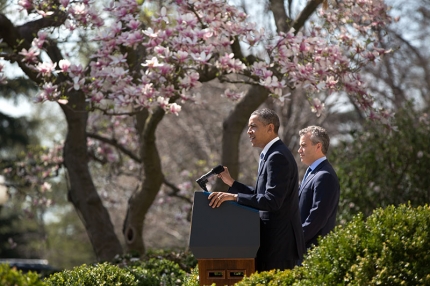
President Obama Sends Congress his Fiscal Year 2014 Budget

President Barack Obama delivers remarks on the FY 2014 budget in the Rose Garden, April 10, 2013

President Barack Obama delivers remarks on the FY 2014 budget, in the Rose Garden of the White House, April 10, 2013. Acting Director of Office of Management and Budget Jeffrey Zients accompanies the President. (Official White House Photo by Pete Souza)

In his 2013 State of the Union address, President Obama said that we must invest in the true engine of America’s economic growth – a rising and thriving middle class.  He said that every day, we must ask ourselves these three questions:  "How do we attract more jobs to our shores? How do we equip our people with the skills needed to do those jobs? And how do we make sure that hard work leads to a decent living?"

This morning the President sent Congress his Budget for Fiscal Year 2014, which presents his plan to address each of these questions. He also spoke to the press about his proposal in the Rose Garden, and said that while our economy is poised for progress, we need to get smarter about our priorities as a nation. And that’s what his 2014 Budget represents -- a fiscally-responsible blueprint for middle-class jobs and growth:

President Obama Nominates Three for the National Labor Relations Board

President Obama’s top priority is creating jobs and growing our economy. A critical part of that effort is ensuring that hardworking men and women can share in our nation’s growth and prosperity. That means decent wages, opportunities for advancement, and safe working conditions. And the National Labor Relations Board is there to address those concerns. The NLRB focuses on unfair labor practices and defends the right of employees to join a union and bargain collectively with their employers. These protections are fundamental to an open, fair, and prosperous economy.

Yesterday, President Obama nominated three extremely qualified members to the National Labor Relations Board, and called on the Senate to move swiftly to confirm all five of his nominees – both Republicans and Democrats – so that the NLRB can continue to perform its important functions on behalf of American workers and businesses. 

Valerie B. Jarrett is a Senior Advisor to President Barack Obama
Related Topics: Economy

President Obama Hosts In Performance at the White House: Memphis Soul

April 09, 2013 | 6:32 | Public Domain

President Obama welcomes music legends and contemporary artists to the White House for a celebration of Memphis Soul music.

Download mp4 (239MB) | mp3 (16MB)

The White House

Office of the Press Secretary

Remarks by the President at "In Performance at the White House: Memphis Soul"

East Room

7:40 P.M. EDT

THE PRESIDENT:  Everybody, please have a seat.  And give it up for our musical director, Booker T. -- (applause) -- and the Memphis Soul All-Stars.  (Applause.)  I just want everybody to know that it is now my second term, so rather than “Hail to the Chief,” we're going with that from here on out.  (Laughter and applause.)  Little change in tradition.

Now, before we get started, I am going to exercise some presidential prerogative to say a few words about two very special people who are here tonight -- this will humiliate them, but I'm going to go ahead and do it anyway.  Jess Wright and Kenny Thompson both work on my staff -- crucial members of my team since way back in Iowa in 2007. 

Over the weekend, Kenny popped the question and Jess said yes.  (Applause.)  So I want to congratulate -- publicly -- Kenny Thompson and Jess Wright.  A beautiful couple.  (Applause.)  We love them.  They are wonderful.  They've been loyal, shown such great friendship to me, and I'm so glad that they have gone ahead and taken the plunge. 

By the way, guys, Justin Timberlake just got married to this lovely young lady right here, Jessica Biel.  (Applause.)  So Justin can probably offer you a few pointers.  And, Justin, they are looking for a wedding singer.  (Laughter.)  I'm just saying. 

Tonight, I am speaking not just as a President, but as one of America’s best-known Al Green impersonators.  (Laughter.)  So I have a new appreciation for what Al once said about the Memphis Soul sound that he helped create -- “We don’t even know ourselves how that music has endured for so long and how that came out of us.”

All I know is I’ve been looking forward to tonight because, let’s face it, who does not love this music?  (Applause.)  These songs get us on the dance floor.  Even the governor of Tennessee said he's going to dance tonight.  (Laughter.)  They get stuck in our heads.  We go back over them again and again.  And they’ve played an important part in our history. 

In the sixties and seventies, Memphis knew its share of division and discord and injustice.  But in that turbulent time, the sound of Hi, and Duke, and Sun, and Stax Records tried to bridge those divides -- to create a little harmony with harmony.  The great Memphis musician Don Nix went to an all-white school, and he described what it was like.  He said, “If you could imagine, nobody’s ever heard R&B music before.  White kids had never heard it.  And you can imagine what that did to us.”

So he and others kept playing music that everybody could get into.  They created a whole new sound, and as they did, they broke down barriers.  On McLemore Avenue, in the heart of a segregated city, Stax Records was integrated from the studio musicians all the way to upper management.  Booker T. Jones and Steve Cropper, who are both here tonight, helped form one of the city’s first integrated bands.  They weren’t allowed to go to school together.  They weren’t always allowed to travel or eat together.  But no one could stop them from playing music together.

And that was the spirit of their music -- the sound of Soulsville, U.S.A., a music that, at its core, is about the pain of being alone, the power of human connection, and the importance of treating each other right.  After all, this is the music that asked us to try a little tenderness.  It’s the music that put Mr. Big Stuff in his place.  (Laughter.)  And it’s the music that challenged us to accept new ways of thinking with four timeless words: “Can you dig it?”  (Laughter.) 

So it’s really no surprise that Memphis Soul swept the nation, and it has stood the test of time.  And tonight, we bring it to the White House.

We’ve got folks here who were there at the beginning, legends like Mavis Staples, Charlie Musselwhite, William Bell, and Eddie Floyd.  We’ve got artists like Cyndi Lauper, and Ben Harper, and Queen Latifah, who still turn to Memphis for inspiration.  We’ve got Justin Timberlake, a proud son of Memphis who’s never forgotten his roots, and the Alabama Shakes, who are bringing the Muscle Shoals sound to a new generation.

So to all of you, even more than for the music you’ve created, I want to say a special thank you for the difference that you’ve made in our lives.  More than half a century after Soulsville, U.S.A. first opened its doors, you still bring us together.  You still remind us how much we have in common.  You still help us imagine a better place.  And you promise, through your beautiful music, that you can take us there.  

So tonight, we’re going to start things off with two extraordinary artists who span the generations -- one is a Memphis legend who’s been around just about forever, the other an American Idol who’s turning 21 today.  In the heyday of soul music, no band had more hits than the group known simply as “Sam and Dave.”  Here to perform his classic “Soul Man” along with Joshua Ledet, please welcome the great Sam Moore.  (Applause.)

END              
7:47 P.M. EDT