President Obama's Message to the Global Entrepreneurship Summit with Arabic subtitles

December 11, 2012 | 2:38 | Public Domain

U.S. government officials, investors, entrepreneurs, NGO leaders, and policy makers from more than 50 countries are gathered in Dubai, United Arab Emirates for the third annual summit, which was created following President Obama's 2009 speech at Cairo University.

Download mp4 (69MB) | mp3 (3MB)

President Obama Speaks on the Economy and Middle-Class Tax Cuts

December 10, 2012 | 24:09 | Public Domain

President Obama delivers remarks at the Daimler Detroit Diesel Plant.

Download mp4 (893MB) | mp3 (23MB)

Read the Transcript

Remarks by the President at the Daimler Detroit Diesel Plant, Redford, MI

Daimler Detroit Diesel Plant
Redford, Michigan

2:29 P.M. EST

THE PRESIDENT:  Hello, Redford!  (Applause.)  It is good to be back in Michigan.  (Applause.)  How is everybody doing today? (Applause.)

Now, let me just start off by saying we have something in common -- both our teams lost yesterday.  (Laughter.)  I mean, I would like to come here and talk a little smack about the Bears, but we didn’t quite get it done.  But it is wonderful to be back. It is good to see everybody in the great state of Michigan.  (Applause.)

A few people I want to acknowledge -- first of all, the Mayor of Detroit here -- Dave Bing is in the house.  (Applause.) We’ve got the Redford Supervisor -- Tracey Schultz Kobylarz.  (Applause.)  We’ve got some outstanding members of Congress who are here -- please give them a big round of applause.  (Applause.) 

I want to thank Martin for hosting us.  I want to thank Jeff and Gibby for giving me a great tour of the factory.  (Applause.) I’ve got to say I love coming to factories. 

AUDIENCE MEMBER:  I love you!

THE PRESIDENT:  I love you.  (Applause.) 

So in addition to seeing the best workers in the world -- (applause) -- you’ve also got all this cool equipment.  (Laughter.)  I wanted to try out some of the equipment, but Secret Service wouldn’t let me.  (Laughter.)  They said, you're going to drop something on your head, hurt yourself.  (Laughter.) They were worried I’d mess something up.  And Jeff and Gibby may not admit it, but I think they were pretty happy the Secret Service wouldn't let me touch the equipment.  (Laughter.) 

Now, it’s been a little over a month since the election came to an end.  (Applause.)  So it’s now safe for you to turn your televisions back on.  (Laughter.)  All those scary political ads are off the air.  You can answer your phone again -- nobody is calling you in the middle of dinner asking for your support.  But, look, I have to admit there’s one part of the campaign that I miss, and that is it is a great excuse for me to get out of Washington and come to towns like this and talk to the people who work so hard every day and are looking out for their families and are in their communities, and just having a conversation about what kind of country do we want to be; what kind of country do we want to leave behind for our kids.  Because ultimately, that's what this is about.   

And I believe -- and I've been saying this not just for the last six months or the last year, but ever since I got into public office -- I believe America only succeeds and thrives when we’ve got a strong and growing middle class.  (Applause.)  That's what I believe.  I believe we’re at our best when everybody who works hard has a chance to get ahead; that they can get a job that pays the bills; that they’ve got health care that they can count on; that they can retire with dignity and respect, maybe take a vacation once in a while -- nothing fancy, just being able to pack up the kids and go someplace and enjoy time with people that you love; make sure that your kids can go to a good school; make sure they can aspire to whatever they want to be. 

That idea is what built America.  That’s the idea that built Michigan.  That’s the idea that’s at the heart of the economic plan I’ve been talking about all year long on the campaign trail. I want to give more Americans the chance to earn the skills that businesses are looking for right now, and give our kids the kind of education they need to succeed in the 21st century.  I want to make sure America leads the world in research and technology and clean energy.  I want to put people back to work rebuilding our roads and our bridges and our schools.  (Applause.)  That’s how we grow an economy.

I want us to bring down our deficits, but I want to do it in a balanced, responsible way.  And I want to reward -- I want a tax code that rewards businesses and manufacturers like Detroit Diesel right here, creating jobs right here in Redford, right here in Michigan, right here in the United States of America.  (Applause.)  That’s where we need to go.  That’s the country we need to build.  And when it comes to bringing manufacturing back to America -- that’s why I’m here today. 

Since 1938, Detroit Diesel has been turning out some of the best engines in the world.  (Applause.)  Over all those years, generations of Redford workers have walked through these doors.  Not just to punch a clock.  Not just to pick up a paycheck.  Not just to build an engine.  But to build a middle-class life for their families; to earn a shot at the American Dream. 

For seven and a half decades, through good times and bad,  through revolutions in technology that sent a lot of good jobs -- manufacturing jobs -- overseas, men and women like you, your parents, maybe even your grandparents, have done your part to build up America’s manufacturing strength.  That’s something you can all be proud of.  And now you’re writing a new proud chapter to that history.  Eight years ago, you started building axles here alongside the engines.  That meant more work.  That meant more jobs.  (Applause.)  So you started seeing products -- more products stamped with those three proud words:  Made in America. 
Today, Daimler is announcing a new $120 million investment into this plant, creating 115 good, new union jobs building transmissions and turbochargers right here in Redford -- (applause) -- 115 good new jobs right here in this plant, making things happen.  That is great for the plant.  It’s great for this community.  But it’s also good for American manufacturing.  Soon, you guys will be building all the key parts that go into powering a heavy-duty truck, all at the same facility.  Nobody else in America is doing that.  Nobody else in North America is doing that.

And by putting everything together in one place, under one roof, Daimler engineers can design each part so it works better with the others.  That means greater fuel efficiency for your trucks.  It means greater savings for your customers.  That’s a big deal.  And it’s just the latest example of Daimler’s leadership on this issue.

Last year, I was proud to have your support when we announced the first-ever national fuel-efficiency standards for commercial trucks, which is going to help save consumers money and reduce our dependence on foreign oil.  That’s good news.  (Applause.)

But here’s the other reason why what you guys are doing, what Daimler is doing, is so important.  For a long time, companies, they weren’t always making those kinds of investments here in the United States.  They weren’t always investing in American workers.  They certainly weren’t willing to make them in the U.S. auto industry. 

Remember, it was just a few years ago that our auto industry was on the verge of collapse.  GM, Chrysler were all on the brink of failure.  And if they failed, the suppliers and distributors that get their business from those companies, they would have died off, too.  Even Ford could have gone down -- production halted.  Factories shuttered.  Once proud companies chopped up and sold off for scraps.  And all of you -- the men and women who built these companies with your own hands  -- would have been hung out to dry.  And everybody in this community that depends on you -- restaurant owners, storekeepers, bartenders -- (laughter and applause) -- their livelihoods would have been at stake, too.

So I wasn’t about to let that happen.  I placed my bet on American workers.  We bet on American ingenuity.  I’d make that same bet any day of the week.  (Applause.)  Three and a half years later, that bet is paying off.  This industry has added over a quarter of a million new jobs.  Assembly lines are humming again.  The American auto industry is back. 

And companies like Daimler know you’re still a smart bet.  They could have made their investment somewhere else, but they didn’t.  And if you ask them whether it was a tough call, they’ll tell you it wasn’t even close.  So the word is going out all around the world:  If you want to find the best workers in the world, if you want to find the best factories in the world, if you want to build the best cars or trucks or any other product in the world, you should invest in the United States of America.  This is the place to be.  (Applause.)

See, you’re starting to see the competitive balance is tipping a little bit.  Over the past few years, it’s become more expensive to do business in countries like China.  Our workers have become even more productive.  Our energy costs are starting to go down here in the United States.  And we still have the largest market.  So when you factor in everything, it makes sense to invest here, in America. 

And that’s one of the reasons why American manufacturing is growing at the fastest pace since the 1990s.  And thanks in part to that boost in manufacturing, four years after the worst economic crisis of our lifetimes, our economy is growing again. Our businesses have created more than 5.5 million new jobs over the past 33 months.  So we’re making progress.  (Applause.)  We’re moving in the right direction.  We’re going forward.

So what we need to do is simple.  We need to keep going.  We need to keep going forward.  We should do everything we can to keep creating good middle-class jobs that help folks rebuild security for their families.  (Applause.)  And we should do everything we can to encourage companies like Daimler to keep investing in American workers.

And by the way, what we shouldn’t do -- I just got to say this -- what we shouldn’t be doing is trying to take away your rights to bargain for better wages and working conditions.  (Applause.)  We shouldn’t be doing that.  (Applause.)  These so-called “right to work” laws, they don't have to do with economics; they have everything to do with politics.  (Applause.) What they're really talking about is giving you the right to work for less money.  (Applause.)

You only have to look to Michigan -- where workers were instrumental in reviving the auto industry -- to see how unions have helped build not just a stronger middle class but a stronger America.  (Applause.)  So folks from our state’s capital, all the way to the nation’s capital, they should be focused on the same thing.  They should be working to make sure companies like this manufacturer is able to make more great products.  That's what they should be focused on.  (Applause.)  We don't want a race to the bottom.  We want a race to the top.  (Applause.)

America is not going to compete based on low-skill, low-wage, no workers’ rights.  That's not our competitive advantage. There’s always going to be some other country that can treat its workers even worse.  Right? 

AUDIENCE:  Right!

THE PRESIDENT:  What’s going to make us succeed is we got the best workers -- well trained, reliable, productive, low turnover, healthy.  That's what makes us strong.  And it also is what allows our workers then to buy the products that we make because they got enough money in their pockets.  (Applause.)

So we’ve got to get past this whole situation where we manufacture crises because of politics.  That actually leads to less certainty, more conflict, and we can't all focus on coming together to grow.

AUDIENCE MEMBER:  That's right!

THE PRESIDENT:  And the same thing -- we're seeing the same thing in Washington.  I’m sure you've all heard the talk recently about some big deadlines we're facing in a few weeks when it comes to decisions on jobs and investment and taxes.  And that debate is going to have a big impact on all of you.  Some of you may know this:  If Congress doesn’t act soon, meaning in the next few weeks, starting on January 1st, everybody is going to see their income taxes go up. 

AUDIENCE:  No!

THE PRESIDENT:  It's true.  You all don’t like that. 

AUDIENCE:  No!

THE PRESIDENT:  Typical, middle-class family of four will see an income tax hike of around $2,200.  How many of you can afford to pay another $2,200 in taxes?  Not you?

AUDIENCE:  No!

THE PRESIDENT:  I didn’t think so.  You can't afford to lose that money.  That’s a hit you can't afford to take.  And, by the way, that’s not a good hit for businesses, either -- because if Congress lets middle-class taxes go up, economists will tell you that means people will spend nearly $200 billion less than they otherwise would spend.  Consumer spending is going to go down.  That means you've got less customers.  Businesses get fewer profits.  They hire fewer workers.  You go in a downward spiral. Wrong idea.

Here is the good news:  We can solve this problem.  All Congress needs to do is pass a law that would prevent a tax hike on the first $250,000 of everybody's income -- everybody.  (Applause.)  That means 98 percent of Americans -- and probably 100 percent of you -- (laughter) -- 97 percent of small businesses wouldn’t see their income taxes go up a single dime.  Even the wealthiest Americans would still get a tax cut on the first $250,000 of their income.  But when they start making a million, or $10 million, or $20 million you can afford to pay a little bit more.  (Applause.)  You're not too strapped. 

So Congress can do that right now.  Everybody says they agree with it.  Let’s get it done.  (Applause.)   

So that’s the bare minimum.  That’s the bare minimum we should be doing in order to the grow the economy.  But we can do more.  We can do more than just extend middle-class tax cuts.  I’ve said I will work with Republicans on a plan for economic growth, job creation, and reducing our deficits.  And that has some compromise between Democrats and Republicans.  I understand people have a lot of different views.  I’m willing to compromise a little bit. 

But if we’re serious about reducing our deficit, we’ve also got to be serious about investing in the things that help us grow and make the middle class strong, like education, and research and development, and making sure kids can go to college, and rebuilding our roads and our infrastructure.  (Applause.)  We’ve got to do that.

So when you put it all together, what you need is a package that keeps taxes where they are for middle-class families; we make some tough spending cuts on things that we don’t need; and then we ask the wealthiest Americans to pay a slightly higher tax rate.  And that’s a principle I won’t compromise on, because I’m not going to have a situation where the wealthiest among us, including folks like me, get to keep all our tax breaks, and then we’re asking students to pay higher student loans.  Or suddenly, a school doesn’t have schoolbooks because the school district couldn’t afford it.  Or some family that has a disabled kid isn’t getting the help that they need through Medicaid. 

We’re not going to do that.  We’re not going to make that tradeoff.  That’s not going to help us to grow.  Our economic success has never come from the top down; it comes from the middle out.  It comes from the bottom up.  (Applause.)  It comes from folks like you working hard, and if you’re working hard and you’re successful, then you become customers and everybody does well.

Our success as a country in this new century will be defined by how well we educate our kids, how well we train our workers, how well we invent, how well we innovate, how well we build things like cars and engines -- all the things that helped create the greatest middle class the world has ever known.  That’s how you bring new jobs back to Detroit.  That’s how you bring good jobs back to America.  That’s what I’m focused on.  That’s what I will stay relentlessly focused on going forward.  (Applause.) 

Because when we focus on these things –- when we stay true to ourselves and our history, there’s nothing we can’t do.  (Applause.)  And if you don’t believe me, you need to come down to this plant and see all these outstanding workers.

In fact, as I was coming over here, I was hearing about a guy named Willie.  (Applause.)  Where’s Willie?  There’s Willie right here.  There’s Willie.  (Applause.)  Now, in case you haven’t heard of him, they actually call him “Pretty Willie.”  (Laughter.)  Now, I got to say you got to be pretty tough to have a nickname like “Pretty Willie.”  (Laughter.)  He’s tough. 

On Wednesday, Willie will celebrate 60 years working at Detroit Diesel -- 60 years.  (Applause.)  Willie started back on December 12, 1952.  I was not born yet.  (Laughter.)  Wasn’t even close to being born.  He made $1.40 an hour.  The only time he spent away from this plant was when he was serving our country in the Korean War.  (Applause.)  So three generations of Willie's family have passed through Detroit Diesel.  One of his daughters works here with him right now -- is that right?  There she is.  (Applause.) 

In all his years, Willie has been late to work only once.  It was back in 1977.  (Laughter.)  It's been so long he can't remember why he was late -- (laughter and applause) -- but we're willing to give him a pass. 

So Willie believes in hard work.  You don’t keep a job for 60 years if you don’t work hard.  Sooner or later, someone is going to fire you if you don’t work hard.  He takes pride in being part of something bigger than himself.  He's committed to family; he's committed to community; he's committed to country. That’s how Willie lives his life.  That’s how all of you live your lives.

And that makes me hopeful about the future, because you're out there fighting every day for a better future for your family and your country.  And when you do that, that means you're creating value all across this economy.  You're inspiring people. You're being a good example for your kids.  That’s what makes America great.  That’s what we have to stay focused on.

And as long as I've got the privilege of serving as your President, I'm going to keep fighting for you.  I'm going to keep fighting for your kids.  I'm going to keep fighting for an America where anybody, no matter who you are, no matter what you look like, no matter where you come from, you can make it if you try here in America.  (Applause.)

Thank you very much, everybody.  God bless you.  (Applause.)  

END
2:51 P.M. EST

Close Transcript

President Obama Talks About "the Idea that Built America"

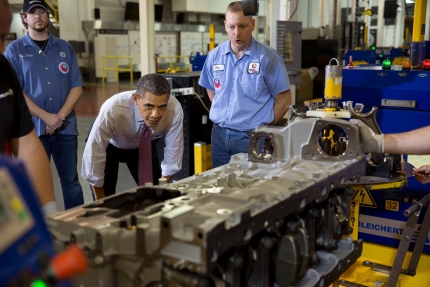
President Obama Tours the Detroit Diesel Facility, Dec. 10, 2012.

President Barack Obama watches as workers explain the process of assembling connecting rods and pistons during a tour of the Detroit Diesel Facility in Redford, Mich., Dec. 10, 2012. (Official White House Photo by Lawrence Jackson)

President Obama was in Detroit today to talk about the economy -- how companies are reinvesting in American workers and why it's so important to extend tax cuts for middle class families.

"I believe America only succeeds and thrives when we’ve got a strong and growing middle class," he said to the crowd at the Daimler Detroit Diesel Plant. "I believe we’re at our best when everybody who works hard has a chance to get ahead; that they can get a job that pays the bills; that they’ve got health care that they can count on; that they can retire with dignity and respect, maybe take a vacation once in a while -- nothing fancy, just being able to pack up the kids and go someplace and enjoy time with people that you love; make sure that your kids can go to a good school; make sure they can aspire to whatever they want to be. That idea is what built America."

In many ways, the Detroit Diesel Plant is an example of a resurgence in American manufacturing. Eight years ago, the workers started building axles in addition to engines. Today, President Obama announced that Daimler is investing $120 million into the plant, which will support 115 new jobs building transmissions and turbochargers, as well.

President Obama Talks #My2k with The Santana Family

December 10, 2012 | 2:02 | Public Domain

President Obama visited one of the 114 million American families who would see their taxes go up next year if Congress fails to extend the middle-class tax cuts. Tiffany, a high school teacher who lives in Northern Virginia, is also one of the thousands of people who wrote in to the White House to share what it would mean to her family if their income taxes went up next year. Share your story at http://obamawhitehouse.archives.gov/my2k

Download mp4 (82.2MB)

The White House

Office of the Press Secretary

Presidential Nominations Sent to the Senate

NOMINATIONS SENT TO THE SENATE:

Timothy Hyungrock Haahs, of Pennsylvania, to be a Member of the Board of Directors of the National Institute of Building Sciences for a term expiring September 7, 2014, vice Morgan Edwards, term expired.

Michael Wayne Hail, of Kentucky, to be a Member of the Board of Trustees of the Harry S Truman Scholarship Foundation for a term expiring December 10, 2017, vice Sharon Tucker, term expired.

Morton H. Halperin, of the District of Columbia, to be a Member of the Board of Directors of the Millennium Challenge Corporation for a term of three years, vice Alan J. Patricof, term expiring.

The White House

Office of the Press Secretary

Statement by the President on the Departure of Princeton Lyman

For the last two years, Ambassador Princeton Lyman has served as my Special Envoy to Sudan and South Sudan, building on a long legacy of dedicated service in the United States government.  Princeton has done a tremendous job in helping to realize the promise of an independent South Sudan, and working toward the international vision of Sudan and South Sudan living side by side in peace.  I have valued his extraordinary service, which has been appreciated by the United States and the international community.  The people of Sudan and South Sudan, who have suffered so much, have the opportunity to seize a brighter future because of Princeton’s efforts to urge both sides to put the interests of their people first.  I am deeply grateful for Princeton’s steadfast and tireless leadership, and wish him and his family well.

The White House

Office of the Press Secretary

Presidential Proclamation -- Human Rights Day and Human Rights Week, 2012

HUMAN RIGHTS DAY AND HUMAN RIGHTS WEEK, 2012

- - - - - - -

BY THE PRESIDENT OF THE UNITED STATES OF AMERICA

A PROCLAMATION

Sixty-four years ago, a group of nations emerging from the shadow of war joined together to light a path toward lasting peace. They adopted the Universal Declaration of Human Rights -- a revolutionary document that recognized the inherent dignity and inalienable rights of all people as the "foundation of freedom, justice, and peace in the world." As we mark the anniversary of that historic act, we celebrate the rights the Declaration recognized and recommit to strengthening them in the 21st century.

The United States was built on the promise that freedom and fairness are not endowed only to some -- they are the birthright of all. Ordinary Americans have fought to fully realize that vision for more than two centuries, courageously forging a democracy that empowers each of us equally and affords every citizen due process under the law. Just as we have cultivated these rights here at home, so have we worked to promote them abroad. Societies across the globe are reaching toward a future where leaders are fairly and duly elected; where everyone can get an education and make a good living; where women and girls are free from violence, as well as free to pursue the same opportunities as men and boys; and where the voice of the people rings clear and true. As they do, the United States stands with them, ready to uphold the basic decency and human rights that underlie everything we have achieved and all our progress yet to come.

Men and women everywhere long for the freedom to determine their destiny, the dignity that comes with work, the comfort that comes with faith, and the justice that exists when governments serve their people. These dreams are common to people all around the world, and the values they represent are universal. This week, we rededicate ourselves to fortifying civil rights in America, while reaffirming that all people around the world should live free from the threat of extrajudicial killing, torture, oppression, and discrimination. And we renew our promise that the United States will be a partner to any nation, large or small, that will contribute to a world that is more peaceful and more prosperous, more just and more free.

NOW, THEREFORE, I, BARACK OBAMA, President of the United States of America, by virtue of the authority vested in me by the Constitution and the laws of the United States, do hereby proclaim December 10, 2012, as Human Rights Day and the week beginning December 10, 2012, as Human Rights Week. I call upon the people of the United States to mark these observances with appropriate ceremonies and activities.

IN WITNESS WHEREOF, I have hereunto set my hand this tenth day of December, in the year of our Lord two thousand twelve, and of the Independence of the United States of America the two hundred and thirty-seventh.

BARACK OBAMA

The White House

Office of the Press Secretary

Statement by the Press Secretary on the Presidential Election in Ghana

The United States congratulates President John Dramani Mahama and the people of Ghana for the successful election on December 7. Nearly 80% of the electorate voted, continuing the Ghanaian tradition of widespread public participation in the democratic process. This is the sixth successful presidential and parliamentary election since 1992, and further demonstrates the people of Ghana’s commitment to democracy and the rule of law. The United States encourages all parties to accept the results and to use the appropriate legal processes to resolve any electoral disputes. The United States places a high value on its long-standing friendship and partnership with Ghana and the Ghanaian people. We look forward to strengthening our bonds by working with President Mahama and the people of Ghana to ensure prosperity, peace, and further democratic development of Ghana and the region.

The White House

Office of the Press Secretary

Press Gaggle by Press Secretary Jay Carney en route Detroit, Michigan, 12/10/2012

Aboard Air Force One
En Route Detroit, Michigan

11:47 A.M. EST

MR. CARNEY:  I have no announcements to make.  I’m glad that you’re joining us on our trip to Michigan today.  The President looks forward to talking about ways that our economy is rebounding growth in our manufacturing sector and especially in our automobile industry.

With that I will take your questions. 

Q    What progress can you report from yesterday’s meeting between the President and the Speaker?

MR. CARNEY:  I can confirm that there was a meeting and that lines of communication remain open, but I cannot characterize the talks or conversations beyond that.

Q    Are there any other one-on-one meetings on the schedule for this week?

MR. CARNEY:  Well, as you know, I don’t preview meetings or conversations.  Our interest here is to see if we can get a deal that’s good for the economy, that makes sure that the middle class is protected, that their taxes don’t go up, and it continues the growth and job creation that we’ve seen.

Q    Jay, is the President any more or less confident of a deal being reached before the end of the year after yesterday’s meeting?

MR. CARNEY:  Again, I won’t characterize yesterday’s meeting or other conversations, but the President does believe that we can reach an agreement.  He has put forward a very detailed plan.  He has shown how he believes we need to achieve the necessary revenue targets in order to put together a large deal that would reflect the goal of $4 trillion in deficit reduction that is so meaningful in terms of our long-term fiscal sustainability.  And he’s made clear in his detailed proposal that he’s willing to enact cuts in our mandatory entitlement programs, including our health care programs. 

What we haven’t seen yet is any specificity at all from Republicans on revenue; we’ve seen a sentence on revenue.  And while there have been encouraging statements by individual lawmakers about the realization that rates will go up on the top 2 percent, we haven’t seen anything specific from Republicans with regard to that.

Q    Jay, as you know, a lot of people are watching this -- not just the taxpayers but the stock market, other countries even -- to see signs of American stability.  What is the harm in telling the public simply whether we’re better off today than yesterday?  That kind of generic update on whether we’re making progress.

MR. CARNEY:  Because our interest is in seeing if we can reach an agreement and not trying to negotiate an agreement through the media.  And I am entirely sympathetic to the interest that you have in this, but we believe that it’s in the best interest of the prospects of getting an agreement to not read out the details of conversations that the President has with the Speaker, or other conversations that hopefully will make it possible to get an agreement.

Q    The Speaker’s office said today, as you have, that the lines of communication are open, but also that they’re continuing to wait for the President to identify specific spending cuts.  And you’ve talked about the need for Republicans to identify more details.  Do you agree with the assessment that it’s up to the White House to make the next move?

MR. CARNEY:  I can simply say that the lines of communication are open.  You’ve seen that the President met with the Speaker.  And we, broadly speaking, continue to engage in this process with important players and stakeholders. 

The fact is we have put forward specific spending cuts.  The President is the only party that has put forward a plan that has specificity on both the spending and revenue side.  We have not seen in any detail from the Republicans, including from the offer that was put forward by the Speaker in his letter, the kind of detail that would allow us to assess the proposal.  To say, for example, on revenue that we can achieve $800 billion, which is far, far short of the necessary revenue for a comprehensive deal that achieves $4 trillion in deficit reduction, and to achieve that only through unnamed closures of loopholes and unnamed reductions to caps and deductions -- it doesn’t really get you very far.

Q    Are you considering making a counter offer to the Speaker’s offer?

MR. CARNEY:  Again, I’m not going to characterize the conversations that we’re having.  I can only say that the President believes that a deal is possible.  It requires acceptance and acknowledgement in a concrete way by Republicans that the top 2 percent will see an increase in their rates.  To do that, all that Republicans in the House have to do is vote for a tax cut. 

All we’re talking about here is the expiration of the Bush-era tax cuts for the top 2 percent, not a vote to -- a proactive vote to hike taxes on anyone.  What we are asking is that Republicans in the House follow the Senate’s lead and approve tax cuts for the middle class, for 98 percent of the American people -- something they say they believe is the right thing to do, the President believes is the right thing to do, the American public overwhelmingly believes it’s the right thing to do.  Economists believe that tax cuts for the middle class are the most beneficial to the economy. 

Let’s get that done as a demonstration that Washington can work, even as we grapple with some of these other issues that we need to resolve in order to achieve a broader agreement.

Q    Jay, will the President weigh in on the Michigan right-to-work case while he’s here?

MR. CARNEY:  I’m not going to preview the President’s remarks.  They’ll be coming soon.  The President’s opposition to the so-called right-to-work laws is well known.  But beyond that, I won’t preview his remarks.

Q    Yesterday, the Speaker repeated what some others have said, that the President is slow-walking this, trying to build pressure on the Republicans and wants it to get up to the last minute.  How do you respond to that?

MR. CARNEY:  I would simply say that we have yet to see more than a sentence of specificity from the Republicans on the issue of revenue.  There is no deal without acknowledgment and acceptance of the fact that rates are going up on top earners.  That’s what I would say.

Secondly, the President has made clear he’s eager to get a deal and he believes that a deal is possible.  He’s also made clear that when it comes to a large deal on the order of magnitude of $4 trillion, that tough choices would have to be made by both sides, and he knows that he would not get everything that he wants.  He knows that not every detail of his proposal would make it through such an agreement.  And he’s willing to make tough choices, as he has in the past.

But Republicans have to recognize that we cannot afford, the public does not support, and it is economically a bad idea to extend tax cuts for millionaires and billionaires and those making over $250,000.

Q    Jay, does the President think there’s any real risk to either the economy or to consumer confidence if this debate runs right up against -- right up to New Year’s Eve?  Or as long as you get it done before January 1, is that okay?

MR. CARNEY:  You’re trying to create a situation where I’m naming a deadline, and I’m not going to do that.  The tax cuts  --

Q    -- as long as it gets done on time, is that sufficient?

MR. CARNEY:  That’s market analysis that I can't do.  The sooner we get a deal the better.  The reason why we're in this situation is we have very specific deadlines.  Taxes go up on everybody on January 1st.  Automatic, across-the-board spending cuts begin to take effect on January 1st if Congress doesn’t act in either of these cases.

So those are the deadlines we face, and the sooner we reach an agreement the better.

Q    New topic.  There is a very important “Friends of Syria” meeting this week, as you know, in Morocco.  The U.S. has been moving in the direction of helping to build up the Syrian opposition, and there has been a lot of talk that maybe this is the moment for the United States to formally recognize the opposition.  What's the White House's view on that?  And do you believe that the time has come to recognize the opposition, and would that be an important step to resolving the terrible situation in Syria?

MR. CARNEY:  Well, you're absolutely right that we've done a lot of work with our international partners in assisting the opposition in Syria.  We've provided substantial humanitarian and non-lethal aid to the Syrian people and to the opposition.  We applauded and continue to work with -- we applauded the creation of and continue to work with the Syrian Opposition Council and consider it an important representative of the Syrian opposition.

I don’t have any previews for you of the meeting that you mention, which is important, except to say that we continue to be committed to the proposition that Syria's future needs to be decided by the Syrian people; that that future cannot include Bashar al Assad, who is a tyrant with an enormous amount of blood on his hands -- the blood of his own people.  And we have noted -- I did last week -- that some of the progress that the opposition has been making, but this conflict needs to end for the sake of the Syrian people.

Q    Has the President talked to the family of the SEAL team member that had been killed in the raid?

MR. CARNEY:  I don’t have a readout of any conversations of the President.  I think you saw the statement from the President, but I have no more information for you on the death of a Special Forces operative. 

Q    Quick one on the trip today.  How would you describe the connection between where we're headed, the President's comments today, and the need to get a deal done on the fiscal cliff?

MR. CARNEY:  Well, I think the President -- again, without previewing his comments, remains focused on his number-one priority, which is helping this economy grow, making the kind of decisions that enable it to grow and enable it to create jobs.

And the automobile industry is an important piece of that policy approach, and he took steps, as you know, early on in his administration to ensure that the American automobile industry survived.  And it has been the rebound of the big American automakers that has helped fuel real progress in the manufacturing sector in this economy.  And he wants to make sure that we’re continuing that progress, and I think that's what this trip will highlight.

Broadly, though, this is all of a piece.  When we talk about the need to reach a big deal that achieves $4 trillion in deficit reduction, that's not because deficit reduction is an inherent good; it’s because done right, done well, coupled with measures that ensure that we continue to grow, inclusive of measures that protect the middle class, large-scale deficit reduction serves the broader purpose, which is economic growth and job creation.  That's why the President seeks it.  That's why he’s negotiating.  That's why he’s willing to make tough choices.  It’s all of a piece for him.  It’s why he ran for office.  It’s why he ran for reelection.

Q    Can I ask one question about the facility we’re going to?  The Daimler company, as you know, in addition to owning Detroit Diesel, used to own Chrysler, and they sold it in 2007 to effectively a hedge fund, and that led to a very dark period in Chrysler’s history that was really only redeemed after the federal bailout under the Obama administration.  I’m just wondering about the symbolism of going to a Daimler-owned facility given Daimler’s rather checkered history in Detroit.  It’s not a particularly happy story.

MR. CARNEY:  Well, I would simply say that what the President is interested in, the growth -- the revival and growth of the American automobile industry, the manufacture of automobiles here in the United States, which means good jobs for American workers.  And I think that's the focus that you’ll hear him talk about today. 

In terms of one company’s past, I don't really have a comment on that.  I think he’s focused on the present and the future.

Q    Is the President getting any closer to deciding who he wants at the State Department and Defense Department?

MR. CARNEY:  Thank you for the opportunity to say that I have no personnel announcements to make today.

Q    Thanks, Jay.

MR. CARNEY:  You bet.  Good to see all of you.

END 
12:01 P.M. EST

The Obama Family Attends Christmas in Washington

President Barack Obama, First Lady Michelle Obama, daughters Sasha and Malia, and Marian Robinson listen as Megan Hilty performs

President Barack Obama, First Lady Michelle Obama, daughters Sasha and Malia, and Marian Robinson listen as Megan Hilty performs at the "Christmas in Washington" concert taping in Washington, D.C., Dec. 9, 2012. (Official White House Photo by Pete Souza)

Last night, President Obama spoke at Christmas in Washington. The concert, hosted by Conan O’Brien, featured performances including Diana Ross, Demi Lovato, Megan Hilty and others, was held to support the Children’s National Medical Center.

“Tonight is a chance to get in the Christmas spirit, to spread some joy and sing along with artists who have much better voices than we do,” President Obama said. “But it’s also a chance to make a real difference in the lives of some very brave young people being treated at Children’s National Medical Center.  Many of these kids and their parents are going through tough times right now, and your support helps give them a reason to hope –- not just during the holidays, but all year round.”

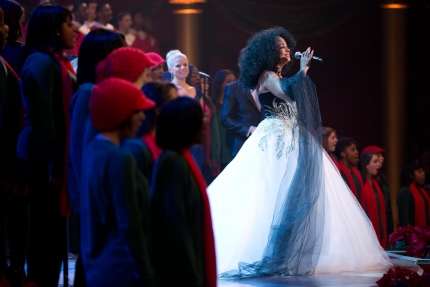
Diana Ross performs at the "Christmas in Washington"

Diana Ross performs at the "Christmas in Washington" concert taping in Washington, D.C., Dec. 9, 2012. (Official White House Photo by Pete Souza)

President Obama said that Christmas is a time to share the blessings we have have with those who have less, especially those who are “spending this holiday in a hospital bed, or a shelter, or protecting our freedom on a battlefield far from home.”

Learn more about holidays at the White House

Related Topics: Inside the White House