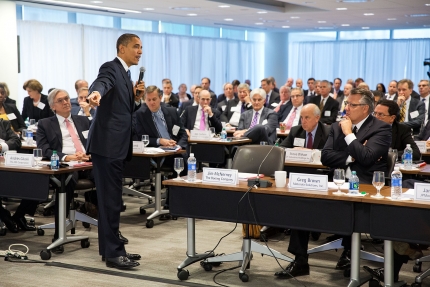
President Obama Speaks to the Business Roundtable

President Barack Obama delivers remarks and takes questions from business leaders

President Barack Obama delivers remarks and takes questions from business leaders at the quarterly meeting of the Business Roundtable at the BRT in Washington, D.C., Dec. 5, 2012. (Official White House Photo by Pete Souza)

Today, President Obama spoke to members of the Business Roundtable, an association of CEOs of American businesses, and reiterated his plan to extend tax cuts for middle-class families.

He explained how preventing tax hikes for middle-class families is good for business leaders as well as the broader economy.

“If the companies in this room are doing well, then small businesses and medium-sized businesses up and down the chain are doing well," he said. "If companies in this room are doing well, then folks get jobs, consumers get confidence, and we're going to be able to compete around the world.”

Related Topics: Jobs, Middle-Class Tax Cuts

The White House

Office of the Press Secretary

Press Briefing by Press Secretary Jay Carney and NEC Prinicipal Deputy Director Jason Furman, 12/5/2012


James S. Brady Press Briefing Room
 
 
12:43 P.M. EST
 
MR. CARNEY:  Thanks for being here.  Good afternoon.  I, as you can see, have brought a guest.  Jason Furman is the Principal Deputy Director of the National Economic Council.  He is also an assistant to the President for economic policy.  He’s somebody that many of you are familiar with.
 
In the last several days in particular we’ve had a lot of questions and a lot of conversation about the issue of revenue, and how we achieve significant revenue as part of a broad deficit reduction package.  It is the President’s position, as you know, that we need to have income tax rates on the highest earners in America, the top 2 percent, rise.  And in addition to that, to pass policies that he has long proposed that would limit deductions and close loopholes for wealthy earners.  And the combination of the revenue accomplished through that reaches the target that is necessary to achieve the kind of broad-based $4 trillion deficit reduction that the President seeks.
 
There’s been some discussion about whether or not significant amounts of revenue can be accomplished through just closing loopholes and capping deductions.  Jason has done some work on this and for that reason I’ve asked him to come here today.  He’ll make a little presentation and then take your questions.
 
MR. FURMAN:  Thanks, Jay.  So I just briefly wanted to give a tiny bit of context, then walk you through a tiny bit of math that can be a little bit boring but is very important because it explains where we’re coming from and where the President is coming from on this issue.
 
The context is we’re trying to cut the deficit by $4 trillion over the next decade, including what we did in the Budget Control Act.  That’s the amount that you need to do in order to stabilize the debt and get the debt to start to be on a downward path as a share of the economy.  And that’s ultimately the economic goal that the President has in a debt reduction agreement.  
 
In the President’s plan, $1.6 trillion of that $4 trillion that we need would come from additional revenues.  And it would come from a combination of allowing the rates on high earners to go back up to what they were under President Clinton, and reducing the value of tax deductions and other tax benefits that they get.
 
Before I get to how much can be raised by the second, let me just say the President is very, very supportive of curbing tax deductions for high-income households.  It’s been a part of his plan from his very first budget.  In fact, he was and remains the only major leaguer in Washington that has put forward a specific, explicit plan that would limit those tax benefits for high-income households that’s been examined by the Joint Committee on Taxation, which is the official referee for these issues in Congress.  
 
That plan, though, doesn’t raise the revenue that you need.  So out of the President’s $1.6 trillion, $950 billion comes from decoupling.  Decoupling is the high-income rates going away, the middle-class tax cuts becoming permanent.  That gets you $950 billion of revenue.  
 
The question is could you plausibly replace that revenue just by limiting tax expenditures.  There have been lots of different ideas out there.  It’s always a little bit like Jell-O -- you look over here, the problem with this one; well, how about this one; the problem with that could fix this, and you go back to the first one.  Most of them -- in fact, none of them that I’ve seen have been scored, as I said, by the official referees at the Joint Committee on Taxation.
 
But I’ll just quickly take you through one that Gene Sperling and I did a blog post on last week, and it’s been the one that I think we’ve heard the most in the public debate, which is let’s take the idea that you could take everyone’s tax deductions, limit them to $25,000.  If you have more than $25,000 in deductions you wouldn’t get to take those extra deductions.  It sounds like a reasonable idea.  It sounds like most middle-class families wouldn’t be affected -- $25,000 is quite a lot.  And it’s been claimed that it could raise over a trillion dollars.  So could you do that instead of what we’re talking about?
 
Well, then you start to look at the idea.  It turns out 17 million middle-class families would see their taxes go up as a result of this proposal, households that make -- married couples that make below $250,000.  Forty percent of the revenue in this plan would come from those middle-class families.  The President doesn’t want to raise taxes on those families.  So you fix it -- you start at $250,000 and now the proposal only raises $800 billion.
 
But it has a cliff:  When your income goes from $249,999 to $250,000, your tax bill could jump way up.  You can’t have features in the tax code like that.  It’s something no one would ever want to write in.  You protect against that cliff with a phase-in; now you’re down to only $650 billion of revenue.
 
Now let’s look at it from a public policy perspective:  $25,000 -- if you’re a high-income household, there’s a good chance your mortgage interest alone is going to be $25,000.  Certainly once you take your mortgage interest and your state and local deduction, you’ve used that entire thing.  That means you’re not getting any incentive to give to charity.  There’s no reason for you to keep your receipts when you give to charity, no reason to turn them into the IRS.  You’ve used your whole cap just on those other items.
 
You look at the top 1 percent of households in this country -- under this proposal, 97 percent of them would lose any incentive at all to give additional money to charity.  These are households that are responsible for one-third of tax-deductible giving.  You take away their charitable deduction completely, you’re going to get $10 billion less a year going into charity according to the types of estimates CBO has done.  
 
Fix the charity -- you’re now down at $450 billion; $450 billion is a meaningful contribution to deficit reduction, it could be a meaningful part of tax reform.  It doesn’t get you anywhere close to the amount of revenue you’re going to need to satisfy what it is the President has called for and to have a balanced plan that at the end of the day is going to get $4 trillion of deficit reduction.
 
I won’t walk you through the 18 other ideas that have been floated in some form or another in the public discourse, but all of them have this feature.  A plan put forward by Marty Feldstein and Maya MacGuineas that some have cited, to cap the value at 2 percent, that also would raise about $500 billion to $600 billion.  If you just applied it to households above $250,000 and if you protected charity that idea would also raise in the neighborhood of $400 billion to $500 billion.  Other proposals would retroactively eliminate municipal bonds, all of those types of things.
 
So at the end of the day, that’s why where the President is coming from is a combination of those rates -- having the tax cuts expire, doing tax expenditures -- tax expenditures can play a role, but they can’t make up for the revenue that you would have gotten through rates.
 
MR. CARNEY:  Now we’ll take some questions for Jason.  
 
Go ahead.
 
Q    Jason, the Republicans are pointing to comments that the President made in 2011 in which he said we could raise $1.2 trillion in revenues without touching tax rates.  I guess if it was an acceptable approach back then, why not now?
 
MR. FURMAN:  First of all, there’s a different context for those discussions then and the discussions now, and that’s something Jay can elaborate on with you in a second.  
 
Second of all, let’s look at how that agreement was structured.  The agreement then was Republicans had offered decoupling.  They had offered that on January 1st, 2013, the middle-class tax cuts would be made permanent and high-income taxes would go back to the Clinton-era rates if tax reform didn’t succeed.  So if we weren’t able to accomplish through tax reform -- if you put forward -- and that could be you put forward a plan that got rid of the charitable deduction, that raised taxes on the middle-class families, that plan got voted down.  Under that agreement then you would have had the type of decoupling that the President is calling for.  It would have happened on the time scale as what the President is calling for.
 
The last point I’d make is that our argument centers around the plausibility and desirability of the tax reform.  Is it politically plausible to raise taxes on the middle class to get rid of the charitable deduction?  Is it economically desirable to do those things?  It’s not saying it’s -- the President, Jay, no one on the economic team has ever argued that it’s mathematically impossible to make up for that revenue.  It’s just at the end of the day, you might have a question in a tax plan:  Would you rather have a higher tax rate, or would you rather have a charitable deduction?  I think most people, Democrats and Republicans, would rather have a slightly higher tax rate than eliminate the charitable deduction.
 
But you might want to talk about the context.
 
MR. CARNEY:  Well, we’ll take some more questions.  
 
Go ahead, Jake.
 
Q    I’m following up on that, so if you want to weigh in on the political context.
 
MR. CARNEY:  Well, I would simply, first of all, echo what Jason said, and that is that a key element that’s not being discussed by people who are putting forward that comment by the President is that the backstop of the deal  -- if there had been a deal, if the Republicans hadn’t refused it and walked away from it -- was that the rates would go up on higher-income Americans when the Bush-era tax cuts expired, concurrent with a permanent extension of tax cuts for the middle class.  The only way that wouldn’t have happened is if tax reform were achieved in a way that was politically feasible -- in other words, that could pass Congress.
 
So there’s not a great distinction here between what we’re saying now.  The difference is back then, January 1st, 2013 created some time to attempt to do tax reform.  January 1st, 2013 is now less than a month away.  And tax rates have to go up as part of any responsible, balanced plan that achieves the revenue targets that are necessary for a $4 trillion deficit reduction plan, which is what the President seeks.  
 
He has said -- he said yesterday in an interview that stage two of this process can and should involve tax reform.  And what shape that takes will be decided by Congress and the White House as they work through the issues and evaluate some of these concerns that Jason is talking about.  How much can we garner from capping deductions, closing loopholes?  And there are limits on that amount, as Jason just explained, because not just -- not because it’s not hypothetically possible in a think tank to achieve it, but because it’s not desirable economic policy and it’s not politically feasible.  
 
Again, it’s hard to imagine that Democrats or Republicans would vote to eliminate the charitable tax deduction.  It’s hard to imagine that anyone on Capitol Hill would vote for such substantial reductions or even an elimination of the mortgage interest deduction that it would severely raise taxes on the middle class.  That’s unacceptable to the President, but I imagine it’s also unacceptable to many Republicans.
 
Q    I’m afraid I just don’t see the difference other than the President feels like he’s in a different position in terms of negotiations, maybe that he feels that he has a stronger hand now because of the reelection and because the tax rates automatically go up.  But, I mean, what he said was -- I mean, the quote is -- “What we said was give us $1.2 trillion in additional revenues, which could be accomplished without hiking tax rates, that could simply be accomplished by eliminating loopholes, eliminating some deductions, and engaging in a tax reform process that could have lowered rates.”  It seems to me like here’s your solution right now:  Just agree to this and we can all go home and have a Christmas vacation.
 
MR. CARNEY:  I’m going to ask Jason to do some substance.  I would remind you that the Republicans did not agree to that.  They didn’t even come close for the third time --
 
Q    It sounds like you don’t agree to it now either.
 
MR. CARNEY:  No, but the thing is he said we could have a process to look at tax reform, to see if we can close loopholes and cap deductions.  But the fundamental aspect of that potential agreement, which Republicans walked away from, was that rates would go up on high-income earners next month if tax reform was not achieved.  And that required tax reform passing Congress.
 
I’ll turn it over to Jason.
 
MR. FURMAN:  Yes, I mean, two things -- one is I could just repeat the same example or switch over to a second or third or fourth example and walk through all of them, and explain why it is we have.  And we’ve done a lot of work on this topic since last summer -- 
 
Q    But the President changed his position.
 
MR. FURMAN:  No.  And the second thing is what we’re seeking to do is to lock in revenue this year, not have some vague process that may or may not add up to something in the future.  And so we’re trying to pass something this month.  We’re trying to pass something this month rather than launch some long process, some long discussion.  We really need to see what those proposals are.  The proposals we’ve seen all have these types of flaws that I’ve identified.  
 
I don’t think there’s another proposal out there, because me and other members of the economic team spent enormous amounts of time on all of this.  But if there are, they should bring them forward.  We should see them.  That’s what’s been so frustrating.  They keep saying, let’s not do rates, let’s do this.  Well, what is this?  What is it?  Point to it.  Tell us what it is.  Show us a score.  Tell us how it locks in revenue -- because you’re trying to actually pass a bill this year, not engage in some long process around tax reform, which we don’t have time to do by the end of this year.
 
Q    Jason, can I ask, you get to $1.6 trillion not just by raising tax rates.  How could you achieve those additional revenues without doing damage to the U.S. housing market or to hurting the charities and non-profits that the President talked about last night?
 
MR. FURMAN:  In the President’s proposal you have the decoupling that gets you $950 [billion], and then he has an additional proposal where he takes the value of tax deductions and other tax expenditures, and limits their value to 28 percent, which is what you’d get if you were upper-middle class -- in effect, you’d get 28 percent value for all of those.  And so he trims them across the board and he saves several hundred billion dollars with that proposal.  The exact amount depends on where the tax rate is and who’s doing the scoring.
 
He thinks that type of thing -- targeted high-income households done in a way that trims things across the board, but doesn’t bluntly eliminate anything, would be sound economic policy and it’s something he’s defended over the last several years.
 
Q    But Boehner’s people keep saying that they’re not eliminating the charitable deduction, and keep saying that, but that they want to limit it.  Isn’t that a different -- 
 
MR. FURMAN:  Okay, but I --
 
Q    There’s a difference between -- but you keep using the word “eliminate” -- 
 
MR. FURMAN:  No, no, but I guess -- I mean, but this is another --
 
Q    I haven’t seen it on paper.  You can tell me --
 
MR. FURMAN:  I have heard them refer to a report by the Committee for Responsible Federal Budget and say -- we sometimes ask, how do you get it?  Well, often we’ll ask you guys, you’ll ask them, they’ll point you to this report.  This report, I have it here, it has three plans in it.  Two of those three plans eliminate the charitable deduction for the majority of high-income households in this country.  So you can’t tell people you have a plan, point to a document that you say contains three different plans that could be like your plan, and then two out of three of those plans eliminate the tax deduction for the vast majority of high-income households.
 
Q    Sure.  I’ll let them defend that.  But the point is in 2009 and 2011, the President himself proposed limiting the charitable deduction, all kinds of deductions -- as you know, you probably wrote the plans -- for the rich.  And in 2009, he was asked at a news conference, isn’t this going to decimate charitable giving, and he said, no, we’ve looked at it and it won’t.  So what’s changed?  He put that on the table in 2009 to pay for health care and said it’s not going to hurt charities.  Now Boehner puts it on the table and he says, oh, it’s going to kill charities.
 
MR. FURMAN:  What’s changed is a few letters that are quite important -- the difference between limit and eliminate.  His --
 
Q    Which do you say they’re going to limit again?
 
MR. FURMAN:  His plan limits the charitable deduction.  It does it in a gradual way.  It does it in a way that we think is completely consistent with charitable giving.  And, by the way, under his plan you’ve got a 28 percent tax incentive for charitable giving.  That’s what you got under President Reagan when the top tax rate was 28 percent.  Any Republican that supports a tax plan with 28 percent tax rate, even if they don’t limit tax deductions, that’s the value of tax deduction.  So it’s a pretty standard value for tax deductions that we’ve had in the past in this country that people have proposed.
 
If you want to get to a trillion dollars on tax expenditures, let alone to the $1.6 trillion, most of the plans we’ve seen eliminated entirely.  You don’t get 28 percent, you don’t get 15 percent, you don’t get the 12 percent you got in Bowles-Simpson.  You get zero percent.  That would have a major impact on charities -- we estimated $10 billion a year using the CBO methodology.
 
Q    Can you clarify some of the terms you’re using?  Because you both referred to what sounds like a two-step plan, but would you lay it out for us -- why are you talking about this in two steps, Jason? 
 
MR. FURMAN:  Yes -- because there is less than a month to go before the end of this year.  And what the President is not going to do is put in place some type of process that may or may not come up with the revenue.  We need to lock in a set of revenue right now.  He’s proposed a very simple way to do it that, by the way, doesn’t need to require anyone to vote for a tax increase.  It just requires them to vote to extend the middle-class tax cuts  -- that gets you a trillion.  And then you have more time next year to --
 
Q    Right, but the first step is Clinton rates.
 
MR. FURMAN:  Yes, absolutely.
 
Q    You go up with the Clinton rates.  And then the second step he said you could --
 
MR. FURMAN:  The second step would be --
 
Q    -- lower tax rates for everyone.
 
MR. FURMAN:  Right.  The second step would be tax reform.  And as the President said in an interview the other day, consistent with what he said over the last several years, absolutely try to look [at] could you simplify the tax code, could you make it more fair, could you make it more efficient, could you lower rates -- which is starting from that 39.6 percent rate.  You’re also starting from a lot of tax expenditures still being out there so you have more scope to do things in tax reform than if you got rid of them all in stage one.
 
Q    And that would be done next year?
 
MR. FURMAN:  We had floated the idea of an August 1st deadline for that process because we think that’s the amount of time you’d need.
 
Q    So when you’re talking about the Republicans talking about these vague ideas and you want some specifics, are you suggesting that they’re trying to put out there things that would score as revenue now and then get repealed down the line?
 
MR. FURMAN:  My understanding is that they are saying here is something you could pass this year, that instead of the top rate going to 39.6, we could keep the top rate at 35, it’s not a long, complicated tax reform process, but it would lock in the revenue that you, Mr. President, wants.  So you want guaranteed revenue, we can do that.  You want it at a 35 percent rate, we can do that; here, go look, there is some think tank somewhere that has an idea for that.  We go and look at the think tank and find that two of the three ideas eliminate the charitable deduction.
 
And a lot of this is just -- I’m not characterizing anything in a back-and-forth in negotiations.  I’m just saying the types of things, different types of people --
 
Q    Are you negotiating with them?
 
MR. FURMAN:  -- these are conversations that are always going on.
 
Q    Yesterday they were?
 
MR. FURMAN:  Any time someone from there calls, someone from here is going to take that call and have a conversation with them.
 
Q    They say they didn’t have any calls yesterday.
 
MR. FURMAN:  Oh, I’m not saying whether there was a call yesterday.
 
MR. CARNEY:  I can address this.  As we’ve said repeatedly, the President is engaged, his team is engaged in broad discussions about how to move this process forward, how to address the fiscal cliff, how to address long-term deficit reduction.  We’re not going to read out every conversation.  We’re not going to read out every proposal.  The fact of the matter is the President has an absolute principle here that he’s not going to abandon, which is that rates are going up on top earners.  And this is not --
 
Q    But you don’t dispute there were no conversations yesterday and there was no exchange of information.
 
MR. CARNEY:  I have no conversations to report, and I can tell you that I’m not going to report out to you blow by blow --
 
Q    Some of you guys are saying you want more detail and then not engaging in the conversation.  So it’s a little --
 
MR. CARNEY:  Again, I had somebody say the day after  -- and I had just said so publicly the President had spoken on the phone with Speaker Boehner -- or maybe 36 hours, why isn’t the President speaking to Speaker Boehner?  Well, he has several times.  He spoke with the numerous lawmakers who were here in the White House several times.  His team is very engaged in this process.
 
But here’s what we’re not going to do:  We’re not going to negotiate against ourselves.  We’re not going to take the flat refusal of Republicans to acknowledge what will happen, which is that rates are going up on top earners, as an incentive to negotiate with ourselves.  The President has put forward, unlike the Republicans -- contrary to what Ed has said -- the Republicans have not put forward a single sentence that in any way provides some specifics on their proposal on revenue -- not a single specific at all.  The President has -- and he’s done it on the spending side, too -- he’s provided a substantial specificity when it comes to entitlement savings, both through our health care entitlement programs and other mandatory entitlement programs.  
 
And the goal here -- don’t forget the goal here:  We focus on revenues.  The President is engaged in this process because he believes broad-based deficit reduction to the tune of $4 trillion over 10 years is a desirable thing to achieve for the economy, for the American people.  And he believes that in order to achieve that we need to do that in a balanced way that includes revenue on the order that he’s described.
 
Q    Are you saying that before he will actually get in a room and sit down with Boehner and Cantor -- which they asked him to do today -- that they have to cry uncle on rates?
 
MR. CARNEY:  Again, I’m not going to -- as much as I understand there’s interest in it -- read out to you our meeting schedules or every communication we have with congressional leaders.  It is not a point of debate with the President that rates are going up on top earners.  And I think -- I understand that a lot of Republicans didn’t want him to win reelection and thought he was not going to, and so maybe they weren’t paying close attention, but he was extremely explicit about this every day, as those of you who traveled with us know.  He did not hide the ball.  And some people probably thought he was taking some political risk in being very clear with the American people that he believed, as a matter of sound economic policy and fairness, that tax cuts for middle-class Americans, for 98 percent of the American people ought to be extended and that tax rates for the top 2 percent had to go up.  
 
And I think the American people spoke very clearly on this issue on November 6th.  They very clearly, in the aftermath of November 6th, have expressed to your news organization and to others who have done surveys how they feel about the various proposals that are out there.  They support the principle that the wealthiest need to pay a little bit more so that the burden of deficit reduction is not borne solely by the middle class or by seniors.  And the President is going to stick to that principle.
 
When the Republicans are ready to acknowledge that rates are going up, we believe that -- well, again, you’re focused on process.  We believe that we’re going to continue to have conversations regardless and including conversations that the President just did with business leaders at the Business Roundtable, who have very much at stake here in this process.  And he’ll continue to speak with leaders in Washington about this.
 
But once Republicans acknowledge that rates are going up for top earners, we believe that an agreement is very achievable.  Why?  Because unlike Republicans, the President has been very specific on both sides of the equation, both on revenues and on spending cuts.  And he’s made clear that he wants to negotiate with Republicans, that he’s not expecting to get every item in his plan just the way he wants it, and that he’s going to be willing to make tough choices.  But on the matter of the top 2 percent paying higher rates, that’s going to happen.
 
Q    Just to clarify something -- no, not on that, but another subject -- 
 
MR. CARNEY:  I don’t have any -- I know Bill is particularly interested in this and whether or not -- and when the next meeting is.  I don’t have a schedule to read out to you.
 
Q    No, no, no.  In answer to Laura’s question, was that a yes?
 
MR. CARNEY:  No, my answer to that question was conversations will continue, I have no doubt.  But --
 
Q    Even before they give up on rates?
 
MR. CARNEY:  Well, an agreement won’t be reached until they understand that rates have to go up.  
 
Q    But I just want to clarify.  Today you’re saying -- you’re no longer saying the math doesn’t add up.  You’re saying it’s politically unfeasible and bad policy.  Those are two different things.
 
MR. FURMAN:  No, no, no -- but math isn’t remotely sound.  And the President, in his first press conference after the election, I’m pretty sure said something very similar that I’ve certainly seen Jay say something very similar, and to the degree I’ve had conversations with a number of you.
 
This is -- during the campaign, there was an argument about a tax plan with a 28 percent rate that would have required a tax increase of $2,000 on middle-class families.  That argument was about pure mathematics.  Even if you get rid of 100 percent of everything, it would still require this to work.  
 
Here our argument is if you want to protect the middle class, if you want to not eliminate the charitable deduction, if you want to not retroactively, entirely eliminate and destroy a several trillion-dollar municipal bond market, then you can’t do this.
 
Q    Can I just --
 
MR. FURMAN:  And those all seem like perfectly reasonable premises to us, and if somebody thinks you should retroactively eliminate the muni market, they should come forward with a proposal.
 
Q    But when you say you’re not going to talk about process, or process isn’t important, with two weeks left -- or however many weeks -- process does become important.  And for you to say to Ed, well, we -- you to ask us, we ask you, you go back and ask them, that seems ridiculous.  Why not call them into a room and say, explain how this works, what are you willing to do, instead of doing this?
 
MR. FURMAN:  We would love to see -- there is no secret from any conversation that’s happened in any format that we would love to see details of a proposal to limit tax expenditures.  The only proposal that’s fully fleshed out, fully scored, fully worked out, is the President’s proposal.  It’s a good proposal.  It doesn’t raise enough revenue for what we need to bring the debt down.
 
Q    Are you going to ask them for the details?
 
MR. FURMAN:  Absolutely, we’ve consistently asked for details.  And what we generally get referred to is a paper by the Committee for Responsible Federal Budget.  They’re an excellent think tank.  Things that think tanks do have all sorts of interesting ideas.  They tend -- all think tanks -- to not be the same degree of rigor and analysis, that something would go through if it went through the official resources that Congress has at its disposal through the Joint Committee on Taxation that we have at our disposal through the Treasury and the White House.
 
When you put proposals through things like that, you discover things like having these types of cliffs doesn’t work.  You discover how many people lose their -- you discover all that.  That’s why it’s so important to see something real.  Again, I have no doubt you can have a sound proposal that raises hundreds of billions of dollars.  To raise $1.6 trillion, to raise even the $1 trillion that we’re calling for out of decoupling, we don’t see something plausible or desirable without rates going up.
 
Q    What is the meaningful revenue target that you are aiming for?  The President today said at the BRT, “But there is a bottom line amount of revenue that is required in order for us to get a real, meaningful deficit reduction plan that hits the numbers for us to stabilize our debt.”  He said that in two different forums.  So what is the target?  It sounds like you’re saying -- 
 
MR. FURMAN:  I’m sure Jay negotiates the details with you all every day, but I don’t think that’s what he brought me here for.  We have $1.6 trillion in our budget; $950 [billion] is what you’d lock in through decoupling right away.  We’re trying to get to $4 trillion in total.  Those are all some of our touchstones.  
 
But obviously the President said he’s open to other ideas.  He’s open to compromise.  But even that $950 billion -- and that wouldn’t be enough -- but even that $950 billion you can’t get through a plausible, desirable tax reform that doesn’t raise rates in a format that we’ve seen.  
 
MR. CARNEY:  Can I just say -- I just want to make the point here that -- two points.  One, this is a discussion about a broad-based deficit reduction package that the President seeks.  Republicans should -- I think it would be helpful -- engage in this process because the process envisions $4 trillion in deficit reduction.  This is not just about the revenue figure.  
 
But the obstacle continues to be an adamant refusal by Republican leaders to this point to accept the premise that rates need to go up on the wealthiest 2 percent, and the willingness to do all sorts of other things.  Last summer it was default on the full faith and credit of the United States; this year it’s allow taxes to go up on middle-class families, all for the sake of protecting tax breaks for millionaires and billionaires -- tax breaks that the overwhelming majority of the American people do not believe we can afford, do not believe are good economic policy.  
 
And so, as Jason has been making clear, if the Republicans believe that they have an alternative proposal that achieves the kind of revenue that’s necessary, they ought to put it on paper.  
 
And I think the reason they haven’t is because they know, as Jason has just explained, that there isn’t a plausible proposal that produces the amount of revenue necessary that could pass Congress or that makes economic sense.  So rates are going to go up on the top 2 percent, and we look forward to Republican leaders agreeing with every day more and more of their colleagues, every day more and more business leaders who have made the statement publicly that we need to get this done, we need to acknowledge that rates are going up, and that a lot of the arguments Republicans have traditionally put forward about why we can’t possibly ask the wealthiest 2 percent to pay top marginal rates at the level that they paid under Clinton are spurious.  
 
I think the CEO of FedEx said as much recently.  Senator Coburn has said so, Senator Snowe, Representative Cole.  The FedEx Chairman and CEO, Fred Smith, said I think just the other day that there’s a lot of mythology in Washington, and among that mythology is that if you raise the rates on the top 2 percent you’ll kill jobs.  We know that’s not true because those were the rates that were in place in the 1990s when this economy created more jobs than we’ve ever seen created in that period of time in our lifetimes.  
 
So we believe that, despite obvious resistance to what has to be the framework of a deal here, that progress is being made and that a compromise is possible, a way to reach an agreement is possible.  But it requires some seriousness by Republican leaders on this very important issue.
 
MR. CARNEY:  Kristen.
 
Q    Jay, thanks.  The President gave a warning today to Republicans that they shouldn’t use the debt limit as a bargaining chip if the bulk of this work goes past the January 1st deadline.  Realistically, is there anything that he could do or that he’s prepared to do to stop it from happening?
 
MR. CARNEY:  The President made clear today at the Business Roundtable that he will not engage in that kind of gamesmanship with Republicans.  We are highly skeptical that Republican leaders believe it would be wise as a matter of economic policy or political strategy to hold the American and global economy hostage again for the sake of tax cuts for wealthy Americans, a position that is wildly unpopular in the United States and among the very constituents that sent members of Congress to Washington.  
 
It is wildly irresponsible to suggest that that is the appropriate approach to take.  It is simply Congress’s duty to pay its bills, to pay for the expenses that Congress itself authorized.  And we expect Congress to take action.  The President is absolutely firm on this.  Congress needs to act without drama, without delay, to ensure that we do not default.  It would be wildly irresponsible to do otherwise.
 
Q    And you say you were engaged.  Does that suggest that you would consider raising the debt limit unilaterally?  I know that that was something that was discussed in 2011.
 
MR. CARNEY:  Again, I just think it’s highly unlikely that Republicans would want to go down that road again.  Not only was what happened in the summer of 2011 terrible for the American economy, terrible for the American middle class, terrible for American business, it was terrible for the Republican Party.  It was bad politics.  I believe it was shortly after that debacle that public approval ratings of Congress dipped into the single digits.  
 
So putting aside doing the right thing, putting aside wise economic policy, putting aside the idea that you should put the country and the economy first, as pure politics, it just doesn’t seem plausible to me that they would want to travel that road. 
 
Q    But they maintained their majority, right?  I mean, this is the argument we have with them all the time, and they say, look, 12 percent and we got reelected with that.  So I don’t quite understand why you guys are so convinced that there’s political pressure bearing down on them when they’ve retained their majority.
 
MR. CARNEY:  Again, I think you have heard and seen public statements by business leaders, some of -- or many of whom are not necessarily natural allies of the Democratic Party or the President of the United States, who are extremely alarmed by that kind of talk being put forward by some Republicans in Congress.  
 
I don’t believe you’ve seen any Republican leaders embrace that strategy.  And it’s funny because some of who are apparently suggesting this to the press describe it as a doomsday strategy, which is ironic indeed because the doom would befall the country and the economy, and does not seem like wise politics. 
 
Q    Jay, some government agencies are saying that they are being asked by the White House to prepare for sequestration cuts.  Is this a government-wide directive?  Can you talk more about that?
 
MR. CARNEY:  I can and I will.  The administration remains focused on reaching agreement as we’ve been discussing on a balanced deficit reduction plan that avoids sequestration.  Leaders of both parties have pledged to work together in the coming weeks, and we are confident, as I just said, that we can reach an agreement.
 
However, with less than one month left before a potential sequestration order would have to be issued, the Office of Management and Budget must take certain steps to ensure the administration is ready to issue such an order should Congress fail to act.
 
Earlier this week, OMB issued a request to federal agencies for additional information, to finalize calculations on the spending reductions that would be required.  This action should not be read -- to anticipate your next question -- as a change in the administration’s commitment to reach an agreement and avoid sequestration.  OMB is simply ensuring that the administration is prepared, should it become necessary to issue such an order.  OMB will continue to consult with agencies and will provide additional guidance as needed.  This is just acting responsibly because of the potential for this happening.
 
Q    Should companies put out layoff notices then?  Because before the election, companies were being told, don’t put out layoff notices to scare people.  If the administration is now doing this, should people be notified about potential layoffs?
 
MR. CARNEY:  Well, again, we believe firmly that a deal is possible.  I think that you’ve seen again and again in recent days Republicans agreeing with the principle that we ought to extend tax cuts for the middle class.  That alone, by passing the Senate bill, would mitigate a substantial portion of the so-called fiscal cliff.  
 
Obviously, there would be more work to do.  But taking that action would, as I said earlier, overcome what seems to be the largest obstacle to a near-term agreement and the first stage of what would be a two-stage agreement that would ensure that rates went up for the top 2 percent, that that revenue would be locked in, commitments for spending cuts would be in place, and commitments to engage in a process of both tax reform and entitlement reform would be in place.
 
And I think that this is an opportunity for Democrats and Republicans to do something very significant, do something important that represents goals that this President has and that Republican leaders have, which is to put our economy on sounder fiscal footing and do it in a way that helps the -- that allows the economy to continue to grow and create jobs.
 
Q    Can I ask you a question not about the --
 
MR. CARNEY:  We spent a lot of time here.  I'll make it to Peter.  I'll come back this way.
 
Q    I get that you think that the idea of using the debt ceiling is a bad idea, bad politics, and all that.  What is the last view today, though, of the 14th Amendment argument?  Is there a constitutional power vested in the President to do this by executive authority as far as you all are concerned?
 
MR. CARNEY:  I have no update on that view.  I'd refer you to the questions I answered about this back at the time.  
 
Q    You said at the time there wasn't enough time to know.   
 
MR. CARNEY:  I'm not sure that's what I said, but I will ask you to refresh your memory and I will refresh mine.  
 
Q    Jay, let me follow that question up by asking if you and the team think it is so unlikely that the Republicans are going to go down that road again, why did the President feel compelled to be so explicit and vehement about this? 
 
MR. CARNEY:  Because we have seen some inclinations by some Republicans again -- as far as I know, disavowed by leaders -- to engage in that game again.  
 
Q    Speaker Boehner did say if you guys want to increase the debt limit, there will be a price for it.  I assume that's what the President was talking about.
 
MR. CARNEY:  Well, I think I said very explicitly in response to that -- and I speak for the President -- that to do so, to demand a political price for Congress to do its job responsibly, which is to ensure that the United States of America pays its bills, would be wildly irresponsible.  
 
Q    So you are taking that threat seriously.
 
MR. CARNEY:  Well, we have to prepare.  We have to answer questions and state clearly what our views on this are.  I don't believe in the end that Republicans want to do that, not because we're telling them it's a bad idea, but because doing great harm to the American economy, doing great harm to American business does not seem like a step that they would want to take, especially when you have a process in place here and an opportunity to work with this President to lock in substantial savings, to lock in substantial deficit reduction, and to do so in a way that is balanced and fair.  
 
And that's where we are today.  Some of the ideas that have been floated about engaging in this process suggest that Republicans would simply vote to extend middle-class tax cuts, let the Clinton-era rates rise for the high-wage earners, and then engage in debt ceiling brinkmanship.  And one has to ask, since the reason why they would do that as opposed to reach a deal now is because they oppose letting the rates go up doesn't make a lot of sense to me strategically. 
 
Q    Here's what you said last time.  You said, “You can have an esoteric -- 
 
MR. CARNEY:  That was very fast.  (Laughter.) 
 
Q    “You can have an esoteric discussion about constitutional law and what could or should not be, but we don't have the luxury or the time.  The law is as it is.”  You didn't have time then.  It's been a year.  Is there any study that’s been done by the administration since then?
 
MR. CARNEY:  Not that I'm aware of.  So what I said then stands to this day.  
 
Q    Is it theoretically possible that you could get a solution in the short term where the rates go up, but not all the way to 39.6, and you can -- by limited capping of deductions, you could make up the revenue you need without doing full-scale tax reforms?
 
MR. FURMAN:  I mean, the President has been clear that rates need to go up.  The President has been clear that there is a plan that works extremely well, which is to let those rates go back up to the Clinton rates and then do additional tax reform on top of that.  It's important not just that you're trying to replace the revenue from decoupling, but you're putting yourself in a position where there's still scope to do tax reform. 
 
So you wouldn't want to do something where any additional tax reform, the only tax expenditures left, would be those for the middle class.  So what tax reform became was an exercise in raising taxes on the middle class, because that's not something we'd want to do.  It's not something that Congress would want to do.  
 
But the President has always said -- wants to hear ideas, engage in a discussion of those ideas.  But whether you could design any of those in a way that again meets that plausible, desirable leaving room for the type of tax reform that we think we need to do as a country, do that all in the next couple of weeks, is something that we haven't seen. 
 
MR. CARNEY:  Can I get one more for Jason?  I'm going to let him go and then stay if you have questions on other subjects.  Anybody have -- for Jason?
 
Q    I was curious.  This is more of a question for Jay, but going back to the -- sorry.  But going back to the summer of last year and the $1.2 million that the President agreed that you could raise without increasing the rates, was there anything that was different?  I mean, did he really think at that time that you could have tax reform in an election year?  It seemed very -- that we would be back here at the same place we are right now with the Bush-era tax cuts ready to expire -- because it's an election year and we all know in Washington that a lot doesn't go on,  and tax reform is a big thing to take on.  
 
MR. FURMAN:  I think two things.  One is that there are two sets of issues when you have to do tax reform.  One is some of the most controversial issues about how much revenue, what the distribution of that revenue is.  And then, a second set of things that are also really complicated and controversial about how you put that whole plan together.  The goal of those talks was to try to settle some of the biggest, most controversial questions in stage one so that stage two would have become a more technical exercise, admittedly an incredibly fraught and incredibly political, and incredibly complicated one, but one that some of the very biggest questions had been settled at the leadership level. 
 
And two, the President's attitude has always been that he wants to get done the things that we need to get done in this country.  And if Republicans were willing to do tax reform in the year 2012 that would have raised revenue, he absolutely would have been willing and thrilled to do that with them.  And that's why he was engaged in those negotiations.  It’s gotten until now to the point where you have any indication of a willingness to --
 
Q    Was he kicking it down the road, though, the tax reform part, to see who won the election and then whoever gets the leverage?
 
MR. FURMAN:  I mean, we weren’t -- Speaker Boehner was the one that withdrew from those talks, not President Obama.  President Obama went the extra mile to try to make those talks succeed, because he thought it was important for the economy and important for our long-term economic growth.  So --
 
Q    When you say the “extra mile,” do you mean moving the goal post the extra mile?  Because that’s how they --
 
MR. FURMAN:  Absolutely not.  I mean, Hans, he was --
 
Q    I mean, we can get into this dispute on where the numbers were and how close they were.
 
MR. FURMAN:  I mean, I don’t -- there’s like a lot of history books one can already start reading about last summer, and I personally have avoided reading any of them.  But we’ve always been clear -- I mean, our central things have been the amount of debt reduction we need to get the debt on a downward slope have been protecting the middle class -- households that make up to $250,000 a year; have been a balanced plan in which revenue is making a meaningful contribution.  Those were consistent when the President ran in 2008.  They were consistent in the talks last time.  They were consistent in this campaign.  And that’s where he’s approaching it from now.
 
Q    The only thing that’s changed is that you all have won the election and there’s a dynamic that’s changed.  So are you saying that now the President has the political capital and a mandate to raise the taxes right now?
 
MR. FURMAN:  First of all, I’ll let Jay answer questions of that nature.  But let me also say we’ve done a lot of work in the last year.  We didn’t just sort of sit here twiddling our thumbs.  We’ve known that we were going to be in this type of conversation in November and December.  So just at a purely analytical level, we know more about tax reform.  We know more about tax expenditures.  We know more about all of those topics now than we’ve known before.  And all of that understanding, all of the types of math I walked you through inform the positions the President has taken.  And the positions he’s taken are we need $4 trillion, we need balance, we need this amount of revenue.  And then, you do a bunch of math and you spend a bunch of time on it, and it turns out you don’t see a way to get that without higher rates.
 
Q    I’m sorry to belabor this, but are you saying that you didn’t know some of the things you know now, that you didn’t back then that you know now?
 
MR. FURMAN:  No, I’m not that saying that now.  I’m just saying I’m giving you -- first of all, as I said then, there was always this structure that if tax reform didn’t succeed -- and one of the ways it wouldn’t have succeeded is if it raised taxes on the middle class or eliminated the charitable deduction -- that as of January 1st, 2013, the top rates would have reverted to what they were in the Clinton era.  So that was built into the agreement then.  There was time to explore something else.
 
Now we’re talking about trying to pass that something else in the next month.  Everything we know about what it would mean to pass that something else in the next month tells us that it can't plausibly be done without higher rates.  Every argument to the contrary has had flaws in it -- very, very serious flaws, like eliminating completely the charitable deduction.  We’re still open for hearing more of those ideas.  We’re not very optimistic that somebody is going to come up with some, because we have, as I said, looked at this even more over the course of the past year.  But of course we’re always open to hearing ideas.
 
MR. CARNEY:  Really quickly, one more.  Last one.
 
Q    In your studies, and you said you looked at over the course of the last year since the last time we went through these negotiations -- the last time we went through these negotiations the President was open to the so-called chained CPI of Social Security.  What has changed -- or, I mean, is Social Security in better shape now than it was a year and a half ago?  Why is the President taking it off the table?  What has changed other than the political calculation?
 
MR. FURMAN:  I’ll let Jay answer a certain amount to that.  But in a negotiation there is always a give-and- take.  And right after those negotiations ended the President put out his plan for the super committee, which if the super committee had adopted would have averted all of these problems.  His plan for the super committee reflected where he’s coming from, what he thinks are the best policies to move this country forward, protect the middle class.  That plan did not include superlative CPI or H67 for Medicare.  And that was in September of last year that that was put forward.
 
MR. CARNEY:  And if I could just, Mike, just add that the President has made clear what his -- the way that he would achieve health care entitlement savings to the tune of -- well, total entitlement savings, additional $600 billion, a substantial portion of that from health care entitlements.  It’s in his plan.  And he has made clear that when it comes to spending cuts and further savings, he understands that he would be negotiating with Congress and is open to other ideas, and is willing to make tough choices.  
 
I’m not going to get into specifically what would or wouldn’t be part of that discussion, but it is certainly the case that the President recognizes that that would be a negotiation, and that it would require tough choices by both sides.
 
What I would note, however, is that the President has put forward, in detail, specific entitlement savings, and we have not seen that yet -- at least not to the same level of specificity -- from the Republicans.  I would also note that on the two measures that you talked about, they alone raise -- would save far less than what the President has proposed in that 10-year window.  
 
So the President is serious about it.  He’s serious about balance in his approach.  And he’s serious about the goal of attaining, when you combine everything together, deficit reduction, long-term, to the tune of $4 trillion, and that requires tough choices by everyone.  The tough choice that we have not yet seen from the Republican Party is, at least at the leadership level, the acknowledgment that rates have to go up in order to achieve the revenue levels, as Jason has so amply laid out, that are required for a balanced package.
 
Q    -- slight adjustment that Social Security could be in the second step that you were discussing with Jessica earlier?
 
MR. CARNEY:  Let me let Jason go.  Thank you.  I know he has meetings and stuff.  I’ll attempt to answer questions on this subject even in his absence.  
 
But, I’m sorry.  Go ahead.
 
Q    Jessica -- you and Jessica were talking earlier about the two-step process.  It could be back on the table, this adjustment to Social Security in the second step.
 
MR. CARNEY:  Entitlement reforms would explicitly be on the table, and --
 
Q    But not just Medicare and Medicaid, but also Social Security?
 
MR. CARNEY:  Well, let’s back up.  On Social Security, we have said that, when we’re talking about deficit reduction, what economists acknowledge, which is that Social Security is not a driver of our deficits.  And having said that, the President has always expressed interest in working with Congress to take steps to further strengthen Social Security because it’s such a vital program for our senior citizens and it needs to be in place for generations to come.  And he has been willing, and is willing, to have those conversations on a separate track, but it is not the case that Social Security is a driver of the deficits that we are trying to address through a long-term deficit reduction package.  
 
Q    So wait, you talk about them at the same time so long as they are not on the same track?
 
MR. CARNEY:  Well, I’m not going to -- we did go through this a little bit back in 2011, and our position hasn’t changed.  As a matter of economic fact, Social Security does not -- is not a driver of our deficits.  Health care entitlements certainly are -- Medicare and Medicaid.  Tax expenditures and a lack of revenue from high-income Americans is certainly a factor, and those are issues that would be addressed in the package that we’re talking about.  
 
But the President is very interested, as he’s always said, in having conversations and working on proposals that would strengthen Social Security for the long term.
 
Jake.
 
Q    Just to change the subject for a second, what qualities does the President look for when he’s going to pick an ambassador?  Especially to an important ally like France -- France or the U.K.
 
Q    Someone very well dressed.  (Laughter.)
 
MR. CARNEY:  I anticipated the question you’re asking, and I can tell you in advance -- I will answer the question, but that I have no personnel announcements.  I’m not going to engage in speculation about possible personnel announcements.  I think that the President, in all of his personnel appointments, looks for talent, wisdom and character in his appointees, and he would do that regardless of the position.
 
Q    Is it important for a diplomat to be diplomatic?
 
MR. CARNEY:  One of the -- (laughter) -- I mean, another way of addressing that is to answer the question that there have been enormously effective diplomats in this country’s history who have not necessarily risen through the diplomatic corps.  Now, we have enormously talented --
 
Q    I mean, just even in their personal lives, or pop culture, you are --
 
MR. CARNEY:  I think --
 
Q    I mean --
 
MR. CARNEY:  I don’t know -- I understand that that’s a rhetorical question, and diplomacy is effectively performed by diplomats.  But we had one of the greatest diplomats of his generation pass away not long ago -- Richard Holbrooke -- and I think everyone who knew him or who sat across the table from him would agree that he was not by anyone’s traditional definition particularly diplomatic.
 
Q    No, but he was also a brilliant negotiator and --
 
MR. CARNEY:  So they come in all types and sizes and approaches. 
 
Q    Has the President seen “The Devil Wears Prada”?  (Laughter.)
 
Q    Before we go to -- question, you don’t deny that Anna Wintour can become ambassador from the United States --
 
MR. CARNEY:  I will not engage in any speculation about personnel announcements.  I just won’t.
 
Q    And what’s your -- what’s the White House reaction to the situation in Egypt at this moment?
 
MR. CARNEY:  Well, that’s a broad question that I’m happy to address.  As you know, we remain concerned with the continuing lack of consensus regarding the recent constitutional declarations and the handling of the draft constitution in Egypt.  As Secretary Clinton said earlier today, the current situation in Egypt indicates that dialogue between all Egyptians is urgently needed and that it must be a two-way dialogue that includes a respectful exchange of the concerns of the Egyptian people themselves about their constitutional process and the substance of their constitution.  
 
The Egyptian people want and deserve a constitutional process that is open, transparent and fair, and does not unduly favor one group over any other.  Democracy depends on strong institutions and the important checks and balances that provide accountability.  We would note the demonstrations supporting both sides of the issues so far have been large and generally peaceful.  As Egyptians continue to express their views, we look to the government of Egypt to respect the freedoms of peaceful expression and assembly, and to exercise restraint.  We also continue to call on demonstrators and political parties to take all possible measures to avoid confrontation and violence.
 
We encourage the implementation of a constitution that is seen as legitimate by a broad cross section of the Egyptian people, across the political spectrum, and that upholds Egypt’s international human rights commitments, including respect for the rights of women, minorities, and Egyptians of all faiths.
 
Q    Does the President fully support President Morsi?
 
MR. CARNEY:  Well, the President has an important relationship -- well, the United States has a very important relationship with Egypt.  The President has worked effectively with President Morsi on key issues, including recently the negotiated ceasefire in Gaza.  
 
We are monitoring the situation, as I just discussed, in Egypt, and we call on all sides to allow for a peaceful process and to pursue a result that is a constitution that both reflects the will of the Egyptian people and upholds Egypt’s international human rights responsibilities and commitments, including respect for the rights of women, minorities, and Egyptians of all faiths.
 
Leslie.
 
Q    Has President Obama called President Morsi, or does he plan to?
 
Q    Can I follow up on that?
 
MR. CARNEY:  I have no foreign leader calls to read out.
 
Yes.
 
Q    Can I follow up on that?  Can you talk about -- has the December 17th visit by President Morsi been postponed, delayed, changed?
 
MR. CARNEY:  Well, I don’t have any information to provide to you about a foreign leader visit at this time.
 
Q    Is he still coming?
 
MR. CARNEY:  Again, I just don’t have any information on that for you.
 
Q    Jay, today The New York Times reported that the White House or the President was going to request from Congress $45 billion to $55 billion in disaster relief money.  Is that report accurate?
 
MR. CARNEY:  I can tell you that the administration has already obligated more than $2.3 billion to support response and recovery efforts.  The administration is working closely with our partners in the states and in Congress, and is in the process of developing a request for a supplemental.  But that process has not been completed and it would be premature to speculate on a specific number or even on a numerical range.
 
Q    Should there be offsets to pay for that, or would that add to the deficit?
 
MR. CARNEY:  I’m not going to get ahead of this process.  I would anticipate that we would get a request up this week, and we can certainly discuss it further then.
 
Yes, in the back.
 
Q    On immigration, what’s the White House reaction to the surprising participation of former President Bush in the debate between Republicans on immigration?
 
MR. CARNEY:  I don’t have a White House reaction beyond noting what I have in the past, which is that President George W. Bush supported comprehensive immigration reform, both as Governor and as President.  It’s something that President Obama notes ruefully, which is that in the past there had been leading Republicans who supported comprehensive immigration reform, including President Bush, including Senator McCain, who coauthored legislation that would have achieved that with Senator Kennedy, and that he hopes and anticipates that we will see Republican leaders -- elected leaders in Congress look to engage in that process because he believes that comprehensive immigration reform is very important.  It’s important for our economy and it’s obviously important for very many people in a community that has been looking to Washington to act on this important issue.
 
Q    Talking about Senator McCain, why do you think he has been changing his position on immigration?
 
MR. CARNEY:  I would have to direct you to Senator McCain.
 
Yes.
 
Q    Jay, I want to go back to something we haven’t talked about for a while.  There’s been a renewed call for President Obama to issue that executive order barring federal contractors from discriminating against LGBT workers.  Over the weekend, Steve Elmendorf, one of his prominent supporters in the election, said he’s -- the first six months -- first six months of next year.  Will President Obama revisit this idea as he begins his second term?
 
MR. CARNEY:  Our position on that hasn’t changed, and we point to, as you and I have discussed, the process that led to the effective repeal of “don’t ask, don’t tell” as a model for the way to approach these issues.  I don’t have any updates for you on our approach.  The President supports an inclusive ENDA that would provide lasting and comprehensive protections for LGBT people across the country, regardless of whether they happen to work for a government contractor.  And we look forward to continuing to support that process and that legislation.
 
Q    So does that rule out the possibility of that order happening in the first six months of next year?
 
MR. CARNEY:  Well, again, I’m not going to speculate on a hypothetical situation.  I would simply point to what our position has been on the avenue that we believe is the best to pursue broad-based protections for LGBT people.
 
Q    Given that Republicans still control Congress, though, after Election Day, isn’t leaving this up to the legislative process -- isn’t that condemning LGBT people who have no federal --
 
MR. CARNEY:  Many people say just that, even though it was in the prior Congress, about repeal of “don’t ask, don’t tell.”  And we believe that the country has moved dramatically on issues like this, and that this President is committed to civil rights and to building on the protections that are necessary for LGBT people, as he is for all Americans.
 
Q    One last question on this.  President Obama --
 
MR. CARNEY:  I think you may have gotten all I can give.
 
Q    President Obama in May said, when he endorsed marriage equality, that he had spoken with servicemembers who were discharged under “don’t ask, don’t tell,” and he had spoken with same-sex couples who were looking to marry.  Has he ever spoken to a victim of LGBT workplace discrimination?
 
MR. CARNEY:  I don’t know that he has or hasn’t.  I just don’t have a conversation to read out to you.
 
Q    Can you get back to me on that?
 
MR. CARNEY:  I’m not going to ask him about every conversation he’s had.
 
Donovan.
 
Q    Jay, there are reports out of Syria that the rebels are making advances, but part of those advances are being aided by militias, some of which have suspected ties to al Qaeda.  What is the administration doing to make sure that those types of groups do not take over or pose a danger to the U.S. going forward, or even to the Syrian people?
 
MR. CARNEY:  Well, as you know, Donovan, it’s long been our position to work with our international partners to support the Syrian opposition, and in supporting the Syrian opposition, to support those groups that are committed to a more democratic future for Syria.  And we are, of course, mindful of the fact that not all elements of the opposition share those democratic aspirations or share the kinds of universal values that we support and try to advance in connection with the work that our partners do.
 
We are monitoring the situation in Syria very closely at many levels, and we’ve talked recently yesterday about disposition of chemical weapons.  We’ve talked about the fact that the opposition has made advances and our concern that the Assad regime out of desperation would make the extremely foolhardy decision to attempt to use chemical weapons, and we have warned strongly against that.
 
We continue to work with our partners to support the opposition and support those elements of the opposition that we believe have Syria’s and -- the best interest of Syria and Syrians at heart, and who aspire to a more inclusive and democratic country.
 
Q    Is there any effort to encourage them not to include al Qaeda in that?  Or how -- it seems like a --
 
MR. CARNEY:  Oh, I think we’re very clear in expressing our views about who we believe has the best interests of the Syrian people in mind and who -- when we talk about working with the opposition, we work with members of the opposition and groups within the opposition now as well as the Syrian opposition group that has been formed that commit themselves to a brighter and more democratic future for Syria and the Syrian people.
 
Thanks, guys.
 
 
END
1:47 P.M. EST

President Obama Speaks at the 2012 Tribal Nations Conference Closing Session

December 05, 2012 | 11:48 | Public Domain

President Obama speaks to leaders of American Indian and Alaska Native communities in the opening session of the 2012 White House Tribal Nations Conference in Washington, DC.

Download mp4 (434MB) | mp3 (28MB)

President Obama Speaks to the Business Roundtable

December 05, 2012 | 17:23 | Public Domain

President Obama explains that our nation’s businesses need the certainty that middle class families won’t see their taxes go up at the end of the year, and asks business leaders for their help in supporting an approach to resolving the debt limit crisis without drama or delay.

Download mp4 (642MB) | mp3 (42MB)

Read the Transcript

Opening Remarks by the President to the Business Roundtable


Business Roundtable
Washington, D.C.
 
 
10:57 A.M. EST
 
 
THE PRESIDENT:  Well, good morning, everybody.  It is great to see all of you.  Many of you I've had a chance to see individually or in small groups over the last several months, but it’s good to be back at the Business Roundtable.  Jim, thanks for your leadership.
 
Originally, my team had prepared some remarks.  They always get nervous when I'm out there on my own -- never know what I might say.  Given the dialogue that we had the last time, I thought it was useful for me to abbreviate my remarks, speak off the cuff at the top, and then spend most of our time just having a conversation.
 
Let me begin by saying that all of you in this room are not just business leaders, not just CEOs of your companies, but you're also economic leaders and thought leaders in this country. And I recognize that all of you have an enormous investment not only in your own companies but in the well-being of America.  
 
There are a lot of patriots in this room, people who care deeply about not only your bottom lines but also the future of this country.  You’ve shown that over the last four years.  We've gone through as difficult an economic period as we've seen in most of our lifetimes, and we've emerged not yet where we need to be but we've certainly made progress.  And the reason we've made progress in part has been because of the outstanding management and productivity gains and efficiencies and competitiveness that you’ve been able to achieve in each and every one of your companies.
 
And I've said this to some of the small groups, let me repeat it to the large group -- I am passionately rooting for your success, because if the companies in this room are doing well, then small businesses and medium-sized businesses up and down the chain are doing well.  If companies in this room are doing well, then folks get jobs, consumers get confidence, and we're going to be able to compete around the world.
 
Now, the good news is that despite the extraordinary challenges that we've seen over the last four years, there is progress in some key sectors of our economy.  We've seen housing finally begin to bounce back for the first time.  And that obviously has an enormous ripple effect throughout the economy.  Consumer confidence is as high as it’s been.  Many of you, over the last two, three years, have experienced record profits or near record profits, and have a lot of money where you're prepared to invest in plants and equipment and hire folks.  
 
Obviously, globally, the economy is still soft.  Europe is going to be in the doldrums for quite some time.  Asia is not charging forward, and some of the emerging markets are not charging forward as quickly as they were maybe a few years ago.  
 
But I think what all of you recognize and many of you have told me is that everybody is looking to America because they understand that if we’re able to put forward a long-term agenda for growth and prosperity that’s broad-based here in the United States, that confidence will not just increase here in the United States, it will increase globally, and we can get the kind of virtuous cycle that I think all of us have been waiting for and want to see.  
 
What’s holding us back right now, ironically, is a lot of stuff that’s going on in this town.  And I know that many of you have come down here to try to see is there a way that we can break through the logjam and go ahead and get things done.  And I’m here to tell you that nobody wants to get this done more than me.  I know that you’ve gotten a lot of briefings, but let me just try to describe where the situation is right now with respect to our fiscal situation, both what the opportunities are but what also the challenges are.
 
I campaigned over the last year on the idea that we need to make sure that this economy is growing and that we’re providing ladders of opportunity for folks -- (electricity goes out, feed drops) -- I can speak pretty loud.  Can people hear me in the back?
 
During the entire campaign, I talked about the importance of short-term measures to boost growth but also a long-term plan to make sure that we've got our fiscal house in order, and I called for a balanced and responsible plan.  My budget reflects a balanced, responsible plan, and I've shown myself willing to make some tough decisions when it comes to government spending -- because, despite, I think, my reputation or the reputation of Democrats, I don't think every government program works exactly the way it should.  I think there are efficiencies that can be gained; there are some programs that used to work and just don't work now the way they were intended.  And as a consequence, working with Democrats and Republicans last year, we were able to cut over a trillion dollars of spending -- the largest cut, by the way, in discretionary spending in history.  So we're prepared to make some tough decisions when it comes to spending cuts. 
 
But if you look at what’s needed in order for us to stabilize our budget, stabilize our deficit-to-GDP ratio, our debt-to-GDP ratio, then every credible economist will tell you that you can't just do it on spending cuts.  We can't cut our way to prosperity, that there’s got to be a balanced approach in which we also are bringing in new revenues -- partly because our revenue levels are as low as they’ve been in most of our lifetimes.
 
And what I've proposed, what I put forward in the campaign and what I think a majority of the American people agreed with -- in fact, there’s some folks who didn’t vote for me that focus groups and polls show nevertheless they agreed with my concept when it comes to deficit reduction -- is that an approach that says we're going to raise additional revenue particularly from those who have done best in the economy over the last decade, combined with some smart cuts and with entitlement reform that can strengthen our social safety net over the long term but do so in a responsible way -- that's the way to go forward.  And that's what we've put forward.
 
Now, the question I think on the minds of a lot of you is how do you get there -- because I know that, speaking to many of you privately, you agree with this approach.  I've been struck by the number of CEOs who said, we're willing to pay slightly higher taxes if it means that we've got the kind of certainty and stability over the long term that allows us to invest and hire with confidence.  So most of the folks in this room I think are onboard for a balanced plan.
 
The problem that we had up until fairly recently -- and this was extensively debated during the campaign -- was the belief that either, A, we could balance our budgets entirely on spending cuts, or a variation that has emerged is, is that we can do so while still lowering rates simply by closing loopholes and deductions.  And you’ve heard from my team, but let me just repeat, we don't have any objection to tax reform, tax simplification, closing loopholes, closing deductions.  But there is a bottom-line amount of revenue that is required in order for us to get a real, meaningful deficit reduction plan that hits the numbers that are required for us to stabilize our debt and deficits.  And all the math that we've done -- and we analyzed this stuff pretty carefully -- shows that it is not possible for us to raise the amount of revenue that's required for a balanced package if all you are relying on is closing deductions and loopholes.
 
Let me amend that.  It is possible to do, theoretically; it is not possible or wise to do as a practical matter.  And the reason is, is that in order for us to raise the amount of revenue that's needed just by closing deductions and loopholes for high earners, we’d have to, for example, eliminate or severely cap the charitable deduction.  And folks in this room, you guys are not only CEOs -- I can't imagine there’s a person here who doesn’t sit on a number of non-for-profit boards, university boards, hospital boards.  In your respective communities, you are supporting an entire infrastructure that is the glue that holds our communities together.  So the notion that somehow we're going to just eliminate charitable deductions is unlikely.  
 
What that means is, is that any formula that says we can't increase tax rates probably only yields about $300-$400 billion, realistically.  And that's well short of the amount of revenue that's needed for a balanced package.
 
So what we've said instead is let’s allow higher rates to go up for the top 2 percent -- that includes all of you, yes, but not in any way that’s going to affect your spending, your lifestyles, or the economy in any significant way; let’s make sure that 98 percent of Americans don't see a single dime in tax increases next year, 97 percent of small businesses don't see a single dime in tax increases next year -- and by doing that alone we raise almost a trillion dollars without any adverse effects on the economy.
 
Let’s combine that, then, with some additional spending cuts and some long-term entitlement reform that can get us to a number close to $4 trillion, which stabilizes our debt and our deficits relative to GDP for at least a decade, perhaps more.
 
That's our plan.  That's what we've presented.  The holdup right now is that Speaker Boehner took a position I think the day after the campaign that said we're willing to bring in revenue but we're not willing to increase rates.  And I just explained to you why we don't think that works.  We're not trying to -- we're not insisting on rates just out of spite or out of any kind of partisan bickering, but rather because we need to raise a certain amount of revenue.  
 
Now, we've seen some movement over the last several days among some Republicans.  I think there’s a recognition that maybe they can accept some rate increases as long as it’s combined with serious entitlement reform and additional spending cuts.  And if we can get the leadership on the Republican side to take that framework, to acknowledge that reality, then the numbers actually aren't that far apart.  Another way of putting this is we can probably solve this in about a week; it’s not that tough.  But we need that conceptual breakthrough that says we need to do a balanced plan; that's what’s best for the economy; that's what the American people voted for; that's how we're going to get it done.
 
Let me make one last point and then I'll start taking questions.  There had been reports -- and these are not necessarily confirmed, and maybe some of you have more insight than I do on this -- that perhaps the Republicans go ahead and let the middle-class tax cuts get extended, the upper-income tax cuts go up, otherwise we don't get a deal, and next year we come back and the thinking is Republicans will have more leverage because there will be another vote on the debt ceiling and we will try to extract more concessions with a stronger hand on the debt ceiling.  
 
I have to just tell you that is a bad strategy for America. It is a bad strategy for our businesses.  And it is not a game that I will play.  
 
Most of you were involved in discussions and watched the catastrophe that happened in August of 2011.  Everybody here is concerned about uncertainty; there’s no uncertainty like the prospect that the United States of America, the largest economy that holds the world’s reserve currency potentially defaults on its debts; that we give up the basic notion that the United States stands behind its obligations.  
 
And we can't afford to go there again.  And this isn't just my opinion; it’s the opinion of most of the folks in this room.  So when I hear some on the other side suggesting that to resolve the possibility of a perpetual or a quarterly debt ceiling crisis that there is a price to pay -- well, the price is paid by the American people and your businesses and the economic environment worldwide.  And we should not accept going through that.
 
John Engler, who is, I think -- he and I philosophically don't agree on much -- (laughter) -- no, I'm just being honest about John, and he’s a great politician but he -- he originally comes from the other party -- but John is exactly right when he says the only thing that the debt ceiling is good for as a weapon is just to destroy your credit rating.
 
So I want to send a very clear message to people here:  We are not going to play that game next year.  If Congress in any way suggests that they’re going to tie negotiations to debt ceiling votes and take us to the brink of default once again as part of a budget negotiation -- which, by the way, we had never done in our history until we did it last year -- I will not play that game.  Because we've got to break that habit before it starts.
 
So, with that, let me just say we've got one path where we resolve this fairly quickly -- we've got some tough spending cuts, we reform our entitlements, we have modest revenue increases; you get business certainty; you do what you do best, innovate, invest, hire workers, make profits, do well by your shareholders and grow America -- and we then have open running room next year to deal with a whole host of other issues like information and tax reform and immigration reform that will further make America, Inc. competitive.  That's one option.  
 
The other option is to engage in a self-inflicted series of wounds that will potentially push us back into recession and set back this country, after all the work that we've done over the last four years digging ourselves out of a hole.  
 
I know the choice I'd like to make.  And I think the BRT can be helpful in making sure that everybody here in Washington makes the right choice.   
 
So with that, let me take some questions.  (Applause.) 
 
 
END
11:14 A.M. EST

Close Transcript

The White House

Office of the Press Secretary

Remarks by The President at the Tribal Nations Conference

U.S. Department of the Interior
Washington, D.C.

3:15 P.M. EST

THE PRESIDENT:  Thank you, everybody.  Thank you so much.  Everybody, please, please have a seat. 

Thank you, Brian, for that wonderful introduction.  Thanks to all the members of Congress and members of my administration who are here.  And I want to give a special shout-out to Senator Danny Akaka, who has been such a tireless advocate for Native Americans throughout his career.  (Applause.)  You know that Danny is going to be retiring this year, and he’s such a great friend.  And as a Hawaiian boy, I’ve got to give him a little special props.  (Laughter.)  So I want to thank all the tribal leaders who took the time and the effort to come and take part in this conference.

Every year I look forward to this event.  It’s especially wonderful to see so many friends that I’ve gotten to know from various nations all across the country.  You guys inspire me every single day, and whenever I’ve traveled to your home states there’s been such a warm welcome that I’ve received.  So I’m truly grateful to all of you.

Today, I want to begin by remembering somebody we lost last week.  To the Crow Nation, he was a revered elder.  To many Native Americans, he was a respected healer.  And I knew him warmly, for a few years at least, as an adoptive father.

Sonny Black Eagle adopted me into the Crow Nation during my 2008 campaign.  And yesterday he would have been 79 years old.  And while we can’t celebrate that milestone with him today, we can celebrate his remarkable life and all that happened along the way, because Sonny’s story is not just one man’s journey to keep his culture alive, but one country’s journey to keep perfecting itself. 
   
So Sonny Black Eagle was born in 1933 just outside of Lodge Grass, Montana.  That’s where his grandparents raised him after his mother died of tuberculosis; where he tended to cattle as a child; and where as an adult, he raised a family of his own.  And Sonny was brought up in the traditional Crow ways, with the same values that many of you share -- a reverence for the Earth, to cherish the Earth and to cherish each other; to honor ancestors and preserve traditions.

Staying true to those values wasn’t always easy.  As a child, if Sonny spoke Crow in school, his teachers would strike his hand with a ruler.  As a teenager, when he went to eat at local restaurants he was sometimes met with a sign on the door that said, “No Indians or dogs allowed.”  In the 1950s, as Sonny and his wife Mary began a new life together, the government put in place a new policy of forced assimilation -- a move that harkened back to the days when Native religions and languages were banned.  The policy was called “termination” for a reason -- it was meant to end tribal governments in America once and for all.

So Sonny, like many of you, knew intolerance and knew injustice.  He knew what it was like to be persecuted for who you are and what you believe.  But as time went by, year by year, decade by decade, as Native Americans rallied together and marched together, as students descended on Alcatraz and activists held their ground at Frank’s Landing, as respect and appreciation for your unique heritage grew and a seminal struggle played itself out, Sonny lived to see something else.  He saw a new beginning.

He lived to see a government that turned the page on a troubled past and adopted a new policy towards Native Americans -- a policy centered on self-determination and the right for tribal governments to do whatever you think is best to strengthen your communities.

Over the past 40 years, that policy has had a major impact.  It has empowered you to build up stronger institutions.  It has enabled you to establish more effective law and order.  It has laid the foundation for a true and lasting government-to-government relationship with the United States.

And over those decades, as Sonny went from being a father to a great-great-grandfather; and as he taught his family the Crow language and his community the Crow customs; as he became a living symbol of the perseverance of the entire Crow nation, Sonny stayed true to those fundamental values -- to those fundamental values -- to cherish the Earth and each other, to honor ancestors and preserve traditions. 

And these are not just Sonny's values.  In fact, they're not just values cherished by Native Americans.  These should be and are American values.  And they lie at the heart of some of our country's greatest challenges -- to rebuild the middle class; to build ladders of opportunity for everybody who's working hard; to protect our planet; to leave our children something better than we inherited; to make sure Americans remain optimistic about the future and that this country of ours remains the place where no matter who you are or what you look like or where you come from or what your last name is, you can make it here if you try.

Now, these are the challenges that we can only solve together, and that's been our approach to the unique challenges facing Indian country. 

Now, three years ago, I was proud to see that this conference was the largest gathering of tribal leaders in our history.  And back then, an event like this was rare.  Today, it’s gotten routine.  (Laughter.)  What I told you then is that I was committed to more than a unique nation-to-nation relationship -- I was committed to getting this relationship right, so that your nations can be full partners in our economy and your children can have a fair shot at pursuing the American Dream -- (applause) -- and that no one has to live under the cloud of fear or injustice.

And to make sure that we follow through on those commitments, I’ve named Native Americans to my White House staff –- like Jodi Gillette and Charlie Galbraith, who many of you know.  (Applause.)  I’ve named Native Americans throughout my administration.  And today, because we’ve made sure that the conversations here have translated into action, we can point to signs of real progress.

We’ve focused on justice and tribal sovereignty.  Long-standing legal disputes, like the Cobell case, have been resolved.  I signed into law the Tribal Law and Order Act, which is helping to fight crime.  These are all important steps.  But we’ve got more to do.  With domestic violence so prevalent on reservations, we’re pushing Congress to restore your power to bring to justice anyone -- Indian or non-Indian -- who hurts a woman.  (Applause.)  With some tribal nations unable to put their land into federal trust, we’re pushing Congress to pass the Carcieri fix right away.  (Applause.)   

A focus that a lot of you have spoken to me about and that we’re now really trying to drill down on is expanding economic opportunity for Native Americans.  Together, we’ve stepped up support for Tribal Colleges and Universities, so that more young people can graduate with the skills they need to start a career.  We’ve strengthened tribal health care and made it more accessible.  And along with the HEARTH Act, we’ve streamlined leasing regulations, putting more power in your hands to build more homes, and more small businesses, more clean energy projects –- like the Moapa solar project in Nevada.

But we’ve got more work to do.  We’ve got to rebuild America’s infrastructure -- from roads to high-speed internet -- that will help connect Native communities to other parts of the country and other parts of the world.  Congress needs to expand support for Native American small businesses, because when they’re opening new stores or exporting new goods, then they’re creating new jobs. 

So that’s where we need to go.  That’s the future we need to build.  And I’ve never been more hopeful about our chances.  Part of that hopefulness is because I’ve gotten to know so many of you, and I know the skills and the talent and the dedication and the values and the wisdom that you all represent.  And I’m hopeful not just because of the work all of you are doing, not just because of the solemn commitment of tribal leaders all across this country.  I’m also hopeful because of the rising generation who I’ve seen embrace the responsibility of following in your footsteps.

I’m hopeful because of young folks like Nick Tilsen.  I just had a chance to talk to Nick, a Lakota Indian who lives on the Pine Ridge Reservation in South Dakota, which is one of the poorest parts of America.  And unemployment there is rampant; high rates of disease and violence are often forcing folks to downsize their dreams.  But there’s a more promising statistic in Pine Ridge.  More than half of Pine Ridge’s population is under 30 years old.  And many of those young people, like Nick, are giving all they have to help turn things around.

So Nick heads up a non-profit in Pine Ridge.  A few years ago, with the support of some grants and other members of his tribe, Nick built a community center that uses spiritual and cultural teachings to help young people stay off drugs and their parents live healthier lifestyles.  And it’s making a difference.  So today, he’s building something bigger -- a clean-energy community that will provide affordable housing for folks who need it and help more Lakota small businesses get off the ground.

Day by day, family by family, community by community, Nick and his non-profit have helped inspire a new beginning for Pine Ridge.  In fact, just a few months ago, young and old came together to adopt a long-term plan that commits to bringing back jobs and development; bringing back native languages and customs; bringing back the spiritual strength that for so long has defined the Lakota people.  And Nick says, “We’ve decided as a community to take ownership of our own future.”

See, that makes me hopeful, talking to young people like that, because throughout Indian Country, you’ve got a generation ready to build on what generations before them have built.  They’re out there right now, stirring with hope, and restless for change, and ready to take ownership of their future. 

So let’s make sure our work here is worthy of their efforts.  Let’s do everything we can to get things in the best shape possible for when they're in charge.

And over the next four years, as long as I have the privilege of serving as your President, we’re going to keep working together to make sure that the promise of America is fully realized for every Native American.

Thank you very much, everybody.  (Applause.)  God bless you.  God bless the United States of America.  (Applause.)

END
3:26 P.M. EST

The White House

Office of the Press Secretary

Opening Remarks by the President to the Business Roundtable


Business Roundtable
Washington, D.C.
 
 
10:57 A.M. EST
 
 
THE PRESIDENT:  Well, good morning, everybody.  It is great to see all of you.  Many of you I've had a chance to see individually or in small groups over the last several months, but it’s good to be back at the Business Roundtable.  Jim, thanks for your leadership.
 
Originally, my team had prepared some remarks.  They always get nervous when I'm out there on my own -- never know what I might say.  Given the dialogue that we had the last time, I thought it was useful for me to abbreviate my remarks, speak off the cuff at the top, and then spend most of our time just having a conversation.
 
Let me begin by saying that all of you in this room are not just business leaders, not just CEOs of your companies, but you're also economic leaders and thought leaders in this country. And I recognize that all of you have an enormous investment not only in your own companies but in the well-being of America.  
 
There are a lot of patriots in this room, people who care deeply about not only your bottom lines but also the future of this country.  You’ve shown that over the last four years.  We've gone through as difficult an economic period as we've seen in most of our lifetimes, and we've emerged not yet where we need to be but we've certainly made progress.  And the reason we've made progress in part has been because of the outstanding management and productivity gains and efficiencies and competitiveness that you’ve been able to achieve in each and every one of your companies.
 
And I've said this to some of the small groups, let me repeat it to the large group -- I am passionately rooting for your success, because if the companies in this room are doing well, then small businesses and medium-sized businesses up and down the chain are doing well.  If companies in this room are doing well, then folks get jobs, consumers get confidence, and we're going to be able to compete around the world.
 
Now, the good news is that despite the extraordinary challenges that we've seen over the last four years, there is progress in some key sectors of our economy.  We've seen housing finally begin to bounce back for the first time.  And that obviously has an enormous ripple effect throughout the economy.  Consumer confidence is as high as it’s been.  Many of you, over the last two, three years, have experienced record profits or near record profits, and have a lot of money where you're prepared to invest in plants and equipment and hire folks.  
 
Obviously, globally, the economy is still soft.  Europe is going to be in the doldrums for quite some time.  Asia is not charging forward, and some of the emerging markets are not charging forward as quickly as they were maybe a few years ago.  
 
But I think what all of you recognize and many of you have told me is that everybody is looking to America because they understand that if we’re able to put forward a long-term agenda for growth and prosperity that’s broad-based here in the United States, that confidence will not just increase here in the United States, it will increase globally, and we can get the kind of virtuous cycle that I think all of us have been waiting for and want to see.  
 
What’s holding us back right now, ironically, is a lot of stuff that’s going on in this town.  And I know that many of you have come down here to try to see is there a way that we can break through the logjam and go ahead and get things done.  And I’m here to tell you that nobody wants to get this done more than me.  I know that you’ve gotten a lot of briefings, but let me just try to describe where the situation is right now with respect to our fiscal situation, both what the opportunities are but what also the challenges are.
 
I campaigned over the last year on the idea that we need to make sure that this economy is growing and that we’re providing ladders of opportunity for folks -- (electricity goes out, feed drops) -- I can speak pretty loud.  Can people hear me in the back?
 
During the entire campaign, I talked about the importance of short-term measures to boost growth but also a long-term plan to make sure that we've got our fiscal house in order, and I called for a balanced and responsible plan.  My budget reflects a balanced, responsible plan, and I've shown myself willing to make some tough decisions when it comes to government spending -- because, despite, I think, my reputation or the reputation of Democrats, I don't think every government program works exactly the way it should.  I think there are efficiencies that can be gained; there are some programs that used to work and just don't work now the way they were intended.  And as a consequence, working with Democrats and Republicans last year, we were able to cut over a trillion dollars of spending -- the largest cut, by the way, in discretionary spending in history.  So we're prepared to make some tough decisions when it comes to spending cuts. 
 
But if you look at what’s needed in order for us to stabilize our budget, stabilize our deficit-to-GDP ratio, our debt-to-GDP ratio, then every credible economist will tell you that you can't just do it on spending cuts.  We can't cut our way to prosperity, that there’s got to be a balanced approach in which we also are bringing in new revenues -- partly because our revenue levels are as low as they’ve been in most of our lifetimes.
 
And what I've proposed, what I put forward in the campaign and what I think a majority of the American people agreed with -- in fact, there’s some folks who didn’t vote for me that focus groups and polls show nevertheless they agreed with my concept when it comes to deficit reduction -- is that an approach that says we're going to raise additional revenue particularly from those who have done best in the economy over the last decade, combined with some smart cuts and with entitlement reform that can strengthen our social safety net over the long term but do so in a responsible way -- that's the way to go forward.  And that's what we've put forward.
 
Now, the question I think on the minds of a lot of you is how do you get there -- because I know that, speaking to many of you privately, you agree with this approach.  I've been struck by the number of CEOs who said, we're willing to pay slightly higher taxes if it means that we've got the kind of certainty and stability over the long term that allows us to invest and hire with confidence.  So most of the folks in this room I think are onboard for a balanced plan.
 
The problem that we had up until fairly recently -- and this was extensively debated during the campaign -- was the belief that either, A, we could balance our budgets entirely on spending cuts, or a variation that has emerged is, is that we can do so while still lowering rates simply by closing loopholes and deductions.  And you’ve heard from my team, but let me just repeat, we don't have any objection to tax reform, tax simplification, closing loopholes, closing deductions.  But there is a bottom-line amount of revenue that is required in order for us to get a real, meaningful deficit reduction plan that hits the numbers that are required for us to stabilize our debt and deficits.  And all the math that we've done -- and we analyzed this stuff pretty carefully -- shows that it is not possible for us to raise the amount of revenue that's required for a balanced package if all you are relying on is closing deductions and loopholes.
 
Let me amend that.  It is possible to do, theoretically; it is not possible or wise to do as a practical matter.  And the reason is, is that in order for us to raise the amount of revenue that's needed just by closing deductions and loopholes for high earners, we’d have to, for example, eliminate or severely cap the charitable deduction.  And folks in this room, you guys are not only CEOs -- I can't imagine there’s a person here who doesn’t sit on a number of non-for-profit boards, university boards, hospital boards.  In your respective communities, you are supporting an entire infrastructure that is the glue that holds our communities together.  So the notion that somehow we're going to just eliminate charitable deductions is unlikely.  
 
What that means is, is that any formula that says we can't increase tax rates probably only yields about $300-$400 billion, realistically.  And that's well short of the amount of revenue that's needed for a balanced package.
 
So what we've said instead is let’s allow higher rates to go up for the top 2 percent -- that includes all of you, yes, but not in any way that’s going to affect your spending, your lifestyles, or the economy in any significant way; let’s make sure that 98 percent of Americans don't see a single dime in tax increases next year, 97 percent of small businesses don't see a single dime in tax increases next year -- and by doing that alone we raise almost a trillion dollars without any adverse effects on the economy.
 
Let’s combine that, then, with some additional spending cuts and some long-term entitlement reform that can get us to a number close to $4 trillion, which stabilizes our debt and our deficits relative to GDP for at least a decade, perhaps more.
 
That's our plan.  That's what we've presented.  The holdup right now is that Speaker Boehner took a position I think the day after the campaign that said we're willing to bring in revenue but we're not willing to increase rates.  And I just explained to you why we don't think that works.  We're not trying to -- we're not insisting on rates just out of spite or out of any kind of partisan bickering, but rather because we need to raise a certain amount of revenue.  
 
Now, we've seen some movement over the last several days among some Republicans.  I think there’s a recognition that maybe they can accept some rate increases as long as it’s combined with serious entitlement reform and additional spending cuts.  And if we can get the leadership on the Republican side to take that framework, to acknowledge that reality, then the numbers actually aren't that far apart.  Another way of putting this is we can probably solve this in about a week; it’s not that tough.  But we need that conceptual breakthrough that says we need to do a balanced plan; that's what’s best for the economy; that's what the American people voted for; that's how we're going to get it done.
 
Let me make one last point and then I'll start taking questions.  There had been reports -- and these are not necessarily confirmed, and maybe some of you have more insight than I do on this -- that perhaps the Republicans go ahead and let the middle-class tax cuts get extended, the upper-income tax cuts go up, otherwise we don't get a deal, and next year we come back and the thinking is Republicans will have more leverage because there will be another vote on the debt ceiling and we will try to extract more concessions with a stronger hand on the debt ceiling.  
 
I have to just tell you that is a bad strategy for America. It is a bad strategy for our businesses.  And it is not a game that I will play.  
 
Most of you were involved in discussions and watched the catastrophe that happened in August of 2011.  Everybody here is concerned about uncertainty; there’s no uncertainty like the prospect that the United States of America, the largest economy that holds the world’s reserve currency potentially defaults on its debts; that we give up the basic notion that the United States stands behind its obligations.  
 
And we can't afford to go there again.  And this isn't just my opinion; it’s the opinion of most of the folks in this room.  So when I hear some on the other side suggesting that to resolve the possibility of a perpetual or a quarterly debt ceiling crisis that there is a price to pay -- well, the price is paid by the American people and your businesses and the economic environment worldwide.  And we should not accept going through that.
 
John Engler, who is, I think -- he and I philosophically don't agree on much -- (laughter) -- no, I'm just being honest about John, and he’s a great politician but he -- he originally comes from the other party -- but John is exactly right when he says the only thing that the debt ceiling is good for as a weapon is just to destroy your credit rating.
 
So I want to send a very clear message to people here:  We are not going to play that game next year.  If Congress in any way suggests that they’re going to tie negotiations to debt ceiling votes and take us to the brink of default once again as part of a budget negotiation -- which, by the way, we had never done in our history until we did it last year -- I will not play that game.  Because we've got to break that habit before it starts.
 
So, with that, let me just say we've got one path where we resolve this fairly quickly -- we've got some tough spending cuts, we reform our entitlements, we have modest revenue increases; you get business certainty; you do what you do best, innovate, invest, hire workers, make profits, do well by your shareholders and grow America -- and we then have open running room next year to deal with a whole host of other issues like information and tax reform and immigration reform that will further make America, Inc. competitive.  That's one option.  
 
The other option is to engage in a self-inflicted series of wounds that will potentially push us back into recession and set back this country, after all the work that we've done over the last four years digging ourselves out of a hole.  
 
I know the choice I'd like to make.  And I think the BRT can be helpful in making sure that everybody here in Washington makes the right choice.   
 
So with that, let me take some questions.  (Applause.) 
 
 
END
11:14 A.M. EST

Behind the Scenes: President Obama on twitter

December 05, 2012 | 1:19 | Public Domain

Go behind the scenes as President Obama answers your questions on twitter in a live chat from the Roosevelt room of the White House. What does $2,000 mean to you? Tell us using #My2k on twitter or visiting http://obamawhitehouse.archives.gov/My2k

Download mp4 (51.4MB)

Watch: President Obama's Twitter Q&A on #My2k

From the Roosevelt Room of the White House Monday, President Obama connected directly with Americans via Twitter, where he answered questions about extending middle class tax cuts (watch the video here).

During the live Twitter Q&A, the President addressed the need for a balanced approach to reduce the deficit, the ongoing fiscal cliff negotiations, and even weighed in with his predictions for Chicago sports teams from the White House Twitter account. During the conversation, the hashtag #My2k was used more than 31,000 times and trended nationally on Twitter throughout the chat.

Related Topics: Middle-Class Tax Cuts

Continuing the Progress in Tribal Communities

Audience members listen as President Obama delivers remarks during the White House Tribal Nations Conference (December 5, 2012)

Audience members listen as President Barack Obama delivers remarks during the White House Tribal Nations Conference at the Department of the Interior in Washington, D.C., Dec. 5, 2012. (Official White House Photo by Pete Souza)

Over the past four years, through tribal consultation and the White House Tribal Nations Conferences, President Obama and his Administration have worked to ensure that tribal leaders are directly involved in setting policy priorities. Today, President Obama is hosting the 2012 White House Tribal Nations Conference at the Department of Interior.

This conference continues to build upon the President’s commitment to strengthen the government to government relationship with Indian Country, by providing invited leaders from the 566 federally recognized tribes the opportunity to interact directly with the President and representatives from the highest levels of his Administration.  In conjunction with today’s event, the White House released a report, Continuing the Progress in Tribal Communities,” that examines the President’s agenda and how this Administration, by working together with tribes, has made a difference for American Indians and Alaska Natives. 

Related Topics: Alaska

The White House

Office of the Press Secretary

Press Briefing by Press Secretary Jay Carney, 12/04/2012

James S. Brady Press Briefing Room

1:03 P.M. EST

MR. CARNEY: I have no personnel announcements to make, and I’ll leave it at that.

MR. CARNEY:  Actually, I am on a tight schedule today, so -- I have a meeting. 

Q    So do I.  (Laughter.)

MR. CARNEY:  Well, good.  We can move through this with great efficiency.  And with that in mind, I will not make any announcements.  I think you have seen a list of governors who participated in the President's meeting earlier today.  It was a good, solid meeting discussing the fiscal cliff, I think the shared concerns of governors that we address our fiscal challenges in a way that ensures that the economy continues to grow and create jobs. 

With that, I will take your questions.

Q    Thanks, Jay.  Two questions on the fiscal cliff.  In the Bloomberg interview, the President was asked directly whether tax rates on the wealthiest Americans have to go to Clinton levels -- 39.6 percent at the top now.  Is that an absolute red line?  And he never really answered that directly.  He talked about a process where rates could go down for everybody eventually next year as part of tax reform.  And you talk consistently about how rates need to go up, but what he campaigned on was 39.6 at the end of the year.  Is that the case?

MR. CARNEY:  Well, let me say this.  The President has been absolutely clear, as have I, that rates have to go up on top earners, on millionaires and billionaires, everyone making over $250,000.  The President made that clear again and again, all year long.  And he's made it clear since -- in this post-election period, when we've been engaged in conversations with members of Congress about how to deal with the fiscal cliff and our long-term deficit challenges.

We have yet to see even an acknowledgment from Republican leaders of the fundamental fact that there is no deal that does not include rates going up on top earners.  And as the President said in the interview that you cited, and as he has said before, he doesn't hold that position because it's inherently good.  He doesn't hold it because he wants to punish wealthy Americans.  He holds it because it is mathematically sound. 

It is an absolute fact that there is no way to achieve the kind of balance in a broad deficit reduction package, a balance that requires significant revenues, without rates going up on top earners.  You cannot achieve it through promised closing of loopholes or capping of deductions.  And you certainly can't achieve it through the kind of vague proposal that we've seen from Republicans, which contains no specificity whatsoever, not a single deduction named or loophole identified to be closed. 

So rates have to go up.  The President believes, and it's part of his proposal that his team put forward to Congress, that we need to have a framework here that envisions dealing with the fiscal cliff and the deadlines we face at the end of the year, but also recognizes that broader entitlement reform, broader tax reform would probably take more than a few weeks that we have remaining here at the end of the year, and that that should be part of a process next year. 

But rates are going up.  They have to go up.  It is the economically essential thing that we have to do as part of a balanced approach to deficit reduction and a balanced approach to dealing with the fiscal cliff.  Because he will not accept a deal that has specific cuts in spending, specific cuts in entitlement programs that asks middle-class Americans, seniors, college students who need loans, families with disabled children to sacrifice, to pay a price, on the one hand, and the promise -- the vague promise, the unspecified promise -- of some magical revenue that will appear from wealthier Americans in the future. That is not a deal this President will sign. 

Q    I understand the process and I understand what the White House is looking for from Republicans.  But I'm asking about the President's position, a yes or no question.  Is it his position that the top tax rate has to go to 39.6 on January 1?

MR. CARNEY:  It's his position that he will not sign an extension of the Bush-era tax cuts for wealthy Americans.  Those tax cuts have rates for top earners at 35 percent.  If you do not sign an extension, the rates go back up to 39.6, the top rate.  That is a fact. 

Secondly, he has not seen a single proposal -- he has not seen a single acknowledgement that a proposal is necessary or will be forthcoming from Republicans that even allows for the essential fact that rates have to go up on top earners as part of a balanced deal. 

So we are now where we are in December, and we need Congress -- Republican leaders in Congress -- to be serious about what the parameters of a deal look like.  And the only obstacle, or the major obstacle to an agreement, is this refusal to acknowledge that rates have to go up.  Because once Republicans do do that, the President believes -- we believe -- that the contours of an agreement are pretty evident and an agreement could be reached. 

The President has made clear he is willing to move off of his proposal, that he's not wedded to every detail of his plan.  And he has acknowledged in advance that he will have to make tough choices and the Democrats won't get everything they want. But on the fundamental issue of balance and where revenues have to come from, Republicans need to acknowledge reality here, because rates have to go up.  That has been a debate that was explicitly engaged in throughout the year.  It is a policy position the President has held for four years.  It comes as news to no one on Capitol Hill, no one out there in the country, that this is his position.  It's a position that's supported by a majority of the American people.  And we need to see from Republicans an acknowledgement of that and a willingness to work together towards a compromise that includes revenues that meet the basic test of fairness and balance. 

Q    It still sounds like --

MR. CARNEY:  I'm not going to negotiate the fine details.  I think we went through this before. 

Q    I understand that, but --

MR. CARNEY:  Is it 39.8 or is it -- I mean, that's not -- the point is the only proposals that are on the table are ones who extend middle class tax cuts for 98 percent of the American people.  The only obstacle to that becoming law is a refusal of Republican leaders to allow a vote take place in the House on the Senate bill.  That could happen tomorrow; the President would sign it tomorrow. 

It would send great certainty to the American people, middle-class Americans.  It would be a great relief to business leaders, especially retailers around the country who want to ensure that consumers out there have the money to spend at their businesses.  And it would send a signal broadly to the American people that we can take action on the things at the very least that we agree on. 

We sign those into law, those tax cuts for 98 percent of the American people, tax rates return to what they were for the high-income Americans in the Clinton era.  When while I saw a prominent Republican senator declare that raising taxes on wealthy Americans would cause economic Armageddon, we know from experience that that is actually not the case, and we know from the Clinton budget in 1993 what the result of that budget deal was and the decisions made then -- the result was the longest peacetime economic expansion in our lifetimes.  And the result of it was a situation where President Clinton inherited deficits and passed on to his successor budget surpluses.

Q    I'll wrap with this.  On the -- if you look at this debate right now from outside Washington, it's very easy to see that this looks like a version of the default crisis, the government shutdown crisis, in which it's going to play out to the end.  It will come down to a deadline.  Both sides are not just making their positions, but they're campaigning.  Is this good government right now?

MR. CARNEY:  It's not good government for one party in Congress to refuse to acknowledge what a compromise has to include, a compromised position that is not just the President's position, is not just the Democratic Party's position, but it's the position of the majority of the American people.  I mean, I think we've seen data again today that reinforced that fundamental fact. 

And it's certainly not good government -- the reference you made to our debt ceiling debacle -- to even hint at the possibility of holding the American economy hostage again to the ideological whims of one wing of one party in Congress.  That’s unacceptable.  Congress has its responsibility:  payment of bills that the United States incurs because Congress passes bills that incur those debts.  Congress has to raise the debt ceiling and do it without drama.  It should be part of this deal.  It should be done.  And you talk about something that causes heartburn among America's businessmen and women, and that is the prospect that we would engage in those kinds of shenanigans.  Again, that's unacceptable.

Q    Jay, speaking of the debt ceiling, does an agreement to raise the debt ceiling have to be part of an agreement to avert the fiscal cliff?

MR. CARNEY:  We're not going to negotiate over what is a fundamental responsibility of Congress, which is to pay the bills that Congress incurred.  It should be part of the deal.  It should be done and it should be done without drama. 

We cannot allow our economy to be held hostage again to the whims of an ideological agenda.  We are the United States of America.  We are the greatest economy on Earth.  We pay our bills.  We always have.  If Congress wants to reduce spending, that should be part of the negotiations that go into making decisions about how we spend -- the programs we spend money on. 
And the President is very interested in reducing spending and in reducing our deficits.  But you don't default on the economy.  We saw what happened in 2011, and it's unacceptable. 

Q    Did the President have a chance to speak to any Republicans last night at the reception here about the fiscal cliff?

MR. CARNEY:  I won't read out conversations.  The President and the First Lady met with scores and scores of lawmakers last night, as is the norm in a situation like this.  But I'm not going to read out individual conversations. 

Q    And Speaker Boehner was not one of them, is that right?

MR. CARNEY:  I've seen it reported that Speaker Boehner was not part of the receiving line, but the President has conversations with Speaker Boehner with some regularity and looks forward to speaking with him again.

Q    Last question, then -- both sides have now given their proposals.  You've said what you need to see from the Republican side.  What in terms of process now is the next step?

MR. CARNEY:  Well, conversations continue between our team and lawmakers and their teams.  The President will continue to have conversations as well.  I don't have any to preview for you or read out to you.  And those conversations will encompass not just leaders of Congress, but business leaders and civic leaders and governors and others who have a stake in the process and the outcome of these negotiations. 

But as Secretary Geithner said over the weekend, as I think President Obama conveyed in his interview earlier today with Bloomberg TV, he remains confident that we can get this done.  He remains optimistic that once Republicans accept that there is no deal without an acknowledgment and an acceptance that rates have to go up on high-end earners, that we can find a compromise here that resolves the fiscal cliff and takes a very important step towards the kind of broad balanced deficit reduction package that will do enormous good to our economy -- and the kind of package, I should not leave out, that includes targeted investments so that our economy continues to grow and create jobs. 

As I've said I think on a number of occasions, deficit reduction in and of itself is not a goal.  It should be part of an economic plan that is focused on economic growth and job creation, as the President is very focused on that. 

Jake.

Q    Just a second ago, you referred to, when talking about the debt ceiling, taking it off the table needs to be part of the deal.  You referred to the economy being held hostage by an ideological view.  You're aware that when he was a senator, President Obama voted against raising it.

MR. CARNEY:  We addressed that and there was no threat of default at the time.  What happened in 2011 -- as we all know, because we all lived it, most of us in this room -- was the threat of default, a willingness expressed on the record and publicly by numerous members of Congress to see the American economy under default and with all the consequent impacts on the global economy and on the American middle class in order to achieve some sort of political victory that was driven by ideology and partisanship. 

And that was enormously damaging to the economy, to consumer confidence.  We were downgraded, famously.  And it is a testament to the American people and the American economy, American business and some of the success we have had working with Congress that we have been able to rebound.  The economy continues to grow and create jobs.  But the fact is that was a self-inflicted wound and we can't have that kind of nonsense anymore.

Q    So it's okay for people to engage in that kind of nonsense if it's --

MR. CARNEY:  Jake, I appreciate the question, and we engaged in this a lot at the time and I refer you to my comments about it back then.  But the fact that --

Q    -- people voting the way that Senator Obama did and except you're using derisive terms --

MR. CARNEY:  What happened in 2011 is that Republicans in Congress demanded -- said they would let America default for the first time in its history if they did not get the items on their agenda.  That was consequential and it was unprecedented, and the result was bad for everyone. 

Q    Anyway, moving on -- a few weeks ago, the Committee for a Responsible Federal Budget, which is a bipartisan group that includes a lot of Democrats that the President consults with, including Laura Tyson and Alice Rivlin and others, they put out a paper on raising revenue from high earners.  They say that there's a middle ground in which Democrats can raise revenues from high earners, Republicans can avoid rate increases, the same amount of revenue.  You just don't agree with their number?

MR. CARNEY:  Well, I'm saying that independent economists have assessed that.  And you can add up the numbers on paper, but when you talk about wiping out the charitable deduction, it's not plausible.  When you talk about cutting into the mortgage deduction in a way that taxes middle-class Americans, that violates a very fundamental principle that the President has, which is this should not -- in order to preserve low taxes, low tax rates for wealthy Americans, to ask the middle class to pay the price is not going to happen.  It's just not good policy.

Q    This is talking about only taxes on those families making more than $250,000. 

MR. CARNEY:  I would have to look at that proposal.  But every proposal that we have seen and every proposal that has been analyzed that imagines that you can achieve the necessary amount of revenue from simply closing deductions or -- capping deductions or closing loopholes does that in one of two ways:  one, raising taxes on the middle class by limiting very family-friendly deductions like the mortgage deduction or health care deduction and others, or by taking Draconian action on charitable deductions or others that just aren't good policy or aren't politically feasible or realistic. 

It would be hard to explain.  I don't think members of Congress of either party would want to explain to nonprofit hospitals, major charities or non-major charities, universities and others that all the contributions that they received in the past will not be forthcoming because of inaction of Congress.  I just don't think that's realistic.

Q    One last question -- I'm sorry.  If the amount of revenue were the same as raising rates, does it matter?  As long as the revenue is being raised from wealthier Americans with the stipulation that there's this one deduction that you don't want to take away for charitable --

MR. CARNEY:  It is not just one.  I'm using one as an example.  I'm happy to provide a more detailed response to your questions about this particular proposal.  But we have not seen  -- and no outside, independent economists have seen -- a credible proposal that says you can achieve the kind of revenues that are necessary for a balanced approach just by closing loopholes or capping deductions.

Q    A while ago, you said conversations continue on the fiscal cliff.  But a senior GOP aide tells CNN that there are no talks, no private communications of any kind right now -- no back channels, no emails going back and forth.  So if this is the case, how can you --

MR. CARNEY:  So somebody on background told you that?  I just want to point out that we do not -- can I just say in answer to your question --

Q    This is more than just one person, now.  It’s at least three people who have said that.

MR. CARNEY:  We do not schedule meetings for the press and we do not negotiate through the press.  We do not, for example, give the press our proposals before we give them to the Republicans. 

Q    I'm not asking for proposals --

MR. CARNEY:  We do not go to meetings with proposals and leak them afterwards, or take proposals from the other side and leak them to the press.  That's not the way we're operating here.
I can guarantee you that conversations continue at different levels among different groups.  Whether there are emails beings exchanged at this moment I cannot say.  But, broadly speaking, there are conversations taking place.  The President met with dozens, scores of lawmakers last night and had conversations.  I'm not going to get into the details of the conversations.  It's inconceivable to me that nobody mentioned the fiscal cliff, but I wasn't present for all of them. 

Q    He talked with the governors. 

MR. CARNEY:  I'm talking about the numerous lawmakers who were in the White House last night.

Q    Because it's not just one.  We have at least three who are saying --

MR. CARNEY:  I think I answered -- I understand the desire to try to negotiate these things through the press, but we prefer to do it directly.

Q    On Iran and this drone that they claim was a U.S. drone that they shot down, can you give us any more information on that?  I know the Navy has said it's not one of theirs.  Perhaps it's a CIA drone.  I don't know.  Is there anything that you can tell us about the drone?

MR. CARNEY:  I can tell you that we have no evidence that the Iranian claims you cite are true.  I'd refer you to the Pentagon's comments this morning for details about this particular type of UAV.  But, again, we have no evidence that the Iranian claims are true.

Q    How do you view, though, the fact that they have shot down some drone, whether it’s U.S. or not?

MR. CARNEY:  Dan, we have no evidence that the Iranian claims are true.  I'm not going to comment on something about which we have no evidence in its truthfulness.

Q    Jay, thanks.  I want to go back to something that the President was asked about during his interview with Bloomberg.  He was just asked about the fact that during his negotiations with Speaker Boehner a year ago, he seemed willing to consider increasing the eligibility age for Medicare recipients and slowing benefit increases for entitlements.  And he said he was willing to look at anything that strengthens our system.  So can you clarify?  Are those proposals that could strengthen the system?  Is that what he was signaling?

MR. CARNEY:  I will say a couple of things that build on and echo what the President said today and has said in the past.  We have put forward substantial and specific savings in entitlement programs, both health care entitlements and non-health care mandatories, to use budgetspeak, including farm subsidy programs and others. 

As I said, those savings are substantial and specific.  The President has said and continues to say that in negotiations with Congress over the spending side, the spending cut side of this package, he wants to hear other ideas and from all sides -- Republicans and Democrats and from the outside -- and is willing to entertain all ideas.  And he has said that he knows he will not get everything that he wants, he will not get every item in his proposal and that he will have to make tough decisions.

I'm not going to negotiate specific items that may or may not be discussed or put forward.  I will say, as I did the other day -- I think, yesterday -- about the two that you mentioned, that those two in and of themselves, the savings contained -- projected by taking those two measures are significantly less than the savings the President has put forward.

Again, I'm not ruling in or out discussions about any serious proposal.  But my point is the President has demonstrated with specificity and seriousness that he is willing to take steps to garner savings from our entitlement programs, including our health care entitlement programs.  He has put forward specific proposals for savings and deficit reduction through increased revenues.  What we haven’t seen from Republicans is specificity at all when it comes to revenues, or either an acknowledgement the rates have to be part of it, or any specificity at all -- just one sentence about closing loopholes and capping deductions. And, in fact, the proposal offer that the Speaker put forward says that they want to lower rates for the wealthy; not just leave them alone, but lower them.

Secondly, while there has been a little more detail from Republicans on entitlement reform, we’re not going to do one without the other.  The President has been very clear that we are not going to sign on to a deal that locks in sacrifice from the middle class, that locks in sacrifice from senior citizens or families with disabled children on the one hand, and then has as its other element a vague promise of tax reform and closure of loopholes that may or may not produce revenue from the wealthy.  You know why?  Because whenever that happens, the middle class is left holding the bag.

Q    But on that specific point, are those two points a possible compromise?

MR. CARNEY:  Well, I think I just said the President is willing to discuss serious proposals put forward --

Q    So, yes?

MR. CARNEY:  Well, I’m not going to negotiate on any specific -- I’m not saying yes or no.  I’m just saying that the President looks forward to negotiating and discussing specific serious proposals for spending cuts, including cuts in health care entitlement programs that might be put forward by Republicans or Democrats. 

But there is no deal to be had on the spending side without an acknowledgement and an acceptance by Republican leaders that rates have to go up on top earners as part of a balanced approach.

Q    The President also said that he didn’t think it was possible to get a comprehensive reform package on taxes and entitlements in the next two weeks, that that would essentially need to be done within the next year.  And I guess the question is what would be included in this plan that would compel Congress to act in a year when they haven’t been able to make some of those tough decisions up until this point?

MR. CARNEY:  Well, there’s a long history of mechanisms that are set up in this way, including under President Reagan and others.  And I think if there’s one area of agreement that we’ve seen between Republicans and Democrats and the White House on how we would move forward structurally here in terms of the framework, it is that it would have that sort of two-step aspect to it that -- a part that would we lock in before the end of the year here and a part that would be further negotiated next year.

Q    Would it be another version of a sequester?

MR. CARNEY:  I’m not going to get into the details of a deal that has not been negotiated.  But I think there are a variety of ways that you could do this as envisioned I think by both Republicans and Democrats. 

Q    And one on Syria, Jay.  Yesterday, you, the President, Secretary of State talked about the increased concern over Assad’s actions.  Given this increased concern, has the President and the Secretary of State started to more seriously consider arming the rebels, no-fly zone, any of those other alternatives?

MR. CARNEY:  Our position on that issue has not changed, but we think it is important to prepare for all scenarios.  Contingency planning is the responsible thing to do, and we are also actively consulting with friends and allies and the opposition on this issue.  But we continue to believe that a political resolution is the best resolution in Syria.

Q    Do you have any indication that Assad got the President’s message yesterday and took it to heart, and that the government forces did?

MR. CARNEY:  Well, I mean, I didn’t obviously have any direct conversations with members of the -- I haven’t seen any -- it would be hard for me to imagine that they’re not fully aware of the seriousness of the President’s position on this, the seriousness with which we would take the prospect of the use of chemical weapons.  And I think that message was delivered very clearly by the President, by others in the administration and others around the world. 

So we continue to say that if the Assad regime makes the tragic mistake of using chemical weapons, or fails to meet their obligations to secure chemical weapons, there will be consequences, and the regime will be held accountable.

Q    Can I follow up on that, Jay?

MR. CARNEY:  Sure.

Q    You’ve got a loophole there.  Are you saying that they have to use the weapons first before the world can do anything?  Preparations to make sarin gas are not enough?

MR. CARNEY:  I will just repeat what I said, Connie.  If the Assad regime makes the tragic mistake of using chemical weapons or fails to meet their obligations to secure them, there will be consequences and the regime will be held accountable.  The President spoke about this very explicitly -- we had this conversation yesterday -- about another component of this is proliferation.  So it’s either use by Syria or proliferation of its chemical weapons stockpiles.

Ed.

Q    You said earlier on the fiscal cliff that the President is focused on economic growth.  I think in answer to Ben you said it’s economically important to raise these tax rates on the rich. I seem to recall when the President extended all the Bush tax rates in 2010, one of his reasons publicly was that you don’t raise taxes in the middle of a downturn.  So given the fact that the economy is still coming along to the point that you want to stimulate it with some new spending, what’s the economic justification for raising taxes right now?

MR. CARNEY:  The fact of the matter is that it is vitally important that we extend and, in the President’s view, make permanent tax cuts for 98 percent of the American people.  The President would like to see that done tomorrow and would sign it right away.  The only obstacle here is the refusal of Republicans in the House to accept that premise. 

Secondly, while we are continuing to dig ourselves out of the mess of the Great Recession, the economy has continued to grow and has continued to create jobs.  But it is certainly the President’s position that you have to address this broader deficit reduction goal in a way that does not achieve deficit reduction as a goal unto itself, and in a way that harms the economy or harms growth. 

In fact, the only reason why we’re having this discussion about the fiscal cliff is because I think there is a shared concern about the impact of tax hikes of the magnitude that would result if you don't extend tax cuts for the middle class and across-the-board spending cuts of the size envisioned in the sequester on the economy because that is using an unfair and blunt device to reduce our deficit.

So we need to do this in a balanced way.  And what economists universally agree is that tax cuts for middle-class Americans, tax cuts for 97 percent of small businesses have far greater positive economic impact than tax cuts for the wealthiest of Americans because the tax cuts to ordinary folks tend to go right back into the economy in the most immediate and beneficial way.

And I think that -- it is important every time we talk about this debate that we are talking about 98 percent of the American people -- 98 percent.  And 100 percent of the American people -- Warren Buffett, Mark Zuckerberg, everybody would get a tax cut if the tax cuts are extended for the top 98 percent.  They would just pay more on income above $250,000.  But they would benefit from lower rates on income below $250,000. 

So, Ed, maybe you make $300,000.  I don't know.  I hope it’s more.  But you would get a tax cut on the first $250,000 of your income, okay?  And you would only pay a higher rate on the last $50,000.  (Laughter.)  So that's another -- but the point is there’s the canard about small businesses the Republicans like to throw out, and it’s been refuted again and again and again by outside independent experts, and we just take issue with the supposition that small businesses by any one -- any common definition out on Main Street, include hedge fund managers, include law partners.  The small businesses we need to help most are the ones that have been helped by the President’s numerous tax cuts and tax credits for small businesses.  And it would be helped by extension of tax cuts for those earning less than $250,000.

Q    You were saying earlier -- not good government for one party to dig in.  How can it be good government then when Speaker Boehner puts a plan on the table, and this White House basically says, it’s so ridiculous -- in your words -- that you’re not even going to do a counter offer?  Where’s the leadership to say, okay, we don't like that, but here’s a counter?  Why can't you put something else --

MR. CARNEY:  We are not going to negotiate with ourselves over --

Q    He put a plan on the table, you have to admit.

MR. CARNEY:  He put a couple of sentences on -- that's not a plan to say that we’re going to magically reduce -- increase revenue through loophole closures and deduction caps with not a single element of specificity.  So we don't know who pays.  We don't know what we’re talking about in terms of actual legislation to increase revenues.  It’s magic beans and fairy dust.

The President has put forward a specific proposal.  I acknowledge that while not with any great specificity, there’s a little more meat on the bones in terms of their proposals on the spending cuts side.  When it comes to revenues, it doesn't meet the test of balance or the necessary test of specificity.

Q    But the fact that he at least put $800 billion in revenues, which Republicans haven’t wanted to do -- there’s now a piece of paper where the Speaker of the House is for -- whether it’s specific or not.  I’m just saying, he’s for revenues, which -- that's movement by Republicans.  Would you at least say that's a step towards where you are?

MR. CARNEY:  I would acknowledge that, broadly speaking, in the wake of the election, the acknowledgement from many Republicans, including the Speaker of the House, that revenue from the wealthy have to be part of this is progress.  But it is not enough progress to achieve a deal.  The President has been very clear that rates have to go up.  It is the only way to achieve the kind of revenue target that allows for a balanced package of deficit reduction.  And it’s the only way to ensure that the middle class doesn't get stuck holding the bag, as it has traditionally in these kinds of deals in the past when promises of revenues -- gauzy promises of revenues -- have been paired with very specific cuts that affect real people around the country.

Q    We all know you’re very stylish, and supposedly you’re a reader of Vogue Magazine, I’m sure.  Anna Wintour going be the ambassador to the United Kingdom?

MR. CARNEY: MRS. OBAMA: I have no personnel announcements to make, and I’ll leave it at that. 

Major.

Q    You just said “magic beans and fairy dust.”  (Laughter.)  Is that what the White House is talking to the Republicans about then?

MR. CARNEY:  No, we are continuing to engage, broadly speaking, with stakeholders about how we move this process forward.  I think it is fair to say that --

Q    So it’s serious enough --

MR. CARNEY:  I think it’s fair to say that perhaps separate -- either separate from or in addition to the proposal that was provided to the press prior to --

Q    And the White House --

MR. CARNEY:  -- prior to us receiving it, there are others  -- there are other conversations happening about how we achieve a deal and a compromise. 

I’m not going to read out specific conversations.  And I think the stakeholders involved in this process are broader than those you all envision meeting in the Roosevelt Room, because this is a process that affects far more people than the denizens of Washington.  And the President is continuing to push the process forward.

We know what the contours of an agreement look like.  We simply hope that Republican leaders in Congress acknowledge the fundamental fact that rates have to go up on the top 2 percent in order to make sure that a deal is balanced and doesn't leave the middle class or seniors bearing the burden of these important economic goals.

Q    Speaking of burdens, Ben and I are burdened by the inability to understand exactly what the President was conveying on this question of rates, all right?  Because it’s not immaterial -- hold up.  No, it’s not immaterial --

MR. CARNEY:  To quote Warren Buffett, let me unburden you.

Q    It’s not immaterial to Republicans who look at this, okay?  He said there’s a two-stage process, leaving open the possibility of reexamining rates in the context of tax reform.  Ben asked, and I repeat, on behalf of that clarity for the present, is it the President’s position that now to avert the fiscal cliff, at least as it relates to the middle-class tax cuts, rates have to go the Clinton-era rates now?

MR. CARNEY:  Right.

Q    Then they can be revisited.  Not revisited now or tweaked in any way less than that now, but later -- and only later? 

MR. CARNEY:  Well, it has been a desire on the specific point to have me make, again, proposals and offers to the Republicans that I’m not going to do.  The President’s position  --

Q    Given that opportunity to set that marker, you are deferring?

MR. CARNEY:  We’re not going to -- there is a reality here, which is that these tax cuts expire on December 31st.  And the fact of the matter is, when it comes to raising rates, we’re not even asking Republicans to vote for a tax hike on the top 2 percent.  We’re asking them to simply acknowledge that rates should -- as legislated by Congress in bills written by Republicans allow those tax cuts to expire because we can't afford them anymore.

I mean, you don't need the economic lecture.  You and I both covered it.  Look at what happened to our economy, at least in part, because of the economic policies that were put in place including two massive -- greater than $1 trillion each -- tax cuts that largely went to the wealthiest.  That's not the economic policy we can afford to pursue any longer. 

The President is very clear:  Rates have to go up.  I think we all acknowledge now -- Democrats and Republicans and the White House -- that a process has to be in place here that envisions two stages, because there’s interest in entitlement reform by all sides, there’s interest in tax reform by all sides, but that is not likely to be achieved between now and the end of the year.  But there is an agreement that can be reached that is balanced, that's fair, that commits all sides to tough choices, and the President is very interested in achieving that deal.

Q    Last thing.  On the debt ceiling, you sounded a bit harder today than you did last week.  You said, the preference or demand the debt ceiling be adjudicated and dealt with in this cliff deal before December 31st.

MR. CARNEY:  It is Congress’s responsibility to pay the bills that it incurs.

Q    Those bills don't come due in this context until February.  The White House knows that.

MR. CARNEY:  The Congress should do its job.  We’re not going to entertain the kind of brinksmanship that some in Congress preferred to engage in back in 2011.  And I think that Republicans in Congress have heard not just from us and not just from Democrats, but from business leaders of businesses large and small, that that kind of behavior is so antithetical to what we need in terms of helping the economy grow and helping the American people get back to work, that we certainly expect it will not happen again, and we certainly expect that leaders in Congress will acknowledge that and simply do their job. 

It is part of Congress’s routine responsibility to pay the bills of the United States, bills that are incurred through legislation passed by Congress.  And Congress ought to get on with it.

Q    Thanks, Jay.  Two questions.  One, is the President planning to do anything to throw any weight behind the Violence Against Women Act reauthorization in the lame duck?

MR. CARNEY:  I don't have any scheduling announcements or events to read out to you, but the President is very interested in this and wants it done.  And the Vice President, as you know, is an author of the original Violence Against Women Act, is keenly focused on this.  I just don't have any events or meetings to read out to you, but it is our position and we urge Congress to act.

Q    So as far as you know, there’s no specific --

MR. CARNEY:  I just don't have any information to read out to you, but I’m happy to get back to you.

Q    Okay.  Second of all, I saw that the Obama administration has put the payroll tax cut extension back on the table in its proposal.  I know that the White House is doing these “my2K” hashtag tweets to engage the public --

MR. CARNEY:  You say that like it’s just the kids.  (Laughter.) 

Q    -- but to engage the public in getting involved in the middle-class tax cut.  So why wouldn’t you change it to “my3K” now that you’re putting the payroll tax cut back in it?

MR. CARNEY:  Well, that's a very good question.  And I appreciate the contribution to our communications thinking.  (Laughter.)  The fact of the matter is we have been very clear that we believe unemployment insurance has to be extended, and we believe that all of the provisions that are expiring at the end of the year need to be part of the conversation here and part of the discussion.  And we are interested in payroll tax cut being very much part of that discussion. 

I’m not going to get into the specifics of our negotiations, but I would say two things.  One is we fought very hard, the President fought very hard for the payroll tax cut and the payroll tax cut extension.  Right around this time last year, I think I was entertaining similar questions, which is “why isn’t the President meeting right now with Speaker Boehner; this deal won’t get done if he doesn't.”  And the deal was done.  And American families benefitted enormously from it during a time when it was important economically.

And we will evaluate that as part of the broader discussions we’re having about taxes.  But I’m not going to get into the specifics of what will be part of a final deal if we can get there once Republicans acknowledge some of the realities that confront them.

Q    What about the hashtag?

MR. CARNEY:  Well, I’ll bring that up in our next communications meeting.

Roger.

Q    Thanks.  The President tomorrow is speaking to the Business Roundtable?

MR. CARNEY:  Yes.

Q    Can you give us a bit of a preview of what he’s going to --

MR. CARNEY:  I think you heard the President gave you an excellent preview on your network just moments ago.

Q    Okay, then to follow up, would you say, or is it fair to say that a majority of the BRT members are largely onboard with his proposals?

MR. CARNEY:  I would not want to speak for them or characterize their positions.  I think you ought to speak to them.  I think, broadly speaking, that business leaders have a lot of interest in some of the items that the President is pushing hardest, which is extension of the middle-class tax cut, dealing with our deficits in a responsible and balanced way, making targeted investments -- specifically going to the proposal that we proffered this week -- in infrastructure, putting people to work building our roads and bridges and schools.  This is an agenda that I think is very business friendly, and it’s also very middle-class friendly.  That’s the point.  It is the kind of agenda that has a broad consensus behind it and is designed specifically to help the economy grow, both in the near term and in the long term.

Q    Quick follow-up on something else, Hurricane Sandy.  Governor Cuomo, acting for the other governors, is asking for a package of -- it’s about $83 billion.  Have they actually made a proposal to the President, or has it been just the Budget Director?  And will there be a supplemental coming from the administration this week?

MR. CARNEY:  Well, as you note, yesterday Governor Cuomo was here and met with senior members of the President’s team to discuss ongoing response and recovery activities related to Hurricane Sandy.  And along with the governor, the meeting included Housing and Urban Development Secretary Donovan, Chief of Staff Lew and other members of the President’s team.  On the issue of the supplemental -- or a supplemental, we expect to discuss the ongoing support that the federal government continues to provide for affected communities and our state and local partners. 

The administration has already obligated more than $2.1 billion to support response and recovery efforts, which includes roughly $1 billion already approved in direct assistance to hundreds of thousands of individuals affected by the storm.  As for a supplemental, we are working closely with our partners in the states and in Congress, but I don’t have any more details for you at this time.

Ari.  And then Christi.

Q    You and the President have both described the use of chemical weapons by Syria as a bright line that must not be crossed without incurring serious consequences.  Tens of thousands of civilians have already been killed in Syria.  Why wasn’t the bright line way back in the rearview mirror?

MR. CARNEY:  Look, we have been very clear about our policy towards Syria.  We have engaged internationally and directly, unilaterally, in support of the Syrian people and the Syrian opposition.  We’ve provided humanitarian support to the Syrian people and nonlethal support to the opposition.  We have worked with our international partners to help the Syrian opposition form itself and to take steps to prepare for a post-Assad Syria in which there is a government that reflects the will and wishes of the Syrian people, and respects the liberties of the Syrian people. 

The fact of the matter is that Assad’s brutality has earned him a dismal place in history, and we continue to work with our partners to help hasten the day when that regime is no longer in any control of any part of Syria.  In the meantime, on the issue of Syria’s chemical weapons, we have been -- and the President has been -- exceedingly clear about the red line that you mentioned.  And we continue to make clear that, if the Assad regime were to use chemical weapons in response to the fact that the opposition has been making gains and that their brutal crackdown has not worked, or if they were to engage in proliferation, there will be consequences.  And this is a grave matter, and one that the President takes very seriously as do our many international partners on this issue.

Christi.

Q    On those warnings to Assad yesterday, can you say more about what prompted them?  What preparations has the administration picked up on to cause concern?

MR. CARNEY:  I would simply say that we closely monitor Syria’s proliferation-sensitive materials and facilities, and we believe as of now that Syria’s chemical stockpiles -- chemical weapon stockpile remains under Syrian control, but we closely monitor them.  And beyond that, I can’t really discuss matters of intelligence.

Q    Could you also just say that as the rebels advance, is there concern on the part of the administration that --

MR. CARNEY:  Yes --

Q    -- weapons of mass destruction could go volatile?

MR. CARNEY:  Sorry, I said “yes” before I let you finish your question and I apologize.  I thought your question was going to be, as the opposition makes advances, do we have concerns about the possibility that the Assad regime, in desperation, might use chemical weapons and the answer to that is yes.  Broadly speaking, we have concerns about the disposition of chemical weapons, but as I noted earlier, it is our belief based on our monitoring, that those weapons remain in control of the Syrian regime.

Q    Just a quick follow-up?

MR. CARNEY:  Okay.

Q    The red line --

MR. CARNEY:  I’ve got to go after -- I’ll take one more after Goyal.

Q    Thank you, Jay.  A red line -- Syria has two big supporters, China and Russia.  And they are -- both are holding veto powers at the United Nations.  So where do Syrian people go or expect to if China and Russia continue to support the Assad regime?

MR. CARNEY:  Well, I think we’ve noted that the opposition has made gains that the Assad regime continues to lose -- having lost all credibility with its people, continues to lose control over Syria.  It is no mystery that we were very disappointed in the failure of the Security Council because of a lack of agreement by some members to take concerted action through the Security Council against Assad.  But we continue to work through the Friends of Syria and with our other international partners to pressure Assad to assist the people of Syria and the opposition, and that work continues.

Q    -- with Russia and China?

MR. CARNEY:  I think I’ve addressed that question.

Q    Thank you, sir.

MR. CARNEY:  Jon Christopher.

Q    Thank you.  The world financial community is watching this fiscal cliff process very, very closely with real concern.  If the parties fail to reach a deal before January 1, what assurances can you give U.S. investor nations like China, Japan, Great Britain, Brazil, that America will not default on its debt?

MR. CARNEY:  Well, we addressed the issue of the debt ceiling and the President’s firm belief that it is inconceivable and unacceptable that leaders in Congress would want to engage in the kind of brinksmanship that we witnessed in 2011 on the issue of making sure that the United States continues to pay its bills and does not default.  The President calls on Congress to do its job and to take care of raising the debt ceiling as part of an end-of-the-year deal because this is not something that the greatest nation on Earth should be engaged in, in a regular way where the whole world has to hold its breath to find out whether a faction in the House of Representatives is going to force us into default.  It’s just not the way we should be doing business.

Thank you all.

END
1:55 P.M. EST