The White House

Office of the Press Secretary

Statement by NSC Spokesman Tommy Vietor on National Security Advisor Tom Donilon’s Meeting with Egyptian Assistant to the President for Foreign Relations and International Cooperation Dr. Essam el-Haddad

National Security Advisor Tom Donilon met today with Assistant to the President of Egypt for Foreign Relations and International Cooperation Dr. Essam el-Haddad.  The two officials reaffirmed the strategic relationship between the United States and Egypt.  They discussed a broad range of issues, including our bilateral economic cooperation, joint efforts to promote regional security and build on the cease-fire in Gaza, and Egypt’s democratic transition and the need to move forward with a peaceful and inclusive transition that respects the rights of all Egyptians.

The White House

Office of the Press Secretary

Statement by the Press Secretary on H.R. 2453, H.R. 6118, H.R. 6131 and H.R. 6570

On Tuesday, December 4, 2012, the President signed into law:

H.R. 2453, the "Mark Twain Commemorative Coin Act," which requires the Department of the Treasury to mint and issue coins in commemoration of Mark Twain;

H.R. 6118, the "Taking Essential Steps for Testing Act of 2012," which to revise sanctions that apply to laboratories that intentionally refer certain testing samples required for Federal certification to another laboratory;

H.R. 6131, which extends to September 30, 2020, the Undertaking Spam, Spyware, and Fraud Enforcement with Enforcers beyond Borders (U.S. SAFE WEB) Act of 2006, which authorizes the Federal Trade Commission to provide assistance to foreign law enforcement agencies investigating fraudulent or deceptive commercial practices; and

H.R. 6570, which makes annual certain quarterly and semiannual reporting requirements related to the use of recovery funds under the American Recovery and Reinvestment Act of 2009 and the cost of troubled assets held by the Federal Government under the Emergency Economic Stabilization Act of 2008.

The White House

Office of the Press Secretary

Presidential Memorandum -- Presidential Determination with respect to the Suspension of Limitations under the Jerusalem Embassy Act

MEMORANDUM FOR THE SECRETARY OF STATE

SUBJECT: Suspension of Limitations under the Jerusalem Embassy Act

Pursuant to the authority vested in me as President by the Constitution and the laws of the United States, including section 7(a) of the Jerusalem Embassy Act of 1995 (Public Law 104-45)(the "Act"), I hereby determine that it is necessary, in order to protect the national security interests of the United States, to suspend for a period of 6 months the limitations set forth in sections 3(b) and 7(b) of the Act.

You are authorized and directed to transmit this determination to the Congress, accompanied by a report in accordance with section 7(a) of the Act, and to publish the determination in the Federal Register.

This suspension shall take effect after the transmission of this determination and report to the Congress.

BARACK OBAMA

You Don't Have to Be an Economist to Understand What $2,000 Means to Middle-Class Families

If Congress fails to act before the end of the year, every family in the country will see their income taxes automatically go up at the beginning of 2013.

A typical middle class family of four will see their income taxes rise by $2,200. We can’t let that happen. Our families can’t afford it, and neither can our economy. 

The thing is, you don’t have to be an economist or economic expert to understand why that’s the case.

Related Topics: Middle-Class Tax Cuts, Taxes

President Obama Pushes for Nonproliferation

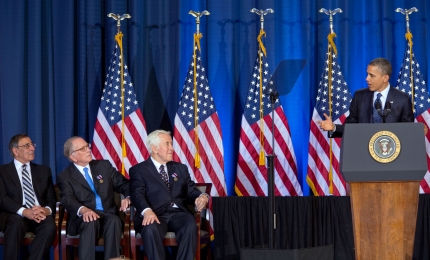
President Barack Obama delivers remarks to the Nunn-Lugar Cooperative Threat Reduction symposium (December 3, 2012)

President Barack Obama delivers remarks to the Nunn-Lugar Cooperative Threat Reduction symposium held at the National Defense University at Fort McNair in Washington, D.C., Dec. 3, 2012. Joing the President on stage are, from left: Defense Secretary Leon Panetta; former Sen. Sam Nunn, D-Ga.; and Sen. Richard Lugar, R- Ind.(Official White House Photo by Sonya N. Hebert)

On Monday, President Obama traveled to the National Defense University to mark the 20th anniversary of what he called "one of the country’s smartest and most successful national security programs" -- the Nunn-Lugar Cooperative Threat Reduction Program for the destruction of weapons of mass destruction in the former Soviet Union.

And after celebrating some of the accomplishments of that program, the President discussed the need to continue that nonproliferation work in the decades ahead.

"We simply cannot allow the 21st century to be darkened by the worst weapons of the 20th century," he said. "And that’s why, over the past four years, we’ve continued to make critical investments in our threat reduction programs -— not just at DOD, but at Energy and at State. In fact, we’ve been increasing funding, and sustaining it. And even as we make some very tough fiscal choices, we’re going to keep investing in these programs —- because our national security depends on it."

President Obama also delivered a specific message to Syrian President Bashar al-Assad.

"On Syria, let me just say this. We will continue to support the legitimate aspirations of the Syrian people -— engaging with the opposition, providing with -- providing them with the humanitarian aid, and working for a transition to a Syria that’s free of the Assad regime," the President said. "And today, I want to make it absolutely clear to Assad and those under his command: The world is watching. The use of chemical weapons is and would be totally unacceptable. And if you make the tragic mistake of using these weapons, there where be consequences, and you will be held accountable."

President Obama concluded his remarks by telling the story of a trip he took to the Ukraine with Senator Richard Lugar when both men were in the Senate.

"We went to a facility, an old factory," he said. "We walked down these long, dark corridors. Finally, we came across some women, sitting at a worktable. On it were piles of old artillery shells. And the women were sitting there, taking them apart. By hand. Slowly. Carefully. One by one."

"It took decades -— and extraordinary sums of money -- to build those arsenals," President Obama told the audience today. "It’s going to take decades -- and continued investments --to dismantle them."

The White House

Office of the Press Secretary

Readout of Vice President Biden’s Meetings with President Enrique Peña Nieto of Mexico and President Juan Manuel Santos of Colombia

Vice President Biden met with President Enrique Peña Nieto of Mexico while in Mexico City to attend his inauguration on Saturday.  The Vice President congratulated President Peña Nieto on his election victory and inauguration and underscored the U.S. commitment to continue working closely with Mexico in a spirit of partnership and shared responsibility to meet common challenges.  The Vice President and President Peña Nieto discussed ways to increase prosperity in both countries and manage our shared border in a way that promotes security, while facilitating legitimate commerce and travel.  The Vice President welcomed Mexico’s commitment to reaching a high-standards agreement as part of the Trans-Pacific Partnership process.
 
Vice President Biden also met with President Juan Manuel Santos of Colombia while in Mexico City.  The Vice President reaffirmed the United States’ commitment to our relationship with Colombia and underscored support for the Santos administration as it works toward a durable peace at home.  The Vice President and President Santos discussed areas of mutual interest, including economic growth, security, and human rights.  The Vice President thanked President Santos for Colombia’s leadership during its term on the UN Security Council, acknowledged Colombia’s valuable contributions on a range of global issues, and highlighted the importance of continued regional security cooperation.
 

President Obama Speaks at the Nunn-Lugar Cooperative Threat Reduction Symposium

December 03, 2012 | 15:13 | Public Domain

President Obama marks the 20th anniversary of the Nunn-Lugar Threat Reduction program, one of the country’s most successful national security programs.

Download mp4 (565MB) | mp3 (37MB)

President Obama's Bilateral Meeting with Prime Minister Boyko Borissov of Bulgaria

December 03, 2012 | 10:28 | Public Domain

President Obama and Prime Minister Boyko Borissov of Bulgaria speak to the press before a bilateral meeting in the Oval Office.

Download mp4 (388MB) | mp3 (25MB)

Read the Transcript

Remarks by President Obama and Prime Minister Borisov of Bulgaria

Oval Office

3:05 P.M. EST

PRESIDENT OBAMA:  Well, I want to welcome Prime Minister Borissov to the White House, and his delegation from Bulgaria.  I have to say at the outset that Bulgaria has proven to be one of our most outstanding NATO allies. 

Obviously, there are very strong bonds between our two countries, including many Bulgarian Americans in my hometown of Chicago.  It reminds us of the strong people-to-people relationship between the United States and Bulgaria. 

I've had an opportunity to work and discuss issues with the Prime Minister in the past, and he has always been a very effective leader on the world stage.  And I think it's important for everybody to know that he's also a black belt in karate, so you should be very careful crossing him.  (Laughter.)

We're going to have a lot to discuss during this meeting.  But first and foremost, I want to thank the Prime Minister for the strong partnership in NATO.  Bulgaria has been a strong supporter of the efforts in Afghanistan, and we'll have the opportunity to touch briefly on the transition that needs to take place there.  But I want to thank him and his fellow countrymen for their service and sacrifice.

We've also had excellent cooperation on criminal investigations, law enforcement, counterterrorism -- and most recently, I want to thank the Prime Minister for his very diligent investigation of the tragic terrorist attack that killed Israeli civilians in Bulgaria.  The security teams in Bulgaria have worked very hard and cooperatively in bringing the perpetrators to justice.

But of course, the relationship is not just based on security issues.  Bulgaria is a modernizing country, and I know that the Prime Minister is interested in a range of reforms to create an open and transparent government, to improve trade and commerce between our two countries, as a leader in the Balkans in moving towards further integration with Europe and the rest of the world economy.  We've been very impressed with the progress that's been made in Bulgaria, and I'm looking forward to hearing from the Prime Minister how the United States can further assist in those efforts.

So, Mr. Prime Minister, welcome to you.  And we look forward to this conversation.  The American people send their regards to the people of Bulgaria.  And the other thing I have to say is the weather is not always this good, so you should enjoy some of the sights while you're here as well.

PRIME MINISTER BORISSOV:  (As interpreted.)  Mr. President, it is an honor that you invited us all here to the White House. 

First of all, I would like to extend my congratulations on your winning the trust again of the American people. 

Of course, the fact that you pointed out you are from Chicago, I would like to point out that this is one of the biggest Bulgarian cities -- over 150,000 Bulgarians make Chicago their home.  And everybody in Bulgaria was deeply moved at your telephone call to express your condolences for the Bulgarian citizen as well as the Israeli nationals who perished in the terrorist act.

I'm very glad that you pointed out that in countries such as Iraq and Afghanistan, places where our soldiers, U.S. and Bulgaria, fight for democracy shoulder to shoulder, that we do have additional topics of mutual interest.  And I thank you for the opportunity to lay a wreath today at Arlington National Cemetery at the Tomb of the Unknown Soldier.  As you know, a lot of Bulgarian soldiers perished and were seriously, grievously wounded in our missions in Iraq and Afghanistan.  And the way that the U.S. people -- and you, personally -- protect the memory of the perished soldiers is unparalleled throughout the world. 

It is true that Bulgaria is an island of stability in the Eastern Balkans.  Our budget deficit is very low, our foreign debt is very low, and our financial stability is great.  Thank you for the opportunity in the energy sphere for Bulgaria to work towards diversification of energy sources.  We do have deep reserves in this area for the future. 

Especially, I also would like to thank you for the excellent cooperation with the United States in such areas as social security, national security, counterterrorism, combating organized crime.  Our law enforcement services work together very effectively.

Of course, the Bulgarian citizens are expecting your decision on Bulgaria's joining the Visa Waiver Program.  We do have visa-free travel regime with the entire European Union.  And thank you once again for the opportunity to discuss these topics. 

END                
3:15 P.M. EST   

Close Transcript

President Obama's Bilateral Meeting with Prime Minister Borissov of Bulgaria

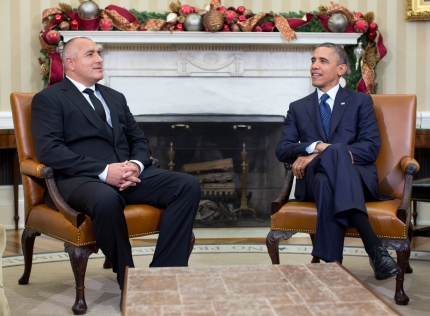
Today, President Obama met with Bulgarian Prime Minister Boyko Borissov.

The President thanked Prime Minister Borissov for Bulgaria’s strong partnership in NATO, as well as the country’s support in Afghanistan and its cooperation on criminal investigations, law enforcement, and counterterrorism.

“But of course, the relationship is not just based on security issues,” President Obama said.

Bulgaria is a modernizing country, and I know that the Prime Minister is interested in a range of reforms to create an open and transparent government, to improve trade and commerce between our two countries, as a leader in the Balkans in moving towards further integration with Europe and the rest of the world economy. We've been very impressed with the progress that's been made in Bulgaria, and I'm looking forward to hearing from the Prime Minister how the United States can further assist in those efforts.


President Obama meets with Prime Minister Boyko Borissov of Bulgaria in the Oval Office, Dec. 3, 2012.

President Barack Obama and Prime Minister Boyko Borissov of Bulgaria hold a bilateral meeting in the Oval Office, Dec. 3, 2012. (Official White House Photo by Lawrence Jackson)

Read the full remarks here

The White House

Office of the Press Secretary

Remarks by the President at the Nunn-Lugar Cooperative Threat Reduction Symposium

The National War College
Washington, D.C.

4:21 P.M. EST

THE PRESIDENT:  Thank you.  Thank you, everybody.  (Applause.)  Please have a seat.  Thank you.  Thank you very much.  (Applause.)  Thank you.  Thank you so much.  Everybody, please have a seat.  (Applause.)  Thank you.

Well, good afternoon everybody.  It is wonderful to be back.  Secretary Panetta, thank you for the introduction.  Last week at the White House we had our first Cabinet meeting since the election, and it was a chance for me to thank my entire team for their service; for keeping our country safe and strong these past four years.  And, Leon, few have done more than you in that regard.  And that includes taking care of our remarkable men and women in uniform and their families and keeping our military the absolute best in the world -- bar none.  So thank you, Leon, for being such an outstanding Secretary of Defense.  We’re very grateful.  (Applause.)

Now, I am not here to give a big speech.  I wanted to just come by and join you in marking the 20th anniversary of one of the country’s smartest and most successful national security programs:  Nunn-Lugar.  And I want to express my gratitude to all of you -- from government, academia, NGOs and our partners from around the world.  People in this room conceived it.  You built it.  You’ve sustained it.  And of course, I especially want to acknowledge a leader who helped create it and who now helps guide it as our outstanding Deputy Secretary of Defense -- Ash Carter.  So thank you, Ash, for your great work.  (Applause.)

Of course, no one has done more than the two visionaries on this stage.  Now, you have to think about what real visionaries do.  They look at the world and they see what’s missing.  So they set out to fill the gap; to build something new.  And that’s what Sam Nunn and Dick Lugar did many years ago.  They challenged us to think anew; to imagine, after decades of confrontation, how our nations might engage in cooperation.  Early in the Cold War, Einstein warned of the danger of our wisdom not keeping pace with our technology.  And with Nunn-Lugar, our wisdom began to catch up.

I also wanted to be here because of my own personal debt to these two leaders.  When I was in -- when I was elected to the Senate, Sam Nunn was one of the first leaders I called.  Obviously, he had an extraordinary reputation for his work on a whole range of issues in the Senate.  And, Sam, by the way, I should -- I always meant to say thanks for taking my call.  (Laughter.)  So we do small talk, he congratulates me on being elected.  And then he says, I’ve got two pieces of advice for you.  First piece of advice:  Get a seat on the Foreign Relations Committee.  I did that.  Second piece of advice:  Learn from Dick Lugar.  (Laughter.)  I did that, too.  So I took Sam’s advice then.  And as President, I continue to value his advice and his counsel. 

Sam, as one of the so-called “Four Horsemen” -- which I’d say is a pretty ominous nickname -- (laughter) -- has spoken out for a world without nuclear weapons.  And with your Nuclear Threat Initiative, you helped us ratify the New START treaty, rally the world to secure nuclear materials, strengthen the global nonproliferation regime, and create an international fuel bank for peaceful nuclear power.  Sam, that’s an extraordinary legacy and an extraordinary record.  Thank you for your partnership and your leadership.  (Applause.)

And because I took Sam’s advice, I came to know and admire Dick Lugar.  I was a new, junior senator.  But nevertheless, he was willing to take me in and served in many cases, particularly on the issues that we’re celebrating here today, took me in as a pupil for him.  I watched, and I learned.  And when we worked together to pass a law to speed up the lockdown of nuclear materials, obviously it was called Lugar-Obama -- in that order.  (Laughter.)

And, Dick, I want to take this opportunity to say something else.  At times, we’ve disagreed on matters of policy.  But one thing we’ve always shared is a notion of what public service should be.  That it ought to be more than just doing what’s popular in the moment.  That it ought to be about what’s right for our nation, over the long term.  It ought to be about problem-solving and governance, not just how we can score political points on each other or engage in obstructionism.  And where compromise is not a vice and where bipartisanship is a actually considered a virtue -- to be rewarded, not punished.

That’s the essence of these two gentlemen, and that’s the essence of Nunn-Lugar.  That’s the spirit that’s defined Dick’s public service for nearly 50 years.  And that’s the bipartisan tradition that we need more of here in Washington, especially on foreign policy.  So, Dick, as you prepare to leave the Senate that you love, I think I speak on behalf of everybody here and millions of people across the country to say that your legacy will endure in a safer and more secure world, and a safer and more secure America.  And we pray that this nation produces more leaders with your sense of decency and civility and integrity.  We are grateful to you.  Thank you very much.  (Applause.)

Now, I will point out, it was Dick who took me on my first foreign trip as a Senator -- to Russia and Ukraine and Azerbaijan.  We were there to see the Cooperative Threat Reduction program in action.  And the first thing I learned is that when Dick Lugar travels overseas, it's not a junket.  We didn't stop and look at a lot of beautiful sights -- (laughter) -- and sort of lounge around on some shopping excursions.  He wore out every 25-year-old staffer that was part of this delegation. 

What you also learn is that Dick Lugar -- the more remote the place is and the more obscure the facility is, the bigger a rock star Dick Lugar is.  (Laughter.)  I mean, they love him in these places.   

I remember walking through one facility.  I started leaning in for a closer look and one of the workers said, don’t touch that orange stuff.  It turned out to be TNT.  (Laughter.)  At another point, the workers were taking apart munitions -- gloves on their hands, masks over their faces -- and I’m thinking, wait a second, why don’t we have masks on?  (Laughter.)  This is the kind of trip you take with Dick Lugar.  (Laughter.) 

We're traipsing through nuclear weapons storage sites and junkyards full of old land mines and technicians showing off test tubes where you said, well, what's that?  Well, that's anthrax, that's plague.  (Laughter.)  Shouldn't you keep it in something a little more sturdy than this?  (Laughter.)  Dick Lugar is standing in the back of the room.  (Laughter.)  I remember I asked him, I think, have you seen it?  He says, yes, yes, I've seen it.  I don't get too close now.  (Laughter.)  That's what it's like traveling with Dick Lugar.   

And I had been a strong advocate for CTR before.  But visiting those facilities, seeing the work that so many of you do, seeing these old weapons once aimed at us now being turned into scrap truly brought home how important this work was.  This is one of our most important national security programs.  And it's a perfect example of the kind of partnerships that we need, working together to meet challenges that no nation can address on its own. 

And so, Nunn-Lugar is the foundation for the vision that I laid out, once I was elected President, in travel to Prague -- where nations come together to secure nuclear materials, as we’re doing with our Nuclear Security Summits, where we build on New START and continue to work to reduce our arsenals; where we strengthen the Nuclear Non-Proliferation Treaty and prevent the spread of the world’s most deadly weapons; where, over time, we come closer to our ultimate vision -- a world without nuclear weapons.  

That’s why we haven’t just sustained programs like Nunn-Lugar over the past four years.  We’ve worked with all of you to strengthen it, expanding it to some 80 nations, far beyond the old Soviet Union -- moving ahead with the destruction of chemical weapons -- partnering with others, countries from Africa to Asia and global health organizations to prevent the spread of deadly diseases and bioterrorism.  And I have to give a shout-out to somebody who was on the original team with Ash that conceived of CTR; she’s been working it ever since and now leads our efforts at the White House -- Laura Holgate is here.  And so we're very proud of her for the outstanding work that she's done.  (Applause.)

And we’ve worked to keep weapons from spreading, whether it was nuclear material in Libya or, now, chemical weapons in Syria.  And on Syria, let me just say this.  We will continue to support the legitimate aspirations of the Syrian people -— engaging with the opposition, providing with -- providing them with the humanitarian aid, and working for a transition to a Syria that’s free of the Assad regime. 

And today, I want to make it absolutely clear to Assad and those under his command:  The world is watching.  The use of chemical weapons is and would be totally unacceptable.  And if you make the tragic mistake of using these weapons, there where be consequences, and you will be held accountable.  (Applause.)

We simply cannot allow the 21st century to be darkened by the worst weapons of the 20th century.  And that’s why, over the past four years, we’ve continued to make critical investments in our threat reduction programs -— not just at DOD, but at Energy and at State.  In fact, we’ve been increasing funding, and sustaining it.  And even as we make some very tough fiscal choices, we’re going to keep investing in these programs —- because our national security depends on it.

After all, even with all your success -— the thousands of missiles destroyed, bombers and submarines eliminated, the warheads that have been deactivated -— we’re nowhere near done.  Not by a long shot.  And you all know this.  There’s still much too much material -— nuclear, chemical, biological -— being stored without enough protection.  There are still terrorists and criminal gangs doing everything they can to get their hands on it.

And make no mistake, if they get it, they will use it; potentially killing hundreds of thousands of innocent people,  perhaps triggering a global crisis.  That’s why I continue to believe that nuclear terrorism remains one of the greatest threats to global security.  That’s why working to prevent nuclear terrorism is going to remain one of my top national security priorities as long as I have the privilege of being President of the United States. 

So, I came here in part to say we cannot let our guard down.  This needs to be a sustained effort across all your organizations, across our government.  We have to keep investing in our people and in new technologies.  We have to sustain the partnerships we have, and that includes Russia. 

We’re joined by some of our Russian friends today.  Russia has said that our current agreement hasn’t kept pace with the changing relationship between our countries.  To which we say, let’s update it.  Let’s work with Russia as an equal partner.  Let’s continue the work that’s so important to the security of both our countries.  And I’m optimistic that we can.

And we have to keep creating new partnerships.  We have to make sure -— to paraphrase Einstein -— that our wisdom stays ahead of our technology.  And I know you’re committed to this.  And I want you to know that I am, too.

So let me leave you with a story of that first trip Dick and I took together.  You may remember this, Dick.  I was Ukraine.  We went to a facility, an old factory.  We walked down these long, dark corridors.  We’re ducking our heads, stepping over puddles of -- something -- we’re not sure what it was.  (Laughter.)  Finally, we came across some women, sitting at a worktable.  On it were piles of old artillery shells.  And the women were sitting there, taking them apart.  By hand.  Slowly.  (Laughter.)  Carefully.  (Laughter.)  One by one. 

It took decades -— and extraordinary sums of money -— to build those arsenals.  It’s going to take decades -— and continued investments -— to dismantle them.  The two of you know know this better than anybody.  It’s painstaking work.   It rarely makes the headlines.  But I want each of you to know, and everybody who’s participating in this important effort to know, that the work you do is absolutely vital to our national security and to our global security. 

Missile by missile, warhead by warhead, shell by shell, we’re putting a bygone era behind us.  Inspired by Sam Nunn and Dick Lugar, we’re moving closer to the future we seek.  A future where these weapons never threaten our children again.  A future where we know the security and peace of a world without nuclear weapons.  I could not be prouder of these gentlemen.  I’m proud to call them friends.  And I’m looking forward to continuing to work with them and all of you in the years to come.

Thank you very much.

END
4:38 P.M. EST