President Obama Holds a Cabinet Meeting

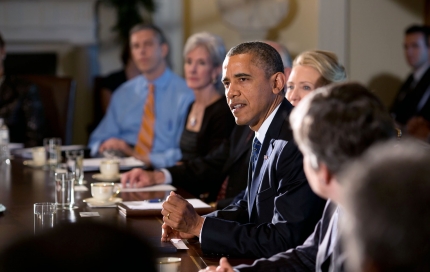
President Barack Obama holds a Cabinet meeting in the Cabinet Room

President Barack Obama holds a Cabinet meeting in the Cabinet Room of the White House, Nov. 28, 2012. (Official White House Photo by Pete Souza)

Today, President Obama held his first full Cabinet meeting since the election took place.

He first thanked Cabinet members for doing “a remarkable job on behalf of the American people, across the board, on a range of issues” including growing our economy, putting people back to work, and keeping Americans safe around the world.

But there’s still much work to be done, he reminded them. In today’s meeting, President Obama said the Cabinet would discuss efforts to help communities recover and rebuild after Hurricane Sandy, as well as something that’s on the minds of many American families across the country: making sure taxes on the middle class don’t go up.

There is no reason why taxes on middle-class families should go up. It would be bad for the economy.  It would be bad for those families. In fact, it would be bad for the world economy. And so I think it’s very important that we get that resolved, and I am very open to a fair and balanced approach to reduce our deficit and provide the kind of certainty that businesses and consumers need so that we can keep this recovery going.

The White House

Office of the Press Secretary

Remarks by the President at a Cabinet Meeting

The Cabinet Room


3:11 P.M. EST
 
THE PRESIDENT:  Hello, everybody.  Is that brighter than usual?  (Laughter.)  Yes, that's serious.  
 
Well, listen, this is a wonderful opportunity for me to meet with my full Cabinet for the first time since the election took place.  The primary purpose from my perspective is to say thank you, because everybody here, in their respective agencies, has done a remarkable job on behalf of the American people, across the board on a wide range of issues.  They’ve always prioritized how do we make sure that we have a strong middle class, how do we grow our economy, how do we put people back to work, and how do we keep the American people safe and continue to extend our influence and our ideals around the world.  And I could not have a better collection of people, many of whom have stayed here throughout my first term.  And I think we’ve had as little turnover as any President during the course of a first term, and the reason is because everybody has done such a remarkable job.
 
So my main purpose is to say thank you to them, but also to remind them that we’ve got a lot of work to do.  There are going to be a few specific issues that we spend a lot of time on.  One in particular that I should note is that the devastating impact of Hurricane Sandy is still being felt by families all across New York and New Jersey, parts of Connecticut.  We are very pleased that under the leadership initially of Janet Napolitano and FEMA, but now Shaun Donovan, who’s heading up a task force, we’re focusing not only on recovery, but now on rebuilding and making sure those communities come back stronger than ever and people get the help that they need.  So that will be an important topic because it’s really going to be an interagency concern.
 
The second thing that we’ll be talking about, obviously, is what’s on the minds of a lot of American families across the country, and that is making sure that we’ve got this fiscal cliff dealt with and that middle-class taxes don’t go up.  I already spoke extensively about that today.  I’ll just repeat:  There is no reason why taxes on middle-class families should go up.  It would be bad for the economy.  It would be bad for those families.  In fact, it would be bad for the world economy.  And so I think it’s very important that we get that resolved, and I am very open to a fair and balanced approach to reduce our deficit and provide the kind of certainty that businesses and consumers need so that we can keep this recovery going.
 
And obviously, we’ll be spending some time talking about national security issues as well.  
 
But I just want to say thank you to this extraordinary Cabinet for a job well done.  And I will take this opportunity to publicly embarrass two members of the Cabinet whose birthdays are either today or tomorrow:  Ric Shinseki, who is the Department of Veterans Affairs.  Happy birthday to you.  And that is actually today.  (Applause.)  And Janet Napolitano’s birthday is tomorrow.  (Applause.)
 
All right, guys.  Thank you.  We want to get back to work.
 
Q    Mr. President, do you think the Hill is being fair to Susan Rice in its meetings?
 
THE PRESIDENT:  Thank you so much guys.
 
Q    Any thoughts on that at all?
 
THE PRESIDENT:  Susan Rice is extraordinary.  I couldn’t be prouder of the job that she’s done as the USPR.  (Applause.)
 
 
END
3:15 P.M. EST


The White House

Office of the Press Secretary

Presidential Memorandum -- Designation of Authorized Representative of the Federal Government under Section 7302 of the National Intelligence Reform and Terrorism Prevention Act of 2004

MEMORANDUM FOR THE SECRETARY OF THE INTERIOR

SUBJECT: Designation of Authorized Representative of the Federal Government under Section 7302 of the National Intelligence Reform and Terrorism Prevention Act of 2004

Pursuant to the authority vested in me as President by section 7302 of the National Intelligence Reform and Terrorism Prevention Act of 2004 (the "Act"), as amended (42 U.S.C. 5196 note), I hereby designate you as an authorized representative of the Federal Government under the Act for lands administered by the Department of the Interior in the National Capital Region. Should a public event be designated as a National Special Security Event (NSSE), you shall coordinate with the United States Secret Service regarding the intent to enter into a National Capital Region mutual aid agreement should this agreement impact the security plan for the designated NSSE.

BARACK OBAMA

President Obama Wants You to Speak Out on Passing the Middle Class Tax Cuts

President Barack Obama discusses the need for Congress to extend the middle class tax cuts (November 28, 2012)

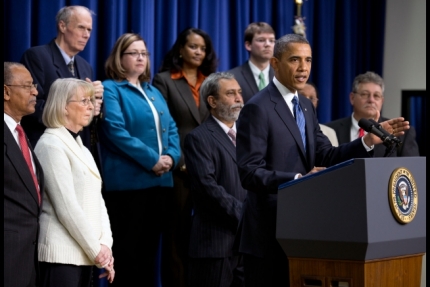
President Barack Obama delivers remarks regarding the need for Congress to extend the middle class tax cuts, in the South Court Auditorium of the White House, Nov. 28, 2012. (Official White House Photo by Pete Souza)

Surrounded by Americans who had written into the White House in support of his plan, President Obama today renewed his call to prevent a tax increase on the middle class.

"If Congress does nothing, every family in America will see their taxes automatically go up at the beginning of next year," the President said. "A typical middle-class family of four would see its income taxes go up by $2,200. That's $2,200 out of people's pockets. That means less money for buying groceries, less money for filling prescriptions, less money for buying diapers. It means a tougher choice between paying the rent and paying tuition. And middle-class families just can’t afford that right now."

To help find an agreement President Obama pledged to keep up the pressure -- meeting with lawmakers, labor leaders, and business executives. And he called on the American people to speak up and add their own voices to the debate.

"If there's one thing I've learned, when the American people speak loudly enough, lo and behold, Congress listens," he said.

You can share your story by visiting WH.gov/My2K, or help keep the conversation going online on Facebook and Twitter using the hashtag #My2K. Or, read what others are saying about what $2,000 means to them. 

Related Topics: Middle-Class Tax Cuts, Taxes

The White House

Office of the Press Secretary

President Obama Signs New Hampshire Disaster Declaration


The President today declared a major disaster exists in the State of New Hampshire and ordered Federal aid to supplement state and local recovery efforts in the area affected by Hurricane Sandy during the period of October 26 to November 8, 2012.

Federal funding is available for to state and eligible local governments and certain private nonprofit organizations on a cost-sharing basis for emergency work and the repair or replacement of facilities damaged by Hurricane Sandy in the counties of Belknap, Carroll, Coos, Grafton, and Sullivan.

Federal funding is also available on a cost-sharing basis for hazard mitigation measures statewide.

W. Craig Fugate, Administrator, Federal Emergency Management Agency (FEMA), Department of Homeland Security, named James N. Russo as the Federal Coordinating Officer for federal recovery operations in the affected area. 

FEMA said additional designations may be made at a later date if requested by the state and warranted by the results of further damage assessments.

FOR FURTHER INFORMATION MEDIA SHOULD CONTACT:  FEMA NEWS DESK AT (202) 646-3272 OR FEMA-NEWS-DESK@DHS.GOV


The White House

Office of the Press Secretary

Remarks by the President on Extending Tax Cuts for the Middle Class


South Court Auditorium
 
12:01 P.M. EST
 
THE PRESIDENT:  Thank you so much.  
Thank you, everybody.  Please have a seat.  Thank you very much. Everybody, please have a seat -- except you guys.  Don't sit down.  (Laughter.) 
 
Well, good morning, everybody.
 
AUDIENCE:  Good morning.
 
THE PRESIDENT:  There’s been a lot of talk here in Washington about the deadlines we’re facing on taxes and deficits -- these deadlines are going to be coming up very soon, in the coming weeks.  But today is important because I want to make sure everybody understands this debate is not just about numbers.  It's a set of major decisions that are going to affect millions of families all across this country in very significant ways.  And their voices -- the voices of the American people -- have to be part of this debate.  And so I asked some friends of mine here to join me, some folks from here in the area.  
 
Our ultimate goal is an agreement that gets our long-term deficit under control in a way that is fair and balanced.  That kind of agreement would be good for our businesses; it would be good for our economy; it would be good for our children’s future. And I believe that both parties can agree on a framework that does that in the coming weeks.  In fact, my hope is to get this done before Christmas.  
 
But the place where we already have, in theory at least, complete agreement right now is on middle-class taxes.  And as I’ve said before, we've got two choices.  If Congress does nothing, every family in America will see their taxes automatically go up at the beginning of next year.  Starting January 1st, every family in America will see their taxes go up.  
A typical middle-class family of four would see its income taxes go up by $2,200.  That's $2,200 out of people's pockets.  That means less money for buying groceries, less money for filling prescriptions, less money for buying diapers.  (Laughter.)  It means a tougher choice between paying the rent and paying tuition.  And middle-class families just can’t afford that right now.   
 
By the way, businesses can’t afford it either.  Yesterday, I sat down with some small business owners who stressed this point. Economists predict that if taxes go up on the middle class next year, consumers will spend nearly $200 billion less on things like cars and clothes and furniture -- and that obviously means fewer customers.  That cuts into business profits.  That makes businesses less likely to invest and hire, which means fewer jobs.  And that can drag our entire economy down. 
 
Now, the good news is there’s a better option.  Right now, as we speak, Congress can pass a law that would prevent a tax hike on the first $250,000 of everybody’s income.  Everybody's.  And that means that 98 percent of Americans and 97 percent of small businesses wouldn’t see their income taxes go up by a single dime.  Ninety-eight percent of Americans, 97 percent of small businesses would not see their income taxes go up by a single dime.
 
Even the wealthiest Americans would still get a tax cut on the first $250,000 of their income.  So it's not like folks who make more than $250,000 aren't getting a tax break, too.  They're getting a tax break on the first $250,000 just like everybody else. 
 
Families and small businesses would, therefore, be able to enjoy some peace of mind heading into Christmas and heading into the New Year.  And it would give us more time then next year to work together on a comprehensive plan to bring down our deficits, to streamline our tax system, to do it in a balanced way -- including asking the wealthiest Americans to pay a little more, so that we can still invest in things like education and training, and science and research.
 
Now, I know some of this may sound familiar to you because we talked a lot about this during the campaign.  This shouldn’t be a surprise to anybody.  This was a major debate in the presidential campaign and in congressional campaigns all across the country.  And a clear majority of Americans -- not just Democrats, but also a lot of Republicans and a lot of independents -- agreed we should have a balanced approach to deficit reduction that doesn’t hurt the economy and doesn’t hurt middle-class families.  And I’m glad to see -- if you've been reading the papers lately -- that more and more Republicans in Congress seem to be agreeing with this idea that we should have a balanced approach.
 
So if both parties agree we should not raise taxes on middle-class families, let’s begin our work with where we agree. The Senate has already passed a bill that keeps income taxes from going up on middle-class families.  Democrats in the House are ready to vote for that same bill today.  And if we can get a few House Republicans to agree as well, I’ll sign this bill as soon as Congress sends it my way.  I've got to repeat, I've got a pen. I'm ready to sign it.  (Applause.)  
 
So my point here today is to say let’s approach this problem with the middle class in mind -- the folks who are behind me and the millions of people all across the country who they represent. The American people are watching what we do -- middle-class families, folks who are working hard to get into the middle class -- they're watching what we do right now.  And if there’s one thing that I’ve learned, when the American people speak loudly enough, lo and behold, Congress listens.  
 
Some of you may remember that a year ago, during our last big fight to protect middle-class families, tens of thousands of working Americans called and tweeted and emailed their representatives, asking them to do the right thing.  And sure enough, it worked.  The same thing happened earlier this year when college students across the country stood up and demanded that Congress keep rates low on their student loans.  Congress got the message loud and clear and they made sure that interest rates on student loans did not go up.
 
So the lesson is that when enough people get involved, we have a pretty good track record of actually making Congress work. And that’s important, because this is our biggest challenge yet  -- and it’s one that we can only meet together.  
 
So in the interest of making sure that everybody makes their voices heard, last week we asked people to tell us what would a $2,000 tax hike mean to them.  Some families told us it would make it more difficult for them to send their kids to college.  Others said it would make it tougher for them to cover the cost of prescription drugs.  Some said it would make it tough for them to make their mortgage.
 
Lyn Lyon, who's here, from Newport News -- where's Lyn?  There she is.  She just wants to see some cooperation in Washington.  She wrote, “Let’s show the rest of the world that we're adults and, living in a democracy, we can solve our problems by working together.” 
 
So that’s what this debate is all about.  And that’s why it’s so important that as many Americans as possible send a message that we need to keep moving forward.  So today, I’m asking Congress to listen to the people who sent us here to serve.  I’m asking Americans all across the country to make your voice heard.  Tell members of Congress what a $2,000 tax hike would mean to you.  Call your members of Congress, write them an email, post it on their Facebook walls.  You can tweet it using the hashtag “My2K.”  Not "Y2K."  (Laughter.)  "My2K."  We figured that would make it a little easier to remember.  
 
And I want to assure the American people I'm doing my part 
-- I’m sitting down with CEOs; I'm sitting down with labor leaders; I'm talking to leaders in Congress.  I am ready and able and willing and excited to go ahead and get this issue resolved in a bipartisan fashion so that American families, American businesses have some certainty going into next year.  And we can do it in a balanced and fair way, but our first job is to make sure that taxes on middle-class families don't go up.  And since we all theoretically agree on that, we should go ahead and get that done.  (Applause.)  If we get that done, a lot of the other stuff is going to be a lot easier.
 
So in light of just sort of spreading this message, I'm going to be visiting Pennsylvania on Friday to talk with folks at a small business there that are trying to make sure that they're filling their Christmas orders.  And I’ll go anywhere and I'll do whatever it takes to get this done.  It’s too important for Washington to screw this up.  Now is the time for us to work on what we all agree to, which is let's keep middle-class taxes low. That’s what our economy needs.  That's what the American people deserve.  
 
And if we get this part of it right, then a lot of the other issues surrounding deficit reduction in a fair and balanced and responsible way are going to be a whole lot easier.  And if we get this wrong, the economy is going to go south.  It's going to be much more difficult for us to balance our budgets and deal with our deficits because if the economy is not strong, that means more money is going out in things like unemployment insurance, and less money is coming in, in terms of tax receipts. And it just actually makes our deficit worse.
 
So we really need to get this right.  I can only do it with the help of the American people.  So, tweet -- what was that again -- "My2K" -- tweet using the hashtag "My2K," or email, post it on a member of Congress's Facebook wall.  Do what it takes to communicate a sense of urgency.  We don't have a lot of time here.  We've got a few weeks to get this thing done.  We could get it done tomorrow.  Now, optimistically, I don't think we're going to get it done tomorrow -- (laughter) -- but I tell you, if everybody here goes out of their way to make their voices heard, and spread the word to your friends and your family, your coworkers, your neighbors, then I am confident we will get it done.  And we will put America on the right track not just for next year but for many years to come.  All right?   
 
Thank you very much, everybody.  (Applause.)  Appreciate it.
 
 
END
12:12 P.M. EST

President Obama on Extending Tax Cuts for the Middle Class

November 28, 2012 | 11:18 | Public Domain

If Congress fails to act, every family in America will see their taxes automatically go up at the beginning of next year. A typical middle-class family of four would see its taxes rise by $2,200.

Download mp4 (423MB) | mp3 (27MB)

President Obama: "This Debate is Too Important for Washington to Get it Wrong"

President Obama just sent the message below to the White House email list, asking people to speak out about extending tax cuts for the middle class. If you didn't get the email, be sure to sign up.

The White House

Office of the Press Secretary

Statement by the President on the Anniversary of the Birth of Guru Nanak Dev Ji


I send my best wishes to all those here in America and around the world who are observing the anniversary of birth of Guru Nanak Dev Ji, the first Sikh Guru.  As always, this is a time to celebrate the principles of equality, respect, service and interfaith cooperation that are the core of the Sikh faith, and to recognize the extraordinary contributions that Sikh Americans make to our country every day.  This year, we also remember the innocent lives that were lost  in the unspeakable violence directed against the Sikh congregation at the gurdwara in Oak Creek, Wisconsin.  I can think of no better way to honor their memory, and to join our Sikh friends as they mark this sacred time, than to recommit ourselves to the spirit of pluralism, equality and compassion that define both the Sikh community and our nation.   

The White House

Office of the Press Secretary

President Obama Signs Alaska Disaster Declaration


The President today declared a major disaster exists in the State of Alaska and ordered Federal aid to supplement state and local recovery efforts in the area affected by a severe storm, straight-line winds, flooding, and landslides during the period of September 15-30, 2012.

Federal funding is available to state and eligible local governments and certain private nonprofit organizations on a cost-sharing basis for emergency work and the repair or replacement of facilities damaged by the severe storm, straight-line winds, flooding, and landslides in the areas of Alaska Gateway REAA, Chugach REAA, Denali Borough, Kenai Peninsula Borough, and the Matanuska Susitna Borough.

Federal funding is also available on a cost-sharing basis for hazard mitigation measures statewide.

W. Craig Fugate, Administrator, Federal Emergency Management Agency (FEMA), Department of Homeland Security, named Kenneth K. Suiso as the Federal Coordinating Officer for federal recovery operations in the affected area. 

FEMA said additional designations may be made at a later date if requested by the state and warranted by the results of further damage assessments.

FOR FURTHER INFORMATION MEDIA SHOULD CONTACT:  FEMA NEWS DESK AT (202) 646-3272 OR FEMA-NEWS-DESK@DHS.GOV