Weekly Address: Urging Congress to Extend the Middle Class Tax Cuts

December 01, 2012 | 3:07 | Public Domain

President Obama speaks to the American people from a busy factory floor in Pennsylvania about the urgent need to pass the middle class tax cuts, which will give families and businesses preparing for the holidays the certainty they need going into the New Year. Democrats and Republicans must come together to pass one thing that everyone agrees on—extending income tax cuts for 98 percent of American families and 97 percent of small businesses, and there is no reason to wait. The President urges Congress to take action to help grow our economy and strengthen the middle class.

Download mp4 (246MB) | mp3 (7MB)

The White House

Office of the Press Secretary

Presidential Proclamation -- Minority Enterprise Development Week, 2012

MINORITY ENTERPRISE DEVELOPMENT WEEK, 2012

- - - - - - -

BY THE PRESIDENT OF THE UNITED STATES OF AMERICA

A PROCLAMATION

At the core of who we are as a Nation is a fundamental belief: that no matter who you are, no matter what you look like, no matter where you come from, if you have an idea and a willingness to work hard, you can succeed. It is this belief that leads a worker to leave a job to become her own boss, propels a basement inventor to sell a new product, or drives an amateur chef to open a restaurant. It is this belief that has drawn millions to our shores and spurred America's prosperity for centuries.

The belief in tomorrow's promise is guiding minority entrepreneurs across our country to start the kinds of businesses that make up the backbone of our economy. With a combined economic output of $1 trillion, minority-owned firms are key producers in an array of industries, hubs of innovation and new technology, and engines of job creation in our communities.

Because the continued growth and success of minority enterprises is essential to our economic recovery, my Administration has taken steps to help bolster these businesses. Through the Minority Business Development Agency, we are providing access to capital, consulting, contracts, and markets to minority entrepreneurs seeking to expand their businesses at home and overseas. We are also making it easier for business owners to find Federal resources with www.BusinessUSA.gov, a centralized, one-stop platform for businesses to access services to help them grow and hire.

As the number and size of minority-owned firms continue to expand, we must harness the diversity and power of these businesses to help strengthen our economy and put people back to work. As we celebrate the 30th anniversary of Minority Enterprise Development Week, let us honor the role America's minority-owned businesses play in spurring our prosperity and recommit to equipping them with the tools for success in the 21st century.

NOW, THEREFORE, I, BARACK OBAMA, President of the United States of America, by virtue of the authority vested in me by the Constitution and the laws of the United States, do hereby proclaim December 2 through December 8, 2012, as Minority Enterprise Development Week. I call upon all Americans to celebrate this week with appropriate programs, ceremonies, and activities to recognize the many contributions of our Nation's minority enterprises.

IN WITNESS WHEREOF, I have hereunto set my hand this thirtieth day of November, in the year of our Lord two thousand twelve, and of the Independence of the United States of America the two hundred and thirty-seventh.

BARACK OBAMA

The White House

Office of the Press Secretary

Presidential Proclamation -- National Impaired Driving Prevention Month, 2012

NATIONAL IMPAIRED DRIVING PREVENTION MONTH, 2012

- - - - - - -

BY THE PRESIDENT OF THE UNITED STATES OF AMERICA

A PROCLAMATION

As Americans gather with friends and family to share in the holiday season, National Impaired Driving Prevention Month reminds us of the importance of celebrating safely. Every year, accidents involving drunk, drugged, or distracted driving claim thousands of lives, leaving families to face the heartbreak of losing a loved one. We stand with all those who have known the tragic consequences of drugged or drunk driving, and we rededicate ourselves to preventing it this December and throughout the year.

Alcohol and drugs present serious risks to all drivers. It is well known that drugs, including some prescription medications, can impair the skills necessary for safe and responsible driving. Distractions like using mobile phones and other electronics behind the wheel also make our roads more hazardous. To reduce the prevalence of impaired driving, my Administration is working to raise public awareness, improve impaired driving screening procedures, and ensure law enforcement officers get the training they need. We are also striving to stop substance abuse before it starts by supporting local prevention programs and providing youth with the facts about alcohol and drug use.

Families play an essential part in stopping impaired driving. By talking about the risks and setting clear expectations, parents and other caregivers can help their children stay safe, sober, and focused on the road. Educators, health care providers, and community leaders can join in that important work by promoting responsible decisionmaking and encouraging young people to live free of drugs and alcohol.

This month, we recommit to keeping our streets safe, our families healthy, and our communities strong. To learn more about impaired driving and how all of us can work to prevent it, visit www.WhiteHouse.gov/ONDCP and www.NHTSA.gov/Impaired.

NOW, THEREFORE, I, BARACK OBAMA, President of the United States of America, by virtue of the authority vested in me by the Constitution and the laws of the United States, do hereby proclaim December 2012 as National Impaired Driving Prevention Month. I urge all Americans to make responsible decisions and take appropriate measures to prevent impaired driving.

IN WITNESS WHEREOF, I have hereunto set my hand this thirtieth day of November, in the year of our Lord two thousand twelve, and of the Independence of the United States of America the two hundred and thirty-seventh.

BARACK OBAMA

The White House

Office of the Press Secretary

Presidential Proclamation -- Critical Infrastructure Protection and Resilience Month, 2012

CRITICAL INFRASTRUCTURE PROTECTION AND RESILIENCE MONTH, 2012

- - - - - - -

BY THE PRESIDENT OF THE UNITED STATES OF AMERICA

A PROCLAMATION

Every day, Americans across our country -- from entrepreneurs and college students to families and community leaders -- rely on critical infrastructure to travel and communicate, work and play. The assets and systems we depend on are essential to our way of life, and during Critical Infrastructure Protection and Resilience Month, we maintain our commitment to keeping our critical infrastructure and our communities safe and resilient.

Our Nation's critical infrastructure is complex and interconnected, and we must understand not only its strengths, but also its vulnerabilities to emerging threats. Cyber incidents can have devastating consequences on both physical and virtual infrastructure, which is why my Administration continues to make cybersecurity a national security priority. As we continue to work within existing authorities to fortify our country against cyber risks, comprehensive legislation remains essential to improving infrastructure security, enhancing cyber information sharing between government and the private sector, and protecting the privacy and civil liberties of the American people.

Physical threats also put our Nation's most important assets at risk. Destruction caused by devastating storms and other natural disasters this year underscored our reliance on our critical infrastructure. Yet, these tragic events also demonstrated once again the strength and resolve of the American people when we work together to recover and rebuild. As long as we keep fortifying partnerships between Federal, State, and local governments and among community leaders and the private sector, we can continue to modernize our critical infrastructure and bolster our ability to overcome whatever challenges we may face.

All Americans have a part to play in protecting our critical infrastructure and making it more resilient, and my Administration continues to engage stakeholders in doing what it takes to keep our people safe and our assets secure. This month, we rededicate ourselves to raising awareness of the importance of critical infrastructure and to doing all we can to protect it. Americans can learn more about how they can get involved by visiting www.Ready.gov.

NOW, THEREFORE, I, BARACK OBAMA, President of the United States of America, by virtue of the authority vested in me by the Constitution and the laws of the United States, do hereby proclaim December 2012 as Critical Infrastructure Protection and Resilience Month. I call upon the people of the United States to recognize the importance of protecting our Nation's resources and to observe this month with appropriate events and training to enhance our national security and resilience.

IN WITNESS WHEREOF, I have hereunto set my hand this thirtieth day of November, in the year of our Lord two thousand twelve, and of the Independence of the United States of America the two hundred and thirty-seventh.

BARACK OBAMA

President Obama Speaks on Extending Tax Cuts for Middle Class Families

November 30, 2012 | 17:44 | Public Domain

President Obama makes the case for extending tax cuts for middle-class families by visiting a business that depends on middle-class consumers during the holiday season, and could be impacted if taxes go up on 98 percent of Americans at the end of the year.

Download mp4 (655MB) | mp3 (43MB)

The White House

Office of the Press Secretary

President Obama Announces More Key Administration Posts

WASHINGTON, DC – Today, President Barack Obama announced his intent to appoint the following individuals to key Administration posts:

• Bob J. Archuleta - Member, Board of Visitors to the United States Military Academy
• Travis Morrison - Member, Board of Visitors to the United States Military Academy
• Admiral Ronne Froman, USN (Ret) - Member, Board of Visitors to the United States Naval Academy
• Sachin Dev Pavithran - Member, Architectural and Transportation Barriers Compliance Board

President Obama said, “These dedicated individuals bring a wealth of experience and talent to their new roles and I am proud to have them serve in this Administration.  I look forward to working with them in the months and years to come.”

President Obama announced his intent to appoint the following individuals to key Administration posts:

Bob J. Archuleta, Appointee for Member, Board of Visitors to the United States Military Academy
Bob J. Archuleta is a Los Angeles County Commissioner of Military Veterans Affairs, a post he has held since 1989.  Mr. Archuleta was elected to the City Council of Pico Rivera, California in 2007, and also serves as Mayor.  He has been a member of the United States Army Advisory Board for Military Recruitment in Los Angeles County since 1989.  He was the Chairman of the U.S. Small Business Administration Advisory Committee on Veterans Business Affairs from 2003 to 2004, and was a member of the Department of Veterans Affairs Advisory Committee on Minority Veterans from 2002 to 2003.  Mr. Archuleta was a reserve police officer and reserve detective with the Montebello Police Department from 1988 to 1998.  He served in the U.S. Army from 1963 to 1966. Mr. Archuleta graduated from Rio Hondo College Police Academy.

Travis Morrison, Appointee for Member, Board of Visitors to the United States Military Academy
Travis Morrison is an entrepreneur who has owned several construction materials businesses in southern Missouri since 1990.  From 1980 to 1986, he served in the Missouri General Assembly.  During that time, he worked in private practice as a certified public accountant.  Mr. Morrison served on active duty as an infantry officer in the U.S. Army from 1971 to 1976, retiring as a Lieutenant Colonel in the Army Reserve in 2008.  He has served on the boards of the Missouri State Employees Retirement System, the Ozarks Medical Center, and West Plains Bank and Trust.  Mr. Morrison received a B.S. from the United States Military Academy at West Point and an M.A. from the University of Southern California, Los Angeles. 

Admiral Ronne Froman, USN (Ret), Appointee for Member, Board of Visitors to the United States Naval Academy
Admiral Ronne Froman is the Chairman and CEO of REBOOT, a non-profit organization that provides behavioral training and employment assistance to veterans transitioning to civilian life.  In addition, Admiral Froman is the President of the Board of the Monarch School Project, a K-12 school for the homeless in San Diego.  She served as the City of San Diego’s Chief Operating Officer from 2005 to 2007, and was the Chief of Business Operations for the San Diego Unified School District from 2001 to 2003.  Admiral Froman served 31 years in the U.S. Navy, retiring as Director of Ashore Readiness for the Chief of Naval Operations.  Admiral Froman received a B.A. from Seton Hill College.

Sachin Dev Pavithran, Appointee for Member, Architectural and Transportation Barriers Compliance Board
Sachin Dev Pavithran is Program Director of the Utah Assistive Technology Program at Utah State University’s Center for Persons with Disabilities, a position he has held since 2011.  Before serving as Program Director, he served in a variety of other roles at the Center, including Program Coordinator and Disability Policy Analyst, since joining in 2002.  Mr. Pavithran has more than 12 years of experience as a consultant on disability police and developing and training users of assistive technology and accessible websites.  He serves on the Association of Assistive Technology Act Programs National Board, the Utah State Rehabilitation Council, the Research and Development Committee of the National Federation of the Blind, and the National Multicultural Council of the Association of University Centers for Disabilities.  In 2007, the National Federation of the Blind awarded him the Kenneth Jernigan Scholarship.  Mr. Pavithran received a B.A., B.S., and an M.S. from Utah State University.

The White House

Office of the Press Secretary

Press Gaggle By Principal Deputy Press Secretary Josh Earnest en route Philadelphia, PA, 11/30/2012

Aboard Air Force One
En Route Philadelphia, Pennsylvania

10:48 A.M. EST

MR. EARNEST:  Good morning.  It's nice to gather in this setting once again after a few weeks. 

As you know, we're headed to Hatfield, Pennsylvania, where the President will tour the K'NEX workshop, visit with some workers at that facility, and of course deliver some remarks.  In those remarks, he will make clear that any deal to avert the so-called fiscal cliff will require higher tax rates for the wealthiest 2 percent of Americans.  He will also call on House Republicans to act expeditiously to vote on something very rare in Washington, D.C. these days:  a policy that has strong bipartisan support.  He wants House Republicans to do what the Senate has already done -- enact legislation that will prevent an income-tax hike on 98 percent of Americans and 97 percent of American small businesses at the end of the year. 

Preventing this tax hike isn’t just good for middle-class families, it’s also good for businesses like K'NEX.  That’s why the President is ready to sign that bill as soon as it passes the House. 

So with that, I’ll take your questions.

Q    Josh, as you point out, the President is asking for those tax rates for the -- and tax cuts for upper-income Americans to go back up, but that alone only generates about $848 billion over 10 years.  The President apparently is asking for about $1.6 trillion, at least in the offer that the Republicans made public yesterday.  Why is the President asking for double the amount that has been kind of the marker for revenue in past discussions with the House?

MR. EARNEST:  Well, my sense is, is that the marker for revenue that the President has discussed for quite some time now -- it was included in the defense-reduction package that the President rolled out in the Rose Garden in September 2011, the marker that was laid out in the President's budget that was presented in February of 2012, and the marker that was presented in the context of the balanced approach to deficit reduction that the President advocated throughout the campaign -- was $1.6 trillion in tax revenue. 

There are specific policies that the President had laid out that would do this that would prevent those who are making less than $250,000 a year from having to pay higher taxes.  What this does is this is the way that we can ask the wealthiest Americans to pay a little bit more to deal with our deficit challenges.  That’s what the President has campaigned on for quite some time, it's what got a strong endorsement of the American people in the election, and that’s what the President is pushing for in the context of these discussions with House Republicans.

Q    $1.6 trillion is negotiable or it can go down?  It can be much lower than that?

MR. EARNEST:  I'm not going to negotiate it from here, but the President has laid out a clear and specific path for asking the wealthy to pay a little bit more to deal with our deficit challenges.  This is part of a balanced approach that includes some proposals to reform entitlements, to make cuts in government spending.  And that balanced approach is what the President is advocating -- not just because it will do something important for our deficit challenges, which it will do; it will reduce our deficit by $4 trillion over 10 years -- but most importantly, what it will do is it will actually lay the foundation for a strong and vibrant American economy. 

That’s what the President is focused on -- a strong economy, an economy where middle-class families have the opportunity to succeed, and an economy that will support the kinds of policies that will create jobs.  Those are the President's priorities, and those are the priorities that the President is pursuing in the context of these negotiations. 

Q    Will you release a copy of Secretary Geithner's plan? And can you tell us --

MR. EARNEST:  It sounds like the Republicans already did that last night.

Q    Well, we would like to have it from the White House.  Is that something that you guys will release?

MR. EARNEST:  We'll talk about it.  But here is the thing:  there is nothing that is -- was included in those discussions that is going to come as a surprise to you.  I know that there were comments from House Republican staffers and Republican staffers on Capitol Hill who expressed surprise at the President's proposal.  And I have to admit that this morning I was surprised that they were surprised.

Again, what Secretary Geithner talked to them about yesterday were exactly the kinds of things that the President has been talking about for well over a year.  I would be willing to bet the President actually made a reference to this balanced approach deficit reduction in every single speech that he gave in the campaign.  Every single one. 

And so there’s no reason for anybody to be surprised here.  So we’ll take a look at the paper, but what the President has articulated and what Secretary Geithner discussed yesterday is something that we have discussed publicly for quite some time.

Q    But the $400 billion in entitlement savings -- can you give us a little more detail about what changes you're proposing there?  And will the President talk with Speaker Boehner today?

MR. EARNEST:  I’m not going to walk through every single detail of our proposal.  I mean, there are some things that are included in there that we -- that are -- that, again, have been on the table for quite some time, including in our Fiscal Year 2013 budget proposal that was presented in February of 2012.  But this includes things like $100 billion in savings for Medicare prescription drugs.  Medicare can purchase -- use their bargaining power to make prescription drug purchases more efficient.  We can save $100 billion by doing that.  The President has also included in his budget asking wealthy seniors to pay a little bit more Medicare payments. 

So there are a number of ways that we can -- including placing reforms to Medicare.  Now, the key to this is the President wants to ensure that these reforms will actually strengthen the programs and extend the life of these programs over the long term.  And these are the kinds of things, again, that we’ve been talking about for quite some time, that we’ve been talking about -- and have also been the substance of the discussions that Secretary Geithner and Rob Nabors had yesterday.

Q    Well, if you've been talking about it for a long time, the word you used is "surprised."  Why go in with that proposal?  I mean, were you surprised that the Republicans didn’t like that proposal?

MR. EARNEST:  Well, the proposal that was presented to Republicans yesterday has the strong support of the majority of the American people.  This is the -- this is what -- this is the approach that the President has talked about for a long time now.  This is an approach that garnered the President a lot of support in the election. 

And so I know that there are some Republicans who have remarked that they feel like they’re a long way from where the President is on this.  That also means those Republicans are a long way from where the American people are on this. 

Q    This also means that you all are a long way from finding a compromise. 

MR. EARNEST:  This means that in order to get a compromise done, we’re going to have to have people on the other side of the aisle who are willing to set aside their partisan interests and work with the President in bipartisan fashion to act in the best interests of the American economy.

Now, here’s the thing.  I know that there have also been House Republicans and Senate Republicans who have expressed some dismay and some concern about meeting the deadline.  We’re not that far apart.  It’s very clear what we need to do to get this done.  It is a bipartisan approach.  It has the strong support of the American people.  And the President is going to get it done.

So all we’re waiting on right now is House Republicans to acknowledge one very simple thing, which is that tax rates on the wealthy must go up to get this deal done.  That is a critical part of a balanced approach.  It's a critical part of the balanced approach that has the strong support of the American people, and once that fact is acknowledged, then we can get this done pretty quick.

Q    Josh, on the U.N. upgrade of the Palestine status, is the United States planning any immediate steps to, say, withdraw funding from U.N. agencies, or other reactions that are substantive?

MR. EARNEST:  No.  What we have talked about and what Ambassador Rice articulated yesterday was our opposition to that vote in the United Nations.  Our opposition is based on one thing, which is our belief that a solution to this long conflict between the Israelis and the Palestinians will only be resolved by face-to-face negotiations that will result in a Palestinian state and an Israeli state living side by side in peace and security.

That is the ultimate goal, and it is our view that that goal will be achieved only through face-to-face negotiations not through unilateral actions like we saw yesterday at the U.N.

Q    And on the fiscal cliff, can you say why a -- you would expect -- you're surprised that -- congressional surprise not withstanding -- why you would expect them to accept a unilateral ability to raise the debt ceiling without their approval?

MR. EARNEST:  Well, for a couple of reasons.  I think even my Republican friends on Capitol Hill would acknowledge that the roiling, wrenching debt-limit process that this country went through in the summer of 2011 was not in the best interests of our economy, it’s not in the best interests of taxpayers -- it wasn’t even in the best interest of the global economy. 

So what was -- what did come out of that process, though, the debt-ceiling negotiations in August 2011, was a workable mechanism that I believe was proposed by Senator McConnell to ensure that politics doesn't get injected into the process and that we can have a manageable way of dealing with the debt limit that doesn't put at risk the full faith and credit of the United States of America.  And I think it’s reasonable that the President would propose to continue using that process moving forward.

Q    So the administration's proposal on the debt ceiling was -- mirrored Senator McConnell’s approach from the previous negotiation?

MR. EARNEST:  I mean, basically, yes.

Q    So you would do it in tranches just like you did the last one?  It was --

MR. EARNEST:  Well, I’m not going to go through the full details here, but as I mentioned, through the wrenching process of August 2011, Senator McConnell proposed a workable process, a manageable process that ensured that we could deal with the debt limit in a way that didn't allow either side -- and in the case of August 2011, the House Republicans -- to play chicken with the full faith and credit of the United States.  That had terrible consequences for our economy.  It had bad consequences for the global economy.  And the process that's been in place for the last year or so has avoided that from happening.  And the President believes it’s natural that we would extend it.

Q    Josh, can you comment separately on the adoption of a constitution in Egypt?  It's resulted in more protests on the street and some concerns that it’s too much of an Islamic document.

MR. EARNEST:  Well, I haven’t reviewed any of the details of what has apparently been -- is working its way through the process there. 

What we have said all along is that we wanted to support the Egyptian people through the process; that they would have a constitutional document and a government that reflected the will of the Egyptian people.  And that has been our interest from the beginning -- a government that reflects the will of the people; that respects racial, religious and ethnic minorities.  These are the kinds of principles that we’ve espoused not just in Egypt, but in other countries throughout the region.

But in terms of a reaction to this specific document, I don’t have one.

Q    Do you have any week ahead for us before we go?

MR. EARNEST:  I do.  I think we’re going to land here so everybody hold on for a second.

Q    Christi doesn’t stand on perfect landings.

MR. EARNEST:  I don’t blame her.

Q    She’s opposed to it.

MR. EARNEST:  I’ll go through this quick.  On Monday, the President will host Prime Minister Borisov of Bulgaria at the White House.  The President welcomes the opportunity to discuss a broad range of bilateral and regional issues during their Oval Office meeting, including Bulgaria’s leadership at NATO and its valuable contributions to the International Security Assistance Force in Afghanistan.  The President also looks forward to receiving updates on Bulgaria’s investigation into the July 2012 terrorist attack in Burgas, and ongoing rule of law and judicial actions.

Later that day, the President will deliver remarks to the Nunn-Lugar Cooperative Threat Reduction Symposium being held at the National Defense University.  On the 20th anniversary of the CTR program, the President will note the extraordinary progress that’s been made in securing nuclear material, thanks to Senators Nunn and Lugar for their -- and thank Senators Nunn and Lugar for their longstanding leadership on these issues.

On Tuesday, the President will meet with governors at the White House, where they’ll discuss the actions we need to take to keep our economy growing and find a balanced approach to reduce our deficit. 

On Wednesday, the President will deliver remarks to members of the Business Roundtable.  Later that day he’ll also deliver remarks to the 2012 Tribal Nations Conference. 

On Thursday, the President and the First Family will attend the National Christmas Tree Lighting on the Ellipse.

And on Friday, the President will participate in the ever-popular meetings at the White House.

Q    Is the meeting with governors bipartisan governors?

Q    Is it all of the governors?  Do we know which governors, in other words.

MR. EARNEST:  I believe that some of the invites have gone out.  I don’t know that we have the final list, but I’m sure that in advance of the meeting we’ll be able to give you a list. 

Q    And will the President talk to Boehner or McConnell today?

MR. EARNEST:  I don’t have any scheduling updates to read out but --

Q    Can you keep us posted?

MR. EARNEST:  I will try.  As you know, the President will regularly have phone consultations with Congress that we don’t often -- we don’t read out every one.

Q    Or often.  (Laughter.)

MR. EARNEST:  But we’ll do our best.

Q    Josh, what was the President’s reaction to the U.N. vote?  It didn’t come as a surprise, obviously, but what’s his level of concern about the impact this could have on the peace process?

MR. EARNEST:  Well, the President’s personal views here are reflective of the administration’s position, which is that these kinds of unilateral actions are not helpful.  This is only going to get resolved through face-to-face bilateral negotiations between the parties.  The goal here is a two-state -- is two states, one Israeli, one Palestinian, living side by side in peace and security.  And unilateral actions like this don’t advance that effort, and that’s not just the administration’s position, it’s the President’s personal view.

Q    And I think you said that the administration is not considering cutting off aid --

MR. EARNEST:  Right.

Q    -- to the P.A., but are there other consequences maybe under consideration, like perhaps having to do with their mission in the U.S.?

MR. EARNEST:  Nothing that I have to report out at this time.  I mean, the reason for that is simply that our aid to the Palestinians is an important part of our relationship.  And we believe that we can -- the United States can and should play a constructive role in facilitating negotiations between the Israelis and Palestinians.  So we want to make sure that we have an open channel with both sides.  But in terms of any specific actions that are being contemplated, I don’t have anything on that for you.

Q    So if a bill came to his desk that cut off aid he’d veto it.

MR. EARNEST:  I’m not -- veto threats.  I don’t know what’s moving through Congress on that front.  All I can tell you is that it is not our view that cutting off aid is the right thing to do.

Q    Thank you.

MR. EARNEST:  We’ll see you shortly, guys.  Thank you.

Q    Is Geithner or anybody on the Hill today of that high level?

MR. EARNEST:  I don’t know the answer to that.  There is actually one other thing that I forgot, which is just that Senator Casey and Congresswoman Schwartz are both on the plane today.

Q    Any business leaders on the plane as well?

MR. EARNEST:  No.

Q    Okay, thanks.

MR. EARNEST:  Thanks, guys.

END
11:06 A.M. EST

President Obama: The Sooner We Get This Done, the Sooner Our Economy Gets a Boost

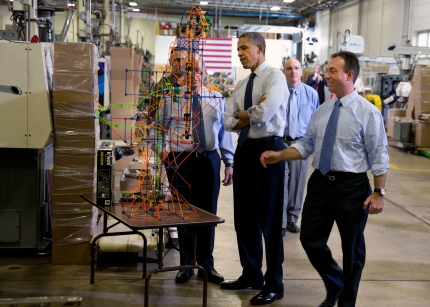
President Barack Obama examines a K'NEX rollercoaster

President Barack Obama examines a K'NEX rollercoaster with Michael Araten, President and CEO of K'NEX and Rodon Group, right, during a tour of the company in Hatfield, Pa., Nov. 30, 2012. (Official White House Photo by Chuck Kennedy)

Today, President Obama spoke at a toy factory in Hatfield, Pennsylvania about extending tax cuts for middle-class families.

The Rodon Group, a third-generation family owned business, manufactures Tinkertoy and K’NEX building sets. The company depends on the many Americans who buy gifts for family and friends during the holiday season.

But, if Congress doesn’t act before the end of the year, every family in America will see their income taxes automatically go up on January 1, President Obama said.

 A typical middle-class family of four would see their income taxes go up by about $2,200. That’s for a typical family -- it would be more for some folks. That’s money a lot of families just can’t afford to lose. That’s less money to buy gas, less money to buy groceries. In some cases, it means tougher choices between paying the rent and saving for college. It means less money to buy more K’NEX.

“And when folks are buying fewer clothes, or cars, or toys, that’s not good for our businesses; it’s not good for our economy; it’s not good for employment,” President Obama explained.

The White House

Office of the Press Secretary

Remarks by the President in Visit to Rodon Group Manufacturing Facility


Hatfield, Pennsylvania
 
 
12:01 P.M. EST
 
THE PRESIDENT:  Hello, everybody!  Thank you.  Thank you.  (Applause.)  Well, good morning, everybody.
 
AUDIENCE:  Good morning!
 
THE PRESIDENT:  Everybody, please, please have a seat.  Have a seat.  Relax for a second.  (Laughter.)  
 
It is good to see all of you.  Hello, Hatfield!  (Applause.) It is good to be back in Pennsylvania.  And it is good to be right here at K’NEX.  (Applause.)  I want to thank Michael Araten, Robert Glickman, and the inventor of K’NEX, Joel Glickman, for hosting me today and giving me a great tour.  (Applause.)  Where did they go?  Where did they go?  I want to -- (applause) -- stand up.  Stand up so everybody can see you guys. There they are.  (Applause.)  There you go. 
 
And I just noticed, we’ve got a couple of outstanding members of Congress here.  We’ve got Chaka Fattah -- (applause) 
-- and Allyson Schwartz.  (Applause.)    
 
Now, I just finished getting a tour of the K’NEX workshop.  I have to say, it makes me wish that Joel had invented this stuff a little sooner, when I was a kid.  (Laughter.)  Back then, you couldn’t really build a rollercoaster out of your Erector Set.  (Laughter.)  
 
And I also got a chance to meet some of the folks who have been working around the clock to keep up with the Christmas rush, and that’s a good thing.  These guys are Santa’s extra elves here.  They manufacture almost 3,000 K’NEX pieces every minute.  And every box that ends up on store shelves in 30 countries is stamped “Made in America.”  And that’s something to be proud of. That’s something to be proud of.  (Applause.)    
 
By the way, I hope the camera folks had a chance to take a look at some of the K’NEX, including that flag made out of K’NEX. And Joe Biden was in Costco; he wanted to buy some of this stuff. (Laughter.)  But I told him he had too much work to do.  I wasn’t going to have him building rollercoasters all day long.  (Laughter.)  
 
Now, of course, Santa delivers everywhere.  I’ve been keeping my own naughty-and-nice list for Washington.  So you should keep your eye on who gets some K’NEX this year.  (Laughter.)  There are going to be some members of Congress who get them, and some who don't.  (Laughter and applause.)  
 
So, look, this is a wonderful time of year.  It’s been a few weeks since a long election finally came to an end.  And obviously, I couldn’t be more honored to be back in the White House.  But I’m already missing the time that I spent on the campaign visiting towns like this and talking to folks like you.
 
AUDIENCE MEMBER:  We love you!
 
THE PRESIDENT:  I love you back.  That's why I miss you.  (Applause.) 
 
And one of the benefits of traveling and getting out of the White House is it gives you a chance to have a conversation with the American people about what kind of country do we want to be 
–- and what kind of country do we want to leave to our kids.  
 
I believe America only thrives when we have a strong and growing middle class.  And I believe we’re at our best when everybody who works hard has a chance to get ahead.  That's what I believe.  And I know that's what the founders of this company believe as well.  We were talking about these guys' dad, who I understand just passed away at the age of 101.  So these guys have good genes in addition to inventive minds.  And the story of generations starting businesses, hiring folks, making sure that if you work hard, you can get ahead, that's what America is all about.  And that’s at the heart of the plan that I’ve been talking about all year.  
 
I want to reward manufacturers like this one and small businesses that create jobs here in the United States, not overseas.  (Applause.)  And by the way this is a company -- one of the few companies in the toy industry that have aggressively moved jobs back here.  (Applause.)  That's a great story to tell because we’ve got the best workers in the world and the most productive workers in the world, and so we need champions for American industry creating jobs here in the United States. 
 
I want to give more Americans the chance to earn the skills that businesses are looking for right now, and I want to give our children the kind of education they’ll need in the 21st century. I want America to lead the world in research and technology and clean energy.  I want to put people back to work rebuilding our roads and our bridges and our schools.  And I want to do all this while bringing down our deficits in a balanced and responsible way.  (Applause.)
 
Now, on this last point, you’ve probably heard a lot of talk in Washington and in the media about the deadlines that we’re facing on jobs and taxes and investments.  This is not some run-of-the-mill debate.  This isn’t about which political party can come out on top in negotiations.  We’ve got important decisions to make that are going to have a real impact on businesses and families all across the country.  
 
Our ultimate goal, our long-term goal is to get our long-term deficit under control in a way that is balanced and is fair. That would be good for businesses, for our economy, for future generations.  And I believe both parties can -- and will -- work together in the coming weeks to get that done.  We know how that gets done.  We’re going to have to raise a little more revenue.  We’ve got to cut out spending we don’t need, building on the trillion dollars of spending cuts we’ve already made.  And if we combine those two things, we can create a path where America is paying its bills while still being able to make investments in the things we need to grow like education and infrastructure.  So we know how to do that.  
 
But in Washington, nothing is easy, so there is going to be some prolonged negotiations.  And all of us are going to have to get out of our comfort zones to make that happen.  I’m willing to do that, and I’m hopeful that enough members of Congress in both parties are willing to do that as well.  We can solve these problems.  But where the clock is really ticking right now is on middle-class taxes.  At the end of the year, middle-class taxes that are currently in place are set to expire -- middle-class tax cuts that are currently in place are set to expire.  
 
There are two things that can happen.  If Congress does nothing, every family in America will see their income taxes automatically go up on January 1st.  Every family, everybody here, you’ll see your taxes go up on January 1st.  I mean, I’m assuming that doesn’t sound too good to you.
 
AUDIENCE:  No!
 
THE PRESIDENT:  That’s sort of like the lump of coal you get for Christmas.  That’s a Scrooge Christmas.  A typical middle-class family of four would see their income taxes go up by about $2,200.  That’s for a typical family -- it would be more for some folks.  That’s money a lot of families just can’t afford to lose. That’s less money to buy gas, less money to buy groceries.  In some cases, it means tougher choices between paying the rent and saving for college.  It means less money to buy more K’NEX.
 
AUDIENCE:  Booo -- (laughter.)  
 
THE PRESIDENT:  Just the other day, economists said that if income taxes go up on the middle class, people will spend nearly $200 billion less in stores and online.  And when folks are buying fewer clothes, or cars, or toys, that’s not good for our businesses; it’s not good for our economy; it’s not good for employment.  
 
So that’s one path:  Congress does nothing, we don’t deal with this looming tax hike on middle-class families, and starting in January, everybody gets hit with this big tax hike and businesses suddenly see fewer customers, less demand.  The economy, which we’ve been fighting for four years to get out of this incredible economic crisis that we have, it starts stalling again.  So that’s one path.
 
The good news is there’s a second option.  Right now, Congress can pass a law that would prevent a tax hike on the first $250,000 of everybody’s income -- everybody.  So that means 98 percent of Americans, 97 percent of small businesses wouldn’t see their income taxes go up by a single dime -- because 98 percent of Americans make $250,000 a year or less; 97 percent of small businesses make $250,000 a year or less.  So if you say income taxes don’t go up for any income above $250,000, the vast majority of Americans, they don’t see a tax hike.
 
But here’s the thing.  Even the top 2 percent, even folks who make more than $250,000, they’d still keep their tax cut on the first $250,000 of income.  So it would still be better off for them, too, for us to go ahead and get that done.  Families would have a sense of security going into the new year.  Companies like this one would know what to expect in terms of planning for next year and the year after.  That means people's jobs would be secure.  
 
The sooner Congress gets this done, the sooner our economy will get a boost.  And it would then give us in Washington more time to work together on that long-range plan to bring down deficits in a balanced way:  Tax reform, working on entitlements, and asking the wealthiest Americans to pay a little bit more so we can keep investing in things like education and research that make us strong.
 
So those are the choices that we have.  And understand this was a central question in the election -- maybe the central question in the election.  You remember.  We talked about this a lot.  (Laughter.)  It wasn't like this should come as a surprise to anybody.  We had debates about it.  There were a lot of TV commercials about it.  And at the end of the day, a clear majority of Americans -- Democrats, Republicans, independents -- they agreed with a balanced approach to deficit reduction and making sure that middle-class taxes don’t go up.  Folks agreed to that.  
 
Now, the good news is we're starting to see a few Republicans coming around to it, too -- I'm talking about Republicans in Congress.  So the reason I'm here is because I want the American people to urge Congress soon, in the next week, the next two weeks, to begin the work we have by doing what we all agree on.  Both parties agree that we should extend the middle-class tax cuts.  We've got some disagreements about the high-end tax cuts, right?  Republicans don’t want to raise taxes on folks like me; I think I can pay a little bit more to make sure that kids can go to college and we can build roads and invest in NIH so that we're finding cures for Alzheimer's.  And that’s a disagreement that we're going to have and we've got to sort out.
 
But we already all agree, we say, on making sure middle-class taxes don’t go up, so let's get that done.  Let's go ahead and take the fear out for the vast majority of American families so they don’t have to worry about $2,000 coming out of their pockets starting next year.
 
The Senate has already passed a bill to keep income taxes from going up on middle-class families.  That’s already passed the Senate.  Your member of Congress like Allyson and Chaka, other Democrats in the House, they're ready to go.  They're ready to vote on that same thing.  And if we can just get a few House Republicans on board, we can pass the bill in the House.  It will land on my desk, and I am ready -- I've got a bunch of pens ready to sign this bill.  (Laughter.)  I’m ready to sign it.  (Applause.)  There are no shortage of pens in the White House.  (Laughter.)  And I carry one around for an emergency just in case, just waiting for the chance to use it to sign this bill to make sure people's taxes don’t go up.  
 
AUDIENCE MEMBER:  Thank you!
 
THE PRESIDENT:  Well, don’t thank me yet, because I haven't signed it.  (Laughter.)  I need some help from Congress.  
 
So the key is, though, that the American people have to be involved.  It's not going to be enough for me to just do this on my own.  So I'm hopeful that both sides are going to come together and do the right thing, but we all know you can't take anything for granted when it comes to Washington.  Let's face it. And that’s why I'm going to be asking for all of you to make your voices heard over the next few days and the next couple of weeks.
 
I need you to remind members of Congress -- Democrats and Republicans -- to not get bogged down in a bunch of partisan bickering, but let's go ahead and focus on the people who sent us to Washington and make sure that we're doing the right thing by them.
 
So I want you to call, I want you to send an email, post on their Facebook wall.  If you tweet, then use a hashtag we're calling "My2K."  Not Y2K, “My2K,” all right?  Because it’s about your “2K” in your pocket.  (Laughter.)  We’re trying to burn that into people’s minds here.  (Applause.)
 
So in the meantime I’m doing my part.  I’m meeting with every constituency group out there.  We’re talking to CEOs.  We’re talking to labor groups.  We’re talking to civic groups. I’m talking to media outlets, just explaining to the American people this is not that complicated.  Let’s make sure that middle-class taxes don’t go up.  Let’s get that done in the next couple of weeks.  
 
Let’s also work together on a fair and balanced, responsible plan so that we are paying our bills -- we’re not spending on things we don’t need, but we are still spending on the things that make us grow.  That’s the kind of fair, balanced, responsible plan that I talked about during the campaign, and that’s what the majority of Americans believe in.
 
So I’m hopeful, but I’m going to need folks like you, the people here in Hatfield and here in Pennsylvania and all across the country, to get this done.  And a lot is riding on this debate.  This is too important to our economy, it’s too important for our families to not get it done.  And it’s not acceptable to me, and I don’t think it’s acceptable to you, for just a handful of Republicans in Congress to hold middle-class tax cuts hostage simply because they don’t want tax rates on upper-income folks to go up.  All right?  That doesn’t make sense.  (Applause.)
 
If your voices are heard, then we can help businesses like this one.  We’re going to sell a whole bunch of K’NEX.  (Laughter and applause.)  Let’s give families all across America the kind of security and certainty that they deserve during the holiday season.  Let’s keep our economy on the right track.  Let’s stand up for the American belief that each of us have our own dreams and aspirations, but we’re also in this together, and we can work together in a responsible way; that we’re one people, and we’re one nation.  
 
That’s what this country is about.  That’s what all of you deserve.  That’s what I’m fighting for every single day, and I will keep fighting for as long as I have the privilege of being your President.
 
Thank you very much, everybody.  (Applause.)  God bless you.  God bless the America.  (Applause.)  


END
12:19 P.M. EST

West Wing Week: 11/30/12 or "#My2k, Tweet it!"

Welcome to the West Wing Week, your guide to everything that's happening at 1600 Pennsylvania Ave. This week, the National Christmas Tree arrived at the White House and holiday decorating got underway, while the President marked Small Business Saturday, and met with leaders of businesses large and small to discuss the importance of avoiding a middle class tax hike next year. He also welcomed the President-Elect of Mexico, his Cabinet, his science and technology council, and the 2012 American Nobel Laureates.