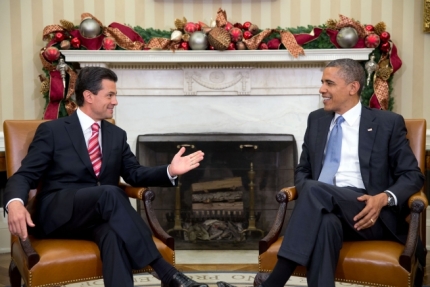
President Obama Welcomes Mexico President-Elect Enrique Peña Nieto

President Obama meets with President-elect Enrique Peña Nieto (November 27, 2012)

President Barack Obama meets with President-elect Enrique Peña Nieto of Mexico in the Oval Office, Nov. 27, 2012. (Official White House Photo by Pete Souza)

This afternoon, President Obama welcomed Enrique Peña Nieto, the President-elect of Mexico, to the Oval Office.

By long-standing tradition, newly elected Mexican presidents hold early meetings with the United States, in part because it symbolizes the close relationship between our two countries.

And President-elect Peña Nieto is himself no stranger to the United States, having spent a year in Maine as a student.

"But I think that’s representative of the strength of the relationship between the United States and Mexico," President Obama said. "It’s not just a matter of policy, but it’s a matter of people, as represented by the many U.S. citizens who travel to Mexico, who live in Mexico, and obviously the incredible contribution that Mexican Americans make to our economy, our society, and to our politics."

President Obama noted that President-elect Peña Nieto's reform agenda is one that Americans will watch closely -- as what happens in Mexico affects our society as well.

President Obama and President-elect Enrique Peña Nieto of Mexico

November 27, 2012 | 16:41 | Public Domain

President Barack Obama welcomes President-elect Enrique Peña Nieto of Mexico to the White House to mark his election.

Download mp4 (617MB) | mp3 (40MB)

The White House

Office of the Press Secretary

Press Briefing by Press Secretary Jay Carney, 11/27/2012


James S. Brady Press Briefing Room
 
 
12:52 P.M. EST
 
 
MR. CARNEY:  Good afternoon, ladies and gentlemen.  Welcome to the James S. Brady White House Briefing Room for your daily briefing.  I know we have some visitors I believe from the United Arab Emirates.  I want to welcome you here and thank you for being here.
 
I have just a couple of things I want to announce at the top, some of which you know about, others you may not.  Today, as I think you know, the President is meeting with small business owners.  Also today -- let me just back up --
 
Q    Right now?
 
MR. CARNEY:  He's meeting with -- it is not happening right now.  I believe it -- at 2:30 p.m., I'm reliably informed.  He'll be meeting with small business owners as part of discussing with them the importance of extending tax cuts for the middle class, for 98 percent of American taxpayers, because of the impact that raising taxes on 98 percent would have on businesses around the country.  He will also discuss with them the measures that he has put forward to assist small businesses, including hiring tax credits and the like that will help the engine of our economic growth to continue to produce jobs and increase our -- grow our economy.
 
Also this afternoon, senior staff, including Jack Lew, Valerie Jarrett, Gene Sperling, Jeff Zients, Bruce Reed, also Secretary Geithner, will meet with leaders of Fix the Debt -- that includes Maya MacGuineas and Erskine Bowles.  Tomorrow the President will have an event with middle-class Americans, again, to talk about and highlight the importance of extending tax cuts to the middle class, to 98 percent of American taxpayers and 97 percent of small businesses.  
 
This is vital.  It is something that everyone in Washington agrees must be done, and it is something that the House of Representatives could do today or tomorrow, if they so chose, because the Senate has already passed the bill that extends those tax cuts.  If the House were to pass them, the President would sign it right away, and that would create certainty for 98 percent of American taxpayers -- middle-class families around the country, 97 percent of America's small businesses, and would go a long way, or a significant way, towards dealing with the so-called fiscal cliff.
 
Also tomorrow, the President has another meeting with business leaders, following on the one he has prior to the Thanksgiving holiday.  And Friday, as I think you know, he'll be traveling to Montgomery County, Pennsylvania, to visit a business, again, to talk about the need to extend these middle-class tax cuts because businesses around the country depend on America's middle class to buy their products.  And as I think Alan Krueger effectively outlined yesterday, and that I think you read about in the report that he co-produced, the impact of raising taxes on the middle class would be significant to our economy.
 
With that, I'll take your questions.  Ben.
 
Q    Thank you.
 
MR. CARNEY:  Each encounter will be bitter-sweet from now to the end, Ben.  
 
Q    I appreciate that.  Bill Plante outlasts another one of us.  (Laughter.) 
 
Q    Is that a compliment?  (Laughter.) 
 
MR. CARNEY:  Does everyone know that Ben is leaving?  Very sad.
 
Q    Thanks, Jay.  Two questions on fiscal cliff first.  Senator Durbin said today in a speech that progressives ought to talk about viability of Medicare and Medicaid, but that "those conversations should not be part of a plan to avert the fiscal cliff."  Doesn’t that complicate the President's position here?  He himself has talked about balance.  He's talked about the willingness to put entitlements on the table as part of a broad package.  And now he's got a leader from his own flank saying that that shouldn’t be part of the discussion.
 
MR. CARNEY:  Well, I haven’t seen those comments from Senator Durbin.  I think it is certainly the case that there are two distinct issues here that are related, which is the fiscal cliff, the deadlines essentially that we have in place that if action isn’t taken will result in significant tax hikes on the one hand and across-the-board spending cuts on the other.  That's the fiscal cliff.
 
The other challenge is one that we've been dealing with for a long time now, which is the need to come to an agreement on a broad, balanced, and comprehensive plan to reduce our deficits and debt, and put us on a sustainable path economically, in a way that protects the middle class, protects seniors and other vulnerable Americans, and continues to invest in our economy so that it can grow and create jobs.
 
The President's belief is that we can address both of these in a broad deficit reduction package.  But there's no question that they are in many ways distinct.  That's why when we talk about an immediate action, a distinct, discreet action that Congress could take if the House of Representatives -- if Republicans in the House of Representatives would agree to it, is to pass the tax cut, extending the so-called Bush-era tax cuts for 98 percent of the American people -- let's do that right now. That's obviously not as comprehensive solution, but it is a significant step towards a solution to the fiscal cliff.  Let's get that done.  
 
Everyone in Washington, I daresay the vast majority of the American people, agree with the proposition that we should extend tax cuts to 98 percent of taxpayers, and we should not hold those tax cuts hostage to an insistence that millionaires and billionaires, the top 2 percent of America's taxpayers, have to have a tax cut, too.  Because, as you know, over the past dozen years or so, that segment of the American populace has done very well at a time when the middle class has been squeezed.
 
So I don't see a contradiction here.  I see distinct challenges that are related.  And the President is very committed to the proposition that we can deal with these challenges if we come together and adopt a balanced approach.
 
Q    A quick follow on that, and then I have a last question.  Every signal we've gotten from the Hill, including out there on the driveway after the last meeting with the President, and also from what you just said, is that essentially the fiscal cliff and a longer-term package on debt and tax reform are combined.  They all have to -- they're all going to happen at once.  So when someone like Durbin says, yes, deal with the fiscal cliff but not entitlements, doesn’t the President at some point have to win over members of his party to say, call it what you want, but we're doing this and they are on the table?
 
MR. CARNEY:  Well, again, it's hard for me to specifically respond to questions about the comments that Senator Durbin made according to you.  I can simply say that it is the President's position that when we're talking about a broad, balanced approach to dealing with our fiscal challenges, that that includes dealing with entitlements.  And the President's budget, as you know, includes $340 billion in savings from our entitlement health care program.  So he has demonstrated yet again his commitment to the principle that we need to include as part of our balance approach savings from entitlements.
 
But in order to be balanced -- because there's never been a debate about that -- Republicans on Capitol Hill have been very focused on trying to extract savings from entitlement programs while insisting that millionaires and billionaires need not just the tax cuts that they already have but extended tax cuts -- the President has long insisted that as part of the three legs of the stool that we talked about yesterday, revenue has to be part of that.  And one of the positive developments in the post-election period has been signs of acknowledgment among Republicans that revenue has to be part of this discussion.  And the President welcomes that.
 
Q    Thanks.  On the question of Susan Rice, she's been meeting, as you know, with Senators on the Hill to come to some better meeting of the minds about Benghazi and her public comments on that.  Leading critics have come out, including Senator Graham, and said afterwards that they're even more disturbed.  They have more questions now than they did before.  I'm wondering what your reaction is to that and whether this outreach effort to the Hill is amounting to anything.
 
MR. CARNEY:  Well, I'd say two things.  First of all, Ambassador Rice has put out a statement; I would refer you to that.  Secondly, I would simply say there are no unanswered questions about Ambassador Rice's appearance on Sunday shows and the talking points that she used for those appearances that were provided by the intelligence community.  Those questions have been answered.  The questions that remain to be answered and that the President insists are answered have to do with what happened in Benghazi, who was responsible for the deaths of four Americans including our Ambassador, and what steps we need to take to ensure that something like that does not happen again. 
 
These are distinct issues.  As the President made clear, Ambassador Rice has no responsibility for collecting, analyzing and providing intelligence.  Nor does she have responsibility, as the United States Ambassador to the United Nations, for diplomatic security around the globe.  The focus on -- some might say obsession on -- comments made on Sunday shows seems to me, and to many, to be misplaced.  
 
I think, again, I would refer you to Ambassador Rice's statement where she discusses the meeting she had today with Senators McCain, Graham, and Ayotte from New Hampshire with
Acting CIA Director Michael Morell to go over exactly the very questions that those senators had and the very clear facts about what information she was using -- where it came from, the fact that all of us who had to answer questions about the events in Benghazi were provided the same information.  And that information was based on the best assessments of our intelligence community at the time.  It also included caveats that those assessments would evolve as more information was collected. 
 
We need to focus on -- as the President has said -- bringing to justice those who killed four Americans, taking steps to ensure that our embassies and diplomatic facilities are secure and that nothing like what happened in Benghazi happens again.  
 
I’d like to move it around a little bit.  I know yesterday I spent a great deal of time on the front row.  But I will come back to the front row. 
 
Yes, Sheryl.  
 
Q    Can you confirm that Secretary Geithner is really leading these negotiations on the fiscal cliff?  And how much leeway does he have to come up with a solution?
 
MR. CARNEY:  I can confirm that Secretary Geithner is -- as he has always been -- a leading participant in negotiations like these.  He will play a leading role in discussions with Congress on this matter.  And he will be working with Jack Lew, the Chief of Staff; Gene Sperling, the Director of the NEC; Ron Nabors, our congressional liaison, and others in that effort.  Ultimately, the leader is the President of the United States, and this is his team.  And I know that other members will be working -- other members of his team will be working on this issue.
 
But Secretary Geithner obviously has a very important role to play here and will be working with others to help bring about that broad agreement that the President seeks.  
 
Q    You didn't answer her question.  Is he the lead of it?
 
MR. CARNEY:  Well, he is the lead in the sense that -- 
 
Q    -- in discussions with negotiators.
 
MR. CARNEY:  -- in terms of discussions with Congress.  But he is not alone.  We would not send him out alone to the Hill.  So I think we have a very strong team of people who have a great deal of knowledge and experience on this issue, and that includes Secretary Geithner, but also many others. 
 
Reuters.  
 
Q    Back on the Susan Rice issue, her critics -- Senator McCain among them -- are not backing off.  And they are threatening to block her nomination if the President were to choose her for Secretary of State or any other Cabinet position that would require a confirmation.  And although I'm sure you're not going to be giving us a short list on who's being considered, can you give us a sense of the timeline of what the President is looking at for choosing a new secretary -- successor to Secretary Clinton?  When is she expected -- will she stay on through the Inauguration?  And at what point would the President be hoping to make a nomination?
 
MR. CARNEY:  I don't have any information for you on timelines or short lists or nominees -- potential or otherwise.  Secretary Clinton, I think has addressed her plans in terms of how long she'll stay.  So I would refer you to her comments. 
 
As I said yesterday, the fact of the matter is that Ambassador Rice is enormously qualified for the position she holds and for the position -- for a variety of positions in the foreign policy field if the President were to decide to nominate her for another position.  And I'm simply quoting the President from his press conference. 
 
Q    A while ago, you gave a comprehensive list of everything the President is doing this week, who he's meeting with, but nowhere there does it mention the President will be meeting with anyone from any of the congressional leadership.  Can we expect that there will be a meeting sometime this week?  And is the President holding these phone conversations behind the scenes with any of the leadership?
 
MR. CARNEY:  Well, I can't remember if you were yesterday, but I did confirm that the President spoke with the Speaker of the House as well as the Senate Majority Leader over the weekend. He will continue to have discussions with those two leaders as well as Leader Pelosi and Senator McConnell in the days and weeks coming forward.  I don't have a schedule for those conversations to provide to you, but he will speak with them and meet with them as appropriate. 
 
He has -- as we just discussed -- designated a team to engage with conference in these negotiations.  And those conversations are taking place.  But he will continue to both engage with congressional leaders as well as business leaders, labor leaders, civic leaders, middle-class Americans as this process continues.  
 
One thing we talked about yesterday that I think is very important and it reflects some of his schedule this week is that it is vitally important that ordinary Americans actively engage in this debate, because the outcome of these negotiations and the hopeful product of these negotiations or the product that we hope emerges from these negotiations will profoundly affect their lives.  That includes making sure that middle-class Americans don't see their taxes go up on average by $2,200 next year, which would be the result if Republicans insist on holding those tax cuts hostage to their insistence that those making more than $250,000 -- the top 2 percent of American earners -- get a tax cut that we cannot afford and which is not economically -- as economically useful as tax cuts for the middle class. 
 
So the President will engage across the board, not just with congressional leaders but with a broad array of people from different communities who have a great stake in the outcome of these negotiations. 
 
Q    And so will the team led by Secretary Geithner will be doing the heavy lifting, and then the President steps in if things aren't going well?  Or will -- 
 
MR. CARNEY:  Again, I think that the President is actively engaged in the numerous ways that I've already described in the meetings that he's already had and obviously in meetings with his team.  So he is doing some heavy lifting himself and will continue to do that.  
 
This is a team effort, however, and when it comes to discussions happening with both members of staff and members of Congress up on Capitol Hill, the President has asked Secretary Geithner and others to engage in that process.  
 
Q    You probably heard Senator Mitch McConnell yesterday criticizing the President, calling for leadership on this issue. And specifically today, he went after the President on the trip that he's taking to Pennsylvania on Friday.  And he said, rather than sitting down with lawmakers of both parties and working out an agreement, he's back on the campaign trail presumably with the same old talking points that we are all quite familiar with.  I just wanted to get your reaction to this criticism from --
 
MR. CARNEY:  Well, the President believes very strongly that the American people matter in this debate, because this debate is about them.  The question of whether or not taxes go up on 98 percent of American taxpayers is very important to ordinary Americans.  It is not just a matter for discussion between the President and the Senate Minority Leader or other congressional leaders.  It is simply a fact that in the recently concluded campaign this topic was perhaps the most debated, the most discussed, the most analyzed for a year.  
 
And I think the election was pretty conclusive in terms of which path a majority of the American people want to take, which is -- when it comes to dealing with our fiscal challenges and dealing with the fiscal cliff.  And that is a balanced approach, one that includes not just spending cuts, not just entitlement reforms and savings, but revenue.  I think the data that we’ve all seen could not be more conclusive.
 
So the President will continue to engage with the American people on this subject because we are all here -- those of us in the administration and those who have been elected to Congress -- to serve the American people.  So to suggest that we should -- now that the election is over -- stop talking to them about these vital issues I think is bad advice.
 
Q    One final question on Ambassador Rice.  Beyond the President's feelings for her and how she conducted herself after the Benghazi attacks, what does he think about this whole back-and-forth about something that's a hypothetical nomination at this point?
 
MR. CARNEY:  The President addressed this in his press conference I think quite well, and I can’t improve upon that.
 
Q    I think he spoke about her and the good work that she has done.
 
MR. CARNEY:  And I think he spoke very clearly that -- about the prospect of proposing her for a different position if he so desires.  So I would refer you to his comments on that.
 
Q    Right, but it’s not about that.  Just the whole theater surrounding the back-and-forth about someone who hasn't even --
 
MR. CARNEY:  I think he believes, as he said, that the focus on Ambassador Rice’s comments on some Sunday shows -- now, I know that Sunday shows have vaunted status in Washington -- but they have almost nothing to do, in fact, zero to do with what happened in Benghazi.  And certainly Ambassador Rice, as I made clear moments ago, has no responsibility for providing intelligence -- that is the intelligence community’s responsibility.  And she, the United States Ambassador to the United Nations, does not, as part of her portfolio, have responsibility for diplomatic security around the world.
 
So, thank you for that.  She is a principal on the President's foreign policy team.  And it is convenient I think for a lot of people, especially from -- well, I won’t say that -- but it is convenient for some to forget the context in which Ambassador Rice appeared on those Sunday shows, which was a period in which there were threats to embassy facilities around the region and the country and the globe.  And it was entirely appropriate for Ambassador Rice to appear on the air, to take questions about the President’s approach to and policy towards the unrest that was occurring as a result of -- largely as a result of the video that -- 
 
Q    Wouldn’t it have been more appropriate for Secretary Clinton or for Tom Donilon or -- 
 
MR. CARNEY:  There are many able members --
 
Q    I mean, this is somebody from the United Nations.
 
MR. CARNEY:  Right, and she is one of the President’s -- 
 
Q    -- a little bit of a one-off at the time.
 
MR. CARNEY:  Can I just say, Chuck, that this is -- what is the point of the focus on this?  It could have been me.  It could have been Ambassador Rice.  I mean, I took questions on this, too, and we all relied on information from the intelligence community, which the IC has made clear was based on initial assessments and made clear at the time with caveats that those assessments would change as more information was collected.
 
So, again, the focus on a Sunday show appearance is entirely misplaced, and it represents less interest I think in what happened in Benghazi than in political dynamics in Washington.
 
James.
 
Q    I wanted to follow up on both of the areas we’ve been talking about.  First, since we’re on it, Ambassador Rice in the statement that she released today and to which you have referred us, she says something which marks the first time that she has said this, which is, and I quote, “In the course of the meeting, we explained that the talking points provided by the intelligence community and the initial assessment upon which they were based were incorrect in a key respect.  There was no protest or demonstration in Benghazi.”
 
And yet, references to this protest that never occurred and these demonstrations that never occurred in Benghazi were a staple of President Obama’s pronouncements about Benghazi for all the way on through September 25 at the United Nations.  Why?
 
MR. CARNEY:  James, I appreciate the question and there have been some very interesting answers to these questions of late, but I would make the point that, as Ambassador Rice makes clear in this statement, that those initial assessments were wrong in one key respect.  There was no protest outside the Benghazi facility.  To this day, it is the assessment of this administration and of our intelligence community and certainly the assessment of your colleagues and the press who have interviewed participants on the ground in the assault on our facilities in Benghazi that they acted at least in part in response to what they saw happening in Cairo and took advantage of that situation.
 
They saw what was the breach of our embassy in Cairo and decided to act in Benghazi.  And as you know, the breach of our embassy in Cairo was directly in response to the video and was started as a protest outside of our embassy in Cairo.  Again, what your question seems to suggest is that it is more important that I or others used talking points provided by the intelligence community than actually what happened in Benghazi.
 
Q    No, that’s not a supposition of my question, and --
 
MR. CARNEY:  No, but it is a supposition of many folks out there who have focused on this for what appear to be political reasons when the issue that matters is what happened to those four Americans and who was responsible and what can we do to make sure it doesn’t happen again.  And nothing that occurred on a Sunday show, nothing that I said or others said based on assessments by the intelligence community relates to our need to find out who was responsible, as the President has made clear he wants to do and insists we do, and making sure that we take action to ensure that it doesn’t happen again.
 
Q    I’m sure you would agree it’s reasonable for members of the news media and members of the public to ask questions about the public statements of their top elected officials and his aides in the aftermath of an event like this.
 
MR. CARNEY:  No question.
 
Q    So that’s why people are asking about it.  I’m sure some have political motives, but you don’t have to impugn the motives of the questioner when we ask those questions.  
 
My other point I wanted to raise with you on Ambassador Rice, and then I want to move to fiscal cliff, is the presence of the acting CIA Director in this meeting.  Whose idea was that?
 
MR. CARNEY:  I’m not sure whose idea it was.  The fundamental issue here, unless this is all about politics, is what information was Ambassador Rice provided, and by whom, and what was it based on when she went out on television to take questions about what happened in Benghazi, and what was happening around the region and the world.  Because the talking points that she relied on and others relied on were provided by the intelligence community, I think it’s entirely appropriate that the Acting Director of the CIA participate in these meetings.  
 
It has been repeatedly said by some of the critics on this issue on the Hill that the White House provided talking points.  That has been categorically refuted not just by us, but by the intelligence community and yet it’s still periodically said on the air.  And it’s just wrong.  And I think it is more -- again, more evidence to the fact that people are more interested in talking points for a Sunday show of several months ago than they are in finding out what happened in Benghazi, bringing to justice who was responsible, and ensuring that we take action that prevents something like that happening again. 
 
Q    Last question, this is on the fiscal cliff.  You have the President hopping on Air Force One this week and going outside the Philadelphia area to rally public support for his position on the fiscal cliff.  We have Speaker Boehner announcing today that in the coming days and weeks Republican members will hold events and visit local small businesses.  You were in a position just now when Dan asked about this to provide no details about any upcoming meetings with the leadership.  If we look back to November 16 when the leaders were here, Minority Leader Pelosi spoke about projecting confidence to consumers and the markets in the short term by having on the President’s desk a blueprint for action by the week after Thanksgiving and potentially something for him to sign by Christmas.  None of that appears to be in the cards, and as we see the President now getting on his airplane and the members drumming up going over the -- it seems like they’ve abandoned each other, and what I’m saying is it seems like these talks have effectively broken down.  Am I wrong about that?
 
MR. CARNEY:  I think you’re wrong.  Again, the President spoke with Speaker of the House Boehner and Senate Majority Leader Reid over the weekend.  Our team is continuing discussions with their congressional counterparts on this matter and it is entirely appropriate, I would say, both for the President and for leaders in Congress, to have this discussion not just among themselves, but with the American people.  And that’s what the President is doing.  That’s why he’s meeting with business leaders -- I assume you wouldn’t -- or critics would not suggest that as a mistake -- or meeting with civic leaders or labor leaders, because everyone the President is meeting with has both I think useful ideas and a substantial stake in the outcome of these negotiations because it is vitally important that we take action to ensure that, for example, middle-class Americans don't see their taxes go up by an average of $2,200 next year.
 
There’s no reason for that to happen because as you know Democrats and Republicans alike believe those tax rates should not go up.  So let’s act on what we agree on.  Let’s demonstrate to the American people that Washington can function; that when everyone agrees on something, we can actually act on it; and then continue to debate whether or not it is the right policy to extend low tax rates for those making more than $250,000 and millionaires and billionaires who make substantially more than that.
 
Q    So why not stay in town and just hammer it out and get a deal done?  Why is everyone jumping on their airplane for photo ops outside the Beltway?
 
MR. CARNEY:  Well, again, that I find disparaging when you suggest that talking to the American people about their --
 
Q    Didn't they speak in this election?  Didn't we hear from them?  Didn't they -- 
 
MR. CARNEY:  The conversation continues, James.  I mean I think it’s very important to continue that conversation with the American people both for the President and for members of Congress, and it’s important to continue that conversation with business leaders and with small business leaders and with civic leaders and labor leaders because everybody has a stake in this; and with ordinary middle-class Americans, with whom the President will be meeting tomorrow.  
 
So it certainly doesn't prevent and won’t prevent work continuing to be done on the various ideas that people have about how to bring about the policy that we need to ensure that we don't go off the fiscal cliff, and more broadly that we deal with our fiscal challenges.
 
Q    But, Jay, isn’t everybody just killing time --
 
MR. CARNEY:  No.
 
Q    -- until the deadline comes?  I mean it just seems like everybody is just --
 
MR. CARNEY:  It doesn't feel like killing time to me, Chuck.
 
Q    Everybody is just killing time until the final week -- and the jet fumes from National Airport.  (Laughter.)  People get out of school, and the holidays come, and then everybody will actually sit down and hammer this out.
 
MR. CARNEY:  Well, look, here’s a fact, the President has on the table a proposal that reduces the deficit by $4 trillion; that does it -- does so in balanced way; that includes substantial cuts to discretionary nondefense spending -- over $1 trillion; that includes revenue and includes $340 billion in savings from our health care entitlement programs.  That is substance.  So he has not waited for people to start smelling the jet fumes at National Airport.  He has actively put forward a plan that --
 
Q    Is Geithner at Boehner’s office today?
 
MR. CARNEY:  I don't know of Secretary Geithner’s precise whereabouts, but I can -- at this moment.  He was here earlier this morning.  I can tell you that members of the President’s team are continuing to work on this issue as are members of Congress’s team and the congressional leaders’ team.  So it does not I think make a lot of sense to simply say, never mind, the American people and business leaders and small business leaders and civic leaders and labor -- cut them out of the process and stop the conversation with them.  The President thinks that's a big mistake.
 
Julianna.
 
Q    Wouldn’t it send a signal to the American people and to markets that -- to see the President meeting here with congressional leadership?  That would be a signal that Washington can function.
 
MR. CARNEY:  The signal that Washington can function is the result.  Only inside the Beltway do people think that sitting in a room for a photo spray will solve, necessarily, problems.  The work has to be done, and that work is being done.  And everybody needs, as the President said, to agree to the principle that compromise will require tough choices by each side.  And the President is willing to do that and has demonstrated his willingness to do that.
 
I would remind you that when it comes to entitlement reform savings that Republicans spent two election cycles, hundreds of millions of dollars beating the stuffing out of Democrats and the President for the $716 billion in savings that was achieved out of health care entitlements through the Affordable Care Act; savings which contribute to the fact, as the Congressional Budget Office, has made clear and independent economists have made clear that the Affordable Care Act reduces the deficit in the first decade and reduces it by more than $1 trillion in the second decade.  So beyond the President has put forward in his budget an additional $340 billion in savings from health care programs.
 
So let’s then back up and say who is serious?  Who has been -- who has demonstrated his willingness to make tough choices and suffer the consequences politically of doing so because they're the right things to do for the economy?
 
Q    So you think if there had been progress since that November 16th meeting, there wouldn’t be a meeting -- another meeting this week, the following -- 
 
MR. CARNEY:  I haven’t said there won’t be a meeting this week.  I said I don't have a scheduling update for you.
 
Q    So there is still the possibility of a meeting this week with the President and the congressional --
 
MR. CARNEY:  I think -- I just don't have a scheduling update for you.
 
Q    Just to change subject to the drought in the Midwest, the governors of Missouri, Illinois, Iowa and 15 senators and 62 members of the House have sent a letter to the administration calling attention to low water levels in the Mississippi River, and that's threatening $7 billion worth of commercial traffic.  And they're requesting a presidential declaration of emergency to allow the Army Corps of Engineers to begin work on a project that would immediately help raise the water levels of the Mississippi. What kind of consideration is the White House giving to that request?
 
MR. CARNEY:  Well, first of all, I’d tell you that President Obama has been committed to ensuring that his administration takes every step possible to help farmers and ranchers affected by this disaster, the drought that you referred to.  
 
And as you know, the administration has taken a variety of actions to that end.  The President has also been clear that Congress must pass a comprehensive, multi-year farm bill that no longer -- or rather that not only provides much needed disaster assistance, but gives farmers and ranchers the certainty they deserve while enacting critical reforms.
 
With regards to the specific request, I would refer you to the Army Corps.
 
Q    But it’s a request for a presidential declaration.
 
MR. CARNEY:  I don't have anything for you on that.  I think the Army Corps is the place to go.
 
Q    Don't you think that if anything were being done that you’d want to let us know given the fact that we’re all sitting here saying, doesn't look like anything is being done?  You say work is being done, but there are no meetings scheduled. There’s nothing to signal to the public, never mind us, that there’s actual progress being made.  And you still have Democrats suggesting that it wouldn’t be a bad idea if we went over for a day or a week or so.  
 
MR. CARNEY:  Well, Bill, I would point to comments by members of both parties that demonstrate I think significant movement towards compromise; that, as we’ve seen and as you and others I’m sure have reported on, demonstrated change in tone at the very least by some Republicans when it comes to the issue of revenue and the need for balance in a comprehensive package.  And I think that is a sign -- those are signs of progress.  
 
Additionally, there are discussions.  There is work being done.  And the President is continuing to meet with stakeholders and others and will continue to have conversations with congressional leaders on this issue.  It is also the case, as I said yesterday, and I cited Senator Corker on this, that we have spent a great deal of time collectively in Washington dealing with these issues.  There has been an enormous amount of brain power applied to the challenges we face, numerous proposals from a variety of corners.  And there is a growing consensus around the fundamental principle that a comprehensive deficit-reduction plan that continues to help the economy grow and create jobs, that protects middle-class Americans and protects seniors and other vulnerable populations would include cuts to discretionary spending -- non-defense discretionary spending, would include savings from entitlement reforms and include revenue.
 
That basic principle was enshrined in Simpson-Bowles.  It was enshrined in Rivlin-Domenici.  It was in enshrined in basically every credible bipartisan attempt at this, so --
 
Q    All of those were ignored.
 
MR. CARNEY:  Well, no, in fact, the President’s proposals have always been modeled on that principle, and so have Senate bipartisan proposals and others.  So we know what needs to be done.  We’re not diving into this either here or on Capitol Hill for the first time.
 
The contours and parameter and even the specifics of what a balanced agreement would look like I think are known by all sides.  And the President made clear that he is not wedded to every detail of his plan.  He understands that compromise requires making tough choices, and he welcomes every credible, mathematically sound idea that gets us from here to there. 
 
Q    Where do you see the progress?
 
MR. CARNEY:  Again, I just cited a number of public indications of progress.  And clearly there are discussions that are going on and work that's being done that hopefully will lead to a positive result for the American people. 
 
Q    There was a poll yesterday that suggests that the Republicans would be blamed if we actually went off the cliff by about -- a good majority of Americans.  So that seems to encourage some Democrats at least to suggest it wouldn’t be a bad idea if we did.
 
MR. CARNEY:  Well, but that’s not the President’s position. The President believes that we need to solve the challenges that confront us, and we need to do it in a balanced way.  And the means to get there are very clear to all of us, the how we do it, the policy proposals that are on the table -- have been on the table for a long time or have been evident, at least on the shelf for a long time -- and we ought to take action to do it.  Now is the time to act.
 
Q    A number of the Democrats who are up for reelection in 2014 are from Republican-leaning states.  How might that fact complicate the President’s efforts to build support to raise taxes on the wealthy?
 
MR. CARNEY:  We just had an election -- (laughter) -- and one thing I can tell you with constitutional certainty is that the President doesn’t face another election and that he is very committed to trying to get a bipartisan agreement that is in keeping with his principles.  And that means balance and that means not asking the middle class or seniors or families with disabled children to bear the brunt of deficit reduction.  That’s the antithesis of balance, and that is the essence of the debate that we’ve had over the past year.  
 
So I think the President made clear in his statements and at his press conference after the election that he is hoping that a majority, enough members of Congress of both parties put politics of the kind that you just described aside for a moment and do what’s right for the country.  And he actually believes that that is good politics for everyone.  And he pursue this in that spirit.
 
Mr. Collinson.
 
Q    President Morsi yesterday appeared to have stuck by his emergency declaration after the meeting with the Egyptian judiciary.  Does that deepen the concerns about what’s going on in Egypt that you spoke about yesterday?
 
MR. CARNEY:  Well, we have seen reports regarding the discussions between Egypt’s leaders, elected officials, and members of the judiciary as you mentioned, and are closely following what is obviously a still unfolding political situation.  As we have done since first learning of the recent decisions, we urge an inclusive dialogue between the government of Egypt and all Egyptian stakeholders.
 
As I said yesterday, one of the aspirations of the Egyptian revolution was to ensure that power is not overly concentrated in the hands of any one person or any institution.  The current constitutional impasse is an internal Egyptian situation that can only be resolved by the Egyptian people through peaceful, democratic dialogue and we call on all Egyptians exercising their right to freedom of expression to do so peacefully.
 
We continue to urge the adoption of a constitution that respects fundamental freedoms, individual rights, and the rule of law consistent with Egypt’s international obligations and commitments, and that is written through a consultative, inclusive process.  Democracy depends on strong institutions and on the important checks and balances that provide accountability.
 
Q    This White House and previous White Houses used to call on Mubarak to lift an emergency law, which was temporary, on the last decades.  What’s the difference here?  You said it was an involving situation.  Do you think this is -- got more to play out?  Is there not a danger to this becoming the same thing?
 
MR. CARNEY:  Well, what I would say is that much has changed since Mubarak was in power, as you as well as anyone in this room understands.  And as I tried to express yesterday, we need to step back and look at the transformation that has been occurring in Egypt since the revolution began there.  And we have raised our concerns about the decisions and declarations that were made on November 22.  Secretary Clinton has spoken directly with Foreign Minister Amr.  She did that yesterday to convey U.S. concerns.  And Ambassador Patterson has also been in regular contact on these issues with Egyptian officials.
 
We believe firmly that this has to -- that this needs to be resolved internally as part of a transition to democracy and the building of institutions that create checks and balances in an Egypt that will be -- that will have, as a government, an entity that is more responsive to the will of the people in Egypt and more democratic.  And where we have concerns we raise them, but we also understand that this is an internal Egyptian process.
 
April.
 
Q    Jay, procedurally and qualitatively, can you discuss how this administration views intelligence, information as it first comes to this White House?
 
MR. CARNEY:  I need something more specific than that. 
 
Q    Okay.  A four-star retired general told me in October, he said, normally, when you gather information it’s considered information at the beginning because they know the beginnings of the information is wrong.  So then they try to pull together once it is assessed and all put together and sent to the White House, it is considered intelligence.  So how does this administration view initial information, considered intelligence, presented to them by the CI or whoever?
 
MR. CARNEY:  Well, I’m obviously not going to get too far into the weeds on the process of gathering and assessing intelligence.  
 
Q    Am I correct?  Is that general correct in his assessment?
 
MR. CARNEY:  I will say -- not that, necessarily, initial assessments are wrong, but that initial assessments are initial. And as was the case in Benghazi, I and others made clear that those initial assessments were subject to change as we gathered 
-- as our intelligence community gathered more information.  And we provided clarity as it became available to our picture of what had happened in Benghazi.  
 
But it is certainly the case that initial assessments of an event like -- as what happened in Benghazi are just that and that investigation and further assessments need to be made.  That's why we made clear that the answers that we were giving in the early days after the events in Benghazi were based on initial assessments and incomplete information, and that investigations were continuing and are continuing to this day.  
 
Q    And it took two weeks?
 
MR. CARNEY:  James, I think I've answered your questions on this. 
 
Q    Wait a minute.  You told Dan that the President answered some information at the press conference with reporters. There's been a lot of movement since that press conference, particularly today with Ambassador Rice on the Hill and with the CIA talking about the intelligence issue.  It's countering everything that's been said.  So what say you about the CIA information that they're talking about that's countering what she said and what you guys -- I mean, what's going on?
 
MR. CARNEY:  I would refer you to the DNI and to the CIA about the intelligence assessments that were provided not just to the administration, but to members of Congress in the immediate aftermath and in the days after the attack in Benghazi.  I really think these questions have been answered.
 
And the focus should be on what happened in Benghazi, who is responsible for the deaths of four Americans including a U.S. ambassador, bringing those responsible to justice and taking action to ensure that we have the necessary security at our diplomatic facilities around the globe especially in dangerous areas so that something like this doesn't happen again.  The focus on talking points is misplaced.
 
Q    One more question, one more question.  
 
MR. CARNEY:  I want to give others a chance. 
 
Q    I understand, but this is important.  We talked about issues of faulty intelligence back when we went to war with Iraq. Now, are we still dealing with issues of faulty intelligence?  
 
MR. CARNEY:  Again, April, I think I answered this question. It was clear in what I cited from Ambassador Rice's statement.  One key element of what the intelligence community assessed at the time turned out to not be the case, that there were protests on the site outside the Benghazi facility prior to the attack.  
 
As I made clear and others made clear -- Ambassador Rice made clear -- those initial assessments were just that.  They were initial assessments and they evolved as more information was gathered.  
 
Q    I have a quick question on a fiscal issue, but I want to follow up on April for one quick question.  Can you update us -- you talked about the questions that the President continues to have about the events in Benghazi.  What is the updated status of when he expects to get answers to those questions?
 
MR. CARNEY:  He looks forward to the completion of the investigation by the FBI, as soon as that investigation is complete and conclusive.  He also looks forward to the assessments of the Accountability Review Board, which was put in place by Secretary Clinton at the President's direction to look at the broader issues of security around our diplomatic facilities.  
 
I don't have a timetable for the completion of those investigations.  I would refer you to the FBI or the Department of Justice on the one hand or the State Department on the other. 
 
Q    Okay, just a quick question.  About this time last year, the President took his campaigning or his message about the payroll tax out to the American people.  Can you describe what he learned from that experience that he may be applying to this situation?  Because he came back to deal with House Republicans in a different way after doing that.
 
MR. CARNEY:  The President believes that it is extremely important to speak with the American people about these incredibly important policy decisions that are being made in Washington on behalf of the American people.  There are a few things that affect American families more directly than the prospect of a $2,200 on average tax hike for 98 percent of us beginning on January 1st, if the House of Representatives refuses to extend the tax cuts from the Bush era for the 98 percent and for 97 percent of small businesses.  
 
It's very important to engage.  As we've seen in election cycles and as we've seen in between election cycles, the American people care deeply about policy decisions that are made in Washington by leaders of both parties.  
 
And I think you've heard the President talk about some of the lessons he learned from the early part of his presidency when with the cascading crises that he was confronted with, he was making decision after decision to try to prevent a Great Depression; making decision after decision to deal with our security challenges and two wars in Afghanistan and Iraq, as well as elsewhere; and his feeling that he needs to continue to communicate with the American people about what his vision is, what his policy proposals are, what the nature of the debates is -- the nature of this debate is, in particular -- but all the policy issues that we have.  So you can expect the President to continue to do that going forward, both in the waning weeks and months of his first term and throughout his second term. 
 
Q    The President is going to Pennsylvania, a blue state that he's carried the last two elections.  
 
MR. CARNEY:  This is not about politics, David.  
 
Q    But why not go to a --
 
MR. CARNEY:  It's about a policy debate that's happening in Washington. 
 
Q    You said the conversation -- this conversation about fiscal issues has been had during the months and months of the campaign.  But the President only visited seven to 10 swing states, states that he was really interested in to have this conversation.  Why not go to like a deeply red state right now and make --
 
MR. CARNEY:  Firstly, that's entirely inaccurate.  He visited far more than seven to 10 states.  Secondly -- 
 
Q    Not for rallies. 
 
Q    Why not go and have the conversation with people who might be standing --
 
MR. CARNEY:  -- I recall a very long, detailed and well-received economic policy speech given to many, many people in Kansas, which last I checked was not a blue state.  
 
Q    It wasn't a rally.
 
MR. CARNEY:  Well, how do you define a rally?  There was a huge audience, people cheered.  (Laughter.)  I call that a rally. What you will hear from the President on Friday is -- 
 
Q    -- he going to go again?  Does he plan to?  
 
MR. CARNEY:  I don't have any scheduling updates for you.  The President will travel all around the country in his second term, and looks forward to it, talking about the incredibly important challenges that we face as a country and the decisions that the elected leaders that the American people sent to Washington are making on the American people's behalf.  
 
And he thinks that is absolutely the right thing for him to do.  He believes it's important for members of Congress to do, because I think as we see in people's evaluation in Washington and in particular their assessments of Congress, I don't think there's a lot of faith that a bunch of people sitting around a table in a room are going to solve problems on behalf of the American people if those people aren't communicating; if those sitting around the table aren't also communicating and engaging with the American people to find out what they believe the right answers are. 
 
Thanks very much, guys. 
 
 
END
1:46 P.M. EST

The White House

Office of the Press Secretary

President Obama Announces More Key Administration Posts

WASHINGTON, DC – Today, President Barack Obama announced his intent to appoint the following individuals to key Administration posts:

• Edward S. Itta – Member, Arctic Research Commission
• James J. McCarthy – Member, Arctic Research Commission
• Waded Cruzado – Member, Board for International Food and Agricultural Development
• Brady J. Deaton – Chairman, Board for International Food and Agricultural Development
• Harold L. Martin, Sr. – Member, Board for International Food and Agricultural Development
• Lisa Green Hall – Member, Community Development Advisory Board
• Ed Stockwell  – United States Commissioner, Inter-American Tropical Tuna Commission

President Obama said, “The extraordinary dedication these individuals bring to their new roles will greatly serve the American people.  I am grateful they have agreed to serve in this Administration and I look forward to working with them in the months and years to come.”

President Obama announced his intent to appoint the following individuals to key Administration posts:

Edward S. Itta, Appointee for Member, Arctic Research Commission
Edward S. Itta served as the Mayor of the North Slope Borough of Alaska from 2005 to 2011.  Before serving as mayor, Mr. Itta held a variety of project management and development positions for Arctic Slope World Services and the Arctic Slope Consulting Group from 1998 to 2004, where he was involved in the engineering and coordination of the North Slope Village water and sewer construction program.  Previously, from 1995 to 1998, Mr. Itta served as President of LCMF, Inc., a design and engineering subsidiary of the Barrow Village Corporation.  From 1977 to 1995, Mr. Itta worked for the North Slope Borough, ultimately serving in a number of leadership positions including Chief Administrative Officer, Public Works Director, Planning Director, and Director of Capital Improvement Program Management.  Mr. Itta is currently a member of the Barrow Whaling Captains Association, where he served as President from 1989 to 1990.  He previously served as President of Inuit Circumpolar Council - Alaska, Vice Chairman of the Alaska Eskimo Whaling Commission, and has served on the Board of Directors of Ukpeagvik Inupiat Corporation, the village corporation of Barrow, Alaska.  Mr. Itta was trained as an electronics technician at the Griswold Institute in Cleveland, Ohio, and served in the U.S. Navy from 1966 to 1969.

Dr. James J. McCarthy, Appointee for Member, Arctic Research Commission
Dr. James J. McCarthy is the Alexander Agassiz Professor of Biological Oceanography at Harvard University, having served on the faculty since 1974. From 1982 to 2002, he served as the Director of Harvard University's Museum of Comparative Zoology.  For the past two decades, Dr. McCarthy has worked as an author, a reviewer, and a co-chair with the Nobel Peace Prize winning Intergovernmental Panel on Climate Change. He was the founding editor of Global Biogeochemical Cycles and the first Chair of the International Geosphere - Biosphere governing committee. Dr. McCarthy is an elected fellow of the American Association for the Advancement of Science (AAAS) and served as President of AAAS from 2008 to 2009. In addition, he was a fellow of the American Academy of Arts and Sciences and a Foreign Member of the Royal Swedish Academy of Sciences. Dr. McCarthy received a B.S. in Biology from Gonzaga University and a Ph.D. in Biological Oceanography from Scripps Institution of Oceanography.

Dr. Waded Cruzado, Appointee for Member, Board for International Food and Agricultural Development
Dr. Waded Cruzado is President of Montana State University.  Previously, from 2007 to 2010, she served as Executive Vice President and Provost of New Mexico State University, including a one year appointment as Interim President.  She joined New Mexico State University in 2003, and served as Dean of the College of Arts and Sciences until 2007.  From 1990 to 2002, she held a series of faculty and administrative positions at the University of Puerto Rico at Mayaguez, including her appointment as Dean of the College of Arts and Sciences in 1998.  Dr. Cruzado received a B.A. from the University of Puerto Rico at Mayaguez and an M.A. and Ph.D. from the University of Texas, Arlington.

Dr. Brady J. Deaton, Appointee for Chairman, Board for International Food and Agricultural Development
Dr. Brady J. Deaton is Chancellor of the University of Missouri, a position he has held since 2004.  He joined the University of Missouri in 1989, where his previous roles included Provost, Deputy Chancellor, Chief of Staff to the Chancellor, and Chair of Agricultural Economics.  Dr. Deaton is Chairman of the Board for International Food and Agricultural Development, having first been appointed to this position in April 2011.  From 1978 to 1989, he worked at Virginia Tech, where he served as Associate Director of the Office for International Development from 1985 to 1989.  Dr. Deaton began his career as a Peace Corps volunteer in Thailand.  He holds a B.S. in Agricultural Economics and an M.A. in Diplomacy and International Commerce from the University of Kentucky, and an M.S. and Ph.D. in Agricultural Economics from the University of Wisconsin.

Dr. Harold L. Martin, Sr., Appointee for Member, Board for International Food and Agricultural Development
Dr. Harold L. Martin, Sr. is Chancellor of North Carolina Agricultural & Technical State University (NC A&T).  Previously, from 2006 to 2009, he was Senior Vice President for Academic Affairs at the University of North Carolina.  From 2000 to 2006, he served as the Chief Administrator and Chancellor at Winston Salem State University.  Dr. Martin began his career with NC A&T, serving in a number of roles including Vice Chancellor of Academic Affairs (1994-1999), Dean of the College of Engineering (1989-1994), Electrical Engineering Program Chair (1985-1987), and Acting Electrical Engineering Program Chair (1984-1985).  Dr. Martin received a B.S. and an M.S. from NC A&T and a Ph.D. from Virginia Polytechnic Institute and State University.

Lisa Green Hall, Appointee for Member, Community Development Advisory Board
Lisa Green Hall is the President and CEO of Calvert Foundation, a nonprofit focused on social and financial return on investment.  She joined Calvert Foundation in 2005 as Chief Lending Officer before becoming CEO in 2011.  With over 25 years of experience, Ms. Hall has held positions in real estate and community development finance with Fannie Mae, the Enterprise Foundation, J.P. Morgan Chase, and Travelers Insurance.  In 1999, she served in the Clinton Administration as a Senior Policy Advisor in the National Economic Council.  Ms. Hall serves on the Boards of The Funders’ Network for Smart Growth and Livable Communities, the Tides Foundation, the Executive Committee of the Aspen Network of Development Entrepreneurs, and the Board of Elsie Whitlow Stokes Community Freedom Public Charter School in Washington, DC.  She received a B.S. in Economics from the University of Pennsylvania and an M.B.A. from Harvard University.

Ed Stockwell, Appointee for United States Commissioner, Inter-American Tropical Tuna Commission
Ed Stockwell worked for StarKist Seafoods, Inc. for 29 years before retiring in 2000 as Vice President of Global Procurement and Government Relations.  From 1986 to 1996, he served as StarKist’s General Manager for Procurement and Government/Industry Relations.  Mr. Stockwell’s career at StarKist also included serving as a General Manager for Production Planning/Inventory Control and a Plant Superintendent.  Before joining StarKist in 1971, Mr. Stockwell was a General Manager for the Union Fisherman’s Cooperative Packing Company.  He began his career in 1970 with Peter Pan Seafoods.  Mr. Stockwell received a B.A. in Business Administration from Boise State University.

The White House

Office of the Press Secretary

Presidential Nominations Sent to the Senate

NOMINATIONS SENT TO THE SENATE:
 
Nitza I. Quiñones Alejandro, of Pennsylvania, to be United States District Judge for the Eastern District of Pennsylvania, vice Richard Barclay Surrick, retired.
 
Luis Felipe Restrepo, of Pennsylvania, to be United States District Judge for the Eastern District of Pennsylvania, vice Anita B. Brody, retired.
 
Jeffrey L. Schmehl, of Pennsylvania, to be United States District Judge for the Eastern District of Pennsylvania, vice Thomas M. Golden, deceased.
 

The White House

Office of the Press Secretary

Statement by the Press Secretary on H.R. 2606, H.R. 4114, S. 743 and S. 1956

On Tuesday, November 27, 2012, the President signed into law:

H.R. 2606, the "New York City Natural Gas Supply Enhancement Act," which authorizes the Secretary of the Interior to issue permits for rights-of-way or other necessary authorizations for the construction, operation, and maintenance of a natural gas pipeline and related facilities within specified areas of the Gateway National Recreation Area in New York City, New York;

H.R. 4114, the "Veterans' Compensation Cost-of-Living Adjustment Act of 2012," which provides for a cost-of-living adjustment (COLA) for the beneficiaries of veterans' disability compensation and dependency and indemnity compensation equal to the Social Security COLA;

S. 743, the "Whistleblower Protection Enhancement Act of 2012," which amends whistleblower protections for Federal employees by:  clarifying the scope of protected disclosures; tightening requirements for non-disclosure agreements; expanding the penalties imposed for violating whistleblower protections; and establishing a Whistleblower Protection Ombudsmen in certain agencies; and

S. 1956, the "European Union Emissions Trading Scheme Prohibition Act of 2011," which requires the Secretary of Transportation to prohibit an operator of a U.S. civil aircraft from participating in the European Union Emissions Trading System (EU ETS) in any case in which the Secretary determines the prohibition to be in the public interest; encourages the Secretary and other appropriate Federal officials to conduct international negotiations to pursue a worldwide approach to address aircraft emissions; and requires these same officials to take necessary actions to hold operators of civil aircraft of the United States harmless from the EU ETS.

The White House

Office of the Press Secretary

Statement by the President on the 100th Anniversary of Albania’s Independence


On behalf of the people of the United States, I would like to extend heartfelt congratulations to the people of Albania on the occasion of the 100th anniversary of your country’s independence.  At this historic milestone, Albania – already a close ally – stands poised to further consolidate its democracy, grow its economy, and to continue the reforms necessary to take its rightful place in Europe. 

The strong ties between the United States and Albania date from Albania’s first years of independence. They were restored and reinvigorated as Albania emerged from communism and committed itself to building a modern, democratic state, firmly anchored in the Euro-Atlantic community.  The partnership between our countries has been strengthened by the close connection between our peoples, and American society has been enriched by the contributions of generations of Albanian-Americans.  As Secretary Clinton said in her historic remarks before the Albanian parliament, the United States stood with the people of Albania for the first 100 years of their country’s independence and will stand with you for the next hundred years, and the hundred years that follow.  On this important occasion, we join you in celebrating your country’s bright future.

The White House

Office of the Press Secretary

President Obama Signs West Virginia Disaster Declaration

The President today declared a major disaster exists in the State of West Virginia and ordered Federal aid to supplement state and local recovery efforts in the area affected by Hurricane Sandy during the period of October 29 to November 8, 2012. 

Federal funding is available to state and eligible local governments and certain private nonprofit organizations on a cost-sharing basis for emergency work and the repair or replacement of facilities damaged by Hurricane Sandy in the counties of Barbour, Boone, Braxton, Clay, Fayette, Kanawha, Lewis, Nicholas, Pendleton, Pocahontas, Preston, Raleigh, Randolph, Taylor, Tucker, Upshur, Webster, and Wyoming.

Federal funding is also available on a cost-sharing basis for hazard mitigation measures statewide. 

W. Craig Fugate, Administrator, Federal Emergency Management Agency (FEMA), Department of Homeland Security, named Dolph A. Diemont as the Federal Coordinating Officer for federal recovery operations in the affected area. 

FEMA said additional designations may be made at a later date if requested by the state and warranted by the results of further damage assessments.

The White House

Office of the Press Secretary

President Obama Nominates Three to the United States District Court

WASHINGTON, DC - Today, President Obama nominated Judge Nitza I. Quiñones Alejandro, Judge Luis Felipe Restrepo and Judge Jeffrey L. Schmehl for District Court judgeships.
 
“These men and women have had distinguished legal careers and I am honored to ask them to continue their work as judges on the federal bench,” said President Obama.  “They will serve the American people with integrity and an unwavering commitment to justice.”
 
Judge Nitza I. Quiñones Alejandro:  Nominee for the United States District Court for the Eastern District of Pennsylvania
Judge Nitza I. Quiñones Alejandro currently serves as a Judge on the Philadelphia County Court of Common Pleas, where she has presided over both civil and criminal matters.  Prior to joining the bench in 1991, Judge Quiñones worked as a Staff Attorney for the United States Department of Veterans Affairs from 1979 to 1991 and as an Attorney Advisor for the United States Department of Health and Human Services from 1977 to 1979.  She began her legal career as a Staff Attorney for Community Legal Services, Inc. in Philadelphia from 1975 to 1977.  Judge Quiñones received her J.D. in 1975 from the University of Puerto Rico School of Law and her B.B.A. cum laude in 1972 from the University of Puerto Rico.
 
Judge Luis Felipe Restrepo:  Nominee for the United States District Court for the Eastern District of Pennsylvania
Judge Luis Felipe Restrepo has served as a United States Magistrate Judge in the Eastern District of Pennsylvania since 2006, where he has presided over a variety of criminal and civil matters.  Prior to taking the bench, Judge Restrepo was a named partner at the law firm of Krasner & Restrepo from 1993 to 2006.  Previously, he served as an Assistant Federal Defender in the Eastern District of Pennsylvania from 1990 to 1993 and as an Assistant Defender with the Defender Association of Philadelphia from 1987 to 1990.  Judge Restrepo began his legal career as a law clerk at the National Prison Project.  He received his J.D. in 1986 from Tulane Law School and his B.A. in 1981 from the University of Pennsylvania.
 
Judge Jeffrey L. Schmehl:  Nominee for the United States District Court for the Eastern District of Pennsylvania
Judge Jeffrey L. Schmehl has served as President Judge of the Berks County Court of Common Pleas since 2008, having joined the court as a judge in 1998.  Previously, Judge Schmehl was a partner at the law firm of Rhoda, Stoudt & Bradley from 1988 to 1997 and an associate at the same firm from 1986 to 1987.  For much of that time, Judge Schmehl also served as the Berks County Solicitor.  From 1981 to 1986, he was a sole practitioner in West Reading, Pennsylvania.  Judge Schmehl also served as an Assistant District Attorney in Berks County from 1981 until 1986 and as an Assistant Public Defender in the same jurisdiction from 1980 until 1981.  He received his J.D. in 1980 from the University of Toledo School of Law and his B.A. in 1977 from Dickinson College.
 

The White House

Office of the Press Secretary

Press Briefing by Press Secretary Jay Carney, 11/26/2012

James S. Brady Press Briefing Room

2:29 P.M. EST
 
MR. CARNEY:  Good afternoon, ladies and gentlemen.  Thank you for being here.  Thank you for your patience.  We decided that it would be beneficial to you to have Alan Krueger, the Chair of the President’s Council of Economic Advisers, to join me here today.  As you know, Alan co-authored a report, a new report from the White House on the impact of middle-class tax hikes if they were to occur on retailers and consumer spending.  That report is available on whitehouse.gov if you haven't read it.  He authored this report for Cyber Monday, and I hope that the extra time you had during the delay led to some more purchases online
-- I'm sure using private computers and not your companies’ computers.
 
 And with that, I want to turn it over to Alan who has a statement at the top and can take your questions on the importance of extending those tax cuts for the middle class because of the effect on consumer spending and confidence and on retailers.  Thanks very much.
 
 MR. KRUEGER:  Thanks, Jay. 
 
Let me make a few remarks about this report.  The Council of Economic Advisers, together with the National Economic Council, considered what would happen if the Bush-era tax cuts for the middle class are not extended.  As you know, the President has supported an extension of the middle-class tax cuts for families earning below $250,000 a year.
 
And what we did was to use pretty standard economic techniques to say what would happen to middle-class families’ after-tax income if the middle-class tax cuts are not extended, and as a result of the decline in their after-tax income, what would happen to their purchases.  And the typical middle-class family with two children would face about a $2,200 tax increase if the tax cuts are not extended for the middle class. 
 
In the aggregate, we calculated that this would reduce consumption by about $200 billion.  To put that in some perspective, that would reduce the growth of consumption by 1.7 percentage points and shave 1.4 percentage points off of GDP growth next year. 
 
Our estimates are quite close to estimates of private sector forecasts and also quite close to the Congressional Budget Office’s estimate that GDP growth would be reduced by 1.3 percentage points next year if the middle-class tax cuts are not extended.
 
We also looked at which sectors would be affected by a $200 billion reduction in consumer spending, and you can see it spread quite broadly across housing, across services -- which include things like paying for cell phones, groceries, durable goods, auto purchases, and so on.  I think evidence like this is one reason why retailers are so concerned that Congress has not yet extended the middle-class tax cuts. 
 
The Senate passed an extension of the tax cuts and it seems to be a thing that we can all agree on that middle-class families should see an extension of these tax cuts.  And that would help the economy in the coming year.
 
So I'm happy to take questions with that.
 
QAlan, thanks for coming.  The report also suggests that lower consumer confidence would even affect how many retail sales.  And the initial report seemed to be that you’ve had record retail sales in the early part of the holiday season.  What accounts for that?  Do you really think that there could be a slide after this?  And what responsibility does the White House have in helping the consumer confidence over the next few days and weeks?
 
MR. KRUEGER:  It’s a great question, and I think we have a lot of evidence that consumer confidence does affect consumer spending and does affect the economy.  Our estimates do not take into account any change in consumer confidence.  We just look at the effect on incomes, and through the effect on after tax income, the effect of not extending the middle-class tax cuts on family spending and how that circulates through the economy.  Businesses would see less revenue.  They'd make less profit.  That would affect their spending.  And we kind of take those second-round effects into account as well. 
 
 You're right that consumer confidence could have an independent effect.  We need to look back no further than last year, when Congress didn't raise the debt ceiling in an orderly fashion, at what happened to consumer confidence and how that affected our economy. 
 
So one of the many reasons why I think it's important that Congress extend the middle-class tax cuts without delay, without drama, is because it will help to maintain the increase in consumer confidence that we've seen since August of 2011.  And the report points out that the latest measures of consumer confidence are now at their highest level in five years.  And I think it's important that we can build on that progress.
 
QYou didn't fear this report hurting consumer confidence?  Because essentially, isn't this report sort of, hey, the sky may -- it's going to fall, the sky is going to fall in six weeks.  Were you worried at all that this would hurt consumer confidence?
 
MR. KRUEGER:  No, what we're focused on at CEA and NEC and the administration is trying to strengthen the economy, try to put us on a fiscally sustainable path to do this in a balanced way.  And a very big step in terms of strengthening the economy, having a balanced approach to our longer-run deficit issues would be to extend the middle class tax cuts. 
 
QAlan, can I ask you a real brief question on the Republican side and the Democratic side in terms of impediments to a deal?  On the Republican side, there seems to be people like Eric Cantor digging in and still saying, we don't want to raise taxes.  But are you encouraged by Saxby Chambliss, Lindsey Graham, other Republicans saying they're open to it?
 
MR. KRUEGER:  My expertise, as you know, is in the economics of these issues.  And I can tell you as an economist, I think a balanced approach is the right approach for the economy.  I think the approach the President laid out in his budgets, which rely on a mix of spending cuts and additional revenue from higher-income families again through a balanced approach of both higher tax rates as well as reduction in deductions would help to strengthen the economy.
 
QThere are some Democrats on the left, like Peter DeFazio saying go off the cliff, which is obviously the opposite of what your report is saying, because they believe the President will have an even stronger hand in January when Democrats have more seats on the Hill.  Are you concerned about that kind of message, sending mixed signals from the Democratic Party -- some saying go off the cliff, the White House putting out a report saying, God, don't do that?
 
MR. KRUEGER:  Again, Ed, my expertise is on what's the best approach for the economy, how will various proposals affect the economy.  So I won't comment on the political strategies. 
 
QIs this the best approach for the economy?  Or could you get more bang for the buck if the government just took this extra revenue and spent it on infrastructure or something like that, or extended unemployment benefits?
 
MR. KRUEGER:  If you go back to the President's budget, he has a mix of programs like what you're suggesting to strengthen the economy.  He had in his budget with the American Jobs Act, part of which passed, and the part that didn't pass, he re-proposed, to invest more in infrastructure, to hire more teachers -- that would help the economy in the short run.  But middle-class families have been struggling over the past decades.
 
And if you look at this recovery, I think one could tell the story that the economy has been recovering in large part because middle-class families have been feeling more confident because their prospects have improved.  That's helped them to maintain consumption.  Sixty-nine percent of GDP growth over the last 13 quarters has been a result of greater consumer spending, primarily driven by the middle class. 
 
So I think that the best way to strengthen the economy is through a mix of policies that support the economy in the near term, like the President proposed in investing more in infrastructure, as well as putting us on a sustainable fiscal path, and as well as protecting the middle class from tax increases that would take effect in January if Congress doesn't act.
 
 QYou were just talking about consumption.  The payroll tax holiday will end in January.  You were just describing the reasons why consumers and the economy have been growing.  Is the President satisfied that the holiday should end, and then folks will see their paychecks go down?  Or can you describe what CEA thinks the effect on consumption and growth would be when it does end?
 
 MR. KRUEGER:  Well, just to go back, the President fought for the extension of the payroll tax cut.  I remember last Christmas everyone had to change their plans because it took a while for Congress to go along with the extension of the payroll tax cut.  And I think if you look over the past year, the payroll tax cuts has helped middle-class families and has helped to support the economy and support consumption. 
 
There are many tax provisions that are expiring at the end of the year, and the President has said that the payroll tax cut, among others, should be on the table.
 
 QDo you think it has more economic bang for the buck than these income tax rates?
 
 MR. KRUEGER:  That's a good question.  I don't have a really good answer for you because the report is just focused on extension of the middle-class income tax cuts and not on the payroll tax cut. 
 
There are some considerations that would require serious study.  For example, we looked at a permanent extension of the payroll -- of the minimum -- sorry, back up -- we looked at a permanent extension of the middle-class tax cuts whereas the payroll tax cuts were explicitly temporary and the economic effects of those are different.
 
 QThe report also talks about the Alternative Minimum Tax and a patch for that.  Is there a reason -- is there a desire in the White House at all to have more of a permanent patch for that instead of having to do this every year?
 
 MR. KRUEGER:  I think one of the problems that we face in our tax policy is lack of certainty -- and for the Alternative Minimum Tax, in particular, the fact that it hasn’t been indexed for inflation, which causes ad hoc adjustments every year and creates some uncertainty.  I don't want to go beyond that because that's not something that we looked into in our report.
 
 QI would like to bring in today, Cyber Monday, and Black Friday into this equation.  Just in basic terms, how would the retail sales from today and Friday help retail?  We understand 70 percent of retail sales go into the economy, directly affect the economy.  How does this affect this economy and -- this economy that we’re seeing right now, economic situation now -- and then how would it affect if this were -- if we would not have the middle-class tax cuts -- and the next year, we see situations -- could you give us today and next-year possibilities without a tax cut?
 
 MR. KRUEGER:  Well, retail spending is extremely important for the economy.  As you mentioned, consumption accounts for about 70 percent of our Gross Domestic Product.  To put the $200 billion figure in context, if the middle-class tax cuts are not extended and if consumer spending falls by $200 billion next year, that’s four times the amount that was spent over the holiday shopping weekend, the Black Friday weekend or four-day period, I guess -- it keeps getting longer -- (laughter) -- if you go back to last year where we have numbers.  So that’s a substantial hit to retailers, and we cite in the report testimony from many retailers -- from Walmart, from Walgreen, from Macy’s, and others -- their concern and their request that the tax cuts for middle-class families be extended to help their businesses.
 
 QYou don’t look at the other side of the fiscal cliff, the spending side.  Are you doing a study about the economic impact of all these sequester cuts that would go into effect?
 
 MR. KRUEGER:  We continually try to evaluate policies that might take effect -- that’s sort of our role at the CEA.
 
 QYes?
 
 MR. KRUEGER:  Well, we’re -- I think you could take it as a yes that important economic policies we’re always looking at and trying to look at independent estimates, come up with our own estimates of how they would impact the economy.
 
 QWill you put something out --
 
 MR. KRUEGER:  I don’t know.
 
 MR. CARNEY:  Okay.  Alan, thank you very much.
 
 MR. KRUEGER:  Thank you, Jay.
 
 MR. CARNEY:  Appreciate it. 
 
And I’m here to take questions on any subject.  Jim.
 
 QThanks, Jay, and welcoming Major back.
 
 MR. CARNEY:  Yes, Major, welcome back.
 
 QThank you, Jay.
 
 QOn the fiscal cliff, I wonder if you could give us more of a kind of an update on the progress.  We saw several key Republicans -- Saxby Chambliss, as was mentioned, Peter King, Lindsey Graham -- putting some distance between themselves and Grover Norquist’s no-tax-increase pledge.  With that kind of compromise tone coming from Republicans, where’s the President willing to give?  Because we’ve been asking you over and over about the tax rates and whether he would, instead of increasing tax rates whether he would settle for closing loopholes and so on.  Could you tell us a little bit more about where the President stands on this and what kind of confidence you can give the public that this is going to get done?
 
 MR. CARNEY:  Well, let me start at the top by saying that some of the comments you mentioned are welcome and they represent what we hope is a difference in tone and approach to these problems, and a recognition that a balanced approach to deficit reduction is the right approach.  It's the one that's most beneficial for our economy.  It's the one that protects the middle class and strengthens it and creates ladders of opportunity for those who aspire to the middle class to get there. 
 
I would say also that the President has made clear that he will not sign a bill that extends the Bush-era tax cuts for those making more than $250,000.  He has made that clear.  I’ve made that clear.  Others have made it clear.  And that is a firm position.  And the reason for that is very practical -- because you can't -- math tells us that you can't get the kind of balanced approach that you need without having rates be part of the equation.  It simply -- we haven't seen a proposal that achieves that -- a realistic proposal that achieves that.
 
But the President has made clear also that he understands that compromise has to be part of this.  And as he demonstrated in the summer of 2011, as he has made clear all this year and in his comments to the press and to the nation since the election, he’s willing to make tough choices as President in order to achieve that balanced approach to deficit reduction and economic growth that's so important for our future economic potential.
 
So it's a pragmatic, practical approach.  And the reality is closing loopholes and ending deductions as an alternative to raising rates on the top earners, top 2 percent, those making over $250,000, sounds good, but you have to look at the actual contents of the proposals.  Because the President has made clear in his budget that he is for some of the very things that we're talking about here.  He has put forward a cap on deductions at 28 percent.  And he has talked explicitly about wanting to reform our tax code.  But you need to do both, and you need to do it in order to achieve the kind of balance that is essential to setting us on a sustainable path, fiscally. 
 
QWhat progress has been made?  The President spoke to the Speaker over the weekend.  He spoke to Senator Reid over the weekend.  Is he confident that there's movement here, or are they still at odds?
 
MR. CARNEY:  Well, yes, I think we remain confident that we can achieve an agreement.  Work has to be done.  Work is continuing to take place.  The President spoke with both Senator Reid and Speaker Boehner over the weekend, as you noted.  He'll continue to have outreach, as he promised he would, with various stakeholders, business leaders and others this week, as well as conversations that are ongoing between his staff and folks on the Hill.  That will continue and we hope to see progress.
 
QAny new meetings with the leaders themselves?
 
MR. CARNEY:  I don't have any scheduling updates.  But you stole my thunder a little bit, but, yes, he met -- rather, he spoke with Speaker Boehner and Senator Reid over the weekend.  And he will meet with them at the appropriate time, as well as obviously Nancy Pelosi and Mitch McConnell. 
 
So the process that he began is continuing.  We continue to be optimistic that a balanced approach is achievable.  We know what the solutions are.  I think it was Senator Corker who said in an op-ed that one benefit of all the debates we've had and negotiations and discussions over the past couple of years on these issues is that we know what the parameters of a balanced solution to these challenges look like.  And they include both spending cuts and revenues and entitlement reforms.  They have to have -- all three legs of the stool have to be part of it.
 
QJay, you mentioned Senator Corker.  Do you have any more of a reaction to what he said in that op-ed and to some of his proposals, which I guess included putting a cap on deductions at $50,000?
 
MR. CARNEY:  I don't have reactions to specific proposals.  I'll leave that for the negotiations that are and will continue to take place -- except to make the point that I just made in response to Jim's question but also that others have made, and that is the math has to add up.  And that's why the rate element of this is so important, because making proposals about limiting deductions and closing loopholes are important, but it's not necessarily realistic to assume that they can achieve the kind of revenue target that's necessary for a balanced approach to a solution to these problems. 
 
So the President has proposed closing loopholes and capping deductions, and is obviously interested in looking at other proposals along those lines.  But he has made clear he will not sign an extension of the Bush-era tax cuts for the top 2 percent, because it's bad economic policy, and doing so would be bad for the middle class and would harm our long-term economic prospects and would severely limit our ability to achieve the kind of balanced approach to our fiscal challenges that we have to achieve.
 
QI know you said you have no scheduling announcements, but can we expect there to be a meeting this week?
 
MR. CARNEY:  Again, I don't have a scheduling announcement, as I just said.  The President spoke with Senator Reid and Speaker Boehner over the weekend.  I'm sure he will continue to have conversations and meetings when appropriate.  He will continue to meet with businesses and civic leaders, as he already has, on this very important issue, because so many people have a stake in this discussion and this debate and in the prospect of finding a balanced solution that everybody can agree on. 
 
And as I think Alan just made clear, the stakes are high and we need to address this in a serious way.  And I think there's a growing consensus -- a consensus that has long existed, but growing now in places that weren't always fertile for growth that we have to do this in a balanced way, and that revenue has to be part of it.  And the President looks forward to all the meetings that he's going to have in the coming days and weeks. 
 
QOne other topic.  The President spoke repeatedly last week with President Morsi of Egypt.  Was he disappointed or was there any sense of betrayal from him after the move that the President made regarding taking on more powers very shortly after the ceasefire happened?
MR. CARNEY:  Well, no.  He spoke on several occasions with President Morsi, because President Morsi had such an important role to play in negotiating a ceasefire.  And he deserves credit for the role he played.
 
 Separately, as you know, the State Department and I here can tell you that we have some concerns about the decisions and declarations that were announced on November 22nd, and those concerns reflect the concerns that many Egyptians have and that others in the international community have, because we’ve approached this transformation in Egypt with basic principles in mind, and that is that we support democracy, we believe that a government in Egypt ought to reflect the will of the people and we believe that the Egyptian people have to decide what that government will look like.
 
 So we’ve expressed our concerns.  But I think that on the issue of the role that Egypt played and President Morsi played in achieving a ceasefire on the one hand, versus the internal deliberations that are ongoing in Egypt -- we have to separate those and acknowledge that President Morsi played a very important role and deserves credit for that.
 
 QThe question is what about the timing.  The President and you told us it felt like they had started getting a good relationship during those phone calls, and then just right after that, he made this move.  So I’m just curious if there is any disappointment there about Morsi using that opportunity after having gotten a lot of accolades to make this power grab.
 
 MR. CARNEY:  The issue of timing as regards Gaza was one that had to do very specifically with achieving a ceasefire so that lives were saved.
 
 QThe timing of his move after Gaza?
 
 MR. CARNEY:  Again, we see those as separate issues.  The President’s interest was in working with the parties involved to help bring about a ceasefire, and President Morsi played a very constructive role in achieving that.  We have expressed and raised concerns about the decisions and declarations of November 22nd, and we’ll continue to do that as appropriate.
 
 Our interest in the development and transition to democracy in Egypt is one that reflects what the Egyptian people demanded through the revolution and continue to demand, which is a government that reflects the will of the people.  And we will continue to work towards that goal because it reflects what the Egyptian people want.
 
 QSenator John McCain seems to be softening his tone on Ambassador Rice.  Where before he said he would block a nomination if it were made, now he’s showing a willingness to hear her out.  I’m just trying to get your reaction to that.
 
 MR. CARNEY:  Well, I certainly saw those comments and appreciate them.  As the President has said, and I and others have said, Ambassador Rice has done an excellent job at the United Nations and is highly qualified for any number of positions in the foreign policy arena.  And I’ll leave it at that.
 
 QDoes the President plan to nominate her?
 
 MR. CARNEY:  I have no announcements to make on personnel.  I can say that now in case you have questions along those lines.
 
 QSpeaker Boehner in an op-ed talked about, in terms of the fiscal cliff negotiations, that the health care law should be on the table because this is not something that this country can afford and certainly all aspects of it should not be kept intact. Is that a non-starter?
 
 MR. CARNEY:  Well, let me just say that congressional leaders of both parties, including the Speaker, have said that Obamacare is the law of the land.  The Supreme Court has rule and upheld the Affordable Care Act.  Implementation continues, as we speak, and will continue.
 
 And then as a third point I would note that as we have in the past, although it’s often overlooked by those who have advocated for repeal, the Affordable Care Act reduces the deficit considerably.  And when we’re talking about deficit reduction and taking a balanced approach to deficit reduction, it’s important to remember that fact. 
 
But I would simply point to you -- point out to you that the Supreme Court has spoken, the American people have spoken, congressional leaders of both parties have spoken, and we are continuing with implementation
 
 QOn entitlements, last year from this podium, the President expressed openness on the part of a major debt deal to means-testing Medicare or asking higher-income recipients to pay higher premiums.  I think his campaign said during the campaign that they would -- he would propose a 15 percent hike on premiums for recipients in Parts B and D in 2017, down the road.  Does that stuff remain on the table and can you give us a sense of what changes are being discussed right now?
 
 MR. CARNEY:  What I can tell you is what the President has said, and that is that he believes and understands that in order to achieve a deal, a compromise that everybody has to make some tough choices, and he remains committed to that principle.  It should be noted that through the Affordable Care Act, significant savings in our health care entitlements have already been locked in.  It should be noted that in the President’s own proposal in his budget that we -- he calls for an additional I believe $340 billion in savings out of health care programs.
 
 So I think he’s demonstrated his seriousness when it comes to recognizing that we need to enact reforms in our entitlement programs that strengthen those programs and produce savings.  And that’s the approach he’ll take.  But I’m not going to get into the specifics and negotiate line items on what those reforms might look like as part of an overall package.  But he understands that compromise requires both sides to make tough choices.
 
 QSo his position on means-testing?
 
 MR. CARNEY:  Again, I’m not going to get into specifics, because I think that should be left to the negotiators, left to the leaders.  But as a general principle, he believes that we -- that compromise requires compromise and that it requires tough choices on all sides.
 
 QCan I ask you real quickly, on the situation in the Congo that we’re seeing unfold in Eastern Congo.  The country is on the verge of war.  By many accounts, it’s a humanitarian disaster already.  Is the administration engaged on this issue, and is there any consideration of appointing an envoy to the region there?
 
 MR. CARNEY:  I can tell you that Assistant Secretary Carson is in the region working on this issue.  I would refer you to the State Department for more on his activity.  The President is updated through his PDB on the issue, on the developments there in the Congo and is obviously very concerned about the violence and the loss of life.  But for more details I would refer you to the State Department.
 
 QJust two quick things.  One is, when you say entitlement reform, does that mean Social Security as well?  Because sometimes when you’ve said in the past, you’ve meant Medicare and Medicaid.  Social Security -- when you say it’s in there, is that -- when you say entitlement reform --
 
 MR. CARNEY:  Well, I referred to health care programs and health care entitlements, and I think that the President has long made clear that he is open to discussions about strengthening Social Security as part of a separate track because it is --
 
 QBut not as part of this deal?  When you say entitlement -- when you say the three legs of the stool, and entitlements was one of them, was that also including Social Security?
 
 MR. CARNEY:  As a principle, we believe that we have to address the issues -- when it comes to a deficit-reduction deal that also ensure future economic growth, we should address the drivers of the deficit.  And Social Security is not currently a driver of the deficit.  That's an economic fact.
 
 And while the President supports engaging with Congress on a separate track to strengthen Social Security for the long term, we need to -- when it comes to entitlements, we need to look at Medicare and Medicaid, as we have already.
 
 QWhen you said --
 
 MR. CARNEY:  I’m not -- again, I’m not going to --
 
 Q-- we should be including -- I understand that.  But we should not assume --
 
 MR. CARNEY:  You should certainly not assume.
 
 Q-- that Social Security is a part of that when you say entitlements?
 
 MR. CARNEY:  Correct.
 
 QAnd when the administration says entitlements. 
 
 The second is, given what Mr. Krueger came out and said, does the White House have an opinion on the fiscal cliff divers, if you will, those in the Senate -- some Senate Democrats who say, hey, go over the cliff.  Are you saying don't?  Is this -- are you guys asking them not to do this?  Are they wrong? 
 
 MR. CARNEY:  Well, we’re engaged --
 
 Q-- of your own party.
 
 MR. CARNEY:  We’re engaged in a process here that has a goal of achieving a bipartisan compromise for a reason, because we believe that the best answer for the economy is to reach that compromise before the end of the year.
 
 I think Alan effectively laid out one of the reasons why we need to address this issue because of its impact -- because of the impact of raising taxes on the middle class, for example -- it would have on the economy, on consumer confidence, on retailers and overall spending.
 
 The President’s approach here has always been what’s best for the economy, what’s best for the middle class, what’s going to keep our recovery moving and hopefully speed it up, lead to stronger economic growth and even stronger job creation.  Because we were all here, we know how deep the hole was at the depths of the Great Recession.  And his primary objective as President has been and will continue to be strengthening the middle class, creating more opportunities for those who aspire to the middle class to get there.  And it certainly is his position that we -- that these are solvable problems, and that we can --
 
 QSo is fiscal cliff diving irresponsible?
 
 MR. CARNEY:  Well, I don't know what fiscal cliff diving specifically means --
 
 QMeaning the idea of saying, let it all go and wait till after the New Year.
 
 MR. CARNEY:  Look, I think that -- you’re talking about sort of I think political analysis of an economic impact.  And our interest is in achieving a deal that maximizes benefits for the middle class, maximizes benefits for the economy, and that is best achieved I think before the end of the year.
 
 Yes, Major.  Welcome.  Major, I didn't realize you were starting so soon.  That's great.  Congratulations.
 
 QNeither did I.  (Laughter.)  First on Egypt.  What does the President believe is happening there?  Some people described it as an autocratic power grab, as something that is injurious to the revolution, that's hostile to it.  What specifically does he believe is happening right now?  And when you say he’s registered some concerns, what specifically are those concerns?  And to do what degree is the administration involved in trying to resolve them?
 
 MR. CARNEY:  Well, let me just say that one of the aspirations of the Egyptian revolution was to ensure that power would not be overly concentrated in the hands of any one person or institution.  And the United States supports Egypt’s democratic transition, consistent with Egypt’s international commitments and the democratic principles that Egyptians fought so hard to secure.  Democracy depends on strong institutions and the important checks and balances that provide accountability.
 
 It’s our view that the current constitutional impasse can only be resolved by the adoption of a constitution that respects fundamental freedoms, individual rights, and the rule of law, consistent with Egypt’s international commitments, and is written through a consultative, inclusive process.  And so we call for calm, and we encourage all parties to work together and call for Egyptians to resolve their differences over these important issues peacefully.
 
 So there’s a process underway in Egypt, and I think we’ve long made clear --
 
 QA process that was going on before Mr. Morsi made these moves?  Or you’re talking about his process?
 
 MR. CARNEY:  No, I’m talking about the process that began with the revolution and a democratic transition that I think everyone knew would not be perfectly smooth but that is important to continue because it’s in the interests of the Egyptian people. And it is the President’s belief that it is in the national interests of the United States and the American people that that process continue and that a government in Egypt reflect the role of the Egyptian people, and that it respects the rights of minorities, that it gives voice to Egyptians so that they can help their economy grow and help their culture flourish.
 
 So we have been and continue to be engaged very substantially with Egypt as that process continues.  And when there are reasons to raise concerns, we raise them.
 
 QHas the President raised this specifically on the phone or in any other way with Prime Minister Morsi?
 
 MR. CARNEY:  He has not spoken with President Morsi, as I understand it, since the ceasefire.  But if I have updates on foreign calls, I’ll bring them to your attention.
 
 QOkay.  On the fiscal cliff, shortly before this briefing, Senator McConnell described the talks on the fiscal cliff as “at an impasse.”  And he said, “it’s up to the President to break that impasse, and if he doesn't, it won’t be broken.  It’s that simple.”  Would you like to respond to that?  Do you think this is at an impasse already?
 
 MR. CARNEY:  We remain hopeful and optimistic that we can achieve a deal.
 
 QYou don't disagree that it’s at an impasse then?
 
 MR. CARNEY:  Well, I think that there are issues that need to be resolved.  But we’ve been very clear about both the President’s interest in and willingness to compromise, but also his clear insistence that he will not sign an extension of Bush-era tax cuts for the top 2 percent, for those making over $250,000.  And his --
 
 QIs he as adamant about that position as he is about avoiding going over the cliff?
 
 MR. CARNEY:  I don't think that's a choice that has to be made here.  Here’s the problem with that dynamic, and I think it’s both a -- more importantly, a substantive economic issue, but also a political issue for those who advocate holding middle-class tax cuts hostage to tax cuts for the wealthiest Americans. It’s untenable.  It’s bad economic policy, and it is untenable politically.  Because I don't think members on Capitol Hill would look forward to explaining to their constituents why, on average, their tax cuts for almost all of their constituents went up at the beginning of the year -- I mean, rather they lost those tax cuts and their taxes went up at the beginning of the year because they insisted that millionaires and billionaires needed a tax cut, too.  I just don't think that's politically palatable to most members of Congress. 
 
 So we believe that there’s a way to get from here to there. We’re actively engaged with our Capitol Hill counterparts and with businesses both large and small, and other stakeholders in this process.  And we’re going to continue and hopefully get to a deal that works and that broadly can be supported.
 
 QLast question on this, about the optics.  There are some Americans who say -- or they might react and say a phone call on a weekend to Senator Reid and Speaker Boehner, that doesn't really suggest presidential muscularity.  Why not have more frequent meetings?  Why not do this in a more structured way that has several days committed to -- address the optics for those Americans who say this sounds urgent to me; I’m beginning to get nervous about this.  Why doesn’t the President, at least to my point of view, engage more directly on a more persistent basis to get this deal, which you said is achievable?
 
 MR. CARNEY:  Well, Major, as you know, the President met with congressional leaders here in the White House prior to his trip to Asia and spoke with the leader of the Senate and the leader of the House over the weekend, and will continue to engage with congressional leaders going forward.
 
 I am highly confident that for the most part, outside of the Beltway, the preoccupation among the American people over this issue is simply that they want action.  As the President said, the mandate he has is the same mandate that everyone else who was elected has, which is for action, and not for political posturing, and certainly not for the proposition that tax cuts ought to go up on 98 percent of the people unless the top 2 percent get tax cuts. 
 
So I know there’s a school of thought that imagines that meetings are the sole way to accomplish a deal.  What I think was clear from what I said earlier, quoting Senator Corker, is that we know what the parameters of a deal look like.  We know what the substance beneath the parameters of a deal look like.  And we are working, as we speak, with our counterparts on Capitol Hill to try to reach that goal.  And the President will meet with not just congressional leaders, but others who have an enormous stake in resolving these issues, both this week and going forward. 
 
 And his goal is to protect the middle class, help it grow, and help those who aspire to getting into the middle class, and to make sure that he’s true to those principles when he sits down with congressional leaders, when he sits down with business leaders, when he sits down with civic leaders.
 
 QJay, on the question of muscularity in terms of leadership, when the President’s economic team is saying this is such an urgent priority, we’ve heard that the President may go public, may go on the road, et cetera.  Why hasn’t he started even making public comments on this when you have some Democrats, as Chuck said, saying, let’s just go off the cliff; other Democrats saying, protect our domestic priorities?  I know he spoke with Boehner before the Asia trip, made some public comments, but why have we heard very little from the President directly to the American people?
 
 MR. CARNEY:  Well, I know in my home and in most Americans’ homes, last week was about Thanksgiving.  It certainly was for the President and, I assume, for the Speaker and others.  He spoke -- he made a public statement about it.  He gave a press conference where he discussed it at length with you and others, and will continue to do so.  And it is certainly true that public communication is essential, and we are always looking for ways to engage the public in a debate like this because everyone here should be acting on the public’s behalf.  And hearing from them, hearing their voices and hearing their priorities is essential to helping compel this process forward. 
 
So we are actively engaged.  I think you’ve seen a number of measures that we’ve taken to try to bring the public into this discussion, and will continue to do that going forward.
 
 QOne other topic.  James Clapper -- over the break, he faced some heat from lawmakers who are upset that he at first said he didn’t know why the Benghazi talking points were changed, why al Qaeda was taken out of it, why the word “terrorism” was taken out.  And now he’s saying that it was the DNI office.  Does the President still have confidence in the DNI?
 
 MR. CARNEY:  Absolutely.
 
 Margaret.
 
 QThanks.  I had a couple questions around President Obama’s upcoming meeting with the Mexican President-elect on immigration and on gun control.  And I'm wondering what kind of assurances can the President give the incoming Mexican leader about any improved prospects for immigration reform?  And if we can revisit the topic of the assault weapons ban?  Is he looking at pushing for a reintroduction of the ban any time soon?  Can you tell us anything specific?  Is this going to be part of their discussions when they meet?
 
 MR. CARNEY:  I don't have an agenda for their discussion.  I think it is something the President looks forward to, meeting the President-elect of Mexico, President-elect Niño -- sorry --
 
 QNieto.
 
 MR. CARNEY:  Thank you.  But as for immigration reform, I can tell you that the President does believe, as he's made clear -- made clear I think on Election Night and has frequently since -- that there is a real opportunity here to move forward.  And the President is committed to that. 
 
He believes that comprehensive immigration reform is achievable, that it requires bipartisan support and that that is achievable, because there has been in the past bipartisan support for immigration reform.  And he thinks it's important not just for specific communities that would be affected by it, but for the American economy.  And we'll be pressing for action on immigration reform.  And to the extent that might come up in the President's meeting with the President-elect that would be his message.
 
QDoes the President believe that the 2012 general election results give the Republicans added incentive to get on board with an immigration reform deal?  Is that something that he would tell the incoming Mexican leader?
 
MR. CARNEY:  Well, I don't want to put words in his mouth, but I think it is certainly true that there's been a lot of analysis around that subject.  And the President is certainly a keen observer of politics in Washington and how they work, and I don't think any of us would disagree with the general proposition that there is both substantive and political incentive to try to achieve immigration reform when it comes to the Republicans.
 
QAnd the assault weapons ban?
 
MR. CARNEY:  Well, the President has long supported the reinstatement of that.  When he's asked about this -- and was not that long ago -- made clear that Congress -- that there are issues here in dealing with Congress on taking those kinds of measures. 
 
So I don't have any update for you on what his approach will be moving forward, but he has certainly supported reinstatement.
 
Mr. Nakamura.
 
QJay, I'm going to follow up on Ed's question, just to press you for more details.  Is the President planning to go on the road between now and the end of the year to talk about the fiscal cliff?  Or do you feel like he did that during the campaign when he went from stop to stop?
 
MR. CARNEY:  I will stick to the general principle that communicating with the public on this issue and others is very important, but I don't have any travel announcements to make today. 
 
Q-- travel with anything else?  I mean, you guys have brought other regular Americans to the White House at times.  You've started even Twitter hashtags around these kind of subjects very effectively for the payroll tax cut debate last year.  Can you give us any guidance about how the President intends to harness this public --
 
MR. CARNEY:  I would simply say that all of us here I think are -- have a better and clearer understanding about how to engage the public in these important policy debates, because these policy debates are about the American people.  They are about the American middle class.  And everyone on an issue like this has a deep interest and stake in the outcome.  And we will continue to bring the American people into these debates using a variety of means. 
 
But I don't have a specific --
 
QIs there any way the -- I mean, one way for the --
 
MR. CARNEY:  It would ruin the fun if I gave you all the details now.
 
QWell, can you talk at all about what -- I mean, the President said during the campaign send a message; break the deadlock; we can't change Washington inside, we need it from the outside.  It seems that -- did the election send that message already?  Or is there more you can do in the next month to harness that?
 
MR. CARNEY:  I think the President was serious about that going forward, not just looking back.  And we need to continue to engage the public, because that's what this is about.  And I think that some of the lessons that we learned over the last four years have to do with always being mindful of the fact that engaging the public on these sometimes chewy policy debates is important because they care and they have a deep stake in the outcome of the debates.  So we’ll continue to do that.
 
 Peter.
 
 QThank you, Jay.  Is the President -- as you do a reevaluation of the last four years, is the President likely to change the way he engages members of Congress?  For example, we’ve seen in past years the President play golf with John Boehner, we’ve seen him invite members over to watch football games -- things like that.  There’s been talk of him inviting members to Camp David.  Might these kinds of steps be helpful in deepening relationships on Capitol Hill, which could in turn be effective in advancing the President’s agenda?
 
 MR. CARNEY:  Well, look, the President is very interested in engaging with lawmakers of both parties in order to achieve their shared goals, which have to do with growing the economy, increasing job creation, making America safer and stronger.  And he will continue to do that.  You cited some ways that he did that in his first term, and I’m confident he’ll continue to do that. 
 
I think that the reality of modern-day Washington is a little different than it was in 1801, to use a timely example.  And so the notion that you can solve all problems over a cocktail I think is a little overrated.  But he is certainly interested in engaging not just with lawmakers but civic leaders, business leaders, labor leaders and others on all these important issues, because, as I was saying earlier, engaging with not just the denizens of Washington but with the broader American public is very important to him.
 
 Donovan.
 
 QThanks, Jay.  I wanted to ask about Afghanistan and -- there’s been reports that the President has decided on the troop levels that he wants after 2014.  Is that the case, and is it --
 
 MR. CARNEY:  Well, it’s not the case, and I’m not sure that that report you’re citing says that he’s decided.  He has not.  He will review options for both -- there are two things to look at here, as we’ve made clear and the President made clear when he visited Afghanistan not that long ago, that we will entertain a continued presence in Afghanistan that will -- that might focus -- that would focus if there is a continued presence on counterterrorism operations and training of Afghan forces.  And that’s continued beyond the 2014 deadline when we will wind down our participation in the war in Afghanistan.
 
 The separate issue, again, that he has not reviewed options on and has not made any decisions on, is fulfillment of his commitment that he made very clearly to continue to draw down forces in Afghanistan from their levels now that we’ve drawn down the surge forces over the course of the next two years.  And the pace of that draw down is a decision that he will be making in coming weeks and months.
 
 QSo is the -- the report suggested that General John Allen had recommended between -- leaving between 6,000 and 15,000 U.S. troops there.  Is that not true?
 
 MR. CARNEY:  I’m not -- that’s different from what you said, which is the President had decided on, and he has not decided on anything.  He will evaluate proposals from the Pentagon and elsewhere on what we might negotiate with the Afghan government on a future presence in Afghanistan after we fulfill our commitment and NATO’s commitment to end the war in Afghanistan in 2014.  That commitment and that presence would be very limited in scope, as we’ve talked about -- focused on counterterrorism operations and training of Afghan forces. 
 
 QAnd very last one.  Meeting with business leaders today, did he meet with the chamber -- Tom Donohue from the Chamber and other business leaders, and is he making progress on that front?
 
 MR. CARNEY:  The President did not have meetings with business leaders today.  I believe Tom Donohue and John Engler in separate meetings are meeting with some senior folks over here -- Jack Lew, Gene Sperling, Jeff Zients.  But that’s part of the process that we’re engaged in that I described earlier, which is an ongoing conversation with leaders on Capitol Hill, rank-and-file members on Capitol Hill, staff on Capitol Hill, and business leaders small and large, as well as civic and labor and other leaders who all have a stake in this very important debate.
 
 Christi.
 
 QThank you, Jay.
 
 MR. CARNEY:  And then Mark.
 
 QDid the President meet with other stakeholders today?  Meetings that aren’t on the public schedule?
 
 MR. CARNEY:  Not that I am aware of, no.
 
 QAnd also you mentioned at the top that you came out here to say that the President had spoken to the Speaker and to Senator Reid over the weekend.  Did you say everything you could say about that?  (Laughter.)
 
 MR. CARNEY:  I did.
 
 QHow long the call lasted, in terms of --
 
 MR. CARNEY:  I don’t have any more details for you, but I know it had begun to get out that he had had these conversations so I was prepared to break some news and confirm those reports.
 
 QCan you say this -- were you planning -- did you guys -- did the White House leave the schedule open today in hopes that a meeting would develop?  And is that the plan for the rest of the week?  You’ve got some open spots.
 
 MR. CARNEY:  No, the President will continue to engage with leaders of Congress as appropriate as this process moves forward.  And the process -- we are engaging with Congress at the staff and member level on this important discussion and will continue to do that. 
 
The President will meet -- continue to meet with business leaders and other leaders this week.  He will continue to engage in different ways on this issue in the hope of achieving a goal here which he knows and believes is widely shared by the American people, which is a balanced solution to our longer-term deficit challenges -- a solution that protects the middle class, that protects seniors, that makes sure we’re making the necessary investments in our economy and infrastructure and research and development and education that will help the economy grow for years into the future.  All of that is achievable.  And with a little give, we can get it done.
 
 Mark.
 
 QJay, when you say that a deal is best achieved before the end of the year, does that rule out the President agreeing to kicking it over into next year?
 
MR. CARNEY:  Well, I'm not going to -- the point was I was asked if he supports the -- what did you call them?  "Fiscal cliff divers?"  (Laughter.)  And it is our belief that --
 
QCopyright.  I'm going to copyright it.
 
MR. CARNEY:  It is our belief and the President's belief that, as spelled out in Alan -- in the plan that Alan presented to you today that was co-authored by the CEA and the NEC, that there would be damage done to the economy if we don’t extend the tax cuts for the middle class, and if we don’t address the other elements of the fiscal cliff, and if we don’t more broadly speaking address our longer-term fiscal challenges in a way that grows the economy and creates jobs.
 
So we believe we can get this done, and that’s what we're working on.
 
QThanks, Jay.
 
QWait a minute.  (Laughter.) 
 
QOne more?
 
MR. CARNEY:  Let's see.  Olivier, then Alexis, and then April. 
 
QAll right.  A couple on Egypt.  You said repeatedly, we have expressed concerns.  Do you know who in the administration addressed who in the Egyptian government?
 
MR. CARNEY:  Well, I would refer you to the State Department.  They have more specifics.
 
QAnd were you forewarned that Mr. Morsi was going to do this, or was the administration caught by surprise?
 
MR. CARNEY:  Well, again, we view these as separate issues.  So these were not -- this was not --
 
QI didn’t link it to any issue.
 
MR. CARNEY:  I understand.  But I think we have raised our concerns, and I think that in part answers your question.  But the President was focused on, and Secretary Clinton was focused on working with President Morsi and others -- Prime Minister Netanyahu -- to help bring about a ceasefire so that lives could be saved and that the possibility of moving forward on negotiations for a more enduring peace could be realized.  And that was very important, and President Morsi played an important role in that.
 
Separately, we've raised concerns about some of the decisions and declarations that were made on November 22nd, and we continue to engage with the Egyptians on this.  And I think that the important issue here is that the Egyptian people want a government that reflects their will, and we certainly support that.
 
Alexis.
 
QQuick clarification.  Because the fiscal discussions are aiming at deficit reduction and that’s the goal, and because it was murky before Thanksgiving, can you clarify the President is shooting for $4 trillion in deficit reduction over 10 years at least?  That is his goal? 
 
MR. CARNEY:  Well, it's reflected -- yes, it's reflected in his proposal, his budget proposal, which I know you all have read cover to cover, and is still the most substantive proposal put forward by any elected official that actually achieves the target of $4 trillion in deficit reduction over 10 years and does it in a balanced way. 
 
QAnd today, where we are today on Monday, is there consensus around that?  Can we say there is consensus among all parties that $4 trillion is the goal?
 
MR. CARNEY:  Well, I don’t want to speak for other parties.  I think that that’s the President's goal when we talk about the longer-term issues, which are part of but certainly separate from the specific fiscal cliff challenges.  That has been his position for a long time.  He has described that going back to the spring and summer of 2011 as a big deal, one that would be -- that would help put us on a sustainable path and create the kind of ratio of deficit to GDP that Alan Krueger and others are so fluid in discussing.  But that is his goal when we talk about the longer-term deficit reduction target.
 
The near-term target, the one that could be resolved tomorrow if the House so desired, would be to pass the extension of the middle-class tax cuts, which would remove a substantial portion of the fiscal cliff right away, would give certainty to consumers and retailers right away.  And the President, as he has repeatedly, urges the House to do that, because we shouldn’t hold the middle class hostage.  We shouldn’t hold 98 percent of the American people hostage to an insistence that millionaires and billionaires and those making from $250,000 to a million get tax cuts going forward.  It's just not good economic policy, and it's certainly not good politics.
 
QJay, two questions. 
 
MR. CARNEY:  Last person.
 
QBecause of all that’s happening, all the historic events that's happened in the past year in Egypt, could we see the President now, because concerns -- you have raised concerns about what's happening since November 22nd -- could we see this President reach out in direct talks -- direct communiqué to President Morsi to ask, what are you doing, what is this?
 
MR. CARNEY:  Well, the President, as you know, spoke on numerous occasions with President Morsi over the violence in Gaza, and had spoken to him before that and will continue to speak to him going forward.  I'm confident of that.  But I don’t have a planned schedule for you of conversations or an agenda for what those conversations would look like. 
 
We've raised concerns.  I think the State Department put out a statement on this; Victoria Nuland addressed it in a briefing, and I think the State Department might have more information for you on specifically how we've communicated those concerns.  But our interest is in the process, the transition towards democracy continuing and the development of a government that reflects the will of the Egyptian people.  And we're working towards that, both because we believe it's in the interest of the American people and of the United States, but also because it reflects the will and the interest of the Egyptian people. 
 
QDoes it look like democracy is in the process?  Or does it look like there could be a transformation into dictatorship? 
 
MR. CARNEY:  Well, look, I think that it's important to take a step back in November of 2012 and look at how much the world has changed in that region since late 2010 and how much Egypt has changed since very early 2011.  And that transition -- if anyone ever promised that it would be smooth, they were foolhardy because that was never going to be the case.
 
 The President focuses on the basic principles that guide his policy towards Egypt and guide his policy towards the overall region when it comes to countries that are attempting to transition to democracy.
 
 QBut you would describe this as disruptive, wouldn’t you?
 
 MR. CARNEY:  Again, we’ve raised concerns about it.  And we wouldn’t if we -- if there weren’t -- if we didn't have concerns. 
 QRaised concerns, that State Department press release -- the State Department release and yours, I mean, you’ve been very careful in what you said.  You haven’t really been critical.  It’s like you’re concerned but not critical.
 
 MR. CARNEY: Well, I think what’s important here is --
 
 QAnd I know diplomacy is a careful choice of words -- 
 
 MR. CARNEY:  Well, I think it is --
 
 Q-- extremely careful --
 
 MR. CARNEY:  -- and I think that what is important here is that the transition to democracy will be achieved by the Egyptian people not by the manner in which we raise concerns.  We have done that and will continue to do that where appropriate.  And we are constantly monitoring developments in Egypt and working with the Egyptians with whom we have a very important relationship.
 
 And again, it’s important to take a longer view here, which is not to say that the concerns that have been raised aren't significant and serious, because they are, and we raise those concerns as appropriate.  But it is important to again look at what the goals are, on whose behalf those goals are being achieved and that's the Egyptian people’s behalf.
 
 QBut you’re not condemning it -- to parse this, you’re not condemning what he’s doing?
 
 MR. CARNEY:  I certainly don't have any --
 
 Q-- you're not criticizing --
 
 MR. CARNEY:  I don't have any new language to give to you today on how our view on it -- what our view on it is.
 
 QIf one of us wrote or said the White House is criticizing President Morsi, would you say that was an incorrect take --
 
 MR. CARNEY:  I would say that we are concerned about it and have raised those concerns.
 
 QJay --
 
 MR. CARNEY:  I've got to go.  (Laughter.)
 
 QHow is the nomination process coming with the President on all of the key posts that are open?  But also, could we expect something before the 36 days of the fiscal cliff deadline?
 
 QAnd who is it going to be?  (Laughter.) 
 
 QLet’s get --
 
 QLet’s get that out of the way.  (Laughter.)
 
 MR. CARNEY:  I have no -- as I said earlier, I have no personnel news to make of any kind.  No timelines.  I don't have anything for you. 
 
 QBut you’d accept --
 
 QNothing this week?
 
 MR. CARNEY:  Again, I don't have anything for you.
 
 QIs he just focusing primarily on averting the fiscal cliff?
 
 MR. CARNEY:  That's an important piece of business, but is not the only piece of business.
 
 Thanks, guys.
 
END
3:32 P.M. EST