President Obama Speaks at the NALEO Annual Conference

June 22, 2012 | 27:11 | Public Domain

President Obama delivers remarks at the National Association of Latino Elected and Appointed Officials’ Annual Conference.

Download mp4 (960MB) | mp3 (62MB)

Read the Transcript

Remarks by the President at the NALEO Annual Conference

Walt Disney World Resort
Orlando, Florida

1:43 P.M. EDT

THE PRESIDENT:  Thank you.  Gracias!  (Applause.)  Thank you so much.  Thank you.  Everybody please have a seat.  Ah, it is good to be back at NALEO.  Qué placer estar aquí con tantos amigos.  (Applause.)  It is wonderful to see a lot of good friends from all across the country.  It is nice to be at Disney World.  This is now the second time I've come to Disney World without my daughters.  They are not happy with me.  (Laughter.)
 
I want to thank Secretary Solis for the introduction, and for her hard work.  She is one of the best Labor Secretaries we have ever had and she is thinking about you each and every day.  (Applause.)  I want to thank Sylvia and Arturo for their outstanding leadership.  Arturo, happy early birthday.  (Applause.)  I will not sing -- don't worry.  (Laughter.)  Welcome to the other side of the hill.  (Laughter.)   
 
And it is especially good to have Ambassador Mari Carmen Aponte here with us.  We are very proud of her.  (Applause.)  When the Senate refused to confirm Mari, I sent her to El Salvador anyway -- (laughter) -- because I knew she was going to do an outstanding job.  And she has.  And I'm glad to see the Senate finally confirmed her last week.  So she's now official.  (Applause.)  
 
Last but not least, I want to thank all of you.  It’s always nice to get out of Washington.  It's nice to get a little Florida sunshine.  But it's especially nice to see folks who have devoted themselves to serving their communities and their country -- who’ve dedicated themselves to making people’s lives just a little bit better each and every day, at every level -- school board, state legislatures, county boards.  You guys are where the rubber hits the road.  And I've had a chance to see many of you in your local communities and hear the stories of all your efforts and all your hopes and all your dreams -- and also some of your frustrations and the hardships that are taking place.     
 
Yesterday, your featured speaker came here and said that the election in November isn’t about two people.  It's not about being a Republican or a Democrat or an independent.  It is about the future of America.  And while we’ve got a lot of differences, he and I, on this point I could not agree more.  This is about America’s future.  The defining issue of our time is whether we carry forward the promise that has drawn generations of immigrants to our shores, from every corner of the globe, sometimes at great risk -- men and women drawn by the promise that no matter who you are, no matter what you look like, no matter where you come from, no matter what your last name, this is a place where you can make it if you try.  This is a place where you can make it if you try.   
 
And whether our ancestors arrived on the Mayflower or were brought here on slave ships, whether they signed in at Ellis Island or they crossed the Rio Grande, their diversity has not only enriched this country, it helped build the greatest economic engine the world has ever known. 
 
Hungry people, striving people, dreamers, risk-takers.  People don’t come here looking for handouts.  We are a nation of strivers and climbers and entrepreneurs -- the hardest-working people on Earth.  And nobody personifies these American values, these American traits, more than the Latino community.  That’s the essence of who you are.  (Applause.) 
 
All we ask for is that hard work pays off, that responsibility is rewarded, so that if these men and women put in enough effort, they can find a good job, own their own home, send their kids to college -- let their kids dream even bigger  -- put away a little bit for retirement, not go bankrupt when you get sick.
 
And I ran for this office because for more than a decade, that dream had been slipping away from too many Americans.  Before I even took office, the worst economic crisis of our lifetimes pushed it even further from reach -- particularly for a lot of Latino communities, which had already faced higher unemployment and higher poverty rates. 
 
So the question is not whether we need to do better.  Of course the economy isn’t where it needs to be.  Of course there's still too many who struggle.  We’ve got so much more work to do.  But the question is:  How do we make the economy grow faster?  How do we create more jobs?  How do we create more opportunity?  The question is:  What vision are we going to stand up for?  Who are we going to fight for? 
 
That’s what we have to decide right now.  That’s what this election is about.  Who are we fighting for?  What vision of America do we believe in?
 
If America is about anything, it’s about passing on even greater opportunity to our children.  It’s about education.  And that’s why I expanded Pell Grants -- which will give an additional 150,000 children in the Latino community a chance to go to college.  (Applause.)  That’s why I’ve invested in our community colleges, which are a gateway to a good job for so many Hispanic Americans -- Americans of every stripe.  (Applause.) 
 
That’s why schools in almost every state -- some in the toughest neighborhoods around -- have answered our challenge to raise their standards for teaching and learning -- not by teaching to a test, but by expanding creativity, and improving curriculums, and focusing more on kids who are hardest to reach so that we give every child a fighting chance.  That’s part of the vision of America that we believe in.
 
In this country, we believe that if you want to take a risk on a new idea, you should have the chance to succeed.  And you shouldn’t have to have wealthy parents in order to be successful.  Latino-owned businesses have been the fastest-growing small businesses, and we’ve cut their taxes 18 times.  (Applause.)  We’ve expanded new loans and new credit so they can grow and they can hire.  That’s the vision we believe in.
 
In America, we believe you shouldn’t go broke because you get sick.  Hardworking people out there -- sometimes two jobs, three jobs -- still don’t have health insurance.  If you did have health insurance, insurance companies were able to discriminate against certain patients.  That was wrong.  It was wrong to let insurance companies just jack up premiums for no reason, and to have millions of working Americans uninsured --  with the Latino community having the highest rate of uninsured of any community in the country. 
 
So after a century of trying, we finally passed reform that will make health care affordable and available for every American.  (Applause.)  That was the right thing to do.  That was the right thing to do.  That was the right thing to do.  (Applause.) 
 
Now, we’re not done yet.  We’ve got more to do.  We need to put more good teachers in our classrooms.  (Applause.)  We need to get colleges and universities to bring down the cost of tuition to make it more affordable for more young people.  (Applause.) 
 
We need to invest in new research and innovation -- especially new sources of energy and high-tech manufacturing.  We need to put people back to work rebuilding our roads and our highways and our runways.  Construction jobs can have a huge ripple effect in communities all across the country.  And nobody knows it better than state and local officials.  You know the difference it makes.  And with the housing bubble bursting, we’ve got tens of thousands of construction workers just ready and eager to get to work. 
 
We need to give families in hard-hit housing markets like Florida and Nevada the chance to refinance and save $3,000 a year on their mortgage.  That's good for those families.  It’s good for the housing market.  It’s good for the surrounding community.  There's no reason why Congress hasn’t already done it.  (Applause.) 
 
Instead of just talking a big game about "job creators," we should give small business owners a tax break for hiring more workers or for paying higher wages.  Instead of rewarding companies that ship jobs overseas, we should take that money and use it to cover moving expenses for companies who are bringing jobs back to America.  (Applause.) 
 
On almost every issue of concern to your community, to every community, what’s holding us back isn’t a lack of big ideas.  It’s not a lack of technical solutions.  By now, just about every policy and proposal has been laid out on the table.  What’s holding us back is a stalemate -- a stalemate in Washington between two fundamentally different views of which direction we should go. 
 
The Republicans who run Congress, the man at the top of their ticket, they don’t agree with any of the proposals I just talked about.  They believe the best way to grow the economy is from the top down.  So they want to roll back regulations, and give insurance companies and credit card companies and mortgage lenders even more power to do as they please.  They want to spend $5 trillion on new tax cuts -- including a 25-percent tax cut for every millionaire in the country.  And they want to pay for it by raising middle-class taxes and gutting middle-class priorities like education and training and health care and medical research. 
 
And that’s it.  That's it.  That’s their economic plan.  When they tell you they can do better, that’s their idea of doing better.  When they tell you they know how to fix the economy, that’s exactly how they plan to do it.  And I think they’re wrong.  I think they’re wrong.  (Applause.) 
 
In this country, prosperity has never come from the top down -- it comes from a strong and growing middle class, and creating ladders of opportunity for all those who are striving to get into the middle class.  It comes from successful, thriving small businesses that over time grow into medium-size and then large businesses. 
 
We don’t need more top-down economics.  What we need is a better plan for education and training, and energy independence, and innovation, and infrastructure that can rebuild America.  What we need is a tax code that encourages companies to create jobs and manufacturing here in the United States, and, yes, asks the wealthiest Americans to help pay down the deficit.  (Applause.)  That's what's needed.  (Applause.) 
 
And what's also needed is immigration reform that finally lives up to our heritage as a nation of laws and as a nation of immigrants, and continues the American story of renewal and energy and dynamism that's made us who we are.  (Applause.)   
 
I mean, think about it.  You and I both know one of America’s greatest strengths has always been our ability to attract talented, hardworking people who believe in this country, who want to help make it stronger.  That's what keeps us young.  That's what keeps us dynamic and energized.  That's what makes us who we are. 
         
But our current immigration system doesn’t reflect those values.  It allows the best and brightest to study here, but then tells them to leave, start companies somewhere else.  It punishes immigrants and businesses who play by the rules, and fails to address the fact that there are too many who don’t.  It separates families and it denies innocent young people the chance to earn an education or serve in the uniform of the country they love.
 
Now, once again, the problem is not the lack of technical solutions.  We know what the solutions are to this challenge.  Just six years ago, an unlikely trio -- John McCain, Ted Kennedy, President Bush -- came together to champion comprehensive immigration reform.  (Applause.)  I, along with a lot of Democrats, were proud to join 23 Senate Republicans in voting for it.  Today, those same Republicans have been driven away from the table by a small faction of their own party.  It’s created the same kind of stalemate on immigration reform that we’re seeing on a whole range of other economic issues.  And it has given rise to a patchwork of state laws that cause more problems than they solve and are often doing more harm than good.  (Applause.) 
 
Now, this makes no sense.  It’s not good for America.  And as long as I am President of the United States, I will not give up the fight to change it. 
 
In the face of a Congress that refuses to do anything on immigration, I’ve said that I’ll take action wherever I can.  So my administration has been doing what we can, without the help in Congress, for more than three years now.  And last week, we took another step.  On Friday, we announced that we’re lifting the shadow of deportation from deserving young people who were brought to this country as children.  (Applause.) 
 
We should have passed the DREAM Act a long time ago.  It was written by members of both parties.  When it came up for a vote a year and a half ago, Republicans in Congress blocked it.  The bill hadn’t changed.  The need hadn’t changed.  The only thing that had changed was politics.  (Applause.)  The need had not changed.  The bill hadn’t changed -- written with Republicans.  The only thing that had changed was politics.  And I refused to keep looking young people in the eye, deserving young people in the eye, and tell them, tough luck, the politics is too hard. 
 
I’ve met these young people all across the country.  They’re studying in our schools.  They’re playing with our children, pledging allegiance to our flag, hoping to serve our country.  They are Americans in their hearts, in their minds. They are Americans through and through -- in every single way but on paper.  And all they want is to go to college and give back to the country they love.  (Applause.)  So lifting the shadow of deportation and giving them a reason to hope -- that was the right thing to do.  It was the right thing to do.  (Applause.)
 
It’s not amnesty.  It falls short of where we need to be --a path to citizenship.  It’s not a permanent fix.  This is a temporary measure that lets us focus our resources wisely while offering some justice to these young people.  But it’s precisely because it’s temporary, Congress still needs to come up with a long-term immigration solution -- rather than argue that we did this the wrong way or for the wrong reasons. 
 
So to those who are saying Congress should be the one to fix this -- absolutely.  For those who say we should do this in a bipartisan fashion -- absolutely.  My door has been open for three and a half years.  They know where to find me.  (Laughter.) 
 
I’ve said time and again:  Send me the DREAM Act; I will sign it right away.  (Applause.)  And I’m still willing to work with anyone from either party who is committed to real reform.  But in the meantime, the question we should consider is this:  Was providing these young people with the opportunity for a temporary measure of relief the right thing to do?
 
AUDIENCE MEMBERS:  Yes!
 
THE PRESIDENT:  I think it was.  It’s long past time that we gave them a sense of hope. 
 
Your speaker from yesterday has a different view.  In his speech, he said that when he makes a promise to you, he’ll keep it.  Well, he has promised to veto the DREAM Act, and we should take him at his word.  (Applause.)  I’m just saying.  (Laughter and applause.) 
 
And I believe that would be a tragic mistake.  You do, too. 
 
On all these issues -- on the investments we need to grow the middle class and leave a better future for our kids, on deficit reduction that’s fair and balanced, on immigration reform, on consumer financial protection so that people aren’t exploited, whether at a payday loan shop or if they’re sending remittances back to their families -- on all these issues, Washington has a long way to go to catch up with the rest of the country. 
 
The whole idea behind the DREAM Act, after all, was inspired by a music teacher in Illinois.  She decided to call her Senator, Dick Durbin, when she discovered that one of her own students was forced to live in the shadows.  But even as that idea fell prey to gridlock and game-playing in Washington, it gained momentum in the rest of the country:  From every student who marched and organized to keep their classmates from being deported; from every parent who discovered the truth about the child down the street and chose to stand up for them -- because these are all our kids; from every American who stood up and spoke out across the country because they saw a wrong and wanted it to be righted; who put their shoulder to the wheel and moved us a little closer towards justice. 
 
That’s what has always moved us forward.  It doesn’t start in Washington.  It starts with a million quiet heroes who love their country and believe they can change it. 
 
We all have different backgrounds.  We all have different political beliefs.  The Latino community is not monolithic; the African American community is not all of one mind.  This is a big country.  And sometimes, in tough times, in a country this big and busy, especially during a political year, those differences are cast in a bright spotlight.
 
But I ran for this office because I am absolutely convinced that what binds us together has always proven stronger than what drives us apart.  We are one people.  We need one another.  (Applause.)  Our patriotism is rooted not in race, not in ethnicity, not in creed; it is based on a shared belief in the enduring and permanent promise of America.
 
That’s the promise that draws so many talented, driven people to these shores.  That’s the promise that drew my own father here.  That’s the promise that drew your parents or grandparents or great grandparents -- generations of people who dreamed of a place where knowledge and opportunity were available to anybody who was willing to work for it, anybody who was willing to seize it.  A place where there was no limit to how far you could go, how high you could climb. 
 
They took a chance.  And America embraced their drive and embraced their courage -- said, "Come, you’re welcome."  This is who we are.
 
Every single day I walk into the Oval Office, every day that I have this extraordinary privilege of being your President, I will always remember that in no other nation on Earth could my story even be possible.  (Applause.)  That’s something I celebrate. 
 
That’s what drives me, in every decision I make, to try and widen the circle of opportunity, to fight for that big and generous and optimistic country we inherited, to carry that dream forward for generations to come.  Because when I meet these young people, all throughout communities, I see myself.  Who knows what they might achieve.  I see my daughters and my nieces and my nephews.  Who knows what they might achieve if we just give them a chance? 
 
That’s what I’m fighting for.  That’s what I stand for. 
 
This fight will not always be easy.  It hasn’t always been easy.  It will not happen overnight.  Our history has been one where that march towards justice and freedom and equality has taken time.  There will always be plenty of stubborn opposition in the way that says: "No, you can’t." "No, you shouldn’t."  "Don’t even try."
 
But America was built by people who said something different -- who said:  "Yes, we can."  Who said, "Sí, se puede."  (Applause.)  And as long as I have the privilege of being your President, I will be alongside you, fighting for the country that we together dream of.  (Applause.) 
 
God bless you.  Thank you, NALEO.  (Applause.)  God bless the United States of America.  (Applause.) 
    
END
2:11 P.M. EDT

Close Transcript

The White House

Office of the Press Secretary

President Obama Signs Vermont Disaster Declaration


The President today declared a major disaster exists in the State of Vermont and ordered Federal aid to supplement state and local recovery efforts in the area affected by a severe storm, tornado, and flooding on May 29, 2012.

Federal funding is available to state and eligible local governments and certain private nonprofit organizations on a cost-sharing basis for emergency work and the repair or replacement of facilities damaged by the severe storm, tornado, and flooding in Addison, Lamoille, and Orleans Counties.

Federal funding is also available on a cost-sharing basis for hazard mitigation measures statewide.

W. Craig Fugate, Administrator, Federal Emergency Management Agency (FEMA), Department of Homeland Security, named James N. Russo as the Federal Coordinating Officer for federal recovery operations in the affected area. 

FEMA said additional designations may be made at a later date if requested by the state and warranted by the results of further damage assessments.

FOR FURTHER INFORMATION MEDIA SHOULD CONTACT:  FEMA NEWS DESK AT (202) 646-3272 OR FEMA-NEWS-DESK@DHS.GOV

The White House

Office of the Press Secretary

Remarks by the President at the NALEO Annual Conference

Walt Disney World Resort
Orlando, Florida

1:43 P.M. EDT

THE PRESIDENT:  Thank you.  Gracias!  (Applause.)  Thank you so much.  Thank you.  Everybody please have a seat.  Ah, it is good to be back at NALEO.  Qué placer estar aquí con tantos amigos.  (Applause.)  It is wonderful to see a lot of good friends from all across the country.  It is nice to be at Disney World.  This is now the second time I've come to Disney World without my daughters.  They are not happy with me.  (Laughter.)
 
I want to thank Secretary Solis for the introduction, and for her hard work.  She is one of the best Labor Secretaries we have ever had and she is thinking about you each and every day.  (Applause.)  I want to thank Sylvia and Arturo for their outstanding leadership.  Arturo, happy early birthday.  (Applause.)  I will not sing -- don't worry.  (Laughter.)  Welcome to the other side of the hill.  (Laughter.)   
 
And it is especially good to have Ambassador Mari Carmen Aponte here with us.  We are very proud of her.  (Applause.)  When the Senate refused to confirm Mari, I sent her to El Salvador anyway -- (laughter) -- because I knew she was going to do an outstanding job.  And she has.  And I'm glad to see the Senate finally confirmed her last week.  So she's now official.  (Applause.)  
 
Last but not least, I want to thank all of you.  It’s always nice to get out of Washington.  It's nice to get a little Florida sunshine.  But it's especially nice to see folks who have devoted themselves to serving their communities and their country -- who’ve dedicated themselves to making people’s lives just a little bit better each and every day, at every level -- school board, state legislatures, county boards.  You guys are where the rubber hits the road.  And I've had a chance to see many of you in your local communities and hear the stories of all your efforts and all your hopes and all your dreams -- and also some of your frustrations and the hardships that are taking place.     
 
Yesterday, your featured speaker came here and said that the election in November isn’t about two people.  It's not about being a Republican or a Democrat or an independent.  It is about the future of America.  And while we’ve got a lot of differences, he and I, on this point I could not agree more.  This is about America’s future.  The defining issue of our time is whether we carry forward the promise that has drawn generations of immigrants to our shores, from every corner of the globe, sometimes at great risk -- men and women drawn by the promise that no matter who you are, no matter what you look like, no matter where you come from, no matter what your last name, this is a place where you can make it if you try.  This is a place where you can make it if you try.   
 
And whether our ancestors arrived on the Mayflower or were brought here on slave ships, whether they signed in at Ellis Island or they crossed the Rio Grande, their diversity has not only enriched this country, it helped build the greatest economic engine the world has ever known. 
 
Hungry people, striving people, dreamers, risk-takers.  People don’t come here looking for handouts.  We are a nation of strivers and climbers and entrepreneurs -- the hardest-working people on Earth.  And nobody personifies these American values, these American traits, more than the Latino community.  That’s the essence of who you are.  (Applause.) 
 
All we ask for is that hard work pays off, that responsibility is rewarded, so that if these men and women put in enough effort, they can find a good job, own their own home, send their kids to college -- let their kids dream even bigger  -- put away a little bit for retirement, not go bankrupt when you get sick.
 
And I ran for this office because for more than a decade, that dream had been slipping away from too many Americans.  Before I even took office, the worst economic crisis of our lifetimes pushed it even further from reach -- particularly for a lot of Latino communities, which had already faced higher unemployment and higher poverty rates. 
 
So the question is not whether we need to do better.  Of course the economy isn’t where it needs to be.  Of course there's still too many who struggle.  We’ve got so much more work to do.  But the question is:  How do we make the economy grow faster?  How do we create more jobs?  How do we create more opportunity?  The question is:  What vision are we going to stand up for?  Who are we going to fight for? 
 
That’s what we have to decide right now.  That’s what this election is about.  Who are we fighting for?  What vision of America do we believe in?
 
If America is about anything, it’s about passing on even greater opportunity to our children.  It’s about education.  And that’s why I expanded Pell Grants -- which will give an additional 150,000 children in the Latino community a chance to go to college.  (Applause.)  That’s why I’ve invested in our community colleges, which are a gateway to a good job for so many Hispanic Americans -- Americans of every stripe.  (Applause.) 
 
That’s why schools in almost every state -- some in the toughest neighborhoods around -- have answered our challenge to raise their standards for teaching and learning -- not by teaching to a test, but by expanding creativity, and improving curriculums, and focusing more on kids who are hardest to reach so that we give every child a fighting chance.  That’s part of the vision of America that we believe in.
 
In this country, we believe that if you want to take a risk on a new idea, you should have the chance to succeed.  And you shouldn’t have to have wealthy parents in order to be successful.  Latino-owned businesses have been the fastest-growing small businesses, and we’ve cut their taxes 18 times.  (Applause.)  We’ve expanded new loans and new credit so they can grow and they can hire.  That’s the vision we believe in.
 
In America, we believe you shouldn’t go broke because you get sick.  Hardworking people out there -- sometimes two jobs, three jobs -- still don’t have health insurance.  If you did have health insurance, insurance companies were able to discriminate against certain patients.  That was wrong.  It was wrong to let insurance companies just jack up premiums for no reason, and to have millions of working Americans uninsured --  with the Latino community having the highest rate of uninsured of any community in the country. 
 
So after a century of trying, we finally passed reform that will make health care affordable and available for every American.  (Applause.)  That was the right thing to do.  That was the right thing to do.  That was the right thing to do.  (Applause.) 
 
Now, we’re not done yet.  We’ve got more to do.  We need to put more good teachers in our classrooms.  (Applause.)  We need to get colleges and universities to bring down the cost of tuition to make it more affordable for more young people.  (Applause.) 
 
We need to invest in new research and innovation -- especially new sources of energy and high-tech manufacturing.  We need to put people back to work rebuilding our roads and our highways and our runways.  Construction jobs can have a huge ripple effect in communities all across the country.  And nobody knows it better than state and local officials.  You know the difference it makes.  And with the housing bubble bursting, we’ve got tens of thousands of construction workers just ready and eager to get to work. 
 
We need to give families in hard-hit housing markets like Florida and Nevada the chance to refinance and save $3,000 a year on their mortgage.  That's good for those families.  It’s good for the housing market.  It’s good for the surrounding community.  There's no reason why Congress hasn’t already done it.  (Applause.) 
 
Instead of just talking a big game about "job creators," we should give small business owners a tax break for hiring more workers or for paying higher wages.  Instead of rewarding companies that ship jobs overseas, we should take that money and use it to cover moving expenses for companies who are bringing jobs back to America.  (Applause.) 
 
On almost every issue of concern to your community, to every community, what’s holding us back isn’t a lack of big ideas.  It’s not a lack of technical solutions.  By now, just about every policy and proposal has been laid out on the table.  What’s holding us back is a stalemate -- a stalemate in Washington between two fundamentally different views of which direction we should go. 
 
The Republicans who run Congress, the man at the top of their ticket, they don’t agree with any of the proposals I just talked about.  They believe the best way to grow the economy is from the top down.  So they want to roll back regulations, and give insurance companies and credit card companies and mortgage lenders even more power to do as they please.  They want to spend $5 trillion on new tax cuts -- including a 25-percent tax cut for every millionaire in the country.  And they want to pay for it by raising middle-class taxes and gutting middle-class priorities like education and training and health care and medical research. 
 
And that’s it.  That's it.  That’s their economic plan.  When they tell you they can do better, that’s their idea of doing better.  When they tell you they know how to fix the economy, that’s exactly how they plan to do it.  And I think they’re wrong.  I think they’re wrong.  (Applause.) 
 
In this country, prosperity has never come from the top down -- it comes from a strong and growing middle class, and creating ladders of opportunity for all those who are striving to get into the middle class.  It comes from successful, thriving small businesses that over time grow into medium-size and then large businesses. 
 
We don’t need more top-down economics.  What we need is a better plan for education and training, and energy independence, and innovation, and infrastructure that can rebuild America.  What we need is a tax code that encourages companies to create jobs and manufacturing here in the United States, and, yes, asks the wealthiest Americans to help pay down the deficit.  (Applause.)  That's what's needed.  (Applause.) 
 
And what's also needed is immigration reform that finally lives up to our heritage as a nation of laws and as a nation of immigrants, and continues the American story of renewal and energy and dynamism that's made us who we are.  (Applause.)   
 
I mean, think about it.  You and I both know one of America’s greatest strengths has always been our ability to attract talented, hardworking people who believe in this country, who want to help make it stronger.  That's what keeps us young.  That's what keeps us dynamic and energized.  That's what makes us who we are. 
         
But our current immigration system doesn’t reflect those values.  It allows the best and brightest to study here, but then tells them to leave, start companies somewhere else.  It punishes immigrants and businesses who play by the rules, and fails to address the fact that there are too many who don’t.  It separates families and it denies innocent young people the chance to earn an education or serve in the uniform of the country they love.
 
Now, once again, the problem is not the lack of technical solutions.  We know what the solutions are to this challenge.  Just six years ago, an unlikely trio -- John McCain, Ted Kennedy, President Bush -- came together to champion comprehensive immigration reform.  (Applause.)  I, along with a lot of Democrats, were proud to join 23 Senate Republicans in voting for it.  Today, those same Republicans have been driven away from the table by a small faction of their own party.  It’s created the same kind of stalemate on immigration reform that we’re seeing on a whole range of other economic issues.  And it has given rise to a patchwork of state laws that cause more problems than they solve and are often doing more harm than good.  (Applause.) 
 
Now, this makes no sense.  It’s not good for America.  And as long as I am President of the United States, I will not give up the fight to change it. 
 
In the face of a Congress that refuses to do anything on immigration, I’ve said that I’ll take action wherever I can.  So my administration has been doing what we can, without the help in Congress, for more than three years now.  And last week, we took another step.  On Friday, we announced that we’re lifting the shadow of deportation from deserving young people who were brought to this country as children.  (Applause.) 
 
We should have passed the DREAM Act a long time ago.  It was written by members of both parties.  When it came up for a vote a year and a half ago, Republicans in Congress blocked it.  The bill hadn’t changed.  The need hadn’t changed.  The only thing that had changed was politics.  (Applause.)  The need had not changed.  The bill hadn’t changed -- written with Republicans.  The only thing that had changed was politics.  And I refused to keep looking young people in the eye, deserving young people in the eye, and tell them, tough luck, the politics is too hard. 
 
I’ve met these young people all across the country.  They’re studying in our schools.  They’re playing with our children, pledging allegiance to our flag, hoping to serve our country.  They are Americans in their hearts, in their minds. They are Americans through and through -- in every single way but on paper.  And all they want is to go to college and give back to the country they love.  (Applause.)  So lifting the shadow of deportation and giving them a reason to hope -- that was the right thing to do.  It was the right thing to do.  (Applause.)
 
It’s not amnesty.  It falls short of where we need to be --a path to citizenship.  It’s not a permanent fix.  This is a temporary measure that lets us focus our resources wisely while offering some justice to these young people.  But it’s precisely because it’s temporary, Congress still needs to come up with a long-term immigration solution -- rather than argue that we did this the wrong way or for the wrong reasons. 
 
So to those who are saying Congress should be the one to fix this -- absolutely.  For those who say we should do this in a bipartisan fashion -- absolutely.  My door has been open for three and a half years.  They know where to find me.  (Laughter.) 
 
I’ve said time and again:  Send me the DREAM Act; I will sign it right away.  (Applause.)  And I’m still willing to work with anyone from either party who is committed to real reform.  But in the meantime, the question we should consider is this:  Was providing these young people with the opportunity for a temporary measure of relief the right thing to do?
 
AUDIENCE MEMBERS:  Yes!
 
THE PRESIDENT:  I think it was.  It’s long past time that we gave them a sense of hope. 
 
Your speaker from yesterday has a different view.  In his speech, he said that when he makes a promise to you, he’ll keep it.  Well, he has promised to veto the DREAM Act, and we should take him at his word.  (Applause.)  I’m just saying.  (Laughter and applause.) 
 
And I believe that would be a tragic mistake.  You do, too. 
 
On all these issues -- on the investments we need to grow the middle class and leave a better future for our kids, on deficit reduction that’s fair and balanced, on immigration reform, on consumer financial protection so that people aren’t exploited, whether at a payday loan shop or if they’re sending remittances back to their families -- on all these issues, Washington has a long way to go to catch up with the rest of the country. 
 
The whole idea behind the DREAM Act, after all, was inspired by a music teacher in Illinois.  She decided to call her Senator, Dick Durbin, when she discovered that one of her own students was forced to live in the shadows.  But even as that idea fell prey to gridlock and game-playing in Washington, it gained momentum in the rest of the country:  From every student who marched and organized to keep their classmates from being deported; from every parent who discovered the truth about the child down the street and chose to stand up for them -- because these are all our kids; from every American who stood up and spoke out across the country because they saw a wrong and wanted it to be righted; who put their shoulder to the wheel and moved us a little closer towards justice. 
 
That’s what has always moved us forward.  It doesn’t start in Washington.  It starts with a million quiet heroes who love their country and believe they can change it. 
 
We all have different backgrounds.  We all have different political beliefs.  The Latino community is not monolithic; the African American community is not all of one mind.  This is a big country.  And sometimes, in tough times, in a country this big and busy, especially during a political year, those differences are cast in a bright spotlight.
 
But I ran for this office because I am absolutely convinced that what binds us together has always proven stronger than what drives us apart.  We are one people.  We need one another.  (Applause.)  Our patriotism is rooted not in race, not in ethnicity, not in creed; it is based on a shared belief in the enduring and permanent promise of America.
 
That’s the promise that draws so many talented, driven people to these shores.  That’s the promise that drew my own father here.  That’s the promise that drew your parents or grandparents or great grandparents -- generations of people who dreamed of a place where knowledge and opportunity were available to anybody who was willing to work for it, anybody who was willing to seize it.  A place where there was no limit to how far you could go, how high you could climb. 
 
They took a chance.  And America embraced their drive and embraced their courage -- said, "Come, you’re welcome."  This is who we are.
 
Every single day I walk into the Oval Office, every day that I have this extraordinary privilege of being your President, I will always remember that in no other nation on Earth could my story even be possible.  (Applause.)  That’s something I celebrate. 
 
That’s what drives me, in every decision I make, to try and widen the circle of opportunity, to fight for that big and generous and optimistic country we inherited, to carry that dream forward for generations to come.  Because when I meet these young people, all throughout communities, I see myself.  Who knows what they might achieve.  I see my daughters and my nieces and my nephews.  Who knows what they might achieve if we just give them a chance? 
 
That’s what I’m fighting for.  That’s what I stand for. 
 
This fight will not always be easy.  It hasn’t always been easy.  It will not happen overnight.  Our history has been one where that march towards justice and freedom and equality has taken time.  There will always be plenty of stubborn opposition in the way that says: "No, you can’t." "No, you shouldn’t."  "Don’t even try."
 
But America was built by people who said something different -- who said:  "Yes, we can."  Who said, "Sí, se puede."  (Applause.)  And as long as I have the privilege of being your President, I will be alongside you, fighting for the country that we together dream of.  (Applause.) 
 
God bless you.  Thank you, NALEO.  (Applause.)  God bless the United States of America.  (Applause.) 
    
END
2:11 P.M. EDT
The White House

Office of the Press Secretary

President Obama Announces Presidential Delegation to the Opening Ceremony of the 2012 Olympic Games in London

In anticipation of “Olympic Day,” a global commemoration on June 23rd of the birth of the modern Olympic Games,President Obama today announced the Presidential Delegation to the Opening Ceremony of the 2012 Olympic Games in London.  First Lady Michelle Obama will lead the delegation this summer, accompanied by Olympic and Paralympic greats toattend the Opening Ceremony, meet with U.S. athletes, and encourage American children to be active in their daily lives.

The First Lady is working to turn the inspiration of the Olympic and Paralympic Games into action by getting more kids healthy and active.  In May, the First Lady joined U.S. Olympians, Paralympians,and London hopefuls to announce a nationwide commitment to get more than 1.7 million American children active as part of her Let’s Move! initiative to solve the problem of childhood obesity in a generation. In March, Mrs. Obama welcomed Mrs. Samantha Cameron, wife of British Prime Minister David Cameron, to the United States by hosting a mini-Olympic event for local school children and in April, Mrs. Obama spoke at the Opening Ceremony for the 2012 Warrior Games.

“This summer I’ll be cheering on Team U.S.A. at the Olympic Games in London with this distinguished group of champions who truly represent the best of our country,” said First Lady Michelle Obama. “Olympians and Paralympians are true American heroes and role models for all of us, especially our young people. And I know that this delegation will help inspire a generation of young people to get into the Olympic spirit by getting active and healthy so they can reach their fullest potential and reach their dreams.”

Members of the Delegation

First Lady Michelle Obama

The Honorable Louis B. Susman, United States Ambassador to the United Kingdom of Great Britain and Northern Ireland

Ms. Brandi Chastain, 2-time Olympic gold medalist (1996, 2004), 1-time Olympic silver medalist (2000), Women’s Soccer

Ms. Dominique Dawes, Co-chair of the President’s Council on Fitness, Sports and Nutrition and Olympic gold medalist (1996), 3-time Olympic bronze medalist (1992, 1996, 2000), Women’s Gymnastics

Mr. Gabriel Diaz de Leon, Paralympic javelin gold medalist (1992), Paralympic discus silver medalist (1992), Paralympic shot put and discus bronze medalist (1988, 1996, 2000)

Mr. Grant Hill, Member of the President’s Council on Fitness, Sports and Nutrition and Olympic gold medalist (1996), Men’s Basketball

Ms. Summer Sanders, 2-time Olympic gold medalist (1992), 1-time Olympic silver medalist (1992), 1-time Olympic bronze medalist (1992), Women’s Swimming 

The White House

Office of the Press Secretary

Notice--Continuation of the National Emergency with Respect to the Western Balkans

NOTICE

CONTINUATION OF THE NATIONAL EMERGENCY WITH RESPECT TO THE WESTERN BALKANS

On June 26, 2001, by Executive Order 13219, the President declared a national emergency with respect to the Western Balkans, pursuant to the International Emergency Economic Powers Act (50 U.S.C. 1701-1706), to deal with the unusual and extraordinary threat to the national security and foreign policy of the United States constituted by the actions of persons engaged in, or assisting, sponsoring, or supporting (i) extremist violence in the Republic of Macedonia and elsewhere in the Western Balkans region, or (ii) acts obstructing implementation of the Dayton Accords in Bosnia or United Nations Security Council Resolution 1244 of June 10, 1999, in Kosovo.  The President subsequently amended that order in Executive Order 13304 of May 28, 2003.

Because the actions of persons threatening the peace and international stabilization efforts in the Western Balkans continue to pose an unusual and extraordinary threat to the national security and foreign policy of the United States, the national emergency declared on June 26, 2001, and the measures adopted on that date and thereafter to deal with that emergency, must continue in effect beyond June 26, 2012.  Therefore, in accordance with section 202(d) of the National Emergencies Act (50 U.S.C. 1622(d)), I am continuing for 1 year the national emergency with respect to the Western Balkans.

This notice shall be published in the Federal Register and transmitted to the Congress.

BARACK OBAMA

THE WHITE HOUSE,
June 22, 2012.

The White House

Office of the Press Secretary

Letter--Continuation of the National Emergency with Respect to the Western Balkans

TEXT OF A LETTER FROM THE PRESIDENT TO THE SPEAKER OF THE HOUSE OF REPRESENTATIVES AND THE PRESIDENT OF THE SENATE

June 22, 2012

Dear Mr. Speaker: (Dear Mr. President:)

Section 202(d) of the National Emergencies Act (50 U.S.C. 1622(d)) provides for the automatic termination of a national emergency unless, within 90 days prior to the anniversary date of its declaration, the President publishes in the Federal Register and transmits to the Congress a notice stating that the emergency is to continue in effect beyond the anniversary date.  In accordance with this provision, I have sent to the Federal Register for publication the enclosed notice stating that the Western Balkans emergency is to continue in effect beyond June 26, 2012.

The crisis constituted by the actions of persons engaged in, or assisting, sponsoring, or supporting (i) extremist violence in the Republic of Macedonia and elsewhere in the Western Balkans region, or (ii) acts obstructing implementation of the Dayton Accords in Bosnia, United Nations Security Council Resolution 1244 of June 10, 1999, in Kosovo, or the Ohrid Framework Agreement of 2001 in Macedonia, that led to the declaration of a national emergency on June 26, 2001, in Executive Order 13219, and to the amendment of that order in Executive Order 13304 of May 28, 2003, has not been resolved.  The acts of extremist violence and obstructionist activity outlined in Executive Order 13219, as amended, are hostile to U.S. interests and continue to pose an unusual and extraordinary threat to the national security and foreign policy of the United States.  For these reasons, I have determined that it is necessary to continue the national emergency declared with respect to the Western Balkans and maintain in force the sanctions to respond to this threat.

Sincerely,

BARACK OBAMA

West Wing Week: 06/21/12 o "Soñadores"

Esta semana, el Presidente habló sobre un mejoramiento importante en la política de inmigración que alinea mejor la política del gobierno con nuestros valores, y viajó a la Cumbre del G20 en Los Cabos, México para trabajar hacia la estabilización de la economía global.

West Wing Week: 06/22/12 or "Dreamers"

This week, the President talks about an important policy change on immigration that more closely aligns our policy with our values, and traveled to the Group of 20 Summit in Los Cabos, Mexico, to work toward stabilization of the global economy.

Watch the West Wing Week here:

President Obama Speaks on Student Loan Interest Rates

June 21, 2012 | 9:22 | Public Domain

With less than 10 days left for Congress to prevent interest rates on student loans from doubling, President Obama calls on students to tell lawmakers: double down on America’s future, don’t double my rates.

Download mp4 (331MB) | mp3 (21MB)

Read the Transcript

Remarks by the President on College Affordability

East Room

1:36 P.M. EDT

THE PRESIDENT:  Thank you.  (Applause.)  Thank you, everybody.  Thank you.  Everybody have a seat.  (Applause.)  Well, it is good to see all of you. 

AUDIENCE MEMBER:  We love you!

THE PRESIDENT:  I love you guys back.  (Laughter.)  I have to say, the -- I don’t know about the choice of music coming in here, though.  (Laughter.)  I love my Marine Band, but this is kind of a young demographic for the piano cocktail hour.  (Laughter.) 

So some of the most fun I've had as President is when I get a chance to talk with you, college students, about the importance of earning a higher education in today's economy.  And I'll admit that the East Room isn't as rowdy as Carmichael Arena at UNC, or -- we got any UNC folks here in the house?  There we go.  Coors Center at CU Boulder -- any -- no?  Okay.  (Laughter.)  I have to say that most of you are much more dressed up than usually when I see you in your own natural habitats.  (Laughter.)  

But our message today is serious.  Right now, the unemployment rate for Americans with a college degree or more is about half the national average.  They earn twice as much as those who don’t have a high school diploma.  So whether it's at a four-year college, or a community college, or a technical program, some form of higher education, something beyond high school has never been more important.  It's the surest path to finding a good job, earning a good salary, making it into the middle class.

And at the same time, over the last two decades, the cost of college has doubled -- it's actually more than doubled.  And that means -- and I don’t have to tell you, because you're probably tallying it up right now -- the cost for you to take out loans has increased, and you are more likely to rack up more debt.  The average student who borrows to pay for college now graduates with about $26,000 of debt from their student loans.  Americans as a whole now owe more on student loans than they do on their credit cards.  And that is wrong, because we cannot afford to price the middle class and folks who aspire to go into the middle class, we can't price them out of the college education market.  We can't stand by when millions of young people are already saddled with debt just as you're starting off.

Your parents, your grandparents, oftentimes they were in a position where when they got that first job, the first thing they're thinking about is, how do I save to buy a home and start a family.  And if you're already dealing with a big bunch of debt before you even get started, that’s a problem.  And it's mind-boggling that we've had this stalemate in Washington that threatens to make the situation even worse. 

So the reason you're all here, the reason all these fine-looking young people behind me are here is that in just over a week the interest rates on federal student loans are scheduled to double.  I’ve been talking about this now for what -- a month and a half, two months, three months, five months -- I’ve lost track. (Laughter.)  We’ve been talking about it for a long time.  If Congress does not get this done in a week, the average student with federal student loans will rack up an additional $1,000 in debt over the coming year.  If Congress fails to act, more than 7 million students will suddenly be hit with the equivalent of a $1,000 tax hike.  And that’s not something that you can afford right now.

Now, as I said, if this warning sounds familiar, we’ve been talking about this for months.  Congress has had the time to fix this for months.  It’s part of the reason why everybody here looks impatient.  (Laughter.)  This issue didn’t come out of nowhere; it’s been looming for months.  But we’ve been stuck watching Congress play chicken with another deadline.  So we’re  nine days away from thousands of American workers having to walk off their job because Congress hasn’t passed a transportation bill.  We’re 10 days away from nearly 7.5 million students seeing their loan rates double because Congress hasn’t acted.  This should be a no-brainer.  It should not be difficult.  It should’ve gotten done weeks ago. 

Now, the good news is there are folks in Congress trying to do the right thing.  Last month, Democrats in the Senate put forward a plan that would have kept these rates in place without adding a dime to the deficit.  Unfortunately, Senate Republicans got together and blocked it.  Over in the House, the Republicans said they’d keep these rates down only if we agreed to cut things like preventive health care for women, which obviously wouldn’t fix the problem, but would create a new problem. 

This is -- even as they were voting in lockstep for an economic plan that would cut financial aid for nine million college students by an average of $1,000 and give a $150,000 tax cut to wealthy Americans.  So I recognize that there’s been some effort to change the subject from this rate hike. 

One Congressman warned that this is all about giving college students “free college education” -- which doesn’t make much sense, because the definition of a loan is it’s not free -- (laughter) -- you have to pay it back.  Others have said we’re just talking about student loans to distract from the economy.  That doesn’t make much sense because this is the economy. 

This is all about the economy.  This is all about whether or not we are going to have the best-trained, best-educated workforce in the world.  That improves our economy.  And higher education cannot be a luxury reserved just for a privileged few. It’s an economic necessity for every family, and every family should be able to afford it.

So you guys, during this period when you’ve been in college have been some of the toughest economic times since the 1930s,  and there are still a lot of challenges ahead globally.  And we can’t control every economic headwind that we face, but this is something we can control.  This is something we can do something about.  Stopping student rates from doubling at the end of the month is something we can do right now to make a difference in the lives of all the American people. 

There’s still 10 days for Congress to do the right thing.  I understand that members of both parties say they want to get this done, and there are conversations taking place, but they haven’t done it yet.  And we’ve got to keep the pressure on. 

That’s where all of you come in.  Over the past few months, there are so many students and parents who have been working hard to shine a light on this issue.  You’ve rallied on campuses, in your communities.  You’ve called, you’ve emailed, you’ve tweeted your representatives in Washington.  So you’ve played your part in making sure your voice is heard and your democracy is responsive.

My main message is, as you guys embark on this day of action, I want to make sure you keep this going.  Don’t stop until it’s actually done.  There is nothing more powerful than millions of voices that are calling for change, and all of your voices can make a difference.  So keep telling Congress to do what’s right, to get this done.  Tell them now is not the time to double interest rates on your student loans.  Tell them to double down on an investment in a strong and secure middle class -- and that means your education.  Tell them now is the time to double down on an America where everybody who works hard has a fair shot at success. 

And for those who are not here and are watching, if you tweet, use the hashtag #dontdoublemyrate -- (laughter) -- #dontdoublemyrate.  But I tell you, when I look out at this group right here, you give me confidence in America.  You make me optimistic, not only because you’re getting a great education, but also because all of you are participating and making sure that this democracy works the way it’s supposed to.  We need outstanding engineers, and we need outstanding nonprofit leaders, and we need outstanding entrepreneurs, but we also need outstanding citizens.  And that’s what you guys are displaying by your presence and your activities. 

So, keep it up.  Let’s get this done.  Thanks, everybody.  (Applause.)

END
1:47 P.M. EDT

Close Transcript

President Obama Again Pushes Congress to Act on Student Loans

President Barack Obama delivers a statement on college affordability (June 21, 2012)

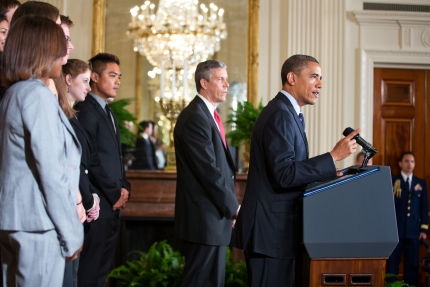
President Barack Obama, with Education Secretary Arne Duncan, delivers a statement on college affordability and interest rates on student loans, in the East Room of the White House, June 21, 2012. (Official White House Photo by Chuck Kennedy)

Time is running out for Congress to take actions to stop the rates on federal student loans from doubling on July 1.

That's why President Obama spoke today from the East Room of the White House about the importance of keeping college affordable.

"If Congress does not get this done in a week, the average student with federal student loans will rack up an additional $1,000 in debt over the coming year," he said. "If Congress fails to act, more than 7 million students will suddenly be hit with the equivalent of a $1,000 tax hike. And that’s not something that you can afford right now."

In his remarks, the President also stressed the importance of taking this step for the broader economy. It's not just that those students will suddenly have less money to spend -- it's that we need to have the best educated workforce in the world, and keeping higher education affordable helps to make that possible.

After the event with the President, Mark Zuckerman, the deputy director of the Domestic Policy Council, took to Twitter to answer your questions about student loans and college affordability in a White House Office Hours.

You can see that discussion on Storify.


Learn More