The White House

Office of the Press Secretary

Remarks by President Obama and President Aquino of the Philippines after Bilateral Meeting

Oval Office

2:48 P.M. EDT

PRESIDENT OBAMA:  It is a great pleasure to welcome President Aquino to the Oval Office and to the White House. 

I had the opportunity to spend a lot of time with him, most recently during my Asia trip, when we met most recently in Bali. And at that time, we discussed how important the U.S.-Philippine relationship was, the historic ties, the 60 years of a mutual defense treaty, the extraordinary links between Filipino-Americans that have brought our two countries so closely together.  And we pledged to work on a whole host of issues that would continue to strengthen and deepen the relationship for the 21st century.

We talked about how we could work on security issues, on economic issues, on people-to-people exchanges, and on a whole host of regional issues.  And I just want to thank President Aquino for his excellent cooperation, because we've made a great deal of progress since that time.

On economic issues, the Philippines is the recipient of a Millennium Challenge grant that is helping to foster greater development and opportunity within the Philippines.  We have a partnership for growth that is working on how we can make sure that we are structuring a relationship of expanding trade and commerce between our two countries. 

I want to congratulate President Aquino for the work that he's done on the Open Government Partnership that is consistent with his campaign to root out corruption that can facilitate greater economic development within the Philippines. 

And on security and military issues, we had discussions about how we can continue to consult closely together, to engage in training together, work on a range of regional issues together -- all of which is consistent with the announced pivot by the United States back to Asia, and reminding everybody that, in fact, the United States considers itself, and is, a Pacific power.

Throughout all these exchanges and all the work that we've done I've always found President Aquino to be a thoughtful and very helpful partner.  And I think that as a consequence of the meeting today in which we discussed not only military and economic issues, but also regional issues -- for example, trying to make sure that we have a strong set of international norms and rules governing maritime disputes in the region -- that I'm very confident that we're going to see continued friendship and strong cooperation between our two countries.  

So, Mr. President, thank you for visiting.  We are very proud of the friendship between our two countries, and we look forward to continuing in the future.

PRESIDENT AQUINO:  I would like to thank President Obama for all the support that the U.S. has given us in our quest to really transform our society.  Ours is a shared history, shared values, and that's why America is just one of two that we have strategic partnerships with.

Today's meeting has really even deepened and strengthened a very long relationship we have, especially as we face the challenges that are before both our countries in the current situation.

And again, we'd like to thank them for all the expressions of support that even now has led to the resolution of situations within our territory.

Thank you.

PRESIDENT OBAMA:  All right.  Thank you, everybody.

Q    Mr. President, Mitt Romney says you're out of touch for saying the private sector is doing fine.  What's your response?

PRESIDENT OBAMA:  Listen, it is absolutely clear that the economy is not doing fine.  That's the reason I had the press conference.  That's why I spent yesterday, the day before yesterday, this past week, this past month, and this past year talking about how we can make the economy stronger. 

The economy is not doing fine.  There are too many people out of work.  The housing market is still weak and too many homes underwater.  And that's precisely why I asked Congress to start taking some steps that can make a difference.

Now, I think if you look at what I said this morning and what I've been saying consistently over the last year, we've actually seen some good momentum in the private sector.  We've seen 4.3 million jobs created -- 800,000 this year alone -- record corporate profits.  And so that has not been the biggest drag on the economy. 

The folks who are hurting, where we have problems and where we can do even better, is small businesses that are having a tough time getting financing; we've seen teachers and police officers and firefighters who've been laid off -- all of which, by the way, when they get laid off spend less money buying goods and going to restaurants and contributing to additional economic growth.  The construction industry is still very weak, and that's one of the areas where we've still seen job losses instead of job gains. 

So if we take the steps that I laid out to make sure that we're not seeing teacher layoffs and we're not seeing police officer layoffs, and we're providing small businesses with additional financing and tax breaks for when they hire or if they're giving raises to their employees; if we refinance housing -- or allow homeowners to refinance so they've got an extra $3,000 in their pocket so that they can spend money and contribute to further economic growth; if we're making sure that we're rebuilding, work that has to be done anyway, deferred maintenance on roads and bridges that could put construction workers back to work -- all those things will strengthen the economy, and independent economists estimate it would create an additional million jobs.  

Now, you can't give me a good reason as to why Congress would not act on these items other than politics -- because these are traditionally ideas that Democrats and Republicans have supported.  So let me be as clear as I can be.  The economy needs to be strengthened.  That's why I had a press conference.

I believe that there are a lot of Americans who are hurting right now, which is what I've been saying for the last year, two years, three years, what I've been saying since I came into office.  And the question then is what are we going to do about it?  And one of the things that people get so frustrated about is that instead of actually talking about what would help, we get wrapped up in these political games.  That's what we need to put an end to.

So the key right now is for folks -- what I'm interested in hearing from Congress and Mr. Romney is what steps are they willing to take right now that are going to make an actual difference.  And so far, all we've heard are additional tax cuts to the folks who are doing fine, as opposed to taking steps that would actually help deal with the weaknesses in the economy and promote the kind of economic growth that we would all like to see.

All right.  Thank you very much, everybody.  Thank you.  Thanks.  Thank you, guys.

END
2:58 P.M. EDT

The White House

Office of the Press Secretary

Readout of the President’s Phone Calls with President Hollande

President Obama spoke today with French President Hollande to discuss economic conditions in Europe.  This continues the President’s close consultations with European colleagues following their Camp David discussions.  The President and President Hollande agreed on the importance of steps to strengthen the resilience of the Eurozone and growth in Europe and globally, and agreed to remain in contact as they prepare for the June 18-19 G-20 Summit in Los Cabos, Mexico.  The President welcomed France’s decision to host the next meeting of the Friends of Syria on July 6, noting the need to quickly bring about a political transition in Syria.

The White House

Office of the Press Secretary

Remarks by the President Congratulating the Super Bowl XLVI Champion New York Giants

South Lawn

3:09 P.M. EDT
 
THE PRESIDENT:  Hello, everybody!  (Applause.)  Everybody, please have a seat.  Welcome to the White House, and congratulations to the Super Bowl Champion New York Giants.  (Applause.)
 
We’ve got some members of Congress and members of my administration who are here today and rabid Giants fans.  I want to also recognize the Maras and the Tischs, as well as, of course, head coach Tom Coughlin and general manager Jerry Reese.  They have built this team into one of the NFL’s most outstanding franchises.  So we are very proud of them.  (Applause.)
 
Now, I know for some of you, this is just “welcome back.”  (Laughter).  You guys have been through this drill before.  The last time the Giants were here was in 2008.  A lot of folks thought that team didn’t have a chance to win a Super Bowl.  They ended up winning with a circus catch in the fourth quarter, MVP performance by Eli Manning -- (applause) -- a come-from-behind win over the Patriots.  So this is all starting to sound kind of like déjà vu all over again.
 
But every season is different, and last year’s Giants were obviously a special bunch, not just because of where they ended up, but because of how they got there.  Every team has to deal with injuries to the players.  Not many teams have to deal with a late hit on the head coach.  (Laughter.)  You saw that Jets game. 
 
Now, Coach Coughlin reminds everybody, he did not go down.  That’s a tough guy.  And you can see that toughness reflected in everybody else on this team.  The Giants took a whole bunch of hits this season, but they never went down.  From day one, they followed a simple motto:  Finish.  Finish the play.  Finish the game.  Finish the season.
 
And after week 15, sitting at 7-7, they knew that every game was a playoff game.  But the players, the coaches, the staff, the owners -- they didn’t quit.  They believed in each other.  And they kept winning, all the way to Indianapolis.
 
The night before the Super Bowl, they watched a highlight reel set to Justin Tuck’s good-luck song, “In the Air Tonight.”  I don’t know about a little Phil Collins before a big game.  (Laughter.)  I may try that before a big meeting with Congress.
 
But apparently it worked.  Next night, Eli Manning led the way, earned his second Super Bowl MVP.  (Applause.)  So I would just advise the sportswriters out there the next time Eli says he thinks he’s an elite quarterback, you might just want to be quiet.  (Applause.)  
 
Eli wasn’t alone, of course.  Justin Tuck got to the QB.  Victor Cruz scored and salsaed.  (Applause.)  Mario Manningham kept his feet inbounds for the biggest catch of his life.  Nobody was perfect, but everybody did their job.  And when the  Patriots’ Hail Mary hit the ground, the Giants were Super Bowl champions.  Of course, the fans back home went crazy.
 
Now, people from New York and New Jersey don’t fall for just anybody.  It’s a tough crowd, let’s face it.  (Applause.)  You’ve got to earn their respect.  They're never completely satisfied, and you’ve got to earn it both on and off the field.  And that’s exactly what the Giants did.  From fighting childhood obesity -- Michelle likes that -- to wrapping up leftover food for homeless shelters, to working with the Make-a-Wish Foundation to bring kids to practices and games, Big Blue supports the folks who support them.
 
They’ve certainly earned the respect of folks like Ray Odierno -- is here, who is obviously one of our greatest warriors and one of our greatest soldiers -- because this team is always there for our men and women in uniform.  This is a New York Giants tradition that goes back to World War II.  (Applause.)  Back in World War II, Wellington Mara served in the United States Navy -- so there’s a long tradition here.
 
And these guys have made it clear that no matter who you root for on Sundays, if you’re a veteran, the New York Giants are on your team.  Whether it’s setting up tickets to games, or inviting folks to practices, the Giants never forget the men and women who risk everything to protect our freedom.  And I especially want to thank and congratulate Coach Coughlin on receiving the Army’s Outstanding Civilian Service Award.  That's a great honor.  (Applause.)
 
By the way, we’ve got some wounded warriors here today.  Let’s give them all a big round of applause.  (Applause.)  Having these folks here today, seeing how much the Giants means to them is a reminder of how important sports and football can be, but it's also a reminder that there are some things that are more important than football -- and the Giants know that.  They finished strong, they won six straight games with everything on the line, they made a difference in the lives of those around them.  But, most importantly, they did it not just on Sunday, but every week.  
 
So, again, I want to congratulate the New York Giants.  Good luck this season.  It looks like we've got somebody singing for you.  (Laughter.)  That’s how happy everybody is. 
 
Give the New York Giants a big round of applause.  (Applause.)  
 
END
3:15 P.M. EDT

The White House

Office of the Press Secretary

Statement on the President’s Meeting with President Aquino of the Philippines

Today, the President met with Philippine President Benigno S. Aquino III in the Oval Office.  The Philippines is a close friend and a key economic and security partner for the United States.  The two leaders reaffirmed their commitment to strengthening the bilateral relationship.  The U.S.-Philippines partnership is based on our shared history, democratic values, and mutual interests.  It is rooted in our bilateral alliance, which has contributed to the stability and prosperity of the Asia-Pacific region for over 60 years.  Both leaders reaffirmed their mutual commitment to the peace and security of the region and to the U.S.-Philippines Mutual Defense Treaty.

The Presidents reviewed recent progress made in enhancing bilateral cooperation since their previous meeting at the East Asia Summit in November.  They welcomed the outcomes of the Bilateral Strategic Dialogue and the first ever “2+2” ministerial consultation in April, including the commitments on regional strategic issues, security and economic cooperation, and supporting the rule of law. 

President Obama reaffirmed the U.S. Government’s support for Philippine efforts to build a minimum credible defense posture, as evidenced by our transfer of a second U.S. Coast Guard Cutter to the Philippine Navy, support for the Philippine National Coast Watch System, and the growing number of bilateral exercises and training programs.

The Presidents agreed to build on our successful security cooperation on counterterrorism by expanding efforts to enhance joint military capabilities and interoperability in humanitarian assistance, as well as in the areas of disaster relief, maritime security, and maritime domain awareness.  President Obama recognized President Aquino’s commitment to peace negotiations with the Moro Islamic Liberation Front and to ensuring a peaceful and prosperous future for Mindanao. 

The leaders acknowledged the importance of a strong economic relationship to both sides, and committed to redouble efforts to bolster and deepen efforts to expand bilateral trade and promote greater trade and economic integration in the Asia Pacific.  In particular, President Obama noted the positive trade dialogue taking place under the bilateral Trade and Investment Framework Agreement and the importance of expanding bilateral trade in key agricultural products of interest to both countries.  

The President welcomed President Aquino’s commitment to the Partnership for Growth as a catalyzing joint effort to promote anti-corruption and rule of law, improved fiscal performance and regulatory quality, and inclusive economic growth.  They agreed to continue to push for progress on good governance and transparency in the Open Government Partnership and through implementation of the Philippines Millennium Challenge Corporation compact grant.  They also welcomed the signing of a Science and Technology agreement that will help boost innovation by facilitating collaborative scientific activities and promoting the exchange of ideas, information, skills and technology.

The President underscored the importance of the long and close ties between the people of the United States and the Philippines, as well as the significant contributions our people have made to each other’s security, prosperity and culture.  They each pledged to continue to deepen those ties through continued educational and cultural exchanges, and welcomed the founding of the U.S.-Philippines Society to further build bilateral ties.

President Aquino welcomed the renewed U.S. strategic focus and rebalancing in the Asia Pacific Region, as well as active participation in the U.S.-ASEAN Leaders Meeting and other regional fora.  President Obama thanked President Aquino for his role as U.S.-ASEAN Dialogue Partner in facilitating the United States’ participation in the East Asia Summit for the first time last year.

President Aquino briefed the President on regional developments, including the situation in the South China Sea.  They underscored the importance of the principles of ensuring freedom of navigation, respect for international law, and unimpeded lawful commerce.   They expressed firm support for a collaborative diplomatic process among claimants to resolve territorial disputes in a manner consistent with international law and without coercion or the use of force. President Obama conveyed his support for the ongoing efforts within ASEAN to reach an agreement with China on a Code of Conduct for the South China Sea that creates a rules-based framework for managing and regulating the conduct of parties, including preventing and managing disputes.

Finally, President Obama and President Aquino committed to maintaining the intensified pace and scope of our bilateral engagement established over the last two years through sustained strategic dialogue and joint activities, in the spirit of mutual respect and mutual responsibility.

The White House

Office of the Press Secretary

Remarks by the President

James S. Brady Press Briefing Room

10:40 A.M. EDT

THE PRESIDENT:  Good morning.  I just want to say a few words about the economy, and then I will take some of your questions.

Today, we’re fighting back from the deepest economic crisis since the Great Depression.  After losing jobs for 25 months in a row, our businesses have now created jobs for 27 months in a row -- 4.3 million new jobs in all.  The fact is job growth in this recovery has been stronger than in the one following the last recession a decade ago.  But the hole we have to fill is much deeper and the global aftershocks are much greater.  That’s why we've got to keep on pressing with actions that further strengthen the economy.

Right now, one concern is Europe, which faces a threat of renewed recession as countries deal with a financial crisis.  Obviously this matters to us because Europe is our largest economic trading partner.  If there’s less demand for our products in places like Paris or Madrid it could mean less businesses -- or less business for manufacturers in places like Pittsburgh or Milwaukee. 

The good news is there is a path out of this challenge.  These decisions are fundamentally in the hands of Europe’s leaders, and fortunately, they understand the seriousness of the situation and the urgent need to act.  I’ve been in frequent contact with them over the past several weeks, and we know that there are specific steps they can take right now to prevent the situation there from getting worse.

In the short term, they’ve got to stabilize their financial system.  And part of that is taking clear action as soon as possible to inject capital into weak banks.  Just as important, leaders can lay out a framework and a vision for a stronger eurozone, including deeper collaboration on budgets and banking policy.  Getting there is going to take some time, but showing the political commitment to share the benefits and responsibilities of a integrated Europe will be a strong step. 

With respect to Greece, which has important elections next weekend, we’ve said that it is in everybody’s interest for Greece to remain in the eurozone while respecting its commitments to reform.  We recognize the sacrifices that the Greek people have made, and European leaders understand the need to provide support if the Greek people choose to remain in the eurozone.  But the Greek people also need to recognize that their hardships will likely be worse if they choose to exit from the eurozone. 

Over the longer term, even as European countries with large debt burdens carry out necessary fiscal reforms, they’ve also got to promote economic growth and job creation.  As some countries have discovered, it’s a lot harder to rein in deficits and debt if your economy isn’t growing.  So it’s a positive thing that the conversation has moved in that direction, and leaders like Angela Merkel and Francois Hollande are working to put in place a growth agenda alongside responsible fiscal plans. 

The bottom line is the solutions to these problems are hard, but there are solutions.  The decisions required are tough, but Europe has the capacity to make them.  And they have America’s support.  Their success is good for us.  And the sooner that they act, and the more decisive and concrete their actions, the sooner people and markets will regain some confidence and the cheaper the costs of cleanup will be down the road.

In the meantime, given the signs of weakness in the world economy, not just in Europe but also some softening in Asia, it's critical that we take the actions we can to strengthen the American economy right now.

Last September, I sent Congress a detailed jobs plan full of the kind of bipartisan ideas that would have put more Americans back to work.  It had broad support from the American people.    It was fully paid for.  If Congress had passed it in full, we’d be on track to have a million more Americans working this year.  The unemployment rate would be lower.  Our economy would be stronger.

Of course, Congress refused to pass this jobs plan in full. They did act on a few parts of the bill -- most significantly the payroll tax cut that’s putting more money in every working person’s paycheck right now.  And I appreciate them taking that action.  But they left most of the jobs plan just sitting there. And in light of the headwinds that we’re facing right now, I urge them to reconsider.  Because there's steps we can take right now to put more people back to work.  They’re not just my ideas; they're not just Democratic ideas -- they’re ideas that independent, nonpartisan economists believe would make a real difference in our economy.  

Keep in mind that the private sector has been hiring at a solid pace over the last 27 months.  But one of the biggest weaknesses has been state and local governments, which have laid off 450,000 Americans.  These are teachers and cops and firefighters.  Congress should pass a bill putting them back to work right now, giving help to the states so that those layoffs are not occurring.

In addition, since the housing bubble burst, we’ve got more than a million construction workers out of work.  There’s nothing fiscally responsible about waiting to fix your roof until it caves in.  We've got a lot of deferred maintenance in this country.  We could be putting a lot of people back to work rebuilding our roads, our bridges, some of our schools.  There's work to be done; there are workers to do it.  Let’s put them back to work right now.

The housing market is stabilizing and beginning to come back in many parts of the country.  But there are still millions of responsible homeowners who've done everything right but still struggle to make ends meet.  So, as I talked about just a few weeks ago, let’s pass a bill that gives them a chance to save an average of $3,000 a year by refinancing their mortgage and taking advantage of these historically low rates.  That's something we can do right now.  It would make a difference.

Instead of just talking a good game about job creators, Congress should give the small business owners that actually create most of the new jobs in America a tax break for hiring more workers.

These are ideas that, again, have gotten strong validation from independent, nonpartisan economists.  It would make a difference in our economy.  And there's no excuse for not passing these ideas.  We know they can work.

Now, if Congress decides, despite all that, that they aren’t going to do anything about this simply because it’s an election year, then they should explain to the American people why.  There’s going to be plenty of time to debate our respective plans for the future.  That’s a debate I’m eager to have.  But right now, people in this town should be focused on doing everything we can to keep our recovery going and keeping our country strong.  And that requires some action on the part of Congress.  So I would urge them to take another look at some of the ideas that have already been put forward.

And with that, I'm going to take a couple of questions.  And I'm going to start with Caren Bohan -- who is with Reuters, but as we all know, is about to go get a fancy job with National Journal.  (Laughter.)  And we're very proud of her.  So congratulations to you, Caren.  You get the first crack at me.

Q    Thank you very much, Mr. President.  Could you tell the American people what role the United States is playing in the European debt crisis?  And also, do you think European leaders have a handle on what’s needed to stem the crisis?  And finally, you talked about a number of ideas that you’ve already put forth to shield the American economy.  Do you plan to give a speech or lay out additional ideas now that the crisis is really escalating?

THE PRESIDENT:  Well, a couple of things.  First of all, the situation in Europe is not simply a debt crisis.  You’ve got some countries like Greece that genuinely have spent more than they’re bringing in, and they’ve got problems.  There are other countries that actually were running a surplus and had fairly responsible fiscal policies but had weaknesses similar to what happened here with respect to their housing market or the real estate markets, and that has weakened their financial system.  So there are a bunch of different issues going on in Europe.  It’s not simply a debt crisis.

What is true is, is that the markets getting nervous have started making it much more expensive for them to borrow, and that then gets them on a downward spiral. 

We have been in constant contact with Europe over the last  -- European leaders over the last two years, and we have consulted with them both at the head of government and head of state level.  I frequently speak to the leaders not only at formal settings like the G8 but also on the telephone or via videoconference.  And our economic teams have gone over there to consult.

As I said in my opening remarks, the challenges they face are solvable.  Right now, their focus has to be on strengthening their overall banking system -- much in the same way that we did back in 2009 and 2010 -- making a series of decisive actions that give people confidence that the banking system is solid, that capital requirements are being met, that various stresses that may be out there can be absorbed by the system.  And I think that European leaders are in discussions about that and they’re moving in the right direction.

In addition, they’re going to have to look at how do they achieve growth at the same time as they’re carrying out structural reforms that may take two or three or five years to fully accomplish.  So countries like Spain and Italy, for example, have embarked on some smart structural reforms that everybody thinks are necessary -- everything from tax collection to labor markets to a whole host of different issues.  But they've got to have the time and the space for those steps to succeed.  And if they are just cutting and cutting and cutting, and their unemployment rate is going up and up and up, and people are pulling back further from spending money because they're feeling a lot of pressure -- ironically, that can actually make it harder for them to carry out some of these reforms over the long term.

So I think there's discussion now about, in addition to sensible ways to deal with debt and government finances, there's a parallel discussion that's taking place among European leaders to figure out how do we also encourage growth and show some flexibility to allow some of these reforms to really take root.

Now, keep in mind that this obviously can have a potential impact on us because Europe is our largest trading partner.  The good news is, is that a lot of the work we did back in 2009 and 2010 have put our financial system on a much more solid footing. Our insistence of increasing capital requirements for banks means that they can absorb some of the shocks that might come from across the Atlantic.  Folks in the financial sector have been monitoring this carefully and I think are prepared for a range of contingencies.

But even if we weren't directly hit in the sense that our financial system still stayed solid, if Europe goes into a recession that means we're selling fewer goods, fewer services, and that is going to have some impact on the pace of our recovery.  So we want to do everything we can to make sure that we are supportive of what European leaders are talking about.  Ultimately, it is a decision that they've got to make in terms of how they move forward towards more integration, how they move forward in terms of accommodating the needs for both reform and growth.

And the most important thing I think we can do is make sure that we continue to have a strong, robust recovery.  So the steps that I've outlined are the ones that are needed.  We've got a couple of sectors in our economy that are still weak.  Overall, the private sector has been doing a good job creating jobs.  We've seen record profits in the corporate sector. 

The big challenge we have in our economy right now is state and local government hiring has been going in the wrong direction.  You've seen teacher layoffs, police officers, cops, firefighters being laid off.  And the other sector that's still weak has been the construction industry.  Those two areas we've directly addressed with our jobs plan.  The problem is that it requires Congress to take action, and we're going to keep pushing them to see if they can move in that direction.

Jackie Calmes.  Where did Jackie go?  There she is.

Q    Thank you, Mr. President.  I'd like to ask you a couple -- about what a couple of other people have said about Europe.  And one is that I'd like to know if you agree with former President Bill Clinton, who said in the past week that the European's policies that you've described here today are much like those of the Republicans in this country -- politics of austerity that would take us in the same direction as Europe -- if you agree with that.  The Republicans, for their part, have said that you're simply blaming the Europeans for problems that have been caused by your own policies.  So I'd like you to respond to both of those.  And also, tell us precisely how much time you personally spend on the European situation.

THE PRESIDENT:  Any other aspects to the question?  (Laughter.)

Q    I do have more questions.  (Laughter.)

Q    Is she going to National Journal?  (Laughter.)  

THE PRESIDENT:  First of all, in terms of the amount of time I spend -- look, I think it's fair to say that over the last two years I'm in consistent discussions with European leadership and consistent discussions with my economic team.

This is one of the things that's changed in the world economy over the last two or three decades, is that this is a global economy now, and what happens anywhere in the world can have an impact here in the United States.  Certainly that's true after the kind of trauma that we saw in 2008 and 2009.

And if you think about the situation in Europe, they're going through a lot of the things that we went through back in 2009, 2010, where we took some very decisive action.  The challenge they have is they’ve got 17 governments that have to coordinate -- 27 if you count the entire European Union, not just the eurozone.  So imagine dealing with 17 Congresses instead of just one.  That makes things more challenging.

But what we’ve tried to do is to be constructive, to not frame this as us scolding them or telling them what to do, but to give them advice, in part based on our experiences here in having stabilized a financial situation effectively.  And ultimately, though, they're going to have to make a lot of these decisions, and so what we can do is to prod, advise, suggest.  But ultimately, they're going to have to make these decisions.

Now, in terms of characterizing the situation over there, what is absolutely true -- this is true in Europe and it’s true here in the United States -- is that we’ve got short-term problems and long-term problems.  And the short-term problems are:  How do we put people back to work?  How do we make the economy grow as rapidly as possible?  How do we ensure that the recovery gains momentum?

Because if we do those things, not only is it good for the people who find work, not only is it good for families who are able to pay the bills, but it actually is one of the most important things we can do to reduce deficits and debt.  It’s a lot easier to deal with deficits and debt if you’re growing, because you’re bringing in more revenue and you’re not spending as much because people don't need unemployment insurance as much; they don't need other programs that are providing support to people in need because things are going pretty good. 

Now, that's true here in the United States, and that's true in Europe.  So the problem I think President Clinton identified is that if, when an economy is still weak and a recovery is still fragile, that you resort to a strategy of "let’s cut more" -- so that you’re seeing government layoffs, reductions in government spending, severe cutbacks in major investments that help the economy grow over the long term -- if you’re doing all those things at the same time as consumers are pulling back because they're still trying to pay off credit card debt, and there’s generally weak demand in the economy as a whole, then you can get on a downward spiral where everybody is pulling back at the same time.  That weakens demand and that further crimps the desire of companies to hire more people.  And that's the pattern that Europe is in danger of getting into.

Some countries in Europe right now have an unemployment rate of 15, 20 percent.  If you are engaging in too much austerity too quickly, and that unemployment rate goes up to 20 or 25 percent, then that actually makes it harder to then pay off your debts.  And the markets, by the way, respond in -- when they see this kind of downward spiral happening, they start making a calculation, well, if you’re not growing at all, if you’re contracting, you may end up having more trouble paying us off, so we’re going to charge you even more.  Your interest rates will go up.  And it makes it that much tougher.

So I think that -- what we want both for ourselves, but what we’ve advised in Europe as well is a strategy that says let’s do everything can to grow now, even as we lock in a long-term plan to stabilize our debt and our deficits, and start bringing them down in a steady, sensible way. 

And by the way, that’s what we proposed last year; that’s what’s proposed in my budget.  What I’ve said is, let’s make long-term spending cuts; let’s initiate long-term reforms; let’s reduce our health care spending; let’s make sure that we’ve got a pathway, a glide-path to fiscal responsibility, but at the same time, let’s not underinvest in the things that we need to do right now to grow.  And that recipe of short-term investments in growth and jobs with a long-term path of fiscal responsibility is the right approach to take for, I think, not only the United States but also for Europe.

Q    What about the Republicans saying that you’re blaming the Europeans for the failures of your own policies?

THE PRESIDENT:  The truth of the matter is that, as I said, we’ve created 4.3 million jobs over the last 27 months, over 800,000 just this year alone.  The private sector is doing fine. Where we’re seeing weaknesses in our economy have to do with state and local government -- oftentimes, cuts initiated by governors or mayors who are not getting the kind of help that they have in the past from the federal government and who don’t have the same kind of flexibility as the federal government in dealing with fewer revenues coming in. 

And so, if Republicans want to be helpful, if they really want to move forward and put people back to work, what they should be thinking about is, how do we help state and local governments and how do we help the construction industry.  Because the recipes that they’re promoting are basically the kinds of policies that would add weakness to the economy, would result in further layoffs, would not provide relief in the housing market, and would result, I think most economists estimate, in lower growth and fewer jobs, not more. 

All right.  David Jackson.

Q    Thank you, sir.  There are a couple of books out with, essentially, details about national security issues.  There are reports of terrorist kill lists that you supervise and there are reports of cyber-attacks on the Iranian nuclear program that you ordered.  Two things.  First of all, what’s your reaction of this information getting out in public?  And secondly, what’s your reaction to lawmakers who accuse your team of leaking these details in order to promote your reelection bid?

THE PRESIDENT:  Well, first of all, I’m not going to comment on the details of what are supposed to be classified items.  Second, as Commander-in-Chief, the issues that you have mentioned touch on our national security, touch on critical issues of war and peace, and they're classified for a reason -- because they're sensitive and because the people involved may, in some cases, be in danger if they're carrying out some of these missions.  And when this information, or reports, whether true or false, surface on the front page of newspapers, that makes the job of folks on the front lines tougher and it makes my job tougher -- which is why since I've been in office, my attitude has been zero tolerance for these kinds of leaks and speculation. 

Now, we have mechanisms in place where if we can root out folks who have leaked, they will suffer consequences.  In some cases, it's criminal -- these are criminal acts when they release information like this.  And we will conduct thorough investigations, as we have in the past.

The notion that my White House would purposely release classified national security information is offensive.  It's wrong.  And people I think need to have a better sense of how I approach this office and how the people around me here approach this office. 

We're dealing with issues that can touch on the safety and security of the American people, our families, or our military personnel, or our allies.  And so we don’t play with that.  And it is a source of consistent frustration, not just for my administration but for previous administrations, when this stuff happens.  And we will continue to let everybody know in government, or after they leave government, that they have certain obligations that they should carry out. 

But as I think has been indicated from these articles, whether or not the information they've received is true, the writers of these articles have all stated unequivocally that they didn't come from this White House.  And that's not how we operate. 

Q    Are there leak investigations going on now -- is that what you're saying?

THE PRESIDENT:  What I'm saying is, is that we consistently, whenever there is classified information that is put out into the public, we try to find out where that came from. 

Okay?  Thank you very much, everybody.  Thank you.

END
11:09 A.M. EDT

President Obama Holds a Press Conference on the Economy

June 08, 2012 | 27:31 | Public Domain

President Obama calls on Congress to pass the bipartisan, paid-for ideas that he proposed last year to put construction workers back to work upgrading our roads and bridges, teachers back in the classroom educating our kids and police and firefighters back on the job keeping our communities safe, and addresses the state of the economy, including the situation in Europe, which continues to pose headwinds to our recovery here at home.

Download mp4 (971MB) | mp3 (63MB)

Read the Transcript

Remarks by the President

James S. Brady Press Briefing Room

10:40 A.M. EDT

THE PRESIDENT:  Good morning.  I just want to say a few words about the economy, and then I will take some of your questions.

Today, we’re fighting back from the deepest economic crisis since the Great Depression.  After losing jobs for 25 months in a row, our businesses have now created jobs for 27 months in a row -- 4.3 million new jobs in all.  The fact is job growth in this recovery has been stronger than in the one following the last recession a decade ago.  But the hole we have to fill is much deeper and the global aftershocks are much greater.  That’s why we've got to keep on pressing with actions that further strengthen the economy.

Right now, one concern is Europe, which faces a threat of renewed recession as countries deal with a financial crisis.  Obviously this matters to us because Europe is our largest economic trading partner.  If there’s less demand for our products in places like Paris or Madrid it could mean less businesses -- or less business for manufacturers in places like Pittsburgh or Milwaukee. 

The good news is there is a path out of this challenge.  These decisions are fundamentally in the hands of Europe’s leaders, and fortunately, they understand the seriousness of the situation and the urgent need to act.  I’ve been in frequent contact with them over the past several weeks, and we know that there are specific steps they can take right now to prevent the situation there from getting worse.

In the short term, they’ve got to stabilize their financial system.  And part of that is taking clear action as soon as possible to inject capital into weak banks.  Just as important, leaders can lay out a framework and a vision for a stronger eurozone, including deeper collaboration on budgets and banking policy.  Getting there is going to take some time, but showing the political commitment to share the benefits and responsibilities of a integrated Europe will be a strong step. 

With respect to Greece, which has important elections next weekend, we’ve said that it is in everybody’s interest for Greece to remain in the eurozone while respecting its commitments to reform.  We recognize the sacrifices that the Greek people have made, and European leaders understand the need to provide support if the Greek people choose to remain in the eurozone.  But the Greek people also need to recognize that their hardships will likely be worse if they choose to exit from the eurozone. 

Over the longer term, even as European countries with large debt burdens carry out necessary fiscal reforms, they’ve also got to promote economic growth and job creation.  As some countries have discovered, it’s a lot harder to rein in deficits and debt if your economy isn’t growing.  So it’s a positive thing that the conversation has moved in that direction, and leaders like Angela Merkel and Francois Hollande are working to put in place a growth agenda alongside responsible fiscal plans. 

The bottom line is the solutions to these problems are hard, but there are solutions.  The decisions required are tough, but Europe has the capacity to make them.  And they have America’s support.  Their success is good for us.  And the sooner that they act, and the more decisive and concrete their actions, the sooner people and markets will regain some confidence and the cheaper the costs of cleanup will be down the road.

In the meantime, given the signs of weakness in the world economy, not just in Europe but also some softening in Asia, it's critical that we take the actions we can to strengthen the American economy right now.

Last September, I sent Congress a detailed jobs plan full of the kind of bipartisan ideas that would have put more Americans back to work.  It had broad support from the American people.    It was fully paid for.  If Congress had passed it in full, we’d be on track to have a million more Americans working this year.  The unemployment rate would be lower.  Our economy would be stronger.

Of course, Congress refused to pass this jobs plan in full. They did act on a few parts of the bill -- most significantly the payroll tax cut that’s putting more money in every working person’s paycheck right now.  And I appreciate them taking that action.  But they left most of the jobs plan just sitting there. And in light of the headwinds that we’re facing right now, I urge them to reconsider.  Because there's steps we can take right now to put more people back to work.  They’re not just my ideas; they're not just Democratic ideas -- they’re ideas that independent, nonpartisan economists believe would make a real difference in our economy.  

Keep in mind that the private sector has been hiring at a solid pace over the last 27 months.  But one of the biggest weaknesses has been state and local governments, which have laid off 450,000 Americans.  These are teachers and cops and firefighters.  Congress should pass a bill putting them back to work right now, giving help to the states so that those layoffs are not occurring.

In addition, since the housing bubble burst, we’ve got more than a million construction workers out of work.  There’s nothing fiscally responsible about waiting to fix your roof until it caves in.  We've got a lot of deferred maintenance in this country.  We could be putting a lot of people back to work rebuilding our roads, our bridges, some of our schools.  There's work to be done; there are workers to do it.  Let’s put them back to work right now.

The housing market is stabilizing and beginning to come back in many parts of the country.  But there are still millions of responsible homeowners who've done everything right but still struggle to make ends meet.  So, as I talked about just a few weeks ago, let’s pass a bill that gives them a chance to save an average of $3,000 a year by refinancing their mortgage and taking advantage of these historically low rates.  That's something we can do right now.  It would make a difference.

Instead of just talking a good game about job creators, Congress should give the small business owners that actually create most of the new jobs in America a tax break for hiring more workers.

These are ideas that, again, have gotten strong validation from independent, nonpartisan economists.  It would make a difference in our economy.  And there's no excuse for not passing these ideas.  We know they can work.

Now, if Congress decides, despite all that, that they aren’t going to do anything about this simply because it’s an election year, then they should explain to the American people why.  There’s going to be plenty of time to debate our respective plans for the future.  That’s a debate I’m eager to have.  But right now, people in this town should be focused on doing everything we can to keep our recovery going and keeping our country strong.  And that requires some action on the part of Congress.  So I would urge them to take another look at some of the ideas that have already been put forward.

And with that, I'm going to take a couple of questions.  And I'm going to start with Caren Bohan -- who is with Reuters, but as we all know, is about to go get a fancy job with National Journal.  (Laughter.)  And we're very proud of her.  So congratulations to you, Caren.  You get the first crack at me.

Q    Thank you very much, Mr. President.  Could you tell the American people what role the United States is playing in the European debt crisis?  And also, do you think European leaders have a handle on what’s needed to stem the crisis?  And finally, you talked about a number of ideas that you’ve already put forth to shield the American economy.  Do you plan to give a speech or lay out additional ideas now that the crisis is really escalating?

THE PRESIDENT:  Well, a couple of things.  First of all, the situation in Europe is not simply a debt crisis.  You’ve got some countries like Greece that genuinely have spent more than they’re bringing in, and they’ve got problems.  There are other countries that actually were running a surplus and had fairly responsible fiscal policies but had weaknesses similar to what happened here with respect to their housing market or the real estate markets, and that has weakened their financial system.  So there are a bunch of different issues going on in Europe.  It’s not simply a debt crisis.

What is true is, is that the markets getting nervous have started making it much more expensive for them to borrow, and that then gets them on a downward spiral. 

We have been in constant contact with Europe over the last  -- European leaders over the last two years, and we have consulted with them both at the head of government and head of state level.  I frequently speak to the leaders not only at formal settings like the G8 but also on the telephone or via videoconference.  And our economic teams have gone over there to consult.

As I said in my opening remarks, the challenges they face are solvable.  Right now, their focus has to be on strengthening their overall banking system -- much in the same way that we did back in 2009 and 2010 -- making a series of decisive actions that give people confidence that the banking system is solid, that capital requirements are being met, that various stresses that may be out there can be absorbed by the system.  And I think that European leaders are in discussions about that and they’re moving in the right direction.

In addition, they’re going to have to look at how do they achieve growth at the same time as they’re carrying out structural reforms that may take two or three or five years to fully accomplish.  So countries like Spain and Italy, for example, have embarked on some smart structural reforms that everybody thinks are necessary -- everything from tax collection to labor markets to a whole host of different issues.  But they've got to have the time and the space for those steps to succeed.  And if they are just cutting and cutting and cutting, and their unemployment rate is going up and up and up, and people are pulling back further from spending money because they're feeling a lot of pressure -- ironically, that can actually make it harder for them to carry out some of these reforms over the long term.

So I think there's discussion now about, in addition to sensible ways to deal with debt and government finances, there's a parallel discussion that's taking place among European leaders to figure out how do we also encourage growth and show some flexibility to allow some of these reforms to really take root.

Now, keep in mind that this obviously can have a potential impact on us because Europe is our largest trading partner.  The good news is, is that a lot of the work we did back in 2009 and 2010 have put our financial system on a much more solid footing. Our insistence of increasing capital requirements for banks means that they can absorb some of the shocks that might come from across the Atlantic.  Folks in the financial sector have been monitoring this carefully and I think are prepared for a range of contingencies.

But even if we weren't directly hit in the sense that our financial system still stayed solid, if Europe goes into a recession that means we're selling fewer goods, fewer services, and that is going to have some impact on the pace of our recovery.  So we want to do everything we can to make sure that we are supportive of what European leaders are talking about.  Ultimately, it is a decision that they've got to make in terms of how they move forward towards more integration, how they move forward in terms of accommodating the needs for both reform and growth.

And the most important thing I think we can do is make sure that we continue to have a strong, robust recovery.  So the steps that I've outlined are the ones that are needed.  We've got a couple of sectors in our economy that are still weak.  Overall, the private sector has been doing a good job creating jobs.  We've seen record profits in the corporate sector. 

The big challenge we have in our economy right now is state and local government hiring has been going in the wrong direction.  You've seen teacher layoffs, police officers, cops, firefighters being laid off.  And the other sector that's still weak has been the construction industry.  Those two areas we've directly addressed with our jobs plan.  The problem is that it requires Congress to take action, and we're going to keep pushing them to see if they can move in that direction.

Jackie Calmes.  Where did Jackie go?  There she is.

Q    Thank you, Mr. President.  I'd like to ask you a couple -- about what a couple of other people have said about Europe.  And one is that I'd like to know if you agree with former President Bill Clinton, who said in the past week that the European's policies that you've described here today are much like those of the Republicans in this country -- politics of austerity that would take us in the same direction as Europe -- if you agree with that.  The Republicans, for their part, have said that you're simply blaming the Europeans for problems that have been caused by your own policies.  So I'd like you to respond to both of those.  And also, tell us precisely how much time you personally spend on the European situation.

THE PRESIDENT:  Any other aspects to the question?  (Laughter.)

Q    I do have more questions.  (Laughter.)

Q    Is she going to National Journal?  (Laughter.)  

THE PRESIDENT:  First of all, in terms of the amount of time I spend -- look, I think it's fair to say that over the last two years I'm in consistent discussions with European leadership and consistent discussions with my economic team.

This is one of the things that's changed in the world economy over the last two or three decades, is that this is a global economy now, and what happens anywhere in the world can have an impact here in the United States.  Certainly that's true after the kind of trauma that we saw in 2008 and 2009.

And if you think about the situation in Europe, they're going through a lot of the things that we went through back in 2009, 2010, where we took some very decisive action.  The challenge they have is they’ve got 17 governments that have to coordinate -- 27 if you count the entire European Union, not just the eurozone.  So imagine dealing with 17 Congresses instead of just one.  That makes things more challenging.

But what we’ve tried to do is to be constructive, to not frame this as us scolding them or telling them what to do, but to give them advice, in part based on our experiences here in having stabilized a financial situation effectively.  And ultimately, though, they're going to have to make a lot of these decisions, and so what we can do is to prod, advise, suggest.  But ultimately, they're going to have to make these decisions.

Now, in terms of characterizing the situation over there, what is absolutely true -- this is true in Europe and it’s true here in the United States -- is that we’ve got short-term problems and long-term problems.  And the short-term problems are:  How do we put people back to work?  How do we make the economy grow as rapidly as possible?  How do we ensure that the recovery gains momentum?

Because if we do those things, not only is it good for the people who find work, not only is it good for families who are able to pay the bills, but it actually is one of the most important things we can do to reduce deficits and debt.  It’s a lot easier to deal with deficits and debt if you’re growing, because you’re bringing in more revenue and you’re not spending as much because people don't need unemployment insurance as much; they don't need other programs that are providing support to people in need because things are going pretty good. 

Now, that's true here in the United States, and that's true in Europe.  So the problem I think President Clinton identified is that if, when an economy is still weak and a recovery is still fragile, that you resort to a strategy of "let’s cut more" -- so that you’re seeing government layoffs, reductions in government spending, severe cutbacks in major investments that help the economy grow over the long term -- if you’re doing all those things at the same time as consumers are pulling back because they're still trying to pay off credit card debt, and there’s generally weak demand in the economy as a whole, then you can get on a downward spiral where everybody is pulling back at the same time.  That weakens demand and that further crimps the desire of companies to hire more people.  And that's the pattern that Europe is in danger of getting into.

Some countries in Europe right now have an unemployment rate of 15, 20 percent.  If you are engaging in too much austerity too quickly, and that unemployment rate goes up to 20 or 25 percent, then that actually makes it harder to then pay off your debts.  And the markets, by the way, respond in -- when they see this kind of downward spiral happening, they start making a calculation, well, if you’re not growing at all, if you’re contracting, you may end up having more trouble paying us off, so we’re going to charge you even more.  Your interest rates will go up.  And it makes it that much tougher.

So I think that -- what we want both for ourselves, but what we’ve advised in Europe as well is a strategy that says let’s do everything can to grow now, even as we lock in a long-term plan to stabilize our debt and our deficits, and start bringing them down in a steady, sensible way. 

And by the way, that’s what we proposed last year; that’s what’s proposed in my budget.  What I’ve said is, let’s make long-term spending cuts; let’s initiate long-term reforms; let’s reduce our health care spending; let’s make sure that we’ve got a pathway, a glide-path to fiscal responsibility, but at the same time, let’s not underinvest in the things that we need to do right now to grow.  And that recipe of short-term investments in growth and jobs with a long-term path of fiscal responsibility is the right approach to take for, I think, not only the United States but also for Europe.

Q    What about the Republicans saying that you’re blaming the Europeans for the failures of your own policies?

THE PRESIDENT:  The truth of the matter is that, as I said, we’ve created 4.3 million jobs over the last 27 months, over 800,000 just this year alone.  The private sector is doing fine. Where we’re seeing weaknesses in our economy have to do with state and local government -- oftentimes, cuts initiated by governors or mayors who are not getting the kind of help that they have in the past from the federal government and who don’t have the same kind of flexibility as the federal government in dealing with fewer revenues coming in. 

And so, if Republicans want to be helpful, if they really want to move forward and put people back to work, what they should be thinking about is, how do we help state and local governments and how do we help the construction industry.  Because the recipes that they’re promoting are basically the kinds of policies that would add weakness to the economy, would result in further layoffs, would not provide relief in the housing market, and would result, I think most economists estimate, in lower growth and fewer jobs, not more. 

All right.  David Jackson.

Q    Thank you, sir.  There are a couple of books out with, essentially, details about national security issues.  There are reports of terrorist kill lists that you supervise and there are reports of cyber-attacks on the Iranian nuclear program that you ordered.  Two things.  First of all, what’s your reaction of this information getting out in public?  And secondly, what’s your reaction to lawmakers who accuse your team of leaking these details in order to promote your reelection bid?

THE PRESIDENT:  Well, first of all, I’m not going to comment on the details of what are supposed to be classified items.  Second, as Commander-in-Chief, the issues that you have mentioned touch on our national security, touch on critical issues of war and peace, and they're classified for a reason -- because they're sensitive and because the people involved may, in some cases, be in danger if they're carrying out some of these missions.  And when this information, or reports, whether true or false, surface on the front page of newspapers, that makes the job of folks on the front lines tougher and it makes my job tougher -- which is why since I've been in office, my attitude has been zero tolerance for these kinds of leaks and speculation. 

Now, we have mechanisms in place where if we can root out folks who have leaked, they will suffer consequences.  In some cases, it's criminal -- these are criminal acts when they release information like this.  And we will conduct thorough investigations, as we have in the past.

The notion that my White House would purposely release classified national security information is offensive.  It's wrong.  And people I think need to have a better sense of how I approach this office and how the people around me here approach this office. 

We're dealing with issues that can touch on the safety and security of the American people, our families, or our military personnel, or our allies.  And so we don’t play with that.  And it is a source of consistent frustration, not just for my administration but for previous administrations, when this stuff happens.  And we will continue to let everybody know in government, or after they leave government, that they have certain obligations that they should carry out. 

But as I think has been indicated from these articles, whether or not the information they've received is true, the writers of these articles have all stated unequivocally that they didn't come from this White House.  And that's not how we operate. 

Q    Are there leak investigations going on now -- is that what you're saying?

THE PRESIDENT:  What I'm saying is, is that we consistently, whenever there is classified information that is put out into the public, we try to find out where that came from. 

Okay?  Thank you very much, everybody.  Thank you.

END
11:09 A.M. EDT
Close Transcript

West Wing Week: 06/08/2012 or "Roll Up Our Sleeves and Never Quit"

This week, the President traveled to Honeywell International in Minnesota to highlight efforts to help veterans find good paying jobs and urged Congress to support the Paycheck Fairness Act and to not let interest rates double on student loans on July 1.  

Watch the West Wing Week here.

President Obama Speaks on College Affordability

June 07, 2012 | 27:38 | Public Domain

President Obama calls on Congress to stop interest rates from doubling on student loans, and discusses his Administration’s initiatives to keep college affordable for students and their families.

Download mp4 (976MB) | mp3 (63MB)

President Obama Talks Income Based Repayment at UNLV

President Barack Obama delivers remarks on college affordability at UNLV (June 7, 2012)

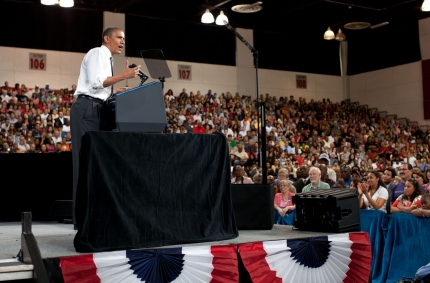
President Barack Obama delivers remarks on college affordability at Cox Pavilion at the University of Las Vegas (UNLV) in Las Vegas, Nevada, June 7, 2012. (Official White House Photo by Pete Souza)

Speaking today at the University of Nevada, Las Vegas, President Obama talked about student loans -- a subject he's personally had quite a bit of experience navigating.

Through the course of their educations -- including a graduate degree for each -- both the President and the First Lady took on debt to pay for school.

"When we got married, we got poorer together," he said. "We sort of added our liabilities together."

In fact, it was 2004 before the Obamas paid off the last of their student loans.

That's not the future he wants for today's college students. And in Las Vegas, he talked about one big step he's taking to help make it easier for everyone to afford a great education:

This is a program that more people need to know about. And we’re going to start doing more advertising about this because this is really important. For those of you who are still in school, you're about to graduate, as long as you make your monthly payments on time -- all right, so pay your bills on time -- we will cap the payments you have to make on your student loans at 10 percent of your discretionary income once you graduate. 10 percent.

It's called the Income Based Repayment program. Have questions? Here's everything you need to know. As part of today's event, the President issued a memorandum to streamline the IBR process and improve information available to responsible borrowers about student loan repayment options. 

The White House

Office of the Press Secretary

Remarks by the President on College Affordability

Cox Pavilion
University of Las Vegas
Las Vegas, Nevada

12:53 P.M. PDT

THE PRESIDENT:  Hello, Las Vegas!  (Applause.)  Well, how’s it going, Rebels?  (Applause.) 

AUDIENCE MEMBERS:  Four more years!  Four more years!

THE PRESIDENT:  Thank you so much.  If you've got a chair, go ahead and sit down.  You can make yourself comfortable.  (Laughter.)  If you don't, you're out of luck, just stay there. 

AUDIENCE MEMBER:  You look great!

THE PRESIDENT:  It is great to be back in Nevada.  I want everybody to give George a big round of applause for that introduction.  (Applause.)  I want to thank all the students for coming out here -- (applause) -- on a nice summer afternoon, some of you might be at Capriotti’s or some place -- (laughter) -- but instead you're here with us. 

AUDIENCE MEMBER:  You look great!

THE PRESIDENT:  Thank you.  I'll tell Michelle you said so.  (Applause.) 

AUDIENCE MEMBER:  We love her too!

THE PRESIDENT:  And I love you back.  Thank you.  (Applause.)  So I’m here today at UNLV -- (applause) -- home of the Runnin' Rebels, to talk about what a lot of you folks are thinking about every day.  Now, keep in mind we're in Vegas.  So in Vegas, you can bet on just about anything.  (Laughter.)  But what the students here have bet on is themselves.  (Applause.)  They've bet on themselves.  By earning your degree, you've decided to make the best possible investment in your future and in the future of America.  And I'm proud of all of you for making that investment, because it's never been more important. 

In today’s economy, the single best predictor of success, by far, is a good education.  (Applause.)  And the statistics prove it.  The unemployment rate for Americans with a college degree or more is about half the national average.  Their incomes are twice as high as those with only a high school diploma.  A higher education is the clearest path to the middle class.

And rebuilding the middle class is what we've been all about.  (Applause.)  I don't have to tell folks in Nevada that we're recovering from a crisis that cost millions of middle-class jobs.  When that housing bubble burst, it hit people really hard. 
But we’re also fighting back from a long-term trend that has cost working families all across the country that sense of security.  So our job is not just to get people back to work.  Our job is to build an economy where hard work pays off.  (Applause.)

So I want more people to be able to make the investment you're making.  I want to make it easier for more students like you to earn a degree without shouldering a mountain of debt -- (applause) -- because even though education, a college education is still a great investment, the burden of debt is serious and it's hard on folks just as they're starting off in life.  I don't want to be a country where a shrinking number of people are doing really, really well and then, a growing number are barely able to get by. 

I want everybody in America to get a fair shot.  (Applause.)  I want everybody to do their fair share.  (Applause.)  I want everyone to play by the same rules.  (Applause.)  That’s the America I know.  That’s the America I believe in.  That's the America we’re trying to build for you, for my children, for future generations.

AUDIENCE MEMBER:  Thank you, President Obama!

THE PRESIDENT:  You're welcome.  (Applause.)  Now, look, the fact is, again, I don’t have to tell folks in Nevada we're still going through this process of recovery from that crisis.  And we've taken some tough steps together.  And the good news is our economy is growing again, but we need it to grow faster.  Businesses have created almost 4.3 million new jobs over the last 27 months.  (Applause.)  But to recover all the jobs that were lost in that recession, we've got to have them come back faster.  
The truth is the recovery has seen stronger job growth than what happened during the last recession a decade ago.  But the problem is the hole we have to fill is a lot deeper.  The global aftershocks are much greater.  We're already seeing it.  Just like last year around this time, our economy has been facing some serious headwinds.  You've got the lingering effects of the spring spike in gas prices.  You remember that.  It's still tough on a lot of folks' wallets.  You've got the situation in Europe.

But from the moment we first took action when I came into office to make sure that we did not go into a freefall depression, we knew that all -- recovering all the jobs that were lost during the recession was going to take some time.  And we knew there would be ups and downs along the way.  What we also knew though was if we acted wisely and we acted together, if we didn't quit, we'd come back stronger.  We would do more than just get back to where we were, we would build an economy that would last for the long term.

And, Las Vegas, I still believe that.  I believe we will come back stronger.  We have better days ahead, and it's because of people like you, because of folks like you.  (Applause.)  I'm inspired when I hear folks like George putting in long hours working and taking summer classes.  Some older students who are retaining -- there you go.  I don't know, you don't look that old to me.  (Laughter.)  But folks deciding to go back to school -- retrain yourself for a new job, the jobs of the future. 

  So you're working hard.  You're playing by the rules.  You deserve to have leaders who are going to do the same, leaders who will take action -- (applause) -- leaders who will do whatever it requires to fight for the middle-class and grow the economy faster.  We may not fully control everything that happens in other parts of the world, but there are plenty of things we can do right here in the United States to strengthen the economy further.  There are plenty of steps we can take right now to help create jobs and grow this economy faster. 

So let me just give you some examples.  Last September, I sent to Congress a jobs bill full of the kinds of ideas that, historically, Republicans and Democrats have supported.  If they had taken all the steps I was pushing for back in September, we could have put even more Americans back to work.  We could have sliced through these headwinds more easily. 

Now, since then, in fairness, Congress has passed a few parts of that jobs bill.  They passed a payroll tax cut that’s put more money in every working person’s paycheck right now.  That's good news.  We thank them for it.  (Applause.)  But they haven’t acted fast enough on the other ideas that economists, independent economists -- not me, but folks who study this stuff for a living -- say could have put over a million more people to work.  Now, there's no excuse for that.  When so many people are still out there pounding the pavement and sending out resumes, so many families are doing whatever it takes to pay the bills -- Congress can't just sit on their hands.  (Applause.)   

So my message to Congress is let's get to work.  Let's get to work.  (Applause.)  I know this is an election year.  That’s not lost on me.  (Laughter.)  But at this make-or-break moment for America's middle class, we can’t afford to have Congress take five months off.  You've got to keep working.  You're not suddenly just sitting around not doing anything.  You should expect the same thing from your representatives in Washington, right.  (Applause.) 

So there are a bunch of things that Congress can do right now.  Let me tick a few off.  At a time when our businesses have created more than 4 million new jobs, unfortunately, state and local governments have lost 450,000 jobs.  That’s been one of the biggest problems in our economy is all the layoffs happening at the state and local level -- cops, teachers, firefighters all being laid off. 

Now, those folks provide vital services.  They protect us.  They’re teaching our kids.  Congress should pass a bill -- (applause) -- Congress should pass a bill like I’ve asked them to do to help states like Nevada put Americans -- those Americans who are doing outstanding service on behalf of our communities, put those folks back on the job right now.  That’s something we can do.  (Applause.)

Number two, we know that the housing bubble burst.  Here in Nevada, the construction industry got killed, right?  So I told Congress months ago, let’s pass a bill to put hundreds of thousands of construction workers and contractors back to work rebuilding America -- rebuilding roads and bridges and new schools for rising populations and -- (applause) -- that’s good for the economy now; it’s good for the economy later.  There’s no excuse for Congress to just shrug its shoulders.  Let’s get it done.  (Applause.)

The housing bubble that burst and helped cause this whole mess is still a major drag on the economy.  Right now, Congress should pass the changes necessary to give every responsible homeowner the opportunity to save an average of $3,000 a year by refinancing their mortgage at today’s historically low interest rates.  (Applause.)

I mean, think about it.  If you’re a homeowner and you live here in this state, your house very well may be underwater and so it’s hard for you to refinance.  We did, through an executive order, a plan that allows those of you whose mortgages are guaranteed by FHA to refinance, but we’ve got to have Congress to take additional steps to reach everybody, to reach even more homeowners. 

These are folks who are paying their mortgage every month, but can’t refinance because your home is underwater.  And let me tell you, I was up in Reno last month, met a family.  They had refinanced through the program that we set up and they’re getting an extra $250,000 [sic] a month.  And that makes a difference.  How many people here could use an extra $250 a month?  (Applause.)  And that’s good for everybody -- that’s good for everybody’s economy, because if you’ve got that extra money in your pocket, you might help -- that might help rebuild some equity in your home or you might go spend it on textbooks or a new computer, and the entire economy gets stronger.  So let’s give every responsible family that chance.  (Applause.)  

Instead of -- all right, here’s another thing.  Instead of just talking about job creators, Congress should put their money where their mouth is.  Give small business owners a tax break for hiring more workers and for paying higher wages.  (Applause.)

And then, with all the veterans that are coming back from Iraq and Afghanistan, let’s make some special efforts there.  We should create what we’re calling a Veterans Job Corps -- because no one who fights for this country should ever have to fight for a job when they come home.  (Applause.)

Right now, Congress needs to extend the tax credits for clean energy manufacturers.  Those tax credits are set to expire at the end of the year.  Nearly 40,000 good jobs are at stake -- making solar panels and wind turbines and lowering our dependence on foreign oil.  So instead of giving tax breaks -- billions of tax breaks -- to oil companies that are making a whole lot of money and don’t need help, let’s double down on a clean energy industry that’s rarely been more promising.  And you’re seeing it right here in Nevada.  There’s a lot of sunshine out here.  (Laughter.)  We can turn that into electricity and put people back to work in the process.  Let’s make that happen.  (Applause.)

And while we’re at it, it’s past time for Congress to stop giving tax breaks that ship jobs overseas.  Give tax breaks to companies that are bringing jobs back to the United States of America, that are investing right here.  (Applause.)

All right, so these are all things we’re pushing Congress to do before they go on vacation -- (laughter) -- but the number one thing Congress should do for you, UNLV, right now, is to stop interest rates on student loans from doubling at the end of the month.  (Applause.)

The clock is running out.  You know, in today’s economy, higher education can’t be a luxury.  It’s an economic necessity.  Everybody should be able to afford it.  But over the last 20 years, the cost of college has more than doubled.  It’s gone up faster than everything else -- even faster than health care costs.  We’re at a point where the average student who borrows to pay for college graduates with $26,000 in student loan debt. And let’s face it, some folks graduate with more than that -- (laughter) -- $50 [thousand], $75 [thousand], even $100 [thousand].  Together, Americans owe more on their student loans than they do on their credit cards. 

And all that debt, that means folks making really tough choices.  It may mean waiting longer to buy a house or starting a family or taking that job that you really want, because it doesn’t pay enough.  And by the way, Michelle and I know something about this.  We did not come from wealthy families.  We graduated from college and law school, and we had a whole lot of debt.  And when we got married, we got poorer together.  (Laughter.)  We sort of added our liabilities together.  (Laughter.) 

Of course -- you know, look, we were lucky enough to land good jobs.  But even with those great jobs that we had, we only finished paying off our student loans about eight years ago.  Now, think about that.  I’m the President of the United States -- (laughter) -- it was only about eight years ago that I finished paying off my student loans.  (Applause.)  So I know what a lot of you are going through.  I’ve been there.  I have done that.  When the girls were first born and we were starting to save up for their college education, we were still paying for our own college educations.  (Laughter.)

And we can do better than that.  I don’t want that future for young people.  So that’s why my administration has already taken a bunch of steps.  We fixed a broken student loan system that was giving tens of billions of dollars to big banks, and said, let’s give that money directly to students -- use that money to afford college.  (Applause.)  That’s why we strengthened aid, like Pell grants for low-income students.  (Applause.)  That’s why we set up a new consumer watchdog agency called the Consumer Finance Protection bureau, and it’s now working with the Department of Education to give students and their parents access to a simple factsheet on student loans and financial aid -- because everybody has got to be well informed.  We call it "Know Before You Owe" -- know before you owe.  (Laughter.)  Don’t be surprised -- two weeks from graduation you look up, and whap! You just got hit upside the head.  Know before you owe. 

On Tuesday, college presidents from across the country came together.  They agreed to provide clear information about costs, financial aid, and loan repayments to all incoming students starting next year.  So that’s good news all right.  (Applause.)

But we’ve got more to do.  So today, I’ve directed my Education Secretary and my Treasury Secretary to make it easier for millions of students with federal loans to afford their loan payments.  And that includes some of you.  (Applause.)  This is a program that more people need to know about.  And we’re going to start doing more advertising about this because this is really important.  For those of you who are still in school, you're about to graduate, as long as you make your monthly payments on time -- all right, so pay your bills on time -- we will cap the payments you have to make on your student loans at 10 percent of your discretionary income once you graduate 10 percent.  (Applause.) 

And this is a big deal, because no matter what career you choose -- if you decide you're going to be a teacher or you're going to be a social worker or you're going to go into public service or the nonprofit sector -- you'll still be able to stay current on your loans.  (Applause.) 

So these are all the things we've already done.  But understand this isn't going to make much of a difference if the costs, underlying costs of college keep going up faster than everything else.  So everybody has got to do their part.  Colleges and universities, they need to do their part.  I've told Congress, let's steer federal aid to schools that are doing a good job keeping tuition affordable and provide good value and serve their students well.  If you're getting federal student loans -- colleges and universities -- you shouldn't just be loading up a whole bunch of debt on your students.  You've got to figure out how are you working to make sure that they can afford their education. 

States have a role to play.  I see some of my buddies from the state legislature here.  Right now, the amount of money that state and local governments invest in their college students is at a 25-year low -- spending a lot of money on prisons, spending a lot of money on other stuff, but we're not spending enough to make sure that tuition stays affordable.  That’s one of the reasons that tuition has gone up so fast.  (Applause.)

If states can find smart new ways to keep costs down and make it easier for more students to graduate, then we're going to help them do it.  So everybody has got to do their part -- colleges, universities, the states, my administration and, yes, Congress.  Congress has got to do their part. 

I warned over a month ago -- I even went on Jimmy Fallon to say this -- if Congress doesn’t act by the end of this month, by July 1st, interest rates on federal student loans will double overnight.  That means the average student with those loans -- including 8,000 students right here at UNLV -- will rack up an additional $1,000 in debt.  That’s like a $1,000 tax hike for more than 7 million students.  How many people can afford to pay an extra $1,000 if you're a student just because Congress can’t get its act together?  That makes no sense.  This is a no-brainer. 

So I just said to Congress, get this done.  Get it done.  Get it done.  This is not complicated.  Last month, Democrats in the Senate put forward a plan that would have kept these low rates in place, wouldn't have added a dime to the deficit.  The Senate Republicans got together, they blocked it.  They said, no.  House Republicans voted to keep your rates down only if we agreed to cut things like preventive health care for women.  So that's not a smart thing to do.  

There are folks on the other side who are coming up with all sorts of reasons why we should just go ahead and let these rates double.  One of them compared these student loans to a “stage three cancer of socialism.”  I don't know what that means exactly.  (Laughter.)  My grandfather went to school on the G.I. Bill.  There's a long tradition of us helping people get a good education, because they know -- we know that it makes everybody richer.  It makes our entire country more competitive and stronger. 

Some of these folks in Congress, they were saying we're just talking about student loans to distract from the economy.  I guess they don't get this is the economy.  (Applause.)  Helping you get the skills that businesses are looking for, that's one of the best things we can do for the economy.  (Applause.)  Making college affordable, that's one of the best things we can do for the economy.  (Applause.)  Putting opportunity within the reach of everybody, no matter what you look like or where you come from, that’s what America is about.  But these guys say that students like you should pay more, so we can bring down the deficit they say. 

Now, keep in mind they ran up this deficit for over a decade.  Now, they want to cut loans to students while giving tax breaks to oil companies and folks like me who don't need tax breaks.  They voted to let millionaires and billionaires keep paying lower taxes than middle-class workers.  They voted to give an average tax cut of at least $150,000 to every millionaire in America, but they want you to pay an extra $1,000 a year for college.  It doesn't make any sense.  It's wrong.  It's wrong. 

Look, here in America, we admire success.  That's why a lot of you are going to school.  We work and study for it.  And if folks aren't willing to help themselves, we can't help them.  But America is about more than just protecting folks who have already done well, it's about giving everybody a chance to do well.  It’s about hard work and responsibility being rewarded.  (Applause.)  It’s about everybody having the chance to get ahead and then, reach back and help somebody behind you so that everybody has a chance.  That's what makes us strong.  (Applause.)  That's what makes us strong.

So if you agree with me, I need your help.  Some of these folks in Congress are a little stubborn.  So, I need your help.  You've got to tell Congress, don’t double my rate.  Call them up, email them, post on their Facebook wall, tweet them.  (Laughter.)  We've got a hashtag -- #dontdoublemyrate.  (Applause.)  

Never forget that your voice matters.  I know sometimes it seems like Washington isn’t listening.  And, frankly, Congress sometimes isn't.  But we're talking about issues that have a real impact on your lives, real impact on your futures.  Making education more affordable, that’s real.  Making homes more affordable, making it a little easier for you to make your mortgage payments -- that’s real.  Building an economy that works for everybody -- that’s real. 

So I need you all to stand up.  I need you to be heard.  Tell Congress now is not the time to double the interest rates on your student loans.  Now is the time to double down on the middle class.  Now is the time to build an America that lasts.  Now is the time to work together, to put people back to work and strengthen our housing market and help our veterans.  Let's get this done.  (Applause.) 

Let's remind the world why the United States of America is the greatest nation on earth.  Thank you, Las Vegas.  God bless you.  God bless America.  (Applause.)

END  
1:21 P.M. PDT