By the Numbers: $3,000

Right now, owning a home is a source of anxiety for many Americans. Millions of homeowners who are paying their bills on time but struggling could benefit from being able to refinance their mortgages at historically low rates.

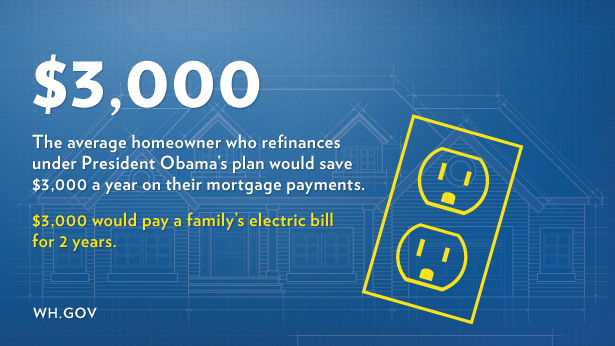
President Obama has proposed a plan that will cut through the red tape that’s keeping millions of responsible homeowners from saving hundreds of dollars each month through refinancing. On average, homeowners who refinance will save $3,000 each year—that’s enough to cover about two years of electric bills for the typical family.

That savings doesn’t just help homeowners. With a little extra money each month, our friends and neighbors will be able to do more for their families. That means stronger communities and a stronger national economy. President Obama has been traveling around the country, talking to families about the benefits of refinancing, and calling on Congress to take up his proposal that will help make sure more homeowners are able to take advantage of the savings it offers.

So even if you don't own a mortgage or don't need to refinance, it's important to add your voice. So speak out beside President Obama. Tell us why you support refinancing, and we'll make sure your story resonates here in Washington and around the country.

Tell us why you support refinancing.

Related Topics: Economy

The White House

Office of the Press Secretary

Notice -- Continuation of the National Emergency with Respect to the Actions and Policies of Certain Members of the Government of Belarus and Other Persons to Undermine Belarus Democratic Processes or Institutions

NOTICE
- - - - - - -
CONTINUATION OF THE NATIONAL EMERGENCY WITH RESPECT TO THE
ACTIONS AND POLICIES OF CERTAIN MEMBERS OF THE GOVERNMENT OF BELARUS AND OTHER PERSONS TO UNDERMINE BELARUS DEMOCRATIC PROCESSES OR INSTITUTIONS

On June 16, 2006, by Executive Order 13405, the President declared a national emergency and ordered related measures blocking the property of certain persons undermining democratic processes or institutions in Belarus, pursuant to the International Emergency Economic Powers Act (50 U.S.C. 1701-1706). The President took this action to deal with the unusual and extraordinary threat to the national security and foreign policy of the United States constituted by the actions and policies of certain members of the Government of Belarus and other persons to undermine Belarus democratic processes or institutions, to commit human rights abuses related to political repression, including detentions and disappearances, and to engage in public corruption, including by diverting or misusing Belarusian public assets or by misusing public authority.

In 2011, the Government of Belarus continued its crackdown against political opposition, civil society, and independent media. The government arbitrarily arrested, detained, and imprisoned citizens for criticizing officials or for participating in demonstrations; imprisoned at least one human rights activist on manufactured charges; and prevented independent media from disseminating information and materials. These actions show that the Government of Belarus has taken additional steps backward in the development of democratic governance and respect for human rights.

The actions and policies of certain members of the Government of Belarus and other persons continue to pose an unusual and extraordinary threat to the national security and foreign policy of the United States. Accordingly, the national emergency declared on June 16, 2006, and the measures adopted on that date to deal with that emergency, must continue in effect beyond June 16, 2012. Therefore, in accordance with section 202(d) of the National Emergencies Act (50 U.S.C. 1622(d)), I am continuing for 1 year the national emergency declared in Executive Order 13405.

This notice shall be published in the Federal Register and transmitted to the Congress.

BARACK OBAMA

The White House

Office of the Press Secretary

Letter -- Continuation of the National Emergency with Respect to the Actions and Policies of Certain Members of the Government of Belarus and Other Persons to Undermine Belarus Democratic Processes or Institutions

Dear Mr. Speaker: (Dear Mr. President:)

Section 202(d) of the National Emergencies Act (50 U.S.C. 1622(d)) provides for the automatic termination of a national emergency unless, within 90 days prior to the anniversary date of its declaration, the President publishes in the Federal Register and transmits to the Congress a notice stating that the emergency is to continue in effect beyond the anniversary date. In accordance with this provision, I have sent to the Federal Register for publication the enclosed notice stating that the national emergency and related measures blocking the property of certain persons undermining democratic processes or institutions in Belarus are to continue in effect beyond June 16, 2012.

In 2011, the Government of Belarus continued its crackdown against political opposition, civil society, and independent media. The government arbitrarily arrested, detained, and imprisoned citizens for criticizing officials or for participating in demonstrations; imprisoned at least one human rights activist on manufactured charges; and prevented independent media from disseminating information and materials. These actions show that the Government of Belarus has taken additional steps backward in the development of democratic governance and respect for human rights.

The actions and policies of certain members of the Government of Belarus and other persons to undermine Belarus democratic processes or institutions, to commit human rights abuses related to political repression, and to engage in public corruption continue to pose an unusual and extraordinary threat to the national security and foreign policy of the United States. For this reason, I have determined that it is necessary to continue the national emergency declared to deal with this threat and the related measures blocking the property of certain persons.

Sincerely,

BARACK OBAMA

The White House

Office of the Press Secretary

Fact Sheet: Obama Administration Accomplishments in Sub-Saharan Africa

“I see Africa as a fundamental part of our interconnected world – as partners with America on behalf of the future we want for all our children.  That partnership must be grounded in mutual responsibility and mutual respect.”

                                                                                                             President Barack Obama
                                                                                                            July 11, 2009,
                                                                                                            Accra, Ghana

The new U.S. Strategy Toward Sub-Saharan Africa, which is derived from a Presidential Policy Directive, builds on numerous accomplishments of U.S.-Africa policy to strengthen democratic institutions, promote regional peace and security, engage with young African leaders, and promote development, trade, and investment.  Some of these accomplishments are set forth in greater detail below:

• Engaged Young African Leaders Who Will Shape the Continent’s Future.  We have deepened our engagement with Africa’s next generation of leaders through the President’s Young African Leaders Initiative, the Obama Administration’s long-term program to engage those leaders who are actively promoting positive change in their communities.  This engagement began with the President’s Forum with Young African Leaders in 2010.  The First Lady’s Young African Women Leaders Forum was held in South Africa in June 2011, and, in June 2012, the State Department sponsored a Young African Leaders Innovation Summit and Mentoring Partnership that connects young African leaders with mentorship opportunities in the United States.  The President’s Young African Leaders Initiative, which seeks to provide tools to support leadership development, promote entrepreneurship, and connect young leaders with one another and the United States, has so far included more than 2,000 programs for young leaders across sub-Saharan Africa.

• Strengthened Democratic Institutions.  The United States has worked to strengthen democratic institutions in sub-Saharan Africa through high-level diplomatic engagement, institution building, and programs that develop the capacity of judiciaries, legislatures, media and civil society.  We have held governments accountable to their commitments to democratic principles and to their obligations under universal human rights norms, and we have spoken out when democratic processes have been subverted.  Examples of these efforts include:

Supported Democracy in Cote d’Ivoire.  The United States worked aggressively to resolve the crisis in Cote D’Ivoire and to support democracy. Immediately after election results were certified in December 2010, President Obama personally communicated to former President Laurent Gbagbo a choice between stepping down or facing greater isolation. When Gbagbo refused to leave office, the United States swiftly imposed sanctions on Gbagbo and his associates, and helped lead efforts with our European allies through the United Nations, and with African organizations like ECOWAS to pressure Gbagbo and support a democratic resolution that enabled the elected leader of Cote d’Ivoire – Alassane Ouattara – to take power. President Ouattara was inaugurated in May 2011, and was subsequently hosted by President Obama at the White House along with heads of state from two other emerging African democracies – Niger and Guinea – and another democracy that has made great progress, Benin.  The United States continues to work closely with the Government of Cote d’Ivoire and all Ivoirians as the country prioritizes reconciliation, economic recovery, and reform of the security sector.

Advanced Reform in Kenya.  The United States helped lead an international effort to support Kenya’s ambitious reform agenda developed in the wake of the 2007-8 post-election violence.  The President’s outreach to the Kenyan government and the Kenyan people, as well as the Vice President’s 2010 trip to Kenya, contributed to a credible national referendum in August 2010 and the historic adoption of a new constitution.  The United States continues to support efforts to deepen reform and to promote justice and reconciliation.

Launched the Open Government Partnership (OGP) We launched the OGP in 2011, with strong participation from African governments and civil society organizations, to advance government transparency and accountability worldwide.  South Africa is a founding member, and Ghana, Liberia, Tanzania, and Kenya have also joined.

• Advanced Peace and Security.  In Fiscal Year 2011, the United States provided $262 million in assistance to improve the overall professionalization of African militaries and to enhance their ability to better respond to challenges such as peacekeeping, maritime security, and counterterrorism.  Additionally, the United States provided, and continues to provide, significant support to peacekeeping operations across the continent, including the United Nations Organization Stabilization Mission in the Democratic Republic of the Congo (MONUSCO), the United Nations Mission in South Sudan (UNMISS), the African Union Mission in Somalia (AMISOM).  Through the U.S. National Action Plan on Women, Peace, and Security, we continue to advance efforts to strengthen women’s participation in peacebuilding and protect women from sexual and gender-based violence in conflict.  Examples of U.S. support to peace and security include:

Promoted Peace in Sudan.  The Obama Administration has built on U.S. leadership in international efforts to broker the 2005 Comprehensive Peace Agreement that ended decades of civil strife by galvanizing international support for the Comprehensive Peace Agreement’s (CPA) implementation.  Under the President’s direction, the United States launched an intense multilateral effort to keep the parties on the path of peace that ultimately culminated in an on-time and peaceful referendum on southern secession and the birth of the world’s newest nation, the Republic of South Sudan.  In December 2011 the United States hosted an international conference to garner support for the Republic of South Sudan’s development plans and to spur investment.  The United States remains fully engaged in supporting Sudan and South Sudan in reaching final agreement on outstanding post-CPA issues in order to achieve the international vision of two countries living side by side in peace.

Supported Regional Efforts to Help Communities Affected by the Lord’s Resistance Army (LRA).  The United States continues to pursue a comprehensive strategy, in partnership with the African Union and United Nations, to help the governments and people of central Africa in their efforts to end the threat posed by the LRA and to address the impacts of the LRA’s atrocities.  This includes working to protect local populations, promoting defections from the LRA’s ranks, and the deployment of a small number of U.S. forces to advise the national militaries in the region that are pursuing the LRA’s top commanders.  The United States is also funding programs to help affected communities employ strategies to address their security needs and to connect with one another using communications technologies.

- Strengthened AMISOM’s Efforts to Restore Stability in Somalia.  The United States has been a strong backer of AMISOM, providing training for its forces and supporting its expansion from 12,000 to 17,731 troops in recognition of its ongoing success against al-Shabaab.  As AMISOM continues to expand the reach of the Transitional Federal Government, the United States is committed to assisting the force meet the evolving operational, security, and humanitarian challenges as it seeks to bring real peace and stability to Somalia.

 Invested in Africa’s Sustainable Development.  The United States is investing in development partnerships across Africa to accelerate sustainable economic growth, promote food security, improve the capacity of countries and communities to respond to diseases and rebuild health systems, and to combat climate change.  These investments in smart development align with country-owned plans, include civil society and the private sector, and strategically deploy our assistance funding for maximal impact.  Examples of U.S. investments in sustainable development include:

Launched the Feed the Future Initiative.  Feed the Future supports country-driven approaches to address the root causes of hunger and poverty.  Through this Presidential initiative, the United States is investing in 12 African focus countries to drive inclusive agriculture-led growth encompassing improved agricultural productivity, expanded markets and trade, and increased economic resilience of vulnerable rural communities.  U.S. efforts work to unleash the proven potential of small-scale agricultural producers to deliver results on a large scale and are undertaken in support of Africa’s Comprehensive African Agriculture Development Program.  In 2012, the U.S. led the G-8 to launch the New Alliance for Food Security and Nutrition, a partnership between the G-8, African governments, the African Union, international partners, private investors, and civil society to substantially accelerate agricultural growth across the continent and help more than 50 million people emerge from poverty over the next ten years.

Launched the Global Health Initiative (GHI) The GHI is strengthening the U.S. government’s existing international health programs and building upon those programs to create integrated, coordinated, sustainable health systems with our partner countries.  The majority of U.S. investments to fight HIV/AIDS and malaria, and to improve maternal and child health, are focused in Africa.  The President’s Emergency Plan for AIDS Relief (PEPFAR) is leading prevention efforts and treating over 3.8 million people in Africa, has dramatically decreased HIV infections and improved life expectancy across the continent, and will support over 6 million people with lifesaving treatment by the end of 2013.  U.S. malaria and child survival efforts (including investments in the Global Alliance for Vaccines and Immunizations) are contributing to the historic reductions of child mortality seen in Senegal, Rwanda, Kenya and in other African states.

Launched the Global Climate Change Initiative (GCCI) Through the GCCI, we are helping African countries to better prepare for extreme weather and climate events, reduce deforestation in the Congo Basin and elsewhere in Africa, and develop clean and affordable energy systems.

Launched the Partnership for Growth (PFG).  The PFG puts into practice the principles of the President’s Policy Directive on Global Development, elevating sustainable, broad-based economic growth, transforming our partnership with countries demonstrating leadership and commitment to their own development progress, and investing in the next generation of emerging markets.  Two of the four countries selected for PFG – Ghana and Tanzania – are in Africa.

Promoted Economic Growth through the Millennium Challenge Corporation.  Since taking office, the Obama Administration has signed multi-year grant agreements with five sub-Saharan Africa countries, totaling over $1.3 billion in investments that seek to reduce poverty through economic growth. 

Responded to Humanitarian Crises and Disasters.  In fiscal year 2011, the United States Government provided over $2 billion in humanitarian funding to address food insecurity, food crises, and other natural and man-made disasters in Africa.  To assist in breaking the cycles of famine and the shocks from drought, especially following the 2011 crisis in the Horn of Africa, the Unites States Government, the Intergovernmental Authority on Development, and the international development community are partnering together to strengthen country drought preparedness, enhance resilience, and promote long-term solutions.  

 Promoted Trade and Investment.  The Export-Import Bank of the United States (Ex-Im Bank), for the first time in its history, approved projects totaling more than $1 billion in 2011 to support the exports of U.S. companies to sub-Saharan Africa.  Two of the nine countries in the world selected by Ex-Im Bank as priority strategic markets for U.S. exports – South Africa and Nigeria – are in sub-Saharan Africa.  In fiscal year 2011, the Overseas Private Investment Corporation (OPIC) supported over $1 billion in private-sector investments in Sub-Saharan Africa, representing over one-third of its total commitments for the year.  This is in addition to OPIC approving $367 million for four private equity funds that could mobilize an additional $1 billion for investments made in the health, agricultural, and small and medium enterprise sectors.  Examples of efforts to promote trade and investment with sub-Saharan Africa include:

African Growth and Opportunity Act (AGOA).  President Obama designated 40 sub-Saharan African countries to be eligible for AGOA benefits in 2012.

Strengthened Trade and Investment Engagement throughout Sub-Saharan Africa.  The United States currently has Trade and Investment Framework Agreements (TIFAs), agreements which provide strategic frameworks and principles for dialogue on trade and investment issues, with 11 countries or regional economic communities in sub-Saharan Africa, including Angola, Ghana, Liberia, Mauritius, Mozambique, Nigeria, Rwanda, South Africa, the Common Market for Eastern and Southern Africa, the EAC, and the West African Economic and Monetary Union.  Additionally, the Obama Administration is using bilateral investment treaties (BITs) as one of many tools to assist reform-minded African countries.

Trade and Investment Partnership with the East African Community (EAC).  During the June 2011 AGOA Forum in Lusaka, Zambia, the United States proposed a new partnership with the EAC to include the exploration of a regional investment treaty, creation of trade enhancing agreements in areas such as trade facilitation, and the development of stronger commercial engagement.

Introduced New U.S. Initiatives to Boost Trade and Investment Opportunities for Least Developed Countries in Sub-Saharan Africa.  In December 2011, the United States announced steps aimed at enabling Least Developed Country (LDC) members of the World Trade Organization (WTO), including a number from sub-Saharan Africa, to benefit more fully from global trade.  The United States will use a Development Credit Authority guarantee and public-private partnerships to drive private debt to investment funds and organizations that will make debt and equity investments in small- and medium-sized enterprises operating in agricultural value chains in West Africa.  In June 2011, the United States announced the new African Competitiveness and Trade Expansion (ACTE) Initiative to provide up to $120 million over four years to improve Africa’s capacity to produce and export competitive, value-added products, including those that can enter duty-free under AGOA, and to address supply-side constraints that impede African trade.  Finally, since the launch of the Aid for Trade initiative, the United States has provided over $9 million in assistance to support LDC accessions to the WTO.

The White House

Office of the Press Secretary

Fact Sheet: The New Strategy Toward Sub-Saharan Africa

Today the White House announced a new U.S. Strategy Toward Sub-Saharan Africa that provides a proactive and forward looking vision grounded in partnership.  The new strategy sets forth four strategic objectives, as described below, and commits the United States to elevate its efforts on the first two of these four pillars: strengthening democratic institutions and spurring economic growth, trade and investment.

• Strengthen Democratic Institutions:  The new strategy commits the United States to work to advance democracy by strengthening institutions at every level, supporting and building upon the aspirations throughout the continent for more open and accountable governance, promoting human rights and the rule of law, and challenging leaders whose actions threaten the credibility of democratic processes.  As the President said in Ghana, “Africa does not need strong men, it needs strong institutions.”

• Spur Economic Growth, Trade, and Investment:  Through greater focus, engagement, and the deployment of additional resources, the new strategy commits the United States to work to promote economic growth, including through increased trade and investment in sub-Saharan Africa.  The United States will promote an enabling environment for trade and investment; improve economic governance; promote regional integration; expand African capacity to effectively access and benefit from global markets; and encourage U.S. companies to trade with and invest in Africa.

• Advance Peace and Security:  The new strategy calls on the United States to deepen its security partnership with African countries and regional organizations to meet the basic security needs of its people.  Only Africa’s governments and people can sustainably resolve the security challenges and internal divisions that have plagued the continent, but the United States can make a positive difference. 

• Promote Opportunity and Development:  Nowhere in the world are our development efforts more central to our engagement as they are in Africa.  We will continue working to focus on sustainable development outcomes and the new operational model for U.S. development assistance outlined in the 2010 Presidential Policy on Global Development.

The White House

Office of the Press Secretary

Executive Order -- Accelerating Broadband Infrastructure Deployment

EXECUTIVE ORDER
- - - - - - -
ACCELERATING BROADBAND INFRASTRUCTURE DEPLOYMENT

By the authority vested in me as President by the Constitution and the laws of the United States of America, including section 301 of title 3, United States Code, and in order to facilitate broadband deployment on Federal lands, buildings, and rights of way, federally assisted highways, and tribal and individual Indian trust lands (tribal lands), particularly in underserved communities, it is hereby ordered as follows:

Section 1. Policy. Broadband access is essential to the Nation's global competitiveness in the 21st century, driving job creation, promoting innovation, and expanding markets for American businesses. Broadband access also affords public safety agencies the opportunity for greater levels of effectiveness and interoperability. While broadband infrastructure has been deployed in a vast majority of communities across the country, today too many areas still lack adequate access to this crucial resource. For these areas, decisions on access to Federal property and rights of way can be essential to the deployment of both wired and wireless broadband infrastructure. The Federal Government controls nearly 30 percent of all land in the United States, owns thousands of buildings, and provides substantial funding for State and local transportation infrastructure, creating significant opportunities for executive departments and agencies (agencies) to help expand broadband infrastructure.

Sec. 2. Broadband Deployment on Federal Property Working Group. (a) In order to ensure a coordinated and consistent approach in implementing agency procedures, requirements, and policies related to access to Federal lands, buildings, and rights of way, federally assisted highways, and tribal lands to advance broadband deployment, there is established a Broadband Deployment on Federal Property Working Group (Working Group), to be co-chaired by representatives designated by the Administrator of General Services and the Secretary of Homeland Security (Co-Chairs) from their respective agencies, in consultation with the Director of the Office of Science and Technology Policy (Director) and in coordination with the Chief Performance Officer (CPO).

(b) The Working Group shall be composed of:

(i) a representative from each of the following agencies, and the Co-Chairs, all of which have significant ownership of, or responsibility for managing, Federal lands, buildings, and rights of way, federally assisted highways, and tribal lands (Broadband Member Agencies):

(1) the Department of Defense;

(2) the Department of the Interior;

(3) the Department of Agriculture;

(4) the Department of Commerce;

(5) the Department of Transportation;

(6) the Department of Veterans Affairs; and

(7) the United States Postal Service;

(ii) a representative from each of the following agencies or offices, to provide advice and assistance:

(1) the Federal Communications Commission;

(2) the Council on Environmental Quality;

(3) the Advisory Council on Historic Preservation; and

(4) the National Security Staff; and

(iii) representatives from such other agencies or offices as the Co-Chairs may invite to participate.

(c) Within 1 year of the date of this order, the Working Group shall report to the Steering Committee on Federal Infrastructure Permitting and Review Process Improvement, established pursuant to Executive Order 13604 of March 22, 2012 (Improving Performance of Federal Permitting and Review of Infrastructure Projects), on the progress that has been made in implementing the actions mandated by sections 3 through 5 of this order.

Sec. 3. Coordinating Consistent and Efficient Federal Broadband Procedures, Requirements, and Policies. (a) Each Broadband Member Agency, following coordination with other Broadband Member Agencies and interested non-member agencies, shall:

(i) develop and implement a strategy to facilitate the timely and efficient deployment of broadband facilities on Federal lands, buildings, and rights of way, federally assisted highways, and tribal lands, that:

(1) ensures a consistent approach across the Federal Government that facilitates broadband deployment processes and decisions, including by: avoiding duplicative reviews; coordinating review processes; providing clear notice of all application and other requirements; ensuring consistent interpretation and application of all procedures, requirements, and policies; supporting decisions on deployment of broadband service to those living on tribal lands consistent with existing statutes, treaties, and trust responsibilities; and ensuring the public availability of current information on these matters;

(2) where beneficial and appropriate, includes procedures for coordination with State, local, and tribal governments, and other appropriate entities;

(3) is coordinated with appropriate external stakeholders, as determined by each Broadband Member Agency, prior to implementation; and

(4) is provided to the Co-Chairs within 180 days of the date of this order; and

(ii) provide comprehensive and current information on accessing Federal lands, buildings, and rights of way, federally assisted highways, and tribal lands for the deployment of broadband facilities, and develop strategies to increase the usefulness and accessibility of this information, including ensuring such information is available online and in a format that is compatible with appropriate Government websites, such as the Federal Infrastructure Projects Dashboard created pursuant to my memorandum of August 31, 2011 (Speeding Infrastructure Development Through More Efficient and Effective Permitting and Environmental Review).

(b) The activities conducted pursuant to subsection (a) of this section, particularly with respect to the establishment of timelines for permitting and review processes, shall be consistent with Executive Order 13604 and with the Federal Plan and Agency Plans to be developed pursuant to that order.

(c) The Co-Chairs, in consultation with the Director and in coordination with the CPO, shall coordinate, review, and monitor the development and implementation of the strategies required by paragraph (a)(i) of this section.

(d) Broadband Member Agencies may limit the information made available pursuant to paragraph (a)(ii) of this section as appropriate to accommodate national security, public safety, and privacy concerns.

Sec. 4. Contracts, Applications, and Permits. (a) Section 6409 of the Middle Class Tax Relief and Job Creation Act of 2012 (Public Law 112-96) contains provisions addressing access to Federal property for the deployment of wireless broadband facilities, including requirements that the General Services Administration (GSA) develop application forms, master contracts, and fees for such access. The GSA shall consult with the Working Group in developing these application forms, master contracts, and fees.

(b) To the extent not already addressed by section 6409, each Broadband Member Agency with responsibility for managing Federal lands, buildings, or rights of way (as determined by the Co-Chairs) shall, in coordination with the Working Group and within 1 year of the date of this order, develop and use one or more templates for uniform contract, application, and permit terms to facilitate nongovernment entities' use of Federal property for the deployment of broadband facilities. The templates shall, where appropriate, allow for access by multiple broadband service providers and public safety entities. To ensure a consistent approach across the Federal Government and different broadband technologies, the templates shall, to the extent practicable and efficient, provide equal access to Federal property for the deployment of wireline and wireless facilities.

Sec. 5. Deployment of Conduit for Broadband Facilities in Conjunction with Federal or Federally Assisted Highway Construction. (a) The installation of underground fiber conduit along highway and roadway rights of way can improve traffic flow and safety through implementation of intelligent transportation systems (ITS) and reduce the cost of future broadband deployment. Accordingly, within 1 year of the date of this order:

(i) the Department of Transportation, in consultation with the Working Group, shall review dig once requirements in its existing programs and implement a flexible set of best practices that can accommodate changes in broadband technology and minimize excavations consistent with competitive broadband deployment;

(ii) the Department of Transportation shall work with State and local governments to help them develop and implement best practices on such matters as establishing dig once requirements, effectively using private investment in State ITS infrastructure, determining fair market value for rights of way on federally assisted highways, and reestablishing any highway assets disturbed by installation;

(iii) the Department of the Interior and other Broadband Member Agencies with responsibility for federally owned highways and rights of way on tribal lands (as determined by the Co-Chairs) shall revise their procedures, requirements, and policies to include the use of dig once requirements and similar policies to encourage the deployment of broadband infrastructure in conjunction with Federal highway construction, as well as to provide for the reestablishment of any highway assets disturbed by installation;

(iv) the Department of Transportation, after outreach to relevant nonfederal stakeholders, shall review and, if necessary, revise its guidance to State departments of transportation on allowing for-profit or other entities to accommodate or construct, safely and securely maintain, and utilize broadband facilities on State and locally owned rights of way in order to reflect changes in broadband technologies and markets and to promote competitive broadband infrastructure deployment; and

(v) the Department of Transportation, in consultation with the Working Group and the American Association of State Highway and Transportation Officials, shall create an online platform that States and counties may use to aggregate and make publicly available their rights of way laws and joint occupancy guidelines and agreements.

(b) For the purposes of this section, the term "dig once requirements" means requirements designed to reduce the number and scale of repeated excavations for the installation and maintenance of broadband facilities in rights of way.

Sec. 6. General Provisions. (a) This order shall be implemented consistent with all applicable laws, treaties, and trust obligations, and subject to the availability of appropriations.

(b) Nothing in this order shall be construed to impair or otherwise affect:

(i) the authority granted by law to an executive department, agency, or the head thereof; or

(ii) the functions of the Director of the Office of Management and Budget relating to budgetary, administrative, or legislative proposals.

(c) Independent agencies are strongly encouraged to comply with this order.

(d) This order is not intended to, and does not, create any right or benefit, substantive or procedural, enforceable at law or in equity by any party against the United States, its departments, agencies, or entities, its officers, employees, or agents, or any other person.

BARACK OBAMA

President Obama Honors Israeli President Shimon Peres

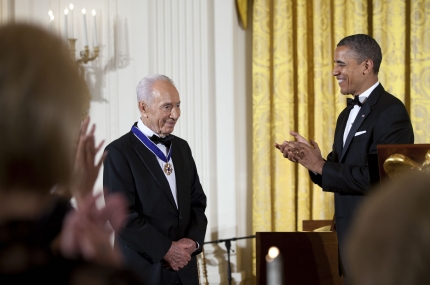
President Obama presents the Medal of Freedom to President Shimon Peres of Israel (June 13, 2012)

President Barack Obama presents the Presidential Medal of Freedom to President Shimon Peres of Israel during a ceremony and dinner in the East Room of the White House, June 13, 2012. (Official White House Photo by Pete Souza)

In a ceremony at the White House on Wednesday, President Obama awarded the Medal of Freedom to Shimon Peres, the President of Israel. 

“The man, the life that we honor tonight is nothing short of extraordinary,” President Obama said. 

Peres began his career in 1947, serving in the Haganah, the predecessor to the Israel Defense Force. He was elected to the Knesset at age 36. Through the course of the next half century, he twice served as Prime Minister and once as Acting Prime Minister. In 1994, he won the Nobel Peace Price with Yitzhak Rabin and Yasser Arafat. 

President Bill Clinton, Secretary of State Hilary Clinton, former Secretary of State Madeleine Albright (another honoree of the Medal of Freedom in 2012), and Elie Wiesel (another winner of the Nobel Peace Prize) were among those in attendance for the presentation. 

The Medal of Freedom was established by President Kennedy and is presented to those who have made "an especially meritorious contribution to the security or national interests of the United States, world peace, cultural or other significant public or private endeavors." 

President Peres joins an illustrious group of world leaders -- including Margaret Thatcher, Nelson Mandela, and Vaclav Havel -- who previously been presented with the medal. 

Watch.

Related Topics: Inside the White House

Honoring Fathers

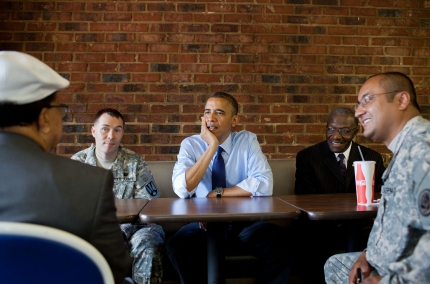
Yesterday, President Obama celebrated Father’s Day a little early with four dads at Kenny’s Barbeque Smokehouse in Northeast Washington, DC.  The four fathers, two active duty members of the military and two long-time local barbers from Mason’s Barbershop, talked about the rewards and challenges of fatherhood as well as the joy and anxiety fathers experience watching their children grow up.

President Barack Obama talks about the"Fatherhood Buzz" campaign at Kenny’s BBQ Smokehouse in Washington, D.C., June 13, 2012

President Barack Obama talks with four fathers participating in the new HHS "Fatherhood Buzz" campaign, as they wait for their lunch at Kenny’s BBQ Smokehouse in Washington, D.C., June 13, 2012. Joining the President, from left, are: Nurney Mason; 1st Lieutenant William Edwards of the U.S. Army; Otis Gamble; and CPT Joubert Paulino of the U.S Army. (Official White House Photo by Pete Souza)

The President talked about his support for military families along with the First Lady and Dr. Jill Biden through Joining Forces. The President also discussed “Fatherhood Buzz,” a new initiative in conjunction with the U.S. Department of Health and Human Services designed to reach out to dads with positive information through their barbers and barber shops, as part of the Administration’s longstanding Fatherhood and Mentoring Initiative.  Each quarter will feature a different “buzz” topic – the topic for the first quarter is financial literacy and job training. The initiative is taking place across the country this weekend, including at Mason’s Barber Shop on H Street Northeast in Washington, DC. Nurney Mason, who joined the President for lunch today, has operated Mason’s Barber shop for over 51 years. 

Joshua DuBois is Special Assistant to President Obama and Executive Director of the White House Office of Faith-Based and Neighborhood Partnerships

The White House

Office of the Press Secretary

Presidential Proclamation -- World Elder Abuse Awareness Day, 2012

WORLD ELDER ABUSE AWARENESS DAY, 2012

- - - - - - -

BY THE PRESIDENT OF THE UNITED STATES OF AMERICA

A PROCLAMATION


Every American deserves the chance to live out the full measure of their days in health and security.  Yet, every year, millions of older Americans are denied that most basic opportunity due to abuse, neglect, or exploitation.  On World Elder Abuse Awareness Day, we call attention to this global public health issue, and we rededicate ourselves to providing our elders the care and protection they deserve.

Victims of elder abuse are parents and grandparents, neighbors and friends.  Elder abuse cuts across race, gender, culture, and circumstance, and whether physical, emotional, or financial, it takes an unacceptable toll on individuals and families across our Nation.  Seniors who experience abuse or neglect face a heightened risk of health complications and premature death, while financial exploitation can rob men and women of the security they have built over a lifetime.  Tragically, many older Americans suffer in silence, burdened by fear, shame, or impairments that prevent them from speaking out about abuse.

We owe it to our seniors to expose elder abuse wherever we find it and take action to bring it to an end.  Two years ago, I was proud to sign the Elder Justice Act, which was included in the Affordable Care Act, and marked a major step forward in the fight against elder abuse, neglect, and exploitation.  With the Department of Health and Human Services, we are partnering with State and local authorities to ensure seniors can live their lives with dignity and independence.  With the Consumer Financial Protection Bureau, we are working to empower older Americans with tools and information to navigate safely through financial challenges.  And with the Department of Justice, we are protecting older Americans by prosecuting those who would target and exploit them.

Every day, State and local agencies, protective services professionals, law enforcement officers, private and non profit organizations, and leaders throughout our communities help protect older Americans from abuse and provide care to those who have already been affected.  Together, all of us can play a role in addressing this public health crisis that puts millions at risk.  Today, let us keep faith with a generation of Americans by speaking out against elder abuse, advancing justice for victims, and building a Nation that preserves and protects the well being of all who call it home.

NOW, THEREFORE, I, BARACK OBAMA, President of the United States of America, by virtue of the authority vested in me by the Constitution and the laws of the United States, do hereby proclaim June 15, 2012, as World Elder Abuse Awareness Day.  I call upon all Americans to observe this day by learning the signs of elder abuse, neglect, and exploitation, and by raising awareness about this public health issue.

IN WITNESS WHEREOF, I have hereunto set my hand this fourteenth day of June, in the year of our Lord two thousand twelve, and of the Independence of the United States of America the two hundred and thirty-sixth.


BARACK OBAMA

Itzhak Perlman Performs at the White House

June 13, 2012 | 6:09 | Public Domain

Itzhak Perlman performs at the White House during a dinner in honor of President Shimon Peres of Israel.

Download mp4 (217MB) | mp3 (14MB)