The White House

Office of the Press Secretary

President Obama Announces Another Key Administration Post

WASHINGTON – Today, President Barack Obama announced his intent to nominate the following individual to a key Administration post:

• Captain Sean Sullivan – Member, Defense Nuclear Facilities Safety Board

President Obama announced his intent to nominate the following individual to a key Administration post:

Captain Sean Sullivan, Nominee for Member, Defense Nuclear Facilities Safety Board
Captain Sean Sullivan, USN (ret), currently serves as a project manager and analyst for Sonalysts, a position he has held since June 2011.   From 2006 to 2011, he practiced law as a general civil litigation attorney at Brown Jacobson, P.C.   Captain Sullivan retired from the Navy in 2006 after 26 years of service.  He was a Submarine Officer and, from 2004 to 2006, the Base Commanding Officer of the Naval Submarine Base New London. Captain Sullivan earned a B.S. in Marine Engineering from the U.S. Naval Academy, an M.A. in National Security Studies from the Naval War College, and a J.D. from the University of Connecticut.

Celebrating the 50th Anniversary of To Kill A Mockingbird on Film

April 26, 2012 | 3:07 | Public Domain

President Obama hosted a film screening of To Kill a Mockingbird in the Family Theater at The White House to commemorate its 50th anniversary with guests including local students from Washington-Lee High School, Mary Badham Wilt, the actress who played Scout, and Veronique Peck, widow of Gregory Peck who played Atticus Finch. The President also acknowledged the American Film Institute for their commitment to the fine arts and NBC Universal and USA Network for their efforts to commemorate this important film.

Download mp4 (194.2MB)

Regional Roundup – “You are the Economy”

Yesterday, President Obama traveled to the University of Iowa where he held a roundtable with a few Hawkeyes who receive Stafford federal student loans. Following the roundtable he spoke to a larger crowd of students about the importance of keeping these interest rates from doubling on July 1. Rates are set to spike on July 1 in Congress doesn’t act. And for each year Congress allows the rate to double, the average student with these loans will rack up an additional $1,000 in debt. That’s unacceptable. He’ll continue to fight to keep these rates low and he’ll continue to fight to create an economy that’s built to last. Keeping these rates low is not only good for students, it’s good for the economy.

As the President told students yesterday, “You are the economy.  If you’ve got skills, if you’ve got talents, if you’re starting a business, if companies are locating here in Iowa because it’s got a well-trained workforce, that’s the economy. That’s how we’re going to compete. Making sure our next generation earns the best education possible is exactly America’s business.” 

It’s time for Congress to act. Higher education shouldn’t be a luxury, it’s an economic imperative that every family should be able to afford. 

Over the past few days Republicans started to climb on board with this idea. That’s a good sign. They still support a budget that could cut sharply the Pell Grant for millions of students, and could eliminate access to work-study job opportunities for one hundred thousand students by 2014 in order to fund tax cuts for millionaires and billionaires. But, it’s good news that they’re coming around to prevent these interest rates from doubling.

Now, leaders in Washington simply need to work together to get this done in a responsible way. Students can’t afford to be saddled additional debt because their elected officials in Washington continue to fight political battles. No more games. No more political posturing. Washington needs to work together on behalf of millions of students all across the country.

Let’s take a look at today's front pages in Iowa:

The White House

Office of the Press Secretary

President Obama Names Presidential Medal of Freedom Recipients

WASHINGTON – Today, President Barack Obama named thirteen recipients of the Presidential Medal of Freedom.  The Medal of Freedom is the Nation’s highest civilian honor, presented to individuals who have made especially meritorious contributions to the security or national interests of the United States, to world peace, or to cultural or other significant public or private endeavors.  The awards will be presented at the White House in late spring.

President Obama said, “These extraordinary honorees come from different backgrounds and different walks of life, but each of them has made a lasting contribution to the life of our Nation.  They’ve challenged us, they’ve inspired us, and they’ve made the world a better place.  I look forward to recognizing them with this award.”

The following individuals will be awarded the Presidential Medal of Freedom:

Madeleine Albright
From 1997 to 2001, under President William J. Clinton, Albright served as the 64th United States Secretary of State, the first woman to hold that position.  During her tenure, she worked to enlarge NATO and helped lead the Alliance’s campaign against terror and ethnic cleansing in the Balkans, pursued peace in the Middle East and Africa, sought to reduce the dangerous spread of nuclear weapons, and was a champion of democracy, human rights, and good governance across the globe.  From 1993 to 1997, she was America’s Permanent Representative to the United Nations.  Since leaving office, she founded the Albright Stonebridge Group and Albright Capital Management, returned to teaching at Georgetown University, and authored five books.  Albright chairs the National Democratic Institute and is President of the Harry S. Truman Scholarship Foundation.

John Doar
Doar was a legendary public servant and leader of federal efforts to protect and enforce civil rights during the 1960s.  He served as Assistant Attorney General in charge of the Civil Rights Division of the Department of Justice.  In that capacity, he was instrumental during many major civil rights crises, including singlehandedly preventing a riot in Jackson, Mississippi, following the funeral of slain civil rights leader Medgar Evars in 1963.  Doar brought notable civil rights cases, including obtaining convictions for the 1964 killings of three civil rights workers in Neshoba County, Mississippi, and leading the effort to enforce the right to vote and implement the Voting Rights Act of 1965.  He later served as Special Counsel to the U.S. House Committee on the Judiciary as it investigated the Watergate scandal and considered articles of impeachment against President Nixon.  Doar continues to practice law at Doar Rieck Kaley & Mack in New York.

Bob Dylan
One of the most influential American musicians of the 20th century, Dylan released his first album in 1962.  Known for his rich and poetic lyrics, his work had considerable influence on the civil rights movement of the 1960s and has had significant impact on American culture over the past five decades.  He has won 11 Grammys, including a lifetime achievement award.  He was named a Commandeur dans l'Ordre des Art et des Lettres and has received a Pulitzer Prize Special Citation.  Dylan was awarded the 2009 National Medal of Arts.  He has written more than 600 songs, and his songs have been recorded more than 3,000 times by other artists.  He continues recording and touring around the world today.

William Foege
A physician and epidemiologist, Foege helped lead the successful campaign to eradicate smallpox in the 1970s.  He was appointed Director of the Centers for Disease Control and Prevention in 1977 and, with colleagues, founded the Task Force for Child Survival in 1984.  Foege became Executive Director of The Carter Center in 1986 and continues to serve the organization as a Senior Fellow.  He helped shape the global health work of the Bill and Melinda Gates Foundation, and remains a champion of a wide array of issues, including child survival and development, injury prevention, and preventative medicine.  Foege’s leadership has contributed significantly to increased awareness and action on global health issues, and his enthusiasm, energy, and effectiveness in these endeavors have inspired a generation of leaders in public health.

John Glenn
Glenn is a former United States Marine Corps pilot, astronaut, and United States Senator.  In 1962, he was the third American in space and the first American to orbit the Earth.  After retiring from the Marine Corps, Glenn was elected to the U.S. Senate in Ohio in 1974. He was an architect and sponsor of the 1978 Nonproliferation Act and served as Chairman of the Senate Government Affairs committee from 1987 until 1995.  In 1998, Glenn became the oldest person to visit space at the age of 77. He retired from the Senate in 1999. Glenn is a recipient of the Congressional Gold Medal and the Congressional Space Medal of Honor.

Gordon Hirabayashi
Hirabayashi openly defied the forced relocation and internment of Japanese Americans during World War II.  As an undergraduate at the University of Washington, he refused the order to report for evacuation to an internment camp, instead turning himself in to the FBI to assert his belief that these practices were racially discriminatory.  Consequently, he was convicted by a U.S. Federal District Court in Seattle of defying the exclusion order and violating curfew.  Hirabayashi appealed his conviction all the way to the U.S. Supreme Court, which ruled against him in 1943.  Following World War II and his time in prison, Hirabayashi obtained his doctoral degree in sociology and became a professor.  In 1987, his conviction was overturned by the U.S. Court of Appeals for the Ninth Circuit.  Hirabayashi died on January 2, 2012.

Dolores Huerta
Huerta is a civil rights, workers, and women’s advocate. With Cesar Chavez, she co-founded the National Farmworkers Association in 1962, which later became the United Farm Workers of America.  Huerta has served as a community activist and a political organizer, and was influential in securing the passage of California’s Agricultural Labor Relations Act of 1975, and disability insurance for farmworkers in California.  In 2002, she founded the Dolores Huerta Foundation, an organization dedicated to developing community organizers and national leaders.  In 1998, President Clinton awarded her the Eleanor Roosevelt Award for Human Rights.

Jan Karski
Karski served as an officer in the Polish Underground during World War II and carried among the first eye-witness accounts of the Holocaust to the world.  He worked as a courier, entering the Warsaw ghetto and the Nazi Izbica transit camp, where he saw first-hand the atrocities occurring under Nazi occupation.  Karski later traveled to London to meet with the Polish government-in-exile and with British government officials.  He subsequently traveled to the United States and met with President Roosevelt.  Karski published Story of a Secret State, earned a Ph.D at Georgetown University, and became a professor at Georgetown’s School of Foreign Service.  Born in 1914, Karski became a U.S. citizen in 1954 and died in 2000.

Juliette Gordon Low
Born in 1860, Low founded the Girl Scouts in 1912.  The organization strives to teach girls self-reliance and resourcefulness.  It also encourages girls to seek fulfillment in the professional world and to become active citizens in their communities.  Since 1912, the Girl Scouts has grown into the largest educational organization for girls and has had over 50 million members.  Low died in 1927.  This year, the Girl Scouts celebrate their 100th Anniversary, calling 2012 “The Year of the Girl.”

Toni Morrison
One of our nation’s most celebrated novelists, Morrison is renowned for works such as Song of Solomon, Jazz, and Beloved, for which she won a Pulitzer Prize in 1988.  When she became the first African American woman to win a Nobel Prize in 1993, Morrison’s citation captured her as an author “who in novels characterized by visionary force and poetic import, gives life to an essential aspect of American reality.”  She created the Princeton Atelier at Princeton University to convene artists and students.  Morrison continues to write today. 

Shimon Peres
An ardent advocate for Israel's security and for peace, Shimon Peres was elected the ninth President of Israel in 2007.  First elected to the Knesset in 1959, he has served in a variety of positions throughout the Israeli government, including in twelve Cabinets as Foreign Minister, Minister of Defense, and Minister of Transport and Communications.  Peres served as Prime Minister from 1984-1986 and 1995-1996.  Along with Israeli Prime Minister Yitzhak Rabin and then-PLO Chairman Yasser Arafat, Peres won the 1994 Nobel Peace Prize for his work as Foreign Minister during the Middle East peace talks that led to the Oslo Accords. Through his life and work, he has strengthened the unbreakable bonds between Israel and the United States.

John Paul Stevens
Stevens served as an Associate Justice of the U.S. Supreme Court from 1975 to 2010, when he retired as the third longest-serving Justice in the Court’s history.  Known for his independent, pragmatic and rigorous approach to judging, Justice Stevens and his work have left a lasting imprint on the law in areas such as civil rights, the First Amendment, the death penalty, administrative law, and the separation of powers.  He was nominated to the Supreme Court by President Gerald Ford, and previously served as a judge on the U.S. Court of Appeals for the Seventh Circuit.  Stevens is a veteran of World War II, in which he served as a naval intelligence officer and was awarded the Bronze Star.

Pat Summitt
In addition to accomplishing an outstanding career as the all-time winningest leader among all NCAA basketball coaches, Summitt has taken the University of Tennessee to more Final Four appearances than any other coach and has the second best record of NCAA Championships in basketball.  She has received numerous awards, including being named Naismith Women’s Collegiate Coach of the Century.  Off the court, she has been a spokesperson against Alzheimer's.  The Pat Summitt Foundation will make grants to nonprofits to provide education and awareness, support to patients and families, and research to prevent, cure and ultimately eradicate early onset dementia, Alzheimer’s type.

The White House

Office of the Press Secretary

Statement by the President on Israeli Independence Day

Sixty-four years ago, the United States became the first country in the world to recognize the State of Israel--the realization of a modern day state in the historic homeland of the Jewish People.  Since that momentous day, the special bond of friendship between the United States and Israel has grown stronger.  Ours is a unique relationship founded on an unbreakable commitment to Israel’s security, and anchored by our common interests and deeply held values.  These values continue to enlighten and guide our efforts as we work with Israel, as well as with others in the region, to confront shared challenges and to achieve a just and comprehensive peace based on a two-state solution that will usher in a future of peace, security, and dignity for the people of Israel and its neighbors.

Today, as Israelis celebrate their 64th Independence Day and their remarkable achievements over the past six decades, it gives me great pleasure to extend my best wishes, and the best wishes of the American people, to President Peres, Prime Minister Netanyahu, and the people of Israel.

The White House

Office of the Press Secretary

Presidential Nominations Sent to the Senate

NOMINATIONS SENT TO THE SENATE:

Terrence G. Berg, of Michigan, to be United States District Judge for the Eastern District of Michigan, vice Arthur J. Tarnow, retired.

Jesus G. Bernal, of California, to be United States District Judge for the Central District of California, vice Stephen G. Larson, resigned.

Charles R. Breyer, of California, to be a Member of the United States Sentencing Commission for a term expiring October 31, 2015, vice Ruben Castillo, term expired.

Shelly Deckert Dick, of Louisiana, to be United States District Judge for the Middle District of Louisiana, vice Ralph E. Tyson, deceased.

Lorna G. Schofield, of New York, to be United States District Judge for the Southern District of New York, vice Shira A. Scheindlin, retired.

President Obama Speaks to Students in Iowa about Student Loan Rates

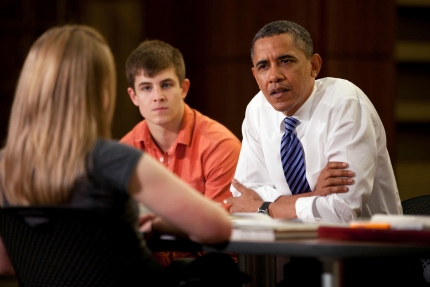
President Barack Obama Listens to Senior Marissa Boles During a Roundtable Discussion

President Barack Obama listens to senior Marissa Boles during a roundtable discussion with students currently receiving Stafford federal student loans at the University of Iowa in Iowa City, April 25, 2012. Also participating in the discussion were students Blake Anderson, center, Myranda Burnett, Jordan Garrsion-Nickerson and Martin Lopez. (Official White House Photo by Chuck Kennedy)

President Obama wrapped up a three-city tour in Iowa today by speaking to students at the University of Iowa about the best tool they’ve got for achieving the American promise: a college education.

This country has always made a commitment to put a good education within the reach of everybody who's willing to work for it. That’s part of what made us special. That’s what kept us at the forefront of business and science and technology and medicine. That’s a commitment that we need to reaffirm today.  

Now, here's the challenge we've got. Since most of you were born, tuition and fees at America’s colleges have more than doubled. And that forces students like you to take out more loans and rack up more debt. The average student who borrows to pay for college now graduates with about $25,000 in student loan debt. And in this state, it’s even higher. Americans now owe more on their student loans than they owe on credit cards.

And living with that debt means you’ve got to make some pretty tough choices. It might mean putting off buying a first home or chasing that great startup idea that you’ve got. Maybe you’ll have to wait a little bit longer to start a family or save for retirement. And when a big chunk of every paycheck goes towards loan debt, that’s not just tough on you, that’s not just tough on middle-class families -- that’s not good for our economy, because that money that could be going into businesses is going just to service debt.

To make matters worse, interest rates on federal Stafford loans are set to double in July, saddling more than 7 million students with an additional $1,000 in debt. Congress has the power to stop this from happening, however, and as he did in North Carolina and Colorado earlier this week, the President asked students to tell their members of Congress one thing: Don’t Double My Rate.

Raise your voice and reach out to your networks if you agree that student loan rates should not double on July 1.

The White House

Office of the Press Secretary

President Obama Nominates Four to Serve on the US District Court

WASHINGTON, DC – Today, President Obama nominated Terrence G. Berg, Jesus G. Bernal, Shelly Deckert Dick and Lorna G. Schofield to serve on the United States District Court.

“I am honored to put forward these highly qualified candidates for the federal bench,” President Obama said.  “They will be distinguished public servants and valuable additions to the United States District Court.”

Terrence G. Berg:  Nominee for the United States District Court for the Eastern District of Michigan
Terrence G. Berg has been an Assistant United States Attorney in the Eastern District of Michigan since 1989, apart from a four-year stint from 1999 to 2003 when he served as Chief of the High Tech Crime Unit at the Michigan Department of the Attorney General.  From 2008 until 2010, Berg served as interim United States Attorney and in 2010 he was detailed to be Acting First Assistant United States Attorney in the Middle District of Georgia.  Since 2011, Berg has been detailed to the Professional Misconduct Review Unit, which is part of the Office of the Deputy Attorney General at the United States Department of Justice.  Berg began his legal career as an associate at the law firm of Debevoise & Plimpton, from 1987 to 1989, and as a law clerk to the Honorable Anthony A. Alaimo of the United States District Court for the Southern District of Georgia, from 1986 to 1987.  He received his J.D. cum laude in 1986 from the Georgetown University Law Center and his B.S. magna cum laude from Georgetown University in 1981.

Jesus G. Bernal:  Nominee for the United States District Court for the Central District of California
Jesus G. Bernal has been a Deputy Federal Public Defender in the Central District of California since 1996.  From 1996 to 2006, he worked in the Los Angeles office and, since 2006, he has served as the Directing Attorney of the Riverside office.  Previously, Bernal worked for almost five years as a litigation associate at the law firm of Heller, Ehrman, White & McAuliffe LLP in Los Angeles, focusing primarily on complex civil litigation.  He began his legal career as a law clerk to the Honorable David V. Kenyon of the Central District of California from 1989 to 1991.  Bernal received his J.D. in 1989 from Stanford Law School and his B.A. cum laude in 1986 from Yale University.       

Shelly Deckert Dick:  Nominee for the United States District Court for the Middle District of Louisiana
Shelly Deckert Dick is a partner in the law firm of Forrester, Dick & Clark in Baton Rouge, Louisiana.  She has been a litigator in private practice for nearly all of her 24-year legal career, handling a wide array of cases in both state and federal courts as well as before administrative tribunals.  Since 2008, Dick has also served as an Ad Hoc Hearing Officer appointed by the Louisiana Workforce Commission to hear worker’s compensation cases and other administrative matters.  From 1988 to 1994, she worked at the law firm of Gary, Field, Landry and Dornier.  Dick received her J.D. in 1988 from the Louisiana State University Paul M. Hebert Law Center and her B.S. cum laude in 1981 from the University of Texas.

Lorna G. Schofield:  Nominee for the United States District Court for the Southern District of New York
Lorna G. Schofield has been affiliated with the law firm of Debevoise & Plimpton LLP in New York City since 1988, focusing her practice on complex civil litigation and white collar criminal defense.  She joined the firm as an associate in 1988, was promoted to partner in 1991, and became of counsel earlier this year.  Prior to joining the firm, Schofield served for four years as an Assistant United States Attorney in the Southern District of New York, where her significant cases involved prosecuting domestic terrorism, arms smuggling, and tax fraud.  From 1981 to 1984, she was an associate at the law firm of Cleary, Gottlieb, Steen & Hamilton.  Throughout her legal career, Schofield has been heavily involved with the American Bar Association, holding many leadership positions including Chair of the Section of Litigation.  Schofield received her J.D. in 1981 from the New York University School of Law and her B.A. in 1977 from Indiana University.

The White House

Office of the Press Secretary

President Obama Nominates Judge Charles R. Breyer to Serve on the US Sentencing Commission

WASHINGTON, DC – Today, President Obama nominated Terrence G. Berg, Jesus G. Bernal, Shelly Deckert Dick and Lorna G. Schofield to serve on the United States District Court.

“I am honored to put forward these highly qualified candidates for the federal bench,” President Obama said.  “They will be distinguished public servants and valuable additions to the United States District Court.”

Terrence G. Berg:  Nominee for the United States District Court for the Eastern District of Michigan
Terrence G. Berg has been an Assistant United States Attorney in the Eastern District of Michigan since 1989, apart from a four-year stint from 1999 to 2003 when he served as Chief of the High Tech Crime Unit at the Michigan Department of the Attorney General.  From 2008 until 2010, Berg served as interim United States Attorney and in 2010 he was detailed to be Acting First Assistant United States Attorney in the Middle District of Georgia.  Since 2011, Berg has been detailed to the Professional Misconduct Review Unit, which is part of the Office of the Deputy Attorney General at the United States Department of Justice.  Berg began his legal career as an associate at the law firm of Debevoise & Plimpton, from 1987 to 1989, and as a law clerk to the Honorable Anthony A. Alaimo of the United States District Court for the Southern District of Georgia, from 1986 to 1987.  He received his J.D. cum laude in 1986 from the Georgetown University Law Center and his B.S. magna cum laude from Georgetown University in 1981.

Jesus G. Bernal:  Nominee for the United States District Court for the Central District of California
Jesus G. Bernal has been a Deputy Federal Public Defender in the Central District of California since 1996.  From 1996 to 2006, he worked in the Los Angeles office and, since 2006, he has served as the Directing Attorney of the Riverside office.  Previously, Bernal worked for almost five years as a litigation associate at the law firm of Heller, Ehrman, White & McAuliffe LLP in Los Angeles, focusing primarily on complex civil litigation.  He began his legal career as a law clerk to the Honorable David V. Kenyon of the Central District of California from 1989 to 1991.  Bernal received his J.D. in 1989 from Stanford Law School and his B.A. cum laude in 1986 from Yale University.       

Shelly Deckert Dick:  Nominee for the United States District Court for the Middle District of Louisiana
Shelly Deckert Dick is a partner in the law firm of Forrester, Dick & Clark in Baton Rouge, Louisiana.  She has been a litigator in private practice for nearly all of her 24-year legal career, handling a wide array of cases in both state and federal courts as well as before administrative tribunals.  Since 2008, Dick has also served as an Ad Hoc Hearing Officer appointed by the Louisiana Workforce Commission to hear worker’s compensation cases and other administrative matters.  From 1988 to 1994, she worked at the law firm of Gary, Field, Landry and Dornier.  Dick received her J.D. in 1988 from the Louisiana State University Paul M. Hebert Law Center and her B.S. cum laude in 1981 from the University of Texas.

Lorna G. Schofield:  Nominee for the United States District Court for the Southern District of New York
Lorna G. Schofield has been affiliated with the law firm of Debevoise & Plimpton LLP in New York City since 1988, focusing her practice on complex civil litigation and white collar criminal defense.  She joined the firm as an associate in 1988, was promoted to partner in 1991, and became of counsel earlier this year.  Prior to joining the firm, Schofield served for four years as an Assistant United States Attorney in the Southern District of New York, where her significant cases involved prosecuting domestic terrorism, arms smuggling, and tax fraud.  From 1981 to 1984, she was an associate at the law firm of Cleary, Gottlieb, Steen & Hamilton.  Throughout her legal career, Schofield has been heavily involved with the American Bar Association, holding many leadership positions including Chair of the Section of Litigation.  Schofield received her J.D. in 1981 from the New York University School of Law and her B.A. in 1977 from Indiana University.

The White House

Office of the Press Secretary

Remarks by the President on College Affordability

University of Iowa
Iowa City, Iowa

1:28 P.M. CDT

THE PRESIDENT:  Hello, Hawkeyes!  (Applause.)  It is good to be back in Iowa!  (Applause.)  Can folks please give it up for Blake for that outstanding introduction?  (Applause.)  And I want to thank the University of Iowa Pep Band for firing everybody up. (Applause.) 

There is some good hospitality here, and I should know.  I spent a little time here in Iowa, spent a little time here in Iowa City.  I’m glad that my hometown of Chicago will get to return the hospitality when your football team kicks off its season at Soldier Field.  (Applause.)

I want to thank a couple guests -- first of all, your Congressman, Dave Loebsack, is here.  (Applause.)  Attorney General Tom Miller.  (Applause.)  State Treasurer Mike Fitzgerald.  (Applause.)  Your Mayor, Matt Hayek.  (Applause.)   The President of the University of Iowa, Sally Mason.  (Applause.)

So I have come to the University of Iowa to talk a little bit about you and some of the issues you guys are dealing with every single day.  Now, I believe that college isn’t just the best investment that you can make in your future -- it’s the best investment you can make in your country’s future.  And I'm proud of all of you for making that investment -- because it’s never been more important.  (Applause.)

In today’s economy, there's no greater predictor of individual success than a good education.  That's at the top.  Right now, the unemployment rate for Americans with a college degree or more is about half the national average.  Their incomes are twice as high as those who don’t have a high school diploma. A higher education is the single clearest path to the middle class.

I know that those of you who are about to graduate are wondering what’s in store for your future -- because not even four years ago, just as the global economy was about to enter into freefall, you were still trying to find your way around campus, and now, four years later, you're looking at what it means when you leave this campus. 

The good news is, today our economy is recovering.  That's the good news.  (Applause.)  But I'll be honest with you.  It has not yet fully healed from the worst economic crisis since the Great Depression.  Our businesses have added more than 4 million jobs over the past two years.  (Applause.)  But there's still a lot of Americans who are out there looking for a job or at least finding a job that pays the bills and helps cover the mortgage.  There's still too many families who don't have that security, that basic middle-class security that started slipping away even before this crisis hit.

But what I want all of you to know is that the degree you earn from Iowa will be the best tool you have to achieve that basic American promise -- the idea that if you work hard, if you give it your all, if you're responsible, then you can do well enough to raise a family and own a home, send your own kids to college, put a little away for retirement.  It’s the idea that each generation is going to have a little more opportunity than the last.  (Applause.)  That’s at the heart of the American Dream. 

And I can tell you, as a parent now, when I see Malia and Sasha doing well, there's nothing more important to me.  And that’s true for American families everywhere, and it's the hope your parents have for you.  That’s the hope you'll have some day for your own kids.  And keeping that promise alive is the defining issue of our time.  I don’t want this a country -- I don’t want this to be a country where a shrinking number of people are doing really, really well, and then a growing number are barely able to get by.  I don’t want that future for you.  I don’t want it for my daughters.  I don’t want it for America.  (Applause.) 

I want this forever to be a country where everybody gets a fair shot, and everybody is doing their fair share, and everybody is playing by the same set of rules.  (Applause.)  That’s the America I know.  That’s the America I love.  And that’s the America within our reach if we work for it.  (Applause.)

And this is personal for me -- 

AUDIENCE MEMBER:  We love you, Barack!

THE PRESIDENT:  I love you back.  (Applause.)  I love you guys, and I believe in you guys -- that’s the most important thing.  I believe in you.  And I believe in your future.  (Applause.)

And I think about my own life.  My grandfather had the chance to go to college because this country decided that every returning veteran of World War II should be able to afford it through the GI Bill.  (Applause.)  My mom was a single mom -- my dad wasn't around -- and she raised two kids by herself with some help from my grandparents because she was able to get grants and work her way through school.  And I'm only here today, and Michelle is only where she is today, because scholarships and student loans gave us a shot at a great education.  That’s how we succeeded.  (Applause.)

This country has always made a commitment to put a good education within the reach of everybody who's willing to work for it.  That’s part of what made us special.  That’s what kept us at the forefront of business and science and technology and medicine.  That’s a commitment that we need to reaffirm today.  

Now, here's the challenge we've got.  Since most of you were born, tuition and fees at America’s colleges have more than doubled.  And that forces students like you to take out more loans and rack up more debt.  The average student who borrows to pay for college now graduates with about $25,000 in student loan debt.  And in this state, it’s even higher.  Americans now owe more on their student loans than they owe on credit cards.

And living with that debt means you’ve got to make some pretty tough choices.  It might mean putting off buying a first home or chasing that great startup idea that you’ve got.  Maybe you’ll have to wait a little bit longer to start a family or save for retirement.  And when a big chunk of every paycheck goes towards loan debt, that’s not just tough on you, that’s not just tough on middle-class families -- that’s not good for our economy, because that money that could be going into businesses is going just to service debt.

And as I said, this is personal for me.  I know something about this, because Michelle and I, we went through it.  And it wasn’t that long ago.  We’ve been in your shoes.  We didn’t come from wealthy families.  We needed loans and we needed grants to get our way through.  (Applause.)

And that meant that when Michelle and I graduated from college and law school, we had a mountain of debt.  When we got married, we got poorer together.  (Laughter.)  So we combined our assets and they were zero.  (Laughter.)  Then we combined our liabilities and they were a lot.  (Laughter.)  So we ended up paying more for our student loans in the first few years that we were married than we paid on our mortgage each month when we finally bought a small condo.  And we were lucky to land good jobs with a steady income, but we only finished paying off our student loans about eight years ago.  Think about that.  I’m the President of the United States -- (laughter) -- it was only about eight years ago that we finished paying off our student loans.  (Applause.)

And let me tell you, it wasn’t easy making those payments, because once we had Malia and Sasha, we’re trying to save for their college education even as we’re paying off our own college educations. 

So this is personal.  This is at the heart of who we are. We’ve got to make college more affordable for more young people. We can’t put the middle class at a disadvantage.  We can’t price out folks who are trying to make sure that they not only succeed for themselves but help the country succeed.  We can’t price the middle class out of a college education.  (Applause.)  We can’t do it -- especially when most new jobs in America will require more than a high school diploma.  Higher education whether it’s at a four-year institution or a two-year program at a community college -- it can’t be a luxury.  It’s an economic imperative every family in America should be able to afford.

Before I came out here I had a chance to meet not just with Blake but with a number of other students, and we had a little roundtable.  And the stories they told me were so familiar.  One young man -- single mom, she had lost her job.  He was already about $30,000 in debt.  He was only halfway through here at University of Iowa.  Another young woman, her dad had been laid off at Maytag.  They were trying to figure out how to make ends meet.  She’s about to graduate.

Now, what I told them is, you’re making the right decision, because over the lifetime of earnings you will more than earn back this investment you’re making.  But making it more affordable would sure help.  It would sure help.  (Applause.)

Now, I’m going to have a specific request for you.  I’m going to need your help, Iowa, but let me briefly tell you what we’ve already done to try to make college more affordable, because I’m not just interested in talking the talk, I want to walk the walk.  (Applause.) 

So before I took office, we had a student loan system where tens of billions of taxpayer dollars were going to banks who were the middlemen on the federal student loan program.  So they were getting billions of dollars in profits managing a loan program where they had no risk because it was all federally guaranteed loans.  So we changed that.

And there were folks in Washington who fought tooth and nail to protect the status quo.  One of them said it would be "an outrage" to change the system where banks are managing this thing.  But the real outrage was letting them serve as middlemen and siphon off profits, while students were working two or three jobs just to get by.  So we kept at it, and we fought and we fought, and today we don't have middlemen.  That money is going directly where it should have been to -- the first place.  It’s going to help more young people afford college.  (Applause.)

And then last fall, I acted to cap student loan payments faster, so that nearly 1.6 million students who make their payments on time only have to pay 10 percent of their monthly income toward loans once they graduate, which means if you decide to become a teacher or a social worker or a guidance counselor, something that doesn’t pay a lot of money, you can still afford to do it because you’ll never have to pay more than 10 percent of your income in order to stay current on your loan.  (Applause.) 

And then we decided, you know what, you guys need more information about this whole process.  We want students to have access to a simple fact sheet on student loans and financial aid, so you can have all the information you need to make your own choices about how to pay for college.  So some of you know we set up this new Consumer Finance Protection Bureau to look out for consumers -- (applause) -- and so they’re now putting out a fact sheet called "Know Before You Owe."  Know before you owe -- which is something Michelle and I could have used when we were in your shoes.

And then what we said was it’s not enough just to increase student aid.  We’ve also got to stop subsidizing skyrocketing tuition, or we’ll run out of money.  So the schools themselves have to keep their tuition lower.  (Applause.)  So we put out the challenge to colleges and universities.  And I’ve told Congress, steer federal aid to those schools that are doing a good job keeping tuition affordable and providing good value, and serving their students well.  And we’ve put colleges on notice:  If you can’t stop tuition from skyrocketing, the funding you get from taxpayers is going to go down.  We’re going to put money into the schools that are doing a better job.  (Applause.)  And we’re going to hold schools accountable. 

Of course, as public universities like this one know, states and state legislatures also have to do their part by making higher education a higher priority in their budgets.  (Applause.) Last year, over 40 states cut their higher education spending. 

AUDIENCE:  Booo --

THE PRESIDENT:  Yes, that’s not good.  These budget cuts are one of the biggest reasons why tuition goes up at public colleges and have been over the last decade.  So we’re challenging states: Take responsibility.  If you can find new ways to bring down the cost on college, make it easier for students to graduate, then we’ll help you do it at the federal level. 

So that’s what we’ve already done -- helped more families, more young people afford a higher education; offer incentives to states and colleges and universities to keep costs down.  That’s what we’ve been doing.  Now comes the tricky part -- we got to get Congress to do their part.  And that’s where you come in.  (Applause.)

There are a couple of things I’d like Congress to be doing this year.  First, they need to extend the tuition tax credit that we put in place when I first came into office, because it’s saving middle-class families thousands of dollars.  They get a tax break when they are helping their kids go to college.  That’s important.  (Applause.)

Second, we need Congress to safeguard aid for low-income students, so that today’s freshmen and sophomores know they’re going to be able to count on it.  We’ve got to make sure the Pell grants are there for people who need them.

Number three, we’ve got to give more young people the chance to earn their way through college by doubling the number of work/study jobs over the next five years.  That’s an achievable goal.  (Applause.)  And then most immediately -- and this is where I really need you guys -- Congress needs to act right now to prevent interest rates on federal student loans from shooting up and shaking you down.  That’s where you come in.  (Applause.) 
You see, five years ago, Congress cut the rates on federal student loans in half.  That was a good thing to do.  But on July 1st of this year, which means about two months from now, that rate cut will expire.  And if it expires, interest rates on these loans will double overnight.  And for each year that Congress doesn’t act, the average student with these loans will rack up an additional $1,000 in debt.  That’s basically a $1,000 tax hike on more than 7 million students around America, including 250,000 students right here in Iowa. 

Now, let me see.  I’ll do a quick poll -- this may be unscientific.  How many people can afford to pay an extra $1,000 right now?

AUDIENCE:  No!

THE PRESIDENT:  I don’t think so.  Stopping this from happening should be a no-brainer.  (Coughs.)  It makes me sick just thinking about it.  (Laughter and applause.)  Helping more young people afford college should be at the forefront of America’s agenda.  And it shouldn’t be a Republican or Democratic issue.  This is an American issue.  (Applause.)  The Stafford loans we’re talking about were named after a Republican senator; Pell grants named after a Democratic senator.  When Congress cut these rates five years ago, a majority of Democrats voted for it, but 77 Republicans in the House of Representatives voted for it too.

Now, the good news is, the Senate introduced a bill last night that would keep student loan rates from doubling.  That’s the good news.  (Applause.)  And what’s also good news is some Republican senators look like they might support it.  And I’m ready to work with them to make it happen.  That’s good.  (Applause.)

But I’ve got to tell you, the Republicans who run the House of Representatives have not yet said whether or not they’ll stop your rates from doubling.  And they’ve hinted that the only way they’d do it is if they cut things like aid for low-income students.  So let me scratch my head there for a second.  Think about that.  We’re going to help some students by messing with other students.  That’s not a good answer.  How many people think that’s a good answer?

AUDIENCE MEMBERS:  No!

THE PRESIDENT:  No, I didn’t think so.  One of these members of Congress -- sometimes I like just getting these quotes, because I’m always interested in how folks talk about this issue. You’ve got one member of Congress who compared these student loans -- I’m not kidding here -- to a "stage-three cancer of socialism."

AUDIENCE:  Booo --

THE PRESIDENT:  Stage-three cancer?  (Laughter.)  I don’t know where to start.  What do you mean?  (Laughter.)  What are you talking about?  (Applause.)  Come on.  Just when you think you’ve heard it all in Washington, somebody comes up with a new way to go off the deep end.  (Laughter.) 

And then, you’ve got the spokesman for the Speaker of the House who says, we’re -- meaning me, my administration -- we're just talking about student loans to distract people from the economy.  Now, think about that for a second.  Because these guys don’t get it -- this is the economy.  (Applause.)  This is the economy.  This is about your job security.  This is about your future.  If you do well, the economy does well.  This is about the economy.  (Applause.)

What economy are they talking about?  You are the economy.  If you’ve got skills, if you’ve got talents, if you’re starting a business, if companies are locating here in Iowa because it’s got a well-trained workforce, that’s the economy.  That’s how we’re going to compete.  Making sure our next generation earns the best education possible is exactly America’s business.  (Applause.)  Making sure that education is available to everybody and not just the few -- that is America’s business.  Our future depends on it. (Applause.)
 
And then, some of them suggest that students like you have to pay more so we can help bring down the deficit.  Now, think about that.  These are the same folks who ran up the deficits for the last decade.  They voted to keep giving billions of dollars in taxpayer subsidies to big oil companies who are raking in record profits.  They voted to let millionaires and billionaires keep paying lower tax rates than middle-class workers.  They voted to give folks like me, the wealthiest Americans, an average tax cut of at least $150,000 -- and that tax cut would be paid for by cutting things like education, and job training programs that give students and workers opportunities to get what they need to succeed.

Now, does that make any sense?  Does that sound like folks who are really concerned with the deficit?

AUDIENCE:  No!

THE PRESIDENT:  How can we want to maintain tax cuts for the wealthiest Americans who don’t need them and weren’t even asking for them?  I don't need one.  I needed help back when I was your age.  I don't need help now.  (Applause.)  I don't need an extra thousand dollars or a few thousand dollars.  You do.

We need to make sure everybody pays their fair share.  How can we continue to subsidize an oil industry that's making record profits instead of investing in things like clean energy that will help shape our future?  (Applause.)  Do we want to jack up interest rates on millions of students?  Or do we want to keep investing in the things that help us in the long term -- things like education and science, and a strong military, and care for our veterans?  Because we can’t have it both ways.  We can't do all things on the cheap. 

And one thing I want to be clear about -- because when I talk like this, sometimes the other side, they get all hot and bothered, and they say, he’s getting -- he’s engaging in class warfare.  This isn’t about class warfare.  We want every American to succeed.  That's the point.  I want all of you to be rich.  (Applause.)  I want all of you to be successful.  We aspire to it.  That's what Americans do.  We work and we hustle, and we study, and we take risks -- to succeed.  And we don't expect a handout.  But we also understand we’re in this thing together, and America is not about just a few people doing well, it’s about everybody having a chance to do well.  That’s what the American Dream is all about.  (Applause.)

You look at this auditorium -- everybody who's here, you’re here because somebody made a commitment to you.  First, your parents.  But it wasn’t just your parents -- the folks who decided, you know what, we’re going to set up a public university.  It was the folks who made a decision early on in this republic that said we believe that all men are created equal, that everybody is endowed by their Creator with certain inalienable rights -- those were commitments that were made by previous generations to future generations. 

So somebody here had a parent or a grandparent who said, maybe I can’t go to college, but some day my son can.  (Applause.)  Maybe I can’t start my own business, but some day I can picture my daughter starting her own business.  Maybe I’m an immigrant, but I believe that this is the country, this is the place where no matter who you are, no matter what you look like, no matter where you come from, no matter what your last name is, you can make it if you try.  (Applause.)  That’s what we believe. (Applause.)

That is what we believe.  You and me, all of us -- we’re only here because someone, somewhere, felt a responsibility not just to themselves, but to this country’s future.  And now it’s our turn to be responsible.  Now it’s our turn to keep that promise alive.  That’s where I need your help. 

I’m asking everybody here, anybody who’s watching, anybody who’s following online -- send your member of Congress a message. Tell them you’re not going to set your sights lower.  Tell them you’re not going to settle for something less.  Call them, email them, write on their Facebook page, tweet.  (Laughter.)  We’ve got a hashtag -- #dontdoublemyrate.  (Laughter and applause.)  Dontdoublemyrate.  Dontdoublemyrate.  (Applause.)
 
We asked students at North Carolina, then at University of Colorado to do this yesterday -- they got it trending worldwide for a while.  Let’s see if you guys can do even better.  (Applause.)  See how the Hawkeyes can do.  Because we’ve got to keep the heat on Congress until this gets done.  And I need your help to do it.  I need you to be heard.  I need you to be counted.

Now is not the time to double the interest rates on our student loans.  Now is not the time to double interest rates.  Now is the time to double down on starting investments that build a strong and secure middle class.  Now is the time to double down on building an America that’s built to last. 

If we work together, with clear eyes and a common purpose, I guarantee you we’ll meet our challenges.  We will rise to this moment.  And the reason I know that is because I believe in you. I believe in you.  (Applause.)  And it’s because of you that we will remind everybody just why it is that this is the greatest nation on Earth.

Thank you, Iowa.  God bless you.  God bless the United States of America.

END
2:57 P.M. CDT