The White House

Office of the Vice President

Readout of Vice President Biden's Visit with Volunteers for the 25th Annual National Disabled Veterans Winter Sports Clinic

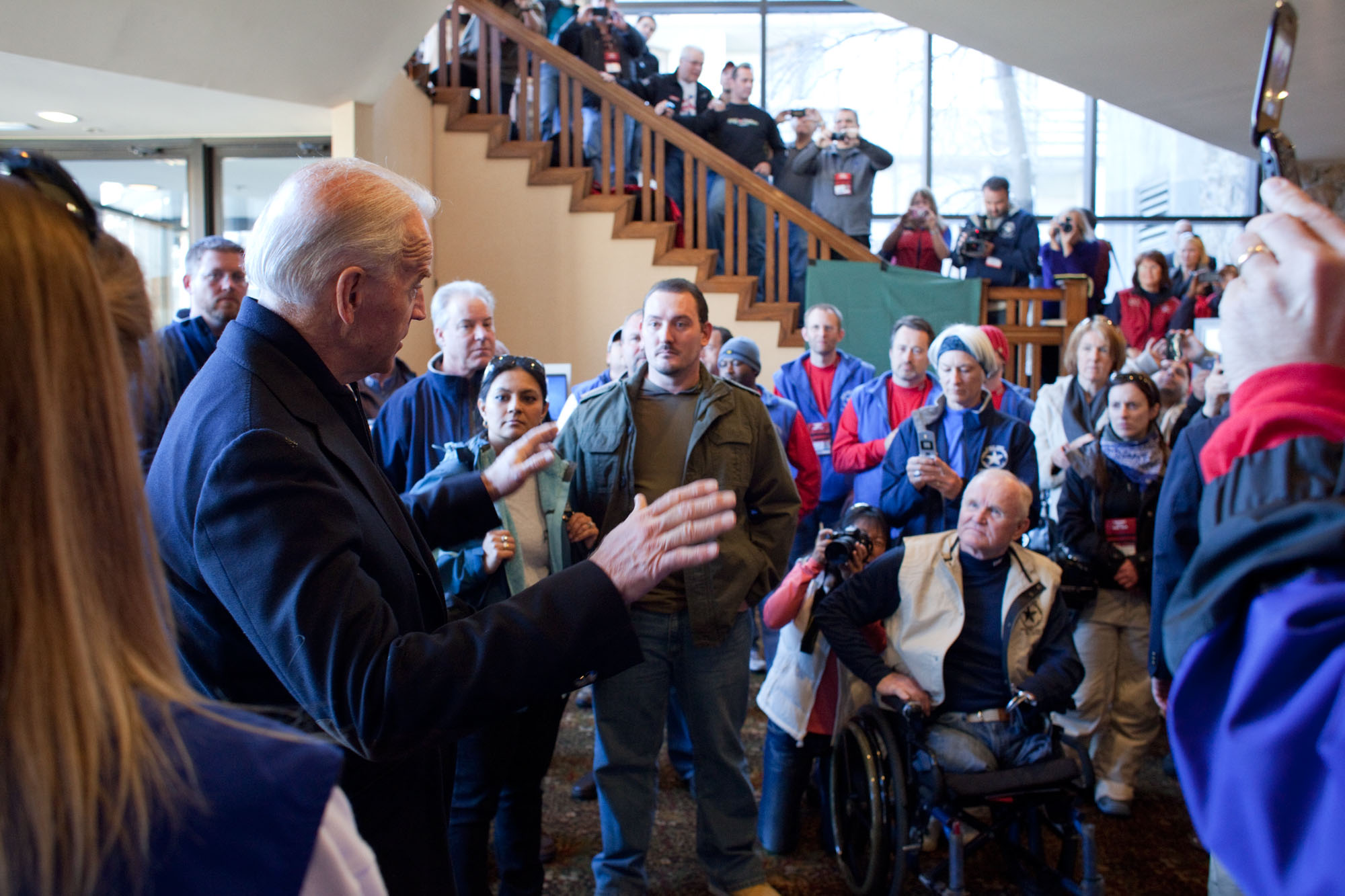
Earlier today, Vice President Biden greeted volunteers during registration for the 25th annual National Disabled Veterans Winter Sports Clinic in Snowmass Village, Colorado. Over 600 volunteers will participate in the week-long program that brings together nearly 400 veterans with disabilities through adaptive winter sports. The clinic is organized by the Department of Veterans Affairs and the Disabled American Veterans.

Click here for a photo: http://obamawhitehouse.archives.gov/sites/default/files/vp_dav.jpg.

Vice President Biden Talks About One Year of the Affordable Care Act

March 23, 2011 | 5:09 | Public Domain

Vice President Biden talks about the first year of the health reform law, the Affordable Care Act, and how it is already helping the American people. To find out more about how the law impacts you, check out http://www.HealthCare.gov

Download mp4 (59.1MB)

A Call to Action on College Completion

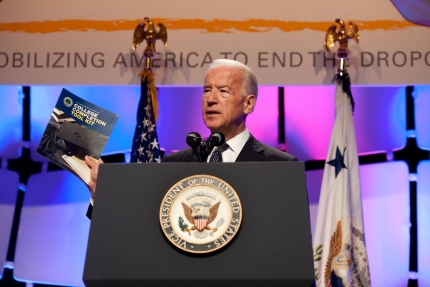
Vice President Biden Speaks at the Grad Nation Conference

Vice President Joe Biden speaks at the Grad Nation Conference at the Marriott Wardman Park, in Washington, DC, March 22, 2011. (Official White House Photo by David Lienemann).

College access and affordability has been a key area of focus for the Middle Class Task Force over the last two years.  On this blog, we have frequently updated you on our Administration’s commitment to expanding student aid through Pell Grants and the American Opportunity Tax Credit.

Providing every American child with the opportunity to go to college is critically important, but we can’t stop there.  We need more American students to graduate from college.  The President has set a clear goal: By 2020, America will have the highest proportion of college graduates in the world.  Right now we are ninth.

70 percent of students go on to pursue some kind of postsecondary education after high school, but less than half actually get a degree or certificate within 6 years.  Why is this so important? Because more than half of all new jobs created in the next decade will require a postsecondary degree.  And college graduates make more money and are less likely to be unemployed than individuals with only a high school diploma.  Ensuring that more students graduate from college is essential to maintaining a strong middle class.

Today the Vice President challenged every Governor to host a state college completion summit, and promised that the Department of Education would help any state develop a plan to boost completion.

The White House

Office of the Vice President

Readout of Vice President Biden's Call with UAE Crown Prince Mohammed bin Zayid al Nahyan

Vice President Biden spoke with United Arab Emirates Crown Prince Mohammed bin Zayid al Nahyan today about developments in Libya and the region.  The Vice President expressed his strong appreciation for the UAE's significant humanitarian contribution to the international effort on Libya.  The Vice President and Crown Prince also discussed the importance of the unified international effort underway to enforce the measures called for in United Nations Security Council Resolution 1973 and agreed to continue close coordination between the United States and UAE on this issue.

The White House

Office of the Vice President

Vice President Biden Issues Call to Action to Boost College Graduation Rates Nationwide

Vice President Releases College Completion Tool Kit to Help Chart the Path

WASHINGTON, D.C. – Vice President Joe Biden today issued a call to action to boost college graduation rates across the country and help the nation meet President Obama’s goal for the United States to have the best-educated workforce and the highest proportion of college graduates in the world by 2020. Speaking at the first annual Building a Grad Nation Summit, Vice President Biden – who has made college affordability and accessibility a key priority in his role as chairman of the Middle Class Task Force – called on each Governor to host a state college completion summit, released a new college completion tool kit for states and Governors to draw ideas from, and announced a new grant competition focused on helping institutions of higher education boost completion rates.
 
“Right now we’ve got an education system that works like a funnel when we need it to work like a pipeline,” said Vice President Biden. “We have to make the same commitment to getting folks across the graduation stage that we did to getting them into the registrar’s office. The dreams and skills of our college graduates will pave the way to a bright economic future for our nation.”
 
To meet the President’s 2020 goal, the United States will have to increase the number of college graduates by 50 percent – turning out at least 8 million additional graduates by the end of the decade.
 
“America once led the world in the number of college graduates it produces, and now we’ve fallen to ninth,” said U.S. Secretary of Education Arne Duncan, who delivered opening remarks at the Summit on Monday evening.  “While our educational advancement stalled, other countries have passed us by. We need to educate our way to a better economy, and governors must help lead the way.”
 
To help governors develop college completion plans, the Administration is releasing a calculation of each state’s share of the President’s 2020 goal as well as a comprehensive college completion tool kit of suggested policies to help governors boost college graduation rates. The toolkit identifies seven no-cost or low-cost strategies that governors can use, fifteen related action steps, and a series of existing federal resource streams from which to draw. The strategies include aligning high school exit and college placement standards, linking state funding to college success in boosting completion rates, making it easier for students to transfer among colleges, and re-engaging adults with some college experience but no degree.
 
“The best jobs and fastest growing firms, whether in biosciences, technology, manufacturing, trade or entertainment, will gravitate to countries, communities and states with a highly qualified workforce. In order for America to lead the world, every governor will have to lead the way at home,” Duncan said.
 
The Administration is also making a number of financial resources available to help governors execute their plans to boost college completion rates. Today, the Department of Education is announcing that it is accepting applications for the 2011 Comprehensive Grant Program, which is part of the Fund for the Improvement of Postsecondary Education (FIPSE). The Comprehensive Grant Program will provide a total of $20 million to colleges to implement plans that can increase success and improve productivity in postsecondary schools. The program aims to award innovative reform practices that have the potential to serve as models for the nation.
 
In addition to these grants, the Administration has also proposed two programs in its 2012 budget. The First in the World initiative, which in its initial year would provide $123 million in competitive funds, would support programs that embrace innovative practices to accelerate learning, boost completion rates and hold down tuition. Secondly, states can also apply for College Completion Incentive Grants, which would give a total of $50 million in awards to reward states and institutions for undertaking reforms that produce more college graduates.
 
The release of the college completion toolkit and announcement of financial resources follows a number of efforts by the Obama-Biden Administration to increase access to and the affordability of higher education. The Administration has dramatically boosted Pell grant funding by more than $40 billion; increased tax incentives for higher education by more than 90 percent through the American Opportunity Tax credit; simplified the Free Application for Federal Student Aid, making it easier for students to apply for grants and loans; provided common-sense student loan repayment options with the Income-Based Repayment program; and implemented a program that forgives the debt of students who dedicate 10 years to public service after graduation.
 
Note to editors:  See HERE for a copy of the college completion toolkit, and HERE for the state-by-state 2020 completion data.

The White House

Office of the Vice President

Vice President Biden Celebrates One-Year Anniversary of Race to the Top Awards in Delaware

Teacher collaboration critical to early success in Delaware

WASHINGTON, D.C. - Today, Vice President Joe Biden and Secretary of Education Arne Duncan were in Wilmington, Delaware to celebrate the first year anniversary of the first Race to the Top awards, which marked the beginning of a transformative and highly successful investment in education. Nearly a year after being awarded over $100 million in Race to the Top funding, Delaware’s grant has significantly helped the state make progress toward improving its education system. Speaking at Howard High School of Technology, the Vice President and Secretary Duncan discussed the success of teacher collaboration in Delaware, as well as how winning the future in education will continue to require investments that promote a shared responsibility among everyone involved; reform at the state and local levels; and a focus on achieving results. They were joined in Wilmington by Governor Jack Markell, Senator Chris Coons, Representative John Carney and President of the Delaware State Education Association Diane Donohue.
 
“For less than one percent of what America spends on education each year, we were able to help jump-start some of the farthest reaching education reforms in history,” said Vice President Biden. “All across the country, Race to the Top is inspiring the same kind of change we’re seeing here in Delaware.”
 
“Nearly one year ago, Delaware won a Race to the Top award because it submitted an application that promised to reach into every corner of the state and had the full support of its teacher’s union,” said Secretary Duncan. “Today, we are here to celebrate the fact that Delaware has made good on its promise and is beginning to implement changes that are transforming the state of education for children throughout the state.”
 
Vice President Biden celebrated the progress Delaware has made since it received the Race to the Top award nearly one year ago at Howard High School—an active partner in the State’s Race to the Top plan. One of the critical elements of the State’s early accomplishments is the establishment of a Partnership Zone which gives low performing schools the help they need to turn around including instituting longer school days, increased instructional time, more flexibility in staffing decisions, and a greater role for teachers in implementing reforms. Howard is one of four Partnership Zone schools in the State and has made several key changes that are helping it transform.
 
Delaware State Education Association President Diane Donohue joined the event to highlight the critical role teacher collaboration has played in Delaware’s early success in implementing its Race to the Top plan. As part of the application process, the Delaware State Education Association (DSEA) and all 19 of the DSEA local affiliates signed on to the State’s application. Over the past year, DSEA and its locals have continued to be very involved in every aspect of the process, including engaging more than 300 educators who are helping to develop student growth measures in 30 content areas, building student performance into teacher assessment systems.
 
Background On Teacher Collaboration:
 
The Administration has consistently sought to lift up the work labor and management can do to support student success when they work collaboratively. In February, the Department, along with key partners like the National Education Association (NEA) and American Federation of Teachers (AFT) sponsored a two day conference attended by 150 school districts – including the School Board President, teachers union president and Superintendent from each district -- to identify labor-management relationships, policies and agreements that can drive student achievement.
 
From the work of Maryland’s Montgomery County Public Schools with its local NEA affiliate to reduce the achievement gap in the district, to Los Angeles’ ABC Unified School District in Los Angeles, where an over decade-long partnership with the AFT local has lead to annual increases in the district’s score on California’s Academic Index, this important work is happening all over the country. 
 
Background on Race to the Top:
 
The $4.35 billion Race to the Top Fund is an unprecedented federal investment in reform. The program includes $4 billion for statewide reform grants and $350 million to support states working together to improve the quality of their assessments. The Race to the Top state competition is designed to reward states that are leading the way in comprehensive, coherent, statewide education reform across four key areas:

  • Adopting standards and assessments that prepare students to succeed in college and the workplace;
  • Building data systems that measure student growth and success, and inform teachers and principals how to improve instruction;
  • Recruiting, developing, rewarding, and retaining effective teachers and principals, especially where they are needed most; and
  • Turning around their lowest-performing schools.

Background on Award Timeline:

  • March 29th, 2010: Delaware and Tennessee were announced as winners of the first phase of the competition
  • June 14th, 2010: Delaware received the first 12.5% of its award
  • July 22nd, 2010: Delaware received the remainder of its award
  • August 24th, 2010: the District of Columbia, Florida, Georgia, Hawaii, Maryland, Massachusetts, New York, North Carolina, Ohio, and Rhode Island were announced as winners of the second phase of the competition

 Year One Accomplishments in Delaware:
 
Teacher Collaboration:
As part of the application process, the Delaware State Education Association (DSEA) and all 19 of its local affiliates signed on to the State’s application. DSEA and its locals have continued to be very involved in implementation:

  • Over 300 educators are helping to develop student growth measures in 30 content areas, building student performance into teacher assessment.
  • Educators helped develop plans for the 90 minute collaborative planning time so that all educators in core subjects will meet in small, relevant groups for 90 minutes weekly to identify best practices and coordinate lesson plans. Teachers will also work with data coaches two times a month beginning next year to make sure that metrics on student achievement are informing their teaching.
  • The DSEA worked closely and continuously with the Governor and State Secretary of Education over the past year in overseeing the implementation process and troubleshooting problems that arose.

 Additional areas of progress:

  • Delaware adopted the Common Core Standards for math and English Language Arts and trained 9,000 teachers on the basics of these new standards.
  • Delaware launched an online assessment system to measure student progress in a timely and reliable manner so teachers can use it to inform their instruction.
  • Delaware recently entered into a contract with Wireless Generation, LLC to provide data coaching services so that, by this spring, teachers in an initial 6 districts and 1 charter school will have regular access to data coaches that will help them use the information from the online assessment system to enrich their instruction and improve student performance.
  • Delaware instituted a new Partnership Zone which targets the lowest-achieving schools.  The State has approved the first four Partnership Zone schools’ reform plans which include adopting longer school days and school years, increasing instructional time, requiring leadership and staffing changes and gaining flexibility in staffing decisions, use of lead partners, and other critical changes.
  • Delaware designed and instituted a nine-month professional development program to provide districts with the skills to continue to implement their portion of the Race to the Top plan over the next three years.

 Background on Howard High School of Technology:

  • Howard High School of Technology is an 860-student school located three blocks from the downtown Wilmington business district.
  • Howard High School’s building was declared a National Historic Landmark due to the role the school played in the civil rights movement. Howard first opened in 1867 and was the only institution in the four-state area of Delaware, Maryland, New Jersey, and Pennsylvania to offer a complete high school education to Black students and was one of the earliest Black secondary schools in the Nation. Howard was also one of the schools involved in Brown vs. Board of Education.
  • The student population is 74 percent African-American, 14 percent Caucasian and 1 percent Asian. Sixty-one percent of the student body is low income.
  • More than half of the students who accept admission to Howard have not previously met grade-level math and/or reading standards on state assessments.

 Howard’s Race to the Top Progress:

  • Howard High School was selected as one of the first four schools in the state’s Partnership Zone program. Since its selection, Howard has put together and the state has approved a transformation plan to turn around the school. 
  • Teachers at the school have developed and agreed to a Memorandum of Understanding that modifies the collective bargaining agreement for teachers at the school, allowing for implementation of the transformation plan.
  • A new principal has been put in place.
  • There is a high level of educator engagement with 40 faculty currently serving on committees that are developing specific details of the Partnership Zone plan
  • In April, a site-based parent coordinator will be hired to increase parent outreach and support services, especially targeting families of students struggling. 
  • This summer, the school will launch a Summer Intensive Learning and Leadership Academy for underperforming students entering the 9th grade.
  • Next year the daily schedule for grades 9 and 10 will be restructured into small learning communities. Students will stay together for their core classes and teams of teachers will collaborate on individual student needs and tie vocational coursework to what students are studying in their academic classes.
  • Delaware will offer incentives to attract highly qualified academic teachers to Howard.
  • This year, the University of Delaware launched a new STEM residency program, funded, in part, by the Race to the Top Award. The program places science and math experts in residency teaching programs at Delaware high schools, where they work with a certified teacher while they pursue graduate courses in education at the University of Delaware. The program placed eight teachers this year, including five at Howard.
The White House

Office of the Vice President

Background on the Vice President's Trip to Howard High School to Celebrate One-Year Anniversary of Race to the Top Awards in Delaware

Today, Vice President Joe Biden and Secretary of Education Arne Duncan will be in Wilmington, Delaware to celebrate the first year anniversary of the first Race to the Top Awards, which marked the beginning of a transformative and highly successful investment in education. Nearly a year after being awarded $100 million in Race to the Top funding, Delaware’s grant has significantly helped the state make progress toward improving its education system. In remarks at Howard High School of Technology, the Vice President and Secretary Duncan will discuss the success of teacher collaboration in Delaware, as well as how winning the future in education will continue to require investments that promote a shared responsibility among everyone involved; reform at the state and local levels; and a focus on achieving results. They will be joined in Wilmington by Governor Jack Markell, Senator Chris Coons, Representative John Carney and President of the Delaware State Education Association Diane Donohue
 
Background On Teacher Collaboration:
 
The Administration has consistently sought to lift up the work labor and management can do to support student success when they work collaboratively. In February, the Department, along with key partners like the National Education Association (NEA) and American Federation of Teachers (AFT) sponsored a two day conference attended by 150 school districts – including the School Board President, teachers union president and Superintendent from each district -- to identify labor-management relationships, policies and agreements that can drive student achievement.
 
From the work of Maryland’s Montgomery County Public Schools with its local NEA affiliate to reduce the achievement gap in the district, to Los Angeles’ ABC Unified School District in Los Angeles, where an over decade-long partnership with the AFT local has lead to annual increases in the district’s score on California’s Academic Index, this important work is happening all over the country.
 
Background on Race to the Top:
 
The $4.35 billion Race to the Top Fund is an unprecedented federal investment in reform. The program includes $4 billion for statewide reform grants and $350 million to support states working together to improve the quality of their assessments. The Race to the Top state competition is designed to reward states that are leading the way in comprehensive, coherent, statewide education reform across four key areas:
 

  • Adopting standards and assessments that prepare students to succeed in college and the workplace;
  • Building data systems that measure student growth and success, and inform teachers and principals how to improve instruction;
  • Recruiting, developing, rewarding, and retaining effective teachers and principals, especially where they are needed most; and
  • Turning around their lowest-performing schools.

Background on Award Timeline:

  • March 29th, 2010: Delaware and Tennessee were announced as winners of the first phase of the competition
  • June 14th, 2010: Delaware received the first 12.5% of its award
  • July 22nd, 2010: Delaware received the remainder of its award
  • August 24th, 2010: the District of Columbia, Florida, Georgia, Hawaii, Maryland, Massachusetts, New York, North Carolina, Ohio, and Rhode Island were announced as winners of the second phase of the competition

Year One Accomplishments in Delaware:
 
Teacher Collaboration:
As part of the application process, the Delaware State Education Association (DSEA) and all 19 of its local affiliates signed on to the State’s application. DSEA and its locals have continued to be very involved in implementation:

  • Over 300 educators helped develop student growth measures in 30 content areas, building student performance into teacher assessment.
  • Educators helped develop plans for the 90 minute collaborative planning time so that all educators in core subjects will meet in small, relevant groups for 90 minutes weekly to identify best practices and coordinate lesson plans. Teachers will also work with data coaches two times a month beginning next year to make sure that metrics on student achievement are informing their teaching.
  • The DSEA worked closely and continuously with the Governor and State Secretary of Education over the past year in overseeing the implementation process and troubleshooting problems that arose.

Additional areas of progress:

  • Delaware adopted the Common Core Standards for math and English Language Arts and trained 9,000 teachers on the basics of these new standards.
  • Delaware launched an online assessment system to measure student progress in a timely and reliable manner so teachers can use it to inform their instruction.
  • Delaware recently entered into a contract with Wireless Generation, LLC to provide data coaching services so that, by this spring, teachers in an initial 6 districts and 1 charter school will have regular access to data coaches that will help them use the information from the online assessment system to enrich their instruction and improve student performance.
  • Delaware instituted a new Partnership Zone which targets the lowest-achieving schools.  The State has approved the first four Partnership Zone schools’ reform plans which include adopting longer school days and school years, increasing instructional time, requiring leadership and staffing changes and gaining flexibility in staffing decisions, use of lead partners, and other critical changes.
  • Delaware designed and instituted a nine-month professional development program to provide districts with the skills to continue to implement their portion of the Race to the Top plan over the next three years.

Background on Howard High School of Technology:

  • Howard High School of Technology is an 860-student school located three blocks from the downtown Wilmington business district.
  • Howard High School’s building was declared a National Historic Landmark due to the role the school played in the civil rights movement. Howard first opened in 1867 and was the only institution in the four-state area of Delaware, Maryland, New Jersey, and Pennsylvania to offer a complete high school education to Black students and was one of the earliest Black secondary schools in the Nation. Howard was also one of the schools involved in Brown vs. Board of Education.
  • The student population is 74 percent African-American, 14 percent Caucasian and 1 percent Asian. Sixty-one percent of the student body is low income.
  • More than half of the students who accept admission to Howard have not previously met grade-level math and/or reading standards on state assessments.

Howard’s Race to the Top Progress:

  • Howard High School was selected as one of the first four schools in the state’s Partnership Zone program. Since its selection, Howard has put together and the state has approved a transformation plan to turn around the school.
  • Teachers at the school have developed and agreed to a Memorandum of Understanding that modifies the collective bargaining agreement for teachers at the school, allowing for implementation of the transformation plan.
  • A new principal has been put in place.
  • There is a high level of educator engagement with 40 faculty currently serving on committees that are developing specific details of the Partnership Zone plan
  • In April, a site-based parent coordinator will be hired to increase parent outreach and support services, especially targeting families of students struggling.
  • This summer, the school will launch a Summer Intensive Learning and Leadership Academy for underperforming students entering the 9th grade.
  • Next year the daily schedule for grades 9 and 10 will be restructured into small learning communities. Students will stay together for their core classes and teams of teachers will collaborate on individual student needs and tie vocational coursework to what students are studying in their academic classes.
  • Delaware will offer incentives to attract highly qualified academic teachers to Howard.
  • This year, the University of Delaware launched a new STEM residency program, funded, in part, by the Race to the Top Award. The program places science and math experts in residency teaching programs at Delaware high schools, where they work with a certified teacher while they pursue graduate courses in education at the University of Delaware. The program placed eight teachers this year, including five at Howard.

The White House

Office of the Vice President

Readout of Vice President Biden's Calls on Libya

The Vice President spoke today to Prime Minister of Algeria Ahmed Ouyahia and Emir of Kuwait Sheikh Sabah Al-Ahmad Al-Jaber Al-Sabah as part of the ongoing consultations on the coalition action to fulfill United Nations Security Council Resolution 1973.  The Vice President discussed with both the Prime Minister and the Emir their mutual support for the full implementation of the resolution and the need to protect the Libyan people.

The White House

Office of the Vice President

Readout of Vice President Biden's Call to President Karzai

Earlier today, Vice President Biden called President Karzai to get an update on the situation in Afghanistan and to underscore our ongoing commitment to Afghanistan, including our efforts to protect Afghan civilians. President Karzai was appreciative of the call, reiterating the need to prevent harm to Afghan civilians and to continue to build our strategic relationship.

The White House

Office of the Vice President

Vice President Biden Announces New Communications Director

Washington, D.C. – The Vice President announced today that Shailagh Murray will serve as his Communications Director, starting next month.  She succeeds Jay Carney, who was appointed by the President to be the White House Press Secretary.  Murray comes to the Vice President’s office as a veteran journalist, most recently at the Washington Post.
 
Vice President Biden said: “Shailagh’s years of experience covering a broad array of issues ranging from domestic policy to foreign affairs make her uniquely positioned to lead our communications team. She is as well-respected among her peers as she is versed in the serious issues facing our nation and the world.  Her leadership and counsel will be invaluable to me, and to the entire administration.”
 
Shailagh Murray became a Capitol Hill correspondent for the Washington Post in 2005.  She has written extensively about fiscal policy, health care reform, and national security issues, including the Iraq war debate, while also covering the 2006, 2008 and 2010 elections. From 1999 to 2005, she covered Congress and politics for the Wall Street Journal's Washington, DC, bureau.  Previously, she was a correspondent for the Wall Street Journal in Prague and Brussels from 1992 to 1999. A native of Buffalo, New York, Shailagh grew up in Virginia and is a graduate of the University of Missouri-Columbia and Northwestern University.
 
Murray joins the Vice President’s communications office, which includes Press Secretary Elizabeth Alexander, Deputy Press Secretary Amy Dudley and Assistant Press Secretary Liz Allen.