Vice President Biden's Remarks at Moscow State University
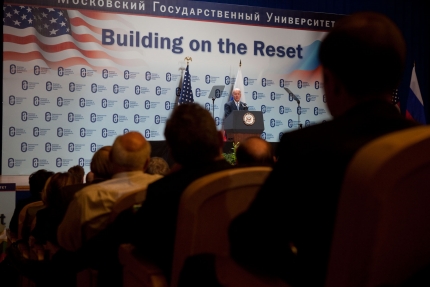
Moscow State University
Moscow, Russia
5:33 P.M. (Local)
THE VICE PRESIDENT: Thank you, Andy. Rector, thank you. It’s an honor to be here at Moscow State University. And I want to thank the AmCham chamber for sponsoring this.
To the students that are here, I apologize. In America, we have a rule. You don’t have to wait any longer than 20 minutes for a full professor. And for someone who is not a full professor, you need only wait 10 minutes. (Laughter. I’m honored you waited at all. I do apologize to the business community, as well as the students, for keeping you waiting.
I want to publicly as well thank President Medvedev and Prime Minister Putin for their hospitality. We have very good meetings, very long meetings, and I hope, productive.
And I want to thank AmCham Russia for sponsoring this event, working to foster a modern business climate after the fall of communism.
And, Rector, again, thank you for hosting us here at Moscow State University, which has given Russia and the world so many and such an extraordinary array of graduates, among them eight-- if I’m not mistaken, eight Nobel Laureates, including former President Gorbachev, who I have known for some time.
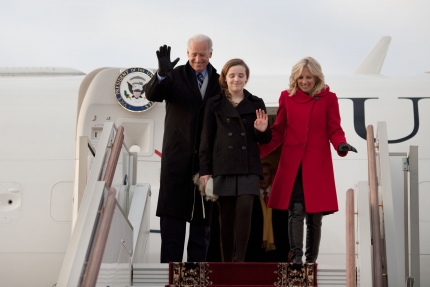
In addition to my wife, Jill, I brought along my granddaughter. Her name is -- my number two granddaughter. Her name is Finnegan Biden. And I brought her along to Russia, because I wanted her to see this great country with her own eyes, the country of Pushkin’s poetry and Tolstoy’s prose, the country of Tchaikovsky’s compositions, and Zhukov’s and Gagarin’s heroic feats. It is a rich and a noble culture. And I’m delighted she has had a chance to get a -- just a little glimpse of it.
Let me also thank our Ambassador John Beyrle, and his team, for hosting me. As you businesspeople know, there’s an old expression if you’re in the military -- but also if you’re in the diplomatic corps. The good news is the commanding general is coming. The bad news is the commanding general is coming. On the diplomatic side, the good news is the Vice President is coming, and the bad news, the Vice President is coming because I’ve created an extraordinary amount of work for John’s incredible team.
But John is one of the best America has to offer. And anyone who doubts the ability of Americans and Russians to work together, need only examine the history of John’s family. His father, Joe -- Joseph was a hero in both Russia and the United States, an American soldier taken prisoner by the Nazis who went on -- later when he escaped to fight with the Red Army on the Eastern Front. And now, more than 65 years later, his son is the American envoy to Moscow. I think that’s a remarkable, remarkable story.
And today, I also want to address -- and the main reason I’m here -- is the state of U.S.-Russian relations. I don’t need to tell anyone in this audience that our administration, when we took office in January of ‘09, our relationship with Russia had hit a fairly low point that had accumulated over the previous eight years.
Yes, so we saw a war between Russia and Georgia played out, and played a role in that decline. But even before that conflict erupted in August of ‘08, a dangerous drift was underway in this important relationship. While we no longer considered each other enemies, we couldn’t always tell from the rhetoric that was flying back and forth across the continent.
Ironically, this came at a time when American and Russian interests -- on nuclear arms control, nonproliferation, stabilizing Afghanistan, fighting terrorism, opening global markets and a range of other issues -- at a time when all of them, we were more closely aligned than ever on each and every one of those issues.
So to seize this opportunity, President Obama and I proposed forging a fresh new start by, as I said in the initial speech on our foreign policy, by pressing a restart button, reset button. We wanted to literally reset this relationship, reset it in a way that reflected our mutual interests, so that our countries could move forward together.
The President asked me to make that “reset” the focus of our administration’s first foreign policy speech, that I delivered several weeks after our inauguration at the Munich Security Conference. And I said then, and I quote, “the United States and Russia can disagree and still -- still -- work together where our interests coincide. And they coincide in many places.”
Now, we know that pursuing this agenda -- we knew pursuing this agenda would be hard work, that old habits -- as we say in America, old habits die hard. That’s why President Obama has met nearly a dozen times with President Medvedev, and why together we established a Bilateral Presidential Commission with working groups on key issues like arms control and energy, broadening the contacts between our two governments.
And in spite, in spite of what we call -- excuse me, in the spirit of what we call in America a “dual-track engagement,” we’ve also worked to deepen our ties between our countries’ business leaders, including many of the distinguished men and women in this room, as well as between our civil society groups.
Our business and civil society summits, alongside our presidential summits in 2009 and 2010, were in my view very important in strengthening these relationships. We believed then, and still believe, in focusing on concrete outcomes that serve both countries’ interests, as President Obama puts it, “win-win,” situations.
And we reject -- we reject, the President and I -- the tired theory that our values and our interests must compete for influence over our politics. We flat reject that notion because we believe and we will continue to stand up for our principles. And I believe those principles make all of us, Americans and Russians alike, more secure, more prosperous, and more free.
Two years since we pressed that reset button, I would argue the benefits of this approach to both our countries are absolutely clear on issue after issue.
Arms control: We signed and ratified a New START Treaty, which will reduce our deployment of strategic weapons while ensuring that we maintain stable and predictable verification.
The two countries with the largest nuclear arsenals showed the world that they are serious about arms control and strengthening global nonproliferation. And that gave us even more credibility to deal with the most egregious violators of their international commitments.
Iran: With our partners in the so called P5 plus 1, we -- Russia and the United States -- gave Tehran a chance for meaningful dialogue based on mutual interests and mutual respect to develop peaceful nuclear means. They simply rejected it. So Russia and the United States, along with our partners on the U.N. Security Council, adopted what is known as Resolution 1929, the most extensive package of sanctions Iran has ever faced.
And Moscow, on its own and to its own -- as costing it in dollars and rubles -- Moscow took another important step: It canceled its contract to sell to Iran S-300, air-defense missile systems, which was an unambiguous sign -- an unambiguous sign -- of international resolve that Iran must address the concerns that we have over their nuclear program.
North Korea -— working closely with Russia and our other international partners on the threat posed by Pyongyang, we adopted another U.N. resolution, referred as 1874, which authorized inspections -- almost unprecedented, authorized inspections of vessels -- Korean vessels -- suspected of carrying nuclear materials into or out of their country. And the nations of the world have cooperated.
I would argue it’s because Russia and the United States were leading in this effort.
Afghanistan -- we’re cooperating on what we call the Northern Distribution Network, which now brings vital supplies to the ISAF, International Security Forces, including American soldiers and civilians into Afghanistan. In addition to rail cars rolling through Russia with supplies, over 800 flights have carried nearly 120,000 passengers over Russian territory to Afghanistan. That would have been thought impossible four years ago.
And Russia is also providing badly needed military equipment and training to the Afghan National Security Forces. We’re also cooperating on drug eradication.
European security -- using America’s improved relationship with Russia as a model, we also reset relations between Russia and NATO during last year’s Lisbon Summit, and a great deal of credit goes to President Medvedev. And we identified missile defense as a common project. I’ve talked extensively with your leaders on this issue. It will be difficult, but it will be a game-changer if we can get it done. It will say to the world, the two largest superpowers in the world are mutually developing the ability to have missile defenses, which I would argue would have an extremely important impact on dissuading so many of the countries who are contemplating becoming nuclear powers from doing so.
This year, we’ll seek agreement on an ambitious work plan for cooperation on this once contentious issue. And we’ll also pursue an agreement on negotiations to modernize and strengthen the Conventional Forces in Europe Treaty. I’ve been around a long time -- the CFE Treaty has been something we’ve been working on since the late ‘70s. We have an opportunity to make more progress.
Central Asia -- we’re working together to foster a stable -- a stable, democratic government -- a stable, democratic government -- and I might add a great deal of the credit goes to your President -- in Kyrgyzstan, combating drug traffickers, eradicating polio -— steps that suggest we can move beyond the so-called “Grand Game” and “spheres of influence,” a Cold War relic in my view.
Cooperation on each of these important issues has made America more secure -- and I would argue, presumptuous of me, but I believe it’s made Russia more secure.
But the reset has also produced more subtle signs of progress, again ones that would not have been contemplated even four years ago. Russian helicopters used for relief efforts in Sudan. California firefighters helping to fight wildfires in central Russia. American and Russian drug officers working side-by-side in Afghanistan, the world’s largest producer of heroin and opium as a consequence of it. Student body presidents from American universities discussing democracy and human rights with Kremlin advisors. And we’re very pleased that are here today in the audience.
These things clearly would have been hard to imagine amid the mistrust and ill will a little over two years ago. And to some of you, they may sound small. But having been involved in this relationship for over 36 years, they are more than the sum of their parts.
And if you think I’m exaggerating and overstating the case, consider the following statistics -- or polling. In December of 2008 -- December of 2008, one month before we were sworn in as President and Vice President, polling showed that only 17 percent of all Russians had a positive opinion of the United States -- 17 percent. This year, that number has jumped to over 60 percent. Our goal is to have it continue to climb.
That same year, Americans ranked Russia as one of the top five countries threatening American security -- two years ago. This year, only 2 percent of the entire American population say they view Russia as a threat. All of this leads to one very important conclusion in the mind of one Vice President that I think is now beyond dispute: the reset is working. Working for all of us, working for Russia. And I would presumptuously suggest working for the world.
But there is still, still much work to be done to enhance our security cooperation and our closeness.
On the Caucasus -- we have a genuine disagreement not only with your leadership but with the vast majority of the Russian people over Georgia. But there’s a larger principle at stake here in our view -- and I want to be straightforward because if friends cannot be straightforward with friends, it really isn’t friendship based on mutual trust.
We think there’s a larger principle at stake here. As I said when I announced the reset at Munich I said, “It will remain our view that sovereign states have the right to make their own decisions and choose their own alliances.”
And further: “We will not recognize any state having a sphere of influence.” And almost regardless of the difficulty, we don't support any state deciding through force changing the leadership of an elected -- democratically elected individual.
We have also worked closely, though, with both Russia and Georgia to reduce the threat of further conflict. As a result, Georgia recently restarted its commitment -- restated its commitment to non-use of first use of -- non-use of force, and commercial flights have resumed between Moscow and Tbilisi. But we must do more to assist those displaced by the 2008 conflict and enable normal travel and commerce to occur.
Our joint diplomacy was essential and is essential in ending conflicts in other areas. Excuse me -- Nagorno-Karabakh, where I would again commend President Medvedev for his tireless work for a peaceful and permanent settlement there.
But the next frontier in our relationship -— and the main area in my view and the President of the United States’ view of future opportunities and challenges -— will be building stronger ties of trade and commerce that match the security cooperation we have accomplished over the last two years and hopefully will continue to grow.
In the 20th Century, the wealth of a nation was measured by the abundance of its natural resources, the expanse of its landmass or the size of its army. Russia had all of those things.
But in the 21st Century, the true wealth of a nation is found in the creative minds of its people and their ability to innovate. There, too, Russia is remarkably blessed. Unleashing Russia’s full potential will be a boon and an opportunity not only for the United States and for Russians, but again for international commerce and peace and justice.
Already, our economic relationship is moving to center stage. Pepsico has made a multi-billion dollar investment in Russia -- Russia’s leading juice and dietary producer. Imagine five years ago, the likelihood that an American company could buy, in effect, the largest of anything in Russia.
Chevron and ExxonMobil recently announced major new deals with Russian partners. General Electric is undertaking a major expansion of its operations here. And John Deere last year opened a major manufacturing center in Moscow -- in the Moscow region -— and is already -- I met with the President -- I think he may be here -- yesterday -- they're already doubling its capacity and as a consequence, employment.
And Alcoa is working closely -- very closely -- with a nanotechnology firm, Rusnano, on an array of high-tech products that are the future.
This week a coalition of public and private sector partners in Russia and the U.S. announced a new program, as well, supported by an American company, Johnson & Johnson. That program will provide pregnant women and new mothers with health information via text messages -— a great example of how civil society, government, and the private sector can work together to find innovative solutions to shared challenges -- real challenges to real people, ordinary people.
And just yesterday, I witnessed the signing of a $2 billion sale of eight Boeing 777 aircraft to Aeroflot, expanding last year’s agreement to sell 50 737s to Russian Technologies. These contracts were able to be done and the plane was able to be built I might add because of Russian titanium, ingenuity and the engineers here; as well as the brilliant engineers and workface back in the United States. These contracts will create or sustain tens of thousands of jobs in Russia and in the United States.
On his visit to Silicon Valley last year, President Medvedev made clear Russia’s desire to bolster our partnership in the innovation economy -— a priority the United States shares, and the President of the United States has announced as the hallmark of what we’re attempting to do.
Yesterday, I had the opportunity to -- Skolkovo -- to be in Skolkovo -- a high-tech hub on the outskirts of Moscow that has the promise of becoming the Silicon Valley of Russia.
Closer cooperation will allow American companies to benefit from greater access to Russia’s deep pool of talented engineers, mathematicians and computer scientists.
Mr. President, if you’ll forgive me to -- I will not mention the context, but yesterday we had this discussion -- a roundtable discussion of American businesses and CEOs from Russian business. A Russian businessman said something that was true. He said the reason why it’s good to be here in Russia and investing -- the United States -- is because of its market. An interesting comment from the chairman of the board of Boeing in Russia, he said, with all due respect to my good friend, that may be true, but that's not the reason we’re here. Other countries have four, five, six and seven times the capacity to purchase our planes in terms of their needs. But we’re here. He said let me tell you why we’re here. We’re here because the best engineers in the world are here. Many educated at this great university.
We’re also providing -- not as a gift. When I say providing it sounds like we’re providing a gift -- we’re also -- American venture capitalists and other foreign investment is flowing into the Russia’s economy to allow it to diversify beyond your abundant natural resources -- metals, oil and gas -- and help Russia -- Russian start-ups get their ideas to market.
Those of you who are studying business know that it’s one thing to have an idea, it’s another thing to get to market. It takes people willing to make a gamble, make an investment, make a bet.
Already, several of America’s leading firms have shown their support for this vision, by committing to invest in the case of several venture capitalists over $1 billion dollars -- already committed -- investing in Russian high-tech industry.
But despite these steps, our trading and investment relationship is not what it should be. As a matter of fact, it was higher years ago than it is now. Russia was America’s 37th largest export market in 2010. The value of the goods that cross our border, the United States border with Canada and Mexico every few days exceeds the annual value of our trade with Russia. We’ve got to do better. We’ve got to do better. And I believe we can.
This is one of the reasons the President and I so strongly support Russians accession to the World Trade Organization. Accession will enable Russia to deepen its trade relations not only with the United States, but the rest of the world. And it will give American companies a greater and more predictable -- important word, predictable -- access to Russia’s growing markets, expanding both U.S. exports and employment.
The renewed energy that Russian negotiators have brought to the table in this accession effort and Moscow’s political will to get the job done are for the first time in a long time genuinely moving things forward.
We’re making progress on these issues that have caused so much friction in the past. We’re making progress on agricultural trade, sanitary regulations, enforcement of intellectual property rights, though we still have more work to do.
So let me make this as clear as I possibly can: President Obama and I strongly support and want to see Russia in WTO. We’ve made that clear to the Congress; we’ve made that clear the world; and we’ve made that clear to anybody who is willing to listen.
It’s better for America -- and presumptuous of me to say this, never tell another man his business or another country their interest -- but it’s better for America, and I believe better for Russia to be able to trade with each other under predictable and transparent rules. And that’s also why we’re going to work with Congress to terminate the Jackson-Vanik amendment.
These steps are critical components to our Administration’s trade agenda. There used to be a bank robber in America in the ‘30s. His name was Willie Sutton. And they once asked Willie Sutton, why do you rob banks, Willie. He said, that’s where the money is. (Laughter.) We’re not doing Russia a favor. This is in the overall best interest, we think, of Russia, but we know for the United States. We know for our unemployment -- our employment to grow, trade, exports have to grow as well.
So we expect Russia’s leaders to continue working with us to move the processes along. But you in this room know as well as anyone that even if liberalizing our trading relationship, Russia’s business and legal climate quite frankly is going to have to continue to improve because right now for many companies it presents a fundamental obstacle.
In early 2008, President Medvedev described Russia as, and I quote, “a country of legal nihilism,” -- not my quote, his quote -- and he prescribed a set of reforms.
The simple fact is this: Pragmatic businessmen, particularly -- and women -- particularly those who are not so big that they can go directly to each of our governments to resolve their differences -- they want to invest where they can expect a reasonable return and an absolute assurance that the legal system in the country they're investing in will provide due process.
I don't think it’s reasonable to expect Americans, or Europeans, or Russians themselves, to invest confidently where -- in a country in which there are infamous cases in which property rights were violated and not protected. It may be unfair, but it is a perception.
A country in which investors -- Russian and American -- can lose when they succeed -- lose when they succeed -- in fact, have lost fortunes because of legal abuses.
A country which -- a company which can be seized, or an owner imprisoned on a politician’s whim; in which a lawyer like Sergei Magnitsky -- I hope I pronounced that correctly -- can be arrested after accusing the police of fraud and then die in detention before being tried.
No amount of government cheerleading or public relations or U.S. support or rebranding will bring wronged or nervous investors back to a market they perceive to have these shortcomings. Only bold and genuine change. I’m not here to lecture. I’m not here to preach. I’m not here to tell Russia what to do. But I know from my experience, almost every country I visit, particularly smaller ones, not great countries like Russia, the first thing they’ll tell me is, can you encourage, Mr. Vice President, American businesses to invest here.
And there’s the same answer: Get your system right. Don't make it a gamble. Have certainty.
Over the past few months alone, our Administration has spoken out against allegations of misconduct in the trial of -- excuse me -- Khodorkovsky -- you can tell I didn't do very well in Russian -- and of the beating and detention of “Strategy 31” demonstrators.
Some of you may say, well, how can you say those things out loud, Mr. Vice President, and expect to have a better relationship. They're necessary to have a good relationship. We should not have to make choices. (Applause.) We will continue to object when we think human rights are violated or democracy and the rule of law is undermined.
For us, these are matters of principle, but I would argue they’re also matters of pragmatism. History shows that in industrialized societies, economic modernization and political modernization go hand-in-hand. You don't get one without the other. Or put it this way, you don't get industrial modernization without political modernization. And I realize -- I realize -- it’s been a short journey -- a short journey since, as we say in the West, the wall came down. And I realize there is an awful lot that’s been accomplished. But -- but -- modernization in every way is essential.
I think that’s why so many Russians now call on their country to strengthen their democratic institutions. Courts must be empowered to uphold the rule of law and protect those playing by the rules.
Non-governmental watchdogs should be applauded as patriots, not traitors. As a famous American jurist once said, a Supreme Court justice, he said, sunlight is the best disinfectant -- sunlight is the best disinfectant. In today’s society, we’d probably say transparency is the best lubricant.
Journalists must be able to publish without fear of retribution. In my country it was a newspaper, not the FBI, or the Justice Department, it was a newspaper, the Washington Post that brought down a President for illegal actions.
Thomas Jefferson said that if he only had a choice of a free press or what we had. He said he’d choose a free press. It’s the greatest guarantee of freedom there is, the so-called Third Estate. And believe me to the American press up there, they drive me crazy. (Laughter.) It’s not like they say nice things about me all the time. But I really mean it: It is the single best guarantee of political freedom.
And viable opposition -- and public parties that are able to compete is also essential to good governance. Just as competition between top athletes produces better players and better teams, it’s also true that that works as well among firms who provide better services and better products. Political competition means better candidates, better politics and most importantly, governments that better represent the will of their people.
In my view, the Russian people already understand this. Polls shows that most Russians want to choose their national and local leaders in competitive elections. They want to be able to assemble freely, and they want a media to be independent of the state. And they want to live in a country that fights corruption.
That’s democracy. They're the ingredients of democracy. So I urge all of you students here: Don't compromise on the basic elements of democracy. You need not make that Faustian bargain.
And it’s also the message I heard recently when President Medvedev said last week -- and I quote him -- “freedom cannot be postponed.” Joe Biden didn't say that. The President of Russia said that.
And when Deputy Premier and Finance Minister Kudrin said that “only fair elections can give the authorities the mandate of trust we need to help implement economic reforms.” That's a Russian leader, not an American leader.
Russia and America both have a lot to gain if these sentiments are turned into actions, which I am hopeful they will be.
Now, there are some in Russia who say we hold your country to an unreasonably high standard. It is true our expectations are high, but it’s because we’ve learned during the Cold War just how capable the Russian people are. When you launched Sputnik we had to marshal our greatest intellectual talents to begin to meet the challenge. And we had no illusions ever about the capacity of our then-adversary.
And in this new era of partnership, our respect for the Russian people as innovators, as thinkers remains undiminished. Unleashing the intellectual capacity of this country is not only in Russia’s interest but it’s in America’s national interest; and I would argue the world’s interest. This is no longer a zero-sum game.
Folks, as you well know, we’ve already come a long way. I visited Moscow for the first time in ’73, but in the summer of ’79, I was asked by then President Carter, some 30 years ago, to lead a delegation of United States Senators who were uncertain about the SALT Talks, SALT II -- Strategic Arms Limitation Talks. And I was a strong supporter of that treaty.
But there were a group of new senators who were not familiar with the treaty, and agnostic on it. And I was asked to bring nine of them to Russia. And we sat across -- I sat across a table -- a conference table in the Kremlin, across the table from Leonid Brezhnev. To his left was Defense Minister Ustinov and to his right was Premier Kosygin.
And to state the obvious, it was a very different time. And I recall President Brezhnev was sicker than we thought then. And he excused himself and left the meeting early and turned it over to Kosygin, Premier Kosygin, who in his opening statement said the following -- I will never forget it -- he said: Before we begin our discussion, Senator, let's agree that we do not trust you, and you do not trust us. And we both have good reason. (Laughter.) Literally.
He was absolutely right back then. But he would be absolutely wrong today. Russians and Americans inside and outside of government have worked extremely hard to overcome decades of mistrust, to identify common ground, to fashion a more secure and more prosperous future for both countries.
And in the second decade of this new century, the United States and Russia no longer have good reason not to trust one another. There is no good reason not to trust one another.
It’s legitimate to be skeptical as you are in dealing with any nation because their self-interest may be different to you. But it’s not -- does not translate into: We cannot trust.
If two great nations that for 40 years stood on the opposite sides of the 20th century’s deepest divide can stand side-by-side facing the 21st century challenges, it will benefit not just the American people and the Russian people, but all people.
That future is not just the stuff of which dreams are made of. We are already moving in that direction. Yes, it can be knocked off course. But we are already moving in that direction. And I say to you young people in this audience, it’s incumbent upon you and incumbent upon the young people of my country to not allow us to get off that path, to stay in this direction.
And I know that for many of you here today, this will be a joint effort -- that you’ll join us. There’s much to overcome, but there’s much we’ve done. And I would argue that based on what we’ve recently done, it’s a clear indication we can fundamentally change this relationship on a permanent basis.
Thank you all for being so gracious waiting and even more gracious listening. Thank you. (Applause.)
END
6:14 P.M. (Local)