The President on TOP COPS: "It Wasn’t Talk; It Was What They Did"

Watch the President's and the Vice President's full remarks here.

It was a beautiful day in the Rose Garden to honor the National Association of Police Organizations (NAPO) TOP COPS.  The Vice President spoke first, reiterating the commitment that he and the President have to supporting America's law enforcement, from giving states the funding they need to keep them on the job, to better communication resources, to supporting their rights as workers.  The President spoke to that commitment as well, and also commended the outstanding officers who had earned this year's title of "Top Cops":

Related Topics: Homeland Security

The White House

Office of the Press Secretary

Remarks by the President and Vice President at a Ceremony Honoring National Association of Police Organizations (NAPO) TOP COPS

Rose Garden

1:50 P.M. EDT
 
 
     THE VICE PRESIDENT:  Good afternoon, everyone, and welcome to the Rose Garden.  It’s a lot safer place than -- it’s always safe, but it’s particularly safe today.  (Laughter.)
 
     Ladies and gentlemen, let me begin by saying congratulations.  It’s a genuine honor to be in the presence of the best of the best.  You each are -- the folks behind us -- an inspiration -- an inspiration to not only your fellow law enforcement officers, but to the whole country.
 
     And the President and I recognize, and have for a long time recognized the bravery you display simply by putting on that shield every morning, strapping on a sidearm, kissing your husband or wife good-bye and walking out, knowing that you don't know with any degree of certainty what’s going to greet you.
 
     The officers honored here today have been singled out for going above and beyond the call of duty.  And we commend each and every one of them.  But we also know that there are thousands and thousands more law enforcement officers out there today on the job, and every day, who are taking risks that are hard for ordinary people to imagine -- risks just to protect their community, to protect people they don't know, protect people they’ve never met, and in some cases, maybe protect people they don't even particularly like.  But they go out there and they do it.
 
     And today is a day for them as well; a day for every man and woman in uniform to feel proud and to feel proud of themselves.  And today is the day the entire community of police officers should understand that America appreciates what you're doing, and this President and I and the Secretary, we appreciate what you're doing.
 
     The President’s commitment to law enforcement can be seen by the unprecedented -- the unprecedented investment we've been putting in cops on the street and this administration’s plan to give you all access to what we promised a long time ago -- a wireless public safety network so you can actually -- actually communicate with all first responders.
 
     And we're also doing everything in our power to protect the rights of workers -- including you, including law enforcement officers.  You're too important to us.
 
     And, folks, let me say -- and I will conclude with this -- what I said to the honorees in the Roosevelt Room before the President came in.  We owe the families.  We owe the families -- because you, other than those who have men and women deployed or work in the fire service, every single day you kiss your husband or your wife good-bye, your son or your daughter, you know; there’s that little nagging feeling inside you, that nagging feeling inside that I wonder what’s going to be there for them today.  And that is a sacrifice.  It’s a sacrifice that warrants recognition.
 
     Ladies and gentlemen, it is my great honor and privilege to present to you a President whose commitment to law enforcement is in his bones and in every action he’s taken as President.  Ladies and gentlemen, the President of the United States, Barack Obama. (Applause.)     
 
     THE PRESIDENT:  Thank you so much.  Thank you, everybody.  (Applause.)  Thank you.  Please, everybody have a seat.
 
Thank you, Joe, not just for being a great Vice President, but being one of law enforcement’s best friends and strongest advocates over the years.  I think they’ve gotten even more love from you than the railroads -– (laughter) -- and that’s hard to  -- that's hard to do.
 
I look forward to this event every single year.  I can’t tell you how much I appreciate the efforts of law enforcement officials nationwide -– not just because I’ve got several around me 24 hours a day.  I have had the special honor of meeting police officers and law enforcement officials in all 50 states.  Last week I had the special honor of visiting with the men and women of New York City’s First Precinct, which was the first to respond on 9/11 and serves the area encompassing Ground Zero.
 
And what I told them is the same thing that I’ll tell all of the law enforcement professionals here today:  Thank you.  We appreciate your service.  You have our support.  We're grateful for the sacrifices you and your families make, and my administration is committed to making sure that you get what you need.
 
Some of the public servants helping us do that today are here:  Our excellent Secretary of Homeland Security, Janet Napolitano.  (Applause.)  Our Director of the Office of National Drug Control Policy, Gil Kerlikowske, is here -- (applause) -- a longtime police officer who also served as police chief in four different cities.
 
I'd also like to say that today I am seeking a two-year extension for FBI Director Bob Mueller.  (Applause.)  And in his 10 years at the FBI, Bob has set the gold standard for leading the Bureau.  He’s improved the working relationship with local law enforcement across the country.  And I hope that Democrats, led by Judiciary Chairman Pat Leahy, who’s here, as well as Republicans in Congress will join together in extending that leadership for the sake of our nation’s safety and security.
 
We’ve also got several elected officials here today, and I'm grateful for their services and their support of law enforcement. And obviously I want to welcome the leaders of the National Association of Police Organizations, including your president, Tom Nee, and your Executive Director, William Johnson.  (Applause.)
 
And most importantly, congratulations to the 30 officers, sheriffs, detectives, investigators, agents who are behind me -– our nation’s Top Cops -- right here.  (Applause and cheering.)  We've got the Montana crew hollering.  (Laughter.)  That was Missoula, right?  (Applause.)  There you go, Missoula.
 
I know the families are just bursting with pride for your loved ones’ accomplishments –- but your love and support has had a lot to do with those accomplishments.  So, again, we are grateful to you.
 
This is the third year I’ve had the honor of welcoming America’s Top Cops to the White House.  It’s kind of like the Heisman Trophy presentation for law enforcement.  But I just spent a little time with these men and women inside, and I can tell you with certainty, they carry themselves with such humility.  They don't say to themselves “This is it –- this year I made Top Cop.”  “I’m going to train, put in long hours, and go to Washington and stand with the President.”  That's not why they do what they do every single day.
 
None of them put together a PR package for our consideration.  Some of them are still recovering from gunshot wounds suffered in the line of duty.  Some have heavy hearts for partners who’ve been lost, and they commit themselves to their memory.  And all would put forward others in their units who they would say are just as brave, or just as dedicated, or just as capable, or just as deserving of this recognition.
 
But, you know, a moment came when their actions earned recognition.  It wasn’t talk; it was what they did.  They didn’t know it that morning, as they pinned on a badge, or strapped on a vest, or holstered a weapon.  But that day, something would happen that would make them worthy of this honor -– whether it was a random act of bravery, or a successful outcome that was the results of months or even years of painstaking and dangerous police work.
 
The men and women we honor today have responded with courage under withering fire to defend the innocent.  They’ve skillfully rescued women and children from armed gang members, and have saved the life of a shooting victim when there wasn’t time for paramedics to arrive.  They’ve carried out a dangerous and deadly sting operation to get drugs off the streets.  They’ve burst into a white-hot building to save paralyzed senior citizens whose beds were engulfed in flames.  They’ve doggedly pursued an 18-year-old cold case until justice was done.  And they’ve investigated last year’s attempted Times Square bombing, successfully extracting a full confession and a wealth of actionable intelligence leading to arrests that have made this country safer.
 
Think about the strong stuff that takes.  Think about the character it takes to refuse to close the books on a case forgotten by all but the victims’ families; the coolness it takes to talk down an armed and hostile criminal; the courage it takes to run into flames or press forward through a hail of bullets when every natural instinct would say, “Stop.  Think about yourself.  Survive.”
 
They’ll be the first to say that they’ve been trained to do it.  Some of them will argue they’re not heroes.  They’ll tell you a badge doesn’t bestow courage; that special training or physical strength doesn’t make you braver; that heroism isn’t something made evident only after the chaos of a firefight.  I think when you talk to most of these guys they’ll say heroism lies just as much in the action of their fellow officers and the hearts of the fellow citizens they’ve sworn to protect.
 
And it’s true, heroism is all around us, inside of all of us, just waiting to be summoned.  But, I tell you what, when gunshots ring out and fire burns hot, when injustice goes unanswered and innocent people cry out for help, it’s one thing to talk about courage; it’s another thing to respond swiftly, decisively, heroically, with little regard for yourself and complete regard for your fellow man.
 
And these are the men and women who actually responded.  These are America’s Top Cops -- who protect and who serve; who walk the beat; who answer the call, and do the dangerous and difficult work of forging a safer, stronger America, block by block, and neighborhood by neighborhood.
 
So each of you deserves this moment in the sun -- and it is sunny.  (Laughter.)  Because tomorrow we know that you and your fellow first responders will be back on your diligent duty -- looking out for us, looking out for one another, looking back at times with fallen partners, determined to make sure that their extraordinary sacrifices were not in vain.  And we will be standing behind you, as one nation and one people, proud of your actions, awed by your courage, and grateful for your service on our behalves.
 
So, to all of you and to all who wear the badge, thank you for keeping us safe.  (Applause.)  God bless you.  God bless the United States of America.  (Applause.)  We're going to knock down this podium and let’s take a picture with America’s Top Cops.  (Applause.)

END
2:05 P.M. EDT

Rebuilding in the Midwest and South, Our National Responsibility

Earlier today, Vice President Joe Biden visited Berkeley, Missouri – a St. Louis suburb severely damaged by a recent wave of tornadoes that swept through the area. The Vice President’s visit came on the heels of Missouri's disaster declaration – a step that will expedite federal assistance to the region as a result of severe storms, tornadoes and flooding.

Vice President Joe Biden Talks with Residents During Tour of Tornado Damage in Missouri

Vice President Joe Biden tours tornado damage with Missouri Governor Jay Nixon, Berkeley Mayor Kyra Watson, FEMA Assistant Administrator for response Bob Fenton and homeowner Djuna Miller, in Berkeley, Missouri, May 11, 2011. (Official White House Photo by David Lienemann)

Joined by Missouri Governor Jay Nixon and Berkeley Mayor Kyra Watson, Vice President Biden took a walking tour of one of the hardest-hit neighborhoods, talking with local homeowners affected by the storms and pledging to help get “roofs back over their heads” as soon as possible. “We know people’s lives are disrupted … it’s all about giving people a shot to repair or relocate,” the Vice President said. “We get it, we understand it, and we’re on top of it.”

Vice President Joe Biden Shakes Hands During Tour of Tornado Damage in Missouri

Vice President Joe Biden tours tornado damage with Missouri Governor Jay Nixon, Berkeley Mayor Kyra Watson, FEMA Assistant Administrator for response Bob Fenton and homeowner Djuna Miller, in Berkeley, Missouri, May 11, 2011. (Official White House Photo by David Lienemann)

From Missouri to Alabama, rebuilding the homes, towns and cities devastated by tornadoes and floods and helping communities recover across the Midwest and the South is a “national responsibility,” said Vice President Biden.

Elizabeth Alexander is Press Secretary for the Vice President

U.S.-China Strategic and Economic Dialogue

May 09, 2011 | 17:08 | Public Domain

Vice President Joe Biden delivers remarks at the opening session of the U.S.-China Strategic and Economic Dialogue at the U.S. Department of Interior.

Download mp4 (163MB) | mp3 (16MB)

Read the Transcript

Remarks by Vice President Joe Biden to the Opening Session of the U.S.-China Strategic & Economic Dialogue

9:50 A.M. EDT
 
     THE VICE PRESIDENT:  Good morning.  Thank you.  Thank you, all.  It’s an honor to welcome back to Washington for the third meeting of the Strategic and Economic Dialogue between the United States and China, two good friends.
 
     Let me acknowledge the co-chairs at the outset here.  Vice Premier Wang and State Counselor Dai, welcome back.  I got an opportunity to spend some time with you -- not as much as my colleagues have -- but your trip with President Hu was a great visit, and we got a chance to spend some time together.
 
     The United States co-chairs are our A-Team, our superstars:  Secretary Clinton and Secretary Geithner, two of the best America has to offer, so we expect great things to happen.  We expect great things to happen with the four of you.
 
     Ladies and gentlemen, we each have a number of important tasks in the days ahead and all designed to continue to guide our relationship to an even better place than it’s already moved.
 
     I also would like to recognize, by the way, Secretary Gary Locke, the President’s choice to be our next ambassador to China.  Gary has served with distinction in the Cabinet, as well as before that serving as the governor of the state of Washington.  And I know that once the Senate confirms Gary, and I expect that to be quickly, he’ll do an outstanding job in Beijing.  (Applause.)  There he is.
 
     And I’m not going to mention the Trade Representative sitting next to you because I told him if he was able to deliver a deal on -- with Korea, I would nominate him for the Nobel Peace Prize.  (Laughter.)  He did and I have to.  (Laughter.)
 
Any rate, I’ve made my -- I hate to acknowledge this, gentlemen, but I made my first trip to China as a young man, meeting with Deng Xiaoping in 1979, in April of ’79.  I was privileged to be with what I guess I’m now part of, a group of very senior senators at that time.  I think we were the first delegation to meet after normalization -- with senators like Jacob Javits of New York, and Frank Church, and a number of other very prominent members.
 
     And on that trip when we met with then Vice Premier Deng and witnessed the changes that were being initiated, beginning to spark China’s remarkable -- absolutely remarkable transformation, even back then it was clear that there was -- that great things were happening.  And there was also a debate -- there was a debate here in the United States and quite frankly throughout most of the West as whether a rising China was in the interest of the United States and the wider world.  As a young member of a Foreign Relations Committee, I wrote and I said and I believed then what I believe now:  That a rising China is a positive, positive development, not only for China but for America and the world writ large.
 
     When President Obama and I took office in January of 2009 we understood -- we understood absolutely clearly that our relationship with China would be a key priority.  The President and I were determined -- determined to set the relationship on a stable course that could be sustained for decades.  Our two countries, now the world’s two largest economies, were bound by ever-growing ties of commerce and investment.  We, the United States, we always talk about what we import; we, the United States, exported $110 billion in American goods and services to China last year.
    
     But we’re bound my much more than commerce.  Over the last three decades, our people have become increasingly linked through education, through work and through travel.  Last year, 130,000 Chinese were studying in the United States.  They’re really good.  We’re going to try to keep some of them.  I’m only joking.  I’m only joking.  (Laughter.)  But they are.  (Laughter.)
 
     We cannot claim the same number of Americans in China, but our 100,000 Strong Initiative will dramatically increase the number of young Americans living and studying in China.  As a matter of fact, my niece who -- excuse me, as we say in the Senate, a point a personal privilege -- who graduated from Harvard not too long ago, works for Secretary Geithner, she did exactly what we hope another 100,000 will do:  She studied Chinese and went and lived in China and is now devoted to making sure the relationship gets better and better and better.
 
     And we’re linked by our shared global responsibilities.  We both serve as permanent members of the United Nations Security Council.  We’re both Pacific powers.  And for many of the world’s pressing challenges, it’s a simple fact, that when the United States and China are not at the table, the solution to the problem is less possible than when we are at the table.  It’s no exaggeration to say that our relationship and how we manage it will help shape the 21st century.
 
     Our commitment starts at the top.  Our Presidents have met face-to-face nine times in two and a half years.  Nine times.  President Hu, as I mentioned, was just here in January for what all would acknowledge was a very successful state visit.  I’ll go back to China this summer at the invitation of Vice President Xi, and I’m looking forward to hosting the Vice President for a reciprocal visit later this year.   
    
     Even these frequent visits and summits, though, as you all know, are not enough on their own to sustain and build a relationship across our entire government, across all agencies.  That's why we’re here.  It’s not merely, merely our mil-to-mil or economic issues.  We want to build a relationship across the entire spectrum of our governments.  That’s why we’ve asked all of you to come together for these dialogues.
 
     When President Obama launched the first strategic and economic dialogue in 2009, he issued a challenge to all of us to work together to address some of the defining problems of our time.  Some would say that's somewhat presumptuous for China and the United States to decide we’re going to work on the defining problems, but as I said earlier, how we cooperate will define in significant part how we deal with the challenges that the world face in the beginning of the 21st century.
 
     This is at the heart of our effort to build a cooperative partnership.  We seek to cooperate to advance our mutual interests in not only promoting economic growth that is strong, sustainable and balanced, but trade that is free and is fair.  We seek cooperation to advance our mutual interests in the prosperous future that will come from an energy supply that's clean and secure and addresses climate change.
 
     And we seek to cooperate to advance our mutual interests in a range of pressing global and regional security challenges.  This includes continuing our work to prevent the spread of nuclear weapons and specifically to curb proliferation of those weapons and technology from both Iran and North Korea.
 
     Where do we stand two years after the President issued his challenge that we cooperate more?  Through this dialogue and the dedicated efforts of our governments and our people, I believe history will show we’ve made progress.
 
     But there's much more to do, and that's why we’re here.  Along with our partners in the G20, we’ve worked to sustain global economic recovery.  We’ve recognized that the United States-China relations generate global economic benefit, not just to both our countries, but global benefit.
 
     Last year our trade with China supported over 500,000 jobs here in the United States, and we made tangible progress during President Hu’s visit, especially in the areas of innovation, intellectual property, and exports, all of which we’re following up on.
 
     Over the next two days, we need to build on this momentum and to make sure our commitments are aggressively implemented so we can continue to move.
 
You may have noticed that there is a debate in this nation how best to secure America’s long-term fiscal future.  We know that overcoming our economic challenges begin at home.  We in the United States have to restore financial stability and we need to make the investments necessary, as well, to win the future.  We need to maintain our commitment to what we believe, the President believes, is the pillars of our economic future:  education, innovation, and infrastructure.
 
I know that you’re adjusting to your economy in the world situation as well.  I know that in China you're working to rebalance your economy and make growth more sustainable, with greater reliance on domestic demand.  None of this is easy.  But success in re-orienting growth will be not only good for China, in our humble opinion, but it will be good for the United States and for the rest of the world.
 
The United States and China are the world’s largest producers and consumers of energy and we share the common challenges that flow from that.  And this creates not only a problem, but great opportunity -- great opportunity for common efforts to find clean energy solutions.  Secretary Chu likes to say -- and I love this expression -- “Science is not a zero-sum game.”  Science is not a zero-sum game.  That amply is illustrated by the remarkable cooperation we've begun to forge in this area.  Let me just mention one example.
 
Our joint Clean Energy Research Center is funding new approaches to energy efficiency, clean coal -- which we both need to deal with -- and clean vehicles.  We need to build on and expand our efforts in this area, and I know you’ll be doing -- having much discussion these next two days on that area, and it seems to me an area where there’s potential for great progress.
 
On global security challenges, we've also made progress.  President Hu joined us at the Nuclear Security Summit -- in January, we signed the memorandum of understanding to build a center for excellence to promote nuclear security in China.  We have cooperated in stemming nuclear proliferation from both Iran and North Korea, including preventing sensitive technologies from being exported to both those countries.
 
The strategic dialogue is important to both our countries.  Just look at the agenda that you have for the next two days.  It’s a fulsome agenda.  To list just a few of the topics on the agenda for the next two days -- and it illustrates the sheer breadth of our relationship:  Climate change; clean energy; mil-to-mil operations -- our military relationships; regional issues such as Sudan and Afghanistan.
 
Our goal -- our goal, in part, is to enhance the communication and understanding that we believe, and I believe you believe, will build trust and confidence.  We have to be honest with each other.  We are not going to agree on everything; we will clearly find areas where there will still be disagreement.  But as we work to advance our respective national interest, we have to move on what we seek in common, find the common ground, and I would argue much of our mutual national interest will find common ground.  But only by discussing a diverse range of topics, including sensitive ones, can we help mitigate the risk of misperception and miscalculation.
 
My father used to say the only disagreement worse than one that is intended is one that is unintended.  That's why it’s so critically important we talk to one another honestly.  We should be realistic; we won't always be able to work together.  In some areas we have vigorous disagreement.  In some we'll have vigorous competition.  In still others we'll have vigorous collaboration.
 
     But I believe on balance we have much more to agree on than to disagree on, and so does the President believe that.  A healthy competition, in our view, is good for both of us.  Competition is not bad.  Competition that’s healthy is good.
 
     This is the reason why I’ve held the view for so many years and continue to hold the view that a rising China is a positive development.  As you might expect, it’s my -- I have overwhelming confidence in the capabilities of the American people.  And those capabilities are enhanced when there’s genuine competition from equally capable people.  I welcome this healthy and fair competition because I believe we’ll see it will spur us both to innovate and both will benefit from it.
 
As I’ve said earlier, it’s important to be straightforward with one another.  There is one area where we have vigorous disagreement.  And I know and I understand that disagreement, when we voice it, is upsetting or rankles -- I don’t know how that translates into Chinese -- but how it concerns some of our friends in China.  We have vigorous disagreement in the area of human rights.
 
We’ve noted our concerns about the recent crackdown in China, including attacks, arrests and the disappearance of journalists, lawyers, bloggers and artists.  And again, no relationship that’s real can be built on a false foundation.  Where we disagree, it’s important to state it.  We’ll continue to express our views in these issues, as we did in the Human Rights Dialogue in Beijing two weeks ago.
 
Now, look, as I said, I recognize that some in China see our advocacy as -- human rights as an intrusion and Lord only knows what else.  But President Obama and I believe strongly, as does the Secretary, that protecting fundamental rights and freedoms such as those enshrined in China’s international commitments, as well as in China’s own constitution, is the best way to promote long-term stability and prosperity of any society.
 
The transformation of China’s economy and society since my first trip as a young man in 1979 has truly been breathtaking.  I doubt whether it’s occurred at any other period in world history -- it’s been so significant and so rapid.  The immense talent of the Chinese people, the incredible hard work and perseverance of the Chinese people and their leaders have literally lifted tens of millions of people out of poverty and built an economy that now helps fuel the world’s prosperity.  It’s remarkable.
 
During this same period, the relationship between the United States and China has also seen a remarkable transformation -- again, through the talent, hard work and respected political leaders who have governed our countries over the last three decades.
 
The bonds between our country -- our countries come about through -- have come about through intense engagement from the moment of normalization -- events like this one.  We’ve already done much to make our relationship positive, cooperative, and comprehensive.  And I’m absolutely confident that we can do more for ourselves and for generations of Americans and Chinese as well.
 
And as I said, presumptuous of me to say this, if that occurs and continues to occur, it will benefit the whole world.  So now it’s time to get to work.
 
Again, welcome, gentlemen; welcome to your delegations.  And I thank you all for the honor of being able to address you.  Thank you very much.  (Applause.)

END
10:07 A.M. EDT

Close Transcript

The White House

Office of the Vice President

Remarks by Vice President Joe Biden to the Opening Session of the U.S.-China Strategic & Economic Dialogue

Department of the Interior Washington, D.C.

9:50 A.M. EDT
 
     THE VICE PRESIDENT:  Good morning.  Thank you.  Thank you, all.  It’s an honor to welcome back to Washington for the third meeting of the Strategic and Economic Dialogue between the United States and China, two good friends.
 
     Let me acknowledge the co-chairs at the outset here.  Vice Premier Wang and State Counselor Dai, welcome back.  I got an opportunity to spend some time with you -- not as much as my colleagues have -- but your trip with President Hu was a great visit, and we got a chance to spend some time together.
 
     The United States co-chairs are our A-Team, our superstars:  Secretary Clinton and Secretary Geithner, two of the best America has to offer, so we expect great things to happen.  We expect great things to happen with the four of you.
 
     Ladies and gentlemen, we each have a number of important tasks in the days ahead and all designed to continue to guide our relationship to an even better place than it’s already moved.
 
     I also would like to recognize, by the way, Secretary Gary Locke, the President’s choice to be our next ambassador to China.  Gary has served with distinction in the Cabinet, as well as before that serving as the governor of the state of Washington.  And I know that once the Senate confirms Gary, and I expect that to be quickly, he’ll do an outstanding job in Beijing.  (Applause.)  There he is.
 
     And I’m not going to mention the Trade Representative sitting next to you because I told him if he was able to deliver a deal on -- with Korea, I would nominate him for the Nobel Peace Prize.  (Laughter.)  He did and I have to.  (Laughter.)
 
Any rate, I’ve made my -- I hate to acknowledge this, gentlemen, but I made my first trip to China as a young man, meeting with Deng Xiaoping in 1979, in April of ’79.  I was privileged to be with what I guess I’m now part of, a group of very senior senators at that time.  I think we were the first delegation to meet after normalization -- with senators like Jacob Javits of New York, and Frank Church, and a number of other very prominent members.
 
     And on that trip when we met with then Vice Premier Deng and witnessed the changes that were being initiated, beginning to spark China’s remarkable -- absolutely remarkable transformation, even back then it was clear that there was -- that great things were happening.  And there was also a debate -- there was a debate here in the United States and quite frankly throughout most of the West as whether a rising China was in the interest of the United States and the wider world.  As a young member of a Foreign Relations Committee, I wrote and I said and I believed then what I believe now:  That a rising China is a positive, positive development, not only for China but for America and the world writ large.
 
     When President Obama and I took office in January of 2009 we understood -- we understood absolutely clearly that our relationship with China would be a key priority.  The President and I were determined -- determined to set the relationship on a stable course that could be sustained for decades.  Our two countries, now the world’s two largest economies, were bound by ever-growing ties of commerce and investment.  We, the United States, we always talk about what we import; we, the United States, exported $110 billion in American goods and services to China last year.
    
     But we’re bound my much more than commerce.  Over the last three decades, our people have become increasingly linked through education, through work and through travel.  Last year, 130,000 Chinese were studying in the United States.  They’re really good.  We’re going to try to keep some of them.  I’m only joking.  I’m only joking.  (Laughter.)  But they are.  (Laughter.)
 
     We cannot claim the same number of Americans in China, but our 100,000 Strong Initiative will dramatically increase the number of young Americans living and studying in China.  As a matter of fact, my niece who -- excuse me, as we say in the Senate, a point a personal privilege -- who graduated from Harvard not too long ago, works for Secretary Geithner, she did exactly what we hope another 100,000 will do:  She studied Chinese and went and lived in China and is now devoted to making sure the relationship gets better and better and better.
 
     And we’re linked by our shared global responsibilities.  We both serve as permanent members of the United Nations Security Council.  We’re both Pacific powers.  And for many of the world’s pressing challenges, it’s a simple fact, that when the United States and China are not at the table, the solution to the problem is less possible than when we are at the table.  It’s no exaggeration to say that our relationship and how we manage it will help shape the 21st century.
 
     Our commitment starts at the top.  Our Presidents have met face-to-face nine times in two and a half years.  Nine times.  President Hu, as I mentioned, was just here in January for what all would acknowledge was a very successful state visit.  I’ll go back to China this summer at the invitation of Vice President Xi, and I’m looking forward to hosting the Vice President for a reciprocal visit later this year.   
    
     Even these frequent visits and summits, though, as you all know, are not enough on their own to sustain and build a relationship across our entire government, across all agencies.  That's why we’re here.  It’s not merely, merely our mil-to-mil or economic issues.  We want to build a relationship across the entire spectrum of our governments.  That’s why we’ve asked all of you to come together for these dialogues.
 
     When President Obama launched the first strategic and economic dialogue in 2009, he issued a challenge to all of us to work together to address some of the defining problems of our time.  Some would say that's somewhat presumptuous for China and the United States to decide we’re going to work on the defining problems, but as I said earlier, how we cooperate will define in significant part how we deal with the challenges that the world face in the beginning of the 21st century.
 
     This is at the heart of our effort to build a cooperative partnership.  We seek to cooperate to advance our mutual interests in not only promoting economic growth that is strong, sustainable and balanced, but trade that is free and is fair.  We seek cooperation to advance our mutual interests in the prosperous future that will come from an energy supply that's clean and secure and addresses climate change.
 
     And we seek to cooperate to advance our mutual interests in a range of pressing global and regional security challenges.  This includes continuing our work to prevent the spread of nuclear weapons and specifically to curb proliferation of those weapons and technology from both Iran and North Korea.
 
     Where do we stand two years after the President issued his challenge that we cooperate more?  Through this dialogue and the dedicated efforts of our governments and our people, I believe history will show we’ve made progress.
 
     But there's much more to do, and that's why we’re here.  Along with our partners in the G20, we’ve worked to sustain global economic recovery.  We’ve recognized that the United States-China relations generate global economic benefit, not just to both our countries, but global benefit.
 
     Last year our trade with China supported over 500,000 jobs here in the United States, and we made tangible progress during President Hu’s visit, especially in the areas of innovation, intellectual property, and exports, all of which we’re following up on.
 
     Over the next two days, we need to build on this momentum and to make sure our commitments are aggressively implemented so we can continue to move.
 
You may have noticed that there is a debate in this nation how best to secure America’s long-term fiscal future.  We know that overcoming our economic challenges begin at home.  We in the United States have to restore financial stability and we need to make the investments necessary, as well, to win the future.  We need to maintain our commitment to what we believe, the President believes, is the pillars of our economic future:  education, innovation, and infrastructure.
 
I know that you’re adjusting to your economy in the world situation as well.  I know that in China you're working to rebalance your economy and make growth more sustainable, with greater reliance on domestic demand.  None of this is easy.  But success in re-orienting growth will be not only good for China, in our humble opinion, but it will be good for the United States and for the rest of the world.
 
The United States and China are the world’s largest producers and consumers of energy and we share the common challenges that flow from that.  And this creates not only a problem, but great opportunity -- great opportunity for common efforts to find clean energy solutions.  Secretary Chu likes to say -- and I love this expression -- “Science is not a zero-sum game.”  Science is not a zero-sum game.  That amply is illustrated by the remarkable cooperation we've begun to forge in this area.  Let me just mention one example.
 
Our joint Clean Energy Research Center is funding new approaches to energy efficiency, clean coal -- which we both need to deal with -- and clean vehicles.  We need to build on and expand our efforts in this area, and I know you’ll be doing -- having much discussion these next two days on that area, and it seems to me an area where there’s potential for great progress.
 
On global security challenges, we've also made progress.  President Hu joined us at the Nuclear Security Summit -- in January, we signed the memorandum of understanding to build a center for excellence to promote nuclear security in China.  We have cooperated in stemming nuclear proliferation from both Iran and North Korea, including preventing sensitive technologies from being exported to both those countries.
 
The strategic dialogue is important to both our countries.  Just look at the agenda that you have for the next two days.  It’s a fulsome agenda.  To list just a few of the topics on the agenda for the next two days -- and it illustrates the sheer breadth of our relationship:  Climate change; clean energy; mil-to-mil operations -- our military relationships; regional issues such as Sudan and Afghanistan.
 
Our goal -- our goal, in part, is to enhance the communication and understanding that we believe, and I believe you believe, will build trust and confidence.  We have to be honest with each other.  We are not going to agree on everything; we will clearly find areas where there will still be disagreement.  But as we work to advance our respective national interest, we have to move on what we seek in common, find the common ground, and I would argue much of our mutual national interest will find common ground.  But only by discussing a diverse range of topics, including sensitive ones, can we help mitigate the risk of misperception and miscalculation.
 
My father used to say the only disagreement worse than one that is intended is one that is unintended.  That's why it’s so critically important we talk to one another honestly.  We should be realistic; we won't always be able to work together.  In some areas we have vigorous disagreement.  In some we'll have vigorous competition.  In still others we'll have vigorous collaboration.
 
     But I believe on balance we have much more to agree on than to disagree on, and so does the President believe that.  A healthy competition, in our view, is good for both of us.  Competition is not bad.  Competition that’s healthy is good.
 
     This is the reason why I’ve held the view for so many years and continue to hold the view that a rising China is a positive development.  As you might expect, it’s my -- I have overwhelming confidence in the capabilities of the American people.  And those capabilities are enhanced when there’s genuine competition from equally capable people.  I welcome this healthy and fair competition because I believe we’ll see it will spur us both to innovate and both will benefit from it.
 
As I’ve said earlier, it’s important to be straightforward with one another.  There is one area where we have vigorous disagreement.  And I know and I understand that disagreement, when we voice it, is upsetting or rankles -- I don’t know how that translates into Chinese -- but how it concerns some of our friends in China.  We have vigorous disagreement in the area of human rights.
 
We’ve noted our concerns about the recent crackdown in China, including attacks, arrests and the disappearance of journalists, lawyers, bloggers and artists.  And again, no relationship that’s real can be built on a false foundation.  Where we disagree, it’s important to state it.  We’ll continue to express our views in these issues, as we did in the Human Rights Dialogue in Beijing two weeks ago.
 
Now, look, as I said, I recognize that some in China see our advocacy as -- human rights as an intrusion and Lord only knows what else.  But President Obama and I believe strongly, as does the Secretary, that protecting fundamental rights and freedoms such as those enshrined in China’s international commitments, as well as in China’s own constitution, is the best way to promote long-term stability and prosperity of any society.
 
The transformation of China’s economy and society since my first trip as a young man in 1979 has truly been breathtaking.  I doubt whether it’s occurred at any other period in world history -- it’s been so significant and so rapid.  The immense talent of the Chinese people, the incredible hard work and perseverance of the Chinese people and their leaders have literally lifted tens of millions of people out of poverty and built an economy that now helps fuel the world’s prosperity.  It’s remarkable.
 
During this same period, the relationship between the United States and China has also seen a remarkable transformation -- again, through the talent, hard work and respected political leaders who have governed our countries over the last three decades.
 
The bonds between our country -- our countries come about through -- have come about through intense engagement from the moment of normalization -- events like this one.  We’ve already done much to make our relationship positive, cooperative, and comprehensive.  And I’m absolutely confident that we can do more for ourselves and for generations of Americans and Chinese as well.
 
And as I said, presumptuous of me to say this, if that occurs and continues to occur, it will benefit the whole world.  So now it’s time to get to work.
 
Again, welcome, gentlemen; welcome to your delegations.  And I thank you all for the honor of being able to address you.  Thank you very much.  (Applause.)

END
10:07 A.M. EDT

The White House

Office of the Vice President

Vice President Biden, Dr. Jill Biden to Travel to Italy

Vice President Joe Biden and Dr. Jill Biden will travel to Italy during the first week of June to participate in the celebration of the 150th anniversary of the unification of Italy.  Vice President Biden will also meet with Italian leaders to discuss the full range of bilateral and regional issues, as well as how the United States and Europe can work together to help meet the global challenges we face.

Additional details about the Vice President and Dr. Biden’s trip will be forthcoming.

The President & Vice President at Fort Campbell: "Gratitude"

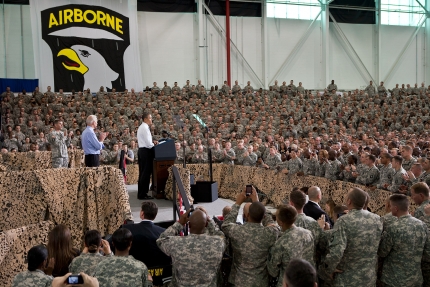
The President and Vice President at Fort Campbell

President Barack Obama delivers remarks to troops at Fort Campbell, Ky., May 6, 2011. Vice President Joe Biden stands at left. (Official White House Photo by Pete Souza)

It was an emotional week, from the relief of the President's announcement that Osama bin Laden was dead to the somber rememberance of the victims in New York City.  It ended on a note of gratitude, as the President and Vice President went to Fort Campbell, Kentucky to welcome troops home from a deployment in Afghanistan after a private meeting honoring the military and intelligence professionals involved in the operation against bin Laden.

The Vice President:

I know many of you have just gotten home in the past few weeks -- so welcome home.  And I know from experience that your families want more than anything to spend time with you.  And so, every time I show up at a welcome home ceremony, I’m always worried about getting in the way.  Because I remember when my son came back home from Iraq after a year, there were all these ceremonies.  And I kept saying, hell, man, stop, I want to see my kid.  (Laughter.)

So, anyway, I get it.  So let me just say how much gratitude the President and I have, and all Americans do, for you all.  You guys have been in the fight from the beginning.  And the risk you’ve taken, the incredible sacrifices you’ve made, the comrades you’ve lost, the losses you’ve personally endured -- you’ve been in some of the most inhospitable terrain in the world.

I’ve been there a number of times, back up those damn mountains.  I’d get a helicopter to go down 9,800 feet, and all I got on is a vest -- a bulletproof vest and a helmet and I’m out of breath climbing up about 40 clicks -- 40 feet.  And you guys are up there, 60 to 80-pound packs running around.  God, you’re amazing.  You just are amazing.  I’m in awe of the job you do, in awe of the job you do.  (Applause.)

As I said back in February, I want to also thank your families.  They made sacrifices as well, those intangible sacrifices -- those missed births and those missed birthdays, those missed graduations, those missed -- an occasional funeral. Perhaps more than anything else, just being missed, just not having you home.

The President:

They’re America’s “quiet professionals” -- because success demands secrecy.  But I will say this.  Like all of you, they could have chosen a life of ease.  But like you, they volunteered.  They chose to serve in a time of war, knowing they could be sent into harm’s way.  They trained for years.  They’re battle-hardened.  They practiced tirelessly for this mission.  And when I gave the order, they were ready.

Now, in recent days, the whole world has learned just how ready they were.  These Americans deserve credit for one of the greatest intelligence military operations in our nation’s history.  But so does every person who wears America’s uniform, the finest military the world has ever known.  (Applause.)  And that includes all of you men and women of 101st.  (Applause.)

You have been on the frontlines of this fight for nearly 10 years.  You were there in those early days, driving the Taliban from power, pushing al Qaeda out of its safe havens.  Over time, as the insurgency grew, you went back for, in some cases, a second time, a third time, a fourth time.

When the decision was made to go into Iraq, you were there, too, making the longest air assault in history, defeating a vicious insurgency, ultimately giving Iraqis the chance to secure their democracy.  And you’ve been at the forefront of our new strategy in Afghanistan.

Sending you -- more of you -- into harm’s way is the toughest decision that I’ve made as Commander-in-Chief.  I don’t make it lightly.  Every time I visit Walter Reed, every time I visit Bethesda, I’m reminded of the wages of war.  But I made that decision because I know that this mission was vital to the security of the nation that we all love.

Europe: "The Cornerstone of our Engagement with the World"

Speaking at the 50th Anniversary celebration of the Atlantic Council on Tuesday night, Vice President Biden discussed the continued importance of a strong partnership with our European allies and partners, as well as the enduring relevance of the North Atlantic Treaty Organization (NATO) in protecting against new and evolving threats around the world.

‪From the European Union’s role as our largest trading partner, to the significant role of NATO in Afghanistan and elsewhere, “Europe is the cornerstone of our engagement with the world and a catalyst for global cooperation,” Vice President Biden said, quoting President Obama.

Vice President Biden Speaks at the 50th Anniversary Celebration of the Atlantic Council

Vice President Biden speaks at the 50th Anniversary celebration of the Atlantic Council, May 3, 2011. (Official White House Photo by David Lienemann)

‪The Vice President stressed that while NATO’s membership and mission have evolved in response to the profound changes of the last two decades, our transatlantic relationship remains essential, as we move from “confrontation to cooperation with Russia” and “navigate the transformation that’s taking place in the Middle East.”

‪Vice President Biden lauded Russia’s emergence as a key partner in the greater European community, highlighting the “reset” in U.S.-Russian relations that led to a new START treaty and close cooperation on counterterrorism and nuclear nonproliferation. “Missile defense cooperation could be the next big step forward,” the Vice President said.

‪In closing, the Vice President asserted that in the next half century, one he predicted “will be just as consequential as the last,” the “lot of humanity is going to continue to depend upon…the solidarity of the Atlantic Community.”

Elizabeth Alexander is Press Secretary for the Vice President

Related Topics: Defense, Foreign Policy

West Wing Week: "A Good Day For America"

This week, the President announced the death of Osama bin Laden, visited New York City to honor the victims of 9/11 and their families, made sure the federal government was doing its part in the states devastated by storms and much more.

West Wing Week: "A Good Day For America"

May 06, 2011 | 7:58 | Public Domain

This week, the President announced the death of Osama bin Laden, visited New York City to honor the victims of 9/11 and their families, made sure the federal government was doing its part in the states devastated by storms and much more.

Download mp4 (262MB)