Remarks by the President and Vice President to Chrysler Plant Workers in Kokomo, Indiana
Chrysler Indiana Transmission Plant, Kokomo, Indiana
2:00 P.M. EST
THE VICE PRESIDENT: Hello, folks, how are you? (Applause.) Good to see you all. Good to be back in an automobile plant, making things. (Applause.) Hey, thank you all very much. We’re delighted to be here and I expect as delighted as you are to be able to be here. (Laughter.)
Look, when the President and I got elected we knew we had a heavy load to carry. The country was in some real tough shape. And we stepped up, and with the help of some of -- all the congressmen, the senators here, we passed the Recovery Act just after taking office, in the midst of the worst economic crisis since the Great Depression.
And we had three clear goals, led by the President. One is help communities and people who were hit the hardest, hit the hardest by this awful recession. Save and create jobs today, but also lay a foundation for long-term prosperity in the future. Because more than -- a year after implementing this act, I can say proudly that not only have we helped millions of people, but -- not only have we created millions of jobs, not only have we spurred growth in new industries, but we have completely transformed, with the great leadership of the local and state leadership here, communities like this one here in Kokomo. (Applause.)
Look, I’m the son of an automobile man, and I want to tell you he managed automobile facilities for my entire life. And Kokomo, anybody in the automobile business has already known, was one of the great auto towns in America -- not only making Chrysler automobiles but Delphi, supplying parts and so many other suppliers, and all the related jobs that go with that.
To bring Kokomo back, to bring the automobile industry back, we knew we had to change things. We couldn’t just keep doing the things the way we did. We knew the auto industry had to get leaner, had to get tougher, had to be more competitive. And we insisted that they did. And now you see the result -- an old industry adapting to a whole new era, competing again, leading again, and most importantly, hiring again. Hiring again. (Applause.)
Mr. President, I know you know this, but the last year of the last outfit we succeeded, they lost 461,000 automobile-related jobs. And so far we’ve created almost 75,000 new jobs, and a lot more to come.
And, folks, look, the government didn’t do this. The government didn’t do this alone. The government did was it was supposed to do. With the leadership of a President and leadership from the President, we had investment from the private sector brought onboard because the government was able to get back in the game and said we’re part of it. The auto industry has roared back in America.
Now, I was telling the boss over here that the thing I like most about everything -- again, being the son of an automobile man -- is that my dad would be happy. For the first time in 24 years -- Americans like your product better than they like foreign products that are made here. (Applause.) That's a big deal. That's a big deal. (Applause.)
Look around here. Look around here. For every one guy working here in the assembly line, there’s five more doing exactly what you’re doing. Everybody thinks it’s only the assembly plants. Well, there's five people working at plants like this for every single job in the automobile assembly line. It’s a big, big process. People working in places like here and Delphi Suppliers, making parts was a major part of this recovery.
And then when you guys have jobs, guess what happens. The coffee shop stays open. The barbershop stays open. The restaurant stays open. People open new businesses downtown. People sell jackets and shoes and hats. People, in fact, have jobs. This has an effect all the way through the economy.
And that's what’s happening here in Kokomo, as your mayor can tell you. The lunch counter needs a few more waitresses and servers to feed them. The remodeled plant can reinvigorate an entire community and give people who don't work here hope. The people who don't work here. We were just in town. People were saying, thank you. They don't work here. They're saying thank you for this facility.
But we can’t just build a new economy by revitalizing and modernizing an old industry. We can’t stop at creating new jobs in old industries. We need to create whole new industries, as well. And that's what the President did. A great example is over in Tipton, AboundSolar -- whole new industry. There’s no reason why you can’t build the best automobiles in the world and also be a leader in what the new industries -- the new green industries in the world are going to be.
The President did what every great President has done in the past. He’s looked to the future. We used the Recovery Act to provide seed money that sparked private investment -- private investment in new industries like solar and wind, advanced batteries, high-efficiency lighting, high-speed rail.
Folks, some of our friends forget, that's what all great Presidents did. Lincoln did it when he built the Transcontinental Railroad by putting down seed money to the railroads to go build it. That's -- we’re doing the same thing here again.
Every great President has a vision. And now we’re doing it here. We’re doing it here with the renewable energy investments that are being made outside the city, with the new industries of the future. And in a sense, there’s a whole new automobile industry building a different kind of automobile.
Mr. President, my dad used to have a saying when he was -- ran automobile dealerships of almost four decades. He said, Joey, all they got to do is give me product. Give me product. Give me product, I can sell it. I can -- you’re giving them the best product in the world again.
We also believe we can’t have a strong economy without strong communities. And that's why the President in the Recovery Act made sure we helped hard-hit towns like Kokomo. We now -- we were just at the fire station. There’s 13 firefighters still on the job because of the Recovery Act and because of the SAFER Act. Teachers, law enforcement officers on the job.
When I tell you an international recession hits and a worldwide recession, guess what. A town like Kokomo and other towns of 50,000 all across America, they can't do it on their own. You got to help them stand up a little bit. And that's why we helped with infrastructure and roads, to bring improvements, to bring back Main Street, to bring it back to life.
Kokomo is in the forefront of it all. And nowhere is it written that Kokomo can't be the hub of innovation in emerging industries of the 21st century -- like it was in the 20th century. (Applause.) Nowhere is that written.
Look, nobody knows better than this man that our work certainly isn’t done yet. We're just starting. But it’s important we recognize success stories like Kokomo as signs that we are definitely moving in the right direction. This town and its people are a model for others looking to do the same thing over and over again in this country. You guys here have been the embodiment of the limitless potential when we put government and the private sector and the community all together, working toward the same end -- a community built -- this community -- this community is built on grit and determination, a willingness for you all to fight hard, to pick yourself back up off the mat and to march toward what you all believe now -- I believe, I hope you do -- is a better day, a brighter future, a new start.
We know it’s a long road back. But we know we're on the road. And the one most important thing we've got to communicate to the nation and to everyone listening is we can't stop now. We can't turn around. We're heading in the right direction.
Kokomo is coming back. America is coming back. And it couldn't have happened without the vision of the man sitting behind me.
Ladies and gentlemen, the President of the United States, Barack Obama. (Applause.)
THE PRESIDENT: Thank you. Thank you, everybody. Thank you. (Applause.) Everybody have a seat. Thank you so much. Thank you, Joe. Thank you, Kokomo. I have to just say, by the way, Joe is not only one of the best Vice Presidents in history. He’s also one of the best introducers in history. (Laughter.) I try to take him wherever I can.
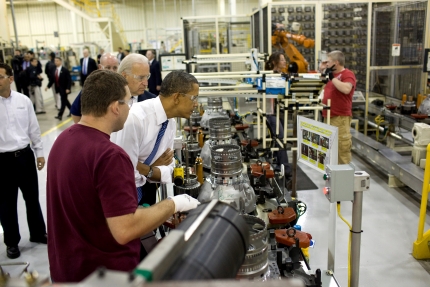
I want to thank your plant manager, Jeremy Keating, for the great tour and the great work that he’s doing here. (Applause.) He is proud of the work that's being done at this plant. I want to thank your local UAW president, Richie Boruff, who’s here -- (applause) -- thank them for showing me around.
A couple other hotshots -- U.S. Senator Evan Bayh is here. (Applause.) Congressman Joe Donnelly is in the house. (Applause.) Congressman Andre Carson is here. (Applause.) Congressman Baron Hill is here. (Applause.) By the way, Congressman Baron Hill is in the Indiana Basketball Hall of Fame. Now, that's pretty cool. Being a congressman is cool; being in the Basketball Hall of Fame in Indiana -- that's something.
Mayor of Kokomo, Greg Goodnight, is here, doing outstanding work. (Applause.) The CEO of Chrysler Group, Sergio Marchionne, is here. (Applause.) President of UAW, Bob King, is in the house. (Applause.)
We've got some of the best workers in the United States of America right here at this plant. (Applause.) And I had a chance to meet some of you as we were going around seeing these amazing transmissions that you’re building. And I was very happy to hear that after a couple of tough years, this plant is now running at full capacity. And that’s why I’m here today. (Applause.) That's why I'm here today.
Now, we all know that one plant by itself doesn’t mean that there aren't people in Kokomo who are still hurting. I had lunch with the mayor and some firefighters, and there's still a long way to go. The mayor has got all kinds of great plans, and there are businesses that are looking to start expanding. But the fact is there are millions of people around the country who are still looking for work in the wake of the worst recession in our lifetimes. I don’t have to tell you that. Many of you still have friends or neighbors, a husband or a wife who is still struggling.
And I know that before this plant started rehiring, a lot of you were in the same position, so you remember that it is a tough, tough thing when you’re out of work, especially when you’ve taken a lifetime of pride in working and supporting a family and making great products.
But even as we continue to face serious challenges, what’s happening here at this plant -– the changes we’re seeing throughout Kokomo -– are signs of hope and confidence in the future -- in our future, together. You’re showing us the way forward. You’re living up to that spirit of optimism and determination -– that grit –- that’s always been at the heart of who we are as a people, at the heart of America.
I remember coming to Kokomo a little over two years ago. Joe will remember this. Some of you might have been here. What was happening here reflected what was happening all over the country, all over this region. For a decade or more, families had felt a growing sense of economic insecurity. A lot of manufacturing had left the area. And then a recession started taking hold, and folks were seeing job losses and facing new hardships.
That was before anybody knew how devastating the recession was going to be. So by the time I took office, just a few months later, the financial crisis had hit, the auto industry teetered on the brink, and we were losing millions of jobs.
And that left Joe and I with some tough choices. One was to help the auto industry restructure. And that wasn’t an easy call. I understood that there were some reservations of those who said that the industry should pay a price for some poor decisions by the part of management. But we also knew that millions of jobs hung in the balance. We also knew that the very survival of places like Kokomo were on the line. And we knew that the collapse of the American auto industry would lead to an even deeper disaster for our economy.
And you know what, we also believed that America, which popularized the automobile, whose middle class was made on the basis of manufacturing -- that we couldn’t just give up. We couldn’t throw in the towel. That was not an option.
There were those who were prepared to give up on Kokomo and our auto industry. There were those who said it was going to be too difficult, or that it was bad politics, or it was throwing good money after bad. You remember the voices arguing for us to do nothing. They were pretty loud, suggesting we should just step back and watch an entire sector of our economy fall apart.
But we knew that the auto industry was not built, and this country was not built, by doing the easy thing. It wasn’t built by doing nothing. It was built by doing what was necessary even when it’s difficult. So we made the decision to stand behind the auto industry -- if automakers, if CEOs like Sergio were willing to do what was necessary to make themselves competitive in the 21st century, and if they have the cooperation of workers who were taking pride in the products that they made.
We made the decision to stand with you because we had confidence in the American worker, more than anything. And today we know that was the right decision. (Applause.) We know that was the right decision.
Today each of the Big Three automakers has increased their market share -- each of them. For the first time in over a decade, Americans are buying a larger share of Chryslers, Fords and G.M. cars, and a smaller share of their foreign counterparts -- for the first time in decades. (Applause.)
We’re coming back. We’re on the move. All three American companies are profitable, and they are growing. Some of you read last week, G.M.’s stock offering exceeded expectations as investors expressed their confidence in a future that seemed so dim just 18 months ago. And as a result, the Treasury was able to sell half of its G.M. stock.
So here’s the lesson: Don't bet against America. (Applause.) Don't bet against the American auto industry. Don't bet against American ingenuity. Don't bet against the American worker. Don't bet against us. (Applause.) Don't bet against us. (Applause.)
Don't bet against us. This plant is a shining example of why you shouldn’t. Two years ago, production here was plummeting. A lot of folks had lost their jobs. Today, this plant is coming back. The company has invested more than $300 million in this factory to retool. (Applause.)
But it gets better. Sergio just told me today Chrysler is announcing an additional investment of more than $800 million in its Kokomo facilities -- $800 million. (Applause.) That's good. That's good news. (Applause.) That's real money, $800 million. (Laughter.) See, the mayor has got a big grin on his face. (Laughter.) You're pretty happy about that. (Laughter.)
Over the next few years, folks here expect to manufacture more transmissions than ever before. And as a result, hundreds of workers are back on the job. Jeremy said we’re going to be hiring more. (Applause.)
This includes -- I’m going to name a couple of people just to embarrass them a little bit. Where is Sharon Ybarra? Is Sharon here? Right here. (Applause.) Sharon lost her job of 20 years at a paper mill. She was only able to find work that paid her far less than her old job -– until she was hired by Chrysler. And now she is doing a great job right here at Chrysler. We’re proud of you. (Applause.)
Jim Faurote is here. Where’s Jim? Jim’s right next to her. (Applause.) Jim worked for Chrysler for a decade -- right? Then he lost his job when the plant he worked at in New Castle shut down. Over the next few years, he could only find intermittent work on and off. It wasn’t until after the restructuring that he was able to have a job he could count on. He’s been back at work now for more than a year doing an outstanding job, making great products here at Chrysler. (Applause.)
At a plant down the road, workers are manufacturing parts for hybrid vehicles. That’s already led to dozens of jobs, and will lead to nearly 200 jobs over the next few years. A few miles outside of Kokomo, in Tipton, a clean energy company called Abound is going to be able to hire 900 workers -– taking over a plant that had to shut down a few years ago.
So a factory that was empty and dark will come back to life. And when people have a paycheck, as Joe said, they can go to the store, they’re able to spend. That helps the economy grow. And so on Main Street in Kokomo we’re seeing a revival, with new businesses opening downtown.
So, for anybody who says our country’s best days are behind us, anybody who would doubt our prospects for the future, anybody who doesn’t believe in the Midwest, anybody who doesn’t believe in manufacturing -- have them come to Kokomo. Have them come to Kokomo. (Applause.) Come here. Meet these workers. Visit these plants. Come back to this city that's fighting block by block, business by business, job by job. (Applause.)
This is a reminder of what we do as Americans. What we can do as Americans when we come together, when we’re not divided; we’re not spending all our time bickering, but instead focusing on getting the job done. We don’t give up. We don’t turn back. We fight for our future.
No, we’re not out of the woods yet. It took a lot of years to get us into this mess. It will take longer than anybody would like to get us out. But I want everybody to be absolutely clear, we are moving in the right direction. (Applause.) We learned that the economy -- we learned today that the economy is growing at a faster pace than we previously thought. That's welcome news. But we’re going to keep on making it grow faster. We’re going to keep on creating more jobs. We need to do everything we can to make that happen.
That’s why in the coming days it is so important, the coming months it’s so important, that Democrats and Republicans work together to speed up our recovery. We’ve got to put aside our differences. The election is over. We’ve got to find places where we can agree. We’ve got to remember the most important contest we face, it’s not between Democrats and Republicans. It’s between America and our economic competitors. Other nations are already making investments -- (applause) -- other nations are making investments in education, energy and infrastructure, technology, because they know that’s how they’re going to be able to attract the new jobs of the future. And throughout our history, Democrats and Republicans have agreed on making these investments.
If we don’t want to cede our economic leadership to nations like China, we’ve got to do the same today. We’ve got to make sure our workers have the skills and the training to compete with any workers in the world. We should give our businesses more incentive to invest in research and innovation that leads to new jobs and new products and new industries like the ones we’re seeing here in Kokomo. We should make it easier, not harder, for middle-class families to get ahead.
I'll give you an example -- on taxes. Next year, taxes are set to go up for middle-class families unless Congress acts. If we don’t act by the end of the year, a typical middle-class family will wake up on January 1st to a tax increase of $3,000 per year.
So, in the next few weeks, I’m asking Congress to take up this issue. The last thing we can afford to do right now is raise taxes on middle-class families. (Applause.) If we allow these taxes to go up, the result would be that a lot of people most likely would spend less, and that means that the economy would grow less. So we ought to resolve this issue in the next couple of weeks so you’ve got the assurance that your taxes won’t go up when that clock strikes midnight.
Now, this is actually an area where Democrats and Republicans agree. The only place where we disagree is whether we can afford to also borrow $700 billion to pay for an extra tax cut for the wealthiest Americans, for millionaires and billionaires. I don’t think we can afford it right now –- not when we are going to have to make some tough decisions to rein in our deficits. That's going to require sacrifice from all Americans, including those who can most afford it.
So I’m eager to sit down with leaders from both parties next week and to hammer this out. But we need to hammer it out.
You know, long before transmissions were coming off the line at this plant -– and by the way, you look at these transmissions today and somebody 20 years ago or 10 years ago might not recognize them -- they’re amazing. Before Henry Ford built the Model T or Walter Chrysler took up the reins at a start-up called Buick, a man by the name of Elwood Haynes decided to do a little experiment right in Kokomo. (Applause.)
He set up a one-horsepower boat engine on his kitchen; he bolted it to the ground. His idea was that he might be able to rig the motor to a carriage. So he starts it up -- and the engine worked great. In fact, it worked so well that it came loose from the bolts and destroyed the kitchen floor. And after a brief and what I imagine was a difficult conversation with his wife -- (laughter) -- Elwood decided to continue his tests in his machine shop. And he toiled for months. But when he was finished, he had completed one of the earliest working automobiles ever built in America. And he named it the Pioneer.
So Kokomo has a storied place in our history. This is a city where people came to invent things and to build things, to make things here in America; to work hard in the hopes of producing something of value and something that people could be proud of.
That’s the legacy of all of you. You are all heirs to that tradition right here at this plant. That’s the legacy that has made this country the envy of the world. (Applause.) And I am absolutely convinced this legacy is one you will continue to uphold for years and decades to come.
Congratulations, Chrysler. Congratulations, Kokomo. Proud of you. (Applause.)
END
2:27 P.M. EST