The White House

Office of the Press Secretary

Vicepresidente Biden, Presidenta del Consejo de Asesores Económicos Romer Dan a Conocer Nuevo Análisis Sobre el Empleo e Impacto Económico de la Ley para la Recuperación

Informe trimestral del consejo indica que la Ley para la Recuperación es responsable por aproximadamente 3 millones de empleos y programas que propician inversión de capital privado externo triplican fondos


WASHINGTON, DC – El Vicepresidente Joe Biden y la presidenta del Consejo de Asesores Económicos (Council of Economic Advisers o CEA) Christina Romer están dando a conocer hoy el informe trimestral más reciente del CEA sobre el impacto económico de la Ley para la Recuperación. El informe concluye que la Ley para la Recuperación ya es responsable por 2.5 millones a 3.6 millones –o aproximadamente 3 millones– de empleos y que por cada dólar de la Ley para la Recuperación que el gobierno invirtió en los programas concebidos para propiciar la inversión de capital externo, las empresas privadas y otros están invirtiendo casi el triple.


Se puede ver el informe completo AQUÍ.


Cuarto informe trimestral del Consejo de Asesores Económicos sobre el impacto económico de la Ley para la Recuperación y Reinversión en Estados Unidos (American Recovery and Reinvestment Act) del 2009

Conclusiones principales


La Ley para la Recuperación ha tenido un impacto significativo en el empleo y crecimiento económico:


  • Hasta el segundo trimestre del 2010, la Ley para la Recuperación aumentó el número de empleos entre 2.5 millones y 3.6 millones de puestos. Esto nos lleva por buen camino para lograr el objetivo de 3.5 millones de empleos para fines de año.


  • El CEA calcula que para el segundo trimestre del 2010, la Ley para la Recuperación aumentó el nivel del PIB entre 2.7 y 3.2 por ciento. Estos cálculos son muy similares a los de una gran variedad de analistas, entre ellos la Oficina de Presupuesto del Congreso (Congressional Budget Office).


·         La inversión en sectores como infraestructura, energía limpia y tecnología de comunicaciones aumentó aproximadamente 50 por ciento del primer al segundo trimestre del 2010.


La Ley para la Recuperación está haciendo inversiones que benefician a la economía actualmente y lo seguirán haciendo durante mucho tiempo:


·         $319,000 millones en la ley han sido destinados a “inversiones públicas” que no sólo están “contribuyendo a que la economía se recupere y haciendo que los estadounidenses vuelvan a trabajar en este momento, sino que también están realizando inversiones en sectores como energía limpia, informática para el campo de salud, carreteras y la capacitación de nuestros trabajadores, lo que beneficiará a la economía durante muchos años”. Hasta la fecha, se han asignado dos tercios de estos fondos y más de una cuarta parte ya se ha entregado. El CEA calcula que los $86.3 millones en inversión ya generaron o preservaron más de 800,000 empleos para el segundo trimestre del 2010, un aumento de 30 por ciento con relación al primer trimestre.


La Ley para la Recuperación está propiciando inversiones significativas por parte de empresas privadas y otras entidades:


·         Una porción de estas inversiones públicas, $95,000 millones, está propiciando la inversión de fondos externos por parte de empresas privadas y otras entidades. Con la inversión de cada dólar, se apoya $4.00 en actividad económica, lo que significa que $286,000 millones en inversión externa se suman a los fondos de la Ley para la Recuperación, para apoyar $382,000 millones en actividad total de los proyectos. Entre los beneficios de esta “inversión conjunta” se encuentran:


·         Impulsar la inversión privada: Ya que el mercado crediticio aún se está recuperando de la crisis económica, la Ley para la Recuperación está estimulando directamente $153,000 millones de inversión tan sólo del sector privado.


·         Alinear incentivos económicos: Ya que los inversionistas privados usan cantidades significativas de su propio dinero en proyectos de la Ley para la Recuperación, se comprometen con ellos y tienen mayor incentivo para usar los fondos responsablemente.


·         Aumentar el respaldo en general: El gobierno federal tiene la responsabilidad de usar el dinero de los contribuyentes de la manera más eficaz y eficiente posible. El dinero de los contribuyentes rinde más cuando la inversión privada multiplica esos dólares.


La energía limpia es uno de los sectores que está propiciando mayor inversión con la Ley para la Recuperación:


·         Por sectores, el de energía limpia cuenta con la mayor cantidad de actividad total apoyada, donde una contribución federal de $46,000 millones se sumará a $107,000 millones para apoyar más de $150,000 millones en inversión total en eficiencia energética, generación de energía renovable, investigación y otros proyectos.


·         Uno de esos proyectos es el programa de red inteligente del Departamento de Energía, que promoverá el consumo más sensato de energía y aumentará la transparencia en la manera en que se consume energía. El sector privado, impulsado por una inversión de $4,500 millones de la Ley para la Recuperación, invirtió $6,000 millones adicionales en proyectos de red inteligente, lo que llevará la inversión total a más de $10,000 millones.


·         Por ejemplo, se les ha asignado a Oregon, Washington, Idaho, Montana y Wyoming $88 millones para un proyecto regional de demostración de red inteligente. El proyecto de $178 millones, expandido por $90 millones en fondos de contrapartida de empresas tecnológicas y de servicios públicos, abarca 12 proyectos de servicios públicos y 15 de prueba, y los estados calculan que generará o preservará 1,500 empleos en cinco estados.


Los bonos Build America de la Ley para la Recuperación también están generando una significativa inversión externa, y a la vez están ahorrándoles a los gobiernos estatales y locales miles de millones de dólares:


·         En desarrollo económico, un aporte por la Ley para la Recuperación de aproximadamente $14,000 millones se está sumando a más de $130,000 en inversión externa para respaldar más de $145,000 millones en actividad económica. Los bonos Build America (BAB) constituyen gran parte de esa actividad.


·         Para el 30 de junio, 2010, se han emitido bonos con un valor nominal total de $115,000 millones, en 1,446 ocasiones separadas en 49 estados, Washington, DC y 2 territorios. Los bonos permitirán que las municipalidades originen préstamos con 35 por ciento de los intereses pagados por el gobierno federal. Los préstamos son atractivos para una variedad de inversionistas, como fondos de pensión, que no se benefician del estatus de exoneración de impuestos de los bonos municipales tradicionales. Al ofrecer más fuentes de fondos, los bonos reducen el costo de intereses de las entidades emisoras. El Tesoro calculó recientemente que los bonos les han ahorrado a gobiernos estatales y locales aproximadamente $12,000 millones.


·         Por ejemplo, en Minneapolis, la junta del condado de Hennepin recaudó $27 millones por medio de la emisión de bonos Build America, los cuales está combinando con bonos estatales y del condado para financiar los $80 millones para la reconstrucción del puente de la avenida Lowry. Se calcula que los contribuyentes de Minneapolis ahorrarán de $3 a $5 millones.


Proyectos de construcción de edificios, descontaminación y conservación ambiental también se están beneficiando de los efectos de la Ley para la Recuperación en propiciar otras inversiones.


·         Otros sectores incluidos en el informe incluyen descontaminación y conservación ambiental, en los que una inversión de $11,000 está respaldando más de $21,000 millones en actividad económica; la construcción de edificios, donde una inversión de $6,400 millones está respaldando $29,400 millones, entre varias otras.


Los programas de la Ley para la Recuperación que propician otras inversiones están activando capital privado y contribuyendo a que continúen los proyectos de energía limpia durante un difícil momento económico:


·         En un caso, el CEA examina la sección 1603 del Programa de Asistencia en Efectivo para Energía (Energy Cash Assistance Program), para ver si esta inversión conjunta se habría realizado sin los fondos aportados por la Ley para la Recuperación.

·         Al examinar los años previos en los que no hubo inversión nacional para impulsar la actividad del sector privado y compararlos con los años en que sí la hubo, los proyectos del CEA que aumentan la capacidad eólica en el 2009 se habrían reducido en más de la mitad sin la Ley para la Recuperación y otros incentivos.

En el 2009, se instalaron proyectos que aumentaron la capacidad eólica en 10,000 MW, y la Ley para la Recuperación y otros incentivos fueron responsables por más de 6,000 MW de ellos.

Assessing the Economic Impact of the Recovery Act

July 14, 2010 | 33:17 | Public Domain

Vice President Joe Biden is joined by Chair of the Council of Economic Advisers Christina Romer as he discusses the latest quarterly report on the economic impact of the Recovery Act.

Download mp4 (318MB) | mp3 (31MB)

The White House

Office of the Press Secretary

Vice President Biden, CEA Chair Romer Release New Analysis on Job and Economic Impact of the Recovery Act

CEA Quarterly Report Finds Recovery Act Responsible for About 3 Million Jobs, Leverage Programs Spurring 3 to 1 Outside Capital Investment

WASHINGTON, DC – Vice President Joe Biden and Chair of the Council of Economic Advisers Christina Romer are unveiling today the Council of Economic Advisers’ latest quarterly report on the economic impact of the Recovery Act.  The report finds that the Recovery Act is already responsible for 2.5 to 3.6 million – or about 3 million – jobs and that for every government dollar invested in Recovery Act programs designed to leverage outside capital, private companies and others are co-investing with nearly three times as much outside investment.

The report can be viewed in full HERE

The Council of Economic Advisers Fourth Quarterly Report on the Economic Impact of the American Recovery and Reinvestment Act of 2009
Key Findings

The Recovery Act has had a significant impact on employment and economic growth:

• As of the second quarter of 2010, the Recovery Act has raised employment by between 2.5 and 3.6 million jobs.  This puts us well on track to reach the 3.5 million jobs benchmark by the end of this year.

• CEA estimates that the Recovery Act has raised the level of GDP as of the second quarter of 2010 by between 2.7 and 3.2 percent.  These estimates are very similar to those of a wide range of other analysts, including the Congressional Budget Office. 

• Outlays in areas such as infrastructure, clean energy, and communications technology increased by roughly 50 percent between the first and second quarters of 2010.

The Recovery Act is making investments that benefit the economy today and far into the future:

• $319 billion in the Act is dedicated to “public investments” that are not only “helping the economy to recover and put Americans back to work today, they are also making investments in areas such as clean energy, health information technology, roads, and the skills of our workers that will benefit the economy far into the future.”  To date, two-thirds of these funds have been obligated and more than one-quarter have been outlayed.  CEA estimates that the $86.3 of outlays has already created or saved more than 800,000 jobs as of the second quarter of 2010, an increase of 30 percent over the first quarter. 

The Recovery Act is leveraging significant investment from private companies and other entities:

• A subset of these public investments, $95 billion, is leveraging external funds from private companies and other entities.  For each of these dollars invested, $4.00 of economic activity is supported – meaning $286 billion of external investments are partnering with Recovery Act funds to support $382 billion into total project activity. The benefits of this “co-investment” include:

• Jump-starting private investment: With credit markets still recovering from the financial crisis, the Recovery Act is directly stimulating $153 billion in private sector investment alone.

• Aligning economic incentives: As private investors use significant amounts of their own money in Recovery Act projects, they put “skin in the game” and have more incentive to use funding responsibly.

• Increasing overall support: The federal government has a responsibility to use tax dollars as effectively and efficiently as possible. Taxpayers get more value when those dollars are leveraged by private investment.

Clean energy is one of the areas generating the most Recovery Act outside investment leverage:

• By sector, the largest amount of total activity supported is in clean energy, where a federal contribution of $46 billion will partner with $107 billion to support over $150 billion in total investments in energy efficiency, renewable generation, research, and other areas.

• One such area is the Department of Energy’s smart grid program, which will foster smarter energy use, increasing the transparency of how energy is used. Spurred by a $4.5 billion Recovery Act investment, the private sector invested an additional $6 billion in smart grid projects, bringing the total investment to over $10 billion.

• For example, Oregon, Washington, Idaho, Montana, and Wyoming have been awarded $88 million for a regional smart grid demonstration project. Bolstered by $90 million in matches from utilities and technology companies, the $178 million project features 12 utilities and 15 test sites and the states estimate it will create or retain 1,500 jobs across the five states.

Recovery Act Build America Bonds are also generating significant outside investment, while saving state and local governments billions:

• In economic development, a Recovery Act contribution of approximately $14 billion is partnering with over $130 in outside investment to support over $145 billion in economic activity. Build America Bonds (BABs) make up the majority of that activity.

• As of June 30, 2010, BABs with a total face value of $115 billion have been issued in 1,446 separate issues in 49 states, DC and 2 territories. BABs allow municipalities to originate loans with 35 percent of the interest paid by the Federal government.  The loans are attractive to a variety of investors, such as pension funds, who do not benefit from the tax-free status of traditional municipal bonds.  By bringing in more sources of funding, the bonds lower interest costs for issuers.  The Treasury recently calculated that the bonds have saved state and local governments about $12 billion.

• For example, in Minneapolis the Hennepin County Board raised $27 million through a BABs issuance, which it is combining with state bonds and county funding to finance the $80 million Lowry Avenue bridge reconstruction.  Estimated savings to Minneapolis taxpayers is between $3 and $5 million.

Building construction and environmental cleanup and preservation projects are also benefiting from the leverage effects of the Recovery Act.

• Other sectors covered in the report include environmental cleanup and preservation, where an $11 billion investment is supporting over $21 billion of economic activity; construction of buildings, where a $6.4 billion investment is supporting $29.4 billion; and several more.

Recovery Act leverage programs are bringing private capital off the sidelines and keeping clean energy projects alive during tough economic times:

• In one case study, CEA examines the Section 1603 Energy Cash Assistance Program, to see if this co-investment would have happened without Recovery Act funds in the game.

• By looking at previous years in which no national investment was spurring private sector activity, compared to years in which there was a national investment, CEA projects that wind capacity additions in 2009 would have been cut by more than half without the Recovery Act and other incentives.

• In 2009, 10,000 MW of wind capacity additions were installed, and the Recovery Act and other incentives were responsible for over 6,000 MW of those additions.

The White House

Office of the Vice President

Remarks by the Vice President at a Fourth of July Reception

New Embassy Compound, Baghdad, Iraq

7:33 P.M. (Local)

THE VICE PRESIDENT:  Thank you very much, Mr. Ambassador.  Let me begin by saying, Mr. President, it’s great to see you again, and all of my friends; Mr. Minister.  So many of you I’ve known for so long.

I came once again with a distinguished American delegation, because they don’t trust me alone.  (Laughter.)
Because they know I like you too much. 

Let me say to all of you before I reference our Fourth of July celebration, the first time I was here was very shortly after -- a matter of weeks after the statue of Saddam was famously pulled from its moorings.

Everything since then has changed but the heat.  (Laughter.)  As I flew into the embassy on a helicopter after landing at the airport last time I was here, it was in the evening.  And I think General Odierno was with me, and I think you were in the helicopter as well, Mr. Ambassador.  And I looked down -- and I mean this seriously -- I observed something remarkable.  There was a traffic jam.  Every road around Baghdad and coming into Baghdad was backed up bumper to bumper with automobiles.  Welcome to peace and democracy.  (Laughter.) 

But it is the most significant sign that life and commerce and celebration has returned.  And speaking of celebration, my -- our comrade in arms, our United States military, of whom I’m incredibly proud, and all the government officials and Americans that are here in Baghdad and throughout Iraq celebrate today in our country’s history because we’re so proud of what the day stands for.

As I’ve traveled around the world on our Fourth of July, many leaders of other countries assume we celebrate the Fourth of July because of our victory over the British in the Revolutionary War.  But that date occurred much later.  We celebrate the Fourth of July because of our Declaration of Independence.  It was the day that our Founders laid out and signed, literally risking their own lives, what we believed our country should stand for and what all humanity was entitled to.

They made a universal statement, applying to all mankind.  They said, “We hold these truths self-evident, that all men are created equal, endowed by their Creator with certain inalienable rights, among them, life, liberty, and the pursuit of happiness,” free of any king or potentate, free of any foreign government.

The creation of the United States was a conscious, a deliberately conscious act to bring liberty and prosperity to all people in the world.

I’m not saying that we have been a perfect nation; we certainly have not.  But as my grandfather would say, in the main, over the past 234 years, we’ve abided by those principles.

That’s why I sent my son here in uniform for a year.  That’s why tens of thousands of Americans have sent their sons and daughters here for extended periods of time, because we know what you fight for.  You hold all these truths self-evident. 

But as you know better than we do -- and I see my good friend Mr. Hashimi has just walked in the door -- all of you know it requires great sacrifice and the willingness to subordinate your individual interest to the communal good.

As I said, I’ve met with all of you for many years, and hopefully you view me as I view you, as a personal friend.  I just wanted to make it clear I’m not lecturing, I’m not imparting any great wisdom that you don’t already know.  But the concept of subordinating your individual interest is fundamental to the success of any nation.  And it’s enshrined in the immortal words of a famous American revolutionary leader who said, “United we stand; divided we fall.” 

The American people stand with you, stand united with you, at a time when a new Iraq has been born.  Over the past several years, you’ve made extraordinary progress, and you’ve had extraordinary sacrifices you’ve made.  These sacrifices have been both public and personal. 

Some of you have lost your brothers.  Some of you have lost your sisters.  Some of you have lost family.  It’s the responsibility, it seems to be now of all of us, but primarily all of you assembled here, to honor those sacrifices and honor the public trust that was awarded to all of you in the elections you just held.

You should not -- and I’m sure you will not -- let any state, from the United States to any state in the region, dictate what will become of you all.

So my plea to you is, finish what you started -- a truly legitimate and representative government that meets the needs and aspirations of all Iraqi people.

To the extent you continue that quest, we will stand with you -- not telling you what to do, but stand with you in doing what you need help doing if you ask us.

I hope you know we’ve kept our commitment so far, and on August 31st, we will change our military mission by drawing closer to all of you, not further apart.

We will still have 50,000 of our sons and daughters who can shoot straight, who can work with you, but they will be in reserve.  You, your military, has acquired the capacity to lead your country.

As we enter this new relationship, I want to reiterate -- and I can speak and I do speak for the President of the United States -- our commitment to you will not disappear on August 31st; it will grow stronger.  As you continue to stand up and build your democracy, we’ll be there with you economically, politically, socially, science, education.  I’ve been put in charge of our government’s effort to unite all the elements of our government, from the Department of Education to the Department of Commerce to the Department of Science and Technology -- to work with you if you want us to.

America has no hidden agenda.  We have nothing more than to want you to grow as an independent, prosperous democracy.  That will benefit our interest more than anything that else could happen in the region.

What I’m about to say is the only thing that may border on sounding like I am lecturing.  In my humble opinion, in order for you to achieve your goals, you must have all communities’ voices represented in this new government -- proportionately.

Iraqiyya, State of Law, Iraqi National Alliance, the Kurdistan Alliance -- all are going to have to play a meaningful role in this new government for it to work, in my humble opinion. 

As a piece of American history, when our Founders did it, when they signed that Declaration, many of them did not even like one another.  (Laughter.)  You think I’m joking; I’m not. 

So I’ll end by repeating what I said to the press when I arrived:  I’m absolutely confident you will do it, because I’ve met so many of you.  There’s so much talent here.  And what I’ve watched grow is an Iraqi interest before a sectarian interest; an Iraqi interest before a regional interest; a national interest that I believe is real.

So Godspeed in your effort, and may God bless you all.

END
7:50 P.M. (Local)

Celebrating the Fourth of July with Our Troops in Iraq

Last night, my husband Joe and I flew to Iraq to celebrate the Fourth of July with our troops. I can't think of a better way to celebrate Independence Day than spending it with Americans who are bravely serving our country.

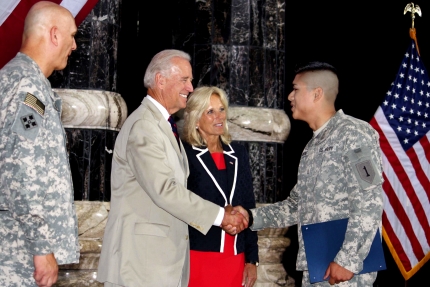
Vice President Joe Biden during a naturalization ceremony in Al Faw Palace on Camp Victory, Iraq

Vice President Joe Biden, center, congratulates a soldier on becoming a U.S. citizen during a naturalization ceremony in Al Faw Palace on Camp Victory, Iraq. Biden's wife, Dr. Jill Biden, and Army Gen. Raymond Odierno, left, commander of U.S. Forces Iraq, also attended the event during which more than 150 U.S. servicemembers became U.S. citizens. July 4, 2010. (by Elaine Wilson)

The White House

Office of the Vice President

Remarks by the Vice President at a Naturalization Ceremony for U.S. Service Members

Al Faw Palace, Camp Victory, Baghdad, Iraq

10:45 A.M. (Local)
 
THE VICE PRESIDENT:  General, all the general officers, Command Sergeant Major, all our military men and women and all the civilians here helping to free and make secure this great country -- I have to tell you, this is the second year in a row I’ve gotten to do this, and this is among the biggest kicks I’ve gotten since I’ve been Vice President of the United States of America.  What an incredible honor.
 
And I have to say it again, what -- the thing I love so much about today is the irony.  Here we are in the hunting lodge of a dictator who subjugated a people; who, in fact, stood for everything that we don’t stand for.  And we’re in the middle of this marble palace, making a lie of everything that he stood for.  I find it delicious that that’s happening.  (Applause.) 
 
I can think of no better place to be sworn in.  We hold these truths self-evident, that all men -- all men, all men -- are created equal.
 
You’re a remarkable bunch of women and men.  I’ve said this in every country and conflict that I’ve been in since I’ve been a United States senator -- was elected to the Senate 37 years ago.  The one lesson every country has to learn, in my humble opinion, particularly as we deal with the resurrection of failed states around the world, is what you symbolize here today.  And that is, until people understand that there is strength in diversity and not division, it makes it awfully difficult to unite a country. 

 Our Iraqi brethren are learning that right now, as they held a free election -- Sunni, Shia, Kurd, Indo-European, Arab.  Ladies and gentlemen, their future lies in what you demonstrate, and I’m confident they’ll achieve it.
 
General, thank you for the introduction and, of course, for your extraordinary service, and I mean extraordinary service, to our country and, quite frankly, to this country, Iraq.  And all of you, all of you, thank you from the bottom of America’s heart for your service and, I might add, for choosing us, for choosing America.
 
What a sight you are today.  And what a powerful symbol -- what a powerful symbol you represent to those who yearn for freedom all across the world.
 
I can’t think of a more stirring example of patriotism than men and women volunteering, as the general pointed out, volunteering to fight for their country, to put their lives on the line, and some of your brethren, having lost their lives and limbs, to fight on foreign soil for their adopted country.  You’re remarkable. 
 
On this Fourth of July weekend, I’m reminded that you have carried the torch of our Founding Fathers, the one that they lit 234 years ago, you carried it around the world, in this case into a nation that’s not your own, in a uniform representing a nation that, until now, was not your own.  
 
You hail from over 60 -- almost 60 countries, different countries, from Brazil to South Korea, and many more in between.
 
You came to America at different points in your lives.  You came with parents aching for a better life than the ones they knew; others, to give a better life to their own children.
 
Your stories may all be different, but today you write a common chapter in American history.  You’ll each raise your right hand in a moment, and in one proud moment together, you’ll recite the oath to be a citizen of the United States of America.
 
The general said he lived essentially in the shadow of the Statue of Liberty.  All of us up here, we spend our time, some more laboriously than others, tracing our roots as to how we got to this status of citizenship.
 
My wife and I, we were kidding, I may be Irish, but I was smart enough to marry an Italian.  I married Dominique Gioccopa’s granddaughter.  But we were going back and looking.  On my side of the family we are Irish, we are English, we are German, we are French.  We are all a mixture.  And you’re just adding to that rich, rich, rich culture.
 
It’s the reason -- I would argue it’s the reason -- it’s the reason why we are who we are, because we have a document called the Constitution that ensures that that mixture will result in the incredible, incredible strain that we have spread all around the world; about freedom.
 
     And for that, I congratulate you, and I welcome you.  I know your service here has not been easy and as the general pointed out, some of you, it’s the third, fourth, fifth time you have served here in Iraq.  Not long ago, Iraq was a country on the brink of civil war.  This is my 15th, 16th, 17th trip in.  And every time I come -- this is four times or five times since I’ve been Vice President -- every time I come, because of an awful lot of brave Iraqis who gave their lives and tens of thousands of Americans who risked and/or gave their lives, it gets better, every single time I’m here.
 
     I was telling the general, last trip in, we were coming in, landing at night, coming in the on the helicopter because we were going into the Green Zone, and I looked down, I thought, what a wonderful thing -- there was a traffic jam.  There were traffic jams.  First time I flew in here, right after the war, there was nobody, nobody, nobody on the road.
 
     This nation, once embroiled in sectarian strife and violence is moving toward a lasting security and prosperity with a government that represents the interest of every member of the community in Iraq, because until they get that straight -- and they’re getting it straight -- there’s no real shot they can become what they’re capable of.
 
     And the United States is committed, we’re committed to cement that relationship through economic, political and diplomatic cooperation, not just by the use of arms.
 
     Last year at this ceremony, I made what I was criticized for saying a bit of a bold statement.  But I was confident then as I am now about other things that are going to happen.
 
     I said last August of this year that we will have achieved two goals.  We will have helped Iraq’s leaders set the conditions for a sovereign, stable and self-reliant nation for future generations of Iraqis within a year, and we will have ended our combat mission here after more than seven years.  And I’m proud to report that because of you, and tens of thousands of our sons and daughters, including our son, we’ve made good on that promise.
 
     Iraq recently held its second national election.  You know the story, guys.  The first election is not the one that determines, is not the most important election in a country’s history.  It’s the second election -- the second election.
 
     Now there’s a new parliament that’s been seated, and when the new government is formed, it will mark something absolutely extraordinary -- a peaceful transition of power encompassing all the people of Iraq, maybe for the first time in their history.  We’re keeping -- we’re keeping our commitments.
 
     Last year we pulled American combat troops out of all major cities on time and, on August 31st, the American combat mission in Iraq will end.  We’ll go from 140,000 troops the day I was sworn in as Vice President with the President of the United States to 50,000, who will remain.
 
     And of those 50,000 American, those forces will train and assist the Iraqi national security forces and be prepared to deal with exigencies that they may face. 
 
But even as we draw down our forces, as I’ve said before, we are ramping up -- we are ramping up our engagement with the Iraqi people and the Iraqi government, diplomatically, politically, economically, culturally, scientifically, in the hope of building a long and strong relationship and partnership with Iraq.
 
In the meantime, for those of you who remain, your safety and security has been and always will be the number one priority for the President and me and for the general officers of this United States military.  And we promise, we make the commitment that we will keep, that everything you need to complete your mission will be available to you.  And while you’re here, rest assured that your families at home will be honored and cared for as well. 
 
     And when you return home, all of your needs as veterans will be attended to as well.  I’ve often said that the United States has only one -- and I mean this sincerely -- only one truly sacred obligation.  That is to care for those who we send to war by giving them everything they need and making sure that everything that they need when they return home is available to them. 
 
That’s the only sacred -- we have many obligations.  Quite simply, we owe you.  We owe all of you.  And we owe your families.  There’s that famous expression:  “They also serve who stand in wait.”
 
My wife Jill was quite jealous of me the last four trips that I was in here.  Our son was here, and she didn’t understand why she couldn’t come then.  And so she is here with me now because she’s going to be meeting with an awful lot of the families here as well.  But the point is, your families, we owe them as well, because they’re making a real, genuine sacrifice for the United States of America.
 
Quite frankly, folks, without you we wouldn’t survive.  Without new blood and without those of you in uniform, we would not survive, we would not prevail.  You represent what America has always stood for:  strength, resolve, sacrifice and diversity.
 
America is that rare place where citizens are not defined by their ethnicity or by their religion, not by their nationality, but what they are committed to, their ideas and ideals, as stated in our Constitution.
 
Oh, I know everyone doesn’t -- can’t refer to the Constitution.  When you ask people what it constitutes to be American, try it out.  Literally try it out when you get back home.  No one -- no one -- unlike any country in the world, will define it in terms other than ideas.  They will not define it on what their race or religion is.
 
That’s our strength.  That, coupled with our diversity, creates a way of life that most of the rest of the world aspires to if they haven’t already achieved it.
 
So what I see in front of me today is people of a different color, different stripes, of different backgrounds, of different beliefs -- all wearing the same uniform.  And that uniform you wear is the ultimate symbol of what it means to be an American.
 
For me, this ceremony is only a formal declaration of what the President and I and your fellow countrymen believe to be true.  You are already Americans. 
 
But let’s go on now and make it official.  Ladies and gentlemen, thank you for the service.  It’s an honor to be with you.  May God bless you and all may God protect our troops.  Thank you very much.  (Applause.)

END
10:57 A.M. (Local)

The White House

Office of the Vice President

Background Briefing on the Vice President's Trip to Iraq

Joint Visitors Bureau, Camp Victory

9:00 P.M. (Local)

SENIOR ADMINSTRATION OFFICIAL:  So, if I could get everybody’s attention just for one second.  This is going to be a background briefing, as a senior administration official or officials, in this case, only, not -- so senior administration officials traveling with the Vice President, you can say.

Q    Just at the top, since this is on background, the Associated Press would like to formally request that you put this on the record and reconsider the background rules.

SENIOR ADMINSTRATION OFFICIAL:  I hear you, but no, we’re going to keep it on background.  Thank you.

Q    And also, just before we start -- hi, I’m from National Public Radio -- is there going to be any opportunity for us to have a press conference with the Vice President?  Because it’s a long three days, and to have absolutely no press opportunities and no way to ask questions seems a little bit -- I hate to use the word “undemocratic.”

SENIOR ADMINSTRATION OFFICIAL:  We have no plans for a press conference at this time.  But we’ll be here for a little while, so we’ll see what happens.  But why don’t we do this briefing now, and I’ll turn it over to my colleague.

SENIOR ADMINSTRATION OFFICIAL:  Let me just say a few things at the top, then I’m happy to take questions.

As my colleague said, this is the Vice President’s fourth trip as Vice President.  He took a trip, as some of you may remember, right before the inaugural in January, so it’s -- five trips as either Vice President-elect or Vice President.  And the purpose of this particular trip and the focus is really twofold.  Mainly it’s to be here on the Fourth of July with our troops and also with the folks who are working incredibly hard in our diplomatic mission.  And as you know, tomorrow he’s going to have a chance to do what he did last year, because he was here on the Fourth of July last year, which is take part in a naturalization ceremony for folks who have been fighting with us and who are about to become American citizens. 

And for those of you who were here last year or have seen the ceremony before, it’s an incredibly powerful thing and very moving.  So he very much wanted to take part in that again, and in that time also to meet with a number of the senior military American leadership here working with General Odierno, and have lunch with troops in the dining hall here at Camp Victory tomorrow.

And then we begin the second piece, which is meeting with virtually the entire senior Iraqi leadership, in terms of the folks who are both leading the government now and/or playing a part in the formation of the next government.  So those are really the two points of focus for the trip.

I think there are just a couple of things that are worth pointing out in terms of what the Vice President is likely to say.  The first is he’s going to underscore to the Iraqis with whom he meets our long-term commitment to Iraq.  It’s a message that he’s carried in the past; it’s a message that he continues to carry with them going forward.

You read somehow in the press occasionally that we are not focused or disengaged from Iraq.  Nothing could be further from the truth.  What is going on, as I think all of you know, is not that we’re disengaging but the nature of our engagement is changing.  We’re moving from a prominently military lead to a civilian, diplomatic and economic lead.  As our military presence ramps down, our diplomatic, political and economic engagement is ramping up.  And there’s a major transition underway as we make good on the commitments of the United States to end our combat mission in August, but also to significantly increase our diplomatic, political and economic engagement going forward.  So it will be a focus on that and on that particular message.

In terms of government formation, which is on everyone’s minds, he’s really here to listen.  He’s here to listen to the Iraqis, to get a sense from them of where they are and where they think things are going.  Let me just be very clear, there’s no American plan, there’s no secret plan.  We don’t have a slate of candidates, we don’t have favorites.  This is up to the Iraqis.

And the one thing that’s become extremely clear over the last year and a half is that, as the Vice President likes to say, politics has emerged in Iraq.  Virtually every time there’s been a roadblock or a so-called crisis, the Iraqis have found a way forward.  It hasn’t always been easy.  It’s taken time.  But using a political process, Iraqis have found a way to advance their interests. 

We’ve seen this time and time again.  We saw it before the election with the difficulties over the election law; the Iraqis worked through it.  We saw it with the concerns about de-Baathification; the Iraqis worked through it.  We saw it with concerns over recounts; the Iraqis worked through it.  We’ve been able to be helpful, but this has been an Iraqi lead.

I think the other thing that’s increasingly clear and that the Vice President has commented upon, and we may see it again as we fly into Baghdad tomorrow, is just the tremendous change that you see on the ground.  And some of it is anecdotal, some of it isn’t scientific, but it’s very real.  Last time we were here, flying it at night, from here, from the airport into Baghdad, the level of activity in the city, whether it was traffic jams, whether it was restaurants open and people congregating, was demonstrably higher than it had been in previous trips over the years.  And so we’re really seeing the reemergence of Iraq.

Other than that, we’re really going to get -- hope to get a sense from the Iraqis of where things are, where they think it’s going.  And we’re here to be helpful if we can.  But again, we’re not here to offer a plan, a solution.  We’re here to hear what the Iraqis have to say and offer our advice if they want it, if they choose it.

Let me stop with that and take any questions.

Q    What’s the Vice President’s thinking if Ramadan comes and goes and the August 31st deadline comes and goes and there’s still no leadership seated or agreed on?

SENIOR ADMINSTRATION OFFICIAL:  There’s a linkage between these events that we think really shouldn’t exist for a number of reasons.

Of course we would like to see -- the Iraqi people would like to see -- a government as expeditiously as possible.  And they’d like to see, and we’d like to see, a government that is inclusive, that brings in the major groups, that’s representative of the results of the election.

But that said, in terms of our own plans on the military side -- that is, ending the combat mission on August 31st, drawing down to 50,000 troops, the relationship between that and the existence or lack of a permanent government really isn’t there, for a number of reasons.

First of all, there’s a caretaker government in place, and it’s doing exactly that.  It’s taking care of business.  It is providing security.  It is, for the most part, providing services, despite the problems we’ve seen with electricity.  It is answering the basic needs of the Iraqi people.  So that’s there.  And in previous -- 2005, 2006, it was a very different situation.

Second, while the combat mission will be ending, the presence of combat troops will not.  We’ll be at 50,000 troops.  That’s still a significant number of troops.  And these are folks who will have combat capability.   

Third, we are not flipping a light switch on August 31st.  The transition that is taking place, moving from a combat mission to basically stability operations, which involve advising and assisting the Iraqis, working in partnered ways with them on counterterrorism, protecting our own forces, and also protecting the PRTs and NGOs and so forth, that’s been a process that started, actually, a year ago.  We got out -- remember, we got out of the cities in Iraq exactly a year -- almost exactly a year ago.  And the Iraqis have been in the lead in the cities ever since.

So this has been an ongoing process.  And really, on August 31st, what we’re already doing is what we’ll be doing now -- we’re already in this advise and assist posture.  And the only difference on August 31st is that there will be some fewer number of troops on August 31st than there are today.  For all of those reasons -- it’s a long answer -- whether or not there is a government doesn’t change the plans that we have to end the combat mission and to be down to 50,000.

Q    Don’t you think it could change the tempo?  I mean, isn’t there some impact?  Or it doesn’t matter, the caretaker government will be here --

SENIOR ADMINSTRATION OFFICIAL:  We just spent time, Andrea, with General Odierno.  And he expressed, as he has in the past, absolute confidence in the plan.  We’re actually ahead of schedule, in terms of moving equipment out.  We’re moving people out very much on schedule.  And he told us he sees absolutely nothing that would move us off of that plan.

SENIOR ADMINSTRATION OFFICIAL:  Let me add to that, he also has expressed a great deal of confidence in the performance of Iraqi security forces as they continue their operations.  And he’s quite pleased -- and you can ask him, and I won’t speak for him -- but he seems to be quite pleased with the progress they’re making and the kinds of operations they’re carrying out.

Q    And yet, even so, so many of the ISF don’t want American troops to start withdrawing.  They say that they don’t feel ready, and the fact that Maliki remains in government and remains -- especially the Sunni-based ISF feel like it’s a flash point that could cause more violence.

SENIOR ADMINSTRATION OFFICIAL:  Again, it’s not as if we’re going to be at zero, and it’s not as if we’re not going to have combat troops here on August 31st.  Fifty thousand Americans will still be here.  And again, they’ll have combat capability.  But the mission that they will formally be undertaking is the mission that, as a practical matter, they’ve already transitioned to, which is essentially advising and assisting the Iraqis.

This is about putting the Iraqis in the lead, having Iraqis take responsibility for their own country, which is exactly what they want to do.  So we really don’t see a tension there, as my colleague said.

It’s striking that in the last two to three months, not only despite the spectacular and terrible attacks that we still see, the level of attacks is at, overall, is at historic lows.  And second, we got through the election with the Iraqi security forces in the lead providing security and doing a very good job.  And third, the senior leadership of al Qaeda in Iraq over the past two months was either killed or captured with the Iraqi forces in the lead, acting on intelligence developed by the Iraqis.  The number one, two, three and four, depending on how you count, senior members of al Qaeda in Iraq have all been taken off the field by the Iraqis.  So they’re doing, as my colleague said, quoting General Odierno, a very good job.

Q    A lot of senior government officials in the past two weeks have told me, in this caretaker government, that there’s a definite link and that it would be a disaster if the U.S. stayed on track if there’s no government come September 1.  They called the policy here right now weak, disengaged on the diplomatic side, and they said that it’s being seen as a sign of weakness to countries like Syria, Iran and the Taliban.  Can you explain --

SENIOR ADMINSTRATION OFFICIAL:  Well, I’d be very curious to know the names of the officials, because --

Q    Well, I have one named in my story right now, Fawzi Hariri in the Ministry of Industry, and there’s others -- you’re not going on the record now, but senior officials are saying this, and it’s not one or two, it’s a lot.

SENIOR ADMINSTRATION OFFICIAL:  Well, we’ll see what they say to us in the next couple of days.  It’s certainly not what we’ve been hearing from them.  We’ve been, as you know, with our ambassador, with General Odierno, and with their respective teams, engaged very intensely with Iraqis across the board every day, every hour.  And that’s not what we’ve been hearing from them.  So it will be interesting to compare notes, but that’s certainly not what we’ve heard.  And the professional judgment of our senior general, General Odierno, as well as our ambassador, is that the plan that we’re on makes sense, and we’re not seeing anything to change that assessment.

And again, let me just emphasize one thing, because I think it’s very important -- we’re not flipping a light switch on August 31st.  This change in mission has been underway for a year.  And it’s largely already occurred.  That is, our troops are already in an advise and assist posture, and that’s where they’ll be on August 31st.  So there’s no dramatic change.

Q    Is there a legal obligation that you have to leave in the end of August, because --

SENIOR ADMINSTRATION OFFICIAL:  It’s the President’s policy, and let me tell you why it’s important.  We’ve made commitments to the Iraqis over time.  We said that we would have our troops out of the cities last year.  We said that we would end the combat mission on August 31st.  We said that all U.S. forces will be out of the country at the end of 2011.  And when we demonstrate that we’re good on our word, that we make good on our commitments, we build trust and confidence with the Iraqis that makes a huge difference in the relationship.

A lot of Iraqis did not expect that we would be out of the cities last summer when we said we would.  We did it, and I think they -- that paid tremendous benefits.  We kept our word.  I suspect there are some who don’t believe we’ll end the combat mission or be down to 50,000 on August 31st.  Barring events that are right now totally unforeseeable, we will be.  And again, that’s a demonstration that we keep our commitment.  We have a policy that’s stated; we stick to it.  And we will move forward for the end of 2011.

Q    So you can’t rule out building back up beyond 50,000 should violence increase after the August 31st --

SENIOR ADMINSTRATION OFFICIAL:  I’m not going to get into hypotheticals about the future.  I can’t rule out lots of things in life.  What I can tell you with great conviction is that we have a plan, we’re following it, and I don’t see anything that would take us off that plan.

Q    Will you talk with Prime Minister Maliki or others about, for instance, this secret prison in Baghdad that had over 300 people who were tortured and were the force that detained these people in the city of Mosul and brought them to Baghdad?  You know, they were attached to the Prime Minister’s office.  It doesn’t mean the Prime Minister knew, but that’s an aspect, I think, to think about as we have U.S. forces in advise and assist mode.  I mean, there are actually U.S. forces on that facility where the prison was, and they didn’t know.

SENIOR ADMINSTRATION OFFICIAL:  We’re engaged in these kind of issues on a regular basis.  Again, when something like this comes up, we have our ambassador, our general and others who are very much engaged with the Iraqis on this.  In this particular case that you’re referring to, what was particularly striking is this came to light as a result of the Iraqi government finding it out and then taking corrective action.  That doesn’t excuse at all what happened, but again, it is illustrative of the fact that increasingly, Iraqis are finding a way to use the political system both to correct things that should absolutely not be happening, and also to work through their problems.

Q    Are you concerned that U.S. forces could end up in a position -- like, there was a case in The Washington Post about, in a town in Anbar, where the soldiers, who had U.S. advisers, were brought -- they detained over 100 people over the course of several hours and beat them as they were looking for some insurgents who had killed a few soldiers, and the U.S. advisers in The Washington Post story had no idea.  I guess what I’m wondering about, are you concerned in this next period, as you lose sort of a real overview of what’s going on, U.S. forces are going to be in a position where they’re backing up troops that sometimes really commit human rights abuses?  How do you address that, then, because it’s -- it can hurt the credibility of the United States?

SENIOR ADMINSTRATION OFFICIAL:  In the first instance, again, Iraqis increasingly are developing their own institutions and abilities when these kinds of situations arise and problems arise, to find them out and to correct them.

We are extremely vigilant in everything we do.  That vigilance is not going to go away.  I don’t think it’s dependent on the number of troops who are here.  It’s something that’s built into what we do.

Q    But do you think you’ll know less?  I mean, obviously you’ll be knowing less of what’s going on as the footprint shrinks.

SENIOR ADMINSTRATION OFFICIAL:  It’s possible that we’ll know less in places that we’re not.  I think we’ll know just as much in places that we are.  So the idea that our troops would somehow unknowingly become involved in something -- and it’s more likely that that would happen because there are fewer of them in the country -- doesn’t make a lot of sense to me because I think if -- wherever the troops are, they will be vigilant about the mission and about the requirements of the mission.

Q    Part of the problem now is that, delaying that government, the fear is that could this destabilize the country, that Prime Minister Nouri al-Maliki does not want -- he has ambition for another term or does not want to step down.  Is the Vice President, when he meets him, is he going to try to convince him to step down and leave the way to Iraqis -- you know, the one who actually won the election?

SENIOR ADMINSTRATION OFFICIAL:  As I said, we have no favorites, we have no candidates that we’re either for or against.  We have no plan.  This is up to the Iraqis.  They had an election; they now have to form a government.  That’s their responsibility.  If we can be helpful to them, we’re prepared to do that, but we’re not proposing anyone.  We’re not promoting anyone.  That is absolutely up to the Iraqis.

In terms of the concerns about the lack of a government, there are two sides to the coin.  I think on the one side, as I suggested earlier, there is a functioning caretaker government that for the most part is doing that, it’s taking care of the necessary functions of government.  And what we haven’t seen, despite the violent attacks that continue -- that occasionally do occur, and despite the lack of a permanent government, we have not seen a rise in sectarian tension or violence.  We have not seen a rise in the lack of confidence in the political system or governance.

So to that extent, we haven’t seen a problem emerge.  On the other hand, here’s why getting a government in place is so important and why we hope that Iraqis can act expeditiously on it.  There are, as you know, a number of very important outstanding issues that need to be resolved for Iraq to move forward, including laws on how to deal with hydrocarbons, the disputed internal boundaries and the status of Kirkuk, the integration of various forces into the Iraqi military, constitutional reforms -- all of these issues are unlikely to be resolved with just a caretaker government in place.  They require a full-time, permanent government.  And until we get to -- Iraqis get to that point, it’s going to be hard for them to move forward on these basic and serious outstanding issues.

It’s also going to be harder for us to move forward with them on what we’re committed to doing, which is building a long-term partnership and bringing the strategic framework agreement to life.  That is, developing increasingly not only political ties and diplomatic ties, but economic ties, cultural ties, scientific ties.  People want a climate to engage in that they’re confident in.  And that comes with a permanent government, and it comes with Iraqis moving forward on these outstanding issues.

So that’s why it’s so important to get there.  But I don’t think we’ve seen any evidence that the absence of this government has created the kind of vacuum that many people feared that would lead to a lot of bad things happening.  Thus far, that hasn’t happened.

Q    Do you have any idea when you’re going to announce a replacement -- when the White House is going to announce a replacement for the commander of CENTCOM?  There’s a big, gaping hole there right now.

SENIOR ADMINSTRATION OFFICIAL:  I do not.

Q    Can I ask an Iraq-related question?  So he just told us that he expects to see a government that’s inclusive, that’s representative of all the parties.  What’s his thinking on this super Shia government that kind of came in post-election and grabbed more seats than Iraqiyya, even though Iraqiyya won more seats in the actual vote?

SENIOR ADMINSTRATION OFFICIAL:  Again, we’re not here to comment on Iraqi internal politics.  We just have, I believe, what is the same desire and perspective that, as far as we can tell, the Iraqi people have, which is they would like to see a government that reflects the results of the election, and that means an inclusive government that brings in the major blocs.  And that’s important, both in terms of the actual government formation process itself -- we think everyone should be in on the formation process -- and it’s important in terms of the outcome, that is, we think, an inclusive government that brings in all of the major players is the best reflection of what the Iraqi people want.  That’s as far as we go.  We’re not -- again, we’re not picking parties, we’re not picking candidates.  That’s not our business.

SENIOR ADMINSTRATION OFFICIAL:  And I would add to that that our sense is that that’s where the Iraqi leaders are as well, that they understand the need for an inclusive government.

Q    Yes, the sense -- the fear here, I wonder if it’s mirrored or echoed in Washington, is that if this stands and Iraqiyya has to take a back seat, despite having won more seats than any other coalition in the vote, it will further alienate Sunnis and this will create more destabilization and lead to more violence.

SENIOR ADMINSTRATION OFFICIAL:  As my colleague just said, our strong sense is that the need for an inclusive government is one that seems to be shared more or less across the board by Iraqis, never mind what we think.  But not only the Iraqi people, but also the political leaders for precisely the reason that you cited, that is, there’s an understanding that a failure to do that could be very destabilizing, and that the way forward for Iraq is to be inclusive.

Q    Have you gotten a commitment from Maliki on that?

SENIOR ADMINSTRATION OFFICIAL:  We haven’t talked to --

Q    Okay.  Can we circle back with you afterwards?

Q    What does Biden bring -- the Vice President bring to the table with this trip?  How can he help?  What does he offer?

Q    I mean, if you’re saying we’re not here to comment on internal Iraqi politics, I mean, no offense, but what is he doing here?

Q    Yes, what can he do for them?  What is his being here -- how does it help?

SENIOR ADMINSTRATION OFFICIAL:  I’m certainly not here to comment -- what he can do is to do virtually everything I suggested.  One is to reaffirm our strong commitment to a long-term partnership with Iraq, which is something the Iraqis want.  Second, it’s to listen and to hear from them where they are on the process of government formation.  And if they ask us to be helpful in any way, we’re open to being helpful.  But we haven’t met with them yet.  So let’s see what they say.

Q    I mean, how could they hypothetically ask you to be helpful?

SENIOR ADMINSTRATION OFFICIAL:  Because you said hypothetically -- (laughter.)

Q    Sir, one other thing.  We were really hoping that we could get some time with the Vice President while he’s here as the Baghdad press corps.  I think it is a bad message in a way not to do that while you’re here in this country, where you’re helping promote democracy, and it would be --

SENIOR ADMINSTRATION OFFICIAL:  We’ll see what happens.  He’s got a terrifically busy schedule, as you can imagine --

Q    Just a chance, five minutes --

Q    Ten, 15 minutes.

Q    Photo sprays?  It’s not helpful for The Washington Post and The New York Times, but we’re sacrificing a lot of our time and we’re getting none of his time.

SENIOR ADMINSTRATION OFFICIAL:  Well, I completely understand, having been in your line of work for 21 years, till 18 months ago.  So I understand.  Thank you.

END
9:25 P.M. (Local)

The White House

Office of the Vice President

Vice President Biden, Dr. Jill Biden in Iraq to Visit U.S. Troops, Meet with Iraqi Leaders

Vice President Joe Biden and Dr. Jill Biden have arrived in Iraq to celebrate the Fourth of July with U.S. troops.  During this visit, the Vice President will meet with Iraqi political leaders to reaffirm the U.S. long-term commitment to Iraq and to discuss recent developments. The Vice President will meet with Iraqi President Jalal Talabani, Prime Minister Nouri al-Maliki, leader of Iraqiyya Ayad Allawi, and other political leaders.  He will also meet with the United Nations Secretary General’s Special Representative for Iraq Ad Melkert.  The Vice President and Dr. Biden will attend a naturalization ceremony for members of the United States Armed Forces and the Vice President will participate in a Fourth of July event for Iraqi officials hosted by Ambassador Hill. 

Dr. Biden will attend a number of Independence Day activities and visit with National Guard soldiers preparing to redeploy to the United States for a discussion about reintegration and the challenges faced by military families during the deployment cycle. Also during this visit, Dr. Biden will meet with civilian embassy personnel and participate in a teacher training roundtable event with Iraqi women who teach English in the greater Baghdad area. This is Dr. Biden’s first visit to Iraq.

Vice President Biden’s Visit to the Gulf Coast

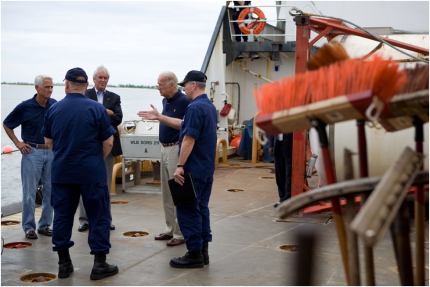
Vice President Biden is Briefed on Oil Recovery Efforts

Vice President Joe Biden, Admiral Thad Allen, and Governor Christ are briefed on oil recovery efforts aboard the U.S. Coast Guard Cutter Oak at Pensacola Naval Air Station in Pensacola, FL, June 29, 2010. (Official White House Photo by David Lienemann)

On Tuesday, Vice President Biden traveled to the Gulf Coast to assess the ongoing efforts to counter the BP oil spill. During the trip, the Vice President visited New Orleans, Louisiana, and Pensacola, Florida, to survey the response efforts, visit with gulf residents impacted by the spill, and meet with area officials.

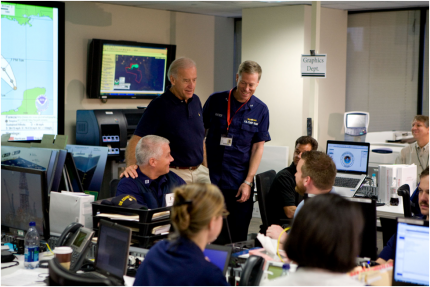
Vice President Biden Talks to Personnel and Tours Unified Area Command

Vice President Joe Biden tours the Unified Area Command and talks to personnel who are coordinating the response to the Deepwater Horizon Oil Spill, in New Orleans, LA, June 29, 2010. (Official White House Photo by David Lienemann)

The White House

Office of the Vice President

PHOTO RELEASE: Vice President Biden's Visit With General Petraeus

On Tuesday evening, June 29, the Vice President flew to MacDill Air Force Base in Tampa, Florida, where he joined General David Petraeus and Mrs. Holly Petraeus for dinner at their home. General Petraeus is expected to take up his new post as commander of the International Security Assistance Force in Afghanistan later this week.
 
To view a photograph of the Vice President’s visit, please click HERE.