The White House

Office of the Vice President

Readout of Vice President Biden's Meetings on Sudan and Somalia

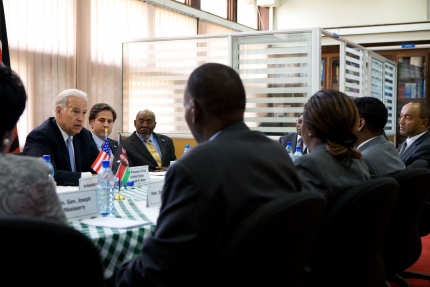
Vice President Biden met today in Nairobi with a delegation from Southern Sudan, led by the President of Southern Sudan and First Vice President of the Government of National Unity, Salva Kiir Mayardit.  In the meeting, the Vice President reaffirmed the strong U.S. commitment to seeing the referendum on Southern self-determination occur on time and in a manner that credibly reflects the will of the Southern Sudanese people.  The Vice President recognized the many challenges faced in referendum preparations and underscored the need for Southern leadership and international mobilization in ensuring that all necessary measures are in place for a peaceful outcome that is internationally recognized, and offered U.S. political, financial, and technical support to that end.
 
The Vice President recognized the great strides that have been made in the South to establish state institutions and responsible governance since the signing of the 2005 Comprehensive Peace Agreement, but emphasized that more needed to be done to increase the capacity, efficiency, and transparency of those institutions, irrespective of the outcome of the referendum.
 
The Vice President encouraged Southerners to immediately begin negotiations on post-referendum arrangements with Khartoum, noting that there is insufficient time before the South's potential independence to wait before tackling the many complex and unresolved issues, including: border demarcation, revenue sharing, and citizenship rights.
 
The Vice President pledged continued U.S. assistance to the professionalization of the Sudan People's Liberation Army in recognition of the serious threats to security faced by the South.

The Vice President then met with the United Nations Special Representative of the Secretary General for Somalia Ahmedou Ould Abdallah and a delegation that included the Special Representative of the Chairperson of the African Union Boubacar Gaoussou Diarra, AU Mission in Somalia (AMISOM) Force Commander Nathan Mugisha, and Ugandan Minister of Defense Crispus Kiyonga to discuss the steps needed to help the Somali people achieve stability.  He discussed the challenges facing AMISOM and the urgent need for greater political inclusivity and stability in the Transitional Federal Government. The Vice President also commended AMISOM for their peacekeeping efforts in Somalia and discussed steps to bolster its capacity.

Vice President Biden Speaks in Kenya

June 09, 2010 | 26:01 | Public Domain

The Vice President gives a significant speech in Kenya weeks before a pivotal vote on a new constitution.

Download mp3 (30MB)

Read the Transcript

Remarks by Vice President Joe Biden to University Students in Nairobi, Kenya

Kenyatta International Conference Center
Nairobi, Kenya

10:58 A.M. (local)

VICE PRESIDENT BIDEN:  Hello, my name is Joe Biden.  I work for Barack Obama.  (Laughter and applause.)

Now, I know no one in Kenya is familiar with Barack Obama, but I can tell you although for years as a United States senator, I had -- I was on a committee called the Foreign Relations Committee, the chairman, and did a lot of work relating to Africa, I hear about Kenya all the time from Barack Obama.  He sends his love to you, not just your love to him.  (Applause.)

And, Wangari, it’s an honor to be with you.  I am very accustomed these days to hanging out with Nobel laureates.  (Laughter.)  I work for one, I get to meet one here, our Secretary of Energy is one -- I am feeling very, very insufficient not having a Nobel Peace Prize.  (Laughter.)  But it’s an honor to be with you, it genuinely is.  (Applause.)  Thank you so much.

You are one of the great treasures not only of your country and of the world, but you’re the embodiment -- in my view -- of what I’m going to talk about today, that is the human capital that this great country has to offer.  And you are -- you are one of the great pieces of that capital.  It’s an honor, again, to be with you.

Now, where is Professor Freida Brown, the Vice Chancellor of United States International?  (Applause.)  Freida, professor -- I want you all to know we have caused this beautiful woman a lot of concern.  She has been the main person in making sure that my ability to speak here was made possible.  I want to personally thank you for all the cooperation and all you do.  (Applause.)  Helping organize us at a speech is a very difficult thing to do, and I thank you very much, Professor.

Ladies and gentlemen, students, leaders, and friends -- I can’t tell you how much I appreciate being invited to speak before you all today.  And I thank you for the warm welcome.  And as I said, I bring greetings and love from President Obama.  I will relay to him that you said, send him -- you’re going to send [him] love.  But I want to reiterate, again, he sends his.  He is committed.  He is concerned, and he is deeply involved in the formation of our policy.  And something that -- and he looks forward to the day that he will be able to come and visit as President of the United States of America.  (Applause.)  I’m sure there may not be -- I doubt whether there’s enough room in the country to house everyone who wants to see him when he comes, but he is anxious to come.  
 
It’s great to be in your beautiful country.  And it’s great to be in front of all of you.  I come here as a representative of the United States to say one thing, one primary message -- the United States stands with you, stands with you on your journey to a secure, free, democratic, and prosperous Kenya.  It’s a journey nearly 50 years in the making.
 
On December 12, 1963, 50,000 Kenyans filled the stadium in Nairobi and 200,000 -- 200,000 more -- I can remember, as a college student, watching 200,000 more pack the hillsides around the stadium.  An entire nation’s eyes watched as, at the stroke of midnight, the new Kenyan flag was unfurled for the first time, making Kenya the 34th independent state in Africa.
 
Earlier that week, American President Lyndon Baines Johnson sent a congratulatory letter to Prime Minister Kenyatta, welcoming Kenya to the family of nations and comparing Kenya’s journey toward independence with that of America’s.  And he said, and I quote, “As our own freedom for all our citizens was proclaimed to the world by our Declaration of Independence, so Kenya’s freedom begins with her declaration of independence today.”
 
Some 50 years later, the promise of that day still pulses through this country, on the bustling streets of Nairobi, from -- up to Mount Kenya, from the coastal shores of Mombasa to the plains of the Maasai Mara.  Once, the wealth of a nation was defined by the expanse of its land, the size of its population or the strength of its army, the abundance of its natural resources.  But, now, we know -- and you know -- that the true wealth of a nation is found in its human capital, in the skill, ingenuity, and determination of its people.  And by that measure, Kenya -- Kenya is a very wealthy nation.  Indeed, Kenya is a rich nation.
 
You have no oil.  You have no precious minerals.  But you have built the largest non-oil, non-mineral based economy in sub-Saharan Africa.  You have become -- (applause) -- you have become the hub for the transportation for the goods and people that are -- flow through East Africa.  And you are the financial capital of East Africa.
 
Your diplomats have helped solve some of Africa’s most intractable problems.  Your military is small in number, but large in stature, helping to bring stability to Sierra Leone to East Timor.  You’ve produced world-renowned scientists, geneticists, environmentalists, writers, and a Nobel Prize winner.  (Applause.)
 
At the heart of this success is a conviction that education -- education has the potential to transform a nation -- seven public universities, over 20 private ones, among the most of any on the continent of Africa; a determination to make primary and secondary education available to all, although there’s a long way to go. 
 
Americans know first-hand your commitment to education.  Thousands of our citizens have studied in Kenya.  And Kenyans have long been among the largest groups of African students at American universities.  And today, Kenyans are the largest group of African students at American universities.  (Applause.)  And that tradition goes back before your independence.  One of the earliest pioneers was a fellow named Barack Obama Sr., the father of a man who is now the President of the United States of America.
 
Kenya and Kenyans have much to be proud of.  But the full force of your potential -- as all of you young students know -- has yet to be released.  You face daunting obstacles.  Kenya is situated in a very tough neighborhood.  Somalia’s decades of instability have generated human tragedy and global threats.  We recognize the burden it’s placed on Somalia’s neighbors and the terrible human cost that the Somali people have borne.
 
And I want to thank -- I want to thank Kenya for hosting Somali refugees who have come looking for safety and for prosecuting pirates not just in Somali waters, but increasingly in the vast swathes of East African waters. 
 
Next January, the referendum on the future of southern Sudan envisioned by the Comprehensive Peace Agreement will occur, and it must be credible and it must be peaceful.  Sudan is hurtling toward a monumental decision that demands urgent international attention and preparation.  And far too many of the people in Sudan’s Darfur region continue to live with unacceptable insecurity.  These regional issues are all on your doorstep.  They are felt in your communities.  They are present, real challenges that we must work on together in partnership to address.
 
The global financial crisis -- generated through no fault of Kenya’s -- dampened your economy, slowing demand for Kenyan goods abroad and lessened the flow of tourists eager to see Kenya’s natural beauty.  Global climate change is not a phenomenon of Kenya’s making, but its consequences affect your forests, your harvests, and your way of life.
 
Kenya feels the effects of these problems and should, because of your wealth of human capital, be a part of a global solution -- a strong African voice on the international stage.  But that voice has been muted by internal problems -- problems that have held you back from making an even greater contribution.
 
Too many of your resources have been lost to corruption, and not a single high-level official has ever been held accountable for these crimes.  Too many of your institutions have lost the people’s confidence.  And too many times, Kenya has been divided against itself, torn apart by ethnic tensions, manipulated by leaders who place their own interests above the interests of their country.  Too many young people have found nothing but dead ends as they seek opportunity and the path to a better future. 
 
The crisis that gripped Kenya in the wake of the 2007 elections revealed just how dangerous these forces can be.  They are dangerous, but they are not immovable.  Change is within your grasp.  And that change will be realized when government is transparent, accountable, and participatory; when corrupt officials are called to account in a court of law, instead of meeting only the indifferent shrug of impunity; when political power changes hands peacefully, but the will of the voters, and those who did not prevail decide -- and decide that their efforts should be moved to constructive opposition; when Kenyans have confidence that the courts and the police are honest, and are committed solely to the pursuit of justice; when the members of the political leadership represent a range, a wide range, of viewpoints reflecting and responding to the needs of Kenyans everywhere.
 
Your coalition government has agreed to a reform agenda that would bring about the fundamental change that Kenyans are seeking.  If implemented fully, corrupt officials will be finally held accountable.  The judiciary and the police force will place the pursuit of justice above the pursuit of personal gain.  Land rights and ownership will be governed by the rule of law, not by the whims of the powerful.  Kenyan women and girls -- the most untapped resource of this nation and almost every nation in the world -- will be ever better positioned to contribute to their communities and their country at every level.  And a new constitution will put in place a framework to accelerate those reforms, including reducing executive power by building up the checks and balances of your parliament and your judiciary.

Folks, in my experience of 36 years on the world stage, stability ultimately rests on the separation of powers --no power, no branch of government should go unchecked, including presidential power.  The truth is, better governance is not just an end in itself, it is your path to a lasting democratic stability and your ultimate stability.  And, I might add -- presumptuous of me, as an outsider, to say -- it’s the best route to economic prosperity, sparking job creation, opening up opportunity, and improving the way of life for Kenyans everywhere.
 
As I said earlier, the real strength of Kenya is your human capital.  And you have so much potential, with two-thirds of your citizens under the age of 25 -- two-thirds under the age of 25.  That should be an incredible sense and source of strength that should be mined, that should be nurtured.  But it requires creative and productive outlets for the energy and enthusiasm of the youth in your country.

Putting in place a new constitution and strengthening your institutions and the rule of law will not only unleash the energy of the youth, deepen the roots of your democracy, and ultimately guarantee your security -- it will also further open the door to major American development programs like the Millennium Challenge.  There’s so much more we could do, and want to do, in partnership with you.  It could provide millions of dollars in grant assistance to Kenya that you would know how to use well to build this great nation.
 
Reform will also encourage -- and I have -- I have been all over the world in my career.  I promise you, foreign investment depends upon stability, transparency, the rule of law, and the crackdown on corruption.  So if you make these changes, I promise you, new foreign private investment will come in like you’ve never seen and you will have a reinvigorated tourism industry that will exceed the billion dollars it was before the economic crisis.  As I told your President and Prime Minister, who I met with jointly yesterday, Americans -- I can only speak for America, Americans want to do business here.  You have everything that they would want to cooperate and participate here.  They want to travel here.  And if you provide the right climate, they will come -- and not only they, but the rest of the world will come.  You are the keystone to East Africa -- literally, not figuratively -- you are the keystone.
 
Fostering the kind of change that is at hand is not up to the political elites, it’s up to you.  It’s up to the Kenyan people.  It’s up to each one of you.  As President Obama said, “Africa’s future is up to Africans.”  We can’t dictate it -- nor should we -- but you can, you can.  And it’s virtually unlimited.  Don’t let others determine for you.  Don’t let others determine for Kenya what Kenyans think.  Determine for yourselves the Kenya you actually need. 
 
Democracies are most effective when people not only vote for them, but embrace their responsibilities under a democratic system -- when they commit to be active citizens, aware citizens, when they participate, when they vote.  
 
Today, Kenya is having a great national debate about a new constitution.  That debate will culminate in a referendum this August.  The cooperation of [the] President and Prime Minister in support of the constitutional review process is extremely encouraging.  But the ultimate responsibility, the real power, does not rest with them -- it rests with you.  It rests with the people of Kenya.  By your participation, by your vote -- as cynical as you may have become about the process -- by your participation, by your vote, you have before you a singular opportunity to strengthen Kenya’s democratic institutions, none like since the evening at midnight that that flag was unfurled, an opportunity to open up to opportunity to give a new generation new power to help Kenya realize its immense potential.
 
The United States strongly supports the process of constitutional reform, including providing assistance for voter registration and civic education, so that Kenyans are able to familiarize themselves with the draft constitution your parliament passed and allow you to make informed decisions.  But, let me repeat, this is your decision, your decision alone.  And the people of Kenya must make this choice -- a choice for Kenya by Kenyans.
 
And as you prepare to write a new history for your nation, resist those who try to divide you based on ethnicity or religion or region -- and above all, fear is a tool as old as mankind, and it’s been used with great effect in this country in the past.  For too long -- for too long, opportunistic politicians have created an all-or-nothing system -- your group is either in or you’re out, and the resources of the state were treated as spoils for the winner, rather than the rightful birthright of the people of Kenya.

When this toxic brand of politics is taken to its logical extreme in Kenya’s post-election violence, the results, I think, shocked even all of you -- but it clearly shocked the world.  Now, Kenyans must make a deliberate and difficult choice -- to reject the divisive politics, to reconcile their communities, to acknowledge the injustice of the past so you do not harbor deep-seated resentment in the future.  This resolve requires a deep inner strength --strength you can, and should, derive from your diversity.
 
Turn Kenya’s youth into a source of innovation and vision.  Dare to reach for transformational change -- the kind of change that might come around only once in your lifetime.  I especially call on the young people -- the backbone of this country -- the next generation of Kenyan leaders.  Your energy is contagious, and your enthusiasm is boundless.  Your ideas and your voice can help create a peaceful, stable, democratic, and economically prosperous Kenya everyone here wants to see -- and, quite frankly, we want to see.
 
And you have a steadfast supporter in the United States.  The United States of America’s relationship with Kenya is among the most important on the continent for us, one that has been strong and uninterrupted since your independence.  Thousands of American Peace Corps volunteers have taught in your schools and villages.  Hundreds of American businessmen have worked in American companies that have built their regional headquarters in Nairobi or Mombasa.  And the U.S. government has established its largest embassy in sub-Saharan Africa in your capital.
 
In crisis and in celebration, we have forged a strong and enduring political and economic relationship.  We have worked together as partners and friends to tackle some of the most difficult problems in the region.  But true friendship -- and I hope you will forgive me, but true friendship demands honesty.  So if our words are sometimes blunt, it’s because our faith in the possibilities of Kenya are unlimited. 

Now, don’t get me wrong, I know from my personal experience, change is never easy.  And change in circumstances like yours is extremely difficult.  Fundamental change is never easy.  But I also know from personal experience that it’s possible.  I’ve seen it happen around the world.  As a young senator, I’ve stood in the capitals of Sarajevo and Pristina -- in the Balkans.  From the Balkans to the Middle East to Eastern Europe, I have seen dark paths transform, through the will of the people, to bring about brighter futures.

In the 1990s, I stood in Sarajevo, Bosnia, and in Pristina, Kosovo, and witnessed the god-awful carnage and the blood running in the rivers, the ethnic cleansing that we thought we’d never see again in Europe.  I saw the carnage and the hate.  I sat in refugee centers.  I sat in homes and heard about how neighbors who had been friends for years literally hacked one another to death in their backyards once Slobodan Milosevic’s ugly, ugly violence took hold.  The hate, it seemed to know no bounds.  And it seemed like it would never end. 

But, the people of those countries, they made a choice.  They ultimately rejected violence.  They drew a line on the past and today they are looking toward a future.  And they’ve given up their own vile criminals to the international courts, which is part of the reconciliation that was needed, acknowledging their individual responsibilities. 

It was a choice that not only is changing their future, but is changing the future of that entire portion of Europe.  And just one year ago, I was in Romania celebrating the 20th Anniversary of the fall of communism and the wall.  And I said then, “Now, we think of central Europe” -- “when we think of Central Europe, we don’t think of what we can do for you, but what we can do with you.”

My prayer is that very soon after you make these momentous changes that are needed, we’ll be talking about not what we can do for you, but what we can do with you, because you have begun to realize the great potential you possess.  The change is within your reach.  The same change that occurred in other parts of the world, including Iraq, can change here.

Ladies and gentlemen, nowhere is it written that the winds of change cannot blow through Africa -- nowhere is that written.  On December 12, 1963, a new day dawned on Kenya, one filled with promise for even better days ahead.  In the coming days and months, you have to -- the chance to build on that promise in a way you haven’t had for over three decades, to fulfill the dreams of everyone who watched that flag unfurl in that stadium 47 years ago.
 
And I want to close with some words that President Johnson used to end his letter to Prime Minister Kenyatta in 1963.  Here’s what he said -- he said, “May the responsibilities of freedom wake the best that is in you, and may its benefits be known by generations yet unborn.”  Well, I would say the same thing to you today.  

Asante sana.  May God bless you. (Applause.)  May God bless the Kenyan people.  (Applause.)  And may God bless America.  Thank you very much.  Don’t let your country down.  Thank you.  (Applause.)

END
11:23 A.M. (local)
Close Transcript

Vice President Biden Q&A in Kenya

June 09, 2010 | 44:52 | Public Domain

Vice President Joe Biden takes questions from the audience following a major speech on U.S.-Kenya relations in Nairobi, Kenya.

Download mp3 (52MB)

The White House

Office of the Vice President

Remarks by Vice President Joe Biden to University Students in Nairobi, Kenya

Kenyatta International Conference Center
Nairobi, Kenya

10:58 A.M. (local)

VICE PRESIDENT BIDEN:  Hello, my name is Joe Biden.  I work for Barack Obama.  (Laughter and applause.)

Now, I know no one in Kenya is familiar with Barack Obama, but I can tell you although for years as a United States senator, I had -- I was on a committee called the Foreign Relations Committee, the chairman, and did a lot of work relating to Africa, I hear about Kenya all the time from Barack Obama.  He sends his love to you, not just your love to him.  (Applause.)

And, Wangari, it’s an honor to be with you.  I am very accustomed these days to hanging out with Nobel laureates.  (Laughter.)  I work for one, I get to meet one here, our Secretary of Energy is one -- I am feeling very, very insufficient not having a Nobel Peace Prize.  (Laughter.)  But it’s an honor to be with you, it genuinely is.  (Applause.)  Thank you so much.

You are one of the great treasures not only of your country and of the world, but you’re the embodiment -- in my view -- of what I’m going to talk about today, that is the human capital that this great country has to offer.  And you are -- you are one of the great pieces of that capital.  It’s an honor, again, to be with you.

Now, where is Professor Freida Brown, the Vice Chancellor of United States International?  (Applause.)  Freida, professor -- I want you all to know we have caused this beautiful woman a lot of concern.  She has been the main person in making sure that my ability to speak here was made possible.  I want to personally thank you for all the cooperation and all you do.  (Applause.)  Helping organize us at a speech is a very difficult thing to do, and I thank you very much, Professor.

Ladies and gentlemen, students, leaders, and friends -- I can’t tell you how much I appreciate being invited to speak before you all today.  And I thank you for the warm welcome.  And as I said, I bring greetings and love from President Obama.  I will relay to him that you said, send him -- you’re going to send [him] love.  But I want to reiterate, again, he sends his.  He is committed.  He is concerned, and he is deeply involved in the formation of our policy.  And something that -- and he looks forward to the day that he will be able to come and visit as President of the United States of America.  (Applause.)  I’m sure there may not be -- I doubt whether there’s enough room in the country to house everyone who wants to see him when he comes, but he is anxious to come.  
 
It’s great to be in your beautiful country.  And it’s great to be in front of all of you.  I come here as a representative of the United States to say one thing, one primary message -- the United States stands with you, stands with you on your journey to a secure, free, democratic, and prosperous Kenya.  It’s a journey nearly 50 years in the making.
 
On December 12, 1963, 50,000 Kenyans filled the stadium in Nairobi and 200,000 -- 200,000 more -- I can remember, as a college student, watching 200,000 more pack the hillsides around the stadium.  An entire nation’s eyes watched as, at the stroke of midnight, the new Kenyan flag was unfurled for the first time, making Kenya the 34th independent state in Africa.
 
Earlier that week, American President Lyndon Baines Johnson sent a congratulatory letter to Prime Minister Kenyatta, welcoming Kenya to the family of nations and comparing Kenya’s journey toward independence with that of America’s.  And he said, and I quote, “As our own freedom for all our citizens was proclaimed to the world by our Declaration of Independence, so Kenya’s freedom begins with her declaration of independence today.”
 
Some 50 years later, the promise of that day still pulses through this country, on the bustling streets of Nairobi, from -- up to Mount Kenya, from the coastal shores of Mombasa to the plains of the Maasai Mara.  Once, the wealth of a nation was defined by the expanse of its land, the size of its population or the strength of its army, the abundance of its natural resources.  But, now, we know -- and you know -- that the true wealth of a nation is found in its human capital, in the skill, ingenuity, and determination of its people.  And by that measure, Kenya -- Kenya is a very wealthy nation.  Indeed, Kenya is a rich nation.
 
You have no oil.  You have no precious minerals.  But you have built the largest non-oil, non-mineral based economy in sub-Saharan Africa.  You have become -- (applause) -- you have become the hub for the transportation for the goods and people that are -- flow through East Africa.  And you are the financial capital of East Africa.
 
Your diplomats have helped solve some of Africa’s most intractable problems.  Your military is small in number, but large in stature, helping to bring stability to Sierra Leone to East Timor.  You’ve produced world-renowned scientists, geneticists, environmentalists, writers, and a Nobel Prize winner.  (Applause.)
 
At the heart of this success is a conviction that education -- education has the potential to transform a nation -- seven public universities, over 20 private ones, among the most of any on the continent of Africa; a determination to make primary and secondary education available to all, although there’s a long way to go. 
 
Americans know first-hand your commitment to education.  Thousands of our citizens have studied in Kenya.  And Kenyans have long been among the largest groups of African students at American universities.  And today, Kenyans are the largest group of African students at American universities.  (Applause.)  And that tradition goes back before your independence.  One of the earliest pioneers was a fellow named Barack Obama Sr., the father of a man who is now the President of the United States of America.
 
Kenya and Kenyans have much to be proud of.  But the full force of your potential -- as all of you young students know -- has yet to be released.  You face daunting obstacles.  Kenya is situated in a very tough neighborhood.  Somalia’s decades of instability have generated human tragedy and global threats.  We recognize the burden it’s placed on Somalia’s neighbors and the terrible human cost that the Somali people have borne.
 
And I want to thank -- I want to thank Kenya for hosting Somali refugees who have come looking for safety and for prosecuting pirates not just in Somali waters, but increasingly in the vast swathes of East African waters. 
 
Next January, the referendum on the future of southern Sudan envisioned by the Comprehensive Peace Agreement will occur, and it must be credible and it must be peaceful.  Sudan is hurtling toward a monumental decision that demands urgent international attention and preparation.  And far too many of the people in Sudan’s Darfur region continue to live with unacceptable insecurity.  These regional issues are all on your doorstep.  They are felt in your communities.  They are present, real challenges that we must work on together in partnership to address.
 
The global financial crisis -- generated through no fault of Kenya’s -- dampened your economy, slowing demand for Kenyan goods abroad and lessened the flow of tourists eager to see Kenya’s natural beauty.  Global climate change is not a phenomenon of Kenya’s making, but its consequences affect your forests, your harvests, and your way of life.
 
Kenya feels the effects of these problems and should, because of your wealth of human capital, be a part of a global solution -- a strong African voice on the international stage.  But that voice has been muted by internal problems -- problems that have held you back from making an even greater contribution.
 
Too many of your resources have been lost to corruption, and not a single high-level official has ever been held accountable for these crimes.  Too many of your institutions have lost the people’s confidence.  And too many times, Kenya has been divided against itself, torn apart by ethnic tensions, manipulated by leaders who place their own interests above the interests of their country.  Too many young people have found nothing but dead ends as they seek opportunity and the path to a better future. 
 
The crisis that gripped Kenya in the wake of the 2007 elections revealed just how dangerous these forces can be.  They are dangerous, but they are not immovable.  Change is within your grasp.  And that change will be realized when government is transparent, accountable, and participatory; when corrupt officials are called to account in a court of law, instead of meeting only the indifferent shrug of impunity; when political power changes hands peacefully, but the will of the voters, and those who did not prevail decide -- and decide that their efforts should be moved to constructive opposition; when Kenyans have confidence that the courts and the police are honest, and are committed solely to the pursuit of justice; when the members of the political leadership represent a range, a wide range, of viewpoints reflecting and responding to the needs of Kenyans everywhere.
 
Your coalition government has agreed to a reform agenda that would bring about the fundamental change that Kenyans are seeking.  If implemented fully, corrupt officials will be finally held accountable.  The judiciary and the police force will place the pursuit of justice above the pursuit of personal gain.  Land rights and ownership will be governed by the rule of law, not by the whims of the powerful.  Kenyan women and girls -- the most untapped resource of this nation and almost every nation in the world -- will be ever better positioned to contribute to their communities and their country at every level.  And a new constitution will put in place a framework to accelerate those reforms, including reducing executive power by building up the checks and balances of your parliament and your judiciary.

Folks, in my experience of 36 years on the world stage, stability ultimately rests on the separation of powers --no power, no branch of government should go unchecked, including presidential power.  The truth is, better governance is not just an end in itself, it is your path to a lasting democratic stability and your ultimate stability.  And, I might add -- presumptuous of me, as an outsider, to say -- it’s the best route to economic prosperity, sparking job creation, opening up opportunity, and improving the way of life for Kenyans everywhere.
 
As I said earlier, the real strength of Kenya is your human capital.  And you have so much potential, with two-thirds of your citizens under the age of 25 -- two-thirds under the age of 25.  That should be an incredible sense and source of strength that should be mined, that should be nurtured.  But it requires creative and productive outlets for the energy and enthusiasm of the youth in your country.

Putting in place a new constitution and strengthening your institutions and the rule of law will not only unleash the energy of the youth, deepen the roots of your democracy, and ultimately guarantee your security -- it will also further open the door to major American development programs like the Millennium Challenge.  There’s so much more we could do, and want to do, in partnership with you.  It could provide millions of dollars in grant assistance to Kenya that you would know how to use well to build this great nation.
 
Reform will also encourage -- and I have -- I have been all over the world in my career.  I promise you, foreign investment depends upon stability, transparency, the rule of law, and the crackdown on corruption.  So if you make these changes, I promise you, new foreign private investment will come in like you’ve never seen and you will have a reinvigorated tourism industry that will exceed the billion dollars it was before the economic crisis.  As I told your President and Prime Minister, who I met with jointly yesterday, Americans -- I can only speak for America, Americans want to do business here.  You have everything that they would want to cooperate and participate here.  They want to travel here.  And if you provide the right climate, they will come -- and not only they, but the rest of the world will come.  You are the keystone to East Africa -- literally, not figuratively -- you are the keystone.
 
Fostering the kind of change that is at hand is not up to the political elites, it’s up to you.  It’s up to the Kenyan people.  It’s up to each one of you.  As President Obama said, “Africa’s future is up to Africans.”  We can’t dictate it -- nor should we -- but you can, you can.  And it’s virtually unlimited.  Don’t let others determine for you.  Don’t let others determine for Kenya what Kenyans think.  Determine for yourselves the Kenya you actually need. 
 
Democracies are most effective when people not only vote for them, but embrace their responsibilities under a democratic system -- when they commit to be active citizens, aware citizens, when they participate, when they vote.  
 
Today, Kenya is having a great national debate about a new constitution.  That debate will culminate in a referendum this August.  The cooperation of [the] President and Prime Minister in support of the constitutional review process is extremely encouraging.  But the ultimate responsibility, the real power, does not rest with them -- it rests with you.  It rests with the people of Kenya.  By your participation, by your vote -- as cynical as you may have become about the process -- by your participation, by your vote, you have before you a singular opportunity to strengthen Kenya’s democratic institutions, none like since the evening at midnight that that flag was unfurled, an opportunity to open up to opportunity to give a new generation new power to help Kenya realize its immense potential.
 
The United States strongly supports the process of constitutional reform, including providing assistance for voter registration and civic education, so that Kenyans are able to familiarize themselves with the draft constitution your parliament passed and allow you to make informed decisions.  But, let me repeat, this is your decision, your decision alone.  And the people of Kenya must make this choice -- a choice for Kenya by Kenyans.
 
And as you prepare to write a new history for your nation, resist those who try to divide you based on ethnicity or religion or region -- and above all, fear is a tool as old as mankind, and it’s been used with great effect in this country in the past.  For too long -- for too long, opportunistic politicians have created an all-or-nothing system -- your group is either in or you’re out, and the resources of the state were treated as spoils for the winner, rather than the rightful birthright of the people of Kenya.

When this toxic brand of politics is taken to its logical extreme in Kenya’s post-election violence, the results, I think, shocked even all of you -- but it clearly shocked the world.  Now, Kenyans must make a deliberate and difficult choice -- to reject the divisive politics, to reconcile their communities, to acknowledge the injustice of the past so you do not harbor deep-seated resentment in the future.  This resolve requires a deep inner strength --strength you can, and should, derive from your diversity.
 
Turn Kenya’s youth into a source of innovation and vision.  Dare to reach for transformational change -- the kind of change that might come around only once in your lifetime.  I especially call on the young people -- the backbone of this country -- the next generation of Kenyan leaders.  Your energy is contagious, and your enthusiasm is boundless.  Your ideas and your voice can help create a peaceful, stable, democratic, and economically prosperous Kenya everyone here wants to see -- and, quite frankly, we want to see.
 
And you have a steadfast supporter in the United States.  The United States of America’s relationship with Kenya is among the most important on the continent for us, one that has been strong and uninterrupted since your independence.  Thousands of American Peace Corps volunteers have taught in your schools and villages.  Hundreds of American businessmen have worked in American companies that have built their regional headquarters in Nairobi or Mombasa.  And the U.S. government has established its largest embassy in sub-Saharan Africa in your capital.
 
In crisis and in celebration, we have forged a strong and enduring political and economic relationship.  We have worked together as partners and friends to tackle some of the most difficult problems in the region.  But true friendship -- and I hope you will forgive me, but true friendship demands honesty.  So if our words are sometimes blunt, it’s because our faith in the possibilities of Kenya are unlimited. 

Now, don’t get me wrong, I know from my personal experience, change is never easy.  And change in circumstances like yours is extremely difficult.  Fundamental change is never easy.  But I also know from personal experience that it’s possible.  I’ve seen it happen around the world.  As a young senator, I’ve stood in the capitals of Sarajevo and Pristina -- in the Balkans.  From the Balkans to the Middle East to Eastern Europe, I have seen dark paths transform, through the will of the people, to bring about brighter futures.

In the 1990s, I stood in Sarajevo, Bosnia, and in Pristina, Kosovo, and witnessed the god-awful carnage and the blood running in the rivers, the ethnic cleansing that we thought we’d never see again in Europe.  I saw the carnage and the hate.  I sat in refugee centers.  I sat in homes and heard about how neighbors who had been friends for years literally hacked one another to death in their backyards once Slobodan Milosevic’s ugly, ugly violence took hold.  The hate, it seemed to know no bounds.  And it seemed like it would never end. 

But, the people of those countries, they made a choice.  They ultimately rejected violence.  They drew a line on the past and today they are looking toward a future.  And they’ve given up their own vile criminals to the international courts, which is part of the reconciliation that was needed, acknowledging their individual responsibilities. 

It was a choice that not only is changing their future, but is changing the future of that entire portion of Europe.  And just one year ago, I was in Romania celebrating the 20th Anniversary of the fall of communism and the wall.  And I said then, “Now, we think of central Europe” -- “when we think of Central Europe, we don’t think of what we can do for you, but what we can do with you.”

My prayer is that very soon after you make these momentous changes that are needed, we’ll be talking about not what we can do for you, but what we can do with you, because you have begun to realize the great potential you possess.  The change is within your reach.  The same change that occurred in other parts of the world, including Iraq, can change here.

Ladies and gentlemen, nowhere is it written that the winds of change cannot blow through Africa -- nowhere is that written.  On December 12, 1963, a new day dawned on Kenya, one filled with promise for even better days ahead.  In the coming days and months, you have to -- the chance to build on that promise in a way you haven’t had for over three decades, to fulfill the dreams of everyone who watched that flag unfurl in that stadium 47 years ago.
 
And I want to close with some words that President Johnson used to end his letter to Prime Minister Kenyatta in 1963.  Here’s what he said -- he said, “May the responsibilities of freedom wake the best that is in you, and may its benefits be known by generations yet unborn.”  Well, I would say the same thing to you today.  

Asante sana.  May God bless you. (Applause.)  May God bless the Kenyan people.  (Applause.)  And may God bless America.  Thank you very much.  Don’t let your country down.  Thank you.  (Applause.)

END
11:23 A.M. (local)
On Board with the VP: Day 2 in Kenya

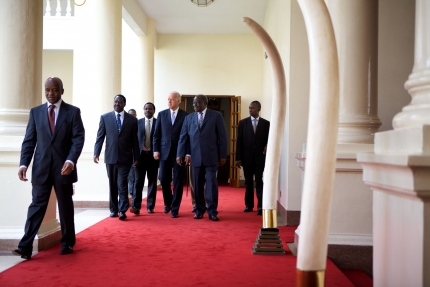
Vice President Joe Biden Walks with President Mwai Kibaki and Prime Minister Raila Odinga

Vice President Joe Biden walks with President Mwai Kibaki and Prime Minister Raila Odinga during a visit to the State House in Nairobi, Kenya. June 8, 2010. (Official White House Photo by David Lienemann)

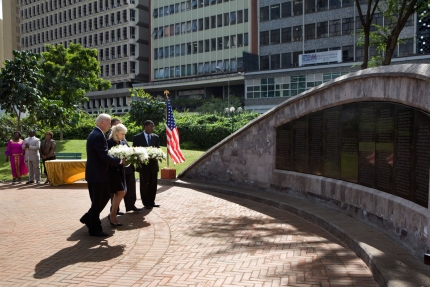
The Vice President was in Kenya today at a pivotal moment--just weeks before a major constitutional referendum. Earlier this morning he met jointly with Kenya's President and Prime Minister to encourage their active support for reform (Watch their statement to the press after the meeting here). He also stopped by Kenya's Parliament to meet privately with the Speaker, as well as the Reform Caucus. Both the Vice President and Dr. Biden visited the August 7th Memorial Park to lay a wreath in memory of the more than 200 people killed by the 1998 embassy bombing in Nairobi.

Next up--The Vice President gives a major speech on Wednesday on U.S.-Kenyan relations at the Kenyatta International Conference Center.

Vice President Joe Biden and Dr. Jill Biden Visit August 7 Memorial Park.

Vice President Joe Biden and Dr. Jill Biden lay a wreath on the memorial stone during a visit to the August 7 Memorial park which memorializes those who were killed or injured in the 1998 embassy bombings in Nairobi, Kenya. June 8, 2010. (Official White House Photo by David Lienemann)

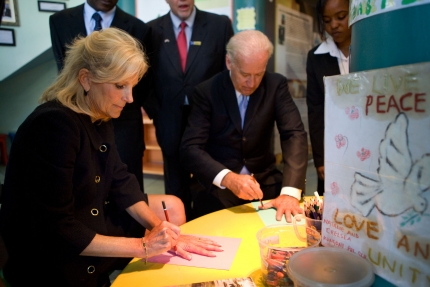
Vice President Joe Biden and Dr. Jill Biden Trace Their Hands During a Visit to the August 7 Memorial Park

Vice President Joe Biden and Dr. Jill Biden trace their hands during a visit to the August 7 Memorial park which memorializes those who were killed or injured in the 1998 embassy bombings in Nairobi, Kenya. June 8, 2010. (Official White House Photo by David Lienemann)

Vice President Joe Biden Meets With the Reform Caucus of Parliamentarians in Nairobi.

Vice President Joe Biden meets with the reform caucus of parliamentarians in the library at the parliament building in Nairobi, Kenya. June 8, 2010. (Official White House Photo by David Lienemann)

Elizabeth Alexander is Press Secretary to the Vice President

Vice President Biden and Kenyan President Kibaki

June 08, 2010 | 11:51 | Public Domain

Vice President Joe Biden and President Mwai Kibaki of Kenya speak to the media after meeting at the State House in Nairobi, Kenya. June 8, 2010.

Download mp3 (14MB)

Read the Transcript

Remarks by Vice President Biden in a Statement to the Press with Kenyan President Mwai Kibaki

State House
Nairobi, Kenya

12:56 P.M. (local)

PRESIDENT KIBAKI:  I think we are all ready.  Members of the media, this morning we held very useful discussions with the visiting United States Vice President, the Honorable Joseph Biden, on a broad range of issues touching on both bilateral and regional matters.  In the meeting, the Kenyan side included the Right Honorable Prime Minister Raila Odinga, the Vice President, Honorable Kalonzo Musyoka, and some cabinet ministers. 

As a government, we are happy that Kenya and the United States enjoy extremely warm and friendly relations that go back to our independence.  Our meeting today, therefore, provided a welcome opportunity to review our bilateral relations and exchange the views on key issues of mutual interest in a candid and cordial atmosphere. 

I briefed the visiting U.S. Vice President of the important milestone that have covered -- that we have covered in implementing our reform agenda.  The referendum on a new constitution, scheduled for 4th August this year, is the most important reform initiative for the Grand Coalition Government.  We are confident that through this process, Kenyans will get a new constitution.

We have also expressed our appreciation for the U.S. support in many areas of cooperation, especially in health, agriculture, and security.  We have requested that assistance be extended to other sectors, including transport, housing, energy, and water.

We also requested the U.S. administration to encourage American investors to take advantage of the single East African Common Market that will become a reality next month.  The single market will also -- will allow free movement of people, goods, services, and capital throughout the five member countries that compromise -- Kenya, Tanzania, Uganda, Rwanda, Burundi.

We also discussed other regional matters, including Somalia.  Stabilization of Somalia is a high priority in our common efforts to secure regional peace and stability.  Both the United States and Kenya are concerned about the growing acts of piracy off the coast of Somalia and the instability caused in Somalia by extremist groups.  This matter must be addressed with greater urgency.  We have asked the U.S. government to provide the leadership to forge a concerted international effort to stabilize Somalia. 

We also discussed present developments in Sudan, in the context of the implementation of the comprehensive peace agreement, of which both our governments are guarantors.  We have noted the recent elections in Sudan.  We expect that the referendum planned for January next year will take place as scheduled.  In our view, the best way of supporting Sudan’s internal stability, regional peace, and prosperity is to respect the verdict of the people, irrespective of the outcome of the referendum.       

At our meeting, we also appreciated the continued keen interest that President Barack Obama has continued -- has shown in Kenya.  We thank President Obama for his support, and count on his administration’s goodwill and cooperation.

Ladies and gentlemen, I now wish to invite the United States Vice President, Joseph Biden, to make his remarks.  I thank you very much. 

VICE PRESIDENT BIDEN:  Thank you, Mr. President.  I am honored to be here in this beautiful country with such a rich and diverse culture and so many qualified leaders.  It’s great to see you all.  And thank you for giving me all the time you did this morning.

Mr. President and Mr. Prime Minister, I have had -- I think we’ve had some very productive discussions today and covering many interests, some of which you’ve mentioned, Mr. President.  But I must tell you, I was truly impressed by the mutual cooperation between you and the Prime Minister and your commitment -- your commitment to -- your mutual commitment to reform.
 
We reaffirmed our commitment to work together and to deepen Kenya’s democracy, and to strengthen the rule of law and advance the prospects for a peaceful, prosperous future.
 
We focused as well on the need to fully implement Kenya’s reform agenda, and the importance of the constitutional reform process.
 
And we share the wish of the people of Kenya for a peaceful constitutional referendum that unites Kenya and accelerates the implementation of these reforms.
 
As President Obama said in a recent interview, the upcoming constitutional referendum is, as he said -- and I quote -- "a singular opportunity to put Kenyan governance on a more solid footing that can move beyond ethnic violence, and move beyond corruption, [and] can move the country toward a path of economic prosperity."
 
And we talked a lot about economic prosperity.  Better governance is just not an end in itself -- it is a path to job creation and to a better economy.  Two-thirds of your citizens are under the age of 25, and they are an incredible source of strength.  But they also represent a challenge to create positive, creative, and productive outlets for their energy and enthusiasm in a prospering economy. 

And as Kenya moves forward, so too will the United States in strengthening our relationships with you, both economically and politically.  Kenya is already the largest recipient of U.S. support in sub-Saharan Africa.  Putting in place a new constitution and strengthening your democratic institutions with the rule of law will further open the door to major American development programs such as the Millennium Challenge and will, I predict, bring about reinvestment by American corporations and international organizations in Kenya that could provide millions of dollars in assistance in grants through the Millennium Challenge, as well as begin to further build the economy of this great country.

Reform is also -- will also encourage, as I said, new foreign investment and reinvigorate tourism.  As I told the President and Prime Minister, Americans want to do business here in Kenya.  I come from a state that is the corporate state of America.  I can tell you, when these reforms take place, you will find a completely different atmosphere about investment in this country.  Americans want to do business here, they want to travel here, and with the right climate they will come.    

And I’ve noticed, Mr. President and Mr. Prime Minister, when we invest, it has the tendency to generate additional investment -- additional investment from other parts of the world.  We see a prosperous Kenya in not only the interest of the Kenyan people -- and all of East Africa -- but in everyone’s interest.  And so we encourage -- with these reforms, when they occur, we encourage the investment -- and not just Americans, but everyone from around the world would like to see this country grow.

I also discussed the cooperation that we have underway and will continue in the shared challenges in the region, including Somalia and the Sudan. 

I assured the President and the Prime Minister that the United States supports Kenya’s effort to secure the border in the face of very real threats from those who wish to spread chaos through despair and violence.

We recognize that Kenya’s long term stability and development are tied to regional security and development, and the United States is committed to work with Kenya to achieve both those objectives.  And I look forward to speaking in more detail tomorrow about this partnership between the United States and Kenya, and my absolute conviction that Kenya’s best days are yet to come.

For today, let me simply say thank you to the President and the Prime Minister for their hospitality and for the very good exchange of ideas we had, and for making me more optimistic than I have been about the prospects of this reform occurring.  And I want to thank all of the cabinet members as well for the hospitality they’ve shown me and my delegation.  And I will have more to say about this in a major speech I’ll deliver tomorrow.

Thank you all very much, and thank you very much, Mr. President.

PRESIDENT KIBAKI:  Asante sana. 

VICE PRESIDENT BIDEN:  Thank you.  Thank you, Mr. Prime Minister.  Thank you very much. 

END
1:08 P.M. (local)

Close Transcript

The White House

Office of the Vice President

Remarks by Vice President Biden in a Statement to the Press with Kenyan President Mwai Kibaki

State House
Nairobi, Kenya

12:56 P.M. (local)

PRESIDENT KIBAKI:  I think we are all ready.  Members of the media, this morning we held very useful discussions with the visiting United States Vice President, the Honorable Joseph Biden, on a broad range of issues touching on both bilateral and regional matters.  In the meeting, the Kenyan side included the Right Honorable Prime Minister Raila Odinga, the Vice President, Honorable Kalonzo Musyoka, and some cabinet ministers. 

As a government, we are happy that Kenya and the United States enjoy extremely warm and friendly relations that go back to our independence.  Our meeting today, therefore, provided a welcome opportunity to review our bilateral relations and exchange the views on key issues of mutual interest in a candid and cordial atmosphere. 

I briefed the visiting U.S. Vice President of the important milestone that have covered -- that we have covered in implementing our reform agenda.  The referendum on a new constitution, scheduled for 4th August this year, is the most important reform initiative for the Grand Coalition Government.  We are confident that through this process, Kenyans will get a new constitution.

We have also expressed our appreciation for the U.S. support in many areas of cooperation, especially in health, agriculture, and security.  We have requested that assistance be extended to other sectors, including transport, housing, energy, and water.

We also requested the U.S. administration to encourage American investors to take advantage of the single East African Common Market that will become a reality next month.  The single market will also -- will allow free movement of people, goods, services, and capital throughout the five member countries that compromise -- Kenya, Tanzania, Uganda, Rwanda, Burundi.

We also discussed other regional matters, including Somalia.  Stabilization of Somalia is a high priority in our common efforts to secure regional peace and stability.  Both the United States and Kenya are concerned about the growing acts of piracy off the coast of Somalia and the instability caused in Somalia by extremist groups.  This matter must be addressed with greater urgency.  We have asked the U.S. government to provide the leadership to forge a concerted international effort to stabilize Somalia. 

We also discussed present developments in Sudan, in the context of the implementation of the comprehensive peace agreement, of which both our governments are guarantors.  We have noted the recent elections in Sudan.  We expect that the referendum planned for January next year will take place as scheduled.  In our view, the best way of supporting Sudan’s internal stability, regional peace, and prosperity is to respect the verdict of the people, irrespective of the outcome of the referendum.       

At our meeting, we also appreciated the continued keen interest that President Barack Obama has continued -- has shown in Kenya.  We thank President Obama for his support, and count on his administration’s goodwill and cooperation.

Ladies and gentlemen, I now wish to invite the United States Vice President, Joseph Biden, to make his remarks.  I thank you very much. 

VICE PRESIDENT BIDEN:  Thank you, Mr. President.  I am honored to be here in this beautiful country with such a rich and diverse culture and so many qualified leaders.  It’s great to see you all.  And thank you for giving me all the time you did this morning.

Mr. President and Mr. Prime Minister, I have had -- I think we’ve had some very productive discussions today and covering many interests, some of which you’ve mentioned, Mr. President.  But I must tell you, I was truly impressed by the mutual cooperation between you and the Prime Minister and your commitment -- your commitment to -- your mutual commitment to reform.
 
We reaffirmed our commitment to work together and to deepen Kenya’s democracy, and to strengthen the rule of law and advance the prospects for a peaceful, prosperous future.
 
We focused as well on the need to fully implement Kenya’s reform agenda, and the importance of the constitutional reform process.
 
And we share the wish of the people of Kenya for a peaceful constitutional referendum that unites Kenya and accelerates the implementation of these reforms.
 
As President Obama said in a recent interview, the upcoming constitutional referendum is, as he said -- and I quote -- "a singular opportunity to put Kenyan governance on a more solid footing that can move beyond ethnic violence, and move beyond corruption, [and] can move the country toward a path of economic prosperity."
 
And we talked a lot about economic prosperity.  Better governance is just not an end in itself -- it is a path to job creation and to a better economy.  Two-thirds of your citizens are under the age of 25, and they are an incredible source of strength.  But they also represent a challenge to create positive, creative, and productive outlets for their energy and enthusiasm in a prospering economy. 

And as Kenya moves forward, so too will the United States in strengthening our relationships with you, both economically and politically.  Kenya is already the largest recipient of U.S. support in sub-Saharan Africa.  Putting in place a new constitution and strengthening your democratic institutions with the rule of law will further open the door to major American development programs such as the Millennium Challenge and will, I predict, bring about reinvestment by American corporations and international organizations in Kenya that could provide millions of dollars in assistance in grants through the Millennium Challenge, as well as begin to further build the economy of this great country.

Reform is also -- will also encourage, as I said, new foreign investment and reinvigorate tourism.  As I told the President and Prime Minister, Americans want to do business here in Kenya.  I come from a state that is the corporate state of America.  I can tell you, when these reforms take place, you will find a completely different atmosphere about investment in this country.  Americans want to do business here, they want to travel here, and with the right climate they will come.    

And I’ve noticed, Mr. President and Mr. Prime Minister, when we invest, it has the tendency to generate additional investment -- additional investment from other parts of the world.  We see a prosperous Kenya in not only the interest of the Kenyan people -- and all of East Africa -- but in everyone’s interest.  And so we encourage -- with these reforms, when they occur, we encourage the investment -- and not just Americans, but everyone from around the world would like to see this country grow.

I also discussed the cooperation that we have underway and will continue in the shared challenges in the region, including Somalia and the Sudan. 

I assured the President and the Prime Minister that the United States supports Kenya’s effort to secure the border in the face of very real threats from those who wish to spread chaos through despair and violence.

We recognize that Kenya’s long term stability and development are tied to regional security and development, and the United States is committed to work with Kenya to achieve both those objectives.  And I look forward to speaking in more detail tomorrow about this partnership between the United States and Kenya, and my absolute conviction that Kenya’s best days are yet to come.

For today, let me simply say thank you to the President and the Prime Minister for their hospitality and for the very good exchange of ideas we had, and for making me more optimistic than I have been about the prospects of this reform occurring.  And I want to thank all of the cabinet members as well for the hospitality they’ve shown me and my delegation.  And I will have more to say about this in a major speech I’ll deliver tomorrow.

Thank you all very much, and thank you very much, Mr. President.

PRESIDENT KIBAKI:  Asante sana. 

VICE PRESIDENT BIDEN:  Thank you.  Thank you, Mr. Prime Minister.  Thank you very much. 

END
1:08 P.M. (local)

On Board: The Vice President and Second Lady in Egypt

The Vice President and Dr. Biden were in Sharm el-Sheikh today on the first leg of their week-long trip to Egypt, Kenya and South Africa. Watch this video to hear directly from the Vice President and Second Lady on their meetings today with President and Mrs. Mubarak. Check back this week for more "On Board" updates from the Vice President's trip.

Download Video: mp4 (54MB) | mp3 (3MB)
Vice President Joe Biden meets with Egyptian President Hosni Mubarak in Sharm El Sheikh, Egypt

Vice President Joe Biden meets with Egyptian President Hosni Mubarak in Sharm El Sheikh, Egypt, June 7, 2010. (Official White House Photo by David Lienemann)

Vice President Joe Biden and Dr. Jill Biden Meet with U.S. Army Soldiers at the airport in Sharm El Sheikh, Egypt

Vice President Joe Biden and Dr. Jill Biden meet with U.S. Army soldiers at the airport in Sharm El Sheikh, Egypt, June 7, 2010. (Official White House Photo by David Lienemann)

Elizabeth Alexander is Press Secretary to the Vice President

Vice President Biden in Egypt

June 07, 2010 | 2:17 | Public Domain

The Vice President and Dr. Biden were in Sharm el-Sheikh on the first leg of their week-long trip to Egypt, Kenya and South Africa. Hear directly from the Vice President and Second Lady on their meetings with President and Mrs. Mubarak.

Download mp4 (54MB) | mp3 (3MB)

The White House

Office of the Vice President

Statement from Vice President Joe Biden on Meeting Egyptian President Hosni Mubarak

Sharm el-Sheikh, Egypt -- Vice President Joe Biden issued the following statement today after his meeting with Egyptian President Hosni Mubarak:

"I am grateful to President Mubarak for his hospitality, and for the opportunity to discuss a broad range of issues.  Egypt and the United States are partners in a shared desire to see peace and economic prosperity in the Middle East, North Africa, and Sudan.  I thank Egypt for the leadership role it has played in supporting these priorities.

"Today, President Mubarak and I reiterated our commitment to reaching a comprehensive peace in the region. The United States recognizes and appreciates Egypt's leadership in support for these efforts.  The status quo is unsustainable for all sides.  It is vital to make progress in the proximity talks between Israelis and Palestinians to enable the parties to move to direct negotiations as soon as possible that will result in an end to the occupation that began in 1967 and to a two-state solution to the conflict with Israel and a Palestinian state living in peace and security.  In addition, we are consulting closely with Egypt, as well as our other partners, on new ways to address the humanitarian, economic, security, and political aspects of the situation in Gaza.

"In addition to the pressing priority of reaching comprehensive peace, we also discussed other areas of regional concern.  We appreciate the vital role Egypt is playing in Afghanistan and its support for a strong, independent, unified and democratic Iraq.

"We discussed our serious concerns about Iran’s nuclear program.  The international community continues to witness Iran’s non-compliance with its obligations to the United Nations Security Council and the International Agency for Atomic Energy, as well as Iran’s unwillingness to engage seriously with the P5+1 on its nuclear program.  The United States remains committed to a diplomatic resolution to these serious issues, but we will continue to hold Iran accountable for its continued violations of its international responsibilities, in accordance with our dual-track policy.  We expect to see developments in the United Nations Security Council to hold Iran accountable very soon.  In addition to concerns about Iran’s nuclear program, we remain concerned about its destabilizing activities throughout the region, including with regard to its support for Hizballah and Hamas.

"We reaffirmed our commitment to supporting stability in Sudan, including Darfur, and the full implementation of Sudan’s Comprehensive Peace Agreement (CPA) and preparing for the referendum on southern self-determination in 2011.

"The United States looks forward to a continuing dialogue with Egypt on a broad range of interests, including Egypt’s ongoing political and economic reform.  Elements such as respect for human rights and the need to continue working for a vibrant civil society and more open political competition are vital for Egypt to remain strong and serve as a model to the region.   Egypt has made commitments as part of the United Nations Human Rights Council’s Universal Periodic Review, including accepting some of the Council’s recommendations.  These commitments are important and I encourage Egypt to move ahead swiftly to implement fully those commitments and build upon that agenda."