The White House

Office of the Vice President

Vicepresidente Joe Biden está en Irak

El Vicepresidente Joe Biden ha llegado a Irak para participar en una ceremonia de cambio de mando y cambio de misión en cumplimiento con el compromiso que el Presidente hizo el primer mes de su presidencia. 

Éste es el sexto viaje del Vicepresidente a Irak desde enero del 2009. Estados Unidos concluye su misión de combate en Irak el 31 de agosto, y quedan menos de 50,000 soldados de los aproximadamente 144,000 apostados en enero del 2009. El resto de los soldados asesorarán y ayudarán a las fuerzas de seguridad de Irak, realizarán operativos conjuntos antiterroristas y protegerán a civiles estadounidenses. Conforme al acuerdo entre el gobierno de Estados Unidos e Irak, todos los efectivos de Estados Unidos habrán partido de Irak para el 31 de diciembre, 2011.

El Presidente Obama pronunciará un discurso nacional sobre Irak el 31 de agosto. La visita del Vicepresidente en este momento recalcará el compromiso a largo plazo de Estados Unidos con Irak. El Vicepresidente se reunirá con el Presidente de Irak Jalal Talabani, el Vicepresidente Tariq al-Hashimi, el Vicepresidente Adil Abd al-Mahdi, el Primer Ministro Nuri al-Maliki, el líder de la Coalición Iraquiya Ayad Alawi, el presidente de la Asamblea Suprema Islámica Ammar al-Hakim y otros líderes políticos para hablar sobre los más recientes sucesos en Irak e instar a los líderes iraquíes a que concluyan las negociaciones sobre la creación de un nuevo gobierno.     


Vice President Biden Lands in Iraq

An update out from the White House moments ago:

Vice President Joe Biden in Iraq

Vice President Joe Biden has arrived in Iraq to participate in a Change of Command and Change of Mission Ceremony, fulfilling the commitment made by the President in his first month in office. 

This is the Vice President’s sixth trip to Iraq since January 2009.  The United States ends its combat mission in Iraq on August 31st, having drawn down to fewer than 50,000 troops from approximately 144,000 troops in January 2009.  The remaining troops will advise and assist Iraq’s security forces, conduct partnered counter-terrorism operations, and protect U.S. civilians.  In accordance with an agreement between the U.S. and Iraqi governments, all U.S. forces will leave Iraq by December 31, 2011.

President Obama will deliver a National Address on Iraq on August 31st.  The Vice President’s visit at this juncture will reinforce the long-term U.S. commitment to Iraq.  The Vice President will meet with Iraqi President Jalal Talabani, Vice President Tariq al-Hashimi, Vice President Adil Abd al-Mahdi, Prime Minister Nouri al-Maliki, leader of the Iraqiyya coalition Ayad Allawi, Chairman of the Islamic Supreme Council Ammar al-Hakim and other political leaders to discuss the latest developments in Iraq and to urge Iraqi leaders to conclude negotiations on the formation of a new government.     

Related Topics: Foreign Policy

The White House

Office of the Vice President

Vice President Joe Biden in Iraq

Vice President Joe Biden has arrived in Iraq to participate in a Change of Command and Change of Mission Ceremony, fulfilling the commitment made by the President in his first month in office. 

This is the Vice President’s sixth trip to Iraq since January 2009.  The United States ends its combat mission in Iraq on August 31st, having drawn down to fewer than 50,000 troops from approximately 144,000 troops in January 2009.  The remaining troops will advise and assist Iraq’s security forces, conduct partnered counter-terrorism operations, and protect U.S. civilians.  In accordance with an agreement between the U.S. and Iraqi governments, all U.S. forces will leave Iraq by December 31, 2011.

President Obama will deliver a National Address on Iraq on August 31st.  The Vice President’s visit at this juncture will reinforce the long-term U.S. commitment to Iraq.  The Vice President will meet with Iraqi President Jalal Talabani, Vice President Tariq al-Hashimi, Vice President Adil Abd al-Mahdi, Prime Minister Nouri al-Maliki, leader of the Iraqiyya coalition Ayad Allawi, Chairman of the Islamic Supreme Council Ammar al-Hakim and other political leaders to discuss the latest developments in Iraq and to urge Iraqi leaders to conclude negotiations on the formation of a new government.

On the Road to Recovery – Manchester, New Hampshire

Yesterday the Vice President traveled to Manchester, New Hampshire to mark the weatherization of 200,000 homes under the Recovery Act.  Across the country, thousands of construction workers are on the job making homes and office buildings more energy efficient.  This is done in simple ways like adding insulation, replacing windows and doors, and sealing up cracks in your home where air can leak out. This program reduces energy consumption, saves homeowners money, and creates jobs.

The Vice President made the announcement in the backyard of Lynn Dumont, a local Manchester resident who is in the process of having her home weatherized. Lynn’s story provides a great opportunity to see what this program is all about.

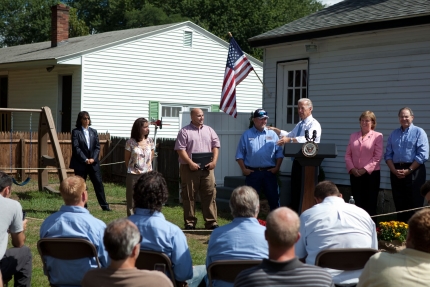
Vice President Joe Biden speaks in Lynn Dumont's back yard

Vice President Joe Biden speaks in Lynn Dumont's back yard about the American Recovery and Reinvestment Act's weatherization program, in Manchester, New Hampshire. The Vice President was announcing that 200,000 homes have been weatherized under the program. August 26, 2010. (Official White House Photo by David Lienemann)

The White House

Office of the Vice President

Vicepresidente Biden anuncia que 200,000 viviendas han sido acondicionadas para las inclemencias del tiempo con la Ley para la Recuperación

Manchester, N.H. – En un evento hoy en Manchester, New Hampshire, con propietarios de vivienda y trabajadores que se beneficiaron del programa, el Vicepresidente Joe Biden anunció un importante logro con la Ley para la Recuperación (Recovery Act): el acondicionamiento de 200,000 residencias contra las inclemencias del tiempo. Como resultado del compromiso sin precedente de la Administración con la eficiencia energética, más de 200,000 familias de bajos ingresos han podido ahorrar dinero en su cuenta de energía y miles de personas han obtenido empleo.

“Gracias a la Ley para Recuperación, miles de obreros de construcción en todo el país ahora se dedican a la labor de mejorar la eficiencia energética en viviendas, lo que les ahorrará a las familias trabajadoras cientos de dólares en su cuenta de servicios públicos”, afirmó el Vicepresidente Biden. “Éstos son cambios pequeños, desde reemplazar ventanas y puertas hasta agregar aislantes, pero están beneficiando mucho a trabajadores, industrias y consumidores estadounidenses. Hemos acelerado el programa de acondicionamiento contra las inclemencias del tiempo y ya hemos logrado que más de 200,000 viviendas sean más eficientes en el uso de energía, y ahora avanzamos a toda velocidad para cumplir con nuestro objetivo original de acondicionar 600,000 viviendas en todo el país”.

“El programa de acondicionamiento con la Ley para la Recuperación –uno de los programas que la caracteriza– está logrando ahorrarles energía y dinero a cientos de miles de familias estadounidenses a la vez que genera miles de empleos en energía limpia en comunidades locales”, afirmó Steven Chu, secretario de Energía de Estados Unidos. 

El Vicepresidente Biden visitó hoy la casa de la familia Dumont en Manchester, New Hampshire para destacar la cifra alcanzada. Se tiene previsto que la familia Dumont ahorre más de $600 al año en cuentas de servicios públicos una vez que se concluya el proyecto de acondicionamiento y Southern New Hampshire Services, la organización local que está acondicionando la vivienda, ya ha contratado a siete nuevos empleados a tiempo completo y aproximadamente 68 subcontratistas como resultado de los fondos de acondicionamiento de la Ley para la Recuperación.

New Hampshire ha sido uno de los líderes del país en acondicionamiento y ha intensificado esfuerzos de manera rápida y eficaz para alcanzar sus objetivos antes de lo previsto. Hasta junio, New Hampshire había acondicionado un total de más de 1,000 viviendas con la Ley para la Recuperación. New Hampshire también fue escogido recientemente para recibir $3.1 millones adicionales para complementar y ampliar su actual programa de acondicionamiento, impulsar la innovación y producir ahorros incluso mayores en los gastos de energía para familias locales.

Los esfuerzos de New Hampshire están contribuyendo al éxito del programa en todo el país. El Programa de Asistencia con el Acondicionamiento (Weatherization Assistance Program), tras su intensificación el año pasado, está acondicionando casas a su ritmo óptimo: aproximadamente 25,000 viviendas al mes. Se ha acondicionado 200,000 viviendas en todo el país, y los estados ya han acondicionado más de un tercio del número objetivo del presidente de casi 600,000 viviendas con la Ley para la Recuperación. Tan sólo este verano, se están acondicionando más de 80,000 viviendas en todo el país, en comparación con 3,000 el verano pasado. Contando las viviendas acondicionadas con los fondos de programas anuales, se han acondicionado más de 300,000 viviendas desde el inicio de la Ley para la Recuperación. 

El programa de acondicionamiento también está generando miles de empleos localmente y haciendo que carpinteros, electricistas y trabajadores de fábrica vuelvan a trabajar instalando aislantes, electrodomésticos nuevos y mejores sistemas de calefacción y aire acondicionado. Según informes estatales, el Programa de Asistencia con el Acondicionamiento de la Ley para la Recuperación respaldó más de 13,000 empleos en el segundo trimestre del 2010, incluidos aproximadamente 120 empleos en New Hampshire. Esos trabajadores están recibiendo capacitación en mejoras energéticas que ayudarán a sentar las bases del sector de eficiencia energética sostenible en Estados Unidos, que se puede extender a las más de 100 millones de viviendas de clase media y beneficiarlas con el acondicionamiento.

El Programa de Asistencia con el Acondicionamiento del Departamento de Energía de Estados Unidos ayuda a familias de bajos ingresos a ahorrar energía y dinero al mejorar la eficiencia energética de sus viviendas. Según un estudio reciente del Laboratorio Nacional Oak Ridge, los servicios de acondicionamiento les ahorran más de $400 en promedio en gastos de energía durante el primer año posterior a la instalación de mejor equipo. En total, el poder ejecutivo está invirtiendo aproximadamente $90,000 millones por medio de la Ley para la Recuperación en proyectos de energía y eficiencia energética que reducen costos y consumo de energía, y generan empleos nuevos.
 

200,000 Homes Weatherized Under the Recovery Act

Ed. Note: Cross posted from the Energy Blog

Today Vice President Biden announced that 200,000 homes have been weatherized under the Recovery Act. Cathy Zoi, Assistant Secretary for Energy Efficiency and Renewable Energy shares her thoughts:

We're still talking about weatherization on Facebook and Twitter. Ask questions, share your thoughts and we’ll follow-up with tips and answers from our experts in the coming days.

Andy Oare is a New Media Specialist at the Department of Energy

The White House

Office of the Vice President

Vice President Biden Announces 200,000 Homes Weatherized Under the Recovery Act

Manchester, N.H. – At an event with homeowners and workers who benefited from the program, today in Manchester, New Hampshire, Vice President Joe Biden announced a major Recovery Act milestone – the weatherizing of 200,000 homes under the Recovery Act.  As a result of the Administration’s unprecedented commitment to energy efficiency, more than 200,000 low-income families have been able to save money on their energy bills while saving energy, and thousands of people have been put to work.

“Thanks to the Recovery Act, thousands of construction workers across the country are now on the job making energy-saving home improvements that will save working families hundreds of dollars a year on their utility bills,” said Vice President Biden.  “From replacing windows and doors to adding insulation, these are small changes that are making a big difference for American workers, manufacturer and consumers.  We’ve hit the accelerator on the weatherization program, making over 200,000 homes more energy-efficient already, and are now full speed ahead to meet our original target of weatherizing 600,000 homes nationwide. ”

“The weatherization program under the Recovery Act – one of our signature programs – is successfully delivering energy and cost savings for hundreds of thousands of American families while creating thousands of clean energy jobs in local communities,” said U.S. Energy Secretary Steven Chu. 

Vice President Biden today visited the Manchester, New Hampshire home of the Dumont family to announce the milestone.  The Dumont family is expected to save over $600 a year on their utility bills once their weatherization project is completed and Southern New Hampshire Services, the local organization weatherizing their home, has already hired 7 new full-time employees and an estimated 68 subcontractors as a result of the Recovery Act weatherization funding.

New Hampshire has been one of the nation’s weatherization leaders, ramping up quickly and effectively to reach their goals ahead of schedule.  Through June, New Hampshire has weatherized a total of more than 1,000 homes under the Recovery Act.  New Hampshire was also recently selected to receive an additional $3.1 million to complement and expand their existing weatherization program, drive innovation, and deliver even greater energy bill savings for local families.

New Hampshire’s efforts are contributing to the success of the program nationwide.  After ramping up last year, the Weatherization Assistance Program is now weatherizing homes at its optimal rate – approximately 25,000 homes per month.  With 200,000 homes weatherized nationally, states are more than a third of the way to reaching the President’s goal of weatherizing nearly 600,000 homes under the Recovery Act.  This summer alone, more than 80,000 homes are being weatherized nationwide versus 3,000 last summer.  Including homes weatherized with annual program funding, more than 300,000 homes have now been weatherized since the Recovery Act began. 

The weatherization program is also creating thousands of jobs locally – putting carpenters, electricians, and factory workers back to work installing insulation, upgrading appliances, and improving heating and cooling systems.  According to state reports, the Recovery Act Weatherization Assistance Program supported more than 13,000 jobs in the second quarter of 2010, including approximately 120 jobs in New Hampshire. These workers are receiving training in energy upgrades that will help form the foundation for a sustainable energy efficiency industry in America that can extend to the more than 100 million middle-class homes that stand to benefit from weatherization.

The U.S. Department of Energy’s Weatherization Assistance Program helps lower-income families save energy and money by improving the energy efficiency of their homes.  According to a recent study by Oak Ridge National Laboratory, weatherization services save families an average of more than $400 in energy costs during the first year after home retrofits are installed.  Overall, the Administration is investing about $90 billion through the Recovery Act in clean energy and energy-efficiency projects that cut costs, reduce energy use and create new jobs.

Keeping Taxes Low for the Middle Class and Small Businesses

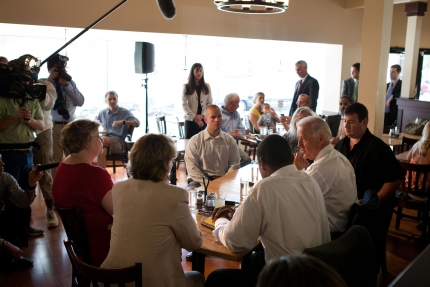
Vice President Joe Biden talks with local workers at Pete's

Vice President Joe Biden talks with local workers and small business owners about the economy during a middle-class task force roundtable at Pete's New Haven Style Apizza restaurant in Washington, DC, August 25, 2010. (Official White House Photo by David Lienemann)

Today the Vice President held a Middle Class Task Force roundtable discussion with workers and small business owners at Pete’s New Haven Style Apizza, a local restaurant that has benefitted from the small business provisions in the Recovery Act. 

The discussion focused on tax policies—some already in place, others we’re fighting for—designed to help middle class families make ends meet and help small businesses invest and grow.

Vice President Biden, the Chair of the Middle Class Task Force, emphasized the importance of preserving tax cuts for the middle class - cuts that mean more than $2,000 per year for an average middle class family.  He also stressed the need for Congress to pass legislation to give small businesses additional tax relief and access to capital so that they can continue to invest and create new jobs.

The White House

Office of the Vice President

Statement by the Vice President on New CBO Report on Employment and Economic Impact of the Recovery Act

Vice President Joe Biden today issued the following statement on a new report from the Congressional Budget Office on the employment and economic impact of the American Recovery and Reinvestment Act:

“This new analysis from the nonpartisan Congressional Budget Office is further confirmation of what we’ve been hearing from leading economists, the nation’s governors and families across the country: the Recovery Act is working to rescue the economy from eight years of failed economic policy and rebuild it even stronger than before.  When the CBO, Congress’s top watchdog and an institution widely-respected on both sides of the aisle, says that because of the Recovery Act as many as 3.3 million Americans are on the job today and the unemployment rate is as much as 1.8 percent lower, it’s impossible for even the most cynical, bent-on-rooting-for-failure critics to deny.  So while Republicans in Congress – the same party that got us into this mess in the first place - may want to turn back the clock and drive us back into the same ditch we’re making our way out of, it’s now clearer than ever before that we can’t afford to go backward; we have to keep moving forward and build on measures like the Recovery Act that are creating jobs and making us competitive in the 21st century economy.”

According to the CBO report, “Estimated Impact of the American Recovery and Reinvestment Act on Employment and Economic Output from April 2010 through June 2010,” in the second quarter of 2010, the Recovery Act:
• Raised the level of real (inflation-adjusted) gross domestic product (GDP) by between 1.7 percent and 4.5 percent,
• Lowered the unemployment rate by between 0.7 percentage points and 1.8 percentage points,
• Increased the number of people employed by between 1.4 million and 3.3 million

The report can be viewed in full HERE.

Transforming the American Economy Through Innovation

August 24, 2010 | 41:51 | Public Domain

Vice President Joe Biden details the role the Recovery Act has played in funding innovation that will help build a foundation for a more robust and competitive American economy.

Download mp4 (399MB) | mp3 (38MB)

Read the Transcript

Remarks by Vice President Joe Biden at the Recovery Act Innovation Report Event

Recovery Act Innovation Report Event
South Court Auditorium, Eisenhower Executive Office Building

As Prepared for Delivery—

Let me start by addressing a couple of items from the news this morning.

First, as of today, we have officially reduced the number of U.S. troops in Iraq below 50,000, meeting a commitment President Obama made before taking office – and meeting it ahead of schedule. Next week, as you know, the U.S. military will end its combat mission in Iraq, with the remaining troops advising and assisting Iraqi forces. This is a remarkable milestone in a war that began more than seven years ago.  We owe a debt of gratitude to our military.

Second, I want to respond to the remarks made this morning by Mr. Boehner, the Republican leader in the House.

After months of promising a look at his party’s agenda and their plans for America, he made what was billed as a major economic address. And his chief proposal apparently was that the President should fire his economic team.  Very constructive advice, thanks. 
 
So, let's just review a little history here:  For eight years before we arrived, Mr. Boehner and his party ran this economy and the middle class into the ground.

They took the $237 billion surplus they inherited from the Clinton Administration and left us with a $1.3 trillion deficit, and, in the process, quadrupled the national debt – all before we had turned on the lights in the West Wing.

They gave free rein to the special interests to write their own rules at the expense of everybody else.

And the sum total of it was the greatest economic crisis since the Great Depression—a crisis that wreaked havoc on families and businesses across this country--a crisis from which we are still digging out.

The head of their campaign committee, Representative Pete Sessions, said that if they were to take control of Congress this fall—which, by the way, they won't—that they would go back to "the exact same agenda" they were pushing before President Obama took office.

They think the policies they had in place during the Bush years—the ones Mr. Boehner helped craft and sell—were the right ones. Well, let me tell you, there are millions and millions of Americans who saw their paychecks shrink or their jobs, houses, and savings vanish.  Mr. Boehner is nostalgic for those good old days…the American people are not. 

They don't want to go back.  They want to move forward.

Now let me respond to a few specific points Mr. Boehner raised:

On taxes, let's be clear on what this debate is all about: the big tax cuts of the last decade are scheduled to expire. This President says the middle class can't afford higher taxes in the midst of this recession. They've borne the brunt of it.

So the President proposes we extend the tax cuts for 98 percent of Americans.

What Mr. Boehner wants to do is extend the tax cut to the other two percent.  That means we’re going to have to borrow $700 billion we don’t have to give a $100,000 a year tax cut to millionaires.

This is a tax cut they don’t need, and they won’t use to create jobs or economic growth.

So to justify that, he has created this myth that a tax cut for millionaires is actually a tax cut for small business.

There aren't three percent of small businesses in America that would qualify for that tax cut. It's a Wall Street tax cut, not a Main Street tax cut.   At the same time, they’re blocking the genuine $12 billion tax cut for small businesses we proposed.

Also, he wants to give U.S. companies that shift jobs and profits overseas a tax credit for taxes they don’t even pay.

We've seen this movie before, Mr. Boehner. We know how it turns out.  And the American people deserve something different and something better.

The rest of his so-called plan doesn’t offer any real economic agenda, it merely is a list of things he thinks the President shouldn’t do.

So after all of this buildup and hype, all we know is what John Boehner and his Republican colleagues are against.  We still haven’t heard what they’re for.

So let’s be clear about the kind of change this administration supports.

Today, Secretary Duncan will make an announcement about Race to the Top, which is our plan to reward states that are willing to take bold steps and change the way we educate our children.

It’s striking that Mr. Boehner’s economic address was devoid of any proposal to improve America’s schools.

And another key to our economic future that Mr. Boehner ignored is what we’re here to discuss: innovation.

Let me tell you basic formula:

Government plants the seeds, the private sector makes them grow, and we launch entire industries, create hundreds of thousands jobs, and spark new forms of commerce that were once unimaginable, allowing us to dominate the 21st century like we did in the 20th.

You know, Secretary Chu is really the perfect person to talk about innovation with us today.  From what I understand, you don’t win a Nobel Prize for repeating the formulas of the past.  You win one for doing something that’s never been done before.  You win one for innovating. 

And more than ever, America needs to innovate. I’ve been all over this country, and talked to a lot of people, and I’ve not yet found anyone who has said to me:  Just bring us back to where we were.  Just bring the economy back to what it was before the beginning of this recession. 

Because not only were families struggling before the beginning of this great recession —America was stagnating.

We were seeing big challenges getting bigger —climate change, our dependence on foreign oil, the erosion of our manufacturing base. 

And at the same time, Americans were losing jobs, and losing hope. 

So when we passed the Recovery Act, our goals were three-fold:

•          To rescue a rapidly deteriorating economy;
•          To put the country on a path to recovery by getting Americans back to work quickly; and
•          To reinvest in the country’s long-term economic future.

On the first two counts, we’re making progress:  We’ve created 3 million jobs, and we’re adding jobs every month.  The economy has been growing for a full year. 

In the last six months of the Bush Administration, we lost 3 million private sector jobs.  In the first seven months of this year, we created 630,000 private sector jobs.

We’re turning this around.

Now, it’s not happening as fast as any of us would like, and certainly not fast enough for the millions of folks who are still out of work.  But there isn’t any doubt – we’re moving in the right direction.

It’s that third part of our strategy that we’re here to report on today. 

As I said, it’s not enough just to rebuild the industries of the 20th century. 

We knew we had to lay the foundation for a new, more robust American economy, one that was ready to meet the challenges of the 21st century—which are different from the ones we face in the 20th.  And, like those before us, we know we have to innovate.

Since its birth, the United States has been a nation built on discovery and innovation.  In fact, our very roots are in innovation. We’re innovators — that’s who we are.  We’re tinkerers and inventors, explorers and entrepreneurs. 

It was in this spirit of taking bold steps forward amid daunting adversity that President Obama signed the Recovery Act. 

Today, I am proud to release this report on how the down payments we have made to entrepreneurs and innovators through the Recovery Act are transforming the American economy.

The report has a lot of details, but I can summarize it very briefly:

The first point I want to make is, our investments in innovation are creating jobs, creating new industries, making existing industries more competitive, and, in the process, they’re driving down costs for new technologies that are badly needed, and helping our nation reassert our place as the world’s center for inventors and entrepreneurs.

This report focuses on our investments in four main areas  Think of them as seed money:
 
1.         Modernizing transportation, including advanced vehicle technology and high-speed rail;
2.         Jumpstarting the renewable energy sector through wind and solar energy;
3.         Investing in groundbreaking medical research; and
4.         Building a platform that will enhance the private sector’s ability to innovate, through investments in broadband and the Smart Grid, by giving them the tools they need to grow.

In each of these areas, we’re seeking game-changing breakthroughs.  And in some cases, entire new American industries are being born—the very industries that are going to allow us to lead the world in the 21st Century.

I’d like to highlight just a bit of what’s happening in each of these areas.

First, modernizing transportation.

I know that we have several electric vehicle manufacturers, battery makers, and people working on charging infrastructure here today.

I was at a Jeep plant yesterday.  Right now, we’re seeing that we did the right thing when we stepped in to give them American auto industry a second chance.

Our goal was not just to rebuild the auto industry of the past—but to create an American auto industry for the next century, that will dominate for decades to come.

I want to see a day when you can pop the hood on your electric car made in Smyrna, Tennessee, to check on your advanced battery made in Holland, Michigan, or Noblesville, Indiana, and an electric motor made in Longmont, Colorado, as you recharge your vehicle at an electric charging station in San Diego. 

But we knew that day wasn’t going to come on its own.  In the greatest automobile producing-country on Earth, we were manufacturing less than two percent of the world’s advanced vehicle batteries. 

Thanks to the Recovery Act, that’s changing – in a big way.  Because we provided $2 billion in seed money to 30 advanced battery and electric drive component factories, it brought more than $2 billion more in private capital off the sidelines.   And, as a result, America is expected to have the capacity to produce 20 percent of the world’s advanced vehicle batteries by 2012.  By 2015, it could be as much as 40 percent—because the private sector will continue to invest in these changes.

And more importantly, we’re on pace to reduce the cost of batteries for autos by 70% by 2015 – which will make electric vehicles cost-competitive with similar non-electric vehicles.

When you put it all together, it means that America will once again be able to provide “Wheels for the world” –  the most advanced, efficient, competitive cars found anywhere—with a side benefit of not having to rely on foreign oil. 

Second, we’re jumpstarting investment in renewable energy.

Three decades ago, the U.S. led the world in another arena - the development of renewable energy such as wind, solar, and geothermal power.  Since that time, because of the failure to invest in these industries, we’ve fallen behind. 

President Obama, Secretary Chu, and I set a goal of doubling U.S. renewable energy generation capacity from wind, solar, and geothermal by 2012. 

We wanted to install as much renewable capacity in three years as the U.S. had in the previous thirty. 

But we’re ahead of pace to meet it.  In Pensacola, Florida, we’ve funded the largest photovoltaic power plant in North America, with over 90,000 solar panels—enough to provide energy for 3,000 homes. 

And the Department of Energy is in the process of supporting what will be the world’s largest solar thermal facility – in the Mojave Desert.  It will have 349,000 mirrors.

Because of projects like these, we are on pace to cut the cost of solar energy use in half by 2015 – leading us towards a day when solar power can be as cheap or cheaper than electricity from the grid, meaning that households can save money by using solar.

All told, the new generation capacity supported by the Recovery Act is going to power 16.7 million homes. 
 
But we knew that generating renewable power was only half the story – that we had to reassert ourselves as renewable manufacturing leaders as well.  So President Obama set a goal of doubling U.S. renewable manufacturing capacity by the end of 2011.

And, by the way, that means jobs. 

We’re on track to meet that goal, too.  We’re using a tax credit (48C) to increase incentives for renewable energy manufacturers to set up or relocate their businesses here in the US.  Already, for example, it’s paid out $346 million in tax credits for wind alone, resulting in 52 wind manufacturing projects in the US.

And again, it’s not just government.  It’s leveraging private capital:  All in all, $46 billion in clean energy funds we’re providing in seed money alone will generate more than $100 billion in non-federal investment in new energy projects. 

As a result, we are on pace to hit our target of doubling America’s renewable energy generation and manufacturing capacity by 2012.

Third, the Recovery Act is investing in groundbreaking medical research, with the goal of finding new ways to treat or prevent some of the world’s most daunting and debilitating diseases, to develop powerful new medicines, and even define strategies that will prevent disease from occurring in the first place—saving lives and saving hundreds of billions of dollars. 

This disease prevention work is happening across the board: in human genome sequencing, cardiovascular disease, cancer, and autism.

Thanks to the Recovery Act, researchers at our National Institutes of Health will complete the sequencing on 50 times as many human genomes as we’ve sequenced to date – not only increasing our understanding of disease, but also bringing down the cost of doing this work and opening the door to a future of personalized medicine. 

Thanks to Recovery Act funds, NIH will be able to sequence the genes of cancers that affect 10 million Americans – again, with the potential to start winning the war on cancer our nation declared in the early 1970s.

The first human genome map cost an estimated $2.7 billion.  Today, a genome map stands at $48,000.  Now, we stand on the verge of bringing the cost of a human genome map below $1,000 – fifty times cheaper than what is currently possible and with the potential to completely transform health care in America.

In the National Institutes of Health, we have one of the greatest assemblages of doctors and scientists in the world. 

Through the Recovery Act, we’re giving them the tools to make the most profound innovation of all: improving and extending health and human life, while bringing down the cost in medicine. 

The fourth area of investment is in building a platform for private sector innovation.

In all of these areas, the President and I recognize that the federal government’s role is limited.  We provide the seeds, but it’s the private sector that makes them grow. 

That’s why we’re investing so heavily in broadband.  Thanks to $7 billion in Recovery Act investments, bringing $3 billion in private capital off the sidelines, approximately 2 million rural American households – and tens of thousands of community institutions – will have better access to broadband. 

Farmers will be able to access real-time weather reports, water conditions, and crop prices, helping them be as competitive as possible in a global market.

As I said, we’re also investing more than $4 billion in Smart Grid, bringing more than $5 billion in capital off the sidelines.  Smart grids provide real-time information on electricity use, so that consumers and businesses can make efficient energy choices on a truly reliable network. 

A smart utility grid.  Universal broadband.  These are the foundation upon which innovative businesses can be built here in the U.S. – able to open their doors anywhere, and prosper everywhere.

And that’s really what this is about – giving American entrepreneurs the tools to do what they do best.

I know that there are several representatives of ARPA-E here today. The original ARPA was started in response to Sputnik.  The goal of this new agency was to rejuvenate America’s military research and development capabilities. 

In 1962, ARPA launched a nationwide effort to build a computer network called ARPA-NET.

By 1975, after spending just $25 million, ARPA researchers had done just that - and they’d created the basic structure of the modern Internet.

In the 1980’s, private industry dove in, and by 2009, the Internet was being used by approximately 27 percent of the world’s population, over 1.8 billion people.  It’s the engine for hundreds of billions of dollars of commerce. 

That was a relatively modest federal investment that allowed private industry to completely transform our economy.

That is exactly what we’re doing again.  Our federal investment is bringing money off of the sidelines. For example, in scientific research, $2.9 billion in investment is being doubled by external investors.  Or take clean energy, where a $46 billion investment is supporting more than $3 for every $1 we spent. 

In fact, on $100 billion of Recovery Act investments, the private sector is investing $286 billion—three dollars for every dollar we spend

A couple of months ago, I visited a company called Cree, in Durham, North Carolina.  I know we have some folks from Cree here today.

Their CEO, Chuck Swoboda, said: “The Recovery Act funding made it a straightforward decision to continue to invest in the U.S., both at our North Carolina facility and throughout our supply chain partners across the country.”

In his Nobel Prize lecture, Dr. Chu said, “As scientists, we hope that others take note of what we have done and use our work to go in directions we never imagined.”

Both had it exactly right, and it brings me back to where I started: 

Government plants the seeds, the private sector makes them grow, and we launch entire industries, create hundreds of thousands jobs, and spark new forms of commerce that were once unimaginable.

That’s how we’ve led the world in the past.  And that’s how we’ll dominate again in the future.   Looking at all of you, I know that we’re already on our way.

Thank you.  May God bless you all, and may God protect our troops.

Close Transcript