West Wing Week 06/20/14 or, “Zot, Zot, Zot!”

June 20, 2014 | 6:25

This week, the President visited Lakota Country, the land of the Anteaters, and Pittsburgh's Tech Shop, while at home he hosted the first-ever Maker Faire and awarded the Medal of Honor.

Download mp4 (210MB)

The White House

Office of the Vice President

Remarks by the Vice President at Maritima Solar

Maritima Solar
Santo Domingo, Dominican Republic

THE VICE PRESIDENT:  It’s a pleasure to be here, and I want to thank you for showing me the remarkable job you’ve done here.  And energy security is vital for every nation.  You see it around the world, and energy dependence is a very difficult place to find yourself as a nation.  Indeed, it’s quite frankly a matter of national security around the world.

I’ve spent a considerable amount of time in the last two months in Ukraine.  You see what the Russians are doing relative to using gas as a foreign policy tool to try to alter behavior.  And so it’s -- around the world in varying degrees it’s of significant consequence in terms of security, both economic and political security of a nation.

But here in the Caribbean, the energy costs are the highest in the hemisphere.  The entire hemisphere, they're most expensive here in the Caribbean, and everybody feels it.  For all the families that live here, it drains government budgets.  And it holds back economic growth.  Island nations face unique challenges when it comes to energy.  They often depend on imports.  They struggle to find economies of scale.  And as a result, they sometimes end up with the most expensive and dirty fuel as a source of energy.

Of course, each country is unique -- with its own opportunities and its own challenges.  But there is -- so there’s no one-size-fits-all program initiative relative to energy that can be applied.

But for example, for some the answer will lie in natural gas.  For others, the abundance of sun, wind, and geothermal or a combination of all of the above.  But there is on common denominator for every island nation.  For any country that hopes to succeed, it requires the creation of an open, transparent, market-based, clear set of rules applied equally all the time because that provides the incentive for the private sector to make the investments that build the infrastructure that's required for a more secure energy future for this entire region.

But it’s easier said than done.  I know some of you reporters have a significant amount of -- questions.  It’s more easily said than done. 

There are those inside your countries and outside with a vested interest in defending the status quo.  In some cases that includes outright corruption and graft.  And I’m here today that any country willing to take difficult steps that are required, the reforms that are required, are willing to put in place the rules and the institutions required to find willing partners, they will find willing partners in the United States to help them turn that commitment into tangible change.

And here’s what we are ready to do, the United States.  First, the United States will provide direct technical assistance and expertise to create the (inaudible) environments that attract investments.  Let me say it another way, without them, you cannot attract investments.

The Caribbean as a whole needs $12 billion in new investments to meet the energy demands by 2035.  It needs $12 billion of new investment.  The private sector can and will mobilize. But they have to be convinced first that there’s a regulatory climate that is predictable, that is transparent, that is fair, and one that allows them to make a fair return on their investment.  Otherwise, they will not invest.  And there’s a need for $12 billion in new investment.

The second thing we’re prepared to do is the overseas -- and I realize this sounds very technical, but it’s a reality, the Overseas Private Investment Corporation, so called OPIC, will dedicate resources to the Caribbean to facilitate deals that match U.S. government financing with strong energy projects.  We’ll match the two:  strong energy projects and U.S. government financing through targeted loans, through guarantees and other credit enhancements.  U.S. development financing can help unlock the supply of private sector capital for the new projects that are badly needed here in the Caribbean.

Thirdly, the United States will work with regional partners to align and coordinate the energy initiatives of the international financial institutions in an effort to eliminate waste and duplication and to increase diversity of financial instruments that support energy projects.  That includes the World Banka and other institutions.  We will help.  We can help facilitate that.

Fourthly, to demonstrate that these changes are not just possible but profoundly beneficial, the United States is about to select one country as a pilot project.  This project will help address energy sector reforms from A to Z, the entire panorama of needs from developing a new regulatory framework that is efficient and free of corruption, to identifying the appropriate energy solution (inaudible) the needs of that country, and to promoting an effective financial model that can attract investment.

We’ll have teams ready to go to work with that country immediately to help take all these steps that I have just described. 

And finally, I’m pleased to announce today that I’ll be convening Caribbean leaders this fall along with the donors and financial institutions to help coordinate our efforts to review the progress that has been made and what needs to be done.  There’s a bottom-line need here, folks.  The infrastructure need is great.  The energy needs are great.  Economic and political security depends on it, but it requires the private sector to know that there’s a predictable regime within which they can operate free of corruption, transparent and one where they can get a return on their investment. 

We have a great deal of experience in this area, and we can help incentivize these kinds of investments.  I’ll end where I began.  There’s a need for $12 billion in investment in energy projects here in the Caribbean.  Absent that, there’s going to be a significant problem for each of the countries in question.

So in conclusion, the challenges are real, but they're also real solutions.  They're not solutions that will come overnight, but they can come quickly.  Most of them are not glamorous.  And I’m sure I’ve already bored you with the detail of the kinds of the things that have to be done.  But it’s a reality.  These things must be done.  But when they are done, where they have been done, they’ve been proven to work.  They’ve been done and proven elsewhere.  And we know they work.  And sometimes our friends in other countries need the -- how can I say it?  The practical, technical expertise to know how to go about establishing these regimes.

The people on these islands deserve a future with affordable, reliable, clean energy, where the electric bill doesn't bankrupt a family or quite frankly bankrupt a nation’s budget; where leadership now lays the groundwork for energy security for generations to come.

Ladies and gentlemen, it’s already beginning to happen here in the DR.  And together, we can make it happen all over the Caribbean, to give this country and this region a more secure, more sustainable and more prosperous future -- energy.  Energy that requires a change in the regulatory regime to get it done.  And we will be all in as countries agree to do just that.

Thank you all so very much.  And I want to congratulate you all on a first-rate project.  I know you all know this, but because of the laws and regulations here that were passed in a poor-sighted way, there has been an (inaudible) in these solar panels.  And right now as we speak, correct me if I’m wrong, Mr. President, but you are not consuming all the energy you’re generating.  And you’re able to sell it back to the grid, and actually sell it back.  It accommodates a need that the grid overall needs more energy, and it’s economically feasible.  And it makes it more affordable all the way around.

So I want to compliment you on a great job.  Thank you for taking what is -- I don't know if that's big a risk, but stepping forward and seeing the opportunity. 

Well, you do help the ecology.  I haven’t even gotten into the environmental side of this, which is profound.  But if there’s any place in the world that take advantage of renewable energy, it’s the Caribbean.  Sun, wind, geothermal, you are sort of in the paradise of renewable energy.  We got to (inaudible).  Thank you all so very, very much.

END

The White House

Office of the Vice President

FACT SHEET: Promoting Energy Security in the Caribbean

Energy security is a major challenge for the Caribbean. The region is largely dependent on relatively high-cost imported fuel and electricity. Small isolated economies and unattractive investment policies discourage investment necessary to build sustainable energy systems. The high cost of energy diverts resources away from economic development, reduces competitiveness, and renders the energy sectors of Caribbean nations vulnerable to supply shocks. 
 
However, the region has access to an abundance of renewable and other energy resources. A concerted effort to provide assistance to Caribbean islands on difficult policy and regulatory reforms can attract the private finance required to implement new energy technologies and approaches.
 
Today, the Vice President announced a new initiative to support the Caribbean on energy. Recognizing that there is no “one-size-fits-all” solution for Caribbean nations and that individual islands may choose to pursue different pathways towards achieving energy security, the Caribbean Energy Security Initiative we are launching today consists of a portfolio of activities designed to provide different options for assisting in the transformation of the Caribbean’s electricity sector.

  1. Increasing Access to Finance, Good Governance, and Diversification
    The Overseas Private Investment Corporation—OPIC—will dedicate resources to the Caribbean to facilitate deals that match U.S. government financing with strong energy projects. Through targeted loans, guarantees, and other credit enhancements, U.S. development finance can help unlock the supply of private sector capital for new projects. And since investment depends on good governance in the sector, in the form of stable and transparent policy, regulatory, and legal regimes, the United States will work in close cooperation with other donors to support and accelerate regional efforts to develop and implement new regulatory models. This, in turn, will open the door to greater energy diversification, which can improve energy security through a reduced dependence on a single energy source. The United States will support national efforts to identify cost-effective fuel mixes through focused technical assistance, informed by the implementation of energy programs in the U.S. Virgin Islands and Hawaii. 
     
  2. Transforming the Caribbean, One Island at a Time
    Recognizing that change starts on the ground, the United States will partner with an individual country committed to achieving an energy sector transformation to provide a comprehensive package of strategic planning and technical assistance. We believe that the private sector, supported as warranted by targeted loans, guarantees, and other credit enhancements from OPIC, will respond positively. This program will demonstrate the impact of a comprehensive, integrated approach to energy sector transformation and will create a model that can help inform similar efforts elsewhere in the region.
     
  3. Maximizing Impact of Existing Donor Efforts
    A number of bilateral, multilateral, and NGO organizations are funding technical and policy assistance programs throughout the Caribbean. Many of these activities could be strengthened through greater coordination and identification of shared priorities. The United States will work with key actors to share information on existing efforts and explore opportunities to coordinate programs, in order to maximize impact and reduce duplication of effort.

The White House

Office of the Vice President

Remarks to the Press by the Vice President and Dominican President Medina

The Presidential Palace
Santo Domingo, Dominican Republic

2:30 P.M. EDT

PRESIDENT MEDINA:  (As interpreted.)  Ladies and gentlemen, I am pleased to welcome Vice President Joe Biden and his delegation in the name of the government and the people of the Dominican Republic, as well as in my own name. 

I would like also to take the opportunity of our distinguished guest to send a message of friendship and solidarity to President Barack Obama and to the people of the United States.

In his public, as well as his private life, Vice President Biden is an example of tenacity and strength before adversities, qualities that determine the leadership that he has in his country and the world.  His visit to our land, crib of the expansion of the Western world to the Americas comes to deepen our relations with the United States based in respect and mutual collaboration.

In the meeting that we just concluded, we have overviewed the bilateral relation and touched on points of mutual interest, amongst which security in the area of the Caribbean and Central America, the fight against the scourge of illegal drug trafficking, the topic of energy and trade may be underscored. 

The Dominican Republic and the United States work hand in hand to guarantee security in the area of the Caribbean and Central America.  The joint efforts are crucial to combat illegal drug trafficking, but also trafficking in persons, and containment of illegal immigration.  In this respect we thank you for your support that is now manifested also through the initiatives promoted by the United States in favor of regional security in the actions of the Central American Integration System. 

As you all know, the United States is our main trade partner.  And since the signing of the free trade agreement, DR-CAFTA, exports to that market have grown by 24 percent, from $3 billion in 2007 to $4.2 billion just last year.  Trade between our nations amounted $12 billion in 2012.  And the Dominican Republic is the ninth place for U.S. exports to the Western Hemisphere. 

We are aware, however, of the fact that DR-CAFTA also presents challenges.  As a product of the great asymmetries between our economies, we trust to have the collaboration of the United States so that our trade be undertaken always under conditions of fairness that are sustainable for our producers.  Our concern -- sustainable for our producers.  In this respect, I must indicate that we are very pleased with the answer that President Obama gave to the letter that we sent related to the dangers that the Trans Pacific Partnership represents for the Dominican economy.  We trust that the United States will take into consideration our concern, and that we will not be forced to compete at a disadvantage in the U.S. market.

Another fundamental aspect of our agenda has been energy security, a topic of vital importance for this government because of its profound repercussions in our national budget, and of course in the development of our nation.  The Dominican Republic has launched an ambitious transformation agenda in energy, an integral project that should take us to overcome the energy deficit once and for all.

Amongst our objective, we have diversification of the energy matrix, with emphasis in use of renewable sources of energy, strategy in which we are receiving the technical support of the United States.  And I take this opportunity to thank you for it. 

We attach great value to the interest of the United States to support our energy self-sufficiency.  As a country with limited resources, we must explore the different sources of energy to find a balance between clean energy and generation cost.  In this respect, aware of the fact that the United States very soon will be exporting natural gas, we want to underscore our wish to be included as one of the priority markets for gas exportation.  This will help us notably reduce energy costs, one of the crucial strategic objectives for competitiveness and development in our country.

I must underscore, however, that beyond trade relations, the United States and the Dominican Republic are brought together by brotherhood ties, by living together of thousands -- of hundreds of thousands of families, more than 1.5 million Dominicans that live currently in the United States, and approximately the same number of U.S. tourists that visit our country, in addition to the 250,000 U.S. citizens that live in the Dominican Republic.  That is a tie that cannot be broken, that makes both countries responsible to create better conditions for our citizens within and outside our own borders. 

In this regard, I would like to once again express our gratitude to the government and the people of the United States for the support offered to put into operation of what is already an initiative without precedence in our country for protection of our citizens.  And I am referring to the 911 Security and Emergency System.  Into its third week of operations, we can now say that it is already transforming attention and services to the public for always.  This good result promotes that we work with enthusiasm in its expansion into other zones of the country.  And we count on the support of the United States. 

Our relations with the United States are and will continue to be excellent.  Our purpose, our objective has been that they reflect the maturity of both democracies manifested as a partnership with a common purpose of moving forward for the development of our people.  As in all partnerships, mutual respect must be an inviolable rule.  Understanding that always amongst partners, we can have disagreements.  What is important, however, is to be able to discuss them through dialogue and convince that the dignity of one country transcends beyond its borders.

In summary, our conversation has been a frank, open, respectful dialogue, as it should be among friends.  To the United States, we are brought to by geography, democratic values and love of freedom, our interest is that today such close relationship may come even closer in the future.  I trust that that will be the case after this memorable visit. 

VICE PRESIDENT BIDEN:  Mr. President, thank you for your hospitality.  I think we worried our teams that we were going to stay down in your office and continue to talk we were getting on so well and leave them out of the discussion.  But we’re about to have lunch, and we’re going to pursue some of the things we’ve already discussed.

I want to thank you -- and I want to apologize to you, Mr. President, for having to postpone my trip.  I was due here a month or so ago, and events called me into an emergency, prevented me from being here.  And the only one more disappointed than me was my wife, Jill, who was scheduled to come with me at the time, and now is not able to be with me.  So I’m in a little bit of trouble for not having been able to keep the first date.

But I did bring along with me, Mr. President, because I wanted her to see your beautiful country and become more acquainted, I brought along my granddaughter.  My granddaughter is with me.  She is 13 years old.  And I brought along my nephew.  And so we came to the Dominican Republic.

As you pointed out to me, I’m the first Vice President to visit the Republic since 1980.  And I’m here for a simple reason, on behalf of the President of the United States, because as you do, Mr. President, we believe very, very deeply in the importance of the relationship.  And I said to you and I’ve said throughout the hemisphere that it is no longer the United States, this administration looking to the hemisphere, looking to the Dominican Republic and concluding what can we do for you.  It’s not about doing anything for anybody.  It’s about doing with you. 

We have an inordinate respect for your democracy, respect for you, and respect for the people.  And this is about equals -- equal sovereign nations dealing with one another.  And as you point out, we mostly agree on almost everything.  Where we disagree, we have an opportunity to tell each other where and when we disagree.  We’re not there yet so far.  But the truth of the matter is this is the relationship that is based on mutual respect.  And they're not just words.  That is what our policy is about.  It’s mutual respect.

We can see how close we are.  As you pointed out, we have a million and a half Dominicans, many of whom are my friends and constituents, who live in the United States of America.  And there are more than a million tourists that flock here.  And the only thing you didn't mention is baseball.  (Laughter.)  Baseball is the sinew that holds us together at the end of the day, as a baseball fan.  And so that is -- that should not be underestimated:  the consequence of our -- both of us having a national pastime called baseball.  And I know that's overshadowed in light of the World Cup going on right now.   But -- I’m a baseball fan.

But anyway, we have so much in common, Mr. President, that it’s only natural that our interests and our values overlap with one another. 

And today the President and I discussed all that he said, and I’m hopeful we’re going to be able to discuss more in our lunch.  But with regard to trade, we spoke about trade between our countries.  And since the Central American and Dominican Republic Free Trade Agreement, it has grown to $11.5 billion.  And today the President and I discussed what the next steps are in fully implementing CAFTA-DR, including efforts to provide predictable business environment under the rule of law, as well as to put in place protections for intellectual property, labor and the environment.  They're essential elements of that agreement, and very, very important to the United States, and I’m sure to the Dominican Republic.

And these aren’t just the terms of the trade agreement, they're the ingredients for future growth.  They are the basis for future growth.  Where there is not labor protection, environmental protection and protection of intellectual property in this 21st century, there’s not likely to be growth consistent with capability.

And the other ingredient to growth is education.  My wife is a professor and teaches full-time while being Second Lady.  And she has an expression.  She says that, show me a country that out-educates you, and I will show you a country that out-competes you.  And it’s obvious you understand that.  That's part of your DNA, Mr. President.  Because I applaud you for your robust investment in education, including the constitutional mandate for a minimum share of the budget devoted to education.  That is remarkable.  That is notable, and we wish you every bit of luck in any way we can be of assistance in that regard.  And the Ambassador and I discussed last night ways in which we think we can.  But at up to you to decide whether we can be a value-added.

On security, the President and I also spoke about our countries’ shared efforts to protect our citizens from crime.  We’re working together to reduce illicit drug trafficking, increasing public safety and security, and to promote social justice, human rights, and the rule of law because security depends on much more than arrest and confiscation of contraband.

As you know, Mr. President, I spent the bulk of my professional life on the security side of this arrangement when I was Chairman of the Judiciary Committee, which has control over our criminal justice system.  And I know we share a common sense of what need be done, and we’re prepared to be of help.

And to give one small example, you’ve mentioned, Mr. President, that together we’ve now put in place 911 emergency response for Santo Domingo.  We see no reason why that cannot be -- if you decide that's what you want -- extend this to the whole country.  There is no reason why it has to be limited to Santo Domingo.  We’re prepared to work with you to expand the 911 system.   And we hope your government is -- shares our view that it should be expanded to your entire country.  But that's for you to decide, not for us to decide.

And, Mr. President, on energy, we also spoke about energy.  The central issue for the Caribbean economies that are the most dependent in the hemisphere on energy imports that affects the lives of families and drains government budgets.  It holds back economies, and people feel it.  People feel it.

Later today I’m going to travel to a local solar facility to speak to this issue in greater depth.  But we did have a chance to go into some detail on this, and I assume we’ll continue the conversation at lunch.

The President and I also talked about regional issues.  And we’ll talk more at lunch about this, at least I will ask to talk more about it, about Venezuela and our mutual interest in bringing greater political inclusion, stability, and protection of basic human rights beyond the issue of energy production and availability. 

And with regard to immigration, we discussed immigration downstairs at some length.  In my country, we’re working to bring about change for 11 million undocumented women, men, and children, and to bring them out of the shadows of American life and give them the dignity and the -- that they deserve.

We also are aware that it is also in our economic interest to do that.  Every independent study shows when we do that, our economy actually grows.  Our deficit shrinks.  Our security system -- our Social Security system gains additional leverage.  And so as I told the President, I personally think that one of the secrets to America’s ability to constantly renew itself is  a consistent flow of immigration and integration into our population.

And this is difficult.  This is difficult.  But we consider it a matter of economic self-interest, as well as a moral imperative.  And the Dominican Republic faces its own challenge of improving the conditions of Haitian migrants and descendants who were born here in the Dominican Republic.  I congratulated the President on the swift and decisive way and the overwhelming support he received in the legislature, in the Dominican Congress for the passage of a new naturalization law that is a serious piece of business.

And now it’s about implementation.  And we’re confident that it will be implemented, and I spent time telling the President how pleased and quite frankly how surprised I was that he was able to act so swiftly in dealing with your Supreme Court decision.  And it took a bold step that required bold leadership.  And you exercised and showed you have both, Mr. President.  And as I said, now implementation will be equally as important.

We had a wide ranging and full discussion reflecting the close ties between our people, and the wide range of issues that connect us.  So, Mr. President, I thank you for the discussions we’ve had so far.  I look forward to continuing those discussions at lunch.  And rest assured, rest assured, we -- the United States, our government values this relationship.  We value it very highly.  And make no mistake about it.  We view you with -- and your country with great respect, and view you as a sovereign nation that is equal in every discussion that takes place between us.  And notwithstanding the asymmetries you referred to, it is born out of genuine respect.  I look forward to continuing our conversation.

Thank the press for being here.  And if there’s any new fundamental breakthroughs, we find out how to establish peace in our time around the world, we’ll come back out and tell you.  (Applause.)

END
2:50 P.M. EDT

The White House

Office of the Vice President

FACT SHEET: The United States and Colombia

Yesterday Vice President Biden visited Bogota to meet with Colombian President Juan Manuel Santos. Their visit underscored the close ties between the United States and Colombia, founded upon shared democratic values, deepening economic ties, and a long history of shared security goals. The visit highlighted our cooperation in the following areas:

  • Free Trade: Since the 2012 entry into force of the Colombia-U.S. Trade Promotion Agreement, U.S. exports have increased 13.8 percent and U.S. foreign direct investment in Colombia has increased 30.3 percent. Colombia diversified its export base with 1,609 companies exporting goods to the United States for the first time. This growth has created jobs in both countries and assisted both small and international businesses. Through the Small Business Network of the Americas and the Latin America IDEA Network, Colombian and U.S. small businesses have developed connections and partnerships to trade internationally and take full advantage of deepening U.S.-Colombia economic relations.

  • Labor Action Plan: The United States and Colombia work together closely on implementation of the Colombian Action Plan Related to Labor Rights, in which the Government of Colombia agreed to address concerns on labor issues. The United States and Colombia have agreed to continue regular meetings on the issues under the Action Plan through at least 2014. Both countries recognize the meaningful progress made under the Action Plan, as well as areas where challenges remain.

  • Energy: The United States-Colombia partnership on energy is expanding, including efforts to link energy markets and develop unconventional energy sources to deliver affordable energy across the Americas. Together, the United States and Colombia launched the Connect 2022 initiative at the Summit of the Americas, which is helping to promote electrical grid interconnection across Mesoamerica. The U.S. government has also provided Colombia with technical assistance to establish strong regulatory frameworks for the development of unconventional, offshore, and coal bed methane hydrocarbons. In July, Colombian offshore oil regulators are scheduled to participate in a technical visit to Washington, DC, and New Orleans to discuss U.S. regulatory policy and practices.

  • Information and Communications Technology (ICT): Building on a commitment of Presidents Obama and Santos, we will hold the inaugural high-level meeting of the ICT Steering Group in Colombia in the coming months. We are developing a robust agenda focused on identifying tangible ways high-speed internet access will provide isolated communities expanded economic opportunities, increased government presence, and better access to education and healthcare. The United States will also bring a delegation of U.S. investors to Colombia to explore business opportunities in the ICT sector.

  • Expanding Opportunity for Vulnerable Populations, including Afro-Colombians: The United States and Colombia continue to work to advance the U.S.-Colombia Action Plan on Racial and Ethnic Equality (CAPREE) to address challenges faced by indigenous and Afro-descendent communities in Colombia and the United States. One example is the Beca Program. In collaboration with the Colombian National Police, the U.S. Embassy promotes the inclusion of minorities and women into the police force through a scholarship program to provide career opportunities for historically poor and underprivileged minority women and men to increase their representation in the police force. There are more than 400 scholarships planned for both 2014 and 2015. Through the U.S. Embassy-sponsored Martin Luther King program, more than 230 talented Afro-Colombian and indigenous university students have studied English at binational centers in Colombia. Another 130 scholars will be selected in September.

  • Environment: On May 28, the United States announced a new USAID deal with the Althelia Climate Fund to lend up to $133.8 million in commercial financing for forest conservation and sustainable land use globally. The Althelia program is global, but it originated in Colombia, where USAID works with 19 Afro-Colombian communities, NASA, and three private sector partners to conserve 700,000 hectares of tropical forest, expand cacao and other productive enterprises, and sequester 2.1 million metric tons per year of carbon dioxide to mitigate climate change. Benefiting more than 19,000 Afro-Colombian families in the Pacific, the project will leverage $20 million in additional investment in the region over the next 10 years.

  • Bilingual Colombia: The United States and Colombia have long partnered to promote English teaching in Colombia and Spanish teaching in the United States through the Fulbright Program. Since 2007, the United States has directly supported instruction for nearly 50,000 students and over 11,000 teachers who have since reached hundreds of thousands of students. In 2013, the United States expanded English teacher training to public school teachers via teacher colleges. Currently, the United States is working with the Colombian government to provide professional development to 500 future public school teachers in English and language pedagogy. Programs for English instruction, academic advising, educational exchange, and mentoring reach hundreds of underserved youth per year at sites throughout Colombia. Local binational centers are working to reach thousands more through online programs like EnglishNet, which uses voice recognition to teach people to read, and Trace Effects, an online English-teaching video game. Highly qualified U.S. educators in the field of Teaching English to Speakers of Other Languages spend two weeks to ten months each year at host institutions in Colombia training teachers and working on curriculum and materials development. Dozens of Colombian teachers of English have also benefited from online graduate-level courses through the E-Teacher Scholarship Program.

  • 100,000 Strong in the Americas: The United States and Colombia are committed to expanding educational and professional exchanges between their citizens and institutions. In March 2011, President Obama launched “100,000 Strong in the Americas,” an initiative to increase international study in Latin America and the Caribbean. In academic year 2012-2013, 6,543 Colombian students studied in the United States, making it the third largest sending country in the region. To build on this and to increase two-way student exchange, two Colombian universities received 100,000 Strong in the Americas innovation grants. The funds will create institutional linkages to facilitate study abroad between the United States and Colombia. The U.S. government also supports 10 EducationUSA student advising centers in Colombia which offer accurate, current, and comprehensive information to Colombian students about study in the United States. 

The White House

Office of the Vice President

Readout of the Vice President's Call with Ukrainian President Petro Poroshenko

Vice President Biden spoke today with Ukrainian President Poroshenko about the Ukrainian government’s efforts to resolve the crisis in the eastern part of the country. The Vice President offered his condolences for the tragic loss of life of Ukrainian service members over the last week. He commended President Poroshenko’s commitment to move ahead with his peace plan, and for further steps taken to unify the country and work towards a better, more prosperous future for all of Ukraine. The Vice President underscored that G-7 Leaders have clearly called for Russia to stop the flow of weapons and militants across the border and to exercise its influence among the separatists to lay down their weapons and renounce violence, both of which Russia has thus far failed to do. The Vice President noted that the United States would work with our partners to impose further costs on Russia if it continued on its current course. The two leaders pledged to stay in touch in the run-up to the European Union leaders meeting on June 27.

The White House

Office of the Vice President

Readout of the Vice President's Calls with Iraqi Prime Minister Nouri al-Maliki, Iraqi Council of Representatives Speaker Osama al-Nujaifi, and President of the Iraqi Kurdistan Region Masoud Barzani

Vice President Biden spoke today with Iraqi Prime Minister Nouri al-Maliki, Iraqi Speaker of Parliament Osama al-Nujaifi, and President of the Iraqi Kurdistan Region Masoud Barzani. The United States has been working to support the Iraqi government and all of Iraq’s communities in their common fight against the Islamic State of Iraq and the Levant (ISIL). The Vice President discussed the security situation, the U.S. assistance currently being provided to Iraqi security forces, and additional measures that could be taken under the Strategic Framework Agreement. In each call, the Vice President also stressed the need for national unity in responding to the ISIL threat against all Iraqi communities, for coordination on security issues going forward, and for moving forward with urgency in forming a new government under the constitution.

With Prime Minister Maliki, Vice President Biden emphasized the United States’ solidarity with all Iraqi communities in the fight against ISIL, discussed the steps required to roll back the terrorists’ advances, and made clear the central importance of embedding security measures within a broader strategy to enlist local communities in the fight against ISIL. 

The Vice President underscored that the United States stands ready to enhance our support to all Iraqis in their fight against ISIL. At the same time, he emphasized the need for the Prime Minister—and all Iraqi leaders—to govern in an inclusive manner, promote stability and unity among Iraq's population, and address the legitimate needs of Iraq's diverse communities.

With Parliament Speaker Nujaifi, the Vice President offered his personal sympathies for the killing and destruction in the Speaker’s home province of Ninewa.  The Vice President and Speaker spoke about the steps required to mobilize the population against ISIL, and the importance of keeping the constitutional process on track following the April 30 national elections. 

With President Barzani, the Vice President emphasized the shared nature of the ISIL threat, the importance of closer security coordination between Kurdish forces and Iraqi Security Forces, and the vital role for the Kurds in the national political process, as defined in the Iraqi constitution.

In each call, the Vice President also noted the broad participation last night in Baghdad by leaders of all national communities, and the unanimous statement declaring ISIL “an enemy of all” Iraqis.  He also noted the emphasis by these leaders on ensuring that any citizen volunteering to protect their local community should do so through existing laws and security institutions.

The White House

Office of the Vice President

Remarks by the Vice President and President Santos of Colombia in a Joint Press Statement

Presidential Palace
Bogotá, Colombia

PRESIDENT SANTOS:  (As interpreted.)  Well, good morning, all of you.  I would like to start off by extending the most cordial welcome to the Vice President of the United States, Mr. Joe Biden.  Vice President Biden has been a great friend of Colombia’s, not just now but for a long time -- ever since he was the chairman of the Foreign Relations Committee at the Senate in the United States.

He was always fair.  In all the circumstances that regarded Colombia, he always supported us.  And I remember when he came and we launched the Colombia Plan in Cartagena.  Well, now he is visiting us for the second time as Vice President, because he was here in May of last year.  So welcome, Mr. Vice President.

I would like to start off congratulating you because of the soccer match in Brazil.  You won -- the United States won.  And I hope that your team goes on.  I think we’re also struggling, and tomorrow we are going to have to face another big team, the Ivory Coast, where we also hope to be winners. 

We’ve had a long meeting this morning, a very fruitful one, where we looked at the agenda, at the program that we have with the United States, ratifying the fact that Colombia is very proud to be a strategic partner with the United States.  The United States not only are our first trade partner, but we have many common denominators.  We’ve been working on all these common denominators, and our agenda with the United States has become larger and larger.

During my visit to Washington, when I saw President Obama, we introduced topics that unite us not only in bilateral relations, but with the rest of the region as well.  We analyzed and we went through all these topics -- the energy item, which we’ve been working on together, not only to develop our own technologies in order to be able to get the utmost out of these resources, but see how on a regional basis we can work with our energy in a more efficient and rational manner. 

I would like to thank Mr. Vice President and the American government, because only a week ago we started the process through which the constitution of a commission on what is called the visa waiver, so that we can get rid of visas for Colombian nationals.  This is a process that requires certain procedures that will require a certain amount of time.  But a week ago, we started this process, which for us is obviously a very important step.

I’d also like to point out that we spoke about the topic regarding security, and these are topics that have united us over a long period of time.  We keep on working on all this, not only a bilateral level, but in terms of third countries we have a number of programs where we have been working together to offer help, aid, cooperation in matters pertaining to security, the struggle against drug trafficking in various Central American countries, the Caribbean. 

And we also talked about technology.  We talked about education, which is something that I personally broached with President Obama when I was in Washington.  We, of course, are hugely interested of this.  And we also went through the evolution of the free trade agreement.  This agreement is advancing.  I think it is going in the right direction.  There are more and more Colombian companies that are exporting to the United States and vice versa.

So as we had forecasted, this is a so-called win-win situation for both our countries.  Both our countries are reaping the benefits of this trade agreement.

I would also like to thank Vice President Biden and the American government for their support for the peace process.  This has been reiterated.  It’s a very important step for us.  They know that we are in a very delicate phase, very delicate stage, and we consider all this an immensely important aspect.  And through institutions like the USAID, we are receiving help, aid in order to elaborate politics that will deal with the post-conflict period. 

I’d also like to welcome the Ambassador, who also presented the credentials last week, Mr. Kevin Whitaker.  We want to thank you, and we are willing to keep on working with your government. 

Mr. Vice President, I also want to tell you that this alliance, this friendship -- this friendship with the United States is something that is hugely important for me, personally it is.  And as always, in any relationship, there’s always a margin to strengthen it, and that’s what I wish to do.  Now that I have my new mandate, I want strengthen our relationship with the United States and allied country.  We consider the United States our friend, and we consider the United States a country that we can work with on many fronts, both with the American citizens, as well as for the Colombian citizens.

Thank you once again, Mr. Vice President.  And welcome to Colombia.

VICE PRESIDENT BIDEN:  Well, thank you, Mr. President.  We’ve been acquaintances for a long time.  And congratulations.  Congratulations to you personally on your re-election.  Congratulations to your security forces who made this one of Colombia’s safest elections in history.  And congratulations, maybe most importantly, to the Colombian people who kept faith through some difficult times to become the oldest uninterrupted democracy in South America -- no small feat.  And congratulations to you all.

And thank you for your congratulations for the United States team winning in Natal.  We’re in a pretty tough division.  And we’re not accustomed over the last 30 years to be expecting to do well like you always do well.  But we are very hopeful, and we’re looking forward to the rest of the games.

I came here just three days after your re-election and because the President, through me, wanted to send to you and to the people of Colombia an unmistakable message:  The United States of America always stands with Colombia.  And to your last comment about wanting to continue to build this relationship, which is already strong, it is a central element of our policy, and we strongly, strongly agree with your assertion.

And thanks to Colombia’s remarkable progress under the leadership of Presidents Santos and Obama, our relationship has broadened on many fronts -- trade and investment, which can even grow beyond what it has; energy and the environment; human rights, political and security cooperation -- all across the hemisphere.  And that’s what was reflected in my conversations with the President today.

Mr. President, your country has an absolutely genuine leadership position.  You founded the Pacific Alliance, which is taking a very ambitious approach, which we look at with admiration, on integrating the open-market economies in the region.  It’s a very important example to set not just in the hemisphere, but around the world.  And more progress can be made as Colombia continues to raise labor standards, environmental protections and human rights.  And greater opportunities will be open to connect the global economies, and particularly the growing markets in the Pacific.  So, Mr. President, we look forward to continuing to work with you on these issues, and your leadership is very much appreciated. 

And the President and I also spoke about events in the Western Hemisphere.  And as I’ve noted before, Colombia is a nation transformed through an awful lot of blood, sacrifice and genuine leadership.  And its role in the hemisphere has grown accordingly.  And from my perspective, I see no reason why it will not continue to grow to the benefit of the hemisphere.

Today, President Santos and I spoke about how our countries can work together -- together with the island nations of the Caribbean -- on energy and on security.  And I will be discussing these challenges when I leave here tonight, tomorrow in the Dominican Republic with President Medina.  Colombia’s efforts can benefit the entire region.  And I thank President Santos.  I thank him for his leadership, his reference to Panama, the ability to begin to make progress that everyone has envisioned for some time.

And President Santos and I also spoke about the dialogue in Venezuela, and I laid out the U.S. position.  And finally, we spoke of Colombia’s peace process.  As the President mentioned, I had the honor for many years in the United States Senate to help write and shepherd through Plan Colombia, through the United States Senate.  And nothing would make me happier, Mr. President, than to come back to Colombia for the signing of the final peace accord.  And I know there’s a lot left to do, but I have absolute confidence in your determination.  And I’m confident whatever is ultimately agreed to, God-willing, will be for the benefit of the Colombian people.

As I told you here in Bogota last spring, just as the United States has supported Colombia’s leaders on the battlefield over the years, we fully support you at the negotiating table to end the country’s 50-year conflict, to bring that to an end.  In war and peace, Mr. President, we stand with Colombia.  And as Colombians walk the last mile to the road of peace -- on the road of peace, as they define for themselves the terms and as they strike the right balance for peace and justice, the United States will stand with you to support you. 

Mr. President, I want to thank you for a terrific meeting.  I always learn something when I’m with you.  I think it deepens our personal relationship.  But also, we share the same passion for making sure that this relationship between Colombia and the United States continues to grow as Colombia’s influence in the hemisphere and also its overall influence continues to grow.

So I thank you for a terrific meeting.  I congratulate you and the Colombian people again on a well-run election and your victory.  And Godspeed carrying forward the dreams of the Colombian people.  So I again thank you, and I look forward to many more meetings. 

END

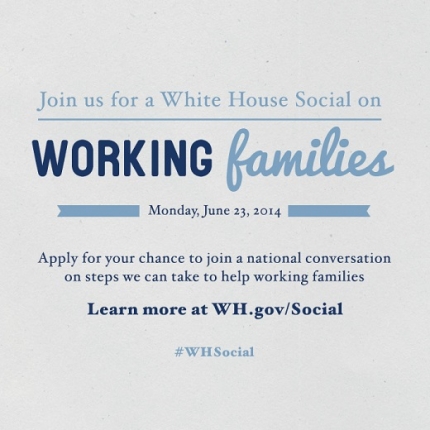
You're Invited: White House Summit on Working Families

We're excited to announce our next White House Social event -- an opportunity for our followers on Twitter and Instagram to attend the White House Summit on Working Families.

On Monday, June 23, 2014, this day-long event will feature remarks by the President, the First Lady, the Vice President, and Dr. Jill Biden, as they participate in a national conversation about how we can create 21st-century workplaces that work for all Americans.

Interested? Sign up for your chance to join other White House social media followers for the White House Summit on Working Families at WhiteHouse.gov/WH-Social-Working-Families. After you sign up, spread the word and tell your friends about the event by using the hashtag #WHSocial.

Working Families Summit Social Invite

Vice President Biden and President Santos Deliver Joint Statements to the Press

July 09, 2014 | 13:30 | Public Domain

In Bogota, Colombia, Vice President Biden and President Santos of Colombia, discuss the ever-growing partnership between United States and Colombia.

Download mp4 (1110MB)