The White House

Office of the Vice President

Background Press Briefing on Vice President Biden's Trip to Ukraine

Aboard Air Force Two
En Route Kyiv, Ukraine

2:00 P.M. (Local)

MR. SPECTOR:  Just a reminder at the top this is on background as a senior administration official.  He will give some brief remarks at the top and walk through the schedule, and then he’ll take a few questions afterwards.  And again, senior administration official on background.

SENIOR ADMINISTRATION OFFICIAL:  Thanks, everybody.  We’re about an hour and a half out of Kyiv, and I just wanted to lay out for you what the Vice President will be doing while he’s here, and then speak to some of the themes from the trip and then answer some of your questions.

When we arrive today, he’s got an opportunity to meet with our embassy team that has been pretty much working around the clock for the last few months, even long before February 21st; and then he will sit down with a CODEL led by Congressman Royce to have the chance to speak with them before they have their series of official meetings on Tuesday as well.  So he’ll get brought up to speed on developments on the ground today from our ambassador and our team, and then he’ll go into his meetings tomorrow.

He starts in the morning with a meeting with acting President Turchynov, and then he will do a meeting with Rada representatives from every corner of the country -- from the center, the west, the east, the south -- from multiple generations of Ukrainian politics; some familiar names and then some younger faces and voices.  And the key message of that meeting from him is one of national unity and a successful constitutional reform effort that takes into account the perspectives and aspirations of all Ukrainians. 

But in addition to sending that message, he’s also going to want to hear from them -- all of them -- about what they would like to see both in the immediate term, and then over the medium to long term.

He will then meet with Prime Minister Yatsenyuk where he’ll cover the full range of issues confronting Ukraine today.  And then he’ll finish with a meeting with a couple of dozen or more members of civil society from a variety of backgrounds who work on a variety of issues from democracy to anti-corruption, to youth issues, to cultural issues.  He’ll have an opportunity to address not just them but a broader segment of the Ukrainian public in public remarks there that will be open to the media before going behind closed doors to have conversations with the assembled group about the way they see things and what the United States can do to support them.

So that's the schedule.  In terms of what the Vice President is trying to accomplish, first and foremost, he wanted to come Kyiv to send a very clear message of the United States’ support for Ukraine’s democracy, unity, sovereignty and territorial integrity.  And he wanted to have the opportunity to speak to all Ukrainians from the center, from the west, from the east and from south.  He will call for urgent implementation of the agreement reached in Geneva last week, while also making clear as we have done for the last few days there will be mounting costs for Russia if they choose a destabilizing rather than constructive course in the days ahead.

He will speak to government leaders both the Prime Minister and the acting President, but also members of various factions in the Rada, as well as with civil society about how the United States can support constitutional reform, including the government’s decentralization proposals and how we can support their effort to bring about free and fair elections, international monitors supporting international standards on May 25th.  He will speak to officials about steps towards economic stabilization in Ukraine.  He’ll discuss forms of U.S. assistance, including the loan guarantee that was signed this past week, but also and especially the IMF agreement.  We hope that the final elements of that will come together imminently, and that the IMF board will be able to meet relatively soon to complete that process and begin dispersing the money.

He will speak about both the short- and long-term energy situation in Ukraine.  As he arrives, there will also be a team on the ground from the United States, a team of experts working on the reverse flow issue.  That team will be in Kyiv and then will travel also to Slovakia, Poland and Hungary to help address the issue of reversing the flow of natural gas to provide Ukraine with some measure of short-term supply of natural gas as they look to replenish their stores.

But also he’ll discuss with them medium- and long-term strategies to boost conventional gas production, and also to begin to take advantage of the unconventional gas reserves that are in Ukraine.

Then, of course, as you might anticipate from his meeting with civil society, he’s looking to lift up the voices of Ukraine civil society as they seek to ensure there isn’t a repeat of the past, that they look to a future with less corruption, less coercion, less division. 

And then finally let me just say I don't want to preempt him but he will be discussing various forms of assistance that the United States will be offering in some of these areas.  And we’ll have an opportunity to go through some of those forms of assistance and what’s behind them after he’s had the opportunity to consult with leaders there.  So I’ll look forward to coming back to briefing you in greater detail on that over the next 24 hours or so.

Q    Are you talking about --

SENIOR ADMINISTRATION OFFICIAL:  Yes.

Q    -- beyond economic assistance?

SENIOR ADMINISTRATION OFFICIAL:  Well, there’s a package of economic and energy and governance assistance that he’ll be discussing.  And we, as you saw, just recently announced a latest tranche of security assistance, nonlethal security assistance.  And he’ll have the opportunity to speak with the government about what more is needed and what more we could provide in the period ahead.

Q    So there’s a package that includes economic, energy and discussion of further security assistance.  Is that right?

SENIOR ADMINISTRATION OFFICIAL:  Well, the package I’m describing includes economic, energy and governance assistance.  On the question of security assistance, that's something we’ll be consulting with the Ukrainian leadership about.

Q    What kind of energy assistance can the U.S. provide broadly?

SENIOR ADMINISTRATION OFFICIAL:  We have a wide range of technical expertise and then forms of technical assistance in four areas.  The first is how to address this immediate reverse flow issue, and we already have a team on the ground to deal with that.  The second is technical assistance to help them be able to boost production in their conventional gas fields, where presently they aren’t getting the maximum of what they could be.  Third, technical assistance relating to a regulatory framework, and also the technology that would be required to extract unconventional gas resources; and Ukraine has meaningful reserves of unconventional gas according to the latest estimates.  And then finally various forms of technical assistance relating to energy efficiency, where experts have shown that the Ukraine could substantially lessen its energy dependence and deny any country the capacity to use energy as a political weapon through a combination of all those things, but in no small part through greater energy efficiency and use of its existing energy.

Q    The economic assistance, does that mean money?

SENIOR ADMINISTRATION OFFICIAL:  I think the biggest piece of business beyond the $1 billion loan guarantee and bringing to closure the IMF and helping also to shepherd the European money will be teams that we can put on the ground to help ensure that that money is allocated in an effective way.  Technical assistance teams from the Treasury Department and elsewhere.  And when I say effective, I mean in keeping with what the IMF and Ukraine have agreed, but also in keeping with everyone’s desire to ensure that all parts of Ukraine benefit from this assistance -- the east and the south, as well as the center and the west.

Q    The violence that broke out on Sunday, in the context of the international agreement, there seemed to be a lot of finger-pointing between Russian and Ukrainian officials about what happened.  Do you have a sense of who is to blame and whether -- how that might affect that agreement?

SENIOR ADMINISTRATION OFFICIAL:  The situation regarding the incident outside of Slavyansk is still very murky.  What the Ukrainian government says is that it was a provocation by the pro-Russian forces manning roadblocks there, and that they have no evidence that there was any either Ukrainian security service involvement or involvement by people coming from Kyiv or elsewhere.  We have nothing to suggest that there was either, but we don't have 100 percent of the facts on that, and part of the reason for that, of course, is that it has been difficult for monitors to travel in and around Slavyansk because the pro-Russian separatists there with Russia standing behind them have not permitted the type of international observation that should be permitted.  And we think that the best way to ensure that those kinds of incidents don't happen again would be for the Russian government to follow through on its commitment to use every influence it has to get these pro-Russian separatists to lay down their arms, to de-occupy buildings, to take down roadblocks and to allow the political process to run its course.

Q    You’ve talked about cohesion, that that's part of the Vice President’s message through all of this.  You guys haven’t really talked to that up till now.  And so can you talk about what the thinking is behind that, and why he’s going to be going with that message at this particular time?  And kind of what the expectations are in terms of getting different factions on board? Is he planning on having some kind of specific takeaway?  Or is it more of a general discussion?

SENIOR ADMINISTRATION OFFICIAL:  Let me start by staying obviously Ukraine’s future -- its political decisions, its economic decisions -- are up to Ukrainians.  And the United States wants to support its free choices in that regard, not to try to dictate any outcomes.

But his focus on unity comes from sort of three bases.  The first is that the Ukrainian government itself has placed an increasingly high premium on pressing for a sense of national unity and has conducted increasingly vigorous outreach to the east and the south, including just this past Friday, when Prime Minister Yatsenyuk spoke about decentralization proposals, spoke about cultural and linguistic traditions.  And the Vice President wants to support that.

Second, there are currently ongoing threats to Ukraine’s sovereignty and territorial integrity.  And the most effective response for Ukraine to that is for the whole country to pull together to push back on those threats and to say we want to take our country forward in a way free from violence, and at the ballot box rather than with arms.

And then third, Ukraine faces substantial urgent challenges right now on a number of different levels.  And only if every aspect of the country gets united behind a game plan to tackle those challenges will they be able to make progress.  That's true with respect to stabilizing the situation on the ground.  It’s true with respect to following through on constitutional reform and elections.  It’s true with stabilizing a very fragile economy.  And it’s true with dealing with an energy situation that remains precarious.  So for all of those reasons, the Vice President feels that the United States’ support for efforts to pull the country together are especially important at this time.

Q    We’re not going to hear at all from him today, right?  The Vice President.

SENIOR ADMINISTRATION OFFICIAL:  You’re not going to hear from him today.  You’ll hear from him multiple times tomorrow.

Q    Did the President task him with a specific message?  Or can you talk at all about kind of what President Obama said -- told the Vice President before he left and kind of whether he’s carrying a message from him, or what his goals are in that sense?

SENIOR ADMINISTRATION OFFICIAL:  Most of what I’ve laid out here is the product of conversations between the President and the Vice President in the run-up to the trip in terms of the issues we’re emphasizing and what we’re trying to accomplish.  I don't want to get into their private conversations, but he will speak directly with the Prime Minister about the President’s perspective on this, and also about the President’s commitment to support the government and to support the broader effort at following through on these various lines of effort.

In terms of what this government has been doing or attempting to do on the economy, on the elections, on constitutional reform, on all the areas that we’ve been discussing, it’s been a very encouraging set of steps that they’ve been trying to take in the face of pretty enormous challenges.  And I think the President and the Vice President want to make sure that the Prime Minister understands that the United States wants to find every way that it can to support those efforts.

Q    -- been vigorous outreach from the Ukrainian government to the south and the east.  Can you give a few examples of the kind of outreach that you think has been very effective and other steps that the U.S. would like to continue to see progress on?

SENIOR ADMINISTRATION OFFICIAL:  I think I said increasingly vigorous, and that's important because it’s been building over time.  And we want to continue to encourage that.  Obviously, the leadership in Kyiv has a lot to deal with, but this is as much at the top of the list as anything else.  And what I mean is both private conversations among leaders in Kyiv and those representing political interests in the south and the east.  I mean officials who have been appointed by this interim government who are out in the oblasts in the east trying to speak with people across the political spectrum there to figure out how we can design -- how they can design a decentralization process that really works.  I mean the Prime Minister himself addressing directly the concerns of some of the citizens in the east and south, including his comment -- or his pledge regarding the Russian language.

I’m referring also to the work of the constitutional commission, which is a balanced group that reflects significant representation from the south and the east, and is focused on these questions of decentralization and empowering local communities.

So at a variety of different levels you’re seeing more robust interchange within Ukraine, and that's all to the good.  We believe that that has to be sustained and deepened in the days ahead.

Q    We talked a little bit about some of the increase in violence that has been seen in Ukraine in the recent days.  This past weekend, the Ukrainian Prime Minister said that really the only person responsible for containing that is Putin.  Do you expect that we should hear some sort of direct message to President Putin from Vice President Biden during this trip, any sort of direct message -- either from the President or just from the administration in general?

SENIOR ADMINISTRATION OFFICIAL:  Well, first of all, President Obama spoke with President Putin last week and was able to deliver the message in the most direct fashion possible -- person-to-person.  And what he told President Putin is the same thing that we’ve been saying publicly which is that really Russia has a choice to make here.  They can contribute to a de-escalation process as a responsible actor, which they have not been -- and going back to their illegal annexation/occupation of Crimea, have proven to be just the opposite of that; or they are going to face increasing costs.  And that's something that the President has been very clear about; the Vice President will continue to be clear about.  And we’ll continue to consult with our European partners about.

Q    Does the administration have any sort of updated timeline on that as to when you say these dire consequences, when we would see that?

SENIOR ADMINISTRATION OFFICIAL:  Well, I didn't say what you just said.  But in terms of the timeframe, Geneva was decided Thursday.  The OSCE has been working over the weekend.  We haven’t seen the kind of progress that, of course, we would like.  We’d like to see every building vacated as soon as possible.  And we’ve seen certain activities that have been discouraging like the shooting at the roadblock outside of Slavyansk.  But I’m not going to put a precise timetable on it.  I will just say that this is not going to be an open-ended process.  This is going to be a situation where we take stock and determine in the relatively near term what our next step should be.

Q    What does that mean?  Because you guys were indicating as recently as Friday that it would be days.  So when you say --

SENIOR ADMINISTRATION OFFICIAL:  Nothing has changed since Friday. 

Q    Okay, so days would mean by the end of this week, right?

SENIOR ADMINISTRATION OFFICIAL:  Like I said, I’m not going to put a precise timeframe on it, only to say that we’re heading into Monday here.  And what we said on Friday was that we would be looking at this in the coming days to determine whether there was progress or whether there wasn’t.  And that still stands.

Q    Could you just say how this trip came about?  Obviously the Vice President has a long history of diplomatic relations with Ukraine.  Was this something that was his initiative?  Did the President ask him to go because of those relationships?  Or how did that come?

SENIOR ADMINISTRATION OFFICIAL:  The reason I’m pausing here is it’s one of those -- it’s one of those conversations where it’s a little hard to say whether the President asked him or he said I want to go.  It grew out of a conversation that the two of them had, and both of them agreed that it was important for the U.S. to send a high-level signal of support for all of the lines of effort that this government is undertaking.

Obviously, the most pressing and acute right now is the security situation.  But these other lines of effort are also existential for Ukraine.  Its politics, its economics and its energy also matter acutely, and so they felt it was important to have somebody with deep ties to and a deep passion for the U.S.-Ukraine relationship to come and send that message both privately and publicly.  And there’s no better messenger for that than the Vice President.  So that's what brings us here, and we’ll make sure that over the next 24 hours we keep you guys up to date in terms of how those conversations are going and how a very fast moving situation is unfolding on the ground.

Obviously as we’ve been flying things have been happening in Ukraine.  It’s early afternoon now.  So we’ll make sure that we stay in touch here over the next 24-36 hours.

Q    What’s been happening -- is there anything significant that’s happened while we’ve been in the air?  I’m just sort of curious.

SENIOR ADMINISTRATION OFFICIAL:  Nothing that I would come back here to announce.

Thanks, guys.

Q    Thank you very much.

END
2:23 P.M. (Local)

Weekly Wrap Up: A Moment of Silence for Boston, and More

This week, the President observed a moment of silence and announced that 8 million Americans have now signed up for private health insurance through the Marketplace; the Vice President joined the President to cheer on the Soldier Ride, and signed up for Instagram and took his first selfie; and more. Check out what else you may have missed in this week's wrap up.


A Moment of Silence for Boston

On Tuesday, the President, along with some of his senior advisers, observed a moment of silence to mark the one-year anniversary of the Boston Marathon bombing.

Related Topics: Arizona, Florida, Michigan, Texas

The White House

Office of the Vice President

Readout of the Vice President’s Call with Prime Minister Robert Fico of Slovakia

Vice President Biden spoke today with Slovakian Prime Minister Robert Fico.  The Vice President and Prime Minister discussed the situation in eastern Ukraine.  The Vice President underscored the United States’ support for a diplomatic resolution to the crisis in Ukraine, contingent on Russia’s disavowal and cessation of destabilizing actions within Ukraine.  The two leaders agreed that if Russia further escalated the situation in Ukraine, it would face mounting consequences for its actions.   The Vice President thanked the Prime Minister for Slovakia’s commitment to bolstering energy security within Europe, including by supporting the reverse flow of natural gas to Ukraine.

West Wing Week: 4/18/14 or, “Pull Together, Fight Back, and Win”

This week, the President nominated Sylvia Burwell as Secretary of Health and Human Services, hosted an Easter Prayer Breakfast and a Passover Seder, discussed immigration reform with Faith leaders, welcomed the Wounded Warrior Soldier Ride, announced a major milestone in the continued implementation of the Affordable Care Act, and hit the road to New York City and Oakdale, Pennsylvania.

The White House

Office of the Press Secretary

Readout of the Vice President’s Call with President Rosen Plevneliev of Bulgaria

Vice President Biden spoke today with Bulgarian President Rosen Plevneliev. The Vice President assured President Plevneliev of the United States’ ironclad commitment to the collective defense of its NATO Allies and thanked him for Bulgaria’s contributions to the Euro-Atlantic partnership. The two leaders discussed the alarming situation in eastern Ukraine, and pledged their full support for Ukraine’s development as an independent, unitary, and democratic state. The Vice President and President Plevneliev stressed that Russia needs to take immediate, concrete actions to de-escalate the situation in eastern Ukraine. The leaders also discussed the importance of efforts to combat corruption, promote democratic accountability, and support independent media in Bulgaria and throughout Europe. 

Wounded Warriors Ride for Recovery

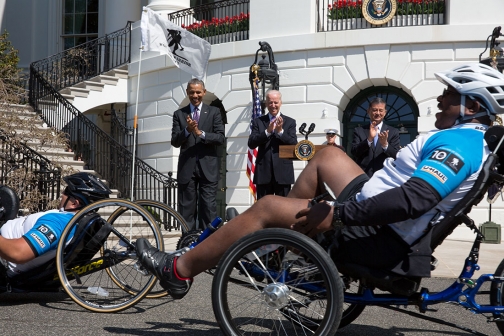
President Barack Obama, Vice President Joe Biden and Veterans Affairs Secretary Eric K. Shinseki welcome the Wounded Warrior Project's Soldier Ride to the South Lawn of the White House in celebration of the seventh annual Soldier Ride, April 17, 2014.

President Barack Obama, Vice President Joe Biden, and Veterans Affairs Secretary Eric K. Shinseki welcome the Wounded Warrior Project's Soldier Ride to the South Lawn of the White House in celebration of the seventh annual Soldier Ride, April 17, 2014. (Official White House Photo by Pete Souza)

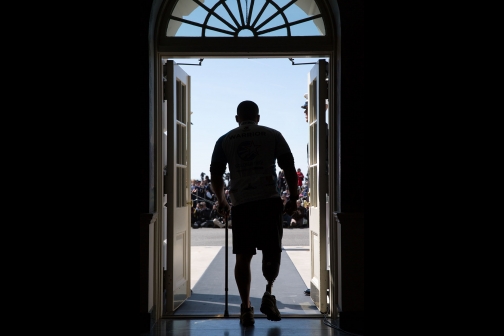
  • A Wounded Warrior Walks Out Of The Diplomatic Reception Room

    A Wounded Warrior exits the Diplomatic Reception Room of the White House to participate in the Soldier Ride, April 17, 2014. (WH Photo by Pete Souza)

    1 of 6
  • President Obama Uses Starts The Wounded Warrior Soldier Ride

    President Obama, with Vice President Biden, uses an air horn to start the seventh annual Soldier Ride, April 17, 2014. (WH Photo by Chuck Kennedy)

    2 of 6
  • President Obama Cheers On Participants

    President Obama, Vice President Biden, and Secretary Shinseki cheer on participants in the Soldier Ride, April 17, 2014. (WH Photo by Chuck Kennedy)

    3 of 6
  • Soldier Ride Participants Circle The South Lawn

    Participants in the seventh annual Soldier Ride make their way around the South Lawn of the White House, April 17, 2014. (WH Photo by Amanda Lucidon)

    4 of 6
  • President Obama Welcomes Wounded Warrior Project's Soldier Ride Participants

    President Obama, Vice President Biden, and Secretary Shinseki welcome the Soldier Ride to the White House, April 17, 2014. (WH Photo by Pete Souza)

    5 of 6
  • President Obama Visits With The Audience

    President Obama visits with the crowd following the Soldier Ride on the South Lawn of the White House, April 17, 2014. (WH Photo by Pete Souza)

    6 of 6


Ed. note: This is cross-posted on The White House Blog. See the original post here.

This morning, on the South Lawn of the White House, President Obama, Vice President Biden, and Secretary Shinseki welcomed riders participating in the Wounded Warrior Project’s Soldier Ride.

Today was the fifth time President Obama has welcomed Soldier Ride to the White House. The ride begins in Washington, D.C. and ends in Friendship, Maryland, spanning a total of 58 miles. 

Wounded Warriors Ride for Recovery

President Barack Obama, Vice President Joe Biden and Veterans Affairs Secretary Eric K. Shinseki welcome the Wounded Warrior Project's Soldier Ride to the South Lawn of the White House in celebration of the seventh annual Soldier Ride, April 17, 2014.

President Barack Obama, Vice President Joe Biden, and Veterans Affairs Secretary Eric K. Shinseki welcome the Wounded Warrior Project's Soldier Ride to the South Lawn of the White House in celebration of the seventh annual Soldier Ride, April 17, 2014. (Official White House Photo by Pete Souza)

  • A Wounded Warrior Walks Out Of The Diplomatic Reception Room

    A Wounded Warrior exits the Diplomatic Reception Room of the White House to participate in the Soldier Ride, April 17, 2014. (WH Photo by Pete Souza)

    1 of 6
  • President Obama Uses Starts The Wounded Warrior Soldier Ride

    President Obama, with Vice President Biden, uses an air horn to start the seventh annual Soldier Ride, April 17, 2014. (WH Photo by Chuck Kennedy)

    2 of 6
  • President Obama Cheers On Participants

    President Obama, Vice President Biden, and Secretary Shinseki cheer on participants in the Soldier Ride, April 17, 2014. (WH Photo by Chuck Kennedy)

    3 of 6
  • Soldier Ride Participants Circle The South Lawn

    Participants in the seventh annual Soldier Ride make their way around the South Lawn of the White House, April 17, 2014. (WH Photo by Amanda Lucidon)

    4 of 6
  • President Obama Welcomes Wounded Warrior Project's Soldier Ride Participants

    President Obama, Vice President Biden, and Secretary Shinseki welcome the Soldier Ride to the White House, April 17, 2014. (WH Photo by Pete Souza)

    5 of 6
  • President Obama Visits With The Audience

    President Obama visits with the crowd following the Soldier Ride on the South Lawn of the White House, April 17, 2014. (WH Photo by Pete Souza)

    6 of 6


This morning, on the South Lawn of the White House, President Obama, Vice President Biden, and Secretary Shinseki welcomed riders participating in the Wounded Warrior Project’s Soldier Ride.

Today was the fifth time President Obama has welcomed Soldier Ride to the White House. The ride begins in Washington, D.C. and ends in Friendship, Maryland, spanning a total of 58 miles. 

Rory Brosius is the Deputy Director of Joining Forces.
Related Topics: Veterans, Maryland

The White House

Office of the Press Secretary

Remarks by the President Welcoming the Wounded Warrior Project's Soldier Ride

South Lawn

11:06 A.M. EDT

THE PRESIDENT:  Hello, everybody!  (Applause.)  Welcome to the White House.  Thank you to Ric for not just a nice introduction, but more importantly, for your outstanding service to our country and for your service to our veterans and fellow wounded warriors.

Now, I also want to mention that our Vice President here has been relentless in his support, along with our spouses, Michelle and Jill Biden, for military families.  And we’re very proud of everything that Joe has done. 

This is now the fifth time that I’ve had the honor of welcoming the Soldier Ride to the White House.  And I have to tell you, this is one of my favorite events of the year.  First of all, you know it’s spring when -- or at least it’s supposed to be spring -- (laughter) -- when the Soldier Ride comes around.  But mainly, it’s because those who participate are such an incredible inspiration to me and to our country.

To all the riders, you look outstanding, especially after biking 17 miles yesterday.  You’re doing another 17 miles tomorrow, another 17 miles after that -- all told, nearly 60 miles.  Today we wanted to come cheer you on.  And I think we’ve got some folks from the Army here, is that right?  (Hooah!)  And the Navy.  (Hooyah!)  Air Force.  (Applause.)  Marines.  (Oorah!)  Oh, that was good.  (Laughter.)  Coast Guard.  (Applause.)  And we’ve got some extraordinary families here today.  (Applause.)  Yay, families. 

By now, everybody knows the story about how this got started.  You had a bartender on Long Island, Chris Carney, who came up with the idea of riding his bike across America to support wounded warriors.  Chris couldn’t be here today.  He owns a gym now; I think you all inspired him to trade the bar in for some barbells.  But today there are Soldier Rides all across the country, and we want to thank everybody at the Wounded Warriors Project for their incredible support.

I know some of you are doing this for the very first time; some of you have ridden three or four times.  Some of you are riding in tandem with your parents.  Biking nearly 60 miles in three days would be a challenge for anybody, but for all of you this is a lot more than a bike ride -- this is a mark of how far you’ve come. 

Many of you are recovering from devastating injuries.  Some of you have had to learn the basics all over again -- how to stand again, how to walk again, how to run again.  And now you’re here today because that’s what Soldier Ride is all about -- seeing each other through the finish line.

Lieutenant Commander John Jae Terry is here.  Three years ago, he was on foot patrol in Afghanistan when he was hit by an IED, ended up losing his leg.  But reflecting on his service, he said he would do it all again.  Now, he’s got a new goal -- get in the best shape possible so he can play with his three kids.  And so today he’s here on his first Soldier Ride.

You’ve got Master Sergeant Louis Alfonso Ramirez.  Serving in Afghanistan, he lost good friends in a terrible ambush.  He even assisted at the airport as they began their dignified transfer home.  Later diagnosed with post-traumatic stress, credits the Wounded Warriors Project with helping him heal.  He says, “You know that they got you.”  This is now his fourth ride.

Sergeant Major Sedrick Banks is here.  An explosion in Iraq left him with injuries to his neck and his back, and traumatic brain injury.  But after years of rehab, Cedric is focused on the future.  He volunteers here in Washington, helps mentor young men with the life skills they need to succeed.  He calls himself now a “warrior for society.”  This is his first Soldier Ride.

Major Jeanette Nieves-Ayala is here.  And I first met Jeanette a few years ago at Walter Reed, where she was recovering from an injury received in Iraq.  As some of you know, when I visit with our troops I often hand out coins marked with the Seal of the President.  Jeanette shook my hand and she said, Mr. President, all these men think your coin is the best; I don’t.  I made a bet with them that there was a coin that could trump yours.  I said, what are you talking about?  She said, I want the First Lady’s coin.  (Laughter.)  The First Lady’s coin would beat yours.

Now, it is true that the First Lady trumps me.  But Jeanette says her proudest accomplishment is being a peer mentor to other wounded warriors.  She says that during her recovery, “I was definitely being carried.  Now I feel like I am helping to carry others.”  So I want to thank you, Jeanette. 

This ride is first and foremost for these incredible riders.  But it’s men and women like John and Louis and Cedric and Jeanette and all of you who make the ride so special for all of us, because you inspire us.  You inspire the country, some of whom will be out cheering along your ride.  You inspire me with your courage, your resolve, your resilience, your tenacity, your optimism.  It makes me proud to be your Commander-in-Chief.  And Michelle and I treasure every moment that we get to spend with you and your families. 

Every day I have the honor of serving as this country’s Commander-in-Chief.  And as long as I have that honor, I will keep fighting to make sure you and your families get the care and treatment and benefits that you have earned and deserve.  When people ask of you to serve your country, to give your all to make your sacrifices, you’ve raised your hands.  You’ve stepped up.  You’ve held up your end of the bargain.  And it’s especially now, as we’re winding down the war in Afghanistan, after having ended over a decade of war, that we are standing up for you.  Our obligations to our veterans endure for your entire lives.  That’s our mission.  That’s why we’re here not just during this ride, but all year long.

So with that, the sun is out.  It’s a spectacular day.  The racers look like they’re ready.  I think it’s time for us to get this party started. 

God bless you.  God bless America.  Let’s get this going.  (Applause.)

END
11:13 A.M. EDT

Reforming America's Job-Driven Training Programs

Watch on YouTube

In this year's State of the Union address, President Obama announced that Vice President Biden would lead a reform of America's job training programs, making sure that these programs "train Americans with the skills employers need, and match them to good jobs that need to be filled right now."

This afternoon, the President and Vice President visited the Community College of Allegheny County in Oakdale, Pennsylvania to announce progress on that reform.

Related Topics: Jobs, Skills, Pennsylvania

The White House

Office of the Press Secretary

Remarks by the President and the Vice President on Skills Training

Community College of Allegheny County
West Hills Center Campus
Oakdale, Pennsylvania

4:05 P.M. EDT

THE VICE PRESIDENT:  Hi, everybody.  Good to be back in Pennsylvania.  That other guy is coming.  (Laughter.)  He’s coming.  He’s coming.

Good to be with you and the President.  And, you know, America -- what a lot of people -- you go around, you hear people talking down the economy.  America is better positioned than any country in the world to lead the world in the 21st century.  The rest of the country -- the rest of the world doesn't have, as they used to say up in Scranton, in my neighborhood, not a patch on our jeans, I tell you.

And when you ask companies why they're coming back -- and remember the President and I have been saying for the last five years American companies are coming back, coming back.  There’s an outfit up in Boston that surveys every year American manufacturing companies in China, and they say, what are your plans.  This year 53 percent of the American companies in Japan  -- I mean in China said they're either planning on coming back to the United States and set up manufacturing, or they're thinking about it -- investing, hiring here at home.

And that's because -- it’s all because of you.  America has the best-qualified workers in the world.  Leo Gerard, he and I have been friends for a long time, and we got tired of hearing all this stuff about how American workers weren’t as productive. Independent studies show American workers are three times as productive as workers in China.  We want China to do well.  We have the best workers in the world.  We have the most innovative ideas in the world. 

You’ve heard for a long time how throughout the world, and particularly in the Far East, they’ve educated X as many engineers as we have, three times, four times -- but guess what. There’s no products with their names on it.  And they're coming home.  I’m serious.  So I’ve kind of had it up to hearing about American workers and American manufacturing.  I’ve been sort of the -- for the last 10 years, as Senator Casey can tell you, I’ve been talking about there’s not a reason in the world why we can't be the manufacturing capital of the world.  None.  Zero.  None.  (Applause.)

And look, we not only have the most creative workers, we have the best laws and protections.  Your intellectual property gets protected here.  You have a court system.  If there’s a disagreement, it’s adjudicated -- adjudicated fairly.  And now there’s an energy boom.  You all know about the Marcellus Shale  -- I think you heard of that, right?  (Applause.)  There’s an energy boom that's changed the paradigm of manufacturing.  It’s cheaper to manufacture in the United States than it is in Europe and/or in Asia.

But the economy is at a crossroads.  Our economy is at a crossroads.  It's not like other periods in our history.  We face tremendous, tremendous opportunities.  But we face challenges, as the President will speak to briefly, as a consequence of that god-awful, lingering recession that just brought us that close to a Depression.  Our workers, though, are up to the task.

But the companies, the education system, every level of government, we need to rethink how we’re helping move folks into these new opportunities.  It’s a different skill set that's going to be required, required now and over -- six out of 10 jobs in the next 10 years are going to require some certificate or degree beyond high school.  That's why the President and I are here today.

The point is real simple:  The backbone of this country is a strong and thriving middle class.  That's not hyperbole.  That's not because I’m a Scranton kid or everybody trying to make me Middle-Class Joe.  It’s true.  It’s been the backbone of America, the distinguishing feature of our economy over the last 150 years.  And we’re here to show how we can help more people find a path to good-paying jobs -- middle-class jobs in high-growth industries from information technology, energy, advanced manufacturing, health care.  It’s not just in manufacturing.

And let me define what I mean by middle class.  Our economists in the administration will argue whether it’s $51,450 or $52,500.  Middle class is an idea.  Middle class is an ideal. What’s it’s about is being able to own your home and not rent it. It’s about being able to send your kid to a park you know they're going to be safe and come home safely.  It’s about being able to send them to a local public school and know if they do well, they can qualify for school after high school.  (Applause.)  And it’s about being able to take care of your parents and hope to God you can plan enough so your kids will never have to take care of you. That's what it has always been about in Pennsylvania.  (Applause.)

But the fact of the matter is so many people over the last two decades have fallen out of the middle class.  You know a lot of them.  You know a lot of people you grew up with, a lot of people you live with.  And so many more generations need to find a path to the middle class.  And that's what the President and I are committed to -- spending the rest of our time in office making sure that the aperture to the middle class is open, is wider, and there’s real, decent, good-paying jobs.

Now, I’m proud to introduce a buddy of mine.  That's not how you usually talk about the President, is it?  (Laughter.)  But he is.  He’s my good friend, but he’s also my President, and I’m proud to serve with him.

And this is a guy who wakes up every morning -- this is not -- I spend a lot of hours a day with the President.  Every single waking hour with him is about how can we make life -- this is real -- better for hardworking Americans -- hardworking Americans who are ready to do whatever it takes to provide for themselves and their families? 

Ladies and gentlemen, let me introduce the President of the United States, Barack Obama.  (Applause.)

THE PRESIDENT:  Hello, everybody!

AUDIENCE:  Hello!

THE PRESIDENT:  Hello, Allegheny County!  (Applause.)  Joe and I decided it was time for a guys’ trip.  (Laughter.)  Actually, Michelle and Jill wanted us out the house.  (Laughter.) So we decided to take a little road trip.  And we are thrilled to be back here with a lot of good friends and folks who are doing terrific work every single day. 

We brought with us some people who are doing some important work, trying to make sure that we're building on the kind of success that we're seeing here -- first of all, Commerce Secretary Penny Pritzker is here.  Give Penny a big round of applause.  (Applause.)  We've got a great friend and an outstanding Senator -- Bob Casey in the house.  (Applause.)   Congressman Mike Doyle is here.  (Applause.)  One of the biggest Steelers fans we've got.  (Laughter.)  We've got County Executive Rich Fitzgerald here in the house.  (Applause.)  Outstanding Mayor of Pittsburgh, Bill Peduto is here.  (Applause.)  And your college president, Quintin Bullock is here.  (Applause.)

And of course, all of you are here.  (Applause.)  Yeah!  Yeah!  (Laughter.)  Now, we're here because CCAC is an outstanding model of the kind of job-driven training we’re trying to encourage all across the country.  And Joe and I just spent some time checking out the machines and motors that are being used here to train folks in mechatronics.  Now, I have to say that before I came here I didn’t know there was such a thing as mechatronics.  (Laughter.)  Sounds like something that Godzilla would be fighting.  (Laughter.)  It turns out it has to do with engineering, how stuff works.  And we saw firsthand everything that you are doing to train more workers for new jobs and better jobs -- jobs companies need to keep growing. 

And what we want to do is we want to replicate your model across the country.  You're doing something right that is making a difference in people’s lives -- (applause) -- and we want to spread the word.  (Applause.)  So that's why we're here today in Allegheny County, because I’m taking some new action to expand this kind of job-driven training to all 50 states.

And Joe talked a little bit about why we have to do this -- because in today’s economy, it's never been more important to make sure that our folks are trained for the jobs that are there -- and for the jobs of the future.

Now, we’ve spent the past five and a half years fighting back from the worst economic crisis in our lifetimes.  The good news is our economy is growing again, our businesses are creating jobs.  We've created nearly 9 million jobs over the past four years.  We’ve cut our deficits by more than half.  Our manufacturing sector that used to be losing jobs, just hemorrhaging jobs, is now adding jobs for the first time since the 1990s.  (Applause.)  The first time since the 1990s.  High school dropout rates are going down.  College attendance rates and graduation rates are going up.  Our troops are coming home.  (Applause.)  We’re seeing an energy boom all across the country. And more than 7.5 million people have been able to sign up for health care, many for the very first time, through the Affordable Care Act.  (Applause.)  And 7.5 million people, by the way, is about the number that it would take to fill up Heinz Field 115 times.

So there are a lot of good trends that are taking place.  And a lot of that has to do with the great work that our outstanding Vice President is doing.  (Applause.)  It has to do with the great work that folks like Mike and Bob and Rich are doing, and your outstanding Mayor in Pittsburgh and all he’s doing to help transform the economy there. 

But here’s the challenge -- and a lot of folks here know it. A lot of people don’t feel that progress in their own lives yet. So the stock market is doing great.  Corporate profits are soaring.  Folks at the very, very top are doing better than ever. But too many Americans, if they’re lucky enough to have a job, are working harder and harder just to get by, much less to get ahead.  For too many middle-class Americans, it feels as if the same trends that have been going on for decades are continuing.  You’re working hard, but wages flat-line, incomes flat-line, cost of everything else going up.   

So we’ve got to reverse those trends.  We’ve got to make sure that we have an economy that’s not just growing from the top down -- because it doesn’t really grow when it’s just from the top down.  We’ve got to have an economy where it grows from the middle class out, and from the bottom up, and everybody has a chance.  (Applause.) 

That’s the idea of America -- if you work hard, you can get ahead.  That’s the promise at the heart of this country.  If you’re responsible, you’re willing to put in some sweat, you can get ahead.  You may not be fabulously wealthy, but you can support a family; you can buy a home; make sure your kids are doing good and they can go to college; have something left over for retirement; have health care you can count on; maybe take a vacation once in a while -- (laughter) -- just the basics and knowing that you’re part of a community that is growing for everybody, not just some. 

Restoring that idea is the defining issue of our time.  And so the truth is -- Joe and I, we were talking about this the other day -- we sometimes sound like a broken record because we’ve been talking about this for six, seven, eight years, ever since we’ve been in public office.  But it’s more urgent than ever now that we move forward.  And we know what to do. 

We’re pushing a four-part opportunity agenda.  And the first part is more good jobs paying good wages -- manufacturing jobs, construction jobs, jobs in energy, jobs in innovation, jobs in infrastructure, rebuilding our roads and our bridges -- putting people back to work.  There’s a lot more we could be doing. 

Number two, we’ve got to train more Americans with the skills to fill the jobs that are there, just like you do here at CCAC.  Number three, we’ve got to guarantee every young American a world-class education.  And number four, when people do have a job, we’ve got to make sure that job pays a decent wage and that you have savings you can retire on and health care you can count on.  (Applause.) 

These are the things we’ve got to be doing.  You know it; I know it.  That’s what would put our unemployment rate down faster.  It would pull our wages up faster.  It’s what we could do to create more jobs and economic security for a lot of families that have been reaching for it for years.  And every single person you send to Washington should be focused on that issue.  That’s what America needs right now.  

Today, the reason we came here is to focus on that second part of that agenda -- training Americans with the skills that they need for the good jobs that are going to be here today and tomorrow. 

Around here, you know better than most how in recent decades the economy hasn’t always worked for middle-class families.  You saw outsourcing.  There was a time when finding a good job in manufacturing wasn’t all that hard.  If you were willing to work, you could go to the local factory, maybe the factory your dad was working in, and say, I’m ready to go, and they’d sign you up. 

And over time, the economy changed, part of it because of globalization, some of it because of new technologies.  And you’ve seen, sometimes painfully, where technology shutters factories and ships jobs overseas, and even makes some jobs obsolete.

But you know what, we’re not going to reverse all those trends.  We can’t stop technology.  And you’ve got a global economy now where we’ve got to compete.  We live in a 21st century global economy.  Jobs know no borders, and companies are able to seek out the best-educated, most highly-skilled workers wherever they live.  And that’s where the good jobs and the good pay and the good benefits is going to be. 

Other countries know this.  Countries like Germany, China, India -- they’re working every day to out-educate our kids so they can out-compete our businesses.  And each year, frankly, it shows that they’re making more progress than we are.  We’re still ahead, we’ve still got the best cards, but they’re making some good decisions.  We’ve got to make those same decisions. 

And when it comes to training our workers, not all of today’s good jobs require a four-year college degree, but I promise you, there’s not a job out there that’s going to pay a lot if you don’t have some sort of specialized training.  So our best bet is keeping ahead in the skills race. 

And you see what happens when we put effort into making sure workers have new skills -- the education that’s required for this 21st century economy.  At a time when traditional manufacturing is back on the rise, Pittsburgh is seeing new factories manufacturing new technologies across the board.  And I know you’re County Executive and your Mayor and steel workers --everybody is -- we’re focused on bringing jobs back.  And the good news is they’re coming back.  The problem is we’re having trouble filling some of those jobs. 

I mean, there’s been great progress in this area.  You’ve earned a great nickname -- “Roboburgh” -- because you’ve got high-tech plants and workplaces that are adding jobs faster than workers can fill them.  That’s a good problem to have.  But we’ve got a lot of Americans who are still looking for work or underemployed and not getting paid enough.  That's where what you do here is making a difference.

America has got a choice to make.  We can do nothing -- which is the strategy that some folks in Washington seem to have -- or we can do what we’ve always done best:  We pull together; we fight back; and we win.  (Applause.)  That's what we do best.

So earlier this year, I asked Joe to work with Penny Pritzker and Tom Perez, our Labor Secretary, to lead an across-the-board reform of all of our federal training programs to make sure they’ve got one clear mission:  Train Americans with the skills employers need.  Not something that looks good on paper, but doesn't give you a job; find out what are the jobs that need to be filled and make sure folks are being trained and matched to those good jobs. 

We’ve got to move away from what our Labor Secretary, Tom Perez, calls a “train and pray” approach.  We train them and we pray that they can get a job.  (Laughter.)  Because the problem there is students, when they go to a community college, they go to a four-year university, they're taking out debt.  They're straining their budgets.  We got to make sure that it pays off for them.  So we need to take a job-driven approach.  And that's what you’ve done here in Allegheny County.  That's what you’re doing here.  (Applause.)

So we’re rewarding high schools that redesign their curriculums to help students gain ready-to-work skills even earlier because there’s no reason why you got to wait for college.  Our high schools could be providing more relevant education and making kids more job-ready.  (Applause.)

We are supporting partnerships between employers and local governments and nonprofits to help unemployed workers who’ve been sidelined for too long, help them get the skills that they need, help to connect them to the jobs that require those skills.  We’re working with a bipartisan coalition of governors and mayors across the country to make job training partnerships a reality for more Americans.

But we could be doing a lot more.  And I’ve asked Congress to invest in serious programs that connect ready-to-work Americans with ready-to-be-filled jobs.  (Applause.)   And in fairness, Mike Doyle, he’s supportive of that and Bob Casey is supportive of it.  But, unfortunately, there are some other folks in Washington that haven’t acted yet.  They haven’t been getting the job done so far.  And Americans can't afford to wait.

So today, I’m taking two significant actions that don’t require Congress -- (applause) -- that don't require Congress.  First, we’ve asked more community colleges to do what you’ve done here at Allegheny, and that is to figure out what skills local employers are looking for, and then partner with them to help design the curriculums and to prepare the students for those jobs.  We want a seamless progression from community college programs to industry-recognized credentials and credit towards a college degree.

And today I’m announcing that we’re going to award nearly $500 million to those institutions who are doing it best in all 50 states -- using existing money to create opportunity for hardworking folks like you.  (Applause.)  That's good.

Second -- and this is related -- we’re launching a $100 million competition for what we’re calling American Apprenticeship Grants.  Now, these are awards that are going to expand the kinds of apprenticeships that help young people and experienced workers get on a path towards advancement, towards better jobs, better pay, a trajectory upwards in their careers.

And apprenticeships are a way to link more Americans to jobs in some of our in-demand fields, like IT and health care.  They let you earn while you learn.  And sometimes it makes -- it’s possible for them to also create college credits on the job, even as you’re pursuing a degree or a better job.

Right now, nearly nine out of 10 apprentices -- folks who are in apprenticeships, they get hired when they’re finished -- which makes sense, right?  You get an apprenticeship; you’re there, you’re learning on the job.  People see that you’re serious about working.  So nine out of 10 folks, once they get an apprenticeship, they get hired.  And by the way, they make an average of $50,000.  

So we’re streamlining efforts by the Department of Veterans Affairs and the Department of Labor to help veterans access their GI Bill benefits for apprenticeships.  Businesses, unions, community colleges, nonprofits -- we’re getting them to work with us as well.  The UAW is joining with the Big Three and John Deere and others to add nearly 2,000 apprentices.  Some of the biggest manufacturers are partnering with community colleges in North Carolina and Texas and California on high-skill training programs. 

And now we want to work with national industry associations to help partnerships like these take root all across the country -- so that anybody, in any city, any state, can earn the training they need to get the good jobs of tomorrow.  So the bottom line is if you’re willing to put in the work to get a job or earn a promotion in today’s economy, America’s job-training system should give you every possible chance. 

And you’re doing it here.  When we took that tour, we saw young people and some not-so-young people -- I won’t say who.  I don't want to offend.  (Laughter.)  But these are folks who -- many of them were in a job right now, but they saw that it was a dead-end and they wanted to make sure that they could get a better job.  Some of them were just getting started.  But either way, their investment and their effort was being rewarded.

One person we met is a gentleman named Tim Wright.  He was showing us some of the computer systems that folks are working on.  Now, Tim worked as a shift laborer for 13 years, loading rail cars, moving equipment, working nights, working weekends.  And he always had his eye on moving into industrial maintenance so he could repair and oversee the factory’s equipment, but he couldn’t pass the skills test.  I love this about Tim.  He did not give up.  He didn't say, well, I guess I can't get to my dream.  Instead he started on this mechatronics training at CCAC. 

So he’d squeeze in classes whenever he could, while he was still working his shifts.  And after six months of hard work, he graduated as an industry-certified mechatronics technician.  He re-took the test.  He passed the test.  (Applause.)   Today, Tim is doing what he set out to do.  (Applause.)  So today he’s working on a factory floor, making sure the machines do what they’re supposed to do.  He earns more money, he works better hours.  He has more time to spend with his family. 

And I want to read what Tim said here about this.  He said, “That extra training made all the difference in the world.  Those were the skills I needed to get to the next level.”

So I couldn’t be prouder of Tim.  Those are the victories -- they don’t get a lot of publicity.  Tim’s name won’t be in the papers -- although now it may be because I just talked about him. (Laughter.)  But that’s what America is all about, each of us working to try to move forward.  And by each of us moving forward, we all move forward.  And then, we reach back and we help other folks. 

Companies that are represented here today -- like Alle-Kiski and Schroeder and Aerotech -- they’re helping.  They want to help even more of their workers to take their skills to the next level, whether it’s through a community college partnership like Tim’s, or working with organizations like New Century Careers here in southwestern Pennsylvania.  (Applause.)  More workers getting apprenticeships.  We know it works.  And if it worked for folks like Tim and some of the men and women who are standing behind me here today, who took the initiative to upgrade their skills and stay ahead of the jobs curve and prepare themselves for a new job or a better job, then it can work all across the country.

We want that for every American.  Everybody who works hard and takes responsibility deserves a chance to get ahead.  That is what this country is built on.  That’s what the moment requires. That’s what Congress should be working on.  (Applause.)  That’s what Joe is working on.  That’s what I’m working on.  That’s what you’re working on.  And if we keep on working, we’re going to move forward. 

Thank you, everybody.  God bless you.  God bless America.  (Applause.)  

END
4:32 P.M. EDT