Vice President Biden Speaks at the U.S.-China Strategic and Economic Dialogue

July 10, 2013 | 17:34 | Public Domain

Vice President Joe Biden delivers remarks at the opening session of the U.S.-China Strategic and Economic Dialogue.

Download mp4 (648MB) | mp3 (43MB)

Vice President Biden Honors Fallen Firefighters in Arizona

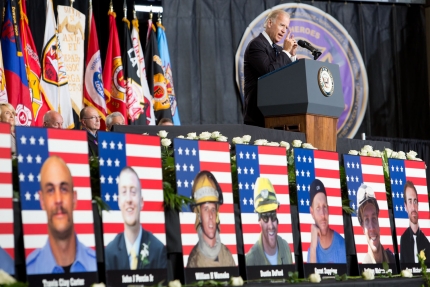
Vice President Joe Biden speaks at a memorial service for the 19 firefighters who died while fighting the Yarnell Wildfire,

Vice President Joe Biden speaks at a memorial service for the 19 firefighters who died while fighting the Yarnell Wildfire, in Prescott Valley, Arizona, July 9, 2013. (Official White House Photo by David Lienemann)

Vice President Biden traveled to Prescott Valley, Arizona yesterday to deliver remarks at a memorial service for the nineteen firefighters who died last week fighting the Yarnell Hill fire. The Vice President honored the firefighters, calling them “heroes long before we knew their names.”

We teach our children that these qualities – courage and resolve and perseverance – these qualities are ingrained in our national character as Americans. And I believe they are.  I believe they animate our national identity.  And I believe America will continue to be defined by the example of the 19 ordinary men who did extraordinary things.”

Lise Clavel is Assistant to the Vice President for Intergovernmental Affairs, Public Engagement and Correspondence
Related Topics: Arizona

The White House

Office of the Vice President

Op-Ed by Vice President Joe Biden in The Financial Times: Let Croatia lead the Balkans into the EU

The following op-ed by Vice President Joe Biden appeared today in print in The Financial Times.

Let Croatia lead the Balkans into the EU
Every country that binds itself to the union advances the cause of peace
By Vice President Joe Biden

James Joyce wrote that “history is a nightmare from which I am trying to awake”. Twenty years ago, Croatians lived that nightmare, imprisoned by regional hatreds and ravaged by war. Yesterday their country became the 28th member of the EU. Croatia has not merely awakened from its tortured history – it has realised the dream of a Euro-Atlantic future.

Croatia’s success was far from inevitable. In fact, it is a testament to the courage of its citizens and leaders who overcame the temptations of ultranationalism and resentment. Letting go of the past is a daily struggle. And, day by day, Croatians kept faith with an ambitious vision and built the democratic institutions that opened the doors to Nato and now the EU.

This achievement belongs to the Croatian people. But it is also speaks to the transformative power of the European project guiding countries toward the rule of law, open markets, prosperity and peace.

Croatia is further along that journey than some may think. It has been a Nato ally since 2009 and a contributor to security around the world, including Afghanistan. Once other countries sent peacekeepers to Croatia; now Croatia contributes to peacekeeping missions in Kosovo, Haiti and the Western Sahara.

Croatia’s accession to the EU also raises the stakes for neighbours who face a risk of being left behind. Over time, the borders of the EU should unite the countries of southeastern Europe rather than divide them. We hope that one day its citizens will benefit from the Transatlantic Trade and Investment Partnership we are negotiating with the EU.

But first, Croatia’s neighbours must make difficult choices that will pave their own paths into Europe.

It is in the interest of the US, Croatia and the rest of Europe that they succeed. History has no greater monument to the idea that countries need not repeat the conflicts of the past than the EU – and no greater mechanism than integration to ensure they don’t. Every country that binds itself to the EU’s rules and institutions brings us closer to the goal of a Europe whole, free and at peace. Even during difficult economic times, a unified Europe is preferable to the threats of division and instability. That is why Croatia is working to bring the very people it fought less than a generation ago into the European fold.

In recent months, I have met several leaders from the western Balkans. I am confident that, if they make the right choices, every one of Croatia’s neighbours can get there.

Serbia and Kosovo have been locked in a deep and bitter struggle – until now. Through dialogue, co-operation and painful compromise, prime ministers Ivica Dacic and Hashim Thaci have reached a historic agreement to normalise relations. The next steps will not be easy, but these leaders have given their citizens an unprecedented opportunity to build a future defined by respect for rights, shared prosperity and peaceful coexistence.

Montenegro and Albania, too, have hard work left to do, but they are making progress toward European integration, tackling economic and political reforms, fighting corruption and strengthening the rule of law. Montenegro is also on the path to join Albania inside Nato. Macedonia must stay the course of reform, address its interethnic tensions and, with Greece, summon the courage to find a mutually acceptable solution on its name. Unfortunately, there are still some who cling to ethnic grievances, personal rivalries and a zero-sum approach to politics that holds back progress. Four years ago, in Sarajevo, I stood in parliament to tell politicians and officials that the door was open for Bosnia-Herzegovina to become an integral part of Europe, and the US wanted to help them get there. That requires agreement to eliminate constitutional provisions that discriminate against minorities and the decision to register defence properties as state property. Neither has happened, and the people of Bosnia deserve better.

No country can completely leave behind its history or forget its tragedies. And nor should they. But countries can choose to put their futures first and act for the well- being of generations to come. That is what Croatia has done. And the result is that dreams that seemed inconceivable 20 years ago today are wonderfully, irreversibly real.

That is both a cause for celebration and a reminder of what is possible. We congratulate Croatia and recommit ourselves to the larger goal of welcoming the entire Balkans into a Europe that is whole, free and at peace.
Vice President Biden Speaks on the Fair Labor Standards Act Anniversary

June 25, 2013 | 21:47 | Public Domain

Vice President Biden highlights the importance of the Fair Labor Standards Act, which established the minimum wage in 1938, and discusses what the Administration’s proposal to raise the minimum wage would mean for hard working American families.

Download mp4 (803MB) | mp3 (53MB)

Vice President Biden Speaks on the Voting Rights Act

June 25, 2013 | 3:11 | Public Domain

Vice President Biden speaks on today's Supreme Court's decision that invalidates a core provision of the Voting Rights Act, and decades of well-established practices that help make sure voting is fair, especially in places where voting discrimination has been historically prevalent.

Download mp4 (114MB) | mp3 (8MB)

Fair Labor Standards Act Anniversary Reminds Us Why We Need to Raise the Minimum Wage

Watch this video on YouTube

In his State of the Union, President Obama laid out a simple principle: “in the wealthiest nation on Earth, no one who works full-time should have to live in poverty.” Today, we came together with Vice President Biden to commemorate an important milestone in upholding that principle – the 75th anniversary of the Fair Labor Standards Act – while making clear what we still need to do to make it a reality.

We can thank the Fair Labor Standards Act, signed into law by President Franklin Roosevelt, for several of the most important protections in place for workers today. The FLSA created the minimum wage, put in place restrictions on child labor, and required that when employees work more than a standard workweek, they get paid overtime.

But a look back at history also serves as a call to action. Over the past three decades, the minimum wage has failed to keep pace with inflation – eroding its value for working families. A full-time worker making the minimum wage now earns only $14,500 a year – leaving a family with two kids below the poverty line even once tax credits are taken into account. That’s why in February, President Obama called on Congress to raise the minimum wage – including for tipped workers – bring it back to the value it had at the beginning of the Reagan Administration, and permanently index it to inflation. 

Today, we heard from workers making the minimum wage from across the country – from a call center worker from Indiana to a valet attendant from Denver  – who spoke about how important a minimum wage increase can be for their families. As President Obama has said, for these families, a minimum wage increase “could mean the difference between groceries or the food bank; rent or eviction; scraping by or finally getting ahead.” Indeed, for a typical working family making $20,000 to $30,000 a year, a minimum wage increase could provide enough to cover six months of housing or their entire budget for groceries in a year. What we also heard from these workers is that they are proud of their work – and they want the dignity that comes with supporting their families with their work.

Seth D. Harris is the Deputy Secretary of Labor and acting Secretary of Labor. Danielle Gray is Cabinet Secretary and Assistant to the President. Alan B. Krueger is Chairman of the Council of Economic Advisers. Gene Sperling is the Director of the National Economic Council
Related Topics: Economy, Urban Policy, Indiana

Vice President Biden: The Fight to Reduce Gun Violence Is Far From Over

A little more than six months after the shooting at Sandy Hook Elementary, Vice President Biden said yesterday that he and President Obama have not given up the fight to reduce gun violence.

In January, the Vice President said, “the President and I stood in this very room, joined by the victims of gun violence, parents, teachers, members of law enforcement, and many others, as we made a simple promise to the American people. We said we will do everything that we can, everything in our power to reduce gun violence in this country."

And although a minority of the Senate voted down common-sense legislation that would keep our kids and communities safer, President Obama has "moved forward on what was within his power, what executive actions he could take," the Vice President explained. "Today, I can report that he announced 23 executive actions; 21 of them have been completed or there has been major progress made toward the total completion and that we’re on track to finish the job."

Related Topics: Violence Prevention

Vice President Biden Speaks on Reducing Gun Violence

June 18, 2013 | 29:15 | Public Domain

Vice President Joe Biden highlights the Obama administration's significant progress on its plan to reduce gun violence that was announced in January, including strengthening the existing background check system, empowering law enforcement, making schools safer, encouraging responsible gun ownership, ending the freeze on gun violence research, preserving the rights of health providers to protect their patients and communities, and improving access to mental health care.

Download mp4 (1106MB) | mp3 (71MB)

The White House

Office of the Vice President

Vice President Biden Marks Progress on Executive Actions to Help Reduce Gun Violence

Obama Administration releases report detailing work on 23 Executive Actions laid out in January

WASHINGTON, DC – Today, the Obama Administration released a new progress report detailing the completion of or significant progress on 21 of the 23 executive actions President Obama laid out in January to help reduce gun violence, and the continuing work toward completing all twenty three. At an event at the White House today, Vice President Joe Biden highlighted the significant progress this Administration has made on strengthening the existing background check system, empowering law enforcement, making schools safer, encouraging responsible gun ownership, ending the freeze on gun violence research, preserving the rights of health providers to protect their patients and communities, and improving access to mental health care.

As part of this progress, the Vice President announced the fulfillment of two executive actions. The Departments of Education, Justice (led by the FBI), Homeland Security (led by FEMA), and Health and Human Services are jointly releasing guidance to schools, institutions of higher education, and houses of worship on how to work with first responders and other community partners to plan and prepare for emergencies such as active shooter situations, tornadoes, and earthquakes. 

Additionally, the Departments of Homeland Security and Justice have expanded access to federal training on active shooter situations for law enforcement, first responders, and school officials with additional outreach, new online resources, improved training curricula, exercises with law enforcement at all FBI field offices, and DHS security briefings for 100 school districts across the country.

Additional information can be found via the below links.

PROGRESS REPORT:
Progress Report on Executive Actions to Reduce Gun Violence Click Here.

FACT SHEETS:
Emergency Management Planning: Click Here.
Training First Responders and Schools on Active Shooter Situations: Click Here.

GUIDES:
Guide for Developing High-Quality School Emergency Operations Plans: Click Here.
Guide for Developing High-Quality Emergency Operations Plans for Institutions of Higher Education: Click Here.
Guide for Developing High-Quality Emergency Operations Plans for Houses of Worship: Click Here.

The Vice President Visits Favela Santa Marta

June 11, 2013 | 1:41 | Public Domain

In Rio De Janeiro Vice President Joe Biden tours Favela Santa Marta. This community has made major strides since 2008 to curb violence and drug trafficking, and now is a model for "community policing". The Vice President met with some of the 7,000 residents and decided to stop for ice cream with some of the neighborhood children.