The White House

Office of the Vice President

Remarks by Vice President Joe Biden on the U.S.-India Partnership at the Bombay Stock Exchange

The Bombay Stock Exchange
Mumbai, India

1:40 P.M. IST

THE VICE PRESIDENT:  Thank you very much, Kaku.  I appreciate it. 

Thank you all for giving me this opportunity.  It’s an honor to be back in India and to be here in Mumbai.  Off script for a second here, I was reminded -- I was elected to the United States Senate when I was a 29-year-old kid back in 1972, and one of the first letters I received and I regret I never followed up on it.  Maybe some genealogist in audience can follow up for me, but I received a letter from a gentleman named Biden -- Biden, my name -- from Mumbai, asserting that we were related.  (Laughter.)  Seriously.  Suggesting that our mutual, great, great, great, something or other worked for the East India Trading Company back in the 1700s and came to Mumbai.

And so I was thinking about it, if that's true, I might run here in India for office.  (Laughter.)  I might be qualified.  But I’ve never followed up on it.  But now that I’m back for the multiple times, I’m going to follow up to find out whether there is a Biden and whether we’re related.  I hope he’s in good standing if we are.  (Laughter.)

I want to thank you for the kind welcome, Kaku, and the nice introduction.  I’m delighted to be in Mumbai, a city full of history and dreams and incredible energy.  I bring with me the admiration of the American people and the good wishes of President Obama.

We admire the way you’ve melded ethnicities, faiths and tongues into a single, proud nation; the way entrepreneurship seems almost hard-wired into Indian society, from rickshaw wallas to web programmers; and maybe most of all, we admire your democracy and the message that your democracy sends to people everywhere in the world.  And that message is:  No nation need choose between development and freedom.   They are not inconsistent.

America is a land of immigrants, as we tell ourselves all the time and are reminded in every generation.  And America has been strengthened by the diverse cultures of India woven into the fabric of most of our communities, including those of you who are Americans my own the small community in the state of Delaware that I represented in the United States Senate. 

Any weekend in Delaware -- we have a very significant and tight Indian-American community -- any weekend in Delaware, you can find the Delaware United Cricket Club competing.  And now I have bragging rights.  I will be able to go back and tell my friends who belong to that club that I visited the home of the best cricket team in the world.  It will give me some reason to -- (applause).  You won the International Cricket Council Championship.

And as an Irish American, it pleased my heart to see you beat Britain, England.  (Laughter.)  That's a joke, by the way, for the press.  (Laughter.)  I don't want to hear a headline:  Biden at Odds with British Empire, you know?  (Laughter.)  But it does make me feel good.  (Laughter.)

India has made a very impressive journey to state the obvious.  Twenty-two years ago, you took bold steps to start opening your economy.  And the results were almost immediate, and they were remarkable.  Over the past decade, you have lifted 160 million people into the middle class.  In 1991, India had 5 million total phone lines; now you have 900 million.  In 1991, you exported $20 billion in goods each year.  Now that's over $300 billion.   India is no longer an economic island -- and a rising, rising economic power.

Of course, obstacles remain as in our country and every country.  But here in India growth has slowed. Poverty persists.  And there are significant challenges in the region and the world in which you reside.

But we’re confident, presumptuous of us to say this, but we Americans are confident that India will continue to rise because we believe you will make the -- take the additional steps necessary to spur further growth and enhance your economic influence around the world, and in the process lift the whole world.  We want to be your partner in that venture, in lifting the economy of the world.

And since we’re at a former stock exchange, let me humbly suggest that America is back, and it’s has never been a good bet to bet against America –- never been a good bet to bet against America.

We’ve had the biggest increase in domestic manufacturing in the past 20 years; 40 months of private sector job growth -- we need more and more rapidly, but constant growth.  We are now the recipients and we have access to and know how to safely extract over 100 years of natural gas reserves, driving the price of energy down to the -- in the United States to make us among the most competitive nations in the world for manufacturing. 

In addition to that, we will be a net energy exporter.  We will be energy independent during the ‘20s -- the decade of the ‘20s, 2020.

The foundations of our economy are stronger than ever.  The best research universities in the world –- you have great ones, we have the most -- and the most vibrant startups; a culture of innovation and openness.

For all the problems of our education system, and every country has it, and we have our own, particularly in elementary education, the one thing that is constant in America from the time a child steps into any classroom from kindergarten to first grade, they are taught that it is okay to question orthodoxy, to challenge the status quo.

So I believe that each of our economies will continue to grow and in the process help shape the course of the century ahead, the 21st century.

If you excuse me quoting an Irishman, but a fellow named William Butler Yeats, my favorite poet, writing a poem about his Ireland in the year 1916, called Easter Sunday 1916, something Indians and Irishmen hold in common, trying to rise with the British.  It was the first rebellion in Ireland in the 20th century.  And he wrote that poem called Easter Sunday 1916.  And in that poem there’s a line that he attempted to describe his Ireland at the time, but I would argue it better describes the state of the world as we find it today.

He said, all’s changed; changed utterly.  A terrible beauty has been born.  All’s changed, changed utterly.  The world has changed utterly just since I entered public life, and matter of fact, in the last 20 years.  And there’s a need for new rules of the road -- both strategically and economically.

But I would ask you -– I would ask you, as we continue to grow separately -- I would ask you to consider the historic opportunity that is in front of us.  Imagine what our two countries can achieve together in this 21st century -- not only for one another but for economic stability of the region, as well as the world.

It seems to me there are certain basic principles in the way forward that are clear: a trade and investment partnership that is open and fair; that grows both our economies as India builds the largest middle class in human history; a security partnership of first resort where we look instinctively to each other to help the Asia-Pacific region to rise -- continue to peacefully; closer ties than ever between our citizens, universities, civil societies and businesses; a partnership defined not by what it promises, but defined by what it delivers. 

We’ve made headway.  We’ve launched an annual dialogue between our governments that covers everything from counterterrorism to higher education.  As a matter of fact at a dinner hosted by the Vice President last night, very generous of him, we were talking in great detail granularly about community colleges and what future they hold for here in India.  My wife is full-time community college professor, has been teaching -- I can't say the number of years now because it reveals her age, but for some time. 

In the Biden family there’s a strange thing, there is no woman as old as any man.  I don't know how that happened, but that's the way it works in my family.  (Laughter.)

But as we say in America, the best-kept secret in American education is the community college system.  And it’s a bold and I think wise move India is taking to try to create hundreds and hundreds of community colleges.

We’ve also made progress on clean energy, defense cooperation, the partnerships between our universities and community colleges.  But there remains a gap between what we are doing and what we are capable of without in any way impacting on either of our countries’ sovereign decisions, without in any way compromising either of our countries’ ability to independently decide what course of action we should take on individual issues and the future generally.

And the reasons are understandable why they're still -- we haven’t made more progress.  In your country as well as mine, there are still those -- some who have lingering doubts of a Cold War era long gone by.  It’s time to put those doubts behind us and seize the opportunities ahead of us.  Leaders -— not bureaucracies -— should set the level of our ambition.

So let me state it plainly:  There is no contradiction between strategic autonomy and a strategic partnership.  I’ll say it again:  There is no contradiction between strategic autonomy and a strategic partnership.  Global powers are capable of both.

And it’s time we take this relationship to a new level for each of our own well-being.  The question is how do we bridge the gap between this vision and the present reality?  You are all practical businesswomen and men.  You know ultimately it’s how do you operationalize a vision.

I’d respectfully suggest that we begin by deepening our economic relationship to help accomplish our overarching individual domestic goals.  They are similar.  They are common.

And our vision and our interest as you look down five, 10 and 20 years, I can see no logical impediment to the development of this relationship in terms of our individual self-interest.

Today, as I speak –- well, not as I speak, but shortly, President Obama is going to be giving a major speech outlining the top priority for the Obama-Biden administration  And it’s straightforward and simple, how do we continue to shore up America’s future and the foundations of the middle class life in America with good-paying jobs, affordable health care, housing, education and the dignity in retirement.

India’s top priority is to lift hundreds of millions of people out of poverty to join the middle class -- totally consistent goals.   Together, in our view, we can help each other achieve our core goals.  And we’ve made a good start. 

In the last 13 years, we’ve increased fivefold our bilateral trade, reaching nearly $100 billion.  There’s not a one of you sitting out there that knows there is any logical impediment as to why that could not be fivefold that number.

There’s no reason, if our countries make the right choices, that we can’t grow together and more rapidly.

The United States is negotiating major new trade agreements across both the Atlantic and the Pacific -- so called TTIP in the Pacific (sic) -- and here in the Pacific, an agreement that would encompass not only the Pacific Basin all the way to the Indian Ocean, but also America and the entire hemisphere.  I recently went on a journey to Latin America and South America.  Chile, other countries are looking forward to this Trans-Pacific Partnership.  Not only to expand, but to enhance economic stability and in turn domestic stability.

Expanding trade between India and the United States can and should be a central part of this story.  But that requires us to be candid with each other about the obstacles that exist when it comes to a business environment: protection of intellectual property; requirements that companies buy local content; limits on foreign direct investment; inconsistent tax treatment; barriers to market access.  These are tough problems.  But we all know they have to be negotiated and worked through in order to meet the potential of this relationship.  Not just with us, but with other countries as well.  This instinct to protect your industries is fully comprehensible and easy to understand.

India has 600 million people under the age of 25 with unlimited capabilities, but in some cases limited horizons.  Your businesses are seeking any competitive edge they find, and why shouldn’t they? 

But I believe recent history of other developing countries and developed countries shows there is a better way to grow and strengthen your economy, although it takes some bold decisions.

A young Indian woman graduating from IIT Bombay who wants to start the next Tata Motors should be able to buy the best technology and parts, wherever in the world they come from -— as her competitors around the world are able to do. 

An Indian medical student with a brilliant idea for a life-saving medical device should know that his intellectual property will be protected and rewarded because that gives him the financial incentive and the intellectual motivation to continue to move forward.

Hundreds of millions of Indian consumers deserve access to the most affordable and reliable products to better their standard of living.  Now, look, I understand -– believe me –- how making even the most modest of changes of opening your markets impacts on interest groups.  It happens in my country, and it clearly happens in yours.

But you have an extraordinary opportunity to unleash the immense talents of the people of India in the global economy -— and power India’s growth for decades to come.  It is not easy.  I am not -- I am a public official.  I’ve been doing this my entire adult life.  These are difficult decisions to make.  It’s a little bit like, as my mother used to say, you got to take your medicine in order to be healthy -- a homely metaphor, but the truth of the matter is, they're difficult.

But the choices are not ours to make, they're India’s to make.  We could both do fine without one another.  We are not here -- I am not here, the President didn't ask me to come here to lecture, to suggest what is India’s interest.  That's for India to decide.  We know what is in our interest.  We believe what is in our interest, and a powerful, growing, vibrant Indian economy we believe is in our interest.  We know is in our interest.  And there are certain basic rules of the road of the 21st century that have to be met as a practical matter -- not dictated by us, but by the marketplace in order to be able to get there.

So America does not claim to be a disinterested party.  We see tremendous opportunities for American companies in technology and infrastructure, and in creating more efficient supply chains here in India. 

One place to start is would be with the Bilateral Investment Treaty.  It would give investors in both countries more certainty and predictability; fair treatment under a single, consistent set of rules for companies small and large, foreign and domestic.

I’m pleased that our countries are reengaging in talks toward a Bilateral Investment Treaty.  Both our governments have instructed our negotiators to see what progress can be made by the time Prime Minister Singh visits Washington this fall.

In the United States, we welcome Indian businesses investing in the United States.  We’ve already benefit from the investment of human capital.  Indians receive more skilled-worker visas to the United States than any other country in the world.  And the legislation our Congress is considering increases the number of temporary visas and Green Cards availability for highly skilled Indians to come work in the United States.  I know that causes, as my Italian friends say, some agita with some individual companies.  But the bottom line is there’s a net expansion.

At the same time, businesses and workers in both our countries benefit when there is a strong, predictable, and fair global trading system.  

In December, members of the World Trade Organization will meet in Bali.  We need to find a way forward to address India’s -- and I’ll be criticized for saying this -- India’s legitimate concerns about food security without distorting global trade.  It’s a difficult problem, but it must be addressed. 

     And also -- it also addresses many countries’ desire to reduce barriers at borders that harm their companies and set back development.

Success in Bali can help reinvigorate world trade, the World Trade Organization and show that it remains a vital forum to resolve these issues. 

In this and many other areas, India has an essential role to play -- both to take its rightful place in international rule-setting and to accept the responsibilities that come with it.  Because ultimately, the two go hand in hand.

The second thing we can do is have our brilliant scientists on both sides of the Pacific -– our brilliant scientists work together on a common, common interest:  clean energy and climate change to ensure that both countries can grow responsibly and sustainably.

In India -- I come from a part of America that -- where we’re only about seven feet above sea level.  Sea levels are rising.  They are rising.  It will affect tens of millions of people in India.

At home, America is working to lower carbon pollution that causes climate change.   In fact, we have brought it down to its lowest level in two decades.  We have much more to do, and we plan to do more.

India, too, needs to take concerted action –- all the more as your economy and your energy needs continue to grow.  I realize it’s a conundrum.  I have heard the debate with developing economies over the past 30 years.  You clear-cut your forest 200 years ago.  You did such and such.  You had an advantage.  True.  But it does not undercut the reality that we both have an overwhelming stake in seeing to it that we address the issue of climate change.

Of course India’s first priority is and must be lifting its citizens out of poverty.  But unless we can develop a sustainable path on a low-carbon path, the consequences of climate change will seriously undermine the development and growth, as well as harm the very health of the people of India.

You’ve all observed what’s happening in China now.  Allegedly a million people a year dying as a consequence o atmospheric pollution.  Reality ultimately intrudes.  And the reality is we have a worldwide problem.

This is not a favor to other nations.  It matters to India -- to the productivity of your farmlands, the availability of water, the risks you face from floods and rising seas. 

India is already taking steps.  But like us, India can do more.  And we are anxious and willing to work with you.

One thing we can do together right now is address pollutants called hydrofluorocarbons, HFCs.  The reason I’m very familiar with this is I come from a little state that has an outfit called the DuPont Company.  They had a great interest in refrigeration and HFCs when I talked about they should be eliminated.  We talk about stakeholders and interests.  Well, HFCs found in air conditioners and other products make an outsized contribution to climate change. 

I hope that India will join the United States, China and more than 100 other countries to work within the Montreal Protocols to phase down the production and consumption of HFCs.

Your leaders fully understand that in order to sustain your development India needs access to low-carbon technologies and other sources of clean energy.  And that’s why when I was a United States Senator and Chairman of the Foreign Relations Committee I fought so hard in the United States Senate to champion the U.S.-India Civil Nuclear Agreement.  It’s part of the path to sustainable energy in a growing, powerful country.  But part of that agreement was India committed to work with American companies as well as you build out those nuclear plants. 

And it’s important that we complete the first agreement between American companies and the Nuclear Power Corporation of India.

The reactors that India has authorized its nuclear company to purchase in -- I hope I pronounce it right -- Gujarat would generate as much as 6,000 megawatts of power.  To put that number in perspective: that would be enough energy to power two cities the size of Mumbai.

Third, although we are already helping India meet its military needs –- we can significantly increase our defense cooperation by what it already is, without in any way compromising each other’s sovereignty.

Cargo aircraft called C-130s that were sold to India are now saving the lives of flood victims in the mountains of northern India.  We’re ready to go forward.  Rather than just India purchasing from us, together we can graduate to have a true partnership or co-production and co-development agreements so that together we can design and co-produce the systems and technologies of the future.


But it’s not just military-to-military where we have increased our cooperation.  Our cooperation has grown dramatically in our shared fight against terrorism.  India has suffered grievous attacks against your parliament and here n Mumbai.  We suffered 9/11.

Together we are working hand-in-hand, sharing intelligence on terrorist groups so there will never be another 9/11; there will never another 26/11.

Fourth, we want to deepen our strategic partnership on regional as well as global issues.  The United States is elevating our engagement in the Asia-Pacific region.  We refer to it as rebalance.

Twenty, even 10 years ago, some might have suggested that not have included India in these discussions.  Today, India is an indispensable part of our rebalance toward the Asia-Pacific.  Indians have looked east through travel and trade for a millennia.  These ties are reemerging.  India is negotiating a trade deal with ASEAN.  It is becoming more involved in regional institutions.  And that is good news for the region and for us.

Stronger connections between India and Southeast Asia will be a good business -- good for business I should say and good for stability.  And both of us have a strong interest in maintaining the security of the sea lanes, freedom of navigation from the South China Sea to the Indian Ocean.  And each have to get our relationship right with China.

I’ve heard people talk about the U.S.-China relationship as everything from the next Cold War to the next G2.  None -- neither of those characterizations is accurate.

Like India, and I’ve had discussions on this issue while I’ve been here, but I knew it already, like India, we have a complex relationship with China.  It has important elements of cooperation and also competition.  And we want it to be constructive.  There are three big nations -- we are three big nations -- China, India and the United States -- with our own perspectives.  We have significant common interests.  All three of us and the entire region would benefit if we coordinated more closely.

America and India have already built strong trilateral dialogue with Japan.  It is past time we launch one with China.  America and India are cooperating closely in Afghanistan.  It’s been the subject of many of my discussions thus far with your leadership.

I know there are questions about the U.S. position on reconciliation with the Taliban.  I want to be clear:  We have always been committed to an Afghan-led, Afghan-owned process that meets three outcomes.  The Taliban must, one, break with Al Qaeda permanently; stop the violence; accept the Afghan constitution and guarantee free and equal treatment for women.

India has exercised responsible leadership in Afghanistan through assistance, investment and strategic agreements with the Afghan government.

The United States is committed to supporting Afghanistan through our Strategic Partnership after the transition is complete at the end of 2014.  We are not leaving the region –- even as Afghanis step up and take responsibility. 

On Pakistan, we support the early outreach between Prime Ministers Singh and Sharif.  It’s not our place to lecture.  It’s not our place to dictate.  Our relationship will not be defined by India’s relationship to Pakistan.  But America and the world have a deep stake in closer ties between India and Pakistan -- an incredibly difficult nut to crack, but it’s yours to crack. 

We have no illusions that it will be easy.  But as you know better than we do, progress would benefit everyone and make all of us, particularly this region, more secure. 

So there’s a great deal we hope India will contribute to.  We believe, discussions I’ve had thus far, the peace and prosperity in the 21st century will be impacted upon by the outcomes of that relationship.  That's why President Obama has called our relationship with India “a defining partnership for the century ahead.”

     He is not engaging in hyperbole.   He means it literally. And so do I.  It’s the defining partnership in the century ahead.  That’s why he stood in the Indian Parliament and declared to the world, that “we look forward to a reformed United Nations Security Council that includes India as a permanent member.”  (Appaluse.)  That’s why yesterday, on behalf of the President Obama, I invited Prime Minister Singh to make a visit to Washington at the end of September.

We have an incredibly full agenda, but nothing gives me more hope for the prospects of that agenda, as we approach it, nothing gives me more hope that we can accomplish it together than our people 720,000 visas per year that are issued here in India to go to the United States, the 100,000 talented Indian students studying at American Universities -– with the aim at doubling that number by 2020, and tripling the number of Americans studying in India.

But the foundation of my hope and expectations is built upon the certain knowledge that our people share a common set of values and peaceful vision for the world.

As I said, be critical, look down the road.  Where is there an intersection in the future of the 21st century where we are likely to be at odds with one another on the big issues?

For those who doubt the vision that the President and I share, I would refer them to the founder of the modern state of India, Mahatma Gandhi.  I had the honor of visiting the place where he literally spent his last days, as probably all of you have as well.  And as I stood there, remembering him as a young child who -- being involved in the Civil Rights Movement and how Dr. King looked to Gandhi, I was reminded once again, which is not very -- how can I say it -- sophisticated to say to a sophisticated audience, but I was reminded once again that dreams matter.  Dreams matter.  A nation without a vision to where it wants to go will be buffeted by the swirling winds of the world and not have the ability to grab the reins to try to determine its own future.  Vision matters.

But they are only realized, as all of you know, by hard work and incredible persistence.  So as you look to the horizon, it’s very important we keep our feet on the ground, and continue the day-to-day painstaking effort of building this great partnership even if it means in the beginning we only make incremental small changes.  But every day must be forward.  No matter how small -- no matter how small the measure of progress is.

I am absolutely confident -- absolutely confident in the future of this relationship.  Not because I’m naïve.  I’ve been around longer than most of you.  I’ve been doing this kind of business my entire adult life.  My confidence is based on the history of the journey of both our countries.  But I am confident.

May God bless you all, may God bless India and may God protect our troops.  Thank you so very much.  (Applause.)

END
2:14 P.M. IST

Vice President Biden and Indian Leaders Discuss U.S.-India Engagement

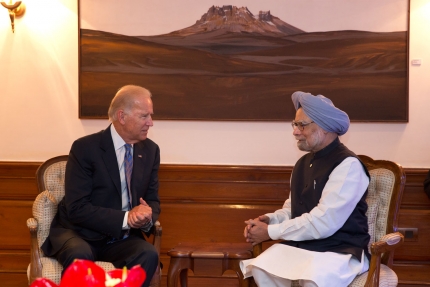
Vice President Joe Biden meets with Indian Prime Minister Dr. Manmohan Singh

Vice President Joe Biden meets with Indian Prime Minister Dr. Manmohan Singh, at Panchavati, in New Delhi, India, July 23, 2013. (Official White House Photo by David Lienemann)

On his second day in New Delhi, Vice President Biden met with Indian leaders to discuss the increasingly important bilateral relationship between our two countries.

In meetings with Prime Minister Dr. Manmohan Singh, President Pranab Mukherjee, Vice President Hamid Ansari and others, Vice President Biden emphasized a range of opportunities for our countries to work more closely together on issues such as economic growth, trade, energy and climate change, security and investments in innovation and education.

In the evening, the Vice President discussed the importance of the U.S.-India relationship at a dinner hosted by Indian Vice President Hamid Ansari.

In New Delhi, Vice President Biden Tours Gandhi Smriti

Vice President Biden and Dr. Jill Biden arrived in New Delhi today, the first stop on a six-day trip to India and Singapore.

This trip is an important opportunity to strengthen our partnerships within the region and reaffirm our commitment to rebalancing U.S. foreign policy toward the Asia-Pacific. Over the next several days, the Vice President will meet with leaders in both countries to discuss a range of issues, from economic growth to energy and climate change to security. 

Ahead of series of meetings in New Delhi, the Vice President and Dr. Biden had the opportunity to meet with Mahatma Gandhi's granddaughter and tour the building where Gandhi spent the last years of his life, which is now the Gandhi Smriti museum. To learn more about their visit, check out the video below or watch here.

For more updates from the trip, check back on whitehouse.gov and follow the Vice President on Twitter at @VP.

On Board in New Delhi: Visiting Gandhi Smriti

July 22, 2013 | 02:09 | Public Domain

In New Delhi, The Vice President and Dr. Jill Biden meet with Gandhi's granddaughter and tour the building where he spent the last years of his life, which is now the Gandhi Smriti museum.

Download mp4 (9.1MB)

Vice President Biden Discusses U.S. Engagement with the Asia-Pacific Region

Vice President Joe Biden delivers remarks on U.S. policy towards the Asia-Pacific region

Vice President Joe Biden delivers remarks on U.S. policy towards the Asia-Pacific region, in the Jack Morton Auditorium at George Washington University, in Washington, D.C., July 18, 2013. (Official White House Photo by David Lienemann)

On Thursday, Vice President Joe Biden discussed the Administration’s elevated engagement in the Asia-Pacific region during a speech at George Washington University, sponsored by the Center for American Progress. Citing the potential for strengthened alliances, institutions and partnerships, the Vice President emphasized an “absolute commitment” to the Asia-Pacific region.

“We want to hasten the emergence of an Asian-Pacific order that delivers security and prosperity for all the nations involved. We want to help lead in creating 21st century rules of the road that will benefit not only the United States, and the region, but the world as a whole.”

Vice President Biden called relations with China as “a healthy mix of competition and cooperation,” and urged China to shift to a more consumer-driven economy. He emphasized the importance of institutions like ASEAN in providing stability and security, as well as their role in fighting climate change. 

“That’s why we’re working with ASEAN to promote investment in clean energy and why we’re helping Pacific island nations mitigate the effects of rising sea levels. We just concluded an agreement with China to reduce the use of pollutants called HFCs that cause climate change. And there’s no reason we cannot do more with India as well.”

The White House

Office of the Vice President

Background Conference Call with Senior Administration Officials on Vice President Biden and Dr. Jill Biden's Trip to India and Singapore

Via Teleconference

9:40 A.M. EDT

MS. TROTTER:  Thanks, everyone, for joining today’s call.  Sorry for the delay.  Our hope is to provide you with a more detailed sense of the Vice President and Dr. Biden’s schedules and goals during their trip next week to India and Singapore.

This call will be on background and our speakers are happy to take questions after they give some brief opening statements at the top. 

We’d like to keep this call as focused on the trip as much as possible and remind everyone that there’s one question per person. 

And with that, I’ll turn it over to our first speaker whom you can quote as a senior administration official.

SENIOR ADMINISTRATION OFFICIAL:  Thank you, Kingsley.  What I’m going to do just for a couple of minutes is lay out top-line goals, the agenda items and schedule for the visit.  And then myself and my colleagues would be happy to take your questions.

The Vice President gave a speech yesterday at George Washington in which he laid out our vision for moving forward with the Asia-Pacific rebalance policy that the President has announced and that the entire national security team is invested in.  And the trip to India and Singapore comes in the context of that strategy.

The goal -- the overarching goal being to tie together the nations of the Asia-Pacific from India to the western shores of the Americas through strong partnerships, institutions, alliances, and rules of the road; and part of the message that the Vice President is sending in going on this trip is that we remain all in on the rebalance.

India is obviously a key player and increasingly so in the Asia-Pacific region.  And the United States and India have an increasingly important bilateral relationship as our countries grow and deepen the ties across an incredibly broad range of areas.

Four areas in particular are going to be at the top of the agenda when the Vice President visits India.  The first will be our economic cooperation where the Vice President will focus on issues from investment policy to intellectual property and speak to how we can work together to close the gap between where we are today and where we can be in our bilateral trade and investment and in our cooperation in multilateral trade and investment fora.

The second area is energy and climate where the Vice President will speak to the work that we need to do together to realize the promise of the civil nuclear agreement, and the work that we should be doing together to lead -- to be leaders on addressing the global challenge of climate change, building on the climate change dialogue that Secretary Kerry announced with the Indian Foreign Minister at the strategic dialogue (inaudible) month.

The third area is defense cooperation.  We’ve built a strong foundation in defense cooperation and defense sales over the past few years, and the Vice President will come to talk about how we can build an even stronger edifice and deeper cooperation going forward.

And the fourth area is the wide range of regional cooperation that the United States and India have embarked upon, both in South Asia and in East Asia relating to maritime security, to counterterrorism, to our work together in the institutions of the Asia-Pacific.  And that will be a full and formidable agenda given all the regional issues at play in the current international climate.

To go through the schedule in India, the Vice President will arrive in Delhi on July 22nd and upon arrival will pay a visit to the Gandhi Smirti Museum with the goal of showing his respect both to Gandhi and to India’s modern history. 

On July 23rd, Tuesday, he will meet with Vice President Ansari, with Sushma Swaraj of the BJP, with Prime Minister Singh, with President Mukherjee, and then he will attend a dinner hosted by Vice President Ansari, along with an array of Indian officials and folks from the private sector.

He will then travel to Mumbai where on Wednesday the 24th, he’ll deliver a policy speech at the Bombay Stock Exchange and hold a roundtable with business leaders. 

And then on the 25th, Thursday, he’ll hold a women’s empowerment event at the India Institute of Technology in Mumbai before departing for Singapore.

And Singapore is a crucial Southeast Asian partner of ours, a major trading partner, a major investment destination, an incredibly important partner with us in the Trans-Pacific Partnership, and he will arrive there while there is an ongoing round of negotiations for the TPP and have the chance to consult on that.

They are a longstanding an increasingly important security partner as well, and he will have the opportunity to visit our littoral combat ship at the Changi Naval Base.  And they are a country with key perspectives and a key role to play in all of the major regional issues that we are confronting today, including issues related to maritime security in the South China Sea.  And on that issue, the Vice President looks forward to consult (inaudible) leaders and to having the opportunity to speak publicly to how we can manage maritime disputes, deal with issues related to freedom of navigation and unimpeded lawful commerce.

In Singapore, he arrives on July 25th, and on Friday the 26th, he will meet with President Tan.  He will meet with Prime Minister Lee, with whom he will give press remarks.  He will meet with Minister Mentor Lee Kuan Yew.  And then on Saturday, he will do an economy and trade event at the Pratt & Whitney aircraft engine overhaul facility.  And then, as I mentioned, a visit to the LCS ship USS Freedom and make remarks to sailors before returning back to the United States.

Just before I touch on Dr. Biden's schedule, I would note that the Vice President sees not just parallels between but interconnections between the elevated engagement the United States is pursuing here in our own hemisphere and the rebalance in the Asia-Pacific.  It is a fact that five of the negotiating partners in the TPP are Western Hemisphere nations, and increasingly, key nations of the Americas are looking west for trade, investment and other forms of interaction and engagement in the Asia-Pacific region.  So the Vice President views all of this as of a piece and deeply interconnected.

Dr. Biden, very quickly, in new Delhi will be doing a health and nutrition event in Kachhupura community in Agra, as well as touring the Taj Mahal.  In Mumbai, she'll be doing a health and nutrition event in the Thane district, a gender-based violence event at DILASA in the Bhabha hospital to learn how this one-stop crisis center is using global best practices to serve victims of gender-based violence.  And she'll be doing a girls education event at the Anjuman-il-Islam school for girls, stopping by an English class, taking a tour, and then giving brief remarks at an assembly about the importance of education and the opportunities that education can provide to these young girls.

In Singapore, she'll do an early education event, visiting the national library and participating in the kidsREAD Initiative, reading a book to children -- young children, four to eight year olds.  And then she will do a U.S. military family barbeque for servicemembers and their families who are stationed in Singapore to thank them for their service and to promote the initiative Joining Forces.

So with that, I will open it up to questions and invite my colleagues to help me answer them.  Thank you.

Q    Can you just do a little more curtain-raiser on his policy speech?  And also, what is he going to talk at the IIT, Bombay?

SENIOR ADMINISTRATION OFFICIAL:  With respect to the policy speech, I think you can expect the Vice President to set out an ambitious vision for the U.S.-India relationship, looking not just at the months ahead or the years ahead, but the decades ahead.  And in particular, I think he will highlight all of the areas of potential -- the economic potential of our relationship. 

For example, in his speech yesterday, he made the point that U.S.-India trade has reached nearly $100 billion a year, but there’s no reason it can't be five times that much.  Over the last 13 years, it has quintupled and it should quintuple again.

On the issue of defense and security and regional cooperation, I think he will point out that increasingly the United States and India are coming into strategic convergence in terms of what our key interests are and how we can pursue them -- relating to maritime security and freedom of navigation; relating to issues around stability that can create regional integration and growth for all of the countries of the region; relating to strong institutions and rules of the road.

And then I think he will also talk about the values questions that connect our societies at the people-to-people level in terms of our shared democratic ideals and how we can build on that and translate that into more practical cooperation in some of the areas that I’ve described -- energy and climate change, all of the dimensions of our economic and security relationship.

So it will be a speech geared not towards policymakers or government officials, but towards the people of India.   And it will be I think a set of observations both to the American people and the Indian people about what is possible if each of us commit to taking the steps necessary to realize our potential.

The IIT, Mumbai stop will be focused on young women and the growing potential and promise of young women in Indian society and Indian business, Indian science and technology.  So he will take a tour of some facilities there and have an opportunity to do a roundtable with young women to highlight the progress that’s been made and to champion further progress, and also to talk about the United States’ experience with the growing participation of women in the science, technology, engineering and math fields.

Q    I just wanted to follow up on the first agenda point that you mentioned for India, which is economic cooperation.  Obviously, in the past couple weeks there’s been a lot of -- the U.S. has been raising a lot of concerns about the so-called localization policies in India as well as protection of intellectual property.  And businesses have been pushing for some changes.  I was just wondering when Vice President Biden is there in India whether you all expect or we can expect the Indian government to take any further measures that would sort of revise or roll back some of these policies that the U.S. has complained about.
I know they’ve already last week taken one step, which has been welcomed by the U.S. to roll back a local content requirement for telecom equipment.  So I was just wondering if we can expect any further progress on that and to what extent that will be a focus on the Vice President’s trip.  Thank you.

SENIOR ADMINISTRATION OFFICIAL:  Well, as you mentioned, we’d welcome the FDI reforms that the government of India announced this week as an important step.  We look forward to continuing to work with the government to further increase American investment in India.  And we’ll also advance the point that international firms can play a very constructive role in developing the Indian retail sector to meet the growing needs of India’s population in a way that benefits Indian farmers and consumers as well as American business. 

So I think you can expect that this will be a very important agenda item and that we will raise the concerns that we have just as we will invite the Indian government to raise its concerns and its views on how we can facilitate economic opportunities for Indian companies in the U.S.

Some of the issues that we’ve noted recently have included our concerns about India’s need to provide adequate protection of intellectual property in key sectors; the importance of a stable and predictable tax regime.  And I think the Vice President will describe our view that reforms in these areas can help strengthen trade and investment ties, and more broadly, help further India’s incredible growth story. 

So this will be a chance to build upon all of the commercial and economic dialogues that we have going with India right now, build upon the recently held CEO forum, and the very productive engagements we had with senior Indian officials here last week, and build upon the strategic dialogue that Secretary Kerry held when he was out in India a month ago.

Q    Can we expect any sort of concrete announcements of further measures that India might take, do you think?

SENIOR ADMINISTRATION OFFICIAL:  Well, I would -- this is obviously a matter for the Indian government to decide the substance, content, and timing of any announcements.  And we’re certainly not going to ahead of them on something like that.

Q    Hi.  I remember covering the Vice President at the time he was a senator, carrying the Democrats in terms of -- the reluctant Democrats, in terms of the U.S.-India Civil Nuclear Agreement.  But it’s been now five years since the agreement was signed, and it’s been in limbo in terms of implementation, and it’s totally sort of (inaudible) U.S. business and industry, and also the Indian American community that heavily lobbied for this agreement.

The Indian government has made clear that it’s not going to compromise on the liability law, and this was called a transformational event in terms of U.S.-India relations.  How is the Vice President, who was catalytic in terms of this agreement, going to square the circle and get this agreement going?

SENIOR ADMINISTRATION OFFICIAL:  Thank you.  I’d like to address part of that.  I would describe the circumstance in terms of the civil nuclear deal as in a place where it should be in terms of maintaining momentum going forward.

First of all, it’s in a commercial space.  The U.S. companies involved are in discussion with their Indian partners, and that is in a good place in terms of active commercial discussions moving forward.

There’s been discussion -- and I imagine you’ve followed it closely -- in terms of the pre-early works agreement and commercial contracts that would precede resolution as a liability problem, which both sides recognize is an issue and is something that we’re working on, on a government-to-government basis.

In terms of actions that the Indian side has taken, which indicates their willingness to move in that direction, I would include the plan that has been set aside for the project, and the reiterated commitment from the Secretary’s visit, from the Indian side, of progress impending on the commercial contracts and the pre-early works deal, which is an important component of a civil nuclear cooperation between our two countries.

Both of us regard this as a signature achievement and it’s something that is very important to maintaining momentum on.  We also recognize that if there are complex issues associated with this, that we need to remain intensely engaged to make progress on.  And the Vice President has that firmly in his crosshairs. 

Q    Hi.  I am wondering what -- I understand that the Vice President met with business leaders, or a group of stakeholders ahead of this trip.  And I guess I'm just wondering if you can give us some color about what he heard from them and what he told them.

SENIOR ADMINISTRATION OFFICIAL:  Sure.  He heard from them I would say suggestions and comments in two major categories -- one related, obviously, to the trade and investment relationship.  And they covered a lot of the issues that I was just describing -- issues related to how to improve investment and market access in India; related to how to deal with issues relating -- dealing with innovation and intellectual property; issues related to immigration here in the United States as well.  And then the second category was really more about how to broaden the engagement by the U.S. government to -- beyond the government in India to the entire range of Indian civil society, private sector stakeholders.

So they were giving him advice on meeting with Indian private sector leaders in India, engaging with Indian civil society while he's there, making stops in Mumbai at cafes and markets and other things along those lines.  It was an incredibly pleasant sort of intensive, casual, free-flowing conversation.  I think they were describing to him the India of 2013; the last time he was there was in 2008.

So there was a set of kind of specific points relating to trade and investment and intellectual property that they had on their minds, but I would say, a surprising amount of the conversation really turned on trying to help the Vice President think about how he could connect to the Indian people writ large, and how, in doing so, he could actually strengthen the prospects for taking this relationship forward in the months and years ahead. 

Q    And if I might follow up, yesterday, the Vice President spoke fairly clearly on the situation in the South China Sea.  At his event on this trip, will he be going beyond what he said yesterday?  Will he have more sort of direct messages on that?

SENIOR ADMINISTRATION OFFICIAL:  I think you can expect that when he is in Singapore he will address the issue of maritime disputes in the South China Sea, as well as in the East China Sea, and the United States' very deep stake in making sure that these disputes are managed in a way that promotes freedom of navigation, promotes stability, promotes conflict resolution, avoids intimidation and coercion and aggression.

In terms of specific formulas and the like, I don't want to sort of jump ahead of what he might say while he’s out there.  But I will say that he is concerned, and the U.S. government is concerned, about certain patterns of activity that have unfolded in these areas.  And so I think you can expect that he will address this issue head on while he is there and do so maybe in even a little bit of a fuller way than he did in his speech.

But he’s not going to make any bold, new pronouncements of policy.  I think he will just elaborate on both the interest we have in making sure this is all handled appropriately and our strong view in the importance of getting to a code of conduct into a place where management of these disputes is more stable, more predictable, and avoids the risk of miscalculation and mistake.

Q    My question is about Afghanistan, which is likely to figure in the talks?  You did not mention Afghanistan when you were setting out the agenda for the visit.  What will be -- can you preview the discussions that will happen on Afghanistan, especially in lieu of differences between the two countries on talks with Taliban, et cetera?  And also you mentioned immigration and the Vice President is likely to hear Indian concerns about immigration reforms here in the U.S.  What will be his message to these concerns?  How will he address these concerns?  What will he be telling his Indian counterparts? 

SENIOR ADMINISTRATION OFFICIAL:  Thank you.  I'd like to address the Afghanistan question.  From the U.S. perspective, India is an essential partner in a peaceful and stable Afghanistan and a prosperous Afghanistan.  And India’s role in Afghanistan has been characterized by a number of different features.  One would be its important role as a development partner and in supporting economic development in Afghanistan; also supporting the institutions of the Afghan state, and in facilitating commercial investment on -- at a significant level in Afghanistan to create the conditions for peace, prosperity, and stability.

The circumstances in Afghanistan are the subject of very close consultations between our governments, and we are also, in terms of the -- you made allusion to the peace process -- it’s also very clear from our perspective in our consultations with the Indians that we share the view that an Afghan-led process that results in a democratic, peaceful, and stable Afghanistan is the core outcome that we are looking for and, again, the Indian role is an important one (inaudible) India’s role as a -- in contributing to regional peace and stability.

SENIOR ADMINISTRATION OFFICIAL:  And just to follow on that briefly before turning to immigration, the Vice President will convey the U.S.’s view that the necessary outcomes of any Afghan-led process that involves the Taliban has to be breaking with al Qaeda, renouncing violence, and abiding by the terms of the Afghan constitution.  The United States has been very clear on these necessary outcomes, remains clear on them in all of our dealings, and that will be a feature of his consultations with the Indians on the peace-process question when he’s in Delhi.

On immigration, I would just note that the Senate bill that has been the subject of discussion in India has provisions that will very much benefit Indian workers seeking employment in the United States.  Just as an example, the bill will nearly triple the number of H-1B  visas for skilled workers.  And since the largest share, by a considerable amount, the largest share of H1-B holders are from India, we anticipate that expansion of this program will certainly benefit many skilled Indian workers.

In fact, because the Senate bill would so dramatically increase the ceiling on H-1Bs, many more Indian university graduates would be able to -- if this bill became law, which of course it is not yet and there are many more hoops to jump through -- but if it were to become law, many more Indian university graduates would be able to work on a temporary basis in the U.S., gaining new skills that in some cases they will bring back to India.

Now, it’s true that some firms who have structured their workforce to rely heavily on H-1B employees would have to, under the terms of this bill, take another look at certain aspects of their business model.  But overall, the bill and its provisions around H1-B visas would not only be good for the United States, but would be good for India as well.

MS. TROTTER:  Thanks, and we have time for one more question.

Q    Hi, thank you for doing this.  A few fact checks with you.  Is he the first Vice President to travel to India in more than 50 years?  And secondly, only Dr. Jill Biden will be going to Taj, not the Vice President?  Thank you.

SENIOR ADMINISTRATION OFFICIAL:  On the first question, I believe -- though I don't want to be absolutely held to this -- that the Vice President will be the first Vice President to travel to India since then Vice President Bush in either the late ‘80s or early ‘90s.  But I am not 100 percent certain of that.  I think that is the case.

I do know that Vice President Hubert Humphrey traveled there in 1966, but I think that Vice President Bush also made a trip to India when he was Vice President. 

But it has certainly been a long time since an American Vice President has gone to India -- too long in the view of Vice President Biden, and that's why he’s eager to make this trip.  It will be his first trip since 2008 when he was a senator. 

On the issue of the Taj Mahal, I regret that only Dr. Biden is going there.  I say I regret because some of us will be with the Vice President while he’s doing a day of intensive, serious meetings in Delhi while Dr. Biden is pursuing both cultural diplomacy and a health and nutrition event in Agra and going to the Taj Mahal. 

But we view Dr. Biden’s role in this visit as crucial to reflecting the broad range of our engagement between the United States and India -- across health and education, women’s empowerment and so many other issues.  And the message that she will send by her presence and by what she does I think will be a powerful catalyst for greater cooperation between our countries as we move forward.

Q    Thank you.

MS. TROTTER:  Thanks, everyone, for joining.  That's all the time that we have today, but look for more details about the Vice President and Dr. Biden’s schedule to be released in the next few days.

Thanks.

END  
10:10 A.M. EDT

The White House

Office of the Vice President

Remarks by Vice President Joe Biden on Asia-Pacific Policy

George Washington University
Washington, D.C.

1:34 P.M. EDT

THE VICE PRESIDENT:  Good afternoon, folks.  Thank you for your patience.

I’d like to begin by thanking -- Mr. President, thank you for offering the venue here at GW.  You’re always generous, and we appreciate it a great deal.  And I was -- it’s terrible being dated.  I was -- I did speak the first year that the Center for American Progress was inaugurated, and here I’m speaking at the 10th anniversary.  And the amazing thing is they're still going; that's having me speak there first. 

But, Neera, thank you.  We miss you.  And, Rich, thank you as well.  And to the ambassadors who are here, thank you very much.  I’m honored that you’d take the time.

Today I want to talk to you about why and how we are pursuing our announced policy of elevated engagement in the Asia-Pacific, and where I believe -- we believe -- that policy is headed.

When President Obama and I came to office, to state the obvious, we inherited two wars.  And it was costing us in blood and treasure and time.  And we knew we had to end both those wars responsibly.  We’ve done that in Iraq, and we’re doing that as I speak in Afghanistan.  We’ll obviously continue to be engaged in both places.  And of course we’ll continue to take the fight to Al Qaeda and its affiliates there or wherever they are.  But winding down those wars has allowed us to turn to the opportunities that reflect the realities of a fast-changing world. 

We ask ourselves two things in the review of how to proceed:  Where should we focus additional attention and resources that would enable us to create greater opportunity at home and generate greater growth -- economic growth -- around the world?  And where must we make strategic investments that are required to enhance not only our security but global stability?

Both -- I say to the ambassadors -- both pointed to the Asia-Pacific.

In terms of economics, the Asia-Pacific region —- stretching from India to the Pacific nations of the Americas -— is home to a middle class of about a billion people.  Some of the fastest growing growth rates in the world are within that region.  Emerging markets whose choices will shape the character of the entire global economy are within that purview. 

So we reached out.  We reached out to deepen economic ties and promote open markets and a rule-based competition for the 21st century. 

We finished a free-trade agreement with South Korea, as well as deals with Panama and Colombia.  We launched negotiations on a new Trans-Pacific Partnership that will connect diverse -- economies as diverse as Singapore and Peru.  We’ve worked toward a more constructive economic relationship with China, including through the Strategic and Economic Dialogue.  And I opened the fifth round of that dialogue just last week. 

In terms of security, we undertook a major strategic review at the Defense Department and with our security personnel on how to assess how our global posture and where do we need to evolve to match the moment. 

In the Asia-Pacific, we saw a region of remarkable promise, but also genuine uncertainty and political risk.  Many nations have experienced rapid economic transformation that has fundamentally created a new dynamic:  rising ambitions and rising tensions.  But the rules and norms that could provide predictability to deal with both those changes, the order needed remained incomplete.

We are focused on the risks of disruptions of commerce, proliferation, human disasters, conflict between nations and the persistent threat posed by North Korea.

So we set about doing several things:  first of all, strengthening our alliances; deepening security partnerships and investing like never before in regional institutions to help manage disputes peacefully.

President Obama adopted a new Defense Strategic Guidance endorsed by the Joint Chiefs of Staff after months of study that elevates our focus in the Asia-Pacific area.

And economically and strategically it’s clear why the United States had to rebalance -- to direct more resources and attention toward the Asia-Pacific region.

Because imagine what can happen if growing Asia-Pacific middle classes help lift the global economy even more than they already are; if nations reject the temptations of zero-sum thinking and rise peacefully together; if progress toward greater rights and freedoms proves that no country has to make a choice between democracy and development, which is a false choice.

Let me put it slightly differently:  Just imagine what will happen if those things don’t come to pass.  We’ll all be in a world of trouble.  So we’re all in, this administration.  Absolutely committed to this rebalance.  The President is absolutely committed, and so am I.  And so is our entire national security and economic teams.

And you don’t need to look any further than my own recent engagement to understand the breadth and scope of the rebalance.  I’m traveling to India next week.  Twenty, even 10 years ago, some might have suggested that India be left out of discussions about the Asia-Pacific.   

One of the reasons why President Obama called our relationship with India “a defining partnership of the century ahead” is that India is increasingly looking east as a force for security and growth in Southeast Asia and beyond.

To us that's welcome news.  We encourage it.  We welcome India’s engagement in the region, and we welcome its efforts to develop new trade and transportation links by land and by sea in the area.

I’ll also visit Singapore, a country of 5 million people, that has become the 17th-largest economy in the world, a partner in the TPP and an important player in Southeast Asia and beyond. 

The reasons President Obama has put particular focus on Southeast Asia:  ASEAN now represents a $2 trillion economy of 600 million people.  There is more American investment in Southeast Asia than in China.  Southeast Asian nations like Singapore and Indonesia have become important partners on everything from counter-proliferation to counter-piracy.  That’s why I’m going to Singapore. 

And, of course, at the core of our strategy in the region are our alliances:    Japan, South Korea, Australia, the Philippines, Thailand.

Across the board in these alliances, we’re at a high water mark in terms of cooperation between our leaders -- both military and political -- and the support of our people.  

Closer to home, our intensified engagement within the Western Hemisphere is also part —- not just parallel to -– our overall rebalancing policy. 

You see that very concretely in the Trans-Pacific Partnership which includes five countries in the Western Hemisphere.  You can also see it in the initiatives within the Hemisphere like the Alliance for the Pacific -- a new group of free-market-oriented countries that are integrating their economies and looking west for trade and investment.

As I said in a speech not long ago, for the first time, at least the first time I can remember, I believe the first time in history, it’s possible -- it’s not Pollyannaish -- to envision an America -- an Americas that is middle class, secure and democratic from northern Canada to the tip of Chile and everything in between.  There’s much work to be done, but that is within reach. 

That kind of Americas connected economically, strategically and through common values can make a great contribution to a more prosperous and secure Pacific. 

That’s one of the reasons why President Obama recently visited Mexico and Costa Rica.  That’s why I was recently in Colombia, Thailand [sic] and Brazil in May and will return to the region this fall.  So what does all this add up to?

Our goal is to help tie Asia-Pacific nations together –- from India to the Americas -— through strong alliances, institutions and partnerships.

For the past 60 years, the security we provided has enabled the region’s people to turn their talents and hard work into an economic miracle.  And now, we want to hasten the emergence of an Asian-Pacific order that delivers security and prosperity for all the nations involved.

In short, we want to help lead in creating the 21st century rules of the road that will benefit not only the United States, and the region, but the world as a whole.  The lifeblood of the region, to state the obvious, is economic development.  But growth has slowed in India, China and many places in Asia.  And each country faces distinct and different challenges. 

But from our perspective, the way forward is fairly clear.  To spark new growth, there has to be:  fewer barriers at and behind our borders; protections for intellectual property to reward innovation; new commitments to make sure everyone plays by the same rules because that’s what attracts investment and jobs; as well as greater economic integration.

That’s what we’re pursuing right now, today in Malaysia as our team negotiates the Trans-Pacific Partnership with countries as diverse as     Vietnam, Chile, New Zealand, Mexico, very soon, Japan, and at which point the group will account for 40% of the world’s GDP.

The TPP has potential to set new standards for collective commitments to fair competition -- on state-owned enterprises, fair competition on investments, labor, the environment, open markets for automobiles and other industries. 

And we firmly believe this will create a strong incentive for other nations to raise their standards, as well, so that they can join.  We’ve already had discussions with some of those very nations both in the Americas as well as in the Pacific.

But not only is this ambitious, this TPP effort of ours, we believe it is also doable.  And we’re working hard to get this done this year.

At the same time, we’re reaching out to the emerging economies of Southeast Asia: partnering with Lower Mekong countries to improve food security, connectivity, water and health; encouraging responsible investments and reforms in Burma; and last fall, the President launched a new initiative for Enhanced Economic Engagement with the ASEAN. 

We are addressing the challenges in our economic relationships with China as well.  They are not at all inconsistent.  We do not view our relationship and future relations with China in terms of conflict or the talk of inevitable conflict.  We view it in terms of a healthy mix of competition and cooperation.  A competition that we welcome.  It’s stamped into our DNA.  We like to compete.  Competition is good for both of us, as long as the game is fair. 

It is clear that the Chinese understand that to reverse their declining growth, there are internal reforms they need to make -- not reforms we’re suggesting they have to make.  They’ve made their own judgment -- judgments if they follow through on them will not only help China in our view, but help the region and the world.  They’ve concluded China needs to shift to a more consumer-driven economy.  They’ve concluded they have to create a market-based, well-regulated financial system.  And they’ve concluded they need to liberalize their exchange rates.  It will be difficult.  It’s difficult internally for them to do that, but I’m convinced they believe -- and we clearly do -- that it’s necessary.

And we are engaging directly with India as it makes some fundamental choices that the Ambassador could speak to more directly than I could about its own economic future.

In the last 13 years, we’ve increased fivefold our bilateral trade, reaching nearly $100 billion.  But if you look at it from a distance, an uninformed person looked at it from a distance, there is no reason, that if our countries make the right choices, trade cannot grow fivefold or more.

Just this week, India announced that it will relax caps on foreign direct investment in certain sectors.  We still have a lot of work to do on a wide range of issues, including the civil nuclear cooperation, a bilateral investment treaty, policies protecting innovation.  There’s a lot of work to do.  But we believe doing -- going with an open mind and listening, as well as making our case, we believe it can be done. 

As we all strive for greater growth, we have to recognize that the impact of climate change also has an impact on growth as well as security.  This is a priority for the President and for me.  America now has the lowest level of carbon emission in two decades.  And we’re determined to move further, and in the process where we can, where our technological capability is available, also help other countries do the same. 

That’s why we’re working with ASEAN to promote investment in clean energy; why we’re helping Pacific island nations mitigate the effects of rising sea levels.  They are rising.  We just concluded an agreement with China to reduce the use of pollutants called HFCs that cause climate change.  And there’s no reason we cannot do more with India as well.  That’s why Secretary Kerry agreed to an enhanced dialogue with India on climate change just last month. 

Look, economic growth may be at the core of all we’re saying.  Economic growth critically depends on peace and stability.  That’s why we have to be -- there have to be 21st century rules of the road not only in the economic sphere, but also with regard to security.

With regard to maritime disputes, it’s critical that all nations have a clear understanding of what constitutes acceptable international behavior.  That means no intimidation, no coercion, no aggression, and a commitment from all parties to reduce the risk of mistake and miscalculation.

My dad, God love him, used to have an expression.  He’d say, Joey, the only war that’s worse than one that’s intended is one that is unintended.  The prospects where they’re so close -- cheek-to-jowl -- for mistakes are real.  So it’s in everyone’s interest that there be freedom of navigation, unimpeded lawful commerce, respect for international laws and norms, and peaceful resolution of territorial disputes.

That’s why I encourage China and ASEAN to work even more quickly to reach an agreement on a code of conduct in the South China Sea.  Setting clear rules is the first step to managing these disputes.  And the U.S. has a strong interest in seeing that happen as well.

With regard to North Korea, the one thing I think everyone now agrees on -- we agree that its nuclear and missile programs present a clear and present danger to stability in the area, in East Asia in particular.  That’s why we’re working closely with our allies, Japan and South Korea.  But we’re also working more closely than the 40 years I’ve been engaged with China and with Russia.

In light of North Korea’s recent provocative behavior, we welcome President Xi’s important statement:  achieving a denuclearized Korean Peninsula, as that being a Chinese priority.  Not just something they wish for, but a priority.  We welcome that firm assertion.

Now, North Korea is calling for dialogue.  As my mother would say, I’ve seen this movie before.  (Laughter.)  We’ve been there before.  But we are ready.  We are ready, but only if North Korea is prepared to engage in genuine negotiations.  We will not countenance North Korea’s pattern of provoking a crisis and then insisting they be rewarded in order to cease and desist from the actions they are taking.  We’ve been there before, only to find that once they’re gotten the space or the aid they need, they return to the same provocative, dangerous behavior and continue their nuclear march.

North Korea can have peace and prosperity like the rest of the region, but only without nuclear weapons.  North Korea has a clear choice:  It can choose a better path for its people, or continue down the road they’re on. 

Make no mistake about it, though.  We are open to engaging with any nation that’s prepared to live up to its international obligations.  That’s what we did in Burma.  And I think most would say we’re already seeing some tangible benefits from that engagement. 

So we’ve got a full agenda ahead of us in Asia.  And we’re committed to seeing it through.  But as I travel around the world, and I’m heading to India -- I’m about to cross the 700,000-mile barrier since Vice President, not counting the previous 36 years -- but I hear questions wherever I go, questions in Asia about whether we’re truly committed to this rebalance.  I’ve also heard questions in my recent trips to Europe, with European leaders, about whether or not we’re going to be leaving Europe behind. 

It should be clear on its face, we’re not leaving Europe.  I recently spoke to the European nations, NATO members and EU members, in Munich.  And I said that Europe remains “the cornerstone of our engagement with the rest of the world.”  That is a fact.  We’re not going anywhere. 

As a matter of fact, we’re absolutely convinced that our engagement in the Pacific is in the overwhelming self-interest of Europe.  We’re convinced the combination of new transatlantic economic agreements that we’re now negotiating and the Trans-Pacific Partnership I’ve discussed, they reinforce one another.  They are not at odds with one another.  Together, they’re designed to update and strengthen the global economic rules of the world in the 21st century.

Europe, just like us, will benefit greatly as well from stability in the Pacific, in Asia.  And by the way, there is no reason why we cannot bring greater focus to the Asia-Pacific and keep our eye on the ball in the Middle East.  Folks, that’s what big powers do.  To use the vernacular, we can walk and chew gum at the same time.  That’s what big powers do. 

And there is no evidence that we are taking our eye off the ball -- as we should [sic] in the Middle East, leaving Europe or not intending on following through on our rebalance in the Asia-Pacific area.

Folks, we’re better positioned than any time before to be able to do it all.  I know you’ll think it sounds like a campaign assertion I’ve been making for years, but America is back.  When I was last in China, as I pointed out to the Chinese leadership, it’s never, never, never been a good bet to bet against America.  The resiliency of the American people and the nature of our system -- America is back. 

To paraphrase Mark Twain, the reports of our demise are very premature.  Our businesses have created 7.2 million jobs since we’ve taken office.  We’ve gone from losing more than 400,000 jobs a month, over 12 months in 2009, to creating over 200,000 jobs per month thus far this year.  Manufacturing is back -- the biggest increase in manufacturing in nearly 20 years.  And an awful lot of high-tech companies are looking to come home. 

There’s a reason for it.  American workers are incredibly productive -- three times as productive as Chinese workers, to give you one example.  They can be assured their intellectual property will be protected.  We have a transparent court system that will enforce contracts. 

Our deficit is down more than 50 percent as a share of the economy since we took office.  Household wealth -- over $17 trillion in household wealth was lost in the Great Recession we inherited.  It’s all back.  We’re producing more energy from all sources.  We now have over 100 years’ supply of natural gas that would enable us to meet every single need we have in America -- energy need for the next 100 years.  We’re the largest natural gas producer in the world -- another reason why companies are coming back.  The cost is a third to a fifth of what it is around the world.

We are prepared to help other countries as well.  Our oil imports are the lowest they’ve been in the last 20 years.  And I believe -- if my colleagues from abroad will forgive me, I believe we remain the most innovative country in the world. 

But I also think, folks, that the rest of the world understands why this is happening, and it’s not just the good fortune of having shale gas or having two oceans, et cetera.  I think it’s because of the enduring strength of our people and of our system.  For all our difficulty in education for our children, they’re still taught to challenge orthodoxy.  No one in America is diminished or punished for challenging orthodoxy. 

It’s the only way there can be a breakthrough, is to challenge orthodoxy -- where competition is fair; where people have a right to express their views, practice their religion, and decide their future.  These are universal values.  They’re not unique to Americans.  I believe there is no Asian exception to the universal desire for freedom. 

And the issues that young people are seized with all across Asia and the world -- corruption, land rights, pollution, food and product safety -- these are all fundamentally linked to openness and transparency, to greater rights and freedom.

In my humble opinion, no nation has to adopt the exact system we have.  That’s not what I’m suggesting at all.  But it’s awful hard to be innovative where you can’t breathe free.  It’s awful hard to make significant technological breakthroughs where orthodoxy is the norm. 

In my humble opinion, the very things that made us such a prosperous, innovative and resilient nation -- our openness, our free exchange of ideas, free enterprise and liberty -- all of which have their downsides, as we’ve recently seen in Boston and other places -- they have downsides -- but we would not trade them for all the world. 

Presumptuous for me to say, because you never tell another leader what’s in their interest, never tell another country what they should do.  But I believe these elements are the fundamental ingredients for success for any nation in the 21st century.

There was that famous line by the founder of Apple, when asked at Stanford, what do I have to do to be more like you?  And his response was, think different.  You can only think different where you can think freely, where you can breathe free air.

So let me conclude by saying we see, as Neera said, this is not a zero-sum game.  It’s overwhelmingly in our interest that India continues to grow.  It’s overwhelmingly in our interest that China grows.  It’s overwhelmingly in our interest that the world economy grow.  Because we believe Asia’s success is fundamentally linked to ours.

So the President and I are going to continue to reach across the ocean, both east and west, particularly to the indispensable Pacific nations, to help us shape a prosperous future, for America, for their people, and I would argue for the world. 

Thank you all for being so gracious and listening.  Thank you.  (Applause.) 

                                               END                               2:04 P.M. EDT


The White House

Office of the Vice President

Readout of the Vice President’s Calls on Support for Building a United Community in Northern Ireland

The Vice President spoke with First Minister Robinson and Deputy First Minister McGuinness of Northern Ireland today to welcome the launch of an All-Party Group process to address sensitive issues such as parades and protests; flags, symbols and emblems; and dealing with the past.  Underscoring the importance of the All-Party process, the Vice President expressed his deep concern at parade-related violence and attacks on police, and supported calls for calm and respect for rule of law. 

The Vice President also spoke with the chair of the All-Party Group process, former U.S. Special Envoy to Northern Ireland Dr. Richard Haass, to pledge the full support of the United States and his personal support in this vital effort.  The Vice President and the U.S. Government, along with the British and Irish governments, will stay in close touch with Dr. Haass as he assists the political parties of Northern Ireland in the crucial work of healing the divisions of the past and building a truly shared future.

As the President said in Belfast in June, the people and institutions of Northern Ireland should be commended for the tremendous progress since the 1998 Good Friday Agreement.  However, more work remains.  Tackling sensitive issues are essential to creating a lasting peace and assuring the road to prosperity for all in Northern Ireland.  It will require political courage, creativity, and compromise on the part of all Northern Ireland’s political parties.  We welcome the launch of the All-Party process as a necessary step toward building a united community.

West Wing Week: 07/12/13 or “Bring it On Brussels Sprout Wrap!”

July 11, 2013 | 03:10 | Public Domain

This week, the White House hosted the second Annual Kids' State Dinner, while the President laid out his vision for building a better, smarter, faster government, awarded the 2012 National Medals of Arts and Humanities, met with the Congressional Black and Congressional Hispanic Caucuses, and honored the Washington Kastles and the 1963 Ramblers.

Download mp4 (104.6MB)

West Wing Week: 07/12/13 or “Bring it On Brussels Sprout Wrap!”

This week, the White House hosted the second Annual Kids' State Dinner, while the President laid out his vision for building a better, smarter, faster government, awarded the 2012 National Medals of Arts and Humanities, met with the Congressional Black and Congressional Hispanic Caucuses, and honored the Washington Kastles and the 1963 Ramblers.