Joining Forces Commitment Met: Chamber of Commerce Holds 100 Hiring Fairs for Veterans and Military Spouses

As First Lady Michelle Obama and Dr. Jill Biden launched Joining Forces last April, the U.S. Chamber of Commerce’s “Hiring Our Heroes” program committed to host 100 hiring fairs across the country with the top notch companies they work with on a daily basis.

Earlier today in Philadelphia, Pennsylvania, the Chamber met that commitment. In just 11 months, the Chamber has hosted 100 of these fairs in 45 states and the District of Columbia and more than 8,000 veterans and military spouses have already landed jobs -- and the best is yet to come.

Starting this month, the Chamber will host 400 hiring fairs in the next year throughout the U.S. They will work with their Employment Advisory Council – which is made up of more than 20 of America’s largest companies and represents 25 million jobs – to find solid jobs for even more veterans and military spouses . The Chamber will also make improvements to their fairs by layering in in classes on resume writing, financial literacy, interview prep, mentorig opportunities, advice on dressing for success, and much more.  

The Chamber has a new focused effort on hiring military spouses too. Last January, they launched a stand-alone program for military spouses and formed the Military Spouse Business Alliance with nine leading military family non-profits. The first-of-its-kind program will include 20 hiring fairs at military installations in the coming year that will include resumé and interview workshops, small-group mentoring with senior women executives and military spouses, an entrepreneurs’ pavilion, and image workshops.  

“Hiring Our Heroes” will also launch a campaign focused on small business engagement later this month. Driven largely by the Chamber’s ability to reach 3 million of its own small business members, the Chamber will get thousands of small businesses across America to commit to veteran and military spouse hiring.

Through their strong partnerships with Joining Forces, the public sector, non-profits, and veteran services organizations, the Chamber will spread this movement to help veterans and military spouses find meaningful careers across America.

Stand by for a great 2012!

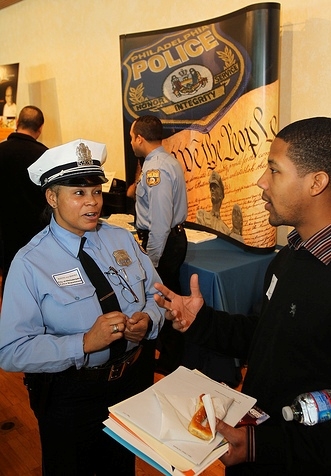
Hiring Our Heroes event at the Philadelphia Independence Seaport Museum

Hiring Our Heroes 100th hiring fair at the Philadelphia Independence Seaport Museum, Philadelphia, Pennsylvania March 2, 2012. (by Ian Wagreich/U.S. Chamber of Commerce)

President Obama Honors Iraq Veterans at the White House

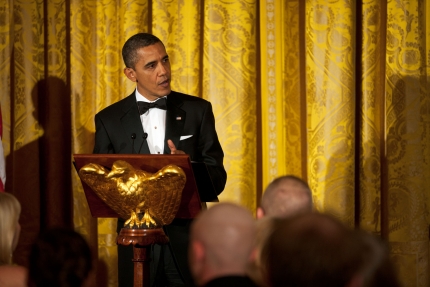
President Barack Obama delivers remarks at a dinner to honor Iraq War Veterans

President Barack Obama delivers remarks at a Department of Defense dinner in the East Room of the White House, Feb. 29, 2012. The President and Mrs. Obama hosted the dinner to honor Armed Forces who served in Operation Iraqi Freedom and Operation New Dawn, and to honor their families. (Official White House Photo by Lawrence Jackson)

President Obama, First Lady Michelle Obama, Vice President Joe Biden and Dr Jill Biden tonight welcomed a group of true American heroes to the White House. “A Nation’s Gratitude: Honoring those who served in Operation Iraqi Freedom and Operation New Dawn” was a formal dinner that paid tribute to our Iraq veterans and marked the end of the war.

More than 100 service members and their guests were in attendance, and the invitees included men and women in uniform from all ranks, each U.S. state and territory, and every branch of the Armed Forces. Together, they represented the million American troops who served in Iraq, and they also represented  what Vice President Joe Biden called the finest generation of warriors in all of history.

In his remarks, the President welcomed the veterans home, praised their bravery and dedication to their mission, and thanked them on behalf of more than 300 million Americans: 

Tonight, what we can do is convey what you’ve meant to the rest of us. Because through the dust and the din and the fog of war, the glory of your service always shone through. In your noble example, we see the virtues and the values that sustain America, that keep this country great.  

You taught us about duty. Blessed to live in the land of the free, you could have opted for an easier path. But you know that freedom is not free. And so you volunteered and you stepped forward, and you raised your hand and you took an oath -- to protect and defend; to serve a cause greater than yourself, knowing, in a time of war, you could be sent into harm’s way. 

You taught us about resolve. Invasion turned to insurgency and then sectarian strife. But you persevered, tour after tour, year after year.  Indeed, we’re mindful that even as we gather here, Iraq veterans continue to risk their lives in Afghanistan, and our prayers are with them all tonight.  

In one of our nation’s longest wars, you wrote one of the most extraordinary chapters in American military history. Now the Iraqi people have a chance to forge their own destiny, and every one of you who served there can take pride in knowing you gave the Iraqis this opportunity; that you succeeded in your mission.        

President Obama Honors Iraq Vets With White House Dinner

Tonight, a group of Iraq veterans will join President Obama and the First Lady for a formal dinner at the White House to mark the end of the war.

Around 80 service members and their guests will be in attendance.

Those invited include men and women in uniform from all ranks, each U.S. state and territory, and every branch of the Armed Forces. Together, they are representative of the hundreds of thousands of Americans who served in Iraq.

As the last American troops left the country, we put together a timeline to show what it took to end combat operations and begin fulfilling the promise we as a nation owe to those who served.

Go check it out.

First Lady Michelle Obama and Dr. Jill Biden Speak on Military Spouse Employment

February 27, 2012 | 19:11 | Public Domain

The First Lady and Dr. Jill Biden speak to governors about their Joining Forces initiative to help military spouses more easily transfer professional licenses across state lines.

Download mp4 (183MB) | mp3 (18MB)

Read the Transcript

Remarks by the First Lady and Dr. Biden Discussing Military Spouse Employment at National Governors Association Annual Meeting

State Dining Room

10:49 A.M. EST

DR. BIDEN:  Thank you.  (Applause.)  Thank you, David, and thank you all for coming.  It was great to see you all here last night -- what a wonderful evening.  And we're so delighted to have you here again at the White House this morning.

The last time we were together, Michelle and I talked to you about our idea for the Joining Forces initiative:  to honor, recognize and support military families.  And in this last year, we've made tremendous progress.  Since we launched Joining Forces in April, we've been so delighted by the response from Americans all over this country.  Businesses have hired tens of thousands of veterans and military spouses.  Medical schools have committed to educate their students about post-traumatic stress and traumatic brain injuries.  Schools, community organizations and Americans of every age and background have sent care packages, donated childcare, and created community celebrations for the military families in their neighborhoods.

These Americans are stepping up because they appreciate how much our military spouses and families do for our country every day.  What we have seen since launching Joining Forces has been truly gratifying, because it has shown our military families that all of us appreciate their sacrifices on their behalf.

But there is more to do.  We would like to talk to you today about one of the top concerns we hear from military spouses wherever we go:  professional licensing.  I know that many of you hear from folks in your state as well. 

A few days ago, Michelle and I went to the Pentagon to help unveil a new report from the Departments of Defense and Treasury about professional licensing for military spouses.  The report found that military spouses move 10 times more than their civilian counterparts, and that 35 percent of spouses in the workforce are in jobs that require a professional license.  Because military transfers often require spouses to move from state to state, the issue of license portability is a real challenge for military spouses.  As Michelle will discuss, there are ways we can work together to ease this burden, and we look forward to doing just that.

So thank you all for what you're doing in your home states, and please join me in welcoming my dear friend and partner in Joining Forces, First Lady Michelle Obama.  (Applause.)

MRS. OBAMA:  Good morning, everyone, and welcome back.  I hope everybody got a little sleep.  (Laughter.)  Just a little bit.  But we had a terrific time last night.  And the mood was good, and hopefully you all enjoyed yourselves as well.  It's always wonderful to host you for this weekend.

I want to thank Jill, not just for her introduction but for just being a terrific partner and, more importantly, a friend over the past few years, and on this issue in particular.  As a Blue Star mom, Jill knows these issues as well as anyone.  And she has been just a terrific champion, and on ensuring that we're moving things forward.

Now, as Jill has said, this new licensing portability initiative is one of the most important and meaningful issues that we've addressed through Joining Forces.  It is the number-one frustration that Jill and I hear about every time we visit with military spouses -- and that’s really saying something.  Because the truth is, is that these women and men are facing plenty of very serious challenges in their lives.  They are raising their kids and running their household, oftentimes alone, while they have a spouse deployed.  These are the folks who are cooking those meals, they're leading the PTA, they're answering all those questions from their children about when mom or dad will be coming home.  And many of them are doing all of this while trying to hold down full-time jobs.

But the truth is that no matter what is on their plates -- and this is what always impresses us -- no matter what their country asks of them, these men and women, they never complain.  They never complain.  And I know that many of our spouses understand that when they interact with military families.  These people never ask for much.  They just keep pushing forward.

So when they do bring something to our attention, when they do come to Jill and I and they ask for our help, when they do let us know that something is a real problem for them, then we know it's serious.  We know it's time for us to take a look and figure out whether there's something that we can do.  And when you hear about how -- some of these licensing stories, what's going on, then you start to understand why they’re beginning to get frustrated.

So take the story of Kelly Crowley.  Kelly is a nurse, she’s an army wife and she’s an expectant mother.  She has been married to her husband for four years and in those four years -- and this is very typical -- Kelly has lived in three different states, which means that every year or so she’s had to gather up her college transcripts, sign and notarize a pile of documents, and pay application costs, and then wait for all of that to clear.

And she estimates that the constant moves have cost her about six months of paychecks.  Six months of paychecks from a woman who wants to work, a woman serving our country.  Six months of paychecks.  And the whole process can be so cumbersome that she’s not even sure that she’s going to go through it again for her family’s next assignment.  She’s ready to walk away from her career because the burdens are so great.

And of course this doesn’t just happen to nurses -- it is happening to teachers, it’s happening to childcare providers, accountants, real estate brokers, dental hygienists, social workers -- I mean, go on and on.  Think of the careers that require some level of licensing and these men and women are being affected.  And in total, more than 100,000 military spouses are affected by this maze of credentialing and requirements -- 100,000 men and women.  And far too often they’re forced to take entry-level classes, or pay hundreds of dollars in fees, or wait weeks or months for their paperwork to be processed all before they can even get a job; can’t even work until all this is done.

And the vast majority of these spouses are clearly qualified -- this isn’t an issue of these men and women being qualified and ready to work.  They’ve got the right skills, they’ve worked in their fields for years, many of them, but so often that doesn’t matter.  It doesn’t count.  Their skills still go unused and, more importantly, their families go without the crucial source of income that so many of them need.  Many of these families survive because they have two incomes.  And unfortunately many career ambitions are just derailed.  So, again, you can see why many of these spouses are frustrated.

Now I want to emphasize that these state standards are extremely important.  They ensure that our professionals meet a level of excellence that gives us all peace of mind when we step into a hospital or we sign our kids up for school.  So I want to be clear that we are not asking any state to change a single professional standard.  And we’re certainly not asking anyone to set a lower bar for our military spouses -- they’re the first ones who don’t want exceptions to the rule for them.  But what we are asking is for a level playing field.  We just want to make sure that these spouses have a fair shot to pursue their careers and support their families.

And of course that’s where all of you come in.  Each of you has a unique opportunity to make a real difference for these families that have given all of us so much.  Some of you have already done this -- some of you have already stepped up, including Governor Gregoire in Washington, Governor Scott in Florida, Governor Nixon in Missouri, Governor Parnell in Alaska.  In total, 12 governors have signed legislation to fix these licensing issues for military spouses, and of course we want to thank you all for leading the way.

And here’s what’s important:  Each of those 12 states found its own solution, whatever worked for them.  Some states are doing things like granting temporary licenses so that military spouses can get to work right away.  Others have given state licensing boards or agencies increased flexibility to grant licenses to military spouses who clearly demonstrate their competence.  And still others have found ways to grant licenses upon application and then verify the documentation as the spouse earns a paycheck.

And many more states are working on legislation as we speak -- California, Louisiana, Illinois and Wyoming have introduced bills in the last two weeks.  Governor Brownback just signed Kansas’ bill on Valentine’s Day, a lovely gift.  But roughly half of the country still hasn’t taken this issue on.  And that's why Jill and I are here today.

As part of Joining Forces, we have set what we hope is an ambitious but achievable goal in that, by 2014, we would love to see all 50 states having passed their own legislation to address this issues -- by 2014.  The goal is a key priority for this administration.  Secretary Panetta is behind it.  General Dempsey and all of the Joint Chiefs are behind it.  The President, of course, the Vice President -- they don't have a choice.  (Laughter.)  But they do support it.  (Laughter.)

But the people who have the biggest impact are right here in this room.  Truly, you all have the power in this instance.  No one can make a difference on this issue like all of you -- no one.  And I’m not just talking about those of you with "Governor" behind your name.  You’re really important and all, but we also have wonderful first spouses. 

I mean, just look at what First Lady Jane Beshear has done in Kentucky.  Now, Jane has formed a statewide team of military spouses who are tackling issues like education and employment in that state.  She’s worked with state higher education leaders to streamline admissions processes for military spouses.  She has testified in front of the state house.  And she has done all of this in just a year.

In fact, Jane told me that after the last governors’ spouses, she was so moved by what we had talked about that she went back to her state and she figured out exactly what she could do to push this issue ahead.

So every single person in this room has a role to play in supporting our military families.  And I am here, as well as Jill, to ask for your help -- as simple as that.  If your state has not addressed license portability for military spouses yet, today I want to ask you to make this issue a priority.  Work with the leaders in your states to get a bill introduced.  Use your bully pulpit to get it passed.  Share military spouses' stories with your local media and your state legislators. 

If you have already passed a law in your state, we encourage you to reach out to one or two of your fellow governors or spouses who are just getting started.  Share your experience.  Encourage them along the way.  Help us finish this job.  And we will be helping as much as we can.  We have a plan in place to be supportive.  Like Jill said, the report from the Department of Defense and Treasury is full of wonderful tips and best practices to help all of you find solutions that work for your state.  And that’s really the point.  There is no one-size-fits-all solution here.  And this report is really designed to offer some ideas to get things started.

Your staffs have received a copy of this report already, and all of your spouses will get one today as well.  And on top of that, the Defense Department's team of state liaisons are here to help you craft legislation, if needed, and usher it through your state houses.  In fact, we've got Ed Kringer -- Ed, where you are sitting, Ed?  Ed is here from the Department of Defense, and Ed will be available after this session to answer any questions to help get you started in the process.

And Jill and I are going to keep working, keep the light on this issue.  We're also going to be working with groups like the American Bar Association and the National Military Family Association to support your efforts at the grassroots level.  They all stand ready to try to find ways to be helpful on this issue.  So you're not in this alone.  Joining Forces has been a wonderful instrument just to raise the bar, to shine a light on these issues.  And we will continue to use this platform to be supportive and proactive.

And that’s really the thing about supporting military families that Jill and I have discovered through our work:  It is something that everyone can get behind.  It really is.  Everyone feels this, and if they don’t, they just don’t know the stories.  And once they hear the stories, they're right there.  That is what we have seen since the day we first started Joining Forces.  No matter who you are or where you come from, we are all so proud of our men and women in uniform and their families.  We all are, and we all want to do everything we can to honor and to support these men and women, and these wonderful children who are sacrificing right alongside of their parents.

And taking on this licensing issue is a perfect way to do just that.  It’s really the perfect opportunity because if we fix this, we don't just support our military spouses as they advance in their careers, which is important, but we’ll also be supporting their families who really depend on these incomes.  We will be supporting the entire military, which can more easily retain married troops if their spouses can pursue their career.  This is a retention issue.

We’ll be infusing our schools and our hospitals and our businesses with much needed, talented and experienced workers who are ready to be out there doing the job.  We will be strengthening our economy by lowering our unemployment rate and increasing our productivity by getting these hundreds of thousands of men and women into the workforce.

And you all can do all of this -- here’s the punch line -- with little or no cost.  Little or no cost.  It’s one of those things that, again, doesn't -- as other state governors will share, it doesn't have to kill the budget, and it can be done in a bipartisan way, even more importantly.  All it takes is a leader who can lead the charge for these families who serve our country so bravely.

These men and women have risked so much for all of us.  They do it for each and every one of us, and they ask so little in return, so very little.  So when they call on us, we have got a solemn obligation to answer that call.

In two years, what I hope we are able to say -- we can look these men and women in the eye and say, we heard you and we acted.  We heard you.  The one -- the few things you’ve asked for, we heard you, and we all stepped up as a nation to make it happen.  And that's really what Joining Forces is all about.

So we look forward to continuing these efforts to working with all of you in the months ahead to serve our military families as well as they serve us.  So we will be there.  We’re going to be checking in.  We’re going to nag a little bit and poke, make a few calls.  You have not heard the last of us.  (Laughter.) 

But we are excited by what this will mean to so many of these men and women.  That is the one thing we hear.  Many of them just say thank you -- thank you for recognizing that we exist and that these issues are important to us. 

So we look forward to seeing this goal achieved by 2014, and we’ll be talking to your spouses more about this shortly at lunch.

So thank you all, and take care.  (Applause.)

END
11:09 A.M. EST
Close Transcript

First Lady and Dr. Biden Urge Action from State Governors on Military Spouse Hiring

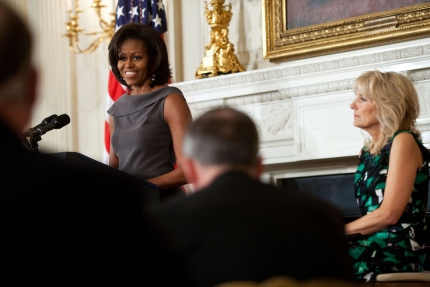
First Lady Michelle Obama and Dr. Jill Biden at the 2012 NGA meeting (February 27, 2012)

First Lady Michelle Obama and Dr. Jill Biden discuss military spouse employment at the National Governors Association annual meeting in the State Dining Room of the White House, Feb. 27, 2012. (Official White House Photo by Lawrence Jackson)

Earlier this morning, the First Lady and Dr. Jill Biden addressed the National Governors Association (NGA) Winter Meeting, the annual meeting that brings state leaders to Washington, D.C. to discuss important issues impacting all Americans.

Today, the First Lady and Dr Biden had one message for the governors: urging them to take action on the state level to support America’s military spouses. 

In their travels to military bases across America and throughout the world over the last three years, the First Lady and Dr. Biden have heard stories from countless military family members and spouses.  One of the top issues they hear about everywhere they go deals with the professional licensing requirements that affect how military spouses can move forward in their careers. 

Less than two weeks ago, the First Lady and Dr. Biden joined the Secretary of Defense, the Chairman of the Joint Chiefs of Staff and all of the Joint Chiefs in rolling out a new report on state licensing.   

This is an enormous issue for military spouses throughout this country. There are more than 100,000 military spouses who serve in the dozens of professions that require a state license or credential – teachers, nurses, childcare providers, dental hygienists, real estate brokers, speech pathologists and many other professionals. Each move to a new state can mean different credentialing or licensing standards – a process that can sometimes take months to resolve.  

Read the rest

The White House

Office of the First Lady

Remarks by the First Lady and Dr. Biden Discussing Military Spouse Employment at National Governors Association Annual Meeting

State Dining Room

10:49 A.M. EST

DR. BIDEN:  Thank you.  (Applause.)  Thank you, David, and thank you all for coming.  It was great to see you all here last night -- what a wonderful evening.  And we're so delighted to have you here again at the White House this morning.

The last time we were together, Michelle and I talked to you about our idea for the Joining Forces initiative:  to honor, recognize and support military families.  And in this last year, we've made tremendous progress.  Since we launched Joining Forces in April, we've been so delighted by the response from Americans all over this country.  Businesses have hired tens of thousands of veterans and military spouses.  Medical schools have committed to educate their students about post-traumatic stress and traumatic brain injuries.  Schools, community organizations and Americans of every age and background have sent care packages, donated childcare, and created community celebrations for the military families in their neighborhoods.

These Americans are stepping up because they appreciate how much our military spouses and families do for our country every day.  What we have seen since launching Joining Forces has been truly gratifying, because it has shown our military families that all of us appreciate their sacrifices on their behalf.

But there is more to do.  We would like to talk to you today about one of the top concerns we hear from military spouses wherever we go:  professional licensing.  I know that many of you hear from folks in your state as well. 

A few days ago, Michelle and I went to the Pentagon to help unveil a new report from the Departments of Defense and Treasury about professional licensing for military spouses.  The report found that military spouses move 10 times more than their civilian counterparts, and that 35 percent of spouses in the workforce are in jobs that require a professional license.  Because military transfers often require spouses to move from state to state, the issue of license portability is a real challenge for military spouses.  As Michelle will discuss, there are ways we can work together to ease this burden, and we look forward to doing just that.

So thank you all for what you're doing in your home states, and please join me in welcoming my dear friend and partner in Joining Forces, First Lady Michelle Obama.  (Applause.)

MRS. OBAMA:  Good morning, everyone, and welcome back.  I hope everybody got a little sleep.  (Laughter.)  Just a little bit.  But we had a terrific time last night.  And the mood was good, and hopefully you all enjoyed yourselves as well.  It's always wonderful to host you for this weekend.

I want to thank Jill, not just for her introduction but for just being a terrific partner and, more importantly, a friend over the past few years, and on this issue in particular.  As a Blue Star mom, Jill knows these issues as well as anyone.  And she has been just a terrific champion, and on ensuring that we're moving things forward.

Now, as Jill has said, this new licensing portability initiative is one of the most important and meaningful issues that we've addressed through Joining Forces.  It is the number-one frustration that Jill and I hear about every time we visit with military spouses -- and that’s really saying something.  Because the truth is, is that these women and men are facing plenty of very serious challenges in their lives.  They are raising their kids and running their household, oftentimes alone, while they have a spouse deployed.  These are the folks who are cooking those meals, they're leading the PTA, they're answering all those questions from their children about when mom or dad will be coming home.  And many of them are doing all of this while trying to hold down full-time jobs.

But the truth is that no matter what is on their plates -- and this is what always impresses us -- no matter what their country asks of them, these men and women, they never complain.  They never complain.  And I know that many of our spouses understand that when they interact with military families.  These people never ask for much.  They just keep pushing forward.

So when they do bring something to our attention, when they do come to Jill and I and they ask for our help, when they do let us know that something is a real problem for them, then we know it's serious.  We know it's time for us to take a look and figure out whether there's something that we can do.  And when you hear about how -- some of these licensing stories, what's going on, then you start to understand why they’re beginning to get frustrated.

So take the story of Kelly Crowley.  Kelly is a nurse, she’s an army wife and she’s an expectant mother.  She has been married to her husband for four years and in those four years -- and this is very typical -- Kelly has lived in three different states, which means that every year or so she’s had to gather up her college transcripts, sign and notarize a pile of documents, and pay application costs, and then wait for all of that to clear.

And she estimates that the constant moves have cost her about six months of paychecks.  Six months of paychecks from a woman who wants to work, a woman serving our country.  Six months of paychecks.  And the whole process can be so cumbersome that she’s not even sure that she’s going to go through it again for her family’s next assignment.  She’s ready to walk away from her career because the burdens are so great.

And of course this doesn’t just happen to nurses -- it is happening to teachers, it’s happening to childcare providers, accountants, real estate brokers, dental hygienists, social workers -- I mean, go on and on.  Think of the careers that require some level of licensing and these men and women are being affected.  And in total, more than 100,000 military spouses are affected by this maze of credentialing and requirements -- 100,000 men and women.  And far too often they’re forced to take entry-level classes, or pay hundreds of dollars in fees, or wait weeks or months for their paperwork to be processed all before they can even get a job; can’t even work until all this is done.

And the vast majority of these spouses are clearly qualified -- this isn’t an issue of these men and women being qualified and ready to work.  They’ve got the right skills, they’ve worked in their fields for years, many of them, but so often that doesn’t matter.  It doesn’t count.  Their skills still go unused and, more importantly, their families go without the crucial source of income that so many of them need.  Many of these families survive because they have two incomes.  And unfortunately many career ambitions are just derailed.  So, again, you can see why many of these spouses are frustrated.

Now I want to emphasize that these state standards are extremely important.  They ensure that our professionals meet a level of excellence that gives us all peace of mind when we step into a hospital or we sign our kids up for school.  So I want to be clear that we are not asking any state to change a single professional standard.  And we’re certainly not asking anyone to set a lower bar for our military spouses -- they’re the first ones who don’t want exceptions to the rule for them.  But what we are asking is for a level playing field.  We just want to make sure that these spouses have a fair shot to pursue their careers and support their families.

And of course that’s where all of you come in.  Each of you has a unique opportunity to make a real difference for these families that have given all of us so much.  Some of you have already done this -- some of you have already stepped up, including Governor Gregoire in Washington, Governor Scott in Florida, Governor Nixon in Missouri, Governor Parnell in Alaska.  In total, 12 governors have signed legislation to fix these licensing issues for military spouses, and of course we want to thank you all for leading the way.

And here’s what’s important:  Each of those 12 states found its own solution, whatever worked for them.  Some states are doing things like granting temporary licenses so that military spouses can get to work right away.  Others have given state licensing boards or agencies increased flexibility to grant licenses to military spouses who clearly demonstrate their competence.  And still others have found ways to grant licenses upon application and then verify the documentation as the spouse earns a paycheck.

And many more states are working on legislation as we speak -- California, Louisiana, Illinois and Wyoming have introduced bills in the last two weeks.  Governor Brownback just signed Kansas’ bill on Valentine’s Day, a lovely gift.  But roughly half of the country still hasn’t taken this issue on.  And that's why Jill and I are here today.

As part of Joining Forces, we have set what we hope is an ambitious but achievable goal in that, by 2014, we would love to see all 50 states having passed their own legislation to address this issues -- by 2014.  The goal is a key priority for this administration.  Secretary Panetta is behind it.  General Dempsey and all of the Joint Chiefs are behind it.  The President, of course, the Vice President -- they don't have a choice.  (Laughter.)  But they do support it.  (Laughter.)

But the people who have the biggest impact are right here in this room.  Truly, you all have the power in this instance.  No one can make a difference on this issue like all of you -- no one.  And I’m not just talking about those of you with "Governor" behind your name.  You’re really important and all, but we also have wonderful first spouses. 

I mean, just look at what First Lady Jane Beshear has done in Kentucky.  Now, Jane has formed a statewide team of military spouses who are tackling issues like education and employment in that state.  She’s worked with state higher education leaders to streamline admissions processes for military spouses.  She has testified in front of the state house.  And she has done all of this in just a year.

In fact, Jane told me that after the last governors’ spouses, she was so moved by what we had talked about that she went back to her state and she figured out exactly what she could do to push this issue ahead.

So every single person in this room has a role to play in supporting our military families.  And I am here, as well as Jill, to ask for your help -- as simple as that.  If your state has not addressed license portability for military spouses yet, today I want to ask you to make this issue a priority.  Work with the leaders in your states to get a bill introduced.  Use your bully pulpit to get it passed.  Share military spouses' stories with your local media and your state legislators. 

If you have already passed a law in your state, we encourage you to reach out to one or two of your fellow governors or spouses who are just getting started.  Share your experience.  Encourage them along the way.  Help us finish this job.  And we will be helping as much as we can.  We have a plan in place to be supportive.  Like Jill said, the report from the Department of Defense and Treasury is full of wonderful tips and best practices to help all of you find solutions that work for your state.  And that’s really the point.  There is no one-size-fits-all solution here.  And this report is really designed to offer some ideas to get things started.

Your staffs have received a copy of this report already, and all of your spouses will get one today as well.  And on top of that, the Defense Department's team of state liaisons are here to help you craft legislation, if needed, and usher it through your state houses.  In fact, we've got Ed Kringer -- Ed, where you are sitting, Ed?  Ed is here from the Department of Defense, and Ed will be available after this session to answer any questions to help get you started in the process.

And Jill and I are going to keep working, keep the light on this issue.  We're also going to be working with groups like the American Bar Association and the National Military Family Association to support your efforts at the grassroots level.  They all stand ready to try to find ways to be helpful on this issue.  So you're not in this alone.  Joining Forces has been a wonderful instrument just to raise the bar, to shine a light on these issues.  And we will continue to use this platform to be supportive and proactive.

And that’s really the thing about supporting military families that Jill and I have discovered through our work:  It is something that everyone can get behind.  It really is.  Everyone feels this, and if they don’t, they just don’t know the stories.  And once they hear the stories, they're right there.  That is what we have seen since the day we first started Joining Forces.  No matter who you are or where you come from, we are all so proud of our men and women in uniform and their families.  We all are, and we all want to do everything we can to honor and to support these men and women, and these wonderful children who are sacrificing right alongside of their parents.

And taking on this licensing issue is a perfect way to do just that.  It’s really the perfect opportunity because if we fix this, we don't just support our military spouses as they advance in their careers, which is important, but we’ll also be supporting their families who really depend on these incomes.  We will be supporting the entire military, which can more easily retain married troops if their spouses can pursue their career.  This is a retention issue.

We’ll be infusing our schools and our hospitals and our businesses with much needed, talented and experienced workers who are ready to be out there doing the job.  We will be strengthening our economy by lowering our unemployment rate and increasing our productivity by getting these hundreds of thousands of men and women into the workforce.

And you all can do all of this -- here’s the punch line -- with little or no cost.  Little or no cost.  It’s one of those things that, again, doesn't -- as other state governors will share, it doesn't have to kill the budget, and it can be done in a bipartisan way, even more importantly.  All it takes is a leader who can lead the charge for these families who serve our country so bravely.

These men and women have risked so much for all of us.  They do it for each and every one of us, and they ask so little in return, so very little.  So when they call on us, we have got a solemn obligation to answer that call.

In two years, what I hope we are able to say -- we can look these men and women in the eye and say, we heard you and we acted.  We heard you.  The one -- the few things you’ve asked for, we heard you, and we all stepped up as a nation to make it happen.  And that's really what Joining Forces is all about.

So we look forward to continuing these efforts to working with all of you in the months ahead to serve our military families as well as they serve us.  So we will be there.  We’re going to be checking in.  We’re going to nag a little bit and poke, make a few calls.  You have not heard the last of us.  (Laughter.) 

But we are excited by what this will mean to so many of these men and women.  That is the one thing we hear.  Many of them just say thank you -- thank you for recognizing that we exist and that these issues are important to us. 

So we look forward to seeing this goal achieved by 2014, and we’ll be talking to your spouses more about this shortly at lunch.

So thank you all, and take care.  (Applause.)

END
11:09 A.M. EST

First Lady and Dr. Biden Urge Action from State Governors on Military Spouse Hiring

First Lady Michelle Obama and Dr. Jill Biden at the 2012 NGA meeting (February 27, 2012)

First Lady Michelle Obama and Dr. Jill Biden discuss military spouse employment at the National Governors Association annual meeting in the State Dining Room of the White House, Feb. 27, 2012. (Official White House Photo by Lawrence Jackson)

Earlier this morning, the First Lady and Dr. Jill Biden addressed the National Governors Association (NGA) Winter Meeting, the annual meeting that brings state leaders to Washington, D.C. to discuss important issues impacting all Americans.

Today, the First Lady and Dr Biden had one message for the governors: urging them to take action on the state level to support America’s military spouses. 

In their travels to military bases across America and throughout the world over the last three years, the First Lady and Dr. Biden have heard stories from countless military family members and spouses.  One of the top issues they hear about everywhere they go deals with the professional licensing requirements that affect how military spouses can move forward in their careers. 

Less than two weeks ago, the First Lady and Dr. Biden joined the Secretary of Defense, the Chairman of the Joint Chiefs of Staff and all of the Joint Chiefs in rolling out a new report on state licensing.   

This is an enormous issue for military spouses throughout this country. There are more than 100,000 military spouses who serve in the dozens of professions that require a state license or credential – teachers, nurses, childcare providers, dental hygienists, real estate brokers, speech pathologists and many other professionals. Each move to a new state can mean different credentialing or licensing standards – a process that can sometimes take months to resolve.  

As part of their address to military families and Pentagon leadership, the First Lady and Dr. Biden announced an ambitious goal: for 50 states to pass legislation that supports military spouse license portability by 2014. 

The White House

Office of the First Lady

Remarks by the First Lady at a DNC Event -- Louisville, KY

Kentucky Center for African American Heritage Museum
Louisville, Kentucky

5:26 P.M. EST
 
MRS. OBAMA:  Yes!  (Applause.)  Wow.  Thank you so much.  Oh, you all are already fired up.  I can just leave now, right?  (Applause.)  It is so good to be back.  I am just honored to be here with all of you.  This is truly amazing.
 
Let me start by just saying a few thank-yous.  First, Representative Yarmuth, thank you for that very kind introduction, and thank you for your leadership and your service in Congress.  You are doing an amazing job.  (Applause.)  Absolutely. 
 
I also want to recognize your governor, Governor Beshear, and Mayor Fischer, who are both here, who have been amazing.  (Applause.)  Thank you both for being here, for leading the way, for having our backs in so many ways.  It means a great deal.
 
And I'd like to thank our dear friend, Matt Barzun, who is our national finance chair.  (Applause.)  He is terrific.  He is so on point.  We love him to death, as well as our wonderful hosts who have made this event such a tremendous success -- Christy Brown, Brooke Pardue, and Carolyn Tandy as well.  Let's give them a big round of applause.  Thank you all for your hard work.  (Applause.)  This is amazing.  Amazing venue.  It's good to be here.  (Applause.) 
 
And finally, I want to thank all of you.  Thank you so much for your support, and thank you for being here with us today.  And I know that there is a reason why you are all here, packed in together tightly.  (Laughter.)  You’re here because you know that we stand at a fundamental crossroads for our country.  And you’re here because you know that in less than a year from now -- because it's coming up, right? -- we are going to make a choice that will impact our lives for decades to come.  And you’re here because you know that choice won’t just affect all of us; it will affect our children, and our grandchildren, and more importantly, the world we leave for them long after we’re gone.
 
And believe me, that is why I am here today.  That's why I'm going to be traveling all across the country.  I am so fired up.  (Applause.)  See, as First Lady, I have had the privilege of traveling all across this magnificent country, and I get to meet folks from all different kinds of backgrounds and I get to hear what’s going on in their lives.  Every day, I hear about how folks are struggling -- the bills they're trying to pay; the businesses they're trying to keep afloat.  I hear about how folks are taking that extra shift, they're working that extra job, they're doing whatever they have to -- they're saving, they're sacrificing, never spending a dime on themselves because they desperately want something better for their kids.
 
And make no mistake about it, these struggles that I'm talking about, these are not new.  For decades now -- decades -- middle-class folks have been squeezed from all sides.  See, the cost of things like gas, groceries, tuition -- prices continuing to rise, but people’s paychecks just haven’t kept up.  And when this economic crisis hit, for far too many families the bottom just completely fell out.
 
Now, over the past three years, your President has worked very hard to dig ourselves out of this mess.  (Applause.)  And a lot of progress has been made.  We have had 23 straight months of private sector job growth -- (applause) -- and unemployment is now the lowest it has been in three years.  (Applause.)
 
But we know that we still have a long way to go.  We've got a lot of work to do.  And we’ve been working hard to rebuild our economy based on a vision that we all share -- the belief, as my husband says, that hard work should pay off in this country; that responsibility should be rewarded; and that everyone -- everyone -- should get a fair shot, they should do their fair share, and they should play by the same rules.  (Applause.)
 
See, as we all know, these are basic American values -- basic.  They’re the values that so many of us were raised with, including myself.  See, my father, as you know -- my father was a blue-collar worker, working at the city water plant.  My family lived in a little-bitty apartment -- this is where I grew up -- little-bitty apartment on the South Side of Chicago.  Neither of my parents went to college, but let me tell you what they did do:  They worked hard -- (applause) -- they saved, and they sacrificed, because, see, my parents, like so many of our parents, wanted something more for me and my brother.
 
And more than anything else, that is what’s at stake.  That's what's at stake -- that fundamental promise that no matter who you are, no matter how you started out, if you work hard, you can build a decent life for yourself, and an even better life for your kids.  (Applause.)  Basic.  And on just about every issue -- from health care to education to the economy -- that is the choice we face.  That's the choice.
 
For example, when you hear all this talk about tax cuts for middle-class families; you hear about unemployment insurance for folks out of work -- let me tell you, that is about whether people can heat their homes.  That's what they're talking about.  (Applause.)  Whether a family can put a hot meal on the table, or gas in their car so that they can even look for work.  That's what that's about.  It’s about whether folks can afford to own a home, send their kids to college, retire with a little dignity, just a little security.  It’s about whether people will have more money in their pockets, which means more money in our economy, which means more jobs.  That's what it's about.  That's what's at stake here.  That is the choice that we face.  (Applause.)
 
And think for -- just for a minute about what this President has done to stand up for the American consumers.  I’m talking about families getting hit with those hidden credit card fees, right?  I’m talking about students -- our young people -- (applause) -- drowning in debt.  I'm talking about our seniors losing their homes and their savings because they were tricked into loans they couldn’t afford, probably couldn't even understand.
 
And that is why my husband created a new consumer watchdog with just one simply mission.  (Applause.)  That is:  To protect folks from exactly these kind of abuses.  That's why he did it.  Because he believes that when you’ve worked hard, when you’ve saved, when you’ve followed the rules, you shouldn’t lose it all to someone just looking to make some easy money.  See, that’s not fair.  That’s not right.  And believe me, your President is working hard to do something about it.  (Applause.)
 
And what about all that we’ve done for our small businesses?  Our small businesses.  See, these are the companies that create two-thirds -- two-thirds of all new jobs each year in this economy.  I'm talking about the mom who opens up the drycleaning store on the corner to provide for her kids.  I'm talking about the family that’s running that neighborhood diner -- has been running it for generations.  That's who we're talking about.  I'm talking about the veteran who launches a startup and pursues that American Dream that he fought so hard for.  See, these are the folks who work themselves to the bone during the day, and then they head home and they pore over their books late into the night, determined to make those numbers add up.
 
See, for these folks, the small business tax cuts that this administration has passed, this means the difference between these folks hiring new employees or handing out pink slips.  This is the difference between those businesses keeping their doors open or closing up shop for good.  That is the choice that we face.
 
And how about the very first bill my husband signed into law, the Lilly Ledbetter Fair Pay Act to make sure that women get equal pay for equal work.  (Applause.)  And he did this because he knows what it means when women aren’t treated fairly in the workplace.  I mean, he watched his own grandmother -- a woman with just a high school education -- she worked her way up to become a vice president at a little community bank.  And his grandmother worked hard and she was good at her job, but like so many women she hit that glass ceiling, and she watched men no more qualified than she was -- men she had actually trained -- be promoted up the ladder ahead of her. 
 
So believe me, for Barack, this is not abstract, this issue.  This isn't some hypothetical thing he's talking about.  He signed this bill because he knows that closing that pay gap can mean the difference between women losing $50, $100, $500 from each paycheck, or having that money in their pockets to buy gas and groceries and put clothes on the backs of their kids.  He did it because when nearly two-thirds of women are breadwinners or co-breadwinners, he knows that women's success in this economy is the key to families' success in this economy.  (Applause.)
 
We believe that here in America, there are no second-class citizens in our workplace.  (Applause.)  That is what’s at stake in this election.  Understand, that's what’s at stake.
 
And let’s just talk for just a minute about health care.  Right?  (Applause.)  Because last year, we made history together by finally passing health reform.  (Applause.)  Amen.
 
But now there are some folks actually talking about repealing this reform.
 
AUDIENCE:  No!
 
MRS. OBAMA:  So today the question for us is, are we going to stand by and let that happen?
 
AUDIENCE:  No!
 
MRS. OBAMA:  Understand that since we passed this law, millions of our senior citizens have saved an average of more than $600 a year on their prescription drugs.  (Applause.)   So the question becomes, are we going to take those savings away from our seniors?
 
AUDIENCE:  No!
 
MRS. OBAMA:  Or will we make sure that our parents and our grandparents can afford to stay healthy in their golden years?  What are we going to do?  Are we going to go back to the days when insurance companies could deny our children coverage because they have pre-existing conditions, things like cancer, diabetes, even asthma?  Or will we stand up and say that in this country no one should ever have to choose between going bankrupt or watching their child suffer because they can't afford a doctor?  (Applause.)  What are we going to do?
 
And when our kids get older and graduate from school, we all know how hard it’s going to be for them to find jobs with good insurance, right?  That's why, as part of health reform, kids can now stay on their parents’ insurance until they’re 26 years old.  (Applause.)  And today that is how 2.5 million of our young people are getting their health coverage.  So the question is, will we take that away from all of our kids?
 
AUDIENCE:  No!
 
MRS. OBAMA:  Or will we say that we don't want our sons and our daughters going out into the world without health care when they're just starting out, trying to build their families, trying to develop their careers on their own?
 
But that is the choice we face.  That's the choice.
 
And think, for just a moment, about what’s been done in this administration on education.  I mean, think about all those investments to raise standards and reform our public schools.  We all know what this is about.  See, this is about improving the circumstances for millions of our children -- kids we know are sitting in crumbling classrooms; kids that we know have so much promise; kids who could be anything in the world they want if we just gave them a chance.  That's what this is about.  (Applause.)
 
And think about how we’ve tripled investments for job training at community colleges.  This is about hundreds of thousands of hardworking folks who are determined to get the skills they need for a better job and better wages.  See, these are the folks -- they're doing everything that they're supposed to do.  They're working full-time.  They're raising their kids.  But they still make it to class every evening, study late into the night -- because why?  They desperately want something better for their families.
 
And, please, make no mistake about it, these kind of investments in our students, in our workers will determine nothing less than the future of our economy.  (Applause.)  It’s going to determine whether we’re prepared to make the discoveries and to build the industries that will let us compete with any country anywhere in the world.  That is what’s at stake.  That's what we’re talking about.
 
And let’s not forget what it meant when my husband appointed those two brilliant Supreme Court justices -- (applause) -- and for the first time in history, our daughters and our sons watched three women take their seat on our nation’s highest court.  (Applause.)  And let us not forget the impact their decisions will have on our lives for decades to come -- on our privacy and security, on whether we can speak freely, worship openly, and, yes, love whomever we choose.  That is what’s at stake here.  (Applause.)  That is the choice we’re facing.
 
And finally, let us not forget all that this administration has done to keep our country safe and restore our standing in the world.  (Applause.)  And thanks to our brave men and women in uniform, we -- (applause) -- yes, indeed -- we finally brought to justice the man behind the 9/11 attacks and so many other horrific acts of terror.  (Applause.)
 
My husband kept his promise:  He ended the war in Iraq, and he brought our troops home for the holidays.  (Applause.)  And as you know, we are working hard to give our veterans and their families the education, the employment and the benefits that they have earned.  (Applause.) 
 
And because my husband ended "don’t ask, don’t tell," our troops will never again have to lie about who they are to serve the country they love.  (Applause.)  That is what’s at stake.  That’s what’s at stake.
 
So make no mistake about it, whether it is healthcare, the economy, whether it’s education, foreign policy -- truly the choice we make will determine nothing less than who we are as a country.  But more importantly, it will determine who we want to be.  Who do we want to be?  Will we be a country where opportunity is limited to just the few at the top?  Or will we be a place where if you work hard, you can get ahead, no matter who you are or how you started out?  Who are we?  (Applause.)
 
Will we tell folks who have done everything right but are still struggling to get by -- are we going to tell them, “tough luck, you’re on your own”?  Or will we honor that fundamental American belief that in this country we are strongest when we're all better off?  Who are we?  (Applause.)
 
Will we continue all the change we’ve begun, all the progress we’ve made?  Or are we going to just allow everything that we’ve fought for to just slip away?  What are we going to do?  But that is the choice we face.  That is the choice.  Those are the stakes.
 
And I want to make sure we’ve got help right here -- is she okay?  It’s hot.  That’s because we’re firing it up in here.  (Applause.)
 
But those are the stakes.  That’s what this is about.  And what I want to share with you all is I want you to know that your President knows this, too.  He knows what’s at stake.  He understands these issues because he’s lived them.  He was raised by a single mother who struggled to put herself through school and pay the bills.  And when she needed help, who stepped up?  It was his grandmother, waking up every morning before dawn to take that bus to that job at the bank.  And even though she was passed over for all those promotions, like so many people in our lives she never complained.  Right?  We know folks like that.  She just kept showing up, just kept doing her best.
 
So believe me, Barack knows what it means when a family struggles.  He knows what it means when someone doesn’t have a chance to fulfill their potential.  See, those are the experiences that have made him the man and, more importantly, the President he is today, and we are blessed to have him.  (Applause.)
 
And that is what I hear in his voice when he returns home after a long day traveling and he tells me about the people that he’s met.  That’s what I see in those quiet moments late at night after the girls have gone to bed, and he’s poring over all those briefings and letters -- the thousands of letters that he gets.  The letter from the woman dying of cancer whose insurance company won’t cover her care.  The letter from the father struggling to pay his family’s bills.  The letter from far too many young people, young people with so much promise but too few opportunities.
 
And I hear the passion and determination in his voice.  He says, "You will not believe what folks are going through."  He says, "Michelle, this ain’t right.  We’ve got to fix this.  We have so much more work to do."  (Applause.)
 
See, what I want people to know about their President is that when it comes to the people he meets, Barack Obama has a memory like a steel trap.  He might not remember your name, but let me tell you, if he’s had a few minutes and a decent conversation, he will never forget your story.  It becomes imprinted on his heart. 
 
And it is that that he carries with him every single day.  It is our collection of struggles and hopes, and it’s our dreams that he carries with him.  That is where your President gets his passion.  That is where he gets his toughness and his fight.  And that is why, even in the hardest moments, when it seems like all is lost, Barack Obama never loses sight of the end goal.  (Applause.)  He sees it down there.  He never, never lets himself get distracted by the chatter and the noise.  He just keeps moving forward.  (Applause.)  See, because the thing that you have to know about a President is, does he have a vision?  And Barack Obama has a vision for this country.  And it is a vision that we all share. 
 
But I have said this before; I said this when I was here before, and I will say it again -- he cannot do this alone.  That was never the promise.  He cannot do this alone.  He needs your help.  He needs you fired up and focused -- (applause) -- to make those calls.  More importantly, young people, register those voters.  Get registered.  (Applause.)  He needs you to take those “I’m In” cards -- you got them, those "I’m In" cards? -- sign them.  Sign up your friends.  Sign up your neighbors.  Sign up your colleagues.  It is so important to convince everyone you know to just give a little part of their lives each week to this cause, to this campaign.
 
Because we all know that this isn’t just about one extraordinary man -- although I love my husband and I think he is pretty amazing.  So I’m a little biased.  I’m just a little biased.  (Applause.)
 
This is really about all of us.  It’s about us.  It’s about us coming together for the values we believe in and the country that we want to be.  Now, I’m not going to kid you either, this journey is going to be long.  It is going to be hard and there will be plenty of twists and turns along the way.  But the truth is, that is how change always happens in this country.  It truly is.  (Applause.)  The reality is that change is slow, that real change never happens all at once.  But if we keep showing up, if we keep fighting the good fight, then eventually we will get there.  We always do.  In this country, we always do -- maybe not in our lifetimes -- maybe not in our lifetimes, but maybe in our children’s lifetimes, maybe in our grandchildren’s lifetimes. 
 
See, because in the end, that is what this is all about.  In the end, we are not fighting these battles for ourselves.  We’re fighting them for our sons and our daughters.  We’re fighting them for our grandsons and our granddaughters.  We are fighting for the world we want to leave for them.  It’s about the children.  It’s not about us.  (Applause.)
 
And believe me, I am in this fight not just as a mother that wants to leave a legacy for my girls.  I am in this as a citizen who knows what we can do together to change this country for the better.  I know it.  I know it.  (Applause.)  Because the truth is, no matter what happens, my girls will be okay.  See, my girls are blessed.  They have plenty of advantages and opportunities, and that is probably true for many of your children as well.
 
But I think that the last few years have shown us the truth of what Barack has always said -- that if any child  -- if any child is left behind, then that matters to all of us, even if he is not our son, even if she is not our daughter.  (Applause.)  If any family in this country struggles, then we cannot be fully content with our family’s own good fortune.  That is not who we are.  In the end, we cannot separate our own story from the broader American story.  We can’t do that, because we know that in this country we rise and we fall together.  (Applause.)
 
And we know that if we make the right choices and have the right priorities, we can ensure that everyone gets a fair shake, everyone has a chance to get ahead.  That is what’s at stake.
 
So let me tell you, it is time for us to get to work.  Are you all ready to work?  (Applause.)  It is time for us to get up and get moving. 
 
So I've got one last question for you:  Are you in?
 
AUDIENCE:  Yes!  (Applause.) 
 
MRS. OBAMA:  I can’t hear you.  Are you in?  Let me hear you.  (Applause.)  I am so in.  We have to be fired up.  We’re going to need you working every single day.
 
God bless you all.  Thank you for what you have done for us.  Thank you for keeping us in your prayers.  God bless.  (Applause.)      

END
5:54 P.M. EST

The White House

Office of the First Lady

Remarks by the First Lady at a DNC Event -- Cincinnati, OH

The Westin
Cincinnati, Ohio

1:38 P.M. EST
 
MRS. OBAMA: Thank you all so much. It is truly a pleasure and an honor to be here with all of you today.
 
I have to start by thanking your fabulous mayor, Mayor Mallory, for that kind introduction, but more importantly, for his outstanding leadership and service on behalf of this city. He has done a phenomenal job. (Applause.) Absolutely. And he has been a supporter from the very beginning. So I am always excited to see him. And I got to meet his wonderful parents, too. You all did a good job raising this young man. (Laughter.) I hope mine turn out just the same. (Laughter.)
 
I also want to thank all of today’s hosts for their wonderful work to make this event such a success. So I want to give all our hosts a round of applause. It takes a lot of work to do this. So well done, well done. (Applause.) And I like the fact that you all are seated. Also, I expect you to be on your feet by the end of this, all fired up and ready to go. I like it. (Laughter.)
 
And finally, I have to thank all of you for your support and for joining us today. I know that there is a reason that you all are here. You’re here because you know that we stand at a fundamental crossroads for our country. And you’re here because you know that in less than a year from now -- time is ticking -- we are going to make a choice that will impact our lives for decades to come. And you’re here because you know that choice won’t just affect all of us, but it's going to affect our children, it's going to affect our grandchildren, and it's going to affect the world that we leave for them long after we’re gone.
 
And truly, that is why I’m here today as well. That's why I'm in this. As First Lady, I have had the privilege of traveling all across this magnificent country, and I get to meet folks from all different backgrounds and I get to hear what’s going on in their lives. And every day, I hear about how folks are trying to keep it together -- their struggles; their challenges; trying to pay the bills; trying to keep those businesses afloat. I hear about how folks are taking the extra shift, how people are working the extra job, how people are saving and sacrificing -- never spending a dime on themselves because they desperately want something better for their kids. It's happening all across this country.
 
And make no mistake about it, these struggles that people are going through, they are not new. For decades now, middle-class folks have been squeezed from all sides. The costs for things like gas and groceries and tuition have continued to rise, but people’s paychecks just haven’t kept up. So when this economic crisis hit, for far too many families the bottom completely fell out.
 
Now, over the last three years, your President has worked very hard to dig ourselves out of this mess. And there has been some real progress made. (Applause.) Absolutely -- real progress. We have had 23 straight months of private sector job growth -- (applause) -- and the unemployment rate is now the lowest it has been in nearly three years. (Applause.)
 
But with all that said, we still have a long way to go. And we’ve been working hard to rebuild our economy based on a vision that we all share -- the belief, as my husband says, that hard work should pay off; that responsibility should be rewarded; and that everyone should get a fair shot, right? They should do their fair share. They should play by the same rules.
 
Because these are basic American values. They’re the values that so many of us were raised with, including myself. You know my story by now: My father was a blue-collar worker, city water plant. My family lived in a little-bitty apartment on the South Side of Chicago. And neither of my parents went to college, but let me tell you -- they worked, they saved, and they sacrificed, because they wanted something more for me and for my brother.
 
And more than anything else, that is what’s at stake. That's what's at stake -- the fundamental promise that no matter who you are, no matter how you started out, if you work hard, you can build a decent life for yourself, and an even better life for your kids. And on just about every issue -- from health care to education to the economy -- that is the choice that we face. That's the choice.
 
For example, when we hear talk about the tax cuts for middle-class families; you hear about unemployment insurance for folks out of work -- see, that’s about whether people can heat their homes. That's about whether a family can put a hot meal on the table, or put gas in their car so that they can even look for work. It’s about whether folks can afford to own a home, send their kids to college, retire with a little dignity, a little security. It’s about whether people will have more money in their pockets, which means more money in our economy, which in turn means more jobs.
 
See, that’s what’s at stake. That's the choice that we face. If you think for a minute about what this administration has done to stand up for American consumers -- I’m talking about families getting hit with those hidden credit card fees, right? I’m talking about students -- our young people -- drowning in debt; seniors losing their home and savings because they were tricked into loans they couldn’t afford, couldn't even understand.
 
That’s why your President gave the new consumer watchdog just one simple mission -- and that is to protect folks from exactly these kinds of abuses. (Applause.) Because when you’ve worked hard and you’ve saved and you’ve followed the rules, your President believes that you shouldn’t lose it all to someone looking to make some easy money. See, that’s not fair. It’s not right. (Applause.) And Barack Obama is working to do something about it.
 
And then what about all that we’ve done together for our small businesses? See, these are the companies that create two-thirds of all new jobs each year -- two-thirds of our jobs in this country. (Applause.)
 
And when you’re talking about our small businesses, you’re talking about that mother who opens up a drycleaner down the street to provide for her kids; or about the family that’s been running that neighborhood diner for generations; or the veteran who launches a startup and pursues that American Dream that he fought so hard for. See, these are the folks who work themselves to the bone during the day, and they head home again, pore over the books late into the night, determined to make the numbers add up.
 
See, and for these folks, the small business tax cuts that this administration has passed, this means the difference between them hiring new employees or handing out pink slips. It’s the difference between keeping those doors open or closing up shop for good. That’s the choice that we face in this election. (Applause.)
 
And then there's the very first bill my husband signed into law, the Lilly Ledbetter Fair Pay Act to help women get equal pay for equal work. (Applause.) The very first thing he did as President of the United States, and he did this because he knows what it means when women aren’t treated fairly in our workplaces. See, he watched his own grandmother -- a woman with just a high school education -- work her way up to become a vice president at a little community bank. And yes, she worked hard and she was good at her job, but like so many others, she hit that glass ceiling and she watched men no more qualified than she was -- men she had actually trained -- be promoted up the ladder ahead of her.
 
So believe me, Barack, for him, these issues are not abstract. This is not hypothetical. And he signed this bill because he knows that closing that pay gap can mean the difference between women losing $50, $100, $500 from each paycheck, or having that money to buy gas and groceries and put clothes on the backs of their children. He did this because when nearly two-thirds of our women are breadwinners or co-breadwinners, women's success in this economy is the key to families' success in this economy. (Applause.)
 
And he did this because, as he put it, we believe that here in America, there are no second-class citizens in our workplace. That is what’s at stake. That's what’s at stake.
 
And as the mayor mentioned, let’s just talk for a minute about health care. Last year, we made history together by finally passing health reform. (Applause.) But now, there are some folks actually talking about repealing that reform. So today, what we must do is ask ourselves, are we going to stand by and let that happen?
 
AUDIENCE: No!
 
MRS. OBAMA: And since we passed this law, millions -- millions of seniors have saved an average of more than $600 a year on their prescription drugs. So are we going to take that away from our seniors, those savings? Are we going to take that away?
 
AUDIENCE: No!
 
MRS. OBAMA: Or will we make sure that our parents and our grandparents can afford to stay healthy in their golden years? What are we going to do? Are we going to go back to the days when insurance companies could deny our children coverage because they have preexisting conditions like cancer, diabetes, even asthma? Or will we stand up and say that in this country, no one should ever have to choose between going bankrupt or watching their child suffer because they can't afford a doctor? (Applause.) What are we going to do?
 
And when our kids get older and graduate from school, we know how hard it is for our young people to find jobs that provide insurance, right? That’s why, as part of health reform, kids can now stay on their parents’ insurance until they’re 26 years old. (Applause.) And today, that is how 2.5 million of our young people are getting their coverage. That's exactly how they're getting their coverage. So are we going to take that away from those kids?
 
AUDIENCE: No!
 
MRS. OBAMA: Or will we say that we don’t want our sons and daughters going without health care when they’re starting out, trying to build families and careers of their own. But truly, that is the choice that we face.
 
And think, for a minute, about what has been done on education. I mean, think about all those investments to raise standards and reform our public schools. See, this is about improving the circumstances of millions of our children in this country. These are our kids -- kids sitting in crumbling classrooms, with so much promise; kids -- you know these kids. They could be anything they wanted if we just gave them a chance.
 
And then think about how your President has tripled investments for job training at community colleges. This is about hundreds of thousands of hard-working people who are determined to get the skills they need for a better job and for better wages. They're doing everything they're supposed to do. They're doing it all. They’re working full-time. They’re trying to raise their kids. And still they find time to get to class in the evening and to study late into the night, because they desperately want something better for their families.
 
See, and make no mistake about it, this kind of investment in our students, in our workers -- I mean, this will determine nothing less than the future of our economy. This is going to determine whether we’re prepared to make the discoveries and to build the industries that will let us compete with any country anywhere in the world. That is what is at stake. That is what is at stake. (Applause.)
 
And let’s not forget what it meant when my husband appointed those two brilliant Supreme Court justices -- (applause) -- and for the first time in history, our daughters and our sons watched three women take their seat on our nation’s highest court. (Applause.) And let us not forget the impact their decisions will have on our lives for decades to come -– on our privacy and security, on whether we can speak freely, worship openly, and yes, love whomever we choose. That is what’s at stake. That is the choice we’re facing. (Applause.)
 
And finally, let’s not forget all this administration has done to keep our country safe and restore our standing in the world. (Applause.) Thanks to the brave men and women in uniform, we finally brought to justice the man behind the 9/11 attacks and so many other horrific acts of terror. (Applause.) As the mayor said, my husband kept his promise -- ended the war in Iraq, brought our troops home for the holidays. (Applause.)
 
And we’ve been working very hard to give our veterans and their families the education, the employment and the benefits that they have earned. (Applause.) And because my husband finally ended "don’t ask, don’t tell," never again will our troops have to lie about who they are to serve the country they love. That is what’s at stake. That's what's at stake. (Applause.)
 
So make no mistake about it, whether it’s health care or the economy, whether it’s education or foreign policy, the choice we make will determine nothing less than who we are as a country. And more importantly, who do we want to be? Who do we want to be?
 
Will we be a country where opportunity is limited to the few at the top? Or will we be a place where if you work hard, you can get ahead, no matter who you are or how you started out?
 
I mean, who are we? Will we tell folks who’ve done everything right, but are struggling just a little bit to get by, are we going to tell them, "tough luck, you’re on your own"? Who are we? Or will we honor the fundamental American belief that this country is strongest when we’re all better off? Who are we? (Applause.)
 
Will we continue all the change we’ve begun and the progress we’ve made, or will we allow everything we’ve fought for to just slip away? Who are we? See, but that is the choice we face. Those are the stakes.
 
And believe me, Barack Obama knows this all too well. He understands these issues because he has lived them. He was raised by a single mother who struggled to put herself through school and pay the bills. And then when he -- she needed help, who stepped up? His grandmother, waking up every morning before dawn to take that bus to that job at the bank. And even though she was passed over for all those promotions, she never complained. She just kept on showing up, just kept doing her best. Sounds familiar, right?
 
See, so trust me, Barack knows what it means when a family struggles. He knows what it means when someone doesn’t have a chance to fulfill their potential. Those are the experiences that have made him the man –- and more importantly, the President -- that he is today. And we are blessed to have him. (Applause.)
 
And that’s what I hear from my husband, in his voice, when he returns home from a long day traveling around the country. See, when he tells me about the people he’s met. And that’s what I see in those quiet moments late at night, after the girls have gone to bed, when he’s up poring over the briefings and the letters -- the thousands of letters he gets every day. The letter from the woman dying of cancer whose insurance company won’t cover her care. The letter from the father struggling to pay his family’s bills. The letter from far too many young people with so much promise but so few opportunities.
 
And I hear the passion and determination in his voice. He says, "You won’t believe what folks are going through." That’s what he tells me. He says, "Michelle, this is not right. We have got to fix this. We have so much more work to do."
 
See, and I share this with everyone about my husband. See, when it comes to the people he meets, Barack has a memory like a steel trap. It gets a little annoying every time I think about it. (Laughter.) He might not remember your name, but if he’s had a few minutes and a decent conversation with you, he will never forget your story. It becomes imprinted on his heart. And that is what he carries with him every single day –- it is our collection of struggles and hopes and dreams. That is where Barack gets his passion. That is where he gets his toughness and that fight. And that’s why, even in the hardest moments, when it seems like all is lost, Barack Obama never loses sight of the end goal. He sees it way down there. He never lets himself get distracted by the chatter and the noise. (Applause.) He just keeps moving forward, day by day.
 
See, because the thing about your President is that he has a vision for this country. He’s got a vision. And it’s a vision that we all share.
 
But I have said this before; I’ve said it here in Cincinnati, I'm going to say it again: He cannot do this alone. That was never the promise. He cannot do this alone. He needs your help. He needs your help. (Applause.)
 
He needs you to make those calls, right, and get out there and register those voters. He needs you to take all those "I’m In" cards, right, sign them, get your friends to sign them -- your neighbors, your colleagues. Convince more and more people to join in giving just a little part of their lives each week to this campaign, because we all know that this has never been about just one extraordinary man -- never. Though I’ll admit I’m a little biased. (Laughter and applause.) But it is really about us. It’s about all of us coming together for the values that we believe in and the country we want to be.
 
Now, I am not going to kid you -- this journey is going to be long. It is going to be hard, and there will be plenty of twists and turns along the way. But the truth is, that’s how change always happens in this country. That’s how it always happens. The reality is that change is slow. Real change never happens all at once. But if we keep showing up, if we keep fighting that good fight, then eventually we get there. We always do. We always do. We always get there. Maybe not in our lifetimes, but maybe in our children’s lifetimes, right; maybe in our grandchildren’s lifetimes.
 
And in the end, that’s what this is all about. In the end, we are not fighting these battles for ourselves. We’re fighting them for our sons and our daughters. We’re fighting them for our grandsons and our granddaughters. We’re fighting for the world we want to leave for them. This is about them. (Applause.)
 
And I’m in this not just as a mother who wants to leave a legacy for my daughters. I’m in this as a citizen who knows what we can do together to change this country for the better. Because the truth is no matter what happens, my girls are going to be okay. They’re going to be fine. They’re blessed. My girls will have plenty of advantages and opportunities in their lives. And that’s probably true for many of your kids as well.
 
But I think that the last few years have shown us the truth of what Barack has always said -- that if any child in this country is left behind, then that matters to all of us, even if she is not our daughter, even if he is not our son. It matters to us. If any family in this country struggles, then we cannot be fully content with our own family’s good fortunes. Because in the end, we cannot separate our own story from the broader American story -- (applause) -- because in this country, we rise and we fall together. Together.
 
And we know that if we make the right choices and we have the right priorities, we can ensure that everyone -- everyone gets a fair shake and everyone has a chance to get ahead. That is what’s at stake.
 
So it is time for us to get moving, right? It is time for us to get to work. (Applause.) We don’t have time to worry and -- we've got to move, right?
 
So I’ve got one final question: I need to know, Cincinnati, are you in?
 
AUDIENCE: Yes!
 
MRS. OBAMA: Are you in?
 
AUDIENCE: Yes!
 
MRS. OBAMA: I need to know, are you really in?
 
AUDIENCE: Yes!
 
MRS. OBAMA: See, because I am so in this. I am going to work so hard over the next few months, but I need you in this and right by our side, working every step of the way. (Applause.) We need to make this happen. There is too much at stake for ourselves, for our children, and for our country.
 
You all, thank you so much and God bless. (Applause.)
 
END
2:03 P.M. EST

First Lady Michelle Obama Welcomes Students to a Blues Workshop at the White House

First Lady Michelle Obama yesterday welcomed a group of young musicians to the White House yesterday for a conversation with some of the country's greatest blues musicians. The workshop, called “At the Crossroads: A History of the Blues in America,” gave the 120 middle and high school students from across the country a chance to learn about the genre’s evolution from African American spirituals and work songs to its influence on the chart-topping hits of today.