The White House

Office of the First Lady

Remarks by the First Lady at Women in Technology Event -- Washington, D.C.

Mayflower Hotel
Washington, D.C.

1:34 P.M. EST
 
MRS. OBAMA:  Thank you all so much.  (Applause.)  Rest yourselves.  Rest yourselves.  That was a great picture.  I love that.  Class photo.  (Laughter.)  It was awesome.  I've never seen 250 people get absolutely quiet -- snap of a finger.  (Laughter.)  It's wonderful.  It is a pleasure and truly an honor to be here with all of you.
 
I'm going to start by thanking Kathy, not just for that very kind introduction but for all the work that she's done, as well as all of the other co-chairs for making this event a tremendous success.  We have to give them all a round of applause for just an amazing job.  (Applause.) 
 
And I also want to thank Senator Gillibrand, who has been just an amazing friend, supporter, Senator, fighter, worker.  And she's gorgeous, and gets the job done.  (Applause.)  Absolutely.
 
And we have my dear friend, Melody Barnes, who is here.  And she looks fabulous because she's out of the White House.  (Laughter.)  She's rested and all that -- barely recognized her.  So that's what it looks like when you get some sleep?  (Laughter.)  But let's give Melody a round of applause as well.  (Applause.)
 
And finally, I want to thank all of you -- all of you for your support and for joining us today.  And I know that there's a reason why you all are all here, and it's not just to get a picture.  It was a good picture, but it's not just about the picture.
 
You're here because you know that we stand at a fundamental crossroads for our country.  You're here because you know that in less than a year from now -- time is ticking away -- we are going to make a choice that will impact our lives for decades to come.  And you're here because you know that that choice won't just affect all of us, but, more importantly, it's going to affect our children, it's going to affect our grandchildren, and it's going to affect the world that we leave for them long after we're gone.
 
And truly, that is why I'm here today.  That's why I'm going to be everywhere, all over this country over the next several months.  Because, as First Lady, I have had the -- what has been a privilege of traveling all across this wonderful country, meeting folks from all different backgrounds and hearing what's going on in their lives.  And every single day, I hear about how people are struggling to keep it together -- the bills they're trying to pay, the businesses they're trying to keep afloat.  I hear about how they're taking that extra shift, how they're working that extra job, how they're saving and sacrificing, never spending a dime on themselves because they desperately want something better for their kids.  That's what I hear. 
 
And make no mistake about it, these struggles are not new -- not at all.  For decades now, middle-class folks have been squeezed from all sides.  The costs for things like gas and groceries and tuition have continued to rise, but people's paychecks just haven't kept up.  So when the economic crisis hit, for far too many families the bottom just fell out.  Just fell out.
 
Now, fortunately, over the past three years, we have had a President who has worked very hard to dig ourselves out of this mess.  (Applause.)  And a lot of important progress has been made.  We have had 23 straight months of private sector job growth; the unemployment rate is now the lowest it's been in nearly three years.  (Applause.)  That's all good news. 
 
But we know that we still have a long way to go.  And we've been working hard -- this President has been working hard to rebuild our economy based on a vision that we all share -- the belief, as my husband says, that hard work should pay off; that responsibility should be rewarded; and that everyone should get a fair shot, right?  Do their fair share, and play by the same rules. 
 
See, these are basic American values.  They're the values that so many of us were raised with, including myself.  I mean, you all know my story -- my father was a blue-collar worker, city plant.  My family lived in a small apartment on the South Side of Chicago.  Neither of my parents attended college, but they worked, and they saved, and they sacrificed everything -- everything -- because they wanted something more for me and my brother.
 
And more than anything else, that is what's at stake.  That's what's at stake in this election.  The fundamental promise that no matter who you are or how you started out, if you work hard, you can build a decent life for yourself, and an even better life for your kids.
 
And on just about every issue -- from health care to education to the economy -- that is the choice that we face.  That's the choice.  For example, when you hear all the talk about tax cuts for middle-class families, or you hear about unemployment insurance for folks out of work, that's about whether people can heat their homes, right?  Or put a hot meal on their table, or put gas in their car so that they can even look for work -- that's what that's about.  It's about whether folks can afford to own a home, send their kids to college, retire with a little dignity, a little security.  It's about whether people will have more money in their pockets, which means more money in our economy, which means more jobs.  That's what's at stake.  That's the choice that we face. 
 
And think for just a minute about what this administration has done to stand up for the American consumer.  I'm talking about families getting hit with those hidden credit card fees.  I'm talking about our students drowning in debt, our seniors losing their homes and their savings because they were tricked into loans they couldn't afford.
 
And that's why my husband created a new consumer watchdog with just one simple mission, and that is to protect folks from exactly these kinds of abuses.  (Applause.)  Because when you've worked and you've saved and you've followed the rules, you shouldn't lose it all to someone just looking to make some easy money.  See, that's not fair.  It's not right.  And your President is working hard to do something about it.
 
And what about all that we've done together for our small businesses?  The companies that create two-thirds of all new jobs each year -- two-thirds.  I'm talking about the mother who opens up that drycleaner down the street to help provide for her kids.  Or the family that runs that neighborhood diner -- run it for generations.  Or the veteran who launches a startup and pursues the American Dream he fought so hard for.  See, these are the folks who work themselves to the bone during the day, then they head home and pore over the books late into the night, determined to make those numbers add up.
 
See, for these folks, the small business tax cuts that this administration has passed, this means the difference between those folks hiring new employees or handing out pink slips; it's the difference between them keeping their doors open or closing shop for good.  See, that is the choice we face.
 
And how about the very first bill my husband signed into law?  Talk about this every -- remember the Lilly Ledbetter Fair Pay Act to help women get equal pay for equal work?  (Applause.)  See, your President did this because he knows what it means when women aren't treated fairly in the workplace.  He watched his own grandmother -- woman with a high school education -- watched her work her way up to become a vice president at a little community bank.  And she worked hard; she was good at her job.  But like so many others, she hit that glass ceiling, and she watched men no more qualified than she was -- men she had actually trained -- be promoted up the ladder ahead of her.
 
So, believe me, for Barack this issue isn't abstract.  This isn't hypothetical.  And he signed this bill because he knows that closing that pay gap -- see, that can mean the difference between women losing $50, $100, $500 from each paycheck, or having that money for gas and groceries and school clothes for their kids.  See, he did it because he knows that when nearly two-thirds of women are breadwinners or co-breadwinners, that women's success in this economy is the key to families' success in this economy.  He knows that.  (Applause.)   
 
And he did it because, as he put it, we believe that here in America there are no second-class citizens in our workplace.
See, that's what's at stake in this election.  (Applause.) 
 
And let's talk for a minute about health care.  Yes.  See, last year, we made history together by finally passing health reform.  But now, there are some folks actually talking about repealing this reform.
 
And today, we have got to ask ourselves, are we going to stand by and let that happen? 
 
AUDIENCE:  No.
 
MRS. OBAMA:  Since we passed this law, millions of seniors have saved an average of more than $600 a year on their prescription drugs.  So are we going to take those savings away from our seniors?
 
AUDIENCE:  No.
 
MRS. OBAMA:  Or will we make sure that our parents and our grandparents can afford to stay healthy in their golden years?  What are we going to do?  Are we going to go back to the days when insurance companies could deny our children coverage because they have preexisting conditions like cancer or diabetes, even asthma?  Or will we stand up and say that in this country, no one -- no one -- should ever have to choose between going bankrupt or watching their child suffer because they can't afford a doctor. 
 
See, when our kids get older and graduate from school, we all know how hard it is for them to find jobs, let alone jobs that provide insurance.  That's why, as part of health reform, kids now can stay on their parents' insurance until they're 26 years old.  (Applause.)  And today, that is how 2.5 million of our young people are getting their coverage -- 2.5 million.  (Applause.)  So we have to ask ourselves, will we take that insurance away from those kids?  Or will we say that we don't want our sons and daughters going without health care when they're just starting out, trying to build families and careers of their own?  But that's the choice we face.
 
And think for a minute about what's been done in education. Think about all of the investments to raise standards and reform our public schools.  I mean, this is about improving the circumstances for millions of our children in this country -- these are our babies.  Kids sitting in crumbling classrooms; kids with so much promise, kids who could be anything -- anything -- they wanted, if we just gave them a chance.
 
So, you think about how this President has tripled investments for job training at community colleges.  This is about hundreds of thousands of hardworking folks -- folks who are determined to get the skills they need for a better job and better wages.  Folks who are doing it all, doing everything they can -- working full-time, raising their kids.  But they still make it to class every evening, still study late into the night.  Why?  Because they are desperately working for something better for their families.
 
     And make no mistake about it, this investment in our students and our workers will determine nothing less than the future of our economy -- nothing less.  It will determine whether we're prepared to make the discoveries and to build the industries that will let us compete with any country anywhere in the world.  That is what's at stake. 
 
And let's not forget what it meant when my husband appointed those two brilliant Supreme Court justices -- (applause) -- and for the first time in history, our daughters and our sons watched three women take their seat on our nation's highest court.  (Applause.)  More importantly, let us not forget the impact their decisions will have on our lives for decades to come -- on our privacy and security, on whether we can speak freely, worship openly, and love whomever we choose.  That is what's at stake.  That is the choice we're facing.  (Applause.)
 
And finally, let's not forget all this administration has done to keep our country safe, and to restore our standing in the world.  Thanks to the brave men and women in uniform, we finally brought to justice the man behind the 9/11 attacks and so many other horrific acts of terror.  (Applause.)  Your President ended the war in Iraq and brought our troops home for the holidays.  (Applause.)  And we are working to give our veterans and their families the education, the employment and the benefits they have earned.  And because my husband ended "don't ask, don't tell," our troops will never again have to lie about who they are to serve the country they love. (Applause.)  Because that is what's at stake.  That's what's at stake. 
 
So make no mistake about it, whether it's health care, whether it's the economy, education, foreign policy, the choice we make will determine nothing less than who we are as a country, but, more importantly, who do we want to be?  Who do we want to be? 
 
Will we be a country where opportunity is limited to the few at the top?  Or will we be a place where if you work hard, you can get ahead, no matter who you are or how you started out?  Who are we?  Will we tell folks who've done everything right but are still struggling just to get by, are we going to tell them, tough luck, you're on your own?  Who are we?  Or will we honor that fundamental American belief that this country is strongest when we're all better off? 
 
But who are we?  Will we continue all the change we've begun, all the progress we've made?  Or will we just allow everything to just slip away?  Who are we?  See, that is the choice we face.  Those are the stakes.
 
But believe me, your President knows this all too well.  He understands these issues, because he's lived them.  He was raised by a single mother who struggled to put herself through school, pay the bills.  When she needed help, who stepped up?  His grandmother stepped up, waking up every morning before dawn to get on some bus to go to that job at the bank.  And even though she was passed over for all those promotions, she didn't complain -- sounds familiar.  She didn't complain.  She just kept on showing up, doing her best. 
 
So believe me, Barack knows what it means when a family struggles.  He knows what it means when someone doesn't have a chance to fulfill their potential.  Because those are the experiences that have made him the man and the President he is today.  We are blessed to have somebody like that in the Oval Office.  (Applause.) 
 
And that's why I'm here.  That's why I'm here.  See, that's what I hear in my husband's voice when he comes home after traveling, a long day, all over the country, and he tells me about the people he's met.  See, and in those quiet moments late at night, after the girls have gone to bed, and he's sitting there poring over briefings and the letters that people have sent him.  Every night he reads these letters -- a woman dying of cancer whose insurance company won't cover her care.  The letter from the father struggling to pay his family's bills.  The letters from far too many young people with so much promise, but so few opportunities.
 
And I hear the passion, the worry, the determination in his voice.  He's like, "you won't believe what folks are going through."  That's what he tells me.  He says, "Michelle, this ain't right.  We have got to fix this.  We have so much more to do." 
 
See, I tell this to everybody:  When it comes to the people he meets, Barack has a memory like a steel trap.  He might not remember your name, but if he's had a few minutes and a decent conversation with you, he will never forget your story.  It becomes imprinted on his heart.  See, and that's what he carries with him.  He carries, every single day -- it's our collection of struggles and hopes and dreams.
 
That is where Barack gets his passion.  That's where he gets his toughness and his fight.  And that's why, even in the hardest moments, when it seems like all is lost, Barack Obama never loses sight of the end goal, never lets himself get distracted by all that chatter, all that noise.  He just keeps moving forward.  Just keeps moving forward.  (Applause.)  Because he has a vision for this country.  He has a vision.  And it's a vision that we all share.  We all share this vision.
 
But I've said this before, and I will say it again:  He cannot do it alone.  That was never the promise.  He needs your help.  He needs you all over this.  Needs you to make those calls, needs you to register those voters.  He needs you to take those "I'm In" cards -- because hopefully you have them in here somewhere -- and sign them up; get your friends, your neighbors, your colleagues.  You've got to convince more and more people that giving just a little part of their lives -- just a little part of their lives -- each week to this campaign will make the world of difference because of what's at stake.
 
Because we all know that this isn't about one extraordinary man.  This is not about Barack Obama -- although I will admit I'm a little biased.  I think he's wonderful.  (Laughter and applause.)  But it has always been about us -- all of us.  All of us coming together for the values we believe in, and for the country we want to be.  We have to work for that
 
And I'm not going to kid you -- I never do -- this journey is going to be long.  It is going to be hard.  And there will be plenty of twists and turns along the way.  But the truth is, that is how change always happens in this country -- always.  The reality is that real change is slow, and it never happens all at once.  But one thing I do know is that if we keep showing up, and if we keep fighting the good fight, then we always get there.  We always do.  We always have.  We always get to that better place.  Maybe not in our lifetimes, but maybe in our children's lifetimes, right?  Maybe in our grandchildren's lifetimes. 
 
Because in the end, that's really what this all -- it's all about.  In the end, we're not fighting these battles for ourselves.  We're fighting them for our sons and our daughters.  We're fighting them for our grandsons and for our granddaughters.  We are fighting for the world we want to leave for them.  This is not about us.
 
And I'm in this not just as a mother who wants to leave a legacy for my girls.  I'm in this as a citizen who knows that we can do so much to change this country for the better.  Because the truth is that no matter what happens, my girls are good.  See, they're blessed.  My girls will have all the advantages and opportunities in their lives.  And that's probably true for so many of your children as well, children in this room.
 
But I think that the last few years have shown us the truth of what Barack has always said:  that if any child in this country is left behind, then that matters to all of us, even if she's not our daughter, even if he's not our son.  If any family in this country struggles, then we cannot be fully content with our own family's good fortune, right?  (Applause.)   
 
Because in the end, we cannot separate our own story from the broader American story, because we know that in this country we rise and we fall together.  (Applause.)  And we know that if we make the right choices and have the right priorities, we can ensure that everyone -- everyone in this country -- gets a fair shake, and everyone has a chance to get ahead.  That's what's at stake. 
 
So it is time for us to get moving, right?  It is time for us to get this thing going, right?
 
AUDIENCE:  Right.
 
MRS. OBAMA:  So I have one final question:  Are you in?  (Applause.)  Wait, wait, wait, I didn't hear that.  Are you in?
 
AUDIENCE:  Yes!
 
MRS. OBAMA:  Are you ready for this?  (Applause.)  You all have to be fired up about this.  This is going to be long.  This is going to take a lot of work.  It is not going to be easy.  But there is too much at stake.  There is too much at stake to miss this opportunity.  I am going to be working so hard, but we need each and every one of you to be working just as hard. 
 
I look forward to seeing you all out there.  We've got to get this done.  Thank you all, and God bless.  (Applause.)
 
END             
2:00 P.M. EST
 

First Lady Speaks to Students at Blues Workshop

February 21, 2012 | 39:04 | Public Domain

First Lady Michelle Obama welcomes music students to the White House before a blues workshop with Keb Mo, Shemekia Copeland, and Troy Andrews.

Download mp4 (373MB) | mp3 (36MB)

Read the Transcript

Remarks by the First Lady at Blues Music Clinic

State Dining Room


2:41 P.M. EST
 
MRS. OBAMA:  Hey!  (Applause.)  You guys, rest yourselves.  Welcome to the White House.  (Laughter.)  What do you think?  (Applause.)  Do you like our house? 
 
AUDIENCE:  Yes.
 
MRS. OBAMA:  It's the State Dining Room; there's state dining that goes on here.  But now it's for you.  We're so excited today as we kick off this latest edition of the White House music series.  In the past three years, we have highlighted country, we've done a little Motown, we've done a little classical, we've done jazz, and today, we’ve got the blues.  (Applause.)  Yes.  But in a very good way we've got the blues.  (Laughter.)
 
You see, the blues are as deeply American -- and as deeply human -- as just about any form of music that we’ve got in this country.  This music wraps all of our emotions -- whether it's love and loss, joy and sorrow, heartbreak and celebration -- it wraps it all into an art form that stirs our souls and it helps us rise above all our struggles.
 
And that’s why this music series is so deeply rooted in the American experience.  That’s why it has traveled from the Deep South into every part of the country and just about every form of music that we hear today.
 
And that’s why, as we celebrate African American History Month, I am proud to have all these folks on stage with me.  It's a good thing.  So let me introduce a couple of them:  Bob Santelli, who has just been amazing -- Bob helps us with everything we do here in our music series.  He's always right there.  He's from the Grammy Museum.  He is always participating in these clinics.  He is just phenomenal, and he knows his stuff.  He is here with us -- Bob.  (Applause.) 
 
We've got Keb Mo, we've got Shemekia Copeland, and we have Troy "Trombone Shorty" Andrews with us.  (Applause.)
 
And finally, I just want to take a minute to recognize all of you here today, because you all are really the reason that we’re here today.  And I understand that you're coming from all over the country -- we've got Mississippi here, we've got a little California, a little Tennessee, a little Missouri, right? 
 
AUDIENCE:  Yeah!
 
MRS. OBAMA:  A few others -- did I miss somebody?
 
AUDIENCE:  Washington.
 
MRS. OBAMA:  Washington -- oh, Washington, D.C.? 
 
AUDIENCE MEMBER:  No, state.
 
MRS. OBAMA:  Washington state.
 
AUDIENCE MEMBER:  Philly.
 
MRS. OBAMA:  Philly?  A little Philly here, see?  A little everybody -- everybody, just represent.  What, Jersey?  And a little Jersey.  That's good, that's good. 
 
AUDIENCE MEMBER:  Illinois.
 
MRS. OBAMA:  Illinois!  What part of Illinois? 
 
AUDIENCE MEMBER:  St. Louis area. 
 
MRS. OBAMA:  St. Louis area.  Well, see, you all are from all over the place.  And this is a good thing.  You are, from what I understand, some of the brightest young musical talent -- is this true? -- (laughter) -- at your schools and in our country.  Is that true?  We've got some of the brightest, some of the -- yes.  Said, "Yes, I am!"  (Laughter.)  What do you play?
 
AUDIENCE MEMBER:  Clarinet.
 
MRS. OBAMA:  Clarinet.  What else we got?  Who else --
 
AUDIENCE MEMBER:  Saxophone.
 
MRS. OBAMA:  Saxophone -- (laughter) -- some of the best.  What's this, vocals?  Is that what you're saying?  (Laughter.) 
 
Well, we've invited you here at the White House because we want you to know that you all have a place here -- a place here at the White House.  Yes, here.  This is your spot.  We want this house to truly be the people’s house.  That's something that we say -- people say, this is the people's house.  We just happen to occupy upstairs, but this belongs to everybody.  And in opening up the doors to this house, we also want to open up a world of possibilities for young people like you.  
 
See, since its very beginning, our country has been built by young people like all of you.  Maybe folks that maybe didn't start out with much, but they worked hard, they followed their hearts, and they did whatever they could to make this country stronger, and whether that was in government or business, science or the arts.
 
If you take these folks sitting up here, they represent that.  Before he was a three-time Grammy winner, Keb Mo was simply Kevin Moore.  (Laughter.)  Keb Mo was just little Kevin -- (laughter) -- the kid down the block in South Central L.A.  Little Kevin.  And then Troy was a little boy marching through the streets of New Orleans with a trombone twice his size.  (Laughter.)
 
MR. ANDREWS:  (Inaudible.)
 
MRS. OBAMA:  Yeah, I can see that.  (Laughter.)  No offense.  (Laughter.)  And as a young woman growing up in Harlem, Shemekia struggled -- stage fright.  Is that true? 
 
MS. COPELAND:  Yes, ma'am.
 
MRS. OBAMA:  She's not shy now.  (Laughter.)  And one time, she was actually afraid to be up on stage performing at all -- you were afraid.  You're over that now, right?
 
MS. COPELAND:  Yeah.
 
MRS. OBAMA:  All right.  But today --
 
MS. COPELAND:  Nervous now.
 
MRS. OBAMA:  Little nervous, little nervous.  (Laughter.)  Well, we're in the White House, you've got every right to be a little nervous. 
 
But today she, Keb, Troy, they're all up here, at the White House, right? 
 
And I mean, just thinking a little -- they were like you all, right?  Did you ever think you'd be sitting up here in the White House?
 
MS. COPELAND:  No way.  (Laughter.)
 
MRS. OBAMA:  Invited by the President of the United States himself?  (Laughter.)  See, that is the beauty of America, right?  You can go from there to here in a split second -- just a little focus, right?
 
And I should mention that the President didn't start out at the top either.  Neither did I, but let's talk about him for a little bit since he's not here.  (Laughter.)  As many people know, he was raised by his grandparents and by his mom, who was a single mom.  And she struggled, just like many parents do, to pay the bills.  But he had to work hard, and get a little focused -- and he wasn’t focused all the time.  It was later in life that he got a little focus, right?  So even if you mess up a little bit, you can get right on track.
 
So I say all this, it's because I want you all to believe that anything is possible for you all.  That's one of the reasons we do this music series.  That's why it is so important for me to open up these doors, to have you guys come from all over the country to sit in the same chairs that kings and queens and ambassadors and senators have sat in, right?  They sit right in those chairs.  And I want you all to hear from people who have struggled, who have worked, who built up careers and art forms for themselves. 
 
Because the point is:  You can be here, too.  This house belongs to you.  These opportunities belong to you.  You never rule yourself, right?  You never sell yourself short.  You stay focused on your craft.  And all of you have been given a talent, a blessing.  God, I would love it if I could sing or play something -- but I can't.  It's okay.  (Laughter.)
 
But you can.  So I want you to use this opportunity, as you sit here, to ask these wonderful men and women some good questions; find out what they've done to stay on track; learn about the art form.  Don't waste this time.  Don't be shy -- although I don't think there are too many shy people here.  (Laughter.)  But ask some good questions.  And remember that you're grooming to be the next greatest something, right?  But it starts with believing that you can be there.  And half of it is walking in these doors at the White House and sitting down here, and just being here, right?  Just get comfortable here, right?  Get comfortable with a little greatness.  (Laughter.)  See how it feels.  Put it on.  Wear it a little bit, right?  Feels pretty good. 
 
But it requires a lot of hard work.  That is the constant theme I think you will hear.  Here you will hear from the President, you will hear from me -- anybody who has experienced any level of success, there's a lot of hard work that comes with it.  So don't be afraid of hard work.  Don't be afraid to fail a little bit.  Don't be afraid to trip, stumble, make a fool out of yourself sometimes.  Sometimes that's the best way to get to your goal, all right?
 
So I am thrilled to have you all here.  Have fun.  And I have to go to some meetings, okay?  (Laughter.) 
 
So with that I will turn it over to Bob.  You all have fun.  (Applause.)
 
END
2:50 P.M. EST
 

Close Transcript

The White House

Office of the First Lady

Remarks by the First Lady at Blues Music Clinic

State Dining Room


2:41 P.M. EST
 
MRS. OBAMA:  Hey!  (Applause.)  You guys, rest yourselves.  Welcome to the White House.  (Laughter.)  What do you think?  (Applause.)  Do you like our house? 
 
AUDIENCE:  Yes.
 
MRS. OBAMA:  It's the State Dining Room; there's state dining that goes on here.  But now it's for you.  We're so excited today as we kick off this latest edition of the White House music series.  In the past three years, we have highlighted country, we've done a little Motown, we've done a little classical, we've done jazz, and today, we’ve got the blues.  (Applause.)  Yes.  But in a very good way we've got the blues.  (Laughter.)
 
You see, the blues are as deeply American -- and as deeply human -- as just about any form of music that we’ve got in this country.  This music wraps all of our emotions -- whether it's love and loss, joy and sorrow, heartbreak and celebration -- it wraps it all into an art form that stirs our souls and it helps us rise above all our struggles.
 
And that’s why this music series is so deeply rooted in the American experience.  That’s why it has traveled from the Deep South into every part of the country and just about every form of music that we hear today.
 
And that’s why, as we celebrate African American History Month, I am proud to have all these folks on stage with me.  It's a good thing.  So let me introduce a couple of them:  Bob Santelli, who has just been amazing -- Bob helps us with everything we do here in our music series.  He's always right there.  He's from the Grammy Museum.  He is always participating in these clinics.  He is just phenomenal, and he knows his stuff.  He is here with us -- Bob.  (Applause.) 
 
We've got Keb Mo, we've got Shemekia Copeland, and we have Troy "Trombone Shorty" Andrews with us.  (Applause.)
 
And finally, I just want to take a minute to recognize all of you here today, because you all are really the reason that we’re here today.  And I understand that you're coming from all over the country -- we've got Mississippi here, we've got a little California, a little Tennessee, a little Missouri, right? 
 
AUDIENCE:  Yeah!
 
MRS. OBAMA:  A few others -- did I miss somebody?
 
AUDIENCE:  Washington.
 
MRS. OBAMA:  Washington -- oh, Washington, D.C.? 
 
AUDIENCE MEMBER:  No, state.
 
MRS. OBAMA:  Washington state.
 
AUDIENCE MEMBER:  Philly.
 
MRS. OBAMA:  Philly?  A little Philly here, see?  A little everybody -- everybody, just represent.  What, Jersey?  And a little Jersey.  That's good, that's good. 
 
AUDIENCE MEMBER:  Illinois.
 
MRS. OBAMA:  Illinois!  What part of Illinois? 
 
AUDIENCE MEMBER:  St. Louis area. 
 
MRS. OBAMA:  St. Louis area.  Well, see, you all are from all over the place.  And this is a good thing.  You are, from what I understand, some of the brightest young musical talent -- is this true? -- (laughter) -- at your schools and in our country.  Is that true?  We've got some of the brightest, some of the -- yes.  Said, "Yes, I am!"  (Laughter.)  What do you play?
 
AUDIENCE MEMBER:  Clarinet.
 
MRS. OBAMA:  Clarinet.  What else we got?  Who else --
 
AUDIENCE MEMBER:  Saxophone.
 
MRS. OBAMA:  Saxophone -- (laughter) -- some of the best.  What's this, vocals?  Is that what you're saying?  (Laughter.) 
 
Well, we've invited you here at the White House because we want you to know that you all have a place here -- a place here at the White House.  Yes, here.  This is your spot.  We want this house to truly be the people’s house.  That's something that we say -- people say, this is the people's house.  We just happen to occupy upstairs, but this belongs to everybody.  And in opening up the doors to this house, we also want to open up a world of possibilities for young people like you.  
 
See, since its very beginning, our country has been built by young people like all of you.  Maybe folks that maybe didn't start out with much, but they worked hard, they followed their hearts, and they did whatever they could to make this country stronger, and whether that was in government or business, science or the arts.
 
If you take these folks sitting up here, they represent that.  Before he was a three-time Grammy winner, Keb Mo was simply Kevin Moore.  (Laughter.)  Keb Mo was just little Kevin -- (laughter) -- the kid down the block in South Central L.A.  Little Kevin.  And then Troy was a little boy marching through the streets of New Orleans with a trombone twice his size.  (Laughter.)
 
MR. ANDREWS:  (Inaudible.)
 
MRS. OBAMA:  Yeah, I can see that.  (Laughter.)  No offense.  (Laughter.)  And as a young woman growing up in Harlem, Shemekia struggled -- stage fright.  Is that true? 
 
MS. COPELAND:  Yes, ma'am.
 
MRS. OBAMA:  She's not shy now.  (Laughter.)  And one time, she was actually afraid to be up on stage performing at all -- you were afraid.  You're over that now, right?
 
MS. COPELAND:  Yeah.
 
MRS. OBAMA:  All right.  But today --
 
MS. COPELAND:  Nervous now.
 
MRS. OBAMA:  Little nervous, little nervous.  (Laughter.)  Well, we're in the White House, you've got every right to be a little nervous. 
 
But today she, Keb, Troy, they're all up here, at the White House, right? 
 
And I mean, just thinking a little -- they were like you all, right?  Did you ever think you'd be sitting up here in the White House?
 
MS. COPELAND:  No way.  (Laughter.)
 
MRS. OBAMA:  Invited by the President of the United States himself?  (Laughter.)  See, that is the beauty of America, right?  You can go from there to here in a split second -- just a little focus, right?
 
And I should mention that the President didn't start out at the top either.  Neither did I, but let's talk about him for a little bit since he's not here.  (Laughter.)  As many people know, he was raised by his grandparents and by his mom, who was a single mom.  And she struggled, just like many parents do, to pay the bills.  But he had to work hard, and get a little focused -- and he wasn’t focused all the time.  It was later in life that he got a little focus, right?  So even if you mess up a little bit, you can get right on track.
 
So I say all this, it's because I want you all to believe that anything is possible for you all.  That's one of the reasons we do this music series.  That's why it is so important for me to open up these doors, to have you guys come from all over the country to sit in the same chairs that kings and queens and ambassadors and senators have sat in, right?  They sit right in those chairs.  And I want you all to hear from people who have struggled, who have worked, who built up careers and art forms for themselves. 
 
Because the point is:  You can be here, too.  This house belongs to you.  These opportunities belong to you.  You never rule yourself, right?  You never sell yourself short.  You stay focused on your craft.  And all of you have been given a talent, a blessing.  God, I would love it if I could sing or play something -- but I can't.  It's okay.  (Laughter.)
 
But you can.  So I want you to use this opportunity, as you sit here, to ask these wonderful men and women some good questions; find out what they've done to stay on track; learn about the art form.  Don't waste this time.  Don't be shy -- although I don't think there are too many shy people here.  (Laughter.)  But ask some good questions.  And remember that you're grooming to be the next greatest something, right?  But it starts with believing that you can be there.  And half of it is walking in these doors at the White House and sitting down here, and just being here, right?  Just get comfortable here, right?  Get comfortable with a little greatness.  (Laughter.)  See how it feels.  Put it on.  Wear it a little bit, right?  Feels pretty good. 
 
But it requires a lot of hard work.  That is the constant theme I think you will hear.  Here you will hear from the President, you will hear from me -- anybody who has experienced any level of success, there's a lot of hard work that comes with it.  So don't be afraid of hard work.  Don't be afraid to fail a little bit.  Don't be afraid to trip, stumble, make a fool out of yourself sometimes.  Sometimes that's the best way to get to your goal, all right?
 
So I am thrilled to have you all here.  Have fun.  And I have to go to some meetings, okay?  (Laughter.) 
 
So with that I will turn it over to Bob.  You all have fun.  (Applause.)
 
END
2:50 P.M. EST
 

Photos: First Lady Michelle Obama Surprises White House Visitors

Yesterday, First Lady Michelle Obama surprised White House visitors during a tour. Watch a video of the unexpected meet and greet here, and check out the images below that capture the some of the visitors’ reactions.  

First Lady Michelle Obama Shakes Hands with White House Visitors

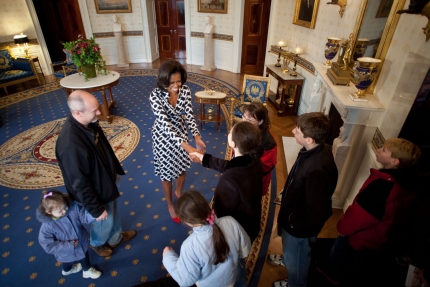
First Lady Michelle Obama greets members of the general public as they enter the Blue Room during their White House tour, Feb. 16, 2012. (Official White House Photo by Chuck Kennedy)

First Lady Michelle Obama Greets a Group of White House Visitors

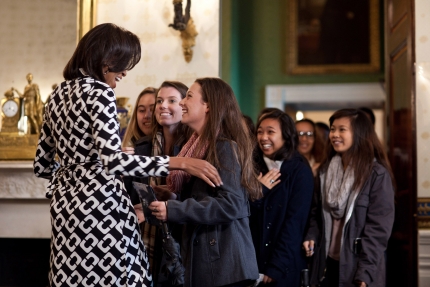
First Lady Michelle Obama greets members of the general public as they enter the Blue Room during their tour of the White House, Feb. 16, 2012. (Official White House Photo by Chuck Kennedy)

Related Topics: Additional Issues

West Wing Week: 2/17/12 or "Go Big!"

February 17, 2012 | 5:40 | Public Domain

Welcome to the West Wing Week, your guide to everything that's happening at 1600 Pennsylvania Avenue. This week, the President made a major announcement on a policy, to guarantee access to free preventative health care services, unveiled next year's budget, pushed Congress to extend the Payroll Tax cut, awarded the National Medals of Arts & Humanities, met with China's Vice President Xi, and traveled west to Wisconsin and California. That's February 10th to February 16th, or "Go Big!"

Download mp4 (174.7MB)

First Lady Michelle Obama Surprises White House Visitors

This morning, First Lady Michelle Obama surprised a group of visitors during a public White House tour. People from all over the country—families, students in town as part of the Junior Statesmen of America program, a group of nurses who work with veterans, and many others—entered the Blue Room expecting a glimpse of its artwork and furniture, only to be greeted by a smiling First Lady and Bo, the Obama family pup.

Reactions ranged from shock, to excitement, to just plain overwhelmed. Watch a video of the whole thing below.

This video is no longer available.

Related Topics: Additional Issues

First Lady Surprises White House Tour Visitors

February 16, 2012 | 1:18:11 | Public Domain

First Lady Michelle Obama and First Dog Bo surprise visitors during a White House tour.

Download mp4 (746MB) | mp3 (72MB)

Supporting Military Spouse Employment

February 15, 2012 | 23:13 | Public Domain

First Lady Michelle Obama and Dr. Jill Biden speak about helping military spouses transfer professional licenses across states more easily.

Download mp4 (222MB) | mp3 (21MB)

The White House

Office of the First Lady

Remarks by the First Lady and Dr. Biden On Military Spouse Licensing

The Pentagon

3:27 P.M. EST

DR. BIDEN:  Hello.  Thank you, Secretary Panetta and Deputy Secretary Wolin for your leadership.  Thank you, General Dempsey, for your kind introduction.  Good afternoon, Deanie, and all the Joint Chiefs and your spouses.  Thank you for being such great partners to Michelle and me.

I want to offer a special welcome to all of our service members and their spouses.  We are honored to be with you today.
 
Many of you know, as the General mentioned, that I am a proud military mom.  One of the best parts of my role as Second Lady is the privilege of meeting with service members and their families all over the world.  I am always amazed at their courage, their determination and their resilience.  That inspiration is one of the main reasons the First Lady and I started Joining Forces so that all Americans are helping to support our military families.

We’ve seen Americans step up in so many ways.  We’ve seen businesses hiring tens of thousands of veterans and military spouses -- businesses like Sears, Kmart and Sam’s Club have made commitments to hire military spouses or make base transfers easier.  Medical schools have committed to educate their students about post-traumatic stress and traumatic brain injuries and conduct new research on these conditions.  Schools, community organizations and Americans of every age and background have sent care packages, donated childcare and created community celebrations for the military families in their neighborhoods.

And Americans are stepping up because they know how much our military spouses and families have done for our country.  People like Ann Wells.  Ann’s husband, Robert, is career combat engineer and command service sergeant major.  After 10 years of marriage, Ann went back to school for her nursing degree.

As a teacher, I have had the privilege of teaching countless women like Ann, women who fight hard for a good education.  But like so many military spouses, Ann moved frequently with her husband and that often meant a new license was required to pursue her nursing career in Hawaii, in Tennessee, in Texas and in Missouri.  That's why our efforts here today are so important.  They are another way we can show our support for those who serve this country.

Please join me in welcoming Ann.  (Applause.)

* * * * *

MRS. OBAMA:  Someone can give an order to be seated.  There are plenty of people here who can do that, correct?  (Laughter.)  But thank you for that wonderful welcome.  And thank you, Ann.  Thank you for the kind introduction and for all that you and your family have done for our country. 

I also want to thank Secretary Panetta for hosting us here at the Pentagon.  And of course, I have to thank Jill, who has been such a wonderful friend and such a terrific partner in Joining Forces.

I also want to join in recognizing General Dempsey and his wife, Jeannie -- Deanie, why am I saying Jeannie?

Hi, Deanie.  How are you?  (Laughter.)  Thank you.  You’ve been amazing.  You’ve helped us through.  You’ve kept us on the straight and narrow along with all of the other spouses of the Joint Chiefs.  You all have been just amazing supports.  And I also have to recognize the Joint Chiefs as well.  Thank you all.  You all have been so steadfast, just right there every step of the way.  We are just proud of everything that you do for this country.

And we also have Deputy Secretary Neal Wolin, who is here from the Department of Treasury, who has put so much time and effort into helping prepare this report.  We wouldn’t be here today without all that you have done, so thank you.  Well done.  Job well done.  Absolutely.

(Applause.)

We also have Alan Krueger, who’s the Chairman of the President’s Council of Economic Advisors; of course, the First Lady of Kentucky, Jane Beshear, who has been really doing some phenomenal work in her state and taking the lead and stepping up in ways big and small.  We really are grateful to everything that you’ve done.  We also have members of Congress here, we have state legislators, and we representatives from many of our nation’s veterans service organizations who are here with us. 

And we are all here today, we have all gathered, to say this to America’s military families:  We are incredibly grateful for your service.  We understand the unique challenges that you face; and we are going to do everything that we can to make sure that you can pursue your careers and provide for your families. 

Now as Jill said, over the past few years, she and I have had the privilege of visiting with military spouses all across the country.  And as Jill said, you all are some of the most courageous, resilient, and inspiring people that we have ever met.  You all are the ones who keep your families together when your spouse is deployed.  You’re the parents who turn off the news at night for fear of what you  might hear, who answer all those questions about why Mom or Dad has been gone for so long.

You’re the spouse who steps up to do the work of two parents, raising the kids, running the household, juggling all the errands and chores all alone.  But you are still the volunteer on the PTA.   You still lead that food drive.  You organize the neighborhood carpool.  You’re the families who, every few years, you pack up your entire lives, and you move whenever and wherever your country calls.

But no matter how much is on your plate, no matter what this country asks of you, you all just keep moving forward.  You just keep serving your families, your communities and your country in ways that many of us cannot fathom.

But when it comes to moving forward in your own careers, when it comes to getting a job and being able to provide for your families when you arrive at that new base or duty station, far too often, you can't just keep moving because you’ve run into a brick wall.

It happens to military spouses again and again.  You’re asked to move to a new state.  You want to get back to the job you love and the job you need to support your family.  But you can’t do any of that because your nursing license or your teaching credentials don’t transfer when you move to a new state.
 
It happens to nurses like Ann.  It happens to school teachers, to childcare providers, to accountants, real estate brokers, dental hygienists, lawyers too -- that's supposed to be funny.  No one likes lawyers.  (Laughter.)  And so many other careers.  We have learned that more than one of every three military spouses in the labor force have jobs that require some kind of professional license or certification.  So this licensing issue affects more than 100,000 individuals -- 100,000 individuals.  And the vast majority of you are clearly ready to work when you get to your new state.

You’ve already demonstrated your specialized skills.  You’ve already gained years of professional experience.  But too often, as Ann said, you’re left waiting for paperwork to clear while your skills go unused and more importantly your family’s bank accounts shrink.  And this is something Jill and I hear about on every single base and in every single military community that we visit.  It is the number one issue that military spouses tell us about.

And we know that this is a challenge for these families because the one important thing that I have learned about military spouses is they never complain.  They never ever ask for anything. 

So on the rare occasion when our military spouses do speak up and ask for our help, then it’s time for all of us to take action.  And that’s what today’s report from the Departments of Defense and Treasury is all about.  That's what we’re doing.  We’re all taking action.  We’ve heard your frustrations, and we’re finding solutions. 

And that starts by first recognizing how these issues arise.  Now, each state issues its own professional license and sets its own standards of professional competence.  Take teachers, for example.  To earn a teaching license, states ask for some combination of state and national test scores, supervised work experience, and advanced coursework.  But when you analyze requirements like these across several states, you begin to understand the challenges that arise for military spouses.

In some states, for example, applicants are required to take an entry-level course in state history or other subjects before the licensing board will grant a license.  So if you’re a military spouse with years of teaching experience and you move across state lines, you could end up taking extra classes for weeks on end before you can even get a job, and that’s just what happens in one profession. 

When you’re talking about dozens of careers, the web of requirements and standards can get pretty thick.  But before we go any further, let me be very clear:  We’re not asking any state to change their standards.  These state rules are important, and states have every right to set benchmarks just like these.  In doing so, they hold our professionals to a high bar and they give us all peace of mind whenever we walk into a hospital or enroll our kids in school.

But it’s also clear that this system poses very unique challenges for our military families.  And recently, a number of states have stepped forward to address this very problem.

So let me just tell you about what just some of a few states are already doing.  In Tennessee, they’re granting temporary licenses in many professions, which will allow spouses to get a job first, then complete any remaining state licensing requirements.  In Colorado, the director of their state licensing agency now has the power to waive cumbersome requirements for military spouses who clearly demonstrate their competence.  And then in Arizona, they passed legislation to grant licenses, in most professions, to military spouses who have at least one year of experience.

So that’s three states with three different solutions.  In each of them, military spouses with professional skills and experience don’t have to wait before they get to work.  If they need to complete any remaining requirements in their new state, they can do it as they earn a paycheck. 

And that’s the general guideline that eight other states have followed as they’ve created laws of their own.  And we’re pleased that 13 more states have legislation pending or waiting to be introduced.  But that still leaves 26 states -– that still leaves more than half the country –- that have yet to address this issue.

And, again, that’s where this report comes in.  We know that there’s no one-size-fits-all solution here.  Every state is different.  So this report simply provides a roadmap of best practices that leaders across the country can use as a resource as they explore ways that their state can better support these military families.

The report contains tips and ideas, not edicts and decrees.  But the point is that there are solutions here.  This is a solvable problem.  So today we are setting a national goal -– by the year 2014, we want all 50 states to have passed their own legislation to address these licensing issues.

And we know it’s an ambitious goal.  We know it won’t be easy to achieve, but we also know that our nation’s military families have waited long enough.  (Applause.)

And it’s also important to note that this isn’t just about military spouses.  This issue affects our troops.  It affects our military children, all of whom are relying on the income of these spouses earn.  This affects our schools and our hospitals and our businesses that need those skilled employees.  And all of that affects our entire economy -– our unemployment rate, our productivity, our competitiveness all around the world.

So it’s time for us to come together as a country to find some solutions to this problem that has affected so many of our military families for so long.  It is time for us to make sure that our military spouses, that their hard work and professional skills are recognized, no matter what state they move to.

And we’re all willing to do our part to work together to move this issue forward and to provide support for states along the way.  That’s why, in addition to today’s announcement, when our nation’s governors gather at the White House in just two weeks, Jill and I are going to make this ask directly. 

We’re going to ask each of the governors to lead the charge on this issue in their state.  We’re also going to reach out to state legislators across the country, and we’re going to ask them to jumpstart the legislative process.  The state liaisons here at the Department of Defense will be working nonstop to help these state leaders craft and pass bills that fit their states’ needs.

In addition, we’re going to be asking advocacy groups like the National Military Family Association to engage at a state level to build the kind of grassroots support that will help get this done.  And we’re going to urge more national professional organizations to follow the lead of the American Bar Association, which actively is encouraging its state affiliates to make licensing accommodations for military spouses.

So we are ready to roll up our sleeves and do some heavy lifting on this issue.  We are ready to make this happen.  And if we can do this, if we can work together so that every state can find its own solution, we’ll once again show all of you –- our incredible military families –- that America has your back.

After all, that’s exactly what you do for all of us every single day.  That's what you do for us.  No matter how much we ask of you, no matter what the personal cost, our military families always answer the call.  They always do.

And today, as we announce this new effort, I’m reminded of a group of military spouses that I met with a few years ago in Kentucky.  One woman we were talking to, she choked up as she told me about some of the challenges that she and her family were facing.  And I’ll never forget what happened next: another military spouse who was sitting there, she jumped in and she said -- and this is a quote -- she said, “I don’t know this woman.  I didn’t meet her before today, but when she leaves here, she will have my number.  And she will be able to call me anytime.  She’s got the support of this friend right here.”

See and I tell that story because that's who military spouses are.  That's exactly who they are.  That’s the life that so many of you here today lead.  That is the commitment that you show every single day to your families, to our communities and to our country.   And I just want you all to know that you can call on us, and we will answer.  We owe it to you and your families who have sacrificed so much.

And so to all of the state leaders out there, in this room and beyond, I want to thank you for everything that you’ve done so far, and I look forward to working with you to finish this job.

And to our troops and our military families, I cannot thank you enough for everything you do for this country. 

We are inspired by you.  We are so proud of you, and we are working as hard as we can to serve you as well as you have served this country.

Thank you and, God bless, and God bless the United States of America.  Thanks, so much.  (Applause.)

END
3:50 P.M. EST

First Lady and Dr. Biden Urge State Action to Support Military Spouses with State Licenses

First Lady Michelle Obama and Dr. Jill Biden at a Joining Forces military spouse employment event

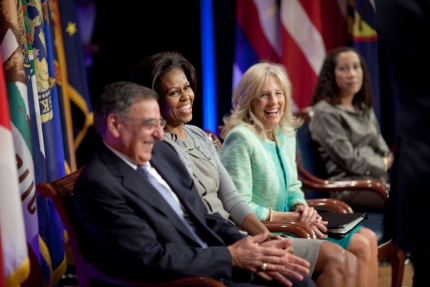
From left, Defense Secretary Leon Panetta, First Lady Michelle Obama and Dr. Jill Biden listen to Gen. Martin Dempsey, Chairman of the Joint Chiefs of Staff, speaks during a Joining Forces military spouse employment event at the Pentagon in Arlington, Va., Feb. 15, 2012. (Official White House Photo by Chuck Kennedy)

Earlier today, I had the great privilege of joining the First Lady, Dr. Biden, members of Congress, the Secretary of Defense, the Chairman of the Joint Chiefs of Staff, the Joint Chiefs and state legislators at the Pentagon for a major announcement impacting our nation’s military spouses. 

In their travels to military bases across America and throughout the world over the last three years, the First Lady and Dr. Biden have heard stories from countless military family members and spouses. One of the top issues they hear about everywhere they go deals with the professional licensing requirements that affect how military spouses can move forward in their careers. 

These spouses are among the more than 100,000 military spouses who serve in one of 50 professions that require a state license or credential – teachers, nurses, childcare providers, dental hygienists, real estate brokers, speech pathologists and many other professionals.  

Here’s why this matters: military families are asked to move again and again as their husband or wife serves our country.  In fact, military spouses move at a rate that is 10 times greater than the civilian population.  

Each move to a new state can mean different credentialing or licensing standards – a process that can sometimes take months to resolve.  In so many cases, these are qualified professionals who simply can’t work in their field because they’re waiting on paperwork. 

Brad Cooper is the Executive Director of Joining Forces