President Obama Awards the 2011 National Medals of Arts and Humanities at the White House

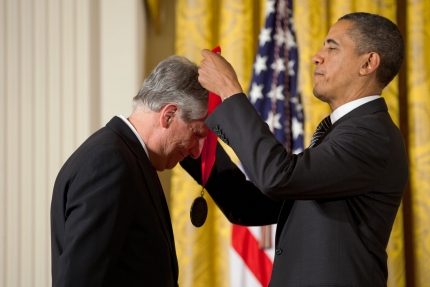
President Barack Obama awards Robert Darnton a 2011 National Humanities Medal

President Barack Obama awards Robert Darnton, author and librarian, the National Humanities Medal for his determination to make knowledge accessible to everyone. President Obama awarded the 2011 National Medal of Arts and National Humanities Medal in the East Room of the White House, Feb. 13, 2012. 2011. (Official White House Photo by Pete Souza)

The 2011 honorees of the National Medals of Arts and Humanities were at the White House today for an event that President Obama said he and First Lady Michelle Obama look forward to every single year. "It's a moment when America has a chance to pay tribute to extraordinary men and women who have excelled in the arts and the humanities, and who, along the way, have left an indelible mark on American culture," the President said before the ceremony in the East Room.

Today's honorees represented the full spectrum of the arts and humanities, and included actors, poets, authors, singers, philosophers, sculptors, curators, musicians, historians and even an economist. President Obama praised the group for their contributions to the arts, and to American society:

You create new possibilities for all of us. And that's a special trait.  And it assigns you a special task.  Because in moments of calm, as in moments of crisis; in times of triumph, as in times of tragedy:  you help guide our growth as a people.  The true power of the arts and the humanities is that you speak to everyone.  There is not one of us here who hasn’t had their beliefs challenged by a writer’s eloquence; or their knowledge deepened by a historian’s insights; or their sagging spirits lifted by a singer’s voice.  Those are some of the most endearing and memorable moments in our lives.

Equal to the impact you have on each of us every day as individuals is the impact you have on us as a society.  And we are told we're divided as a people, and then suddenly the arts have this power to bring us together and speak to our common condition.

Related Topics:

Michelle Obama: Changing the Conversation on Healthy Eating

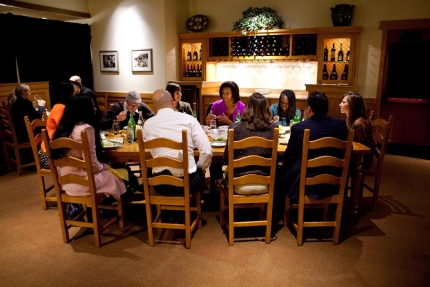
First Lady Michelle Obama Olive Garden Dinner

First Lady Michelle Obama holds a roundtable dinner discussion at an Olive Garden restaurant in Fort Worth, Texas, Feb. 9, 2012. Mrs. Obama met with the parents to hear their ideas on how Let’s Move! can continue to support families across the country. In September 2011, Darden, the world’s largest full service restaurant company which owns Olive Garden, made a commitment to improve their kids menus by offering a fruit or vegetable and low-fat milk with every meal, as well as reduce total calories and sodium across their menus. (Official White House Photo by Sonya N. Hebert)

 
Back when we first launched Let's Move! -- a nationwide initiative to end our childhood obesity epidemic -- in the back of my mind, I wondered whether it was really possible to make a difference.

I knew how serious this problem is. Nearly one in three of our children are overweight or obese, at risk for illnesses such as diabetes, heart disease and cancer that cost our economy billions of dollars each year to treat.

I also knew the conventional wisdom on this issue. There's the assumption that kids don't like healthy food, so why try to feed it to them? There's the belief that healthy food doesn't sell as well, so companies will never change the products they offer. And there's the sense that this problem is so big and entrenched that no matter what we do, we'll never be able to solve it. 

But over the past two years, we have seen a new conversation in this country about how we live and eat and how that affects the health and well-being of our kids. Since we launched Let's Move!, people from every corner of this country who care about our children's futures have stepped up and proved the conventional wisdom wrong.

Read the entire op-ed from the First Lady at CNN.com

More from the Let's Move tour:
Michelle Obama: If You Are Doing Great Work, Tell Me About It 
Michelle Obama Judges "Top Chef"
On the Road with Let’s Move
Watch: Behind the Scenes on the Let’s Move Tour 
Two Years of Healthy Changes for Our Nation’s Kids
View a slideshow from the tour

First Lady Michelle Obama & The Platypus Walk

February 11, 2012 | 1:25 | Public Domain

On the third day of her tour to promote the second anniversary of the Lets Move! initiative, First Lady Michelle Obama performs the Platypus Walk with children and Disney stars at the ESPN Wide World of Sports Complex in Orlando, Florida. http://letsmove.obamawhitehouse.archives.gov

Download mp4 (41.5MB)

First Lady Michelle Obama Speaks on the Second Anniversary of Lets Move!

February 11, 2012 | 26:34 | Public Domain

First Lady Michelle Obama speaks in Longwood, Florida about the progress that has been made during the last two years of Lets Move!, the national initiative to end childhood obesity within a generation.

Download mp4 (676.4MB) | mp3 (64MB)

The White House

Office of the First Lady

Remarks by the First Lady at a Let's Move! Faith and Communities Physical Activity Event at Walt Disney World

ESPN Wide World of Sports
Walt Disney World
Orlando, Florida

2:25 P.M. EST

MRS. OBAMA:  Oh, my gosh!  You guys be careful!  (Applause.)  Oh, wow!  It sounds like you all are having some good fun out here!  (Applause.) 

You know, I am happy to be here.  We are celebrating the second anniversary of "Let's Move."  I have been traveling all over the country -- I've been to Iowa, watching how kids are eating well and changing their schools.  I've been to Dallas, with "Top Chef."  (Applause.)  And we've made -- Dallas!  (Applause.)  I had some good dinner here in Florida.  And now I'm hanging out with all of you. 

And I just want to thank Disney and all that they have done to support "Let's Move" and to make sure that our kids are eating right and being active.  Right?  We want to give Disney a big round of applause.  (Applause.) 

So now I hear you all have been practicing something for me.  You've got a little dance you want to show me? 

AUDIENCE:  Yes!

MRS. OBAMA:  You guys know I like to dance.  I haven't completely gotten the dance down, but I'm going to watch you all -- right?  All right, you all ready to do some dancing?

AUDIENCE;  Yes!

MRS. OBAMA:  Let's do it!

END  
2:27 P.M. EST

The White House

Office of the First Lady

Remarks by the First Lady at a Let's Move! Faith and Communities Event

Northland Church
Longwood, Florida

10:17 A.M. EST

MRS. OBAMA:  Good morning!  Oh, you rest yourselves.  (Laughter.)  I know you've been through a lot this morning -- a little dancing, a little working out.  So you need a little rest. (Laughter.)

But I want to thank you all so much.  I am beyond thrilled to be here with all of you today as we celebrate the second anniversary of "Let's Move."  It's a birthday.  (Applause.)  

And I want to start by thanking Pastor Hunter and Becky for, oh, that very kind introduction.  We love those two people very dearly.  They are tremendous role models to our family, to their community, to this nation.  And I am grateful that they're hosting us here today.  So let's give them a wonderful round of applause.  (Applause.)  Thank you so much. 

I also want to thank Nemours for their support for today's events and for their partnership in so many of our "Let's Move" initiatives.  

And finally, I want to thank all of you.  We have got folks here from more than 120 congregations and organizations representing at least 15 different faiths and denominations.  But we are all  (applause) -- that's wonderful.  That is wonderful.  And you're here on a Saturday morning, which is another wonderful thing.  (Laughter.)  Now, that's some commitment.  Like that.  (Laughter.)   

But we are all here today for one very simple reason -- because we love our children, and we are determined to build a future that is worthy of their promise. 

That’s what so many of you are doing every day in your congregations and in your communities.  Whether you volunteer with a homeless ministry of a food bank, whether you’re fighting for better health care or a cleaner environment, every day, so many of you are taking on the most urgent challenges of our time.

Every day, you’re serving God by serving others.  Every day, you’re proving that when we come together to do good works, no challenge is too big, no problem too hard, and there is no such thing as a hopeless cause.  No such thing.  And that, more than anything else, is the story of "Let's Move."

It’s the story of a very serious challenge -- a challenge that many of us believed was too big, too complicated, too entrenched for us to solve.  And that problem is our epidemic of childhood obesity -- the fact that right now, one-third of our children are overweight or obese.  And they’re at risk for serious conditions like diabetes, cancer, heart disease that undermine their health, that diminish their prospects, and they cost our economy billions of dollars each year.

But the story of "Let's Move" is also the story of individuals and organizations from every sector of our society who have stepped forward to meet this challenge.  It’s the story of food manufacturers who’ve pledged to cut 1.5 trillion calories from their products.  Companies like Goya Foods that are giving our family the information they need to make healthy choices about what they eat.  Local grocers and national chains like Walgreens, SuperValu -- they're building new supermarkets and selling fresh food in 1,500 underserved communities in this country.  (Applause.)   

Our restaurants are stepping up, transforming their kids’ menus, loading them with healthier options.  Our mayors out there across the country, they're planting gardens, they're refurbishing parks.  Congress passed historic legislation to provide healthier school meals for millions of our children.  (Applause.)  More than 3,400 professional chefs have signed up to help local schools improve their menus. 

And then there are our celebrities -- everyone from Beyonce to LeBron to Drew Brees are serving as role models, inspiring our kids to dance, dribble and pass their way to a healthier life. 

And it's important to know that all these folks are doing these things not just as business leaders who are concerned about their bottom lines -- not just as elected officials serving their constituents, or as celebrities promoting a cause.  They’re doing this as parents and grandparents who care about our nation’s children.  They’re doing it as citizens who know that we as a country cannot fulfill our promise unless our children can fulfill their promise.  (Applause.) 

And they’re doing it because they know that when children here in one of the nations -- richest nations on Earth aren’t getting the nutrition they need, when one in three of our children is on track to develop diabetes in their lifetimes, that means it’s time for us to act.  Because this isn’t who we are, and it certainly isn’t who we want to be. 

We know that something better is possible for our children. And we are determined to solve this problem once and for all.  But we know that if we truly want to end our obesity epidemic so that our kids can have a healthier future, then we have to understand how did we get here in the first place, how did we wind up here. 

So I want you all to think back, think way back -- especially the grown folks like me -- think back to when many of us were kids, all those years ago.  Now, the children, you might not even understand how life was back then.  (Laughter.)  Most of us led reasonably healthy lives.  We walked to and from school every day -- rain or shine.  (Applause.)  Amen.  And in Chicago, where I was raised, we did it in the hail, sleet, snow, gale-force winds.  (Applause.)  Yes, I sound just like my grandfather. Never thought I would.  (Laughter.)

Back then, our TVs only had a few channels -- you remember that?  (Laughter.)  Just a handful of channels.  And when those Saturday morning cartoons were finished, we were done with TV.  That was it.  It was over.  (Laughter.)  Once American Bandstand and Soul Train were over -- (applause) -- you had to go outside and play -- right?  And back then, playing did not involve a screen or a remote control.  (Laughter.)  It meant actually moving your bodies.  (Laughter.)  It meant riding bikes, jumping double-dutch, playing tag until our mothers called us in for dinner.

And then when we ate that dinner, we all sat around the table as a family.  (Applause.)  Yes.  And our food wasn’t fancy. Because we didn’t have a lot of money, the portion sizes had to be reasonable -- right?  (Laughter.)  There was always a vegetable on the plate.  (Applause.)  And we ate whatever we were served.  (Applause.)  My mother never cared whether my brother or I liked what was on our plate.  (Laughter.)  We either ate what was there, or we went to bed hungry.  That was the bottom line. 

And in those days, we hardly ever ate out.  Fast food was considered a rare treat.  In fact, I tell this story often, but I can still remember the time that my brother and I convinced our grandmother to let us have takeout burgers and fries for lunch.  Now, we were shocked when she finally agreed.  We could barely contain our excitement.  So when the food arrived, Grandma unwrapped the burger, put it on a plate -- because you had to eat on a plate no matter what you were eating -- (laughter) -- put the fries on a plate.  We were sitting there all excited, and then what does she do?  She opened up a can of peas.  (Laughter.) She opened up a can of a can of peas.  And to our horror, she served us two scoops each.  My brother and I, we were like, "Grandma, no!"  (Laughter.)  Because fast food or not, my grandma, she believed in feeding her family a balanced meal at every single meal.  Every single meal.  (Applause.)  

See, back then, our society was structured so that healthy eating and exercise were just natural parts of kids’ lives -- all our lives.  We didn’t have to think about it, that was just the way it was.

But today, unfortunately, it’s the exact opposite.  It's the exact opposite.  Many kids no longer attend neighborhood schools, so instead of walking or riding their bikes to school, they're taking a bus or car.  Instead of just a few hours of cartoons on weekends, there are entire networks devoted to children’s programming and the Internet is available 24/7.  That was just never an option for us.  So today, when our kids go and “play,” that often means they're sitting in one place for hours, clicking, typing, texting away -- not moving a lick.

And for many folks, those wholesome family meals are, unfortunately, a thing of the past.  See, a lot of our families today are living in communities without a single grocery store, so they have to buy their food at places like gas stations or corner stores, places with few, if any, healthy options. 

And frankly, a lot of parents today are just plain tired.  Folks are working longer hours to make ends meet and everyone is under more stress.  And as much as we all hate to admit it, sometimes it’s just easier to park the kids in front of the TV, so that we can get a little time to pay the bills, do the laundry, just get a few hours of peace right?  Just a little peace, that's all we want.  (Laughter.)  

Sometimes it’s just easier to pick up something from the drive-through, pop something in the microwave.  And if we’re being honest with ourselves, we have to admit that even when we do cook, we don’t always make the healthiest choices.   

And that’s really where this gets personal and emotional -- probably why some people think this is a very complicated issue. You see, for so many of us, food is more than just nourishment for our bodies.  It’s how we knit our families and our communities together.  It’s how we pass down traditions from generation to generation. 

How many of us find ourselves looking forward to that fried chicken and mac and cheese, pound cake, after church on Sunday?  (Laughter.)  Some people come to church just for the fried chicken.  (Laughter.)  How many of us have those warm, wonderful memories of family and friends gathering in the kitchen?  We still do that at the White House.  It's a little, bitty kitchen
-- big, old house, everybody sitting in the kitchen.  No matter where -- you're sitting in the kitchen.  I'm not cooking, but -- (laughter and applause) -- but we still like the kitchen.  (Laughter.)  Dirtying every pot, cooking everyone’s favorite dishes, talking, laughing, sharing stories late into the night.  That's family.   

Whether it’s Christmas supper, Passover Seder, Iftar dinner, so many of our most sacred holidays revolve around food.  All those familiar smells and tastes, and the memories that go along with them -- all of that brings us joy and comfort.  Times may be tough and money may be tight, but at least we can still serve up Uncle Joe’s ribs or Abuela’s Arroz con pollo -- huh?  (Applause.) That’s how we show our families that we care about them.  Right? 
No matter what culture we come from, no matter what faith we believe in, for so many of us, food is love.  Food is sometimes all we have.  And that is a beautiful thing and we don’t ever want to give that up -- right?  And fortunately, we don’t have to.  Fortunately, we don't have to.  We can still show that love, we can still honor those traditions, and we can do it in a way that’s healthy for everyone, especially our kids.  But we’re going to have to make some changes, some modifications to adapt these traditions to our way of life today.

And ultimately, that’s what "Let's Move" is really trying to do.  We know that government doesn’t have all the answers; know that there’s no one-size-fits all program or policy that will solve this problem.  Every family and every community is different.  Each of us needs to make the changes that fit with our budgets, our beliefs, and our tastes. 

And that’s really where all of you come in.  That's why today was such an important part of our celebration.  Because that is what our faith communities do best -- you inspire and empower people to make meaningful changes in their lives.  Sometimes folks won't do it if it wasn’t said right here -- right?  You serve as a beacon for those who are lost, a refuge for those who’ve been forgotten. You’re there for people during some of the most important moments of their lives, offering counsel on family matters, providing comfort in times of crisis, guiding folks on every mile of their journeys.  That's why people come.

And our faith communities don’t tend only to folks’ spiritual health but to their emotional and their physical health as well.  Think for a moment about the scripture that tells us that your bodies are temples given to you by God.  That is a core teaching of so many of our faiths -- a teaching that calls us to honor and nourish the bodies we’ve been blessed with, and to help others do the same. 

So it’s no accident that this church hosts classes to help folks lead healthier lives.  It’s no accident that, long before we ever started "Let's Move," so many congregations were already sponsoring health ministries and fitness classes, hosting food pantries and summer nutrition programs for our kids. 

So as part of "Let's Move," we wanted to work with you from the very beginning.  We wanted to learn from our faith communities.  And we wanted to do everything we could to support and highlight your magnificent efforts.  And that’s why we started a special program called Let’s Move Faith and Communities to challenge more of our organizations and congregations to take up this cause.

And just like everywhere else, the response to this initiative has been overwhelming.  All kinds of faith communities have been stepping up.  Muslim community leaders are hosting sports tournaments to encourage young people to get active.  The Jewish Community Centers Association is working with JCCs around the country to grow gardens, and to get fresh food into underserved areas, and they're create early child wellness programs. 

Groups like the National Council of Churches have joined with an organization called Ample Harvest to help gardeners donate fresh produce to 4,700 of their local food pantries.  (Applause.)  The National Baptist Convention is aiming to have health ambassadors at all of their nearly 10,000 churches by September.  (Applause.)  And some of their churches have already created “no fry” zones in their congregations.  (Applause.)
Now, it's been a little tough.  (Laughter.)  But with just a little effort, the congregations have accepted this.  They're also and they’re hosting “Taste Test Sundays” where people can sample healthy food. 

Altogether, the members of Let’s Move Faith and Communities have sponsored more than 1,000 summer nutrition sites providing millions of healthy meals for children in need.  And these congregations and communities have walked more than 2.8 million miles.  That's very impressive.  (Applause.)  Very impressive. 

And let’s not forget that all of this represents the efforts of just a tiny fraction of our faith and community organizations. Just a tiny fraction.  That's what they've done in just a short period of time. 

So just imagine what we could achieve if every single organization and every single congregation in America got involved in this way.  Just imagine.  Imagine how many children we could feed.  Imagine how many miles we'd walk.  Imagine how many lives would be transformed.

So today, I have just one simple request for congregations and organizations across America, and that is:  Join us.  Join us.  Be a part of this effort.  Join us.  If you’re in a leadership role, make wellness a priority both with words and with deeds.  Talk about the importance of healthy eating and physical activity with your members.  Get organized.  Get organized by creating a wellness council or a ministry, appointing a health ambassador to lead the charge. 

There are so many natural leaders in our congregations who are just waiting to be tapped.  Maybe there’s a gardener who’s been growing food in her backyard who wants to help the church out.  Or maybe there’s a nurse or a dietitian, a community health worker, who’s eager to share their expertise.  Maybe there's somebody who's just a great cook -- right -- and knows how to make some good, healthy snacks that taste good, too, right?  

And once you’ve gotten organized, I want you to take action. Don’t hold back.  On this one, the sky should be the limit.  You can host cooking classes or a farmers market.  I just tried Zumba, which is like -- that was pretty good.  (Applause.)  See! We've got a lot of Zumbas.  We're Zumbaing after church -- man, look out.  (Laughter.)

You can take your youth group on a weekend hike, or better yet, a weekly jog.  They will love the time spent with an adult. You can try substituting fresh fruit and vegetables for those donuts and coffee cake after service -- right?

And anyone who is interested for additional ideas, tools, resources, you can go directly to the website at Letsmove.gov.  There are so many fun things, ways people are doing -- there are so many creative activities happening in congregations and in communities across the country.  And I hope you all will be inspired to do even more. 

And whatever you do, I want to know about it.  Tell me about it.  Whatever you're doing out in your congregations, I want you to email me, I want you to write me.  Even better, I want you to send me a video of what you’re doing.  Because today, I'm announcing -- listen up -- that "Let's Move" is starting a video contest -- and we’re asking faith and community organizations to show us the best examples of the healthy changes that you’re making.  And you know what, the winners -- you know what we're going to do?  We're going to invite them to the White House this summer.  (Applause.)  Come on to the White House!  Our top entrees.  Because I want to meet you all in person; I want to hear about all that you’re doing.  So, hopefully that's a little incentive.  Maybe a little fun -- the funnier, the better.  You've seen me -- I love fun.  (Laughter.)

So I really do hope that all of you, here and congregations and organizations across this country, will embrace these efforts on behalf of our children.  Because we all know that we are our children’s first and best role models.  No matter what they see or hear, we're it.  And if we embrace this work, our kids will embrace it.  If we’re excited about it, then they will be excited about it, too.

It won’t be easy.  But our faith communities have never shrunk from a challenge right?  From slavery to civil rights, from poverty to human rights, so many of our congregations have been a force for justice and equality.  (Applause.)  Right?  So many have been the righteous voice for the least among us, working every day, in ways large and small, to repair our world. 
And today, once again, we need all of you to help lead the way on this important issue.  We need your vision.  We need your moral passion.  As it says in this church’s vision statement, it says, “A vision is a clear mental picture of a preferable future. It sees the future through the eyes of faith.” 

We all know the future we want for our kids.  We all know that, right?  No matter who those kids are, we know what we want for our kids.  We want them, every single one of them -- every single one of them -- to be healthy and whole.  We want them to have opportunities that we never dreamed of.  We want them to have families of their own that love them.  We want them to have communities that support and sustain them.  And we want them to have the strength and the energy and the stamina to live their lives to the fullest -- and to raise their own children to do the same.  That's how we build community.  That's how we do it.

Again, while it won’t be easy to make that vision a reality, I have faith that together, we will get where we need to go.  I mean, it’s the same faith that so many of you share -- “the substance of things hoped for, and the evidence of things not seen.”  (Applause.)  And with that faith, and with that hope, let us join together -- every single one of us -- and work together in this campaign for our children’s lives. 

Let’s finish what we started -- this wonderful journey -- and give our kids everything they need for the bright, healthy futures they all deserve. 

I look forward to working with you all in the months and years to come.  Thank you all and God bless.  (Applause.)

END             
10:43 A.M. EST  

The White House

Office of the First Lady

Remarks by the First Lady at a Let's Move! WebMD/YMCA Forum

Homestead YMCA
Homestead, Florida

4:10 P.M. EST
 
MS. WARD: Yay! Yes, great crowd. Very good, very good. All right. Yay! This is great. Well, Mrs. Obama, we'd like to start acknowledging your amazing displays of strength and agility recently, when you competed against Jimmy Fallon and Ellen DeGeneres. (Laughter.) I hope you all saw that. This is a push-up queen here. (Laughter.) But also I know a lot of the kids are very curious about your appearance on the iCarly television show, and they would like to know how that was.

MRS. OBAMA: How many people here saw iCarly? Oh, yeah. We'll, see, my girls love iCarly, but I didn't know how many kids across this country love iCarly. So the reason why we worked with iCarly is that -- and I didn't realize this, because I watch the show with the girls every now and then -- but she's a military kid, as you guys know. And one of the things that I've worked a lot on is making sure that the country supports our military families. And iCarly -- exactly. (Applause.) Absolutely.

MS. WARD: Absolutely.

MRS. OBAMA: So we're looking at all kinds of creative ways to get the message out. And one important element is making sure that other kids around the country realize the sacrifices that military kids make. Because I don't think most people understand that military kids oftentimes are moving from school to school to school; every few years they have to get readjusted, keep their grades up; oftentimes dealing with a loved one deployed -- a mom or a dad. And that's tough, but they manage to keep it together.

And that time on iCarly was a lot of fun. There are two members of the cast that are military kids. So it was really great. They're all down-to-earth kids. They're nice, they're kind, they're polite -- so keep that in mind. In real life, they're good people.

So it was a lot of fun, and I'm glad you all watched.

MS. WARD: Great, great. We have so much to get to. We've got some great questions from our viewers and also from the audience. And the first one is for you: "When you and your family are on the road, what are your favorite go-to healthy meals?"

MRS. OBAMA: Oh, favorite go-to -- now that's -- the tough thing is really staying on track when you're not at home. And a lot of times we travel, whether it's campaigning or doing things like this. But what I remind my kids is that a lot of foods that are out there are healthy. I mean, a hamburger is not unhealthy, right, if it's on a whole-wheat bun, if the fries are baked, if it's not fried, if it's grilled. Sandwiches are good -- turkey sandwiches and on whole-wheat, and you put lettuce and tomato, you've got a good mix.

What I usually encourage my kids to do is to -- I tell them that they have alternating opportunities to pick a fun lunch and a healthy lunch. And the fun lunch means they can eat whatever they want. A healthy lunch means it's got to be something that has a vegetable, but it can be something like pasta, and oftentimes we'll use whole-wheat pasta. So a lot of times it's the way it's prepared, and it's not necessarily the actual thing. So chicken nuggets are good. Oftentimes we look at them when they're baked and not fried. That's a good meal.

So when we're on the go, you have to make do with what's out there. And just tweak it the best you can to make it something that's not just completely over the top. And what I tell my kids, whether we're on the road or not, is that dessert is that sometimes treat. So we don't have desserts every day of the week. Desserts are reserved for the weekends, and that's true even if we're traveling. We just try to keep it to a minimum.

And then we make sure that we have snacks that are healthy, so they're not just cookies and chips but we've got lots of fruit around, nuts, trail mix, things like that. And popcorn -- air-popped popcorn is good. So those are the kind of things that you don’t have to be a culinary genius to make the simple things easy. So we just try to keep it simple.

MS. WARD: So true. Okay, thank you.

Dr. Hansa, this is for you. Susan on WebMD asks: "My 12-year-old, five-foot seven-inch son Nick is always hungry. He eats while at mealtime, but an hour later he's asking for a snack. Can you suggest some quick, easy and healthy snacks?"

DR. HANSA: Absolutely. Well, I think a lot of people with teenagers and kids who are tall feel that way; I'm sure many families in this audience. It's really important for kids to eat healthy, like Mrs. Obama was talking about. Often, what you can do is combine a fruit or a vegetable with a protein, and that actually gives them the nutrients they need and gives them the energy they need to go forward. Also, it's important to make sure that they're getting a variety of fruits and vegetables as well.

Did you have anything to add to that?

MS. ZELMAN: I think I would add that the winning combination is protein and fiber. So you get fiber from fruits and vegetables and whole grains, and protein sources are dairy and beans and nuts and eggs. And if you have that winning combination, it fills you up and so you'll -- the 12-year-old will go a little longer. But also it kind of crowds out the foods that are maybe less healthy. So it's important to always think of that winning combination at snacks and at meals.

MS. WARD: And kids are snacking so much these days that we have to make snacks an opportunity for good nutrition, too. So it's really important to make sure that we're working in whole foods and leaving out some of the processed foods in the snacking.

So, Kathleen, we have an audience question for you from nine-year-old Brianna. Brianna? Oh, there's Brianna. Brianna, what's your question?

Q What's -- (audio feedback) -- oh, sorry. (Laughter.) What type of foods should I eat every day to be a healthy person?

MS. ZELMAN: Oh, I love that question, Brianna. That feeds right in to MyPlate, which Mrs. Obama is very familiar with and Elizabeth wrote a book about it. If you look at the plate, it's divided into four quarters, and each -- half of the plate is fruits and vegetables; one-quarter is protein; and one-quarter is a grain.

So if you use that, and you pair it with some dairy, that always gives you an idea of what your plate should look like -- what breakfast, lunch and dinner -- so you can always try to make sure that you have lots of fruits and vegetables.

DR. HANSA: And if I may just add to that, it's not only what kinds of foods you eat, but also when you eat them and how you eat them. So it's important to sit down and eat them, not in front of a television, so that you know what you're eating, and enjoy your food. And remember always to have as many family meals as possible, because that will make you healthy and happy.

MS. WARD: And I love that word "enjoy," because that's what it's all about. We’re going to move and we're going to enjoy it, and we're going to have healthy foods.

Now, Jim, speaking of food, I have a question for you. Are there any foods you should avoid before you exercise? And how about after?

MR. KAUFFMAN: That's a really good question. A lot of it is personal preference, and what you're most comfortable with, and what your body can tolerate before you're going to go out and do some kind of physical activity. So a lot of people, they don't do dairy -- they don't do well with that. Recommended is probably something that you're comfortable with -- a protein -- about an hour before you go. One thing to actually include is water, and water regularly and often if you're thirsty.

Other things to avoid would be anything really heavy that's going to sit in your stomach -- some pastas, some of the more unhealthy breads and cereals. And then, afterwards, after a good, strenuous workout, a good thing to do is include some kind of protein to help replenish the muscle breakdown that you've had during the exercise. So some time about 30 minutes to an hour afterwards would be a good thing.

MS. ZELMAN: And I would add that chocolate milk -- here's your opportunity to drink chocolate milk, because it's been proven -- there are studies that say it's one of the best beverages that hydrates and provides those nutrients from the muscles that have been exercised.

MS. WARD: Can you think of any other snacks, maybe post-workout snacks?

MS. ZELMAN: Yogurt.

MR. KAUFFMAN: Peanut butter. Tuna salad.

MRS. OBAMA: I often do peanut butter and apples, a good dip or honey. I do that before my workout.

MS. WARD: Great. And it's all fuel, and we need to fuel our body for the work that it does.

So, Mrs. Obama, this one is for you: "Do parents have the right to recommend to their kids' schools what kind of food the kid should eat?"

MRS. OBAMA: Now, I think parent involvement in schools at all levels is really critical, and I don't think that there's any parent here who should feel that they don't have the right to ask those kind of questions. I mean, we're fortunate because we just got some wonderful new legislation passed that's going to improve school meals. Thirty-two million kids will be getting better meals at lunch and at breakfast as a result; more proteins, more low-fat, more fruits and vegetables. It's going to be a good thing for our schools.

But how things are implemented on the ground in your school is really up to the parents and the students and the teachers. So it's really important for you to keep an eye on what's happening in your kids' lunchrooms. And you definitely should ask questions, and sit down and talk to the principal, and get other parents involved to make sure that you're satisfied with the choices that are being made for your kids. I mean, when you think about school lunches -- and for many kids who are coming from families that are struggling, these school meals may be the main source of nutrition that they get. And if your kid is getting breakfast and lunch, that is more than half of their calorie intake coming from those school meals. So I think it's -- that makes it really important for parents to be involved and to take an active role.

And don't let anyone intimidate you. I mean, you should be in a position to be able to ask those kind of questions. I've been to many schools where the parents have taken an initiative. They've started that school garden that’s used to feed the kids at lunch. Many parents use their own resources and expertise to add value to what's going on. So if you have something to add, do not hesitate to do it. Our kids need parents who are watching and concerned. School meals are critical to their overall development. And if there are any teachers out here, you know that if a child doesn't come to school ready to learn, with a good set of nutrients in their system, they have a tough time focusing. And this -- their meals, their nutrition directly affects their success not just in school, but in life. So we have to get them off to a good start.

So this is a fight worth fighting for parents. And I would urge you all not to shy away from it.

MS. WARD: So don't feel intimidated, make your wish-list known, get in --

MRS. OBAMA: Absolutely.

MS. WARD: Because I know a lot of parents do feel like they shouldn't say anything.

MRS. OBAMA: Right, right. Well, people should know in -- when the parents are involved, that affects everything at the school level. So don't ever be intimidated.

MR. KAUFFMAN: And if I could add a piece of that also -- the Partnership for a Healthier America recently set some standards for not just what goes on in a school area, but also the afterschool time. And Mrs. Obama is the honorary chair of the Partnership for a Healthier America, and these standards are that when your child is involved in an afterschool activity, that water is the primary drink of choice and that that's going to be available, and that any kind of snack is going to be some kind of fruit and vegetable or a healthy grain, and that there's going to be adequate physical that goes with that.

So if you combine a great, healthy lunch at the school along with some good standards in the afterschool time, you're really starting to have an opportunity to make some significant inroads to just a healthier atmosphere for kids.

MS. WARD: Good. That's great.

So Kathleen, an overwhelming amount of people asked us for some advice on fitting healthy foods into a grocery budget which may be tight. So what are your thoughts?

MS. ZELMAN: Well, if you're looking to stretch your food dollar, it's good news because you can do it without skimping on good taste or good nutrition. If you keep that plate in mind, one of the most expensive parts of the plate is the protein source, but it doesn't have to be fish or chicken or meat; it can be beans. Beans are so nutritious. They're inexpensive, you can keep them in the pantry, you can take your family meals, your family-favorite recipes and stretch them with things like beans or eggs. Make dinners out of eggs. Have vegetarian dinners where you just eat all vegetables plus whole grains and beans.

So you really can do it without compromising the health of your family. And when you think about the amount of protein you need, it's really small. So you can make that one pound of ground beef stretch and feed the whole family. And the one chicken breast can be in a pot of soup that's loaded with potatoes and vegetables.

So they're very nourishing, good for you, and inexpensive. But, of course, shopping sales -- shopping seasonally -- so when fruits and vegetables are in season, they're the most abundant, they taste the best, and they're the least expensive. Frozen vegetables -- another great spot. If you buy them plain, frozen fruits and vegetables, there's no waste; you take out what you need, you reseal the bag, and throw some of those vegetables into the dishes that you're making, your family favorites.

So think about stretching. The slow-cooker -- that is working parents' favorite tool. You can make the dish before you go. But you really can eat healthy and wise, and just focus a little bit more on other sources of protein like eggs, protein, low-fat dairy.

MS. WARD: So I think a lot of times we hear that healthy eating is expensive, and you're saying, really -- it really isn't if you make wise choices.

MS. ZELMAN: It doesn't have to be. I mean, if you want the fresh berries, sometimes they do get pricey. But you can buy frozen blueberries. I would just caution to make sure when you buy canned foods and frozen vegetables, you buy them as plain -- without sauces, without added sugars or salts or syrups -- buy them plain, and if they come in some kind of solution, rinse them off. You can reduce the sodium in beans by almost 40 percent by really rinsing them.

DR. HANSA: Right. And I would add two other things to that. One-third of our families right now are shop -- are going outside to eat. That's how many meals we're eating outside the home. If you stay at home and you cook, you're going to save a lot of money. Put that money into a jar and use it for fun activities, like going skating with your kids if you live up in the north, or maybe roller-skating in the south. You can actually save that money, and save the gas money that you're going out -- when you go outside and eat as well. And you're teaching your kids good habits, because you need to model that behavior.

Cooking at home is something they will learn, and then they can pass that on to their families.

MRS. OBAMA: That's one of the main things we did in our household, before we lived in the White House, when I was still cooking -- (laughter) -- is we eliminated the number of times we went out. And that made a huge difference. Now, that meant that I had to be way more organized about cooking. But I would cook a big meal on Sunday. So we'd have Sunday; that would last until Monday; I'd get a break on Tuesday; we'd come around on Thursday, get another meal.

So eliminating those opportunities to eat out made a huge difference. And then also, my kids liked it. They liked being at home. They like sitting around the table. I mean, that became -- and still is -- for us at the White House, no matter what is going on, at 6:30 we stop everything, we have dinner together. When the President travels, his goal is to get home in time for dinner. And that's really the time that we get to connect with our girls. I mean, we're running to and fro, and dropping people off, and kids in the back seat, and the only time we really get to find out those little hidden treasures of information that slip out -- good teaching moments -- what would normally be a lecture is a nice conversation around the dinner table.

And I find that my girls aren't as focused on gobbling their food down if they're engaged in a conversation. They're really focused on tasting their food, and taking their time, and cutting their food. And then we use that time to talk about manners -- how to hold a fork, and sitting up, and take your elbows off the table -- little things like that that nowadays kids, they don't know these basic things because we don't have time to sit down with them.

So the family meal is much more critical than we ever imagined, and we experience that every day at our home.

DR. HANSA: And just as a pediatrician, there's been plenty of research to show that not only you get the benefits that Mrs. Obama is talking about, but guess what, your kids are more grounded, they're less depressed, less likely to be overweight. There's just so many benefits that you get in addition to having those wonderful conversations with your children.

MS. ZELMAN: And I would add that it doesn't have to be dinner. If you don't have time to sit around the dinner table, it can be any meal. And the studies do say that kids who eat many meals with their families have healthier diets. So you get to be the role model and show them. Because role modeling, as you've just suggested, is really important. And it's the whole person we're talking about here.

MS. WARD: Right. And time spent together is the most important. And I think, Jim, you would agree, just even a walk with your child, a 30-minute walk would be a great thing to do, too.

MR. KAUFFMAN: Absolutely. Any time that a parent can spend time with their kids. And by the way, the research does show that kids do want to spend time with their parents. (Laughter.) So despite what they might say, that it's the opposite -- and when you do spend time with your parents and you do some kind of physical activity, you're getting a double whammy. You're getting all the benefits that were just discussed here, along with some additional physical activity.

MS. WARD: Well, we're going to go to Olivia in the audience. She has a question for Mrs. Obama. And Olivia, where are you? Okay.

Q Tell us about the vegetables you grow in the White House garden, please.

MRS. OBAMA: I would be happy to. (Laughter.) As you all know, one of the first things I did as First Lady was to plant a White House kitchen garden. And it has been one of the best and most fulfilling things that I've done as First Lady. It's about 1,100 square feet. It's maybe a little bit larger, because I think we expanded it here or there, a few new beds. And we grow a little bit of everything -- lots of herbs, lots of different lettuces. Sweet potatoes are a big favorite, because you never know what they look like until you pull them up from the ground, and then they're these huge monstrous potatoes. So the kids that help us harvest get a big kick out of that. We've tried to plant watermelon; haven't done so well on watermelon. We got some little pumpkins. We've worked on some berries, but we can't keep the birds away from the berries. Lots of snap peas, broccoli.

So we plant what we enjoy. And the White House kitchen garden just doesn't feed our family, but we use it at important state dinners and lunches. And the leftovers we donate to a soup kitchen that focuses on healthy eating, making sure that their customer base is eating well, too. And we also have a beehive that has really helped with pollination, and it's helped our garden grow in many ways. And we get many pounds of honey every year, and we use those as gifts. I've given them to almost every First Lady of every country that has come to visit, or I've visited. So it's a wonderful gift.

So it's been a real fun experience. And we work with kids in the community. They help us do everything from planting, sowing, harvesting -- and eating. We actually do a little eating, too. (Laughter.) So it's a lot of fun. So you have to come and visit my garden, right? All right.

MS. WARD: Wow. (Laughter and applause.) Well, speaking of vegetables, Vicki (ph) on WebMD says, "My seven-year-old son does not like to eat veggies. Kathleen, please help."

MS. ZELMAN: Well, if you want to win the battle of the broccoli, you have to be creative. One of the best ways is when kids grow vegetables, they know that it's going to taste better, or they're going to at least be more inclined to do it.

But you can't always have a garden. You have to be creative. You can't open up a can of peas and put them in the microwave and expect them to be delicious. I got my kids to love vegetables because I would grill them, roast them in a high temperature with a little olive oil -- it makes them sweet. It makes vegetables take on a whole different life when you try to use some fresh herbs, use different seasonings.

You've got to take a little time to be creative to help kids love vegetables. Their taste buds are very acute, and vegetables are strong. So when they're in a mixed dish like a soup, a soup that has lots of vegetables, it's a lot easier to eat those carrots in the soup than maybe just grab a carrot. Or shred up some carrots and add them with some raisins, and all of a sudden that salad makes it a little easier.

Sometimes a dip -- my favorite is hummus. It's made from chickpeas, which is another bean -- high in protein, very satisfying, and you can dip baby carrots. And jicama is a favorite when kids get a chance to taste it.

So, parents, you have to expose them, continue to expose them, be a role model, incorporate them into dishes as much as you can, and keep trying. Vegetables and fruits are the foundation of a healthy diet and should comprise half that plate.

MS. WARD: Half of the plate.

MS. ZELMAN: So you really need to work hard, and being creative, thinking about those dips. Or sometimes a little sauce -- if that's what helps make it go down easier, go for it.

DR. HANSA: And if I could just add that -- take your kids grocery shopping. I have two six-year-old twins and they love going grocery shopping with me, because they get to pick some vegetables. They help me cook them, so they get excited about it, and when it comes to the table, they actually want to try it. And don't give up if they say no a few times. Most studies have shown that it takes sometimes eight or nine times for a child to actually start liking something. So keep on trying.

MRS. OBAMA: And then there's the flipside, right? (Laughter.) There's the, "You've got to eat your vegetables -- period." (Laughter.) "You want dessert? You got to eat your vegetables." I mean, our motto is: If you're full, then finish your vegetables and you can be done, but you can't ask for anything else; and if you're walking away, you definitely can't come back later and ask for cookies or chips or whatever. If you're full, you're full. I don't want to see you in the kitchen after that.

And pretty soon, they're going to be hungry. (Laughter.) So there's that -- you just got to do it sometimes. (Laughter.)

MS. WARD: I think the audience liked that tip. If you're full, you're full, right? (Laughter.) That's great.

Okay, this next question is for you. A WebMD user asks: "I have watched the First Lady exercise, and I am always watching her husband working under pressure. Their bodies have maintained their weight and are healthy. My question is, how are they balancing time, diet, exercise, and stress and sleep, and everything else that goes along with a healthy lifestyle?"

MRS. OBAMA: Well, it's just prioritizing what's important. And there are some sacrifices. Sometimes sleep gets sacrificed, getting up early to get your workout in. But what I tell my girlfriends who are struggling -- we're all the same age, and everybody is wondering how to keep my weight down. The secret is good diet and exercise. Sorry. It just -- it is. I know, everybody is looking for the magic pill. But it is.

But the thing is -- and I tell a lot of my friends this -- you have to give it some time. It's just like kids with vegetables. If you go into the gym and walk on the treadmill and it hurts, you can't give up -- because it will feel better. It will graduate, just like kids with vegetables. You will build up your endurance, and if you give yourself some time -- six weeks, eight weeks -- you're going to feel better doing the workout, and then you're going to start seeing results. And then you're ego is going to come in -- you got that dress size going down, and then it makes it a little -- you get a little more of an incentive to get back on the treadmill.

But it takes some time to build up endurance, especially if you're going from doing nothing to doing something. And it can be walking. It can be walking fast. It can be walking on a little bit of an incline. It can be jumping rope. It can be dancing with your kids. I mean, it doesn't have to be complicated; it just has to be something that you enjoy and know that you can't give up on it. And you're just thinking, every day, if I just do a little bit; the next day, if I can just do it; the next week, if I can do a little more. Don't feel like you've got to take these huge chunks -- you have to go from zero to doing 25 push-ups on Ellen. (Laughter.) You don't have to be there to get the kind of benefit that you need. And eventually your body will ask for it.

So what happens with the President and I is that exercise is a de-stresser. It is the thing that just keeps you calm. So now you need it, right? So the President works out because he needs to work out. He's got to blow off that steam. He's got to sweat a little bit. He's got to use that so that he can sleep at night. It becomes a necessary tool just for getting through. And we're encouraging our girls to start early with exercise -- just making sure that they've got some routine, some sport that they do. Because what I don't want is my girls to grow up like many girls grow up, thinking that sweating isn't cute; that girls shouldn't be on teams and learn how to fall and to compete. Sometimes we do that to our young girls particularly.

So I think we, as women in particular, have to be that role model for our girls especially. So when I get on the treadmill and my girls see me, I make sure they know, "Mommy is tired. Mommy doesn't want to work out. I would rather go back to bed. But after you go to school, I'm going up to the gym because it's good for me, and I'll feel better once I'm done." So if you just get over that hump -- just do it -- and eventually just know it's going to feel better. I promise you.

MS. WARD: Sometimes just putting your exercise clothes on, it gets you motivated.

MRS. OBAMA: That's another thing I do in the evening -- and I've told friends to do this. When you come home from work, put on your workout clothes. Put your gym shoes on. Do not put on your pajamas. Do not pass “go”. (Laughter.) Because if you have the clothes on already, you're more likely -- it's just the notion of taking your clothes off and putting something else back on, right? Nobody wants to do that. But if you start out -- and my trainer always tells me that working out early is the best thing, but not everybody can do that. If you get it out of the way, then nothing gets in the way of your day. It doesn't interfere with anything. You get up, you do it first thing. That's why I work out in the morning, because I never know what my day is going to look like.

MS. ZELMAN: And I would add that you don't have to do it all at once. If you're really busy and your schedule doesn't allow for it, increments -- 10 minutes here, 10 minutes there; strap on a pedometer. Fit it into your day is another way to be active and move.

MS. WARD: Now, Jim, Anne on WebMD asked: "My child is on the clumsy side, and organized sports are not for her. So even if I take her to the playground, she falls a lot and she gets upset. What can I do to encourage her to exercise?" -- since we're on the topic.

MR. KAUFFMAN: Well, that's a really good question. And, number one, know that clumsy is a stage, and that you'll eventually get out of that. But in the meantime, we do want kids to grow and thrive in whatever they're doing.

So a couple of things that come to mind with that kind of a question is, number one: Don't think about exercise and sport, but think about play and physical activity. What is it that we can do that's maybe not quite so tough for a clumsy person? And let's see if we can go engage in that. Because there's got to be something. Somebody is not clumsy in everything. So let's go find out what it is -- and I got to tell you, though, the minimum is walking. Because kids do want to be with their parents. I would say to the parent, don’t just take your child to the playground and say, go play -- let’s go play together; let’s do this together. So that’s one thing, is know that there’s a variety of things that you should just be looking at, and it’s the physical activity. And the other one is you should be doing it with them, because the role model is a very, very important piece to having kids grow up, just as Mrs. Obama said right now.

MS. WARD: So speaking of exercise, Dr. Hansa, how much exercise do kids need every day?

DR. HANSA: Well, the recommendations are 60 minutes a day, but it doesn’t have to be all at once. It can be in 15-minute spurts, or it can be incorporated, like Jim was saying, into your daily lifestyle. Park far away from the grocery store entrance or from the mall. Or take a walk instead of taking the school bus. I know communities who are doing walking school buses or walking carpools. What a great idea -- you get to be with your kids, you get to walk, you get the exercise, and you do it together as a family. So you can incorporate it in.

And as Mrs. Obama was saying, take small steps. Don’t think you have to get that 60 minutes in tomorrow. Just do 15 minutes three times a week to start with, and the next week just edge up that amount, and you will find it much easier than you think.

And lastly, I just have to say this -- I was reading a statistic the other day: Our kids are spending 7.5 hours a day on media. I don’t even understand where they’re getting that time. I mean, eight hours of school and 7.5 hours of media.

So just ask yourself and your family, how many hours a day am I spending on TV, Internet, texting, all of those things? And maybe we can cut away some of that time, because we’re all busy, I know it. I’m a working mom, too. I know there’s a ton a working parents out there and working grandmas and military families who are single-parent families for -- temporarily.

We need to find out where we can carve that time out and make it a priority, as Mrs. Obama said.

MS. WARD: Well, Vicki (ph) on WebMD would like to know: “Mrs. Obama, how often do you work out and what is your favorite type of workout?”

MRS. OBAMA: Well, I work out every day. If I’m traveling -- I couldn’t work out this morning. But that’s why I work out whenever I can all the time, because I never know when that -- I’m going to wake up, go to bed late and I’m just tired and I need the rest. So I also have to listen to my body if I’m not feeling well.

But the President and I, we work out every single day. And what do I like to do? Okay. (Laughter.) Well, hula hoop, yes. Hula hooping is fun. But we mix it up. I mean, everything from cardio to a little kickboxing, which lets out a little steam. Some Pilates every now and then. Stretching. That’s one thing, now that I’m 48 years old, it’s to prevent injuries, it’s really important for us to stay limber.

So we try to do a little bit of everything. The President plays basketball. I like to play tennis. Sasha plays basketball. Malia plays tennis. So we each have something we can do with the girls. Riding bikes when we can. When we sneak off and nobody can see us, we’ll get on our bikes and we’ll go. Sometimes it works. Sometimes it works. So just try to mix it up.

I did a zumba class over vacation; that was a ton of fun. Lots of aerobics and good dancing, good music. So the important thing is for people to find the thing that they love, especially when you’re starting out. What’s the thing that you think you can do? If you like music then go with the dancing. Step classes, good music. Good beat -- that gets you going and keeps you going. So it doesn’t have to be something specific. It should be what you enjoy to start out with, and then it grows from there.

MS. WARD: I like the idea of mixing it up. And you always are talking about having fun when you were moving, too. So Jim, I just wanted you to address that. What do you think about mixing up different type of activities?

MR. KAUFFMAN: Well, physiologically it is the best thing to do, is to mix things up. Your body will adapt to whatever you’re doing, so you do want to mix up what you’re doing so that your body is always guessing what’s next. And as a result, it will start to rebuild itself into places, so that’s good.

And what we also know is that variety is a big key. There are some rare people that will want to go to the same exercise class or do the same workout time and time and time again. I couldn’t do that myself. I’d get bored after a while. And boredom is what we don’t want to have. So the variety is very, very key to have a whole slew of different things that you can do. And that’s why if you look at a YMCA example -- you can come into a Y and see every different kind of exercise class that you could ever imagine, along with all kinds of equipment -- and that’s really fun; and to be able to go from one piece to the next and try something else.

And what I would also say is, don’t hesitate. If somebody gives you an invitation to try something new, regardless of what age you are, say yes. Try something different in the way of activity. And again, realize you don’t have to go in and do an hour of it. Even if you go in and do five minutes of it, you tried it. You’ll start to see -- I do like this, or I don’t like this, and you just keep looking for the variety.

MS. WARD: Okay. You did mention, if you don’t have an hour or what to do -- and that was actually the next question. That’s a perfect segue. Thank you very much.

What are some easy ways to get the exercise they need? And we’ve talked about it several times already -- break it up into chunks during the day. But can you give us some specifics? What exactly?

MR. KAUFFMAN: Well, my recommendation would be not to look at just exercise but look at physical activity. Look at the little things that you might be able to incorporate into your every day.

If you work in an office building that has an elevator, how about if you get off the elevator two floors before yours and walk up the stairs for the last two floors, and maybe walk down those? Rely less on the electronics, more on your own power. Maybe that also means parking a little farther away from where you want to park at the mall or at your job. The parking might even be cheaper if it’s out farther away.

So you incorporate these little things, so all of a sudden that 10-minute walk -- that counts towards that 60 minutes that you’re looking for in a day. So you can do those kind of things.

I would also say that -- to look at the rituals that you have in your life, that if you’re in front of the sink washing dishes, there isn’t anything that says that you can’t do one or two or three or five little bit of knee bends. That’s a time that it just gets you moving, gets you a little bit more active.

One other thing that I know has worked for some people -- they were just starting out in physical activity and I said, tonight, and every other night, pick two commercials while you’re watching television and get up and move for just 30 seconds. And the response was: Just 30 seconds? And I said, yeah, that’s all I want you to do, just 30 seconds. And they came back and they said, well, I did those but I wanted to do more. (Laughter.) All right, you see what the secret is there. It’s incorporating those little things, and all of a sudden you can add up to that 60 minutes that you’re looking for.

MS. WARD: Yes, I think sometimes we’re trying to be so efficient in our lives that we try to bring all the laundry upstairs, all six loads. Maybe we should make six trips. Is that what you’re talking about?

MR. KAUFFMAN: That’s a great example right there. Absolutely.

MS. WARD: So physical activity matters. We need to move whenever we can. Great.

Okay, Mrs. Obama, this is for you: “As a parent, how do I compete with an Xbox?”

MRS. OBAMA: Oh, the Xbox -- tough. Just say no. (Laughter.) Turn it off. Turn it off. Say no. But the other thing we’re finding -- they have these games, all these computer games; now they’re getting a bit more savvy and there are things that require kids to move. So what is it? The dance one? Well, there’s the dance one where I don’t even know where -- it takes a picture of your body and then all you have to do is dance in front of it? You guys have that one? That’s a good one. I mean, that’s a good party -- and you work up a sweat and you learn some good moves.

So some of these Xboxes are -- I don’t want to pick out a brand, but some of these computer games are getting pretty savvy. If you got -- if there is time in front of it, I would just urge the kids to focus on the thing that’s going to get them up. Move away from the things that are just thumb oriented, where they’re sitting. Because now there are more of these games that require kids to be up.

But when in doubt, sometimes the answer is just no. I know in our house we have pretty strict rules about TV time, computer time -- nothing during the week. They can earn an hour if they finish everything they have to do for that week, and they have to earn it. So they can work towards an hour during the week. They have two hours on Friday, three hours on Saturday, two hours of Friday -- period.

And what happens is that they’re bored, so then they wind up doing stuff like playing with their dog, and then they’re running around, throwing -- you know, because kids can’t sit still. So they’re not just going to sit there and stare. They might do a little more reading, but eventually they’re going to figure out, just like we did when we were growing up, when we were bored, you just picked something up and you started moving, right?

So it’s important for us as parents to set those limits. And it’s tough because I know there are just times you need them in front of that box so that you can get a little peace of mind.

But I think it’s our job to kind of just cut them off, because this stuff is so enticing and it’s a lot of fun for them, and it’s just pulling them in. And if they’re sitting -- if kids are sitting for hours on end, it’s just never good for them. It’s just not going to work. Just like us -- you know, whenever a kid is sitting, the question is, how can we get them moving? How can we take every opportunity where they’re sitting and turn it into a game where they’re up doing the same things? Making them go get the laundry. Seeing how many -- make a competition -- see how many sit-ups they can do over the course of a commercial. Set up rewards systems. Kids are good at competing for things.

So if we help them make it fun, that Xbox, that computer game is going to be a little less interesting to them because, as was said before, kids ultimately want our time more than anything else. But it is a challenge. It’s a challenge.

MS. WARD: It is a challenge, for sure. Dr. Hansa, this is for you: “Preparing for tests really stresses out my child. How can I help him relax?”

DR. HANSA: Well, I think a lot of parents feel that way, and I certainly see a lot of parents in my practice coming in asking those questions as well.

It’s really important to pay attention to your children’s moods and stress levels. And to prepare for a test specifically, it’s a good idea to sit down with them, talk to them about what’s stressing them out, no matter what it is, and have an organized way of handling it.

The most important thing you can do for your child is really to talk to them. If you can carve out time to talk to them, whether it’s at a family meal or a family breakfast, or wherever you can find the time. On the car ride home -- sometimes I pick up my kids from schools and I ask them how their day was. And it’s wonderful. It’s a 30-minute ride, and I can actually talk to them and find out what’s going on in their minds.

So if you can talk to them you’ll actually find out what’s stressing them out, and you can help them. And again, going back to what Mrs. Obama was saying, if you cut out some of that media time, some of that Xbox or video time or TV time, you’ll actually find the time not only to move but to connect as a family. And the more you connect as a family the less likely they’re going to be depressed, the less likely they’re going to go and do drugs, the less likely they’re going to smoke. I mean, there has been plenty of research to show this.

So as a mom I know that it’s hard with everything that you have on your plate, but we have to prioritize and just talk to our children.

MS. WARD: And I suppose getting enough sleep, you were probably going to add that in there, too.

DR. HANSA: Oh, absolutely.

MS. WARD: And that’s an absolute perfect segue to the next questions that we have about kids having a hard time falling asleep. What can we do to encourage getting enough sleep? It doesn’t matter what age the child is, this always seems to come up as an issue.

DR. HANSA: And I know I’ve said this before, but unplug. Fifty percent of our kids have TVs in their bedrooms. Forty percent of four-year-olds. I mean, that means that they’re watching TV more than they should. They’re watching what they may not be wanting to watch -- or you may not want them to watch. They’re being exposed to commercials, and they’re certainly not moving those little bodies.

So it’s very important to make sure that your kids are unplugged, especially before sleeping, an hour before. And let me just say that sleep, interrupted sleep or lack of sleep in children has been shown to have serious health effects as well -- depression, inattention. They don’t have the energy. Bad school grades. And of course, being overweight.

So there are just so many benefits for your child to go to sleep on time and to get enough sleep that it really has to be a priority for us.

MS. WARD: Mrs. Obama, do you have rules about what goes on at bedtime, certain bedtime?

MRS. OBAMA: Yes, we still set bedtime. The older they get and the more homework that comes into play, that winds up taking up the time. So it’s hard to tell a kid who hasn’t finished their homework to go to bed. But there is a bedtime expectation, and there is a goal to work towards that.

And we don’t have TVs in the bedrooms and any other kind of distraction like that. And again, if they’re active -- and this is also where schools come in, why we’re focusing on physical activity, because many schools have eliminated that. When money is tight sometimes the first thing to go is recess, P.E., those -- so if they’re not getting an opportunity during the school day to burn off that energy they have to have a place to make it happen. But we do need to focus back on our schools to try to get recess back into play, to try and get P.E., so that kids are having an opportunity to burn off that extra energy, so that by the time they come home they are tired.

But if we’ve got our kids in sports and other extra-curricular activities, the truth is, there are times when Sasha puts herself to bed she’s so tired. So if they’re really staying engaged, and again, sitting in front of the TV means they’re not burning off energy, so they may not be tired enough. That means they need to walk around the block. Just walk them. (Laughter.)

MS. WARD: Jim, I know you have something to say about recess in schools.

MR. KAUFFMAN: Well, there is significant research that shows that when someone, a child does engage in physical activity, that extra blood flow to the brain and to the rest of their system actually does increase their ability to retain what they’re learning and what they’re studying.

So I would recommend that you don’t say, you can't go out and play until you get your homework done. Because maybe look at that and say, I’m going to let you go out and play for 15 minutes and then come back in and we’ll break up the homework that way. Because the research does show the increase blood flow from exercise does make a difference in your retention of what you’re studying.

MS. WARD: And just to that effect, there are some school programs that are using that research and inserting 10 minutes of physical activity into classrooms because of that research. It makes you feel good. In fact, if you’ve ever tried -- if you’re feeling down or tired around three o’clock in the afternoon, which does happen to me, actually going for a vigorous walk can wake you up just like a cup of caffeine can.

So, I mean, there is definitely a practical application of that.

MS. ZELMAN: And I think we should be advocates as parents about the physical activity that we’re -- that our kids are getting in school, just like you were talking about when it comes to food as well.

MRS. OBAMA: Absolutely. We’ve got to really put the focus back on the schools in terms of what we expect is -- constitutes a full educational experience. And we’ve -- we can focus on test scores, we can focus on grades, but the truth is, is that our kids have to be well rounded. I mean, when they go to college that’s going to be the expectation these days. It’s not just the A-student with the great scores, they want to know: Did you play a sport? Did you take a leadership role? Did you do community service? And that’s how they start winnowing down.

So we have to make sure that our kids, all of our kids, have that kind of opportunity in their elementary schools, in their high school, so that they’re competitive in life, they’re competitive in college, and they have all those experiences to draw upon when they start figuring out who they want to be in the world.

MS. WARD: Great. Well, unfortunately, we’ve come to the end of our time together. And I want to thank you all for coming. I want to thank Mrs. Obama and the panel for making this a national priority. And get out there and let’s move! (Applause.)

END
4:58 P.M. EST

The White House

Office of the First Lady

Remarks by the First Lady at "Top Chef" School Event -- Dallas, TX

Kleberg/Rylie Recreation Center
Dallas, Texas

11:20 A.M. CST

MRS. OBAMA:  Wow!  Wasn't that fun?

AUDIENCE:  Yes!  (Applause.)

MRS. OBAMA:  I think the point in our decision is that when you've got great chefs paired with kids that are enthusiastic, and you've got schools that care, everybody is a winner.  I think every single one of those meals would be something that school kids would love, they would get the kind of nourishment they needed.  And we sent the signal that good food doesn't have to cost a ton of money.

So we're just excited that "Top Chef" hosted this competition.  All our teams, all our schools were amazing.  We're so proud of you.

I have to start by thanking Tom and everyone from "Top Chef" for putting together such a great competition.  Let's give them a round of applause.  Tom, thank you.  (Applause.)

And of course, we have to thank all our hype men from the Dallas Cowboys, right?  (Applause.)  DeMarcus Ware, Miles Austin, Felix Jones, and DeMarco Murray -- you all were fabulous.  Hope you all learned a little something here.  (Applause.)

I also want to recognize Dora Rivas.  She's the Director of Food and Child Nutrition Services for the Dallas Schools.  She's just been amazing.  (Applause.)  And I want to thank everyone from the Kleberg/Rylie Recreation Center for hosting us here today.  This is very nice.  (Applause.)

And finally, I want to say thank you to all of you guys -- our students, our teachers, the staff.  Thank you for being here with us as we celebrate the second anniversary of "Let’s Move."

Now, this is the third state -- the third state -- that we’ve visited in just a little over a day, so we've been busy.  We've been to Iowa.  We’ve been to Arkansas.  And right after we leave here, we’re going to be in Florida.  And we're doing this because we want to see what folks across this country are doing to eat healthy and to get active.  And there are wonderful stories all over this country, including right here.

And that's one of the reasons why I'm here in Dallas today, because I’ve heard that you all are doing some terrific work through the HealthierUS Schools Challenge.  You all have been doing some amazing things.

As everybody here knows, this challenge is run by the Department of Agriculture, or the USDA as we call it.  And it recognizes schools that meet the highest national standards for nutrition and physical activity -- the highest standards.  These schools are the schools that are finding creative, innovative ways to serve healthy meals and to get kids active.  So it's a twofer -- it's not just nutrition, but it's also physical activity.  And these high-ranking schools are doing it at a time when budgets are tight -- and we all know that budgets are tight -- and there aren't a whole lot of resources to go around, again, which is why this competition is important, because schools are being asked to do so much more with less. 

But right here in Dallas, more than 150 schools have been recognized in this challenge.  That includes 78 schools that have earned Gold Awards, which go to schools that meet the highest levels of standards.  And that’s more than any other school district in the entire country.  Did you hear that?  (Applause.)  Dallas, you have more Gold schools in this district than anywhere in the country.  And that includes schools like Nancy Moseley Elementary School!  (Applause.) 

So that's why we're here, because you all are really leading the way for schools.  And we want schools across the country to start following your lead.  See, when we first launched "Let's Move" just two years ago, we set a goal of doubling the number of HealthierUS Schools by June of 2011, which was last year.  And then we had a goal of adding 1,000 more schools, new schools each year.  And now -- when we set this goal, there were just 625 HealthierUS Schools around the entire country.  By June of last year, 2011, we had more than doubled that number -- more than doubled that number in a very short period of time.  And as far as reaching our goal of 1,000 new schools by this year, well, today, thanks to the hard work and support of the USDA staff all across this country, I'm proud to announce that 1,589 schools have already earned awards in the challenge this school year.  (Applause.)  Good stuff, good stuff.

Now, that brings the total number of schools to 2,862.  That's up from just about 600 -- very good stuff.

And we’re trying to help even more schools win this challenge with a fun program that we call "Chefs Move to School."  And that's another reason why we're here at "Top Chef," because chefs have been a key to helping so many schools reach their goals.  This program brings local chefs into our schools to help prepare healthier food -- just like we did here today -- and to teach our children about healthy eating.  And so far, we’ve had more than 3,400 local chefs sign up to volunteer throughout the country.  The chefs have been amazing.  We did a kickoff event at the South Lawn, and how many chefs -- we had over -- we had six, 700 chefs in their white coats on the South Lawn, and it was powerful because our chefs know the value of food in the life of our families, our communities and our children, and they're stepping up.  And right here in Dallas, chefs from this program have done healthy cooking demonstrations, they’ve helped develop new recipes for schools, for the meals -- just like we did here today -- and they've done new training for kitchen staffs around the city.

So they're taking time out of their personal lives to come in and train some of our staff and our teachers.  It's just been wonderful.  And I’m pleased today to announce that we’re taking this program, the chefs program, to the next level.  We’re working with groups from around the country to launch a new website that we're calling ChefsMoveToSchools.org.  This website will make it easier for chefs to connect with schools and to share ideas with one another.  Because it's not the interest -- some chef -- there are so many chefs that want to get involved, they just need to know how to link up with the school and how to work with them.  This website is going to do just that.

So I’m counting on chefs and schools across the country to go to the site if they're interested, and we hope everyone is; we want them to sign up, and we want them to start cooking and working together.  And I want to thank the School Nutrition Association, the American Culinary Federation, Share Our Strength, and there were so many other groups who have stepped up to make this program a big success.  Again, "Let's Move" is only possible with partners -- people coming together, all for you guys, all to make you healthier.

So we have come a very long way in our first two years of "Let's Move."  And we couldn’t have done it without students, teachers and -- like the folks here in Dallas.  And our athletes as well, they have been stepping up.  Athletes -- when they're asked, they are ready to be here with you guys.  They are some of the best role models you can have, and we're so proud that so many of them -- particularly the NFL has been finding ways to get you guys to move and understand the importance of nutrition.

So I want to thank everyone for everything that you've done.  And to the students, what did I say to each of you?  It's important to eat right, it's important to get your exercise, but it's more important to be a good student -- that all of these things add up.  It is very hard to focus at school if you don't have good fuel in your body.  And that is the truth.  This isn't just a grownup telling you to eat your vegetables.  The truth is, is that your brain works better on good food.  And we need you guys to be at your very best, because you're going to be the ones that are going to be the next leaders for our country, right?  We want you to be the next principals, and NFL stars; we want you to be the next presidents of the United States, right? 

So we need you guys to be healthy and take this seriously, and you need to pass this on to your kids, right?  When you grow up, right?  You've got to teach your kids how to eat right.  So can we count on you to do that?

AUDIENCE:  Yes!

MRS. OBAMA:  I am so proud of you all.  You all have been terrific.  Thank you, guys, and have fun, all right?  (Applause.)

END               
11:30 A.M. CST

First Lady Michelle Obama Is on the Road with Let's Move

First Lady Michelle Obama Celebrates Let's Move Day in Iowa

First Lady Michelle Obama dances with students at the event highlighting Iowa’s Healthiest State Initiative during her tour celebrating the second anniversary of Let’s Move!, at Wells Fargo Arena in Des Moines, Iowa, Feb. 9, 2012. (Official White House Photo by Chuck Kennedy)

Ed note: this has been cross-posted from Let's Move!

To celebrate the second anniversary of Let's Move!, First Lady Michelle Obama is on a three day, four state tour, visiting people across the country whose lives have been impacted by her signature initiative.

First stop was Des Moines, Iowa where more than 14,000 students gathered to join Governor Terry Branstad as he declared February 9, 2012  Let's Move! Day in Iowa. The energy in the Wells Fargo Arena was electric, as Olympians Michelle Kwan and Shawn Johnson talked to the crowd of students waving "Let's Get Moving" signs about how eating healthy had helped them achieve their dreams. 

Mrs. Obama said she she was in Iowa to celebrate the state's bold ambitions:

We could have had this party anywhere in the country, right? We could have gone anywhere, but there is a reason why we wanted to come here to Iowa to be with all of you. And that’s because I am so proud of what you all are doing to make Iowa the healthiest state in this country by 2016.

I am proud that you guys are starting community gardens, that you’re eating your fruits and vegetables.  I’m proud that you guys are walking to school instead of taking the bus.  I’m proud that you’re working hard to get that 60 minutes of activity a day, every day.  I’m also proud of your government, and businesses like Hy-Vee, and community leaders across the state who are all coming together to help you guys get healthy, to keep moving. 

This is exactly what "Let’s Move" is all about.  We want every single state in this country to do exactly what Iowa is doing. 

The White House

Office of the First Lady

Remarks by the First Lady in a Briefing with Air Force Leadership at Little Rock Air Force Base

Hercules Dining Facility
Little Rock Air Force Base
Little Rock, Arkansas

2:17 P.M. CST

BRIGADIER MURRIE:  Good, afternoon again, ma’am.  We’re thrilled to have you here to visit your first Air Force Food Transformation base.  I know you had a chance to look at the slides a little before.  I do want to point out, Mr. Mike Teal is on my staff -- he’s kind of the architect for the Air Force Food Transformation.  He’s allowing me to brief, but if there’s any hard questions we’ll look right at him.

MRS. OBAMA:  I got it.  I do the same thing.  (Laughter.)

BRIGADIER MURRIE:  Okay.  Next slide, please.

Ma’am, traditionally, chow halls are what we found in the military.  We moved in the Air Force to "dining facility" name -- a little more elegant, but we really hadn’t upgraded our meal choice, our menu variety, or anything for a few years.  While it was nutritious, we were on a kind of a rotating menu, and the airmen said, you know what, can you beef it up a little?  So we said, okay, let’s look at it.  And we did that, and that’s how Food Transformation was born, on the feedback from our airmen.

Next slide.  Our goal is to continue to provide service and quality, menu variety, and of course nutritious options.  What Food Transformation has allowed us to do is open our dining facilities to the entire populous.  Traditionally, they were for our airmen in the dorms or airmen in uniform and not open to the rest of the base -- and so we’ve been able to do that.

The other that, interestingly enough, we’ve been able to do with AirMark's help is all of the concessions on base, like at the bowling center or the golf course or that the airmen who are on a meal card -- the Air Force is paying for their meals -- can use that card and eat at different venues.  And so that’s increased their variety, too.  And of course AirMark is working with us to make sure we have nutritional options for them at those concession.

Six bases so far.  Of course, here at Little Rock, you can see the other six up there, and I mentioned the concessions already.  And so far, it’s going really well, as I’ll show you in a couple of slides.

Next slide.  DOD and menu standards, nutrition.  Of course, that’s got to be what we’re concentrated on, and obviously with "Let's Move" being near and dear to your heart, we’re working toward that with DOD menu standards, and we’re making sure that we meet those.  And that’s through Dr. Woodson and Mr. Gordon making sure that we have those.

You can see here just the salad bar alone that we’ve beefed up -- it sounds like such a simple thing, but that’s one thing that we did better.  And you know it’s a huge motivator for folks who come in and either eat in or take a salad out.  We had that before but we just made it better.  And access and opportunity and menu variety, once again, is what we did, and tying those into the menu standards for DOD, that will make it even better as we go forward.

Next slide.  So here’s where we are.  Here’s our report card right here.  If you look at Food Transformation dining facilities versus the surveys that we get back and forth from that, you can see that there’s about a 10-point increase, so we’re doing better.  And that’s from the airmen themselves.

Once again, as I mentioned, increased meals.  We just have more people showing up -- 561,000 meals this year -- as opposed to last year -- more.  And even an increase in airmen in the dorms.  I mean, not even just the families we had included, but the airmen are coming out of the dorms more to eat the variety that we have offered.  So that’s a win.

The biggest thing they asked us to do besides menu variety was increase the hours.  The contract has allowed us to increase the labor force we have and save money.  And by bundling the contracts for the six bases, we were able to do that and increase the hours.  And before we basically had 6-8, 11-1, 5-7.  And if you were an airmen going to school or something you couldn’t eat at the dining facility because we weren’t open.  Now we’re open from about 5:30 in the morning to about, in some cases, 1:00 for midnight meals.  It depends on the base and the location.

And you can certainly see the satisfaction and great feedback from our retirees, our military spouses, our families.  All ranks can eat together now.  You can have a commander's call in here.

I talked to one of the spouses who had been a commander at a base and she had her key spouse meetings here -- put all the key spouses together and use the dining facility.  So just great feedback from our retiree population.  A different dining facility than they’re used to, but they like it a lot.  So we’ve got the scores to prove that this is working.

Next slide, please.  Provisions on demand.  This is really cool.  This is like Chili’s at the airport -- the grab-and-go.  Only this is located where our airmen work, right on the flight line.  That's hot meals and cold meals -- just incredibly popular.  I couldn’t believe the numbers when I read it -- over 100,000 meals served and we’ve only had two pods open at both Travis and Elmendorf since September.  So folks are going in there and getting food.  They don’t have to get in their car and drive; they just walk next door.  Maybe it’s a couple of feet down the flight line.  Just really a huge improvement.  And the fact that we include hot meals, especially in the middle of the night -- really popular.

And so that’s good.  And Little Rock is going to get one in April right on their flight line, and I think they’ll really enjoy that here.

Next slide.  So the way ahead, we’re going to keep on with this.  We have seven bases that I point down here on the bottom of the slide that we’re going to continue Food Transformation at. You’ll see, as they show you around here, one of the things that we’ve done as an improvement is a cooking light station.  Kind of like when you go and they prepare pasta in front of you.  That’s going to be open here.  And the airmen, I think, are looking forward to that, as are families. 

And so we’re thrilled with Food Transformation.  We’ve had a lot of lessons learned.  It’s a change in paradigm for us, for the airmen, for the folks who work in the dining facility, because we do train people to feed folks down range -- so we kind of had to get through some paradigm shifts and all that, but it’s going really well.  And the proof is in the pudding, and the folks are coming.  So we’re really excited about it.

And Colonel Robinson will share with you some Little Rock specifics.

COLONEL ROBINSON:  Thank you, ma’am. 

Again, ma’am, welcome.  I’ll take some time to share with you what Little Rock’s approach has been to Food Transformation and improving the nutritional health of our airmen here at Little Rock Air Force Base.

First and foremost, though, it’s been -- when you’re done with the presentation here, the things we’re going to show you and the people you’re going to interact with, I think you’ll find that it’s come down to three simple things:  It’s been partnership, leadership, and innovation.  We had to take this on to figure out how we’re going to make it work and be successful  -- and I think we’ve done that.  We’ve got a good -- in fact, we're well on our way and we’re going to continue with that.

The first challenge, though, was, how do we influence behavioral change in approach to nutrition and fitness?  The team that worked this, we broke that down into two key aspects.  One was education and the other was execution.  And I say execution with regard to the decision points you face when you’re coming to your menu choices.

The education part was already in place.  We have a function called the Health and Wellness Center that resides within our medical group.  And that’s a staff of professional health care fitness and dietician specialties.  They’re well trained in that. And what they’ve done all along is, either an airman or his family independently seeks advice on how to improve their nutrition, or they’re referred by the chain of command because we want to help them get healthier -- they go there.  So we had that part pretty well down.

Where we got innovative was, as we brought on the Food Transformation Initiative was, the execution part was about to change.  We had a new partner -- AirMark.  We had a new venue; we had to improve our venues.  So what were we going to do to make that happen?  But the thing that we thought was key was we had to figure out how to be creative, make it appealing, healthy, affordable, accessible, and nutritional for our airmen, what we were going to do there.

So we focused, as General Murrie said, with the dining facility, because that’s really our mainstay with how we feed our first-term airmen to give them the nutrition they need.

So in October of 2010, we started down that path with AirMark here, with that partnership.  When we saw the goodness coming out of that we very quickly realized that this is a benefit that needs to be expanded to a broader audience.  So we basically allowed the entire base population to partake in what was coming out of this venue in terms of improving nutrition. 

And the nutritional health and fitness is key, because for the Air Force we get improved readiness, we get improved productivity, as well as resilience for the airmen and their families in the short term.  But in the long term, the benefit is also potentially offset in health care concerns and costs down the road.  So we took a look at that and made that happen.

But I would say the center point of our collaboration with us and AirMark was when our dieticians from the Health and Wellness Center got together with the executive chefs from AirMark and said, how can we make this better?  How can we make this accessible, user friendly, and get the nutrition to our airmen that they need.  And what happened was we came up with something that sounds familiar that’s from your “Let’s Move” campaign, but we call it the Rock Plate lunch. 

So the dieticians and the chefs got together and figured out how to make a meal that consists of lean protein, non-starchy vegetables that’s well balanced, well presented, and tasteful, so that it would make our airmen want to partake of that meal.  And that’s been very, very successful.

In the lower left quadrant as you look at it our outcomes pretty well speak for themselves and are consistent with what General Murrie said about the response.  Basically, people voted with their feet -- more attendance here, more plates served, more meals served. 

So we’ve got that momentum that we’re going to seize.  It’s our responsibility and our challenge to keep that moving going forward.  So we’ve got a way ahead to keep that -- to achieve our goals to get to 100 percent of the standards that we want to have. 

General Murrie already mentioned the pod.  We’re going to have that installed in basically our flight line area.  We drove some of that on the way here.  That will be very near where our industrial work occurs with our maintainers and our flight line crews.  So it’s very accessible, healthy choices; they can pop in there, select from a wide array of healthy choices for their meals, and then have a quick meal and continue on with the work they have to do in the day.

The second thing about making this a pleasant dining experience was how can we improve the efficiency with which our customers and our patrons move through here so that they have a pleasant dining experience, can get to their food, and sit down and eat as quickly as they need to and get back to work or whatever they’re going to do with their day?  So we took a continuous process improvement look at it for how we can improve that productivity, get rid of the bottlenecks around the soda fountains and things of that nature.

And we were successful in securing funding of about just under $900,000 to make those improvements.  So sometime this summer, about June or July, we’re going to start making those renovations in this fine facility you see already around you.  So, again, make that -- increase the pleasantry.

But the partnership and the collaboration on the Rock Plate was, I would say, somewhat unique and informal.  But it was successful.  So we’re going to formalize that and circulate that around our peer wings to let them know that this is a way that you can go about that.  But also, we’re going to expand that and we’re going to take the Rock Plate concept and expand that into a breakfast meal.  So now, we can get two meals a day to our airmen with that healthy choice -- easy to decide what you want to do and it’s something that they want to partake in.

I myself have dined at the DFAC here.  And when I came to my decision point, I was faced with that cold salad bar which you’re going to see.  It looks fantastic, but the sizzling salad bar also looks fantastic.  Not a bad dilemma to have.  I opted for the sizzling salad bar with the Greek salad.  But it was fantastic.  I watched it prepared right there before me and it was a very, very -- it was one of the best salads I’ve had in a long time.

So that’s a brief introduction.  Subject to any questions or discussion from the table here, after that -- after we do that, what we’d like to do is show you around to the people who work very hard in the services to make this happen and deliver this service to our airmen every day, as well as let you meet with some of our airmen and Marines who benefit from the service that the force support provide with AirMark’s collaboration here.

MRS. OBAMA:  Terrific.

COLONEL ROBINSON:  And, again, thank you for being here.

MRS. OBAMA:  Thank you.  Congratulations.  (Applause.) 

One thing I wanted to ask, particularly since we have some media here, is to just talk a bit about the readiness issue.  Because I know that I have spoken to generals in the past who have talked about the state of health of incoming recruits and how that affects cost, training, readiness.  I’d love to hear a bit about what you all were seeing over this particular generation.

COLONEL ROBINSON:  Yes, absolutely.  I would be happy to answer that, but if our medical group, Commander Colonel Jeter, has anything to say, I’ll give him the first option as well.

COLONEL JETER:  Yes, ma’am.  I’m Colonel Ray Jeter.  I’m the Medical Group Commander.  The Air Force over the years has increased the rigor of our fitness requirements.  Again, we’ve been changing the paradigm.  When I first came in, we’d run a mile and a half, and then have a cookout afterwards.  Nowadays, it’s a little bit more rigorous and people are being challenged and sometimes it’s actually affecting their decisions whether they’re going to stay in or not.

This base I think took a very active approach in trying to help those members that were struggling to provide them every option available that we could to maybe reverse that and get them healthy through diet, through exercise regimes, through support from leadership.  And it was fairly holistic.  I think we’ve been really, really successful with that. 

So, do I see this as the way ahead?  I kind of do if we want to support our service members and their families.

DR. WOODSON:  It’s important to note that the military has always taken a lead in terms of setting standards for the nation. In 1947, after it was found that many recruits were undernourished coming in, the school lunch program was born. And now, we have an opportunity to take leadership in shaping nutritional attitudes for the nation as we face this epidemic of obesity and its consequences.
 
And so, in answer to your question, it really is a readiness issue.  Many of our young Americans are not ready to enter military service because of weight concerns, and when they’re in the service they have a harder time sustaining the program because of fitness issueS.  So it’s a problem.

MRS. OBAMA:  And have you seen changes since implementing the Food Transformation and how service members responded in terms of how they feel?

COLONEL ROBINSON:  I think they responded pretty well.  We really tackled the physical fitness aspect first.  And that I think manifested itself first and foremost because people would go to the AOR and Central Command in a very demanding environment, very hot, a lot of heavy lifting, very active, to get the mission done.  And many people were exhausted and, frankly, couldn’t accomplish the mission or just couldn’t physically meet the demands in Iraq or Afghanistan.

So I think from the Air Force perspective that was our first sign.  We’ve tackled very hard now the nutritional aspect, because the two definitely go hand in hand.  I know for myself when I adopted the run several times a week and eating better, I come to work more upbeat, ready to perform, and I’m able to perform at my peak.  And we have seen that result from around the Air Force. 

And I think largely we’re over the physical fitness piece and we’re really very well involved in getting our hands around the nutritional aspect of it.  But I think people understand that very much now.

GENERAL MURRIE:  Yes, ma’am, we’re working hard to make healthy sexy.  Sorry, but that’s what it is.  (Laughter.)

MRS. OBAMA:  Yes, that's right.

GENERAL MURRIE:  So if you’ll walk by the chicken nugget and do the chicken grilled strips or the sizzling salad or something like that -- and the Rock Plate does that without you knowing that we did it to you.  It doesn’t say, this is healthy, here you go.  It just points out a little bit what to do.  So if you’re concentrating on your fitness, you need more protein or something like that, we’ve done that.  You don’t have to think about it and it looks cool.  And so, that’s what we’re trying to do.

And you do folks who will say -- and that’s the feedback from the airmen -- I feel better, you guys are providing me more options.  They can take it out.  They don’t have to eat here, but they tend to eat here.  It’s improved our sense of Air Force community.  So I think overall, we’re heavily on the fitness first and nutrition is coming.  And I think this will blend and we’ll have a healthier workforce.

MRS. OBAMA:  And how about cost?  Has this been more expensive to implement?

MR. TEAL:  Actually, ma’am, because we bundled all six bases into a single contract, we were actually able to save 8 percent.  Saving money wasn’t our objective; it was to make sure that we could make nutritious food more available to our airmen and expand the hours, because they were telling us the hours didn’t meet the requirement.  But we were very fortunate, we were still able to save 8 percent. 

And we’re confident that as we go forward -- and it’s primarily -- again, we’re bundling six or seven bases as opposed to seven different contracts, so we’re able to achieve modest savings.  But our goal was not to increase our costs.

MRS. OBAMA:  Well, a lot of people think eating healthy costs more.  And I know that time and again the military is showing that you can do both and it doesn’t have to break the bank.  Particularly how much is DOD spending on the costs related to obesity, weight issues, because I know that number is pretty staggering?

DR. WOODSON:  So we spend about $1.2 billion to $1.4 billion a year in obesity-related health issues.
 
MR. TEAL:  We’re seeing that our food costs at a base that’s under Food Transformation, there’s no measurable difference between the food costs that we have at one of our regular bases.  And we do track that.  It’s one of our standard metrics, what’s our basic daily food allowance.  And basically there’s been no change.

MRS. OBAMA:  Now, the real test -- because you’re opening it up to families -- is how are the kids responding.  And I know some of you have to have some kids.  They’re the toughest critics.

MR. TEAL:  But actually, if you present it well and, as the General said, you make it fun.  We were very surprised -- at the pod, within our top 10 sellers was celery sticks with hummus and cups of fruit.  And these are the guys and gals that are fixing the aircraft.  They call themselves the Knucklebusters.  And you wouldn’t expect those to be in the top 10.  But if it’s made to look appealing, they like it and it tastes good and it looks good -- then we’ll sell it.
 
And that’s what we’re trying to do, make it not only more accessible, but make sure the presentation is there so that it looks good.

MRS. OBAMA:  Excellent.
 
GENERAL MURRIE:  Ma’am, we want you to go and actually look and see what we present.

MRS. OBAMA:  All right, let’s go see some food.

END
2:34 P.M. CST