The White House

Office of the First Lady

Remarks by the First Lady at a Campaign Event in Charlottesville, VA

Private Residence
Charlottesville, Virginia

5:33 P.M. EST

MRS. OBAMA:  Thank you so much.  (Applause.)  This is a great -- thank you all.  Thank you so much.  Oh, my goodness.  Rest yourselves.  You’ve earned it.  Have they fed you anything yet?  (Laughter.)  All right, I’m going to talk quick so you can get to dinner.

But I am just thrilled to be here.  It is such a pleasure and an honor to be here with all of you.  I want to thank Karen for that very kind introduction.  And while I know that Carter couldn’t be here this evening, I want to thank both him and Karen and their beautiful family.  We got brothers and sisters and moms -- everybody is here.  (Laughter.)  Thank you for inviting me into their lovely home. 

And Nadja, thank you for that beautiful tribute.  She did a wax figure of me.  Well, no, she did a report on me, and you were a wax figure and you were me.  (Laughter.) And the dress was amazing.  (Laughter.)  So let’s give them all a round of applause.  Thank you all so much.  (Applause.)

I also want to recognize a few other people who are here -- your former mayor, Mayor Norris, is here.  Thank you for your service and for joining us here tonight.  I’m not sure where everyone is around here.  Yay!  (Applause.)

I want to thank Sonjia Smith and Bruce Murray for their outstanding work as co-chairs of this event.  (Applause.)  Where’s Bruce?  Bruce is not the -- where is Bruce?  Bruce, Bruce, Bruce.  I wasn’t expecting Bruce.  (Laughter.)  It’s like, you’re not a Bruce.  (Laughter.)  She tricks us all with that.  She’s a Bruce.  (Laughter.)  Thank you all.  This is amazing -- amazing job.
    
And finally, I want to thank all of you for joining us here this evening, for coming out in the pouring rain.  I heard it was sunshiny up until now.  I usually bring sunshine, so this is a little odd.  (Laughter.)  But I really appreciate you all taking time out of your busy lives and being here with me.

And I know that you’re -- I know why you’re here.  And it’s not just to see me, it’s not just to eat a good meal.  You’re here because you know that we stand at a fundamental crossroads for our country.  And you’re here because you know that in less than a year from now, we’re going to make a choice that will impact our lives for decades to come. 

And you’re here because you know that choice won’t just affect each of us.  It will also affect our children.  It will affect our grandchildren, and it will affect the world that we leave for them long after we’re gone.  And that is why I’m here tonight as well.  That’s why I’m going to be out there campaigning for my husband.

See, as the First Lady, I have the privilege of traveling all across this country, meeting folks from all different backgrounds and hearing what’s going on in their lives.  And every day, I hear about people’s struggles -– the bills they’re trying to pay, the businesses they’re trying to keep afloat. 

I hear about how folks are taking that extra shift, working that extra job, how people are scrimping and saving and sacrificing; many never spending a dime on themselves because they desperately want something better for their kids. 

And make no mistake about it, these struggles are not new.  For decades now, middle-class folks have been squeezed from all sides.  The cost for things like gas, groceries, tuition have been steadily rising, but people’s paychecks just haven’t kept up.  So when this economic crisis hit, for far too many families, the bottom completely fell out.

Now, as Karen mentioned, over the past three years, your President has worked very hard to dig us out of this mess.  We’ve all worked very hard, and we’ve made some important progress.  We have had 22 straight months of private sector growth, and unemployment now is at its lowest in the last three years, and that’s good news.  But we have a long way to go. 

And you have a President that has been working hard to rebuild our economy based on a vision that we all share --the belief, as my husband says, that hard work should pay off, that responsibility should be rewarded, and that everyone, everyone should get a fair shot, and do their fair share, and play by the same rules.  And these are basic American values.

They’re the kind of values that so many of us were raised with, including myself.  And many of you know, my father was a blue-collar worker at the city water plant, and my family lived in little bitty apartment on the South Side of Chicago.  That’s where I grew up.  Neither of my parents attended college, but what they did was work really hard.  And they saved, and they sacrificed, because they wanted something more for me and my brother.

And more than anything else, it’s important for us to remember that’s what’s at stake, that fundamental promise that no matter who you are or how you started out, if you work hard, you can build a decent life for yourself and an even better life for your kids.

And on just about every issue, from health care to education to the economy, that is the choice that we face. 
For example, when you hear people talking about tax cuts for the middle-class families, or unemployment insurance for folks out of work, I mean, what that is about is --it’s about whether people can heat their homes.  It’s about whether people can put a hot meal on their table, put gas in their car to look for a job. 

It’s about whether folks can afford to own a home, send their kids to college, retire with dignity and security.  It’s about whether people will have more money in their pockets, which means more money in our economy, which means more jobs.

That’s what’s at stake.  That is the choice that we face.  And think for a minute about what this administration has done to stand up for American consumers. I’m talking about families getting hit with hidden credit card fees.  I’m talking about students, our students, drowning in debt.  Our seniors losing their homes and savings because they were tricked into loans they couldn’t afford. 

And that’s why my husband created a new consumer watchdog with just one simple mission:  to protect folks from exactly that kind of abuse.  (Applause.)  Because your President believes that when you’ve worked and you’ve saved and you followed the rules, you shouldn’t lose it all to someone looking to make some easy money.  That’s not right.  That’s not fair.  And we’re all working to do something about it. 

And what about all we’ve done together for our small businesses?  The companies that create two-thirds of all new jobs in this country each year.  Two-thirds.  And I’m talking small businesses.  Think about the mother who opens up the drycleaner store on the corner to provide for her kids.  We’re talking about the family that’s running that neighborhood diner for generations.  Or the veteran who launches a startup and pursues the American Dream that he fought so hard for. 

See, these are the folks who are working themselves to the bone during the day, then they head home just to pore over the books more late into the night, determined to make the numbers add up.

For these folks, the small business tax cuts this administration has passed mean the difference between these kind of hardworking people hiring new employees or handing out pink slips.  It means the difference between keeping their doors open, or closing up shop for good.  That is the choice that we face.

And then how about the very first bill my husband signed into law -- the Lilly Ledbetter Fair Pay Act to help women get equal pay for equal work?  (Applause.)  He did this because he knows what it means when women aren’t treated fairly in the workplace. 

He watched his own grandmother –- a woman with a high school education -– work her way up to become a vice president at a little community bank.  She worked hard, and she was good at her job.  But like so many women even today, back then, she hit a glass ceiling and she watched men no more qualified than she was –- men she had actually trained -– be promoted up the ladder ahead of her. 

So believe me, your President, for him, this issue is not abstract.  This is not hypothetical.  He signed this bill because he knows that closing that pay gap can mean the difference between women losing $50, $100, $500 from each paycheck, or having that money in their pocket to buy gas, groceries, to put clothes on the backs of their kids.

He did it because he knows that when nearly two-thirds of women are breadwinners or co-breadwinners, that women’s success in this economy is the key to families’ success in this economy.  And he did it because, as he put it, we believe that here in America there are no second-class citizens in our workplace.  And that is what’s at stake.  (Applause.)
 
And we have to spend a minute talking about health care, because last year we made history together by finally passing health reform.  (Applause.)  Wonderful progress.  But now there are some folks actually talking about repealing this reform.

So today, we must ask ourselves, are we going to stand by and let that happen?  I mean, really?  Are we going to let insurance companies refuse to cover things like cancer screening, prenatal care, that don’t just save money, but they save lives?  Or are we going to stand up for our lives and for the lives of the people that we love?  

Are we going to go back to the days when insurance companies could deny our children coverage because they have a preexisting condition like cancer, diabetes, even asthma?  Or will we stand up and say that in this country, no one should ever have to choose between bankruptcy or watching their children suffer because they can’t afford a doctor?  (Applause.)

And when our kids get older and they graduate from school -- I know many people are in that situation -- we know how hard it is for them not only to find a job, but a job with insurance.  And that’s why, as part of health reform, kids can now stay on their parents’ insurance until they’re 26 years old.  And today, that’s how about 2.5 million of our young people are getting their coverage. 

Will we take that insurance away from those kids, our kids?  Or will we say that we don’t want our sons and daughters going without health care when they’re just starting out, when they’re just starting to build families and careers of their own?  But that’s the choice that we face.

And think, for a moment, about what’s been done on education.  Think about all the investments that your President has made to raise standards and to reform our public schools.  This is about improving the circumstances for millions, millions of children in this country -- kids who are sitting in crumbling classrooms.  Our kids, kids with so much promise.  Kids we know could be anything they wanted if we would just give them a chance.

And think about how we have tripled investments for job training at community colleges.  I mean, this is about hundreds of thousands of hardworking folks who are determined to get the skills they need for a better job and better wages. 

I mean, these folks are doing everything right.  They’re doing it all.  They’re working full-time.   They’re raising their kids.  But they’re still making it to night class, and studying late into the night, because they desperately want something better for their families.

And make no mistake about it, this investment in our students and in our workers will determine nothing less than the future of our economy.  It will determine whether we’re prepared to make the discoveries and to build the industries that will let us compete with any country anywhere in the world.  That’s what’s at stake. 

And let’s not forget what it meant when my husband appointed those two brilliant Supreme Court justices -- (applause) -- and for the first time in history, our daughters and our sons watched three women take their seat on our nation’s highest court.  (Applause.)

And let’s not forget the impact their decisions will have on our lives for decades to come –- on our privacy and security, on whether we can speak freely, worship openly, and love whomever we choose.  That’s what’s at stake.  (Applause.)  That is the choice that we’re facing.  (Applause.)

And finally, let’s not forget all that this administration has done to keep our country safe and restore our standing in the world.  (Applause.)  And thanks to our brave men and women in uniform, we finally brought to justice the man behind the 9/11 attacks and so many other horrific acts of terror.  (Applause.)

My husband kept his promise:  ended the war in Iraq and brought our troops home for the holidays.  (Applause.)  And we are working to give our veterans and their families the education, the employment and the benefits they’ve earned.

And because my husband ended “don’t ask, don’t tell,” our troops will never again have to lie about who they are to serve the country they love.  (Applause.)  That is what’s at stake.  That is what we’ve done.  That is what this President has accomplished.  And I could go on.

But make no mistake about it, whether it’s health care or the economy, whether it’s education or foreign policy, the choice we make will determine nothing less than who we are as a country, but more important it will determine who we want to be.  Who are we?  Who are we?

Will we be a country where opportunity is limited to just the few at the top?  Or will we be a place where if you work hard, you can get ahead, no matter who you are or how you started?  Who are we?  Who do we want to be?

Will we tell folks who have done everything right, but are still struggling to get by, are we going to tell them, “tough luck, you’re on your own”?  Who are we?  

Or will we honor that fundamental American belief that this country is strongest when we’re all better off?  Who do we want to be?

Will we continue all the change we’ve begun, all the progress we’ve made?  Or will we allow everything we’ve fought for to just slip away?  Because that is the choice we face.  Those are the stakes.

And believe me, Barack knows this better than anyone.  He understands these issues, because like so many of us, he’s lived them.  He was raised by a single mother who struggled to put herself through school, pay the bills.  And when she needed help, who stepped up but his grandmother, waking up every morning before dawn, catching that bus to the job at the bank.  And even though she was being passed over for all those years, his grandmother didn’t complain. 

Sound familiar?  She just kept on showing up, just kept on doing her best.  So believe me, Barack knows what it means when a family struggles.  He knows what it means when someone doesn’t have a chance to fulfill their potential.  See, those are the experiences that have made him the man, and more importantly, the President he is today. 

And that’s what I hear in his voice when he returns home from a long day traveling around the country, and he tells me about the people he’s met.  And that’s what I see in those quiet moments late at night, when the girls have gone to bed, and he’s poring over the letters that he gets from people.  He reads them every night. 

The letter from the woman who is dying of cancer whose insurance company won’t cover her care.  The letter from the father struggling to pay the family’s bills.  The letters from too many young people with so much promise, but so few opportunities. 

And I hear the passion and the determination in his voice.  He tells me, “You will not believe what folks are going through.”  He says, “Michelle, this isn’t right, and we got to fix it.  We have so much more work to do.”

See, when it comes to the people that he meets, Barack has a memory like a steel trap.  I tell people this all the time -- he might not remember your name, but if he’s had a few minutes and a decent conversation with you, he will never forget your story.  It’s like it becomes imprinted on his heart.  And that’s what he carries with him every single day -– it is our collection of struggles, and hopes and dreams. 

And that is where your President gets his passion.  That is where he gets his toughness and his fight.  And that’s why, even in the some of the hardest moments, when it seems like all is lost and we’re wringing our hands, and wondering, oh, no, what’s he thinking, what’s he doing, let me tell you, Barack Obama never loses sight of the end goal.  Never loses sight.  He never lets himself get distracted by all that chatter and noise, because he just keeps moving forward.  Just keeps showing up.  Because, see, he has what many don’t -- it’s a vision for this country.  And it’s a vision that we all know and we all share.  It’s our vision.  We all know that vision.

But I’ve said this before, and I’m going to say it again:  He cannot do this alone.  He cannot do this alone.  Never could.  It was never the promise.  He needs your help.  He needs you to make those calls, to register those voters.  He needs you to take those “I’m in” cards and to sign them and to sign up your friends and your neighbors and your colleagues, and convince them to join in giving just a little part of their lives each week to this campaign. 

Need you to make that one-on-one contact, because people want to know what has this President done, and they’re doing to trust you, as their neighbors and friends, to share with them what you know.  That’s how you win elections.  It’s person to person, it’s not PAC money.  It’s not -- it’s one-on-one conversations with people, your neighbors.  Because we all know that this election is not just about one extraordinary man -– though I’ll admit I’m a little biased.  I think he’s pretty cool.  (Laughter.)

This election is and will always be about us.  It’s about all of us.  Who are we?  It’s about all of us, coming together for the values we believe in and the country we want to be.

Now, I’m not going to kid you, either, that this journey is going to be long.  And it’s going to be hard.  And it’s going to have many twists and turns along the way.  That is guaranteed.  I guarantee you.  I don’t expect anything less.  And if it happens, I will be surprised.

But the truth is, that’s how change always happens in this country.  The reality is that change is slow.  Real change takes time, and it never happens all at once.  But we know in our hearts that if we keep showing up, if we keep fighting the good fight, doing what we know is right, then we eventually get there, because we always do.  We always have in this country.  That is our history.  Maybe not in our lifetimes, but maybe in our children’s lifetimes, maybe in our grandchildren’s lifetimes.  Because in the end, that’s what this is really all about.

I mean, in the end, we’re not fighting these battles for ourselves.  We’re fighting these battles for our sons and our daughters.  We’re fighting these battles for our grandsons and granddaughters.  We’re fighting for the world that we want to leave for them.  This is not about us.  It’s about them.  And I am certainly in this fight not just as a mother who wants to leave a legacy for my daughters, I’m in this as a citizen who knows what we can and should do together to change this country for the better.  Because the truth is, that no matter what happens, my girls will be okay.

See, my girls are like so many.  They’re blessed with plenty of advantages and opportunities in their lives.  And that’s probably true for so many of the kids right here in this room.

But I think the last few years have shown us the truth of what Barack has always said:  that if any child in this country is left behind, then that matters to all of us, even if he is not our son, even if she’s not our daughter. 

If any family in this country struggles, then we cannot be fully content with our own family’s good fortune, because in the end, we cannot separate our own story from the broader American story.  Like it or not, we are all in this together, and we know that in this country, we rise and we fall together. 

And we know that if we make the right choices, and have the right priorities, we can ensure that everyone, everyone is this country gets a fair shake and everyone has a chance to get ahead.  That’s what’s at stake.

So it is time for us to get moving.  It is time for us to get to work.  So I have one final question:  Are you all in?  (Applause.)  Are you all in?  Are you all ready for this?  Because let me tell you something -- I am in.  I am so in.  (Applause.)  That vision that we know, that world we want to create, we know what it is, but we have to work for it and we need you fighting, working, hustling every second of the day until election day.

So I look forward to working with you all.  Thank you so much for everything you’ve done.  (Applause.)  Thank you for everything you’re doing to do.  And God bless you all.  Thanks so much.  (Applause.)

END          
5:59 P.M. EST
The White House

Office of the First Lady

Remarks by the First Lady at Joining Forces Medical College Event

Virginia Commonwealth University
Richmond, Virginia

3:00 P.M. EST

MRS. OBAMA:  Thank you.  (Applause.)  Thank you all so much.  Thank you so much.  You all, please be seated.  Good afternoon.  And again, thank you.  I want to thank John for that very kind introduction. 

And a very special thanks to Specialist Cedric Holland.  That was I know a very difficult thing to share, but that’s what this is all about.  And we thank Specialist Holland for your service to this nation and for showing strength by standing up today and sharing that story.  It is truly admirable.

I’d also like to thank Virginia’s First Lady, Maureen McDonnell, who is here with her daughter Rachel.  Thank you for being here.  (Applause.)  There they are.  And I want to thank you for your work, your efforts; you’ve been doing it on the ground for years.  And I’m grateful for your support.  I’d also like to recognize Congressman Scott, who is here, as well as -- Congressman.  (Applause.)  As well as Richmond Mayor Dwight Jones, who is here today.  (Applause.)  Thank you all for joining us.

I also want to thank Jerry Strauss and everyone here at VCU not only for hosting us today, but for all that you do every day to advance our understanding of the signature injuries of our 9/11 generation of troops -– post-traumatic stress and traumatic brain injuries.

And finally, I want to thank everyone here -- our active duty troops, our veterans, the deans and administrators from medical schools across the country, and of course the VCU medical students.  Thank you all for coming together to support the health and welfare of our veterans and their families.

Now, as many of you know, I have devoted much of my time as First Lady to military family issues, because quite frankly, these families truly inspire me.  It’s as simple as that. 

I have traveled to bases all across the country.  We have held barbeques.  We visited hospitals.  I’ve sat with our courageous wounded warriors, spoken with the survivors of our fallen.  I have been especially moved by the strength of our military spouses and our military children. 

I am awed by the sacrifices they make -- enduring long deployments; uprooting their lives; moving from base to base, year after year; running households and raising kids all alone while a loved one is overseas. 

I’m amazed by the young people who manage to stay so strong while adjusting to new schools every few years; children who pick up extra chores around the house, take on new responsibilities, all while shouldering the emotions of a parent’s deployment.

These are the men, women and children who inspired me and Jill Biden to start our Joining Forces initiative.  We wanted to honor, to recognize, and to support these magnificent military families. 

And the idea is very simple:  In a time of war, when our troops and their families are sacrificing so much, we all should be doing everything we can to serve them as well as they’re serving this country.

And it’s an obligation that extends to every single American.  And it’s an obligation that does not end when wars draw to a close and troops return home.  In many ways, that’s when the real work begins. 

And that was never more clear to me than last month, when I joined my husband to welcome home some of our troops from Iraq.  We were in Fort Bragg, in a huge hangar packed full of soldiers.  And it was a proud, historic day; an extraordinary achievement nearly nine years in the making. 

Every single soldier there had done their duty and they had done it well.  And as the President said, their service now belonged to the ages.  But I couldn’t shake the feeling that even though we were marking the end of a war, even though so many of our troops were coming home, this was not an ending for them. 

See, we all must remember in this country that, for our troops, the end of war marks the beginning of a very long period of transition.  For some, it means a transition from combat to duty in a base, or perhaps even a future deployment. 

For those whose military service is over, those who will enter our newest generation of veterans, it means a transition home -- a transition to our cities and our towns to our classrooms and offices, to finally just being Dad or Mom, a husband, wife, neighbor or friend once again. 

And the truth is, those transitions are not always easy.  In some cases, they bring with them the hardest moments our troops and their families will ever face.  For some of our men and women, coping with the realities of war long after they’ve faded is the most difficult struggle they will face yet. 

And that’s what we’re here to address today -- the mental health challenges that so many of our troops face once they return home. 

Now, first, it’s important to emphasize that the majority of our troops return home with few or no mental health issues at all.  And they are continuing to give back.  They are continuing to do so much for this country, even when they’re out of uniform. 

They’re in our communities leading our businesses and jumpstarting new careers.  They’re volunteering everywhere, serving on school boards, getting active in our faith communities.  And they do it all with such grace that most of the time, the rest of us don’t even notice the enormous transitions they’ve gone through. 

The military has a number of programs to help troops decompress and make these transitions, but the fact remains that they make these sharp physical and emotional shifts in unimaginably short periods of time.  I mean, just think about it -- when they’re deployed, they have a clear, urgent, and all-consuming mission.  They’re surrounded by colleagues and friends who completely understand exactly what they’re going through.  But when these young men and women get back to their home communities, so much of that vanishes. 

Their combat buddies gone, spread out all over the country.  And while they cherish the love and support of those closest to them -- spouses, children, parents, siblings -- often their loved ones can’t begin to fathom what they’ve been through. 

And for so many of our returning troops and veterans, that’s when the memories, the images, the emotional wounds that they learned to cope with overseas come flooding back. It might be the aching loss over a fallen friend.  It might be the memories of shock from an explosion that rocked their vehicle, or a flashback to the chaos of a firefight. 

For some, it could be anything that triggers a traumatic episode:  an engine backfiring, a passing ambulance, a rock hitting the windshield.

And some can’t sleep at night.  Others suffer nightmares that keep coming back, or they’re overwhelmed by deep despair that just won’t go away, or fits of rage that seem to come from nowhere. 

Now, the rest of us can try, on an intellectual level, to understand PTSD or TBI, or post-combat depression.  We can learn terms, and we can certainly listen compassionately to stories.  But mere words and anecdotes don’t do any of this justice.  Just doesn’t. 

Those of us who have never experienced war will never be able to fully understand the true emotional costs.  And as a result, many of us often misinterpret what our troops and vets and military families go through. 

Even today, as we continue to educate the public and learn more and more, there is a certain stigma that still remains.  So I want to be very clear today.  These mental health challenges are not a sign of weakness.  They are not a sign of weakness.  PTSD, TBI, depression, and any other combat-related mental health issue should never again be a source of shame.  Never. 

These emotional waves, these traumatic incidents are natural, human responses to the brutality of war.  And it’s been that way throughout the ages -- and today’s wars are no different. 

Fortunately, we are developing a better understanding of these issues.  Studies show that as many as one in six veterans of Iraq and Afghanistan have reported symptoms of PTSD.  Similar numbers have reported signs of post-deployment depression.  Our National Guardsmen and Army Reservists are affected by higher rates of both.  And since the year 2000, more than 44,000 of our service members have suffered at least a moderate-grade traumatic brain injury.
And those are the invisible wounds of war.

To cope, some turn to substances.  Some contemplate suicide.  And many of our troops just don’t ask for help because, as one of our troops said, and this is a quote, “You don’t want people to think you’re weird, so you bury it.”  You bury it.  But at home, you can’t always bury it.  It affects the whole family.  Kids notice that Dad or Mom is acting differently.  Spouses, parents, friends notice that something’s changed.  And sometimes, the effects can’t be ignored. 

Gina Hill, a military wife from Kansas, wrote me a letter about how her PTSD-stricken husband would lapse into full combat mode right in their own home.  And she wrote -- and this is what she said -- she said, “We are struggling here.  It shouldn’t be this hard.  We shouldn’t have to fight the war once our spouses come home.  But the reality is, we do.”

Now, this is a feeling that’s shared by military families all across this country.  Our heroic military spouses, for all of their strength, you could see how they might begin to feel a sense of personal isolation, or perhaps a strain in their marriage, or that they lack the knowledge or the skills to properly care and help the ones they love.

Those incredible, resilient military kids and teenagers can sometimes end up shutting down, maybe acting out in school, or maybe they become distant, even scared of a parent suffering from PTSD or TBI.  And many of these veterans and families, they don’t live in military communities.  If they seek help, they rely on family doctors, local clinics, or public or private hospitals throughout the country. 

And we’ve seen from prior wars that as many as 60 percent of veterans with PTSD sought help outside of the VA system.  And of our Iraq and Afghanistan veterans who have returned home, only about half have sought any type of care through the VA system at all. 

So what this tells us is that we have to meet our veterans and military families where they live.  We have to engage all of this country’s doctors, nurses, health care providers on the variety of health issues these families face, especially on issues of mental health. 

And that’s why I am so proud to be with all of you today, because we are taking a big step forward to achieving that goal -- now and for years to come. 

Today, the nation’s medical colleges are committing to create a new generation of doctors, medical schools, and research facilities that will make sure that our heroes receive care that is worthy of their service.

It is an effort that’s led by the Association of American Medical Colleges, or the AAMC, and 105 of its member institutions.  It also includes the American Association of Colleges of Osteopathic Medicine and 25 of its schools.

Together, these organizations are committing to train their medical students, as well as their current physicians, faculty, and staff to better diagnose and treat our veterans and military families.  They’re going to develop new research and clinical trials on PTSD and TBI so that we can better understand and treat those conditions. 

They’re going to share their information and best practices with one another through a collaborative web forum created by the AAMC.  And they will continue to work with the VA and the Department of Defense to make sure that everyone in this country is providing the best care available.  So that’s their pledge. 

And I want to emphasize that these commitments are coming from schools all across the country:  Harvard, Stanford, Wake Forest, UCLA, Michigan, and so many more.  Everyone is stepping up.  And we’ve seen that so many of these institutions are already making strides on these issues.

For example, researchers at the University of Pittsburgh are developing a new imaging tool that allows us to see the wiring of the brain in vivid high definition, which could lead to some wonderful new breakthroughs in the diagnosis of TBI. 

At the University of South Florida, they’re working with the Department of Defense and the VA to create a first-of-its-kind Center for Veterans Reintegration, which will mean a single, cohesive, research, treatment and education facility for veterans and families. 

And right here at VCU, they’re leading a groundbreaking project to provide resources and training to health care providers, to volunteers, to community members throughout the state of Virginia who can help ease the transition home for veterans with TBI and PTSD.

So there is already a lot of wonderful work going on, so just imagine how much more will be achieved when 130 of some of the best schools in the country are better connected with one another, when they’re sharing their best practices, when they’re communicating more quickly and more effectively.  So this is a big deal. 

From what I understand, you guys don’t collaborate a lot on stuff, right?  (Laughter.)  And it comes on top of the unprecedented steps that this administration has taken on behalf of our veterans and their families. 

By husband is strengthening the VA and its ability to treat PTSD and TBI.  And he’s hiring and training more mental health counselors.  He’s improving suicide prevention.  And he signed legislation that allows caregivers to receive the skills and stipends they need to care for their loved ones.
 
And just yesterday at the White House, we hosted representatives from many of the nation’s largest health care organizations for our Joining Forces roundtable discussion with America’s medical associations.  And in the coming weeks, we’re going to be announcing commitments from these groups that we hope will begin to take effect immediately. 

So we are making some magnificent progress here.  And I know that if we continue to engage government, military, and the entire health community, we will continue to make progress.  But it will mean real work.  It will mean every single one of us doing our part. 

And with that in mind, I just want to take a moment to speak directly to the medical students who are here today. 
To all of you young people, I just want to emphasize the power in your chosen profession.  And I couldn’t do it.  That’s why I went to law school.  (Laughter.)  It’s too hard.  And I know you hear this a lot from your professors and alumni, but you will be there for some of your patients’ most powerful life moments. 

It is the essence of true service.  And when that patient is one of our veterans or one of their family members, you will a have a unique opportunity and responsibility to make an impact on their lives.  You will single-handedly be able to show these heroes that this country is there for them, no matter what they’re going through. 

So this country is counting on you -- no pressure --counting on all of you to do exactly that for our veterans and military families.  We’re counting on you to be medical professionals who understand their unique challenges; professionals who make these heroes feel comfortable, who will give them a level of care that honors their service and sacrifice.  And again, those are big responsibilities, but I know you can do it. 

I know how much talent, commitment and discipline that it takes to succeed in medical school.  And I know that when you direct all of your skills and passions toward helping our veterans and military families, you will make a world of difference on these issues.  You will change these heroes’ lives for the better forever.  You’ll uphold our nation’s sacred trust with our veterans and their families. 

And to all of the troops and veterans we have here, I want you to know one thing:  that no matter where you are, no matter what you’re going through, please know that America will be there for you and your families.  So if you are struggling, please don’t be afraid to speak up.  If you know someone else who is struggling, encourage them to seek help.  Don’t bury it. 

Asking for support is a sign of strength.  We’re already proud of you.  It can also set an example for those who have served alongside you.  It can help fight the stigma that surrounds PTSD, depression, and other mental health issues, and not just in the military, but for Americans of all kinds who struggle with these issues.  Because if others see that the strongest, most courageous among us are sure enough to step up and speak out, then maybe, just maybe they might be more likely to find the strength within themselves to do the same thing. 

And once you do reach out, I am confident that you will feel America’s unmatched capacity for compassion.  You will find doctors and people throughout the health care system who understand these issues and can give you the care you need.  You will see how much goodwill there is out there for you and your families.  And that’s what I see every day through Joining Forces.  That is the beauty of this initiative and my role in it.

We are seeing America step up on issues of all kinds -- when asked.  It’s happening all across the country, and it’s going to keep happening.  There is no shortage of people who want to help because America is here for the long haul -- not just today when the lights are bright and the cameras are on.  Not just at a rally at Fort Bragg.  Not just on Veterans Day or September 11th, but every day. 

And I’m not going to stop.  The President is not going to stop, and all the people here are not going to stop until you feel the full force of this country’s love and admiration.  That should be our pledge to you.  

So I want to thank you for your unparalleled service and incredible sacrifice.  I want to thank the medical school students.  I want to thank the deans, the administrators for helping us fulfill this country’s commitment to our troops, veterans, and military families. 

And I truly look forward to working with all of you in the months and years ahead.

God bless you all, and may God bless the United States of America.  Thank you so much.  (Applause.)

END                    
3:23 P.M. EST

New Commitments Will Improve Health Care for our Heroes

Michelle Obama at Virginia Commonwealth University AAMC-Medical Center

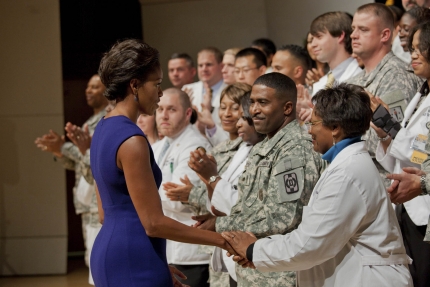
First Lady Michelle Obama shakes hands with veterans and medical personnel during a Joining Forces event at Virginia Commonwealth University AAMC-Medical Center in Richmond, Va., January 11, 2012. Mrs. Obama announced a major commitment by the country’s top medical colleges and universities to create a new generation of doctors, medical schools, and research facilities to ensure that veterans, service men and women receive the medical care that they deserve. (Official White House Photo by Chuck Kennedy)

After more than 10 years of war, nearly 50,000 of our military members have been wounded, many of them severely. These are the visible wounds of war.  But the invisible wounds which are the signature injuries of our wars in Iraq and Afghanistan -- Post-traumatic Stress Disorder (PTSD) and Traumatic Brain Injury (TBI)  -- have impacted roughly 1 in 6 of our veterans. 

Though the Department of Defense and the Veterans Administration continue their strong efforts to address PTSD and TBI, we know that more than half of today's Iraq and Afghanistan veterans seek care from health care providers that are outside of the VA system. We have veterans in every corner of this country and if we are going to fully understand the issues these heroes face, we've got to meet our veterans where they live. And that means that health care providers throughout this country need to have some fundamental understanding about PTSD and TBI so they can recognize the conditions and then positively impact the health care outcome for our veterans. 

We can’t wait to help our heroes. We must act now to ensure the nation's current and future health care providers are familiar with issues impacting our veterans and families. Because those impacted are young -- almost all in their 20's and 30's -- this is a long term issue for this nation.  

Today, First Lady Michelle Obama announced the largest coordinated commitment from America's medical colleges to support our veterans and military families. Led by the Association of American Medical Colleges (AAMC) and the American Association of Colleges of Osteopathic Medicine (AACOM),   130 of the nation's medical and osteopathic colleges -- 105 medical colleges and 25 osteopathic colleges – have committed to train students in treating brain injuries, PTSD and other mental-health issues affecting returning service members. 

The White House

Office of the First Lady

Remarks by the First Lady at a Campaign Event in Richmond

Richmond Marriott
Richmond, Virginia

12:19 P.M. EST

MRS. OBAMA:  Thank you all so much.  Richmond, it’s good to be here!  (Applause.)  You all, thank you.  You all rest yourselves because I want you all ready to work.  So I don’t want you to run your energy out clapping and standing up.  (Laughter.)  But thank you all so much.  It is such a pleasure to be here.  This is my first official event campaigning of the year.  (Applause.)  Yes!  It’s a great way to kick it off.

And I want to start by thanking your former governor, Tim Kaine, for that very kind introduction, but more importantly for his outstanding leadership.  One of my favorite people.  He’s got good judgment, too, because his wife Anne is amazing.  Love her to death.  So let’s give them both another round of applause.  (Applause.)

I also want to thank Congressman Scott, who is here, Mayor Jones, also, for their dedicated service.  (Applause.)  Thank you all for joining us here today. 

And I want to recognize all of the Richmond Women for Obama who are here -- (applause) -- along with the Host Committee that I know have worked very hard to make this event such a success. 

And finally, I want to thank all of you for joining us here today, this afternoon.  It is afternoon, right?  See, when I do this -- is it morning, it’s afternoon?

And I know that all you are here for a couple of reasons.  And it’s not just because there’s a good luncheon, and you’re not just here to see me.  Right?  (Laughter.)  There’s a reason why all of us are here, why all of you are here today. 

You’re here because you know that we stand at a fundamental crossroads for our country.  You’re here because you know that in less than a year from now, we’re going to make a choice that will impact our lives for decades to come.  And you’re here because you know that that choice won’t just affect all of us, but it’s going to affect our children and our grandchildren and the world that we leave for them long after we’re gone.

And that is why I’m here today as well.  You see, as First Lady, I have the privilege of traveling all across the country, meeting folks from all different backgrounds and hearing what’s going on in their lives.  And every day, I hear about folks’ struggles -– the bills they’re trying to pay, the businesses they’re trying to keep afloat. 

I hear about how they’re taking the extra shift, or working the extra job.  How so many people are saving and sacrificing, never spending a dime on themselves because they desperately want something better for their kids. 

And make no mistake about it, these struggles are not new.  For decades now, middle-class folks have been squeezed from all sides.  The cost for things like gas and groceries, tuition, have been steadily rising, but people’s paychecks just haven’t kept up.

So when this economy fell apart, the crisis hit, for far too many families, the bottom just fell out.

Now, fortunately, over the past three years, we’ve worked very hard to dig ourselves out of this mess.  Your President has worked very hard.  And there’s been a lot of wonderful progress made.  (Applause.)  

We have had 22 straight months of private sector job growth -- (applause) -- and unemployment is now the lowest it’s been in nearly three years.  (Applause.)  So there’s a lot of work happening, but we know that we still have a very long way to go.  But your President has been working hard to rebuild our economy based on a vision that we all share -- the belief, as my husband says, that hard work should pay off, that responsibility should be rewarded, and that everyone should get a fair shot, and everyone should do their fair share and play by the same rules. 

See, these are basic American values.  They’re the values that so many of us were raised with, including myself.

As you know, my father was a blue-collar worker at the city water plant.  My family lived in a little bitty apartment on the South Side of Chicago.  And my parents, neither of them were able to go to school -- to college, that is.  But they worked very hard, and they saved, and they sacrificed, because they wanted something better for me and my brother. 

And more than anything else, that is what’s at stake -- that fundamental promise that no matter who you are or how you started out, that if you work hard, you can build a decent life for yourself and an even better life for your kids.

And on just about every issue -- from health care to education to the economy -- that is the choice we face.

For example, when you hear talk about tax cuts for middle-class families, or unemployment insurance for folks out of work, understand that that’s about whether people can heat their homes.  That’s about whether folks can put a hot meal on their table or put gas in their car so that they can look for work.  It’s about whether folks can afford to own a home, send their kids to college, retire with dignity and security.

This talk about whether people will have more money in their pockets, which means more money in the economy, which means more jobs.  That’s what’s at stake here.  That is the choice that we face.

And just think for a minute about what this administration has done to stand up for American consumers.  I’m talking about families getting hit with those hidden credit card fees.  I’m talking about our students drowning in debt, our seniors losing their home and their savings because they’ve been tricked into loans they couldn’t afford.

That’s why my husband created a new consumer watchdog with just one simple mission -- and that is to protect folks from exactly these kinds of abuses.  (Applause.)  Because he believes that when you’ve worked hard and you’ve saved and you’ve followed the rules, you shouldn’t lose it all to someone who’s looking to make some easy money.  That’s not right.  That’s not fair.  (Applause.)  And your President, all of us, we are working hard to do something about that.

And what about all that we’ve done together for our small businesses?  These are the companies that create two-thirds of all new jobs each year.  That’s two-thirds.  I’m talking about that mom who opens up the dry-cleaning store on the corner to provide for her kids, or that family that’s been running the neighborhood diner for generations, or the veteran who launches a startup and pursues that American Dream he fought so hard for.

See, these are the folks who work themselves to the bone during the day, then they head home, pore over the books late into the night, determined to make the numbers add up.

For these folks, the small business tax cuts this administration has passed, for these folks it means the difference between hiring new employees in those businesses or handing out pink slips; between keeping the doors open or closing up shop for good.  That is the choice that we face.

And how about the very first bill my husband signed into law, the very first bill, the Lilly Ledbetter Fair Pay Act to help women get equal pay for equal work?  (Applause.)

He did this because he knows what it means when women aren’t treated fairly in the workplace.  He watched his own grandmother -- woman with a high school education -- work her way up from being a vice president at a little community bank.  She worked hard and she was good at her job.  But like so many women, she hit a glass ceiling, and she watched men no more qualified than she, men she had actually trained, be promoted up that ladder ahead of her.

So believe me, for Barack, this issue isn’t abstract.  This isn’t some hypothetical situation.  And he signed this bill because he knows that closing that pay gap can mean the difference between women losing $50, $100, $500 for each paycheck, or having that money in their pockets for gas or groceries, school clothes for their kids.

He did it because when nearly two-thirds of women are breadwinners or co-breadwinners, your President knows that women’s success in this economy is the key to families’ success in this economy.  (Applause.)

And he did it because, as he put it, we believe that here in America, there should be no second-class citizens in our workplaces.  That is what’s at stake.

And let’s just talk for a minute about health care.  Last year, we made history together by finally passing health reform.  (Applause.)  It’s wonderful.  But now, there are some folks actually talking about repealing this reform -- repealing it.  And today, we need to ask ourselves, are we going to stand by and let that happen? 

Are we going to let insurance companies refuse to cover things like cancer screenings and prenatal care that don’t just save money, but save lives?  Or will we stand up for our lives and for the lives of the people that we love?  

Are we going to go back to the days when insurance companies could deny our children coverage because they have preexisting conditions like cancer or diabetes, even asthma?  Or will we stand up and say that in this country, no one -- no one should ever have to choose between going bankrupt or watching their child suffer because they can’t afford a doctor.  (Applause.)  

And when our children get older and graduate from school, we know how hard it is for them to find jobs, and jobs that provide insurance.  That’s why, as part of health reform, our children can now stay on their parents’ insurance until they’re 26 years old.  (Applause.)  And so today, that’s how about 2.5 million of our young people are getting their coverage.  So will we take that insurance away from those kids?  Or will we say that we don’t want our sons and daughters going without health care when they’re just starting out, just trying to build their own families and build their own careers?  Because that is the choice that we face.  That is the choice.

And think again for a moment about what’s been done on education.  Think about all those investments to raise standards and reform our public schools.  We all know this is about improving the circumstances for millions of children in this country -- kids we know who are sitting in crumbling classrooms, kids with so much promise, kids who could be anything they wanted if we just gave them the chance.  That’s what this is about.

And think about how this President has tripled investments for job training at community colleges.  This is about hundreds of thousands of hardworking folks who are determined to get the skills they need for a better job and for better wages.  I mean, these are the folks who are doing it all.  They’re doing what they’re supposed to do.  They’re working full-time, they’re raising their kids, but they’re still finding time to go to night classes and study late into the evening because they desperately want to do something better for their families.

Make no mistake -- this investment in our students and our workers will determine nothing less than the future of our economy.  I mean, this kind of stuff will determine whether we’re prepared to make the discoveries and to build the industries that will let us compete with any country anywhere in the world.  And that’s what’s at stake. 
    
And let’s not forget what it meant when my husband appointed those two brilliant Supreme Court justices, and for the first time in history, our daughters –- and our sons –- (applause) -- watched three women take their seat on our nation’s highest court.  Let’s not forget the impact their decisions will have on our lives for decades to come -- on our privacy and security, on whether we can speak freely, worship openly, and love whomever we choose.  That’s what’s at stake.  That is the choice we’re facing.  (Applause.)

And finally, let’s not forget all this administration has done to keep our country safe and restore our standing in the world.  Thanks to our brave men and women in uniform, we finally brought to justice the man behind the 9/11 attacks and so many other horrific acts of terror.  (Applause.)  Yes, my husband ended the war in Iraq and brought our troops home for the holidays.  (Applause.)

And as Tim said, we are working hard to give our veterans and their families the education, the employment and the benefits they’ve earned.  (Applause.)  And because my husband ended “don’t ask, don’t tell,” our troops will never again have to lie about who they are to serve the country they love.  (Applause.)  That is what’s at stake.  That is what’s at stake.

So Richmond, make no mistake about it.  Whether it’s health care or the economy, whether it’s education or foreign policy, the choice we make will determine nothing less than who we are as a country, but, more importantly, who do we want to be.  Who are we?

Will we be a country where opportunity is limited to the few at the top?  Or will we be a place where if you work hard, you can get ahead, no matter who you are or how you started out?  Who are we?

Will we tell folks who’ve done everything right, but are still struggling just a little to get by, tough luck, you’re on your own?   Who are we?  Or will we honor the fundamental American belief that this country is strongest when we’re all better off?  Who are we?  (Applause.)  

Will we continue all the change we’ve begun and the progress we’ve made?  Or will we allow everything we’ve fought for to just slip away?  That is the choice we face.  Those are the stakes. 

And believe me, Barack knows this.  He understands these issues, because he’s lived them.  He was raised by a single mother who struggled to put herself through school, pay the bills.  And when she needed help his grandmother stepped up -- getting up every morning, getting on that bus, going to that job at the bank, even though she was passed over for all those promotions.  She never complained.  She just kept showing up and doing her best.  Sounds familiar, right?

So Barack knows what it means when a family struggles.  He knows what it means when someone doesn’t have a chance to fulfill their potential.  Those are the experiences that have made him the man -- but more importantly, the President -- he is today.  And we are blessed to have him.  (Applause.)   

And that is what I hear in his voice when he returns home after a long day traveling around the country and he tells me about the people he’s met.  That’s what I see in those quiet moments late at night after the girls have gone to bed and he’s poring over the letters people have sent him -- the letter from the woman dying of cancer whose insurance company won’t cover her care; the letter from the father struggling to pay the bills for his family; the letter from the young person, too many young people with so much promise but so few opportunities. 

And I hear the passion and determination in his voice.  You won’t believe what folks are going through -- that’s what he tells me.  He says, Michelle, it’s not right.  And we’ve got to fix it.  We have way too much work to do.

See, what I’m trying to remind people about my husband is that when it comes to the people he meets, Barack has a memory like a steel trap.  He might not remember your name, but if he has had just a few minutes and a decent conversation with you, he will never forget your story.  It becomes imprinted on his heart. 

And that is what he carries with him every single day.  It is our collection of struggles and hopes and dreams.  And that is where your President gets his passion.  That is where your President gets his toughness and his fight. 

And that’s why even in some of the hardest moments, when it seems like all is lost and we’re sweating it and we’re sweating him, Barack Obama never loses sight of the end goal.  (Applause.)  He never -- never lets himself get distracted by the chatter and the noise. 

See, your President just keeps moving forward, because so importantly he has a vision for this country.  And it’s a vision that we all share.  This is our vision.  This is the country we want to live in.  But I have said this before and I will say it again:  He cannot do this alone.  Never could.  He needs your help. 

He needs you to make those phone calls.  He needs you to get up, be ready to work, get those voters registered.  He needs you to take those “I’m in” cards, which I hope you have.  Use them.  Sign yourself up.  Sign your friends, sign your neighbors, your colleagues up.  Convince them to join in giving just a little part of your life and their lives each week to this campaign, because we all know that this isn’t just about one extraordinary man -- never was.  Though I’ll admit, I’m a little biased.  (Laughter.)  I think he’s wonderful.

But this is really about us -- about all of us -- about all of us coming together for the values we believe in and for the country that we want to be.  Now, again, I’m not going to kid you, this journey is going to be long and it is going to be hard.  And there will be plenty of twists and turns along the way -- always love drama. 

But the truth is, that is how change always happens in this country.  The reality is that change is slow, real change, and it never happens all at once.  But if we keep showing up, if we keep fighting the good fight doing what we know is right, then we eventually get there.  We always do.  We always do -- maybe not in our lifetimes, but maybe in our children’s lifetimes, our grandchildren’s lifetimes, because in the end, that’s what this is all about. 

In the end, we’re not fighting these battles for ourselves.  We’re fighting these battles for our sons and our daughters.  We’re fighting these battles for our grandsons and our granddaughters.  We’re fighting for the world we want to leave for them.  It’s about our children.  (Applause.) 

And I’m in this fight not just as a mother who wants to leave a legacy for my children.  I’m in this as a citizen who knows what we can do together to change this country for the better.  See, because if I’m honest, the truth is no matter what happens, my girls will be okay.  See, my girls are blessed.  They will still have plenty of advantages and opportunities in their lives, and that’s probably true for many of your kids as well, right?

But I think the last few years have shown us the truth of what Barack has always said, that if any child in this country is left behind, then that matters to all of us, even if she is not our daughter, even if he is not our son.  If any family in this country struggles, then we cannot be fully content with our own family’s good fortune.  That is not who we are.  (Applause.)  

In the end, we cannot separate our own story from the broader American story, because we know that in the end this country, in this country of America we rise and fall together.  And we know that if we make the right choices, if we have the right priorities, we can ensure that everyone gets a fair shake and everyone has a chance to get ahead.  That’s what’s at stake.  So Richmond, it is time for us to get moving.  It is time for us to get to work. 

So I have one last question to ask you all -- you’ve been listening so politely.  (Laughter.)  Are you in?

AUDIENCE:  Yes!  (Applause.)

MRS. OBAMA:  See, because I’m in.  I am in.  I need to hear that.  Are you in? 

AUDIENCE:  Yes!  (Applause.)

MRS. OBAMA:  Tell me:  I am in!

AUDIENCE:  I am in!  (Applause.)

MRS. OBAMA:  So I hope you all are fired up.  I hope you all are ready to go.  We need each and every one of you.  You need to reach out.  You need to talk to people.  You can influence your neighbors, get this done.  There’s a lot at stake. 

God bless you all.  I will be working right alongside of you.  Thank you all.  God bless.  (Applause.) 

END
12:45 P.M. EST

The White House

Office of the First Lady

First Lady Michelle Obama Announces Major Coordinated Effort by America's Academic Institutions to Combat PTSD & TBI

130 Medical Schools & Research Facilities to Join Forces to Serve Veterans & Families

(Richmond, Virginia) Today, as part of First Lady Michelle Obama and Dr. Jill Biden’s Joining Forces initiative, the Association of American Medical Colleges (AAMC) and the American Association of Colleges of Osteopathic Medicine (AACOM) committed to creating a new generation of doctors, medical schools, and research facilities that will make sure our heroes and their families receive the care worthy of their sacrifice.  Recognizing veterans, service members and their families’ dedication and commitment, 130 schools associated with the AAMC and AACOM pledged to leverage their missions in education, research, and clinical care to train the nation’s physicians to meet the unique health care needs of the military and veterans communities.  

“I’m inspired to see our nation’s medical schools step up to address this pressing need for our veterans and military families.  By directing some of our brightest minds, our most cutting-edge research, and our finest teaching institutions toward our military families, they’re ensuring that those who have served our country receive the first-rate care that they have earned,” says First Lady Michelle Obama.

Together, the AAMC and AACOM are committing to improve the education in their medical schools, the research in their laboratories, and the clinical care in their hospitals to better address the health issues that military families face.  Specifically, these organizations are committing to:

• Train their medical students as well as their current physicians, faculty, and staff to better diagnose and treat our veterans and military families;
• Develop new research and clinical trials on PTSD and TBI so that we can better understand and treat those conditions;
• Share their information and best practices with one another through a collaborative web forum created by the AAMC; and
• Continue to work with the VA and the Department of Defense to make sure that everyone is providing the best care available. 

“Because of our integrated missions in education, clinical care, and research, America’s medical schools are uniquely positioned to take a leadership role in this important effort,” said Darrell G. Kirch, M.D., president and CEO of the Association of American Medical Colleges.  “Medical schools have long recognized the sacrifice and commitment of our military, veterans, and their families.  The relationship between the Department of Veterans Affairs medical centers and academic medicine dates back to the end of World War II and serves as a model for successful partnerships between public and private institutions.   Our work with the White House on Joining Forces is a natural extension of our efforts in this area and renews our commitment to the wellness of our nation’s military.”

“A central component of the White House Joining Forces Initiative is wellness, and I am pleased to announce AACOM’s participation in a new Joining Forces effort that could have a significant impact on the health and well-being of our nation’s veterans.” Dr. Stephen C. Shannon, President and CEO, American Association of Colleges of Osteopathic Medicine.

Examples of universities stepping up to provide for veterans and their families include:

• Virginia Commonwealth University where they’re leading a groundbreaking project to provide resources and training to health care providers, volunteers, and community members throughout Virginia who can help ease the transition home for veterans with TBI and PTSD.
• The University of Pittsburgh where researchers are developing a new imaging tool that allows the visualization of the wiring of the brain in vivid high definition, which could lead to new breakthroughs in the diagnosis of TBI. 
• The University of South Florida where they are working with the Department of Defense and the VA to create a first-of-its-kind Center for Veterans Reintegration, which will mean a single, cohesive research, treatment, and education facility for veterans and families. 

First Lady Michelle Obama and Dr. Jill Biden created Joining Forces to bring Americans together to recognize, honor and take action to support veterans and military families as they serve our country and throughout their lives. The initiative aims to educate, challenge, and spark action from all sectors of society to ensure veterans and military families have the support they have earned. The initiative focuses on key priority areas – employment, education, and wellness while raising awareness about the service, sacrifice, and needs of America’s veterans and military families. More information is available at: www.JoiningForces.gov.

The following is a list of the 130 universities and colleges participating in this program:
• University of Alabama School of Medicine
• University of South Alabama College of Medicine
• University of Arkansas for Medical Sciences College of Medicine
• Arizona College of Osteopathic Medicine of Midwestern University
• AT Still University School of Osteopathic Medicine of Arizona
• University of Arizona College of Medicine
• Loma Linda University
• Keck School of Medicine of the University of Southern California
• Touro University California College of Osteopathic Medicine
• Stanford University School of Medicine
• UC Davis Health System
• University of California, Irvine School of Medicine
• David Geffen School of Medicine at UCLA
• Western University of Health Sciences College of Osteopathic Medicine of the Pacific
• Rocky Vista University College of Osteopathic Medicine
• University of Colorado School of Medicine
• Yale School of Medicine
• Georgetown University School of Medicine
• George Washington University School of Medicine and Health Sciences
• Howard University College of Medicine
• Florida State University College of Medicine
• Herbert Wertheim College of Medicine Florida International University
• Nova Southeastern University College os Osteopathic Medicine
• University of Florida College of Medicine
• USF Health Morsani College of Medicine
• Emory University School of Medicine
• Medical College of Georgia at Georgia Health Sciences University
• Mercer University School of Medicine
• Morehouse School of Medicine
• University of Hawaii at Manoa, John A. Burns School of Medicine
• Des Moines University College of Osteopathic Medicine
• University of Iowa Carver College of Medicine
• Chicago College of Osteopathic Medicine of Midwestern University
• Loyola University Chicago Stritch School of Medicine
• Rush University Medical Center, Chicago
• Southern Illinois University School of Medicine
• The Chicago Medical School in conjunction with the Lovell Federal Health Care Center
• University of Chicago Pritzker School of Medicine
• University of Illinois College of Medicine
• Indiana University
• University of Kansas Medical Center
• University of Kentucky College of Medicine
• University of Pikeville Kentucky College of Osteopathic Medicine
• Louisiana State University School of Medicine in New Orleans
• Tulane University School of Medicine
• Boston University School of Medicine
• Harvard Medical School
• Tufts University School of Medicine
• University of Massachusetts Medical School
• Johns Hopkins University School of Medicine
• Uniformed Services University of the Health Science's F. Edward Hebert School of Medicine
• University of Maryland School of Medicine
• University of New England College of Osteopathic Medicine
• Michigan State University College of Human Medicine
• Michigan State University College of Osteopathic Medicine
• University of Michigan Medical School
• Wayne State University School of Medicine
• University of Minnesota Medical School
• Kansas City University of Medicine and Biosciences College of Osteopathic Medicine
• Kirksville College of Osteopathic Medicine AT Still University
• Saint Louis University
• University of Missouri-Columbia School of Medicine
• University of Missouri - Kansas City School of Medicine
• Washington University in St. Louis School of Medicine
• University of Mississippi School of Medicine
• Creighton University School of Medicine
• University of Nebraska Medical Center College of Medicine
• The Brody School of Medicine at East Carolina University
• Wake Forest School of Medicine
• University of North Carolina at Chapel Hill School of Medicine
• University of North Dakota School of Medicine and Health Sciences
• Dartmouth Medical School
• Cooper Medical School of Rowan University.
• University of Medicine and Dentistry of New Jersey - New Jersey Medical School
• University of Medicine and Dentistry of New Jersey - Robert Wood Johnson Medical School
• University of Medicine and Dentistry of New Jersey - School of Osteopathic Medicine
• University of New Mexico School of Medicine
• University of Nevada School of Medicine
• Hofstra North Shore - LIJ School of Medicine
• New York Institute of Technology New York College of Osteopathic Medicine
• State University of New York Upstate Medical University
• Touro University College of Osteopathic Medicine
• University at Buffalo State University of New York School of Medicine & Biomedical Sciences
• Case Western Reserve University School of Medicine
• The Ohio State University
• Ohio University College of Osteopathic Medicine
• University of Cincinnati College of Medicine
• University of Toledo College of Medicine
• Wright State University Boonshoft School of Medicine
• Oklahoma State University College of Osteopathic Medicine
• University of Oklahoma College of Medicine
• Oregon Health & Science University School of Medicine
• Pacific Northwest University of Health Science College of Osteopathic Medicine
• Commonwealth Medical College
• Drexel University College of Medicine
• Jefferson Medical College of Thomas Jefferson University
• Lake Erie College of Osteopathic Medicine
• Perelman School of Medicine at the University of Pennsylvania
• Penn State University College of Medicine
• Philadelphia College of Osteopathic Medicine
• Temple University School of Medicine
• University of Pittsburgh School of Medicine
• Universidad Central del Caribe School of Medicine
• Ponce School of Medicine and Health Sciences
• Medical University of South Carolina College of Medicine
• University of South Carolina School of Medicine
• University of South Carolina School of Medicine, Greenville
• University of South Dakota Sanford School of Medicine
• Lincoln Memorial University DeBusk College of Osteopathic Medicine
• Meharry Medical College
• Vanderbilt University School of Medicine
• Baylor College of Medicine
• The Texas A & M Health Science Center College of Medicine
• Texas Tech University Health Sciences Center School of Medicine
• Texas Tech University Health Sciences Center School of Medicine Paul L. Foster School of Medicine
• The University of North Texas Health Science Center Texas College of Osteopathic Medicine
• The University of Texas School of Medicine at San Antonio
• University of Texas Medical School at Houston
• University of Utah School of Medicine
• Eastern Virginia Medical School
• University of Virginia School of Medicine
• Virginia Commonwealth University School of Medicine
• Virginia Tech Carilion School of Medicine
• Edward Via College of Osteopathic Medicine
• University of Washington School of Medicine
• Medical College of Wisconsin
• University of Wisconsin School of Medicine and Public Health
• The Joan C. Edwards School of Medicine at Marshall University
• West Virginia School of Osteopathic Medicine
• West Virginia University School of Medicine

NCAA Will Celebrate Military Families At More Than 600 Events in 2012

The National Collegiate Athletic Association (NCAA) is joining forces with First Lady Michelle Obama to recognize, honor and support our troops and their families. Throughout 2012, the NCAA will highlight the sacrifices made by service members and their families across its 89 championship events that span 23 sports.

“Our nation’s service members demonstrate the kind of example we should all try to set for young people, and we at the NCAA are honored to recognize military members and families across the 89 championship events we host every year,” said NCAA President Emmert. “As student-athletes learn in practice every day, each of us must rely on others to succeed; from here on in, military members and their families can look to the NCAA for the recognition and thanks they so richly deserve.”

That recognition will include public address announcements at all finals sites as well as at approximately 600 preliminary round sites; access to youth clinics for children of military families (Men’s and Women’s Final Four and other NCAA-sponsored clinics; designated seating areas at select special events for military families; inviting military personnel to serve as honorary team or game captains; and behind-the-scenes tours prior to select championship competitions for families of military personnel

A new video featuring the First Lady and NCAA President Mark Emmert will air for the first time on Saturday, January 77th at the Football Championship Subdivision (FCS) title game -- but you can see it here first.

Watch Joining Forces with the NCAA, here

Joining Forces with the NCAA

January 06, 2012 | 1:00 | Public Domain

First Lady Michelle Obama and NCAA President Mark Emmert speak on the national initiative Joining Forces, which mobilizes all sectors of society to give our service members and their families the opportunities and support they deserve. http://joiningforces.gov

Download mp4 (32MB)

Joining Forces with NASCAR to Say Thanks to our Troops and their Families

Watch Joining Forces with NASCAR, here

Joining Forces was launched earlier this year with one simple goal: Letting the men and women who serve our country – and their families -- know, as First Lady Michelle Obama says, “People care about you, they care about what you have done.”

The response to this initiative has been tremendous, with individuals and organizations from across the country joining in to say “thank you” – with commitments around hiring veterans, with commitments to increase access to wellness opportunities and with invitations for our active and retired servicemen and women – and their families – to participate in special events.

Recently, the First Lady and Dr. Jill Biden joined some of those families at a NASCAR race in Miami, Florida. It was a once in a lifetime experience for everyone who was there, but as Dr. Biden points out, making a difference isn’t that difficult, especially around the holidays. “Reach out to a military family and say, come on over and have dinner with us. This is the perfect time to extend an act of kindness.”

The White House

Office of the Press Secretary

Statement by the President and First Lady on Kwanzaa

Michelle and I send our warmest wishes to all those celebrating Kwanzaa this holiday season. Today marks the beginning of the week-long celebration honoring African American heritage and culture through the seven principles of Kwanzaa -- unity, self determination, collective work and responsibility, cooperative economics, purpose, creativity, and faith.

We celebrate Kwanzaa at a time when many African Americans and all Americans reflect on our many blessings and memories over the past year and our aspirations for the year to come. And even as there is much to be thankful for, we know that there are still too many Americans going through enormous challenges and trying to make ends meet. But we also know that in the spirit of unity, or Umoja, we can overcome those challenges together.

As families across America and around the world light the red, black, and green candles of the Kinara this week, our family sends our well wishes and blessings for a happy and healthy new year.

The White House

Office of the Press Secretary

WEEKLY ADDRESS: The President and First Lady Thank our Troops for their Service as we Celebrate the Holiday Season

WASHINGTON— In this week’s address, President Obama and First Lady Michelle Obama came together to wish the American people a Merry Christmas and Happy Holidays, and thanked our troops, military families, and veterans for their service and sacrifice. President Obama and Michelle Obama encouraged everyone to visit JoiningForces.gov to find ways to give back to our brave men and women in uniform and their families during the holiday season as we work together in the spirit of service.

Remarks of President Barack Obama and First Lady Michelle Obama
Weekly Address
The White House
December 24, 2011

THE PRESIDENT: Hi everyone. As you gather with family and friends this weekend, Michelle, Malia, Sasha and I – and of course Bo – want to wish you all Merry Christmas and Happy Holidays.
 
THE FIRST LADY:  This is such a wonderful time of year. 
 
It’s a time to honor the story of love and redemption that began 2,000 years ago … a time to see the world through a child’s eyes and rediscover the magic all around us … and a time to give thanks for the gifts that bless us every single day. 
                                                                                                             
This holiday season at the White House, we wanted to show our thanks with a special holiday tribute to some of the strongest, bravest, and most resilient members of our American family – the men and women who wear our country’s uniform and the families who support them. 
 
THE PRESIDENT: For many military families, the best gift this year is a simple one – welcoming a loved one back for the holidays. You see, after nearly nine years, our war in Iraq is over.  Our troops are coming home.  And across America, military families are being reunited.
 
So let’s take a moment to give thanks for their service; for their families’ service; for our veterans’ service.  And let’s say a prayer for all our troops standing post all over the world, especially our brave men and women in Afghanistan who are serving, even as we speak, in harm’s way to protect the freedoms and security we hold dear.
 
THE FIRST LADY: Our veterans, troops, and military families sacrifice so much for us.
 
So this holiday season, let’s make sure that all of them know just how much we appreciate everything they do. 
 
Let’s ask ourselves, “How can I give back? How can my family serve them as well as they’ve served us” 
 
One way you can get started is to visit JoiningForces.gov to find out how you can get involved in your community.
 
THE PRESIDENT: Giving of ourselves; service to others – that’s what this season is all about. For my family and millions of Americans, that’s what Christmas is all about. It reminds us that part of what it means to love God is to love one another, to be our brother’s keeper and our sister’s keeper. But that belief is not just at the center of our Christian faith, it’s shared by Americans of all faiths and backgrounds. It’s why so many of us, every year, volunteer our time to help those most in need; especially our hungry and our homeless.
 
So whatever you believe, wherever you’re from, let’s remember the spirit of service that connects us all this season – as Americans.  Each of us can do our part to serve our communities and our country, not just today, but every day.
 
THE FIRST LADY: So from our family to yours, Merry Christmas.
 
THE PRESIDENT:  Merry Christmas and Happy Holidays, everybody.