West Wing Week 11/17/11 - A Preview

November 17, 2011 | :51 | Public Domain

This week, the President embarked on a nine-day Asia Pacific tour focused on creating opportunities for American businesses and entrepreneurs in some of the fastest growing economies in the world. Before leaving, he marked veterans day by visiting servicemen and women aboard the USS Carl Vinson in San Diego and attending the Carrier Classic. Stay tuned for a behind-the-scenes look at the President's trip that included stops in: Hawaii where he hosted the APEC conference; Australia where he announced a strategic military agreement with the Australian Prime Minister; and Indonesia where he attended the East Asia Summit, a first for an American President.

The White House

Office of the Press Secretary

Remarks by the First Lady at Jobs Fair

Joint Base Pearl Harbor-Hickam, Hawaii

2:52 A.M. HAST

MRS. OBAMA:  Well, aloha!

AUDIENCE:  Aloha!

MRS. OBAMA:  Let me just say that we're just ending a couple of days of being here for the APEC Summit.

AUDIENCE MEMBER:  All right!

MRS. OBAMA:  Yeah -- you're just happy about everything.  (Laughter.)  And I have to say that Honolulu really did a phenomenal job hosting these world leaders over the last couple of days.  And I can say, personally, just from talking to them, that they were so incredibly impressed with the people, with the food, with the culture, with the hospitality, as well as all of the world leaders' spouses. 

So you all should be very proud.  This has been a successful visit.  My husband is going to be leaving to go on to Australia and Indonesia, and I am leaving to go back home to Malia and Sasha -- (laughter) -- the other half.  You know how it is, mothers:  Dad can be gone for I don't know how long, but short time for mom.  So I'm heading back, but before I hop on the plane I wanted to stop by and get a look for myself to see how these job fairs are faring.  And I'm just happy that I've had an opportunity to come by and to hear from you and to see all the great things that are happening.

So I want to start by thanking Kevin not just for that wonderful introduction but for all of his leadership at the Chamber, in pulling together these job fairs all over the country.  He is a phenomenal leader, and we are grateful to him, and we have to give him a round of applause.  (Applause.)

I also want to thank Captain James and his family for his outstanding leadership, and for hosting us here today. 

And I also learned today that we are welcoming back the sailors from the USS Hopper, who I understand have just returned home earlier today from deployment.  So that's good news!  (Applause.)  That's wonderful news.  And hopefully, by year's end, there'll be a lot more of that kind of good news going on all over the country.  So we are so proud of their service, and we're thrilled that they're home, and we're proud of all of you.

And finally, and most important, I want to thank all of you -- our extraordinary men and women in uniform, our veterans, and of course your extraordinary families.  Thank you so much. 

As Kevin said, over the past few years I've had the privilege of meeting thousands of folks all across this country just like you, on bases and in communities all over the place.  And I always come back from these visits not just with a sense of pride and gratitude, but with a sense of awe.  And I say this time and time again, but it is simply true:  I am awed by the sacrifices you’ve made to defend our country -- signing up to serve at a time of war, enduring deployment after deployment, being away from the people you love most for months -- and sometimes years -- on end.

And I am awed by our military families -- that's for sure.  You all might not wear any kind of uniform, but when our troops are called to serve, you’re serving right alongside them.  You all are the spouses who run your households all alone, often juggling fulltime jobs of your own.  Many of you out there are kids, wonderful kids who are studying hard, you're helping out with chores -- right?  You're listening to your parents and eating your vegetables!  (Laughter.)  And many of you are doing your best to be brave while mom or dad is away.

So you all didn’t exactly take the easy path when you signed up to serve your country.  But I know that things don’t necessarily get any easier once you decide to leave the military.  And that's important for America to understand as well.

In fact, for a lot of folks, sometimes it’s just the opposite.  For a lot of folks, making the transition to civilian life is hard, especially in the midst of a tough economy.  And I know it can be daunting –- and incredibly stressful –- to walk away from an institution where you have invested so much of yourselves and spent so many years of your lives and of your careers.  And I know that right now, many of you are wondering how you’re going to translate all that you’ve learned in the military into a job and into civilian life. 

But here’s something else that I know, and Kevin mentioned it:  I know that all of you are some of the highest-skilled, hardest-working, most dedicated employees that we have in this country -- and that's important for this country to know.  You all have mastered state of the art technologies, run some of the world’s most complex operations.  You’ve overseen hundreds of your colleagues and you've undertaken missions with no margin for error, working in situations where the bottom line is literally a matter of life and death. 

And make no mistake about it, these are precisely the kind of skills that so many of our businesses so desperately need right now.  And the way I see it, we have an obligation to help you put those skills to work.  As my husband said, no one who’s fought for our country abroad should have to fight for a job when they return home.  (Applause.)

But that’s why Dr. Jill Biden and I started a nationwide campaign called what?  Joining Forces!  Where were you?  (Laughter.)  And what we're doing through Joining Forces is rallying all of America to recognize and honor and support our veterans and military families.  As part of this effort, we've issued a simple challenge to America’s businesses:  We've asked them to step up and hire as many veterans and military spouses as they can.

And I have to tell you that the response has been overwhelming.  That is the good news.  The Chamber of Commerce has sponsored veterans hiring fairs like this one.  And they’ve connected more than 44,000 veterans to more than 2,200 employers in 36 states.  And they're going to keep doing it.

We’ve also launched a website called vetjobbank.com, where you can find veteran-friendly jobs online -- and that site currently lists more than half a million jobs just waiting to be filled right now.  So check it out.  They're there.  (Applause.)

Companies like Siemens, Sears -- they've already hired hundreds of veterans.  Kmart and Sam’s Club have promised to help military spouses keep their jobs if their family is assigned to a new duty station.  And in the past month, American businesses have stepped forward with pledges to hire 125,000 additional veterans and military spouses by 2014.  (Applause.)

And as many of you probably know, my husband has also proposed a new tax credit for small businesses that hire veterans -- that's a good thing.  And he’s working with Secretary Shinseki and the Veterans Affairs Department to improve the transition process; that's something that we hear from you all quite often, that the transition resources have to be better so that you all have the resources and support as you prepare to enter civilian life.

So if there’s one thing that I want you all to know today -- and I want every veteran out there, and every spouse and family to know -- is that America does have your back.  America has your back. 

Every time we have asked someone to get involved and step up, we’ve gotten the same answer –- absolutely yes.  No hesitation.  When people are asked, they are stepping up.  Companies are lining up to sign on.  They’re challenging themselves and each other to do more.  And as Kevin said, they’re not just doing it because it’s the right thing to do and the patriotic thing to do -- which it is.  They’re doing it because it’s good for business.  It's good for their bottom lines, too.  They’re doing it because they know that all of you are the best employees that money can buy.

I think the Deputy Commander of this base, Colonel Carlson, put it best when he said, and this is his quote:  “We are a part of the greatest Air Force and Navy the world’s ever seen, but it’s the people that make it, and it’s the families behind those people that make the difference.”

He’s talking about people like Colonel Wicks, who's commanded a unit in Afghanistan.  They were plenty busy with their official duties there.  But they still find time to adopt a school for girls in Kabul.  (Applause.)  Absolutely.  And every week or so, they dropped off desperately needed supplies to help those girls get the education they deserve.

And then there are the 561st Network Operations Squadron Airmen, who were called in after the earthquake and tsunami in Japan earlier this year.  Within five hours, they got a network up and running so that workers and supplies could get where they needed.

And then there are the spouses like Joni Mansapit -- I hope I'm pronouncing her name right.  She is a mother of five children, one of whom has a life-threatening medical condition.  And while her husband was away, Joni wasn’t just caring for her own family.  She stepped up to help other families with seriously ill loved ones.  She would cook dinner for them.  She took them shopping.  And she did everything she could to keep their spirits up.

So make no mistake about it, you all represent the very best this country has to offer.  And that is my goal, to make sure that everyone in this country understands that.  And today, I want to end the same way that I started -- by simply saying thank you.

Thank you for everything that you have done for this country.  Thank you for your sacrifice.  Know that we are proud of you, that we're going to be continuing to work hard to make sure that you get the support that you deserve.

So you all just hang in there.  Keep working hard.  Keep taking care of each other.  God bless you all, and God bless America.  I'll come down and shake hands.  (Applause.)

END
3:04 P.M. HAST

The First Lady in Hawaii for APEC

201111114 APEC cultural event

Leaders and their spouses watch cultural performance at the APEC summit at the Hale Koa Hotel in Honolulu, Hawaii, Saturday, Nov. 12, 2011. (Official White House Photo by Pete Souza)

This weekend, First Lady Michelle Obama joined the President in Hawaii to host the conference of Asia Pacific Economic Cooperation leaders.

At a luncheon for APEC spouses, Mrs. Obama discussed why Hawaii is uniquely suited to entertain talks like those held between the 21 nations in attendance: 

Hawaii is an incredibly diverse place; it's home to people of all different cultures.  And there’s a special spirit here –- a spirit of openness and tolerance. And I have experienced it myself. I feel like this is my home away from  home, a place where I feel welcome and open and optimistic. Folks here view their differences as strengths –- not as weaknesses. And people of all different backgrounds live together and work together and seek to learn from each other. 

The meal featured produce from the MA'O Organic Farm -- which the First Lady toured over the weekend. Guiding her through the farm, which is also home to a youth leadership program, were high school and college interns.

At the luncheon, the First Lady presented each of the spouses with a personal gift created by Hawaiian artists.

The White House

Office of the Press Secretary

Remarks by the First Lady at APEC Spouses Luncheon

Ka’a’awa, Hawaii

11:49 A.M. HAST

MRS. OBAMA:  Well, first of all I just want to say welcome and good afternoon.  It is such a pleasure to see each of you again today.  I hope you enjoyed last night.  I hope that you got some rest.  And if you still feel a bit tired, then our hope is that this spectacular view will wake you up, as well as this wonderful lunch.  I am thrilled to be with all of you today, as I am every time we have an opportunity to meet. 

I know traveling for our spouses can be difficult, but for me, one of the things that makes it worthwhile is getting to know each one of you.  Over the last several years, I've had an opportunity to talk and share stories, and learn more about your lives and your children and your family.  And I can say that this is one of the greatest benefits of being a First Lady, is sharing this experience with each and every one of you.  So from the bottom of my heart, I want to thank you for your friendship, and I look forward to spending more time with each of you in the years to come. 

I am also thrilled to have a chance to welcome you all here to Hawaii at this year’s APEC Summit.  And I have to tell you that this state, as you know, has a very special place in my heart.  As many of you know, my husband was born and raised here.  Our sister, Maya, is joining us here today, and she still lives here with our two nieces.  She's working with the University of Hawaii, doing some great outreach education, training of teachers, and just being an overall great professional and wonderful mother.  And I'm glad that she could be here today. 

And our family has the privilege of coming here -- the burden of coming back here every year.  (Laughter.)  And that's really one of the reasons I married Barack.  (Laughter.)  When I realized that this is where we'd be spending the holidays, I said, "Yes -- I love you!"  (Laughter.)  So Barack and I, we have a tradition:  Over the last 20, maybe -- more than 20 years, because we started coming back even before we were engaged; every year we come here for two weeks and spend time getting to know this wonderful island and spending time with our families.  So it is a unique privilege to be able to share this special place with all of you.  And ever since I first met Barack, he’s always talked about how growing up here, in this place, has shaped his character and his perspective -- and it's true.  He is a very calm, focused individual, and much of that comes from his upbringing here, and the connection to the community here as well. 

As he said, Hawaii is an incredibly diverse place; it's home to people of all different cultures.  And there’s a special spirit here –- a spirit of openness and tolerance.  And I have experienced it myself.  I feel like this is my home away from  home, a place where I feel welcome and open and optimistic.  Folks here view their differences as strengths –- not as weaknesses.  And people of all different backgrounds live together and work together and seek to learn from each other.  

So in many ways, Hawaii is really the perfect place for this year’s APEC Summit, because that is precisely what our spouses are working towards here during their time together.  They’re coming together to address our shared challenges.  They are finding ways to boost our economies so that we can all prosper.  And they’re working to ensure -- most importantly -- that our young people will have every opportunity to fulfill their dreams.  And I know that all of you and your spouses also share that hope and goal for the young people in our country and in our world.

So we thought that this last point actually brings me to one of the reasons why we came here, and why you're about to eat the meal that you're going to have.  Because we're working with young people -- they've helped us make this afternoon possible.  The fresh fruits and vegetables that you’ll be eating today were grown and prepared by some phenomenal young people at a local organic farm under the guidance of a great Hawaiian chef, Chef Ed Kenney. 

And I had the pleasure of spending a very cool afternoon with many of these young people yesterday, and I can tell you that they are some amazing, positive people who will have an impact not just on the state of Hawaii, but on the rest of the world.  Through the work that they're doing, they're not only interning and learning about farming and learning how to reconnect with one of the important cultural aspects of their heritage, but they're also working, earning a living, gaining an internship -- and the program is paying for many of them to finish their education.  All of these young people are either getting -- going to community colleges in the area, or they're pursuing their graduate or undergraduate educations at the University of Hawaii and other institutions here.  I love these kids.  I love this program.  And I am just pleased that they decided to come and spend a little more time with us today.  So it is now my pleasure to introduce to you Chef Kenney and two of the great students who work with Ma'o Farms -– Manny Miles and Ku’u Samson.  You guys ready to talk some more?

MS. SAMSON:  Yes.  (Laughter.)

MRS. OBAMA:  They pretend to be shy, but they're not really.  So they're going to tell you a little bit more about the meal that they've prepared for you -- for us today, and anything else that you want to share with us.  So, Chef Kenney, take it away.

END
11:56 P.M. HAST

The White House

Office of the Press Secretary

Remarks by The First Lady in Roundtable with Members of Ma'o Organic Farms

Waianae, Hawaii

November 12, 2011
11:55 A.M. HAST

MR. ENOS: So, aloha, and welcome to Ma'o Organic Farms. I'll be your moderator.

MRS. OBAMA: Excellent. (Laughter.)

MR. ENOS: And on behalf of our organization and our community, we're really, really grateful. And we welcome you for what you do, not just because of your Office of the First Lady -- which is -- so fun.

MRS. OBAMA: It's all right. (Laughter.)

MR. ENOS: You've really done a lot of work to lift up the things we do and we're practicing here, so we're so honored to have a fellow comrade in arms, if you will, to visit us. And we'd like to start today's event with just an introduction.

MRS. OBAMA: Okay.

MR. ENOS: We'll just go around, and our team is going to just give a little bit more about themselves, and share some things. And we'll pick up a conversation after that.

MRS. OBAMA: Great.

MS. ABBOTT: So, aloha again. My name is Maisha Abbott. I am 20 years old, started working at Ma'o about three years ago. And the reason why I came to this program was because I heard of its college opportunities and I always had a passion to further my education. So that's why I joined. And just by being here, I just realized that it's bigger than just going to school -- it's about changing our community. And afterwards, I plan on getting a bachelor's in fashion design and getting my master's in environmental studies -- and eco-friendly design.

MRS. OBAMA: Awesome. (Applause.) Yes.

MR. KENNEY: Aloha. Welcome to heaven on Earth.

MRS. OBAMA: It is, yes. (Laughter.)

MR. KENNEY: My name is Ed Kenney. I am 43. (Laughter.) I am the chef/owner of Town and Downtown Restaurants. And we've been co-producers with Ma'o for 10-plus years. A year ago, I was asked to sit on the board of directors, and without hesitation, wholeheartedly, said yes. As a chef and a director, I am given the task to, I think, tell the story of Ma'o to 600 hungry people a day. And when you tell the story with food, and with this food, it's incredibly easy. When you taste this food, it's -- you're not just tasting a carrot, you're tasting this youthful enthusiasm, you're tasting youth leadership and mentorship -- you're tasting food security and sustainability. And you will get a chance to taste the food tomorrow.

MRS. OBAMA: Yes. Awesome. (Laughter.)

MR. KENNEY: Thanks.

MS. SAMSON: Aloha, my name is Kuuleilani Samson. I was born and raised in Makaha-Waianae all my life. I attended Waianae High School. I graduated in 2008. And in my senior year, I went -- I first heard of Ma'o through one of our majors, Hawaiian studies. And as soon as I graduated, I came into the summer -- program. And there I came into the two-and-a-half-year internship, the youth leadership intern. And I just recently graduated from that program. I just got my AA from Leeward Community College in -- I'm currently at the University of Hawaii-Manoa, working on my bachelor's in Hawaiian studies. I hope to move on towards a master's in education, and I want to teach back at my high school.

MRS. OBAMA: Nice. (Applause.)

MS. SANA: Aloha, my name is Cheryse Sana. I've lived in this valley about my whole life. I'm 22 years old. I came to Ma'o after I graduated in 2007. I heard about Ma'o through my teachers at Waianae High, and also in the Hawaii -- I was just kind of, like, "Oh, what to do?" And I know that they had their college program here, and so I was like -- I always wanted to go to college, so I was like, "Ah, let me just take it." So I came here, and then three years later, I'm the farm co-manager. And I graduated from LCCU with my AA and certificate in community food security. I'm at UH-Manoa -- University of Hawaii, UH-Manoa. And I'm in -- major, and I should be graduating in about a year. So -- with my BA.

MRS. OBAMA: That's awesome.

MS. SANA: And I also want to be a professor when I grow older, or a farmer.

MRS. OBAMA: Awesome. (Applause.)

MR. MILES: I guess I'd better follow suit, then.

MRS. OBAMA: Should I introduce myself?

MR. ENOS: Yes. (Laughter.)

MRS. OBAMA: I am Michelle Obama. (Laughter and applause.) I am 48 years old. And I am honored to be here. I've heard about all that's been going on here for years and years. We have some very interesting connections to what has been going on here. So I jumped at the opportunity to come and not just see for myself, but to also allow the world to see what you all are doing. As you know, I planted a little garden in my backyard. (Laughter and applause.) And while it's a good food-producer -- we're producing about 1,100* pounds of food every year, we also have a beehive, we've got tons of honey that we're using. We use them as gifts, we give them to the community.

But one of the primary reasons we planted the garden was as a form of education. Childhood obesity is one of my signature issues. Our goal is to eliminate childhood obesity in a generation. And our view is that if we teach young people early about how to eat, and we give them a connection to the food that they eat, that they're more excited and interesting -- and interested in what's going on, and that in turn opens up a broader conversation about nutrition and health and movement -- but also deeper issues of access and affordability, which are some of the primary causes of obesity. Because many of our communities -- in underserved communities, kids aren't growing up with vegetables because there are no grocery stores. People don't have that connection.

And we're finding, through our contact with kids, that it is in fact working -- like you guys: You now eat vegetables. You actually know what arugula is. (Laughter.) And you eat it.

MR. MILES: -- favorite.

MRS. OBAMA: That's right -- my favorite, too. Arugula and steak, I like it a lot. (Laughter.) That's good stuff.

MR. PARKER: Say it, man -- it's great.

MRS. OBAMA: But we find the same thing is true with young kids, and if they get their palates adjusted to those very interesting flavors, they stay connected. So we feel like we're just a small part of what you all have been doing for a very long time. And it's important to know that it's working. It's sustaining a community, it's creating a conversation, and it's putting young people to work and giving them futures, which is the most powerful thing. And I am just proud of you all in so many ways.

So I look forward to more discussion. But that's who I am. (Laughter and applause.)

MR. MILES: Aloha, my name is Manny Miles. I'm 27 years old, grew up here in Waianae. Pretty much lived here my whole life. I've been working at Ma'o for 9 years, so, like, I'm the old fart of all the interns.

MRS. OBAMA: You're old, you're old. Old man. (Laughter.)

MR. MILES: I've been here forever. Started with Uncle William back then -- good times. The reason I joined was because I love working outdoors. Funny thing is, I told myself growing up that I'd never be a farmer, because my family, we had a little -- we had about a half-acre plot with corn; we raised chickens, sold the eggs to our neighbors. And I told myself, "You know what? I'm never going to do this -- it's too much work." Funny thing is I'm here doing it, and my dream is to one day have my own farm. I mean, I want to work here in Ma'o for a long time, but I want to be able to grow food for my community and sustain my family with my own farm -- even if it's only, like, half an acre, it's a little something to grow food.

Thank you. (Applause.)

MR. PARKER: Hi, my name is Derrick Parker. And I'm 21 years old, and I'm an organic farmer.

MRS. OBAMA: Yes!

MR. PARKER: It feels good saying that. (Laughter.)

MRS. OBAMA: "I am a farmer!"

MR. PARKER: But I joined the program, I've been here for about almost four years. I graduated from the program -- like these guys -- and now I'm attending UH-Manoa -- University of Hawaii. And I'm hoping to major in music. I want to get a bachelor's, or even achieve my master's in music -- specifically voice, and then become a voice teacher. Also, I do want to, like, stay in touch to farming, because it's a -- it should be a way of -- it's a way of life. So it should be a way of life, and not just work. All of us that are here, we don't just work. This is, like, our life.

MRS. OBAMA: Yes. So you can sing, huh?

MR. PARKER: Yeah -- look at that. (Laughter.)

MRS. OBAMA: That one escaped me.

MR. PARKER: She gets into it. (Laughter.)

MRS. OBAMA: I mean, is there -- you got a little something?

MR. PARKER: Really? (Laughter and applause.)

MRS. OBAMA: I put you on the spot.

MR. PARKER: Oh, my gosh.

MRS. OBAMA: I didn't plan it. I was just -- (laughter.)

MR. PARKER: Okay. I only know, like, my gospel kind of music, so --

MRS. OBAMA: Okay.

MR. PARKER: (Sings a song.)

MRS. OBAMA: Yeah! (Applause.) See, just in case you all thought this was about farming -- (laughter) -- you've got gospel music. Very talented crew. Thank you, thank you.

MR. KENNEY: Don't quit your day job. (Laughter.) I'm kidding.

MRS. OBAMA: Thank you.

MS. ARASATO: Aloha, my name is Miki, but my real name is Michelle. (Laughter.) I'm 21 years old, and I have been in Ma'o for three years. And I was one that was -- I didn't -- farming was, like, far, far away from my mind. Let alone was helping my community. It wasn't a thing on the list, you know? So I came here. So I came to Ma'o, then I realized, "Oh, this is important and I have to make a difference." Yeah. So after I graduate, I plan -- I want to repeat Ma'o within our community or anywhere on this island. And I plan to do that trying to get my goal, environmental studies, agriculture and Hawaiian studies.

MRS. OBAMA: Awesome. And you're going to be traveling to my home town.

MS. ARASATO: Yeah. I can't wait. (Laughter.)

MRS. OBAMA: So, yeah, Chicago in February -- she doesn't realize that it won't be that fun. (Laughter.) So what are you going to Chicago for?

MS. ARASATO: I'm going for the Kellogg Foundation, to go talk with youth and do some empowering over there -- get them hyped. Like how I do here with these guys.

MRS. OBAMA: Yeah. (Laughter.) So this is giving you an opportunity to travel the country as well. Good stuff. Just bring a sweater, long underwear.

MS. ARASATO: Okay. (Laughter.)

MRS. OBAMA: Hats and gloves. Someone who knows cold, help her before she goes. (Laughter.)

MR. ENOS: Thank you, Miki. Aloha, my name is Kamuela Enos. I am first and foremost honored to work for these guys. They keep me very busy. I am Ma'o's director of social enterprise. I'm also on the White House initiative on the Asian and Pacific islanders. Somehow they chose a farmer from Waianae to get involved.

MRS. OBAMA: Yeah, it's not a bad choice.

MR. ENOS: It's such a wonderful experience. But I'm born and raised in this community, and my father was heavily active for many years. So sometimes I felt like I had no choice. It was like those Darth Vader scenarios, like, "You're going to do this."

MRS. OBAMA: Right. (Laughter.) "I am your father." (Laughter.)

MR. ENOS: Through that, you learn about responsibility and mentorship. And I think that's what led me to where I'm at now. And I really -- like, I believe that we do this because our ancestors were organic farmers. And this gives us a way to walk in their footsteps, but still survive in the context in which we live -- a market economy, a standards-based education system. And the challenges which often face us in our community -- which is called "underserved" by the outside -- but we know the inherent value and assets: the land and the youth. So we are here to kind of show you things that we already know inside all of us. So I really appreciate you being here in Ma'o. (Applause.)

MR. DeMOTTO: Okay. Aloha, my name is Jordan DeMotto. I am 18 years old, and I've been here for about 4 months, so I'm new.

MRS. OBAMA: You're the baby. (Laughter.)

MR. DeMOTTO: Yeah. So in high school, my major was agriculture. So my passion was waking up to having -- getting dirty. So that's why I joined Ma'o. And also because of the support that you can get from your fellow interns, cool managers, and the staff -- with working, schooling, and also your personal issues. After, I want to go to the University of Hawaii at Manoa and get my master's in environmental studies.

MRS. OBAMA: Nice. (Applause.)

MR. ENOS: So I have the very daunting task to kind of take all these wonderful ideas and topics, and try to continue this conversation along. But I really wanted to start with maybe some reflections. I mean, we've -- part of their job was to study what your -- the initiatives you've put forth -- like "MyPlate", "Let's Move."

MRS. OBAMA: Yeah.

MR. ENOS: And we want to start -- maybe if you have any reflections on this, what you say today, and to share with them, as a leader, and to give them some advice, maybe, on their path.

MRS. OBAMA: Yeah. Well, I just think that the youth leadership piece is key to all of this. Because it's really about continuing to pass what you're learning on and on, because that's what happened: There was a break in that learning, in that connection. So one of the greatest tasks is to not let that break happen again, and that really falls to all of you, because you have the privilege and the opportunity, now, to learn and to carry this forward.

So taking it seriously, as you all are doing; continuing to prepare yourselves, because it's one thing to farm and to talk and to eat and to grow and to connect, but the next step to change requires your preparation. And going to school, and understanding the subject, and understanding how what you do connects to not just the rest of the nation but the rest of the world. These issues are affecting communities all over the globe, and it's important for you to have the substantive foundation to back up your passion.

So I think that that's one of the most key components of this effort, is the fact that you're educating and you're encouraging each other, and young people who will follow you, to go back to school, stay in school, get that foundation -- and then bring that knowledge back. And to continue to pass it on. Everyone here is lucky, as was I -- growing up on the South Side of Chicago, we had some similar issues. We didn't grow up in a beautiful valley, where we could look around and see the connection. But for the few of us who did have some of the opportunities to get an education and go out and learn, feeling that obligation to then reach back and bring other people along.

So the mentorship piece of this stuff is important. You now have to lift people up, whether it's your own brothers and sisters or the kids down the street, or the students that you're going to teach. It is a responsibility that you all have to embrace, to just keep reaching back. But I think you all are doing that. So just keep it up. Keep it up.

MR. ENOS: Thank you. Anybody want to respond to that, just to share some of your thoughts a little bit? Miki, please.

MS. ARASATO: Oh, with the mentoring?

MR. ENOS: Yeah. How does that work here?

MS. ARASATO: Okay. Well, for us working here, it is -- it can be hard sometimes. But, like how Jordan said, we have the support of each other. Like, it sometimes is hard being the bad guy, sometimes being like, "Oh, no, you have to work better. Oh, you got to do your homework." Like, being a good mommy sometimes is hard. But at the same time, those kids didn't have -- most of these guys don't even have that kind of role model to look to, because all around them they just see is negative -- negative things. So we just try to be that positive --

MRS. OBAMA: I mean, everybody here is so positive. You all support each other. It feels like it's easy, but I'm sure that this hasn't been easy. I would love to hear some of the challenges that you face in your own families, in your own communities. Farming is not necessarily the hot thing to do, right? (Laughter.) So what happens when you hang out with your boys and you tell them, "I'm going to farm! I like arugula." (Laughter.) How does that work out? (Laughter.)

MR. PARKER: Well, I guess that's true. It's not really the most popular job. Like, some of my friends, I told them, "I'm an organic farmer." And they’re like, "So when are you going to get out of that? When are you going just" -- because I guess, like, they haven't -- but I can't, like, blame them, or I can't, like, just say it's their fault that they're saying that, or they're trying to bring me down. But it's just that that's how we were raised up -- that's how we were brought up. Even me, like, I saw farming as like a -- it wasn't even a last resort for me. It was like, that's -- who does that? That's so old school -- not realizing the importance of it, and how we're connected to it. This is how we survive, how we -- we take for granted the foods we eat because we can -- there are so many fast-food restaurants; people just -- this easy access thing, and we don't really see the work that goes into it.

Being a farmer for me -- just being able to eat the food that you grow. I mean, you see it from every -- like a child, like your own babies. I have all little babies over here. (Laughter.) You see that seed -- you just see how that seed, and you're continually nurturing it, weeding it every few weeks, make sure it grows well. And then when you finally get the chance to eat it at an awesome restaurant -- Town Restaurant -- it's just that -- see it on the plate, that's like the final --

MRS. OBAMA: It's good, right?

MR. PARKER: The final spot.

MR. KENNEY: It makes my job easy. (Laughter.) You guys do all the work.

MRS. OBAMA: But what kind of pushback have you all gotten? And how do you deal with that? Because you're going it -- for many, you're the first, often, in your families to go to school, to pursue this. What happens when you hit that wall of, "What are you doing?" Have you all faced that?

MS. ARASATO: Oh, yeah. (Laughter.) Every single one.

MR. MILES: I think for me, like, with my family the biggest challenge was getting them to understand that eating healthy is important. I lost my father three years ago, and my family doesn't want to admit that it was due to his health.

MRS. OBAMA: Yeah.

MR. MILES: And I tried for years to try and get them to eat healthy. I mean, I grow vegetables for a living. It's not hard to take some home -- that's one of the benefits of working here, we get to take food home. And I tried so many times, like, to cook food for my family. My mom loves it. My dad, he's so stubborn, he's so used to eating, like, Spam, corned beef. But I mean, it just takes a lot to try and get it to work. And slowly it is -- I mean, last Thanksgiving I made, like, some of the beans that we were growing, just sautéed it, and they loved it. I mean, it's just taking those little baby steps. But it's definitely a challenge.

MR. ENOS: Maybe one of you guys want to share about the challenges facing the school side of it, and just the whole different culture that maybe different from what your peers think about what they do after high school.

MS. SAMSON: Yeah, definitely -- like, a lot of my -- okay, so like I said, Ma'o has been sending students to school for, like, 6 years. And I come from the third cohort -- poetry. So I've been here a few years, and our cohort initially started off a little larger than our previous cohort -- about 26 interns. And it slowly dwindled through the years, and that's because people find their own passion on other things, and farming is not for them, or schooling is not for them. Because here in Ma'o -- Ma'o is a special, unique -- it's a special blend of schooling and farming, to train you to be a good leader.

And just like Jordan said, we move off of our support that we get from our fellow workers. And sort of like having our interns and our friends drop out of the program, it's tough to want to stay there. But when we come to the realization of what the bigger mission and the bigger movement is, it is really important to really, like, be able to strive -- what you think is really important.

MR. ENOS: Maisha, you've been silent. Is there anything you want to share about some of this? We're not going to let you slide.

MS. ABBOTT: Definitely, I have faced hardships by being in this program. Just coming from a family background who suffered in obesity and diabetes, and high cholesterol and blood pressure, and stuff like that -- the symptoms that most Waianae people have. Just trying to make my mom to eat more healthy, because she's disabled, and making the decision to stay home and going to school -- yeah, so.

MRS. OBAMA: It's hard stuff, huh?

MS. ABBOTT: Yeah, it's -- but I definitely like the support -- exactly what Jordan said -- that we have here. It's because we each have our own individual stories, and we all go through struggles here, and we just lift each other up by being in this program. And just being in that organic movement -- further education, further pushing the farm to be more successful.

MRS. OBAMA: Well, you all are ahead of the curve. I just -- this -- you've been around for a bit, but this movement is growing all over the place. And the fact that you've got the training and the experience that you have -- I mean, what your families don't understand is that there are -- there will be growing opportunities in not just farming but in policy, in larger discussions in terms of technology, and a whole range of things. And there will be a lot of people catching up with where you are, because you've done this. It's not hard to -- it's not easy to convince them of that now, but trust me --

MS. ABBOTT: Yeah, later.

MRS. OBAMA: -- yeah, it's coming.

MR. ENOS: Yeah, I think that's the key that is captured in our name -- it's youth leadership training, where it's not farming or academics; the goal is that there are pathways to leadership. And maybe -- and I know that leadership and mentorship is a really big piece of the things you're promoting. And maybe some of you can talk about what leadership means to you, and especially what you've learned, and how this program has helped you to understand that. And if anybody wants to pick that up and --

MS. SANA: Leadership -- I can honestly say that when I was in high school -- well, when I was small, until I came here, speaking up was not my thing. I was scared. I was, like, nervous of what people would say because of my own opinion. But coming here, like, it's like they got me out of my shell, and I --

MRS. OBAMA: Yeah.

MS. SANA: -- I won't be stopped. (Laughter.) And, like, it's good because when you don't stop, sometimes more ideas come out -- not only from you but from other people. And this leadership, I guess, is -- what I've learned from this, being a leader in the shed and on the farm to my peers and the younger cohorts, is that it's not only me running it, it's all of us. Sometimes, like, they'll remind me, like, "Oh, aren't you supposed to do this first?" (Laughter.) I'll say --

MRS. OBAMA: It's like, "Aahhhh."

MS. SANA: Yes, you're right. Well, you're teaching me. And I tell them, "You know what? You're teaching me, too. You're backing me up" -- and, like, how I would probably say to other people. And, gosh, if you'd seen me 4 years ago, you would not even recognize me.

MRS. OBAMA: I hope not.

MS. SANA: It's like I'm a whole other person now. I actually remember -- I was the class valedictorian, and I had to give a speech, why I like the -- Hawaiian coast, which was probably like 1,000 people. And it was, like, really nerve-racking. I couldn't even speak; couldn't even understand me. And I'm here talking to you, and -- (laughter) -- enunciating, and --

MRS. OBAMA: It's good. That is good. (Laughter and applause.) Enunciating, making all kinds of sense.

MS. SANA: Yeah. (Laughter.) I make sense now. I don't even remember my speech, but I'll definitely remember this. (Laughter.) And just -- leadership to me -- to me, growing up, I always wanted to do my culture. It might not be growing taro consistently, or sweet potato, like how our ancestors did. But it's a part of what we do, and we're doing it a 21st-century way. We're respecting our land. We're trying to have that connection. And back then, like how Derrick was saying, it was a way of life -- it was a way of life. It wasn't work. It was --

MRS. OBAMA: Survival.

MS. SANA: -- survival. And I think we have -- nowadays, we have this mental block, like, "Oh, we got to grow food to survive." Back then, it was, like, to every ancestor -- all of our ancestors, it was like, "We got to grow food to just grow food." (Laughter.) It's common sense.

MR. KENNEY: What would you do?

MS. SANA: And my goal is to change that mentality to back then, because if we don't know where -- I mean, we heard it all before, so -- because if we don't know our past, it's going to happen again.

MRS. OBAMA: That's right.

MS. SANA: And we have it there -- it's all there. It's in books, it's in oral history. We have to use it. We have to use our resources and provide ourselves, to grow bigger, to expand, to farm the -- the Naval Base, hopefully someone gives it up and we can farm it and that -- (laughter and applause.) It not only provides us a farm, but it provides our community, people outside of our community. You know how much people want to be here, but just because, like, our restriction, it's just kind of building on our community first. And it's just -- we want to do so many things, but how can we do it? That's my question. (Laughter.)

MRS. OBAMA: This is the beginning.

MS. SANA: Yeah, it's the beginning.

MRS. OBAMA: It's this -- the same way that you talk about little by little changing habits and changing beliefs -- you're already doing this. I mean, just hearing about how Ma'o has grown; you started with what, how many --

MR. ENOS: Five acres.

MRS. OBAMA: You started with 5 acres. You have how many now?

MR. ENOS: We have 24, approximately.

MRS. OBAMA: I mean, that is change. And that's something -- I think that's another part of leadership, too, is understanding that -- and I say this, the President says this -- change -- meaningful change does take time. And the thing that I would urge you not to be is so impatient that you give up before you get -- right? Be patient! (Laughter.) Because oftentimes we expect things instantaneously. And this community didn't arrive here in a few years, it took generations. So it's going to take some time to wind this back down.

The key is to stay the course, and to not let the great be the enemy of the good. I mean, you may not achieve everything that you envision right away, but that doesn't mean you turn around, that doesn't mean you stop. That means you keep pushing it forward, step by step.

And that's how we're approaching this obesity initiative. That's why we set a generational goal. It would have been ridiculous for me to say, in 10 years we're going to -- or in 5 years we're going to change the way people have thought about eating and living. It doesn't happen that way. We start with kids. We start with introducing them. We start with their habits, and it's -- the impact is really going to be on their kids, and how they pass that on.

So patience is a big part of this. And the President has to deal with patience. As the leader of our country -- there are a lot of people who are like, "Why isn't everything fixed now?" It's like, he's been President for 3 years. (Laughter.) Some things take time.

And I always say, the only thing that happens in an instant is destruction, right? You can take decades to build something up -- tornado comes through, it's gone, right? So important things: Not just this movement, but your lives, right? When you become parents, raising your children, that is a forever proposition. And believe me, kids require patience. (Laughter.) They don't do anything right away. (Laughter.) So it's good to start practicing. Many of your parents will think that, too. (Laughter.)

MR. ENOS: That's a long way off.

MRS. OBAMA: Right -- it's a long way off. But let me tell you -- you'll be in training. So this -- you are doing it now. Change is happening. You just think of how you've changed in 3 years -- did you say 3 years? You have become a completely different person. Now, what if you had given up after the first year, when you hadn't changed right away, right? You were still shy, you were still a little hesitant, you were still a little nervous, a little insecure. But you stuck with this initiative, and now you can't shut up. (Laughter.) And that's a good thing.

MS. SANA: It's a good thing.

MRS. OBAMA: It's a very good thing. So just don't lose heart. There will be victories. The flow of change is up and down. But as long as it's -- as Barack says -- we're moving towards a more positive place. That's what you're looking towards -- you're looking towards the long term. So be patient.

MR. ENOS: And I think that arc that he refers to is, like, it's really important. And I think as farmers, we know that you can't plant something and expect to eat the next day.
MRS. OBAMA: That's right.

MR. ENOS: -- of creation, investing is key to what the program is based on. And this idea of generations, and one of the rocks of our program was Uncle William Aila, Sr. -- that they teach us this notion of what it means to work in a valley for decades, and to grow your family here, and to come back and give, and teach love, respect and willingness to work. So I think having this generational approach as well to the program is key. It's not this generation within the internship, the generation within the community that come and serve in the same space.

Maybe could one of you just quickly talk about what it was like to work under a mentor, like Uncle William, Sr.? Like, maybe Derrick.

MR. PARKER: Oh, okay. Well, I'm blessed to have the opportunity to have worked with Papa Aila -- I call him -- yeah, we call him "Papa Aila." But just because he -- it's just he's a good role model. I just thought the fact that he's lived a long time, he's lived a good life, he's -- if you've seen him working, he's unbelievable, because he's just -- like, he works faster than me. He's just -- the way he works. And you can see, he's not just, like -- he's not just working to work; he's working because there's something behind that pushing him. He has that passion -- the passion for farming, the passion for us as youth. And then that's exactly what we're learning now, is that we're not just -- I'm not just waking up at five in the morning or four in the morning to come here and work and then go home. There's more to it. There's just something that's behind us, pushing us. There's a passion that's pushing us to come to work, to do what we got to do -- to stay the extra 30 minutes, the extra 3 hours, or 2. But it's --

MRS. OBAMA: Whatever it takes to get it done.

MR. PARKER: Yeah, it's more than just us. It's not just our selfish goals or our own -- whatever we want. There's more to it. That's what -- we learned that from him.

MR. ENOS: I think at this point we're going to start wrapping down. But I want to create a space where all of us can go around and just say one last -- if there's one last thing you want to share with the First Lady, or if she wants to share with us.

MRS. OBAMA: Or if you have a question -- whatever you --

MR. ENOS: If you have a question. So we can --

MRS. OBAMA: But don't feel pressured.

MR. ENOS: Don't feel pressured. (Laughter.)

MS. ABBOTT: Starting with me? How about we start with Jordan?

MR. ENOS: Yeah, Jordan.

MRS. OBAMA: Oh, she put you back on the -- that was good. (Laughter.)

MR. DeMOTTO: I guess just, like -- because I just started, and being in Ma'o has really, like, inspired me to -- because me, too, I'm kind of shy. But then I'm here, speaking to you -- and in front of a lot of people. (Laughter.) It's really, like, helping me to be a better person.

MRS. OBAMA: That's good. That's good. And we expect big things. No pressure! (Laughter.)

MR. ENOS: Thank you. Thank you, thank you very much. It was an honor to have you here, and it's an honor to work for your husband.

MRS. OBAMA: Thank you. Keep it up. Michelle! (Laughter.)

MS. ARASATO: Just so you know, you're awesome. But they're reflecting on what all this -- all this knowledge you sent us. Thank you so much for doing that. And now I know, like, pushing these guys, I have all this -- all I can share with them, all this -- and you're such a beautiful -- thank you for coming. Thank you -- thank you so much.

MRS. OBAMA: My pleasure.

MR. PARKER: Well, I have a question, so --

MRS. OBAMA: Yes!

MR. PARKER: Well, where -- like, the elementary I went to, it was -- elementary, and we had a farm there. That's kind of like -- I feel like I'm going back to my roots, where I was at. And some of the things that I'm learning here, I learned previously, and I remember them when I was younger. And I was just wondering, like, how could we incorporate farm -- like, I know -- I agree with gardens, and I have a garden in my own house. But I just like the concept of farming. Like, when you think of -- when I think of farming, you think of producing food to feed people, and like it's -- more than like -- yeah, just, when I think about that. So I wonder, like, how -- maybe how could we have more farms, and in our elementary schools? Like, across the world?

MRS. OBAMA: Yeah, yeah. Well, that's something that we're really encouraging through "Let's Move" and the Department of Agriculture, HHS -- there are a bunch of departments that are giving grants to schools and communities to promote gardening. And one of my hopes is -- this isn't -- but I want to work on developing more resources that we can use to give out to encourage and support. There are nonprofit organizations that do it, but I think one of the first steps is really just lifting it up. And we're seeing that change. There are more -- I get so many letters. We have so many wonderful stories from community groups and local schools that are planting their own gardens, they're changing the way they eat, they're incorporating nutrition education into every aspect of the curriculum. The Department of Agriculture has something called U.S. Healthier Schools, and we're trying to encourage schools to become sort of gold-standard rated, which means that they're making changes in their curriculum, they're changing the nutrition levels in their cafeterias, they're incorporating community gardens -- they're doing a whole range of things. And we've doubled the number of U.S. schools, which was our goal for one year. We've already surpassed that, and we're going to keep pushing.

So we're starting, and I think that you all are ambassadors in that respect. That may be another outreach effort that you all can do as part of your youth leadership, is identifying some schools, working with them, being the mentor -- because many schools don't do it because they don't have the knowledge base or the resources. And you all have all of that. So wouldn't it be wonderful to pick some of the key schools in the area that have the potential, raise some money, and share that knowledge. That's how it happens.

MR. KENNEY: Yeah, passing the torch.

MRS. OBAMA: Yeah, passing the torch. That would be great to do. And I would love to come visit some of those schools. I come here regularly. So --

MS. ABBOTT: Visit more often.

MRS. OBAMA: I would love to! (Laughter.) Let me tell my staff -- put Hawaii in the rotation; once a month. (Laughter.)

MR. PARKER: We'll have -- arugula for you. (Laughter.)

MRS. OBAMA: It's a great idea. But I'd love to see you all do more of that. You can lead it up -- you can head it up there. You got it. No pressure! (Laughter.)

MR. MILES: I guess for me, I have a kind of a similar question to Derrick. Because, like, for me -- I've been married for a couple of years, had a child --

MRS. OBAMA: You just sound like you're such an old man. (Laughter.)

MR. MILES: Around them I am.

MRS. OBAMA: Like, 26, married -- (laughter.)

MR. MILES: I know what you mean about the patience. (Laughter.) But my wife and I, we made a decision to buy a home instead of buying farmland, because farmland is so expensive here in Hawaii. I mean, a half-acre of land costs more than buying a three-bedroom house. And I guess my question is, how does someone like me -- and not even -- I know a lot of people. Like, people usually don't want to be farmers, but I have friends that do want to be farmers, and how do people like us go about doing that? How do we get the funds? And because my goal is eventually to have Waianae be the hub of all organic agriculture here in Hawaii. I mean, we're in the middle of the ocean, 2,000 miles away from California -- we need to somehow figure out how to grow our own food. And I'd like to be a part of that.

MRS. OBAMA: Well, developing some policy groups that are thinking about how to finance that; getting government officials to sit down with you all and think through financing. Thinking about co-oping, coming together, pooling resources together. I mean, the truth is land in Hawaii is incredibly expensive. But again, starting small and growing from there.

And Gary, who is the founder here, I'm sure he's got some knowledge to bear on -- how do you replicate this model is essentially what you're talking about. But that's a good topic to form some discussion groups, get some other young people, some business leaders -- pull folks together and start thinking it through.

MR. MILES: We'll form a working group, and we'll keep you apprised on your next visit, next year.

MRS. OBAMA: Sounds good. (Laughter.)

MR. ENOS: Actually, we got this sign, though, that we’re going to wrap things up.

MRS. OBAMA: What, we got a sign?

MR. ENOS: We got a sign.

MRS. OBAMA: Who’s giving signs? (Laughter.)

MS. SAMSON: Can I ask my question?

MRS. OBAMA: Yeah, yeah, we’ve got time. Go ahead. (Laughter.)

MR. ENOS: Okay, if we have time from the First Lady, go ahead.

MS. SAMSON: I really wanted to ask my question.

MRS. OBAMA: Uh-oh, I’m getting the stink-eye. (Laughter.) Ask it quick, before I get in trouble. I don’t seem them.

MS. SAMSON: I love what you’re doing with the “Let’s Move”. But then, I guess, my question is, what’s after “Let’s Move”? It’s in schools now, but what’s after we may leave the schools, when they go back into their community and they have to fight that? Where is the -- how do we build on opportunities to build -- to keep going up, and not to -- they have this hope and then -- it’s sad to say sometimes they just go straight back down. And that’s how it is --

MR. ENOS: Continuity? Like, how do you continue the --

MS. SAMSON: -- yeah, for us. And, like, that's what I brought up in previous conversations, and it’s kind of going off now, is the idea -- a lot of people like to use pipelines. I’m using the idea of an -- is like a stream that comes straight down. But then in the -- thinking on -- like, I was just thinking, like, what I guess my ancestors was like challenging me. And I was just thinking, like, real -- like, back in the day, like, you know, it wasn’t just -- it wasn’t -- first of all, it wasn’t a pipe; it was a stream the water went down into the ocean. The water went up into the air, and it somehow comes back and it revives the whole land of the air that we breathe and it’s part of who we are. And I just want to keep that going. How is it that we get people from two-year college to four-year college; four-year college to getting their M.A., and providing, in the same sense, food -- access to good food from their elementary health to the intermediate health to high school health.

And college, people have more options now and there’s a lot of good food at college.

MRS. OBAMA: But you still have to have the knowledge base to make the choices.

MR. ENOS: Yes, you still have to be educated to make those choices and to maybe even have that support. I know for us it’s a lot more easier because we all -- we are educated. But I guess it just falls back in replicating this model in other places to --

MRS. OBAMA: Well, with “Let’s Move,” we’ve really had to think about it in a multipronged approach, because while we focus a lot on schools, “Let’s Move” is really about galvanizing a community. I mean, the goals are much bigger than just schools -- because we know that kids can’t make choices if their parents don’t have information and if they don’t have a -- and parents can’t make good choices if they don’t have a community feeding into those choices, again. So you can’t tell a mother, "Add more fruits and vegetables to your kids’ plates," and then the nearest grocery store is 10 miles away and requires a cab ride, a bus ride. It’s just not practical. So that mother may want to make the change, but if she doesn’t have the resources and she doesn’t have a community supporting them, it’s all just talk.

So that’s why we have to look at accessibility and affordability. We’re working with mayors and local elected officials, in trying to get them to be a part of what we call “Let’s Move Cities and Towns," where mayors and local officials start making commitments, affordable commitments, because it’s tough in these economic times when all cities and towns are squeezed economically.

But how are we building our communities to make them healthier? What kind of playgrounds and walkways and bike paths are we utilizing? We’re calling on chefs. We have “Let’s Move Chefs to Schools." We’re calling on chefs all around the country to adopt a school and to work with them on changing their menus and getting kids involved.

So we -- this isn’t a one-shot deal, and it’s not -- again, it’s not an instant goal. It’s a generational goal. And I would urge you to think big. Because it is true, you can’t make change in a vacuum. You can’t ask a child to make a change and then plop him down in a community that’s not supporting that. It is true -- you’re just setting them up to fail. So the goals do have to be big. And that can be daunting, especially when the little stuff is already hard. But you don’t do this alone. You have to have a coalition of people that represent so many different factions of a community.

You have to -- just like Ma’o farms wouldn’t be successful if it plopped down here and it didn’t have connections, and you weren’t talking to people, and local residents didn’t feel some ownership -- it wouldn’t survive. And the same thing is true for this initiative: pull other people in. You’ve got -- buy in your local elected officials. Find the foundation leaders out there. Find the businesses that are -- that can help support this. It takes a community to make this happen.

So it’s a heavy lift, but one step at a time. One stays -- yeah. And you talk good. (Laughter.)

MR. MILES: Yeah, you're new.

MRS. OBAMA: You can convince anybody to do anything now. (Laughter.)

MR. ENOS: So we would like to honor you with -- to close, like, all of our -- we didn’t have an opening protocol, but we have a brief Oli Mahalo for you, and we would like to share it at this time. So thank you for your time.

END
12:43 P.M. HAST

* 2,600 pounds per year.

100,000 New Jobs for Veterans and Military Families

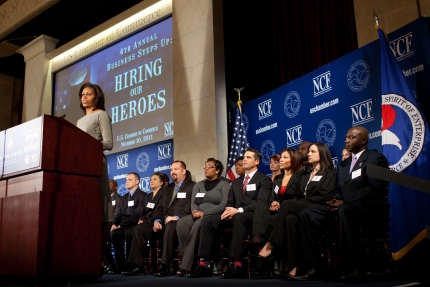
20111110 FLOTUS Joining Forces Announcement

First Lady Michelle Obama delivers remarks to business leaders, veterans and military spouses as part of her Joining Forces initiative, at the U.S. Chamber of Commerce’s 4th Annual “Business Steps Up: Hiring Our Heroes” event in Washington, D.C., Nov. 10, 2011. (Official White House Photo by Lawrence Jackson)

Today, First Lady Michelle Obama was at the U.S. Chamber of Commerce to talk about what private companies are doing to help military families. 

She announced that a range of businesses now plan to hire 100,000 veterans and military spouses by 2014. She said that the Veterans Jobs Bank -- launched on Monday -- now hosts more than 550,000 job postings from military-friendly employers.

She told the crowd at the Chamber:

This commitment of 100,000 jobs isn’t about making headlines. These wonderful programs don’t just provide a good opportunity for a press conference. All of these efforts are about upholding our sacred duty to our veterans and their families. 

Since Joining Forces got off the ground, 16,000 veterans and spouses have already found new positions.

Later today, the Senate is expected to vote on and approve a provision of the American Jobs Act -- which will offer business a $9,600 tax credit for hiring disabled veterans and create additional tax credits for employers who hire veterans who have spent four weeks or more out of work.

The White House

Office of the First Lady

Remarks by the First Lady at a Joining Forces Announcement

11:26 A.M. EST

MRS. OBAMA:  Thank you, everyone.  (Applause.)  Good morning.  I want to start by thanking Kevin for that very kind introduction.  And I want to thank him for his service as a Marine, and for all that he does for veterans here at the Chamber.  And I also want to say hi to his mom -- (laughter) -- who is watching.

I also want to recognize Administrator Karen Mills from the [SBA] for being here today, and for all of the Small Business Administration’s efforts to create jobs for our veterans.  (Applause.)  Absolutely.

And of course, I want to thank the U.S. Chamber of Commerce for organizing today’s conference, and to all of the business leaders that we have here today.  Thank you all for joining us today.  (Applause.)  Thank you all so much.

Now, I have to say, I am excited to be here because this is a big day.  This is unprecedented.  Joining me here today are representatives from some of our biggest brand names and our most vibrant small businesses.  We have leaders from service organizations, technology companies, and agencies from all across our government.

And we’re all gathered here at the home of the world’s largest business federation to send one simple message to our veterans and military families:  America has your back.  America has your back. 

Today, America’s businesses have stepped forward with pledges to hire 100,000 veterans and military spouses by 2014.  That’s right:  100,000.  (Applause.)  That’s 100,000 jobs.  That’s 100,000 veterans and spouses who will have the security of a paycheck and a good career.  That’s thousands of families that can rest just a little bit easier every night.

Now, these jobs will come from two organizations:  the International Franchising Association -– the IFA -– and the Military Spouse Employment Partnership.

Now, the IFA, which includes franchisees like UPS, Guidant Financial, Data Doctors, Mr. Rooter, has committed to hire 80,000 veterans and military spouses -– which will include 5,000 of our wounded warriors -– by 2014.  Absolutely.  (Applause.)  They’re also going to offer a program that helps veterans learn how to run their own businesses. 

And then the Military Spouse Employment Partnership has committed to hire 20,000 military spouses at companies like Microsoft, Citi and Home Depot. 

So like I said, this is big.  This is really big, and it makes me very proud.  But I have to tell you, as big as this announcement is today, there was never a guarantee that a day like this would happen.  See, back when Jill and I started our Joining Forces initiative to recognize, honor and support our military families, we knew we had our work cut out for us.  We knew that there were too many of our troops who bravely served our country overseas, only to return home to fight for a job.  We knew that too many of our military spouses struggled to build careers as they moved from base to base every couple of years.

So one of the first things that Jill and I did was to issue a challenge to all of you, our nation’s businesses, to hire more veterans and military spouses.  Now, we knew we would get some response, but quite frankly, we had no idea what that response would be because we were asking for your help during the toughest economy that most of us have ever seen. 

We knew that many of you were fighting every day just to keep your own businesses afloat.  So we tempered our expectations.  But I am proud to say that your responses have been simply overwhelming.

From day one, companies large and small have stepped up to hire, retain and train our veterans and military spouses.  The Chamber has led the way by taking all of the actions that Kevin mentioned earlier, especially the veterans hiring fairs that have already resulted in more than 3,400 veterans hired all over the country.  Companies like Sears and Siemens, Kmart, Sam’s Club, have expanded their efforts to hire and retain even more veterans and military spouses.

Just a few weeks ago, the American Logistics Association committed to hiring 25,000 veterans and military spouses.  And today’s commitment of 100,000 more jobs gives us our biggest step forward yet.

So what is happening here?  Every week, someone new is getting involved.  Every day, we’re gaining more and more momentum.  And all of these commitments come on top of the steps my husband’s administration is taking at the federal level.

In the American Jobs Act, he proposed tax credits for businesses that hire unemployed veterans or wounded warriors.  This proposal is in front of Congress right now.  They’re voting this afternoon, and I want to urge Congress to act on behalf of our heroes.

My husband has also launched a Veterans Gold Card program that provides personalized job search services for our veterans, as well as an online Veterans Job Bank with more than half a million job listings from companies committed to hiring veterans.

And there is also this fantastic service called My Next Move for Veterans where vets can enter their military experience online and instantly receive a list of jobs that they’re qualified for.

Each of these steps is going to make a real difference, not just for a veteran, but also for your businesses, and more importantly, for this entire nation.  And that’s really what all of these efforts are about. 

This commitment of 100,000 jobs isn’t about making headlines.  These wonderful programs don’t just provide a good opportunity for a press conference.  All of these efforts are about upholding our sacred duty to our veterans and their families. 

This is about who we are as individuals and as a country.  This is about making sure that every person who wears our uniform knows that their fellow citizens have their backs.

Just take Edzavier Reese, who’s sitting behind me today.  Edzavier spent eight years in the Marines.  He did five tours in the Middle East, serving in Baghdad, Kuwait, Fallujah.  He has leadership experience as a squad leader, a communications chief, a motor transport chief, an assistant training chief.  He knows how to manage logistics and schedules and to work with all sorts of people. 

But after his military service ended last summer, he bounced between jobs.  He had trouble finding a career that suited his skills.  So a couple weeks ago, he walked into one of the Chamber’s hiring fairs in Atlanta.  And fortunately, he walked out with an interview. 

And now he’s a manager-in-training at a retail store. 

And this is exactly the kind of story that all of us are working for.  In fact, everyone sitting behind me today has a similar story.  They’ve all been hired by an organization or business that’s partnering with the Joining Forces campaign.

But while we are thrilled for these men and women, we all know that there are thousands more veterans and military spouses out there looking for jobs, folks who just need a little help to connect with a hiring fair, to find a career that suits their skills. 

So we still have a very long way to go.  And we were reminded of just how far we have to go.  We were reminded of that last week, when the overall unemployment rate dipped, yet the rate of Iraq and Afghanistan’s veterans continued to rise.

And that just doesn’t seem right.  And hearing something like that, it drives me to want to do more.  But fortunately, I am not alone.  That has been the most inspiring part of this entire endeavor.  Every time we have asked someone to get involved -- anyone -- we always get the same answer: “Absolutely.”

And today, as Veterans Day approaches, that is really what I want all of our veterans and military spouses to realize about this country.  I want you all to know that there are millions of Americans, of all walks of life, all across this country, who are working hard every day to find new ways to honor your service. 

Executives and generals building new things, huddling together around conference tables.  Veterans organizations and tech companies building new platforms together.  Your neighbors reaching out to each other.  Your President asking questions and demanding results.  And all of these efforts are starting to add up. 

It’s like a wave of support stretching across the country; a wave that is washing over new people and through new communities every day. 

And to the veterans and spouses who might not feel these efforts in your own lives just yet, those of you who might be wondering if this wave will ever reach you, I want you to know today that I won’t stop, and all of the people joining me here today won’t stop.  We will keep working until this wave of support reaches every single veteran and every single military family in this nation. 

That is my solemn promise as First Lady.  (Applause.)

And I am comforted to know that it’s a pledge shared by millions of Americans, including so many of you here today.

So to our veterans and military families, thank you again.  Thank you for your service.  Thank you your sacrifice.  Thank you for your enduring commitment to our country. 

And to the businesses and organizations who have led the way so far, thank you for carrying the banner. 

And to everyone here, God bless you all, and may God bless the United States of America.  Thank you so much, and congratulations.

END       
11:48 A.M. EST

The White House

Office of the First Lady

First Lady Michelle Obama Announces Major Private Sector Commitments to Hire 100,000 Veterans and Military Spouses in Support of Joining Forces

Leading Organizations Answer President Obama’s Challenge to Private Sector to Hire & Train Veterans and Military Spouses

Washington, D.C. – Today, in her keynote address to the U.S. Chamber of Commerce’s Business Steps Up: Hiring our Heroes event, First Lady Michelle Obama announced that the International Franchise Association (IFA) which represents 1,100 franchises has committed to hiring 80,000 veterans and military spouses by 2014. 5,000 jobs of this commitment are promised to wounded warriors.  Mrs. Obama also announced that the Military Spouse Employment Partnership (MSEP) – which Dr. Jill Biden helped launch at the Chamber of Commerce last summer and which includes nearly 100 companies and organizations – has committed to employ 20,000 military spouses. These organizations include companies like Microsoft, Home Depot and Citi and franchises like UPS, Guidant Financial and Data Doctors. Together, the commitment by the International Franchise Association and the Military Spouse Employment Partnership represents a commitment to hire 100,000 veterans, wounded warriors and military spouses by 2014.

The IFA and MSEP are supporting Mrs. Obama and Dr. Biden’s Joining Forces initiative and answering President Obama’s challenge to the private sector to offer jobs and career opportunities to veterans, wounded warriors and their families. Last month, the First Lady joined the President at Joint Base Langley-Eustis in announcing that the American Logistics Association (ALA) and their 270 affiliate companies committed to hiring 25,000 veterans and military spouses by 2014.

As part of the Joining Forces program’s focus on employment, the First Lady also announced a Veterans Job Bank tool, an open online resource supported by nearly a dozen technology and job search companies, including Simply Hired, Monster, and others to help veterans and military spouses search job openings from committed employers based on their location and skills. The Job Bank is designed with a simple, easy to use approach which is why last week, companies like Guidant Financial and Data Doctors learned about the tool and were able to quickly tag their postings, now part of the 550,000+ jobs available to veterans and military spouses today.

“When we think about what we’re announcing today, 100,000 new jobs committed and 550,000 searchable jobs online, those aren’t just numbers. There are millions of Americans all across this country who are working hard every day to find new ways to honor military families’ service,” said First Lady Michelle Obama. “All of this is adding up and thanks to the IFA and MSEP, they’re part of the wave of support forming that stretches across this country.”

“Over the past year, the White House’s Joining Forces and the Chamber’s Hiring Our Heroes initiatives have been united for a common goal: to ensure our veterans and military spouses can find jobs,” said Thomas J. Donohue, president and CEO of the U.S. Chamber of Commerce. “While we have made great strides in the past year, there is still much to do. Our partnership with Joining Forces will continue, as we spread this movement across the country to create an environment in which thousands of military veterans and military spouses can find meaningful employment in their local communities.”

“First Lady Michelle Obama and Dr. Jill Biden’s leadership of Joining Forces has mobilized the franchise industry to step up its longstanding effort to provide opportunities for franchise small business ownership and employment opportunities to veterans and their families,” said IFA President & CEO Steve Caldeira. “Franchising, due to its structured, scalable model, is an engine of job creation and provides a tremendous opportunity for returning veterans and their families to join the franchise industry and help lead the country to economic recovery. We are grateful and proud to be part of the White House Joining Forces Initiative.”

“Military spouses face unique challenges when pursuing careers, with time constraints and portability issues topping the list of obstacles.  The Military Spouse Employment Partnership (MSEP) aims to solve these challenges by connecting military spouses to career opportunities available through MSEP's employment partners,” said Dr. Jo Ann Rooney, Acting Under Secretary of Defense for Personnel and Readiness. “The Joining Forces effort, led by the First Lady and Dr. Biden are helping to address the issue of military spouse employment in a very personal and direct way -- by connecting jobs opportunities with the military spouses who need them.”

Mrs. Obama and Dr. Jill Biden created Joining Forces to bring Americans together to recognize, honor and take action to support military families as they serve our country and throughout their lives. The U.S. Chamber of Commerce has supported their initiative by conducting hiring fairs for veterans and military spouses in 100 local communities across the country and will expand that number to several hundred next year.

For more information, visit JoiningForces.gov.

The White House

Office of the First Lady

Remarks and Q&A by the First Lady at a Mentoring Event - College Immersion Day at Georgetown University

Georgetown University
Washington, D.C.

2:25 P.M. EST

MRS. OBAMA:  Hey!  How are you all doing? 

AUDIENCE:  Good.

MRS. OBAMA:  That’s good.  Thank you so much.  I am thrilled to be here.  I hope you have had a great afternoon.  You’ll tell me all about it shortly.  But I want to start by thanking President DeGioia, not just for that kind introduction but for hosting us here today at Georgetown.  And he does so much for our family; we’re neighbors.  My house is right down the street, so -- (laughter) -- we often rely on the Georgetown community and we’re grateful for all of you for taking the time.

I also want to thank these fantastic college students who you have spent some time with, for giving you just a little taste of life here at this school.  And I want you all to know that these students, everyone here at Georgetown, they’re not doing this just to be nice -- even though they are very nice -- that’s what I’ve heard; you all have been terrific.  And they’re not doing it just because I asked them to, although I hope that helped a bit. 

Everyone here who is hosting you today, they’re here for one simple reason, and it’s important for you all to know:  We’re here because we all believe that all of you belong at colleges and universities just like this one.  And that’s one of the reasons why we want you to spend time on these campuses.  We believe that all of you have exactly what it takes to continue your education after high school, and to succeed in any career or any endeavor that you choose.  And we really want you to believe that as well.  I want you to believe that.  That’s why we do this not just all across the country, but we have done mentorship sessions like this all over the world. 

We want you to look around what is a beautiful campus.  Don’t you agree?  I mean, this is just a beautiful place to live for a little while, right?  But we want you to look around and imagine yourselves walking around these halls.  I mean, look at this place.  See yourselves here.  We want you to talk to these students and realize that you are no different from anyone who’s here.  And it’s important for you to start out with that belief that you belong here.  This is where you fit in.

And I know it’s not always easy.  Sometimes it’s easier said than done.  And I remember back when I was your age, headed to college -- neither one of my parents had gone to college; they were not college graduates.  I do have an older brother who went to college.  And there were people in my sphere who had gone to college, but my parents didn’t.  Most of the people in my neighborhood hadn’t gone either.  I grew up on the South Side of Chicago, and people were smart and engaged, but college wasn’t always the next step for people.

So there were plenty of well-meaning but misguided people in my lives who questioned whether someone with my background could succeed at college, particularly at Princeton, where I wound up going.  So after a while of hearing their doubts and hesitations, of course, that fed into my own natural fears.  I was naturally hesitant and not sure about it myself.

So when I started out at my freshman year at Princeton, I wondered whether I’d be able to compete with my classmates.  And believe me, these were kids who had gone to the best schools all over the world.  They were wealthy, they were privileged, and they didn’t go to public schools like me, many of them.  There were just two other kids from my high school who went to Princeton.  So I worried that I wouldn’t be prepared and that I wouldn’t be able to compete with these kids who had so many other advantages than I had.

But once I started attending classes and starting walking around on those campuses -- that campus, and living in my dorm and meeting these other students, I started taking tests and writing papers, I found out that I could do just as well, if not better, than most of my classmates.  And I realize that it didn’t matter where I was from or how much money my parents made; what mattered was how deeply I was willing to believe in myself.  That was the primary thing that got me through, was sort of looking at my performance and saying, yes, I can compete.  What mattered even more than that was how hard I was willing to work, because I did have some deficits coming in, so I had to pump it up just a little bit more than probably other students there.  But I knew that what I put in was what I would give out.  And that’s something that I want to emphasize to all of you today.

What you have to understand is that no one is born successful.  There are people who are born lucky, but no one is born successful.  You become successful through hard work.  Anybody who has accomplished anything in the world -- I don’t care where they’ve come from -- they will tell you that is what they put in.  No one is born being a brilliant writer or a scientist or an athlete or a musician.  Those are things that you become through practice, through discipline, and by putting in the time and the effort.

So today -- and we’ll talk more -- but I really want to urge you all, we brought you here today so that you start to get into the habit of investing in yourself 100 percent in every single thing you do.  This is something, the President and I, we spend dinnertime talking to our girls who are 13 and 10.  You have to invest 100 percent in every single thing you do -- 100 percent in your classes, every single one of them, whether you like them or not; 100 percent in your extracurricular activities, which means that it’s not enough just to be a good student -- you got to be involved in other things, and you’ve got to be a leader in those things as well. 

And the other thing we tell our girls is whatever you do, do not be afraid to make mistakes.  I mean, this is the lesson I am trying to teach my fifth grader:  Do not be afraid to make mistakes, because that’s how you get better.  This is what this place is for.  Education is about learning.  No one expects you to already know this stuff.  So by messing things up, you can figure out how to do it right the next time.  So don’t use your mistakes as a point of embarrassment.  That’s your job, is to learn. 

My husband and I, again, tell this to our girls all the time.  So nothing you’re going to do is easy, because if it is too easy it may mean that you’re not challenging yourself enough.  So I want you to remember that what makes sense for your friends or your classmates might not always be the right thing for you.  You’ve got to step outside of your comfort zones.  You got to make sure that you’re on your path, and your path may not be the exact same path as some of your best friends -- which may often be the case -- so you got to find your path and make sure that you’re on it.

And I want you guys to own your dreams.  So you got to figure out who you are and then own it.  All right?  The only reason I’m standing here today is because I own some level of excellence, in terms of how I thought about myself.  And the same thing is true for my husband and everybody that I know who is working in this administration.  At some level they bought into their own idea that they were worthy of something.

So this is the beginning of what I hope will be an important journey for all of you, that leads you right here to places like this.  But it doesn’t come on its own.  It comes if you and when you invest in yourselves.  So I hope that you enjoyed this time and that you learned a lot about what this university has to offer.  But there are thousands of excellent schools across this country.  That’s something that’s important to remember. 

You can get an education right in your own backyard, but you can also see the country and the world.  And somewhere out there, there’s a college or university that’s right for you, but you got to prepare yourself for it.  You got to be ready so that when the time comes you can perform at very high levels.

So I’m going to stop talking, and I think you guys are going to have a chance to ask me some questions and maybe share some stuff.  I want to know what’s on your mind, how you’re thinking about this, what you’re afraid of, what you’re worried about, and what you want to know.  I know there’s press here, but you got to pretend like they don’t exist. 

And the other thing I tell my girls -- do not be afraid to use your voice.  So speak up.  This is an opportunity.  You’re not going to get to hang out with the First Lady of the United States all the time.  (Laughter.)  I wish I could.  If it were my choice I’d be hanging out with you all all the time.  So make sure you take advantage of these opportunities.  And I think that Todd Olsen is going to join us to facilitate this part.

Todd, come on up.  I think I have a seat here.  So let’s hear what you guys have --

MR. OLSEN:  First, Mrs. Obama, thank you so much for you inspiring comments and for taking the time to be with us this afternoon.  As we talked about earlier, preparing for college and being in college is not a spectator sport.  It’s about actively participating in conversations.  And we’re honored to have the First Lady here for this conversation today.  And I know some of you have questions you’ve prepared.  And the first person who I know wanted to ask a question is Daria Johnson (ph).

Daria, please stand up and share -- let us know what high school you’re from and share your questions.

MRS. OBAMA:  Hey, Daria.  Get your mic.

Q    I’m from Freedom High School, and my question to Michelle Obama is, when you went to law school, what were your strengths and weaknesses?  And how did you overcome them?

MRS. OBAMA:  That’s a good question.  That’s a long time ago.  Law school, 1988.  Who was born then?  That’s so sad.  (Laughter.)  Oh, so sad.  They weren’t even born when I went to law school. 

Anyway, okay, what was my strengths and weaknesses in law school.  I think one of my strengths was that I had a big mouth and I liked to talk a lot.  That’s why mother said I should go to law school.  It’s like, “You like to talk, just go.”  (Laughter.)   So I think that was one.

It’s good in a law school environment to be willing to use your voice and to make your argument and to get your point out there because, again, that’s how you learn.  And I think that was something that worked for me.  I was also open to trying some new things, so I got to work for the Harvard Legal Aid Bureau, and we did public-interest law for underserved people in the community.  And that was one of the best things that I did.  So not being afraid to step out and try some new things.

I think one of my weaknesses in law school in particular was being able to get geared up for courses that I wasn’t excited about, right?  Because in law school in your first year, you’re really taking a bunch of mandatory classes.  So your first year is really not your own.  You don’t really get to choose any courses on your own, so you’re trying a little bit of everything.  Well, I like criminal law.  I love contracts.  Sometimes civil procedure wasn’t as interesting because it’s about the rules of law.  So I had to find a way to stay pumped up and engaged even in courses that weren’t my choosing.  And that’s what you’ll find in college.  I mean, there will be mandatory courses that you have to take, and it isn’t until later in your years that you get to select the things and focus more specifically on the things that you’re interested in.  So you got to be able to get over the hump of doing well in things that you’re not necessarily good at or not particularly interested in.

And I still find that to be one of my strengths and weaknesses -- trying to do things that are hard, and I don’t want to do.  I talk to my kids about this all the time.  You got to get up.  You can’t just be excited about vacation.  You have to be excited about the actual school year, too.  So I still find myself challenged to make sure I’m pumped up about things that I have to do.

MR. OLSEN:  Thank you, Mrs. Obama.  And our next question comes from Kiana Miller (ph).  Kiana, can you please stand and tell us what school you are from and share your question?

Q    I attend Anacostia High School, and my question for you is, which college majors do you believe that are up and coming that high school graduates should focus on?

MRS. OBAMA:  I should hand these mics over to you all.  I have to say I’m not as up on the exact right college majors, but I think -- here’s my answer:  That’s the beauty of a liberal arts education, and I value liberal arts education because you’re really getting a broad skill set.  And I think one of the things that’s important to be able to do in life is learn how to read and write -- write really well and articulate your views. 

So if you’re planning on going to graduate school, if you’re going to law school, for example, almost any liberal arts major that’s pushing you into writing where you have to write a thesis maybe, a large research paper at the end of the year, that kind of stuff is really good preparation for law school.  But in terms of specific careers, I think that the health care professions are growing rapidly.  I think that jobs that deal with caring for the aging, good stuff.  Lots of nursing and sort of those tech fields are good.

But then if you know you want to do something, like if you want to be a doctor, there are certain majors that are critical for that:  biology, chemistry, the things of that nature.  I don’t know if there’s one of the professionals here from Georgetown if you want to weigh in that as well, Todd.

MR. OLSEN:  Mrs. Obama, I’d be happy to.  And I think you shared some very helpful comments there.  I would just add that in most college settings you have some time to explore, and you have the chance to test out some courses, to talk with advisors, to talk in a career center that will be there for you on a campus, and you have some time to decide on your major so you won’t need to settle on it the day you walk in the door.  So you should feel a little bit more relaxed about that, but still explore colleges that seem to offer programs that are of interest to you.

Okay, our next question comes from Iris Ukane (ph).  And Iris, if you’d stand up and share your high school with us and share your question.

Q    Hi.  I attend Wheaton High School, and my question is, how can parents who aren’t always available be able to be part of the college application process and receive all the information that other parents are given?

MRS. OBAMA:  Is there a specific situation that you’re talking about, for you in particular?

Q    Just like general meetings given at school and all like about financial aid, usually given at meetings.

MRS. OBAMA:  Well, I think a lot of that is specific to your high school and how things are set up.  But here’s one thing that I would tell you.  The application process and the process of getting to college is like your gateway to maturity.  And I say that because you’re kind of probably the best person to make sure that your parents are informed, right?  Because you’re getting this information, right?  So even if you’ve got a parent that’s working late or somebody that’s not available, this is like that step of where you’re starting to be responsible for the information that you get, that ownership over it, and making sure that that information has been filtered to your parents.

My parents didn’t know a ton about college and how to apply for it.  So fortunately I had an older brother who had gone through the process.  But by the time I was applying he was at college, so it was up to me to talk to my guidance counselors to bring that information home, to make sure that I knew the application deadlines, that I knew when my parents needed to sign certain things.  So there was a part of me that really had to begin to own that because that’s really what college is about.  You’re not going to be -- your parents aren’t going to be as involved in this process, and they’re going to be relying on you to bring them into the process however they see fit.

I know that even in some colleges parents now have to get permission to get students’ grades, which, quite frankly, I don’t know.  (Laughter.)  It’s like if I’m writing the check, I want the grades.  (Laughter.) 

But I understand the philosophy that essentially you’re an adult.  So that’s one way that I would answer that.  But, again, I think you keeping up with what’s coming up, making sure you’re talking to your guidance counselors, making sure that you’re asking for the help and support that you need and your family needs and trying to find out what ways are there given any particular circumstances because things may be different depending upon the circumstance of the family or the parents.  There may be some extenuating circumstances that your school or the college you’re applying to needs to know, and they’re not going to know that unless you share it with them, and then pushing them to find out a way to accommodate your needs.

A lot of times schools will do what they can to make life better for you, but they have to know what your issues are in order to be responsive.

Todd, do you have any?

MR. OLSEN:  No, your comments are exactly on target.  And as the First Lady was saying, I think it’s really important to ask for the help you need and to think about new roles that you can take on, push yourself a little bit to be the person in charge of steering the ship as you prepare for college, but always asking for that help you need.  And in nearly every high school, there are adults there who are there to help you with that process.

So thanks very much, and very thoughtful advice.

And our next question comes from Eureka Black (ph).  And so, Eureka, if you could please stand and let us know what school you’re from and share your question.  Eureka is not here.  That’s okay because we have plenty of other great questions so we’re going to move on. 

Now, we’re finally getting one of the young gentlemen in the room, Darnell George (ph).  Darnell, if you’d stand and let us know what school you’re from and share your question.

Q    I’m from Wheaton and my question is, what’s the greatest adversity that you had to go through and how did you overcome it?

MRS. OBAMA:  My greatest adversity?  That’s a hard one because I consider myself pretty blessed, so I think sometimes I look over challenges -- not adversities, but just as a part of life.  I think it’s trying to figure out how to continually excel in environments that are not natural to me, going from a public school on the South Side to Princeton, which is a cultural shock -- (laughter ) --  in so many ways, or was.

One of the things that I think I still work on and I won’t call this my -- this wasn’t my struggle.  It was my father’s -- my father had a disability, and he had multiple sclerosis when we were growing up, and I don’t know if any of you guys have grown up with a parent or someone in your household with a disability, but as I’ve grown up, I realize that if someone in your family is struggling in that way, everybody somehow is touched by it.  So I think that there are aspects to my personality, the way that I see life, that is tied to his challenge and how he had to struggle with it and how we had to accommodate and adjust and make certain sacrifices to be able to help him manage through his life.  And I still think that that affects me.

But I always try to take any adversity and turn it into a strength.  And I think -- when it comes to my father I think one of the reasons why I’m so motivated to focus on health and fitness and making sure that young people are moving and active is because I lived with a father that was once an athlete who lost that in a blink of an eye.

Now, my father boxed and he swam.  And it wasn’t until his mid ‘20s that he was struck with MS, and he couldn’t run ever again.  That was it.  And I think for me and my brother you just don’t take things for granted -- your health, the opportunities you have in your life.  Because at any day, anything can happen. 

So we try to live life to the fullest, right?  I live life to make my parents proud of me so that they can live through me all the sacrifices that they may have made.  Maybe the things that we accomplish, me and my brother, speaks to their triumph even if they didn’t experience it.

So we each have to find a way to take whatever struggle we’re facing, whatever challenges we have and turn it into that lightening rod that’s going to spark you to do more, as opposed to saying, well, I can’t do this because this happened to me or that happened to me.

MR. OLSEN:  Thank you.  And our next question comes from Norah O’Neill (ph).  Norah, if you’d please stand, let us know what school you’re from and share your question.

Q    I attend Yorktown High School, and my question for you is what advice do you have for those applying to colleges?

MRS. OBAMA:  Advice.  I think we heard some of it.  Number one, do it.  (Laughter.)  College is good.  As I was telling my daughter the other -- college is like the -- probably still one of the best times in my life, because if you think about what college offers you, is the chance to spend four years or however long it takes for you to get through -- hopefully it’s four or five or something like that -- but where you can live on your own and practice being an adult.  And you’ve got hopefully your room and board paid for, and you’re around a bunch of people your age, your peers.  And that doesn’t happen again in life, because when you work you’re with everybody, right?  Where you’re living and you’re sleeping and all you really have to do is take some courses and read.

Me and the President look at each other and say, you know, if all we had to do was, like, go to a couple of courses a few times a week, that was a luxury.  And you don’t realize it until you’re a grownup and it’s gone forever.

So college is a good, rare, unique privilege, and hopefully all of you view it that way and don’t take it for granted.  But as you apply, do your homework.  Research your schools and own your decisions -- and by that I mean you should know more than your parent or your guidance counselor or anyone else what the schools you are applying to offer you, and why you’re applying to them.

Because going to college is also big money, right?  This is probably the most significant investment that you’ll make in your life.  And for me and the President of the United States, up until he wrote a book, our largest bill was our student loan bill.  Our combined student loan payment was more than our mortgage for a really nice condo.  So that was the biggest investment, and we just recently -- we paid it off just a few years ago.

So it’s a huge investment, right?  So you should know everything about this investment before you make the commitment.  Is it the right school for you?  Is it the right curriculum?  Is it the right size, right?  If you get a chance, try to visit these schools -- and not everybody will have that opportunity but with technology many of these campuses have wonderful online tours.  Take them.

Try to meet students who have gone to those colleges.  Understand the requirements -- how long does it take to get through?  Know everything about these schools, not just the application process and when the application is due, but is this the place for you?  What are the dorms like?  Where are you going to eat?  What are the extracurriculars?  You got to know everything.  And most importantly, how much is this going to cost, and what’s the financial burden going to feel like when you leave, right? 

So you should know how much this costs -- how many loans you’ll have to take out, whether you can get a scholarship.  And if you take out the loans, know in your mind what is that payment going to look like every month?  Because when you take out a loan, you will have a payment for a good 10, 20 years of your life that could be $100, $200 a month that’s part of your being forever and ever until you pay the loan off.  So you should know in yourself whether that’s the kind of debt you want to take on.

Because private schools cost more than state schools, which cost more than community colleges, which cost -- and not every institution financially makes sense for everyone, but you have to know that and understand that for yourself.

So I’d urge you to do your homework -- and you have to do it.  You have to know this information more than anyone else, and own it so that the decision is yours, ultimately.  And the consequences, good or bad, are ones that you are responsible for fully. 

Does that make sense?  Okay.

MR. OLSEN:  Thank you.  And I believe Delmus Omanser (ph) has a similar question about what happens a bit later.  So, Delmus, would you like to ask your questions?

Q    So I’m from Wheaton High School.  And my question is, from your experience, what would be the top five survival tips you would give to incoming freshmen in college?

MRS. OBAMA:  Ooh, top five survival tips.  Okay, so if I don’t number them don’t mess me up.  (Laughter.)

Number one:  Don’t procrastinate.  All right?  College is a practice of management and organization.  It’s not just mastering the subject or knowing how to write or knowing how to do some problem sets.  Your greatest challenge will be managing your time.

Because college is about -- you are on your own.  You get a syllabus and you get the date of the next exams, and then no one cares about you -- not at this institution, everyone cares about you.  But by not caring about you I mean no one is going to be dogging you to turn your stuff in, you know?  No one is going to notify you that your stuff was late.  It’s just going to be part of your -- what the professor looks at when he gives you your D if you haven’t done the work.

So you can’t see a semester as, I’m free until the exams.  Building on your work and just making sure that you don’t let things accumulate.  And if you do that, college is great.  The thing that messes up college is procrastination.  And then you look up and it’s like, I had two weeks to do a semester’s worth of stuff.  That’s bad.  That makes for a not-so-nice experience.  So that would be one thing I’d say, is don’t procrastinate.

And I would -- the other thing I would say, ask for help often.  And maybe that goes with don’t procrastinate.  Don’t wait until the very end if you don’t understand something.  Ask for help all the time, from the -- just get used to asking for help.  Whether you’re in classes or in -- I think this is true for high school.  This is true for you getting from high school to college.  You have to always ask for help.  You can’t be afraid of somebody looking at you like you don’t know what you’re talking about.  You can’t care about that. 

You have to care about your own survival more than you care about being embarrassed because someone thinks you should have known something.  That is not your problem.  Your problem is getting everything you need whenever you need it, and doing it right away and not waiting.  Because just like high school -- even more so -- the college experience is cumulative, so if you don’t understand something week one, you’re not going to understand it week three and then you’ll have weeks two and three to make up for.  So you want to get help right away.  And that’s true when it comes to your financial situation -- don’t wait.

The other, I guess, survival tip is, do not use credit.  Do not come out of college in debt from credit cards -- from buying that stereo system, or those new pair of shoes, or getting that -- going on that trip that you can’t afford.  Do not put anything on a credit card, because there are so many young people who are coming out of college not just with tuition loans, which you have to have, but they’re coming out with American Express bills with 35 percent interest, and that will crush you.

So in college buy what you can afford, which for most college students is nothing.  (Laughter.)  You just got to wait on everything else.  Look nice later.  Get your hair done later.  You shouldn’t have new nice stuff in college.  That’s not the time to have it.  Wait until you’re grown up with a job.  Don’t use credit.  That’s probably only three, but those are some big ones.  So I’ll stop there.

MR. OLSEN:  Some very helpful ones, too.  So I know that Imani Robinson (ph) also had a question.  Imani, can you stand up?  And please share your high school and your question.

Q    Hi, Mrs. Obama.  I’m Imani, I’m from Anacostia, and my question is, do you feel more pressure being an African American woman also being the First Lady in America?

MRS. OBAMA:  That’s a good question.  I don’t think I’d use the term pressure, and I don’t think what I feel is unique to me because of my race, because let me tell you, I’m sure that every woman who has become First Lady has felt some level of what I’ll call responsibility.  Because that’s what I feel. 

I feel like I have -- being in this role I have a huge responsibility to use this platform in a way that’s going to make a difference; in that way that I feel like I don’t want to disappoint my parents, I wouldn’t want to disappoint the country.  Sheesh.  That’s a burden.  But I think that that’s a responsibility. 

So I want to be good at what I do.  I want to -- I don’t want to procrastinate.  And that way I apply the same things that I’ve applied in every aspect of my life.  I feel like I want to have something to show for this.  I want to look back and say I did something good for a bunch of people because I was in this position.  And I feel a huge sense of responsibility to do that.

Because not everybody gets the privilege of serving in this role, and no matter who you are you only get to serve in it for four to eight years.  So that’s not a lot of time.  So I want to make the most of it.

But I think that’s true for all my predecessors as well.  I mean, I’ve met almost every living First Lady, and I don’t think that anyone feels any differently.  The women who -- they have all been women who have served in this role -- love their country deeply, and none of us were -- chose the position.  You get it because of who you’re married to, and you don’t get a paycheck or a title, but you feel like you want to make the most of it and do some good things.

So I think I feel responsibility.  Thank you for that question.  It’s like a therapy session.  Excuse me, everyone.  (Laughter.)

MR. OLSEN:  Very glad.  We can cover a lot of territory.  I know that Adriana Carmona (ph) has a question as well, back to what’s happening in high school.  Adriana, are you in the room and want to share your high school and your question?

Q    I’m from Wheaton High School, and my question is, what do you think will help high school seniors move onto their college life?

MRS. OBAMA:  What will help you move onto your college life?
Q    Like, if you want to stay home and like, you don’t really want to go away?  What do you think will be some helpful tips?

MRS. OBAMA:  To help people who are afraid to go away but think they should?

Q    Yes.

MRS. OBAMA:  You know, I use the carrot thing.  I just sort of think, you know, you’ve been living at home for a while, right?  Parents, they’re nice.  (Laughter.)  But, you know, see the country. 

This is a -- it’s a special rare time in your life.  You’re young, you’ve got your futures ahead of you, there’s still room for some mistakes.  Nothing is life or death, truly, in terms of when it comes to the choices you make about college.  I mean, there’s a freedom.

So, you know, try something new.  It gives you a chance to live in a new city if you -- or live in a new state, to see another part of the country. 

The other thing I encourage people to do is not just think about going away for college, but then, when you’re in college, studying abroad because that’s the next step.  Because the world is big.  It’s a big place but technology is making it very small, and we’re so dependent on other countries and other cultures, and it’s so helpful for our own individual growth to get some experience in other people’s ways of life.

Because we get so rooted here, we get so used to our comfort zones here, and expanding yourself and pushing yourself beyond your comfort zones and doing that when you go away to college.  Sometimes that’s when you grow the most is when you’re the most uncomfortable.

But with that said, not everybody is ready to be away from home.  And there’s nothing wrong with that, truly.  Because not every -- it’s not going to work, being -- for everybody.  Sometimes it’s more costly to go out of state for school, and for some people there may be just some realistic limitations.  And that’s okay. 

We talked about what -- how do you turn strengths -- or challenges into triumphs?  And if you think you want to go away but you’re not quite ready or it doesn’t work out, all right, so what’s plan B?  And plan B sometimes is just as good as plan A, it’s just a little different. 

So there are going to be many students who won’t get to go away.  They won’t be ready, they won’t want to, financially they won’t be able to.  The right college may not be one that’s away.  So make the choice that’s right for you but don’t base it on fear.  Don’t do something because you’re afraid.  Do something because it works for you.

And if it’s all just about fear, then push yourself just a little bit.  Because that’s what life is about -- hitting up on your comfort zone and then pushing just a little bit past it.  And then you get used to the fact that, you know what, fear is something you overcome.  Fear is in your own head, it’s in your own heart.  And you don’t want to limit yourself for the rest of your life because you’re afraid.

Because there’s a lot of stuff to be afraid of.  But if you get over that, there’s so much -- you know, this is scary.  Shoot, being married to Barack Obama -- (laughter) -- it’s like he’s got big plans.  He’s always pushing us beyond our comfort zones, and I’m dragging along going, “What are we doing now?  No, not this!” 

So he’s -- my husband has taught me about pushing myself beyond my comfort zone, because I grew up same community in the same house.  My mother lives in the same house I grew up in, lived in; my bedroom is the exact same bedroom -- the same pictures, same bed sheet.  (Laughter.)  And that’s my comfort zone. 

But everything that I’ve done up until this date has pushed me.  It’s been something that I should have been afraid of and probably was, but just stepped my foot in it and realized, you know what?  I’m kind of good at this.  I can do this.  Lookie here, I’m ready to roll. 

So sometimes I’ve learned that pushing yourself in that way can lead to great growth and development. 

So you go away to school.  You I know, you’re going away.  (Laughter.) 

MR. OLSEN:  All right.  We have one more question.  I believe Lena Jones (ph) wanted to ask.  We’ll see, we may have time for more.  We’ll find out.  But we know Lena had a question.  If you could share your high school and your question, Lena.

Q    I go to Murray School, and what would you like to leave as your legacy as First Lady?

MRS. OBAMA:  Well, my mentees all know the issues that I’m working on.  The things that I’m working on are health and nutrition, trying to get this generation healthy and fit.  So I want to leave that legacy.  I want to make sure that the next generation of kids grow up, like I said, for the reasons that I talked about, but also because we need the next generation to be popping on it on all levels, because the problems that we’re facing now won’t be solved in our lifetimes, many of them. 

So they’re going to be handed over to you, so you all have to be ready.  I’m serious.  You have to be really ready.  So that means you got to be healthy and fit, and the kids you raise have to be healthy and fit.  So that’s one important legacy.

So if I changed -- if I can be a part of helping to change the way kids view themselves in terms of what they eat and how they move and if they’re part of a broader conversation about our health and nutrition as a nation, if we really can change the conversation I think that would be a good legacy. 

The other legacy, you know, really, is that -- and something that I focus on a lot, is I want to make sure I raise two healthy, productive, positive, contributing daughters -- because that’s my responsibility, is me and my husband’s, right?  We brought them in, so we want to make sure that they’re good and solid, and sane and happy and all that stuff, and that’s on me.  So I’m kind of counting on them to do that.  So I do take that role seriously, although there are many, many other things that I care deeply about.  But I have to put raising my kids up there pretty high, because that’s no one else’s job but mine.

MR. OLSEN:  All right.  Mrs. Obama, any advice you’d want to share that hasn’t come up in any of the questions yet?  You’ve shared a whole lot with us already, but I wonder if there are any other comments you’d want to make.

MRS. OBAMA:  First of all, just -- I hope you guys had a good day today.  I mean -- and I hope that it shed some light on your thinking about yourselves and what you want in the future.  I hope it did.  And I hope that this isn’t the last opportunity like this that you search out and that you gain access to, because sometimes you need a little boost over the course of high school just to remind you what it’s all about, and is the sacrifice worth it.

But the biggest thing that I would just urge you -- what I was saying earlier is, just don’t let fear guide you.  Don’t let that be the guidepost.  Because I know for young people, much of what you do or don’t do is based on what you’re afraid of as opposed to what you’re trying to become.  Sometimes how we dress is based on worrying about what somebody else is going to think.  Who we associate with is based on what we think other people are going to say. 

Be proactive about who you want to be, and then surround yourselves with people who support that vision of yourself.  And I’ve said this to a group of kids -- I think I said it when I spoke at Anacostia -- if you want to be successful you have to surround yourself with successful people.  You cannot be hanging out with trifling people.  (Laughter.)  You cannot.  Who you associate with defines who you will be in so many ways.  And you can’t be hanging out with people who don’t share the same goals as you because that’s going to be tough for you to break through that.  That may be another survival tip when you get to college, is choose your friends wisely.  Choose the people you want to be around.  Choose people who are into good things, who are working hard, who are focused on school -- because I guarantee you, if you’re not, those other folks will pull you down.  And that’s a conscious decision.

So make decisions based on the power of your own vision about yourself -- you.  You alone.  Not who your mother is.  Not what your cousins are doing.  Not what’s going in your neighborhood.  Nothing.  You can make the decision to set your own path today.  And it may be hard, it may require you to push and push outside of your comfort zone, but you have that power and potential.  That’s why I think these things are so important, if you hear nothing else, is do not look at me and go, oh, that’s the First Lady of the United States.  Look at me, Michelle Obama:  I grew up on the South Side of Chicago.  My parents weren’t rich.  I went to public school.  There were kids who fought in my school.  There were kids who got in trouble.  We did not have a lot of money.  We did not have a lot of resources.  And yes, I am still a First Lady of the United States -- and I went to Princeton, and I went to Harvard. 

And if you want to do the same thing, you can, but you have to work your butts off -- and you can do that.  All right?  That is within your power.  Maybe nothing else is, but that is within your power.  And that’s what I urge you to tap into for the rest of your lives.  For everything you do, tap into that reality.  And if you do that, anything is possible, truly.  But if you start reacting on fear and worrying about what other people say, then you’ll get caught up and it’ll be really hard -- that it will be. 

But we have faith in you all.  That’s why we’re all doing it.  That’s why everybody is here.  We know each and every one of you has what it takes to be sitting here or there or anywhere else you do.  It may take you a little more time.  It may take you a little more energy.  But you have everything you need right now to be whatever you want to be.  And if you start believing that and acting on it, then you’ll be good.  I guarantee you that you will be good.

And just know there are a lot of people like me who really care.  We really do care about who you become.  That’s why we’re all here.  That’s why Georgetown University opened up its doors, because everybody cares about you all.  And that is true around this country.  So just make us proud.  All right?

All right, we got another -- we got another question back there.

MR. OLSEN:  One more question back there?  Do we have time for one more question?  Okay.

Q    Hi.  I know we’ve been talking about, like, school and colleges and stuff, but I have a question about the community, like, about this violence and teen pregnancy that’s going on.  Like, what could you and your husband do to change or help out us young people?  Because it’s like someone dying every day.  Like, it’s just crazy.  And you being the head of the States and you’re in D.C., something could come out to help these young people.

MRS. OBAMA:  You know, this President every day is doing everything he can trying to get this economy back up and running, making sure people get work, trying to pass a jobs bill that put people back to work.  And I don’t want to make this a political advertisement in any way, shape or form.

But the point that I made earlier is that the work still has to happen in the community level, and it starts with you.  I mean, if everyone in every community owned -- and if people -- people have to have the resources, they have to have the belief in themselves.  They can’t do it on their own.  But the question that we each have to ask ourselves, and in particular, you all as young people -- what are you going to do to change the dynamic in your life? 

So when I say my legacy is my daughters, that is truly, even as First Lady, the -- probably the only thing that I have truly direct control over.  And I don’t even have complete control over that because they have their own minds.  All I can do is guide them in the right direction and ply them, just fill their heads with values and expectations, and lessons and lectures, and just fill them up.  And then I got to let them go, and hope that they stay on course, and hope that they have everything that they need to make the right choices in their lives.

So I still ask each of you as young people, you guys still have a lot of power in your own situation.  So the question is:  What are you going to do that you make sure that you got your stuff on point?  And that then when you have an opportunity you mentor somebody else.  For me, this is one of the greatest things that I can do is talk to you all and to give you the little bit of stuff that I give my girls each and every day.  What makes my kids different is that they hear my mouth every day, drilling this stuff into them at every dinner, every -- raising the bar high for them.  And what I’m trying to do is raise that bar for you and then ask you to reach back.

How many other kids in your community can you help lift up?  And you’re not going to be able to get all of them.  But if you’re getting one or two, and each of you are reaching back in your own families and your own communities and pulling somebody along with the knowledge that you’re getting about life and how it works and choices and all of that -- which means that you, in turn, have to be a good role model.  That means you have to have your stuff together.  Each and every one of you has to view yourselves as having the responsibility of setting an example, of being the other alternative in the face of somebody younger than you.

And that’s why, as First Lady, I do this -- because this is all I can be for you right now, is just this model of an alternative, because there is an alternative, but it takes a lot of work and it’s not easy.  And you will get your butts kicked sometimes, and you will be disappointed. And you will be knocked down, and you have to get back up.  There will be people hating on you.  You’ll have people talking about you.  At every level, can you handle that?  As you improve your lives, are you going to be afraid?   Are you going to be afraid, and then retreat back into what’s comfortable?  Are you going to keep surrounding yourself by people who make you feel comfortable but aren’t the right people for you to grow?

That’s our power.  That’s your power.  And then there’s all this stuff the President and Congress can do, but trust me, they can’t fix that.  No matter what, they can’t get in your head and change that.  You have to do that.  And you have to do it against some of the greatest odds.  You have to get it in your mind that I am going to choose a different path.

So I can talk to you all, and maybe I’m talking to some more kids out there.  And it is hard, and there’s a lot of work to do.  But there are a lot of adults out here, a lot of people in this country who are trying to get everybody on track.  And it’s going to take some time.    So what do you have control over?  Start there. 

Does that make sense?  Or am I just being -- it’s like I can’t tell.  You’re like Malia and Sasha -- “Are you done yet, Mom?”  (Laughter.)  So this is an example of my house at dinner.  (Laughter.)  Like, I got a whole bunch of blank faces, like, do you hear me?  (Laughter.) 

MR. OLSEN:  Well, Mrs. Obama, thank you so much for your leadership, your inspiration, and all your hard work.  We’re really honored to have you here as a model and a mentor.  And so let’s give a round of applause for the First Lady.  (Applause.) 

END
3:27 P.M. EST

The First Lady Honors Arts and Humanities Programs for Youth

November 02, 2011 | 33:07 | Public Domain

First Lady Michelle Obama, Honorary Chair of the President’s Committee on the Arts and Humanities, speaks on the importance of arts programs for young people.

Download mp4 (316MB) | mp3 (30MB)

Read the Transcript

Remarks by the First Lady at the President's Council on Arts and Humanities Youth Event

East Room

2:33 P.M. EDT

MRS. OBAMA:  Thank you.  (Applause.)  Thank you all, so much.

Hello and welcome to the White House.  (Laughter.)  I am, as always, so thrilled to have all of you join us here today -- one of our favorite events, just all around.  We are so excited.

I want to start by thanking the President’s Committee on the Arts and Humanities for sponsoring these awards.  And I'd like to ask all of the committee members here today to stand up so that we can honor them for their service.  Please stand.  (Applause.)  Thank you, so much.

I also want to take a moment to acknowledge Representative Jim McDermott.  I’m not sure if he’s here today because there are votes happening, but if he is I want to thank him for his service and for all the work that he’s done.

And, finally, I want to recognize all of the artists, the educators, and administrators who are on the ground everyday running the programs that we’re honoring today.  Every day you all are providing unparalleled opportunities for our young people to explore every facet of the arts -- from dance and theater, to writing and music, to history and the visual arts. 

In so doing, you’re not just teaching these young people about painting or acting or singing, you’re teaching them about hard work and discipline and teamwork.  You’re teaching them how to manage their time -- something that we all need to learn -- (laughter) -- how to set goals, and, more importantly, how to achieve those goals.

And you all have seen firsthand how these skills translate to every part of their lives.  You’ve seen them realize that if they can compose a song or a poem, then maybe they can write that term paper -- (laughter) -- or finish that math homework, too.  We were just having this conversation at home last night at dinner.  (Laughter.)  If they can deliver a monologue up on stage with all the grandeur that goes along with what you do, then maybe they can make a presentation in front of the classroom on something not so dramatic.

If they can conduct a quartet or direct a play, then maybe they can lead a student group.  Maybe they can, one day, run a business or a city or a state or maybe even the United States of America, right?  That’s right.  (Applause.)

And all of you working so hard with these young people are not just helping them use the arts to lift themselves; you’re showing them how they can lift their communities, as well, and that’s so important. 

Because of your programs, because of the work that you’re doing, there are students all over this country who are doing great things -- students in Denver, Colorado, who wrote a play about teenage homelessness.  There are students in Grand Rapids, Michigan, who designed a mural to brighten a struggling neighborhood. 

And through this year’s international honoree program, Youth Community Media Project, students in Indonesia created their own videos to raise awareness around issues like poverty, women’s rights, and the effects of natural disasters.

Every day, with every lesson you teach, you remind our young people that their story is part of the broader American story, and you show them how they, as artists, can challenge our assumptions and help us view our world in new and very unexpected ways.  That is precisely what we are trying to do here at the White House, as well. 

Over the past few years we’ve worked to make this place a showcase for our country’s rich cultural life, and to throw open our doors to as many young people as possible.  We’ve hosted students at concerts and workshops on everything from jazz to spoken-word poetry to modern dance.  We’ve done it because we want them to know that they can be part of our arts community; that this community is for them.  We say that every year.  You own the space; it is yours.  And we want to support your efforts to show them that if they work hard, and if they believed in themselves, then anything is possible.  Anything.

Now, I know that what many of you do in these programs and projects -- it’s not easy, particularly in these difficult economic times.  I know that in this era of belt-tightening and budget cuts, all of you are working harder than ever before just to hold things together.  But month after month, and year after year, in spite of all the challenges, you all keep going, because you know that, for so many of our young people, the arts are not an extra.  You know that the arts are not a luxury; rather, it’s a lifeline.  It is a lifeline for so many of these kids. 

And you know that for every young life you transform, there is a tremendous ripple effect.  It happens when that child goes on to mentor and inspire other young people, which many of them do.  It happens when a community is lifted by their service.  It happens when our economy benefits from their skills and hard work.  It happens when our nation and our world are graced by the works of art they go on to create.

So make no mistake about it.  All of you working on these programs, you are impact multipliers.  You are inspiration multipliers.  And that is the power that you have, that you hold.  And it is a truly precious power.  And, today, I want to honor you all.  I want to congratulate you.  I want to thank you for everything you do for our kids and for our country.  You all are amazing.  And you should give yourselves a round of applause.  (Applause.)  Thank you.

And with that, it is my pleasure to introduce Margo Lion, Co-Chair of the President’s Committee on the Arts and the Humanities, who will now say a few words.

Thank you all, and God bless.  Congratulations.  (Applause.) 

END
2:40 P.M. EDT

Close Transcript