First Lady Michelle Obama on Making a Difference in Cities with Food Deserts

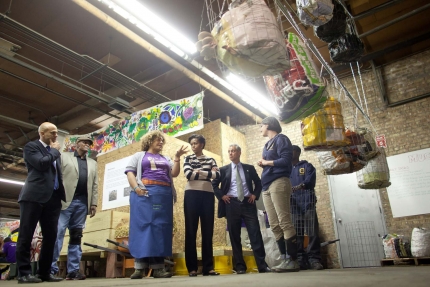
First Lady Michelle Obama at Iron Street Farm

First Lady Michelle Obama learns about growing mushroom chandeliers from Erika Allen, National Outreach Director for Growing Power, during a tour of Iron Street Farm in Chicago, Ill., Oct. 25, 2011. Sam Kass, White House Assistant Chef and Senior Policy Advisor for Healthy Food Initiatives, left, and Chicago Mayor Rahm Emanuel toured the seven-acre urban farm with Mrs. Obama. October 25, 2011. (Official White House Photo by Lawrence Jackson)

For too many American families, serving healthy food as part of a regular diet isn’t actually an option. That’s because, in many communities across the country, there is no place to purchase any groceries, much less fresh fruits and vegetables. These neighborhoods are known as food deserts, and in recent years, as economic difficulties caused grocery stores to shut their doors or consolidate locations, they have been proliferating. 

Eliminating these food deserts and making sure parents in every part of the country have access to fresh produce and healthy choices is a primary goal of Let’s Move, and today First Lady Michelle Obama was in Chicago where she challenged attendees at the Mayor’s Summit on Food Deserts to look for ways to attract grocery stores and other businesses selling fresh produce to their communities.

Studies have shown that people who live in communities with greater access to supermarkets, they eat more fresh fruits and vegetables – surprise. And that can have a real impact on the health of our families.  

I mean, truly, we all grew up in communities with grandmothers who cooked two, three vegetables that you had to eat. There was no ifs, ands or buts about it. But that’s because many of our grandparents, they had community gardens; there was the vegetable man that came around.  There were many other resources that allowed them to have access. So it’s not that people don't know or don't want to do the right thing; they just have to have access to the foods that they know will make their families healthier. 

The White House

Office of the First Lady

Remarks by the First Lady at Mayor's Summit on Food Deserts, Chicago, Illinois

Walgreens Store
Chicago, Illinois 

2:55 P.M. CDT

MRS. OBAMA:  Well, goodness.  (Applause.)  Keica, that was beautiful.  You know, we can just stop right there.  (Laughter.) That means so much to all of us, that statement.  So we're just so happy for you, just so proud.  Thank you so much for that kind introduction. 

And I have to tell you, I'm thrilled to be -- I'm so glad that we're doing this here, at home, in Chicago.  (Applause.)  This is just -- it's a truly wonderful homecoming.  And it's a good reason to be here.  And we're not just anywhere -- we're on the South Side -- right?  (Applause.)  On the South Side.  And I am just so proud and honored.

And I want to thank Greg for his leadership.  You can just see how much it means to communities, to families, to individuals.  So thank you.  Thank you for taking the lead.  Thank you for being bold.  Thank you for hiring tremendous staff who have the kind of relationships with their customers and with the rest of the community.  (Applause.) 

And thank you to all the Walgreens staff.  You all should be incredibly proud of yourselves.  This is a great day for you, to celebrate you and all you do, and for being from the community.  I know everybody is from this community as well.

And of course, I have to recognize my dear friend, and Chicago’s Mayor -- still getting used to that.  (Laughter.)

MAYOR EMMANUEL:  So am I.  (Laughter.) 

MRS. OBAMA:  Mayor Emmanuel -- Rahm -- this is tremendous.  We've been talking about doing this for a while.  I am glad that we're here.  Your leadership means so much.  This Mayor's Summit today is just an important step towards what we hope will be a national effort across this country for mayors and cities and towns.

And I also want to recognize Craig Herkert, who's here from SuperValu, as well.  Thank you, Craig, for everything that SuperValu is doing to bring healthy food into this city and cities across America.

And I want to thank all the mayors.  Many of you I've worked with individually.  I've visited your cities -- and I hope to get to all of yours.  I've met the kids in your communities.  We danced, we played games.  It is -- you are setting the tone for what this country can do for our children and our families.  So we should applaud you all as well for your leadership.  (Applause.)

So, of course, I can’t think of a better place to end this summit than here at this store in this community -- because the story of this Walgreens is a story that we want to be telling in cities and in towns all across this nation.  As Keica said, before Walgreens started selling fruits and vegetables and other grocery items, there were not a whole lot of convenient places for people in certain communities to buy fresh produce.  And a lot of folks wound up buying their groceries at gas stations at ridiculously high prices, not the right quality at times, or convenience stores, places with few, if any, healthy options. 

And I saw this growing up in my own community, you know?  Starting out with wonderful grocery stores and places to go -- you could walk down the street.  But slowly, but surely, as the economy changed, many of these resources just disappeared into thin air.  And this is true for so many communities across this country.  This isn't just happening here in Chicago or on the South Side.  In so many neighborhoods, if folks want to buy a head of lettuce for a salad, or some fruit for their kids' lunch, they'd have to take two or three buses, maybe pay for a taxi cab in order to do it, to go into a different community just to do the basics for their kids. 

And a lot of people don’t have the time, and quite frankly, they don't have the money.  That adds to the cost of doing the right thing for your family.  So what we know in our shop is that we can talk all we want about making healthy choices, about the food we serve our kids, but the truth is if parents don’t have anywhere to buy these foods, then all of that is really just talk.  And that's something that I don't like, is just talking about anything. 

And that’s why, last spring, as part of our "Let's Move" initiative, we brought together non-profit organizations and grocery stores, both large and small, and we asked them one simple question.  We asked them, what can we do, together, to start solving this problem?

And I'm happy to say that within a couple of months, we were getting some of those answers.  And that's important for the community to know, is that people do want to do the right thing, particularly when it comes to the health of our children.

Back in July, we unveiled a new collaboration with Walgreens and Walmart, SuperValu, Calhoun Grocer, and Jeff Brown of Shoprite -- and the collaboration was to build or expand 1,500 stores in underserved areas.  The Fresh Works Fund, which is a coalition of companies and non-profits, agreed to dedicate $200 million to this effort.  And altogether, these companies believe that they will serve 9.5 million people currently living in food deserts and create tens of thousands of new jobs.
 
And since then we have seen other companies get on board.  So it wasn’t just those first few.  What we had hoped would happen was that with that leadership of those first few, others would step up to the plate.  And that has happened.  For example, right here in Chicago, ALDI has promised to work with local farms to buy produce directly from the community, as Rahm has mentioned.  And both ALDI and Roundy’s are planning to open new stores as well. 

And the leaders of these companies are making these investments -- which is important for the community -- though they're not doing this just as executives who care about their bottom lines.  As Greg said, these folks are parents and they're grandparents, and they care about their kids and they care about our kids and our kids’ futures.  So they're doing it for the greater good because they know how big the payoff can really be on things like this -- and not just in dollars, but in the lives of our families and communities.  Stories like Keica's, they impact these business leaders. 

Studies have shown that people who live in communities with greater access to supermarkets, they eat more fresh fruits and vegetables -- surprise.  (Laughter.)  And that can have a real impact on the health of our families. 

I mean, truly, we all grew up in communities with grandmothers who cooked two, three vegetables that you had to eat.  (Laughter.)  There was no ifs, ands or buts about it.  But that’s because many of our grandparents, they had community gardens; there was the vegetable man that came around.  There were many other resources that allowed them to have access.  So it’s not that people don't know or don't want to do the right thing; they just have to have access to the foods that they know will make their families healthier. 

So these companies have really made a truly groundbreaking commitment.  And that’s why it was important for me to be standing here with these companies, with these mayors. 

But we’re here today because we all know that these companies cannot fulfill this commitment alone.  They can do a lot, but they need support as well.  We know that a company cannot just show up one day in a neighborhood and start building a supermarket.  They can’t just scout out an empty lot and start setting up a farmers market.  They need to meet land use and licensing requirements.  They need tax incentives that make it worth their while -- their business interest to make it happen.  They need public transportation that will bring customers to their doors.  And most of all, they need to understand the needs of the community that they want to enter so that the people in those communities will come. 

Keica comes here because Walgreens speaks to her.  She has a relationship with the people here.  And the only way that companies can get that understanding is to connect with those communities and understand where they’re coming from. 

And that’s where all of the mayors come in.  That’s where all of you come in.  And I’m not just talking about how you, as mayors, can help with things like zoning and permitting and public safety –- and all that’s critical.  I’m also talking about how you can use your bully pulpit -- your platform as mayors. 

And that might mean doing something like this -- convening other people, other non-profits, foundations, corporations to help pitch in.  It might mean mobilizing community support by working with civic groups and parent groups and health advocates and neighborhood leaders who are engaged with this issue on the ground, and making clear that everyone has a role to play on issues like this.

It might mean planting community gardens in your cities and towns, or bringing in fresh produce trucks, or finding other creative ways to get healthy food into more neighborhoods.  And that’s what Mayor Emmanuel has done here in Chicago.  As he’s said, he is bringing more urban farms -- and more jobs on those farms -- into underserved communities by passing the urban agriculture bill that’s created fish and plant systems across the city that sell their goods to local stores and restaurants that normally wouldn’t have been able to do that without the bill.  And that, in turn, is creating jobs here in the city.  So it’s very important work. 

And we also have people like Mayor Lozano, who’s here from Baldwin Park, California, who we worked with for a good part of the “Let’s Move” initiative.  And in that area, their motto is -- and this is a quote -- “Health is the heart of business."  Health is the heart of business.  And they’re proactively seeking out grocery stores to serve as anchors in new development areas. 

So the notion is you don't start a new development without the basics, like food and places for kids to play and to walk.  They’ve offered low-interest loans to these stores to attract them into areas, and they’ve expedited the paperwork so that construction can begin more quickly for these new stores.  And they worked with one grocer to design a new floor plan where healthier items would be more prominently displayed for shoppers -- because people know if they see it, they buy it.  So if we put the apples up front instead of the candy up front, that’s what mom is going to pick up, or the kids are going to ask for.

These are just examples that show us that success here doesn’t have to cost a whole lot of money, because there are wonderful ideas that can be implemented that don't require more money.  And it’s certainly not about government telling people what to do.  That is not what “Let’s Move” is about, and that’s not what anyone here is talking about. 

We also know that no one-size-fits-all solution is going to work.  Every community and every city and every town are different, but they all have one thing in common -- they all have leaders like all of you who have joined us today who have the power to make a real difference.  And really, that’s all that’s needed, sometimes, is a little power and a little will.

And if we think about it for a minute, just imagine what we could achieve if mayors across the country started taking on this issue.  Just really think about it.  Every mayor of every town, large and small, just said, I’m going to put this issue -- the health of our children -- on the top of the priority list.  Think about all the jobs that would be created.  As we’re seeing here, we just multiply that across the country.  Think about all the neighborhoods that could be transformed, because people want to live in communities where they have resources.  And a grocery store -- a good-quality grocery store -- is the first step.

And think about what it means when our children finally get -- all of our children -- finally get the nutrition they need to grow up healthy.  Think about what that means for the health of our nation -- the health care system -- when healthy kids grow up to become healthy adults -- adults who are less likely to suffer from illnesses like diabetes and heart disease or cancer, that cost us billions of dollars a year.

Think about what it means for our economy when kids have the nutrition they need to focus in the classroom.  Because starting out with that apple really makes a difference in terms of how kids focus and are ready to learn.  And what it means as they grow up into adults with the energy and the stamina to succeed in the workplace and to go on to succeed in life.  And if we transform children’s eating habits today, think about the effect that will have on how they feed their own children in the years to come. 

And that’s really why we start with kids.  Sometimes, grownups, we’re a little bit hard -- we’re a little hardheaded.  Kids, you start them out early, they don't develop those bad habits and they have the information they need for their kids. 

So make no mistake about it -- we’re not just making this generation of kids healthier, but we’re talking about the next generation as well.  And that’s huge.  That’s the kind of impact that all of you here can have; all of you here are having.  So don't underestimate the power of what is going on here, especially to the employees and people who live in the community. This is big stuff. 

So I hope that all of you will continue to lead the way.  I hope that the country and the nation that is watching will decide to pick up this issue and find a way to make it work in their communities.  Because I know we can make a difference -- we’re already seeing it.  If I can tell you how many kids come up to me and tell me that, because of “Let’s Move” they’re eating different, they’ve got their families eating different.  Kids lead the way.  They make us do for ourselves what we would never do on our own -- right? 

So we are making progress.  And with the help of our leaders -- the continued help of our leaders -- we can expand this in such a grand way, and really change the fate of our children and of our nation.

So I’m so proud of all of you.  This has been just a wonderful reason to come back home.  And let’s keep up the good work.

Thank you all.  Congratulations.  (Applause.)

END
3:12 P.M. CDT

The White House

Office of the First Lady

Remarks by the First Lady at a DNC Event in Detroit, Michigan

The Westin Book Cadillac Hotel
Detroit, Michigan

12:48 P.M. EDT

MRS. OBAMA: This is a good crowd! (Applause.) Oh, my goodness! (Applause.) I heard you all in here making some noise. Well, good afternoon, Detroit! (Applause.) Thank you so much. You don't know, when you travel, coming into a nice warm welcome, a nice warm hug just makes it all worthwhile. (Laughter.) It is truly a pleasure and an honor to be with all of you today.

I want to first thank Rashida for her wonderful remarks earlier today. Yay, Rashida. (Applause.) And I also want to thank a few other people -- Congressman Clarke, and to all the DNC members who are here with us today, former Mayor Dennis Archer, Debbie Dingell, Tina Abbot, Jill Alper, and Virgie Rollins who's here. Let's give them all a terrific round of applause. (Applause.) You all have been amazing. Love you all. Thank you so much. Thank you for your outstanding work.

And finally, I want to thank all of you for taking time out of your lives to come here this afternoon. And I know that there is a reason why we all gathered here today, right? (Applause.) We are here because we know that we stand at a fundamental crossroads for our country. And I know that you’re here because you know that in little over a year we are going to make a choice that will impact our lives truly for decades to come.

And I know you’re here because truly you care about this country. You care about your fellow citizens. You care about our kids, our grandkids, and you care about the world that we’re leaving for them.

And that is truly the reason why I'm here today. Because one of the beautiful things about being First Lady is that I have the privilege of traveling all across this great country, meeting folks from all different backgrounds and hearing what’s going on in their lives.

And every day, I hear about the struggles -- the businesses they’re trying to keep afloat. I hear about the doctor bills people can’t pay, or the mortgage they can no longer afford. I hear about how people are trying to keep it together, taking that extra shift, working that extra job; how folks are scrimping and saving, and sacrificing -- never spending a dime on themselves because they desperately want something better for their kids.

And make no mistake about it -- these struggles are not new. For decades now, middle-class folks have been squeezed from all sides. The cost of things -- gas, groceries, tuition -- they've just continued to rise, but people's paychecks just have not kept up. So when this economic crisis hit, for far too many families, the bottom just fell out.

So the question today is, what are we -- we as a country -- going to do about all of this? Where do we go from here?

And I know that amidst all of the chatter and the debates, it can be really hard to clearly understand what’s at stake. These issues are complicated, and quite frankly, folks are busy. We’re raising our families, working full-time jobs, many of us helping out in our communities, to top it off. And many of us just don’t have time to follow the news and sort through all of that back-and-forth, and figure out how all of these issues connect to our daily lives.

But the fact is that in little over a year from now, we are going to make a decision between two very different visions for our country. And I am here today because when it comes to just about every issue -- from our health, to our economic security, to the quality of our schools -- the stakes for our families, and for our country, have never been higher. Never.

Let’s start with the American Jobs Act that my husband sent to Congress. (Applause.) Now, it's important to understand that when we talk about this bill, we talk about how this bill would give tax cuts to 6 million small business owners, we have to understand that we’re talking about regular folks who will run restaurants and stores and startups that create two-thirds of all new jobs in this country each year. That’s two-thirds.

We’re talking about the people who work themselves to the bone every day, and then head home to pore over the books late at night, determined to make those numbers add up. We’re talking about a tax cut that could mean the difference between these companies hiring new employees -- or handing out pink slips; between keeping their doors open -- or closing up shop for good. See, that's what’s at stake here.

And when we talk about how this bill would extend unemployment insurance for 6 million Americans -- (applause) -- we are talking about people who are just weeks away from losing their only source of income. Weeks away. So this bill is literally about whether or not millions of families and children will have food on their tables and a roof over their heads.

It’s about whether folks will have more money in their pockets -- and more money in their pockets means more money in our economy, which means more jobs. And we all need those, right? (Applause.) And it’s about whether -- more importantly, whether we as a country will honor that fundamental promise that we made generations ago that when times are hard in this country, we do not abandon our fellow citizens. We don't do that. (Applause.)

We don’t let everything fall apart for struggling families. That's not who we are. Instead, we say, “There but for the grace of God goes my family.” (Applause.) Instead, we remember that we are all in this together -- and we extend a helping hand.

And that is why, even though some are trying to stop this bill from moving forward, my husband is never going to give up. (Applause.) He’s going to keep fighting. He is going to keep fighting for what are common-sense jobs proposals. Things like tax cuts for workers, or tax credits for businesses that hire unemployed veterans, jobs for teachers and construction workers -- (applause) -- job training for unemployed or low-income workers -- things like rebuilding our crumbling schools, refurbishing vacant or foreclosed homes and businesses.

All of that is part of the American Jobs Act. All of that is in there. And that is what we’re fighting for. That is the choice in this election.

And how about the very first bill my husband signed into law -- the Lilly Ledbetter Fair Pay Act -- (applause) -- to make sure women get equal pay for equal work. (Applause.) And it's important to know that he did this because, as he put it, we believe that here in America, there are no second-class citizens in the workplace. And he did it because he understands that when nearly two-thirds of women are breadwinners or co-breadwinners, women's success in this economy is the key to families' success in this economy. (Applause.) That's what he knows.

And we know that closing that pay gap can mean the difference between women losing $50, $100, $500 from each paycheck, or having that money to buy gas and groceries and school clothes for their kids. That is the choice that we’re making in this election.

And let’s talk about health care for a minute. Last year, we made history together by finally passing health reform. (Applause.) But now, there are folks out there talking about repealing this reform.

AUDIENCE: Booo --

MRS. OBAMA: So today, we have to ask ourselves, is this who we are? Will we let them succeed?

AUDIENCE: No!

MRS. OBAMA: Is this what we want? Will we let insurance companies deny us coverage because we have preexisting conditions like breast cancer or diabetes? Or will we stand up and say that in this country, we don't let our fellow citizens go bankrupt because they got sick? Not here in America. (Applause.)

Will we let insurance companies refuse to cover basic preventive care -- things like cancer screenings and prenatal care that save money, but more importantly, save lives? Or will we stand up for our lives -- and for the lives of the people that we love? That is what’s at stake here. That is the choice in this election.

And just think for a moment about what this administration has done on education. And think about the investments that we’ve made to raise standards and reform our public schools. These changes are about improving the circumstances for millions of children in this country. These are our children, all of our children -- kids we know who are sitting in crumbling classrooms; kids we know that have so much promise; kids who could be anything they wanted if we just gave them the chance.

And think about how this administration has tripled investments for things like job training and community colleges just this year alone. And that is about millions of hardworking folks -- (applause) -- people who are determined to get the skills they need to get a better job and better wages. I mean, these are people working hard, folks willing to do whatever it takes to improve their own lives -- working full-time jobs, raising their kids, but still making it to that class every evening and studying late into the night, because these are people who will do anything that it takes to get something better for their families.

And make no mistake about it -- these types of investments in our students, in our workers, will determine nothing less than the future of our economy. It will determine whether we’re prepared to make the discoveries and to build the industries that will let us compete with any country anywhere in the world. And that is what’s at stake here.
 
And let us not forget what it meant when my husband appointed two brilliant Supreme Court justices -- (applause) -- and for the first time in history, our daughters and sons watched three women take their seats on our nation’s highest court. (Applause.) But, more importantly, let us not forget the impact of their decisions, the impact that will have on our lives for decades to come -- on our privacy and security, on whether we can speak freely, worship openly, and love whomever we choose. That is what is at stake here. (Applause.)

And think about how we are finally bringing the wars in Afghanistan and Iraq to a responsible end. (Applause.) Think about how we’ll be bringing the last of the troops home from Iraq by the end of this year, and these men and men will be able to celebrate the holidays with their families. (Applause.)

And think about all that we are doing, and will continue to do, to help out our veterans and all the families of the troops to get their education, to get the employment and the benefits that they’ve earned -- because we believe that we should serve our men and women in uniform and their families as well as they have served us. (Applause.)

And let us not forget how, because we finally ended "don't ask, don't tell," our troops will never again have to lie about who they love to serve the country they love. (Applause.) And how we finally brought to justice the man behind the 9/11 attacks and so many other horrific acts. (Applause.)

So now it means we have a foreign policy where we work to keep our country safe, but also restore our standing in the world. That is what’s at stake in this election.

So make no mistake about it, whether it’s health care or the economy, education or foreign policy, the choice we make in this election will determine nothing less than who we are as a country, but more importantly, who we want to be. Who are we? Will we be a country that tells our neighbors who've done everything right but are still struggling to get by, "tough luck, you’re on your own"? Is that who we are?

AUDIENCE: No!

MRS. OBAMA: Or will we honor that fundamental American belief that I am my brother’s keeper, that I am my sister’s keeper -- (applause) -- and if one of us is hurting, then we’re all hurting? (Applause.)

Who are we? Will we be a country where opportunity is limited to a few at the top -- or will we give every child a chance to succeed, no matter where they’re from, or what they look like, or how much money their parents have? Who are we?

Will we lose sight of those basic values that made our country great and built a thriving middle class? Will we rebuild our economy for the long-term so that work pays, so that responsibility is actually rewarded, and everyone -- everyone -- gets a fair shake, and does their fair share?

Who are we? That is the choice we face. Those are the stakes.

And believe me, your President knows this. He understands these issues because he’s lived them. He was raised by a single mother who struggled to put herself through school and pay the bills. And when she needed help, who stepped in but his grandmother, waking up every morning before dawn to take that bus to that job at the bank. His grandmother worked hard and she was good at what she did. But for nearly two decades, she was passed over for promotions. Why? Because she was a woman. And she watched men no more qualified then she -- men she actually trained -- climb the corporate ladder ahead of her.

So believe me, Barack knows what it means when a family struggles. He knows what it means when someone doesn’t have a chance to fulfill their potential. And today, as a father, he certainly knows what it means to want your child to grow up with no limits on their dreams. See, these are the experiences that have made him the man -- and the President -- that he is today. And we are blessed to have him. (Applause.)

And that is what I hear in my husband’s voice when he returns home after a long day -- whether it’s traveling around the country, or working in the office -- and he tells me about the people he’s met. That’s what I see in those quiet moments late at night after the girls have gone to bed, and he’s still up poring over the letters people have sent him -- the letter from the woman dying of cancer whose insurance company won’t cover her care, or the letter from the man struggling to pay his family’s bills, the letter from the many young people with so much promise but so few opportunities.

And I hear the passion and the determination in his voice, say, “You won’t believe what these folks are still going through.” That’s what he tells me. He says, “Michelle, it’s not right. And we have to fix this. We have more work to do.”

So what you need to know is that when it comes to the people that Barack meets, he has a memory like a steel trap. (Laughter.) Gets annoying sometimes. (Laughter.) He might not remember your name, but if he’s had a few minutes and a decent conversation with you, he will never forget your story. It becomes imprinted on his heart. And that is what he carries with him every day. It is your collection of hopes and struggles and dreams.

And that is where Barack gets his passion. That is where Barack gets his toughness and his fight. And that is why, even in the darkest moments, when it looks like all is lost and we’re all sweating it, Barack Obama never loses sight of the end goal. He never lets himself get distracted by the chatter and the noise. He just keeps moving forward. (Applause.)

But I have said this before, and if anybody has ever been near me, I have said it and I will say it again: He cannot do it alone. He needs your help. He needs you to make those phone calls. He needs you to register voters. He needs you to take those “I’m in” cards I know you must have and use them -- sign your neighbors up, your friends up, your colleagues up. Convince them to join in, in giving just a little part of your lives and their lives each week to this campaign. That’s what he needs from you.

Now, I’m not going to kid you, this journey is going to be long.

AUDIENCE: Yes.

MRS. OBAMA: And it is going to be hard. And there will be plenty of twists and turns along the way. It’s a beautiful journey. But the truth is that is how change always happens in this country -- real change. The reality is, is that change is slow, it never happens all at once. But if we keep showing up, if we keep fighting the good fight and do what we know is right, then we always get there. We always get there. Maybe not in our lifetimes, but maybe in our children’s lifetimes, or our grandchildren’s lifetimes.

Because in the end, that is really what this is all about. It’s not about us. In the end, we’re not fighting these battles for ourselves. We’re fighting them for our sons and our daughters, for our grandsons and our granddaughters. We’re fighting for the world we want to leave for them.

And I am not in this fight not just as a mother who wants to leave a legacy for my girls -- and I do. I’m in this as a citizen who knows what we can all do together to change this country for the better. Because the truth is, is that no matter what happens, my girls will be okay. They are blessed. My girls will still have plenty of advantages and opportunities in their lives. And that is probably true for so many of your kids as well. But I think that the last few years have shown us the truth of what Barack has always said -- that if any child in this country is left behind, then that matters to all of us, even if she’s not our daughter, even if he’s not our son. If any family in this country struggles, then we cannot be fully content with our own family’s good fortune. Because that is not what we do in America. That is not who we are. (Applause.)

In the end, we can’t separate our own individual story from the broader American story. Like it or not, we’re all in this together -- and that’s a good thing. And we know that here in this country we can shape our own destiny. We know that if we make the right choices and have the right priorities, we can ensure that everyone gets a fair shake and a chance to get ahead.
So we can’t afford to be complacent, or tired, or frustrated. We don’t have time for that. It is time for us to get to work.

So let me ask you one final question: Are you in?

AUDIENCE: Yes!

MRS. OBAMA: Wait, wait, wait, I’ve got to hear it -- are you in?

AUDIENCE: Yes!

MRS. OBAMA: Because let me tell you, I am so in. (Applause.) I am so far in. I want you all so fired up.

AUDIENCE: Fired up! (Applause.)

MRS. OBAMA: I am going to be working so hard this year. And I want to see each and every one of you out there pushing this thing like you know what’s at stake.

So are you in with me?

AUDIENCE: Yes!

MRS. OBAMA: You all, thank you so much. Thank you for your prayers. Thank you for your work. God bless you all. (Applause.)

END
1:12 P.M. EDT

At the World Series with Joining Forces

Last week, First Lady Michelle Obama and Dr. Jill Biden traveled to St. Louis for Game One of the 2011 World Series to honor the troops, veterans and their families as part of their Joining Forces initiative geared towards connecting local communities in support of military families.

Check out the video from their trip here:

Before the first pitch, the First Lady also took your questions from Twitter and Facebook on how you can say thanks and provide a helping hand for the families of service members. There are lots of ways to get involved, from sending a message of gratitude to exploring volunteer opportunities near you. Find out how you can support a military family in your community at JoiningForces.gov.

The First Lady makes her first official tweet at Game 1 of the World Series

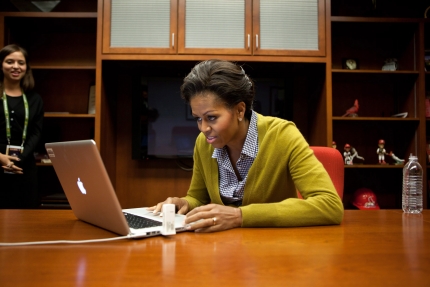
First Lady Michelle Obama makes her first official tweet at Game 1 of the World Series to recognize Major League Baseball’s (MLB) outstanding support of America's veterans and military families as part of their Joining Forces at Busch Stadium in St. Louis, Mo., Oct. 19, 2011. (Official White House Photo by Lawrence Jackson)

Travels with The First Lady: Joining Forces at The World Series

October 24, 2011 | 1:21 | Public Domain

First Lady Michelle Obama and Dr. Jill Biden travel to St. Louis for Game 1 of the 2011 World Series to promote their Joining Forces initiative geared towards connecting local communities in support of military families. Find out how you can support a military family in your community at http://joiningforces.gov

Download mp4 (41.8MB)

New Photo: the First Lady and the First Dog

As the Director of Correspondence for the First Lady, it’s my honor – and pleasure – to read through the letters the First Lady receives every day from across the country. People write in about all kinds of issues, ranging from the First Lady’s Let’s Move! initiative to help kids get active and stay healthy to her work lifting up military families through Joining Forces. But we also get quite a few letters addressed to, or about, the youngest member of the Obama family – Bo! That’s why Mrs. Obama recently took a photo with Bo in the White House kitchen garden, so that kids writing in about the garden or about Bo could get a letter back with a photo of the First Dog. Letters from children are always such a joy and inspiration, that’s why Mrs. Obama wanted to give them something more tangible in return. We hope kids of all ages enjoy this special look at the First Lady and the First Dog as much as I do!

The First Lady and Bo

Howli Ledbetter is Director of Correspondence for the First Lady
Related Topics: Working Families

10/21/11 West Wing Week or: "Right Now!"

October 20, 2011 | 8:33 | Public Domain

Welcome to the West Wing Week, your guide to everything that's happening at 1600 Pennsylvania Ave. This week, the President traveled to Detroit with the President of South Korea, dedicated the Martin Luther King, Jr. National Memorial, embarked on a three day American Jobs act bus tour, bestowed the Presidential Citizens Medal and hosted the Norwegian Prime Minister. That's October 14th to October 20th or: "Right Now!"

Download mp4 (202MB)

Watch: First Lady Michelle Obama’s First Tweet

Before the first pitch at Game One of the World Series, First Lady Michelle Obama sent her first official tweet calling on all Americans to support our nation’s military families. Check out the clip here

As part of their Joining Forces initiative, Mrs. Obama and Dr. Jill Biden teamed up with Major League Baseball at a game dedicated to veterans and military families. The Joining Forces initiative and MLB’s Welcome Back Veterans program encourage all Americans to recognize and support America’s veterans and military families.

Earlier in the day, the First Lady joined President Obama to announce a commitment from the private sector to hire 25,000 veterans and military spouses. Before the game, Mrs. Obama and Dr. Biden spent time with veterans and military families at the St. Louis Veterans Center and answered MLB fans' questions in an online chat.

Related Topics: Service, Veterans

The First Lady's First Tweet

October 20, 2011 | :22 | Public Domain

Right before Game One of the 2011 World Series in St Louis, MO, First Lady Michelle Obama becomes the first sitting First Lady of the United States to tweet. Watch the behind-the-scenes video and follow future messages from the First Lady on twitter at http://twitter.com/joiningforces

Download mp4 (10.3MB)

Joining Forces at the World Series to Support Our Military Families

First Lady Michelle Obama and Dr. Jill Biden watch Game one of the 2011 World Series

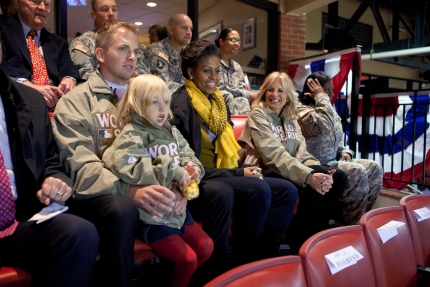
First Lady Michelle Obama and Dr. Jill Biden watch Game one of the 2011 World Series between the Texas Rangers and the St. Louis Cardinals with Marine Lance Cpl. James Sperry and his daughter Hannah, 5, at Busch Stadium in St. Louis, Missouri, Oct. 19, 2011.(Official White House Photo by Lawrence Jackson)

This afternoon, First Lady Michelle Obama and Dr. Jill Biden headed to St. Louis, Missouri for Game One of the World Series to meet with military families and recognize Major League Baseball’s (MLB) support of those who serve and their families.

During the game, a new Joining Forces and MLB Public Service Announcement will premiere featuring New York Yankees first baseman Mark Teixeira and Tampa Bay Rays outfielder Johnny Damon, encouraging Americans to support Joining Forces and MLB’s Welcome Back Veterans program to stand with veterans, the troops and their families. Watch a sneak peek here

Download Video: mp4 (31.7MB)