Remarks by The First Lady during Keynote Address at Young African Women Leaders Forum
Regina Mundi Church
Soweto, South Africa
10:16 A.M. (Local)
MRS. OBAMA: Thank you. Thank you so much. It is such a pleasure and an honor to be here with all of you today.
I want to start by thanking Graca Machel for that just gracious, kind introduction. It is overwhelming. And I want to thank her for her lifetime of service as a champion for women and children. And from the bottom of my heart, I want to thank you for all of the kindness and generosity that you have shown my family for our visit here. Thank you so much. (Applause.)
I am also honored to share the stage with another remarkable leader, Baleka Mbete. (Applause.) She has played a vital role in advancing equality and promoting development here in South Africa. Thank you to the both of you for joining us here for sharing this moment with all of us.
I also want to thank the Archbishop of Johannesburg for honoring us today with his presence.
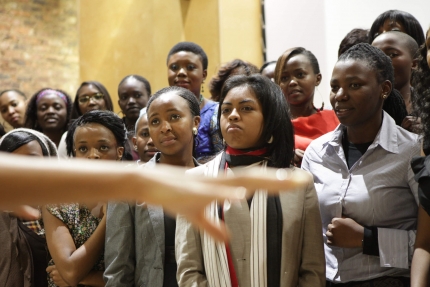
And of course, I want to recognize our guests of honor –- these 76 extraordinary young women leaders from here in South Africa and across the continent. (Applause.)
These are young women transforming their communities and their countries, and let me tell you I am so impressed by all of them. I am so proud of everything they have achieved.
And finally, I want to thank the leaders and the congregation of Regina Mundi for hosting us in this sacred space today. It has been more than three decades, but those bullet holes in the ceiling, this broken altar still stand as vivid reminders of the history that unfolded here.
And you all know the story –- how 35 years ago this month, a group of students planned a peaceful protest to express their outrage over a new law requiring them to take courses in Afrikaans. Thousands of them took to the streets, intending to march to Orlando Stadium.
But when security forces opened fire, some fled here to this church. The police followed, first with tear gas, and then with bullets.
And while no one was killed within this sanctuary, hundreds lost their lives that day, including a boy named Hector Pieterson, who was just 12 years old, and Hastings Ndlovu, who was just 15.
Many of the students hadn’t even known about the protest when they arrived at school that morning. But they agreed to take part, knowing full well the dangers involved, because they were determined to get an education worthy of their potential.
And as the Archbishop noted, that June day wasn’t the first, or the last, time that this church stood in the crosscurrents of history. It was referred to as “the parliament of Soweto.” When the congregation sang their hymns, activists would make plans, singing the locations and times of secret meetings. Church services, and even funerals, often became anti-Apartheid rallies. And as President Mandela once put it, “Regina Mundi became a world-wide symbol of the determination of our people to free themselves.”
It is a story that has unfolded across this country and across this continent, and also in my country -- the story of young people 20 years ago, 50 years ago, who marched until their feet were raw, who endured beatings and bullets and decades behind bars, who risked, and sacrificed, everything they had for the freedom they deserved.
And it is because of them that we are able to gather here today. It is because of them that so many of these young women leaders can now pursue their dreams. It is because of them that I stand before you as First Lady of the United States of America. (Applause.) That is the legacy of the independence generation, the freedom generation. And all of you -– the young people of this continent -– you are the heirs of that blood, sweat, sacrifice, and love.
So the question today is, what will you make of that inheritance? What legacy will you leave for your children and your grandchildren? What generation will you be?
Now, I could ask these questions of young people in any country, on any continent. But there is a reason why I wanted to come here to South Africa to speak with all of you.
As my husband has said, Africa is a fundamental part of our interconnected world. And when it comes to the defining challenges of our times –- creating jobs in our global economy, promoting democracy and development, confronting climate change, extremism, poverty and disease -- for all this, the world is looking to Africa as a vital partner.
That is why my husband’s administration is not simply focused on extending a helping hand to Africa, but focusing on partnering with Africans who will shape their future by combating corruption, and building strong democratic institutions, by growing new crops, caring for the sick. And more than ever before, we will be looking to all of you, our young people, to lead the way.
And I’m not just saying that to make you all feel good. (Laughter.) The fact is that in Africa, people under 25 make up 60 percent of the population. And here in South Africa, nearly two-thirds of citizens are under the age of 30. So over the next 20 years, the next 50 years, our future will be shaped by your leadership.
And I want to pause for a moment on that word -– leadership -- because I know that so often, when we think about what that word means, what it means to be a leader, we think of presidents and prime ministers. We think of people who pass laws or command armies, run big businesses, people with fancy titles, big salaries.
And most young people don’t fit that image. And I know that often when you try to make your voices heard, sometimes people don’t always listen. I know there are those who discount your opinions, who tell you you’re not ready, who say that you should sit back and wait your turn.
But I am here today because when it comes to the challenges we face, we simply don’t have time to sit back and wait.
I’m here because I believe that each of you is ready, right here and right now, to start meeting these challenges.
And I am here because I know that true leadership -– leadership that lifts families, leadership that sustains communities and transforms nations –- that kind of leadership rarely starts in palaces or parliaments.
That kind of leadership is not limited only to those of a certain age or status. And that kind of leadership is not just about dramatic events that change the course of history in an instant.
Instead, true leadership often happens with the smallest acts, in the most unexpected places, by the most unlikely individuals.
I mean, think about what happened here in Soweto 35 years ago. Many of the students who led the uprising were younger than all of you. They carried signs made of cardboard boxes and canvass sacks. Yet together, they propelled this cause into the consciousness of the world. And we now celebrate National Youth Day and National Youth Month every year in their honor.
I mean, think about the giants of the struggle –- people like Albertina Sisulu, whose recent passing we all mourn. Orphaned as a teenager, she worked as a nurse to support her siblings. And when her husband, Walter Sisulu, became Secretary-General of the ANC, it was up to her to provide for their family. When he was imprisoned for 26 years, it was up to her to continue his work. And that she did. With a mother’s fierce love for this country, she threw herself into the struggle.
She led boycotts and sit-ins and marches, including the 1956 Women’s March, when thousands of women from across this country, converged on Pretoria to protest the pass laws. They were women of every color, many of them not much older than all of you. Some of them carried their babies on their backs. And for 30 minutes, they stood in complete silence, raising their voices only to sing freedom songs like Nkosi Sikelel iAfrica. Their motto was simple, but clear: “If you strike a woman, you strike a rock.” (Applause.)
Ma Sisulu, the students of Soweto, those women in Pretoria, they had little money, even less status, no fancy titles to speak of. But what they had was their vision for a free South Africa. What they had was an unshakeable belief that they were worthy of that freedom –- and they had the courage to act on that belief. Each of them chose to be a rock for justice. And with countless acts of daring and defiance, together, they transformed this nation.
Together they paved the way for free and fair elections, for a process of healing and reconciliation, and for the rise of South Africa as a political and economic leader on the world stage.
Now, I know that as your generation looks back on that struggle, and on the many liberation movements of the past century, you may think that all of the great moral struggles have already been won.
As you hear the stories of lions like Madiba and Sisulu and Luthuli, you may think that you can never measure up to such greatness.
But while today’s challenges might not always inspire the lofty rhetoric or the high drama of struggles past, the injustices at hand are no less glaring, the human suffering no less acute.
So make no mistake about it: There are still so many causes worth sacrificing for. There is still so much history yet to be made. You can be the generation that makes the discoveries and builds the industries that will transform our economies. You can be the generation that brings opportunity and prosperity to forgotten corners of the world and banishes hunger from this continent forever. You can be the generation that ends HIV/AIDS in our time -- (applause) -- the generation that fights not just the disease, but the stigma of the disease, the generation that teaches the world that HIV is fully preventable, and treatable, and should never be a source of shame. (Applause.)
You can be the generation that holds your leaders accountable for open, honest government at every level, government that stamps out corruption and protects the rights of every citizen to speak freely, to worship openly, to love whomever they choose.
You can be the generation to ensure that women are no longer second-class citizens, that girls take their rightful places in our schools. (Applause.)
You can be the generation that stands up and says that violence against women in any form, in any place -- (applause) -- including the home –- especially the home –- that isn’t just a women’s rights violation. It’s a human rights violation. And it has no place in any society.
You see, that is the history that your generation can make.
Now, I have to be honest. Your efforts might not always draw the world’s attention, except for today. (Laughter.) You may not find yourself leading passionate protests that fill stadiums and shut down city streets. And the change you seek may come slowly, little by little, measured not by sweeping changes in the law, but by daily improvements in people’s lives.
But I can tell you from my own experience –- and from my husband’s experience -– that this work is no less meaningful, no less inspiring, and no less urgent than what you read about in the history books.
You see, it wasn’t that long ago that my husband and I were young, believe it or not -- (laugher) -- just starting out our careers. After he graduated from university, Barack got a job as a community organizer in the struggling neighborhoods on the South Side of Chicago. A lot of people there were out of work and barely getting by. Children had few opportunities and little hope for their future. And trust me, no one thought that this skinny kid with the funny name -- (laughter) -- could make much of a difference.
But Barack started talking to people. He urged them to start working on the change they wanted to see. Soon, slowly, folks started coming together to fight for job training programs and better schools and safer housing for their families.
Slowly, the neighborhoods started to turn around. Little by little, people started feeling hopeful again. And that made Barack feel hopeful.
And I had a similar experience in my own career. Like my husband, I came from a modest background. My parents saved and sacrificed everything they had so that I could get an education. And when I graduated, got a job at a big, fancy law firm -- nice salary, big office. My friends were impressed. My family was proud. By all accounts, I was living the dream.
But I knew something was missing. I knew I didn’t want to be way up in some tall building all alone in an office writing memos. I wanted to be down on the ground working with kids, helping families put food on the table and a roof over their heads.
So I left that job for a new job training young people like yourselves for careers in public service. I was making a lot less money. My office wasn’t so nice. (Laughter.) But every day, I got to watch those young people gain skills and build confidence. And then I saw them go on to mentor and inspire other young people. And that made me feel inspired. It still does.
See, my husband and I, we didn’t change any laws, we didn’t win any awards, get our pictures in the paper. But we were making a difference in people’s lives. We were part of something greater than ourselves. And we knew that in our own small way, we were helping to build a better world. And that is precisely what so many young people are doing every day across this continent.
These 76 young women are outstanding examples. Take Gqibelo Dandala from here in South Africa. She left a lucrative career in investment banking to found the Future of the African Daughter Project, an organization that lifts up young women in rural and township areas. Of her work, she says: “…we are building a legacy which will outlive and outgrow us…”
And then there’s Robyn Kriel. She’s a young reporter from Zimbabwe who has written about corruption and human rights abuses in her country. She was beaten by police; her home raided, her mother imprisoned. But she still hasn’t lost her passion for reporting, because, as she put it, the people of Zimbabwe “want their stories to be told.”
And then there’s Grace Nanyonga, who joins us today from Uganda. Hey, Grace! (Applause.) You go, girl. (Laughter.) Orphaned at the age of 13, she started cooking and selling fish during her school vacations to support her six siblings. Determined to get an education, she founded her own company, and she made enough money to put herself through university. And she’s now started an organization that trains local women to work at her company so that they can support their own families. (Applause.) Of her achievements, she says, simply -- these are her words -- “I made it against all odds” and “I want to be an example for girls in my country and beyond.”
Now, Grace could have been content to make lots of money, and just provide for her own family. Gqibelo could have climbed the corporate ladder, and never looked back. Where is she? Please stand. Grace got to stand. (Laughter.) Come on, where is she? Is she out there? (Applause.) And no one would’ve blamed Robyn -- where’s Robyn? (Applause.) No one would have blamed Robyn if after all she’d been through she decided to quit reporting and pursue an easier career. But these young women -- and these are just examples of stories that go on and on -- these young women could not be content with their own comfort and success when they knew that other people were struggling.
You see, that’s how people of conscience view the world. It’s the belief, as my husband often says, that if any child goes hungry, that matters to me, even if she’s not my child. (Applause.) If any family is devastated by disease, then I cannot be content with my own good health. If anyone is persecuted because of how they look, or what they believe, then that diminishes my freedom and threatens my rights as well.
And in the end, that sense of interconnectedness, that depth of compassion, that determination to act in the face of impossible odds, those are the qualities of mind and heart that I hope will define your generation.
I hope that all of you will reject the false comfort that others’ suffering is not your concern, or if you can’t solve all the world’s problems, then you shouldn’t even try.
Instead, as one of our great American presidents, Teddy Roosevelt, liked to say, I hope that you will commit yourselves to doing “what you can, with what you’ve got, where you are,” because in the end, that is what makes you a lion. Not fortune, not fame, not your pictures in history books, but the refusal to remain a bystander when others are suffering, and that commitment to serve however you can, where you are.
Now it will not be easy. You women know that already. You will have failures and setbacks and critics and plenty of moments of frustration and doubt. But if you ever start to lose heart, I brought you all here today because I want you to think of each other.
Think about Grace, supporting her family all by herself. And think about Robyn, who endured that beating so she could tell other people’s stories. Think about Ma Sisulu, raising her kids alone, surviving banishment, exile, and prison. When reflecting on her journey, Ma Sisulu once said, with her signature humility, she said, “All these years, I never had a comfortable life.”
So you may not always have a comfortable life. And you will not always be able to solve all the world’s problems all at once. But don’t ever underestimate the impact you can have, because history has shown us that courage can be contagious, and hope can take on a life of its own.
It’s what happens when folks start asking questions -- a father asks, “Why should my son go to school, but not my daughter?” Or a mother asks, “Why should I pay a bribe to start a business to support my family?” Or a student stands up and declares, “Yes, I have HIV, and here’s how I’m treating it, and here’s how we can stop it from spreading.”
See, and then soon, they inspire others to start asking questions. They inspire others to start stepping forward.
And those are the “ripples of hope” that a young U.S. senator named Robert Kennedy spoke of when he came here to South Africa 45 years ago this month. In his words, he said, the “numberless diverse acts of courage and belief which can sweep down the mightiest walls of oppression and resistance.”
And that is how a church can become a parliament. That is how a hymn can be a call to action.
That is how a group of young people with nothing more than some handmade signs and a belief in their own God-given potential can galvanize a nation.
And that’s how young people around the world can inspire each other, and draw strength from each other.
I’m thinking today of the young activists who gathered at the American Library here in Soweto to read the speeches of Dr. Martin Luther King for their inspiration.
And I’m thinking of how Dr. King drew inspiration from Chief Luthuli and the young people here in South Africa.
And I’m thinking about how young South Africans singing the American civil rights anthem “We Shall Overcome” in the streets of Cape Town and Durban.
And I’m thinking of how Nkosi Sikelel iAfrica echoed through university campuses in the U.S., as students -– including my husband –- planned boycotts to support students here in South Africa.
And I’m thinking of this church and how those stained windows depicting the struggle were donated by the people of Poland, and how the peace pole in the park outside was donated by people from Japan, and how every week, visitors from every corner of the globe come here to bear witness and draw inspiration from your history.
And finally, I’m thinking of the history of my own country. I mean, America won its independence more than two centuries ago. It has been nearly 50 years since the victories of our own civil rights movement. Yet we still struggle every day to perfect our union and live up to our ideals. And every day, it is our young people who are leading the way. They are the ones enlisting in our military. They’re the ones teaching in struggling schools, volunteering countless hours in countless ways in communities.
And in this past presidential election, they were engaged in our democracy like never before. They studied the issues, followed the campaign, knocked on doors in the freezing snow and the blazing sun, urging people to vote. They waited in line for hours to cast their ballots.
And I have seen that same passion, that same determination to serve in young people I have met all across the world, from India to El Salvador, from Mexico to the United Kingdom to here in South Africa.
So today, I want you to know that as you work to lift up your families, your communities, your countries and your world, know that you are never alone. You are never alone.
As Bobby Kennedy said here in South Africa all those years ago: “…you are joined with fellow young people in every land, they struggling with their problems and you with yours, but all joined in a common purpose…determined to build a better future.”
And if anyone of you ever doubts that you can build that future, if anyone ever tells you that you shouldn’t or you can’t, then I want you to say with one voice –- the voice of a generation –- you tell them, “Yes, we can.” (Applause.) What do you say? Yes, we can. (Applause.) What do you say? Yes, we can!
AUDIENCE: Yes, we can!
MRS. OBAMA: What do you say?
AUDIENCE: Yes, we can!
MRS. OBAMA: Thank you all so much. God bless you. (Applause.)
END
10:50 A.M. (Local)