Remarks by The First Lady at George Washington University Commencement
National Mall
Washington, D.C.
10:55 A.M. EDT
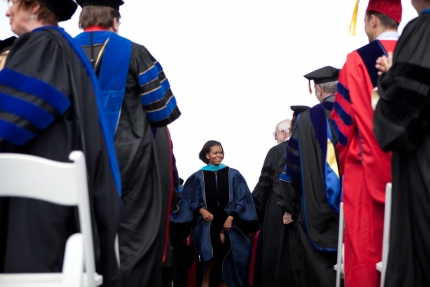
MRS. OBAMA: Wow. Thank you all. Thank you so much. (Applause.) Thank you. “Dr. Obama” -- I like that. (Laughter.) I think I'll have everybody at home start calling me that. (Laughter.)
Thank you. I am so honored to help you celebrate this wonderful day.
And thank you, Ally; thank you, Dr. Knapp, for your generous introduction. I also want to thank Russ Ramsey, Chair of the George Washington University Board of Trustees.
And congratulations to the extraordinary young men and women of the Class of 2010! (Applause.)
You guys, you should be so proud of yourselves and your incredible accomplishments. But let’s not forget all the people who also share in that pride –- again, your moms and dads, and brothers and sisters, your friends, grandparents, mentors –- all of whom took this journey with you in ways both seen and unseen. So this is their day, too. So let’s give them another round of applause and thank you. (Applause.)
Now, I’m here today for a reason -- and not just because it’s a quick commute. (Laughter.) I am here because, as you’ve seen, eight months ago, I used you all in great ways. I issued a challenge to the students, faculty, staff, and trustees of GW. I promised you that if you performed 100,000 hours of service to the greater Washington community this school year, that I’d come and speak at your commencement.
Well, I am a woman of my word! So congratulations on this remarkable achievement. Thank you for the incredible contributions that you’ve made to the lives of so many people.
But I will say that if I had known that you’d complete more than 3,300 hours on the first day of the challenge -- (laughter) -- I'd probably have picked a higher number! (Laughter.)
Each month, you sent me just wonderful letters updating your progress. “Dear Mrs. Obama, we’re at 19,000 hours.” “Dear Mrs. Obama, we’re at 46,000 hours.” “Dear Mrs. Obama, we’ve at 73,958 hours.” (Laughter.) Yes, I got every minute of detail. (Laughter.) And soon enough, I realized, “Uh-oh, I better start working on that commencement speech!” (Laughter.)
But more impressive than the fact that you did it was really how you did it. Your letters were filled with, oh, wonderful stories of holding food drives, and beautifying parks, and making care packages for our troops and writing postcards to their families.
You helped your neighbors in Foggy Bottom dig out after “Snowmageddon” –- an effort spurred by Ally.
And led by junior Eden Sutley, you helped more than 1,000 -- hey, Eden, yay for Eden -- (applause) -- you helped more than 1,000 World War II veterans from her home state of Louisiana come to see the monuments on this Mall and visit their fallen friends at Arlington.
You hosted about 200 local senior citizens for GW’s eighth annual Senior Prom. And yes, I saw the photos, and it looked like they were showing you all how to dance. (Laughter.)
GW law students -- (applause) -- you showed a greater commitment to community and public service careers than ever before. GW medical students -- (applause) -- they ran their own clinic in Anacostia for our neighbors most in need of medical aid, and so many students wanted to do it that you had to hold a lottery. And more than 500 of you spent Martin Luther King, Jr. Day at Roosevelt Senior High School here in D.C. You repainted the classrooms, and revamped the athletic facilities, you updated the library. You all restored an entire school. And just think about that. What was just a few hours to you is going to make the difference for thousands of young lives for years to come.
And those are just some of the stories that I’ve read in your letters. But what you may not know is that the people whose lives you’ve touched, they also sent me letters.
One was from a local retirement community for veterans and their spouses. On September 11, the day that I issued the challenge to you, more than 100 of you hopped on a bus and spent the day there.
And the letter described in moving detail how you altered your plans to stay an extra hour so you could keep talking with an original Tuskegee Airman; how you decided to set up regular visits with the veterans; how you started a monthly intergenerational discussion group. I mean, the letter went on and on about just how incredible you were. And it described just what your efforts meant to those veterans. But it also showed me what theirs meant to you.
And that’s what you guys have done, simply because this university decided to play a role in the life of its neighbors. You have made immeasurable differences in the life of this community and to your country. And you should be so proud, because we certainly are.
And for every act of service that you performed for the community here in D.C., you committed yourselves to serving the greater global community, as well.
I’m talking about the more than 200 of you who took your winter breaks abroad –- building a school in Guatemala, community center in Peru, comforting the sick in Ecuador; the freshman who spent his break in Ghana helping prevent blindness; and the students who helped Sudanese refugees settle in Tennessee; stepping in one night to teach when the refugees’ English teacher didn’t show up –- a class that the refugees called their very best.
So even as you’ve buried yourselves in your books, becoming thoughtful and educated scholars -- so parents, they did that, right? -- (laughter) -- you’ve also immersed yourselves in your community, becoming active and engaged citizens.
You have fully joined a generation of activists and doers. And when you think about how your generation has come of age, that’s pretty astounding. I mean, you all have seen so much. Just since you were in middle school, you’ve witnessed terrorism touch our soil, you’ve seen the cost of war reach into our communities. You’ve watched unimaginable devastation and suffering in the aftermath of a tsunami; a hurricane; an earthquake. You’ve felt the wrath of a recession that’s changed your towns and even your families.
Now, that’s a whole lot to bear for any generation. So, no one would have blamed you had you chosen to hunker down and turn inward; if you had simply focused on making sure that your own lives were secure.
But so many of you have done the exact opposite. Instead, you’ve dived in. You’ve reached out. You have volunteered and applied to organizations like Teach for America and the Peace Corps in record numbers. In fact, this year is the second year in a row that GW led universities of this size in the number of undergraduate alumni serving in the Peace Corps. (Applause.)
So for every ill of this interconnected world, you’ve tried to find a way to make good. Where there’s hate, you’ve tried to heal it. Where there’s need, you’ve tried to fill it. Where there’s devastation, you’ve tried to rebuild it.
You guys can’t be stopped. You don’t know the meaning of the word “can’t.” And every time someone’s tried to say to tell you that, you’ve replied what -- “Oh, Yes We Can.” (Laughter and applause.)
In fact, you remind me of something President Wilson once said. He said, “Sometimes people call me an idealist. Well, that’s the way I know I’m an American.”
Even so, you’ve probably also run up against people who love your idealism, but warn you to lower your sights; to scale back your ambitions a bit; to settle for something less.
And you know their hearts may be in the right place. They may be worried that you’re in for a letdown once you realize that it can take years and even decades for your best efforts to bear fruit. See, we live in a culture, after all, that tells us that our lives should be easy; that we can have everything we want without a whole lot of effort.
But the truth is -- and you know this -- creating anything meaningful takes time. And sometimes, the only thing that happens in an instant is destruction.
And I say this because during our trip to Haiti, Jill Biden and I, we got to visit the people there, and there amidst so much misery and destruction, all of which occurred in a matter of minutes, it is so easy to ask: After so much ruin, how can anything rise again? After so much loss, how can anyone still have hope?
But let me tell you that everyone I met during that visit –- doctors, relief workers; Haitians, Americans, citizens of the world –- they were focused on the task of answering those questions. Yeah, they were exhausted and they were heartbroken. But they were equally unyielding in their determination to help that country heal, and fully aware of how many years that would take.
And by the way, I also met with President Preval and his wife, Elisabeth, who’s a GW graduate herself. And she just went on and on about how GW, the community, has been there at the forefront of the efforts to help Haiti from the very beginning.
But the point is, everyone I encountered during my trip embodied a Haitian proverb that I learned which says that, “little by little, the bird builds its nest.” And your generation is doing its best to live by this idea.
You see, as impatient as you may be to get out there and change the world –- and that’s a good thing –- you’re equally patient for that change to come. As idealistic as all of you may be, what your generation has lived through has also tempered you with a deep realism.
You understand things that perhaps your parents and I even don’t always have to consider when our world was still separated by walls of concrete and communication.
That we are no longer isolated from what happens on the other side of the world. That it’s in our best interest to look beyond our immediate self-interest, and look out for one another globally. That so many of today’s challenges are borderless, from the economy to terrorism to climate change, and that solving those problems demands cooperation with others. And more than any other generation, yours is fully convinced that you’re uniquely equipped to solve those challenges. You believe that you can change your communities and change the world. And you know what, I think you’re right. Yes, you can.
So today, graduates, I have one more request to make of you, one more challenge, and that is: Keep going. Keep giving. Keep engaging.
I’m asking you to take what you’ve learned here and embrace the full responsibilities that a degree from an institution like GW gives you. I’m asking your generation to be America’s face to the world. It will make the world safer, it will make America stronger, and it will make you more competitive.
Now, you didn’t think I’d show up here without another challenge, did you? (Laughter.)
I know that some of you may be thinking, well, “Hang on, Michelle. I’m in debt, I’ve got to find a job in a tough economy, and now you want me to what?”
And I know there are parents out there thinking the same thing. “Hang on, Michelle. I just shelled out six figures to get my kid to this day, and now you want her to do what?” (Laughter.)
I’m just asking you to keep being you, to keep doing what you’re doing. Just take it global.
Yes, that can mean serving in the world’s most broken places. Or it can simply mean surfing foreign news sources to get an idea of how other young people see things in other parts of the world.
It can mean continuing your own personal and professional growth by traveling far and wide. Or it can mean reaching back to convince the students behind you to try study abroad programs, especially students from communities and backgrounds who might not normally consider it.
It can mean seizing that overseas opportunity with a company. Or it can mean staying here and fixing the world by doing business with the world, and, at the same time, creating opportunity in your own community.
This class of graduates in particular has a leg up, because at GW, you’ve already been trained to think this way. Nearly half of undergraduates here study abroad. As Zoe said, you can’t walk a block without running into the State Department, or the World Bank, or any number of NGOs and faith-based organizations. And all around you, every day, are classmates and friends from more than 130 different countries. So for you, it’s as easy as falling out of bed, even if some of you stay in bed until noon. (Laughter.)
But so many Americans either don’t have those opportunities or simply don’t consider them.
And as interconnected as we are; as quickly as the 21st century global economy moves; we have to find ways to extend those opportunities to as many young people as possible.
And I say this as someone who, like, perhaps many of your parents, didn’t always have or consider those opportunities. As you heard, I grew up in a blue-collar neighborhood on the South Side of Chicago, where the idea of spending some time abroad just didn’t register. My brother and I were the first in our families to go to college, so we were way more focused on just getting in, getting through, and getting on with our lives. And after law school, my priority was paying off my student debt. So, I just never considered that I needed to take an additional journey or expand the boundaries of my own life.
And then I met my husband, whose life was -- yeah, yeah -- (laughter) -- his life was somewhat different than mine. His had been more informed by experiences abroad. And watching him helped me to expand the way I looked at things; to consider my life as connected not just to my country but to the world. And it’s a perspective that we now are trying to instill in our daughters, as well.
And today, fortunately my new role, it affords me extraordinary opportunities to visit foreign countries. And during these trips, I try to spend as much time as possible with young people. And those experiences are what convince me so fully that it’s in this nation’s best interest that your generation get out there, because it’s going to strengthen all of us.
Now, there are some things that government can do, and things that I’ll pursue as First Lady, to bring these opportunities within reach to more young people.
For example, my husband is committed to substantially increasing the number of volunteer opportunities within the Peace Corps. And, by the way, joining the Peace Corps only requires that you be young at heart, because the oldest active member is 85 years old! (Applause.)
We’re also expanding exchange programs, study abroad opportunities; and encouraging universities like GW to create their own, because as those of you who have already participated in study abroad know, the most lasting lessons sometimes don’t always come from books.
But more important than anything government can do will be a sincere willingness on your part to keep sharing your enthusiasm; to keep believing that you can make a difference; to keep going to places where there is brokenness and injustice and despair, and asking what you can do to lift those places up.
It is through the simple act of engaging with your counterparts around the world that you can make the world a safer place. As you know, in times of tension, we tend to focus on what makes us different -– things like color or creed; class or country -– when sometimes, that only serves to deepen misunderstanding and harden mistrust. In the midst of our struggles, we too easily forget about all that we share in common –- that no matter where or how we live, we all have the same dreams: a life of dignity, a chance at opportunity, a better future for our kids.
It reminds me of a story our Secretary of State and friend, Hillary Clinton, told during a visit to one of our embassies earlier this year. She spoke about a meeting she attended with a State Councilor of China, who proudly told her that he had just had his first grandchild.
And Secretary Clinton responded that she thought everyone should bring pictures of their children and grandchildren to international meetings, and set those pictures right in front of them and ask themselves, “Is the decision that we’re about to make going to make their lives better?” And then at the very next meeting together, the first thing he did when he had arrived was pull out a picture of his grandchild.
Now, perhaps some of you have had similar interactions with your classmates; interactions that helped you discover that when we just make that effort to engage with one another; when we share our stories; we begin to build familiarity that often ultimately softens mistrust. We begin to see ourselves in one another. We begin to realize that the forces that bind us are so much more powerful than the forces that blind us.
And because many of you already serve around the world, this class knows firsthand that each one of those interactions in the world has the power to start a chain reaction. Every child that learns to read can teach another. Every girl taught that she has power inspires dozens of others. Every school built improves thousands of lives.
And just as that makes the world safer, it also makes America stronger.
Imagine a child whose first memory of an American is a student who helps him see again. Imagine a community whose first experience with America is a group of youth on winter break standing side by side with them building homes. Imagine a country shattered by a catastrophic earthquake that they see wave after wave of rescuers and doctors and relief workers all wearing the stars and stripes on their sleeve.
Imagine how powerful that is. Imagine what impact thousands of stories like that today can have a decade from now.
Now, this is not to discourage any American from continuing to serve in their own communities in this country as best they can, especially in a time when so many fellow Americans need help here at home. And thanks to the ingenuity of the American people, and a newly strengthened AmeriCorps, there are more opportunities to serve at home than ever before.
But just know that when you serve others abroad, you’re serving our country, too. You’re showing the world the true face of America –- our generosity, our strength, the enduring power of our ideals, the infinite reservoir of our hope.
And yes, serving abroad will make you stronger, more competitive, a more valuable asset for a career in the public or private sectors. Just talk to any of your colleagues who have spent some time abroad. And one of the first things they’ll tell you, for example, is that you’ll never learn a language or develop self-reliance as quickly as you will when you’re on your own in a foreign country!
But they may also tell you that making a difference abroad might just be the thing that inspires you to come back and make a difference here at home. They might tell you that engaging with the world doesn’t just change the course of other people’s lives -– it may change the course of yours, too. You may just find that pivot point that you’ve been looking for, or maybe one that you didn’t even expect at all.
An extraordinary young woman that I met in Mexico last month, during my visit, she told me that in high school, she felt as if she were living in a bubble. So on a whim, she went to Vietnam to volunteer with children.
She described her days there as very “unfair” and “difficult.” She said there were days there “that [made] us feel meaningless.” But she also said there were days “…where I felt I could change the world.” And that trip made her realize she wanted to be a doctor. And when she returned to Mexico, she enrolled in medical school. But her journey led her to an important pivot point in her life. She said, and these are her words, “I realized that this is my country. This is where I belong and this is my culture, where I need to help.”
You see, that young woman, she went halfway around the world before she found her way home. And I suspect that something has -- like that has happened to many of you.
I know it did for Davina Durgana, who’s a remarkable young woman who’s graduating with you today. A simple mission trip to El Salvador inspired her to take up the cause of human trafficking –- modern day slavery -– when she came back. She found an internship that allowed her to work on an anti-human trafficking campaign, and she’s going to pursue graduate studies in human rights next year at the Sorbonne.
And by the way, Davina, she also serves as a Big Sister to a young girl in Anacostia; she volunteers with wounded warriors at Walter Reed; she helped run a Girl Scouts troop where she encouraged underprivileged girls to get involved; she volunteers as an EMT at the busiest fire department in the D.C. area, and convinced other classmates to join her –- and, somehow, she found time to graduate! That's for your parents, Davina. (Laughter.)
In the end, the simple act of opening your mind and engaging abroad –- whether it’s in the heart of campus or in the most remote villages -– can change your definition of what’s possible.
And more importantly, you can change ours. See, after all, it’s your generation that always has –- often from the very Mall where we’re sitting right now. I mean, just look around you. It was on this Mall where young people marched for women’s rights. It was on this Mall where young people marched for civil rights. It was on this Mall where young people marched for peace, for equality, for awareness.
Decade after decade, young Americans who loved their country; and loved its ideals; who knew that it stood for something larger in the world; came here to this spot to wade into the rushing currents of history because they believed that they could change its course.
And on a cold January morning last year, many of you came here to wade in yourselves. It was the day my husband took the oath of office as President of the United States. And that day, he pledged to seek a new era of American engagement, and he asked each of us to embrace anew our duties to ourselves, our nation, and the world.
Now, I’m not a President. I’m just a citizen. But as a citizen, I'm asking you, as graduates of this global institution, to seize those responsibilities gladly. I’m asking you to fully embrace your role in the next vital chapter of our history. I’m asking you to play your part.
And from what I’ve seen from your class, I have no doubt that you will. Look, we believe in you so deeply. So, your new challenge begins now –- and it’s one that doesn’t end after 100,000 hours.
So thank you, graduates. I wish you God’s grace and the greatest luck on the journey ahead. Congratulations. Thank you. (Applause.)
END
11:22 A.M. EDT