Remarks by the First Lady in Video Conference with Students at Peking University and Stanford University in California
Stanford Center at Peking University Beijing, China
11:57 A.M. CST
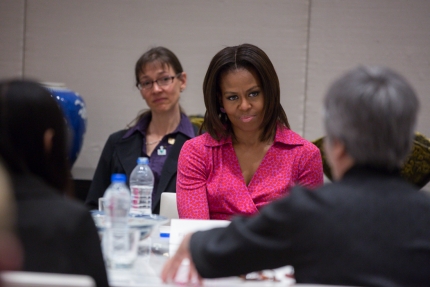
DR. CUELLAR Well, we’re joined by somebody who also happens to be interested in this discussion. (Laughter.) And just to give you a little background, you walked in during the most important part of the discussion, which is when they give me advice.
MRS. OBAMA: Oh, well I caught the tail end of it, so -- sound advice.
DR. CUELLAR: I was explaining that I have a daughter and a son; I’m trying to teach them Spanish, and sometimes they will resist. And I’m getting good advice.
MRS. OBAMA: How old are they?
DR. CUELLAR: They’re seven and nine.
MRS. OBAMA: Oh, well, they will resist everything. (Laughter.) Coming from you, they’re going to resist it.
DR. CUELLAR: I wonder if we could ask Wang (ph) maybe to summarize the discussion up to now, and then we can take it from there.
Q Yes, sure. Well, First Lady, I’m Ting Yu (ph) from the School of Foreign Languages. My major is madrigal literature. So what we have been -- discussed about is how learning a new language is important for different individuals, as well as for a community or a country. And also, how we struggle during this process, and also, how study abroad benefits our different individuals and also our country and our people who are supportive, behind us.
MRS. OBAMA: Absolutely.
DR. CUELLAR: And I would simply add that many of the students were expressing appreciation for the attention you’re bringing to this issue. And I wonder if you want to say anything more about it.
MRS. OBAMA: Well, first of all, hello, California. Is that where you guys are? Are you in California? Hi! I hear you just finished midterms, is that correct?
STUDENTS: Finals.
MRS. OBAMA: Finals. (Laughter.) So they all -- finals! So this is the last thing you’re going to do before you go out and party, right? (Laughter.)
Well, I am excited to be a part of this discussion not just because of the issue of trying to get more young people around the world to consider traveling outside of their comfort zones, and learning new cultures, but the format that we have here is incredibly unique. It highlights just the importance that the role of technology plays in opening up communities and cultures to one another.
This conversation right here, where we have students in Beijing talking to students at -- in California, this is what’s possible. But, as I said in my speech, one of the things I worry about is making sure that these types of opportunities -- studying abroad, quite frankly, going to college, period -- are not just limited to kids based on class or where they great up or who their parents were.
Because it’s so important for the world to have access to the energy and insight of all of the people, not just folks who come from privilege. So this opportunity I hope will just shed a light on how possible this work is. Because when a young person sees themselves in you, they will understand that it perhaps is possible for them.
So I appreciate you guys taking the time and participating in this dialogue. And I’m going to do a lot of listening and probably jumping in and making comments. But I want to hear from you guys.
DR. CUELLAR: Great. Thank you very much. And one of the questions that comes up perhaps, as we talk about our own experiences, deciding to study other cultures, deciding to study abroad, is how each of us navigated the bureaucracy, the question of how you make time in your calendar, how you justify it to yourselves and others -- to your parents, even -- who may not understand why you’re taking off to go across the world.
So I wonder if maybe I could hear from the middle row here any experiences that you had specifically in arranging your opportunity to study abroad.
Q Well, I’ve studied in France, and obviously China, and my parents were kind of against both of them because it’s not really pertinent to my major; I’m not studying language, I’m studying chemical engineering. But I found that going to other countries and learning how other students learn engineering and science has been really, really helpful in connecting to what I’ve learned at Carnegie Mellon.
DR. CUELLAR: That’s terrific. Let me ask Palo Alto, in the front row perhaps, do you have people in mind that maybe inspired you or encouraged you, or told you to overcome barriers and say, it makes sense for you to go, even if maybe you had hesitations about it? People who were especially influential in the decision? Right here, striped shirt.
Q Me? (Laughter.) I have a wonderful mentor here at the Stanford Medical School. I’m a high school student, but I intern at one of the labs. And my mentor actually traveled a lot to the Philippines; he’s Philippino, first generation, and he went there for a few years. He lived in -- and he told me about his worldly experiences and how he has been inspired through his experience in the Philippines to go to Medicine and eventually return to help his roots. And I’m from Mexico; right now I don’t think Mexico is in the best situation from where my parents are from, but I have been inspired by him and learning from him. And I want to travel eventually to Mexico when it’s safer for me.
DR. CUELLAR: Good for you. And how did you meet this mentor? How did you make that initial connection?
Q I applied to a summer program here at Stanford called Summer At -- don’t remember what the acronym stands for, but I was matched through this program, and I was matched with him as a mentor.
DR. CUELLAR: That’s terrific. It’s useful for us to hear this, because when we design these programs, we don’t always know if they’re going to work or how those connections are going to be facilitated.
Back here, yes.
Q Well, actually, I’m a student majoring in languages. And my major is Portuguese and Spanish, and actually, after I graduate, I want to further my study in Brazil. When I told my dad, actually I was a little bit afraid because, as you know, Brazil, as a country, can be a little bit dangerous. But my dad told me, don’t be afraid, don’t be afraid of anything, Brazil is a wonderful country. And now, the -- no more states can survive individually. The states can only be survived under collaboration and partnership.
So I still have faith that I will further -- and start my own business in Brazil. And actually, just like Mrs. Obama said in her speech, actually why we are sitting here is because that we as future leaders for the world have a responsibility to bridge between states. And there is still a Chinese concept in the Chinese culture called -- that is, great harmony in different words, in different backgrounds of cultures.
So I think maybe starting -- is like a bridge. And that’s beyond ourselves. We can do it better. Thank you.
DR. CUELLAR: And it’s important to remember that sometimes the support that we need we can find in our own families. Sometimes we help them see it, sometimes they help us see it.
Q Can I talk something about my motivation to -- international exchange? Actually, now, I’m a graduate student in Peking U from the School of International Studies. And actually I will continue my study one year later in Arizona -- it’s a hot place, right?
MRS. OBAMA: Yes. (Laughter.)
Q The Thunderbird School of Global Management. For me, I prefer to -- the relationship -- the commerce relationship between -- and the future. So in this program, I think I cannot only learn about the language, the American cultures, but also I can take some courses on this field. So in this way, I cannot promote myself on this field, but also, what is most important I think is to learn -- to understand -- to make a better understanding on the United States culture and people. And I think it’s really important for people, especially young generation, to have some time to go abroad, to live and study there so in this way they can build a deeper understanding with each other.
MRS. OBAMA: Excellent. And one thing that you pointed out that I think it’s important to consider is not letting fear be your guide. And that’s oftentimes what holds many young people back from doing fabulous things.
Let’s take my husband, for example. He has dragged me kicking and screaming into things that I wanted no parts of. (Laughter.) And a lot of it was because of fear -- the fear of making mistakes, the fear of not knowing, the fear of uncertainty, the fear of leaving your comfort zone.
And we’re living in a world where we can no longer afford to let fear keep us apart, because the truth -- what I have learned, coming from the background I come from -- I grew up in a little apartment on the South Side of Chicago. My parents didn’t get a chance to go to college, but they poured everything they had into me. And no one could have envisioned that a kid like me would be sitting here, having given a speech at Peking University as the First Lady of the United States.
But easily, fear could have blocked me at every turn. So I want all of the young people around the world to operate with the freedom that we have all fought for -- the freedom to explore the world, to learn about new cultures, to try hard things, to make mistakes. And I know parents want you to be perfect because we want you to be safe -- (laughter) -- but life is about making mistakes, and maybe saying the wrong thing at the wrong time, and learning that you recover from even some of your worst mistakes, so that that fear doesn’t keep you from being as excellent as you can be.
And that’s what I think study abroad -- it’s that first step of leaving your country, speaking another language, having it come out of your voice, your lips, and having someone here actually understand you. And you think, well, that wasn’t that bad.
So I want you -- first of all, I just want to applaud you all for being that brave, and for being a role model to other young people of what the world needs in you as leaders. So don’t be afraid. Start with your parents.
DR. CUELLAR: Let me ask you, picking up where the First Lady left off, what advice would you have to somebody who is trying to decide whether to study abroad?
Q Well, I would think -- personally, I’m a law student, and I would say that -- you have to start with very good academic environment, for student like us, because -- last semester, I’ve just been to the Columbia Law School as an exchange student, and I saw how -- experienced the Socratic Method that they use in law school --
MRS. OBAMA: Oh, yeah. (Laughter.)
DR. CUELLAR: That’s why I called on you.
Q -- give experience to have -- been exposed to the new culture when everyone was so aggressive. And maybe that’s a little bit different from our culture, but that helps improve from different aspects. And I think that will improve our way of -- life. Thank you.
MRS. OBAMA: Let me just ask, how did you deal with the Socratic Method? (Laughter.)
Q Well, at first it was a little bit too difficult for me, but I think I gradually got used to that later. And I think the most important thing is to do our homework beforehand. (Laughter.)
DR. CUELLAR: Radical idea. Jamal (ph), what advice would you have?
Q Can I touch on something that Mrs. Obama spoke about a little earlier? About fear and -- something that you spoke about that really resonated with me is that I came from a background -- my great-grandmother, who is 92 next week -- great-grandmother -- she raised a bunch of kids and many of them went different ways. And I was one that -- though I made it through Stuyvesant High School in New York City, I failed out. And I have spent a lot of time out, and I had to -- I was the first person in my family to go to college. And it was scary; it was one of the biggest, most frightening things that I ever did.
And as I kept moving forward, all these things came to me and they were all frightening, but I threw myself into it. I had the support of my great-grandmother, I had the support of other people at my school, and it kept pushing me forward, pushing me forward, pushing me forward.
And so when I had this opportunity -- the year before, I had throat cancer, thyroid cancer. And so I spent a year not working, I was pretty much in -- I had no money, I was just poor -- I was beyond poor. And so getting the Fulbright was amazing, but I was afraid, because I didn’t have the money to afford the flight, because you have to pay for it up front, and -- just to get here. And then to have to deal with my particular affliction, perhaps if it like were to come back while I was here.
But my great-grandmother told me, baby, listen -- (laughter) --
MRS. OBAMA: That’s how our great-grandmothers talk.
DR. CUELLAR: The Socratic Method.
Q -- you have one life to live, and if you don’t live it no one else will for you. And she told me that if I didn’t do this, this could be the thing that -- even if I were only three months left in this world, if I didn’t do it I would hurt and wonder what could be.
So do not give up the chance and -- put yourself in here. And it’s been frightening, as I was explaining to people earlier -- my language was very poor, being here is very, very difficult when you don’t have the language. But if I had to do it like a billion times again, I would do it the same way. I would come because it is important for us to do it.
So no matter what age, it’s important for us to do these things regardless of fright. (Applause.)
MRS. OBAMA: Yes, yes.
DR. CUELLAR: I think the conversation reminds us that sometimes getting this to happen means overcoming our own challenges. But I also want to turn the attention to the question of how our societies and our organizations and our governments can support this kind of work, and I wonder if -- we’ll start with the middle row in Palo Alto, what thoughts you might have as we think about our schools -- our K-12 education, our colleges -- that might encourage people to study other cultures.
Somebody smile.
MRS. OBAMA: The Socratic Method is coming, it’s coming. (Laughter.) He’s going to call on you.
DR. CUELLAR: May I call on the lady with the glasses next to the gentleman with the white shirt in the middle row? That’s absolutely right. You smiled. (Laughter.)
Q So I think -- so I’m a senior in high school, and I would say that for me personally, like, coming from the background where -- I have a single mother, she emigrated here so she doesn’t know much about traveling. And I got involved in a community service program, and it encourage me to travel abroad and do community service, and so that’s when I first stepped out of my comfort zone and was like, wow, like, I’m here by myself but I’m connecting with these people and -- like, speaking Spanish was an advantage because I was able to connect with them better. But that was the very first time where I started connecting with people abroad, and I felt very connected to them. And even to this day, we still connect over the Internet.
And I personally encourage people all over my school to join programs like that, but from what I know in my school we kind of emphasize that a lot. And so I know from my community a lot of people plan to study abroad because you can just obtain so much more perspective on the ways you view life, whether you’re studying science or law or whatever it is, studying abroad does give you perspectives specifically on -- studies.
DR. CUELLAR: Thank you. Over here, back --
Q Yes. I’m a doctorate student from Peking University and majoring in comparative politics. And I want to share a story which I experienced last -- in the year 2012 when I was living in Harvard.
And the program was -- the education and -- and before I came to the United States, I even hardly heard about what is -- entrepreneurship -- how -- entrepreneurship can play a part in education. And we visited the organization called Primary Source. It was a set by a retired teacher. He recognized the problem that the students are more diversity in a classroom, especially in high school, and that teachers are not well prepared to deal with the students. So when she retired, she set up this organization to connect -- primary source, meaning books, documents and videos, from all countries and trained the high school teachers. And also they invited professors from Harvard, MIT, Boston University to train these teachers to make them prepared for the students.
So I think this is very important for the social organization to take a part in this place.
DR. CUELLAR: Terrific. That’s very helpful.
Q My comment actually connects to Tsio’s (ph) point. We’ve talked a lot about the technology, these amazing technological advances that allow things like this, which is just incredible, and also about travel and study abroad and all of these things. But there are a lot of barriers to those.
And I’m going to sound really old fashioned -- (laughter) -- but I’m a literary translator, and I think one of the most important things we can do is to give our children and our adults, give everybody, books coming from other cultures -- not just written about other cultures, but actually translated from other languages into English, giving a completely different perspective, a different side of the conversation.
And it’s something you can get for free in your own home, and it’s an incredible basis I think for everything that comes after.
DR. CUELLAR: So if you could pick one book that you would recommend along those lines, what would it be? (Laughter.)
MRS. OBAMA: You’re tough.
Q So this is also going to sound non-mainstream -- so I translate primarily poetry. And I think there are some amazing poets working today in China, in particular some very important women poets. One in particular, whom I happen to work with, called Juang San Lee (ph.) She’s an incredible -- she has an amazing eye for the social climate here in China, of the issues that are going on with migrant workers, people in the countryside, this incredible economic disparity that’s happening in China right now. And she addresses it in really beautiful language and in wonderfully rich metaphors.
So I would say -- Google her, Juan Sang Lee (ph.) You can find her stuff on the Internet.
DR. CUELLAR: When you mention translation, I started thinking not only about texts being translated but also about the acts of translation that occur in everyday interactions that people studying abroad have. In the personal relationships -- so I wonder if somebody would like to speak to those personal relationships and how they work.
Q I’d like to promote the government to support -- as Mrs. Obama already said, the language is the most important -- in cultural exchange. I’d like to promote the institute -- the Confucius Institute to advocate the learning of Chinese. And I’m a law school student but I’m also pursuing a double major in Chinese literature, so I’d like to later work for the Confucius Institute to tell little kids about Chinese and Chinese culture as well.
DR. CUELLAR: Excellent. Do we have any other though in California, perhaps, about personal relationships and how they play into your experience studying abroad? Friendships -- yes, right here in the front row. Blue shirt.
Q So I studied abroad in Oxford a couple of years ago, and I think for me, I didn’t go in with a whole lot of expectations of there being an enormous difference, because everybody there also spoke English. But I think what really struck me was the fact that all of us are grappling with similar questions, but we deal with them in very different ways. And so to be able to engage with people in Oxford, students at Oxford on these same issues but see their perspectives, and have these intimate conversations about mundane things but see that we actually think in different ways because of how we’ve been brought up was really very eye-opening for me and something that I reflect on.
DR. CUELLAR: Thank you. Other thoughts? Back here.
Q Talking personally about personal relationships -- for learning Chinese, for learning about cultures, there’s nothing better. I know for a fact that most of my Chinese, in the five years I’ve been here, has been learned from friends or from people I’ve met on the street or from just anyone. It’s something that you can’t miss out on, personal interactions.
DR. CUELLAR: And I want to bring this back for just a moment to the theme about overcoming fear, too. Because when people have not experienced this, it may not be so obvious to them, but people around them, once they go to the different country, even people on the street might become allies in trying to understand the culture and learning the language.
Q Yes, just -- I’m thinking of just knowing how to push yourself beyond your comfort zone. You just never know what doors are going to open for you. I did a program back in 2009 called APSA, Americans Promoting Study Abroad. (Laughter.) I was able to visit the U.S. Embassy there, and so since then, just knowing the presence that the U.S. government had in China, I’ve studied abroad twice since then and now I’m interning with the U.S. Consulate General, the Department of Commercial Service.
So just knowing what connections you can make and going beyond your comfort zone, I think those are the best personal connections.
DR. CUELLAR: Terrific.
Q Well, I just think it’s important to highlight that -- overcoming fear, I mean -- I think it’s imperative for the American educational system to really provide the tools and confidence in students and the youth of America to become global citizens, and to really strive towards making more of a global community and making those connections. And I’m on a program with Cameron (ph) also; I’m a high school student with -- through the Department of State. And so I think -- I mean, a lot of students don’t really know that they have these opportunities.
We have nine students total here studying at a high school, and we come from all over the country with different backgrounds. And I think not many people know -- when I started -- when I told people I was coming here, people were very surprised. (Laughter.) They asked a lot of questions, and I think -- it’s very -- it’s opened so many doors for me and my fellow students, and it’s just an amazing opportunity and -- so many different ways.
DR. CUELLAR: And I want to underscore this point about getting information out. Even when the opportunity is there --
MRS. OBAMA: That’s what -- I was going to say that, right.
DR. CUELLAR: We find that Stanford has an extraordinary array of opportunities to get people to study abroad. And we find that even people get to their junior year and they don’t know about them sometimes.
Q This program is absolutely wonderful.
Q Speaking of the personal relationship in the process of learning and -- as a cultural, I think -- I was actually part of the student ambassador program of the Stanford Center in 2012. And we actually met -- I actually met some Stanford students, and we actually have a -- group now, which -- every day to update. Actually, there are some, like -- because one of them is now working for Google and the other one is now in Africa working for the sustainable development.
So I think keeping touch is quite important during the process of the inter-culture communication, because you have to form a long-term relationship with these guys. And you are the leaders of the future, so how can we -- how can not -- why not just keep in touch and be -- probably shake your hands in the United Nations in the future.
MRS. OBAMA: That’s right.
DR. CUELLAR: That’s terrific. And your comments -- she reminds us that technology can be an enabler, but also, maybe even more so, once those personal relationships are begun. And that requires something more than technology by itself.
MRS. OBAMA: Well, and what you point out is that you all are the greatest ambassadors. People who -- young adults, young people, however old you are -- I don’t know how old you guys are -- (laughter) -- you’re all younger than me. (Laughter.)
DR. CUELLAR: Adults, but young.
MRS. OBAMA: That’s right. But you all are the best voices for this because you’ve overcome your fears. You’ve done the legwork. You’ve experienced this in ways that so many young people around the world will just never have the opportunity. And other young people listen to you more than they listen to old folks like me and Tino over here.
So I hope that you feel like you have a responsibility that once you complete this work, that you use whatever avenues you have to spread the word and be that mentor that you found, to bring others along.
And one thing that we need to talk more about, particularly in the United States, is the expansion of language. That’s just -- we’re sort of good at English. (Laughter.) But too few young people in the United States have exposure to other languages, and I was one of those kids. And now, I don’t have a good ear for it. And I know that’s something that my husband regrets -- he regrets that he didn’t stick with the guitar -- (laughter) -- and he regrets that he didn’t fully learn another language.
But we have to talk about that more in the United States. It’s something that’s not anti-American, but it’s important to live in a global world. And we’ve got to equip our kids with the tools to be able to succeed.
Before coming here, I visited a school in Washington, D.C., the Yu Ying School, where -- it’s a charter school that’s focused on Chinese education. And kids as young as three are taught by Chinese teachers, they’re learning Mandarin. And it was amazing to walk into a predominantly minority community in Washington, D.C. and go into a third-grade class where the kids had fabulous accents, and they were answering questions, and they were correcting my pronunciation. (Laughter.) But it really warmed my heart to know we are giving these kids, just through language, such a unique head start.
But then I think, well, then there’s so many kids who don’t have this. And that’s something that we have to talk more about, and we have to find the resources. And we have to engage our private sector as well to understand, if they’re going to have the employees of the future who can operate in a global environment, then we have to start investing in them at a very early age -- as early as three and four years old. And that’s going to take resources.
DR. CUELLAR: Very sadly, our time for this conversation is drawing to a close. I know we could continue for many hours, so I would like to ask somebody who is as far away from me as we have anybody in this conversation -- which I think is the back row in Palo Alto -- to maybe say a few words of reflection as we draw the conversation to a close?
Yes, right over there.
Q So I’m a PhD student in the Department of Political Science studying with (inaudible.) I study the -- economy of China. One of the things I learned -- I also study international relations -- but one of the things I learned over the course of when I studied here in the United States is that -- I talked to my professors and classmates about international relations of the time, and we have all sorts of fancy models about why crises in international relations exists.
But at the end of the day, all conversations boil down to lack of understanding -- lack of understanding each other’s preferences, lack of understanding each other’s information. So I think this conversation today really speaks to the need of having more and deeper conversation between China and the United States, and among all countries in the world.
DR. CUELLAR: Thank you very much. And I would just say, on that particular note, building that understanding doesn’t just help us avoid crises, but probably helps us understand ourselves better as well.
MRS. OBAMA: Well said.
DR. CUELLAR: Thank you. Well, thank you very much, everybody.
MRS. OBAMA: Thank you. (Applause.)
END 12:25 P.M. CST