The First Lady's Travel Journal: A Taste of Tibetan Culture

Note: This post is part of a series authored by First Lady Michelle Obama to share her visit to China with young people in the U.S. You can read all of the First Lady's posts at WhiteHouse.gov/First-Lady-China-Trip.

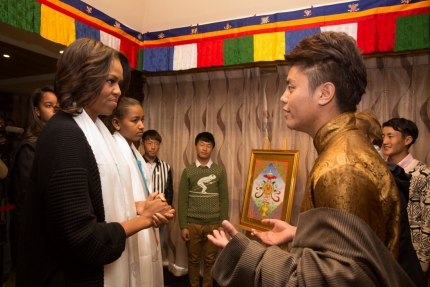
The First Lady is greeted by Tibetan students

First Lady Michelle Obama, Sasha, Malia and Mrs. Robinson are greeted by Tibetan students at the Zangxiang Village Tea House in Chengdu, China. March 26, 2014. (Official White House Photo by Amanda Lucidon)

Chengdu is sometimes known as the “Gateway to Tibet" because it is located just a few hours from the towering mountains and rich culture of Tibet, which is a region of China.  There are roughly 6.5 million Tibetans in China, and they are one of the largest and most well-known minority groups in the country.

For centuries, Tibet was largely unknown to the outside world -- but today, Tibetan Buddhism (the main religion in this area) and its spiritual leader in exile, the Dalai Lama, are known across the globe for their teachings on compassion, forgiveness and tolerance.  Tibet is also known for its beautiful, majestic landscapes.  Some of the world’s tallest mountains are located there – if you want to scale Mount Everest, you can start from a base camp in Tibet. 

Related Topics: 2014 Asia Trip

The First Lady’s Travel Journal: Pandas!

First Lady Michelle Obama, Sasha, Malia and Mrs. Robinson feed apples to Giant Pandas during their visit to Chengdu Panda Base

First Lady Michelle Obama, Sasha, Malia and Mrs. Robinson feed apples to Giant Pandas during their visit to Chengdu Panda Base in Chengdu, China on March 26, 2014. (Official White House Photo by Amanda Lucidon)

Note: This post is part of a series authored by First Lady Michelle Obama to share her visit to China with young people in the U.S. You can read all of the First Lady's posts at WhiteHouse.gov/First-Lady-China-Trip.

Related Topics: 2014 Asia Trip

The First Lady Speaks on Education at Number 7 School in Chengdu, China

March 25, 2014 | 15:06

March 25, 2014

Download mp4 (1240MB)

The White House

Office of the First Lady

Remarks by the First Lady Before Number Seven School Classroom Visit -- Chengdu, China

Number Seven High School
Chengdu, China

11:16 A.M. CST

MRS. OBAMA:  (Applause.)  Well, I’m very excited to meet all of you.  I am here to learn from you.  I’m very interested to hear all the things you’re doing here at the Number Seven School.  I’m really interested to see how the distance-learning program works here; it sounds very exciting. 

And also, I’m open to answering any questions that you all have as well, so feel free.  So I’m going to stop talking, because I want to hear from you.  But thank you for such a warm welcome. 

You all truly make me proud, and it is wonderful to be able to highlight all that you’re doing here to students here in the United States who are following my trip.  So you all are wonderful examples and wonderful representation of your country.

So thank you.  (Applause.)

MR. XIE:  Mrs. Obama -- for your coming.  We, too, feel very honored for your coming.  As you can see here, it’s our usual class.  And every day, we have tens of thousands of students having the class at the same time.  And we are from Number Seven High School -- campus district schools.  And here you can see in the screen is a district school from Wen Jiang Number Two, the school.  It’s a town not very far away from Chengdu, like half-an hour drive from Chengdu.  But we still have another school from our -- distant school, and it’s about four hours’ drive.  It’s in Nanchong, Yi Long High School. 

So we are very eager to ask you questions later.  But first of all, we would like to greet the -- welcome you.  So would you please say something to our First Lady here?

STUDENT:  Hello, Mrs. Obama. 

MRS. OBAMA:  Hello.

STUDENT:  Nice to see you.  Well, my question is --

MR. XIE:  Oh, a question for you.

STUDENT:  -- we’ve seen many examples of creative Americans, so how do you think school education makes students become creative?  Thank you.

MR. XIE:  First of all, a question for you.  So see how they are eager to ask you questions.  (Laughter.) 

MRS. OBAMA:  Well, looking back on when I was young, when I was your age -- probably even younger -- that was the first time that I got the spark of creativity myself.  One of the things I loved to do and still continue to love to do is to write.  And some of my best teachers were in school; they were the people who encouraged me to write, who gave me the skills, who showed me new ideas, new approaches.  They exposed me to literature, and to other great works that fed my creativity.

But also, the wonderful thing about education is that you are surrounded by your peers.  And often, it is your peers who push you and encourage your creativity.  So having the opportunity to come to school every day with other young people who are struggling with the same issues and have the same hopes -- they push you to be even better.

So that’s one of the reasons why I think it’s so important for every child in this world to have access to an education like you all have.  And that’s why I think this distance-learning program is such a wonderful model for reaching out to kids who may not live near schools but can still get the quality education that they need, so that we make sure that we tap into all the creativity of young people like you and none of that energy goes to waste.

Thank you for the question. 

STUDENT:  Thank you.

MR. XIE:  Thank you.  Great.  (Applause.)  Thank you.  So of course we have other students here in the school, and we are still prepare -- I think they prepared questions for you.  So do they get the chance to ask you questions?  No?

MRS. OBAMA:  Oh, well -- tell me, what’s the --

MR. XIE:  I mean, the students here --

MRS. OBAMA:  Oh, that’s right.  You guys are supposed to ask.  (Laughter.)  So, please. 

STUDENT:  Excuse me.  Pleased to meet you, Mrs. Obama.  As we all know, we are a generation leading the 21st century, and people leading this time are under too much pressure competing with each other.  So what I wonder is, what’s the technical ability, do you think -- should teens just like us have as our core competitiveness to surviving such a society?  Thank you. 

MRS. OBAMA:  I understand this because I have a teenage daughter who is in her second year.  She’s a great student, but she feels the stress of trying to succeed.  Like you, she’s concerned about already what college she’s going to.  My youngest daughter, who is just 12, is already talking about colleges. 

So you’re absolutely right, your generation feels a level of pressure that is oftentimes difficult.  But the one thing that I tell my daughters -- and it’s something that I hope you understand -- is that your education, first and foremost, is for you.  You have to have it in your mind that everything you’re doing is, first and foremost, for yourself and your own development.

I mean, I spoke in my speech about how I felt like I had to make my parents proud, and that was important motivation for me.  But in order to work as hard as you’re going to have to, you have to do it for yourself.  You have to have the vision in your head of where you want to be.  And you have to not let the disappointment of inevitable failure -- which happens to us all -- let you down.

We have all failed.  I have had some miserable failures in my life -- tests I didn’t do well on, big exams I had embarrassing failures on.  My husband, the same way -- he wasn’t always a great student.  But it’s the perseverance, it’s the sense of what your own goal is, and it’s pushing beyond your fear of failure to make sure that you’re still trying to be the best that you can be.

I don’t know if that directly answered your question.

STUDENT:  Thank you.

MRS. OBAMA:  Thank you.  (Applause.) 

MR. XIE:  Another question here.  Yes.

STUDENT:  Nice to meet you, Mrs. Obama.  (Laughter.) 

MRS. OBAMA:  You all aren’t shy.  I love that.  (Laughter.)

STUDENT:  I know you are in China for -- in some -- in a few days.  So my question is, what’s your impression about the people you meet, the cities you have gone to, and the food you eat in China?  (Laughter.)

MRS. OBAMA:  This is my first time visiting China, and let me tell you, it has been a phenomenal experience.  Words can’t describe -- I mean, I don’t know if you followed my trip.  I started in Beijing, yesterday we were in Xi’an, and today I’m here in Chengdu. 

And the cities are so vast and so complex and so different from one another.  You can’t lump any aspect of China into one stereotype.  As I mentioned in my speech, sometimes in the United States, people don’t -- they’ve never visited China, they don’t know much about the culture, so sometimes they sort of exist on those stereotypes and misconceptions.  Fortunately, I travel a little more than most people in the United States so I’m already pretty open to new cultures.  But that’s one of the things that I want to do through this trip.

I want to encourage more young people in the United States to, what I call, step outside of their comfort zones and try new things -- get on a plane, travel to another country, experience another language, try new foods.  Because, as I said in my speech, underneath all of those difference, we’re still the same. When I look into your eyes -- and I’ve met many young people -- you all remind me of my girls.  You remind me of my kids.  And I want for you what I want for them and what I want for all kids.

And the kids -- the young people I’ve met here, you all remind me of the kids that I’ve met in India, the kids that I’ve met in Moscow -- I could go on and on.  You all are born with innate gifts, warmth, a possibility for hope that I don’t want you to lose.  And I want us to be in a world that cultivates that for all of you.

So that is my passion.  But being here in China just reminds me, yes, we have millions and millions of phenomenal young people who deserve access to the best that the world has to offer.  So it has been a true privilege, but, more importantly, I’ve been glad that I’ve been able to bring along other kids in the United States who are following this trip.  And maybe they too will think, maybe I’ll come to Chengdu, and maybe I will study at Number Seven School -- (laughter) -- and learn how to speak Chinese as well as you all speak English. 

So that is my hope.

STUDENT:  And what’s your impression about Chengdu and our school?

MRS. OBAMA:  Chengdu is beautiful.  I mean, I have to say, when we drove in last night I didn’t expect it -- it is -- the river that runs through the city is beautiful.  The walkway is gorgeous.  We came in at night, the lights were breathtaking.  In Beijing -- there’s much more green space here than in a bigger city -- (laughter) -- in Beijing, which was wonderful to see. 

I didn’t get to go out last night, but I’m going to have lunch here.  So I’m going to try some traditional dishes, so I’ll have to let you know.  I’m sure I’ll love it.

But the impression is absolutely wonderful.  I told my kids -- I don’t know if this is politically correct -- but Chengdu is probably the kind of city that I would choose to live in if I were to come to China.

STUDENTS:  Ooohh --

MRS. OBAMA:  But that’s no -- (laughter) -- of all of the other cities.  But this one is -- it’s beautiful.

STUDENT:  Okay.  Have fun in Chengdu.  Thank you.  (Applause.) 

MRS. OBAMA:  Thank you.

MR. XIE:  -- you have another student from a distance who made -- who wants to ask you another question.  Would you please?  Yes.  And this student is -- well, will you just wait for a moment because we cannot hear you properly.  (Laughter.)  Yes, would you please say it -- also again?  Sorry to interrupt you.

STUDENT:  Oh, okay.  (Laughter.)  I heard that you had tried Chinese calligraphy in Beijing, and I want to know, are you interested in any other forms of Chinese culture like kung fu, (inaudible,) and so on.  That’s all.  Thank you. 

MRS. OBAMA:  Thank you.  I think I might get to try some tai chi while I’m here at this school.  I think that’s what my staff told me. 

And one of my father’s favorite sports -- he introduced us -- and I don’t know how he knew -- to badminton when we were -- and I’m not any good at it now.  But when we were little, we had a badminton set and we would set it up in our backyard, and we played when I was little.  I learned how to play badminton -- again, I am no good at it now.  (Laughter.) 

But, yes, I’m interested in learning so much more.  And that’s one of the reasons why I am excited about the school I mentioned in my speech, the Yu Ying School, which is in Washington, D.C.  It’s a charter school that’s completely dedicated to Chinese culture and Chinese language.  And every single student at that school, from the age of three on up, they’re learning to speak Chinese at a very young age.  They’re learning everything about the culture, the music, the dance, the film, the food. 

And that’s part of my hope that I will encourage through my trip, is that more and more young people in the United States will explore and learn more about Chinese culture.  So, yes, I am interested in doing so much more.

MR. XIE:  Thank you, Mrs. Obama.  I know that -- (applause) -- we appreciate your time to be with us.

MRS. OBAMA:  We’re done?  That’s it? 

MR. XIE:  Yes, well we want -- sorry, but we want you more --

MRS. OBAMA:  Let’s do one more question.

MR. XIE:  One more question.  Yes, you’re lucky, guys.  (Laughter.) 

MRS. OBAMA:  You choose.  It’s hard to pick.

STUDENT:  Okay.  So, hello, Mrs. Obama.  As your daughter is now learning Chinese, has she ever thought being an exchange student in China, or even staying in China for some time? 

MRS. OBAMA:  My youngest -- we were trying to correct this in the media -- in fourth grade -- she’s now in seventh grade -- they focused for a semester on Chinese culture.  And that’s -- and it happened to be the time when the Chinese President was there.  So she knew some phrases when she was very young, but she didn’t continue to study Chinese; she, instead, is taking Spanish.

I am encouraging both of my daughters to study abroad somewhere.  Now, like any parent, I want it to be their choice, because if you tell kids at your age what to do, sometimes you do the exact opposite.  (Laughter.)  And they’re going to figure it out as they get older. 

But my husband and I, we believe that because we are living in a more global economy where our world just feels a lot smaller -- because the Internet and so much of technology allows us to be closer to one another that it is so important for young people like you to be citizens of the world.  You have to be comfortable traveling and living in all parts of the world, because that’s how you’re going to get jobs in the future, that’s how you’re going to be able to make contributions.  Because we can’t solve these problems together if we don’t know one another.  And the best way to learn about one another is to live together and learn each other’s languages. 

So I want my girls to be global citizens.  Now, whether their first effort at studying abroad is in China or Spain or you name it, I will be happy that they take that first step.  So I’m not going to commit them because that would be unfair for me to say, yes, they’re going to come to China.  (Laughter.)  And they will say, mom, why did you say that?

So we’ll see as they get older.

STUDENT:  So thank you. 

MRS. OBAMA:  Thank you.  (Applause.)

MR. XIE:  -- you are even more popular than Mr. Obama, right?  (Laughter.)  And so before you go, please leave us some encouraging words -- to young people?  We do appreciate that. 

MRS. OBAMA:  Well, I think -- I can tell that you all are very serious students already, so I don’t have to tell you how important education is because I think you know that.  I can see that. 

What I want to just remind you is that education is about more than learning words and numbers, and memorizing things, and taking tests and getting good scores.  It’s also about the experiences that you have.  And I hope that, as you grow older, that you’ll understand that life is a balance; that you have to feed yourself with experiences to continue to grow. 

That first question about creativity -- creativity comes because you’re filling yourself with all kinds of different experiences that just shape your mind and shape your thinking.  So if you’re always comfortable and safe, then you have to think to yourself, well, how much am I learning if I’m not pushing myself outside of my comfort zone?  And I think that’s the thing that I would encourage you all to do, is think about how you’re going to continue to fill your life with experiences.

And some of that could be raising your own families, it could be travel, it could be taking up a new hobby, it could be exercising, it could be pursuing a different career than you ever thought you’d ever pursue.  But experiences are the other half of the educational process.

And sometimes we as adults just sort of focus on the scores -- and the scores are important now.  (Laughter.)  The grades are important, and I tell my kids that too.  But think about how you’re going to strike that balance so that you grow up to be well-rounded people.  Because if you’re going to be the leaders of your country, of the world, you’ve got to have a lot of experiences to draw from to make good judgments, and some of that is going to be about what you’ve learned in a book, but a lot of that is going to be about what you’ve learned by meeting and interacting with other people.

So keep learning from each other, and continue to be open to new experiences and to new ideas. 

END
11:36 A.M. CST

The White House

Office of the First Lady

Remarks by the First Lady at Number Seven School -- Chengdu, China

Chengdu, China

10:50 A.M. CST

MRS. OBAMA:  (Applause.)  Ni hao.  It is truly a pleasure to be here at the Number Seven School.  Thank you so much for your warm welcome. 

Now, before I get started, on behalf of myself and my husband, I want to say that our hearts go out to all those with loved ones on Malaysia Airlines Flight 370.  As I said this past weekend when I spoke at Peking University, we are very much keeping all of them in our thoughts and our prayers at this tremendously difficult time. 

So now, let me start by thanking your Principal, Principal Liu, and your classmate, Ju Chao, for that wonderful introduction.  Your English, Ju Chao, is excellent, and you should be very proud.  Thank you so much.  (Applause.)  And I want to thank all of the students here today, both those of you here in person and those of you joining remotely from across the region.  I’m thrilled to be visiting your wonderful school. 

Now, in preparation for this visit, before I left the U.S. I visited the Yu Ying School.  It’s a public school near the White House in Washington, D.C., and all of the students at this school study Chinese.  And I met with the sixth-grade class, kids who are 11 and 12 years old.  They had recently taken a trip here to China, and they were bursting with excitement.  They were eager to tell me about everything about what they had seen.

But they admitted that before their trip, they had all kinds of misconceptions about China.  They thought they would see palaces and temples everywhere they went, but instead they found massive cities filled with skyscrapers.  They weren’t sure that they’d like the food here in China, but they actually loved it, and they learned how to use chopsticks.  And in the end, one of the students told me –- and this is his quote -- he said, “Coming home was really exciting, but was at the same time sad.”

Now, meeting these students reminded me that when we live so far away from each other, it’s easy to develop all kinds of misconceptions and stereotypes.  It’s easy to focus on our differences –- how we speak different languages and eat different foods and observe different traditions.  But as I travel the world, and I meet young people from so many countries, I’m always struck by how much more we have in common.  And that’s been particularly true during my visit here in China.

You see, the truth is that I grew up like many of you.  My mom, my dad, my brother and I, we lived in a tiny apartment in Chicago, which is one of the largest cities in America.  My father worked at the local water plant.  And we didn’t have much money, but our little home was bursting with love.  Every evening, my family would laugh and share stories over dinner.  We’d play card games and have fun for hours.  And on summer nights, I remember, when our apartment got too hot, we’d all sleep outside on our back porch.

Family meant everything to us, including our extended family.  My grandparents lived nearby, and my elderly great aunt and uncle lived in the apartment downstairs from us.  And when their health started to decline my parents stepped in, helping my uncle shave and dress each morning, dashing downstairs in the middle of the night to check on my aunt. 

So in my family, like in so many of your families, we took care of each other.  And while we certainly weren’t rich, my parents had big dreams for me and my brother.  They had only a high school education themselves, but they were determined to send us both to universities. 

So they poured all of their love and all of their hope into us, and they worked hard.  They saved every penny.  And I know that wasn’t easy for them, especially for my father.  You see, my father had a serious illness called multiple sclerosis.  And as he got sicker, it got harder for him to walk, and it took him longer to get dressed in the morning. 

But no matter how tired he felt, no matter how much pain he was in, my father hardly ever missed a day of work, because he was determined to give me and my brother a better life.  And every day, like so many of you, I felt the weight of my parents’ sacrifices on my shoulders.  Every day, I wanted to make them proud. 

So while most American kids attend public schools near their homes, when it was time for me to attend high school, I took an exam and got into a special public high school where I could get a better education.  But the school was very far from my home, so I had to get up early every morning and ride a bus for an hour, sometimes an hour and a half if the weather was bad.  And every afternoon, I’d ride that same bus back home and then immediately start my homework, often studying late into the night -- and sometimes I would wake up at 4:30 or 5:00 in the morning to study even more. 

And it wasn’t easy.  But whenever I got tired or discouraged, I would just think about how hard my parents were working for me.  And I would remember something my mother always told me –- she said:  “A good education is something that no one can take away from you.”

And when it was time for me to apply to university, I had many options, because in America, there are many kinds of universities.  There are four-year universities.  There are two-year community colleges which are less expensive.  There are universities where you take classes at night while working during the day.  So you don’t have to be a top student to attend a university.  And even if your parents don’t have much money or you live in a tiny town in a rural area, in America, you can still attend university.  And you can get scholarships and government loans to help pay your tuition. 

So I attended Princeton University for my undergraduate degree, and I went on to Harvard University for my graduate degree in law.  And with those degrees I was able to become a lawyer at a large law firm, and then I worked as an executive at a city hospital, and then I was the director of an organization that helped disadvantaged young people.

And my story isn’t unusual in America.  Some of our most famous athletes, like LeBron James, and artists, like the singer Janelle Monae, came from struggling families like mine, as do many business leaders -- like Howard Schultz.  He’s the head of a company called Starbucks, which many of you may have heard of.  When Mr. Schultz was a boy his father lost his job, leaving their family destitute.  But Mr. Schultz worked hard.  He got a scholarship to a university, and eventually built the largest coffeehouse company in the world. 

And then there’s this other guy I know who was raised by a single mother who sometimes struggled to afford food for their family.  But like me, this guy got scholarships and loans to attend universities.  He became a lawyer and a professor, and then he was a state senator and then a national senator.  And then, he became President of the United States.  This guy I’m talking about is my husband, Barack Obama.  (Applause.)

These stories are the stories of so many Americans, and of America itself.  Because in America, we believe that no matter where you live or how much money your parents have, or what race or religion or ethnicity you are, if you work hard and believe in yourself, then you should have a chance to succeed.  We also believe that everyone is equal, and that we all have the right to say what we think and worship as we choose, even when others don’t like what we say or don’t always agree with what we believe.

Now of course, living up to these ideals isn’t always easy.  And there have been times in our history where we have fallen short.  Many decades ago, there were actually laws in America that allowed discrimination against black people like me, who are a minority in the United States.  But over time, ordinary citizens decided that those laws were unfair.  So they held peaceful protests and marches.  They called on government officials to change those laws, and they voted to elect new officials who shared their views. 

And slowly but surely, America changed.  We got rid of those unjust laws.  And today, just 50 years later, my husband and I are President and First Lady of the United States.  And that is really the story of America –- how over the course of our short history, through so many trials and struggles, we have become more equal, more inclusive, and more free. 

And today in America, people of every race, religion and ethnicity live together and work together to build a better life for their children and grandchildren.  And in the end, that deep yearning to leave something better for those who come after us, that is something we all truly share.  In fact, there’s a Chinese saying that I love that says, “To achieve true happiness, help the next generation.” 

And like so many of your parents, my parents sacrificed so much so that I could have opportunities they never dreamed of.  And today, as a mother myself, I want even more opportunities for my own daughters.  But of course, as I always tell my daughters, with opportunities come obligations. 

And that is true for all of you as well.  You all have the opportunity to receive an education from this wonderful school, and you all have an obligation to take the fullest advantage of this opportunity.  And I know that’s exactly what you all are doing.   

You’re winning prizes in math and science.  Here, you are staging musical performances around the world.  You’re volunteering in your communities.  And many of you are working hard to get an education your parents never dreamed of. 

So you all have so much to offer –- and that’s a good thing, because the world needs your talent.  The world needs your creativity and energy more than ever before.  Because we face big challenges that know no borders –- like improving the quality of our air and water, ensuring that people have good jobs, stopping the spread of disease.  And soon, it will all fall to all of you to come together with people on every continent and solve these problems together. 

Now, fortunately, here at this wonderful school, you’re already well on your way.  For more than a decade, you’ve been building special relationships with a American school in -- an American high school, and many of you will attend universities in America or find other ways to reach out beyond your borders.

So in the years ahead, much like you and I are doing here today, you will be creating bonds of friendship across the globe that will last for decades to come.  And over the past week, as I have seen both the ancient wonders and the modern achievements of your fascinating country, and as I’ve met with extraordinary young people like all of you, I am more confident than ever before in our shared future.  And I cannot wait to see everything that you will achieve here in China and around the world. 

Thank you again for hosting me and my family at this extraordinary school, and I wish you all the best of luck in your journey ahead.  Xie-Xie.  (Applause.)

END
11:05 A.M. CST

The First Lady's Travel Journal: Visiting the No. 7 School in Chengdu

Note: This post is part of a series authored by First Lady Michelle Obama to share her visit to China with young people in the U.S. You can read all of the First Lady's posts at WhiteHouse.gov/First-Lady-China-Trip.

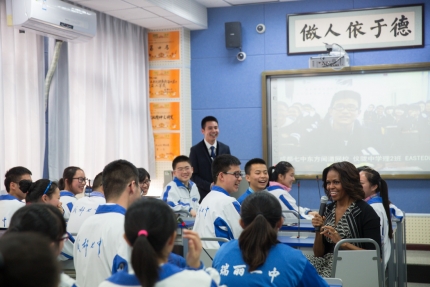
First Lady Michelle Obama talks with students in an interactive classroom at Number 7 School in Chengdu

First Lady Michelle Obama talks with students in an interactive classroom at Number 7 School in Chengdu, China. March 25, 2014. (Official White House Photo by Amanda Lucidon)

Today, I had the pleasure of visiting the No. 7 School here in Chengdu, an extraordinary high school that uses the power of technology to bring educational opportunities to students across southwest China.

More than 5,000 high school students attend the No. 7 School in person each day – and 42,000 more high school students from 182 schools in smaller cities and rural areas attend remotely.  Classrooms here in Chengdu are equipped with large screens – and students from across the region can beam in and take part in the same lessons (and they even get assigned the same homework too).  Many of the students who attend classes remotely are from disadvantaged backgrounds, and the education they get at the No. 7 school gives them a better chance of possibly being accepted into college.

Related Topics: 2014 Asia Trip, Education

On Board: Travels with the First Lady in China, Terracotta Warriors

March 24, 2014 | 1:45

Go behind the scenes with First Lady Michelle Obama as she visits the Museum of Qin Terra Cotta Warriors in Xi'an, China. Narrated by First Lady Michelle Obama. Learn more about the First lady's trip to China at http://www.wh.gov/First-Lady-China-Trip

Download mp4 (144.9MB)

The First Lady's Travel Journal: Visiting the Xi'an City Wall

Note: This post is part of a series authored by First Lady Michelle Obama to share her visit to China with young people in the U.S. You can read all of the First Lady's posts at WhiteHouse.gov/First-Lady-China-Trip.

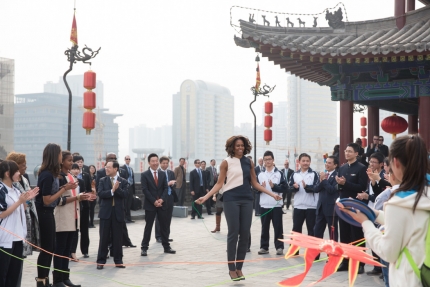
First Lady Michelle Obama jumps rope on her visit to the Xi'an City Wall with Sasha, Malia and Marian Robinson in Xi'an, China

First Lady Michelle Obama jumps rope on her visit to the Xi'an City Wall with Sasha, Malia and Marian Robinson in Xi'an, China on March 24, 2014. (Official White House Photo by Amanda Lucidon)

After seeing the Terra Cotta Warriors outside of Xi’an, we returned to the city to view the Xi’an City Wall.

The Xi’an City Wall is the oldest and largest surviving wall of its kind in China.  It’s a 40-foot tall rectangle that stretches for 8.5 miles.  At its base, the Wall is 50 or 60 feet wide.  At the top, it’s about 40 feet wide – wide enough for Xi’an residents and tourists to run, walk, or ride a bike around (it takes about four hours to walk the entire distance at a leisurely pace).  From the wall you can see the ancient Bell Tower, a beautiful building which marks the center of the ancient city.

Xi’an was once China’s capital city, and even after the capital was relocated, the city remained an important military stronghold for centuries.  Just like the Great Wall, the Xi’an City Wall was originally built for defense, with watchtowers and even a deep moat and drawbridges.  Parts of the wall date back to the seventh century, and the wall we know today was completed in the 14th century.  Since then, it has been refurbished three times – roughly once every two hundred years – in the late 1500s, the late 1700s and, most recently, in 1983.

Related Topics: 2014 Asia Trip, Education

The First Lady's Travel Journal: Seeing the Terra Cotta Warriors in X'ian

Note: This post is part of a series authored by First Lady Michelle Obama to share her visit to China with young people in the U.S. You can read all of the First Lady's posts at WhiteHouse.gov/First-Lady-China-Trip.

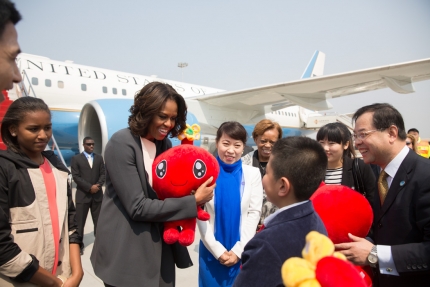
First Lady Michelle Obama, Sasha, Malia and Marian Robinson are greeted upon arrival to Xi'an, China

First Lady Michelle Obama, Sasha, Malia and Marian Robinson are greeted upon arrival to Xi'an, China on March 24, 2014. (Official White House Photo by Amanda Lucidon)

This morning we left Beijing and flew for about two hours to Xi’an, a city of more than 7 million people in central China.  If Xi’an were in America, it would be the second-largest city in the country – trailing only New York City – but in China, a nation of more than 1 billion people, Xi’an isn’t even in the top ten.

Related Topics: 2014 Asia Trip, Education

The White House

Office of the First Lady

Q+A with First Lady Michelle Obama

This weekend, Caixin Online published a Q+A with First Lady Michelle Obama about her visit to China from March 19-26, 2014.  View Mrs. Obama’s Q+A in English HERE; view Mrs. Obama’s Q+A in Chinese HERE.

Excerpts below:

Caixin: Why is the main focus of your trip "the power and importance of education," and in what ways do you think this is particularly relevant to China?

Michelle Obama: I always tell young people that if they get a good education, then they won't just build a better future for themselves and their families, they'll help build a better world for us all.

You see, our world is more interconnected than ever before, and the challenges we face – from combating climate change, to expanding economic opportunity, to confronting the spread of nuclear weapons – know no borders. They cannot be solved by any one person or group in any one country, and soon it will fall to our next generation to confront these challenges together. And a good education – one that helps young people understand the world beyond their borders and engage with people from different cultures – will empower young people in China and in the U.S to come together and ensure that our shared future is peaceful and prosperous.

And in order to make those kinds of connections, it's important to ensure that information and ideas flow freely over the Internet and through the media because that's how we learn about each other and it's how we decide which ideas we think are best, by debating them vigorously and deciding for ourselves.

My husband and I know from experience that this can be a messy process – we get plenty of questioning and criticism from our media and our fellow citizens – but we wouldn't trade it for anything in the world because time and again we have seen that countries are stronger and more prosperous when the voices of all their citizens can be heard.

Your mother, Mrs. Marian Robinson, and daughters, Malia and Sasha, are traveling with you. This represents three different generations of Americans. What kind of message or image do you want to convey to China?

Like many Chinese families, at our house, we have three generations under one roof. When my husband was elected president back in 2008, one of the first things I did was ask my mother to come live with us in the White House and help raise our daughters, and I am grateful every day for her presence in our lives. Our family is the center of our world and there are so many families just like ours all across America. Their hard work and devotion to each other help make our country strong every single day.

In addition, as you noted, the focus of my trip is the power of education and the importance of students from different cultures engaging with each other and learning from each other. And as I've learned more about China and its people, I've been struck by the tremendous value that Chinese families place on schooling, with parents often making great sacrifices to ensure that their children can get a good education. The story of these families very much mirrors my own family's story. My parents didn't attend university, but they worked tremendously hard and saved every penny so that my brother and I could have that chance. And today, my husband and I are working hard to ensure that every child in America has the same opportunity we did to complete their education and fulfill their potential.

So in my family's experience, I hope the people of China see a reflection of the commitment we all share to leave something better for our next generation and to give our children and grandchildren opportunities we never dreamed of for ourselves.

What have the four of you done to prepare for your trip?

I have received a number of briefings by China experts, and I've been reading about Chinese culture with a particular focus on learning about the Chinese education system. I also had the unique opportunity to visit the Yu Ying School, a public school near the White House. Yu Ying is one of a number of Chinese immersion schools across America where students learn Chinese. I met with sixth graders there – kids who are 11 and 12 years old – and they did a presentation for me about their recent trip to China. They were bursting with excitement, eager to tell me about the places they visited, the foods they ate and the families they stayed with. I also attended a Chinese class composed of three and four year olds, and I have to tell you, it was incredibly moving to see these tiny American children learning about another culture and speaking another language. They even taught me a few key phrases for my trip.

Leading up to the trip, my office also reached out to PBS and Discovery, two educational media outlets in America, to establish a platform to share my trip with children across America. During my time in China, I'll be sharing my experiences via Twitter and Instagram, and I'll be posting a daily travel blog complete with photos and videos. I'll be answering questions from students across America, and I'll be sharing the stories of the Chinese students I meet along with interesting facts about China's history and culture.

You were unable to meet with Peng Liyuan, President Xi Jinping's wife, last year in California, but I believe you two have kept in touch. Might you be able to speak to what you two have discussed?

Madame Peng and I have a number of things in common. We have both worked hard to balance our roles as mothers and professionals, and we both have the great honor of representing our countries when we travel, showcasing the unique cultures and history of the United States and China all around the world. We have also both chosen to work on issues we care about, and Madame Peng's commitment to improving public health in her country and around the world is truly inspiring.

A certain American TV series about Washington politics is a big hit among Chinese viewers, and many of those viewers are getting their primary impression of the president and first lady from said series. What is the real American first lady's life like?

I hate to disappoint people, but real life in the White House is nothing like what you see in that television show. In real life, everyone in the White House – my husband and I and every member of our extraordinary staff – is there for one reason: because we love our country and want to serve it. And that's what we focus on every day: how to give more Americans a chance to fulfill their dreams, to get a good education, get a good job to support their families, and so much more. 

You've been first lady for six years now, and have successfully led projects like the White House Kitchen Garden and Let's Move! for solving childhood obesity. What have you learned from these experiences about the power of the first lady's role?

I've learned that as first lady, I have the opportunity to bring attention to vitally important issues that affect so many people in my country. And I've learned that there are so many committed individuals, organizations and businesses that are eager to step up and help if we just ask. For example, through our initiative to combat childhood obesity, schools, businesses and non-profit organizations are working hard every day to provide children with healthier food and more opportunities to exercise.

I have also learned the power of my story and my husband's story to inspire young people who come from very humble backgrounds like ours. Education has been a key focus of my husband's administration, and in support of his efforts, I recently launched a new initiative to inspire more young people to pursue their education beyond high school. And when I talk to young people, I often use our stories as an example, and I tell them that it doesn't matter where they're from, or what they look like, or how much money their parents have, if they commit to their education and work as hard as they can, there is no limit to what they can achieve. 

What kind of legacy do you hope to leave at the end of your time as first lady?

I very much hope that when my time as first lady ends, America's children will be leading healthier lives and our young people will have more opportunities to get a good education and fulfill their potential.

I also hope that I will have left a legacy of truly making the White House "the people's house." My husband and I have worked hard to open up the White House to as many Americans as possible, particularly those who have never had a chance to visit before. We've hosted all kinds of cultural and artistic events, and we always make a special effort to invite young people to participate, particularly young people from disadvantaged backgrounds.