The White House

Office of the First Lady

Remarks by the First Lady at a National Symposium on Veterans' Employment in Construction, A Joining Forces Event

U.S. Department of Labor
Washington, D.C.

11:35 A.M. EST

MRS. OBAMA:  Thank you all.  (Applause.)  Thank you so much.  Thank you.  You all rest yourselves.  It is a pleasure to be here with all of you.  And thank you all for joining us.

Before I begin, we have to just take a moment to acknowledge Katie and Larry.  Their remarks, they serve as shining examples of just what we’re talking about.  I don’t know what you were nervous about, Katie, but -- (laughter) -- you handled yourself.  And, Larry, your story is inspiring.  It’s the kind of story that we want to see repeated over and over and over again.  So please, let’s give both of these individuals a round of applause.  (Applause.)  Thank you so much. 

I also want to recognize our outstanding Secretary of Labor, Secretary Perez, and -- yay for our Secretary.  (Applause.)  And I want to thank him and his VETs team for the terrific work that they’re doing on hiring our veterans.  You guys are really showing up and making it easy for our veterans.  So I’m so proud of you.  Glad to be here with all of you. 

And of course, I want to recognize the construction industry leaders who are here with us today, as well as their public and private sector partners.  Now, these are some of the biggest companies in the construction industry, many of whom are direct competitors -- companies like Jacobs Engineering.  But they are here together.  They’re also regional leaders like Cianbro Construction, as well as leading organizations like NCCER, the Homebuilders Institute, the Associated General Contractors of America, and the Building Trades.

And today, I am thrilled to announce that altogether, these companies and more than 100 others have committed to hiring more than 100,000 of America’s veterans over the next five years -- 100,000.  (Applause.)  Now, that’s a number that gets me out of bed in the morning, so that’s why I’m happy to be here.  This is huge.  It’s a huge deal.  And I have to tell you that it’s days like today that remind me of why Dr. Biden and I started Joining Forces in the first place.

We did this because we wanted to inspire businesses and organizations across the country to ask themselves one simple question, and that is, what more can we do to honor and support our veterans and military families?  And today, you all answered that question with this incredibly strong commitment.  And I am so proud of all of you, and so thankful for everything that you’re doing.

And I know that you all have made this commitment not just because it is the patriotic thing to do, which it is.  You’ve done this because you know that it is the smart thing to do for your businesses, because you know that America’s military turns out some of the highest-skilled, hardest-working employees this country has ever seen.  And that’s particularly true when it comes to the construction sector. 

As the Secretary mentioned, just think about the kind of work our men and women in uniform have done every single day all across the globe.  They have built cities in the middle of deserts halfway around the world.  They’ve built schools in remote villages.  They’ve repaired complex machinery in combat zones in the middle of the night.  In short, our troops have taken on some of the most challenging projects in some of the most inhospitable places under some of the toughest deadlines and constraints.

So when it comes to the attitude and experience needed to thrive in construction jobs, our men and women in uniform are second to none.  And with the Iraq war over and the war in Afghanistan winding down, hundreds of thousands of these men and women are returning home, and they’re hanging up their uniforms, and they are looking for good civilian jobs.

Many of these veterans have technical skills that are directly relevant to the construction industry.  And plenty of veterans who don’t have those skills are eager to learn them.  And with the right training, we know they have the discipline, we know they have the determination that is necessary to succeed in all kinds of construction jobs.

And the good news, as the Secretary pointed out, is that those jobs are out there.  In fact, the construction industry is currently one of fastest-growing industries in America, and companies like those here today are desperate for highly trained workers from welders to pipefitters, to engineers, to electricians and more.  And these are good jobs with good salaries.  And they’re also good careers, as well.  And Larry’s story is a perfect example.

Now, Larry told you a little bit about what he does, but he’s still a little modest, even though he’s an ex-football player and now -- what is it, senior vice president of the world?  (Laughter.)  You’re in charge of everything now -- working on it.  But he didn’t tell you that he went straight from the Marines to some of the most exciting transportation construction projects in the country.

He has had some very challenging assignments like managing global transportation projects in San Francisco to working on the JFK Airport redevelopment program in New York.  And as you have heard, he was so good at what he did that Bechtel promoted him to a senior leadership role here in D.C., working on, as you heard, our Metro.  And with each new job, Larry climbed higher, he improved his resume, he improved his salary -- which I know made your wife happy -- (laughter) -- and took on more responsibility. 

And Larry’s story highlights the fact that these jobs don’t just give our veterans the chance to collect a good paycheck, but to build careers for decades in the future, careers that give them the ability to support their families and climb the professional ladder.  And I believe, and my husband believes, that our men and women in uniform should be able to start pursuing these careers the minute they hang up their uniforms. 

But unfortunately, what we have learned is that this transition from military to civilian life can be difficult for too many of our troops, because while they get excellent training, they don’t always know how to translate that military experience into good civilian jobs.  And that’s why, in June of 2012, my husband launched the Department of Defense Military Credentialing and Licensing Task Force.  And we’re already starting to see results. 

Today, service members across the country are participating in apprenticeships and accredited civilian training programs right near their bases, so when they leave the military, they’ll be ready to start a good job the very next day.  And the Department of Defense is also working to help service members apply their hard-earned military training toward earning civilian credentials, particularly in high-demand fields like plumbing and HVAC.  In addition, my husband has ensured that veterans can use their Post-9/11 GI Bill benefits to pay for career and technical training in industries like construction so troops who didn’t get the training they need in the military can get that training as a civilian.  And, finally, we have 2,600 American Job Centers across the country where veterans can go to find jobs and companies can go to find qualified employees.  

So make no mistake about it, in the coming years, more and more of our men and women in uniform will leave the military with the skills and opportunities they need to thrive in this growing workforce.  But, ultimately, today’s commitment isn’t just about putting high-skilled individuals into work in high-paying careers.  It’s also about providing our companies with the very best workers so that they can keep growing, and they can keep creating even more jobs and strengthening our economy for decades to come. 

And it’s also about modeling a certain set of values for our communities and for our country.  You see, by making these kind of commitments -- and this is why I’m here -- you all are sending a clear message that in this country, we honor those who’ve sacrificed for us, and when they return home we are going to have their backs. 

And that’s really my message to all of the veterans who have joined us today.  Please know that America has your back.  And if you ever need to be reminded of how thankful we are for everything you’ve done for us, take a look around this room.  You’ve got representatives from some of the leading companies in America, many of whom have traveled a very long way to be here.  And they’re all here because they want to serve you as well as you’ve served this country.

So I want to end today as I started, by once again saying thank you.  Thank you to all of the companies and organizations here today for giving more than 100,000 of America’s heroes the chance to keep serving the country they love.  And thank you to all the veterans who will soon be hard at work building the homes, schools, factories and offices that will strengthen our communities and fuel our economy for generations to come.

I look forward to working with all of you in the months and years ahead.  And I always send a message out to other businesses and other industries out there to roll up their sleeves and find a way to match this commitment.  We can keep doing more.  Thank you all.  God bless.  (Applause.)

END
11:46 A.M. EST

West Wing Week 02/07/14 or "POTUS Cam!"

This week, the President urged action on long-term unemployment, hung out on Google+ for his first virtual road trip, announced major private-sector commitments to expand broadband Internet for students, spoke with both House and Senate Democrats, and joined the First Lady for the National Prayer Breakfast. The First Lady helped students get a leg up with filing for financial aid, and the Vice President unveiled Amtrak’s new Cities Sprinter electric locomotive.

West Wing Week 02/07/14 or "POTUS Cam!"

February 05, 2014 | 5:43 | Public Domain

This week, the President urged action on long term unemployment, hung out on Google for his first virtual road trip, announced major private sector commitments to expand broadband internet for students, spoke with both House and Senate Democrats, and joined the First Lady for the National Prayer Breakfast, while she helped students get a leg up with filing for financial aid, and the Vice President unveiled Amtrak’s new Cities Sprinter electric locomotive.

Download mp4 (221MB)

Fill Out Your FAFSA, Get Help Paying for College

P020514AL-0100

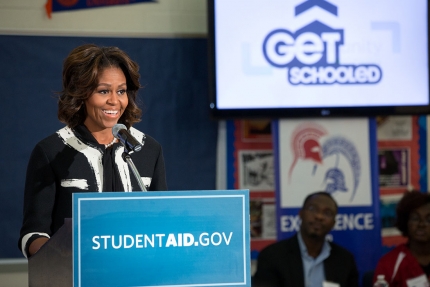
First Lady Michelle Obama delivers remarks during a FAFSA (Free Application for Federal Student Aid) workshop at T.C. Williams High School in Alexandria, Va., Feb. 5, 2014. (Official White House Photo by Amanda Lucidon)

On Wednesday, during her visit to T.C. Williams High School in Alexandria, Virginia, First Lady Michelle Obama asked students a good question: Why would the First Lady of the United States come to a school and spend time with students “just to watch you fill out a computer form?”

The answer is that filling out one particular form – the FAFSA, or Free Application for Federal Student Aid – is one of the most important things students and families can do in planning for college success.

“You don’t have to be the valedictorian. You don’t have to major in a certain subject,” the First Lady said in her remarks. “You don’t even have to be at the bottom of the income ladder to receive the money.”

There is no income cutoff to qualify for financial aid, and most federal student aid programs don’t take grades into consideration when you apply.

Jennifer Simon is Senior Policy Advisor to the First Lady.

The White House

Office of the First Lady

Remarks by the First Lady at FAFSA Workshop

T.C. Williams High School
Alexandria, Virginia

11:45 A.M. EST

MRS. OBAMA:  Thank you, guys.  Thanks for having me.  (Applause.)  You all rest.  You have work to do.  (Laughter.)  I don’t want you to be tired.  I want you to get these forms done.  But I am thrilled to be here. 

I want to start by thanking Edom for that wonderful introduction.  She is a true representative of what this amazing school has done for all of you.  And you’ve got some pretty big shoes to fill, right, that you all -- I know it, I know it.  I also want to thank your principal, Principal Maxey, as well as everyone here at T.C. Williams for hosting us here.  You all, I told your administrators, you all are a true example of excellence.  And that’s one of the reasons why we wanted to be here. 

You all are blessed to have this kind of support in the college process.  And we know that there are other schools with great counselor programs and great principals and great faculty that are doing the same thing, but not every kid has that.  And that’s why we want to lift this up so that more kids around the country have the kind of support and know about the resources that you all have at your disposal.  So I am thrilled to be here.

I also want to thank and recognize my good friend Arne Duncan -- Arne, where are you?  Oh, he’s so tall I rarely miss him.  (Laughter.)  But there he is.  How are you, Arne?  He has been doing a great job with the Department of Education, and I’m looking forward to partnering with him and his Department over the years to make sure that more and more of our kids in this country apply to college, can afford college.  But we couldn’t do it without his leadership, so let’s give Arne another round of applause.  (Applause.)  

So I’m not going to speak very long today because, as I said, you guys need to get to work.  But for those of you who might be wondering why the First Lady is here just to watch you fill out a computer form, it’s because completing this form is a critical start to completing your education.  And as the President and I will continue to stress over the next several years and beyond to young people throughout this country, completing your education –- whether it’s a 2-year or 4-year college, or vocational program -– is the single most important thing you can do for your future.  That is it.  There’s nothing that compares to getting your education.

With a good education, you can get a job that pays a decent salary or more.  You can provide for your family, which is key.  And you can become whatever you dream of becoming, which is the kind of freedom that I want all of you to have.  And filling out the FAFSA form is one of the first and most important steps you can take in that journey, because it’s no secret, as Edom mentioned and as all of you know, college can be expensive.  And you all know that because, fortunately, everyone here is applying to college.  And that’s an important start. 

And as you’re waiting to hear back, you’re starting to add up all the costs -- the tuition, the room and board, the books, the lab fees, all kinds of other expenses that I’m sure you never anticipated -- that was true for me.  And you and your families I’m sure are wondering how you’re ever going to pay for all of that.  And unfortunately, too many students don’t even bother to apply to college because they don’t think they’ll ever be able to afford it, so they just walk away from the opportunity without getting any advice or seeking any support.

And that’s where the FAFSA comes in, because through FAFSA, the Department of Education provides more than $150 billion every year in low-interest loans, in grants that you don’t have to pay back, and work-study programs that can help cover your educational expenses.  And I was a work-study student all throughout college, and I had some great jobs.  On top of helping you pay for school, work-study gave me some of the best experiences that I’ve ever had -- I ran a daycare center, I worked in an office.  I did a lot of really interesting things in college, and it really made a difference.  So work-study is something that’s available if you fill out your form.  And on top of that, a lot of states, colleges, and many private organizations use the FAFSA to determine whether you qualify for even more scholarships and financial aid beyond what the government provides.

And here’s the thing:  As you guys are demonstrating by being here today, FAFSA is quick, it’s easy, it’s free, and it can help you access the thousands of dollars to help you and your family pay for college.  And that’s true -- and this is important -- no matter who you are.  You don’t have to be the valedictorian.  You don’t have to major in a certain subject.  You don’t even have to be at the very bottom of the income ladder to receive the money.  Almost everyone is eligible for some form of financial aid, and all you have to do to access that aid is fill out this one little form.  It’s so simple.  (Laughter.) 

So that’s why I’m here.  And that’s my message for you and for students all across the country:  Fill out those forms.  Fill them out!  (Laughter.)  Don’t leave money on the table.  Parents, don’t leave money on the table.  Fill out the form. 

And if you need help completing the FAFSA, there are plenty of resources you can turn to for support.  I’m thrilled to be joined today by people from across the country who will be helping me spread that message and providing you with the kind of support that you need.

Get Schooled is a nonprofit designed to help more students graduate from high school and succeed in college.  And their partner -- they’re partnering with Viacom, and they’re going to be promoting FAFSA on MTV, on BET, on Nickelodeon, and all over social media.  So this is the beginning of a big, huge campaign.  We’re starting here at T.C. Williams -- isn’t that cool?  Right here.  (Applause.)  And they’re also creating a package of online resources to help students prepare for college. 

And Google is going to partner with GetSchooled.com to use the Google Helpouts platform to connect students and families with experts who can give one-on-one FAFSA advice.  So you don’t have to do this alone.  Even parents who might be intimidated by this process, you don’t have to do this alone.  There are resources -- people who will be available to help you with -- your child walk through this process.

On top of all that, leading organizations like the American School Counselors Association, the National College Access Network, and so many other wonderful organizations are already working every day to help connect students like all of you with financial aid.  And the Department of Education is doing their part as well.  They’ve made the FAFSA form quicker and easier than ever before to fill out -- too bad that didn’t happen about 50 years ago when I was going to school, but better late than never.  (Laughter.)  And they’ve loaded up their website -- the website is called StudentAid.gov.  Want to make sure everybody -- StudentAid.gov.  On that website there will be all sorts of checklists, sample forms, links to help students and parents connect to financial aid.

And finally, probably some of the most critical and accessible resources available to you students are the people you see every day -- the people right here in this room, for the students who are here.  You have got your school counselors who are there to answer your questions.  They’re there leading FAFSA workshops just like this one.  They are tracking you down and nagging you until you complete that form -- yay for nagging.  (Laughter.) 

And I just want to take a moment to congratulate the staff here at T.C. Williams for setting the goal of getting 100 percent of their seniors to complete the FAFSA form.  And that’s the kind of leadership that we hope that all schools will take; they will make this a goal.  Because if students don’t fill out this form, they can’t even begin to access the resources that are already there.  So, T.C. Williams, you all are leading the way.  We are so proud of you.  Again, that’s why we’re here. 

And, last but not least, students, you’ve got your parents and your family members who are there to help you fill in those blanks on that form and guide you on your way as you get started on this journey.  And I know that’s not always easy for some families, especially for those who have never sent anyone to college before -- it could be intimidating -- or for those whose finances are really stretched, and they’re wondering whether all the money is worth it.  I mean, I know I found that with some of the kids I went to -- that I grew up with.  Making that investment and understanding the importance of putting that -- down that money now, sometimes it’s hard when you think, well, maybe it’s better if your kids just get to work and not waste that time going to college.  

But my hope is that every parent in America will understand that lifting up their kids and encouraging them to get an education is one of the best investments that they can make for their child.  And that’s one of the biggest gifts that I got from my parents.  Because my parents didn’t go to college, they didn’t have a lot of money.  And they didn’t -- my mom still says she doesn’t know who raised me -- which is really selling herself short, because she did a lot of raising.  (Laughter.)  But that’s to say she didn’t feel like she had a lot to offer me in this process. 

But my parents, fortunately, were just like the parents who are here today.  I mean, I applaud you all for taking this time and being here by your kids, and supporting them along the way. Like all of you, my parents were determined to do their part to ensure that I had all the support I needed to achieve my dreams.  And even if it made them uncomfortable, they pushed outside of their comfort zones to help me figure this out.  And for that, I will always be grateful.  I wouldn’t be here without that kind of support. 

So, parents, thank you for being here.  Keep it up.  Be that example for other families that may be hesitant.  And I want the students to know here today, from parents and school counselors, to Google and Viacom, to the President of the United States of America -- you all have got an army of supporters here to help you make college more affordable.  So your job -- as my father used to say, you’ve got one job.  (Laughter.)  That’s to work hard in school -- okay, maybe it’s two -- work hard in school.  But for today, your one job is to fill out that form.  It will not take you long.  You will see that here today.

And in a few months, when you start hearing back from colleges, you’ll start getting information about what grants and loans you qualify for and what financial packages the schools are offering you.  And then you have the power.  Then you can make the choice that’s right for you and your family, which is key.  Picking a school means picking a school that you can afford and that’s going to give you the best package.  If you fill this form out, you will have the chance to see what options are available to you.

So I want you and young people across the country to get on this right now.  Don’t wait another minute.  And then I want you all out there to tell your classmates, tell your friends, tell your Valentine sweetheart if you have one, tell somebody about this form and what they can do and all the resources that are available to them.  Share this information with the people in your lives, because, as I said at the beginning, not every kid is blessed enough to have the resources that you all do.  So your job is to share your blessings with others.  

So with that, I’m going to stop talking and I’m going to come around and meet all of you.  I’m going to hear about where you’re thinking about going, where you’re applying, how the form is.  Hopefully, I’ll meet your family members.  You will introduce me to your parents, right?  (Laughter.)  Don’t be shy.  And I’m proud of all of you for taking this step and for being a role model for so many kids around this country. 

So thank you again for everything that you are doing in your lives.  And I look forward to seeing all the amazing things you’re going to do with your futures.  Thanks so much.  Get to work.  (Applause.)

* * * * *

REMARKS BY THE FIRST LADY AT THE
CONCLUSION OF THE FAFSA WORKSHOP

Well, this was incredible for me, just to meet so many smart, focused, articulate, clear-eyed, clear-thinking young people with amazing counselors and parents.  This was a dream room right here.  And your stories are so diverse and so different and so compelling.  This is why I’m still here -- and I was probably supposed to be gone an hour ago.  (Laughter.)

But it has been a real delight for me, and an inspiration to meet you guys.  And as I was telling Colleen, when you look around this room -- you know, we can’t afford to lose any of your talent.  We need you to be educated and prepared, because you all are awesome individuals who have the potential to do some amazing things for this country.  So it’s up to us to support you.  It’s up to us to find other kids like you who don’t have the support. 
And that’s the thing I worry about -- all the thousands of kids, the millions of kids out here who don’t know about FAFSA, who don’t have great counselors, who don’t know how to get an affordable college education.  And that’s why working with Arne, the President, myself, the corporate community, the nonprofit sector -- this is the best investment that we can make in the future of our country, is investing in you all.

So it has been a joy.  Principal Maxey, you are -- you’ve got a great team out here.  You have every reason to be proud. 

So with that, I think we’re going to take a picture?  You guys want to come up?  I’m assuming you’ve been instructed?  Bring your forms!  Bring your forms!

END
1:15 P.M. EST

First Lady Michelle Obama: “I’m First”

Last November, First Lady Michelle Obama spoke to the sophomore class at Bell Multicultural High School in Washington, D.C. about the importance of higher education. In her remarks, Mrs. Obama talked about how education has created opportunity in her own life, working hard to attend and graduate from college.

Today, we are releasing a special video message from the First Lady in which she talks about being the first in her family to attend college. This video is part of the “I’m First” storytelling project, which lifts up the stories of first generation college students in order to inspire future generations.

As the First Lady says in her video, “no matter where you come from or how much money your family has, I want you to know that you can succeed in college, and get your degree, and then go on to build an incredible life for yourself.”

Related Topics: Education

The White House

Office of the Press Secretary

Statement by the President and First Lady on the Passing of Joan Mondale

Michelle and I send our deepest condolences to former Vice President Walter Mondale and his family on the passing of Joan Adams Mondale.  America first came to know Joan through her husband; she was his devoted partner in public service, from Minnesota to Washington.  A lifelong patron of the arts, Joan filled the Vice Presidential mansion with works by dozens of artists, including many unknowns, and later did the same at the U.S. embassy in Japan during her husband’s tenure as ambassador.  Through her contributions to the Federal Council on the Arts and Humanities and the Kennedy Center, she passionately advocated for the role of art in the life of our nation and the promotion of understanding worldwide.  Our thoughts and prayers are with Vice President Mondale and his family today as we remember with gratitude “Joan of Art” and her service to our nation. 

The White House

Office of the First Lady

Remarks by the First Lady at DNCC Women's Luncheon

Fairmont Hotel

San Francisco, California


11:45 A.M. PST

MRS. OBAMA:  Oh, my goodness.  Thank you so much.  (Applause.)  Thank you all.  It is great to be here.  Thank you so much. 

Well, it is truly a pleasure to be here today with so many fabulous women -- and a few brave men I see out there.  (Laughter.)  And speaking of fabulous women, I want to start by thanking Leader Nancy Pelosi not just for that kind introduction but for her outstanding and historic leadership in Congress.  (Applause.)  She is a fighter.  She has courage.  She's willing to take the risks, and she has been behind our President every step of the way.  We love you.  We love your family.  You are amazing.  Thank you so much.  (Applause.) 

And I also just want to mention that, as you know, Nancy was inducted into the Women’s Hall of Fame, and Barack and I could not be more proud.  It is the right thing.  That’s where you need to be.  So keep it up, Nancy, we need you.  Let's give her another big round of applause.  (Applause.)  We love you. 

I also want to recognize the many terrific members of Congress who are joining us here today.  You guys are doing a phenomenal job.  Keep it up.  Thank you for your leadership, your service.  Thank you to your families for the sacrifices they make.

And of course, I want to thank Joan Baez for gracing us with her performance.  (Applause.)  That was amazing.  We are thrilled she could be here today. 

But most of all, I want to thank all of you for taking the time to be here today.  And I want to thank you for everything that you’ve done for Barack and for so many other leaders who share our values.  Thank you for being there for them year after year and election after election.  And I know it feels like a long journey sometimes, I know that it hasn't always been easy.  But if you have ever wondered whether your support makes a difference, I just want you to think for a moment about what Barack said in his State of the Union speech earlier this week.  

I want you to think about the vision that he laid out for our future.  Think about everything he's asked Congress to help him achieve over the next three years:  ending gun violence, raising the minimum wage, investing in job training and scientific research, opening the doors of pre-K for all of our children -- and so much more.  There's so much work that needs to be done.  (Applause.)  And that is how your President wants to lift up the middle class and restore opportunity to everyone in this country.

And make no mistake about it, when we talk about the 2014 midterm elections -- and that’s what we are going to talk about a lot -- elections that are less than 10 months away -- please understand that that’s what's at stake.  And we need to ask ourselves whether we will have leaders in Congress who share our values and who will work with Barack to keep moving this country forward.  And that’s why the midterm elections are so critical. 

And that’s why we need your support, and that’s why I’m here today.  I’m here because like all of you, I believe that in America, no matter how you start out, if you are willing to work for it and sacrifice for it, you should be able to build a decent life for yourself and an even better life for your kids.  That is the American Dream that we all believe in -- all of us.   

And we don’t believe in handouts.  We don’t believe that anyone should get a free ride.  But we also understand a pretty simple principle:  that “there but for the grace of God go I” -- that in the blink of an eye, any of us could be faced with a terrible diagnosis, any of us could be injured in a horrible accident, any of us could lose the job we count on to support our family.

And when that happens, it shouldn’t mean falling off a cliff.  It shouldn’t mean having to go without food or medicine or a roof over our heads.  Not here in America.  That’s not who we are.  Here in America, while we expect everyone to do their fair share, we also believe that we should give everyone a fair shot.  We believe that everyone should have the basic security they need to provide for their families and give their kids a decent shot in life.  And that’s certainly the kind of security that I and I know so many people here grew up with. 

As you know by now, my family wasn’t rich, growing up -- far from it.  Neither of my parents were able to go to college.  But I was fortunate.  I had decent public schools that prepared me to succeed.  I had parents who pushed me and supported me every step of the way.  And because my dad’s job at the city water plant paid him a decent wage, he and my mom were able to build a stable life for me and my brother.  They were even able to pay that tiny bit of my college tuition that wasn’t covered by student loans and grants.

So I was able to get a college education, go on to law school.  And let me tell you, for a working-class kid from the South Side of Chicago, being able to get my education meant everything to me.  It was the foundation for my career.  It was the launching pad for my dreams.  It let me build a life for myself that my parents never could have imagined for themselves -- never.

And today, there are so many kids out there just like me, just like Barack –- kids with such big dreams and so much promise, but kids who never get those opportunities; kids who have the potential to be anything in the world -- surgeons, teachers, engineers, and yes, President of the United States.  (Applause.) 

But no one is willing to invest in them.  No one ever encourages them to go to college.  No one ever explains the complicated financial aid process.  No one helps them shape a vision for what their lives could be with a decent education.  No one ever gives them the opportunity to fulfill their potential.

And what’s even worse is that when we fail to invest in our young people, that just doesn’t limit their future, it limits our country’s future as well.  And let me tell you, there is not a day that goes by when I don’t think about the millions of kids who are falling through the cracks of opportunity in this country, because I can’t help but think how their story could be my story.  But I also remember that my story can be their story if we give these kids a chance. 

And that’s why Barack and I are and will be working so hard to help more of our young people afford college.  We're going to be working to inspire them to apply -- (applause) -- especially kids in underserved communities.  And that is why Barack is also fighting so hard to ensure that once these kids graduate, that they actually have good jobs with good wages so that they can pass that gift of opportunity on to their own kids. 

But let’s be clear -- and I have said this again -- Barack cannot do this all alone just sitting by himself in the Oval Office.  (Laughter.)  It's a sad thought, isn't it?  It's a sad little thought.  (Laughter.)  And we know this.  We know this by now.  We’ve seen it time and again.  He needs help.

Remember the Recovery Act that helped rescue our economy and helped our businesses create 8.2 million new jobs in the past 46 months?  It's good stuff.  Well, we needed Congress to pass that bill.  Remember the Lilly Ledbetter Fair Pay Act to help women get equal pay for equal work?  I know you all remember that one.  (Applause.)  Well, that bill was passed by Congress back in 2009.  And of course, there’s the Affordable Care Act, passed by Congress in 2010.  (Applause.)    

So make no mistake about it, it matters who we elect to represent us in Washington.  It matters.  And right now, we are just 17 seats away from winning back the House of Representatives -- 17 seats.  (Applause.)  But I’m also going to be straight with you:  Most districts in this country are not like San Francisco.  (Laughter.)  And we have a lot of tight races in other parts of California and all across the country.  And every single one of these seats matters.  Every single vote in the House of Representatives matters, because so many critically important issues come before our Congress.

I’m talking about issues like contraception, and whether we as women can make the most private choices about our bodies and our health.  (Applause.)  And I’m talking about issues like repealing the Affordable Care Act, and whether Americans could once again be denied insurance because of preexisting conditions –- things like breast cancer diagnoses from ten years ago, childhood asthma.  I’m talking about issues like whether we can marry the person we love, whether our kids will be safe from gun violence in their classrooms, whether hardworking Americans struggling to get back on their feet will have the unemployment insurance they need.

So these midterm elections matter, because it is simply not enough to elect Barack Obama President if we don’t also elect leaders in Congress who will work with him to keep making the changes we believe in.  (Applause.)  And we have some of them here -- leaders like Staci Appel from Iowa, Amanda Renteria from here in California, Martha Robertson from New York.  (Applause.)  All of them are here today.  They need our help.  They can make a difference.

So starting right now, today, we need to be as passionate and as hungry as we were back in 2008 and 2012.  In fact, we need to be even more passionate and more hungry, because these races will be even harder, and even closer, than those presidential elections.  We’re talking about races that are won or lost by just a few thousand or even a few hundred votes.

And here's the thing that caught me by surprise:  I learned that one of the reasons these midterm races are so tight is because too often, we don’t show up.  History shows that there is a significant drop-off in voting among women, minorities, and young people during the midterms as compared to general elections.  It's on us.  They're not beating us, we're losing.  We're not voting.

So if we truly are serious about continuing to move this country forward, then we can’t just sit back and hope for the best, and then be surprised and outraged when things don’t work out.  I see that all the time.  We need to be engaged right from the beginning, right now. 

And this is where all of you here -- talking to all of you all here right now -- come in, because there is something that all of you can do right now, today, to make a difference:  you can write a check.  Yes.  And if you've written one, you write another one.  (Laughter.)  Because seriously, that’s what we need you to do right now.  Write a big old check.  Write the biggest check that you can possibly write.

And I know that so many of you may be tired of people always asking you for money, and I understand because it's not always easy being one of the ones always asking you.  (Laughter.)  But we do this because writing those checks is the single most impactful thing you can do right now to affect the outcomes of the midterms.  That is not joke.  Because it will be the strength of our resources that will make the difference this November. 

Again, it is simply not enough for us to have the best candidates if we don’t give them the resources they need to win elections.  It’s not enough to have the best ideals and values if we never get the chance to make them into laws and policies.  It’s not enough to simply stake out the moral high ground, feel good about ourselves, and then wait for things to turn out okay.  We need to act.

And when we translate our actions into dollars, that in turn translates into staff hired, offices opened, doors knocked on, ads running where they need to run.  And yes, time is of the essence.  We cannot wait until next spring or summer or fall to get this going.  These candidates need those resources right now -- in fact, they needed them yesterday.

So we need you to dig deep.  We need you to max out.  And once you’ve given what you can, then we need you to go out there and volunteer.  Leave San Francisco.  (Laughter.)  Leave this bastion.  Go out into the wilderness.  (Laughter.)  And roll up your sleeves, because we know that those person-to-person contacts, those calls and doors knocked on, all of that can also mean the difference between victory and defeat.

And finally, please know that the stakes this year simply could not be higher, because so many people are counting on all of us to make our voices heard -- families who are working harder than ever before and deserve to make a decent wage.  They are counting on us, because no one in this country should work 40 or 50 hours a week and still be stuck in poverty.  Not in the greatest nation on Earth.  That’s not who we are.  (Applause.) 

Women who don’t want anyone interfering with their most private health decisions –- women who are more than capable of making their own choices about their bodies -- they are counting on us.  Our young daughters are counting on us to fight for their rights and freedoms.  This fight is not over.  They’re counting on us to keep fighting for equal pay, for workplace policies that women and men –- help us all -- balance the needs of families with the responsibilities of their jobs.  Because as my husband said in his State of the Union address, as Nancy also mentioned, and I'm proud of him for saying it:  “When women succeed, America succeeds.”  (Applause.) 

And of course, our children and grandchildren across this country –- children who deserve good schools and the chance to go to college and build a decent future for themselves -- all those kids are counting on us.  And I’m thinking about the story of one of those kids; a young man named Troy Simon who Barack and I met at a White House college summit just a few weeks ago at the White House.  Troy introduced me, and he told his story. 

Troy grew up in a struggling family in New Orleans.  And for years, he, like so many kids, was shuffled between relatives.  He spent his days skipping school and getting into trouble on the streets.  That’s why at the age of fourteen, Troy still couldn’t read.  Troy couldn’t write.  Troy couldn’t even count very well. 

But then Troy made a decision.  He decided that he wanted to set a better example for his brothers and sisters.  So he decided he wanted to own his future and commit to his education.  So Troy got to work, because he had to make up for lost time.  He buckled down at school; he sought out the help he needed to catch up.  He found a college prep program to help him succeed in high school and then help him apply to college.  He found a scholarship program to pay his college tuition.  And today, Troy is a sophomore at Bard College majoring in American Literature.  (Applause.)  And he is a phenomenal young man.

And there are so many kids just like Troy all across this country -- young people who’ve had a tough start, but are still so hungry to succeed; young people who are desperate to lift themselves up if we just gave them a chance.  And that ultimately is why we’re here today.  And that’s why we need to work so hard between now and November.

And if during this time you ever start to get tired or frustrated, if you ever think about giving up, I just want you to think about all those folks who are counting on us -- all those young people like Troy who deserve a shot at their dreams, all those families who are struggling to build something better for their kids.  We need to be energized for them.  We need to be inspired for them.  We need to pour everything we have into these elections so that they can have the opportunities they need to build the future they deserve.

And the beautiful thing is we have done this before.  We've done this.  And if we do it again, if we all keep stepping up and digging deep and bringing others along, then I know that we can keep on making the change we believe in.  I know that we can keep on moving this country forward.  And together, we can build a future worthy of all of our children. 

You all ready for this -- midterms?  Are you ready?  (Applause.)  Are you ready?  Are you ready to roll up your sleeves?  This is going to take an active set of actions on the part of everyone here.  We can't be passive when there isn't a president running.  We have to be as passionate as we were when we got Barack elected into office. 

So we need you guys.  Are you up for this?  (Applause.)  You've got to be real up.  You've got to be ready for this. 

Thank you guys.  Thank you so much.  We love you.  Thank you for all your support.  God bless.  (Applause.)

END 12:06 P.M. PST


West Wing Week 01/31/14 or "West Wing Week Turns 200!"

This anniversary episode, hosted by the President, coincides with this year's State of the Union Address. We'll take you behind the scenes and on the road to speak directly with Americans like you about your lives and your families, and how together we can make sure that every American who works and studies hard has a real chance to get ahead.

West Wing Week 01/31/14 or "West Wing Week Turns 200!"

January 30, 2014 | 6:57 | Public Domain

This anniversary episode, hosted by the President, coincides with this year's State of the Union Address. We'll take you behind the scenes and on the road to speak directly with Americans like you about your lives and your families, and how together we can make sure that every American who works and studies hard has a real chance to get ahead.

Download mp4 (291.6MB)