First Lady Michelle Obama Speaks on Expanding College Opportunity

January 16, 2014 | 14:29 | Public Domain

The First Lady Speaks to leaders in postsecondary education at The Event on College Opportunity. This event is dedicated to launching a plan of action for increasing college opportunity for low-income and disadvantaged students.

Download mp4 (533MB) | mp3 (35MB)

First Lady Michelle Obama Hosts a Discussion on Education

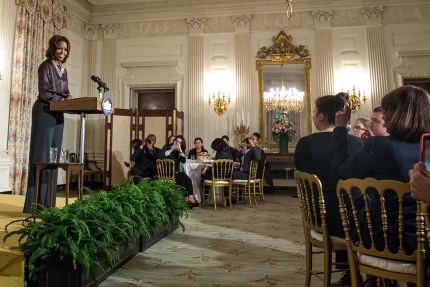
First Lady Michelle Obama delivers remarks prior to a screening of the movie "The Inevitable Defeat of Mister and Pete," and a discussion in the State Dining Room

First Lady Michelle Obama delivers remarks prior to a screening of the movie "The Inevitable Defeat of Mister and Pete," and a discussion in the State Dining Room of the White House Jan. 15, 2014. (Official White House Photo by Amanda Lucidon)

Yesterday, to support the President’s “North Star” Goal -- that by 2020, Americans will once again have the highest proportion of college graduates in the world -- First Lady Michelle Obama hosted a discussion with education stakeholders about the challenges and best practices regarding education access in underserved communities. As part of the event, guests participated in a screening of The Inevitable Defeat of Mister and Pete, a coming of age story about two inner-city youth that display grit, resilience, courage even in the most hopeless circumstances. The movie's executive producer Alicia Keys opened up the event by talking about how she was personally inspired by the script. The First Lady then thanked the educators participating in the event for engaging on this issue: 

I want to thank all of you for taking the time to participate in this screening and this discussion, and for the work that you're doing to move our kids forward and basically keep our country thriving and on top. And again, there's a reason why I invited you all here. We did this because for many of you, this movie isn’t just a powerful story of -- or a great piece of art.  For so many of you, it’s the reality you see every day in your classrooms and in your communities.

Related Topics: Education

The White House

Office of the Press Secretary

FACT SHEET: The President and First Lady’s Call to Action on College Opportunity

To view the White House report on Increasing College Opportunity for Low-Income Students, click HERE.  To view the list of Commitments to Action on College Opportunity, click HERE.

The President believes he has a job to do, and every day he is fighting to create more opportunities for working and middle class Americans. And while he will continue to work with Democrats and Republicans in Congress to move our country forward, the President is committed to partnering with colleges and universities, business leaders, nonprofits and others to do everything he can to support more college opportunities for students across the country.

Today, in response to the President’s call to action, the President and First Lady are joining with leaders in higher education to announce over 100 new commitments to expand college opportunity. To help more students afford and graduate from college with the skills they need, the Administration has already taken action including doubling Federal investments in Pell Grants and college tax credits and reforming student loans.  Last August, the President laid out an ambitious new agenda aimed at improving college value, removing barriers to innovation and competition, and ensuring that student debt remains affordable. As the Administration continues to push for changes that keep college affordable for all students and families, we can and must do more to get more low-income students prepared for college, enrolled in quality institutions, and graduating if we are to achieve our North Star goal of leading the world in the share of college graduates by 2020. Together, the President, the First Lady and these leaders in higher education are taking another step to help ensure that every child, rich or poor, has the opportunity for a quality college education so they can get ahead. 

  • Over 100 New Commitments to Expand College Opportunity: The participants in today’s event were asked not simply to attend an event – but to commit to new action in one of the following areas crucial to college opportunity: 

  • Connecting more low-income students to the college that is right for them and ensuring more graduate
  • Increasing the pool of students preparing for college through early interventions
  • Leveling the playing field in college advising and SAT/ACT test preparation
  • Strengthening remediation to help academically underprepared students progress through and complete college 

Today, over 100 colleges and universities and 40 organizations are announcing new commitments to action to build on their existing efforts in this area. Together, these actions will serve hundreds of thousands of students across the country.

  • Improving College Opportunity Is Important to Increasing Economic Mobility and Growing the Economy: Without college, a child born in the bottom quintile has only a 5 percent chance of making it to the top quintile. However, the chance of making it to the top nearly quadruples with a college degree – with a nearly equal chance of making it to the top quintile as staying in the bottom quintile. Yet only 9 percent of those born in the bottom quartile attain a bachelor’s degree by age 25, compared to 54 percent in the top quartile. Improving college success is one of the most powerful tools to increase economic mobility and reduce inequality. 

  • Taking Further Action to Expand College Opportunity: This event is not the culmination of these efforts, but rather the launch of a mobilization by the White House and the Department of Education, which will help share and develop additional evidence on what works and foster new commitments to action from a broader range of colleges and universities, business, nonprofits and other leaders. In 2014, the White House and the Department of Education will work with outside groups to engage in further gatherings, catalyze new and additional commitments, develop a follow-up report on progress and hold a White House convening over the next year. 

The President and First Lady’s Call to Action on College Opportunity

As part of the President and First Lady’s national call to action on college opportunity, over 100 college presidents and 40 non-profits, foundations and other organizations are announcing new commitments in the following key areas:

  1. Connecting more low-income students to the school that is right for them and ensuring more students graduate.  Many low-income students do not apply to or attend schools where they are most likely to succeed, often because they are not fully aware of their options available to them. Building on models that have had success in better matching low-income students to colleges where their outcomes will be best, participants have committed to doing more to enroll low-income students and ensure they matriculate and graduate. Over 80 colleges and universities and 15 organizations are making commitments in this area, with selected examples including: 

    • A Doubling of STEM Posse Partner Institutions: The Posse Foundation is announcing a doubling to 10 of its STEM Posse Partner Institutions – serving, over the next five years, 250 additional students from diverse, urban backgrounds who might otherwise be overlooked, providing a total of $35 million in full-tuition, four-year scholarships, and helping students to complete science, technology engineering and mathematics (STEM) degrees at some of the nation’s top colleges and universities. 

    • College Board Joining With Member Institutions to Offer Four Free Fee Waivers to Eligible Students for College Applications: The College Board is joining with its member institutions to announce that every income-eligible student who takes the SAT will receive four free fee waivers to apply to college for free. 

    • More than $95 Million in Commitments to Help More Students Complete STEM Degrees: Investments totaling $95 million are being announced today from the Howard Hughes Medical Institute ($65 million over five years) and the Leona M. and Harry B. Helmsley Charitable Trust ($30 million over three years) and to help more students complete STEM degrees.  

    • Action By More than 80 Colleges and Universities: Over 80 colleges and universities are – in addition to their efforts in other categories – taking actions like engaging in new efforts to recruit students who might not otherwise attend their university, expanding need-based aid for low-income students, setting new goals for increasing the share of low-income students, committing to additional community college transfers and taking new steps to improve outcomes for low-income students once they arrive on campus. 

  1. Increasing the Pool of Students Preparing for College Through Early Interventions:  Low-income students are less likely to prepare to apply for college by taking recommend courses, visiting college campuses, and taking the SAT or ACT.  Building on models that have had success in getting more students to prepare for college through early interventions, participants have committed to working with elementary, middle, and high schools to encourage college-going and assist with preparation. More than 30 colleges and 12 organizations have made commitments in this area, with selected examples including:
    • A New $5 Million Effort to Design Pathways to Success for Careers: Deloitte, Darden, Walmart, AT&T, Mutual of America, and the Samberg Family Foundation are committing $5 million over four years to support College Summit, and in particular a partnership called ScholarJob that will help low-income students across America connect getting an education with getting a great career. This year, with an investment from the Bezos Family Foundation, ScholarJob volunteers will partner with College Summit student Peer Leaders to scale the program, equipping more than 100,000 high school students from low-income communities in 10 cities with cutting-edge technology to help them explore careers, and to attend and complete college. 

    • $4.5 Million in New Commitments to Redesigned Schools: The Irvine Foundation and Pacific Gas & Electric are making a combined $4.5 million commitment to support the President’s initiative to redesign high schools to include more real-world learning and business partnerships. 

    • Matching Tens of Thousands of Students With Mentors and Rigorous College-Preparation: iMentor is matching 20,000 new first-generation college students with mentors and Blue Engine is expanding academic preparation in college gateway skills to 10,000 additional students over the next five years 

    • $12.5 Million in New Funding to Support Excellent STEM Teaching: 100kin10, a network formed in response to the President’s call to action to prepare 100,000 excellent STEM teachers over a decade, is announcing an additional $12.5 million in funding with support from JP Morgan Chase, the Overdeck Family Foundation, the Hewlett Foundation and the New York State Attorney General. 

    • Efforts by More than 35 Colleges and Universities to Prepare More Students for College: More than 35 colleges and universities are – along with efforts in other categories – taking actions like hosting summer enrichment programs for low-income students; partnering with local high schools to create programs that span high school and link students to college; and encouraging current students or faculty to tutor and interact with low-income high school students 

  1. Leveling the Playing Field in College Advising and Test Preparation. Low-income students are often at a triple disadvantage when it comes to advising and mentorship:  their schools have fewer counselors, they can’t afford extra advising or test prep, and often cannot turn to their parents or peers for college insight. Building on models that have had success in boosting low-income college enrollment, participants have committed to increasing access to mentors and advisors. More than 20 colleges and 16 organizations have made commitments in this area, with selected examples including: 

    • Serving An Additional 80,000 Students Through the National College Advising Corps: The National College Advising Corps is announcing new commitments from partner universities that will provide more than 80,000 students over three years with college counseling that has shown effectiveness in increasing college enrollment. 

    • Offering Additional Resources to School Counselors: The National Association for College Admission Counseling will offer free resources and additional training to school counselors to help guide students and their families on the path to college. 

    • New Effort by Khan Academy to Provide College Advising Support: Khan Academy is developing a new college advising and counseling section, along with new college-prep features that focus students on the specific content they need to be prepared for college math placement tests. 

    • Providing Thousands of Additional Students With College Prep Support: Organizations including College Possible, College Spring, College Track, OneGoal, Leadership Enterprise for a Diverse America (LEDA) as well as a coalition of groups under the National College Access Network are making commitments to serve thousands of additional students, providing counseling services, high-quality SAT/ACT prep, and other support for students applying to college 

    • New Commitments by More than 20 Colleges To Offer Advice to Students Navigating College Application: More than 20 colleges and universities are – along with efforts in other categories – taking actions to expand summer college preparation programs for low-income students; creating new relationships with high schools to provide advising about college and financial aid; and expanding opportunities for current college students to work in high schools and middle schools to help advise students on college options 

  1. Seeking Breakthroughs in Remedial Education. While increasing college access is critical, we must ensure that low-income students are successful once they get there. Far too many students enter college underprepared to succeed, and remediation needs at four-year institutions are greatest for low-income students. Only one in four students in remedial classes will eventually earn a degree from a community college. An additional 14 percent will transfer to a four-year college without a certificate or degree. But new models are emerging that have the promise of dramatically improving college outcomes for students in need of remediation.  Participants have committed to significantly improving outcomes for academically underprepared students to ensure they succeed in college by strengthening instruction, using technology, better supporting students in remediation, and reducing the need for remediation. More than 20 colleges and universities, 22 states and the District of Columbia, and 10 organizations have made commitments in this area, including: 

    • A New Commitment by 22 States and the District of Columbia to a Comprehensive Approach to Address Remediation: 22 states and the District of Columbia supported by Complete College America, have committed to comprehensive approaches to addressing remediation that will help them achieve a significant increase in the number of college students assigned to remediation completing college level math and English their first year, recognizing that most of these students will need additional academic support. Completion of these gateway courses will lead to many more students completing their degrees. 

    • Providing Colleges With Tools And Resources to Serve Academically Underprepared Students: Key organizations are teaming up to ensure that colleges interested in improving their remediation activities have tools and resources they need to successfully serve students who are academically underprepared.  Achieving the Dream, Carnegie Foundation for the Advancement of Teaching, and Jobs for the Future—experts in institutional change, faculty engagement and curriculum reform, and policy development, respectively, are working to create a "Breakthrough Collaborative." The collaborative will work with willing community colleges, higher education organizations, philanthropy and other stakeholders to help learn together the best ways to implement and improve promising practices that accelerate progression through remediation and gateway courses, especially for those students who are the least college-ready.

In addition to these steps, the Department of Education is taking the following actions to help support low-income students.  This builds on announcements by the Department of Education at the Higher Education “Datapalooza” earlier in the week.

  • Leveraging Work-Study Jobs to Support Near-Peer Mentoring: To build on promising evidence around the effectiveness of near-peer students as college advisers, the Department of Education will develop and announce in the coming weeks a new effort that would encourage and support institutions to place students into college counseling and mentoring work-study jobs through the Federal Work-Study program. This effort would assist institutions to establish, in partnership with school districts, work-study jobs that will help expand access and strengthen secondary-to-postsecondary transitions by raising awareness about college and financial aid among high school students, as well as provide on-campus work-study mentoring jobs that will help increase postsecondary persistence and completion. 

  • Building the Evidence Base for Early Intervention through GEAR UP: The Department of Education will partner with the National Council for Community and Education Partnerships (NCCEP) to support NCCEP’s efforts to develop and evaluate best practices from GEAR UP programs related to college fit and college readiness. In addition, the Department will announce that the approximately $62 million GEAR UP grant competition scheduled for next year will focus on building and promoting the use of successful practices aimed at improving college fit, college readiness, and helping ensure students achieve the necessary milestones that provide a pathway to college success.

  • Testing the Best Approaches to College Advising and Matching Through Upward Bound:  During 2014-15, the Department of Education will commit to developing and testing a new professional development program for Upward Bound staff that includes tools and resources building on lessons and strategies learned in the field to support college matching and in-person college advising. The tool kit and training are being developed in collaboration with the College Board, ACT, and the Council for Opportunity in Education, and will be designed for use with both Upward Bound staff and high school counselors.

  • Using FAFSA Completion Information to Support College Going: The Department of Education commits to providing a process for sharing data on Free Application for Federal Student Aid (FAFSA) completion with states, so states and school districts can better identify which students have completed their forms and target efforts to increase completion. This initiative would allow the scaling up of successful initiatives that the Department has launched around FAFSA completion in cities like Chicago, San Antonio and Detroit, which raised FAFSA completion rates by more than 30 percent in some cases. This will be implemented formally through agreements between the Department of Education and state student aid agencies in early 2014, which coincides with the beginning of the FAFSA application cycle for academic year 2014-15.

The White House

Office of the First Lady

Remarks by the First Lady at a Discussion with Education Stakeholders

State Dining Room

4:17 P.M. EST
 
MRS. OBAMA: Thanks so much. (Applause.) The applause should go to all of you. Thank you. Welcome. (Applause.) You guys rest yourselves. You work hard enough. I don’t want you to wear yourselves out clapping for me here in the White House. 
 
It is truly a pleasure to welcome you all here today to the White House. I want to start by thanking Jen for that wonderful introduction, but also for her work as one of the millions of teachers out there who are doing their part to keep our kids on track. And as she said, it's not just her role as a teacher, but also as a mom, which is -- I say that all the time. In the end, it's the most important job we have, no matter -- whether you're teaching or serving in the White House, it's the first part of contributing to this society. So thank you for your work. Thank you for being here.
 
And I have to recognize my dear friend Miss Alicia Keys for her eloquence, and her foresight in seeing the value of this movie and investing in it, along with many other very smart people. I was telling Alicia that I saw this movie this summer and I wept, like I know all of you all did, because you can't help but weep and laugh and look in horror and cheer for these two young kids. Because they represent all of our kids. 
 
And the minute I got through watching this movie, I said, I am going to screen this at the White House; I'm going to -- this is the movie that should begin the conversation that is already happening about what we have to do to invest in kids in this community. Because there are millions of Mister and Petes out there who are just struggling to make it. So I am thrilled that you could be here today. Get it done. Took a little second. Had a few things in the way, but we got through it and we're here. (Laughter.) 
 
And I also want to thank the screenwriter, Michael. Michael -- where is Michael? Michael is here. (Applause.) Well done, well done. 
 
And most of all I want to thank all of you for taking the time to participate in this screening and this discussion, and for the work that you're doing to move our kids forward and basically keep our country thriving and on top. And again, there's a reason why I invited you all here. We did this because for many of you, this movie isn’t just a powerful story of -- or a great piece of art. For so many of you, it’s the reality you see every day in your classrooms and in your communities. 
 
This is not unfamiliar. Many of you work with kids just like Mister and Pete. You see them every day -- kids struggling against heartbreaking odds in neighborhoods torn apart by poverty and hopelessness, surrounded by gangs and guns and drugs. You see this every day. But, see, this is the thing, the beauty of this movie -- this movie isn’t just about the challenges that kids like Mister and Peter are facing. And that's really why this movie was so powerful to me, because it’s also about their courage. It’s about their grit, their resilience. Those are three words you are going to hear me say a lot over the next three years -- grit, resilience, courage -- that these kids displayed even in the most hopeless circumstances. 
 
Kids are living like this every day. And all of you see this firsthand every single day in your lives. And think of all the kids you know who somehow maintain that fierce commitment to their dreams just like Mister did. He was going to be an actor, right? (Laughter.) He was going to find a way to get to that audition. 
 
Think of all the kids who show each other the kind of love and loyalty that Mister and Pete showed to each other even when they don't see it in their own lives. Even when they don't get it themselves, somehow intrinsically, they find a way to replicate it in their lives wherever they can find it. Think about all the talent, all the intelligence, all that drive that you see in every single one of these kids. You see it -- all that untapped promise, that vast, unfulfilled human potential; the frustration that comes when you have something deep inside of you, and you got nowhere to go with it -- nowhere to go.
 
And all of that is both the tragedy, and, more importantly, the opportunity that exists for millions of kids in this country. We all know that these kids could be the next generation of workers and innovators and leaders. You all know that. They could be building the businesses and making the discoveries and enriching the communities that will fuel our economies for decades to come. So when all of you are out there working to inspire and educate these kids, you’re not just building a better future for them and for their families, you’re actually building a better future for our country. That's the work that you do. You may not get credit for it, but that's what you’re doing.
 
And that's really what drives me, and that is truly what drives my husband, your President. That's why he’s set a goal that by the year 2020, our country would once again have the highest proportion of college graduates in the world. He wants to get us back on top. And as part of that effort, tomorrow we are going to be hosting a White House summit of university presidents from all across the country, and we’ll be challenging them to recruit and support even more underserved young students at their schools.
 
And for the rest of my time as First Lady, in addition to all my other initiatives -- so nothing is going away, we’re just adding more on -- (laughter) -- I’m going to be doing my very best to promote these efforts by talking directly with young people. That's my focus. Everybody else is going to be talking about resources, but the one thing I can bring to this is the message that we can give directly to young people. 
 
 I’m going to be conveying the simple truth -- I’m going to tell them that they have everything they need to succeed already. It’s all in there, but they still have to be committed to getting their educations. I’m going to be making a special effort, obviously, to reach kids like Mister and Pete, who face such overwhelming obstacles in their lives. And as you all know, too often these kids view their difficult life experiences as weaknesses. They view what they go through as a source of embarrassment and shame sometimes. But as we all know, it’s really just the opposite, and it’s important for them to understand that. 
 
I want these young people to understand that their struggles can actually be a source of strength and even a source of pride, because they’ve overcome obstacles and learned skills that many of us will never have, that many of us need to actually get the real work done. I tell my kids, you can’t always teach resilience. It’s the life you live that gets you there. And these kids have lived some lives. 
 
So I remind these kids, look, if you could go through all that you’ve already gone through -- and just think of what you’ve already made it through. You’ve lost people you love to violence and drugs. You have to have a strategy just to get to school safely. You’re smart enough to figure out how to stay out of gangs. You’ve seen your family fighting just to get by and you still keep moving. You’ve adjusted to living in another country and needing to learn another language. Maybe no one in your family speaks that language yet you’re still going to school and you’re still making it.
 
So what I want these kids to understand is that if you can do all of that, then certainly you can fill out a FAFSA form. (Laughter.) That is not the intimidating part of life. If you can do that, then surely you can get up in the morning and get to class, get to school on time and pay attention. That’s not the hard part. They’ve already gotten through the hard part. They can do all that they can do, surely they can seek out some adults in their lives because there is always one adult -- I don’t care how bad the school is or how bad the neighborhood -- there is always one adult who will move mountains for a kid who wants something. 
 
You all are those people. You can seek that adult out. You can get the help you need. I want to give them the confidence to know that what they go through prepares them for all that they need to do in the future. I remind them, though, that all of that is their responsibility though. In the end, that’s up to them. But it is our responsibility to make sure that they have those caring adults in their lives. It’s our responsibility to make sure they have schools that will teach them. It’s our responsibility to make sure they have programs that support them, and universities that will seek them out and give them a chance, and then prepare them and help them finish their degrees once they get in.
 
And I go to the scene that you talked about, Alicia, in the movie -- because that is the scene that just did me in. I still can’t think about that scene without breaking down. But when the police officer, after all that Mister went through, this boy just broke down and he says, “Keep fighting, because there ain’t no ceiling for a kid like you.” There’s no ceiling. But Mister says, “I can’t do it alone.” And as Alicia says, no one can do it alone. And we have to show these kids that they’re not doing this alone. That’s what we’re here for. 
 
So I want to thank you all for being that hand that is there for these kids, and to keep finding ways to do this, because you’ve got an ally in the White House. You’ve got a President who believes in this, who’s going to work. You’ve got the Secretary of Education who believes in this. You have a First Lady who’s going to do whatever I can to support you and these kids. So we have to keep working together, we have to keep fighting, because these kids are worth it. They are worth it.
 
So with that, I thank you. I’m going to leave and let you guys finish your discussion. I’m going to introduce Roberto and Catherine who are education policy leaders for this administration, and they’re going to come up today and continue the conversation that this film has started, and hopefully it will be a conversation that we’ll continue to have throughout the country -- how do we continue to help lift these kids up; what do we do to make sure that they’re not alone. And the first responsibility for young people is to own their education. We all know that. If they’re not owning it, then there’s very little that we can do. But I’m going to work on that, too.
 
So thank you again, Alicia, Michael. To all the producers, the people who made this movie possible, thank you all. This is truly one of my favorite films this year, and it obviously has moved me and it will be the guiding post for my work over the next three years. So congratulations on a job well done. And let’s get to work.
 
Roberto, Catherine, you guys can come on up. We’ll get it done. (Applause.)            
 
               END        4:30 P.M. EST
 
###
 

The First Lady and Alicia Keys Discuss Education at the White House

January 15, 2014 | 23:11 | Public Domain

First Lady Michelle Obama hosts a discussion with education stakeholders about the challenges and best practices regarding education access in underserved communities.

Download mp4 (856MB) | mp3 (56MB)

Expanding College Opportunity

Tomorrow, December 16, college and university presidents and leadersfrom nonprofits, foundations, state governments, and the private sector will join President Obama and First Lady Michelle Obama at the White House to discuss expanding college opportunity.

The day-long event will feature remarks from the President, First Lady, and senior administration officials, as well as a series of panel discussions.

Additional information is available at wh.gov/college-opportunity, so check back to learn more. You can also tune in to whitehouse.gov/live to watch the event, starting at 9:00 am ET.  

West Wing Week 1/10/14 or, "A Year of Action"

Welcome to the West Wing Week, your guide to everything that's happening at 1600 Pennsylvania Avenue. This week, the President repeatedly called for Congress to extend Emergency Unemployment Insurance for more than a million Americans, and announced the first five of what will be 20 Promise Zones to help change the odds for kids, as the War on Poverty turned 50. And as a polar vortex descended on much of the country, the President's Science Advisor explained why. That's January 3rd to January 9th or, "A Year of Action. " 

West Wing Week 1/10/14 or, "A Year of Action"

January 09, 2014 | 4:25

Welcome to the West Wing Week, your guide to everything that's happening at 1600 Pennsylvania Avenue. This week, the President repeatedly called for Congress to extend Emergency Unemployment Insurance for more than a million Americans, and announced the first five of what will be 20 Promise Zones to help change the odds for kids, as the War on Poverty turned 50. And as a polar vortex descended on much of the country, the President's Science Advisor explained why. That's January 3rd to January 9th or, "A Year of Action."

Download mp4

Weekly Address: Time to Pass Bipartisan Legislation to Extend Emergency Unemployment Insurance

In this week's address, President Obama said Congress should act to extend emergency unemployment insurance for more than one million Americans who have lost this vital economic lifeline while looking for a job. Letting emergency unemployment insurance expire not only harms American families, but it is also a drag on the overall economy. The President urges both parties to pass the bipartisan three-month extension under consideration in the Senate so that we can once again focus on expanding opportunities for the middle class and creating jobs for all hardworking Americans.

Transcript | Download mp4 | Download mp3

Related Topics: Jobs, Inside the White House

The White House

Office of the Press Secretary

Statement by the President

Michelle and I send our best wishes to Mrs. Bush for a speedy recovery. Barbara is blessed to have both a loving, supportive family by her side and a vibrant spirit that we hope will have her feeling better soon. I know I speak for Americans everywhere when I say that our thoughts and prayers are with Barbara and her family on this New Year's Day.