Gathering in the Spirit of Unity: The President and First Lady Visit Those Fasting for Immigration Reform

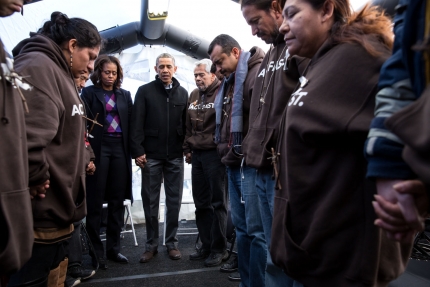
President Obama and the First Lady visited the brave individuals who are fasting in the shadow of the Capitol, sacrificing their health in an effort to get Congress to act swiftly on commonsense immigration reform.

President Barack Obama and First Lady Michelle Obama visits with a group staging a public fast for immigration on the National Mall in Washington, D.C., Nov. 29, 2013. "Fast for Families" is seeking to pressure Congress into passing an immigration bill. (Official White House Photo by Pete Souza)

Today, the President and the First Lady visited the brave individuals who are fasting in the shadow of the Capitol, sacrificing their health in an effort to get Congress to act swiftly on commonsense immigration reform. The President and the First Lady gave their support for their fight for family unity this Thanksgiving weekend, as families across the country come together to spend time with loved ones.

Since November 12, fasters from “Fast For Families” have abstained from all food except water in an effort to bring attention to the urgent need for the Republican leadership in the House of Representatives to take a vote on comprehensive immigration reform. Vice President Joe Biden, Secretary of Agriculture Tom Vilsack, Secretary of Labor Tom Perez, Chief of Staff Denis McDonough, Senior Advisor Valerie Jarrett and I have also visited Fast For families in recent weeks.

The fasters shared their stories and described empty stomachs but full hearts as they received an outpouring of support; to date, more than 3,000 people around the country have committed to fasting in solidarity.

The President and the First Lady thanked Eliseo Medina, Dae Joong Yoon, and all of the fasters for their sacrifice and dedication and told them that the country is behind them on immigration reform.  He said that the only thing standing in the way is politics.  And it is the brave commitment to change from advocates like them that will pressure the House to finally act on immigration reform.

This Thanksgiving, as friends, family, and community gather in the spirit of unity, we lend our support to those fighting for making commonsense immigration reform a reality. We will stand with them every step of the way to make sure that we bring coherence to our immigration laws, and pass a common sense reform that is consistent with our tradition as a nation of laws and a nation of immigrants.

Related Topics: Immigration

The First Lady Receives the 2013 White House Christmas Tree

November 29, 2013 | 2:32 | Public Domain

The First Lady is presented with the White House Christmas Tree, which will be displayed in the Blue Room of the White House.

Download mp4 (90MB) | mp3 (6MB)

The White House

Office of the Press Secretary

Weekly Address: Wishing the American People a Happy Thanksgiving

Remarks of President Barack Obama

Weekly Address -- Thanksgiving

Thursday, November 28, 2013

Hi, everybody.  On behalf of all the Obamas – Michelle, Malia, Sasha, Bo, and the newest member of our family, Sunny – I want to wish you a happy and healthy Thanksgiving. 

We’ll be spending today just like many of you – sitting down with family and friends to eat some good food, tell stories, watch a little football, and most importantly, count our blessings. 

And as Americans, we have so much to be thankful for. 

We give thanks for the men and women who set sail for this land nearly four centuries ago, risking everything for the chance at a better life – and the people who were already here, our Native American brothers and sisters, for their generosity during that first Thanksgiving. 

We give thanks for the generations who followed – people of all races and religions, who arrived here from every country on Earth and worked to build something better for themselves and for us. 

We give thanks for all our men and women in uniform – and for their families, who are surely missing them very much today.  We’re grateful for their sacrifice too. 

We give thanks for the freedoms they defend – the freedom to think what we want and say what we think, to worship according to our own beliefs, to choose our leaders and, yes, criticize them without punishment.  People around the world are fighting and even dying for their chance at these freedoms.  We stand with them in that struggle, and we give thanks for being free. 

And we give thanks to everyone who’s doing their part to make the United States a better, more compassionate nation – who spend their Thanksgiving volunteering at a soup kitchen, or joining a service project, or bringing food and cheer to a lonely neighbor.  That big-hearted generosity is a central part of our American character.  We believe in lending a hand to folks who need it.  We believe in pitching in to solve problems even if they aren’t our problems.  And that’s not a one-day-a-year belief.  It’s part of the fabric of our nation. 

And we remember that many Americans need that helping hand right now.  Americans who’ve lost their jobs and can’t get a new one through no fault of their own.  Americans who’ve been trapped in poverty and just need that helping hand to climb out.  Citizens whose prayers and hopes move us to act.

We are a people who are greater together than we are on our own.  That’s what today is about.  That’s what every day should be about.  No matter our differences, we’re all part of one American family.  We are each other’s keeper.  We are one nation, under God.  That core tenet of our American experience has guided us from the earliest days of our founding – and it will guide us to a future that’s even brighter than today. 

Thank you, God bless you, and from my family to yours, Happy Thanksgiving.

Volunteers from The Mission Continues Join the First Family for a Thanksgiving Service Project

Today, continuing Obama family tradition, The First Family, their extended family, and many friends packed and handed out food bags at the Capital Area Food Bank in preparation for Thanksgiving. This year, the family was joined by volunteers from The Mission Continues, who exemplify the continuing service of our Nation’s veterans. The First Family will also be donating two turkeys and canned goods to the Capital Area Food Bank.

For many of our Nation’s veterans, their desire to lend assistance to others extends well beyond their service in the military. Through The Mission Continues, post-9/11 veterans are awarded community service fellowships that allow them to engage in projects throughout the United States and continue the strong sense of purpose and mission they found in the military. These veterans are using their skills and leadership to take on tough challenges like homelessness, poverty, and educating our youth. Together, they are making a significant impact and building relationships with their local communities. Today, Joining Forces is proud to highlight several veterans from The Mission Continues who participated in the Thanksgiving service project with the First Family.

Connor Mallon is an excellent example of a veteran who has answered the call of continuing service. Connor served as a squad leader during two deployments to Iraq. After completing his military service, Connor enrolled in college and applied for a Fellowship with The Mission Continues. Connor’s passion for wildlife photography helped him secure a fellowship with the Smithsonian National Zoo as a photographer. During his fellowship, Connor created a professional portfolio of images for the Zoo to use in news releases and digital media.

Ryaja Johnson Rhone served for seven years in the United States Air Force and deployed to Afghanistan. After learning about The Mission Continues, Ryaja was eager to become a fellow. She earned a fellowship with Dress for Success, a non-profit organization that provides disadvantaged women the support they need to find meaningful employment. As a fellow, Ryaja’s goal is to provide more than 345 women with the services and support to put them on the road to great careers. 

Vu Nguyen enlisted in the Navy during his senior year of high school and served for four years. Vu was crucial to the operational readiness of the Squadron during their deployment to Bagram Airfield in 2008. After his military service ended, Vu returned to school but had a desire to continue serving, which led him to The Mission Continues. Vu earned a fellowship at the National Veteran’s Center, which provides career-oriented employment and community-based job training to veterans with significant disabilities. He served as a program manager where he utilized the skills he learned in the military to keep the program organized, moving forward, and serving veterans.

This Thanksgiving, the First Lady is thankful for our veterans who have chosen to continue their service at home as community leaders and volunteers through organizations like The Mission Continues. On behalf of the First Lady, we encourage every American to follow the example of these veteran volunteers and find ways to serve. From volunteering at a local charity, to sending a military service member a holiday card, there are many ways to support our military communities during the holiday season. To learn more about getting involved in your local community, visit serve.gov.   

Commander Cara LaPointe, US Navy, is a White House Fellow in the Office of the First Lady

The White House

Office of the Press Secretary

Remarks by the First Lady at National Arts and Humanities Youth Program Awards

East Room
 
 
2:24 P.M. EST
 
MRS. OBAMA:  Well, hello, everyone.  (Applause.)    
 
AUDIENCE:  Hello.
 
MRS. OBAMA:  Welcome to the White House -- again!  (Laughter.)  This is a good time.  We are excited to have you all here.  It’s a pleasure to be here today for the National Arts and Humanities Youth Program Awards, where we honor outstanding organizations that are using the arts to lift up our young people.  
 
And I want to start by thanking everyone from the President’s Committee on the Arts and Humanities for sponsoring these awards.  And we just announced seven tremendous new committee members this week, and we’re very excited about that.  But I’d like to take a moment to ask everyone from the committee who is here to please stand so that we can recognize you for your amazing work.  (Applause.)  Thank you all so much.
 
As I told them backstage, this is a real, working committee.  And I just want to tell you how proud I have been to work beside you all.  You all do real roll-up-your-sleeves kind of work, and it really matters, not just to me and to the President but to the lives of so many young people.  You all should be so proud of yourselves.  We are absolutely proud and grateful.  So thank you.
 
I also want to recognize Representatives Elijah Cummings and Bobby Scott.  Where are -- hello.  How are you?  (Applause.)  We also have Ambassador Kamau, who’s here.  Ambassador, thank you.  It’s wonderful to have you here.  (Applause.)  And of course, we have to recognize all of our young folks, the young people who are here today.  (Applause.)  We’re so proud.  You guys are so special.  I hope -- do you feel special right about now?  You should.  (Laughter.)  That’s good.  That’s the point.  We want you to feel special.  (Laughter.)
 
I also want to draw your attention to this beautiful pastel painting here on stage, which was made by our student speaker, Danashiya Pritchard -- Danashiya? -- who we are going to hear from.  You don’t have to come up yet.  She’s like, “Oh, my God, not now!”  (Laughter.)  She’s going to come up and tell us a little bit about herself and her work.  We are so proud of you, sweetie.  Don’t be nervous.  (Laughter.)  None of these people bite.  
 
And of course, I want to thank all of the artists, the teachers, the administrators in the audience who do the real work.  You guys are amazing.  Every day, you are out there pouring your heart and soul into these programs.  You’ve taking time out of your own lives to give young people the guidance and the support they need to be their very best.  You’re doing whatever it takes.  Many of you are answering phone calls and emails late into the night; you’re reaching into your own pockets when necessary.  And you’re doing this because you know the difference that the arts can make in young people’s lives.  You know this better than anyone.
 
You see firsthand that giving a child the chance to fill a canvas, or to perfect a harmony, or to shine on stage, that can stoke the flames of a lifelong passion, and it can teach valuable skills -- skills like hard work and persistence.  I could go on and on.  You know the skills.  It can open up possibilities that young people might not otherwise see for themselves.  And there are thousands of programs all across this country that are doing this kind of important work every day.  And today’s honorees represent organizations that have found new and creative ways to give young people these opportunities.  
 
For example, in Baltimore, the Baltimore Symphony Orchestra is providing instruments, mentors, and classes to help young people experience the magic of music and the magic of the orchestra at a very early age.  In Chicago, my hometown -- (laughter) -- StoryCatchers Theatre is helping underserved young people and those in the juvenile justice system write, produce, and perform their own musicals based on their own personal stories.  In Los Angeles, WriteGirl is matching at-risk young women with professional writers for one-on-one mentoring and coaching.  And these girls are learning to express themselves through poetry, and journaling, and investigative writing.  And in the last dozen years through this program, every single one of the program’s graduating seniors has gone on to college.
 
And these are just a few examples of how all of you are using the power of the arts to change our young people’s lives.  And as First Lady, as you know, that is something that I’ve been working hard to do as well every day in the White House.  With the incredible support of this phenomenal committee, we’ve been able to host youth workshops on everything from country music to modern dance to poetry.  In fact, just a few weeks ago, we put together one of our best events ever -- something we called our “Careers in Film Symposium.”  We had some of the biggest and best in Hollywood come, where we brought together about 80 students from Boston, New York and Washington.  All of these were young people enrolled in arts and film programs that we were talking about, and they were there to help celebrate the day.  
 
And we did everything right here on the State Floor.  We set up in the Green Room a green screen so that the kids could learn about special effects.  We brought in award-winning directors who worked one on one with these kids to teach them how to bring out the best in their colleagues and in each other.  In the Blue Room, we let them play around with some makeup, which terrified our curator.  (Laughter.)  But they were able to practice that special-effects makeup, and they put on some disturbingly lifelike cuts and bruises on our staff members -- (laughter) -- who then walked around all day looking like -- with vampire bites.  (Laughter.)  And many of them forgot they had these on, and they were in the West Wing.  And I think one of them passed by Denis McDonough, who sort of looked in horror.  (Laughter.)  But it was a lot of fun.
 
And as I walked around and talked to these young people, and I saw the looks in their eyes, I could tell that they were beginning to truly understand -- some of them maybe for the first time -- that they really do have what it takes to make it in the movie business or anywhere else for that matter; they started to envision possibilities for themselves that they never even imagined just from that day.  
 
I spoke to one young man who told me that he had never thought of pursuing special effects until that day.  And he was one of the kids -- I think he spent all of his time putting on that makeup.  (Laughter.)  But he was just drawn to it in a way that it surprised him.  And we heard later from the teachers and coaches who told us that their students left with a purpose and a fire they’d never seen before.
    
So that’s what the arts can do, a little exposure.  And the research shows that what those kids learned on that day won’t just further their interest in the arts; as you all know, it furthers their academic performance, as well.  You all know this.  Studies have shown that students who are highly involved in the arts stay in school longer than those who are less involved.  Arts education also leads to better scores in reading and math.  And it makes students much more motivated and engaged, period, in school.  They come to school more, they set higher goals for themselves, and they have a reason to achieve them because they’re determined to succeed because they’re passionate about something.  
 
And those are just some of the skills -- those skills, skills like grit and determination and resilience that they learn from this work.  Those skills will lead students to success no matter what path they choose.  You all know this.  You experience this every day.  And as you might have heard, I believe in this as well myself.  
 
I’m going to be spending a lot more of my time trying to inspire students in this country to use those skills to complete their education, talk to them more about the importance of reaching beyond high school, and the power that they already have to make that happen.  So I hope to join you in those efforts, and make that a big part of what I do for the time that I’m here.  We know that arts education and programs like yours can play an important role in achieving the President’s North Star goal, which is one of the reasons why we are so passionately supporting you all.
 
So I simply want to say thank you to all of you for the critical work that you’re doing every day.  Thank you for laying that foundation for so many kids.  I met with our performers today, all of them so bright and articulate and confident, looking me in the eye, introducing themselves.  (Laughter.)  Only arts can do that.  (Laughter.)  Yes, indeed.  (Applause)  
 
And to all the young people who are here today, I just want to say this:  I know you all probably already know this, but just in case you don’t, these programs will and are changing your lives.  So stick with it.  Stick with it.  If you love what you’re doing, immerse yourself in it.  Find the thing you’re passionate about and dig really deep.  Don’t be afraid to fail.  Just dig deep.  Give it all you’ve got, whether it’s writing or design or music.  Whatever it is, hold onto it.
 
Because no matter whether you ultimately want to go into the arts, or whether you ultimately want to go into business or teaching, whatever it is, the skills that you are learning in these programs will help you do whatever it is you can imagine for yourselves.  But as I always say, you’ve got to work hard.  That is really the message.  None of this stuff comes easy.  You have to be willing to put in the work.  Just like you do in the things that you’re passionate about, you have to bring that kind of energy to every single thing you do.  That means you’ve got to get up and go to school every day -- no exceptions.  You’ve got to finish school.  High school is not your starting point.  It is not your end.  It is the beginning.  Completing high school is the beginning of a lifelong dream of education that I hope you guys pursue.
 
And we all have your back.  We do.  You’ve got a President who is working hard to make sure you have the resources you need. You have teachers.  You’ve got parents.  You’ve got this committee of people.  They’re really important.  (Laughter.)  They are.
Just look at them.  It’s like, these are some pretty impressive people.  They care so much about you guys.  
 
So we are investing in you, so keep investing in yourself.  You promise me that.  Promise?  All right.  (Laughter.)  You’ve got what it takes.  Set your bar high, okay?  Set it really high.  Don’t let anybody talk you down to a lower bar.  Think big.  Think about being here one day, running it, all right?  (Laughter and applause.)  And if you guys do that, you can do whatever you want in life.  You got that? 
 
So with that, I’m going to turn it over to the co-chair of the President’s Committee on the Arts and the Humanities, my dear friend, Margo Lion.  Thank you, Margo.  (Applause.)
 
END
2:37 P.M. EST


The First Lady Honors National Arts and Humanities Youth Program Award Winners

November 22, 2013 | 44:35 | Public Domain

First Lady Michelle Obama, Honorary Chair of the President's Committee on the Arts and the Humanities, honors the 2013 winners of the President's Committee on the Arts and the Humanities National Arts and Humanities Youth Program Awards.

Download mp4 (1690MB) | mp3 (107MB)

Read the Transcript

Remarks by the First Lady at National Arts and Humanities Youth Program Awards

East Room
 
 
2:24 P.M. EST
 
MRS. OBAMA:  Well, hello, everyone.  (Applause.)    
 
AUDIENCE:  Hello.
 
MRS. OBAMA:  Welcome to the White House -- again!  (Laughter.)  This is a good time.  We are excited to have you all here.  It’s a pleasure to be here today for the National Arts and Humanities Youth Program Awards, where we honor outstanding organizations that are using the arts to lift up our young people.  
 
And I want to start by thanking everyone from the President’s Committee on the Arts and Humanities for sponsoring these awards.  And we just announced seven tremendous new committee members this week, and we’re very excited about that.  But I’d like to take a moment to ask everyone from the committee who is here to please stand so that we can recognize you for your amazing work.  (Applause.)  Thank you all so much.
 
As I told them backstage, this is a real, working committee.  And I just want to tell you how proud I have been to work beside you all.  You all do real roll-up-your-sleeves kind of work, and it really matters, not just to me and to the President but to the lives of so many young people.  You all should be so proud of yourselves.  We are absolutely proud and grateful.  So thank you.
 
I also want to recognize Representatives Elijah Cummings and Bobby Scott.  Where are -- hello.  How are you?  (Applause.)  We also have Ambassador Kamau, who’s here.  Ambassador, thank you.  It’s wonderful to have you here.  (Applause.)  And of course, we have to recognize all of our young folks, the young people who are here today.  (Applause.)  We’re so proud.  You guys are so special.  I hope -- do you feel special right about now?  You should.  (Laughter.)  That’s good.  That’s the point.  We want you to feel special.  (Laughter.)
 
I also want to draw your attention to this beautiful pastel painting here on stage, which was made by our student speaker, Danashiya Pritchard -- Danashiya? -- who we are going to hear from.  You don’t have to come up yet.  She’s like, “Oh, my God, not now!”  (Laughter.)  She’s going to come up and tell us a little bit about herself and her work.  We are so proud of you, sweetie.  Don’t be nervous.  (Laughter.)  None of these people bite.  
 
And of course, I want to thank all of the artists, the teachers, the administrators in the audience who do the real work.  You guys are amazing.  Every day, you are out there pouring your heart and soul into these programs.  You’ve taking time out of your own lives to give young people the guidance and the support they need to be their very best.  You’re doing whatever it takes.  Many of you are answering phone calls and emails late into the night; you’re reaching into your own pockets when necessary.  And you’re doing this because you know the difference that the arts can make in young people’s lives.  You know this better than anyone.
 
You see firsthand that giving a child the chance to fill a canvas, or to perfect a harmony, or to shine on stage, that can stoke the flames of a lifelong passion, and it can teach valuable skills -- skills like hard work and persistence.  I could go on and on.  You know the skills.  It can open up possibilities that young people might not otherwise see for themselves.  And there are thousands of programs all across this country that are doing this kind of important work every day.  And today’s honorees represent organizations that have found new and creative ways to give young people these opportunities.  
 
For example, in Baltimore, the Baltimore Symphony Orchestra is providing instruments, mentors, and classes to help young people experience the magic of music and the magic of the orchestra at a very early age.  In Chicago, my hometown -- (laughter) -- StoryCatchers Theatre is helping underserved young people and those in the juvenile justice system write, produce, and perform their own musicals based on their own personal stories.  In Los Angeles, WriteGirl is matching at-risk young women with professional writers for one-on-one mentoring and coaching.  And these girls are learning to express themselves through poetry, and journaling, and investigative writing.  And in the last dozen years through this program, every single one of the program’s graduating seniors has gone on to college.
 
And these are just a few examples of how all of you are using the power of the arts to change our young people’s lives.  And as First Lady, as you know, that is something that I’ve been working hard to do as well every day in the White House.  With the incredible support of this phenomenal committee, we’ve been able to host youth workshops on everything from country music to modern dance to poetry.  In fact, just a few weeks ago, we put together one of our best events ever -- something we called our “Careers in Film Symposium.”  We had some of the biggest and best in Hollywood come, where we brought together about 80 students from Boston, New York and Washington.  All of these were young people enrolled in arts and film programs that we were talking about, and they were there to help celebrate the day.  
 
And we did everything right here on the State Floor.  We set up in the Green Room a green screen so that the kids could learn about special effects.  We brought in award-winning directors who worked one on one with these kids to teach them how to bring out the best in their colleagues and in each other.  In the Blue Room, we let them play around with some makeup, which terrified our curator.  (Laughter.)  But they were able to practice that special-effects makeup, and they put on some disturbingly lifelike cuts and bruises on our staff members -- (laughter) -- who then walked around all day looking like -- with vampire bites.  (Laughter.)  And many of them forgot they had these on, and they were in the West Wing.  And I think one of them passed by Denis McDonough, who sort of looked in horror.  (Laughter.)  But it was a lot of fun.
 
And as I walked around and talked to these young people, and I saw the looks in their eyes, I could tell that they were beginning to truly understand -- some of them maybe for the first time -- that they really do have what it takes to make it in the movie business or anywhere else for that matter; they started to envision possibilities for themselves that they never even imagined just from that day.  
 
I spoke to one young man who told me that he had never thought of pursuing special effects until that day.  And he was one of the kids -- I think he spent all of his time putting on that makeup.  (Laughter.)  But he was just drawn to it in a way that it surprised him.  And we heard later from the teachers and coaches who told us that their students left with a purpose and a fire they’d never seen before.
    
So that’s what the arts can do, a little exposure.  And the research shows that what those kids learned on that day won’t just further their interest in the arts; as you all know, it furthers their academic performance, as well.  You all know this.  Studies have shown that students who are highly involved in the arts stay in school longer than those who are less involved.  Arts education also leads to better scores in reading and math.  And it makes students much more motivated and engaged, period, in school.  They come to school more, they set higher goals for themselves, and they have a reason to achieve them because they’re determined to succeed because they’re passionate about something.  
 
And those are just some of the skills -- those skills, skills like grit and determination and resilience that they learn from this work.  Those skills will lead students to success no matter what path they choose.  You all know this.  You experience this every day.  And as you might have heard, I believe in this as well myself.  
 
I’m going to be spending a lot more of my time trying to inspire students in this country to use those skills to complete their education, talk to them more about the importance of reaching beyond high school, and the power that they already have to make that happen.  So I hope to join you in those efforts, and make that a big part of what I do for the time that I’m here.  We know that arts education and programs like yours can play an important role in achieving the President’s North Star goal, which is one of the reasons why we are so passionately supporting you all.
 
So I simply want to say thank you to all of you for the critical work that you’re doing every day.  Thank you for laying that foundation for so many kids.  I met with our performers today, all of them so bright and articulate and confident, looking me in the eye, introducing themselves.  (Laughter.)  Only arts can do that.  (Laughter.)  Yes, indeed.  (Applause)  
 
And to all the young people who are here today, I just want to say this:  I know you all probably already know this, but just in case you don’t, these programs will and are changing your lives.  So stick with it.  Stick with it.  If you love what you’re doing, immerse yourself in it.  Find the thing you’re passionate about and dig really deep.  Don’t be afraid to fail.  Just dig deep.  Give it all you’ve got, whether it’s writing or design or music.  Whatever it is, hold onto it.
 
Because no matter whether you ultimately want to go into the arts, or whether you ultimately want to go into business or teaching, whatever it is, the skills that you are learning in these programs will help you do whatever it is you can imagine for yourselves.  But as I always say, you’ve got to work hard.  That is really the message.  None of this stuff comes easy.  You have to be willing to put in the work.  Just like you do in the things that you’re passionate about, you have to bring that kind of energy to every single thing you do.  That means you’ve got to get up and go to school every day -- no exceptions.  You’ve got to finish school.  High school is not your starting point.  It is not your end.  It is the beginning.  Completing high school is the beginning of a lifelong dream of education that I hope you guys pursue.
 
And we all have your back.  We do.  You’ve got a President who is working hard to make sure you have the resources you need. You have teachers.  You’ve got parents.  You’ve got this committee of people.  They’re really important.  (Laughter.)  They are.
Just look at them.  It’s like, these are some pretty impressive people.  They care so much about you guys.  
 
So we are investing in you, so keep investing in yourself.  You promise me that.  Promise?  All right.  (Laughter.)  You’ve got what it takes.  Set your bar high, okay?  Set it really high.  Don’t let anybody talk you down to a lower bar.  Think big.  Think about being here one day, running it, all right?  (Laughter and applause.)  And if you guys do that, you can do whatever you want in life.  You got that? 
 
So with that, I’m going to turn it over to the co-chair of the President’s Committee on the Arts and the Humanities, my dear friend, Margo Lion.  Thank you, Margo.  (Applause.)
 
END
2:37 P.M. EST


Close Transcript

The White House

Office of the First Lady

Interview of the First Lady by Bow Wow and Keshia Chante

BET’S 106 & PARK
Black Entertainment Television Studios
New York, New York

3:00 P.M. EST

MRS. OBAMA:  Hello!

Q    Well, hello!

MRS. OBAMA:  This is nice.  (Applause.)

Q    So, welcome to 106.  It's an honor, if I may say so myself, to have you here.  We're really excited that you are here.

MRS. OBAMA:  Well, let me just start by saying, first of all, that was my music to Let's Move.

Q    Yes.

MRS. OBAMA:  Beyoncé hooked a sister up.

Q    She really did. 

MRS. OBAMA:  But I have to say I was sharing with you all that this appearance gives me street cred in my own home, because my kids never care what I do.  When I told them I was coming here, they were like, oh.  (Laughter.)  So I'm very happy to be here with you.  (Applause.)

Q    So your daughters are excited.

MRS. OBAMA:  Yes, they are. 

Q    So as you said, that was a collaboration with you and Beyoncé for your Let's Move campaign. 

MRS. OBAMA:  Absolutely.

Q    Really cool flash mob dancing.  It was in a cafeteria if you guys all saw it.  And it was a great workout routine.  I got a little workout in that.

MRS. OBAMA:  A little moving.  That's important for you guys.  I want you guys to be healthy, eat right, keep moving.  When we did this video, we had flash mobs going on across the world.  It wasn't just -- so on that day, people were moving.  It was amazing.  And I just want to thank Beyoncé.  She has been terrific, just a great supporter.  She is amazing.  (Applause.)

Q    So you're so committed to encouraging young people to be the best versions of themselves.  But I kind of want to know what were you like growing up?

MRS. OBAMA:  What was I like when I was growing up?  I have to say, I was a pretty serious student.  I mean, one of the things I wanted to make sure was that I didn’t peak in high school.  That's something I want you all -- you don't want your best days to be in high school.  So I focused on school.  I mean, I was really clear that I wanted to go to college.  So I needed to have myself together, go to my classes -- be on point, be involved in the school.  I was student class treasurer, so I wasn't doing too much partying in high school.  I was trying to get myself into college.

Q    Good for you. 

Q    Oh, most definitely.  (Applause.)  And see, that was my next question.  I was getting ready to ask you, well, what did you do for fun?

MRS. OBAMA:  It was pretty low key back then.  I try to tell my kids they have way more fun than we ever do.  I mean, my kids go to parties.  They hang out.  But what we really did -- hung out with friends.  You went over somebody's house, played some music.  We didn't have a lot of money.  Nobody had cars.  You had to borrow.  I know I was driving around my father's deuce and a quarter.  And if he had to take that car to work, you didn't have a car.

So you went over to a friend's house.  There were occasional parties, but there weren't that many parties going on.  So I was probably a little more dull than people might imagine in high school.

Q    And I know with growing up, there's goals that people set all the time.  Now, was there something that you wanted to be when you were growing up?

MRS. OBAMA:  I thought I wanted to be a pediatrician when I was really little.  And then, I wasn't that great at math and science, so I switched to law, because my mother told me I like to argue a lot.  But I realized in high school and in college that you don't have to exactly know.  You're kind of always discovering yourself. 

So I studied law.  I went to law school, but it was pretty clear that I just wanted to be a good student.  I wanted to know how to read and write and communicate, be able to articulate my point, which is always a good skill.  And I'm still discovering who I want to be.  I don't know what I'm going to do when I leave the White House.  So I tell young people you are always reinventing yourself.  You're always discovering who you're going to be.  The learning never stops.  So ask me that in three and a half years or so and we'll see what it looks like on that side.

Q    You got it.  No problem. 

Q    And is it true that you commuted three hours to high school? 

MRS. OBAMA:  Yes.

Q    Was it every single day?

MRS. OBAMA:  When I was growing up, there was really one strong school in Chicago.  It was Whitney Young.  It was a magnet high school.  And if you were serious about college, you were going to go to that school.  But it was literally on the other side of the city.  So every morning, I got up at 6:00 a.m.  I had to take a city bus.  There wasn't an express bus then, so it literally took me an hour, an hour and a half to get one way. 

And then, when it was snowing, this is what we used to do, because you know kids are lazy.  We didn't want to stand.  So on bad days, we'd leave even earlier, catch the bus in the opposite direction until it was empty and got on it, so we could get seats to ride all the way back.  A little counter-productive, but we were young.  We weren't really bright.  We were just lazy.  So, yes, it took a long time to commute.

So I had trouble doing sports, because if you were going to stay late doing sports, you'd wind up getting home at 9:00 p.m. or 10:00 p.m. if you didn't have a car or a parent, so that's why I did a lot of student government, because I could do it during the school day.  But it was worth it to me, because I knew I had to go to a good high school.  I knew I had to focus and take it seriously if I wanted to compete for the top colleges.  (Applause.)

Q    Right on.  Now, speaking of school -- you guys can clap.  It's okay.  (Applause.)  Now, speaking of school this is what we want to do right now.  Okay, now we're going to show a few photos of you.  And what we would like for you to do is tell us what would you tell that girl in the photo.  Ready?  Okay, so here we go.  Photo number one, let's check it out.

MRS. OBAMA:  Oh, my gosh.  What would I tell that girl?  I don't know about you guys, but I think that girl was always afraid.  I was thinking maybe I'm not smart enough.  Maybe I'm not bright enough.  Maybe there are kids that are working harder than me.  I was always worrying about disappointing someone or failing.  And the thing that I would tell that girl is don't worry about failure, because failure is the key to success.  And you are smart enough to sit at any table and compete and to have your voice heard.  (Applause.)  And, fortunately, I've come to know that.  (Applause.)

Q    Photo number two.

MRS. OBAMA:  Oh, that girl was starting to get a little more confidence.  I'd probably tell her to put on a different shirt.  But I think that -- I can't remember what year that was.  But I still think that it gets to confidence amidst all the worries.  And I know there are kids in this audience today that are wondering how am I going to get to college, how can I pay for it?  I came from a working-class background.  My parents didn't have a ton of money, so I think there were a lot of worries going on in my head.  How was I going to get there?  How would I support myself when I got there?

So I know that kids that age are just full of worries.  And we're going to talk about that a little later on, just about how you guys can think about going that next step.  Because let me tell you, I was you.  That was me -- same girl that all of you all are -- same worries, same fears.  And look at where I am, where we are today.  You could be the President of the United States, the First Lady, anything you want to be.  That's what I would tell that girl.  (Applause.)  And I would tell you that too.

Q    I love that.

Q    Right on.  We have one more, one more photo.

MRS. OBAMA:  Where did you get all this stuff?

Q    Well, you're very popular there. 

MRS. OBAMA:  Oh, that was senior prom.
 
Q    Talk about this one. 

Q    You look fabulous.  Can I just say you are fabulous in that photo.

MRS. OBAMA:  I designed that dress and my mother --

Q    Did you?  (Applause.)

Q    Tell us the story.  Tell us the story.

MRS. OBAMA:  My mother made the dress.  We weren't going to Nordstrom's or Neiman's or anything to buy anything.  We went to the pattern shop and I picked out a couple of different patterns in the material.  And I knew I wanted that split up the side.  A little risky, but that was senior prom. 

And by then, I was breathing a sigh of relief, because by then I had gotten into Princeton even though there were counselors and people who told me that I shouldn't reach that high, that I didn't have what it would take to get into a school like Princeton.  But I ignored the naysayers.  I got myself together.  I focused on my applications.  I got my financial aid forms in.  It turned out that my parents could provide some support, but I got grants and scholarships.  I was flying high then, because I had achieved one of my most important goals after all the worry and the hard work.  Then, I could actually wear the split and have a little fun with my little date. 

So I was really -- I was feeling at the top of my game right there, because I had done something that people told me I couldn't do.  And I felt good.  I felt really good.  (Applause.)

Q    Just a sigh of relief.

Q    That's right.  And she was styling in that gold dress.  I got to let you know that right now.  After the break, the First Lady is talking about her goal to make America the smartest country in the world and how that involves you.  (Applause.)  I'm letting you know right now this is one for the history books.  Don't miss.  This is big.  Yes, indeed.  Do not go anywhere.  The First Lady is in the building.  Mrs. Obama is here.  (Applause.)

*****

Q    Welcome back.  We are still here with First Lady Michelle Obama.  And I just want to say thank you because I was invited to Bell Multicultural Academy, and I think that was the first time that you talked about the President's North Star goal.  Is that correct?

MRS. OBAMA:  Yes, you guys helped me kick off that initiative.  We are trying to make sure that by the year 2020 that the United States has the most educated population in the world.  We have slipped to 12th.  We are going to regain that, and we're going to need everyone's help here to make that happen.  (Applause.) 

Q    Yes.  Let's take a look real quick at what happened at Bell.

(Video plays.)

Q    That was -- I have to say that was such a cool experience, not just because that you came out and you gave a wonderful, inspirational speech, but I just thought the kids were so inspired and so motivated, and I think the best part was everyone kicked out the press.  There was a point where there was no cameras, there was no press, it was just you, it was Jeff, it was me, and the kids, and you spent so much time, hours and hours, just answering all their questions, and I thought that was amazing.  It was really cool that you did that.  (Applause.) 

MRS. OBAMA:  Well, it was tons of fun for me.  And I know that there are a lot of young people around the country who have questions about how to -- what do I do after high school?  And that's one of the things -- by the year 2020, most of the jobs that are going to be out there available for young people are going to require some kind of education or training beyond high school.  And we want to get you all ready for that.  There are so many resources out there, and we want to answer your questions, and I want to tell my story so that you understand that you can -- if I can do it, you all can do it.

Q    Right on.  (Applause.) 

Now, we're continuing that conversation here today.  But before we open it up to our audience, what are the steps of taking control of your education?

MRS. OBAMA:  Well, first of all, I want all young people to understand there is nothing more important that they will do for themselves than to focus on their education.  And the President, the Secretary of Education, they're doing tons of things to provide support, but ultimately, it's up to the student.  I knew nobody was going to take my hand and walk me through the college process, so I had to own that.  And it starts with taking high school seriously, and doing the best you can in every course you take, doing all your homework, being in class on time, no matter what you think about your teachers, or your parents' support.  It's up to you to be in that school learning as much as you can as often as you can, and then asking for help when you need it.  (Applause.) 

Q    What would you say are the biggest obstacles our audience face in just taking those next steps?  What do you think are the biggest things?

MRS. OBAMA:  Well, it's just knowing what to do.  I look at -- you know, I have a sophomore in high school.  Malia is going to be applying for schools.  And the amount of information, just doing test prep, getting ready for the SATs, knowing what applications, what financial forms you need to fill out, what kind of colleges are right for you, is a four-year college the right thing for you -- because higher education looks like so many different things.  It's a two-year community college.  It can be a training, a tech program.  So how do you begin to explore that?

So we want young people to ask these questions, because we've got a great website, studentaid.gov.  I want everybody to write that down.  That's a site that the government has created to help walk you through the process of figuring out, beginning as a freshman all the way through senior year, what are the steps that you and your families need to be taking to make sure you're where you need to be when you graduate from high school.  (Applause.) 

Q    Yes.  So now it's time to hear from some students.  Please welcome Jeff Johnson, who will be taking your questions. 

Hey, Jeff.

Q    Hey, you all, thank you.  First Lady, good to see you again.  It was great to be with you last week.

MRS. OBAMA:  It's great to see you.  You were amazing.

Q    Thank you so much.  But right now we have a question.  What's your name?

Q    Melanie (ph). 

Q    Where do you go to school?

Q    Career High in New Haven.  

Q    And what's your question for the First Lady?

Q    Do you have any advice for kids today?

MRS. OBAMA:  My advice is what I've been saying:  Education is what you should be focused on right now.  It is the best investment that you can make for yourselves.  I mean, when we think about our history and our how our grandparents and great grandparents fought and died so that we could get an education, we have no excuse but to take advantage of every opportunity that they died and fought for.  And there is no excuse.  Folks were learning how to read with no light, no heat, no food.  So we as young people -- I want to make sure you all as young people know you don't have an excused not to go to the schools that are available to you, especially when you think about what's going on around the world.  And there are kids who are dying to have access to the educational opportunities that we have here in America.  So I want you guys to own that.  Reclaim that hunger for education.  (Applause.) 

Q    We have another question.   What's your name?

Q    Hannah (ph).

Q    And where do you go to school?

Q    Career High in New Haven.

Q    And your question for the First Lady?

Q    When did education become so important to you?

MRS. OBAMA:  It was something that I knew from the very beginning.  It was never a question in our household.  I mean, my parents weren't rich.  They were working-class folks, but they had a belief in the power of education, and it was just assumed you were going to college, and they were going to figure out how to help us make that happen.  So it was -- there was never a question in my mind.  And that's what we want young people to do to get us to that North Star goal, is to start thinking beyond high school.

High school is a stepping stone.  It is not the finish line for anyone, because if you view it as a finish line -- sometimes you think, oh, you know, by the time I’m a senior I’m not going to have to be bothered with this anymore, so why go to class, why worry about learning how to write? 

We need you all to be educated so that we have a workforce that can make sure that this country is competing globally.  (Applause.) 

Q    We have another question.  How are you? 

Q    I'm good.

Q    You good?  What's your name and what's your question?

Q    Hi, I'm Najay (ph), and my first question is, what advice do you give to your daughters now about their education?

MRS. OBAMA:  The same thing that my parents told me.  They have to put 120 percent into their education.  And one of the things that I'm hoping that they develop is a passion for learning.  I mean, so many young people just get into the grades, and checking the boxes of just doing what they think they're supposed to do, but there's also a value in learning how to love to learn, because you're going to have to be doing that forever.

The way jobs are going now, nothing is set in stone.  Few people work at a job for 50 years and retire and get that gold watch.  People are needing to retrain, and be able to reeducate themselves, so that they stay on top of the jobs of the future.  So I want my girls to be lifelong learners.

But I also don't want them to take anything for granted.  I mean, these kind of conversations I'm having with you guys I have with them.  They don't have any excuse not to be outstanding students.  We're counting on them to do that. 

And we're starting to work on -- I'm starting to talk -- I've been talking to my kids about college, and getting them to think about how much fun that's going to be, and getting excited about the possibility of living on a campus with other young people, and being able to explore, and making that something that they are desperate to get at. I don't want them staying at home up under me.  (Laughter.) 

Q    Well, thanks again to the students who asked their questions, of course.

Q    Thank you so much.  You know, I had a question for you.  I have a question for you.  What do you say -- because nowadays a lot of kids, they see the entertainers, or they see the ball players, and they might say, you know, I'm in high school and I'm already getting recruited for ball, and I look at a Sean Diddy Combs, and he didn't have to go to school, or most other guys are making it are successful.  They might not have that college background.  What do you say to those that think like that?

MRS. OBAMA:  Yes, I would just say that those people are few and far between.  That is like winning the lotto.  My brother is a head coach of a Division I school, and he's working with some of the top athletes in the country, and they all want to go pro.  But he's got them focused like he did when he was in college -- that he had to have Plan B, C, and D -- and it all started with having an education. 

And the truth is, as you all both know, you have to have education to be in entertainment, to be able to manage your business.  You see all these entertainers and athletes who get taken advantage of, they wind up broke at the end of their careers, because if you don't know how to read and count, you can't check up on your lawyer and your accountant.   You have to know this stuff better than they do, because no one is going to look out for you better than you.  (Applause.)  So going to college, getting an education is -- it is a must.

Q    And I was going to say, the one thing that no one can take away from you is your education, because a lot of those people -- you can lose a lot of things in life, you can lose health, you can lose circumstances, but you always get to keep what you know, and I think that's super important.

MRS. OBAMA:  Absolutely.

Q    I believe in that.

Q    That's right, that's right.  We'll get to know the First Lady a little better after the break.  Stick around.  I told you this is history.  (Applause.)  The First Lady is here.  Don't go nowhere.  (Applause.) 

*****

Q    Welcome back to 106 and Park.  We still have First Lady Michelle Obama here with us and we’ve had a great conversation about the President’s North Star goal to make the United States number one in college graduates by the year 2020.  I totally believe it’s going to happen.  (Applause.)  And you guys are going to help, correct, 106?  (Applause.)

So now it’s time for the Bowl of Randomness.  (Applause.)

Q    Okay, so this is what we’re going to do here.  We have this magic bowl and you’re going to reach in here, there are some questions.

MRS. OBAMA:  It’s just not any bowl.  It’s popcorn.

Q    Garrett’s.  Chicago.  That’s right.

MRS. OBAMA:  Chicago's finest.  All right, first question:  What’s one thing you miss about your life before becoming First Lady?  That’s a great question.

You would imagine how -- anonymity, being able to walk out your front door on your own without agents, people following you around.  I just long to walk out that front door, go to CVS and buy some toothpaste, and nobody would notice me.

Q    Have you ever tried?  Like maybe like a wig and beards?

MRS. OBAMA:  I do a cap and I’ve taken the dogs out for a walk.  I’ve gotten to sneak into Target a couple of times, but the longer we’re here, the more people -- it’s harder because I was doing that when we first got here.  So anonymity is something that I miss.

Q    I couldn’t imagine just walking into Target and -- that would just be like --

Q    Be like, is that who I think it is?

MRS. OBAMA:  Well, the first time I did that I was in an aisle, one woman walked up to me and she tapped me on the shoulder, and I thought, okay, she's seen me.  And she said, can you reach up there and hand me that detergent?  (Laughter.)  And I was like, all right. 

Question number two:  On a scale of 1 to 10, how awesome was it when the President started singing “Let’s Stay Together” -- Al Green?  That was pretty awesome.  I mean, he’s got a pretty good voice.

Q    He does.

MRS. OBAMA:  I always say my husband has got swag.  He’s got a little swag.  (Applause.)

Q    He definitely does. 

MRS. OBAMA:  It was really sweet.  But he sings all the time.  Oh, yes, he’s in the bathroom all the time just singing.  He is always willing to sing.  He’s like, you want me to sing now, want me to sing something for you?  But he has got a good voice.  That was very sweet.

Q    All right, well, here we go.  Another one.  Let’s reach in there.

MRS. OBAMA:  Number three:  What’s your biggest fashion regret?

Oh, that’s a tough one.  Wow, biggest fashion regret.  I don’t have an answer to this one.  I kind of always am happy with what I’m wearing.  (Applause.)  Sometimes as First Lady, sometimes I forget I’m the First Lady and I’m running around in shorts.  I know the first time we went on a family vacation, I had shorts on getting off of Air Force One and that created a huge stink because people were like, she’s wearing shorts getting off of Air Force One.  And I thought, what, we’re on vacation.

Q    And you have to be comfortable when you fly.

MRS. OBAMA:  So I have avoided shorts getting off of Air Force One.

Q    Let’s get one more.

MRS. OBAMA:  All right, one more.  One more.  Who is a better dancer, you or the President?

That’s easy --

Q    Uh-oh.

MRS. OBAMA:  Me.  (Laughter and applause.)  Without a doubt.  Without a doubt.  He can sing.  I can dance.  I think that divides the talent evenly across the family tree.  We’re all satisfied.  (Applause.)

Q    Thank you for answering the questions in the bowl of randomness.

MRS. OBAMA:  Thank you, guys.  That’s fun.

Q    Me and Bow actually have a random question for you.  You have one?

Q    Didn’t you have one?

Q    Oh, I’ll go first.

Q    Okay, go ahead.

Q    Okay.  So what is a pick-up line that President Obama has used on you?

MRS. OBAMA:  Oh my goodness.  It wasn’t a line, it was a whole day.  Our first date, he laid it out.  I mean, he covered every base.  He took me to an art museum.  And then he was talking Picasso.  So he showed me his little cultural side and then we went for a long walk and we went to see the opening of “Do the Right Thing” -- Spike Lee -- so he showed me his swag side.  We had a deep conversation about that and we ended it having drinks on the top of the John Hancock Building in Chicago.  That was our first date.  (Applause.)

Q    Wow.

MRS. OBAMA:  Yes.  That was a whole day.

Q    I have to totally step my game up.  And my question for you is, what is the First Lady’s guilty pleasure?

MRS. OBAMA:  Oh, I could go on and on.  Garrett’s popcorn, pizza, French fries.  I mean, I believe in “Let’s Move” but I always talk about life in balance.  I work out hard, I work out every day, so if I want some French fries -- I would say French fries are my most favorite guilty pleasure.  If I could eat French fries 24-7, I would.  But folks, we can’t do that.  (Laughter.)  That’s my message:  Eat your vegetables, get your workout in, “Let’s Move”, all that good stuff, but a French fry every now and then, it’s not too bad.

Q    You are so fun.  Do you have any last words?  You said a lot of amazing things, but any last words you want to give?

MRS. OBAMA:  Well, what I want young people out there to know is that to be where you want to be in four years or in three years, two years, you have to start now.  I tell my girls, you have to practice being who you want to be every single day.  If you want to be a responsible, accomplished adult, you have to start now.  You won’t wake up one day and become that person -- you have to invest in that now.  And that goes for your education as well.  You all have to start now thinking about where you’re going to be in four years, or when you graduate from high school.  I want you guys to utilize studentaid.gov.  It’s a great resource and I want everybody out there to go online and check that out, and I want you guys to help us reach that 2020 north-star goal.  I know we can do it.  I’m so proud of you all.  Keep it up. 

Q    I just want to say thank you so much.  This was such a surreal moment for us.  And I probably speak -- I don’t want to say probably, I know I speak for every young man and every young girl that’s watching right now that this is honestly a pleasure for you to come here and to grace this space with us, like you don’t understand how much this really means to us.  And plus, BET and 106 and Park, and you’ve got our vote.  You’ve got us.  So anything you need from us, you guys have it.  Thank you so much.

MRS. OBAMA:  We love you guys -- proud of you both, proud of you all.

Q    Thank you so much.

END
3:37 P.M. EST

The White House

Office of the First Lady

Remarks by the First Lady at DSCC Women Senators Event

Sheraton Hotel & Towers
New York, New York

12:41 P.M. EST

MRS. OBAMA:  Well, good afternoon.  (Applause.)  Are you all fired up?  Just how fired up are you?  (Applause.)  This is the time to be very fired up. 

Thank you so much.  It is a pleasure to be here today with so many fabulous women -- and I see a few brave men in there, too.  (Laughter.)  And speaking of fabulous women, I want to start by thanking Senator Tammy Baldwin for that very kind introduction.  She is amazing.  She is doing such a phenomenal job.  (Applause.)

And I also want to recognize Senator Bennet for his terrific leadership as our DSCC Chair.  (Applause.)  So proud of you.  Keep it up.  I also want to thank all of the other senators and senate candidates who have taken the time to be here today.  Truly, we are so grateful for your leadership, for your service.

And of course, most of all, I want to thank all of you for taking the time to be here today.  I want to thank you for everything that you have done for my husband, and for so many other leaders who share our values.  Thank you for being there for them year after year, election after election. 

And, look, I know it hasn’t always been easy.  I know that there have been plenty of ups and downs over these years.  But if you have ever wondered whether your support makes a difference, if you’ve ever doubted that it matters who we elect to serve in Congress, well, I think recent events should put any of those doubts to rest.

What happened last month reminded us that the folks that we send to Washington make decisions about some very important issues –- issues that affect our lives every single day.  Will we be able to see a doctor when we’re sick?  Will our businesses have what they need to create good jobs?  Will our kids have what they need to learn and grow –- things like decent nutrition, safe streets, good schools?

And make no mistake about it, these questions –- questions that are debated every day in Congress –- these questions speak to our most fundamental values and aspirations as a nation.  See, we believe, here in America, no matter how you start out, if you’re willing to work for it, if you're willing to sacrifice for it, you should be able to build a decent life for yourself and an even better life for your kids.  That’s the American Dream that we all believe in.  We can never forget that. 

No, we don’t believe in handouts.  We don’t think anyone should get a free ride.  But we also understand one simple principle -- that “there but for the grace of God go I;" that in the blink of an eye, any of us -- any of us -- could be faced with a terrible diagnosis.  Any of us could be injured in a horrible accident.  Any of us could lose the job we count on to support our family -- any of us.

And when that happens, it shouldn’t mean falling off a cliff.  It shouldn’t mean having to go without food, or medicine, or a roof over our heads –- not here in the United States of America.  Not in the greatest country on the planet.  That is not who we are.

Here in America, while we expect everyone to do their fair share, we also believe that we should give everyone a fair shot.  We believe that everyone should have the basic security they need to provide for their families, give their kids a decent chance in life.  And that’s the kind of security that I and I know so many of you grew up with. 

You know my story by now.  My family wasn’t rich -– far from it.  You know that my father had MS, which is a serious chronic condition.  So we lived with the reality that at any given moment, my father could have had a flare-up, needed medication, even been hospitalized.  That’s how we lived our lives.  But we were lucky -- my father’s job at the city water plant provided health insurance, so my dad was able to stay healthy enough to get up every day and to go work. 

So for families like mine, health insurance meant everything -- it meant everything.  It gave my dad the pride and dignity of being our provider, being able to pay our bills on time.  He was even able to pay the tiny little bit of my college tuition that wasn’t covered by student loans and grants.  And, in turn, that allowed me to get my degree, build my career, and to support a family of my own. 

And every family in this country deserves that kind of security.  Every child deserves that kind of opportunity.  And that’s why Barack has worked so hard to lift up the middle class.  That’s why he fought so hard and risked so much to pass the Affordable Care Act.  (Applause.)  And that’s why, time and again, he has stood strong for our most fundamental values -- whether that’s getting equal pay for women, or ending "don’t ask, don’t tell," or supporting our right to marry the person we love.  (Applause.)

And today, not even five years after Barack took office in the depths of a historic economic crisis, we’re now seeing the results of those convictions and all that hard work.  As Tammy said, our auto industry is back -- there's no doubt about that.  Our housing market is rebounding.  Our deficits are shrinking.  And our businesses have created 7.5 million new jobs. 

But please, let us be very clear, Barack hasn’t done any of this alone, just sitting by himself in the Oval Office -- so sad.  (Laughter.)  Fortunately, he has not been alone.  

Remember the Recovery Act that helped rescue our economy and create all those jobs?  Well, we needed Congress to pass that bill.  And, as Tammy said, the Lilly Ledbetter Fair Pay Act to help women get equal pay for equal work?  Believe it or not, that bill was passed by Congress back in 2009 -- Congress was working then.  And the Affordable Care Act?  That’s right, Obamacare was passed by Congress in 2010, signed by my husband, and upheld by the Supreme Court.  (Applause.)

So at the end of the day, so many of our most important accomplishments, so much of what Barack has done to help working families, that all happened because of who we had in Congress.  Let’s not forget that some of our most frustrating defeats happened for the exact same reason.

The DREAM Act -- an act that gives immigrant kids a fair shot, kids brought here by their parents through no fault of their own -- this act failed, once by just five votes in the Senate, and once by just four.  So the President had to sign an executive order to finally get these kids some relief.  And let's not forget about that commonsense gun legislation that so many of us feel so strongly about.  Sadly, as you know, that bill failed, and you want to know by how many votes?  It failed by just six votes in the Senate -- six.

So make no mistake about it, the midterm elections matter.  They matter.  And if you want to bring some change to Congress, then we can't just sit around feeling angry or helpless or hopeless.  Because there’s something that we and all of you can do right now, today, to make a huge difference, and it's simple:  You can write a big old fat check.  (Laughter.)  That’s what we need you to do right now.  Write a big check, big huge one.  Write the biggest check you can possibly write.  Take your frustration, your passion, your hope and turn that into real, meaningful support for leaders who will truly represent the people they serve.

Do not wait another minute, because the stakes are simply too high.  They couldn’t be higher.  And so many people, people I meet every day, they are counting on all of us to make our voices heard.  Families who are working harder than ever and deserve to make a decent wage, they’re counting on us, because no one in this country should work 40 or 50 hours a week and still be stuck in poverty.  That’s not who we are.

Folks without insurance who’ve been living from emergency to emergency.  Folks who’ve been ignoring their symptoms and just praying that nothing goes wrong -- that’s been their health care -- because no one should go without health care in one of the wealthiest countries in the world.  (Applause.)  They're counting on us.

Our children and grandchildren all across this country, they deserve good schools, the chance to go to college.  They deserve commonsense gun safety laws to keep them safe in their classrooms and in their neighborhoods.  So those kids, they are counting on us.  (Applause.)

And all the women and families who don’t want anyone interfering with their most private health decisions –- women who are more than capable of making our own choices about our bodies -- those women are counting on us to stand up and fight for their rights and freedoms.  They're counting on us.  (Applause.)  And that’s why we need your support.  That’s why I'm here.  That’s why we're here.  

And I know that some of you might occasionally feel a little bit annoyed that we’re always hitting you up for some money.  Somebody said that to me -- oh, it was you.  (Laughter.)  No, it wasn't.  But that’s okay.  It's okay, you can admit it, it's annoying. 

But the thing is -- it's the truth -- we do this because writing those checks is the single most impactful thing that you can do right now, because it’s not enough for us to have the most dedicated, hard-working, public-minded candidates if they don’t have the resources they need to win elections.  It’s not enough for us to have the best policies and ideas if no one hears about them and we never get a chance to implement them.  

So we can’t just sit back on our moral high ground feeling good about ourselves.  We need to keep moving forward.  And that’s why your support is so vitally important, because when you dig deep, that translates into things like staff hired and offices opened.  It translates into calls made, doors knocked on, and ads running where they need to run.  That’s what happens when you dig deep.  These things don’t happen by magic.  You all know, you've been involved long enough -- they only happen because of folks like you.

And I also know that it feels like we just did this big push for the 2012 Presidential election, and I know it can be hard to get geared up again for the midterms.  But when you find yourself starting to tune out or to get a little fatigued, I just want you to think about some cold, hard numbers that I think about every day.

The fact is that right now, we are just six seats away from losing the Senate -- just six.  That’s how close these midterm elections are.  So it is critical that we elect Michelle Nunn, Alison Grimes, Natalie Tennant.  It is critical that we get them to the Senate.  And it is just as critical that we elect -- reelect Senators Mary Kay Hagan, Mary Landrieu, Jeanne Shaheen -- it is critical, because we all know that it’s not enough to elect Barack Obama President if we don’t give him a Congress that will help him keep moving this country forward.  We know that now.  We've seen it.  We've experienced it.  (Applause.) 

So we need you all to max out.  And just as important, once you’ve maxed out, we need you to get everyone you know to give whatever they can, as well.  (Laughter.)  Yes, there's more.  And I know as women that there's nothing more uncomfortable than asking people for stuff.  I hate doing this.  I love you all, but I hate asking you guys for stuff -- and I've gotten pretty good at it.  (Laughter and applause.) 

We as women, we feel a little awkward asking for stuff.  We feel a little embarrassed to ask people for money.  Oh, my goodness.  But this is what I think when I start feeling shy or embarrassed -- I just think -- I want you to think about all those folks, again, who are counting on us every day; all those kids, all those women, all those families who need someone on their side standing up for them.

So now is not the time for us to be hesitant, or doubtful, or fatigued.  Now is the time for us to be energized.  Ladies, now is the time for us to be inspired -- not in four years, not in two, now is the time.  Now is the time to tap into the deep well of passion and compassion and strength that we all have as women.  No one can do this better than us as women. 

And here's the thing -- we have seen it time and time again -- when we do that, when we step up and dig deep and bring others along with us, then we keep making that change that we believe in.  We keep moving this country forward.  And together, we keep building a future worthy of our children. 

So are you all ready for this?  (Applause.)  Ladies, are we ready for this?  We've got these candidates, they are strong, they are smart, they are the best this country has to offer.  And the only thing standing between them and victory is us.  We can do this.  We've got the right people.  Now we just need to roll up our sleeves and do the work. 

And I'm going to be there with you all and with these candidates every step of the way.  So I'm going to be working hard and I'm going to be counting on each and every one of you to do the same.

So thank you so much, and God bless.  (Applause.) 

END

12:57 P.M. EST

West Wing Week: 11/15/13 or "We Will Stand By Your Side"

Welcome to the West Wing Week, your guide to everything that's happening at 1600 Pennsylvania Avenue, and beyond. This week, the First and Second Families honored Veterans Day, the President traveled to New Orleans and to Cleveland to speak on the importance of infrastructure to job creation, signed the EpiPen Law, discussed immigration reform with Faith Leaders and attended the 5th Annual Tribal Nations Conference. That's November 8th to November 14th or "We Will Stand By Your Side."

Related Topics:

West Wing Week: 11/15/13 or "We Will Stand By Your Side"

November 15, 2013 | Public Domain

Welcome to the West Wing Week, your guide to everything that's happening at 1600 Pennsylvania Avenue, and beyond. This week, the First and Second Families honored Veterans Day, the President traveled to New Orleans and to Cleveland to speak on the importance of infrastructure to job creation, signed the EpiPen Law, discussed immigration reform with Faith Leaders and attended the 5th Annual Tribal Nations Conference. That's November 8th to November 14th or "We Will Stand By Your Side."

Download mp4