The White House

Office of the Press Secretary

Remarks by the First Lady at Disney's Veterans Institute

Disney Boardwalk Inn

Orlando, Florida


12:32 P.M. EST

MRS. OBAMA:  Well hello, everyone.  It is a real pleasure to be with all of you today, not just because it's at Disney.  (Laughter.)  Because when you turn off that highway, you just can't help but get excited.  This is a magical place.  And I begged my Secret Service to let me go on some rides -- (laughter) -- but I don’t know if we'll make that happen.

But I want to start by thanking Bob for that very kind introduction, and for Disney's outstanding leadership on behalf of our veterans.  Disney has truly gone above and beyond.  They have created an entire initiative on veterans-hiring here at Disney, and they're also hosting this wonderful summit to help other companies do the same.

And it's this kind of generosity, it's this kind of commitment that we were exactly going for through Joining Forces.  That’s what it's all about.  So I just want to take a moment to give Bob and the Disney team another round of applause.  (Applause.)  Congratulations.

And of course, I want to thank all of you for taking the time to join us here today.  And I understand that you've been busy this morning with panels and remarks, and I also understand you'll be spending all afternoon learning new hiring strategies and best practices.  And I also know that it's not easy for many of you to take this much time away from your businesses, your work -- particularly for those of you from small- and medium-sized businesses. 

But I also know, as Bob said, there's a reason that you chose to be here today.  And it's not just because hiring veterans is the patriotic thing to do -- which it absolutely is.  You're here because hiring veterans is the smart thing to do for your businesses, because veterans are some of the most highly skilled, hardest-working employees that you will ever find. 

And you don’t have to take my word for it.  Just look at the research.  A recent report from the Institute for Veterans and Military Families at Syracuse University states that veterans are resilient, they are good at team-building, they're comfortable with diversity, they're good at handling uncertainty, they have language skills and technical training -- and the report goes on and on and on. 

Many of you already know this from firsthand experience.  For example, those of you who work right here at Disney may have encountered an employee named Glenn Tussing.  Now, Glenn served in the Air Force as Chief of Future Joint Manpower Requirements.  Now, with a title like that, you might wonder how on Earth did Glenn wind up here at Disney.  But if you look at what Glenn was actually doing in the military, it makes perfect sense.

See, Glenn was a manpower expert.  And for every mission he was assigned, he was responsible for figuring out the exact numbers and types of troops needed for that mission to succeed -- from the pilots, to the engineers, to the medical personnel.  Then he would have to locate those troops, and then help them get where they needed to go. 

So when Disney was looking for someone to manage the menus in Disney properties around the world, and then figure out the exact quantities and types of ingredients needed for every recipe at every meal, and then get that information where it needed to go, they knew that Glenn was their guy.  (Laughter.)  In fact, today, Glenn says he's actually using the same types of databases and programs he was using in the military -- although Glenn reports that here at Disney, folks smile a whole lot more.  (Laughter.) 

So it's fair to say that our veterans have some highly marketable and highly transferrable skills, and chances are you won't go wrong if you hire a veteran.  But for many companies, that’s really where the biggest challenge lies -- in the hiring process.

For example, where do you go to find veterans who are looking for work?  How do you translate all those military credentials, those acronyms and jargon on their résumés into civilian qualifications?  And once you've got veterans on board, how do you retain them?  How do you ensure they have the opportunities and support they need to succeed?

So it's really not for lack of interest that small- and medium-sized companies don’t hire veterans.  Often it's just a lack of information or resources.  And as an employer, that deficit can make you hesitant, because when it comes to hiring a veteran, you want to get it right.  And fortunately, that’s what you all have learned about today.

You've learned how to get it right.  You've learned that veterans can bring valuable skills to every part of your business, from marketing to IT, to strategic communications and operations.  You've learned that there are thousands of government job centers and nonprofits that are eager to help you bring veterans on board.  And this afternoon, Disney is going to be teaching you how to successfully recruit and retain veterans all across the country.

So now it's up to you to go home, put all these resources and all this good expertise to use.  And this is the perfect time to get started, because in the coming months, as you know, more and more of our servicemembers are -- be coming home and hanging up their uniforms, and transitioning to civilian life.  And we're counting on all of you to ensure that these veterans can get the good jobs they deserve.

That’s especially true for small- and medium-sized businesses.  Because there are veterans in just about every zip code in this country, but not every community has a Disney.  What every community does have, however, are local businesses like the ones that many of you represent.  So companies like yours can actually hire veterans where they and their families live.

And remember -- you don’t have to be a Disney or a Walmart and hire hundreds of thousands of people to make a difference.  Maybe you can just bring one or two, maybe a dozen veterans on.  And that’s okay, because every single one of those hires matters.  And taken together, they add up pretty fast. 

In fact, two years ago, the small- and medium-sized businesses in the International Franchise Association committed to hiring 80,000 veterans and military spouses.  Pretty impressive, right?  Well, just recently, they announced that they've nearly doubled that number by hiring a total of 150,000 veterans and military spouses in just two years. 

So I know you all can do this.  And once you've gone home and you've made your hires, we need you to reach out and help other small- and medium-sized businesses in your communities do the same thing.  Share what you've learned here today.  Answer their questions.  Ease their concerns.  Follow Disney's example and pass this knowledge on to keep increasing the number of available job opportunities for veterans and military spouses. 

And to the big companies that are here today, I just want to thank you.  Thank you to those of you who have already done so much for our veterans.  In just the past six months alone, you've helped us rack up nearly 100,000 hires.  That makes for a grand total of more than 380,000 veterans hired since we first launched Joining Forces just two and a half years ago.  That’s outstanding.  (Applause.)  That’s outstanding. 

But of course, until every veteran in this country who wants a job has a job, it's still not enough.  So we need you all to really dig deep.  We need you to double down.  And that’s exactly what AT&T is doing.  They've committed to doubling the number of veterans they hire.  Starbucks --  

AUDIENCE MEMBER:  Woo hoo!

MRS. OBAMA:  Yes, woo hoo!  (Laughter.)  Starbucks has just announced that over the next five years, they'll be hiring 10,000 veterans and military spouses all across America.  And just since Memorial Day, Walmart has hired 20,000 veterans -- that’s 20,000 hires in less than six months.

So these are really impressive numbers.  And what I want you to remember is that each one of these hires creates a ripple effect that runs through families and communities all across this country.  Because when you hire one veteran, you're not just giving a highly qualified employee the chance to help your company succeed, you're giving one more American hero the chance to keep on serving his or her country.  You're giving that hero's families the security that comes with a steady paycheck.  And you're modeling a certain set of values for your community and for your country.  You're sending a clear message that we honor those who sacrifice for us, and when they come home, we're going to have their backs.

And in the end, that’s really my message to all the veterans here today.  America has your back.  And if you ever need to be reminded of how grateful this nation is and how much we care about you, I just want you to look around this room.  As one example, you have got one of the biggest, most well-respected companies in the world hosting hundreds of other great American companies, and they're all here because they want to serve you as well as you have served this country.

So I want to end today as I started -- by, once again, saying thank you.  Thank you to our veterans for your service and sacrifice, and to your families.  Thank you to Disney for putting together this wonderful event.  And thank you to all of you here today for everything your companies are doing and will continue to do on behalf of our nation's veterans.  And I look forward to working with you all in the months and years ahead. 

Thank you so much.  God bless.  (Applause.)

END                

12:43 P.M. EST

First Lady Michelle Obama Speaks on The Power of Education

November 12, 2013 | 17:33 | Public Domain

First Lady Michelle Obama speaks to sophomore class at Bell Multicultural High School in Washington, D.C. and addresses the importance of higher education and her hopes for them as college graduates in 2020.

Download mp4 (1430MB)

Read the Transcript

Remarks by the First Lady at Education Event with DC High School Sophomores

Bell Multicultural High School,
Columbia Heights Education Campus
Washington, D.C.

11:24 A.M. EST
 
MRS. OBAMA:  Well, good morning.  How are you all doing?  You good? 
 
STUDENTS:  Yes.
 
MRS. OBAMA:  Let me tell you, I’m thrilled to be back here at the Columbia Heights Education Campus.  How many of you guys were here when the President and I were here the last time?  (Applause.)  Yes, show -- applause are good.  That will help me out.  That’s good. 

So you guys have made some good progress, and now we’re back because we are so proud of what you all have been doing here, and we thought that this was the best place to begin this conversation.   
 
So let me start by thanking Menbere for that very kind introduction.  She is a proud representative of what this school can do, and her story is one that we want you all to emulate. 
 
I also want to recognize Mayor Gray, as well as Kaya Henderson, the Chancellor of the D.C. Public Schools.  And of course, I want to recognize your principal, Principal Tukeva, and all of the faculty and staff here at Bell Multicultural High School.  Thank you for hosting us.

Of course, I want to thank Secretary Duncan for joining me today, as well as Jeff and Keshia and everyone from 106 & Park for helping to facilitate today’s discussion.  Let’s give them all a big round of applause.  (Applause.)   
 
But most of all, I want to recognize all of the young people who are here with us, the sophomores here at CHEC.  And I wanted to come here today because you guys and students like you across America are at the heart of one of my husband’s most important goals as President. 
 
See, when Barack came into office, one of the very first things he did was to set what he calls a North Star goal for the entire country -– that by the year 2020, the year that all of you will be graduating from college, that this country will have the highest proportion of college graduates in the world. 
 
Now, Barack set this goal because as a -- a generation ago, we were number one in college graduates.  But over the past couple of decades, this country has slipped all the way to 12th.  We’ve slipped.  And that’s unacceptable, and we’ve all got a lot of work to do to turn that around and get back on top.
 
But Barack didn’t just set that goal because it’s good for our country.  He did it because he knows how important higher education is to all of you as individuals.  Because when the year 2020 rolls around, nearly two-thirds of all jobs in this country are going to require some form of training beyond high school.  That means whether it’s a vocational program, community college, a four-year university, you all are going to need some form of higher education in order to build the kind of lives that you want for yourselves, good careers, to be able to provide for your family. 
 
And that’s why the President and Secretary Duncan have been doing everything they can to make sure that kids like you get the best education possible and that you have everything you need to continue your education after high school.  They’ve been fighting to strengthen your schools and to support your teachers.  They’ve been working hard to make college more affordable for all young people in this country no matter where you come from or how much money your parents have.  They’ve been working with parents, teachers, administrators, community leaders all across this country just to help you succeed.
 
But here’s the thing -- and I want you to listen to this -- at the end of the day, no matter what the President does, no matter what your teachers and principals do or whatever is going on in your home or in your neighborhood, the person with the biggest impact on your education is you.  It’s that simple.  It is you, the student.  And more than anything else, meeting that 2020 goal is going to take young people like all of you across this country stepping up and taking control of your education. 
 
And that’s what we’re going to talk about today.  We’re going to talk about the power that each of you has to commit to your education.  We’re going to talk about the power that you have to fulfill your potential and unlock opportunities that you can’t even begin to imagine for yourselves right now.  And when I talk about students needing to take responsibility for their education, I want you all to know that I’m speaking from my own personal life experience. 
 
Like Menbere, growing up, I considered myself pretty lucky.  Even though my parents didn’t have a lot of money, they never went to college themselves, they had an unwavering belief in the power of education.  So they always pushed me and my brother to do whatever it took to succeed in school.  So when it came time for me to go to high school, they encouraged me to enroll in one of the best schools in Chicago.  It was a school a lot like this one. 
 
And listening to Menbere’s story, it was so similar, because my school was way across the other side of the city from where I lived.  So at 6:00 a.m. every morning, I had to get on a city bus and ride for an hour, sometimes more, just to get to school.  And I was willing to do that because I was willing to do whatever it took for me to go to college. 
 
I set my sights high.  I decided I was going to Princeton.  But I quickly realized that for me, a kid like me, getting into Princeton wasn’t just going to happen on its own.  See I went to a great school, but at my school we had so many kids, so few guidance counselors, they were dealing with hundreds of students so they didn’t always have much time to help me personally get my applications together.  Plus, I knew I couldn’t afford to go on a bunch of college visits.  I couldn't hire a personal tutor.  I couldn't enroll in SAT prep classes.  We didn't have the money. 
 
And then -- get this –- some of my teachers straight up told me that I was setting my sights too high.  They told me I was never going to get into a school like Princeton.  I still hear that doubt ringing in my head.  So it was clear to me that nobody was going to take my hand and lead me to where I needed to go.
 
Instead, it was going to be up to me to reach my goal.  I would have to chart my own course.  And I knew that the first thing I needed to do was have the strongest academic record possible. 
 
So I worked hard to get the best grades I could in all of my classes.  I got involved in leadership opportunities in school where I developed close relationships with some of my teachers and administrators.  I knew I needed to present very solid and thoughtful college applications, so I stayed up late, got up early in the morning to work on my essays and personal statements.  I knew my parents would not be able to pay for all of my tuition, so I made sure that I applied for financial aid on time.  That FAFSA form was my best friend.  I knew the deadlines, everything.
 
Most importantly, when I encountered doubters, when people told me I wasn’t going to cut it, I didn't let that stop me -- in fact, I did the opposite.  I used that negativity to fuel me, to keep me going.  And at the end, I got into Princeton, and that was one of the proudest days of my life. 
 
But getting into Princeton was only the beginning.  Graduating from Princeton was my ultimate goal.  So I had to start all over again, developing and executing a plan that would lead me to my goal.  And of course, I struggled a little bit.  I had to work hard, again, to find a base of friends and build a community of support for myself in this Ivy League University.
 
I remember as a freshman I mistakenly rolled into a class that was meant for juniors and seniors.  And there were times when I felt like I could barely keep my head above water.  But through it all, I kept that college diploma as my North Star.  And four years later, I reached that goal, and then I went on to build a life I never could have imagined for myself.
 
I went to law school, became a lawyer.  I’ve been a vice president for a hospital.  I’ve been the head of a nonprofit organization.  And I am here today because I want you to know that my story can be your story.  The details might be a little different, but let me tell you, so many of the challenges and the triumphs will be just the same.  
 
You might be dreaming of becoming a doctor or a teacher; maybe a mechanic or a software designer.  Or you might not know what you want to do right now –- and that’s fine.  But no matter what path you choose, no matter what dreams you have, you have got to do whatever it takes to continue your education after high school –- again, whether that’s going to community college, getting a technical certificate, or completing a training opportunity, or going off to a four-year college.
 
And once you’ve completed your education, you will have the foundation you need to build a successful life.  That’s how me, that’s how Menbere, that’s how so many other students have overcome adversities  to reach our goals.
 
There’s another young man, Roger Sanchez.  He is another example of a CHEC alum who is working toward his North Star goal. 
 
In fifth grade, Roger came to the United States from the Dominican Republic to live with his mother.  When Roger arrived in America, he could barely speak a word of English.  He often couldn’t understand anything his teachers were saying, so he decided to put a piece of paper in his pocket so he could jot down all the new words he heard, and then he’d ask his friends and teachers to translate for him. 
 
He went to the library and poured through books and videos and cassettes to help teach himself English.  And after all those hours of studying and practicing, Roger arrived here at Bell ready to thrive.  And every day, he put the same effort into his classes that he put into learning English.  He joined the baseball, the football teams.  He helped found your Global Kids Club so that students could discuss world issues.  And last spring, he graduated with nearly a 4.0 GPA. 
 
And today, Roger is a freshman at American University.  He’s majoring in international relations, and he also volunteers as a mentor.  He’s paying it forward.  He’s helping high school students just like all of you with their college applications and essays.  And I had a chance to meet Roger, who’s here today, and I'd like to -- Roger, can you stand up if you’re in the audience so we can give you a round of applause?  We’re so proud of you.  There Roger is.  (Applause.)  Congratulations. 
 
So every day, students like Menbere and Roger and all of you are proving that it is not your circumstance that define your future -- it’s your attitude.  It’s your commitment.  You decide how high you set your goals.  You decide how hard you’re going to work for those goals.  You decide how you’re going to respond when something doesn’t go your way.
 
And here’s the thing:  Studies show that those kinds of skills –- skills like grit, determination, skills like optimism and resilience –- those skills can be just as important as your test scores or your grade scores -- or your grades.  And so many of you already have those skills because of everything you’ve already overcome in your lives.   
 
Maybe you’ve had problems at home and you’ve had to step up, take on extra responsibilities for your family.  Maybe you come from a tough neighborhood, and you’ve been surrounded by things like violence and drugs.  Maybe one of your parents has lost a job and you’ve had to struggle just to make it here today.
 
One of the most important things you all must understand about yourselves is that those experiences are not weaknesses.  They’re not something to be ashamed of.  Experiences like those can make you stronger and more determined.  They can teach you all kinds of skills that you could never learn in a classroom –- the skills that will lead you to success anywhere in life.  But first, you’ve got to apply those skills toward getting an education. 
 
So what does that mean?  That means, first and foremost, believing in yourselves no matter what obstacles you face.  It means going to class every single day -- that’s what I did -- not just showing up, but actually paying attention, taking some notes, asking questions. 
 
It means doing your homework every single night -- I did -- studying hard for every test, even if it’s not your favorite subject.  It means reaching out to your teachers and counselors and coaches and asking for help whenever you need it.  And when you stumble and fall –- and I guarantee you, you will, because we all do –- it means picking yourself up and trying again and again and again. 
 
All of that is on you.  You’ve got to own that part of it.  You’ve got to step up as individuals.  Because here’s the key:  If you step up, if you choose to own your future and commit to your education, and if you don’t let anything stand in your way until you complete it, then you will not only lead our country to that North Star goal, but you will lead yourselves to whatever future you dream of.
 
That is my message for all of you today.  And over these next few years, I’m going to continue sharing that message all across the country and all across the world to students just like you.  We, with the help of Arne and the President and everyone in this administration, we’re going to do everything we can to help connect you to all the resources that are available to help you on your journey -– many resources that weren’t around when I was your age.
 
For example, we’re going to tell students about our College Navigator and College Scorecard that can help you find affordable programs that fit your interests, your goals.  We also want to make sure that you know about websites like StudentAid.gov, which helps you apply for grants and loans, and also provides you with a year-by-year checklist so you know what you need to be doing to get you to college, or whatever program you need to get to.
 
But I also believe that this conversation -- it’s got to be a two-way conversation.  I know that you all have important things to say, you have important questions that you deserve answers to, and that that’s why I want to make sure that I continue to hear your stories as well as talking to you.  I want to hear about your dreams.  I want to hear about the things you're worried about.  I want folks like me and my husband and your teachers and parents, I want you to tell us what we can do to help you get to college and fulfill your dreams.
 
So that’s what we’re going to do next.  I’m going to step away from the podium, and Secretary Duncan, Menbere, Jeff, and Keshia are going to come back out, and we’re going to talk.  We’re going to ask you some questions, you’re going to ask you some questions.  We’ll listen.  I don't want you go be shy, I want you to be relaxed, okay?  And we’ll talk more about how do we get you to your goals, okay?  And hopefully, this conversation here will help students around the country.
 
So are you all ready for that?  You have questions?
 
STUDENTS:  Yes.
 
MRS. OBAMA:  All right.  Well, let’s get it started.  Let’s bring out the other panelists.  You all, thank you so much.  We love you, and I’m so proud of you all.  Keep going.  (Applause.)

END 
11:41 A.M. EST

Close Transcript

The First Lady on the Power of Education

Today, First Lady Michelle Obama and Secretary of Education Arne Duncan visited sophomores at Bell Multicultural High School in Washington, DC. The First Lady’s remarks continued to expand her focus on issues of youth empowerment and education, in particular working to achieve the President’s “North Star” Goal.

You see, when Barack came into office,” she said, “one of the very first things he did was to set what he calls a North Star goal for America – that by the year 2020, the year that you all will be graduating from college, our country will have the highest proportion of college graduates in the world.”

In her remarks, the First Lady spoke directly to young people about committing to their education so that they can create a better future for themselves, their communities, and their country. She also shared some of her personal academic experiences to illustrate her belief that circumstances do not define your future, but rather your attitude.

“My parents didn’t have much money, and they never went to college themselves, but they had an unwavering belief in the power of education, and they always pushed me and my brother to do whatever it took to succeed in school." 

“I knew that the first thing I needed to do was to have the strongest academic record possible… so I worked hard to get the best grades that I possibly could in all my classes.  I got involved in leadership opportunities in school, where I developed close relationships with teachers and administrators. I knew I needed to present very solid and thoughtful college applications… so I stayed up late at night working on my college essays and personal statements.  I knew my parents would not be able to pay for all of my tuition… so I made sure I applied for financial aid on time.  And when I encountered doubters…when people told me that I wasn’t going to cut it… I didn’t let that stop me."

Tina Tchen is the Assistant to the President and Chief of Staff to the First Lady
Related Topics: Reach Higher, Urban Policy

The White House

Office of the First Lady

Remarks by the First Lady at Education Event with DC High School Sophomores

Bell Multicultural High School,
Columbia Heights Education Campus
Washington, D.C.

11:24 A.M. EST
 
MRS. OBAMA:  Well, good morning.  How are you all doing?  You good? 
 
STUDENTS:  Yes.
 
MRS. OBAMA:  Let me tell you, I’m thrilled to be back here at the Columbia Heights Education Campus.  How many of you guys were here when the President and I were here the last time?  (Applause.)  Yes, show -- applause are good.  That will help me out.  That’s good. 

So you guys have made some good progress, and now we’re back because we are so proud of what you all have been doing here, and we thought that this was the best place to begin this conversation.   
 
So let me start by thanking Menbere for that very kind introduction.  She is a proud representative of what this school can do, and her story is one that we want you all to emulate. 
 
I also want to recognize Mayor Gray, as well as Kaya Henderson, the Chancellor of the D.C. Public Schools.  And of course, I want to recognize your principal, Principal Tukeva, and all of the faculty and staff here at Bell Multicultural High School.  Thank you for hosting us.

Of course, I want to thank Secretary Duncan for joining me today, as well as Jeff and Keshia and everyone from 106 & Park for helping to facilitate today’s discussion.  Let’s give them all a big round of applause.  (Applause.)   
 
But most of all, I want to recognize all of the young people who are here with us, the sophomores here at CHEC.  And I wanted to come here today because you guys and students like you across America are at the heart of one of my husband’s most important goals as President. 
 
See, when Barack came into office, one of the very first things he did was to set what he calls a North Star goal for the entire country -– that by the year 2020, the year that all of you will be graduating from college, that this country will have the highest proportion of college graduates in the world. 
 
Now, Barack set this goal because as a -- a generation ago, we were number one in college graduates.  But over the past couple of decades, this country has slipped all the way to 12th.  We’ve slipped.  And that’s unacceptable, and we’ve all got a lot of work to do to turn that around and get back on top.
 
But Barack didn’t just set that goal because it’s good for our country.  He did it because he knows how important higher education is to all of you as individuals.  Because when the year 2020 rolls around, nearly two-thirds of all jobs in this country are going to require some form of training beyond high school.  That means whether it’s a vocational program, community college, a four-year university, you all are going to need some form of higher education in order to build the kind of lives that you want for yourselves, good careers, to be able to provide for your family. 
 
And that’s why the President and Secretary Duncan have been doing everything they can to make sure that kids like you get the best education possible and that you have everything you need to continue your education after high school.  They’ve been fighting to strengthen your schools and to support your teachers.  They’ve been working hard to make college more affordable for all young people in this country no matter where you come from or how much money your parents have.  They’ve been working with parents, teachers, administrators, community leaders all across this country just to help you succeed.
 
But here’s the thing -- and I want you to listen to this -- at the end of the day, no matter what the President does, no matter what your teachers and principals do or whatever is going on in your home or in your neighborhood, the person with the biggest impact on your education is you.  It’s that simple.  It is you, the student.  And more than anything else, meeting that 2020 goal is going to take young people like all of you across this country stepping up and taking control of your education. 
 
And that’s what we’re going to talk about today.  We’re going to talk about the power that each of you has to commit to your education.  We’re going to talk about the power that you have to fulfill your potential and unlock opportunities that you can’t even begin to imagine for yourselves right now.  And when I talk about students needing to take responsibility for their education, I want you all to know that I’m speaking from my own personal life experience. 
 
Like Menbere, growing up, I considered myself pretty lucky.  Even though my parents didn’t have a lot of money, they never went to college themselves, they had an unwavering belief in the power of education.  So they always pushed me and my brother to do whatever it took to succeed in school.  So when it came time for me to go to high school, they encouraged me to enroll in one of the best schools in Chicago.  It was a school a lot like this one. 
 
And listening to Menbere’s story, it was so similar, because my school was way across the other side of the city from where I lived.  So at 6:00 a.m. every morning, I had to get on a city bus and ride for an hour, sometimes more, just to get to school.  And I was willing to do that because I was willing to do whatever it took for me to go to college. 
 
I set my sights high.  I decided I was going to Princeton.  But I quickly realized that for me, a kid like me, getting into Princeton wasn’t just going to happen on its own.  See I went to a great school, but at my school we had so many kids, so few guidance counselors, they were dealing with hundreds of students so they didn’t always have much time to help me personally get my applications together.  Plus, I knew I couldn’t afford to go on a bunch of college visits.  I couldn't hire a personal tutor.  I couldn't enroll in SAT prep classes.  We didn't have the money. 
 
And then -- get this –- some of my teachers straight up told me that I was setting my sights too high.  They told me I was never going to get into a school like Princeton.  I still hear that doubt ringing in my head.  So it was clear to me that nobody was going to take my hand and lead me to where I needed to go.
 
Instead, it was going to be up to me to reach my goal.  I would have to chart my own course.  And I knew that the first thing I needed to do was have the strongest academic record possible. 
 
So I worked hard to get the best grades I could in all of my classes.  I got involved in leadership opportunities in school where I developed close relationships with some of my teachers and administrators.  I knew I needed to present very solid and thoughtful college applications, so I stayed up late, got up early in the morning to work on my essays and personal statements.  I knew my parents would not be able to pay for all of my tuition, so I made sure that I applied for financial aid on time.  That FAFSA form was my best friend.  I knew the deadlines, everything.
 
Most importantly, when I encountered doubters, when people told me I wasn’t going to cut it, I didn't let that stop me -- in fact, I did the opposite.  I used that negativity to fuel me, to keep me going.  And at the end, I got into Princeton, and that was one of the proudest days of my life. 
 
But getting into Princeton was only the beginning.  Graduating from Princeton was my ultimate goal.  So I had to start all over again, developing and executing a plan that would lead me to my goal.  And of course, I struggled a little bit.  I had to work hard, again, to find a base of friends and build a community of support for myself in this Ivy League University.
 
I remember as a freshman I mistakenly rolled into a class that was meant for juniors and seniors.  And there were times when I felt like I could barely keep my head above water.  But through it all, I kept that college diploma as my North Star.  And four years later, I reached that goal, and then I went on to build a life I never could have imagined for myself.
 
I went to law school, became a lawyer.  I’ve been a vice president for a hospital.  I’ve been the head of a nonprofit organization.  And I am here today because I want you to know that my story can be your story.  The details might be a little different, but let me tell you, so many of the challenges and the triumphs will be just the same.  
 
You might be dreaming of becoming a doctor or a teacher; maybe a mechanic or a software designer.  Or you might not know what you want to do right now –- and that’s fine.  But no matter what path you choose, no matter what dreams you have, you have got to do whatever it takes to continue your education after high school –- again, whether that’s going to community college, getting a technical certificate, or completing a training opportunity, or going off to a four-year college.
 
And once you’ve completed your education, you will have the foundation you need to build a successful life.  That’s how me, that’s how Menbere, that’s how so many other students have overcome adversities  to reach our goals.
 
There’s another young man, Roger Sanchez.  He is another example of a CHEC alum who is working toward his North Star goal. 
 
In fifth grade, Roger came to the United States from the Dominican Republic to live with his mother.  When Roger arrived in America, he could barely speak a word of English.  He often couldn’t understand anything his teachers were saying, so he decided to put a piece of paper in his pocket so he could jot down all the new words he heard, and then he’d ask his friends and teachers to translate for him. 
 
He went to the library and poured through books and videos and cassettes to help teach himself English.  And after all those hours of studying and practicing, Roger arrived here at Bell ready to thrive.  And every day, he put the same effort into his classes that he put into learning English.  He joined the baseball, the football teams.  He helped found your Global Kids Club so that students could discuss world issues.  And last spring, he graduated with nearly a 4.0 GPA. 
 
And today, Roger is a freshman at American University.  He’s majoring in international relations, and he also volunteers as a mentor.  He’s paying it forward.  He’s helping high school students just like all of you with their college applications and essays.  And I had a chance to meet Roger, who’s here today, and I'd like to -- Roger, can you stand up if you’re in the audience so we can give you a round of applause?  We’re so proud of you.  There Roger is.  (Applause.)  Congratulations. 
 
So every day, students like Menbere and Roger and all of you are proving that it is not your circumstance that define your future -- it’s your attitude.  It’s your commitment.  You decide how high you set your goals.  You decide how hard you’re going to work for those goals.  You decide how you’re going to respond when something doesn’t go your way.
 
And here’s the thing:  Studies show that those kinds of skills –- skills like grit, determination, skills like optimism and resilience –- those skills can be just as important as your test scores or your grade scores -- or your grades.  And so many of you already have those skills because of everything you’ve already overcome in your lives.   
 
Maybe you’ve had problems at home and you’ve had to step up, take on extra responsibilities for your family.  Maybe you come from a tough neighborhood, and you’ve been surrounded by things like violence and drugs.  Maybe one of your parents has lost a job and you’ve had to struggle just to make it here today.
 
One of the most important things you all must understand about yourselves is that those experiences are not weaknesses.  They’re not something to be ashamed of.  Experiences like those can make you stronger and more determined.  They can teach you all kinds of skills that you could never learn in a classroom –- the skills that will lead you to success anywhere in life.  But first, you’ve got to apply those skills toward getting an education. 
 
So what does that mean?  That means, first and foremost, believing in yourselves no matter what obstacles you face.  It means going to class every single day -- that’s what I did -- not just showing up, but actually paying attention, taking some notes, asking questions. 
 
It means doing your homework every single night -- I did -- studying hard for every test, even if it’s not your favorite subject.  It means reaching out to your teachers and counselors and coaches and asking for help whenever you need it.  And when you stumble and fall –- and I guarantee you, you will, because we all do –- it means picking yourself up and trying again and again and again. 
 
All of that is on you.  You’ve got to own that part of it.  You’ve got to step up as individuals.  Because here’s the key:  If you step up, if you choose to own your future and commit to your education, and if you don’t let anything stand in your way until you complete it, then you will not only lead our country to that North Star goal, but you will lead yourselves to whatever future you dream of.
 
That is my message for all of you today.  And over these next few years, I’m going to continue sharing that message all across the country and all across the world to students just like you.  We, with the help of Arne and the President and everyone in this administration, we’re going to do everything we can to help connect you to all the resources that are available to help you on your journey -– many resources that weren’t around when I was your age.
 
For example, we’re going to tell students about our College Navigator and College Scorecard that can help you find affordable programs that fit your interests, your goals.  We also want to make sure that you know about websites like StudentAid.gov, which helps you apply for grants and loans, and also provides you with a year-by-year checklist so you know what you need to be doing to get you to college, or whatever program you need to get to.
 
But I also believe that this conversation -- it’s got to be a two-way conversation.  I know that you all have important things to say, you have important questions that you deserve answers to, and that that’s why I want to make sure that I continue to hear your stories as well as talking to you.  I want to hear about your dreams.  I want to hear about the things you're worried about.  I want folks like me and my husband and your teachers and parents, I want you to tell us what we can do to help you get to college and fulfill your dreams.
 
So that’s what we’re going to do next.  I’m going to step away from the podium, and Secretary Duncan, Menbere, Jeff, and Keshia are going to come back out, and we’re going to talk.  We’re going to ask you some questions, you’re going to ask you some questions.  We’ll listen.  I don't want you go be shy, I want you to be relaxed, okay?  And we’ll talk more about how do we get you to your goals, okay?  And hopefully, this conversation here will help students around the country.
 
So are you all ready for that?  You have questions?
 
STUDENTS:  Yes.
 
MRS. OBAMA:  All right.  Well, let’s get it started.  Let’s bring out the other panelists.  You all, thank you so much.  We love you, and I’m so proud of you all.  Keep going.  (Applause.)

END 
11:41 A.M. EST

President Obama Commemorates Veterans Day

This Veterans Day, the President honored those, past and present, who put on the uniform of the United States military and put their lives on the line.

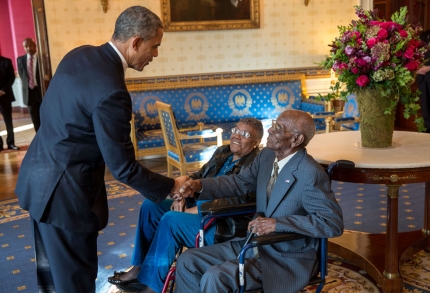
President Barack Obama greets Richard Overton

President Barack Obama greets Richard Overton, with Earlene Love-Karo, in the Blue Room of the White House, Nov. 11, 2013. Mr. Overton,107 years old and the oldest living World War II veteran, attended the Veteran's Day Breakfast at the White House. (Official White House Photo by Lawrence Jackson)

On Monday morning, the President hosted a breakfast in the East Room of the White House for veterans and their families. In attendance was Richard Overton from Austin, Texas. Richard is the oldest living World War II veteran. The President honored the veteran in his remarks at Arlington National Cemetery, and thanked Richard for his selfless dedication and his courage when he faced adversity.

That’s what we owe veterans like Richard Overton, who served in the Army in World War II. He was there at Pearl Harbor, when the battleships were still smoldering. He was there at Okinawa.  He was there at Iwo Jima, where he said, “I only got out of there by the grace of God.”

When the war ended, Richard headed home to Texas to a nation bitterly divided by race.  And his service on the battlefield was not always matched by the respect that he deserved at home.  But this veteran held his head high.  He carried on and lived his life with honor and dignity.  

Related Topics: Veterans, Texas

'Joining Forces' with You on Veterans Day

Ed. note: The following op-ed by First Lady Michelle Obama and Dr. Jill Biden appeared this morning on the following military news websites: Military Times, Army Times, Air Force Times, Marine Corps Times, and Navy Times.

Over the past five years, the two of us have had the privilege of traveling across America and around the world to visit with our extraordinary troops, veterans and military families — and time and again, we have been awed by your service and sacrifice.

We’ve been overwhelmed by the courage of our wounded warriors and the devotion of the caregivers who stand by their side. We’ve been inspired by the military spouses and children who’ve endured move after move, deployment after deployment with such strength and grace. And we’ve seen how, even after transitioning to civilian life, our veterans and military families continue to serve, volunteering countless hours in your communities for all sorts of important causes.

That’s why, 2½ years ago, we decided that it was our obligation not only to tell you how much we appreciate everything you do for our country, but to show you by stepping up and giving you and your families the honor, recognition and support you’ve earned. That’s how Joining Forces was born.

The goal of this initiative was to rally all Americans to step up and serve you as well as you have served this country. We challenged individuals, organizations and businesses across the country to make real, meaningful commitments to you and your families. And from the very beginning, we have been overwhelmed by the response. Here are just a few examples:

Employment: It is simply unacceptable that men and women who serve this country so bravely abroad often struggle to find a good job once they return home. Our veterans are some of the most highly-skilled, hardest-working employees around. They thrive in fast-paced, high-pressure environments, and they’ve got extensive experience building teams, managing complex logistics, and dealing with cutting-edge technology.

Related Topics: Veterans

The White House

Office of the First Lady

Op-ed by First Lady Michelle Obama and Dr. Jill Biden: 'Joining Forces' with you on Veterans Day

The following op-ed by First Lady Michelle Obama and Dr. Jill Biden appeared this morning on the following military news websites: Military Times, Army Times, Air Force Times, Marine Corps Times, and Navy Times.

Michelle Obama, Jill Biden: 'Joining Forces' with you on Veterans Day

Over the past five years, the two of us have had the privilege of traveling across America and around the world to visit with our extraordinary troops, veterans and military families — and time and again, we have been awed by your service and sacrifice.

We’ve been overwhelmed by the courage of our wounded warriors and the devotion of the caregivers who stand by their side. We’ve been inspired by the military spouses and children who’ve endured move after move, deployment after deployment with such strength and grace. And we’ve seen how, even after transitioning to civilian life, our veterans and military families continue to serve, volunteering countless hours in your communities for all sorts of important causes.

That’s why, 2½ years ago, we decided that it was our obligation not only to tell you how much we appreciate everything you do for our country, but to show you by stepping up and giving you and your families the honor, recognition and support you’ve earned. That’s how Joining Forces was born.

The goal of this initiative was to rally all Americans to step up and serve you as well as you have served this country. We challenged individuals, organizations and businesses across the country to make real, meaningful commitments to you and your families. And from the very beginning, we have been overwhelmed by the response. Here are just a few examples:

Employment: It is simply unacceptable that men and women who serve this country so bravely abroad often struggle to find a good job once they return home. Our veterans are some of the most highly-skilled, hardest-working employees around. They thrive in fast-paced, high-pressure environments, and they’ve got extensive experience building teams, managing complex logistics, and dealing with cutting-edge technology.

In short, our veterans are tremendous assets for our businesses, so we challenged companies across America to hire as many veterans as possible. And since we launched Joining Forces, companies of all sizes, including major American businesses like Walmart, Starbucks, Facebook, AT&T and more have hired hundreds of thousands of veterans and military spouses.

But too often, even when good jobs were available, veterans and military spouses had trouble getting hired because of outdated, inefficient licensing and credentialing requirements.

We heard from so many veterans who had learned highly technical, specialized skills during their time in the military, but when they returned home, employers had trouble understanding how those military credentials translated into civilian qualifications. Military spouses were also having difficulty building their careers because almost every time they moved, their teaching or nursing or other professional credentials weren’t recognized by their new state, even if they’d been practicing for years.

To address these issues, we’ve been working with governors, state legislatures and the Defense Department to streamline licensing and credentialing processes and to help employers better understand military credentials. So far, 44 states have changed their laws to help veterans, and 40 states have done so on behalf of spouses.

Wellness: For some of our veterans, the transition from combat to civilian life brings with it some of the hardest moments they and their families will ever face. While the majority of our veterans make this transition smoothly, we know that post-traumatic stress and traumatic brain injuries pose significant challenges for so many military families. But too often, these conditions are improperly diagnosed, or veterans and their families simply don’t receive adequate treatment and support.

That’s why major national associations of doctors, nurses, medical schools, physical therapists, and social workers have committed to educating their members about these issues, expanding their research on promising treatments and cures, and providing world-class care and support for all of those who are contending with the unseen wounds of war — and for their families.

Education: Last week, the Veterans Affairs Department announced its one-millionth GI Bill recipient, Steven Ferraro. Like Steven, so many of our veterans complete their service and head to a community college or four-year school to get the degree or credential they need to get the good jobs they deserve.

To help these heroes succeed once they arrive on campus, 250 community colleges and universities have signed on to our “8 Keys to Success” initiative and pledged to provide important services for veterans, from offering academic and career advice to collaborating with local organizations to provide more comprehensive outreach to student veterans.

We’re also working to support all those military children who are moving from school to school every few years, constantly having to find new friends and adjust to new learning environments. That’s why we launched Operation Educate the Educators to help teachers across the country better understand the challenges of being a military child and to equip them with the tools they need to address military children’s unique needs and concerns. We are thrilled that more than 100 teachers colleges have signed on to this effort.

We’re proud of how far we’ve come, but we are nowhere near finished. We’re not going to stop until every veteran and military spouse who wants a job has one; until we reach every family affected by the unseen wounds of war; until every student veteran and military child gets the education they need; and until every community and every American shows their admiration and support for you and your families in ways that you feel every single day.

That is our vow to you on this Veterans Day. Thank you again for your service to our country, and God bless.

Michelle Obama is the First Lady. Dr. Jill Biden is the wife of Vice President Joe Biden.

The First Lady Hosts the First White House Careers in Film Symposium for Students

FLOTUS Film Symposium 1

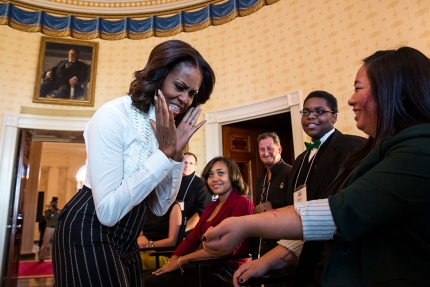
First Lady Michelle Obama reacts to special effects makeup during the makeup and costume segment of the Film Symposium and Oscars Workshop, in the Blue Room of the White House. November 8, 2013. (Official White House Photo by Amanda Lucidon)

This afternoon, First Lady Michelle Obama opened the doors of the White House to high school students from DC, New York, and Boston to partake in the first-ever White House Careers in Film Symposium.

The students had an opportunity to learn about animation, special effects, makeup, costume, directing, music and sound effects, and heard from leaders in the film industry about how their education helped them succeed—as well as hear from the First Lady herself.

The First Lady stopped by the workshop and encouraged the students to continue chasing their dreams in film, but to never forget the importance of education and the ability to overcome adversity.

Once you find that passion, whether it’s film -- maybe it's science or business, maybe it's teaching -- anything, you have got to get your education.  That's the bottom line.  As I tell my kids, you have one job:  Get an education.  It is the most important thing that you can do for yourselves right now, because that's how you'll prepare yourself for success.  You have to be ready.  And this is the foundation that you have to have with you when those opportunities come.  And that's how you're going to learn the skills that you need to achieve and to keep dreaming big. 

Mrs. Obama also encouraged the students to take advantage of their time with the panel saying “And I want you to take advantage of every second that you're here.  Ask a lot of questions.  Find out who these folks are, what they did.  What made them afraid.  What was hard.  Get as much information as you can.  And then go back and work hard.” Students had the opportunity to hear from actors and directors including Whoopi Goldberg, Naomie Harris, Ryan Coogler, David Frankel, Blake Lively, and Gayle King.

Watch the First Lady's remarks below:

Related Topics: Education, New York, New York

First Lady Michelle Obama Hosts a Student Film Symposium

November 08, 2013 | 13:57 | Public Domain

First Lady Michelle Obama welcomes high school students from DC, New York, and Boston to the White House for a workshop about careers in film and an opportunity to learn about animation, special effects, makeup, costume, directing, music and sound effects, as well as hear from leaders in the film industry about how their education helped them succeed.

Download mp4 (513MB) | mp3 (34MB)

The White House

Office of the First Lady

Remarks by the First Lady at Careers in Film Symposium

East Room

1:49 P.M. EST

MRS. OBAMA:  Well, hey!

AUDIENCE:  Hey!

MRS. OBAMA:  How are you doing?  You guys, rest.  Sit down.  You've been here all day, you should feel at home by now.  Oh, wasn't that great.  Alan, oh, Beauty -- I thought he was going to call the President the Beast.  I was going to laugh at that.  But that was pretty cool, Beauty and the Chief.  That was -- I don’t know about you guys, but I was listening backstage, and I just wanted to put my ball gown on and twirl and twirl.  (Laughter.)  I mean, -- yes, I hear some people in the back -- beautiful scores, beautiful music, great way to start off this workshop, or this panel discussion. 

I want to welcome you to the White House.  Have you been having fun?

AUDIENCE:  Yes!

MRS. OBAMA:  Oh, I can tell.  I want to start by thanking Harvey Weinstein for organizing this amazing day.  (Applause.)  Harvey.  This is possible because of Harvey.  He is a wonderful human being, a good friend and just a powerhouse.  And the fact that he and his team took the time to make this happen for all of you should say something not about me or about this place, but about you.  Everybody -- we are here because of you. 

Whoopi Goldberg, Naomie Harris, Ryan Coogler, David Frankel, Blake Lively -- all of us are here because of you.  And of course, my dear friend Gayle King is here.  We are here because of you.  So let's welcome everybody here.  (Applause.)  

I also want to thank all of the directors and the actors, all the specialists who generously shared their time and talent this morning.  You guys did an amazing job.  I got to sit in on a few things and see what was going on today, it was pretty amazing.  But as I -- yes, big hand to all the teams for making this possible.  (Applause.) 

But most importantly, I want to thank our young people.  I want to thank you guys for -- yes, give yourselves a hand.  (Applause.)  We have students here from film and visual arts programs in Boston, in Brooklyn, and right here in Washington, D.C.  (Applause.)  And I’m thrilled to have all of you here for our first-ever Careers in Film Symposium.  We never did this before. 

This is the first time that we have brought young people into the White House for an event like this.  And we have had students here for workshops on all sorts of things.  We've done everything from classical music to spoken word to poetry.  And just a few days ago, we were doing some Bollywood dancing in the State Dining Room.  (Laughter.)  And today, we wanted to continue this tradition by giving you all the chance to dive into the world of film-making.

And from what I heard, and what I saw for myself, I see you guys dove in pretty deeply on this subject.  You learned about directing and improvising.  You saw how a blank screen can create a whole new world.  You discovered how music and sound effects can add emotion to any scene.  And you even had a chance to design a wardrobe and apply makeup just like they do in Hollywood. 

And just so that the press understand, you maybe see some of our staff people with big gashes and cuts on their heads -- (laughter) -- it's just Hollywood happening here.  Many of the students did that work.  And I was prepared; people told me, there are people walking around with scabs on their faces.  And then I saw Jeremy, my head of the Social Office, and I was shocked that his nose was cut up.  This stuff is pretty good.  Very realistic. 

So you all have had a chance to learn the nuts and bolts of the movie business from some of Hollywood’s most respected leaders. But here’s the thing:  These folks know that it doesn’t just take technical knowledge to succeed in the movie business.  That’s one of the important points we want you all to take away.  It’s not just about being a good actor or knowing how to create the best special effects.  It’s also about things like grit.  It's about determination, resilience.  Because all of those character traits -- the ability to overcome adversity -- all of that are some of the traits and skills that have made the folks on this stage successful in life.  And that’s what I want you guys to understand. 

Talent comes and goes.  But it's your ability to dig deep when things are hard and make things happen for yourself -- that’s the difference between just an average life and success.  And there are many examples up on this stage.

You all know that Ryan is one of the fastest-rising directors in Hollywood -- and if you don’t know that, you'll find out more.  But what you might not know is that just a few years ago, he was growing up amid violence and drugs in a city torn apart by poverty and crime.  And he says that if it weren’t for the discipline and drive that his parents instilled in him
-- and I can say the same -- if he hadn’t made the right choices and worked hard every single day -- and I can say the same thing -- he might have ended up as a statistic, just like many of the kids he grew up with.

Meanwhile, for Harvey, it was a poke in the eye –- and I mean literally a poke in the eye -- that may have led to him becoming one of the biggest producers in Hollywood that we have ever seen.  When Harvey was 10 years old, he lost an eye when he was playing around with some other kids.  So he couldn’t go to school for six months.  But Harvey didn’t just sit around feeling sorry for himself.  He knocked on the door of a retired librarian who lived next door to him and asked for books.  Now, for those of you who know Harvey, can you imagine a 10-year-old Harvey in a conversation with a librarian?  (Laughter.)  But from that moment on, Harvey developed a love of reading and a knack for finding good stories -- a skill he has used every day for decades. 

And then there’s my dear, dear friend Whoopi, who has overcome all kinds of adversity.  She was raised, like the President, by a single mother.  She grew up in housing projects in Manhattan.  She was growing up -- when she was growing up, she was dyslexic.  She had trouble reading.  As a result, there were people again and again who would call her dumb.  They would call her slow. 

By the time she was in her early 20s, she had a baby daughter, she had battled drug addiction, she had gone through a divorce.  But let me tell you, Whoopi never let any of that stop her from pursuing her passions for comedy and acting.  She took all kinds of jobs -- good grief -- bricklayer -- (laughter) -- dish washer, beautician in a mortuary.  (Laughter.)  All of that just to support herself and her family as she performed with comedy groups and developed her stand-up routine. 

And after years and years of scraping by, she got her break and landed a role in a wonderful movie called, "The Color Purple."  You've heard of that.  (Applause.)  And from there, she has gone on to build a legendary career.  And in 1990, she became the second African American woman to win an acting award at the Academy Awards.  (Applause.) 

And those are just three stories.  Gayle, Naomie, Blake, David and Bruce -- I didn't see you up here, Bruce is here too
-- they're going to share their own stories.  And I hope that you all will listen and ask them questions.  Find out what their paths to success were.  That's why we're here.  See, because when you do that, when you ask successful people what they've done, when you learn more about these men and women here today, you discover that they've all overcome some kind of challenges in their lives.  They've all struggled.  They've all sacrificed.  And they've worked as hard as possible to get where they are today. 

And why we have you here is because I want you to know -- we want you to know -- that the same thing is true for you.  The same thing is true for you.  We are you.  We are not that far from where you are.  We grew up just like you all did.  Because no matter what kind of neighborhood you come from, no matter what obstacle you are facing in your path right now -- I don't care what's happening to you today, you can always find something that you're passionate about.  You can always find something worth working for in your life. 

And once you find that passion, whether it’s film -- maybe it's science or business, maybe it's teaching -- anything, you have got to get your education.  That's the bottom line.  As I tell my kids, you have one job:  Get an education.  It is the most important thing that you can do for yourselves right now, because that's how you'll prepare yourself for success.  You have to be ready.  And this is the foundation that you have to have with you when those opportunities come.  And that's how you're going to learn the skills that you need to achieve and to keep dreaming big. 

And getting your education means doing everything you can.  It is on you.  That is what I just want you to understand.  Your education is up to you.  So it's up to you to go to school every day.  I didn't miss a day of school.  It's up to you to do your homework every night.  I never showed up at school without my homework being done.  It is up to you to prepare for every class, every exam, every test -- even if it's not a subject that you care about.  That's on you.  That's the secret. 

And you can own that no matter where you come from.  That's why we want you here, because we want you to see this for yourselves.  And if you do that, if you own your education and you don't let any excuses get in your way, no obstacle block you, then I guarantee you can achieve anything that you put your mind to.  As Gayle once said -- she said, “Confidence comes by doing and doing and doing.  That's the secret."  And she said, "You can’t get confident without working hard.  That's the key to everything.”  

The President works hard.  Everybody in this room -- every intern, every person with a light or a camera, they get up and they work hard.  That's the difference.  So I want you all to have that confidence for yourself. 

And I hope that this day here in the White House showed you that if you can walk into the White House and sit in the East Room with all these stars and greats, that you can do anything.  Do you realize that?  You have been in this room in this house with all of us.  So you can do anything.  Can you just own that for a minute?  Stand up a little straighter.  (Laughter.)  Own it.  I spent the day at the White House with the First Lady and with all these stars and actors, and I held it together.  (Laughter.) 

And you made us all very proud today.  I heard that over and over and over again.  And I hope this experience helps to transform you and solidify in your minds that you have everything you need to be successful.

So I want you guys to relax.  Shake it off.  Because I want you to use this time.  Don't be shy.  Ask questions.  These cameras, they'll be gone in a second so you don't even have to worry about them.  And I want you to take advantage of every second that you're here.  Ask a lot of questions.  Find out who these folks are, what they did.  What made them afraid.  What was hard.  Get as much information as you can.  And then go back and work hard. 

And promise me that you will do everything you can in your powers to get the education that is right before you.  Because there are kids all over the world that would love to trade places with any single one of you, because they don't have a fraction of the opportunities that kids in America do, kids like all of you.  So promise me that you will take this seriously.   Take your lives seriously.  Own your futures, because we all did. 

And with that, I'm going to turn it over to Gayle.  And I'm going to go do a little hard work.  I'll be listening in.  But thank you for being here.  I'm very proud of you all.  (Applause.) 

END                
2:03 P.M. EST