The White House

Office of the First Lady

First Lady Michelle Obama to Join Shaquille O’neal, Allyson Felix, and Dominique Dawes at a Back to School Event

Mrs. Obama to highlight healthy changes happening in schools, and applaud new commitments to Let’s Move! Active Schools

Washington, DC – On Friday, September 6, at 1:00 PM ET, First Lady Michelle Obama will visit Orr Elementary in Washington, DC for a back to school event highlighting healthy changes happening in schools and across the country. Mrs. Obama will be joined by Shaquille O'Neal, Allyson Felix, Dominique Dawes, DC Public Schools Chancellor Kaya Henderson and North America Reebok President Uli Becker to announce new commitments around Let’s Move! Active Schools, which aims to get physical activity back into schools, before, during and after the school day.  Since launching in February, more than 3,700 schools have signed up at LetsMoveSchools.org to be active schools, building on the knowledge that active kids do better. Shaq and Allyson Felix are respectively Reebok and Nike spokespeople, both companies that have made commitments to Let’s Move! Active Schools.

Orr Elementary School has been a great example of what schools all across the country are doing to provide healthier environments for kids. Not only has Orr successfully implemented the new healthy school lunch standards, but they’ve already started providing healthier snacks in vending machines – a move all schools will make starting next school year. Orr also has physical education classes, and participates in BOKS, an initiative of Reebok and the Reebok Foundation which incorporates physical activity and nutrition into programming for kids before the school day.

During the event, the First Lady will deliver remarks about healthy changes happening in schools and across the country, and then participate in a physical activity with children and the athletes.

The White House

Office of the First Lady

First Lady Michelle Obama to Join Shaquille O'Neal, Allyson Felix, and Dominique Dawes at a Back to School Event

Mrs. Obama to highlight healthy changes happening in schools, and applaud new commitments to Let’s Move! Active Schools

Washington, DC – On Friday, September 6, at 1:00 PM ET, First Lady Michelle Obama will visit Orr Elementary in Washington, DC for a back to school event highlighting healthy changes happening in schools and across the country. Mrs. Obama will be joined by Shaquille O'Neal, Allyson Felix, Dominique Dawes, DC Public Schools Chancellor Kaya Henderson and North America Reebok President Uli Becker to announce new commitments around Let’s Move! Active Schools, which aims to get physical activity back into schools, before, during and after the school day.  Since launching in February, more than 3,700 schools have signed up at LetsMoveSchools.org to be active schools, building on the knowledge that active kids do better. Shaq and Allyson Felix are respectively Reebok and Nike spokespeople, both companies that have made commitments to Let’s Move! Active Schools.

Orr Elementary School has been a great example of what schools all across the country are doing to provide healthier environments for kids. Not only has Orr successfully implemented the new healthy school lunch standards, but they’ve already started providing healthier snacks in vending machines – a move all schools will make starting next school year. Orr also has physical education classes, and participates in BOKS, an initiative of Reebok and the Reebok Foundation which incorporates physical activity and nutrition into programming for kids before the school day.

During the event, the First Lady will deliver remarks about healthy changes happening in schools and across the country, and then participate in a physical activity with children and the athletes. Members of the media who wish to cover this event must RSVP to firstladypress@who.eop.gov by 3 PM ET, Wednesday, September 4. 

First Lady Michelle Obama: We're Counting on You to be the Next Agents of Change

First Lady Michelle Obama at a screening of "The Powerbroker: Whitney Young's Fight for Civil Rights"

First Lady Michelle Obama delivers remarks at a screening of "The Powerbroker: Whitney Young's Fight for Civil Rights," in the Eisenhower Executive Office Building South Court Auditorium, Aug. 27, 2013. Mrs. Obama was introduced by Whitney Young's niece Bonnie Boswell, left, who wrote and produced the documentary. (Official White House Photo by Amanda Lucidon)

A day before celebrating the 50th anniversary of the March on Washington, the First Lady invited local students to the White House to watch “The Powerbroker: Whitney Young’s Fight for Civil Rights,” a film that chronicles the life and legacy of the civil rights leader.

"What this documentary shows us is that there are so many unsung heroes in our history whose impact we still feel today," said Mrs. Obama. During her remarks, the First Lady shared one of her favorite quotes by Young:

It is better to be prepared for an opportunity and not have one, than to have an opportunity and not be prepared.

"How are you going to be the agents of change for the next generation?" the First Lady asked. "We’re counting on you all to be ready to take the helm and be the next agents of change, because there is still a lot of work to do."

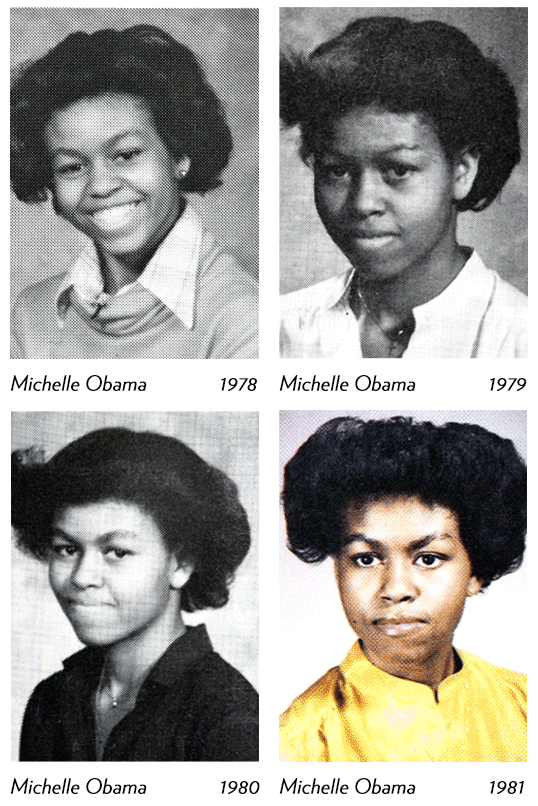
The First Lady has a personal connection to the civil rights leader. In 1981, Michelle Robinson graduated from the Whitney M. Young Magnet High School in Chicago. Take a look some archival photos from the First Lady's time at Whitney Young High School:

Photos courtesy of Whitney M. Young Magnet High School.

Related Topics: Illinois

First Lady Michelle Obama Speaks at a Screening of "The Powerbroker"

August 27, 2013 | 10:12 | Public Domain

"The Powerbroker: Whitney Young’s Fight for Civil Rights," a documentary narrated by Alfre Woodard, chronicles Whitney Young’s civil rights fight of the 1960’s that took him from segregated Kentucky to leader of the National Urban League. The First Lady graduated from the Whitney M. Young Magnet High School in Chicago, IL in 1981.

Download mp4 (374MB) | mp3 (25MB)

Read the Transcript

Remarks by the First Lady at a screening of “The Powerbroker: Whitney Young’s Fight for Civil Rights”

South Court Auditorium

4:24 P.M. EDT

MRS. OBAMA:  Hello, everyone.  (Applause.)  Thank you so much.  It's good to have you all here.  Rest yourselves. 

Let me start by thanking Bonnie, not just for that very kind introduction, but for all the work that she and her crew and her family put into making this important documentary.  It's truly a wonderful piece.  I had a chance to look at it -- I just looked at it yesterday, actually.  And it was very moving, very powerful.  As I told Bonnie, it is important in this position to remember that history, and to understand just how much work goes into making change and making things happen.

So I know you guys are going to take away something very special, but I think we need to give Bonnie a round of applause for her work on this project.  (Applause.)  Thank you. 

And I want to thank all of you for taking time to be here.  We wanted to make sure to do something special on this day, because this is a perfect day I think to watch this film.  Because tomorrow, as many of you may know, we're going to be celebrating the 50th anniversary of the March on Washington.  Now, did you all know that tomorrow is the -- you knew that, right?  (Laughter.)  All right, that’s good.  

And as you’ll see in this documentary, Whitney Young was one of the main organizers of that historic march, which gathered together hundreds of thousands of people of all races and all backgrounds with the important goal of making change.  In fact, Mr. Young spoke on the steps of the Lincoln Memorial just a few minutes before Dr. King gave his I Have A Dream speech. 

Now, Bonnie asked the question -- and I was in the back, so I couldn’t see the answer -- but I want to see how many people had heard of Whitney Young.  I didn’t see a show of hands before you came here today.  Yes, that sounds about right.  Because the truth is, is that I probably wouldn’t have known about him either had I not gone to Whitney Young Magnet High School in Chicago -- yes indeed.  (Applause.)  Whitney Young. 

But what we learned from this documentary is that Whitney Young drew on his decency.  He drew upon his intelligence and his amazing sense of humor to face down all kinds of discrimination and challenges and all kinds of threats.  But one of the things I want you guys to keep in mind, as Bonnie mentioned, is that what this documentary shows us is that there are so many unsung heroes in our history whose impact we still feel today, just regular folks.  They're not always going to be the Barack Obamas, the Dr. Kings, the Malcolm Xs.

For every Dr. King, there is a Whitney Young or a Roy Wilkins or a Dorothy Height, each of whom played a critical role in the struggle for change.  And then there are the millions of Americans, regular folks out there, whose names will never show up in the history books. 

I'm talking about the maids who walked miles home from work every night during the bus boycotts in Montgomery.  We won't know the names of those men and women, and the young people who faced down fire hoses and police dogs and angry mobs.  We know some of those names, but we won't know all of them.  I'm talking about the mothers and the fathers who taught their children to stand with dignity during a time when it was hard to get your kids to dream big.  But those parents, throughout all that they saw, still taught their kids to dream bigger than the world ever could expect of them. 

Each of those people played a critical role in the difficult and often dangerous work of building a better future for all of us.  And the thing I want you all to remember, as you watch this film, is that we are here because of that struggle.  I'm here because of that struggle.  And even though you may think you have some struggles, your paths are a whole lot easier because of the work these men and women did.  And today, as a result of their work, we're living in a more just and more fair society.

So that leads me to something else I want to ask you all and have you think about as you watch the film -- a question that Barack and I, we often discuss with our daughters.  And that question is, how are you all going to continue what these folks started?  I want you to think about that.  What are you going to do?  What will be your contribution?  Think about that, because you got to start building up that energy now.  It starts now.  I want you to think about that.  How are you going to make your community and our country safer?  Each and every one of you has the power to do that.  How are you going to make this entire country more prosperous and more free?

You’ll see in the video that there are so many different ways to answer this question.  There are so many ways that you can contribute.  You could work on a corporate board, sit on a board, be right there at the table of change.  You could do that.  You could strategize in the halls of power like Whitney Young did.  You might want to teach -- teach some young people to write, to do math, to demand more of themselves like Whitney Young’s father did.  You're going to learn a little bit about his parents, his family, his upbringing.  You might want to be a filmmaker, although I saw that there weren't many hands up going -- (laughter) -- filmmakers, but I'm just saying you never know.  You never know.   

Or you might want to make your mark working in a hospital.  You might want to do it working in your church.  You might want to do it just being good parents -- raising good, decent kids with some values, just like all those hundreds of thousands of people who attended the Lincoln Memorial March 50 years ago. 

But whatever you do, what I want you all to take with you is that I want you to keep pushing to be the very best that you can be at whatever you choose.  And that takes hard work.  And I know your teachers and your parents tell you this over and over again, but it’s real.  You have to put in the time and the energy to be great. 

And that leads me to a quote that Whitney Young -- one of his quotes that I love.  He said, “It is better to be prepared for an opportunity and not have one, than to have an opportunity and not be prepared.”  You know what that means?  You got to be ready all the time.  That means today you are preparing yourselves for the opportunities that are going to come your way. 

Barack Obama at your age didn’t know he was going to be President of the United States -- would have bet money that he wouldn’t.  I never thought I’d be the First Lady of the United States.  But let me tell you something, we prepared ourselves -- as Whitney Young did, as Dr. King did.  And that meant going to school every day, doing your homework every day, showing up every single day and putting your best into whatever you’re doing. 

And at the core of that is your education.  There is nothing more important that you all need to be doing right now.  It ain’t rapping, it ain’t dancing.  (Laughter.)  It is learning to read and write in an outstanding way.  That is your job.  And if you do that, you will be prepared for whatever comes your way.  But the worst thing you could do is to have that opportunity and not be ready to shine. 

So you all don’t want to be in that position -- and I know you won’t.  So I want you to think about that as you watch this film.  I want you to ask yourselves those questions.  How are you going to be the agents of change for the next generation?  Because we’re counting on you all.  We’re going to be old in a second.  (Laughter.)  Many of us are old.  And we’re going to hand all of these wonderful issues over to you.  And we’re counting on you all to be ready to take the helm and be the next agents of change, because there is still a lot of work to do.  So keep that in mind, okay?

And I hope you enjoy the film.  And I hope you keep reading and learning about the history of the Civil Rights Movement, because there are so many stories, so many, many more stories out there to learn from.  And it’s important for you all to know that history.

So make this the beginning of that journey of your history so that you understand it and that you can grow from it, and that you don’t repeat the mistakes that have been made in the past, but you just build on the successes.  You promise me that? 

All right.  Well, enjoy the film and have a great discussion.  Thanks for being here.  We’re proud of you guys.  (Applause.)  All right, you all, take care.

END
4:33 P.M. EDT

Close Transcript

The White House

Office of the First Lady

Remarks by the First Lady at a screening of “The Powerbroker: Whitney Young’s Fight for Civil Rights”

South Court Auditorium

4:24 P.M. EDT

MRS. OBAMA:  Hello, everyone.  (Applause.)  Thank you so much.  It's good to have you all here.  Rest yourselves. 

Let me start by thanking Bonnie, not just for that very kind introduction, but for all the work that she and her crew and her family put into making this important documentary.  It's truly a wonderful piece.  I had a chance to look at it -- I just looked at it yesterday, actually.  And it was very moving, very powerful.  As I told Bonnie, it is important in this position to remember that history, and to understand just how much work goes into making change and making things happen.

So I know you guys are going to take away something very special, but I think we need to give Bonnie a round of applause for her work on this project.  (Applause.)  Thank you. 

And I want to thank all of you for taking time to be here.  We wanted to make sure to do something special on this day, because this is a perfect day I think to watch this film.  Because tomorrow, as many of you may know, we're going to be celebrating the 50th anniversary of the March on Washington.  Now, did you all know that tomorrow is the -- you knew that, right?  (Laughter.)  All right, that’s good.  

And as you’ll see in this documentary, Whitney Young was one of the main organizers of that historic march, which gathered together hundreds of thousands of people of all races and all backgrounds with the important goal of making change.  In fact, Mr. Young spoke on the steps of the Lincoln Memorial just a few minutes before Dr. King gave his I Have A Dream speech. 

Now, Bonnie asked the question -- and I was in the back, so I couldn’t see the answer -- but I want to see how many people had heard of Whitney Young.  I didn’t see a show of hands before you came here today.  Yes, that sounds about right.  Because the truth is, is that I probably wouldn’t have known about him either had I not gone to Whitney Young Magnet High School in Chicago -- yes indeed.  (Applause.)  Whitney Young. 

But what we learned from this documentary is that Whitney Young drew on his decency.  He drew upon his intelligence and his amazing sense of humor to face down all kinds of discrimination and challenges and all kinds of threats.  But one of the things I want you guys to keep in mind, as Bonnie mentioned, is that what this documentary shows us is that there are so many unsung heroes in our history whose impact we still feel today, just regular folks.  They're not always going to be the Barack Obamas, the Dr. Kings, the Malcolm Xs.

For every Dr. King, there is a Whitney Young or a Roy Wilkins or a Dorothy Height, each of whom played a critical role in the struggle for change.  And then there are the millions of Americans, regular folks out there, whose names will never show up in the history books. 

I'm talking about the maids who walked miles home from work every night during the bus boycotts in Montgomery.  We won't know the names of those men and women, and the young people who faced down fire hoses and police dogs and angry mobs.  We know some of those names, but we won't know all of them.  I'm talking about the mothers and the fathers who taught their children to stand with dignity during a time when it was hard to get your kids to dream big.  But those parents, throughout all that they saw, still taught their kids to dream bigger than the world ever could expect of them. 

Each of those people played a critical role in the difficult and often dangerous work of building a better future for all of us.  And the thing I want you all to remember, as you watch this film, is that we are here because of that struggle.  I'm here because of that struggle.  And even though you may think you have some struggles, your paths are a whole lot easier because of the work these men and women did.  And today, as a result of their work, we're living in a more just and more fair society.

So that leads me to something else I want to ask you all and have you think about as you watch the film -- a question that Barack and I, we often discuss with our daughters.  And that question is, how are you all going to continue what these folks started?  I want you to think about that.  What are you going to do?  What will be your contribution?  Think about that, because you got to start building up that energy now.  It starts now.  I want you to think about that.  How are you going to make your community and our country safer?  Each and every one of you has the power to do that.  How are you going to make this entire country more prosperous and more free?

You’ll see in the video that there are so many different ways to answer this question.  There are so many ways that you can contribute.  You could work on a corporate board, sit on a board, be right there at the table of change.  You could do that.  You could strategize in the halls of power like Whitney Young did.  You might want to teach -- teach some young people to write, to do math, to demand more of themselves like Whitney Young’s father did.  You're going to learn a little bit about his parents, his family, his upbringing.  You might want to be a filmmaker, although I saw that there weren't many hands up going -- (laughter) -- filmmakers, but I'm just saying you never know.  You never know.   

Or you might want to make your mark working in a hospital.  You might want to do it working in your church.  You might want to do it just being good parents -- raising good, decent kids with some values, just like all those hundreds of thousands of people who attended the Lincoln Memorial March 50 years ago. 

But whatever you do, what I want you all to take with you is that I want you to keep pushing to be the very best that you can be at whatever you choose.  And that takes hard work.  And I know your teachers and your parents tell you this over and over again, but it’s real.  You have to put in the time and the energy to be great. 

And that leads me to a quote that Whitney Young -- one of his quotes that I love.  He said, “It is better to be prepared for an opportunity and not have one, than to have an opportunity and not be prepared.”  You know what that means?  You got to be ready all the time.  That means today you are preparing yourselves for the opportunities that are going to come your way. 

Barack Obama at your age didn’t know he was going to be President of the United States -- would have bet money that he wouldn’t.  I never thought I’d be the First Lady of the United States.  But let me tell you something, we prepared ourselves -- as Whitney Young did, as Dr. King did.  And that meant going to school every day, doing your homework every day, showing up every single day and putting your best into whatever you’re doing. 

And at the core of that is your education.  There is nothing more important that you all need to be doing right now.  It ain’t rapping, it ain’t dancing.  (Laughter.)  It is learning to read and write in an outstanding way.  That is your job.  And if you do that, you will be prepared for whatever comes your way.  But the worst thing you could do is to have that opportunity and not be ready to shine. 

So you all don’t want to be in that position -- and I know you won’t.  So I want you to think about that as you watch this film.  I want you to ask yourselves those questions.  How are you going to be the agents of change for the next generation?  Because we’re counting on you all.  We’re going to be old in a second.  (Laughter.)  Many of us are old.  And we’re going to hand all of these wonderful issues over to you.  And we’re counting on you all to be ready to take the helm and be the next agents of change, because there is still a lot of work to do.  So keep that in mind, okay?

And I hope you enjoy the film.  And I hope you keep reading and learning about the history of the Civil Rights Movement, because there are so many stories, so many, many more stories out there to learn from.  And it’s important for you all to know that history.

So make this the beginning of that journey of your history so that you understand it and that you can grow from it, and that you don’t repeat the mistakes that have been made in the past, but you just build on the successes.  You promise me that? 

All right.  Well, enjoy the film and have a great discussion.  Thanks for being here.  We’re proud of you guys.  (Applause.)  All right, you all, take care.

END
4:33 P.M. EDT

The White House

Office of the First Lady

Remarks by the First Lady at a screening of “The Powerbroker: Whitney Young’s Fight for Civil Rights”

South Court Auditorium

4:24 P.M. EDT

MRS. OBAMA:  Hello, everyone.  (Applause.)  Thank you so much.  It's good to have you all here.  Rest yourselves. 

Let me start by thanking Bonnie, not just for that very kind introduction, but for all the work that she and her crew and her family put into making this important documentary.  It's truly a wonderful piece.  I had a chance to look at it -- I just looked at it yesterday, actually.  And it was very moving, very powerful.  As I told Bonnie, it is important in this position to remember that history, and to understand just how much work goes into making change and making things happen.

So I know you guys are going to take away something very special, but I think we need to give Bonnie a round of applause for her work on this project.  (Applause.)  Thank you. 

And I want to thank all of you for taking time to be here.  We wanted to make sure to do something special on this day, because this is a perfect day I think to watch this film.  Because tomorrow, as many of you may know, we're going to be celebrating the 50th anniversary of the March on Washington.  Now, did you all know that tomorrow is the -- you knew that, right?  (Laughter.)  All right, that’s good.  

And as you’ll see in this documentary, Whitney Young was one of the main organizers of that historic march, which gathered together hundreds of thousands of people of all races and all backgrounds with the important goal of making change.  In fact, Mr. Young spoke on the steps of the Lincoln Memorial just a few minutes before Dr. King gave his I Have A Dream speech. 

Now, Bonnie asked the question -- and I was in the back, so I couldn’t see the answer -- but I want to see how many people had heard of Whitney Young.  I didn’t see a show of hands before you came here today.  Yes, that sounds about right.  Because the truth is, is that I probably wouldn’t have known about him either had I not gone to Whitney Young Magnet High School in Chicago -- yes indeed.  (Applause.)  Whitney Young. 

But what we learned from this documentary is that Whitney Young drew on his decency.  He drew upon his intelligence and his amazing sense of humor to face down all kinds of discrimination and challenges and all kinds of threats.  But one of the things I want you guys to keep in mind, as Bonnie mentioned, is that what this documentary shows us is that there are so many unsung heroes in our history whose impact we still feel today, just regular folks.  They're not always going to be the Barack Obamas, the Dr. Kings, the Malcolm Xs.

For every Dr. King, there is a Whitney Young or a Roy Wilkins or a Dorothy Height, each of whom played a critical role in the struggle for change.  And then there are the millions of Americans, regular folks out there, whose names will never show up in the history books. 

I'm talking about the maids who walked miles home from work every night during the bus boycotts in Montgomery.  We won't know the names of those men and women, and the young people who faced down fire hoses and police dogs and angry mobs.  We know some of those names, but we won't know all of them.  I'm talking about the mothers and the fathers who taught their children to stand with dignity during a time when it was hard to get your kids to dream big.  But those parents, throughout all that they saw, still taught their kids to dream bigger than the world ever could expect of them. 

Each of those people played a critical role in the difficult and often dangerous work of building a better future for all of us.  And the thing I want you all to remember, as you watch this film, is that we are here because of that struggle.  I'm here because of that struggle.  And even though you may think you have some struggles, your paths are a whole lot easier because of the work these men and women did.  And today, as a result of their work, we're living in a more just and more fair society.

So that leads me to something else I want to ask you all and have you think about as you watch the film -- a question that Barack and I, we often discuss with our daughters.  And that question is, how are you all going to continue what these folks started?  I want you to think about that.  What are you going to do?  What will be your contribution?  Think about that, because you got to start building up that energy now.  It starts now.  I want you to think about that.  How are you going to make your community and our country safer?  Each and every one of you has the power to do that.  How are you going to make this entire country more prosperous and more free?

You’ll see in the video that there are so many different ways to answer this question.  There are so many ways that you can contribute.  You could work on a corporate board, sit on a board, be right there at the table of change.  You could do that.  You could strategize in the halls of power like Whitney Young did.  You might want to teach -- teach some young people to write, to do math, to demand more of themselves like Whitney Young’s father did.  You're going to learn a little bit about his parents, his family, his upbringing.  You might want to be a filmmaker, although I saw that there weren't many hands up going -- (laughter) -- filmmakers, but I'm just saying you never know.  You never know.   

Or you might want to make your mark working in a hospital.  You might want to do it working in your church.  You might want to do it just being good parents -- raising good, decent kids with some values, just like all those hundreds of thousands of people who attended the Lincoln Memorial March 50 years ago. 

But whatever you do, what I want you all to take with you is that I want you to keep pushing to be the very best that you can be at whatever you choose.  And that takes hard work.  And I know your teachers and your parents tell you this over and over again, but it’s real.  You have to put in the time and the energy to be great. 

And that leads me to a quote that Whitney Young -- one of his quotes that I love.  He said, “It is better to be prepared for an opportunity and not have one, than to have an opportunity and not be prepared.”  You know what that means?  You got to be ready all the time.  That means today you are preparing yourselves for the opportunities that are going to come your way. 

Barack Obama at your age didn’t know he was going to be President of the United States -- would have bet money that he wouldn’t.  I never thought I’d be the First Lady of the United States.  But let me tell you something, we prepared ourselves -- as Whitney Young did, as Dr. King did.  And that meant going to school every day, doing your homework every day, showing up every single day and putting your best into whatever you’re doing. 

And at the core of that is your education.  There is nothing more important that you all need to be doing right now.  It ain’t rapping, it ain’t dancing.  (Laughter.)  It is learning to read and write in an outstanding way.  That is your job.  And if you do that, you will be prepared for whatever comes your way.  But the worst thing you could do is to have that opportunity and not be ready to shine. 

So you all don’t want to be in that position -- and I know you won’t.  So I want you to think about that as you watch this film.  I want you to ask yourselves those questions.  How are you going to be the agents of change for the next generation?  Because we’re counting on you all.  We’re going to be old in a second.  (Laughter.)  Many of us are old.  And we’re going to hand all of these wonderful issues over to you.  And we’re counting on you all to be ready to take the helm and be the next agents of change, because there is still a lot of work to do.  So keep that in mind, okay?

And I hope you enjoy the film.  And I hope you keep reading and learning about the history of the Civil Rights Movement, because there are so many stories, so many, many more stories out there to learn from.  And it’s important for you all to know that history.

So make this the beginning of that journey of your history so that you understand it and that you can grow from it, and that you don’t repeat the mistakes that have been made in the past, but you just build on the successes.  You promise me that? 

All right.  Well, enjoy the film and have a great discussion.  Thanks for being here.  We’re proud of you guys.  (Applause.)  All right, you all, take care.

END
4:33 P.M. EDT

The White House

Office of the First Lady

Remarks by the First Lady at Arthur Ashe Kids' Day

U.S. Open
New York, New York

2:04 P.M. EDT
 
MRS. OBAMA:  Wow!  (Applause.)  Are you guys having fun?  (Applause.)  Is everybody here ready to move?  (Applause.)  Well, I am.  I can't tell you how thrilled I am to be here with all of you.  You all look good, you sound good.  This is amazing. 
 
I want to start by thanking one of my favorite athletes, a woman who has become a very good friend, Serena, for that very kind introduction.  Let's give her a round of applause.  So proud of Serena.  (Applause.)  She is awesome. 
 
And I want to thank Missy, as well as Quddus for being our MCs today.  I've been watching them backstage -- they're really good.  You guys can talk a lot.  That’s excellent. 
 
I got to see Missy as well as Serena compete at last year’s Olympics, and it was truly an honor.  They represented this country with grace, and they brought back some medals, and it was a very good thing.  So congratulations, Missy.  I know you're headed to college, right?  Way to go!  Education is important.  I am proud of all of them, and I am proud of all of these players up here as well for being such outstanding role models to all of you young people.  
 
I also have to recognize a wonderful woman who has been an inspiration to so many of us -- the wife of Arthur Ashe, Jeanne Ashe, and well as her daughter, Camera, who are here today.  It’s an honor to be here with them today to celebrate Arthur’s legacy.  (Applause.)  And I also have to point out that there is someone also very special here, a living legend who has meant so much to me, so much to women, so much to young people and young athletes all over this country -- the great Billie Jean King is here.  Let's give her a round of applause.  (Applause.) 
 
And we also have a very special group of people here -- we have some members of our military and their families who are here, so I want us to make sure that we thank them for their sacrifice and for their grace.  (Applause.)  We are so proud of you all.  It's great to have you here.
 
And most of all, I want to thank David Haggerty, Katrina Adams, and everyone from the USTA for being such outstanding partners in our work to help kids and families across this country lead healthier lives.  The USTA has already done so much.  They have been such amazing partners on this initiative. 
 
But today, I want to applaud them for announcing that they’re going to do even more.  They're going even further.  They’re committing to build 5,000 more courts.  They have committed to train 15,000 more instructors.  They are going to engage an additional 300,000 young people in afterschool summer programs.  And they're going to donate hundreds of thousands of dollars' worth of new equipment to kids in communities all across this country.  Let's give the USTA a round of applause for that outstanding commitment to our children, our communities and their health.  (Applause.) 
 
It's such a big deal, because we know how important it is to create early, positive experiences for our young people.  And I want to make sure that I thank everyone at the Partnership for a Healthier America for helping to make this happen.  Because of the USTA, what they're doing, more kids like all of you are going to be out there learning to play tennis on kid-sized courts all across this country. 
 
And just let me share something with you.  When you -- I was your age, I didn’t have tennis role models.  I didn’t live in a community where there were any tennis courts.  And, quite frankly, I don’t think I knew a single person when I was young who even knew how to play tennis. 
 
So this commitment is huge, because kids like you who are going to get involved in tennis, you guys are going to be way ahead of me.  I just wish that I had had some of these opportunities when I was your age, because if I had started playing earlier, I'd be a whole lot better than I am today. 
 
And believe me, I love the game of tennis.  I really do.  It's a great way to stay healthy, to stay fit.  It's a lifelong sport.  It's something I've tried to tell my kids -- I forced them into playing tennis because I didn’t want them to be like me.  But it's a great way to stay active.  And today, I don’t worry about how good I am -- because I'm not very good, so it's easy.  For me, tennis is an important way to achieve my own personal goals.
 
Tennis is a sport, as I said, that you can play for your entire life.  It's a good game to get your heart racing and pumping no matter how old you are.  So you guys are lucky to have the USTA working so hard to make tennis available to so many more kids across this country.
 
And that’s really what Let's Move is all about -- it's about helping kids across this country get active and feel healthy and learn the skills that you all are going to need to succeed not just in school, but in life.  You're going to learn things like hard work, team work, discipline -- that’s why playing sports is so important.  And that’s what sports teaches you -- it teaches you that if you keep on practicing and giving 100 percent to anything you do, you will get better at it.  And that’s not just true on the tennis court, but that’s also true in the classroom as well. 
 
Because if you want to succeed -- and, young people, I really want you to pay attention to this, because many of you have already started school or many of you are going to be starting the school year off -- if you want to be good at anything, you have to work at it.  I know your parents tell you that all the time, but I want to emphasize it -- if you want to be good at anything, you have to put the work in.  You have to show up every day.  You have to do your homework every single night without any exceptions.  And you have to work hard for every test, for everything you do.  That’s how you become successful.  And you all can do it.  (Applause.)  
 
Just know this -- the harder you work, the smarter you will get.  And the athletes that are here on this stage that you will hear from, they know that all too well.  And it's important for you guys to understand that no one waved a magic wand over these guys and turned them into champions.  They turned themselves into champions by putting in the effort, by exercising and focusing every day, working out, eating right, practicing their skills over and over and over again.  That’s what it takes to be excellent.
 
And I know that all of you young people here have everything you need right now to be great.  We are proud of you.  Know that.  The President is proud of you, I'm proud of you.  We cannot wait to see who you're going to become.  But we want you to know you've got to focus, you've got to be fit, you've got to eat healthy, and you've got to keep moving. 
 
You guys are the next generation.  And we are looking so forward for all of the wonderful things you're going to do to contribute to this country and to this world in the years to come. 
 
We love you so much.  God bless you, and have a great academic year.  (Applause.) 

END
2:14 P.M. EDT

Meet Sunny: The Obamas' New Puppy

Today the Obamas welcomed the newest member of their family – a little girl (puppy) named Sunny!

Sunny, the new Obama family dog, on the South Lawn of the White House, Aug. 19, 2013.

Sunny, the new Obama family dog, on the South Lawn of the White House, Aug. 19, 2013. (Official White House Photo by Pete Souza)

Pin

Sunny was born in Michigan in June 2012, and arrived at the White House today. Just like Bo, she’s a Portuguese Water Dog, which works great for the Obamas because of allergies in their family.

Sunny is the perfect little sister for Bo – full of energy and very affectionate – and the First Family picked her name because it fit her cheerful personality.

In the past, Bo has been eager to help the First Family with their official duties, from visiting Walter Reed and the Children’s National Medical Center, to inspecting the Holiday decorations at the White House, to greeting guests at the White House on tours and during the Easter Egg Roll, but in October, the First Lady told reporters that she hosted a “doggie play date” because “Bo doesn't have enough dog interaction.” So now, in addition to helping with those official duties, Bo takes on the important role of big brother!

Watch on YouTube

The President and First Lady Speak at the Disabled American Veterans National Convention

On Saturday, the President and First Lady spoke at the Disabled American Veterans (DAV) National Convention in Orlando, FL. Founded in September of 1920, the DAV celebrates 92 years of service to disabled veterans and their families with this three-day event.

The forerunner to the Department of Veterans Affairs, the DAV has empowered disabled veterans and their families serving in every conflict from World War I to Iraq and Afghanistan.

Watch the video.

Colonel Rich Morales is the Executive Director of Joining Forces
Related Topics: Veterans, Florida

The White House

Office of the Press Secretary

Remarks by The First Lady and The President at Disabled American Veterans Convention

Hilton
Orlando, Florida

12:00 P.M. EDT

MRS. OBAMA:  (Applause.)  Thank you.  Thanks so much.  Thank you all.  Thank you.  (Applause.)  Good afternoon, everyone.  It’s so good to be here.  (Applause.)  We are so proud of you all.  Thank you all.  Please, I know you’ve been working hard, so rest yourselves.  (Laughter.)

I am beyond thrilled to be here with all of you today, and I want to start by thanking Larry for that very kind introduction, but more importantly for his tremendous leadership of the DAV and for all of his outstanding service to this country.  But most of all, I want to thank all of you here today -- the men and women who have served and sacrificed so greatly on behalf of all Americans.

Truly, one of my greatest joys over these past few years has been spending time with veterans and military families like all of you.  I have laughed with your children at barbeques.  I’ve gone to baby showers with spouses.  I’ve learned so much during my many visits to military bases across this country.  I’ve even smashed a champagne bottle to christen a Coast Guard cutter.  (Laughter.)

And let me tell you, day after day, I have been so inspired by your stories -- so inspired.  And I’m reminded of one of those stories today, the story of a young man I met at Walter Reed.  His name is Sergeant Winder Perez, and he is 24 years old.  Now, a year and a half ago, Sergeant Perez was on a combat mission in Afghanistan, when he was hit by an RPG.  He collapsed, but the grenade stayed lodged in his left thigh and it didn’t go off.  Sergeant Perez’s fellow Marines ran to his aid and together they chose to carry him off the battlefield to safety, even though they knew that any wrong move would mean certain disaster.

Moments later, four pilots and medics chose to load him onto a helicopter with the live explosive still in his leg, transporting him 65 miles to the nearest medical station.  And finally, when they arrived, a nurse and explosive expert chose to rush to his aid, finally dislodging the rocket by hand and giving doctors a chance to save his leg -- which they did.

Now, just that part of Sergeant Perez’s story tells you everything you need to know about the men and women of our armed forces.  But as all of you know very well, stories like these don’t end in the combat zone.  Since his injury, Sergeant Perez has endured 30 or 31 surgeries -- he doesn’t remember the exact number.  He has survived a heart attack and an aneurysm, and he’s fought through hundreds of hours of rigorous physical therapy to strengthen his leg.

And time and again, just when he’s regained the strength to walk, his doctors have told him that it’s time for another surgery, and then Sergeant Perez is back in a wheelchair, starting all over again from square one.

But here is the thing:  You don’t hear about any of that when you talk to Sergeant Perez.  What you do hear about is his mother, who he will tell you has stayed by his side every single day.  You will hear about his gratitude to those who saved his life, to the family and friends who come from New York to visit, and for the life he has in front of him.

Today, Sergeant Perez is walking again.  He’s three months into an internship with the Defense Intelligence Agency, and he plans to spend the rest of his career serving his country.  And when asked about everything he’s been through, Sergeant Perez puts it all in perspective by simply saying, "I just think you’ve got to get back up."  That’s all he said.  "You’ve got to get back up."

And as I look across this room, I see a group of people who know how to get back up.  No matter what you’ve been through -- (applause) -- no matter what the struggles you have faced, you all get back up.  And that is what inspires me.  That’s why, every day, I work to push myself harder to live up to your example.

And that’s why Jill Biden and I are working so hard on Joining Forces, because we want to honor and serve you and your families -- to make sure that you and your families have the educational opportunities you need, the support you’ve earned and the good jobs you deserve.

And if there is one thing that I want all of you to know today, it’s this:  You will never have to get back up all on your own.  Not while we’re here, Never.  (Applause.)  And it’s not just us.  You have got families who support you day and night.  You have countless neighbors and pastors, business owners -- I’ve met them -- even strangers who will snap into action for you.

And one important person you have is a Commander-in-Chief who doesn’t simply understand your service and your sacrifice.  (Applause.)  Let me tell you something about this man, he carries your stories with him every single day.  I have seen it in his eyes when he comes home from a visit to a military hospital.  I’ve noticed the extra energy he gets after a military commencement.  And I’ve heard the emotion in his voice after he talks with the families of our fallen.  That is the well he draws from as Commander-in-Chief.  You are that well. 

And that’s why he has stood up for you again and again and again, and it’s why he’s going to keep fighting for you and your families every single day.  So ladies and gentlemen, please welcome my husband, our President Barack Obama.  (Applause.)

*****

THE PRESIDENT:  Hello, DAV.  (Applause.)  Thank you so much.  Thank you.  Everybody, please have a seat.  Do we have an extraordinary First Lady?  (Applause.)  We will be celebrating our 21st anniversary in October.  The first time I saw her, I knew she was something special.  (Laughter.)  She was a little more skeptical about me.  (Laughter.)  But persistence is the key.  You just got to stay on it.  Eventually, you can marry up.  (Laughter.)

To Michelle and Jill Biden and Joining Forces, we are so proud of the work you've done to help rally America around military families and veterans.  I'm inspired by what they are doing.  So thank you, Michelle, for your extraordinary work.

DAV, I was proud to join at your convention three years ago.  (Applause.)  It is wonderful to be back.  I want to thank your national commander, Larry Polzin.  Thank you so much to the entire leadership team -- Joe Johnston, Marc Burgess, Donna Adams, all the incredible spouses and families of the DAV Auxiliary.  I want to thank Barry Jesinoski.  (Laughter.)  I got it.  (Laughter.)  They used to mispronounce Obama too.  (Laughter.)  I want to thank Barry and your great team in Washington.

Disabled American Veterans, like all veterans, you carry in your hearts the story of brave service that took you to every corner of the Earth.  As young men and women, you left home, left everything and everyone you ever knew because storm clouds gathered far across the sea.  You had your whole lives ahead of you, but you were willing to risk all of it for this land that we love.  Because you know, from hard experience, what we must never forget -- our country endures because in every generation there are Americans like you who stand beside her and guide her and protect her.

You fought across the Pacific, island by island.  You fought into the heart of Europe, mile by mile, freeing millions from fascism.  That’s your legacy as veterans of the Second World War.  You held the line at the Pusan Perimeter and survived the bitter cold of the Chosin Reservoir.  And on this 60th anniversary of the end of that war, we salute all of our veterans of the Korean War.  (Applause.)

To our Vietnam veterans -- (applause) -- you served with valor not just in the thick of the jungle, but through intense urban combat.  And let it be remembered that you won every major battle that you fought in.  (Applause.)  And so in the decades since, whenever our country has needed you, you said "send me" -- from the sands of Desert Storm to the mountains of the Balkans to the villages of Afghanistan and Iraq -- and next year, your profound sacrifice will be recognized in the heart of our nation’s capital when our country dedicates the American Veterans Disabled for Life Memorial.  (Applause.)

That memorial will honor your courage in war.  But it will also pay tribute to your bravery in the other battle you have fought -- the fight to recover from the wounds of war.  And this may be your greatest triumph of all.  Because rather than being defined by what you lost, by what you can’t do, you’ve inspired America with what you can do.

Maybe you lost your sight, but you can still see the truth that our disabled veterans make extraordinary contributions to our country every single day.  Maybe you lost an arm, but you still have the strength to pick up a friend or neighbor in need.  Maybe you lost a leg, but you still stand tall for the values and freedoms that make America the greatest nation on Earth.  (Applause.)

I think of the wounded warrior who spoke for so many of you when he said, "Your life will never be the same, but that doesn’t mean you can’t go on to do amazing things with the second chance you were given."  I think of wounded warriors across America and how they’ve used that second chance --volunteering in communities, building homes, being a mentor to local kids, showing up after tornadoes, after Hurricane Sandy to help folks rebuild.  I think of the wounded warriors who reached out to the survivors of the Boston Marathon bombing with the example of their own recovery and with a simple message -- "We stand with you."

I think of all the inspiring wounded warriors that Michelle and I have met -- their resilience, their resolve, their determination to push through and to carry on.  That’s the fighting spirit of our wounded warriors.  That’s the spirit of DAV -- (applause) -- dedicated not just to your own recovery, but to taking care of each other.  Every day you work to ensure that America is fulfilling its promises to our men and women who have served.  That’s your mission.  And I want you to know it is my mission, too.

I believe that this work is more important than ever, because this time of war that we've been in is coming to an end.  (Applause.)  For nearly 12 years -- ever since we were attacked on that clear September morning -- our nation has been at war.  Our fight in Afghanistan is now America’s longest war.  At the same time, our troops fought courageously in Iraq for nine long years.  And among us today are proud veterans of the wars in Afghanistan and Iraq.

Now, we’ve marked another milestone in Afghanistan.  As of this past June, Afghan forces have taken the lead for security across their entire country.  Instead of leading the fight, our troops now have a different mission -- supporting Afghan forces.  Our war in Afghanistan has entered the final chapter.  More of our troops are coming home.  This winter, we’ll be down to 34,000.  By the end of next year, the transition will be complete -- Afghans will take full responsibility for their security and our war in Afghanistan will be over.  (Applause.)

For this progress, we thank all who have served in Afghanistan, including DAV members here today -- just a few I want to mention.  We salute folks like Timothy Duke.  Where’s Timothy?  Right here -- (applause) -- in the early days of the war, Timothy's helicopter unit served in some of the most remote parts of Afghanistan.  On another tour, in Iraq, his convoy was hit by an IED.  He endured three spinal surgeries.  Then he went to school on the Post-9/11 GI Bill.  Today he is helping at the DAV, helping veterans and their families access their benefits.  That's the kind of spirit the DAV represents.  Thank you, Timothy, for your outstanding service and work.  (Applause.)

We salute Staff Sergeant Jacare Hogan.  (Applause.)  Where’s Jacare?  In Iraq, she was hit by IEDs three times.  She’s endured surgeries, rehab -- which continue to this day -- but she refused to stop serving.  She deployed again to Afghanistan.  As a logistics specialist, she served at forward operating bases -- keeping them running, flying between bases, getting shot at along the way.  At those remote outposts, she was often the only woman on base.  She proudly wears the Combat Action Badge.  (Applause.)  But her service hasn't stopped.  So here at DAV, she counsels others as they recover.  "Helping [the] troops is what I’m about."  That's what she says.  And we are grateful to you, Jacare, for your extraordinary service.  (Applause.)

And we salute Jason Hassinger.  Where is Jason?  (Applause.)  Right here -- when Jason's unit was ambushed and pinned down, he was hit five times in the chest.  But he pushed on, helped lead his men to safety for which he earned the Silver Star.  (Applause.)  After months of care and rehab he returned to his unit -- going out on patrol, gritting his teeth through the pain in his chest.  And today, at DAV, Jason helps his fellow vets access the benefits that they have earned.  It is "my job" to "help people heal."  That's what Jason says.  Thank you.  (Applause.)

So Timothy, Jacare, Jason -- they're just examples of all who've served in these years of war -- the 9/11 Generation.  And now, you’re beginning the next chapter in your lives wearing a proud new title -- veteran of the United States Armed Forces.  So this time of war may be coming to an end, but the job of caring for our veterans goes on and our work caring for our newest veterans has only just begun.

Think about it -- we lost the last veteran of the First World War two years ago, but we still care for the children of our World War I veterans.  To this day, we still help care for children of men who fought in the Spanish-American War, even the daughter of a Civil War veteran.  (Applause.)  So when we talk about fulfilling our promises to all who serve, we’re not just talking about a few years, we’re talking about decades -- for as long as you and your families walk this Earth.

With a new generation joining your ranks, I believe that now is the time to make sure our nation is truly ready -- organized and structured to get this right not just for this year, not just for next year, but for decades to come not just for the veterans of today’s wars, but for all wars.  And I believe we need to focus on five key priorities.

Number one, we need to make sure we’ve got the resources, the budgets our veterans deserve.  (Applause.)  Since I took office, we’ve made historic investments in our veterans.  Even in these tough fiscal times, we’ve boosted the VA budget by more than 40 percent.  We now budget for veterans’ health care a year in advance.  (Applause.)  And I’ve proposed a further increase in veterans funding for next year.  (Applause.)

Now, some of you may be aware right now we've got these reckless, across-the-board budget cuts called the sequester that's hitting a lot of folks hard.  And it’s cost jobs.  It's hurting our military, slashing investments in education and science and medical research.  I made it clear that your veteran’s benefits are exempt from this year’s sequester.  I've made that clear.  (Applause.)  But I want to tell you going forward the best way to protect the VA care you have earned is to get rid of this sequester altogether.  (Applause.)  Congress needs to come together and agree on a responsible plan that reduces our deficit and keeps our promises to our veterans and keeps our promises to future generations.  That’s what I’m fighting for.  That’s what you deserve.  (Applause.)

Number two, we need to make sure you’re getting the veterans’ health care you’ve been promised.  We’re already making record investments -- more outreach, more clinics, more service.  For our Vietnam vets, we made sure that you and your families finally got the disability pay you deserved because of your exposure to Agent Orange.  (Applause.)  For our Desert Storm veterans, we made it easier for you to get the care you need for illnesses connected to your service.  (Applause.)  For our veterans with PTSD, we’ve made it easier for you to get the VA care you need as well, regardless of the war that you served in.  (Applause.)

For our women veterans -- and there are more of you than ever -- we’re offering more tailored care, more clinics just for women, more clinicians trained to treat you with respect and dignity.  (Applause.)  So all told, we’ve made VA health care available to more than 2 million veterans who didn’t have it before.  (Applause.)

I’ve proposed more funding for prosthetics for our disabled vets, to help you work and walk and run again.  And for you -- the caregivers and families -- we’re going to keep empowering you with the skills and support you need as you care for the veterans that you love.  (Applause.)

We also need to keep improving mental health services, because we’ve got to end this epidemic of suicide among our veterans and troops.  (Applause.)  Last year, I said this had to be an all-hands-on-deck approach -- not just at DOD and the VA, but across our government.  I issued an executive order to step up our game, and we have:  hiring more counselors, hiring more mental health providers, new awareness campaigns so that those who are hurting know that asking for help is not a sign of weakness; it’s a part of staying strong.  It’s a part of getting back up.  (Applause.)  Hundreds of medical and nursing schools have committed to improving research and care for our veterans and their families.  And I’ve proposed more funding for mental health.  We can’t just promise better care, we’ve actually got to deliver better care.

So today I’m proud to announce the next step in this fight.  We’re unveiling a new national action plan to guide mental health research across government, industry and academia, so that we’re going to focus on developing more effective ways to prevent, diagnose and treat mental health conditions like TBI and PTSD.  And to get it done, we’re moving ahead with more than $100 million in new research.  (Applause.)  So I’m not going to be satisfied until every veteran and every man and woman in uniform gets the support and the help they need to stay strong.  (Applause.)

Now, on the subject of veteran’s health care, you may have noticed there’s still a lot of misinformation out there about the new health care law -- Affordable Care Act.  Some folks are out there trying to scare people, including veterans.  So let me say this as plainly as I can.  If you already have health insurance, or health care from the VA, you do not have to do a thing; your VA health care does not change, it is safe; there are no new fees.  Don’t let them hoodwink you.  (Applause.)

But the good news is if you’re among one of the more than 1 million veterans who don’t have health insurance, starting October 1st, you’ll have a new option.  Online marketplaces will let you shop and compare and buy private health insurance plans, just like you can go online to compare prices when you buy a TV, or airplane ticket or a car.  And because of the Affordable Care Act, insurance companies will no longer be able to discriminate against you or deny you coverage because of preexisting conditions -- like PTSD.  (Applause.)  So you’ll have more security in being able to get health insurance.  So don’t let them fool you.  No one is taking away your benefits.  Your veterans’ health care is safe.  We’re not reducing veterans’ access to health care, we’re expanding it.  That’s the truth.  (Applause.)

And that leads me to the third priority we’ve got to focus on.  We’ve got to attack this claims backlog.  (Applause.)  Now, the last time I was with you, I pledged to cut the backlog, slash those wait times, deliver your benefits sooner.  And I’m going to be honest with you, it has not moved as fast as I wanted.  Part of it is all these new veterans in the system who came in -- Agent Orange, PTSD.  It means a lot more claims, and despite additional resources, it’s resulted in longer waits.  And that’s been unacceptable -- unacceptable to me, unacceptable to Secretary Shinseki.

So we put more of our VA folks to work as claims processors, we hired more claims processors as well.  We’ve got them working overtime -- completing more than a million claims a year.  We prioritized the oldest claims.  Veterans groups like the DAV have pitched in as well, helping vets with their claims, getting them ready, so when they bring them, they’re in better shape and they can move a little quicker.  And today, I can report that we are not where we need to be, but we’re making progress.  We are making progress.  (Applause.)  So after years when the backlog kept growing, finally the backlog is shrinking.  In the last five months alone, it’s down nearly 20 percent.  We’re turning the tide.

And we’re not going to let up until we eliminate the backlog once and for all.  And we’ll keep moving ahead with paperless systems so the backlog doesn’t come back, and so your claims are processed right -- the first time, on time.  (Applause.)  After years of military service, you shouldn’t have to wait for years for the benefits you have earned.

Fourth, just like you fought to defend our rights and freedoms, we need to uphold the dignity and rights of every veteran.  And that starts by keeping up our campaign to end homelessness among veterans.  (Applause.)  We’re not just bringing our veterans off the streets, we’re doing more to reach at-risk and low-income vets, so they don’t become homeless in the first place.  And we’re not going to rest until every veteran who has fought for America has a home in America.  (Applause.)

Yesterday, I was proud to sign into law the Helping Heroes Fly Act -- to end those intrusive airport screenings so you, our wounded warriors and disabled vets, especially those of you with prosthetics, can travel with dignity.  And I know how disappointing it was last year when the Senate failed to approve the Disabilities Treaty despite the fact that we had a former senator and World War II veteran, Bob Dole, in the Senate chamber.  But we’re going to keep fighting to ratify that Treaty, because the United States has always been a leader for the rights of the disabled.  We believe that disabled Americans like you deserve the same opportunities to work and to study and to travel in other countries as any other American.  It’s the right thing to do.  We need to get it done.  (Applause.)

Which brings me to the final priority we need to stay focused on, and that’s making sure that our veterans have every opportunity to pursue the American Dream, starting with the education and jobs worthy of your extraordinary talents.

With our new transition assistance program we’re doing more to help departing service members and their spouses plan their careers and find that new job.  We’re going to keep helping our newest veterans and their families pursue their education under the Post-9/11 GI Bill.  We’re building on the executive order I issued last year to protect you as you go looking for schools.  I said we’re going to stand up against dishonest recruiting and predatory practices that target our veterans.  So we set new standards.  And so far, more than 6,000 schools across the country have signed on and pledged to do right by you and your families.  We don’t want our veterans cheated.  (Applause.)

I also said that schools need to step up their support so we’re doing more to help our veterans succeed on campus.  So today, we’re announcing what we call "8 Keys to Success" -- specific steps that schools can take to truly welcome and encourage our veterans.  And so far, more than 250 community colleges and universities have signed on, and today I’m calling on schools across America to join us in this effort.  Let’s help our veterans get that degree, get that credential and compete for the high-skilled jobs of tomorrow.  (Applause.)

Now, I’m also going to make sure that the federal government keeps doing its part.  I’m very proud of the fact that, since I took office, federal departments and agencies have hired nearly 300,000 veterans -- including many disabled veterans.  (Applause.)  And I’m going to keep calling on Congress to pass the Veterans Jobs Corps, to put our veterans to work protecting and rebuilding America.

And we’re also doing everything we can to help you get those private sector jobs.  More help with job searches.  More tools like our online jobs bank to connect veterans to jobs that are open right now.  Making it easier for you to transfer your skills to the licenses and credentials you need for civilian jobs.  And because tens of thousands of our veterans have already been helped, Congress needs to make permanent tax credits for companies that hire our veterans and wounded warriors.  It’s the right thing to do.  (Applause.)

And we’re going to keep urging companies across America to do the smart thing -- hire some of the best workers you’ll ever find; hire a vet.  Michelle and Jill have done great work on this.  And responding to our challenge, working with Joining Forces, America's businesses have already hired or trained 290,000 veterans and military spouses and they’ve committed to hiring over 400,000 more.  More companies are signing up all the time.  We are going to get companies to understand that you can’t get a better deal than hiring a veteran.  (Applause.)

Because of all the efforts I’ve described, and because of a growing economy, veterans unemployment is going down, more veterans are finding jobs, and we’re going to keep at this.  Because with your skills and drive, we don’t just want you fighting for America overseas, we want you to be right here, building a stronger America, fighting for a better future for our kids.

So ensuring the resources and budgets you deserve, delivering the health care that you’ve earned, making sure you can count on it -- continuing to reduce the backlog, standing up for your rights and dignity, creating jobs and opportunity so you can realize your dreams -- that’s what I’m focused on.  That’s what I have told my entire administration to be focused on.  That’s what our country needs -- to stay focused for the many years to come.

And nobody knows this better than you, our disabled veterans.  The road of recovery is often such a long haul.  And America needs to be there for you during that long haul.  And that’s the lesson of the extraordinary young man I told you about when I spoke to you three years ago -- an Army Ranger, Sergeant First Class Cory Remsburg.

A massive IED in Afghanistan nearly killed him.  He was in a coma for months, with severe traumatic brain injury.  And I told you then how, when I saw him in the hospital, he had come out of the coma, but he still couldn’t speak.  And when I asked how he was feeling, he slowly brought his hand up and he pulled his fingers together and he gave a thumbs up.  His mom was sitting there with him.

A few days ago, I saw Cory and his family again, this time in Phoenix where they live.  So I wanted to give you an update on how he’s doing.  I suspect it won’t surprise you to know that for Cory, the years since he was injured have been very hard -- brain surgeries, half dozen of them; surgeries to replace part of his skull; eye surgeries; special procedures on his lungs; skin grafts and skin flaps -- all told, dozens of surgeries and procedures.

Rehab has been grueling.  On a typical day, Cory wakes up and spend hours in therapy -- physical therapy, occupational therapy, speech therapy.  Progress has come slowly, but it has come.  He had to learn the simple things all over again -- how to speak, how to write his name, how to throw a ball.  And this past spring, he reached another milestone.  After years in the hospital and rehab facilities, he finally came home greeted by hundreds of neighbors and friends waving American flags.

And so when I saw Cory a few days ago, he is still blind in one eye.  He still struggles to move his left side.  But the young man I had seen in that hospital bed unable to speak, barely able to move, this time he was in a chair sitting up -- alert, smiling, talking.  And then, he wanted to show me something.  And he leaned out of his chair.  And he reached out and grabbed his walker.  And with the help of his parents, he pulled himself forward and he stood up.  And he looked at me, and he gave me a sharp salute.  (Applause.)  He said, "Rangers Lead the Way."  (Applause.)

And his stepmom held one arm for balance and I held the other.  And then, Cory took a step -- then another, and then another one after that all the way across the room.  Little by little, Cory is learning to walk again.  (Applause.)  And he's starting to get good on his recumbent bike.  He hopes to bike in a race this fall -- 42 miles.  He’s scheduled to move into his own home adapted to his needs with the help of a caregiver -- another step towards the greater independence he seeks.  And so Cory says, "My recovery has not been easy.  Nothing in life that’s worth anything is easy."  But he says, I don't "give up."

The war in Afghanistan may be ending, but for Cory and our disabled vets, the work has only just begun.  Cory is 30 years old.  His recovery -- like so many of yours -- will last a lifetime.  But he won’t give up, because you haven't given up.  And when it comes to our work, to making sure that our nation is fulfilling its promises to the men and women who served and sacrificed, America cannot give up either.  I will not give up.  We cannot give up.

So long as I'm the United States' President, I will make it my mission to make sure that America is right there beside you every step of the way, every step with Cory, every step with the DAV.  God bless you.  God bless our veterans.  God bless the United States of America.  (Applause.)

END 12:42 P.M. EDT