The White House

Office of the Press Secretary

Letter -- Blocking Property of Additional Persons Contributing to the Situation in Ukraine

Dear Mr. Speaker: (Mr. President:)

Pursuant to the International Emergency Economic Powers Act (50 U.S.C. 1701 et seq.) (IEEPA), I hereby report that I have issued an Executive Order (the "order") further expanding the scope of the national emergency I declared in Executive Order 13660 of March 6, 2014, and expanded in Executive Order 13661 of March 16, 2014, with respect to the unusual and extraordinary threat to the national security and foreign policy of the United States posed by the situation in Ukraine.

In the order, I find that the actions and policies of the Government of the Russian Federation with respect to Ukraine -- including its purported annexation of Crimea and its use of force in Ukraine -- undermine democratic processes and institutions in Ukraine; threaten its peace, security, stability, sovereignty, and territorial integrity; and contribute to the misappropriation of its assets, and thereby constitute an unusual and extraordinary threat to the national security and foreign policy of the United States. The order blocks the property and interests in property of persons determined by the Secretary of the Treasury, in consultation with the Secretary of State:

  • to operate in such sectors of the Russian Federation economy as may be determined by the Secretary of the Treasury, in consultation with the Secretary of State, such as financial services, energy, metals and mining, engineering, and defense and related materiel;

  • to be owned or controlled by, or to have acted or purported to act for or on behalf of, directly or indirectly, any person whose property and interests in property are blocked pursuant to the order; or

  • to have materially assisted, sponsored, or provided financial, material, or technological support for, or goods or services to or in support of, any person whose property and interests in property are blocked pursuant to the order.

In addition, the order suspends entry into the United States of any alien determined to meet one or more of the above criteria.

I have delegated to the Secretary of the Treasury the authority, in consultation with the Secretary of State, to take such actions, including the promulgation of rules and regulations, and to employ all powers granted to the President by IEEPA as may be necessary to carry out the purposes of the order. All agencies of the United States Government are directed to take all appropriate measures within their authority to carry out the provisions of the order.

I am enclosing a copy of the Executive Order I have issued.

Sincerely,

BARACK OBAMA

The White House

Office of the Press Secretary

FACT SHEET: Expanding Economic Opportunity for Women and Working Families

“This year let's all come together, Congress, the White House, businesses from Wall Street to Main Street, to give every woman the opportunity she deserves, because I believe when women succeed, America succeeds.”

--President Barack Obama, State of the Union, January 28, 2014

Today, President Obama will hold a roundtable discussion at Valencia College in Orlando, Florida with women to discuss his plan to expand economic opportunity for women and working families.  The President will discuss his efforts to expand access to higher education for women, and ensure that when women enter the workforce they have access to the skills they need to succeed and earn a fair and equal wage.

Today's event kicks off an initial five regional forums on women’s issues hosted by senior administration officials that will take place across the country this spring, leading up to the White House Summit on Working Families hosted by the President on June 23. These forums will take place in Denver on April 11; Chicago on April 28; San Francisco on May 5; Boston on May 19 and in New York City (date to be announced).

In addition to these regional forums, next week on March 26, the Small Business Administration and the National Women’s Business Council are hosting a roundtable, STEM for Her, that will bring together the private sector, academic experts and other stakeholders to identify actions that can encourage more women entrepreneurs in STEM fields to start and grow their businesses. The feedback we hear at all of these events will help inform the Summit and our efforts to build 21st century workplaces that meet the needs of a 21st century workforce.

Expanding Women’s Access to Higher Education

Since first taking office President Obama has made critical investments in higher education to ensure opportunity for all Americans to get the education and training they need to be successful.  These investments have helped ensure economic opportunity for women and girls. 

Earning a college degree remains one of the surest pathways into the middle class.  Women with an associate’s degree earn 26 percent more than those with a high school degree, women with a bachelor’s degree earn more than 80 percent more, and these returns are growing.

The Administration continues its commitment to strengthen support for women in postsecondary education.

Today, more than 11 million women are pursuing a postsecondary education and average graduation rates for women exceed their male counterparts (the college graduation rate for women at 2-year institutions is 34 percent compared to 27 percent for men).  However, women are disproportionately dependent on financial aid, and many enrolled women, especially those over the age of 25, are mothers, meaning they have additional considerations on their time and finances as they work to achieve their educational goals.  

Key investments that support higher education access for women and girls include:

  • Creating the $2,500 American Opportunity Tax Credit (AOTC).  Over 9.4 million Americans are able use the AOTC to help finance their postsecondary education each year.
  • Increasing the maximum Pell grant award by $1,000.  President Obama pushed to increase the maximum Pell grant award, which will rise to $5,730 in school year 2014-15. Over 5.8 million women receive Pell grants or another federal scholarship, compared to over 3.5 million men. 
  • Keeping student loan interest rates low.  The President has also fought to ensure that student loan interest rates stay low to provide borrowers with income-based repayment options that will help the 580,309 women at community colleges accessing loans to pay for college (more than double the number since 2007-08).  38 percent of women take out federal loans, compared to 31 percent of men.

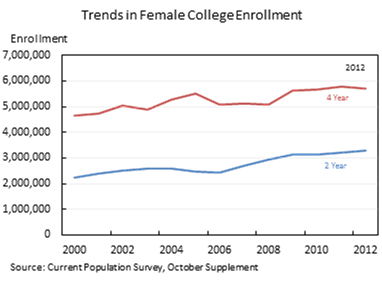
These investments have helped support large increases in the number of women pursuing a college degree.  Enrollments of women in 4 year schools are up over 20 percent since 2000, and enrollments in community colleges are up by 50 percent.

Expanding Women’s Access to the Skills They Need

The Administration has also focused on ensuring that women have access to the skills they need to succeed in the workforce.

While the data shows young women outpacing men in obtaining college degrees, women continue to be underrepresented in critical areas of the economy like math, science, and technology related fields – areas that are projected to grow at faster rates than other job sectors and that present significant economic opportunities.  Though the number of women earning STEM degrees continues to rise, the share of degrees awarded to women relative to men stopped improving in the early 2000s. 

This is critical, because women in science, technology, engineering, and mathematics (STEM) fields make, on average, 33 percent more than women in non-STEM fields, and the gender pay gap is smaller in those occupations.  The Administration remains committed to ensuring that women and girls have every opportunity to be successful.  For example:

  • Increasing opportunities for STEM mentorship.  Research shows that outstanding women mentors and role models can break down stereotypes and help girls believe—by seeing—that they too can succeed in STEM education and careers.  To expand STEM achievement, the Administration has issued a call to mobilize the 200,000 Federal STEM employees to volunteer in STEM-related activities, including the many Federal STEM women, to inspire young people to pursue STEM careers and called on private sector CEOs to do the same.  Federal science-mission agencies have also developed programs, including Women@Energy and Women@NASA, to profile exceptional women in STEM professions to inspire girls around the country to pursue STEM education and careers
  • Providing real world job experience to high schoolers.  The President’s proposal to redesign American high schools to provide hands-on learning experiences in high-growth fields would expose girls to these careers early on. In the Department of Labor’s Youth CareerConnect grants which provided some funding for high school redesign, grants were evaluated in part based on the extent to which girls and other underrepresented groups would be recruited into traditionally male occupations.
  • Focusing on job-driven training. The President and Vice President have made preparing workers for good-paying jobs a priority and are working to make training programs more job-driven. As a part of this agenda, government agencies will be using administrative authorities to encourage training programs to make information about the types of jobs available and expected wages more transparent. This will help women and other groups who may be less likely to have information about high-paying occupations from informal networks.  Another key goal is encouraging more competency-based training that rewards people who have gained the skills necessary for a job regardless of other factors.

Valencia College

  • Expanding economic opportunity begins with expanding educational opportunity.  Valencia College is a community college with a large, diverse student population.  Nationally, community colleges are key paths to economic opportunity for women.  In fact, 4.1 million women make up 58 percent of community college students, and about a quarter of them are mothers.  The number of women enrolled at community colleges will grow by nearly 20 percent between now and 2021, to 4.9 million by 2021, nearly three times faster growth than male enrollment.     
  • Part of that expected growth is due to the fact that community colleges, like Valencia, provide flexible pathways for students, particularly women who are seeking an avenue to broaden their skills, expand their career options, or to go on to a four year degree program.  For example, Valencia has over 100 degree programs including Nursing, Electronics Engineering Technology, Computer Programming, Culinary, and Business, each with high placement rates, including transfers to four year institutions.
  • In 2011, Valencia College won the first-ever Aspen Prize for Community College Excellence in recognition of success at serving the needs of a diverse population in metro Orlando.  The Aspen Prize grew out of the 2010 White House Summit on Community Colleges, where President Obama and Dr. Jill Biden brought together community college leaders, business, and philanthropy to discuss community college’s central role in increasing the number of college graduates.

The White House

Office of the Press Secretary

Statement by President Obama on Nowruz

To view the President’s video message, click HERE.

Dorood.  As you and your families gather around the Nowruz table, I want to extend my best wishes on this new spring and new year.  As always, this holiday is a chance to give gratitude for your blessings and to reflect on our hopes for the year ahead.

As I have every year as President, I want to take this opportunity to speak directly to the people and leaders of the Islamic Republic of Iran.  Since taking office, I’ve offered the Iranian government an opportunity—if it meets its international obligations, then there could be a new relationship between our two countries, and Iran could begin to return to its rightful place among the community of nations.

Last year, you—the Iranian people—made your voice heard when you elected Dr. Hassan Rouhani as your new president.  During his campaign, he pledged to strengthen Iran’s economy, improve the lives of the Iranian people and engage constructively with the international community—and he was elected with your strong support. 

Last fall, I spoke with President Rouhani.  It was the first conversation between an American president and an Iranian leader since 1979.  I conveyed to President Rouhani my deep respect for the Iranian people, just as he expressed his respect for the American people.  And I told him that I firmly believe that we can address the serious disagreements between our governments, reduce distrust and begin to move beyond our difficult history. 

Since then, we’ve made progress.  For years, the international community has had concerns that Iran’s nuclear program could lead to Iran acquiring a nuclear weapon, which would be a threat to the region and to the world.  Under the initial agreement we reached in November, the Iranian government has agreed to limit key parts of its nuclear program.  Along with our international partners, the United States is giving Iran some relief from sanctions.  Now we’re engaged in intensive negotiations in the hopes of finding a comprehensive solution that resolves the world’s concerns with the Iranian nuclear program. 

As I’ve said before, I’m under no illusions.  This will be difficult.  But I’m committed to diplomacy because I believe there is the basis for a practical solution.  Iran’s highest officials, including Supreme Leader Khamenei, have said that Iran is not developing nuclear weapons.  So there is a chance to reach an agreement if Iran takes meaningful and verifiable steps to assure the world that its nuclear program is for peaceful purposes only.  Iran would have access to peaceful nuclear energy.  And we will have addressed—peacefully, with diplomacy—one of the greatest challenges to international peace and security. 

A comprehensive agreement on the nuclear issue—and an Iran that upholds universal rights, at home and abroad—would help move Iran along the new path that so many Iranians seek.  After all, throughout your history the talents and genius of the Iranian people have led to great achievements in literature and the arts, science and technology.  But the economic hardship that so many Iranians have endured in recent years—because of the choices of Iranian leaders—has deprived your country and the world of the extraordinary skills and contributions you have to offer.  And you deserve better.

If Iran meets its international obligations, we know where the path of dialogue and greater trust and cooperation can lead.  It will mean more opportunities for Iranians to trade and forge ties with the rest of the world.  It means more economic growth and jobs for Iranians, especially young Iranians who dream of making their mark in the world.  It will mean more opportunities for Iranian students to travel abroad and build new partnerships that help you realize your incredible potential.  In short, real diplomatic progress this year can help open up new possibilities and prosperity for the Iranian people for years to come.       

That’s the message the Iranian people sent at the ballot box last year.  I hope that the entire Iranian government hears that message too.  Because for the first time in many years, we have the opportunity to start down a new path.  If Iran seizes this moment, this Nowruz could mark not just the beginning of a new year, but a new chapter in the history of Iran and its role in the world—including a better relationship with the United States and the American people, rooted in mutual interest and mutual respect.

Thank you, and Eid-eh Shoma Mobarak. 

The White House

Office of the Press Secretary

Statement by the President

Michelle and I were saddened to hear of the passing of Bob Strauss. Bob was one of the greatest leaders the Democratic Party ever had, yet presidents of both parties relied on his advice, his instincts, and his passion for public service – not to mention his well-honed sense of humor. As President Carter’s trade representative, he helped open new markets for American exports. As President Bush’s last Ambassador to the Soviet Union and first Ambassador to the Russian Federation, he stood up for our interests and values at a moment of immense change. Bob was truly one of a kind, and our thoughts are with his children, his family, and his friends too numerous to count.

The White House

Office of the Press Secretary

Press Briefing by Press Secretary Jay Carney, 3/19/2014

James S. Brady Press Briefing Room

1:18 P.M. EDT

MR. CARNEY:  Good afternoon, ladies and gentlemen.  Thanks for being here.  Thank you for your patience.  Before I take your questions, I have some exciting news at the top.  Some of you may have noticed that we have a new White House tweeter, Jen Palmieri, who just announced that tomorrow, in Orlando, the President will kick of a series of regional events we will hold across the country to explore how we can continue to expand opportunity for all Americans by helping women and working families succeed.

These events will take place over the next few months, leading up to our White House Summit on Working Families on June 23rd.  That’s our White House Summit on Working Families on June 23rd.

There is another way the President will make 2014 a year of action by bringing together business leaders, economists, labor legislators and other stakeholders to find innovative solutions for building 21st century workplaces that meet the needs and realities for a 21st century workforce.  Each of these forums will focus on key issues.  And tomorrow, at Valencia College, the President will discuss how we can better equip our students and workers with the skills they need for good jobs and to advance in their careers. 

Before I take your questions, I just want to make sure that everybody is following @JPalm44.  With that, I go to Darlene.

Q    Thanks, Jay.  Is there any reaction to the takeover of the Ukrainian naval headquarters today by Crimean self-defense forces?

MR. CARNEY:  We strongly condemn Russia’s use of force in Crimea.  The Russian military is directly responsible for any casualties that its forces -- whether they be regular, uniformed troops, or irregulars without insignias -- inflict on Ukrainian military members in Crimea.  Reports that a Ukrainian military officer was killed yesterday are particularly concerning and belie President Putin’s claim that Russia’s military intervention in Crimea has brought security to that part of Ukraine.

The continued efforts by Russian forces to seize Ukrainian military installations are creating a dangerous situation.  We condemn these actions.  Russia should immediately begin discussions with the Ukrainian government to ensure the safety of Ukrainian forces in the Crimean region of Ukraine.

Diplomacy remains the only acceptable means of resolving this situation, and we are prepared to impose further costs on Russia for its violation of Ukrainian sovereignty and territorial integrity.

Q    When you say that the U.S. is prepared to impose further costs -- asset freezes have already been instituted --what beyond economic sanctions or sanctions in general is the President willing to use, is the U.S. willing to use, to bring about this diplomatic solution that you all talk about wanting?

MR. CARNEY:  Well, I think it’s important to note, Darlene, that the sanctions that have been announced already -- the designations that we have made public -- are, if you will, the beginning of actions we can take under the authorities provided by the executive orders.  And as I said yesterday, you can expect that more action will be taken under those authorities.

So Russia has incurred costs already; has caused the United States and our European allies and Japan to take action.  Because of what Russia has done already -- that will cause costs to be incurred by Russia now and in the future.  But there will be additional responses under the authorities provided by the executive orders, and we’re working on those now.

Q    Sorry, I guess what I’m trying to get at is what are some of those additional responses.

MR. CARNEY:  Well, if you look at the executive orders, they provide a great deal of flexibility and an expansive range of potential designations for sanctions, including Russian government officials, the arms sectors of Russia, and individuals who, while not holding positions within the Russian government, have influence over or provide material support to senior Russian government officials.  And then there were the designations -- I mean, there were the categories listed in the first executive order as well.

We are working very closely with our partners in Europe and elsewhere on a response to Russia’s violation of Ukraine’s territorial integrity and its violation of Ukraine’s sovereignty.  You have seen action taken by the European Union, as well as Japan.  And we are coordinating with our allies and partners on how we will react further to further transgressions by Russia. 

It remains a simple fact that the so-called referendum and so-called annexation violate Ukrainian law, violate the Ukrainian constitution, are illegal under the United Nations Charter, and have not been and will not be recognized by the United States and other members of the international community.  So we will continue to make clear that this kind of behavior will result in costs to Russia and isolation to Russia. 

And Russia will need to assess the impact of those costs and understand that they will grow more severe and compound over time, and also understand that there is a reasonable alternative here available to Russia that allows Russia to ensure that its legitimate interests in Ukraine are accounted for and protected; that Russian ethnics in -- or ethnic Russians, rather, in Ukraine are assured of their rights in that country through international observers and monitors.  And we will continue to work with our partners to make clear those options to Moscow.

Q    One other question.  The statement the NSC put out yesterday announcing the G7 meeting next week in the Netherlands, it says that Obama had invited his counterparts.  I just want to make sure that that meeting is actually going to be happening.

MR. CARNEY:  Yes.  Yes, it will.

Q    Jay, with regard to Ukraine, as the crisis has unfolded, events seem to have unfolded more quickly than the United States has anticipated.  In spite of efforts of diplomacy, Putin has established facts on the ground very quickly.  Has the way this has happened forced a fundamental rethink of the way the United States deals with Russia?

MR. CARNEY:  What I would say Mark is that we and our allies and partners have, of course, responded to these developments by making clear to Russia that there is a legal alternative available to them to pursuing their interests in Ukraine.  And I don’t think that the fact that Russia has not availed itself of that option yet means that we didn’t or don’t anticipate the kinds of things that Russia has done and may do.

It still is the far preferable alternative to a violation of international law in a sovereign state’s territorial integrity that Russia pursue its interests through legitimate channels.  What I can assure you is that these decisions by the Russian leadership and the implementation of those decisions are resulting in and will result in further costs to the Russian economy, and to individuals, and potentially sectors of the Russian economy and enterprises the longer this goes on and the longer that Russia flouts international law.

Q    One of the events that seems to have been upsetting to Russia in the run-up to this is the prospect that some of the former Soviet states become closer to NATO.  Does the crisis in Ukraine call for a greater commitment by the United States in defense and security in Europe?

MR. CARNEY:  Well, that commitment is extremely strong and contains within it an obligation by the United States and all NATO members to our fellow members in the alliance.  What you have seen is the United States, and NATO in general, take action in the Baltic nations, in Poland, to reassure those nations and make clear that our commitment remains as firm as ever.  And I don’t want to predict where this will lead in terms of Russia’s actions, but I don’t think anyone doubts the strength of that alliance and the commitments that are contained within it.

Q    I guess my question is, do these events cause the United States to think that it needs to take greater steps, invest more in that alliance?

MR. CARNEY:  I would simply point to you the steps that we have taken.  I mean, if you're talking about a broader assessment of European security -- and I think those things are ongoing -- and obviously if Russia takes action that further destabilizes the situation in Ukraine or pursues other courses of action that cause the alliance to reassess or evaluate its posture, I'm sure that will take place.  This is a powerful and united alliance, so you can expect that those discussions have taken place and will continue to take place.  But there’s a lot of speculation associated with your question so I don't want to get ahead of events on the ground.

Q    Just quickly on Malaysia.  Could you update us on the role of the FBI in assisting in that investigation?  And have they been asked, have they been rebuffed?  What are they doing to help find this plane?

MR. CARNEY:  The FBI is assisting in the investigation.  The NTSB and the FAA are the primary interlocutors with the Malaysian government, but the FBI is also assisting in the investigation.  And we are finding that the level of cooperation with the Malaysian government is solid, and we are working closely with the Malaysians as well as our other international partners in this effort to find out what happened to the plane and why it happened.  But I have no update on the course of the investigation.  It remains the case that we are not in a position yet to draw conclusions about what happened.

Let me move around.  NBC.

Q    Jay, thank you.  How would the President assess the United States’ relationship with Russia right now?  Obviously there have been comparisons made to the Cold War, a lot of people saying this is the frostiest it's been since the Cold War.  How does he see it?

MR. CARNEY:  I don't think there’s any question that relations between Russia and the West are not in a good place right now.  What is absolutely the case is that this President since the time he took office has been very clear-eyed about U.S.-Russia relations.  He has been focused on making progress where the interests of the United States and Russia coincide, where we can make progress in a way that benefits our national security, and very clear-eyed and blunt and vocal about those areas where we disagree. 

Over the last period of time, the intensity of the disagreements has increased, to be sure, with regard to Syria in particular and certainly most especially of late in Ukraine.  This is obviously a higher order of disagreement and involves, in this case, Russia’s violation of international law, its military intervention in a sovereign -- into the territory of a sovereign neighbor state.  And you have seen a broad international consensus in opposition to what Russia has done.

So we are going to continue to make sure that U.S. national security interests, the national security interests of our allies and partners, are what drive or policy decision-making going forward.

Q    And on the question of costs, Vice President Biden obviously had some very strong language today.  Is the United States moving any closer to considering a potential military option, or is that still pretty much off the table?

MR. CARNEY:  We are still focused on what we believe is the proper way to resolve this situation, which is through de-escalation.

Q    So military option is not at the forefront of discussions right now?

MR. CARNEY:  It certainly is not at the forefront of discussions.  I think that we are focused on, when it comes to costs for Russia for the actions it's undertaken, looking at and implementing the visa bans and sanctions that have already been put in place and others that can be put in place under the authorities allowed by the executive orders he signed.  And we are working with our partners and allies to make sure that that effort is coordinated and that we remain united in the actions that we take. 

And we have seen strong unity and cooperation with our European partners and Japan in making clear to the Russians that this behavior, these actions are unacceptable.  They violate international law.  They harken back to an era that the rest of the world or most of the rest of the world has left behind.  And that in today’s economy and today’s world, when it comes to the institutions that govern interaction between nations and the intersection of our economies, there is a significant price to be paid for the kind of flagrant violation of the established order and international law that we’re seeing Russia undertake.

Q    Could we see President Obama announce next steps by the end of the week?

MR. CARNEY:  I’m not going to give you a timeline on our steps, except to say that, as I noted yesterday, you can expect further costs to be imposed upon Russia because of the actions it’s taken in Crimea. 

Q    And one more just on Malaysia.  Given there is so much uncertainty about what happened -- and President Obama obviously before he speaks about this wants to be careful about his language -- but some people have taken to Twitter and said, why haven’t we heard from the President yet if only to reassure Americans who might be feeling jittery?

MR. CARNEY:  About the Malaysian plane?

Q    About the Malaysian plane.

MR. CARNEY:  The President has been updated regularly.  We have contributed a significant number of resources and assets to the search for the plane and to the investigation into what happened.  And we’re going to continue that effort.

Chris.

Q    Thanks, Jay.  The President yesterday received a letter from 200 members of Congress brought up to House Democratic Whip Steny Hoyer, calling on him to immediately act by signing a non-discrimination executive order for LGBT workers.  You’ve said before this issue is best left to Congress, but this many lawmakers are lobbing it back to the President.  Has he misjudged the situation?

MR. CARNEY:  Chris, we continue to support ENDA, the Employment Non-Discrimination Act.  And I don’t have any update for you on proposed or possible executive orders.  The fact is that legislation which has moved in the Senate, if it were to be passed by the full Congress and signed into law, would have the greatest benefit when it comes to ensuring the rights of LGBT individuals.  So on the issue that you ask me about regularly of executive order proposed or speculated about, I just don’t have any updates.

Q    But what makes you think that legislation should be the only course of action if lawmakers in Congress are saying the President should issue an executive order as they continue to --

MR. CARNEY:  Again, Chris, I just don’t have any new information to provide to you about our views on this, which we’ve discussed many times.  And there is no question I think in anyone’s mind that the passage of legislation in the form of the Employment Non-Discrimination Act would provide those protections broadly in a way that an EO would not.  And, as I’ve said before, opposition to that legislation is contrary to the tide of history, and that those lawmakers who oppose this will find in the not too distant future that they made a grave mistake and that they will regret it. 

Q    And one last very important question on this.  The letter takes note that time is of the essence, because after an executive order is signed, full implementation will require a process that will last many months, if not longer.  Do you deny there’s a limited time for the President to exercise this option before time is up at the end of his administration?

MR. CARNEY:  Chris, I’m not even sure there’s a question there, but I would point you to my previous answer.

Cheryl.

Q    I’m wondering if you have any update on the prospects for exporting natural gas in light of the Ukraine situation.

MR. CARNEY:  I have no new information to impart on that.  We’ve talked about the evaluations that are made by the Department of Energy, the licenses that it approves.  And that process obviously continues.  And in the short term, we are obviously taking steps to assist Ukraine with its energy security, its energy efficiency, and more broadly through bilateral assistance and multilateral assistance to provide needed assistance to the Ukrainian government at a difficult time for its economy. 

It’s essential, in our view, that the Congress upon return act very quickly to pass legislation that you’ve seen in the Senate that would authorize the provision of loan guarantees in direct bilateral assistance, but also provide the quota reforms, the so-called quota reforms to the IMF that would allow the IMF to provide maximum assistance as part of its package to Ukraine.  So we look forward to Congress for taking action on that.  That is something that Congress can do concretely to assist Ukraine in this difficult time.  And we urge Congress to take action.

I’ve also noted -- and I won’t repeat, unless you want me to -- some facts about surpluses in terms of energy supplies in Europe and the impact that any action Russia might take to limit or cut off gas supplies to Ukraine or Europe on the Russian economy, which would certainly be quite severe because they depend -- Russia does -- on those markets for a great deal of their foreign currency.

Q    Israel war planes attacked Syrian military targets.  This is the most serious escalation in almost four decades.  Do you worry that it might escalate and get out of hand?

MR. CARNEY:  Look, we, in matters like this, refer you to the statement released by the Israelis on this issue.  I really don’t have anything more for you on it, so I would point you to the Israelis.

Q    But you don’t think it will complicate the Syrian situation that’s already tense?

MR. CARNEY:  I think that the Syrian situation is a problem unto itself.  There’s no question about that. 

Q    Jay, getting back to the Vice President’s trip, what about this comment from Vladimir Putin yesterday that the Russians almost feel provoked by NATO’s reach into Eastern Europe?  Looking back -- and I know this didn’t happen on this administration’s watch -- but was that a mistake for the West and for NATO to move all the way to Russia’s borders -- historically?

MR. CARNEY:  No.  And I’ll tell you why, having covered it from Moscow and Washington.  The opportunity that Russia has had and has pursued sporadically since the emergence of Russia and the other independent states in the wake of the dissolution of the Soviet Union has been to integrate and engage with Europe and with the broader global economy, and to integrate and engage with international institutions that help set the rules by which peaceful nations govern their interactions. 

The fact of the matter is those opportunities potentially still exist for Russia.  And in the long term, a path of confrontation with the West of trying to assert through military force intervention -- like we’ve seen in Crimea -- hegemony over sovereign states will not result in a stronger Russia, but a more isolated Russia and one that’s less connected, and therefore less able to grow economically.

So the fact of the matter is I think that the West in general, and the United States in particular, has since the dissolution of the Soviet Union pursued policies designed to help Russia and the former Soviet republics, now independent states, integrate with the global economy, integrate with Europe and the rest of the world in a manner that in the long term has benefited a number of those states and could benefit Russia and others.

The option, the alternative is what we’re seeing now.  And that -- again, while it obviously creates instability in Ukraine, creates great concern in Europe and here and around the world -- ultimately comes at a high cost to Russia and the Russian people and to the Russian economy, because it leads to international condemnation and approbation [disapprobation] and isolation, and does economic harm to Russia, and doesn’t leave Russia in a better place, ultimately.
So we’re taking steps that we find necessary in response to this action.  We’re working with our allies and partners.  We will see what kind of calculations the leadership of Russia makes in the coming days and weeks.
Q    And I’m sure you heard Republicans say in the last several days that what’s happening in Ukraine right now, what’s happening in Crimea will be a liability for former Secretary Clinton should she choose to run for President.
MR. CARNEY:  Well, that’s a pretty superficial way of looking at things.  I think that the challenges posed by Russia’s intervention in Ukraine are challenges for the United States, for the Ukraine, for Europe, and for Russia.  Our obligation is to be very clear-eyed about what our national security interests, what our obligations are to our allies and partners, and to pursue those.  That’s how we’re looking at it.  I know there’s a temptation to see everything through the lens of the next election cycle, but that’s pretty flaccid thinking.
Q    To what extent does the President believe that he is responsible and his Affordable Care Act is responsible for the situation that his former Senate Democrats find themselves in politically?
MR. CARNEY:  Going right to that superficial conversation, I would say that --
Q    Some of them would say it’s not superficial at all.
MR. CARNEY:  Well, no, I’m not diminishing the fact that, as is the case every election cycle, there are challenging races, and certainly in midterms that can be doubly so for Democrats.  But this President believes and what those Democrats who voted to extend affordable, quality health insurance to millions of Americans believe is that it’s the right policy, and that the alternative Republicans have proposed, which is repeal, it means higher premiums; it means insurance companies dictating to you whether or not you get coverage for your condition or whether your sister gets charged double what you get charged, whether you can see your insurance coverage cancelled arbitrarily and capriciously, and whether or not premiums can go up exponentially. 
That’s the alternative they’re proposing.  And what I think you’ll see as more and more people enroll and as the year progresses is that the arguments for repeal are going to be arguments made to individuals who have insurance coverage, sometimes for the first time, who are being told by Republican candidates that they would prefer that insurance companies deny them coverage; that they would prefer that those with preexisting conditions be denied coverage, and that those with existing conditions find out when they need medical attention that the fine print in their policy carves out coverage for that particular condition.  All of those, of course, are forbidden under the Affordable Care Act.
So this is going to be an important debate on policy grounds and on the impact to the lives of millions of Americans across the country.  The President feels, and I know that Democrats feel they have the stronger case.  And I'm sure that this will be debated in races across the country.  Again, Republicans are going to have to explain why the alternative is better, why they would rather have insurance executives dictate to individuals across the country whether they get coverage as opposed to the peace of mind that comes from knowing that you get coverage and that your conditions are covered.

Q    Has he heard any of the concerns from some Senate Democrats that his organization, Organizing for America, has not been sufficiently focused on the midterm elections?  And has he urged any more of a sharper focus?

MR. CARNEY:  I would refer you to that organization.  I'm not here as a spokesman for the DNC or for campaigns.  I can tell you what the President’s views are on matters of policy, why he believes and shares with Democrats the belief that providing affordable, quality health insurance was and is the right thing, and why the Republican alternative is hardly an alternative at all, because it really is telling the American people that the world was better when they didn’t have insurance or they had insurance that allowed issuers to dictate whether or not their conditions were covered, whether or not their kid with asthma got adequate coverage. 

And we're in the real world now, as opposed to the theoretical world, prior to implementation of ACA.  And candidates who make that case for repeal are going to have to make it to Americans who have concretely benefited from the Affordable Care Act.  And we'll see what happens.

Bill.

Q    With just two weeks to go before the end of the month, is the President feeling the pressure to get more young people to sign up?  I mean, you’re still at about 25 percent; you need to be around 40.

MR. CARNEY:  Well, I'm happy to repeat again that the 40 percent figure is the percentage of young adults within the overall population of uninsured.  It is not by any insurance experts’ estimation the percentage you need to have the marketplaces work.  I would point you to Massachusetts as the --

Q    Well, whatever it is, you don't have it. 

MR. CARNEY:  Well, how would you know since you're citing a figure that actually doesn’t relate to the conversation?  What I can say is that --

Q    We know that’s not enough.

MR. CARNEY:  Do you?  Do you have experts who say it's not enough?  I think if you look at what insurance executives have said, they believe that they’re getting the demographic mix that's necessary.  We're confident that come April 1st you will see a demographic mix that is equal to the objective, which is to ensure that actuarially the marketplaces function effectively. 

And, yes, I think that we have undertaken and continue to undertake an effort to reach Americans everywhere so that they’re getting the information through the channels that they watch or receive.  And you’ve seen that effort include the President doing an interview with Zach Galifianakis, and you’ve seen it in efforts undertaken by athletes and other celebrities, and you’ll see it in the kinds of interviews that the President will give and others have engaged in.  Because, unfortunately -- it's not enough for me to make the case to you here or for the President to give a speech covered by you -- a lot of folks, millions and millions and millions of Americans, and certainly a huge percentage of young Americans aren’t listening or watching or reading what the people in this room are producing.  And you're our -- through the traditional media, this is our filter.  So in order to reach them, we have to be creative, and that's what we've done.

Q    Yeah, but are you suggesting that he doesn’t need to worry about getting more young people to sign up?

MR. CARNEY:  No, no.  I said that we're going to be working hard right up to the deadline to ensure that that information is getting to the people who need it and that more Americans are enrolling.  And we're comfortable, as you’ve seen, with the pace thus far of enrollees.  I think CMS put out information about recent figures in terms of total number of Americans who have signed up, and obviously we've got 11 or 12 or 13 very important days left.

Q    If you’re suggesting that perhaps the situation regarding young people is not as dire as some suggest, then --

MR. CARNEY:  I would point you to experts who have said --

Q    -- why is he appealing to mothers and young people and going on programs -- he’s on “Ellen” I think tomorrow.

MR. CARNEY:  Absolutely.  Based on the model provided by the closest similar experience in Massachusetts -- that health care reform signed into law by a Republican governor on which this President modeled his plan -- the demographic breakdown at the various stages of enrollment in the open enrollment period is mirrored by what we've seen in our figures.  And I don't think anyone would argue that Massachusetts did not get in the end either sufficient numbers or the sufficient demographic breakdown that it needed to function effectively.  So we feel confident that we'll do the same.

Roger.

Q    Thank you.  On Malaysia, is the FBI examining the hard drive of the pilot’s simulator?

MR. CARNEY:  You’d have to ask the FBI.  I have no idea.

Q    Has Malaysia asked for any additional U.S. help beyond what the U.S. has already --

MR. CARNEY:  What I can tell you, Roger, is what I said before.  We feel that we have a good, collaborative relationship with Malaysian authorities who are obviously taking the lead in this investigation and taking the lead in the search for the missing airplane.  Our cooperation includes Department of Defense assets that have been assigned the task of assisting for the search; it includes investigative efforts by the FAA and the NTSB as well as the FBI.  But I would refer you to those agencies for more specifics about what they’re doing. 

Q    And on Russia, is tapping of the SPR to drive down prices and maybe squeeze Russia’s economy, is that an option under consideration?

MR. CARNEY:  You know I don't speculate about uses of the SPR.  There was a recent routine sale for reasons that we discussed, unrelated to this matter, so I'm not going to get into speculation about that.  I can tell you what I said earlier in answer to a question from Cheryl about Ukraine’s energy situation, the supplies that Europe and Ukraine depend on from Russia, but also the costs to Russia of cutting off or limiting those supplies.

Q    Can you say if anybody in the government -- whether it’s feasible?

MR. CARNEY:  I'm not going to talk speculatively about the SPR.

Ann.

Q    Thanks, Jay.  Has the President heard back from the other members of the G7?  Does it look like they will be able to have that meeting?

MR. CARNEY:  I answered that question at the top.  There will be a meeting of the G7, yes. 

Q    Would you describe it as an action meeting?  Since these are all leaders that describe -- that talk to each other all the time, what’s the point?  Is it to once again make a statement, or is there some kind of action that the G7 could or would take?

MR. CARNEY:  We have been coordinating closely with our allies and partners in Europe and elsewhere, and obviously the member nations of the G7 have been very actively engaged in the effort to coordinate a response to Russia’s actions.  So that will be the topic of the conversation.  And I'm not going to preview a conversation that hasn’t taken place except to say that we have worked collectively together and will continue to do so moving forward as necessary, depending on Russia’s actions.

Q    There’s nothing now that you could say that the President is going to table that would actually ask the G7 --

MR. CARNEY:  I'm not going to preview the meeting.

Ed.

Q    Jay, on the Malaysian plane, when you said the President has been updated regularly, do you mean briefed every day?  Can you describe his involvement?  We understand the FBI is involved, but does this cross his desk every day?

MR. CARNEY:  Absolutely.

Q    It does?

MR. CARNEY:  I mean, he gets updates on the status of the search and investigation, the contributions that we're making.  But again, this is an investigation being led appropriately by the Malaysian government, to which we are providing significant assistance.

Q    And on Ukraine, I want to drill down on -- the Ukrainian Prime Minister was here last week.  The President pledged his support.  Yesterday, the Prime Minister made some allegations that the Ukrainian military officer being killed yesterday was, in his words, a Russian war crime.  And he said it had moved from a political conflict to a military conflict.  And I wonder, since you at the top used the phrase, “use of force,” about what happened over the last 24 hours, does the White House agree with the Prime Minister?  Do you believe we've moved from a political conflict in Ukraine to a military one?

MR. CARNEY:  Russia intervened militarily, occupied a region of Ukraine with military forces; held a referendum in violation of Ukrainian law and the Ukrainian constitution in an environment intensified by the presence of heavily armed Russian military personnel.  So I don't think there’s been any doubt that there is a military component to this activity that is deeply troubling and elemental to what Russia has done.  After all, as we've talked about, there is a means by which the residents of Crimea, the Crimean region of Ukraine, can seek a change in their territorial status, their relationship to the central government in Kyiv.  That kind of discussion has to be held consistent with the Ukrainian constitution and in a dialogue with the Ukrainian government and Ukrainian parliament.

But those kinds of discussions are of course possible, and the Ukrainian government has indicated that it is willing to discuss constitutional reform and other issues, but it has to be done not at the point of a gun, not under threat of force, but in accordance with Ukrainian law, with international law, and not over the heads of democratically elected representatives of the Ukrainian people.

Q    I ask in part because the ambiguity of some of these forces that have been on the ground are not wearing necessarily Russian uniforms, but folks on the ground have seen vehicles with Russian plates on them.

MR. CARNEY:  Yes.  I don't think there’s much ambiguity.

Q    So this White House believes clearly it's Russian military?

MR. CARNEY:  I don't think the efforts to -- if they are such -- to camouflage the identity or the origin of these forces have been very successful, and I think they’ve been kind of half-hearted.

Q    Last one.  You were asked about health care as an issue.  Another issue the President is pushing is minimum wage.  Republicans like Eric Cantor today are pushing the study by Express Employment Professionals, and they’re claiming -- this  is a group that's looked at how employers will deal with a minimum wage hike.  I suspect you might have different views, so I ask you -- the survey found that 38 percent of employers who currently pay the minimum wage say that if you raised it to $10.10 an hour they would end up laying people off to cover costs -- 38 percent of those employers.  How do you push the word on that issue?

MR. CARNEY:  Well, I'm not sure -- it sounds like a little forum shopping for the survey he wanted and the report he wanted.  What I can tell you is that overwhelmingly economists say that the macro impact of raising the minimum wage does not affect job creation in a negative way and that the positive economic benefit of raising the minimum wage spurs further economic growth and hiring because it puts more money in the pockets of those at the lower end of the earning -- lowest end of the earning scale, and folks who make that minimum tend to spend what they have in order to make ends meet.

So if Congressman Cantor wants to take issue with the general proposition that in America you shouldn’t work full-time and still be in poverty, he ought to say so.  And he doesn’t need a survey from an organization prepared to say what he wants to say to make that point.  Just say you don't think that's a fair proposition; that, sure, it's okay in America to get paid the minimum wage and find out at the end of the week you're still in poverty.  And that's a terrible consequence.

What I don't understand from him or others is why a minimum wage that has naturally eroded in terms of its purchasing power because of inflation over the years -- why it was the right level in the past when Presidents have raised it and Congresses have raised it, but that's not the case now; why it's okay now but wasn’t then that Americans work full-time and live in poverty.

Q    I'm wondering if you’d agree with an assertion that the NATO Secretary General is going to make in a speech in D.C. today that the situation in Ukraine is “the gravest threat to European security and stability since the end of the Cold War”?

MR. CARNEY:  Well, I haven't heard him give the speech.  It sounds like he hasn’t yet.  So I would say that --

Q    It’s in the prepared text.

MR. CARNEY:  Well, I certainly wouldn't disagree with the fact that Russia’s actions have created instability and concerns broadly about security in Europe in a way that we haven't seen certainly since the ‘90s.  But it doesn’t have to get worse.  And what I think you’ve seen in the coordinated response by the international community and the consensus opposition to Russia’s actions is that Russia will not find tolerance for this kind of behavior in violation of international law, and that there are costs and consequences associated with that behavior. 

And others have asked in the past -- and you’ve certainly seen it discussed -- how high of a cost is Russia willing to pay? I mean, that’s obviously for Russian leaders to decide.  But they’re going to be real.  And in this economy and this modern world, the outcome of having to pay those costs and having to suffer from the isolation associated with condemnation of these actions from around the world is significant, and it is most severe and significant for Russia and the Russian people.

So we’re going to continue to pursue with our allies and partners a set of policy responses that support our national security interests and the national security interests of our allies and partners.
Q    One other foreign policy issue.  I’m wondering if you have a reaction to the latest critical comments about the administration from the Israeli Defense Minister Ya’alon, claiming that the administration is showing weakness on Iran and other issues. 
MR. CARNEY:  Well, those comments were clearly not constructive.  The United States maintains an unshakeable commitment to Israel’s security.  President Obama has provided an all-time high level of security assistance to Israel, including critical Iron Dome and missile defense funding, even during times of budgetary uncertainty, to provide Israel with unprecedented capabilities and options that help Israel better deal with regional threats and challenges.
Now, Minister Ya’alon could consult with Prime Minister Netanyahu, who has said that the breadth of our security cooperation, this administration’s security cooperation with Israel is unprecedented.  And it’s certainly confusing why Minister Ya’alon would continue this pattern of his, of making comments that don’t accurately represent the scope of our close partnership on a range of security issues and the enduring bonds between the United States and Israel.
Q    Do you in any way think he was representing the government itself in those comments, or is he just freelancing?
MR. CARNEY:  Well, you should ask him.  I would point you to the comments of other very prominent Israeli leaders, including the Prime Minister, about the demonstrated commitment of this administration and this country to Israel’s security.
Alexis.
Q    Jay, just to follow up on what Peter was asking, just to close that loop -- did the President speak with Prime Minister Netanyahu in the last day or two?
MR. CARNEY:  I don’t believe so, but I don’t have any foreign leader conversations to read out.
Q    And would that also include the President’s interest in talking to the leaders that he’ll see next week, related to Ukraine and Russia?  You can't say whether he had any more calls --
MR. CARNEY:  He spoke with Chancellor Merkel yesterday; I think we read that out.  And we’ve been reading out calls pretty consistently.  But not every conversation is read out, so I don’t have any to read out today.
Q    And one follow-up.  On the President’s discussions with local anchors today, can you describe -- because of the range of cities and localities -- what the President, how he chose -- how you all chose those particular stations?  Because not all those audiences are Obama fans.
MR. CARNEY:  Well, I think that -- I guess you’ve made my point for me.  That’s not what these kinds of efforts to reach people where they live and through the channels that they receive their information is about.  We have in today’s interviews continued our “Live from the White House” efforts, and this is an event consistent with ones we’ve done in the past. 
The President will participate in the latest installment of “Live from the White House” by conducting a round of interviews with local television anchors from New England, St. Louis, Minneapolis, Dallas, Phoenix and San Diego to make the case for raising the minimum wage and giving hardworking Americans the raise they deserve.  While in Washington, the local anchors will spend the day with behind-the-scenes access to the White House and the President’s top advisors.  These interviews are embargoed until 5:00 p.m. Eastern Daylight Time and they will take place in the Diplomatic Room in the Residence.

The President will obviously be discussing with these regional television anchors his views about why it’s so necessary to raise the minimum wage so that American families across the country are not living in poverty even though they’re working full-time or their breadwinners are working full-time.  Other questions may be asked, and if they are he’ll answer them.

I had the anchors who were visiting us today in my office earlier, and I said one of the things that -- and I mean no disrespect by saying this -- but when I was a member of the national media I did not understand as clearly as I do now how impactful and important a source of news, local television news and certainly local newspapers are.  And, again, this is part of our effort -- consistent, across the board since President Obama has been in office -- to make sure we’re communicating with Americans across the country and reaching them where they live, if you will.  And that obviously includes, as he frequently does, talking to the national media.  But it includes talking to local and regional media, too. 

Last one, Victoria.

Q    Have U.S. business groups or members of the business community been in touch with the administration about sanctions, maybe to express concerns or to talk about it?

MR. CARNEY:  I don’t have -- I think it’s fair to assume, or I can say for a fact that whenever, under any circumstance, we consider imposing sanctions, that evaluations are made about what the impact of the imposition of sanctions would be on the U.S. economy, the economy of our allies and partners, the economies of our allies and partners, and on U.S. businesses.  So I think when those assessments are made, those kinds of considerations are taken into account.  But I don’t have any specific conversations to read out because that process takes place naturally.

Q    What is the assessment of what the impact will be on U.S.-Russian business?

MR. CARNEY:  Well, I think that question presupposes actions that we have not yet taken, so I will be in a better position to answer that if and when further sanctions are imposed.

Q    Jay, did you see this report that Ukraine’s military is taking steps to withdraw its forces from Crimea?  The Associated Press and AFP have both reported this in the last half hour.  Is there a reaction from the administration?

MR. CARNEY:  Well, I would simply point you to what I said earlier, that any harm done to Ukrainian military personnel by Russian military personnel is the responsibility of Russian military personnel, and it’s essential that Ukrainian military personnel are not harmed.  But I haven’t seen those reports.

Q    Jay, on immigration, I understand the President was going to see the movie of César Chávez. 

MR. CARNEY:  Yes.

Q    Do you think this is going to help to make the point about the need for immigration reform?

MR. CARNEY:  Well, I think the place that César Chávez has in our history and the importance of new generations of Americans understanding the place that he holds is important.

Separate and apart from any conversation about policy, we’re engaged in an effort across the board to make sure that the benefits of comprehensive immigration reform are understood -- the security benefits, the economic benefits that comprehensive immigration reform provides -- and that folks understand that there isn’t an alternative to comprehensive immigration reform, and that there’s a bipartisan consensus across the country that includes business and labor, law enforcement and faith communities, Democrats and Republicans behind the need to get this done. 

The Senate has done it in bipartisan fashion with a big vote.  The House can do it.  I am absolutely confident, and I wish I had the opportunity to put my money, metaphorically, on the table to back this up, that if legislation similar to the Senate bill were put on the floor of the House today it would pass with Democrats and Republicans voting for it.

Q    Is the President aware that César Chávez opposed guest workers, which the President’s bill would double?  César Chávez said reducing guest workers drove up wages.

MR. CARNEY:  I appreciate the history lesson, Neil, but I think I was talking to this gentleman here.  The fact of the matter is -- and maybe Neil can explain this -- why -- that if Speaker Boehner would simply put a bill on the floor it would get Republican support as well as Democratic support.  And then you would see a situation where in Congress the American people could see that both parties supported this vital initiative that would enhance security, ensure that businesses across the country were playing by the same rules, and would be a direct benefit to the bottom line, if you will, to economic growth and job creation.  So we look forward to that day arriving. 

Thanks, everybody.

END 
2:10 P.M. EDT

The White House

Office of the Press Secretary

FACT SHEET: The Economic Case for Increasing the Minimum Wage: State by State Impact

The minimum wage is a critical tool for ensuring that hard work is rewarded with fair pay, but its real value has been allowed to erode substantially despite decades of economic growth. The president believes raising the minimum wage will help ensure opportunity for all Americans, and that’s why he has led by example signing an Executive Order to raise the minimum wage to $10.10 for new federal contract workers.  Now Congress should act to raise the minimum wage for all workers and pass the Harkin/Miller bill which would raise incomes for millions of Americans in every state and reduce poverty.

In real terms, the minimum wage is worth less today than it was at the beginning of 1950.

  • Since 1950, real per capita gross domestic product (GDP) has increased 246 percent, and labor productivity has grown 278 percent, but the minimum wage’s real value has fallen.
  • Relative to the mean wage, the minimum wage peaked in 1968 at 54 percent but had fallen to only 35 percent in February 2014.

If no action is taken, the real value of the minimum wage will decline even further.

  • In 2014 alone, the minimum wage is projected to lose 1.7 percent of its value. For a full-time worker, that represents nearly $250, enough to pay for a month of groceries or a month of utilities.
  • Over the next five years, the real value of the minimum wage is projected to decline by 10 percent, or over $1,400 dollars of purchasing power for a full-time worker.
  • Increasing the purchasing power of minimum wage workers helps stimulate the economy. Research has shown that these workers spend the additional income they receive when the minimum wage is increased.

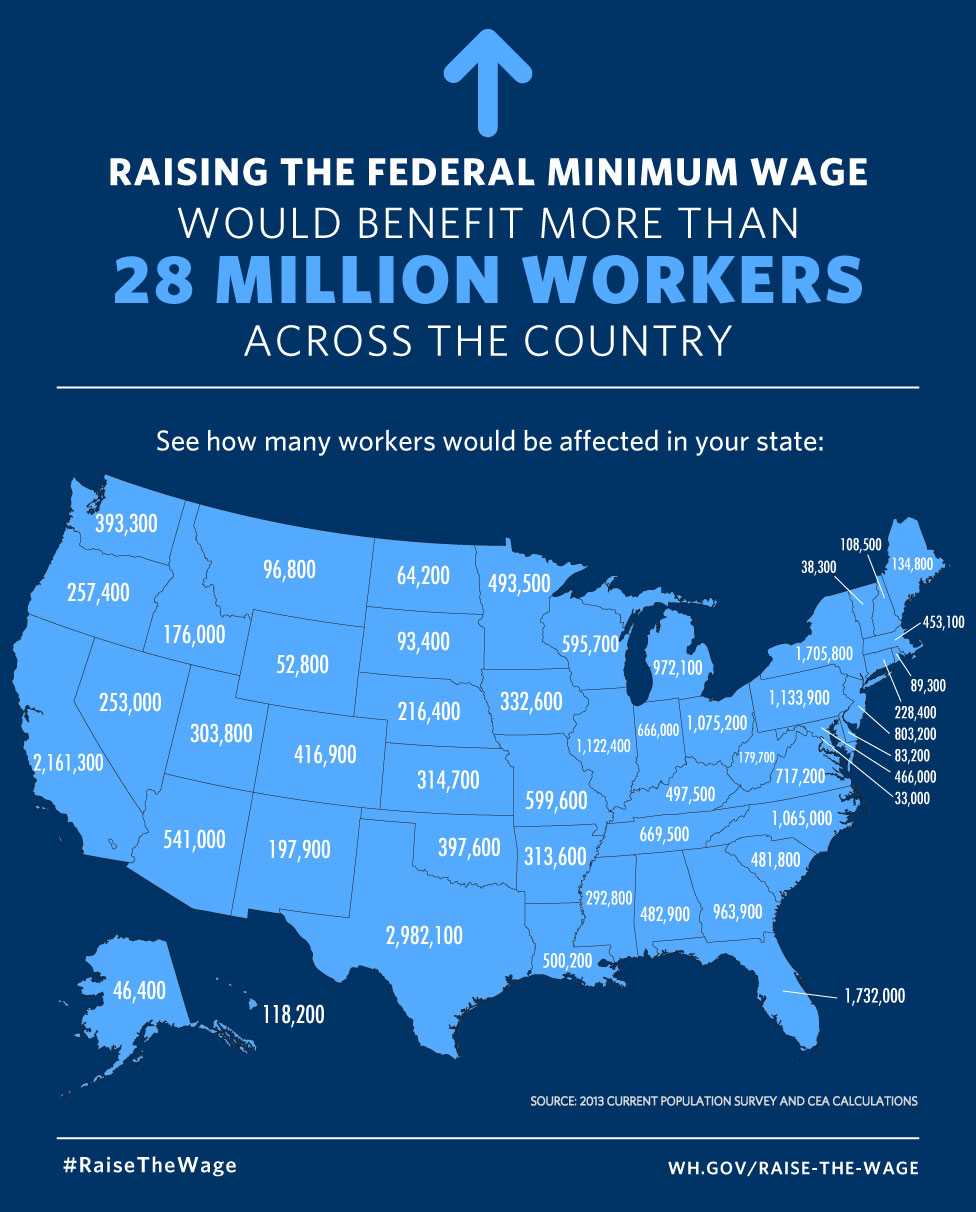
Over 28 million workers would benefit from the Harkin-Miller proposal to increase the minimum wage to $10.10 an hour.

  • Women (55 percent) and people with family income below $35,000 (46 percent) would make up substantial shares of the beneficiaries. One quarter of potential beneficiaries are caring for children.
  • The vast majority of people who would see their wages go up are adults in the prime of their working years, not teenagers, as some have claimed. Only 12 percent of beneficiaries would be under 20 years old.
  • About 12 million people in poverty would see their families’ incomes increase due to this proposal. It would lift 2 million of those people out of poverty.
  • At least 30,000 workers in every state would benefit from raising the Harkin-Miller proposal. In eighteen states, at least half a million workers will benefit.
Number of Workers Benefiting from Increasing tde Minimum Wage to $10.10, by State
State Number Affected State Number Affected
Alabama 482,900 Montana 96,800
Alaska 46,400 Nebraska 216,400
Arizona 541,000 Nevada 253,000
Arkansas 313,600 New Hampshire 108,500
California 2,161,300 New Jersey 803,200
Colorado 416,900 New Mexico 197,900
Connecticut 228,400 New York 1,705,800
Delaware 83,200 Nortd Carolina 1,065,000
District of Columbia 33,000 Nortd Dakota 64,200
Florida 1,732,000 Ohio 1,075,200
Georgia 963,900 Oklahoma 397,600
Hawaii 118,200 Oregon 257,400
Idaho 176,000 Pennsylvania 1,133,900
Illinois 1,122,400 Rhode Island 89,300
Indiana 666,000 Soutd Carolina 481,800
Iowa 332,600 Soutd Dakota 93,400
Kansas 314,700 Tennessee 669,500
Kentucky 497,500 Texas 2,982,100
Louisiana 500,200 Utah 303,800
Maine 134,800 Vermont 38,300
Maryland 466,000 Virginia 717,200
Massachusetts 453,100 Washington 393,300
Michigan 972,100 West Virginia 179,700
Minnesota 493,500 Wisconsin 595,700
Mississippi 292,800 Wyoming 52,800
Missouri 599,600 Total 28,113,400
Source: 2013 Current Population Survey and CEA calculations 


The White House

Office of the Press Secretary

Remarks by the President at Screening of "Cesar Chavez: An American Hero"

South Court Auditorium

2:38 P.M. EDT
 
THE PRESIDENT:  Welcome to the White House.  We are here to celebrate the life of an American hero.  Cesar Chavez was a man who devoted this brief time that we have on Earth to making sure that this country lived up to some of its lofty ideals, the words of our founding, the idea that all of us are created equal -- a man who organized others to widen the circle of opportunity not just for the people he knew, but for future generations. 
 
And some of those future generations are here today.  Cesar’s son, Paul, is here.  (Applause.)  There he is.  I was looking for him.  Some of his children -- some of his grandchildren and great-grandchildren are here.  I did not have the honor of knowing Mr. Chavez, but I’d imagine that he’d be pretty proud to know that his granddaughter works in the White House.  (Applause.)  And not only does she know how to deliver an outstanding introduction -- (laughter) -- but she also does just an extraordinary job carrying on his work organizing people, but now all across the country, to engage on issues that are of importance to all Americans.  And Julie just does an extraordinary job.  We’re so proud of her.  So, thank you, Julie, for the great introduction.  (Applause.) 
 
A couple of other acknowledgements -- I want to acknowledge an outstanding Democratic leader in the House of Representatives, Nancy Pelosi.  (Applause.)  The great Dolores Huerta, our dear friend who co-founded the United Farm Workers along with Cesar.  (Applause.)  Rosario told me she was playing Dolores, and I thought I can see that -- there’s the same fire.  I did have to say Rosario is a little taller.  Just a little bit.  (Laughter.) 
I want to thank the UFW’s current president, Arturo Rodriguez, a great friend of ours.  Thank you. (Applause.)  And I want to thank Diego Luna and the entire cast of “Cesar Chavez.”  (Applause.)  I told him I loved “Y Tu Mamá, También.”  But we can’t screen that at the White House.  (Laughter.)  It’s a great movie, but this is a little more family-friendly here.  (Laughter.)   

This movie, this film tells the story of a man guided by an enormous faith -- faith in a righteous cause and a loving God, and the dignity of every human being.  And it reminds us how throughout our history that faith has been tested, and that it falls to ordinary Americans, ordinary people, to fight and restore that faith. 
 
Cesar himself said that he spent his first 20 years working as an organizer without a single major victory.  But he never gave up.  He kept on going, and the world is a better place because he did.  And that’s one of the great lessons of his life. You don’t give up the fight no matter how long it takes.  No matter how long the odds, you keep going, fueled by a simple creed -- sí, se puede. 
 
Sometimes people ask me -- in fact, while we were backstage, somebody said, oh, you look pretty good.  You look better than I expected.  (Laughter.)  The implication being that there might be reason for me not to look good.  (Laughter.)  But part of what sustains me and part of what I’ve said in the past -- and some of you who have been in meetings with me when we’ve experienced setbacks or frustrations on particular issues -- I’ve tried to remind people change is hard.  It doesn’t happen easily.  It doesn’t happen smoothly or painlessly.  It happens because you put your shoulder behind the wheel and you keep on pushing.  And then, sometimes it’s going to roll back a little bit on you.  And then, you got to dig in and you’ve got to push some more. 
 
And Cesar Chavez understood that.  You have to push and you create this space.  And sometimes you won’t even see all the victories that are achieved, but you’ve invested that time and that effort, and you’ve inspired others.  And, eventually, things change, and you pass the baton and future generations then continue this process.
 
So we’ve got a lot of causes that are worth fighting for.  We’ve got to keep fighting to make sure that every American has access to quality, affordable health care.  We were very persistent about getting that website fixed.  It’s fixed now.  (Laughter and applause.)  And we’ve got more than 5 million people signed up.  But we’ve got two more weeks to sign them up. (Applause.)  So cuidadodesalud.gov -- (laughter) -- get on the website, spread the word.
 
We’ve got to keep fighting to make sure that our economy rewards the hard work of every American with a fair and living wage and equal pay for equal work.  We’ve got to keep working to fix our broken immigration system.  This is an example of where this is hard, but we’ve made progress and we are going to get this done.  This is going to happen.  It’s not a matter of if, just a matter of when.  And I want it to happen now, so we are going to keep on pushing.  (Applause.) 
 
Mr. Chavez once said, “When you have people together who believe in something very strongly -- whether it’s religion or politics or unions -- things happen.”  And today, we’ve got labor leaders and CEOs and faith leaders and law enforcement, and they’ve come together and they’ve said it’s time to fix this broken immigration system.  We’ve got Democrats and Republicans who have now passed in the Senate a comprehensive bill.  And if we stay united, things will happen, things will get done. 
 
None of us can claim to know exactly what Cesar would have said about this fight, or any other.  But I do think he would want us to remember that the debates we have are less about policy than they are about people.  They’re about the lives of men and women, the young and not so young, who want nothing more than the chance to work hard, support their families, provide a future for their kids and their grandkids, earn their place in our American story.  That’s what this is all about.  They’re about our highest hopes and aspirations for this country that we love -- and the country that we leave for future generations.
 
As this film reminds us, that was the cause of Cesar Chavez’s life, and I hope this afternoon it’s going to inspire all of us in the causes that we have to fight as well. 
 
I cannot stay for the screening.  I’ve been promised by our director that I’m -- or producer or somebody is going to get me the CD.
 
AUDIENCE MEMBER:  DVD.
 
THE PRESIDENT:  Whatever.  (Laughter.)  I’m a little technologically challenged.  (Laughter.)  The DVD.  (Laughter.)  The point is I’m going to watch it this weekend.  (Applause.)  Michelle and the girls are on their way to China.  It’s very lonely at home, so nothing better than to see an inspiring film. And I’m really looking forward to seeing a chronicled life of one of my heroes and one of the people who inspired me to get into the work that I’ve gotten into.  So thank you for sharing it with us.  (Applause.)  God bless.  (Applause.) 
 
END  
2:47 P.M. EDT

The White House

Office of the Press Secretary

Statement by the Press Secretary on the Visit of Prime Minister Jomaa of Tunisia

President Obama will host Prime Minister Mehdi Jomaa of Tunisia at the White House on Friday, April 4.  During the meeting, the President looks forward to discussing the commitment Tunisia’s leaders have made to advancing Tunisia’s democracy and how the United States can further support Tunisia’s historic transition.  The leaders will discuss a broad range of bilateral and regional issues of mutual interest, including U.S. economic, political, and security assistance to support the Prime Minister’s reform agenda and Tunisia’s stability.  Prime Minister Jomaa’s visit is a demonstration of the strong bonds of friendship between the American and Tunisian people, and America’s enduring commitment to Tunisia’s democratic transition.

The White House

Office of the Press Secretary

Statement by NSC Spokesperson Caitlin Hayden on U.S. Admittance as an Extractive Industries Transparency Initiative Candidate Country

We are pleased that today the International Board of the Extractive Industries Transparency Initiative (EITI) accepted the U.S. Candidacy Application at their Board Meeting in Oslo, Norway. 

Two years ago, at the launch of the Open Government Partnership, President Obama announced the U.S. commitment to implement EITI, an international standard aimed at increasing transparency and accountability in the payments that companies make and the revenues governments receive for their natural resources such as oil, gas, and mining.

The United States is first G-8 country to achieve candidate status and become an EITI implementing country, joining a group of 41 countries around the world that are working actively to improve the management of their oil, gas, and mining sectors. 

As an EITI Candidate Country, the United States, through the Department of the Interior, will continue its work toward increasing revenue transparency and accountability in relevant industry sectors, ensuring that American taxpayers receive every dollar due for the extraction of the nation’s natural resources, and making the U.S. government more open and more accountable to the American people.

The White House

Office of the Press Secretary

FACT SHEET: The President’s Climate Data Initiative: Empowering America’s Communities to Prepare for the Effects of Climate Change

“Climate change is a fact.  And when our children’s children look us in the eye and ask if we did all we could to leave them a safer, more stable world, with new sources of energy, I want us to be able to say yes, we did.”– President Barack Obama, State of the Union Address, January 28, 2014

Last June, President Obama launched a Climate Action Plan to cut carbon pollution, prepare communities for the impacts of climate change, and lead international efforts to address this global challenge. The plan recognizes that even as we act to curb the carbon pollution that is driving climate change, we must also prepare our citizens and communities for the climate impacts that are already underway across the country.

Delivering on a commitment in the President’s Climate Action Plan, the Obama Administration is today launching the Climate Data Initiative—a broad effort to leverage the Federal Government’s extensive, freely-available climate-relevant data resources to stimulate innovation and private-sector entrepreneurship in support of national climate-change preparedness.

President Obama is committed to ensuring that communities across America have access to the information and tools they need to protect themselves from harm today and potential damage in the future. This means connecting regional and city planners, resource managers, farmers, hospitals, and businesses with data-driven tools to help them better understand, manage, and prepare for the real-world impacts associated with climate change. Maps of future sea-level rise, for instance, can help builders decide where to break ground out of harm’s way, while other online tools can help water utility operators identify potential threats to the local water supply.

Insights gathered from data can help communities and businesses better understand and manage the risks associated with climate change. However, taking data about climate that is collected by satellites and scientific equipment and turning it into easy-to-use information and tools takes analysis, innovation, and cutting-edge technology expertise.

Through the Climate Data Initiative, the Obama Administration is today issuing a call to America’s top private-sector innovators to leverage open government data resources and other datasets to build tools that will make America’s communities more resilient to climate change and to forge cross-sector partnerships to make those tools as useful as possible.  In response to this call to action, today’s launch includes a number of commitments by Federal agencies and private-sector partners:

Administration Commitments:

The Climate Data Initiative builds on two significant Administration commitments: (1) to strengthen America’s resilience to climate change, and (2) to make government-held data more accessible to the public, entrepreneurs, researchers, and others as fuel for innovation and economic growth. New steps by the Administration include:

  • Launch of climate.data.gov. With leadership from the National Oceanic and Atmospheric Administration (NOAA) and National Aeronautics and Space Administration (NASA), the Administration is launching climate.data.gov—a new climate-focused section of Data.gov, the Federal Government’s open data platform, hosted by the General Services Administration, that will make Federal data about our climate more open, accessible, and useful to citizens, researchers, entrepreneurs, and innovators. Climate.data.gov will initially focus on coastal flooding and sea level rise in its beta phase, and already includes more than 100 curated, high-quality datasets, web services, and tools that can be leveraged by innovators to help communities prepare for the future. Over time, these data and resources will expand to provide information on other climate-relevant threats, such as to human health, energy infrastructure, and our food supply. 

  • Launch of NASA and NOAA Innovation Challenge on Coastal Vulnerability and Preparedness.  Today, NOAA and NASA are launching an innovation challenge to encourage entrepreneurs, technologists, and developers to create and deploy data-driven visualizations and simulations that help people understand their exposure to coastal-inundation hazards and other vulnerabilities. This “Coastal Flooding Challenge” will culminate in a two-day event on April 12-13, 2014, as part of broader activities around the International Space Apps Challenge—a global mass collaboration inviting teams of problem-solvers to leverage publicly available data to design innovative solutions for global challenges. 

  • Release of New Infrastructure and Geographic Map Data Relevant to Climate-Preparedness. To help communities and citizens plan for the risks of coastal flooding and other climate-change-related impacts, the U.S. Geological Survey, U.S. Department of Homeland Security, U.S. Department of Defense, and National Geospatial-Intelligence Agency are releasing today a collection of datasets containing mapping information about hundreds of thousands of the Nation’s infrastructure units and geographical features, including bridges, roads, railroad tunnels, canals, and river gauges. Providing wider access to these data to mission partners and the general public can advance preparedness for climate change impacts and other disasters. These data, which have been reviewed by DHS, DoD, USGS, and NGA and deemed non-sensitive, are being made available via user-friendly mapping services on Geoplatform.gov and Climate.data.gov

  • NOAA Request for Information on Increasing Access to Environmental Data: To increase access to and use of its vast library of environmental data, NOAA has issued a request for information (RFI) seeking comment from industry, non-profits, research laboratories, universities, and private-sector partners to help make NOAA's vast data holdings available in a rapid, scalable manner to the public. Of the 20 terabytes of data NOAA gathers each day only a small percentage is easily accessible to the public. Through the RFI, American companies will be able to provide potential solutions for NOAA to turn this untapped information into usable products or services. Respondents have until March 24, 2014, to submit a written statement of interest, including a proposed way forward.  

  • Support for Climate Data & Tools in the President’s Budget. Recognizing the critical importance of data and information to meet the challenge of climate change, the President’s proposed FY15 Budget includes support for State, local, and tribal preparedness efforts, analysis of vulnerabilities of critical infrastructure, and development and dissemination of better information and planning tools, including the Climate Resilience Toolkit and Climate Data Initiative. The Budget also includes a new $1 billion Climate Resilience Fund, within a fully paid for $56 billion Opportunity, Growth, and Security Initiative, that expands on existing climate-change preparedness programs to ensure we are doing everything we can to support the safety and security of our communities and resources. The Fund will help us better understand and prepare for climate change by investing in research and unlocking data and information, including new sea-level rise analyses. 

  • Expanding Stakeholder Outreach & Engagement. The White House, NASA, NOAA, and other Federal agencies will convene innovators, community leaders, scientists, communicators, and citizens to identify needs for data and data-driven tools, spur innovative collaborations and partnerships, and get feedback on how to best make data, information tools, and other resources on climate change available and useful to people, businesses, and communities. This process began today with two collaborative stakeholder workshops during which climate and technology experts will brainstorm innovative new climate resilience tools and ways to provide increased data-access to wide audiences. These workshops will precede the public launch. 

Private Sector Commitments

  • Esri: Providing Communities with Map-Based Planning Tools and Collaboration Platforms. Esri is unveiling a new two-part initiative to help communities more effectively build climate-resilience. First, Esri will develop and publish a series of free and open "maps and apps" developed in partnership with 12 cities that help address the most urgent climate-relevant needs shared among thousands of users of Esri’s ArcGIS platform—such as preparing for droughts, heat waves, or flooding. Second, Esri is announcing today a climate-focused geo-collaboration portal—an online destination to discover, contribute, and share resources critical to confronting the impacts of climate change. Additionally, Esri recently announced, during one of the largest gatherings of GIS developers and in response to the President’s call to action, a Climate Resilience App Challenge to inspire more than 2,500 developers to focus their creative attention on creating mapping and analytical tools that help communities see, understand, and prepare for climate risks. Prizes will be awarded and the resulting apps will be openly shared in July.  

  • Intel Corporation: Fostering Regional Partnerships and Hosting Hackathons to Boost the Development of Climate Resilience Tools. Intel Corporation, as part of its Code for Good program, is announcing its sponsorship of three regional partnerships including “hackathon” events focused on climate resilience in the Chesapeake Bay, New Orleans, and San Jose. In each location, Intel will join with local partners to convene teams of engineering and computer science students, and other interested local citizens, and challenge them to develop new software applications and tools to make good use of available data sets related to climate -change resilience. Each hackathon will have a focus area tailored to priorities of its host community, with an emphasis on driving a sense of local ownership of the tools that emerge from the event. These tools will be broadly communicated and made available for use in other localities. 

  • Google: Providing Vast Cloud Computing Resources to Spur Creation of High-Resolution Drought and Flood Mapping, Apps, and Tools for Climate Risk Resilience Google is today announcing it will donate significant cloud computing and storage resources to support the creation of global, high-resolution maps, tools, and data products that will be made freely available to the public to help manage the risks of extreme heat, drought, sea-level rise and flooding. Google is committing to provide one petabyte (1,000 terabytes) of cloud storage to house satellite observations, digital elevation data, and climate and weather model datasets drawn from government open data and contributed by scientists as well as 50 million hours of high performance cloud computing on the Google Earth Engine geospatial analysis platform. To leverage these resources, Google is announcing today new partnerships with the Desert Research Institute, the University of Idaho, and the University of Nebraska to (1) provide drought mapping and monitoring for the entire continental United States in near real-time and (2) model water consumption from vegetation across the entire planet. To better manage climate-related flooding, Google is also challenging the innovation community to leverage these vast cloud computing resources by collaborating in the development of an open and freely available global terrain model at unprecedented resolution - one petabyte of storage could support better than 1 meter resolution which will help the public and planners worldwide better anticipate and map the risks of coastal floods and other disasters. Google is also committing to support analysis and visualization of these scientific data to make information about impacts such as sea-level rise, storm surges, extreme heat, and drought easily accessible to the public. 

  • CartoDB: Announcing New Grants Program to Support Creation of Data-Driven Tools. CartoDB will launch a grants program to support foundations and nonprofits in creating data-driven tools or efforts with respect to helping communities, companies, or citizens with resilience and preparedness for climate change impacts such as flooding, drought, and heat waves.  The company will solicit grant applications and offer between $50 and $3500 for successful applications to be used on CartoDB infrastructure to help make climate resilience apps or projects possible. The money is to be spent in a year, but funded projects are free to reapply in the future.   

  • Climate Central: Releasing New Web Tools to Assess Local-Scale Sea Level Rise. Climate Central will release a free web tool providing local projections, maps, and assessments of exposure to sea level rise and coastal flooding tabulated for every coastal zip code, municipality, county, and state in the U.S., along with planning, legislative and other geographic districts. Exposure assessments will cover more than 100 demographic, economic, infrastructure and environmental variables using data drawn mainly from federal sources, including NOAA, USGS, FEMA, DOT, DOE, DOI, EPA, FCC and the Census. Climate Central has already developed its Surging Seas Risk Finder tool for Florida, New Jersey, and New York, which is geared toward city, state, and Federal planners, and commits to completing the balance of coastal states this year. Climate Central will conduct at least 100 more informational webinars and briefings with officials, planners and other stakeholders across the country in 2014. 

  • Microsoft Research: Providing Climate Scientists with New Tools and Computing Resources. Microsoft Research is announcing a new program to provide climate change scientists and decision-makers free access to cloud computing resources to conduct research and analysis of climate data. Microsoft Research will grant 12 months of free cloud computing resources to 40 awardees selected from project proposals submitted by June 15, 2014. Each award provides up to 180,000 hours of free cloud computing time and 20 Terabytes of cloud storage. Microsoft is also announcing a new, free climate data resource, FetchClimate, for retrieving past and present observations and for future climate-prediction information. FetchClimate will continue to be available as a free intelligent environmental information-retrieval service and will now be adaptable as a cloud-based system that can be re-implemented and adapted to the specific needs of new projects.  

  • Circle of Blue and Qlik: Developing New Tools and Visualizations to Better Understand Climate Impacts. Circle of Blue, a nonprofit news and science organization, has partnered with Qlik, a data-analytics company, to develop a series of tools to improve understanding of water, food, and energy in a changing climate. Today the two organizations will launch an interactive visual dashboard that analyzes and integrates data into displays of current and past levels of water reservoirs in California, and which can be scaled to compare hyper-local data and research with national and global trends. Current data, particularly water-related, is often compartmentalized and not available in comparative, visual formats. This new interactive display application, will help the public, water managers, and researchers, and others to build more resilient communities and ecosystems by helping the nation better understand, monitor, compare and manage its water supplies in this era of climate change. 

  • 100 Resilient Cities, an effort Launched by the Rockefeller Foundation: Supplying Data on Local Demand and Market Opportunities for Resilience Tools. 100 Resilient Cities (100RC) is working to build urban resilience in 100 member cities around the world and develop the practice of resilience. As cities work to build resilience, they will demand new resilience-building tools from the marketplace. 100RC will provide to the Climate Data Initiative’s stakeholder engagement community with information from their 100 member cities on which types of resilience tools are most needed and could be most useful to inform efforts and direct investment in areas of greatest need, and pool demand for these tools as a signal to innovators of the market opportunity. 

  • Code for Philly: Using City Buses to Help Monitor Local Climate Change-Related Pollution. Code for Philly, Code for America’s Philadelphia Brigade, is announcing the development of a new mobile sensor network they aim to run on city buses to gather temperature and pollution data across the city, allowing researchers to track the effects of climate change on and its pollutants in areas across an entire city. This data will be combined with OpenTreeMaps, a platform for crowdsourced tree inventory and urban forestry analysis, to determine the value of trees in combating climate change. The data will also be openly available so developers can incorporate and convey information on local pollution and heat levels in real time to citizens. 

  • The World Bank: Launching New Initiative for Global Use of Open Data for Climate and Disaster Resilience. The World Bank is launching today a new Field Guide that serves as a model for how communities around the globe can best leverage open data for resilience to disasters and climate change impacts. As part of the World Bank’s Open Data for Resilience Initiative (OpenDRI), the Field Guide builds on work active across more than 20 countries to map millions of buildings and urban infrastructure; open more than 1,000 geospatial datasets to the public; and spur the development of innovative applications based on those data. The OpenDRI Field Guide will be presented at stakeholder workshops and events across the globe. Additionally, to establish a versatile framework for free access to risk data, the World Bank will share the Field Guide and other resources with at least 24 partner countries by 2016. 

  • Antioch University New England: Creating New Academic Center for Climate Preparedness and Resilience. Antioch University New England (AUNE) is announcing the creation of a new Center for Climate Preparedness and Community Resilience, to be launched later this year. The Center will expand on a decade of AUNE’s climate adaptation research and modeling efforts, community engagement/technical assistance, and professional science sustainable development and climate change education. The launch of the new Center will include a convening in May, 2014, in partnership with the U.S. Environmental Protection Agency, of municipal, county and regional leaders on the frontlines of climate change adaptation, from the upper Chesapeake Bay watershed to Maine, to leverage the data-driven expertise of a wide range of organizations and individuals. 

  • MIT Climate CoLab: Crowdsourcing Solutions to Global Climate Change Preparedness. The Massachusetts Institute for Technology (MIT) Center for Collective Intelligence runs the Climate CoLab, an online platform to crowdsource solutions for what to do about global climate change. Over 10,000 people from around the world have registered as members and have submitted more than 400 proposals in contests ranging from how to generate electricity with fewer harmful emissions, to how to increase public understanding about climate change. The MIT Climate CoLab recently launched two global crowdsourcing contests, in line with the White House Climate Data Initiative, to generate solutions to climate change preparedness and resilience: (1) What can be done to adapt to the impacts of climate change? and (2) How can crowdsourcing provide more efficient disaster risk management?  To help the public understand the potential impacts of climate change, MIT Climate CoLab’s platform also includes computer simulation models to predict phenomena such as temperature change and sea level rise.  

  • EcoHack: Launching New Hackahton Climate Data Track. EcoHack, an annual hackathon focused on tackling real scientific and environmental challenges through code, visualization, and hardware hacking, will launch and promote a new dedicated track to support climate data and application hacks. The event will take place this year on May 9 – 10th in New York City, San Francisco, and São Paulo, Brazil. At each of the three locations, organizers will work to identify one or more high-impact climate-relevant products or outcomes resulting from the hackathons—with the goal of creating a finished visualization, app, or website to help expand the reach and impact of these tools.

  • Alliance for Water Efficiency: Over the next three years, Alliance for Water Efficiency will provide assistance to communities across the country to help them achieve water use reductions or expand water conservation programs, through webinars, workshops, and new tools. This includes AWE’s Water Conservation Tracking Tool, which enables utilities to evaluate the water savings, costs, and benefits of a variety of conservation programs, and track savings over time. AWE is also announcing it will build over the next three years an Outdoor Water Savings Research Program to produce actionable data on the potential and actual water savings from outdoor conservation measures. AWE will work with at least ten communities to customize and distribute its online Household Water Calculator, which empowers citizens to make better decisions about their water use through data, allowing consumers to calculate their own water use and compare it to a neighboring and water-efficient home, and then receive a personalized efficiency plan to help them use water more wisely.