President Obama Pays Tribute to Fallen Police Officers

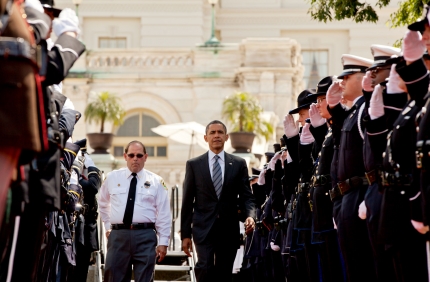
President Barack Obama at the National Peace Officers Memorial Service

President Barack Obama, with Chuck Canterbury, president, Grand Lodge Fraternal Order of Police, arrives at the National Peace Officers Memorial Service, an annual ceremony honoring law enforcement officers killed in the line of duty in the previous year, at the U.S. Capitol in Washington, D.C. May 15, 2012. (Official White House Photo by Pete Souza)

President Obama was at the U.S Capitol today for a ceremony where he paid tribute to law enforcement officials who were killed in the line of duty in the previous year. The serive is part of the annual Peace Officers Memorial Day and National Police Week. 

In his remarks, the President acknowledged and thanked the families of those who have fallen, and highlighted the courageous acts of those we lost. He also praised the bravery of all those who serve as law enforcement officers across our country:

Every American who wears the badge knows the burdens that come with it -- the long hours and the stress; the knowledge that just about any moment could be a matter of life or death.  You carry these burdens so the rest of us don’t have to. 

And this shared sense of purpose brings you together, and it brings you to our nation’s capital today.  You come from different states and different backgrounds and different walks of life, but I know that you come here as a community:  one family, united by a quiet strength and a willingness to sacrifice on behalf of others. 

The rest of us can never fully understand what you go through.  But please know that we hold you in our hearts -- not just today, but always.  We are forever in your debt.  And it is on behalf of all of us, the entire American people, that I offer my thoughts, my prayers, and my thanks.

President Obama & Vice President Biden Honor the Nations TOP COPS

President Obama TOP COPS 2012

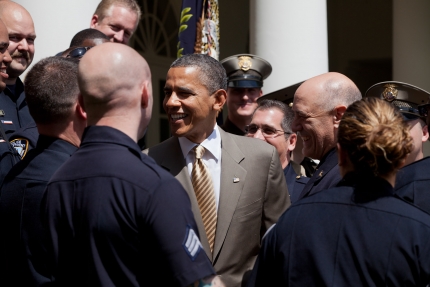
President Barack Obama greets 2012 National Association of Police Organizations Top Cops honorees following his remarks in the Rose Garden of the White House, May 12, 2012. (Official White House Photo by Pete Souza) May 12, 2012. (Official White House Photo)

Today, in a ceremony in the Rose Garden of the White House, President Obama and Vice President Biden honored the winners of the National Association of Police Organizations (NAPO) TOP COPS award for law enforcement who have shown bravery and valor in the line of duty.
 
President Barack Obama, joined by Vice President Joe Biden, National Association of Police Organizations President Tom Nee, and Homeland Security Secretary Janet Napolitano delivered remarks on the imporant role law enforcement officers play, how they put their lives on the live every day to keep America's citizens and neighborhoods safe.  The President  noted:
 You know, I look forward to this event each and every year, because it’s a chance to say thank you.  Every day, hundreds of thousands of law enforcement officers keep our neighborhoods safe, and frankly, they don’t ask for a lot.  They don't ask for a lot of credit.  They don’t go to work planning to be heroes.  They just do their jobs.

But when you put on that badge, you assume a special responsibility.  And every time you put it on, you never know if this day will be the day that you’ve spent your entire career training for -– the day when just doing your job and being a hero are exactly the same thing.  For the men and women standing behind me, America’s Top Cops, that day came.  And when it did, they were ready.  They didn’t flinch.  They didn't back off.  There are people who are alive today only because of their courage.

President Obama also remarked that we must continue to to support our men and women in law enforcement, like the Top Cops and work to make their line of work safer and more effective because, he said:

Our safety will always depend on the quiet heroism of ordinary Americans, like the ones that we recognize today.  We will be forever in debt to those who wear the badge; to men and women with a deep sense of duty, and a willingness to serve and sacrifice on our behalf.  And I think these individuals don't mind me saying that they are representative of the sacrifices and that quiet courage that exists among law enforcement officers all across the country -- and their families, because I know the strains of families in such a difficult job is significant as well.  And those families, those of you who are here today, we want to say thank you to you as well.

So, again, to the 2012 Top Cops, thank you for everything you do.  God bless you and your families.  And God bless the United States of America.  All right. 


Download Video: mp4 (378MB) | mp3 (24MB)
Related Topics: Homeland Security, Service

Remarks by Secretary Janet Napolitano to the Anti-Defamation League

On April 29th, Secretary Janet Napolitano was honored by the Anti-Defamation League with the William and Naomi Gorowitz Institute Service Award for her work as Secretary of Homeland Security in combatting terrorism, extremism, and injustice. The Secretary's full remarks are below.

Thank you, Abe, for your kind words.

I’ve been privileged to work with the Anti-Defamation League since the 1990s and was honored to receive the ADL Leader of Distinction award as Arizona Attorney General, and your “Torch of Liberty” award as Governor, as Abe mentioned.

I am truly humbled again tonight to receive the William and Naomi Gorowitz Institute Service Award, for the Department of Homeland Security’s work to “combat terrorism, extremism, and injustice”.

Strengthening the Violence Against Women Act

This week, the Senate will consider bipartisan legislation, introduced by Senators Patrick Leahy (D-VT) and Mike Crapo (R-ID),  that would reauthorize the Violence Against Women Act (VAWA). First authored by then-Senator Biden in 1994, VAWA provides funding to states and local communities to improve the criminal justice response to domestic violence, dating violence, sexual assault and stalking.  VAWA supports specialized law enforcement units to investigate these crimes and helps prosecutors get dangerous offenders off the streets. Since the passage of the act, annual incidents of domestic violence have dropped by more than 60 percent. 

While tremendous progress has been made, violence is still a significant problem facing women, men, families, and communities.  On average, 3 women a day die as a result of domestic violence. The hidden crime of stalking affects 1 in 6 women and sexual assault remains the most underreported violent crime in the country. 1 in 5 women and 1 in 71 men have been sexually assaulted at some time in their lives.  The Leahy-Crapo bill to reauthorize VAWA addresses today’s most pressing issues and builds on what we have learned over the past 17 years.  We must continue moving forward to reduce violence against all women. 

Native American women suffer from violent crime at some of the highest rates in the United States. One regional survey conducted by University of Oklahoma researchers showed that nearly three out of five Native American women had been assaulted by their spouses or intimate partners.  In addition, a recent Center for Disease Control (CDC) study found that 46 percent of Native American women have experienced rape, physical violence, and/or stalking by an intimate partner in their lifetime. Tribal leaders say there are countless more victims of domestic violence and sexual assault whose stories may never be told. 

With non-Indians constituting more than 76 percent of the overall population living on reservations and other Indian lands, interracial dating and marriage are common, and many of the abusers of Native American women are non-Indian men.  Too often, non-Indian men who batter their Indian wives and girlfriends go unpunished because tribes cannot prosecute non-Indians, even if the offender lives on the reservation and is married to a tribal member, and because Federal law‐enforcement resources are hours away from reservations and stretched thin.  

The White House

Office of the Press Secretary

President Obama Signs Hawaii Disaster Declaration

The President today declared a major disaster exists in the State of Hawaii and ordered Federal aid to supplement state and local recovery efforts in the area affected by severe storms, flooding, and landslides during the period of March 3-11, 2012. 

Federal funding is available to state and eligible local governments and certain private nonprofit organizations on a cost-sharing basis for emergency work and the repair or replacement of facilities damaged by the severe storms,  flooding, and landslides in Kauai County.  

Federal funding is also available on a cost-sharing basis for hazard mitigation measures statewide. 

W. Craig Fugate, Administrator, Federal Emergency Management Agency (FEMA), Department of Homeland Security, named Mark H. Armstrong as the Federal Coordinating Officer for federal recovery operations in the affected area. 

FEMA said additional designations may be made at a later date if requested by the state and warranted by the results of further damage assessments.

FOR FURTHER INFORMATION MEDIA SHOULD CONTACT:  FEMA NEWS DESK AT (202) 646-3272 OR FEMA-NEWS-DESK@DHS.GOV

A Drug Policy for the 21st Century

Illegal drugs not only harm a user’s mind and body, they devastate families, communities, and neighborhoods. They jeopardize public safety, prevent too many Americans from reaching their full potential, and place obstacles in the way of raising a healthy generation of young people.

To address these challenges, today we are releasing the 2012 National Drug Control Strategy – the Obama Administration’s primary policy blueprint for reducing drug use and its consequences in America.  The President’s inaugural National Drug Control Strategy, published in 2010, charted a new direction in our approach to drug policy. Today’s Strategy builds upon that approach, which is based on science, evidence, and research.  Most important, it is based on the premise that drug addiction is a chronic disease of the brain that can be prevented and treated. Simply put, we are not powerless against the challenge of substance abuse – people can recover, and millions are in recovery. These individuals are our neighbors, friends and family members. They contribute to our communities, our workforce, our economy, and help make America stronger. 

Our emphasis on addressing the drug problem through a public health approach is grounded in decades of research and scientific study. There is overwhelming evidence that drug prevention and treatment programs achieve meaningful results with significant long-term cost savings. In fact, recent research has shown that each dollar invested in an evidence-based prevention program can reduce costs related to substance use disorders by an average of $18.

But reducing the burden of our Nation’s drug problem stretches beyond prevention and treatment. We need an all of the above approach. To address this problem in a comprehensive way, the President’s new Strategy also applies the principles of public health to reforming the criminal justice system, which continues to play a vital role in drug policy. It outlines ways to break the cycle of drug use, crime, incarceration, and arrest by diverting non-violent drug offenders into treatment, bolstering support for reentry programs that help offenders rejoin their communities, and advancing support for innovative enforcement programs proven to improve public health while protecting public safety. 

Kathleen Sebelius is the Secretary of Health and Human Services; Eric Holder is the U.S. Attorney General and Gil Kerlikowske is the Director of the White House Office of National Drug Control Policy

The White House

Office of the First Lady

Remarks by the First Lady Honoring Young Women from Military Families

Jacksonville Naval Air Station
Jacksonville, Florida

6:08 P.M. EDT

MRS. OBAMA: Oh! (Applause.) How are you guys doing? (Applause.) You guys sit down. Rest yourselves. Are you having fun? (Applause.) There is more fun to come. I am thrilled -- thrilled -- to be here.

I want to start by thanking Maddie for her poise and for introducing me not once, but twice. (Applause.) Well done, Maddie. She is amazing. She's terrific. Very proud of her, so let's give her another round of applause. (Applause.)

A few other people that I want to thank. I want to thank Representative Corrine Brown, who's here, and Mayor Alvin Brown, who are here to -- joining us today. Thank you both for your leadership and being here with us.

I also want to take a moment to recognize all of the extraordinary men and women in uniform who are here today. You're amazing -- and your amazing spouses. Yay for the spouses. Thank you for the service that you've given. Thank you for the sacrifices that you've made. You all are the very best this country has to offer, and I am thrilled that you could join us here today.

And finally, I want to thank our guests of honor, these amazing, beautiful, well-dressed, well-put-together young women we are celebrating here today. (Applause.) And on behalf of myself and my husband, I want to tell you all truly how proud we are of you. We are so proud of you. We are inspired by you, and we are grateful for everything that you do for this country every single day. That’s why we wanted to have you here.

You see, when we talk about how our men and women in uniform sacrifice so much and serve this country so bravely, we’re not just talking about your parents. We are not. We are talking about all of you. We’re talking about our military kids and our military families, because we know that when your parents are called to serve, you all serve right alongside them.

When your parents get that call to pick up and move halfway across the country, you pick up and move right alongside them. And then, just when you finally get settled in, just when you’re feeling comfortable and make friends and start fitting in, what happens? That call comes again, right? And you have to start all over again and make new friends, and settle in, yet again.

And I know that couldn’t be easy. That can't possibly be easy for you. And I know it's even harder when your parents are deployed, and you have to keep your spirits up through all those missed holidays, and missed birthdays, and times when you would give anything in the world to have them back home.

And I know that some of you here will be -- for you, there will be an empty seat at graduation -- I know this. And for some of you, when it comes time for the prom, mom might not be there to help you pick out your dress. Dad might not be there to see you out on your date. And I know that that can't possibly be easy either.

But here’s something else that I know: Through it all –- through all the moves that you've had to make, through all those difficult moments, you all have stayed strong. I have seen it. I've seen it in so many kids like you across this country. You all have risen to the challenge.

You’ve become leaders in your schools. You're excelling in your classes. You're getting involved in all kinds of activities. You’ve become leaders in your communities, finding all kinds of ways to volunteer and give back. And many of you have stepped up at home as well, juggling activities and homework with chores and housework.

Many of you have had to put on a brave face for maybe a younger brother or sister, even when you were worried. You’ve had to reassure your parents that you were okay, even when sometimes you weren’t.

And you’ve done all of this because ultimately, you understand that your parents are part of something far bigger than themselves. You know that they protect and defend the freedoms that every single one of us holds dear. You know that their service keeps this country safe every single day. And you all are a vital part of that work. You truly are.

By working so hard at school and at home, and doing your part, you give your parents the peace of mind they need to focus on their mission. With your service, you make their service possible. And for that, we can't thank you enough. We cannot thank you enough.

Now, I know that many of you have never known anything else, right? This is your life. So for you, this is no big deal, maybe. Maybe you think it's nothing special, because this is just how you've grown up.

But I am here today -- we are all here today, and we're doing all of this today -- because you should know that this is a big deal. You are special. You all have lived lives that make you incredibly special young individuals.

As military kids, you have learned lessons and had experiences that many people don’t have in their entire lifetimes. You’ve immersed yourselves in all kinds of communities and cultures. You’ve made friends with people from all different backgrounds. And you’ve gained the wisdom and the perspective to appreciate what really matters in life.

You see, unlike a lot of young people, you all don’t take your families for granted, right? A lot of times, you have to work to stay connected to your families -- maybe through Skype. It's a lot of hard work making the most of those precious weeks of leave, saying the things that we don’t nearly say enough to the people we love –- things like “I’m so proud of you," “I don’t know what I’d do without you," “I love you more than you will ever know.”

And that’s something that always strikes me about our military families –- how dealing with the challenges of military life actually strengthens your family bonds, rather than weakening them; how spending time apart oftentimes actually brings you closer together. And all of that is part of who you are. And you should know that.

And as you get older, you will see that growing up in a military family has prepared you for life in a way that nothing else can. Because that’s really what life is about –- it’s about weathering all sorts of changes and transitions, and bumps and bruises. But it’s also about savoring the good times, right? Treasuring the people that we love and appreciating the many blessings that come with living in this great country of ours. That’s what all of you do every day.

Like your parents, you all are the very best this country has to offer. You’re role models not just for kids, but for adults and for all Americans who want to see what patriotism, sacrifice and service really looks like. That’s why we're here.

So I want to thank you all for everything that you do. I want to once again thank your parents for their service to our country.

And now -- here's where the fun begins -- I would like to announce that we have a special surprise guest who is about to join us. She is someone that I am proud to call a friend. She's a tremendous supporter and admirer of veterans and military families. And she's so amazed by your service that she's going to put you all on national TV right now.

So are you ready?

AUDIENCE: Yes! (Applause.)

MRS. OBAMA: So joining us live from the set of her TV show, I'm proud to introduce the one and only Ellen DeGeneres. (Applause.)

MS. DEGENERES: Hi, everybody!

MRS. OBAMA: They're screaming.

MS. DEGENERES: Hello, Mrs. Obama!

MRS. OBAMA: Hey, Ellen.

MS. DEGENERES: We're screaming here too! (Applause.)

MRS. OBAMA: What's going on?

MS. DEGENERES: I hope I'm not interrupting anything.

MRS. OBAMA: No, we're good. We're just -- good to have you here.

MS. DEGENERES: Good to be there. Congratulations on Joining Forces' one-year anniversary. Tell everybody what it's about, please.

MRS. OBAMA: Well, Joining Forces is our national initiative to make sure that all Americans honor our troops, veterans and families. This is the one-year anniversary. We've made some amazing strides, and we're here with some great military kids to give them a special thank you.

MS. DEGENERES: And that’s why I'm there, too, to give them a special thank you. You've accomplished so much already. What do you hope to accomplish this year?

MRS. OBAMA: Well, we want to do more. We want to make sure that every American does something. We're saying -- our motto is everyone can do something. It can be something as big as having you on your show, but it can also be helping mow the lawn; it can be doing what you do best, but doing it on behalf of a military family -- finding those families within your communities and reaching out to find out what they need.

So we want more of that to go on across this country.

MS. DEGENERES: So that is what you'd say if you -- if somebody says how can I help, it's all the little things. Just call up and say, what can I offer, what's my specialty?

MRS. OBAMA: Yes. And people can go to our website, joiningforces.gov. And we've got thousands of wonderful ideas, suggestions, things that are going on in communities all across this country. That’s a good place to start.

MS. DEGENERES: Great. Great. Now, Mrs. Obama, before we go any further, I think it's time we talk about the push-up situation. (Laughter.)

MRS. OBAMA: You're still bothered by that, huh?

MS. DEGENERES: Oh! (Laughter.)

MRS. OBAMA: Still feeling the wounds of defeat. (Laughter.)

MS. DEGENERES: Let's just make sure that everyone sees what we're talking about here. You were here in February, we had a competition to see who could do the most push-ups. I did 20, and you did 25. (Laughter.) Now, let's just watch the video for a second and then we'll comment.

Anything you'd like to say?

MRS. OBAMA: I could have done 35. I stopped because I felt bad for you. (Laughter and applause.)

MS. DEGENERES: I bet you could have. I actually bet you could have.

All right, we have to take a break. And we'll be back with the First Lady, Michelle Obama, and we have a surprise for a few lucky people there. We'll be right back. I'm going to do some push-ups. (Applause.)

MS. DEGENERES: Oh! I'm exhausted. I just did 53 push-ups. (Laughter and applause.)
 
We're back with the First Lady of the United States, Michelle Obama. She's in Jacksonville, Florida right now with military families. (Applause.) Mrs. Obama?

MRS. OBAMA: Yes! (Applause.)

MS. DEGENERES: Mrs. Obama, tell me who you're sitting with right now.

MRS. OBAMA: Oh man, we've got some great, beautiful young ladies. They're just gorgeous. You want me to pass the mic? You want to hear from them? You want to hear who's here?

MS. DEGENERES: Sure, let me meet them.

MRS. OBAMA: All right, we've got --

Q Hi, I’m Rachel.

MS. DEGENERES: Hi, Rachel. You excited to be there today?

Q Oh, I'm extremely excited to be here. I'm so honored. I'm here with all my classmates and my family members as well.

MS. DEGENERES: Well, it's so nice to meet you Rachel. Who are you sitting next to?

Q I'm sitting next to --

Q Hey! My name's Kianna. (Laughter.)

MS. DEGENERES: Hey, Kianna! (Applause.) Hey Kianna, I love your energy. And your mom is serving overseas right now, right?

Q Yes, she is.

MS. DEGENERES: And how do you stay in touch?

Q My mom calls our house a few times a week, and I always enjoy whenever she calls the house. I love hearing her voice, but it reminds me of her background.

MS. DEGENERES: I bet, I bet. And you're sitting next to?

Q Hi Ellen. My name is Elise.

MS. DEGENERES: Hi Elise, how are you?

Q I'm good. How are you?

MS. DEGENERES: And your dad is a Navy vet? I'm fantastic, thank you. Your dad is a Navy veteran. What is the best thing about being a military kid?

Q I really think that it teaches you a lot of good characteristics and to have a lot of strength and courage. Because it's really not easy when you have a family member out in deployment.

MS. DEGENERES: I know, it certainly is not easy, and that’s why you get so much love and support from all of us. We admire your strength and everything that your parents are doing for us. (Applause.)

So my question is, it's almost prom. You're looking forward to that, I bet, right?

Q Yes. Definitely.

MS. DEGENERES: Now, Mrs. Obama, I don’t think I've ever shown you my prom picture. I just wanted to -- I want to show you my prom picture first. (Laughter and applause.)

MRS. OBAMA: That is an excellent picture. Love the dress. Love the dress.

MS. DEGENERES: Thank you very much. That was a tablecloth at one point. (Laughter.) Now, I heard you have a good one too, so I thought I would share yours. (Laughter.)

MRS. OBAMA: That split was a little high. I don’t know if I'd let my kids go out with a split that high, so let's not show this to Malia and Sasha.

MS. DEGENERES: All right. Were you shopping at Pier One or something? (Laughter.)

MRS. OBAMA: You've never done the wicker chair shot? That’s standard.

MS. DEGENERES: No, I've seen the wicker chairs before but -- I didn’t know it was standard.

All right. Well, listen, JC Penny knows that you guys are getting ready for prom. They're a one-stop shop for all your prom needs. They have dresses, shoes, accessories -- even a salon -- all at great prices. So they're giving all three of you a $250 JC Penny giftcard. (Applause.)

And I know there are 300 other students there with you all for the event today who need to get ready for the prom as well. So all of you students who are there in Florida with Mrs. Obama are also getting a $250 JC Penny giftcard. (Applause.)

Thank you so much for your time today, Mrs. Obama. You know I admire you, I think you're an amazing, amazing woman. Thank you for all that you're doing. We're going to put something up on our website if anyone wants to get involved with Joining Forces. And we send our love and our support to all of you there. Thank you so much for all you do. And thank you, again, Mrs. Obama, for your time.

MRS. OBAMA: Thank you, Ellen. We love you. This is amazing. (Applause.) Thank you.

MS. DEGENERES: Love you, too. We'll be right back.

END
6:30 P.M. EDT

The White House

Office of the First Lady

Remarks by the First Lady and Dr. Biden at a Joining Forces Nurses Event

University of Pennsylvania
Philadelphia, Pennsylvania

2:52 P.M. EDT

DR. BIDEN:  Thank you, Dr. Meleis, for that kind introduction.  I can see you're a great educator.

It's great to be here in Philadelphia to mark the one-year Joining Forces anniversary.  Many of you know that I'm a proud military mom.  One of the best parts of my role as Second Lady is spending time with so many veterans and military families.  And I've traveled around the country and the world, and I'm always inspired by the strength and resilience of military families. 

Our military families have done so much for our country, and each of us can do something in return.  That’s why the First Lady and I started Joining Forces last year -- so that every American can take action to honor and support our military families.  The federal government is doing its part.  And as we've seen all across the country this past year, companies, stores, churches, schools, individuals are all stepping up to support military families. 

We have asked a lot of our service men and women since September 11, 2001.  They and their families have responded to the need for more frequent and longer deployments.  As they have done in the past, these troops and their families have stepped up with no complaint. 

We know that some of our returning veterans and wounded warriors face significant challenges when they come home.  We have seen a growing number of veterans returning with post-traumatic stress and traumatic brain injury.  Making sure that they get the care they need is a priority for this administration and for Joining Forces.  That’s why I'm so pleased to be here today for this announcement.

Nurses represent America's largest health care workforce.  Many of you know that I'm a community college professor, and I've had the great privilege over the years of teaching countless nursing students -- and I have to tell you, they're always my A students.  I know just how dedicated nurses are to their profession. 

Nurses are on the front lines in providing life-saving care in nearly every community.  And this is critical, because only half of our veterans seek care through the VA system.  Nurses are vital to ensuring that all our veterans receive the care they need and deserve.  More than 500 nursing schools, and more than 150 nursing organizations are joining forces to make sure our nurses are prepared to meet the unique health needs of servicemembers, veterans and their families.

The leading nursing schools and nursing organizations have committed to educate current and future nurses on how to recognize and treat post-traumatic stress, traumatic brain injury, depression and other combat-related issues.  This Joining Forces commitment means there will be more than 3 million nurses ready to meet the needs of our brave men and women.  This is absolutely essential to ensuring our returning servicemembers and their families receive the care they deserve.  Thank you, for this tremendous effort. 

Our military families deserve the very best efforts of each of us, to ease the burdens created by their service to our country.  It is our sacred obligation to show our military families that we truly appreciate their sacrifices on our behalf. 

Before I close, I want to give a special thank you to my good friend and partner in this effort, First Lady Michelle Obama.  She is a committed, caring advocate who has done so much for our military families.  Thank you, Michelle.  (Applause.)

And now, I am so pleased to introduce Lieutenant Commander Pamela Wall -- a nurse who understands firsthand the kind of wounds we are talking about today.  She joined the U.S. Navy Corps in 1996 as a nurse, and has served at military medical facilities around the world.  as a pre-doctoral student at the University of Pennsylvania, her research is focused on traumatic brain injury.  Thank you, Pamela, for your service. 

And now, please join me in welcoming Lieutenant Commander Wall.  Thank you.  (Applause.)

* * * * * 

MRS. OBAMA:  Thank you all so much.  (Applause.)  Thank you. 

AUDIENCE MEMBERS:  We love you, Michelle!  (Applause.)

MRS. OBAMA:  You all, thank you so much.  That’s very sweet, very sweet. 

Well, I can’t tell you what a pleasure it is to be here with all of you today, and to feel this enthusiasm.  This is good stuff.  (Laughter.) 

I want to start by thanking Dr. Meleis for her very kind introduction.  And I'd like to thank both her and Lieutenant Commander Wall for their outstanding leadership at this university, and for the work that they're doing on this effort.  And of course, I have to recognize my partner and dear friend, Dr. Jill Biden.  I mean, she has just been a tireless advocate for our men and women in uniform.  (Applause.)  She has been a tremendous partner for Joining Forces, and a tremendous voice.  And I am grateful to have her as a partner and as a friend.

I also want to recognize Mrs. Lisa Nutter, who is here -- was here representing both herself and her husband.  She had to run -- her husband Mayor Nutter.  Assume you'd know that.  But I was happy she was able to attend, and just want to acknowledge her today.

And I also know that my friend, Patrick Murphy, your former congressman and a veteran himself -- (applause) -- as well as a champion for veterans and military families -- he is here.  And I want to thank Patrick for being with us today. 

And most of all, I want to thank all of the nurses and all of the nursing students who are here with us today.  (Applause.)  Yes, absolutely.  Because whether we're in a hospital or a doctor's office or community health center, nurses are often the first people we see when we walk through that door.  And we often spend much more time with nurses than just about any other health professional.  And I have seen this again and again in my own life experiences -- especially as a mother. 

Now, I have been fortunate enough to have some terrific doctors, and I am grateful for every last one of them, but when my daughters were born, it was the nurses who spent the most time with me and my husband.  They were the first ones to notice when something wasn't right, or when we needed a little extra time and attention.  And as my girls started to grow and I took them to all those well-baby exams and checkups -- it's a lot of them -- the nurses always took the time to answer all of my crazy, anxious questions, and to put my mind at ease.

So quite simply, nurses are the front line of America's health care system.  Every day, with your hard work, with your skill, your compassion, nurses determine the quality of care that we all receive.  So when Jill and I launched Joining Forces and we first started thinking about how to improve health care for our veterans and military families, it was very clear that we needed to call on all of you -- America's nurses and nursing students.  And it is clear from today's announcement that you all have answered the call in a tremendous way.  I mean, you all are mobilized and organized.

And because of your hard work, 3 million -- and that number, 3 million -- nurses -- (applause) -- will get the training that they need to better support our men and women in uniform and their families.

Now, when you think about it, it's not surprising that America's nurses came through in this way.  Because we all know that nurses get things done.  Ask any doctor.  They don’t know what they're doing, do they?  (Laughter.) 

We are all so thrilled to be announcing this commitment as we celebrate the one-year anniversary of Joining Forces.  This was excellent timing.  Because the fact is, your work is more critical for our veterans and military families than ever before.  As all of you know, and have heard from our speakers, that while the majority of our troops and veterans return home with few or no mental health challenges at all -- and that’s important to note -- many do experience the so-called "invisible wounds of war." 

Since 2000, more than 44,000 of our troops have sustained at least moderate traumatic brain injuries.  And studies show that as many as one in six Iraq and Afghanistan veterans have reported symptoms of PTSD.  Similar numbers have reported signs of post-deployment depression.

Now, I want to be clear on this point:  These combat-related mental health challenges are natural, normal, human responses to the violence of war.  They are not in any way a sign of weakness, and they should never be a source of shame or a cause for stigma.  (Applause.)  But too often, these conditions are misunderstood or misdiagnosed.  And also, many of our veterans and military families don’t live in military communities, or they don’t have a VA hospital nearby.  So when they seek help, they often rely on local clinics and hospitals; places where health professionals don’t always have the information and training they need to provide the care that America's heroes deserve.

But we know that training exists.  We know that information is out there.  We know that high quality of care is possible, and we see examples every day, all across this country.  At the University of Detroit Mercy School of Nursing, nursing students are working with engineering students to design devices that will help veterans with disabilities return to the activities they love.  And they recently worked with a veteran who had trouble grasping objects and holding his arms steady.  With the device they built for him, he's been able to resume his favorite hobbies -- hunting and photography.  And that’s so important.  Nurses were right there.

At the San Diego State University School of Nursing, they're helping run a program for troops and veterans and their spouses.  During weekend retreats, they work with these couples on restoring their relationships after deployments.  And they cover everything from problem solving and communication skills to dealing with trauma and stress.

And at the University of South Florida College of Nursing, they're even testing a new therapy to treat PTSD.  And one of their patients is a veteran named Josh Thomas.  And since returning from Afghanistan, Josh had been suffering from insomnia, anxiety, nightmares, high blood pressure, depression.  But after just two therapy sessions, he saw dramatic improvements.  And as he put it -- and these are his words -- he said, "before the therapy, I didn’t feel I had any control over my life, or the sinking feeling of drowning.  But after the second session, I feel I have some control, and am actually swimming -- getting somewhere.  This therapy changed my life."  Those were his words.

And ultimately, that’s what this new initiative that we're announcing today is all about.  It's about insuring that nurses across this country have that kind of information; have the tools and also the training they need to change the lives of our veterans and military families.  And that is the least we can do for the men and women who have served this country so bravely. 

And I cannot say it again -- as Jill said before -- these people answer the call.  I know we have a number of these wonderful heroes with us today.  So to all of you, and our men and women in uniform all across the country who may be watching this, I want to send a very clear message to all of you, particularly on this issue:  No matter what you're going through, America will be there for you and your families.  That’s what this is about.  (Applause.) 

And Jill and I have seen it.  People are ready to step up for you.  So if you need help, don’t be afraid to ask for it -- because we also know that that’s your training too, you don’t ask for help, and you handle things so well.  But don’t be afraid.  If you know someone else who's struggling, encourage them to get the support they need.  Seeking help is not a sign of weakness; in fact, it's a sign of strength.  It can set an example for those who served alongside of you, and it can also help eliminate any remaining stigma that surrounds conditions like PTSD and TBI and post-deployment depression. 

And with the new commitment that we're announcing today, we'll be doing our part to ensure that no matter where you turn to for help, America's single largest health care workforces -- more than 3 million nurses -- will be ready to meet your needs. 

So ask for help.  We want to ensure that no matter where you live, you will find providers who make you feel comfortable.  That’s the first step -- we want you to feel comfortable.  People who understand your unique challenges and who will give you a level of care that honors your service and your sacrifice.  So thank you.

And to all of the nurses and nursing students here today and across this country, I want to be clear that we need your leadership, not just in this area -- in our hospitals and clinics and doctor's offices -- we need your leadership period.  Because in addition to being health professionals, you are also neighbors and friends, and active members of your schools and your communities, and we need you to be leaders in those capacities as well when it comes to this issue. 

We need you to educate people about the challenges that our veterans and military families are facing.  As you learn and grow, we need you to spread the word.  We need you to work with your employers to better support our veterans as they transition to civilian life.  We need you to work with teachers and coaches and youth group leaders to help them understand that our military kids are going through a lot as well.

All of you have a critically important role to play in this mission.  And it's not just because you are nurses, but because you all are good citizens, and you have that compassion.  That’s why we have made this new initiative a centerpiece of our work through Joining Forces.  Because with your expertise as nurses, we know that people will listen to you -- people will listen to you.  We know that people will trust what you have to say.  And we know that by joining forces with all of you and millions of nurses across this country, we can serve our men and women in uniform and their families as well as they have served this country.  That’s what this is all about.

So I want to, once again, thank all you and all of the nursing schools and organizations that are leading the way.  This is truly amazing, what you're doing.  And you're doing work that will have an impact.  I mean, just imagine the spouse or the military kid who walks into your office or your clinic, or into whatever environment, and they've got somebody who can listen.  They've got somebody who has training, somebody who has dealt in this world and can make them feel just a little safer.  That’s our duty.  That’s the sacrem -- sacred promise, as Jill said, that we have to these men and women in uniform.

So I look forward to working with all of you to ensure that our veterans and military families get the world-class care that they deserve.  And congratulations on all the work that you are going to do.  It is going to be fabulous.  I can't wait to see you there, especially the students.  So work hard.  Get good grades.  Stay out of trouble.  (Laughter.) 

Thank you all.  God bless.  (Applause.)

END
3:16 P.M. EDT

The White House

Office of the First Lady

First Lady Michelle Obama & Dr. Jill Biden to Celebrate First Anniversary of Joining Forces

April 11th and 12th visits include White House kick off; Philadelphia, Pennsylvania; Shreveport, Louisiana; and Jacksonville, Florida

WASHINGTON – On April 11, 2012, First Lady Michelle Obama and Dr. Jill Biden will kick off a two-day tour celebrating the first anniversary of Joining Forces, their initiative to recognize, honor and serve military families. Since launching Joining Forces on April 12th, 2011, significant progress has been made to rally Americans around military families. Communities, businesses, schools, faith groups, non-profit organizations and individual Americans have made substantial commitments to show military families the support that they deserve. Through collaborative efforts with Joining Forces, these groups have helped thousands of veterans and military families find jobs, improved educational opportunities for military children, supported our nation’s wounded warriors and their caregivers, and honored our nation’s fallen. The Joining Forces two-day tour will highlight examples of organizations and companies that have made significant commitments to support military families.

First Lady Michelle Obama and Dr. Jill Biden created Joining Forces to bring Americans together to recognize, honor and take action to support veterans and military families as they serve our country and throughout their lives. The initiative aims to educate, challenge, and spark action from all sectors of society to ensure veterans and military families have the support they have earned. The initiative focuses on key priority areas – employment, education, and wellness -- while raising awareness about the service, sacrifice, and needs of America’s veterans and military families. More information is available at: www.JoiningForces.gov.

The First Lady and Dr. Biden’s Joining Forces tour schedule is below:

Wednesday, April 11, 2012

White House * 11:00 AM ET * Anniversary Celebration

First Lady Michelle Obama and Dr. Jill Biden will kick off a celebration for military families and organization leaders that have played key roles in supporting our nation’s troops, veterans and families. Finalists of the Joining Forces Community Challenge will be the celebration’s special guests. Late last year, Mrs. Obama and Dr. Biden launched the Challenge to recognize and celebrate citizens, communities, and organizations who have demonstrated a deep commitment to service by improving the lives of military families and veterans. Hundreds of submissions were received and twenty finalists who found innovative ways to show their gratitude and support at the local level were chosen. These twenty finalists will travel from across the country to be honored at the White House. The finalists will be joined by the Challenge’s notable judges, Tom Brokaw – who will deliver opening remarks, J.R. Martinez, San Antonio Mayor Julián Castro, USO President Sloan Gibson and Deanie Dempsey, wife of General Martin Dempsey.

The Missouri Air National Guard's 571st Air Force Band “Sidewinder” will perform at the event. Last year, a fan’s video of the band performing at an airbase in Southwest Asia went viral on YouTube and garnered national attention.

University of Pennsylvania, Philadelphia * 2:15 PM ET* Nurses Nationwide Join Forces to Support Veterans and Military Families

First Lady Michelle Obama and Dr. Jill Biden will announce a major initiative by more than 150 of America’s leading nursing organizations and more than 450 nursing schools in 50 states and territories to ensure our nation’s nurses are prepared to help meet the unique health needs of service members, veterans, and their families.  Nursing leaders have committed to educating current and future nurses on how to recognize and care for those suffering from post-traumatic stress disorder, traumatic brain injury, and other combat-related issues. Collectively, this effort will reach over three million nurses in nearly every health care setting and every community in America. 

New York City * The Colbert Report

First Lady Michelle Obama will appear on The Colbert Report to discuss her Joining Forces initiative. Host Stephen Colbert has shown strong support for our troops, including bringing his show to Iraq, broadcasting special episodes to honor returning troops, performing at numerous USO events and getting a military-style hair cut to show his solidarity with those in uniform. Military families of troops deployed to Afghanistan will be a part of the audience.

Thursday, April 12, 2012

Shreveport, Louisiana * 1:15 PM CT / 2:15 PM ET * Announcing Joining Forces’ 50,000th Hire

Last August, President Obama announced a series of policies to increase veterans’ employment and asked the First Lady and Dr. Biden to lead an effort through Joining Forces to challenge the private sector to hire or train 100,000 veterans and military spouses by the end of 2013. Well on track to exceed this goal, First Lady Michelle Obama will travel to Shreveport, Louisiana, to announce the 50,000th veteran or military spouse to have been hired by a company through the Joining Forces initiative. Mrs. Obama will visit the Kansas City Southern Railway Company, which has aggressively hired veterans in the last year because of the unique skill set that they bring to the job.

Naval Air Station Jacksonville, Florida * 6:00 PM ET * Honoring Young Women from Military Families

First Lady Michelle Obama will invite young women from military families to a celebration honoring their service to our nation as members of a military family. Mrs. Obama will deliver remarks to the high school junior and senior girls and their parents and reveal surprise guests who she invited for this special occasion.

President Obama Sees Progress on Nuclear Security

Number of the Day: 280 (March 27, 2012)

Two years ago, President Obama welcomed leaders from nearly 50 countries to Washington, DC to discuss nuclear weapons and lay out a framework for reducing their threat to global security.

Yesterday, in South Korea, the President said that the world has made significant progress in achieving that initial set of goals:

We are fulfilling the commitments we made in Washington. We are improving security at our nuclear facilities. We are forging new partnerships. We are removing nuclear materials, and in some cases, getting rid of these materials entirely. And as a result, more of the world's nuclear materials will never fall into the hands of terrorists who would gladly use them against us.

And today, we saw another bit of tangible evidence of that success when the United States announced that more than 280 pounds of highly enriched uranium from the Ukraine have been transferred to Russia, where it will be downblended into low enriched uranium -- which can't be used to make a nuclear weapon.