The White House

Office of the Press Secretary

Fact Sheet on the Successful Conclusion of the Seventh Review Conference of the Biological and Toxin Weapons Convention

“We will continue to face new and emerging biological threats that will require the coordinated and connected efforts of a broad range of domestic and international partners.  As we take action to counter these threats, we will work together to advance our own health security and provide for the improved condition of all humanity.”

-  President Obama’s National Strategy for Countering Biological Threats
November 23, 2009

On December 22 in Geneva, the States Parties to the Biological and Toxin Weapons Convention (BWC) ended the meeting of the treaty’s Seventh Review Conference (RevCon) on a high note by endorsing a multinational work program for the next five years that promises to revitalize global efforts to reduce biological threats and advance objectives set forth in the President’s National Strategy for Countering Biological Threats.  States Parties announced their agreement to focus on three broad areas proposed by the United States: the strengthening of national implementation of the BWC; science and technology developments relevant to the treaty; and cooperation and assistance to build global capacities for preventing and controlling disease outbreaks, whatever their origin.  The RevCon Final Document provides a critical framework to bring together international security, health, law enforcement, and science communities to raise awareness of evolving biological risks and how to best manage them.  As Secretary of State Clinton noted in the U.S. opening statement, shoring up our domestic and international defenses against intentional attacks will make it easier to detect and respond to naturally occurring outbreaks, providing benefits for every country in every region.

Advancing the National Strategy

The ambitious work program adopted by the Review Conference is an important step toward reinvigorating the BWC as a premier venue for multinational collaboration on concrete activities to help counter biological proliferation and bioterrorism.  States Parties agreed that efforts on the three priority standing issues would continue from one year to the next – an approach the United States had advocated as key to enabling real progress at the international level. 

  • To strengthen national implementation of the BWC, States Parties agreed to begin annual discussions of topics such as enforcement of national legislation, coordination among law enforcement institutions, and best practices for enhancing implementation.  
  • States Parties concluded that there is a need for regular and systematic review of scientific and technological developments relevant to the Convention, and they emphasized the importance of education and efforts to raise awareness of dual-use concerns among those working in the biological sciences.  States Parties took the additional step of identifying topics for the working group on Science and Technology to consider each year, starting in 2012, with advances in enabling technologies, such as those for sequencing, synthesizing, and analyzing DNA.
  • States Parties also agreed on the need to build capacity to deal with disease outbreaks, including those potentially due to use of biological weapons.  During the next five years experts will address, inter alia, capacity-building in biosafety and biosecurity, preparedness, response, and crisis management; States Parties also decided that a database system to facilitate requests and offers for assistance among States Parties will be created.

Building Confidence in Compliance

The States Parties acknowledged the need to enhance participation in voluntary confidence-building measures (CBMs) submissions.  As a first step, States Parties undertook a review to improve the treaty’s annual CBM reporting system – the first time since 1991 that such a review had been done – and they committed to continuing the effort during the next five years.  The United States asked States Parties to further focus on developing constructive approaches to strengthening BWC implementation and to building confidence that all Parties were living up to their obligations.  Because the dual-use nature of biological work makes it impossible to verify compliance through traditional arms control means, the United States urged that countries create their own openness and transparency measures to demonstrate confidence in compliance. 

  • Leading by example, Secretary Clinton announced a new Bio-Transparency and Openness Initiative, featuring a U.S.-hosted International Forum on Health and Security in mid-2012 to share views on biological threats and discuss the evolution of U.S. bioresearch programs, as well as continued tours of U.S. biodefense facilities and exchanges among American scientists and their counterparts from other countries.

The White House

Office of the Press Secretary

WEEKLY ADDRESS: Honoring Those Who Served in Iraq, as the War Comes to An End

WASHINGTON— In this week’s address, President Obama expressed the gratitude of the entire nation to the brave men and women who have served in the war in Iraq, and welcomed our troops home as we mark the official end to the war.  This historic achievement would not be possible without the skill and dedication of the men and women of the United States Armed Forces.  They prove every day that when we come together, there is nothing we cannot do.  Now it’s time to follow their example, put aside partisanship, and rebuild our economy so that every American who wants to work can find a job, and everyone has the opportunity to make it if they try.

Remarks of President Barack Obama
Weekly Address
The White House
December 17, 2011

This week marked an historic moment in the life of our country and our military. 
 
For nearly nine years, our nation has been at war in Iraq.  More than 1.5 million Americans have served there with honor, skill, and bravery.  Tens of thousands have been wounded.  Military families have sacrificed greatly – none more so than the families of those nearly 4,500 Americans who made the ultimate sacrifice.  All of them – our troops, veterans, and their families – will always have the thanks of a grateful nation.
 
On Thursday, the colors our Armed Forces fought under in Iraq were formally cased in a ceremony in Baghdad before beginning their journey back home.  Our troops are now preparing to make their final march across the border and out of the country.  Iraq’s future will be in the hands of its own people.  Our war there will be over.  All of our troops will be out of Iraq.  And this holiday season, all of us can finally say: welcome home.
 
This is an extraordinary achievement – one made possible by the hard work and sacrifice of the men and women who had the courage to serve.  And there’s a lesson to learn from that – a lesson about our character as a nation.
 
See, there’s a reason our military is the most respected institution in America.  They don’t see themselves or each other as Democrats first or Republicans first.  They see themselves as Americans first. 
 
For all our differences and disagreements, they remind us that we are all a part of something bigger; that we are one nation and one people.  And for all our challenges, they remind us that there is nothing we can’t do when we stick together. 
 
They’re the finest our nation has to offer.  Many will remain in the military and go on to the next mission.  Others will take off the uniform and become veterans.  But their commitment to service doesn’t end when they take off the uniform – in fact, I’m confident the story of their service to America is just beginning. 
 
After years of rebuilding Iraq, it is time to enlist our veterans and all our people in the work of rebuilding America.
 
Folks like my grandfather came back from World War II to form the backbone of the largest middle class in history.  And today’s generation of veterans – the 9/11 Generation of veterans – is armed with the skills, discipline, and leadership to attack the defining challenge of our time: rebuilding an economy where hard work pays off, where responsibility is rewarded, where anyone can make it if they try.
 
Now it is up to us to serve these brave men and women as well as they serve us.  Every day, they meet their responsibilities to their families and their country.  Now it’s time to meet ours – especially those of us who you sent to serve in Washington.  This cannot be a country where division and discord stand in the way of our progress.  This is a moment where we must come together to ensure that every American has the chance to work for a decent living, own their own home, send their kids to college, and secure a decent retirement.
 
This is a moment for us to build a country that lives up to the ideals that so many of our bravest Americans have fought and even died for.  That is our highest obligation as citizens.  That is the welcome home that our troops deserve.
 
Thank you.

Protecting Our Values and Cyberspace Together

I am pleased to share President Obama’s announcement of the intent to nominate three eminent members to serve on the Privacy and Civil Liberties Oversight Board (the “Board”).  Independently established by Congress, the Board’s function is to analyze and review the actions of the executive branch and ensure that concerns with respect to privacy and civil liberties are appropriately considered in the implementation of laws, regulations, and executive branch policies related to counter-terrorism.  

In short, the Board has an important role in safeguarding Americans’ privacy and civil liberties as we work to improve the nation’s cybersecurity. To improve cybersecurity, we need to develop better information sharing capabilities about cyber threats within the government and with the private sector. Yet such information sharing must be conducted with strict regard to minimizing any impact on privacy and civil liberties. For these reasons, the Board has a key part in oversight of the customized set of privacy and civil liberties protections designed into the Administration’s cybersecurity legislative proposal submitted to Congress this past May. Specifically, the Board is charged with reporting to Congress and the President its assessment of the privacy and civil liberties impact of the government’s activities and recommending improvements to or modifications of the law to address privacy and civil liberties concerns. The Administration firmly believes that both Board oversight and affirmative requirements for privacy policies and procedures are essential components of any legislation. 

Once these nominations are confirmed, the Board can begin its vital work. Thus, we encourage Congress to act swiftly. As the National Commission on Terrorist Attacks Upon the United States rightly stated, "The choice between security and liberty is a false choice…Our history has shown us that insecurity threatens liberty. Yet, if our liberties are curtailed, we lose the values that we are struggling to defend." We anticipate initiation of the Board as a critical requirement for enhancing our efforts to safeguard our critical infrastructure and government networks as well as protect the American people from identity theft and other cyber crimes, while simultaneously preserving their privacy and civil liberties. We look forward to continued engagement with Congressional leaders in a bipartisan, bicameral way to enact cybersecurity legislation as swiftly as possible that meets all of these goals.  

Howard A. Schmidt is the Cybersecurity Coordinator and Special Assistant to the President

The White House

Office of the Press Secretary

Letter from the President to the Speaker of the House of Representatives and the President Pro Tempore of the Senate Regarding the War Powers Resolution

TEXT OF A LETTER FROM THE PRESIDENT
TO THE SPEAKER OF THE HOUSE OF REPRESENTATIVES
AND THE PRESIDENT PRO TEMPORE OF THE SENATE

December 15, 2011

Dear Mr. Speaker:  (Dear Mr. President:)

I am providing this supplemental consolidated report, prepared by my Administration and consistent with the War Powers Resolution (Public Law 93-148), as part of my efforts to keep the Congress informed about deployments of U.S. Armed Forces equipped for combat.

MILITARY OPERATIONS AGAINST AL-QA'IDA, THE TALIBAN, AND ASSOCIATED FORCES AND IN SUPPORT OF RELATED U.S. COUNTERTERRORISM OBJECTIVES

Since October 7, 2001, the United States has conducted combat operations in Afghanistan against al-Qa'ida terrorists and their Taliban supporters.  In support of these and other overseas operations, the United States has deployed combat-equipped forces to a number of locations in the U.S. Central, Pacific, European, Southern, and Africa Command areas of operation.  Previously such operations and deployments have been reported, consistent with Public Law 107-40 and the War Powers Resolution, and operations and deployments remain ongoing.  These operations, which the United States has carried out with the assistance of numerous international partners, have been successful in seriously degrading al-Qa'ida's capabilities and brought an end to the Taliban's leadership of Afghanistan.

United States Armed Forces are also actively pursuing and engaging remaining al-Qa'ida and Taliban fighters in Afghanistan.  The total number of U.S. forces in Afghanistan is approximately 93,000, of which more than 78,000 are assigned to the North Atlantic Treaty Organization (NATO)-led International Security Assistance Force (ISAF) in Afghanistan.  The U.N. Security Council most recently reaffirmed its authorization of ISAF for a 12-month period until October 13, 2012, in U.N. Security Council Resolution 2011 (October 12, 2011).  The mission of ISAF, under NATO command and in partnership with the Government of the Islamic Republic of Afghanistan, is to conduct population centric counterinsurgency operations, enable expanded and effective capabilities of the Afghan National Security Forces, support improved governance and development in order to protect the Afghan people, and promote sustainable security.  Forty-nine nations, including the United States and all 28 NATO Allies, contribute troops to ISAF.  These combat operations are gradually pushing insurgents to the edges of secured population areas in a number of important regions, largely resulting from the increase in U.S. forces over the past 2 years.

United States and other coalition forces will continue to execute the strategy of clear-hold-build, and transition, until full responsibility for security rests with the Afghan National Security Forces.

The United States continues to detain approximately 2,500 al Qa'ida, Taliban, and associated force fighters who are believed to pose a continuing threat to the United States and its interests.

The combat equipped forces, deployed since January 2002 to Naval Base, Guantanamo Bay, Cuba, continue to conduct secure detention operations for the approximately 170 detainees at Guantanamo Bay under Public Law 107-40 and consistent with principles of the law of war.

In furtherance of U.S. efforts against members of al-Qa'ida, the Taliban, and associated forces, the United States continues to work with partners around the globe, with a particular focus on  countries within the U.S. Central Command's area of responsibility.  In this context, the United States has deployed U.S. combat-equipped forces to assist in enhancing the counterterrorism capabilities of our friends and allies, including special operations and other forces for sensitive operations in various locations around the world.  The United States is committed to thwarting the efforts of al-Qa'ida and its associated forces to carry out future acts of international terrorism, and we have continued to work with our counterterrorism partners to disrupt and degrade the capabilities of al-Qa'ida and its associated forces.  As necessary, in response to the terrorist threat, I will direct additional measures against al-Qa'ida, the Taliban, and associated forces to protect U.S. citizens and interests.  It is not possible to know at this time the precise scope or the duration of the deployments of U.S. Armed Forces necessary to counter this terrorist threat to the United States.  A classified annex to this report provides further information.

MILITARY OPERATIONS IN IRAQ

Since the expiration of the authorization and mandate for the Multinational Force in Iraq in U.N. Security Council Resolution 1790 on December 31, 2008, U.S. forces have continued operations to support Iraq in its efforts to maintain security and stability in Iraq, pursuant to the bilateral Agreement Between the United States of America and the Republic of Iraq on the Withdrawal of United States Forces from Iraq and the Organization of Their Activities during Their Temporary Presence in Iraq (Security Agreement), which entered into force on January 1, 2009.  These contributions have included, but have not been limited to, assisting in building the capability of the Iraqi security forces, supporting the development of Iraq's political institutions, enhancing the capacity of the Ministries of Defense and Interior, providing critical humanitarian and reconstruction assistance to the Iraqis, and supporting the U.S. diplomatic mission.  The United States continues its responsible drawdown, in accordance with commitments in the Security Agreement, to withdraw U.S. forces from Iraq by December 31, 2011.  The number of U.S. forces in Iraq as of October 28, 2011, was 36,011.

MILITARY OPERATIONS IN LIBYA

As I reported on March 21 and June 15, and at my direction, consistent with a request from the Arab League, and as authorized by the U.N. Security Council under the provisions of U.N. Security Council Resolution 1973, U.S. military forces commenced operations on March 19, 2011, to prevent a humanitarian catastrophe and address the threat posed to international and regional peace and security by the crisis in Libya and to protect the people of Libya from the Qadhafi regime, which had made a lawless challenge to the authority of the Security Council.  The initial phase of U.S. military involvement in Libya was conducted under the U.S. Africa Command.  By April 4, however, the United States had transferred responsibility for the military operations in Libya to NATO and the U.S. involvement assumed a supporting role in the coalition's efforts.  From April 4 through October 31, U.S. participation consisted of:  (1) non-kinetic support to the NATO-led operation, including intelligence, logistical support, and search and rescue assistance; (2) aircraft that have assisted in the suppression and destruction of air defenses in support of the no-fly zone; and (3) since April 23, precision strikes by unmanned aerial vehicles against a limited set of clearly defined targets in support of the NATO-led coalition's efforts.  Although the United States was no longer in the lead, U.S. support for the NATO based coalition remained crucial to ensuring the success of international efforts to protect civilians and civilian populated areas from the actions of the Qadhafi regime, and to address the threat to international and regional peace and security posed by the crisis in Libya.  With the exception of operations to rescue the crew of a U.S. aircraft on March 21, 2011, and approximately 16 U.S. military personnel deployed under Chief of Mission authority to assist with re-establishment of U.S. Embassy Tripoli in September, the United States deployed no ground forces to Libya.  The U.N. Security Council adopted Resolution 2016 on October 27, 2011, which terminated the no-fly zone and civilian protection mandates effective October 31.  NATO terminated its mission at the same time.

MILITARY OPERATIONS IN SUPPORT OF U.S. EMBASSY CAIRO SECURITY

On January 31, 2011, a security force of approximately 40 U.S. military personnel from the U.S. Central Command deployed to bolster the security of the U.S. Embassy in Cairo and its personnel.  The force ended its deployment on July 4, 2011.  This security force was separate from, and in addition to, the U.S. contingent of the Multinational Force and Observers, which have been present in Egypt since 1981.

MILITARY OPERATIONS IN CENTRAL AFRICA

On October 13, an initial team of U.S. military personnel with appropriate combat equipment deployed to Uganda to advise regional forces that are working to protect civilians, apprehend or remove Joseph Kony and other senior Lord's Resistance Army (LRA) commanders from the battlefield, and disarm and demobilize the remaining LRA fighters.  During the next month, additional U.S. military personnel deployed to the region, including a second combat-equipped team and associated headquarters, communications, and logistics personnel.  The total number of U.S. military personnel deployed for this mission, including those providing logistical and support functions, is approximately 100.  United States forces are providing information, advice, and assistance to select partner nation forces.  Subject to the approval of each respective host nation, elements of these U.S. forces have begun to deploy to forward locations in the LRA-affected areas of the Central African Republic to enhance regional efforts against the LRA, and similar movements are planned for the Republic of South Sudan and the Democratic Republic of the Congo.  However, these forces will not engage LRA forces except in self-defense.  The deployment of these U.S. Armed Forces furthers U.S. national security interests and foreign policy efforts and is contributing to advancing peace and respect for human rights in central Africa.

MARITIME INTERCEPTION OPERATIONS

As noted in previous reports, the United States remains prepared to conduct maritime interception operations on the high seas in the areas of responsibility of each of the geographic combatant commands.  These maritime operations are aimed at stopping the movement, arming, and financing of certain international terrorist groups, and also include operations aimed at stopping proliferation by sea of weapons of mass destruction and related materials.

U.S.-NATO OPERATIONS IN KOSOVO

The U.N. Security Council authorized Member States to establish a NATO-led Kosovo Force (KFOR) in Resolution 1244 on June 10, 1999.  The original mission of KFOR was to monitor, verify, and, when necessary, enforce compliance with the Military Technical Agreement between NATO and the then-Federal Republic of Yugoslavia (now Serbia), while maintaining a safe and secure environment.  Today, KFOR deters renewed hostilities in cooperation with local authorities and international institutions.  The principal military tasks of KFOR forces are to help maintain a safe and secure environment and to ensure freedom of movement throughout Kosovo.
 
Currently, 22 NATO Allies contribute to KFOR.  Eight non-NATO countries also participate.  The United States contribution to KFOR is approximately 800 U.S. military personnel out of the total strength of approximately 6,240 personnel, plus a temporarily deployed Operational Reserve Force. 

I have directed the participation of U.S. Armed Forces in all of these operations pursuant to my constitutional and statutory authority as Commander in Chief (including the authority to carry out Public Law 107-40 and other statutes) and as Chief Executive, as well as my constitutional and statutory authority to conduct the foreign relations of the United States.  Officials of my Administration and I communicate regularly with the leadership and other Members of Congress with regard to these deployments, and we will continue to do so.

Sincerely,

BARACK OBAMA

Expanding our “If You See Something, Say Something™” Message to the Hispanic Community

Ed. Note: Cross-posted from the Department of Homeland Security.

Today I joined law enforcement partners from the Hispanic American Police Command Officers Association, the National Latino Peace Officers Association, and the Washington, D.C. Metropolitan Police Department to launch our Spanish-language Public Service Announcements (PSAs) in support of the “If You See Something, Say Something™” campaign.

At DHS, we often say that homeland security begins with hometown security. It begins with our state and local law enforcement partners, businesses, communities, and individual citizens all working together to identify potential threats and report suspicious activity to the appropriate authorities.

Time and again, we have seen the value of public vigilance in thwarting terrorism and crime, including foiled plots against Times Square in May 2010, an MLK day parade route in Washington state last year, and more recently, the Fort Hood Army Base.

One way we have promoted the “If You See Something, Say Something™” campaign is by airing PSAs on television and radio encouraging individuals to report suspicious activity – a suspicious bag or package, someone who is acting in a suspicious manner, or a vehicle that seems out of place – to authorities.

Army Navy Game 2011 Ends in 10th Straight Victory for Navy: 27-21

On Saturday, President Obama, Vice President Biden, and Dr. Jill Biden attended the 112th edition of the annual Army vs. Navy football game at FedEx Field, which ended in the 10th straight victory for Navy, scoring 27-21.  The President's attendance kicks off a number of observances to mark the end of the Iraq war and honor all Americans who have served in Iraq.

Army Navy 1

President Barack Obama performs the coin toss before the annual Army vs. Navy football game at FedEx Field, Landover, Md. December 10, 2011. (Official White House Photo by Pete Souza)

 
Army Navy 2

President Barack Obama watches the first half of the annual Army vs. Navy football game with U.S. Naval Academy Midshipman at FedEx Field, Landover, Md., Dec. 10, 2011. December 10, 2011. (Official White House Photo by Pete Souza)

 
Army Navy 3

During an Army vs. Navy halftime ceremony, President Barack Obama is transferred from the U.S. Naval Academy's custody to the custody of the U.S. Military Academy by Lt. Gen. David Huntoon Jr., Superintendent, U.S. Military Academy, at FedEx Field, Landover, Md., Dec. 10, 2011 December 10, 2011. (Official White House Photo by Pete Souza)

 
20111210 POTUS Army-Navy game

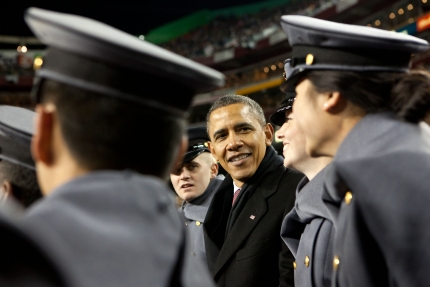
President Barack Obama talks with U.S. Military Academy Cadets during the annual Army vs. Navy football game at FedEx Field in Landover, Md., Dec. 10, 2011. (Official White House Photo by Pete Souza)


Vice President Biden Welcomes Home the USS Gettysburg

Vice President Joe Biden and Rear Admiral Nora Tyson welcome home the USS Gettysburg

Vice President Joe Biden and Rear Admiral Nora Tyson welcome home sailors from the USS Gettysburg following its return to Mayport Naval Base, Fla., Dec. 8, 2011. The Gettysburg, a guided missile cruiser, was part of the carrier strike group supporting the USS George H.W. Bush on its first deployment since being commissioned. (Official White House Photo by David Lienemann)

Yesterday morning, Vice President Biden made a surprise visit to Mayport Naval Station in Jacksonville, Florida to welcome over 300 sailors home from a seven month deployment to the Middle East. 

The sailors serve on the USS Gettysburg, which was returning to its homeport in Mayport. The Gettysburg deployed last May – along with helicopters and crew from Helicopter Maritime Strike Squadron 70 (the “Spartans”, based at nearby Naval Station Jacksonville) – as part of the George H.W. Bush Strike Group. 

As the Gettysburg slowly made its way into port, the Vice President said a few words to the hundreds of family and friends gathered to welcome home their loved ones. He was joined by Rear Admiral Nora Tyson, Commander of Carrier Strike Group 2 – the first woman in U.S. Navy history to assume command of a carrier strike group. The Vice President thanked the families for the sacrifices they have made while their loved ones served overseas. “They also serve who only stand and wait,” he said, quoting poet John Milton. 

He also recalled his own son Beau’s homecoming after serving a year in Iraq. 

“I learned early, early on,” the Vice President said, “if anyone got - no matter who it was, the president, the Lord almighty - got between his mother and him or his wife and him as he was getting off that bus, they would have been trampled.” 

“I promise I'm not going to get between you and that ship coming in here,” he told the crowd. 

Amy Dudley is the Deputy Press Secretary for the Vice President

The White House

Office of the Press Secretary

Presidential Proclamation -- National Pearl Harbor Remembrance Day, 2011

BY THE PRESIDENT OF THE UNITED STATES OF AMERICA
A PROCLAMATION

On a serene Sunday morning 70 years ago, the skies above Pearl Harbor were darkened by the bombs of Japanese forces in a surprise attack that tested the resilience of our Armed Forces and the will of our Nation. As explosions sounded and battleships burned, brave service members fought back fiercely with everything they could find. Unbeknownst to these selfless individuals, the sacrifices endured on that infamous day would galvanize America and come to symbolize the mettle of a generation.

In the wake of the bombing of our harbor and the crippling of our Pacific Fleet, there were those who declared the United States had been reduced to a third-class power. But rather than break the spirit of our Nation, the attack brought Americans together and fortified our resolve. Patriots across our country answered the call to defend our way of life at home and abroad. They crossed oceans and stormed beaches, freeing millions from the grip of tyranny and proving that our military is the greatest force for liberty and security the world has ever known. On the home front, dedicated civilians supported the war effort by repairing wrecked battleships, working in factories, and joining civilian defense organizations to help with salvage programs and plant Victory gardens. At this time of great strife, we reminded the world there is no challenge we cannot meet; there is no challenge we cannot overcome.

On National Pearl Harbor Remembrance Day, we honor the more than 3,500 Americans killed or wounded during that deadly attack and pay tribute to the heroes whose courage ensured our Nation would recover from this vicious blow. Their tenacity helped define the Greatest Generation and their valor fortified all who served during World War II. As a Nation, we look to December 7, 1941, to draw strength from the example set by these patriots and to honor all who have sacrificed for our freedoms.

The Congress, by Public Law 103-308, as amended, has designated December 7 of each year as "National Pearl Harbor Remembrance Day."

NOW, THEREFORE, I, BARACK OBAMA, President of the United States of America, do hereby proclaim December 7, 2011, as National Pearl Harbor Remembrance Day. I encourage all Americans to observe this solemn day of remembrance and to honor our military, past and present, with appropriate ceremonies and activities. I urge all Federal agencies and interested organizations, groups, and individuals to fly the flag of the United States at half-staff this December 7 in honor of those American patriots who died as a result of their service at Pearl Harbor.

IN WITNESS WHEREOF, I have hereunto set my hand this sixth day of December, in the year of our Lord two thousand eleven, and of the Independence of the United States of America the two hundred and thirty-sixth.

BARACK OBAMA

The White House

Office of the Press Secretary

President Obama Signs New Hampshire Disaster Declaration

The President today declared a major disaster exists in the State of New Hampshire and ordered Federal aid to supplement state and local recovery efforts in the area affected by a severe storm and snowstorm during the period of October 29-30, 2011.

Federal funding is available to state and eligible local governments and certain private nonprofit organizations on a cost-sharing basis for emergency work and the repair or replacement of facilities damaged by the severe storm and snowstorm in the counties of Hillsborough and Rockingham.

Federal funding also is available to state and eligible local governments on a cost-sharing basis for emergency protective measures, including snow assistance, for a continuous 48-hour period during or proximate to the incident period in Hillsborough County.

Federal funding is also available on a cost-sharing basis for hazard mitigation measures statewide.

W. Craig Fugate, Administrator, Federal Emergency Management Agency (FEMA), Department of Homeland Security, named Albert Lewis as the Federal Coordinating Officer for federal recovery operations in the affected area. 

FEMA said additional designations may be made at a later date if requested by the state and warranted by the results of further damage assessments.

FOR FURTHER INFORMATION MEDIA SHOULD CONTACT:  FEMA NEWS DESK AT (202) 646-3272 OR FEMA-NEWS-DESK@DHS.GOV

The White House

Office of the Press Secretary

Fact Sheet on the Seventh Review Conference of the Biological and Toxin Weapons Convention

“We must come together to prevent, detect, and fight every kind of biological danger – whether it is a pandemic like H1N1, a terrorist threat, or a treatable disease.”

-  President Obama, United Nations General Assembly, September 22, 2011

Today, the States Parties to the Biological and Toxin Weapons Convention (BWC) are meeting in Geneva for the start of the Seventh Review Conference (RevCon) of the Biological Weapons Convention to evaluate the implementation of the treaty and chart a course for the coming years.  To underscore the importance the United States places on the BWC as a critical tool to help counter biological threats, the President has asked Secretary of State Clinton to lead the United States delegation to the RevCon, where she will deliver the opening statement for the United States on December 7th.

Part of a Broader National Strategy

The BWC is a critical venue for advancing objectives set forth in the President’s National Strategy for Countering Biological Threats, which emphasizes the need for multinational collaboration on concrete activities to help counter biological proliferation and bioterrorism.   The three-week BWC Review Conference presents an opportunity for countries to promote real action to improve global response capabilities, reinforce norms against the misuse of biological science, and to help identify and thwart those who would seek to cause harm.
 

Revitalizing International Efforts to Reduce Biological Threats

The United States believes the BWC should be the premier forum for bringing together the security, health, law enforcement, and science communities to raise awareness of evolving biological risks and how to best manage them.  The U.S. believes that revitalized international efforts and a coordinated series of actions can help reduce the threat of biological attacks.

At the RevCon, the United States will seek the endorsement of the BWC States Parties of a work program for the next five years in three broad areas of work that will greatly enhance international efforts to counter biological threats.

  • First, the United States is asking States Parties to establish an effort to develop constructive ways to strengthen implementation of the BWC and build confidence that all members are living up to their obligations.  The dual-use nature of biological work simply makes it too easy to conceal prohibited activities – so the United States has proposed efforts to promulgate legislative and regulatory frameworks, safety and security measures, outreach to stakeholders, improved annual reporting, and options for addressing compliance concerns.
  • Second, the United States is proposing that the RevCon create a working group that will be tasked with taking concrete actions to make the BWC a more robust forum for building global capacities for preventing, detecting, and combating disease outbreaks, regardless of whether they are natural, deliberate or accidental.  We need to be prepared, both nationally and internationally, to deal with a biological attack should one occur.  The United States seeks to capitalize on synergies between security and public health communities – and to do so through the sort of international cooperation called for in the BWC.
  • Third, the United States is asking States Parties to establish a mechanism for assessing developments in science and technology to better understand their potential benefits to the BWC as well as their potential misuse by terrorists or others.  It is important for BWC States Parties to have a structured dialogue with the international scientific community on emerging technologies in order to better address the potential for their misuse.

In order to meet these goals, the United States will propose that the BWC RevCon establish a vigorous work program for the next five years that focuses on the common needs and interests of all States Parties in combating biological threats.  Pursuing this robust program will help the international community produce concrete results, thereby enabling successful annual Meetings of States Parties and a robust Eighth BWC Review Conference in 2016.