President Obama: How We're Responding to the ISIL Threat

Tonight, the following message was sent from President Obama to those signed up to receive updates from the White House, outlining his comprehensive and sustained counterterrorism strategy to degrade and destroy ISIL.

Didn't get the email? Make sure you're signed up to receive updates from the President and other senior Administration officials.


Good evening,

I just addressed the nation about what the United States will do with our friends and allies to degrade and destroy the terrorist group known as ISIL.

Let’s be clear: While this group may call itself the "Islamic State," it is not "Islamic." No religion condones the killing of innocents, and the vast majority of ISIL's victims have been Muslim. Nor is it a "state." It is not recognized by any government, nor by the people it subjugates.

This is nothing but a terrorist organization with no vision or goal other than to slaughter all who stand in its way. While we have not yet detected specific plotting against our homeland, these terrorists have threatened America and our allies. And the United States will meet this threat with strength and resolve.

President Obama Gives a Statement on the Murder of Steven Sotloff

This morning, in a joint press conference with President Ilves of Estonia, President Obama gave the following statement about the murder of journalist Steven Sotloff.

Finally, I want to say that today the prayers of the American people are with the family of a devoted and courageous journalist, Steven Sotloff. Overnight, our government determined that, tragically, Steven was taken from us in a horrific act of violence. We cannot even begin to imagine the agony that everyone who loved Steven is feeling right now, especially his mother, his father and his younger sister. So today, our country grieves with them.

Like Jim Foley before him, Steve’s life stood in sharp contrast to those who have murdered him so brutally. They make the absurd claim that they kill in the name of religion, but it was Steven, his friends say, who deeply loved the Islamic world. His killers try to claim that they defend the oppressed, but it was Steven who traveled across the Middle East, risking his life to tell the story of Muslim men and women demanding justice and dignity.

Whatever these murderers think they’ll achieve by killing innocent Americans like Steven, they have already failed. They have failed because, like people around the world, Americans are repulsed by their barbarism. We will not be intimidated. Their horrific acts only unite us as a country and stiffen our resolve to take the fight against these terrorists. And those who make the mistake of harming Americans will learn that we will not forget, and that our reach is long and that justice will be served.

You can read the full text of the joint press conference here.

The Press Secretary's Statement on Troop Levels in Iraq

Yesterday, White House Press Secretary Josh Earnest released the following statement about U.S. Military personnel in Iraq.

Today, the President authorized the Department of Defense to fulfill a Department of State request for approximately 350 additional U.S. military personnel to protect our diplomatic facilities and personnel in Baghdad, Iraq. This action was taken at the recommendation of the Department of Defense after an extensive interagency review, and is part of the President's commitment to protect our personnel and facilities in Iraq as we continue to support the Government of Iraq in its fight against the Islamic State of Iraq and the Levant (ISIL). These additional forces will not serve in a combat role.

President Obama Delivers an Update on the Economy, Iraq, and Ukraine

President Obama Delivers a Statement on the Economy, Iraq, and Ukraine

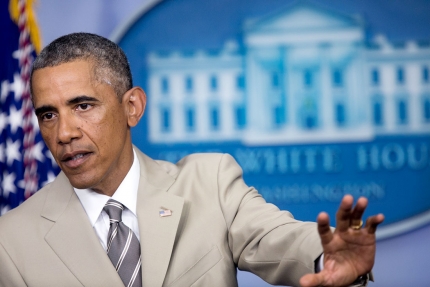
President Barack Obama delivers a statement in the James S. Brady Press Briefing Room of the White House, August 28, 2014. (Official White House Photo by Amanda Lucidon)

At the White House this afternoon, President Obama provided an update on important issues ahead of his attendance at the NATO Summit in the United Kingdom next week.  

The President first addressed the "number one thing that most Americans care about" -- our economy. He noted that the economy is growing "at a stronger clip" than predicted and that we have more work to do to continue this momentum: 

This morning, we found out that our economy actually grew at a stronger clip in the 2nd quarter than we originally thought.  Companies are investing.  Consumers are spending.  Over the past four and a half years, our businesses have created now nearly 10 million new jobs. So there are reasons to feel good about the direction we’re headed.  But as everybody knows, there’s a lot more we should be doing to make sure more Americans benefit from the progress that we've made and I am going to be pushing Congress hard on this when they return next week.

As the U.S. military continues to carry out targeted airstrikes against ISIL in Iraq and to address the humanitarian situation on the ground, the President reiterated his commitment as Commander-in-Chief to "always do what is necessary to protect the American people and defend against evolving threats to our homeland."


"Our military action in Iraq has to be part of a broader, comprehensive strategy to protect our people and to support our partners who are taking the fight to ISIL. And that starts with Iraq’s leaders building on the progress they’ve made so far and forming the inclusive government that will unite their country and strengthen their security forces to confront ISIL."


The President reported that our strikes have cost ISIL terrorists arms and equipment, and Iraqi and Kurdish forces are continuing to push them back. The U.S. will consider a range of options but he made clear that a successful strategy will require working with an inclusive Iraqi government and strong regional partners to meet this threat:

Now ISIL poses an immediate threat to the people of Iraq and the people throughout the region. And that’s why our military action in Iraq has to be part of a broader, comprehensive strategy to protect our people and to support our partners who are taking the fight to ISIL. And that starts with Iraq’s leaders building on the progress they’ve made so far and forming the inclusive government that will unite their country and strengthen their security forces to confront ISIL.

Any successful strategy, though, also needs strong regional partners. I’m encouraged so far that countries in the region -- countries that don’t always agree on many things -- increasingly recognize the primacy of the threat ISIL poses to all of them.  And I’ve asked Secretary Kerry to travel to the region to continue to build the coalition that’s needed to meet this threat.  As I’ve said, rooting out a cancer like ISIL will not be quick or easy but I’m confident that we can -- and we will -- working closely with our allies and partners. 

For our part, I’ve directed Secretary Hagel and our Joint Chiefs of Staff to prepare a range of options. I’ll be meeting with my National Security Council again this evening as we continue to develop that strategy. And I’ve been consulting with Congress and I’ll continue to do so in the days ahead.

President Obama: James Foley's Life "Stands in Stark Contrast to His Killers"

Watch on YouTube

This afternoon, the President made a statement on the killing of journalist James Foley by the terrorist group ISIL. He was 40 years old.

"The entire world is appalled by the brutal murder of Jim Foley," President Obama said. "Jim was a journalist, a son, a brother, and a friend. He reported from difficult and dangerous places, bearing witness to the lives of people a world away."

Foley was taken hostage in Syria almost two years ago while reporting on the conflict there. The President made clear in today's statement that Foley's life "stands in stark contrast to his killers":

The White House

Office of the Press Secretary

Readout of the President’s Homeland Security Council Meeting

This afternoon, the President and Vice President met in the Situation Room with the President’s Homeland Security Council to discuss the urgent humanitarian situation at the border as well as the comprehensive response that the Administration has implemented at the President’s direction. Today’s meeting took place as preliminary data show that average daily apprehensions of unaccompanied children by the Customs and Border Patrol have dropped by about half from June to July. This important decline was noted, and the Council committed to continuing aggressive efforts on both sides of the border to deter illegal migration—including by sustaining cooperation with Central American leaders—and to providing appropriate care for those apprehended at the border. Participants also discussed combating the root causes of migration and the need to secure the additional resources sought in the President’s supplemental appropriations request.

Attendees at this afternoon’s meeting included:

  • The Vice President
  • Chuck Hagel, Secretary of Defense
  • James Cole, Deputy Attorney General
  • Sylvia Burwell, Secretary of Health and Human Services
  • Jeh Johnson, Secretary of Homeland Security
  • Denis McDonough, Assistant to the President and Chief of Staff
  • John Podesta, Counselor to the President
  • Kristie Canegallo, Deputy Chief of Staff to the President
  • Amb. Samantha Power, Permanent Representative of the United States of America to the United Nations
  • Brian Deese, Acting Director of the Office of Management and Budget
  • Valerie Jarrett, Senior Advisor and Assistant to the President for Intergovernmental Affairs and Public Engagement
  • Susan Rice, Assistant to the President for National Security Affairs
  • Neil Eggleston, Assistant to the President and Counsel to the President
  • Stephanie O’Sullivan, Principal Deputy Director of National Intelligence
  • Cecilia Muñoz, Assistant to the President and Director of Domestic Policy
  • Lisa Monaco, Assistant to the President for Homeland Security and Counterterrorism
  • Katie Fallon, Assistant to the President and Director of the Office of Legislative Affairs
  • Rajiv Shah, Administrator of the U.S. Agency for International Development
  • General Martin Dempsey, Chairman, Joint Chiefs of Staff
  • Heather Higginbottom, Deputy Secretary of State
  • Craig Fugate, Administrator of the Federal Emergency Management Agency
  • Dan Tangherlini, Administrator of the General Services
  • Jeffrey Prescott, Deputy National Security Advisor to the Vice President
  • Rand Beers, Deputy Assistant to the President for Homeland Security
  • Gil Kerlikowske, Commissioner of the Customs Border Protection
  • Thomas Winkowski, Principal Deputy Assistant Secretary for Immigration and Customs Enforcement

About the Homeland Security Council:
The Homeland Security Council was created by Executive Order in 2001 and codified in statute by the Homeland Security Act of 2002. Similar to the National Security Council, which is also a statutory body, the Homeland Security Council serves to coordinate across the government on homeland security issues. In 2009, the Homeland Security Council and National Security Council were integrated under one staff, but both continue to exist by statute. Meetings of either are convened as needed. 

The White House

Office of the Press Secretary

Readout of the Vice President’s Call to President Juan Orlando Hernández of Honduras

Vice President Joe Biden spoke by phone with Honduran President Juan Orlando Hernández on his way to Guatemala to discuss a regional strategy to address the influx of unaccompanied children coming from Central America to the U.S.-Mexico border. The Vice President previewed his meeting in Guatemala with the Presidents of Guatemala and El Salvador, as well as representatives from the governments of Mexico and Honduras to discuss the urgent humanitarian issue. He asked President Hernández to work in close cooperation with other regional leaders to develop concrete proposals to address the root causes of unlawful migration from Central America.

The Vice President also reiterated that arriving migrants will not qualify for legalization under proposed immigration reform legislation or deferred action for childhood arrivals (DACA).

The White House

Office of the Press Secretary

FACT SHEET: Unaccompanied Children from Central America

The Administration remains greatly concerned by the rise in unaccompanied children from Central America who are crossing into the United States. These children are some of the most vulnerable, and many become victims of violent crime or sexual abuse along the dangerous journey. There has also been a rise in the number of very young children, female children, and adults with their children that are making the journey. The vast majority of these individuals rely on dangerous human smuggling networks to transport them up through Central America and Mexico. 

To address the situation, the President directed the Department of Homeland Security (DHS) and the Federal Emergency Management Agency to coordinate a government-wide response to this urgent situation. Our first priority is to manage the urgent humanitarian situation by making sure these children are housed, fed, and receive any necessary medical treatment. We also are taking steps to improve enforcement and partnering with our Central American counterparts in three key areas: combating gang violence and strengthening citizen security, spurring economic development, and improving capacity to receive and reintegrate returned families and children.

In Guatemala, the Vice President is meeting with regional leaders to address the rise in the flow of unaccompanied children and adults with their children to the United States, to discuss our work together with the countries of Central America, and to discuss our efforts to help address the underlying security and economic issues that cause migration.

Partnering with Central America and Mexico

New Programs

  • The U.S. Government will be providing $9.6 million in additional support for Central American governments to receive and reintegrate their repatriated citizens. This funding will enable El Salvador, Guatemala, and Honduras to make substantial investments in their existing repatriation centers, provide training to immigration officials on migrant care, and increase the capacity of these governments and non-governmental organizations to provide expanded services to returned migrants. 

  • In Guatemala, we are launching a new $40-million U.S. Agency for International Development (USAID) program over 5 years to improve citizen security. This program will work in some of the most violent communities to reduce the risk factors for youth involvement in gangs and address factors driving migration to the United States.

  • In El Salvador, we are initiating a new $25-million Crime and Violence Prevention USAID program over 5 years that will establish 77 youth outreach centers in addition to the 30 already in existence. These will continue to offer services to at-risk youth who are susceptible to gang recruitment and potential migration.

  • In Honduras, under the Central American Regional Security Initiative (CARSI), we will provide $18.5 million to support community policing and law enforcement efforts to confront gangs and other sources of crime. In addition, USAID will build on an existing initiative to support 40 youth outreach centers by soon announcing a substantial new Crime and Violence Prevention program to further address root causes.

  • USAID is calling for proposals to support new public-private partnerships through the Global Development Alliance to increase economic and educational opportunities for at risk youth in El Salvador, Guatemala, and Honduras.

  • The United States also plans to provide $161.5 million this year for CARSI programs that are critical to enabling Central American countries to respond to the region’s most pressing security and governance challenges. Our assistance will help stem migration flows as well as address root cause of the migration. This assistance will include:

    • Approximately $65 million for Rule of Law, Human Rights and Transparency programs, including activities to prevent at-risk youth from joining gangs and encourage their involvement in community crime prevention efforts and programs to expand education and job training.

    • Another approximately $96.5 million will go toward peace, security, stabilization, and other related rule of law programs to strengthen immigration, law enforcement, and judicial authorities and promote anti-gang and human rights programs.

Ongoing Programs

  • The United States is providing almost $130 million in ongoing bilateral assistance to El Salvador, Honduras, and Guatemala for a variety of programs related to health, education, climate change, economic growth, military cooperation, and democracy assistance.   

  • We are collaborating on campaigns to help potential migrants understand the significant danger of relying on human smuggling networks and to reinforce that recently arriving children and individuals are not eligible for programs like Deferred Action for Childhood Arrivals, commonly called DACA, and earned citizenship provisions in comprehensive immigration reform currently under consideration in the Congress. 

Increased Enforcement

  • The Department of Justice and DHS are taking additional steps to enhance enforcement and removal proceedings. We are surging government enforcement resources to increase our capacity to detain individuals and adults who bring their children with them and to handle immigration court hearings – in cases where hearings are necessary – as quickly and efficiently as possible while also while also protecting those who are seeking asylum. That will allow ICE to return unlawful migrants from Central America to their home countries more quickly.

  • These new measures build on a strong existing record of enforcement and removal of Central Americans entering the country unlawfully. In FY 2013, ICE removed 47,769 individuals from Guatemala, 37,049 from Honduras, and 21,602 from El Salvador. This represents approximately 29% of all ICE removals.

  • The Vice President will reiterate that unaccompanied children and adults arriving with their children are not eligible to benefit from the passage of immigration reform legislation or from the Deferred Action for Childhood Arrivals (DACA) process.