Taking Action: Creating Model Emergency Management Plans for Schools, Institutions of Higher Education and Houses of Worship

Secretary Duncan at High-Quality Emergency Management Event

Education Secretary Arne Duncan takes part in “Taking Action: Creating Model Emergency Management Plans for Schools, Institutions of Higher Education, and Houses of Worship”, in the Eisenhower Executive Office Building South Court Auditorium, Feb. 27, 2013. The meeting was held as part of the President’s plan to protect our children and communities by reducing gun violence. Answering questions were, from left: John McDonald, Executive Director of Security and Emergency Management, Jefferson County Public Schools; Marleen Wong, Associate Dean, University of Southern California School of Social Work; Secretary of Education Arne Duncan; Major Ian A. Moffett, Miami Police Department; Robert Fein, Forensic and National Security Psychologist; and Natalie Hammond, Teacher, Sandy Hook Elementary School.

Yesterday, over 100 leaders from across the country came to the White House to join Secretary of Education Arne Duncan and Secretary of Homeland Security Janet Napolitano for a discussion about how to make our schools, institutions of higher education, and houses of worship safer through the creation of high-quality emergency management plans.

Secretary Duncan noted that, “Some tough lessons we’ve learned over time, some inspiring lessons as well, but if we can all learn from each other, learn together, and go back home to our communities, it makes me hopeful about where we can go despite the tremendous challenges we face.”

On January 16th, President Obama, through an executive action, directed the Departments of Education, Homeland Security, Justice, and Health and Human Services to work together to create model emergency management plans for these communities. Yesterday’s event helped inform the agencies’ work to implement that executive action. The President’s plan to reduce gun violence includes a total of 23 executive actions, as well as specific proposals that he has called on Congress to act on right away.

Policy Statement for Countering Improvised Explosive Devices Announced

Twenty years ago today, an improvised explosive contained in a truck was detonated in the public parking garage below the North Tower of the World Trade Center.  Improvised explosive devices (IED) continue to pose an ongoing threat, both here at home and abroad.  Our capability to identify and disrupt them before they occur, as well as to respond after an attack, has improved greatly. We have come a long way in twenty years. 

Today, with the publication of the policy statement on Countering Improvised Explosive Devices, we both recognize the progress we have made, and rededicate ourselves to the next phase in our efforts to implement measures to discover, prevent, protect against, respond to, recover from, and mitigate IED attacks and their consequences.

We will seek to develop even smarter solutions, and make the most efficient use of our resources, by enhancing our capability to share information regarding these threats, synchronizing standards and procedures, prioritizing and aligning activities according to risk management principles, and leveraging the expertise and resources of industry and foreign partners in pursuit of our shared interests.

The threat from IED use is likely to remain high in the near future, and will continue to evolve in response to our abilities to counter them. A whole-of-government approach that integrates Federal, state, local, tribal, territorial, private sector, and global participation in counter-IED activities will best position the United States to discover plots to use IEDs in the United States, or against U.S. persons abroad, before those threats become imminent.

Patricia F.S. Cogswell is the Special Assistant to the President for Homeland Security and the Senior Director for Transborder Security on the National Security Staff
Related Topics: Homeland Security

Weekly Wrap Up: "Fulfilling Our Obligations"

Watch the West Wing Week here.

Sequester Looming: On Tuesday, with just days left until a set of deep, across-the-board budget cuts are set to take effect, President Obama discussed what’s at stake for our country’s economy, security and future and pushed lawmakers to work out a deal for the American people.

“So these cuts are not smart. They are not fair. They will hurt our economy. They will add hundreds of thousands of Americans to the unemployment rolls,” said President Obama, as emergency respondents stood behind him. “This is not an abstraction -- people will lose their jobs. The unemployment rate might tick up again.”

The President called for “a balanced approach to deficit reduction,” which ends tax loopholes and deductions for the wealthy, while targeting wasteful spending in the process.

Giving Every Child a Chance: Last Friday, President Obama headed home to Chicago to promote his proposals from the State of the Union address and emphasized the importance of protecting our children from gun violence, illustrating the importance of family in our communities.

“And so that means that this is not just a gun issue. It’s also an issue of the kinds of communities that we’re building. And for that, we all share a responsibility, as citizens, to fix it.”

Vice President Biden Honors Public Safety Officers with Medal of Valor

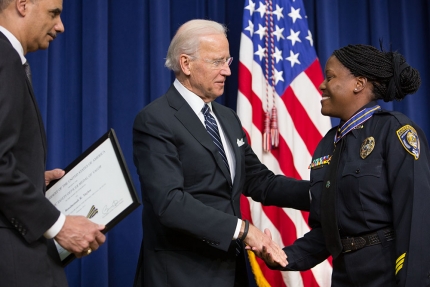
Vice President Joe Biden with Officer Reeshemah Taylor at a Medal of Valor ceremony, Feb., 20, 2013.

Vice President Joe Biden congratulates Officer Reeshemah Taylor of the Osceola County Corrections Department after presenting her with the Medal of Valor, during a Medal of Valor ceremony with Attorney General Eric Holder, in the South Court Auditorium at the White House, Feb., 20, 2013. (Official White House Photo by David Lienemann)

Vice President Joe Biden today recognized 18 public safety officers for exhibiting exceptional courage in a Medal of Valor ceremony at the White House. The Medal of Valor is the highest national award for valor by a public safety officer, and it is bestowed on those whose heroic actions were above and beyond the call of duty.

The Vice President, who was joined by Attorney General Eric Holder, highlighted the bravery of the men and women who were being honored, and paid tribute to the spouses of the recipients who had lost their lives in the line of duty. He also talked about the special qualities that are unique to those who put themselves in danger to save others:

My association with firefighters and police has been... the essence of my public life. And as many of these things that I do, I still grapple with what makes you do what you do? I’m just thankful that you do.

You can't explain it, but you know it when you see it. I see it in the shield over someone’s heart. I see it in the men and women who are sitting here before us today...Thank God for you. You’re from different backgrounds, but you’re the glue that literally binds communities together at times of stress. You’re that face that shows up for a woman on the second floor of a burning building just when she thinks it’s all over for her... The amazing thing about all of you is that the very things you do when you’re on duty to save people’s lives, you do when you're off duty. There’s no separation.

Related Topics: Homeland Security

Securing our Nation’s Borders

Flying Over the Rio Grande River

Flying on the U.S. side of the U.S.-Mexico border and overlooking the Rio Grande River, Homeland Security Secretary Janet Napolitano tours the border in a U.S. Customs and Border Protection Office of Air and Marine helicopter over Clint, Texas, Feb. 5, 2013. (Official White House Photo by Lawrence Jackson)

Last week, I travelled to San Diego, CA and Clint and El Paso, TX where I saw firsthand the need for more modernized immigration laws that make it harder for criminals and transnational criminal organizations to operate, while encouraging immigrants to choose to pursue a pathway to legal immigration rather than breaking the law.

See a photo gallery of Secretary Napolitano's visit

Over the past four years, we have dedicated historic levels of personnel, technology, and resources to the Southwest border, and undertaken an unprecedented effort to transform our Nation's immigration enforcement systems into one that focuses on public safety, border security, and the integrity of the immigration system. We have matched our success at the border with smart, effective immigration enforcement, with a focus on identifying and removing criminal aliens and other public safety threats, recent border crossers, repeat violators, and employers who break the law. We have also increased funding to our state and local law enforcement partners to make sure they have the resources they need.

Improving the Security of the Nation’s Critical Infrastructure

The Nation increasingly relies on the Internet to run the systems that light our houses, provide gas for our cars, and ensure our water is safe to drink. Collectively, these diverse systems represent our cyber critical infrastructure. Linking our critical infrastructure to the Internet brings considerable benefits, but our daily reliance on this critical infrastructure means that we are vulnerable to disruptions in our ability to use it. Unfortunately, the threats against our cyber critical infrastructure are numerous, ranging from sophisticated nation states to common criminals.

The government’s senior-most civilian, military, and intelligence professionals all agree that inadequate cybersecurity within this critical infrastructure poses a grave threat to the security of the United States.  Most recently, we have seen an increased interest in targeting public and private critical infrastructure systems by actors who seek to threaten our national and economic security. Along with dissuading their actions, we must better protect the critical systems that support our way of life.

Because of the importance of our cyber critical infrastructure, and the seriousness of the threats, the President issued an Executive Order yesterday directing federal departments and agencies to use their existing authorities to provide better cybersecurity for the Nation. These efforts will by necessity involve increased collaboration with the private sector and a whole-of-government approach.

Working to Counter Online Radicalization to Violence in the United States

The American public increasingly relies on the Internet for socializing, business transactions, gathering information, entertainment, and creating and sharing content. The rapid growth of the Internet has brought opportunities but also risks, and the Federal Government is committed to empowering members of the public to protect themselves against the full range of online threats, including online radicalization to violence.

Violent extremist groups ─ like al-Qa’ida and its affiliates and adherents, violent supremacist groups, and violent “sovereign citizens” ─ are leveraging online tools and resources to propagate messages of violence and division. These groups use the Internet to disseminate propaganda, identify and groom potential recruits, and supplement their real-world recruitment efforts.  Some members and supporters of these groups visit mainstream fora to see whether individuals might be recruited or encouraged to commit acts of violence, look for opportunities to draw targets into private exchanges, and exploit popular media like music videos and online video games.  Although the Internet offers countless opportunities for Americans to connect, it has also provided violent extremists with access to new audiences and instruments for radicalization.

As a starting point to prevent online radicalization to violence in the homeland, the Federal Government initially will focus on raising awareness about the threat and providing communities with practical information and tools for staying safe online. In this process, we will work closely with the technology industry to consider policies, technologies, and tools that can help counter violent extremism online. Companies already have developed voluntary measures to promote Internet safety ─ such as fraud warnings, identity protection, and Internet safety tips ─ and we will collaborate with industry to explore how we might counter online violent extremism without interfering with lawful Internet use or the privacy and civil liberties of individual users.

Quintan Wiktorowicz is the White House Senior Director for Community Partnerships, on the National Security Staff

President Obama Nominates John Brennan as CIA Director

President Barack Obama listens to the remarks of John Brennan

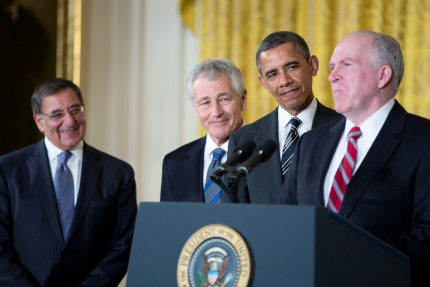
President Barack Obama listens to the remarks of John Brennan, Assistant to the President for Homeland Security and Counterterrorism, his nominee for Director of the CIA, during the announcement in the East Room of the White House, Jan. 7, 2013. The President also announced former Senator Chuck Hagel, second from left, as his nominee for Secretary of Defense. Joining them are departing Defense Secretary Leon Panetta, left. (Official White House Photo by Pete Souza)

After announcing Chuck Hagel as his nominee for the next Secretary of Defense, President Obama today nominated John Brennan as the next Director of the Central Intelligence Agency.

Brennan, a 25-year veteran of the CIA, has served as President Obama’s Advisor for Counterterrorism and Homeland Security since 2009. “For the last four years,” President Obama said, “John developed and has overseen our comprehensive counterterrorism strategy -- a collaborative effort across the government, including intelligence and defense and homeland security, and law enforcement agencies.”

President Obama called Brennan “one of the hardest working civil servants I’ve ever known” and said that he valued Brennan’s integrity and commitment “to the values that define us as Americans.”

Related Topics: Defense, Homeland Security

President Obama Pushes for Nonproliferation

President Barack Obama delivers remarks to the Nunn-Lugar Cooperative Threat Reduction symposium (December 3, 2012)

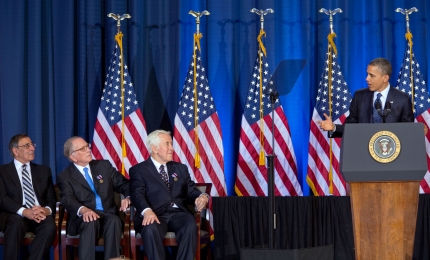
President Barack Obama delivers remarks to the Nunn-Lugar Cooperative Threat Reduction symposium held at the National Defense University at Fort McNair in Washington, D.C., Dec. 3, 2012. Joing the President on stage are, from left: Defense Secretary Leon Panetta; former Sen. Sam Nunn, D-Ga.; and Sen. Richard Lugar, R- Ind.(Official White House Photo by Sonya N. Hebert)

On Monday, President Obama traveled to the National Defense University to mark the 20th anniversary of what he called "one of the country’s smartest and most successful national security programs" -- the Nunn-Lugar Cooperative Threat Reduction Program for the destruction of weapons of mass destruction in the former Soviet Union.

And after celebrating some of the accomplishments of that program, the President discussed the need to continue that nonproliferation work in the decades ahead.

"We simply cannot allow the 21st century to be darkened by the worst weapons of the 20th century," he said. "And that’s why, over the past four years, we’ve continued to make critical investments in our threat reduction programs -— not just at DOD, but at Energy and at State. In fact, we’ve been increasing funding, and sustaining it. And even as we make some very tough fiscal choices, we’re going to keep investing in these programs —- because our national security depends on it."

President Obama also delivered a specific message to Syrian President Bashar al-Assad.

"On Syria, let me just say this. We will continue to support the legitimate aspirations of the Syrian people -— engaging with the opposition, providing with -- providing them with the humanitarian aid, and working for a transition to a Syria that’s free of the Assad regime," the President said. "And today, I want to make it absolutely clear to Assad and those under his command: The world is watching. The use of chemical weapons is and would be totally unacceptable. And if you make the tragic mistake of using these weapons, there where be consequences, and you will be held accountable."

President Obama concluded his remarks by telling the story of a trip he took to the Ukraine with Senator Richard Lugar when both men were in the Senate.

"We went to a facility, an old factory," he said. "We walked down these long, dark corridors. Finally, we came across some women, sitting at a worktable. On it were piles of old artillery shells. And the women were sitting there, taking them apart. By hand. Slowly. Carefully. One by one."

"It took decades -— and extraordinary sums of money -- to build those arsenals," President Obama told the audience today. "It’s going to take decades -- and continued investments --to dismantle them."

HUD Secretary Shaun Donovan Visits Communities Impacted By Hurricane Sandy

The Obama Administration has continued to bring all available resources to bear to support the states affected by Hurricane Sandy as they continue to respond and recover from the storm.

On Thursday, November 15th, the President travelled to New York, marking his second trip to the region since Sandy made landfall. The President announced that he has asked Housing and Urban Development Secretary Shaun Donovan to continue to work closely with Governors, mayors and local officials in the affected states as they identify longer term priorities to help communities rebuild and recover.

SEE THE PHOTO GALLERY FROM SEC DONOVAN'S VISIT TO COMMUNITIES IMPACTED BY SANDY

In this new role, Secretary Donovan will coordinate Federal support as States design individual redevelopment plans, identify priorities, and over time work to implement them. This structure will streamline the process for Governors as they seek assistance for longer-term projects and identify community redevelopment priorities. The Department of Homeland Security (DHS) and the Federal Emergency Management Agency (FEMA) continue to provide all available federal resources to support the immediate response and recovery efforts.

Fred Tombar is the HUD Senior Advisor for Disaster Programs