FAA Commemorates 9/11 with NextGen arrival profiles into National Airport

Ed. note: This is cross-posted from the U.S. Department of Transportation.

No one who was working at the Department of Transportation 11 years ago will forget the morning of September 11, 2001. Whether it was the Federal Aviation Administration's air traffic controllers, who helped bring every aircraft in U.S. airspace safely to ground, or the U.S. Merchant Marine Academy's midshipmen, who went into the chaos of Lower Manhattan to support the maritime evacuation of Wall Street workers, 9/11 is permanently etched into the Department's memory.

To commemorate that day, the FAA's Washington Metroplex Team has named two arrival sequences to Ronald Reagan Washington National Airport to honor those who died that day and those who have served our country from that day forward. Each arrival sequence is part of our new NextGen descents, which use satellite-based information to make more efficient arrivals and departures at airports. The sequences contain a series of five-letter waypoints – points in the sky through which an aircraft must fly to remain on course – and together, they spell out messages of support and remembrance for 9/11. 

Aircraft flying the Freedom route to National from the northwest pass through waypoints named “WEEEE,” “WLLLL,” “NEVVR,” “FORGT” and “SEP11.” Those flying the Troops route from the southwest pass through waypoints named “USAAY,” “WEEDU,” “SUPRT,” “OOURR” and “TRUPS.” Depending on the runway configuration, aircraft might also pass through waypoints named “STAND” and “TOGETHER” or “LETZZ,” “RLLLL,” “VCTRY” and “HEROO."

Freedom/Troops Satellite Navigation Waypoints

Freedom/Troop Satellite Navigation Waypoints (Photo Credit by U.S. Department of Transportation)

 
Ray LaHood is the U.S. Secretary of Transportation

Weekly Address: Coming Together to Remember September 11th

President Obama marks the eleventh anniversary of the September 11th attacks by remembering the innocent lives lost, and honoring the first responders and men and women in uniform who have served and sacrificed to keep our country safe.

In the difficult years following the attacks, the United States has come back stronger as a nation, decimated the leadership of al-Qaeda, ensured that Osama bin Laden will never attack America again, and strengthened our alliances across the world.

The President has signed a proclamation making Friday, September 7 through Sunday, September 9, 2012 National Days of Prayer and Remembrance.

To join that commemoration, you can sign up for a service opportunity near you at Serve.gov.

Transcript | Download mp4 | Download mp3

Related Topics: Homeland Security, Service

President Obama Meets with Victims of Hurricane Isaac


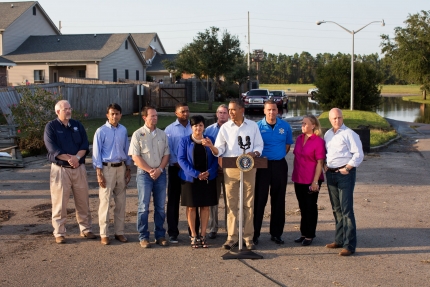
President Obama delivers a statement on the ongoing response to Hurricane Isaac (September 3, 2012)

President Barack Obama is surrounded by local and federal officials as he delivers a statement on the ongoing response and recovery efforts to Hurricane Isaac in LaPlace, Louisiana, Sept. 3, 2012. Standing with the President from left were FEMA Administrator Craig Fugate, Gov. Bobby Jindal, Rep. Jeff Landry, Rep. Cedric Richmond, Saint John the Baptist Parish President Natalie Robottom, Sen. David Vitter, Sheriff Mike Tregre, Sen. Mary Landrieu and New Orleans Mayor Mitch Landrieu. (Official White House Photo by Pete Souza)

President Obama yesterday made his way to St. John's Parish in Louisiana to take in the damage from Hurricane Isaac and meet with officials responding to the disaster.

The President highlighted the “extraordinary work” done by local first responders who worked around the clock to rescue residents stranded by high water in a place that hadn't flooded in 17 years.

"Some of the folks that we just walked by literally had to be saved by boat. They were in their homes, trapped. The waters came in so quickly," he said. "But because of the great work of law enforcement, National Guard, Coast Guard, making sure that folks were out in rescue mode rapidly, even in some cases at risk of their own lives, no lives were lost."

The White House

Office of the Press Secretary

Remarks by the President to the Troops at Fort Bliss, TX


Fort Bliss Main Hangar
Fort Bliss, Texas
 
1:06 P.M. MDT
 
THE PRESIDENT: Hello, Team Bliss! (Applause.) Hooah! Thank you so much, everybody. Hooah!
 
AUDIENCE: Hooah!
 
THE PRESIDENT: To General Lloyd Austin, thanks for the introduction and your leadership, leading our troops in Iraq and taking care of our soldiers now that they are at home. 
 
And right at the top, let me say that our hearts are obviously with all the folks who are down in Louisiana and the Gulf Coast, who are dealing with the aftermath of Hurricane Isaac. Our prayers are with those who've lost loved ones. And I've directed the federal government to keep doing everything that it can to help our partners at the state and local level. As a country, we stand united with our fellow Americans in their hour of need. 
 
I want to thank General Pittard and all your great commanders for welcoming me here today. I want to give a shout-out to the Sergeant Major of the Army, Ray Chandler. (Hooah!) And Command Sergeant Major Ronnie Kelley. (Hooah!) These guys remind us that our noncommissioned officers are the backbone of our military -- (applause) -- leading the finest enlisted force in the world. (Hooah!) 
 
It is great to be back at Fort Bliss, home to the Army, Air and Missile Defense Command -- "Swift and Sure." (Hooah!) We've got Guard and Reserve here. (Hooah!) Of course, it's home to the legendary 1st Armored Division, "Old Ironsides." (Hooah!) We've got a lot of brigades here, including the "Iron Eagles," "Iron Brigade," "Bulldogs," and "Ready First." (Hooah!) 
 
And I also want to salute Lucille Pittard and Alice Kelley and all the extraordinary spouses and military families who are here. Give them a big round of applause. (Applause.) 
 
 I know that all of you are grateful for the incredible support you receive from your civilian neighbors. So I want to acknowledge two champions of Fort Bliss -- we've got Congressman Silvestre Reyes and we've got Mayor John Cook. And we've also got all the great folks in El Paso and New Mexico. Give them a big round of applause. (Applause.) 
 
I've come back to Bliss for a simple reason. Two years ago, I was here to mark a historic moment in the life of our nation and our military -- the end of major combat operations in Iraq. It was a chance for me to say on behalf of the American people to you and all who served there -- welcome home, and congratulations on a job well done. 
 
AUDIENCE: Hooah!
 
THE PRESIDENT: In every major phase of that war, you were there, the Iron Soldiers. Because of your speed and strength, American troops toppled a dictator in less than a month. Because of your commitment, you stayed on extended tours and went back, tour after tour, year after year. Because of your determination to succeed, you turned back an insurgency. You stood firm against sectarian strife. You helped pull Iraq back from the abyss and you trained Iraqis to take the lead. That was the progress you made possible with your service and your courage. 
 
And so, two years ago, I was able to come here to Bliss and mark the end of our combat mission. And that night I told the American people that all our troops would be out of Iraq by the end of the following year. At the time, I know some folks didn’t believe me. They were skeptical. Some thought the end of combat was just word games and semantics, but I meant what I said. (Hooah!)
 
So you kept training up those Iraqi forces. We removed nearly 150,000 troops, and this past December, under General Austin’s leadership, the last American troops came home, including the 4th Brigade Combat Team from Bliss. (Hooah!) (Applause.)
 
You left Iraq with honor, your mission complete, your heads held high. After nearly nine years, our war in Iraq was over. And today Iraq has a chance to forge its own destiny, and there are no American troops fighting and dying in Iraq.
 
On this anniversary, we honor the memory of all who gave their lives there -- nearly 4,500 American patriots, including 198 fallen heroes from Fort Bliss and the 1st Armored Division. And we salute all who served there.
 
When I was here two years ago I told you something else, though -- that we had more work to do, including taking the fight to al Qaeda. (Hooah!) And there, too, I meant what I said. With allies and partners, we’ve taken out more top al Qaeda terrorists than at any time since 9/11. And thanks to the courage of our forces, al Qaeda is on the road to defeat and bin Laden will never again threaten the United States of America. (Applause.)
 
Two years ago I also told you that we’d keep up the fight in Afghanistan. And I know that some of you recently got back. On behalf of a grateful nation, welcome home. 
 
Some of your buddies are in Afghanistan right now -- (Hooah!) -- and our thoughts and prayers are with all the troops from Bliss deployed around the world, including Afghanistan -- the "War Eagles" and the "Highlanders." 
 
And I know that some of you will be deploying later this year. (Hooah!) And I’ve got to tell you the truth -- this is still a very tough fight. You know this. You carry in your hearts the memory of comrades who made that ultimate sacrifice, including six heroes from Bliss who gave their lives on that awful day last month. 
 
I just had the opportunity to meet with some of our Gold Star families, and our message to them is this: Your loved ones live on in the soul of our nation and we will honor them always. 
 
Because of their sacrifice, because of your service, we pushed the Taliban back. We’re training Afghan forces. The transition to Afghan lead is underway, and as promised, more than 30,000 of our troops will have come home by next month.
 
Just as in Iraq, we are going to end this war responsibly. Next year, Afghans will take the lead for their own security. In 2014, the transition will be complete. And even as this war ends, we will stay vigilant so Afghanistan is never again a source for attacks against America. Never again. (Hooah!) (Applause.)
 
So we’re not just ending these wars. We’re doing it in a way that keeps America safe and makes America stronger. And that includes our military. 
 
Think about it. Just four years ago, there were some 180,000 American troops in Iraq and Afghanistan. By next month we will have cut that number by nearly two-thirds. So most of our troops have come home. And as more Afghans step up, more of our troops will come home. 
 
And what does that mean for you? Well, after 10 years of continuous operations, it means fewer deployments. It means more time for training. It means more time to improve readiness, more time to prepare for the future. And it means more time on the home front with your families -- your spouses and your kids. (Hooah!)
 
THE PRESIDENT: So make no mistake -- ending the wars responsibly makes us safer and it makes our military even stronger. And ending these wars is letting us do something else -- restore American leadership. 
 
If you hear anyone trying to say that America is in decline or that our influence has waned, don’t you believe it. Because here's the truth -- our alliances have never been stronger. We're leading on behalf of freedom, including standing with the people of Libya that are finally free from Muammar Qaddafi. (Hooah!)
 
Around the world, there's a new attitude toward America, new confidence in our leadership. When people are asked, which country do you admire most, one nation always comes out on top: the United States of America. (Hooah!) (Applause.) 
 
And that’s the progress that we've made, thanks to your incredible service. We're winding down a decade of war. We're destroying terrorist networks that attacked us. And we've restored American leadership. And today, every American can be proud that the United States is safer, the United States is stronger, and the United States is more respected in the world.
 
Now, when I was here last, I made you a pledge. I said that, as President, I will insist that America serves you and your families as well as you've served us. And there again, I meant what I said. Because part of ending wars responsibly is caring for those who fought in it. That’s why I wanted to come back to Bliss on this anniversary to reaffirm our solemn obligations to you and your families.
 
You see, we may be turning a page on a decade of war, but America's responsibilities to you have only just begun. (Baby shouts.)
 
THE PRESIDENT: Hey! (Laughter.) I hear you. 
 
So here's my pledge to you. In a world of serious threats, I will never hesitate to use force to defend the United States of America or our interests. (Hooah!) At the same time, I will only send you into harm's way when it is absolutely necessary. And when we do, we will give you the equipment and the clear mission and the smart strategy and the support back home that you need to get the job done. We owe you that. (Applause.) 
 
With the end of the wars, our military will be leaner, but we'll keep making historic investments to keep you the absolute best military in the world -- bar none. The United States will always maintain our military superiority. (Hooah!) In you, we've got the best-trained, best-led, best-equipped military in human history. And as Commander-In-Chief, I'm going to keep it that way. (Applause.) 
 
And by the way, you've been hearing some folks out there trying to talk about the budget and trying to scare you. Last year, Congress pledged to find a plan to reduce the deficit, and they said if they couldn’t agree there would be big cuts across the board, including defense. But understand, nobody wants these cuts, and that’s why Congress threatened them, to force themselves to make hard decisions. 
 
Here's the thing. There’s no reason those cuts should happen because folks in Congress ought to come together and agree on a responsible plan that reduces the deficit and keeps our military strong. (Hooah!)
 
That's what needs to happen. That's what you and your families deserve. And that's how we’re going to keep America safe and strong and grow our economy all at the same time. (Applause.) That's a pledge that we need to make to you.
 
And just as we give you the best equipment and technology on the battlefield, we need to give you the best support and care when you come home.
 
AUDIENCE MEMBER: I say hooah!
 
THE PRESIDENT: Hooah!
 
AUDIENCE: Hooah!
 
THE PRESIDENT: We just had a roundtable with some soldiers and their families, talking about how coming home can be its own struggle, especially for our wounded warriors. So we’ve poured tremendous resources into this effort, unprecedented support for our troops with Traumatic Brain Injury, for our troops and veterans with PTSD -- more counselors, more clinicians, more care, more treatment. 
 
And I know you’ve been a leader on this here at Bliss, making it clear that everyone has a responsibility to help a comrade who's hurting. So today we’re taking another step. I’ve signed a new executive order to give our troops, our veterans, and our families better access to mental health care. (Hooah!) (Applause.) 
 
We’re going increase the number of folks manning those crisis hotlines so help is there when you need it most. We’re going to add even more counselors and mental health providers. We’re launching a new awareness campaign, starting tomorrow, and I’m directing a new task force to find out what works best so we’re doing everything we can to help those in need and save lives. And I know that you join me in saying to everyone who's ever worn the uniform: If you’re hurting, it’s not a sign of weakness to seek help; it’s a sign of strength. (Hooah!) 
 
We are here to help you stay strong -- Army Strong. (Hooah!) That's a commitment I’m making to you. 
 
And we’re going to keep taking care of our remarkable military families, too. (Hooah!) This is something I care deeply about, but even if I didn't, I’d have no choice because Michelle would tell me what to do. (Laughter.) And along with Michelle and Dr. Jill Biden, they have been doing everything they can to get civilians involved in this process, not just our government. So today more people all across America are joining forces to give our military families the respect and the support that they deserve, and that's especially important right now.
 
Now, this may be a political season, and folks may be arguing about all sorts of things. But one thing that we Americans are united on is our support for you. Only 1 percent of Americans may wear the uniform -- (Hooah!) -- but 100 percent of Americans need to be supporting you and your families 100 percent. (Hooah!)
 
And so this brings me to the final pledge I made here at Bliss two years ago. When you take off the uniform, we are going to help you fully participate in our economy. Every single one of you has defended the American Dream for the rest of us, and every single one of you deserves a chance to live the American Dream yourselves. (Hooah!) And that includes jobs worthy of your incredible talents. 
 
And by the way, it’s not just good for you. It’s good for the country -- because after a decade of war, the nation we need to be rebuilding is the United States of America. (Hooah!) (Applause.) And all of you have the skills that America needs. 
 
So with a million more of you rejoining civilian life in the years ahead, we’re upping our game at every stage of your careers. We’ve overhauled the Transition Assistance Program, creating a kind of reverse boot camp as you leave service, to help you find a job, or pursue that degree, or start that business. And hopefully this will be one boot camp you actually like. (Laughter.) 
 
We’ll keep helping you and your families pursue your education under the Post-9/11 GI Bill. (Hooah!) And by the way, we’re cracking down on those schools that have been trying to take your money and then rip you off by not giving you the education that you paid for. That needs to stop. We’re going to bring an end to that. (Hooah!)
 
We’re going to keep hiring our newest veterans in the federal government, and in communities as police officers and firefighters and first responders. Because we passed tax credits, more businesses can hire our veterans and wounded warriors. 
 
We’re making it easier for you to transfer your outstanding military skills to the licenses and credentials that you need to get that civilian job. If you’ve been a medic in theater, you shouldn’t have to start at nursing 101 if you decide you want to go into the medical profession here in the United States. (Hooah!) (Applause.) If you’ve been a mechanic on a multimillion-dollar piece of equipment, you shouldn’t have to come back and start all over again in getting credentialed to work on a car here in the United States. (Hooah!)
 
And maybe you’ve heard -- last year I challenged the private sector to hire or train 100,000 veterans or military spouses. Well, last week Michelle was able to announce that patriotic companies across America have actually exceeded that goal ahead of schedule with 125,000 jobs. (Hooah!) (Applause.)
 
But we’ve still got more work to do. So today I’m again calling on Congress to act. They’ve got some work they need to do. Pass the Veterans Jobs Corps so we can put more vets to work protecting and rebuilding America. Extend tax credits to businesses that hire our veterans. (Applause.) And I say to every company in America: If you want somebody who knows how to get the job done, if you want somebody who is going to make you proud, just like they made America proud -- then hire a vet. (Hooah!) Hire a vet. (Applause.) Because after fighting for America, you shouldn’t have to fight for a job in America. (Hooah!)
 
So, Team Bliss, these are America’s commitments to you and all who serve -- because we need to be there for you just like you were there for us -- not just this year or next, but for all the years to come. 
 
That’s the lesson of a soldier I had the honor to meet the last time I was in Afghanistan, visiting some of our wounded warriors in the hospital at Bagram. Sergeant Chase Haag is 22 years old. This past spring he was with his team when their vehicle got hit by an IED the day that I flew in. So when I arrived at his hospital room, he and his buddies were all in pretty bad shape. And he was certainly in bad shape -- his leg was broken, his back was fractured. He was laying there on his bed. He was under a lot of medication, face was swollen, his eyes were shut.
 
And at first, my attitude was I didn’t want to disturb him because I thought he was sleeping. And the doctor said, no, I think he can understand what you’re saying even if he can’t acknowledge it, and I think he’d appreciate knowing that you’re by his side. So I leaned in and I told Chase how proud I was of him and how proud the country was of him, and how we’d be praying for his recovery. 
 
And I was turning to leave and then something happened. There was a rustling under his blanket. And Chase never opened his eyes, couldn’t make a sound, but suddenly you saw the blanket lift and his arm came out. And he shook my hand -- a firm Army handshake. (Hooah!) And I don’t think there was a dry eye in that room.
 
And then a few months later I was visiting our wounded warriors at Walter Reed, and I walk around the corner and who’s there but Chase. He had endured multiple surgeries. He was persevering through physical therapy. But this time he was on his feet. He was walking again. And he had his dad next to him. And today he’s back where every soldier wants to be -- back with his unit. (Hooah!) (Applause.)
 
And it made me think, that’s just one moment in the life of one American soldier. But it captured the spirit, the resilience, the tenacity, the discipline, the resolve, the patriotism of all of you. 
 
For a decade, you have served under the dark cloud of war. You've endured great loss, and good men and women have given their last full measure of devotion. But we Americans are strong, and we are resilient, and we have resolve. And now, we can see a light -- the light of a new day on the horizon. And that’s because of you.
 
The war in Iraq is over. The transition is underway in Afghanistan. Our troops will keep coming home. And we are keeping our military ready for whatever the future may hold. But know this, Bliss -- we are moving forward stronger and more confident in knowing that when faced with great trials, we Americans do what we always do. We don’t just endure; we emerge stronger than before. 
 
And as we go forward as one nation, if the American people ever need inspiration, they just have to look at Bliss. They need only to look at you. For in you, we see the best that our country has to offer -- the virtues that have made America great for more than two centuries, and the values that will keep us great for centuries to come. 
 
It's the belief that all men are created equal; that we are endowed by our Creator with certain unalienable rights, and that among these are life and liberty and the pursuit of happiness. It's the sense of duty that says our country and our freedoms are worth fighting for. It's the selflessness that says I don’t care who gets the credit, but I'll do my part and we'll get the job done. The trust in one another, knowing that when the chips are down, the person next to you has got your back and you've got theirs. (Hooah!) The strength you draw from every part of our American family, every color, every creed, every background, every faith coming together, succeeding together as one American team. 
 
That’s who you are. That’s who we are. We are Americans. We pledge allegiance to the same proud flag. And we all love this country and all it represents to the world -- the hope, the opportunity. And we stand united in support of our troops and your families. And when we stand together and when we work together, when we take care of each other, we remind ourselves there's nothing we can't do, America's greatest days are yet to come, and that we remain the greatest force for freedom that the world has ever known.
 
So God bless you. God bless all our men and women in uniform. And God bless the United States of America. (Applause.) 
 
END
1:32 P.M. MDT

Weekly Wrap Up: Salute the Troops

Watch the West Wing Week here.

Here's a quick glimpse at what happened this week on WhiteHouse.gov:

Remembering Neil Armstrong: Neil Armstrong, the first man to walk on the moon, passed away last weekend. In a statement issued on Saturday, President Obama said that “Neil was among the greatest of American heroes – not just of his time, but of all time.”

Check out the photo gallery remembering Neil Armstrong and watch the video of Neil Armstrong’s visit to the White House in 2009. To learn more about Neil Armstrong, visit NASA.gov.

The White House

Office of the Press Secretary

Fact Sheet: President Obama Signs Executive Order to Improve Access to Mental Health Services for Veterans, Service Members, and Military Families


WASHINGTON, DC – Today, President Obama will sign an Executive Order directing key federal departments to expand suicide prevention strategies and take steps to meet the current and future demand for mental health and substance abuse treatment services for veterans, service members, and their families.  
 
Ensuring that all veterans, Active, Guard, and Reserve service members and their families receive the support they deserve is a top priority for the Obama Administration. Since September 11, 2001, more than two million service members have deployed to Iraq or Afghanistan with unprecedented duration and frequency.  Long deployments and intense combat conditions require optimal support for the emotional and mental health needs of our service members and their families. The Obama Administration has consistently expanded efforts to ensure our troops, veterans and their families receive the benefits they have earned and deserve, including providing timely mental health service. The Executive Order signed today builds on these efforts.  
 
President Obama’s Executive Order 
 
The Executive Order signed by President Obama:
 
Strengthens suicide prevention efforts across the Force and in the veteran community:
  • The Executive Order directs the VA to increase the VA veteran crisis line capacity by 50% by the end of the year.  
  • Under the Executive Order, VA will ensure that any veteran identifying him or herself as being in crisis connects with a mental health professional or trained mental health worker within 24 hours or less. 
  • VA will work with the Department of Defense to develop and implement a national 12 month suicide prevention campaign focused on connecting veterans to mental health services.  
Enhances access to mental health care by building partnerships between VA and community providers:
  • In service areas where VA has faced challenges in hiring and placing mental health service providers and continues to have unfilled vacancies or long wait times, the Executive Order Directs the Department of Veterans Affairs to work with the Department of Health and Human Services (HHS) to establish at least 15 pilot sites.  In pilot sites, VA will contract with community health centers, community mental health clinics, community substance abuse treatment facilities and other HHS grantees and community resources to help reduce VA mental health waiting lists.  
  • Under the Executive Order, HHS and VA will develop a plan for a rural mental health recruitment initiative to promote opportunities for VA and rural communities to share mental health providers when demand is insufficient for either to support a full-time provider.  
Increases the number of VA mental health providers serving our veterans:
  • Under the Executive Order, VA will hire 800 peer-to-peer support counselors to empower veterans to support other veterans and help ensure that their mental health care and overall service needs are met. 
  • VA has launched an effort to hire 1,600 new mental health professionals to serve veterans. The Executive Order directs VA to use its pay-setting authorities, loan repayment and scholarships, partnerships with health care workforce training programs, and collaborative arrangements with community-based providers to recruit, hire, and place 1,600 mental health professionals by June, 2013. Since, 2009, the VA has expanded its mental health programs, hiring more than 3,500 mental health professionals since 2009.
Promotes mental health research and development of more effective treatment methodologies:
  • The Executive Order directs the Department of Defense, the Department of Veterans Affairs, the Department of Health and Human Services and the Department of Education to develop a National Research Action Plan that will include strategies to improve early diagnosis and treatment effectiveness for TBI and PTSD.  
  • The Executive Order further directs the Department of Defense and Department of Health and Human Services to conduct a comprehensive mental health study with an emphasis on PTSD, TBI, and related injuries to develop better prevention, diagnosis, and treatment options.  
Launch a government-wide collaborative effort to address these issues through a Military and Veterans Mental Health Interagency Task Force:
  • The Executive Order establishes an Interagency Task Force, including the Department of Defense, Department of Veterans Affairs, Department of Health and Human Services, Department of Education, the Domestic Policy Council, National Security Staff, the Office of Management and Budget, the Office of Science and Technology Policy, and the Office of National Drug Control Policy, which will make recommendations to the President on additional strategies to improve mental health and substance abuse treatment services for veterans, service members, and their families.  
Supporting our Military, Veterans, and their Families
The President has taken key steps to protect and strengthen the health of our military, veterans and their families here at home. Many of these initiatives are supported by agencies across the federal government and collaborative partnerships with states and communities. 
 
Health Care 
  • For the first time ever, 135 medical schools have committed to exchanging leading research on PTSD and TBI and will also train future physicians to better understand veteran health needs.  More than 150 state and national nursing organizations and over 650 nursing schools have committed to ensure our nation’s 3 million nurses are prepared to meet the unique health needs of veterans and their families by educating the current and future nurses of America to have a better understanding of PTSD and TBI.
  • President Obama signed the “caregivers and Veterans Omnibus Health Services Act of 2010”, into law which helps our most seriously injured post-9/11 veterans and their family caregivers with a monthly stipend; access to health insurance; mental health services and counseling; and comprehensive VA caregiver training and respite care.
  • The Department of Labor has proposed new regulations for the Family and Medical Leave Act (FMLA) to support military families and caregivers. This rule would implement statutory changes to the FMLA, expanding leave to family members caring for veterans who have suffered a serious injury or illness. 
  • In July 2010, the VA published a historic change to its rules, streamlining the process and paperwork needed by combat veterans to pursue a claim for disability pay for post-traumatic stress disorder (PTSD). 
  • The VA expanded its workforce by over 2,600 people to handle applications for disability pay. The VA is also using technology and new approaches to help veterans get their benefits by accepting online applications for initial disability benefits, initiating an innovation competition, launching pilot initiatives, and investing over $128 million in a paperless Veterans Benefits Management System.
  • The administration is utilizing partnerships to reduce the stigma associated with seeking treatment for behavioral health issues. Make the Connection, a campaign launched by the Department of Veterans Affairs, is creating ways for veterans and their family members to connect with the experiences of other veterans and access the information and resources to help these families confront the challenges of transitioning from service to daily civilian life. 
Licensing and Credentials
  • Nearly 35 percent of military spouses in the labor force require licenses or certification for their profession. Many military spouses hold occupational licenses and routinely move across state lines, causing licensing requirements to disproportionately affect the military spouse population. The First Lady and Dr. Biden encouraged all 50 governors to pass legislation by 2014 to reduce the financial and administrative strains that 100,000 military spouses incur from trying to get their state licenses or certification credentials to transfer from state to state as they move. Mrs. Obama and Dr. Biden encouraged governors to take Action in February 2012 when only 11 states had legislation on the books. 26 states now have measures in place to support military spouses and the initiative is on-track to meet the 2014 goal.
Education
  • The Department of Defense has awarded $180 million in grants to support military-connected public school districts.  These grants support improved academic programs for military children.  More than 400,000 students from military families across all grade levels are impacted by these grant projects.
  • The Department of Defense has awarded approximately $25 million to military-connected Local Education Agencies (LEAs) this summer to focus on increasing student achievement and easing transitions through research-based academic and support programs.  
  • The Department of Defense, in collaboration with the Council of State Governments' (CSG) National Center for Interstate Compacts developed the Interstate Compact on Educational Opportunity for Military Children (the Compact) to address the educational transition issues of children of military families.  The Compact covers transition issues including class placement, records transfer, immunization requirements, course placement, graduation requirements, exit testing, and extra-curricular opportunities.  States adopt the Compact through legislation, and as a result, join the Military Interstate Children’s Compact Commission (MIC3).  To date, 39 states have approved the Compact and these states are home to 89 percent of school age children whose active duty parents are assigned to military installations in the United States.  We will continue to work with leaders to encourage the 11 remaining states approve the Compact and become members of MIC3.
  • VA eased the Post-9/11 GI Bill application process within the eBenefits portal, including transferability to spouses or children for service members with over six years of service. Servicemembers can now apply on-line to transfer the benefits of their Post-9/11 GI Bill to eligible beneficiaries. 
Housing
  • On top of the historic settlements completed by the Federal government and 49 state Attorneys General, major mortgage servicers will be providing relief to thousands of service member and veteran households. A review will be conducted of every service member household foreclosed upon since 2006. Those wrongly foreclosed upon will be compensated equal to a minimum of lost equity, plus interest and a refund for money lost because they were wrongfully denied the opportunity to reduce their mortgage payments. Additionally, these organizations will pay $10 million into a VA fund that guarantees loans on favorable terms for veterans.
  • The Administration is working to end veteran homelessness through leveraging broad support at Federal, State, and local levels in both the public and private sectors. Working with over 4,000 community agencies, the VA and HUD have successfully placed more than 37,000 veterans in permanent housing with dedicated case managers and access to high-quality VA health care since 2009. To ensure we reach out to our homeless veterans, the VA created a National Registry for Homeless Veterans and established a National Homeless Hotline. Veteran homelessness was reduced by nearly 12 percent between January 2010 and January 2011. 
  • In 2011, VA helped save 72,391 Veteran and military borrowers with VA-guaranteed loans from foreclosure, a 10% increase from the prior year.   VA has helped nearly 59,000 borrowers avoid foreclosure so far in 2012.  The home loan guaranty program helps Veterans and their families purchase homes, often with no down payment required.  The program expects to guaranty the 20 millionth loan in early November 2012.
  • Using their Interest Rate Reduction Refinancing Loan, also known as the Streamline Refinance, VA refinances existing VA loans into new loans with lower interest rates, or adjustable rate mortgages (ARMs) into fixed rate mortgages.  In 2011, this program saved an average of $202 per month in individual payment reductions and 1.42% in interest rates.  This equates to saving military and veterans $24 million a month and $293 million per year.
Financial Readiness
  • The Department of the Treasury’s Office of Financial Education and Financial Access has helped military families identify predatory lending practices. The Consumer Financial Protection Bureau (CFPB) established an office of service member affairs to ensure that the CFPB addresses the financial challenges that confront military families and strengthens protections against abusive financial practices.

The White House

Office of the Press Secretary

Executive Order -- Improving Access to Mental Health Services for Veterans, Service Members, and Military Families


EXECUTIVE ORDER
 
IMPROVING ACCESS TO MENTAL HEALTH SERVICES FOR VETERANS, SERVICE MEMBERS, AND MILITARY FAMILIES
 
By the authority vested in me as President by the Constitution and the laws of the United States of America, I hereby order as follows:
 
Section 1.  Policy.  Since September 11, 2001, more than two million service members have deployed to Iraq or Afghanistan.  Long deployments and intense combat conditions require optimal support for the emotional and mental health needs of our service members and their families.  The need for mental health services will only increase in the coming years as the Nation deals with the effects of more than a decade of conflict.  Reiterating and expanding upon the commitment outlined in my Administration's 2011 report, entitled "Strengthening Our Military Families," we have an obligation to evaluate our progress and continue to build an integrated network of support capable of providing effective mental health services for veterans, service members, and their families.  Our public health approach must encompass the practices of disease prevention and the promotion of good health for all military populations throughout their lifespans, both within the health care systems of the Departments of Defense and Veterans Affairs and in local communities.  Our efforts also must focus on both outreach to veterans and their families and the provision of high quality mental health treatment to those in need.  Coordination between the Departments of Veterans Affairs and Defense during service members' transition to civilian life is essential to achieving these goals.
 
Ensuring that all veterans, service members (Active, Guard, and Reserve alike), and their families receive the support they deserve is a top priority for my Administration.  As part of our ongoing efforts to improve all facets of military mental health, this order directs the Secretaries of Defense, Health and Human Services, Education, Veterans Affairs, and Homeland Security to expand suicide prevention strategies and take steps to meet the current and future demand for mental health and substance abuse treatment services for veterans, service members, and their families.
 
Sec. 2.  Suicide Prevention.  (a)  By December 31, 2012, the Department of Veterans Affairs, in continued collaboration with the Department of Health and Human Services, shall expand the capacity of the Veterans Crisis Line by 50 percent to ensure that veterans have timely access, including by telephone, text, or online chat, to qualified, caring responders who can help address immediate crises and direct veterans to appropriate care.  Further, the Department of Veterans Affairs shall ensure that any veteran identifying him or herself as being in crisis connects with a mental health professional or trained mental health worker within 24 hours.  The Department of Veterans Affairs also shall expand the number of mental health professionals who are available to see veterans beyond traditional business hours.
 
(b)  The Departments of Veterans Affairs and Defense shall jointly develop and implement a national suicide prevention campaign focused on connecting veterans and service members to mental health services.  This 12 month campaign, which shall begin on September 1, 2012, will focus on the positive benefits of seeking care and encourage veterans and service members to proactively reach out to support services.
 
(c)  To provide the best mental health and substance abuse prevention, education, and outreach support to our military and their family members, the Department of Defense shall review all of its existing mental health and substance abuse prevention, education, and outreach programs across the military services and the Defense Health Program to identify the key program areas that produce the greatest impact on quality and outcomes, and rank programs within each of these program areas using metrics that assess their effectiveness.  By the end of Fiscal Year 2014, existing program resources shall be realigned to ensure that highly ranked programs are implemented across all of the military services and less effective programs are replaced.
 
Sec. 3.  Enhanced Partnerships Between the Department of Veterans Affairs and Community Providers.  (a)  Within 180 days of the date of this order, in those service areas where the Department of Veterans Affairs has faced challenges in hiring and placing mental health service providers and continues to have unfilled vacancies or long wait times, the Departments of Veterans Affairs and Health and Human Services shall establish pilot projects whereby the Department of Veterans Affairs contracts or develops formal arrangements with community based providers, such as community mental health clinics, community health centers, substance abuse treatment facilities, and rural health clinics, to test the effectiveness of community partnerships in helping to meet the mental health needs of veterans in a timely way.  Pilot sites shall ensure that consumers of community-based services continue to be integrated into the health care systems of the Department of Veterans Affairs.  No fewer than 15 pilot projects shall be established.
 
(b)  The Department of Veterans Affairs shall develop guidance for its medical centers and service networks that supports the use of community mental health services, including telehealth services and substance abuse services, where appropriate, to meet demand and facilitate access to care.  This guidance shall include recommendations that medical centers and service networks use community-based providers to help meet veterans' mental health needs where objective criteria, which the Department of Veterans Affairs shall define in the form of specific metrics, demonstrate such needs.  Such objective criteria should include estimates of wait-times for needed care that exceed established targets.
 
(c)  The Departments of Health and Human Services and Veterans Affairs shall develop a plan for a rural mental health recruitment initiative to promote opportunities for the Department of Veterans Affairs and rural communities to share mental health providers when demand is insufficient for either the Department of Veterans Affairs or the communities to independently support a full time provider.
 
Sec. 4.  Expanded Department of Veterans Affairs Mental Health Services Staffing.  The Secretary of Veterans Affairs shall, by December 31, 2013, hire and train 800 peer to peer counselors to empower veterans to support other veterans and help meet mental health care needs.  In addition, the Secretary shall continue to use all appropriate tools, including collaborative arrangements with community based providers, pay setting authorities, loan repayment and scholarships, and partnerships with health care workforce training programs to accomplish the Department of Veterans Affairs' goal of recruiting, hiring, and placing 1,600 mental health professionals by June 30, 2013.  The Department of Veterans Affairs also shall evaluate the reporting requirements associated with providing mental health services and reduce paperwork requirements where appropriate.  In addition, the Department of Veterans Affairs shall update its management performance evaluation system to link performance to meeting mental health service demand.
 
Sec. 5.  Improved Research and Development.  (a)  The lack of full understanding of the underlying mechanisms of Post Traumatic Stress Disorder (PTSD), other mental health conditions, and Traumatic Brain Injury (TBI) has hampered progress in prevention, diagnosis, and treatment.  In order to improve the coordination of agency research into these conditions and reduce the number of affected men and women through better prevention, diagnosis, and treatment, the Departments of Defense, Veterans Affairs, Health and Human Services, and Education, in coordination with the Office of Science and Technology Policy, shall establish a National Research Action Plan within 8 months of the date of this order.
 
(b)  The National Research Action Plan shall include strategies to establish surrogate and clinically actionable biomarkers for early diagnosis and treatment effectiveness; develop improved diagnostic criteria for TBI; enhance our understanding of the mechanisms responsible for PTSD, related injuries, and neurological disorders following TBI; foster development of new treatments for these conditions based on a better understanding of the underlying mechanisms; improve data sharing between agencies and academic and industry researchers to accelerate progress and reduce redundant efforts without compromising privacy; and make better use of electronic health records to gain insight into the risk and mitigation of PTSD, TBI, and related injuries.  In addition, the National Research Action Plan shall include strategies to support collaborative research to address suicide prevention.
 
(c)  The Departments of Defense and Health and Human Services shall engage in a comprehensive longitudinal mental health study with an emphasis on PTSD, TBI, and related injuries to develop better prevention, diagnosis, and treatment options.  Agencies shall continue ongoing collaborative research efforts, with an aim to enroll at least 100,000 service members by December 31, 2012, and include a plan for long term follow up with enrollees through a coordinated effort with the Department of Veterans Affairs.
 
Sec. 6.  Military and Veterans Mental Health Interagency Task Force.  There is established an Interagency Task Force on Military and Veterans Mental Health (Task Force), to be co chaired by the Secretaries of Defense, Veterans Affairs, and Health and Human Services, or their designated representatives.
 
(a)  Membership.  In addition to the Co-Chairs, the Task Force shall consist of representatives from:
 
(i)    the Department of Education;
 
(ii)   the Office of Management and Budget;
 
(iii)  the Domestic Policy Council;
 
(iv)   the National Security Staff;
 
(v)    the Office of Science and Technology Policy;
 
(vi)   the Office of National Drug Control Policy; and
 
(vii)  such other executive departments, agencies, or offices as the Co-Chairs may designate.
 
A member agency of the Task Force shall designate a full time officer or employee of the Federal Government to perform the Task Force functions.
 
(b)  Mission.  Member agencies shall review relevant statutes, policies, and agency training and guidance to identify reforms and take actions that facilitate implementation of the strategies outlined in this order.  Member agencies shall work collaboratively on these strategies and also create an inventory of mental health and substance abuse programs and activities to inform this work.
 
(c)  Functions.
 
(i)    Not later than 180 days after the date of this order, the Task Force shall submit recommendations to the President on strategies to improve mental health and substance abuse treatment services for veterans, service members, and their families.  Every year thereafter, the Task Force shall provide to the President a review of agency actions to enhance mental health and substance abuse treatment services for veterans, service members, and their families consistent with this order, as well as provide additional recommendations for action as appropriate.  The Task Force shall define specific goals and metrics that will aid in measuring progress in improving mental health strategies.  The Task Force will include cost analysis in the development of all recommendations, and will ensure any new requirements are supported within existing resources.
 
(ii)   In addition to coordinating and reviewing agency efforts to enhance veteran and military mental health services pursuant to this order, the Task Force shall evaluate:
 
(1)  agency efforts to improve care quality and ensure that the Departments of Defense and Veterans Affairs and community based mental health providers are trained in the most current evidence based methodologies for treating PTSD, TBI, depression, related mental health conditions, and substance abuse;
 
(2)  agency efforts to improve awareness and reduce stigma for those needing to seek care; and
 
(3)  agency research efforts to improve the prevention, diagnosis, and treatment of TBI, PTSD, and related injuries, and explore the need for an external research portfolio review.
 
(iii)  In performing its functions, the Task Force shall consult with relevant nongovernmental experts and organizations as necessary.
 
Sec. 7.  General Provisions.  (a)  This order shall be implemented consistent with applicable law and subject to the availability of appropriations.
 
(b)  Nothing in this order shall be construed to impair or otherwise affect:
 
(i)   the authority granted by law to an executive department or agency, or the head thereof; or
 
(ii)  the functions of the Director of the Office of Management and Budget relating to budgetary, administrative, or legislative proposals.
 
(c)  This order is not intended to, and does not, create any right or benefit, substantive or procedural, enforceable at law or in equity by any party against the United States, its departments, agencies, or entities, its officers, employees, or agents, or any other person.
 
BARACK OBAMA
 
THE WHITE HOUSE,
August 31, 2012.

Tracking the Response to Isaac

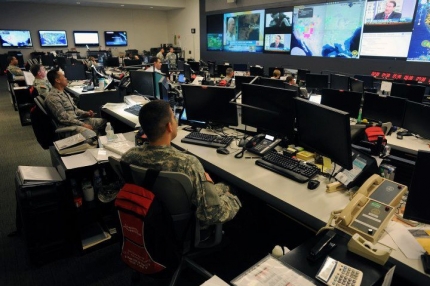
Personnel in the National Guard Command Center monitor Tropical Storm Isaac (August 29, 2012)

(August 28 - Personnel in the National Guard Command Center in Arlington, Va., monitor the progress of Tropical Storm Isaac as it makes its way through the Gulf of Mexico. The NGCC, which serves as a hub that provides an overall tracking and coordination of National Guard elements, has gone to 24 hour operations in preparation for Isaac making landfall. Isaac's predicted path has it hitting the Gulf Coast region sometime Tuesday or Wednesday. U.S. Army Photo by Sgt. 1st Class Jon Soucy.)

This morning, Hurricane Isaac was downgraded to a tropical storm, and by the end of the day, it's expected to further diminish to a tropical depression.

But as the storm continues moving north, federal emergency personnel are still monitoring its progress and mobilizing to provide relief for those in its path.

In the past 24 hours, federal officials have taken the following steps to respond Isaac. Check out the list, compiled by the Federal Emergency Management Agency below, or visit FEMA.gov for additional information.

The White House

Office of the Press Secretary

President Obama Signs Mississippi Disaster Declaration


The President today declared a major disaster exists in the State of Mississippi and ordered Federal aid to supplement state and local recovery efforts in the area affected by Hurricane Isaac beginning on August 26, 2012, and continuing.
 
Federal funding is available to state and eligible local governments and certain private nonprofit organizations on a cost-sharing basis for emergency work in the counties of Amite, Attala, Carroll, Clarke, Copiah, Covington, Forrest, George, Greene, Grenada, Hancock, Harrison, Hinds, Holmes, Jackson, Jasper, Jefferson Davis, Jones, Lamar, Lauderdale, Lawrence, Lincoln, Madison, Marion, Montgomery, Pearl River, Perry, Pike, Rankin, Stone, Walthall, Wayne, Wilkinson, and Yazoo.
 
Federal funding is also available on a cost-sharing basis for hazard mitigation measures statewide.
 
W. Craig Fugate, Administrator, Federal Emergency Management Agency (FEMA), Department of Homeland Security, named Terry L. Quarles as the Federal Coordinating Officer for federal recovery operations in the affected area. 
 
Additional counties and forms of assistance may be added after the Preliminary Damage Assessments are fully completed.
 
FOR FURTHER INFORMATION MEDIA SHOULD CONTACT:  FEMA NEWS DESK AT (202) 646-3272 OR FEMA-NEWS-DESK@DHS.GOV 

The White House

Office of the Press Secretary

President Obama Signs Louisiana Disaster Declaration


The President today declared a major disaster exists in the State of Louisiana and ordered Federal aid to supplement state and local recovery efforts in the area affected by Hurricane Isaac beginning on August 26, 2012, and continuing.
 
Federal funding is available to state and eligible local governments and certain private nonprofit organizations on a cost-sharing basis for emergency work in the parishes of Acadia, Allen, Ascension, Assumption, Avoyelles, Cameron, East Baton Rouge, East Feliciana, Franklin, Iberia, Iberville, Jefferson, Jefferson Davis, Lafourche, Livingston, Morehouse, Natchitoches, Orleans, Ouachita, Plaquemines, Pointe Coupee, Rapides, St. Bernard, St. Charles, St. Helena, St. James, St. John the Baptist, St. Martin, St. Mary, St. Tammany, Tangipahoa, Terrebonne, Vermilion, Washington, and West Baton Rouge.
 
Federal funding is also available on a cost-sharing basis for hazard mitigation measures statewide.
 
W. Craig Fugate, Administrator, Federal Emergency Management Agency (FEMA), Department of Homeland Security, named Gerard M. Stolar as the Federal Coordinating Officer for federal recovery operations in the affected area. 
 
Additional parishes and forms of assistance may be added after the Preliminary Damage Assessments are fully completed.
 
FOR FURTHER INFORMATION MEDIA SHOULD CONTACT:  FEMA NEWS DESK AT (202) 646-3272 OR FEMA-NEWS-DESK@DHS.GOV