
Office of Science and Technology Policy Blog
Building a 21st Century Bioeconomy
Posted by on October 12, 2011 at 11:25 AM EST
JANUARY 17, 2012 UPDATE: OSTP received 135 submissions in response to the Request for Information detailed below.
On September 16, President Obama announced that his Administration will develop a National Bioeconomy Blueprint detailing Administration-wide steps to harness biological research innovations to address national challenges in health, food, energy, and the environment. Biological research underpins the foundation of a significant portion of the Nation’s economy. By better leveraging America’s national investments in biological research and development, the Administration aims to stimulate the growth of high-wage, high-skill jobs while improving the lives of all Americans. OSTP has issued a Request for Information (RFI) to solicit input from all interested parties on how best to develop the National Bioeconomy Blueprint.
The National Bioeconomy Blueprint will highlight Administration progress in this productive and promising scientific and economic arena and identify needs and goals, including:
- strategies to meet grand challenges in lean budget times;
- commercialization and entrepreneurship opportunities to open new markets;
- research and development investments in areas that will provide the foundation for the bioeconomy;
- enhancements of workforce training to prepare the next generation of scientists and engineers for the bioeconomy jobs of the future;
- regulatory reforms that will reduce unnecessary burdens and impediments while protecting health and safety, and
- bioeconomy public-private partnerships to accelerate innovation in key areas.
OSTP welcomes your ideas and invites your help prioritizing approaches to building the US bioeconomy. Please submit your responses electronically as an attachment to the e-mail address provided in the RFI by 11:59 p.m. ET on December 6, 2011. Do not include any information that might be considered proprietary or confidential. Responses to the RFI, including the names of the authors and their institutional affiliations, will be posted at a later date.
Mary Maxon is Assistant Director for Biological Research and Mike Stebbins is Assistant Director for Biotechnology at OSTP
Learn more about Economy, TechnologyStamping All Corners of the Globe With ‘Made In America’
Posted by on October 5, 2011 at 1:09 PM ESTOn Monday, President Obama transmitted to Congress three free trade agreements that will make it easier for American companies to sell their products in South Korea, Colombia, and Panama, and provide a major boost to our exports. These agreements will support tens of thousands of jobs across the country for workers making products stamped “Made in America”.
Swift Congressional approval of these agreements will help American companies gain greater access to these markets and sell more of their products and services abroad, including high technology and intellectual property intensive products.
These trade agreements, along with bipartisan agreement on the Trade Adjustment Assistance program, represent a balanced approach to trade that not only opens up new opportunities for U.S. businesses but also provides support for American workers whose jobs have been affected by global competition.
Boosted by President Obama’s National Export Initiative, exports have been leading the economic recovery. Exports now support nearly 10 million American jobs and accounted for more than 13 percent of U.S. economic output in the first quarter of 2011.
Along with the American Jobs Act, these free trade agreements are something that Congress can do right away in a bipartisan fashion that will have a measurable effect on jobs and the American economy. While the Administration continues to lay the groundwork for long term American competitiveness, we should seize every opportunity to help American workers and entrepreneurs compete internationally right away.
Quentin Palfrey is Senior Adviser to the CTO for Jobs and Competitiveness
Learn more about EconomyPresident Obama Welcomes Science Fair Winners to Oval Office
Posted by on October 4, 2011 at 1:00 PM EST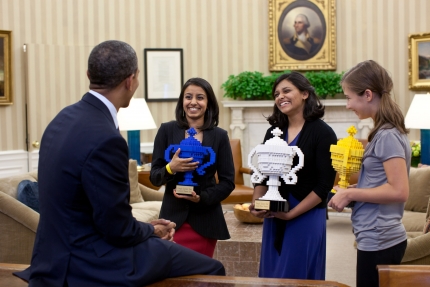
President Barack Obama congratulates Google Science Fair winners, from left, Naomi Shah, Shree Bose, and Lauren Hodge in the Oval Office, Oct. 3, 2011. (Official White House Photo by Pete Souza)
In keeping with his promise to honor the winners of science competitions as much as those who win sports championships, President Obama welcomed the winners of the first-ever Google Science Fair to the Oval Office yesterday.
The winners, three young women from the United States, bested roughly 10,000 competitors from 90 different countries to earn top accolades from a judging panel of acclaimed scientists. Their victories represent the impressive accomplishments that students – including girls and underrepresented groups – can achieve in science, technology, engineering, and math subjects when given the tools and support they need to succeed.
In their meeting with the President, the winners described their hopes of earning advanced degrees in the sciences and making that research relevant to the lives of others in their communities.
The winners of competition are:
-
Shree Bose, 17 (Winner age 17-18 category, Grand-prize winner), from Ft. Worth, TX, discovered a way to improve ovarian cancer treatment for patients who have built up a resistance to certain chemotherapy drugs.
-
Naomi Shah, 16 (Winner age 15-16 category) from Portland, OR, demonstrated that making changes to indoor environments can improve indoor air quality and reduce reliance on asthma medications.
- Lauren Hodge, 14 (Winner age 13-14 category) from York, Pennsylvania, tested the effect of different marinades on the level of potentially harmful carcinogens in grilled chicken.
Congrats to them all!
Learn more about Education, Technology-
Shree Bose, 17 (Winner age 17-18 category, Grand-prize winner), from Ft. Worth, TX, discovered a way to improve ovarian cancer treatment for patients who have built up a resistance to certain chemotherapy drugs.
NASA Contest Heralds Dawn of the Electric Plane
Posted by on September 30, 2011 at 12:54 PM EST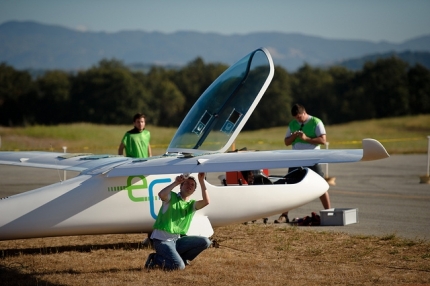
Team members of the e-Genius aircraft prepare their plane prior to competition as part of the 2011 Green Flight Challenge, sponsored by Google, at the Charles M. Schulz Sonoma County Airport in Santa Rosa, Calif. on Monday, Sept. 26, 2011. NASA and the Comparative Aircraft Flight Efficiency (CAFE) Foundation are having the challenge with the goal to advance technologies in fuel efficiency and reduced emissions with cleaner renewable fuels and electric aircraft. (Photo Courtesy NASA/Bill Ingalls)
In addition to NASA's missions in space that amaze the world, our work in aeronautics continues to spur innovation and jobs.
NASA is providing the $1.65 million prize purse for the Comparative Aircraft Flight Efficiency (CAFE) Foundation Green Flight Challenge competition, sponsored by Google, taking place this week outside of Santa Rosa, Calif.
The purse is the largest aviation prize in history and attracted 13 teams, all led by American innovators. Three teams successfully completed aircraft and flight qualification requirements and are competing for the purse. Teams are flying electric and biofueled powered aircraft to prove they have the most fuel efficient, small aircraft in the world.
To win the competition, an aircraft must fly 200 miles in less than two hours and use less than one gallon of fuel per occupant, or the equivalent in electricity.
Why is NASA sponsoring the competition?
NASA-funded prize competitions establish an important goal without having to choose the approach or the team that is most likely to succeed. NASA pays only for results. The competitions highlight excellence in a particular domain of human endeavor to motivate, inspire, and guide others.
NASA prize competitions increase the number and diversity of the individuals, organizations, and teams that are addressing a particular problem or challenge of national or international. They stimulate private sector investment that is many times greater than the cash value of the prize, while furthering NASA's mission by attracting more interest and attention to a defined program, activity, or issue of concern. And they capture the public imagination and change their perception of what is possible.
Aerospace remains a strong component of our national fabric and is the largest positive contributor to our nation’s trade balance. However, this technological leadership position is not a given. To remain the leader in aerospace technology, we must continue to perform research and invest in the people who will create the breakthroughs of tomorrow.
The CAFE Green Flight Challenge, sponsored by Google, may be the birth of a new segment of the aviation industry. This competition represents the dawn of a new era in efficient flight and is the first time that full-scale electric aircraft have performed in competition. The technologies demonstrated by the winning plane may end up in general aviation aircraft, spawning new jobs and new industries for the 21st century.
For photos of the Green Flight Challenge, visit:
http://www.flickr.com/photos/nasahqphoto
Charles Bolden is Administrator of NASA
Learn more about Energy and Environment, TechnologyBack to Classes and Science Labs Today for Good Jobs Tomorrow
Posted by on September 28, 2011 at 5:51 PM ESTToday, President Obama delivered his third annual “Back to School” speech from Benjamin Banneker High School in Washington, D.C.
The next generation of American leaders is hitting the books again, and the challenges they face today are greater than ever. The quality of education they receive is central to our Nation’s future, as well as to producing the workforce needed to maintain American leadership in the next century.
Science, technology, engineering, and math (STEM) today permeate the classroom, the home, the boardroom, manufacturing services, and even entertainment. The information revolution, spawned by striking scientific and technological advances, has triggered profound social and economic changes throughout the world, resulting in an intensely competitive global marketplace, with prime job opportunities increasingly available only to those with technical and critical thinking skills.
That’s one reason why the President’s American Jobs Act is so important. It promises to modernize at least 35,000 schools across the country by building new science labs and Internet-ready classrooms while preventing up to 280,000 teacher layoffs.
The degree to which our Nation prospers in the 21st century will depend upon our abilities to develop scientific and technical talent in our youth, to provide lifelong learning to a well-educated workforce able to embrace the rapid pace of technological change, and to raise the level of public scientific and technological literacy. Consider this fact: the unemployment rate for college graduates is 4.3 percent. That’s less than half of what it is for workers who only completed high school (9.6 percent) and a third of those who never finished high school (14.3 percent).
Learn more about Education, TechnologyAmerica's Universities Growing the Economy With “Lab to Market” Initiatives
Posted by on September 28, 2011 at 8:05 AM ESTAmerica’s universities play an important role in the national imperative to spur innovation, encourage entrepreneurship, and jumpstart the economy. A wide range of life-changing technologies were nurtured in university labs, from the Internet, to the global positioning system (GPS), to leading-edge vaccines.
At the Sept. 16 signing ceremony for the America Invents Act, the President recognized the commitment previously made by 135 U.S. university leaders to undertake “greater efforts to advance regional and national economic growth” and to “ensure that the knowledge and technological breakthroughs developed through campus-based research was rapidly and broadly disseminated to advance the nation’s social and economic interests.” The commitments are aimed at helping achieve the President’s goal of strengthening “commercialization of the nearly $148 billion in annual federally-funded research and development”, as first proposed in January 2011 at the launch of the White House-led Startup America campaign.
These efforts will encourage universities to streamline their technology-transfer procedures, support additional government-industry collaboration, and encourage the commercialization of novel technologies flowing from their research programs – in short, to speed up innovation from Lab to Market.
Also on Sept. 16, more than 40 universities released announcements on their specific plans for following through on this commitment and bolstering their commercialization efforts, in direct response to the President’s call to action. Examples include:
- The Georgia Institute of Technology has created a new Georgia Tech Integrated Program for Startups, GT: IPS. This program combines a streamlined licensing program with organized support for faculty and student inventor-entrepreneurs. This program will expand the number of spin out companies while broadening the participation in entrepreneurship among faculty and students.
- Rutgers University’s Office of Research Alliances has opened a web portal for the corporate community, where corporations can learn how to build partnerships with Rutgers including hiring its graduates, developing R&D partnerships, using advanced equipment, and licensing technology.
- The University of Virginia Office of the Vice President for Research will host a UVa Venture Capital Summit, a major venture capital event created to marry venture capitalists with UVA faculty inventors and to capitalize spin-out companies generated by the university.
Many thanks to the Association of American Universities, the Association of Public and Land-grant Universities, and the Department of Commerce for their help in encouraging universities to strengthen their research commercialization efforts.
Tom Kalil is Deputy Director for Policy at OSTP and Nick Maynard is a Senior Advisor to the Deputy Director for Small Business.
Learn more about Economy, Technology
- &lsaquo previous
- …
- 105
- 106
- 107
- 108
- 109
- 110
- 111
- 112
- 113
- …
- next &rsaquo


White House Blogs
- The White House Blog
- Middle Class Task Force
- Council of Economic Advisers
- Council on Environmental Quality
- Council on Women and Girls
- Office of Intergovernmental Affairs
- Office of Management and Budget
- Office of Public Engagement
- Office of Science & Tech Policy
- Office of Urban Affairs
- Open Government
- Faith and Neighborhood Partnerships
- Social Innovation and Civic Participation
- US Trade Representative
- Office National Drug Control Policy
categories
- AIDS Policy
- Alaska
- Blueprint for an America Built to Last
- Budget
- Civil Rights
- Defense
- Disabilities
- Economy
- Education
- Energy and Environment
- Equal Pay
- Ethics
- Faith Based
- Fiscal Responsibility
- Foreign Policy
- Grab Bag
- Health Care
- Homeland Security
- Immigration
- Innovation Fellows
- Inside the White House
- Middle Class Security
- Open Government
- Poverty
- Rural
- Seniors and Social Security
- Service
- Social Innovation
- State of the Union
- Taxes
- Technology
- Urban Policy
- Veterans
- Violence Prevention
- White House Internships
- Women
- Working Families
- Additional Issues